All posts by: UMBC News Staff


NIDA’s deputy director visits campus to promote resources available to faculty

Wilson Compton, deputy director of the National Institute on Drug Abuse (NIDA), visited UMBC on April 20, meeting with President Freeman A. Hrabowski, Vice President for Research Karl V. Steiner, and other distinguished faculty. Michael Summers, professor of chemistry and biochemistry and recent electee to the National Academy of Sciences, discussed his groundbreaking HIV research with Compton. Compton also made a presentation to UMBC faculty about NIDA’s goals and opportunities for researchers, ensuring that UMBC faculty are aware of the range of resources available to them.

Joe Frascella, senior science advisor to the director of NIDA and previous director of the division of clinical neuroscience and behavior research at NIDA, is currently at based UMBC in the Office of the Vice President for Research under a one-year Intergovernmental Personnel Act (IPA) agreement. He is working with UMBC faculty to increase awareness of NIH research opportunities, mentoring students and faculty on grant-writing strategies, and establishing collaborations between NIH institutes and UMBC. He is also working to boost diversity at NIH by expanding connections between UMBC and NIH.

“I am thrilled to have the opportunity to work with students and faculty at UMBC during this year,” said Frascella. “I have been very impressed with the unique strengths of UMBC to attract and prepare students from a broad variety of backgrounds for future careers, especially in the biomedical field. My goal is to establish long-term relationships and learn from UMBC how NIH could enhance its own programs.”

Image: President Hrabowski signs a copy of his book for Wilson Compton, deputy director of NIDA.

Former Apple CEO and tech investor John Sculley learns about engineering innovations at UMBC

John Sculley, former CEO of Apple and Pepsi-Cola and currently entrepreneur and investor in high-tech startups, visited the Center for Advanced Sensor Technology (CAST) at UMBC on April 15 to learn more about the innovative work conducted by CAST researchers. Sculley met with Govind Rao, CAST director and professor of chemical, biochemical, and environmental engineering, as well as staff and students.

President Freeman Hrabowski and Karl V. Steiner, vice president for research, welcomed Sculley and his wife, Diane, to campus.

“It is an honor to share some of the exciting and path-breaking research underway at UMBC with an internationally recognized technology leader like John Sculley,” said Karl Steiner. “The world-class work that Govind Rao and his outstanding team at CAST are pursuing has the potential to change some well-established paradigms.”

Sculley was particularly interested in learning more about CAST’s “biologics on demand” program, part of the BioMOD program supported by the Defense Advanced Research Project Agency (DARPA). He also spoke with team members about a non-invasive respiration and glucose sensor project and a low-cost cardboard neonatal incubator for developing nations.

Image: John Sculley and wife, Diane, visit with CAST students, staff, and faculty at UMBC.

President of German Research Foundation visits UMBC, discusses academic globalization and UMBC initiatives

Peter Strohschneider, president of the German Research Foundation (Deutsche Forschungsgemeinschaft, or DFG), visited campus on April 13 for a half-day as part of a visit to Washington, DC. He met with President Hrabowski, Vice President for Research Karl V. Steiner, and faculty to discuss globalization aspects of UMBC’s strategic plan and other UMBC initiatives.

Max Voegler, director of DFG’s North America Office, commented on how impressed the delegation was “by the way in which the university has sought to define and act on its mission.”

Steiner recently returned from Germany, where he met with colleagues at the University of Kassel to discuss a growing international partnership, and attended the Hannover Trade Fair with the State of Maryland. The world’s largest industrial fair was opened this year by President Obama and German Chancellor Merkel.

Michael Nance, assistant professor of philosophy, is UMBC’s most-recent recipient of the Humboldt Award, a prestigious award that provides up to 18 months of support for travel to Germany for research. Other faculty and graduate students have ties to German research institutions, and this visit from the president of Germany’s largest research-funding agency will further cement UMBC’s positive research relationships with this influential country and grow the university’s international reputation.

Image: DFG president Peter Strohschneider and UMBC president Freeman Hrabowski converse on the Administration Building’s green roof; photo: Marlayna Demond ’11 for UMBC.

Capstone research program brings Baltimore high school students to UMBC

For eighteen students at Baltimore Polytechnic Institute (Poly), the spring semester provided an opportunity to delve into high-level academic research and offered an early glimpse into life as a college student.

The Poly students were part of a new AP class offered by the College Board that is a year-long, research-intensive course. Last fall, the students conducted group research projects, and the second semester was spent working on individual research papers.

The inaugural cohort of Poly AP capstone students spent the last several months working closely with the Honors College and UMBC faculty and graduate students in the College of Arts, Humanities, and Social Sciences (CAHSS) who served as mentors for the students’ individual research projects. The students visited campus to receive feedback from faculty on their work, use the resources of the Albin O. Kuhn Library, and present their final projects to their faculty mentors.

“Access to any part of the professorial ranks is difficult for most high school students,” shares Josh Headley, chair of the Poly history department. “The fact that the built in gatekeepers of academia were removed, and these students had direct access, with honest critiques of their work, was invaluable.”

Poly partnership

Christopher Corbett, professor of the practice in the English department, served as a faculty mentor and visited Poly each week throughout the semester.

“This is an excellent opportunity for UMBC to connect with Baltimore in a real way. We need more of those connections,” explains Corbett. “I was impressed at how thoughtful and eager the students at Poly were. It’s a very friendly place. It was a pleasure to go there. I also had an opportunity to observe the classes in session and they were very engaged.”

May Chung, a Ph.D. student in language, literacy, and culture and another faculty mentor, observed the students develop skills and interests over the course of the semester as they grappled with their research questions and had direct access to college-level resources.

“I think this is a really important connection for students who are considering college to talk to and discuss what they are interested in with college educators. And it’s also equally valuable for we faculty to listen to what they have to say,” she says.

“The academic growth in this first cohort of AP Capstone students has been nothing less than phenomenal,” says Headley. “When they began, most of the students had only brief experiences with the academic research process, possibly a term paper that needed three valid sources and citations. As they went along, validating source material, and refining their arguments, their body of literature grew, and they began to recognize the author’s voice and tone more rapidly.”

The program was a chance to expand research offerings for high school students beyond STEM disciplines, and stimulus material was provided to the students at the beginning of the semester to help them generate research questions based exclusively in the arts and humanities.

“For CAHSS, this collaboration with Poly helps us not only to showcase the wonderful and important work of the university beyond the STEM disciplines, but is also a very clear example of the college’s commitment to civic engagement by reaching out and working with our partners in the Baltimore City Public School System,” says John Stolle-McAllister, associate dean of the College of Arts, Humanities, and Social Sciences.

“The goal of this program is twofold,” adds Simon Stacey, director of the Honors College. “The first is to provide an opportunity for high school students interested in college access to come to campus to work directly with a professor or graduate student on a research project. The second goal is getting Baltimore high school students interested in coming to UMBC.”

The hope is for systemic adoption of the program, continuing it into next year to work with additional high school students.

“Partnerships like these allow both parties to increase student access to higher learning that is often fraught with roadblocks and hurdles,” says Headley. “When partnerships like these work well, it is always the students who benefit, with their increased academic ownership, and ability to succeed in their post-secondary goals.”

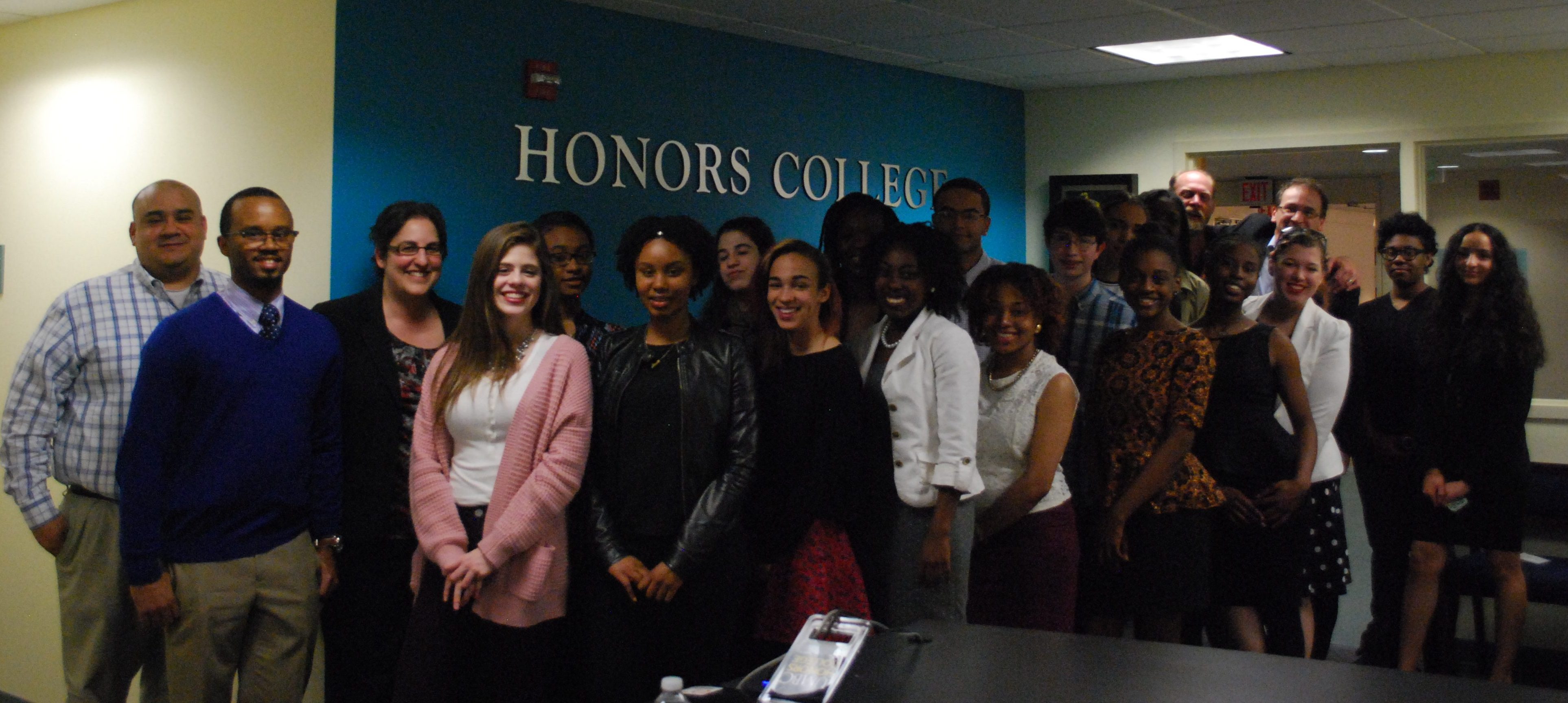
Images: (Top) Albin O. Kuhn Library, where students had access to resources for their research projects. Photo by Marlayna Demond ’11 for UMBC. Poly AP capstone students before presenting their research at UMBC. Photo by Lisa Bolton.  

Felipe Filomeno and students examine immigration policies and urban revival in post-industrial America

As post-industrial cities in the United States across the Northeast and Midwest have experienced population decline and economic challenges in recent decades, many local governments are implementing policies to socially integrate immigrants in those cities to promote local economic development.

Felipe Filomeno

Felipe Filomeno, an assistant professor of political science and global studies, worked with students in his “Immigration Politics” course last year to conduct research on the impact of these policies, and they published an article in the National League of Cities blog CitiesSpeak summarizing their findings.

Filomeno and the students looked at a range of issues in post-industrial cities, including economic development policies, multicultural policies, law enforcement policies, collaboration with the civil society, and policy advocacy.

Focusing on Baltimore, the researchers found that the city has moved forward with several initiatives, including seed funding and technical assistance to the Latino Economic Development Center, which provides training and consultation for immigrant entrepreneurs, disseminating public information in Spanish and support for an annual Latino festival, and collaboration among the Mayor’s Office of Immigrant and Multicultural Affairs and hundreds of community leaders and representatives from city agencies, social service providers and philanthropic organizations.

“A development-oriented inclusionary approach for immigration governance is consolidating in the rust belt. The task now is to monitor the implementation of those policies. In Baltimore, the number of immigrants increased 50 percent between 2000 and 2013, contributing to the first population growth the city experienced in decades. If other cities in the region share similar experiences, the ‘rust belt model’ might start to inspire higher levels of government and cities in other areas,” Filomeno and the students concluded.

The article “Immigrants and Urban Revival in Post-Industrial America” received widespread circulation and it was published in The Weekly, The National League of Cities’ official newsletter, which reaches more than 15,000 local elected officials and their staff, and the Illinois Municipal League magazine, as part of its issue on cultural diversity. The article was co-authored by Filomeno and undergraduate students Arielle Erenrich ’15, global studies and English; Edward Sauer ’16, political science; Emily Wigfield ’16, social work; Estelle Bol ’15, biology and political science; Danielle McGrogan ’17, global studies; Samuel Damesa ’16, global studies and political science; Charles Brother ’15, history and political science; Ghislain Tapsoba ’16, global studies; and Richard Coaxum ’15, political science.

Image: Baltimore Skyline from I-95 south. Photo by Marlayna Demond ’11. 

Scholarship Q&A: Cindy Alms ’17, Biological Sciences

As the academic year draws to a close, we thought we might take the time to introduce you to some of our Alumni Association Scholarship recipients. Today, we hear from Cindy Alms ’17, biological sciences.

Name: Cindy Alms

Major/Minor: Biological Sciences/Mathematics

Grad Year: 2017

Extracurriculars: Cross country and track team, Couple and Family Relationships Lab, RAC staff member, Peer Advisor in the Office of Academic and Pre-professional Advising, Scribe at Baltimore Washington Medical Center, SUCCESS Peer Volunteer

Why did you decide to attend UMBC? UMBC is a strong STEM school and I love how students really care about their academic work. I value a quality education, and there are so many other ways to become involved and gain experience on campus.

What’s been the most amazing discovery you’ve made so far as a student here? The most amazing discovery [I’ve made] is the amount of opportunities to get experience and be involved, as well as the amount of people willing to help you reach your goals. I have made close relationships with professors and staff on campus who genuinely want to […] see their students succeed.

What are you most proud of accomplishing in your time at UMBC? My involvement on campus. I feel like I have met so many people and made so many connections from my time here. Some of the relationships are going to last for the rest of my life.

What would you say to the people who provided your scholarship? I cannot begin to explain the gratitude I feel for the people who provided my scholarship. I am very lucky to be a recipient and I will continue to work hard at UMBC.

What do you hope to do after graduation? I am hoping to go to medical school to get a doctorate in medicine.

Give to UMBC today to support scholarships for students like Cindy.


Scholarship Q&A: Joelle Cusic ’16

As the academic year draws to a close, we thought we might take the time to introduce you to some of our Alumni Association Scholarship recipients. Today, we hear from Joelle Cusic ’16, biochemistry and molecular biology.

Name: Joelle Cusic

Major: Biochemistry and Molecular Biology

Grad Year: 2016

Extracurriculars: Shock Trauma volunteer at UMMC, URA scholar, Woolie, hospital lab volunteer, violin

Why did you decide to attend UMBC? I decided to attend UMBC because I felt that I would receive a strong science education with the opportunity to do research, which would provide me with a strong foundation upon which I can build when I enter medical school.

What’s been the most amazing discovery you’ve made so far as a student here? The most amazing discovery I’ve made so far as a student at UMBC is that I can achieve my goals and far exceed my own expectations. I’m still amazed that I’m a Biochem major. There is always room to improve and grow and looking back over the last few years here, I have seen just how far I’ve come as an individual and as a student.

What are you most proud of accomplishing in your time at UMBC? If there is anything I’m most happy about accomplishing, it is that I have had the opportunity to expand my own mind through research while helping other through being a teaching assistant.

What would you say to the people who provided your scholarship? I would say thank you for helping me pursue my dream of becoming a medical doctor. Your gift has helped me immensely as I finish out my last year of undergrad and my parents and I are truly grateful. Your gift has allowed me to take another step closer to reaching my goal.

What do you hope to do after graduation? Once I graduate with my bachelor of science in biochemistry and molecular biology in May 2016, I will be applying to medical school in the hopes of matriculating in fall 2017. During my year off, I plan to find a position in a local hospital and perhaps a research internship. I am also in the midst of applying for a spot in a six-month medical missions trip, which is based in New Zealand and will run from January to June of 2017, that will serve the islands of the South Pacific. However, my ultimate goal is to become an oncologist, which I believe would allow me to be able to have the opportunity to treat patients and promote health wellness and prevention within the community while also opening the door for me to do research on genetic diseases.

Help students like Joelle pursue their educational goals by making a gift today.


Carrie Cleveland shares her inspiring story in Baltimore Sun Class of 2016 profile

A new article in The Baltimore Sun profiles members of the Class of 2016 from Baltimore-area colleges and universities and their unique journeys toward earning their degrees. Carrie Cleveland ’16, social work, shares her uplifting story in the article and describes how she developed a passion for social work.

Cleveland initially enrolled at Rutgers University, but left after three semesters in 1997 after she decided college wasn’t for her at the time. She moved to Maryland in 2006 and began taking classes at Anne Arundel Community College. The article explains that when her daughter was undergoing a medical evaluation after she was born with a congenital heart defect, Cleveland had such a positive interaction with a hospital social worker that she thought to herself: “I want that job.”

On May 19, Cleveland graduates with a bachelor’s degree in social work from UMBC. She explains that the support she received from the UMBC community while working toward earning her degree was tremendous.

“Here I think of myself as a college dropout and this isn’t my place to occupy,” Cleveland said. “But mostly the students are great and have appreciated my experiences and contributions.”

She plans to bring her daughters to her commencement ceremony to inspire them to pursue college degrees, and will begin graduate studies in social work at the University of Maryland, Baltimore in the fall, where she will be doing field work with middle school children with emotional disabilities.

The secret to Cleveland’s success? She says, “It took me finding what my passion was to be able to excel.”

Read the complete article “The unique roads of Baltimore college graduates” on The Baltimore Sun website.

Image: Carrie Cleveland. Photo by Marlayna Demond ’11 for UMBC. 

Scholarship Q&A: Sarah Bach ’16, Biological Sciences

As the academic year draws to a close, we thought we might take the time to introduce you to some of our Alumni Association Scholarship recipients. Let’s hear from Sarah Bach ’16, biological sciences, who received an Alumni Legacy Scholarship for the 2015-16 academic year.

Name: Sarah Bach

Major: Biological Sciences

Grad Year: 2016

Extracurriculars: Global Brigades Dental Program, Pre-Dental Society

Why did you decide to attend UMBC? I chose UMBC because of its strong STEM program. I was also impressed by the amount of undergraduate opportunities in research. At many other schools that I toured, research was limited to graduate students. My dad also attended UMBC!

What’s been the most amazing discovery you’ve made so far as a student here? Joining a club or campus organization can really shape your undergrad experience and help you discover where your passion lies!

What are you most proud of accomplishing in your time at UMBC? During my time at UMBC I have changed so much as a person. The diversity at this school has allowed me to broaden my understanding of other cultures [,and the] opportunities I’ve had here have helped me grow into a more mature and well-rounded individual.

What would you say to the people who provided your scholarship? Thank you! There is so much value in education and I am so glad you have chosen to support mine!

What do you hope to do after graduation? I just got accepted at [the] University of [Maryland] dental school, so for the next four years I’ll be working towards my dream!

Help students like Sarah pursue their dreams by making a gift today.

Scholarship Q&A: Michael Wallace Karugu ’15, Information Systems, and M.S. ’17, Cybersecurity

As the academic year draws to a close, we thought we might take the time to introduce you to some of our Alumni Association Scholarship recipients. Today, we hear from Michael Wallace Karugu ’15, information systems, who is currently working toward a master’s degree in cybersecurity here at UMBC.

Name: Michael Wallace Karugu

Major: Information Systems (current master’s student in Cybersecurity)

Grad Year: 2015, 2017

Extracurriculars: Soccer and billiards

Why did you decide to attend UMBC? UMBC is a renowned institution offering recognized STEM programs. I wanted to experience the learning environment and opportunities offered by UMBC. Furthermore, since I was a transfer student, UMBC was ready to accommodate the credits that I wanted to transfer.

What’s been the most amazing discovery you’ve made so far as a student here? The faculty, staff and students at UMBC are very friendly and always willing to assist. This friendly environment promotes a healthy learning environment.

What are you most proud of accomplishing in your time at UMBC? I am currently the student manager of the Desktop Student Support section in DoIT. Having started as a regular student employee here two years ago, I feel this is my most proud accomplishment during my time at UMBC.

What would you say to the people who provided your scholarship? I would like to thank them from the bottom of my heart for supporting me financially. This assistance enabled me to focus more on my studies as compared to stressing about how I would meet my school related costs. This assistance goes a long way in nurturing deserving students.

What do you hope to do after graduation? I graduated from my undergraduate program in fall 2015 and I am now pursuing a master’s program in cybersecurity here at UMBC. I plan on graduating in the Spring of 2017. After earning my master’s degree, I will pursue employment from the private sector as a cybersecurity specialist, and in future I plan on establishing a cybersecurity consultancy firm.

Students like Michael rely on the financial support of our donors. Please consider making a contribution today.

Researchers across disciplines gather for vital conversation about academic freedom

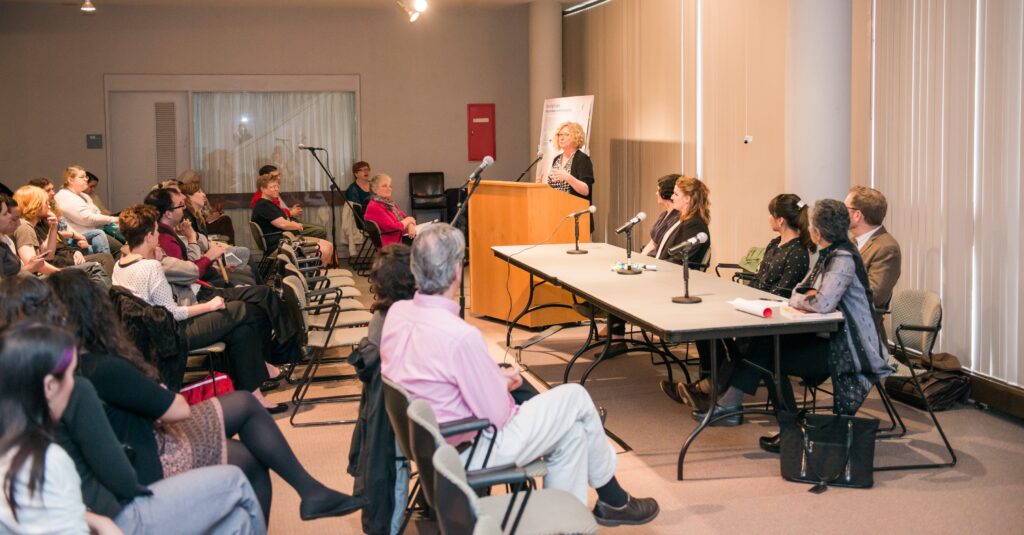
UMBC students, faculty, and staff gathered on May 12, 2016, to honor the work of two accomplished emerging scholars and to engage in a vibrant discussion on academic freedom and the display and interpretation of research.

At the discussion forum, Zoe Wang ‘16, interdisciplinary studies, and Riley Auer ‘17, ancient studies, presented their poster “Illustrating the Unseen: Analogy and Metaphor in an Ancient Gynecological Text.”

Their work became the center of a campus-wide conversation on academic freedom in late April after the poster was moved to a less prominent location shortly before Undergraduate Research and Creative Achievement Day (URCAD), with nearby signage stating, “Certain research posters may contain content that may be inappropriate for children under the age of 17.”

President Freeman Hrabowski responded to apologize to the students and affirm university support for their academic work. Scott Casper, dean of the College of Arts, Humanities, and Social Sciences, and Diane Lee, vice provost and dean of undergraduate education, then organized a special campus event to discuss “the nature of artistic, humanistic, and scientific research and representation; the presentation of research to academic and public audiences; and the meaning and centrality of academic freedom.”

Several UMBC faculty members joined the students in a panel discussion to reflect on the issues that their poster and response to it during URCAD have raised for UMBC’s research community; the context of how research on reproduction, gender, sexuality, and women’s bodies has been interpreted over time; as well as positive steps the university administration and community can take to ensure that the academic freedom of student researchers is fully supported in the future.

Wang and Auer’s research is connected with “Seeing Science,” a new initiative of the Center for Art, Design, and Visual Culture (CADVC) to reveal and advance connections between the visual arts and the sciences. Their research project examined gynecology from ancient Greek texts with a focus on Soranus’ studies about female reproductive organs. The work combined text, illustrations, and design to create an artistically interpreted visual representation to help contemporary readers understand the ancient texts without losing their original content.

“Why did we chose to hold on to medical terms that are thousands of years old?” asked Auer, during her research presentation at the forum. “I wanted to understand what terms were used…and what allowed us to develop the terms and continue their usage.”

Addressing the decision to move her poster at URCAD, Wang explained, “if we don’t treat reproductive biology with a healthy attitude, then research and education in this field will have a difficult time moving forward. I believe that we have to provide a healthy academic environment for everyone who wants to come and learn.”
post-URCAD-discussion-2699

Following the poster presentation, Molly Jones-Lewis, visiting assistant professor of ancient studies; Carole McCann, professor and chair of gender and women’s studies; Stephen Freeland, director of interdisciplinary studies; and Preminda Jacob, associate professor and chair of visual arts, presented their thoughts on the questions about scholarship and academic freedom that have been asked in the days following the URCAD incident.

Jones-Lewis, who served as a faculty mentor to Auer, commended the students on their bravery and tenacity in addressing a research topic that isn’t often discussed in the larger cultural landscape.

McCann spoke about the historical context of sexual and reproductive health and politics in the United States. She pointed to the 1870s when Comstock Laws were passed to ban representations, information, and devices related to sexual and reproductive health. She said the laws have reverberated for nearly 150 years and have made it harder to attract research scholars to address essential topics related to gender, women, reproduction, and sexual health, and to build a reputation for reproductive health sciences.

“As a university that is committed to a search for knowledge and inclusive excellence…we should be conscious of these politics, we should learn to see them when they are implied in decisions, and we should learn to discuss them quite openly,” said McCann.

Freeland commented on the power of URCAD and UMBC to “build bridges” among disciplines and to create dialogue to grapple with and address significant research questions. “This exercise was one in building bridges between images and text,” said Freeland. “In a nation and a world that is so divided between belief systems and perspectives, the university stands proud in its ability to welcome those discussions and to show and teach our students the tools of how they can navigate brave spaces,” he suggested, with a nod to the UMBC Women’s Center’s influential work promoting “brave space” discussions on campus.

As an historian of modern and contemporary art, Jacob spoke about the interpretations that images generate and the public perceptions and history of responses to those images. She explained that in today’s world, where people are constantly inundated with images, if there is one that “breaks the norm,” it can evoke a more passionate response that can bring deep-seeded emotions and assumptions to the surface.

Following the panel presentations, the audience engaged in a discussion about academic freedom, the lessons learned from the incident, and next steps in moving forward to affirm the university’s support for student research in the future.

Tim Nohe, visual arts professor and director of the Center for Innovation, Research, and Creativity in the Arts, shared that for him it was also a day to recognize the importance of each generation of scholars committing actively to support the continuity of academic freedom. He was grateful to Wang and Auer, he said, for “carrying the torch” of academic freedom for generations to come.

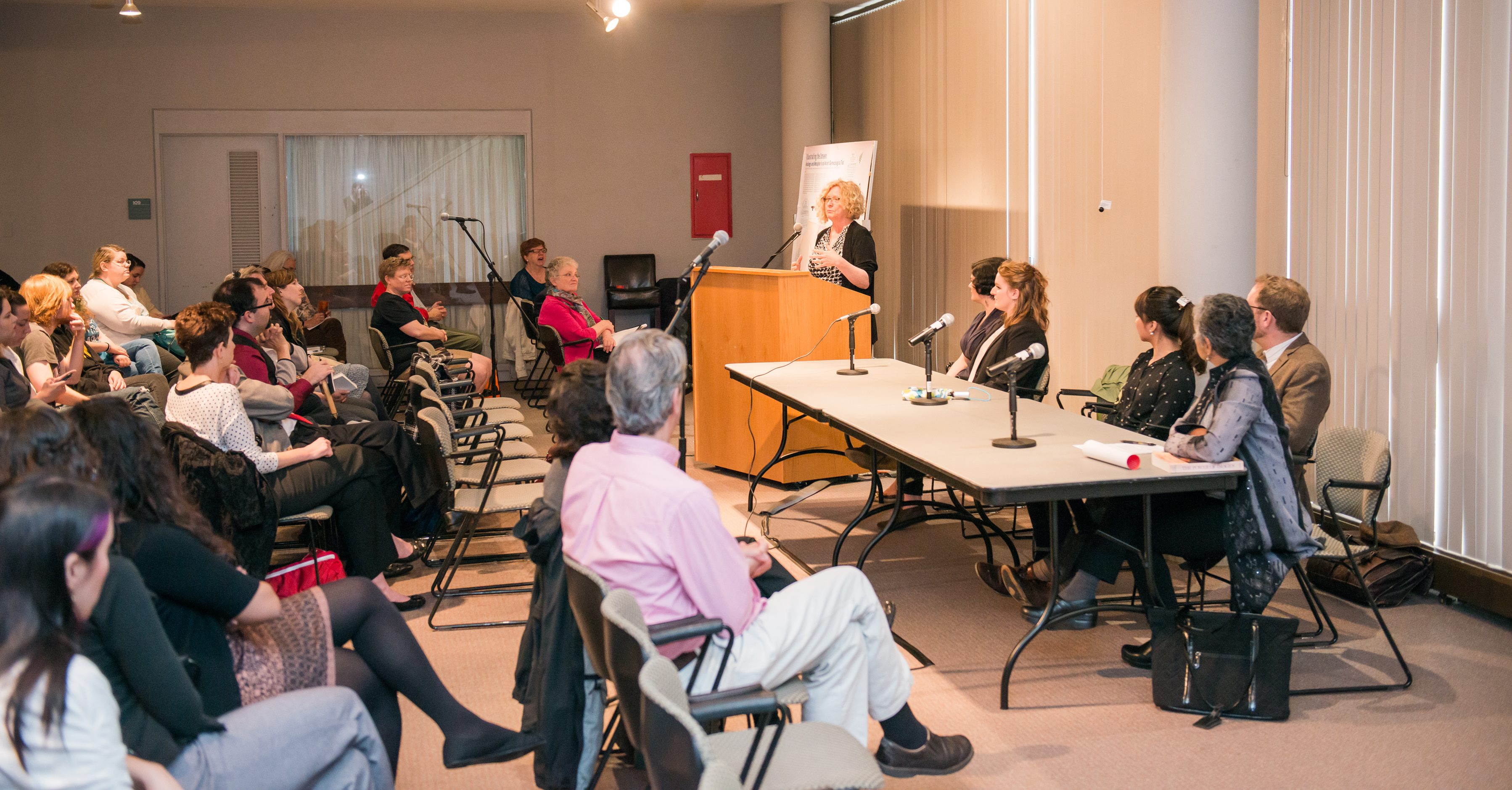
Images: (Top) Students Zoe Wang and Riley Auer present their research poster during a conversation about academic freedom. (Bottom) Carole McCann speaks during the panel discussion. Photos by Marlayna Demond ’11 for UMBC. 

Education department announces its second cohort of Summer Enrichment Experience Scholars

Fourteen middle and high school students from local schools have been selected to participate in an innovate summer enrichment program at UMBC to build on skills learned and tap into creative interests across disciplines.

The UMBC Department of Education recently announced its second cohort of Summer Enrichment Experience Scholars (SEE Scholars). A total of fourteen rising 6th-12th grade students were nominated by UMBC teacher candidates completing their internships at UMBC Professional Development Schools (PDS) and were selected by the Education Department Scholarship Committee. Students accepted into the program will attend the campus-based summer learning camps free of charge.

SEE Scholars Program

Developed and led by UMBC faculty, students, and industry leaders, SEE experiences are designed to spark participants’ passions and interests in the fields of science, engineering, technology, the arts, and humanities; tap into their creative talents; expand technical skills; and hone their academic skills.

The 2016 SEE Scholars currently attend Windsor Middle School in Baltimore County; Talbot Springs Elementary School, Patapsco Middle School, and Mt. Hebron High School in Howard County; and City College High School and Digital Harbor High School in Baltimore City. The scholars were able to select the camp of their choice. Selected camps include The World of Cybersecurity, Music Technology Pro Tools, Sounding Off: The Art of Foley Sound in Storytelling, Science and Engineering, and The Repercussion Project: Build and Play Your Own Percussion Instrument.

Funding for the program comes from the Homer and Martha Gudelsky Foundation. Read more about the SEE Scholars Program.

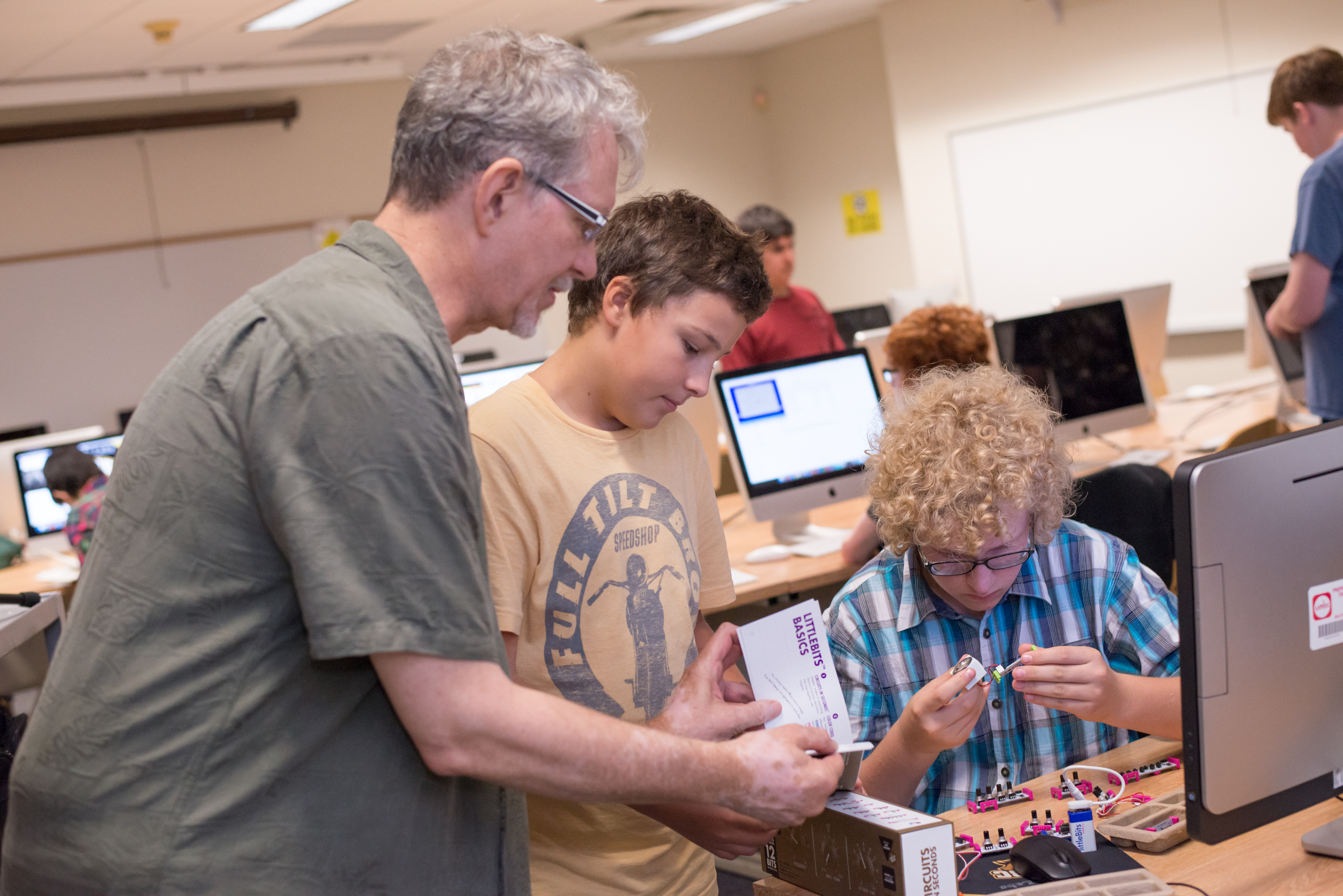
Images: (Top) The 2015 SEE Scholars learn about cybersecurity at UMBC. (Bottom) Steve Bradley, associate professor of visual arts, works with SEE Scholars during last summer’s program. Photos courtesy of Carol Bateman.