All posts by: UMBC News Staff


Ecologist Chris Swan to analyze big data on biodiversity in new major study

Scientists and the public have long known that ecosystems like coral reefs and rainforests harbor an impressive array of species, from algae to armadillos. How biodiversity changes over time, however, is much less understood.

Chris Swan, professor of geography and environmental systems, and colleagues will tackle that question with a new research project funded by the National Science Foundation (NSF). The team hopes to reveal how changes in biodiversity might relate to environmental disturbances such as hurricanes, intense drought, or the introduction of invasive species.

Understanding the relationship between biodiversity and environmental change could inform conservation efforts, and there are numerous uses for this knowledge beyond preserving biodiversity for its own sake.

“Biodiversity is the foundation for ecosystem services,” says Swan, “so biodiversity is important to prevent loss of those services.” “Ecosystem services” include pollination of crops by insects and birds, carbon sequestration by vegetation, and water filtration by oysters and mussels. By highlighting these connections between biodiversity and areas like food production, energy, and water quality, Swan explains, he and fellow researchers “hope to elevate people’s understanding of the importance of biodiversity.”

Rather than collecting new data, the team is “synthesizing reams and reams and reams of data” that already exist, Swan says. He expects this large-scale analysis to reveal themes indicating how biodiversity shifts in response to environmental changes over time.

The team includes Swan, two additional principal investigators, and 12 more researchers. They will synthesize 37 data sets that include anywhere from 12 to 37 years of data each. The data come from Long Term Ecological Research (LTER) Network sites, and include locations all over North America as well as the Antarctic and Arctic. Sites cover every type of ecosystem and focus on different kinds of organisms, from plants to worms to fish to mammals.

The project will consolidate the datasets into a single large-scale searchable database accessible to the public. Other researchers will have access to the computer code the team will develop to analyze the data, which they can apply to other datasets in future research.

The team will conduct its analyses at the National Center for Ecological Analysis and Synthesis (NCEAS), located at the University of California, Santa Barbara. NCEAS offers massive computing power, meeting space, and IT staff free of charge to research groups selected in a competitive process. Swan’s proposal was one of only three selected nationwide in the last round. The NSF funding will support the researchers’ travel to Santa Barbara for several working group sessions over the next two years.

This is UMBC’s first opportunity to use NCEAS resources. By analyzing so much data, Swan plans to answer “some very big questions…about what’s happening over time” in Earth’s complex ecosystems.

Image: One of Chris Swan’s research sites in MD; by Marlayna Demond ’11 for UMBC.

UMBC’s 2016 Fulbright Scholars to serve as teachers and researchers around the world, from Moldova to Malaysia

After class one day in 2015, Brigitte May, senior lecturer in German, turned to her student, Matthew Kelly, to talk about his plans for after graduation. “Matt, I know what you are going to do when you graduate,” she told him. “You are going to win a Fulbright grant and teach English in Germany.” A year later, Kelly is heading to Germany with an English Teaching Assistantship Fulbright award.

Kelly’s story reveals the caring mentorship and high level of student preparation common across UMBC’s 2016 Fulbright award class.

“What I loved about this year’s class is that they threw themselves into the process early,” says Brian Souders, associate director of international education services and Fulbright program advisor. “They really got into the spirit of Fulbright, which is all about cultural exchange.”

The Fulbright Program is the flagship international educational exchange program sponsored by the U.S. government and is designed to build relations between the people of the United States and the people of other countries that are needed to solve global challenges. The Fulbright Program is funded through an annual appropriation made by the U.S. Congress to the U.S. Department of State. Participating governments and host institutions, corporations, and foundations around the world also provide direct and indirect support to the program, which operates in more than 160 countries worldwide.

Matthew Kelly ’16, modern languages, linguistics, and intercultural communication, is one of several UMBC students and recent alumni receiving Fulbright scholarships this year. UMBC’s additional English Teaching Assistantship (ETA) recipients include: Emily Bernstein ’16, psychology and political science (Malaysia); Alexandria Clay ’16 M.A., intercultural communication (Mexico); Matthew Poissant ’15, American studies (Indonesia); and Alexander Szabo ’15, history (Nepal, alternate). Ayushi Aggarwal ’16, biochemistry (Laos) also received an ETA but is unable to complete the program at this time. Shruti Gujaran ’16, biochemistry and molecular biology (Australia), and Rachel Rettaliata ’14, history (Moldova) have both received Fulbright research grants.

Rettaliata is using her Fulbright research grant to study public monuments in Moldova and how they represent the evolution of the country’s national identity through its pre-Soviet, Soviet, and post-Soviet history. She plans to apply research skills she developed as an undergraduate to make the most of her research abroad.

“I really think that UMBC’s history department has prepared me for the Fulbright grant,” explains Rettaliata. “Through various coursework, I’ve been able to research in archives, databases, and pursue oral and digital history projects…there are so many different areas that I’ll be able to translate into my research in Moldova.”

Gujaran is the second UMBC Fulbright recipient for Australia. Timothy Nohe, professor of visual arts and director of the Center for Innovation, Research, and Creativity in the Arts (CIRCA), received a Fulbright Senior Scholar award in 2006 to Australia to teach at University of Wollongong.

Gujaran will use her research grant to study antibiotic drug resistance at the University of Melbourne’s department of microbiology and immunology. She credits her experiences pursuing civic engagement opportunities through The Shriver Center and Honors College with inspiring her to become a well-rounded researcher, dedicating her time to help improve access to healthcare for people who need it the most.

“I want to focus on infectious diseases because I really want to work with international populations, specifically in developing countries that might not have access to healthcare,” says Gujaran.

Humanities scholar Matthew Poissant is hoping to build off of his study abroad experience in South Korea as he pursues his Fulbright ETA teaching English to 10th and 11th grade students in Indonesia.

“I feel very honored to have been chosen by my government to be a cultural representative of the United States,” he says. “Because of what I learned from my American studies education at UMBC, I am not scared to have discussions about the complexity of American culture and identity.”

Matthew Kelly will be teaching English at a school in Bavaria, Germany and hopes to embrace the cultural exchange component of the Fulbright program through community service work coaching ice hockey in Munich.

“I really do believe that the sky is the limit, and the more that I put into this experience, the more that I will get out of it,” he shares.

Reflecting on this year’s Fulbright class, Souders is confident the students will embrace cultural exchange, serve as positive ambassadors of the United States, and bring back a breadth of knowledge and experiences to their professional lives when they return to the U.S.

After guiding so many students through the Fulbright experience, what is Souders most excited about for this year’s recipients? It’s not just about their time abroad, he shares. “I love the fact that the students are developing skills that will be useful for the rest of their lives.”

Image: Shruti Gujaran (left) and Rachel Rettaliata (right). Photo by Marlayna Demond ’11 for UMBC. 

“Smog Blog” run by UMBC students becomes go-to air quality reference for national audience

When Jill Engel-Cox Ph.D. ’04, marine-estuarine environmental sciences, started the Smog Blog in 2003, it served as “kind of an online lab notebook,” she says. In the early 2000s, there were plenty of sources of air quality data, “but no one was putting these disparate data sources all together on a daily basis.” Enter the Smog Blog.

As Engel-Cox developed the site, she and advisor Ray Hoff, now-emeritus professor of physics at UMBC, expanded it to include other students. “The Smog Blog turned into a great way for students to learn how to analyze satellite and other air quality data quickly, as well as how to write scientific information clearly for a wide audience,” Engel-Cox says.

But the Smog Blog was destined for bigger things. “It took on a life of its own,” says Ruben Delgado, assistant research scientist at the Joint Center for Earth Systems Technology. From comments on the site, “we discovered we had a wide variety of readers,” says Engel-Cox, “including atmospheric scientists, state environmental regulators, and even an amateur astronomer who used the Smog Blog to better predict clear skies.”

Four years ago, Delgado realized the Smog Blog had more than five million total hits per year. Now it gets 16,000 unique hits per month. Many visitors, such as weather agencies or citizens sensitive to air pollution, visit several times per day.

A team of students posts to the Smog Blog six days per week to keep readers updated. Now it’s a self-perpetuating venture: as students graduate, they train the next cohort of Smog Bloggers how to interpret data from satellites and explain it in layman’s terms on the blog.

Delgado has received external offers to buy the Smog Blog, but he’s not interested in commercializing it. He says it’s “by students, for students,” and should stay that way. Even as a university project, however, there are many possibilities for the Smog Blog’s future, including growth through collaborations. The blog even emerged in a discussion with Robert Marshall ‘88, founder and CEO of Earth Networks, on compelling uses for weather data following Marshall’s keynote at a UMBC research conference on climate issues.

Next on the horizon for the Smog Blog is a new home: a freshly designed website expected to launch by the end of the summer. Students will also be working over the summer to develop a Smog Blog mobile app.

In the meantime, as spring pollen, summer wildfires, winter inversions, and other air quality issues continue, the blog expects traffic to keep rising as it serves up critical information to a diverse audience, all while supporting the research and education of UMBC students.

Images: Sourced from the Smog Blog website. These highlight how different instruments observed smoke from the spring 2016 Fort McMurray wildfire in Alberta, Canada traveling across the Great Lakes region.


Dawn Biehler brings fresh perspective to pest control on WYPR

The Zika outbreak has brought renewed attention to strategies for controlling pest populations across the country. Dawn Biehler, an associate professor of geography and environmental systems, recently joined WYPR’s “Humanities Connection” program to explain how the humanities can help inform environmental research on pest and rodent control.

“Studying unwanted animals like rats and mosquitoes might seem more a topic for the natural or health sciences than for the humanities,” Biehler said during her segment, which aired June 24 on WYPR. “But humanities disciplines can open up important ways of understanding humans’ relationships with the creatures we call pests.”

Biehler is leading a research team that is working on an extensive study to determine whether a neighborhood having more mosquitoes translates to a greater risk of disease transmission. The researchers are focusing on West and Southwest Baltimore neighborhoods to study how abandoned buildings can sustain mosquito populations.

In her “Humanities Connection” segment, Biehler explained that legacies of discrimination and urban planning have led to current patterns of infestation, and her research team is engaging residents in environmental and political action to make communities healthier and to advocate for better mosquito control. As part of the Baltimore Mosquito Study, residents have been working on producing community photography and oral histories to tell the stories of the environments they live in.

“Perhaps these stories of environmental past and present can help us understand what we need to do today to help make Baltimore healthier,” Biehler said.

Listen to the full segment on the Maryland Humanities website.

Image: Asian Tiger Mosquito. Photo by frankieleon, CC by 2.0

Nancy Rankie Shelton publishes thought-provoking memoir about love, loss, and survival

Nancy Rankie Shelton, a professor of education, is author of a powerful new memoir that is already receiving significant praise for its contributions to the growing body of literature on living and dying well. The book, titled 5-13: A Memoir of Love, Loss and Survival, was published earlier this month by Garn Press.

NRS-Cover-Softcover-v-4-book-post-2-201x300In a review posted on the Garn Press website, the reviewer notes, “Nancy Rankie Shelton’s 5-13, A Memoir of Love, Loss and Survival is a breathtaking read. It is work of great courage but also a literary triumph. Like an uncut diamond it is rough reading in places and then the light fractures and you feel the surge of an enduring human spirit who is not frightened to love, face death, and then reimagine her life.”

The book encourages readers to overcome fears of cancer, remain loving and strong, survive the death of a loved one, and continue living. The story traces Shelton’s husband Jack’s fight with lung cancer and the stress and confusion of managing his treatment. The book reflects on the 35 years the couple was together and the family’s relationships with others over the years.

“Dying with dignity, end of life decisions, assisted suicide and advances in health care are important topics in today’s society,” the review on the Garn Press website states. “Nancy Rankie Shelton contributes to this body of work in her book…which leads the reader through her husband Jack’s cancer diagnosis and his death, with moving vignettes of life and love woven throughout the text.”

Shelton is the author of 23 publications appearing in prominent academic journals and leading publishing companies specializing in literacy research and/or education policy. Her teaching areas focus on reading and language arts, literacy/culture and composition theory/practice. Her research interests include children’s writing development, effects of mandated instruction on elementary literacy development, literacy/art connections, and children’s literature. Read more about her work on the education department website.

Image: Nancy Rankie Shelton. Garn Press photo.

Kimberly Moffitt weighs in on the presidential election and Gov. Hogan’s stance on Trump

Kimberly Moffitt recently joined The Baltimore Sun’s “Roughly Speaking” podcast with Dan Rodricks to discuss the state of the 2016 presidential campaign and Gov. Larry Hogan’s announcement that he will not be endorsing Donald Trump, the presumptive Republican nominee for president.

Moffitt appeared on the program with Republican analyst Richard Cross, and they covered a range of topics, including Gov. Hogan’s stance on the presidential election and national political scene.

“Although we are often considered a blue state in national politics, I think Hogan recognized that his success as our governor had a lot to do with Democrats as well as Independents to help catapult him toward the role he is currently serving for us now,” Moffitt explained on the program. “Recognizing that, I think seeing Trump as a polarizing figure, he said that I must take a different stance.”

Discussing voter perceptions of presumptive Democratic nominee Hillary Clinton, Moffitt shared that many voters consider her polarizing due to her length of time and extended scrutiny on the national political scene, as well as many voters tying her to the impact of policies that originated under President Bill Clinton’s administration.

Listen to the full podcast “Larry Hogan walks away from Donald Trump” on The Baltimore Sun‘s website.

Moffitt also recently appeared on WEAA’s The Marc Steiner Show to reflect on the remake of the classic miniseries Roots after the entire series had aired. Listen to Moffitt’s complete analysis on The Marc Steiner Show website.

Image: Kimberly Moffitt in her office. Photo by Marlayna Demond ’11 for UMBC.

Pres. Hrabowski focuses on building supportive learning communities at NYT Higher Ed Leaders Forum

Higher education leaders from across the country are grappling with urgent issues facing today’s universities, including diversity and inclusion on campus, how STEM and humanities disciplines are valued, and funding for higher ed. To address some of these challenges, The New York Times hosted a Higher Ed Leaders Forum this week in New York City, bringing together the nation’s most influential leaders in higher education.

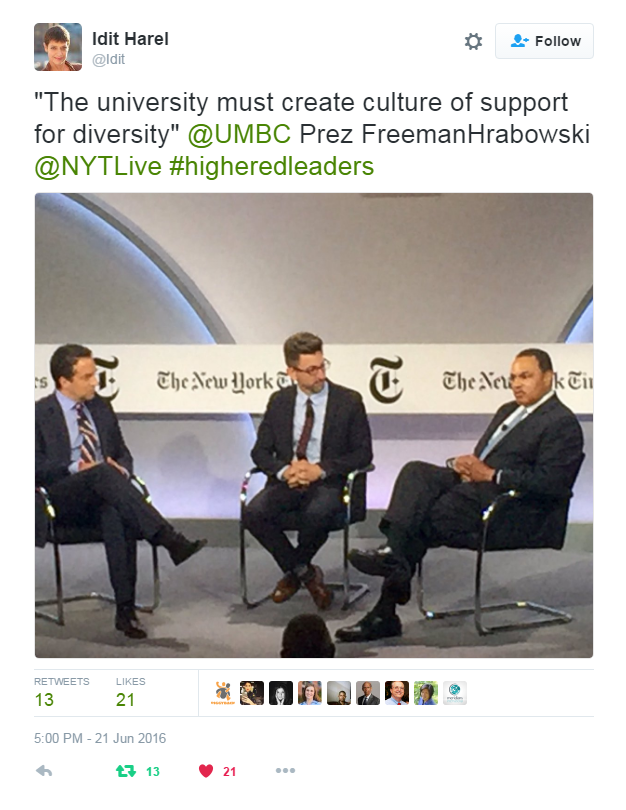
President Freeman Hrabowski represented UMBC at the event and participated in a conversation on “The Emotional Challenges of Leadership Today.” He joined Marc Brackett, director of the Yale Center for Emotional Intelligence, and Adam Bryant, deputy science editor and Corner Office columnist for The New York Times, to discuss how complex social change is creating new demands for education leaders and the emotional challenges that presidents, provosts, and chancellors are confronted with in today’s education environment.

https://www.youtube.com/watch?v=olw6EhmvZv0

Dr. Hrabowski emphasized the importance of helping students meet high expectations through building community and creating a culture of support on today’s college campuses.

“What we’ve worked to do at UMBC, and we are still working on it, is to look in the mirror,” he explained. “We have a theory of change that we’ve been working on now for almost 20 years that focuses on how you create communities of empowerment for students…but also how we rethink the teaching and learning process.”

He added that it takes the full university community to reach goals focusing on success.

“As we’ve been redesigning courses and as faculty have been talking about what it takes to help students succeed, it’s not a matter of one group. It’s a matter of all of us—presidents, faculty, and staff—doing much more than we’ve been doing to give support not only to students, but also to each other.”

FAH at NYT event

In a separate essay published in The New York TimesPres. Hrabowski wrote about the value of caring communities where people view success as a collective responsibility.

Ensuring that more students succeed will require a host of strategies, from better understanding our students’ strengths and challenges to supporting teacher and faculty development. Any solution must start with this mind-set — we must agree that it is not acceptable for such a large number of students to work hard to earn a college education, often going into debt, not to succeed. As a society, we must be willing to look in the mirror, and we need to listen to students and their families as we craft strategies.

Read the full essay “Student Success is a Community Responsibility” in The New York Times and watch a video of Pres. Hrabowski’s panel at the Higher Ed Leaders Forum. For a recap of the full event, see “Educators Discuss the Future of Higher Education”

Image: Pres. Hrabowski speaks with students in the UMBC Commons during visit with leaders from Simmons College. Photo by Marlayna Demond ’11.

UMBC welcomes Ryan Moran as new head coach of men’s lacrosse

UMBC introduced Ryan Moran as the Retrievers’ new head men’s lacrosse coach during a press conference held on campus Wednesday, June 22, 2016. Moran is the program’s third head coach since UMBC joined the U.S. Intercollegiate Lacrosse Association (USILA) in 1971.

“Ryan Moran is more than ready to take Retriever men’s lacrosse to new heights and once again have our program a contender on the regional and national scene,” said UMBC Athletics Director Tim Hall. “He is intelligent, thoughtful, a fantastic recruiter, an extraordinary strategist, and is completely committed to academic success and the welfare of his athletes. We are excited to welcome him to the UMBC family.”

Moran brings more than ten years of experience as an offensive coordinator and assistant coach across the region, most recently for Loyola University Maryland, where he helped guide the Greyhounds to the 2016 national semifinals. Prior to his appointment at Loyola, Moran spent six seasons at University of Maryland, College Park, rising to the rank of associate head coach during his final two years.

He started his coaching career at the Naval Academy Prep School in 2005, then served on the coaching staff at the U.S. Naval Academy 2006-08, where helped the team to three NCAA Tournament appearances and two Patriot League titles.

Moran comes from a lineage of top lacrosse coaches. His father has been a high school coach for more than 30 years, winning his 500th career game in 2014, and his great uncle is a U.S. Lacrosse National Hall of Fame member who led Cornell University to three national titles.

Moran replaces coach Don Zimmerman, who has led the Retrievers for the past 23 years and will retire from the university on July 1, 2016. Zimmerman guided UMBC to six NCAA Division I Championship berths, highlighted by a quarterfinal appearance in 2007.

“An unbelievable debt of gratitude is owed to Don Zimmerman for the work he has done on behalf of UMBC, its student-athletes, and the game of lacrosse—not only at UMBC, but also nationally and internationally,” said Hall. “Don has not only left an indelible mark on the sport of lacrosse, but he has certainly left one at UMBC.”

Coach Moran says he is eager to begin leading the UMBC men’s lacrosse team and continue to build on the legacy left by coach Zimmerman. “I am truly excited and truly honored for this opportunity to lead this great program,” he said.

Media Coverage:

Baltimore Sun: Ryan Moran hopes to bring new tempo, success to UMBC men’s lacrosse
Baltimore Sun: New UMBC men’s lacrosse coach Ryan Moran reveals what he learned from previous mentors
Baltimore Sun: UMBC hires former Terp, Loyola assistant Ryan Moran as head lacrosse coach
Lacrosse Magazine: UMBC Names Ryan Moran Head Men’s Lacrosse Coach

Image: Ryan Moran, new head coach of UMBC men’s lacrosse. Photo by Marlayna Demond ’11 for UMBC.

UMBC celebrates the career of Bimal Sinha at 10th annual Probability and Statistics Day

The highly anticipated 2016 Probability and Statistics Day at UMBC on May 20 and 21 featured numerous compelling talks from leading statisticians. Previous years included workshops and student presentations on innovative work, while this year included a poignant celebration. In addition to marking the event’s 10th anniversary, participants also honored event founder Bimal Sinha, longtime professor of mathematics and statistics at UMBC, on his 70th birthday.

Sinha founded the graduate program in applied statistics at UMBC and has made substantial contributions to the UMBC community over three decades. “What stands out for me,” said Bill LaCourse, dean of the College of Natural and Mathematical Sciences, “is that he is a kind, thoughtful, and generous person.” Reflecting on Sinha’s work to expand statistics at UMBC is like watching “an acorn…growing into a mighty oak,” said LaCourse.

Many of Sinha’s former students returned to UMBC to attend the event, which is “a testament to his mentorship and involvement,” said Liz Stanwyck Ph.D. ’11. Stanwyck recalled that Sinha helped arrange for her to give invited talks in Bangladesh and India during her graduate studies, an opportunity that proved to be transformative. Stanwyck currently serves as a lecturer in the UMBC math department and as the statistics program advisor.

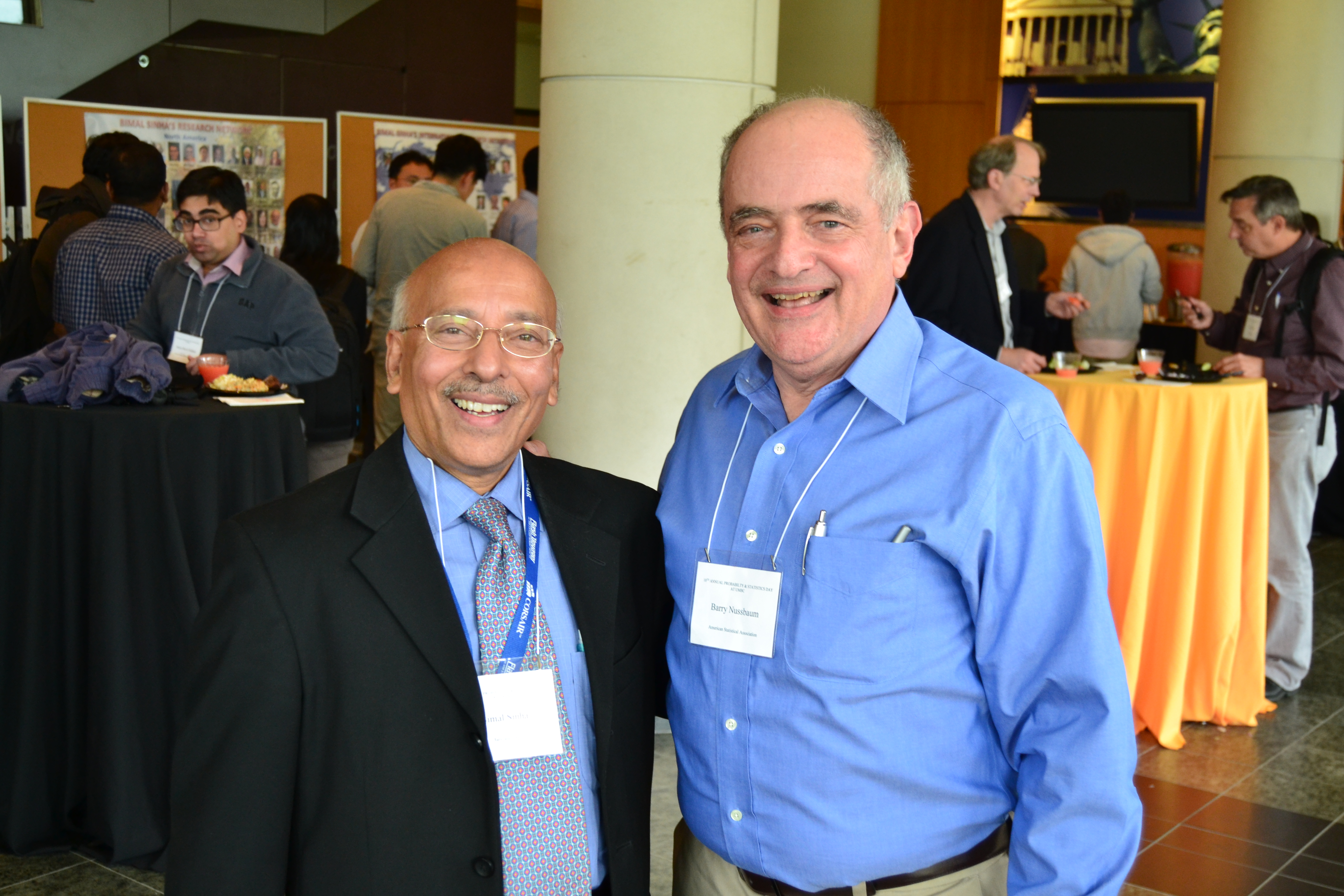
Barry Nussbaum, president-elect of the American Statistical Association (ASA), lauded the UMBC math and statistics department—and by extension, Sinha, who helped shape it—for “embracing all the traits the ASA suggests departments have” to be recognized as standard bearers. These include an emphasis on data science and external communications, real applications of theoretical work, and interdisciplinary initiatives. Nussbaum was particularly impressed by what he called UMBC’s “innovative extras,” such as the strength of undergraduate research and the “math gym” tutoring program.

Colleagues also reflected on Sinha’s pivotal role in developing strong relationships with local agencies where his theoretical work is applied. In addition to furthering research, relationships with groups like the Environmental Protection Agency and U.S. Census Bureau create important opportunities for students and alumni.

“It’s fascinating to see what our alumni have done with their careers,” said Rouben Rostamian, who joined the UMBC faculty the same year as Sinha and is now chair of UMBC’s math department. He shared, “It gives meaning to what we do here.”

In addition to his contributions to UMBC, Sinha has founded an annual mathematics and statistics conference in Africa, hosted over the first three years in Ethiopia, Cameroon, and Senegal, and planned to take place next in South Africa. “We can actually see the impact it is having,” said Thomas Mathew, professor of mathematics and statistics at UMBC.

Throughout his long career, still going strong, Bimal Sinha has cultivated a global research network, mentored dozens of graduate students to their Ph.D. and M.S. degrees, contributed new knowledge to the field of statistics, and founded a graduate program and two successful conference series, among other accomplishments. The secret to his success, he says, is simply, “Do good work and be nice to everybody”—a message his students and colleague have taken to heart.

DSC_0033

Images: Attendees (header image) and Bimal Sinha (l) and Barry Nussbaum (r) at UMBC Probability and Statistics Day 2016. Photos by Ricardo Moura.


Fan Yang’s “Faked in China” tackles competing visions of the Chinese economy in a globalized world

The opening ceremony of the 2008 Summer Olympics in Beijing lasted several hours, showcased thousands of performers, and featured an elaborate fireworks ceremony, wowing the many spectators who viewed it in person and on high-definition television. But what the viewers saw was not entirely real.

The song that accompanied the entrance of the Chinese national flag was lip-synced. The impressive fireworks display was pre-recorded. But for one emerging cultural and media studies scholar watching on television, the event sparked provocative research questions. Fan Yang saw the opening ceremony incidents as emblematic of a larger struggle taking place within China’s economy.

Fan Yang

Yang, an assistant professor of media and communication studies, wrestles with this in her new book Faked in China: Nation Branding, Counterfeit Culture, and Globalization (Indiana University Press 2015). The thought-provoking work closely examines China’s cultural dilemma as it deals with competing visions for the nation’s economy since it joined the World Trade Organization (WTO) in 2001.

The book traces interactions between Chinese government policies to enforce its nation branding—the idea that China should make its own products to comply with the intellectual property rights regime, and the “counterfeit culture” of making, buying, and selling unauthorized products.

After living in several regions of the country and experiencing its vastly diverse landscape, Yang first became interested in this analysis when she began to think critically about the idea of national culture as a unified notion and started to push back against dominant Western perceptions that Chinese culture has an inherent propensity for faking.

“That kind of discussion of culture to me is not the most helpful,” explains Yang. “Not only because it understands culture as a fixed idea that never changes, but also that it doesn’t take into account the fact that many other places in the world have had this reputation of faking.”

Throughout the book, Yang weaves in examples like Beijing’s Silk Street Market (a popular tourist destination), the cultural formation of the term shanzhai (imitation and counterfeit brands and goods), and the concept of the Chinese Dream to illustrate the complex cultural dilemma that China is experiencing.

“There is a need to think about what China really means not just for China, but for the world. Looking at the interactions between culture and economy in China is a way for us to broaden the scope of cultural studies in the West,” Yang says.

In an increasingly globalized world, Yang is hopeful her book will make an important contribution to generating discussions about how a “rising” China is viewed by people in the West.

“The imagined contention between superpowers of China and America is overly simplistic and doesn’t account for a lot of complexities,” she says. “The kind of analysis that I performed I hope will reorient our thinking of China as at once aspiring to join the First World while still encountering ‘faking’ as a ‘Third-World problem.’”

For news media interviews related to Yang’s book, see below:

Fan Yang on fakes, pirates, and shanzhai culture (Sinica Podcast) 

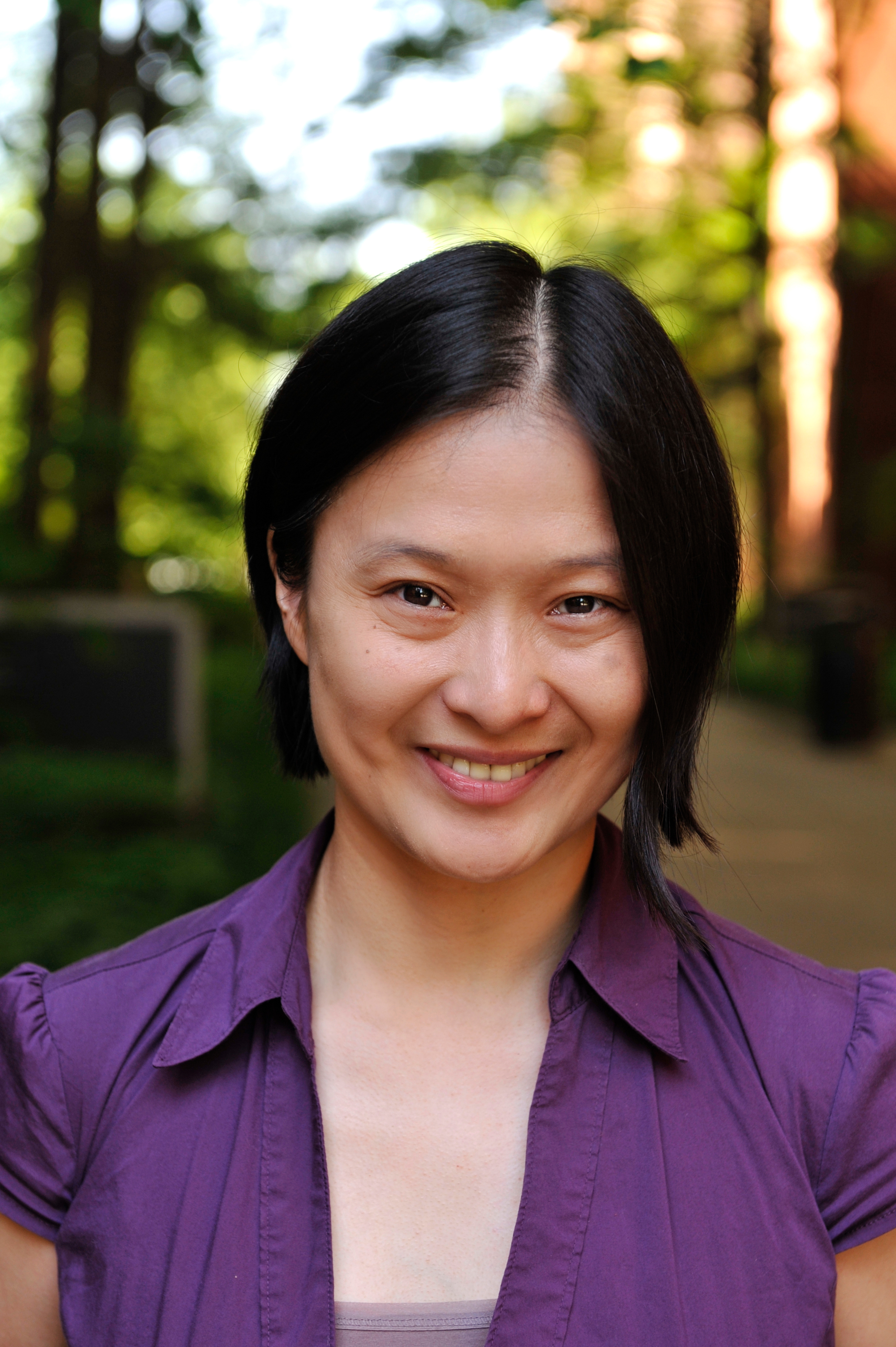
Images: (1) Silk Street Markets by Tim Riley, CC by-NC-ND 2.0. (2) Fan Yang, photo by Marlayna Demond ’11 for UMBC.   

George Derek Musgrove reflects on the surprisingly brief history of D.C.’s presidential primary

Washington D.C.’s presidential primary on June 14 marked the 60th anniversary of the District’s first-ever presidential primary. George Derek Musgrove ’97, history, associate professor of history, joined WAMU Radio to discuss why it took so long for the nation’s capital to have a say in presidential politics.

“Because it looks bad internationally,” Musgrove told WAMU. “We can’t be the capital of the free world, if in fact no one votes here.”

Musgrove is an expert in post-WWII United States history with an emphasis on African American politics. He is currently working on a book project about the history of race and democracy in Washington, D.C.

In the WAMU radio and print story “On D.C. primary day, celebrating 60 years of having a voice,” Musgrove explained that the history of the lack of a vote in presidential primaries extends all the way back to the nineteenth century.

“Remember that the excuse for stripping the city of the vote entirely in the 1870s was that black folks had the vote and would dominate the city with their vote,” he said. “And over the years, since the 1870s, segregationists in Congress had brought that back up repeatedly.”

Musgrove said that the city’s shifting demographics from majority white to majority black in the 1950s also played a role in D.C.’s push for voting rights, especially with Congress being heavily involved in the process.

“Black leaders in the city are very clear on who their enemies are in Congress and how those people will respond to their being involved in the effort to gain self-determination for the city.”

Listen to the full story on WAMU’s website.

Community Law in Action honors LaMar Davis, director of The Choice Program, as a 2016 Baltimore Inspiring Voice

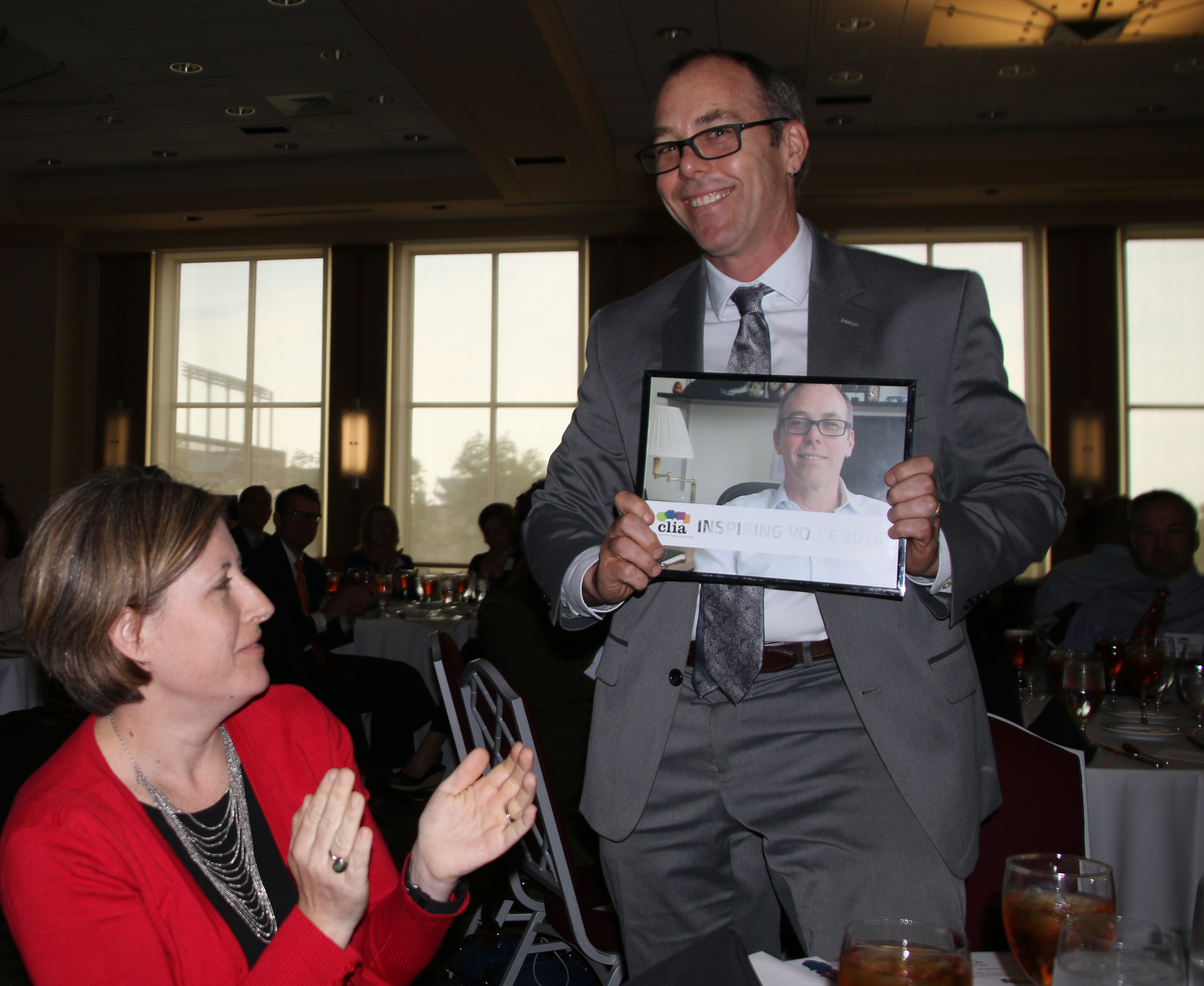
Each year, Community Law in Action (CLIA), an organization dedicated to cultivating the leadership skills of Baltimore youth, honors a select group of individuals who create positive social change and transform the city. LaMar Davis, director of The Choice Program at UMBC, was one of just eight people honored by CLIA during this year’s “Inspiring Voices” award ceremony, held May 10 at the University of Maryland, Baltimore.

During the event, CLIA Executive Director Corryne Deliberto recognized the awardees for dedicating their skills and expertise to serving as positive leaders, role models, and mentors to Baltimore youth who are devoted to making Baltimore a better city.

As a 2016 CLIA Inspiring Voice award winner, Davis was featured in a compelling video produced by CLIA about The Choice Program, a nationally recognized model for community-based intervention that has served more than 25,000 youth and their families from Maryland’s highest risk communities.

LaMar Davis at the 2016 Inspiring Voices Award luncheon.

“The Choice Program is UMBC’s response to addressing pressing social issues within Maryland and Baltimore City,” Davis explains in the video, which was screened at the award ceremony. “What we know is that when youth enter into detention facilities, the likelihood that they will enter as an adult goes up exponentially.”

For more than 28 years, The Choice Program has partnered with the Maryland Department of Juvenile Services (DJS) to focus on four areas of intervention: education, employment, family involvement, and community supervision. The program works within high poverty communities in Baltimore City and in Baltimore, Prince George’s, and Montgomery Counties to reduce obstacles impacting youth and family success. Last year, 92% of participating court-involved youth completed the program and were not adjudicated with new charges.

During the CLIA Inspiring Voice award ceremony, Davis shared that the tremendous success of the program over the years has been largely due to an approach that focuses on youth, their families, and the community, supported by 50 AmeriCorps community service-learning fellows. Those fellows provide critical contact, mentoring, and advocacy to young people and their families involved in the juvenile justice and social services systems.

“We bring an approach that says, ‘What are your strengths?’ Youth and families already know what their problems are, but it’s much more difficult for them and for others to really identify what they do well,” said Davis in the video. “We are also looking at how to give young people in Baltimore and Baltimore County an opportunity to get that first job experience, to build a resume, and get some on-the-job experience though our Choice Flying Fruit Café, kiosk, and stand.”

The Choice Jobs Program, which serves 200 local youth each year, expanded earlier this year with the grand opening of Baltimore’s first Flying Fruit Café, located at the University of Baltimore (UB) John and Frances Angelos Law Center.

As UMBC is in the midst of its 50th anniversary celebration year, Davis is optimistic that the program will continue to build on its success, serving even larger numbers of Baltimore youth in the future.

“UMBC and our president, Dr. Freeman Hrabowski, continue to lead the way on how a public university should support its community and commit to being part of the solution,” says Davis. “I am honored to have received this award on behalf of the university, The Choice Program at UMBC, our amazing staff, and AmeriCorps Community Service-Learning Fellows who do the work every day. This award speaks to our program and institution’s inspired commitment.”

Images: (1) LaMar Davis speaks at the 2015 University Retreat. Photo by Marlayna Demond ’11 for UMBC. (2) LaMar Davis receives 2016 Inspiring Voice Award. Photo courtesy of Community Law in Action.