All posts by: UMBC News Staff


UMBC’s Emily Escobedo finishes in top 10 at U.S. Swimming Olympic Trials

UMBC swimming and diving standout Emily Escobedo ’17, psychology, capped her historic year with a strong finish in the 200m breaststroke at the U.S. Swimming Olympic Trials, held last week in Omaha, Neb.

In the 200m breaststroke prelim, Escobedo finished 4th in her heat and 16th overall with a time of 2:29.12, earning a trip to the semifinal, which aired live on NBC. In the semifinal Escobedo swam an impressive 2:27.03, finishing in 10th place, just two spots shy of qualifying for the finals.

“This year’s Olympic trials was an amazing experience for me,” said Escobedo. “It’s such a fun meet to watch and truly such an honor to be able to swim in. There is so much talent at that meet and I was lucky to be able to witness some incredible swims and watch the dedication that those athletes have.”

43ad8498-bb1a-42e5-9537-0bca5ddced7c


Earlier in the week, Escobedo placed 54th in the 100m breaststroke, winning her preliminary heat with a time of 1:10.72. She also placed 36th in the 200m individual medley, earning third in her prelim heat with a time of 2:17.67.

“The U.S. Swimming Olympic Trials is the fastest meet in the world, and we are so proud of Emily and all she has accomplished,” said head coach Chad Cradock ’97, psychology. “Finishing tenth and swimming in the semifinals is that much more impressive.”

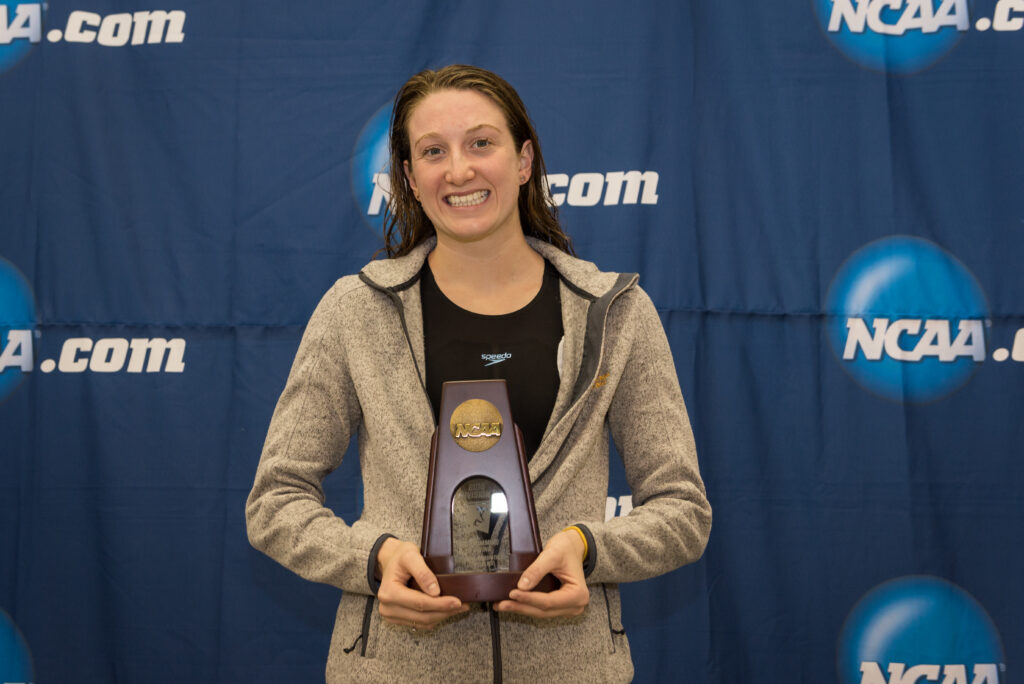
Competing in the Olympic Trials adds to Escobedo’s growing list of athletic accomplishments. Earlier this year, Escobedo won bronze in the 200m breaststroke at the NCAA finals, becoming the first Retriever to earn All-American status in the pool. She has also been named America East Rookie of the Year and Swimmer of the Year three times, earning multiple trips to the NCAA Championships, and becoming the first Retriever to score at the national meet.

2016.03.19 2016 Womens NCAA Swimming Championships_Lunn-52

Escobedo is also a phenomenal scholar-athlete. In 2016, she was named to the America East All-Academic Team and as a Collegiate Swimming Coaches Association of America Scholar (CSCAA) All-American. The CSCAA scholar award recognizes students-athletes competing in the NCAA championships who have maintained a 3.5 GPA or higher during the school year.

See additional details at UMBC Athletics.

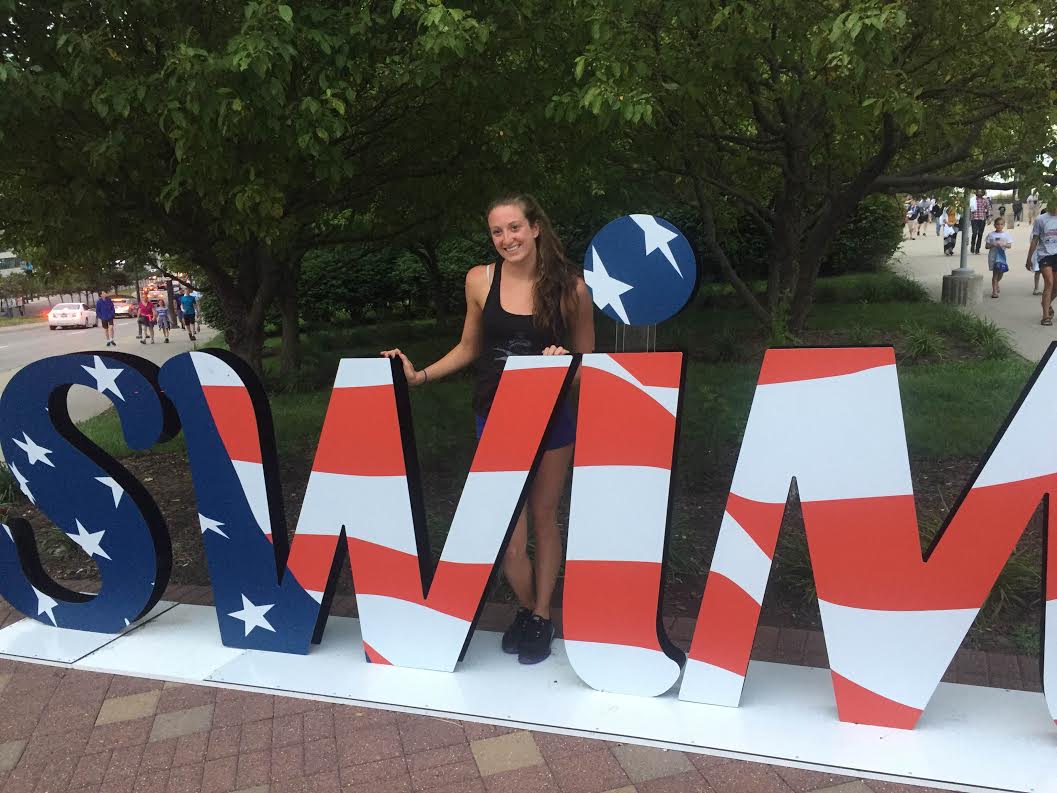
Images, top-bottom: (1) Emily Escobedo at the 2016 NCAA swimming finals, photo courtesy of Tim Binning/The Swim Pictures. (2) Emily Escobedo enjoying the 2016 U.S. Swimming Olympic trials, photo courtesy of Emily Escobedo. (3) Emily Escobedo receiving her bronze in the 200m breaststroke at the 2016 NCAA swimming finals, photo courtesy of Reagan Lunn.

UMB-UMBC Partnership Symposium celebrates research collaborations with impact

UMBC and the University of Maryland, Baltimore (UMB) celebrated new and recent recipients of UMB-UMBC Research and Innovation Partnership Grants at a symposium held last month on UMB’s downtown Baltimore campus.

This annual event seeks to actively support the growth of meaningful and sustainable research collaborations between the two universities. The June 2016 symposium highlighted the milestones of past partnership grant recipients and celebrated a new round of awardees: five teams of two, with faculty from all three colleges at UMBC as well as UMB’s School of Medicine, School of Pharmacy, School of Dentistry, and School of Social Work.

In recognition of the power of collaborative research, Karl V. Steiner, vice president for research at UMBC, shared, “This is another brick in the pavement as we’re building a road between our two campuses.”

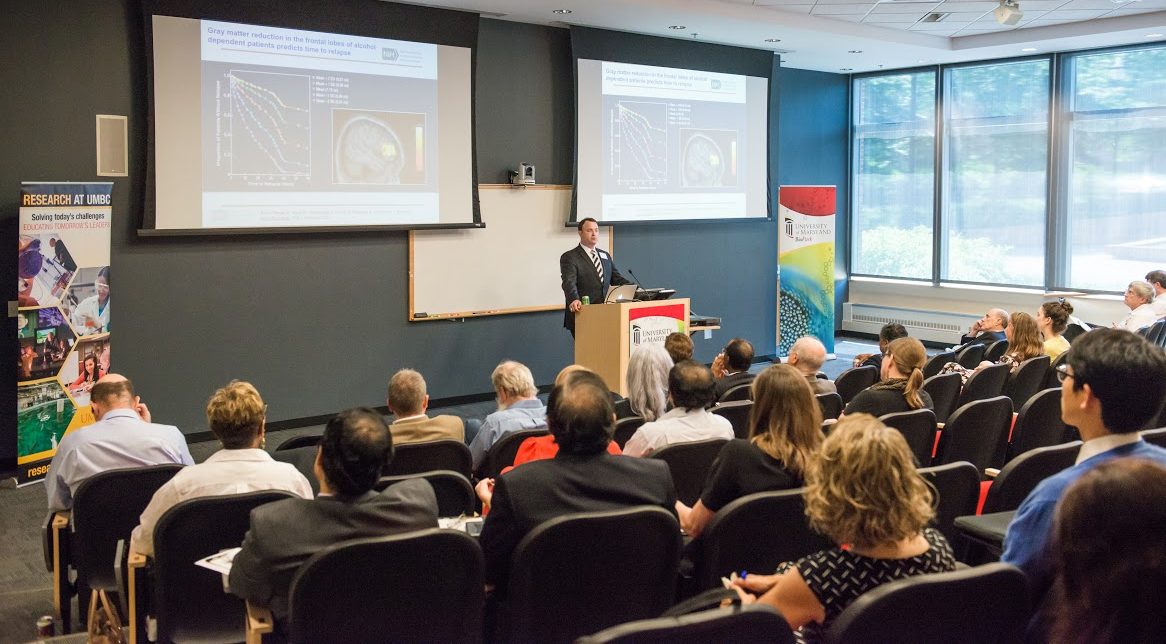
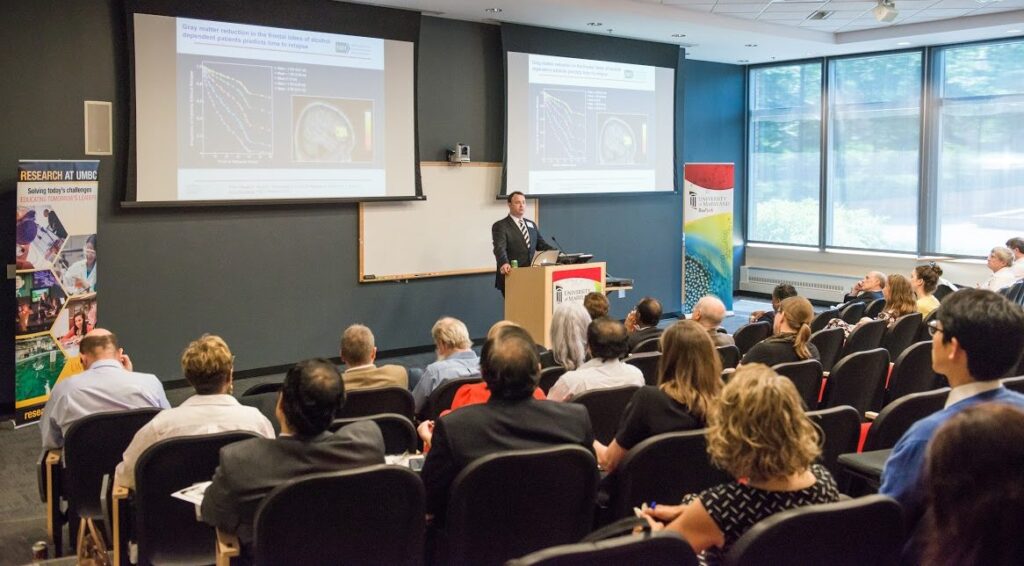
Aaron White, senior scientific advisor to the director at the National Institutes of Health-National Institute on Alcohol Abuse and Alcoholism (NIH-NIAAA), delivered a keynote focused on the diagnosis, prevention, and treatment of alcohol addiction. In addition to having a major negative impact on so many lives, White noted, alcohol addiction costs the U.S. nearly $250 billion dollars each year.

Following White’s remarks, the 2014-15 Research and Innovation Partnership Seed Grant teams each presented updates on their work, including goals for the upcoming year.
Toni Antalis, professor of physiology at the UMB School of Medicine; Rajabrata Sarkar, professor of surgery at UMB School of Medicine; and Zeev Rosenzweig, professor of chemistry and biochemistry at UMBC collaborated to develop a targeted therapy that increases blood flow to the limbs of patients with artery blockages resulting from diabetes, stroke, or other causes. With the prevalence of diabetes rising dramatically in this country, it’s critical to find ways to prevent the need for last-resort treatments like amputation.

When an artery experiences blockage, the nearby arteries expand to compensate, a process called “arteriogenesis.” When a specific protein called “p53” is deleted, the arteriogenesis response is stronger. However, p53 is also a critical tumor suppressor, so deleting it throughout the entire body or for an extended period of time is dangerous. The team is developing a new technique using nanoparticles to carry a drug that blocks p53 to carefully targeted immune cells, which pick up the particles and deliver the drug where it is needed. The team has shown that the new therapy effectively reduces p53 activity and increases arteriogenesis, which is maintained after treatment stops after 14 days.

Aryya Gangopadhyay, professor and chair of the department of information systems; Nirmalya Roy, assistant professor of information systems; and Elizabeth Galik, associate professor in UMB’s School of Nursing; have developed and implemented a smart health technology for people with Alzheimer’s or symptoms of the disease. The technology monitors the cognitive impairment of older adults to help them maintain independence. They worked with a senior community center to fit some residents with wearable sensors to assess cognitive function by monitoring everyday activities like making a sandwich, sweeping the floor, washing hands, and folding clothes.

Radi Masri, associate professor of endodontics, prosthodontics and operative dentistry at the UMB School of Dentistry; David Seminowicz, assistant professor of neural and pain sciences at the UMB School of Dentistry; and Raimi Quiton, assistant professor of psychology at UMBC, are working together to elucidate pain processing in migraines, the third most common cause of pain in the U.S. They hope to discover neural pathways that could be new targets for treatment, because current treatments are ineffective for a large percentage of migraine sufferers.

The team showed that a brain area known as the superior colliculus could be involved in processing migraine pain. The superior colliculus is known to integrate many types of sensory information, which might help explain symptoms such as sensitivity to light, sound, and touch. They also found that individuals who experience migraines have chronically high levels of a protein that is known to transmit pain signals. One next step for their research is to see how mice respond to pain stimuli if the neural signal is prevented from passing through the superior colliculus.

The final presentation examined how drugs are evaluated to develop a more effective way to test the effects of drugs on different cells simultaneously. To assess their new testing method, Ronghui Ma, associate professor of mechanical engineering; Liang Zhu, professor of mechanical engineering, and Hongbing Wong, professor in UMB’s School of Pharmacy, developed a specialized 3D-printed plate with multiple chambers.
umb-umbc partnership steiner-jarrell1

The 2016-17 grant winners span several several departments and centers at UMBC and schools at UMB. On the “challenge track,” Xudong Ge, UMBC Center for Advanced Sensor Technology (CAST), and Richard Pierson, UMB School of Medicine, will pursue development of a non-invasive respiratory status monitor. Chris Geddes, UMBC chemistry and biochemistry and Institute of Fluorescence, and Colin Stine, UMB School of Medicine, will work on the ultra-rapid and sensitive detection of cholera.

“Seed track” winners include Elsa Garcin, UMBC chemistry and biochemistry, with Patrick Wintrode, UMB School of Pharmacy; Soobum Lee, UMBC mechanical engineering, with Mary Melo, UMB School of Dentistry; and Christine Mair, UMBC sociology and anthropology, with Amanda Lehning, UMB School of Social Work.

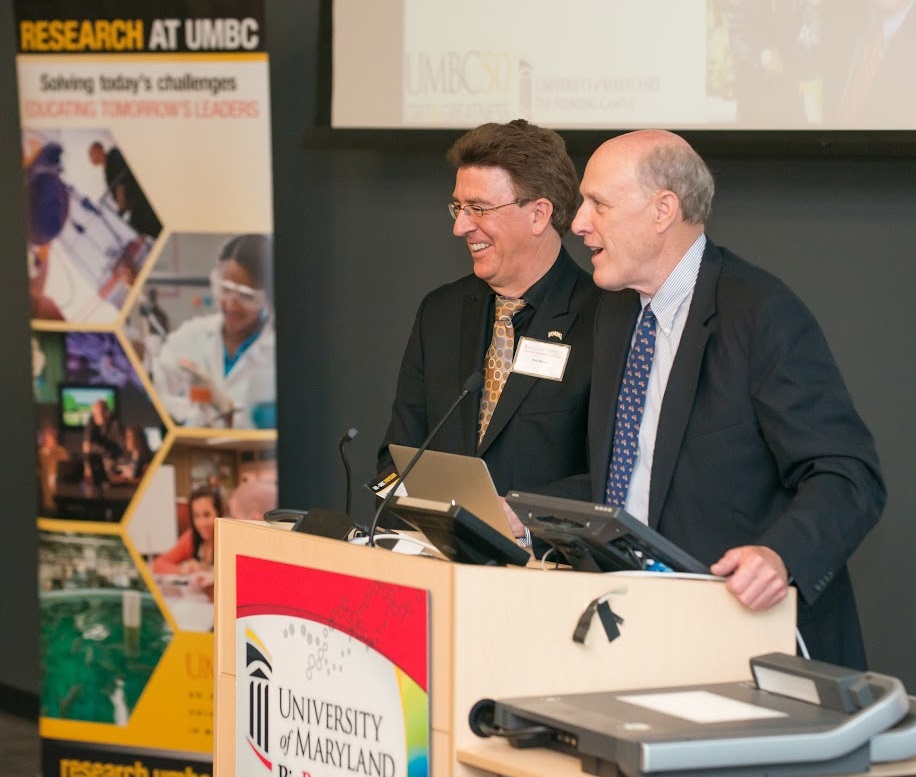
UMBC President Freeman Hrabowski and UMB Chief Academic and Research Officer Bruce Jarrell offered closing remarks focused on their shared commitment to building a close relationship between the two universities for years to come. UMB and UMBC have complementary strengths, Pres. Hrabowski explained. Programs like the UMB-UMBC Partnership Grants, he said, help both universities fulfill their potential as national leaders in innovative research and teaching.

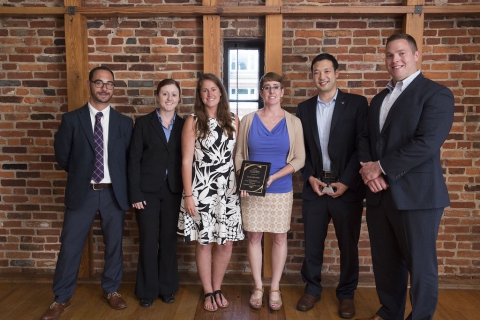
Header image: 2016-17 UMB-UMBC Partnership Grant winners, from left to right: Amanda Lehning, Christine Mair, Chris Geddes, Colin Stine, Mary Melo, Soobum Lee, Xudong Ge. Top image: Andrew White gives his keynote address. Bottom image: Karl Steiner (left) and Bruce Jarrell introduce the program. All photos by Marlayna Demond ’11 for UMBC.

Tim Brennan reflects on economic implications of federal court decision to uphold the FCC’s net neutrality rules

Last month, a panel of the D.C. Circuit Court of Appeals upheld the Federal Communications Commission (FCC) net neutrality rules, the idea that Internet service providers should allow access to all content and applications without favoring or charging differently by user. Tim Brennan, a professor of public policy and economics and former FCC chief economist, published an article in The Free State Foundation journal, reflecting on the economic implications of the decision and arguments on both sides of the issue.

In his article “Is the Open Internet Order an ‘Economics-Free Zone‘?,” Brennan explains that economics was indeed in the order, but he goes through several points including the ideas of “paid prioritization” and a “virtuous cycle” that were included in the Open Internet Order and explained his view of how they didn’t match up with the evidence.

Brennan offered potential alternatives to the Open Internet Order, including regulating the price that broadband suppliers charge for content delivery, and he also commented on why both sides fought so hard over the issue.

“The broadband industry may have feared even stronger regulation,” he explained, adding “…From the government’s side, a speculative possibility may be that if the U.S. government allows broadband providers to charge content suppliers for delivery, it will invite broadband providers in other countries to extract delivery fees from the dominant U.S. content suppliers, such as Google, Facebook, Amazon, and Netflix.”

Read the full article on the Free State Foundation website.

Image: Tim Brennan speaks at a 2015 research forum on campus. Photo by Marlayna Demond ’11 for UMBC.

John Rennie Short explains what Brexit vote reveals about economic and social inequality in the U.K.

There has been widespread analysis and commentary in recent weeks about what the Brexit vote will mean for the global economy, but School of Public Policy Professor John Rennie Short wrote in a June 25 op-ed in The Conversation that the vote reveals a lot about the political geography in the United Kingdom.

“The vote laid bare a seldom-acknowledged political and economic imbalance within the country. It has also raised the chances of dissolving a more than three centuries-old union,” he explained.

Short wrote about the economic and social inequality in the U.K. and how the voted reflected competing interests in a crowded political space.

“There is a spatial dimension to this social inequality. The U.K. has the most marked regional inequality in Europe. The rich and wealthy are concentrated in London and the South East where household incomes are higher than the rest of the country. As the U.K. became a more unequal and divided society, the cleavage between London and the South East compared to the rest of the country is becoming more marked.”

Prof. Short also wrote about what lies ahead politically for the U.K., stating, “the Brexit vote reveals and embodies the deep divide in the U.K. between the different regions of England and Wales and especially between the affluent London and the South East. This division is unlikely to heal soon.”

Read Short’s full article, titled “The geography of Brexit: what the vote reveals about the Disunited Kingdom,” on The Conversation‘s website. The article was also republished in the Associated Press, Salon, and SF Gate.

Image: John Rennie Short. Photo by Marlayna Demond ’11 for UMBC. 

Two bwtech@UMBC companies win 2016 Maryland Incubator Company of the Year awards

AirPhoton and Phoenix Operations Group are the newest bwtech@UMBC companies to win Maryland Incubator Company of the Year (ICOY) awards. AirPhoton won best technology product company, and Phoenix Operations Group won best data analytics company at the awards event held June 21 at the American Visionary Arts Museum.  Six other bwtech@UMBC companies were recognized as finalists.

AirPhoton produces customized scientific equipment for air quality data collection. The instruments they build are employed on the ground, in aircraft, and on satellites.

“AirPhoton is very excited to be recognized with this award, especially given the other very fine companies that were selected as finalists,” says Lorraine Remer, CEO and research professor of physics at UMBC. “We hope to continue growing and contributing to the incubator program and the Maryland economy.”

mdincwinner2

Phoenix Operations Group offers data analytics, cloud application design and administration, and platform optimization services to the intelligence community. Devin Edwards, director of strategic development, says the research park has served the company well.

“The cyber incubator at bwtech@UMBC was able to provide Phoenix Operations Group with access to industry professionals to help set up our infrastructure,” Edwards says, “thereby allowing us to compete and grow within our domain in a matter of months, surpassing companies that have been in the industry for years.”

mdincwinner1

The event’s keynote speech by Andy Jones, managing director of the Maryland Venture Fund, centered on advice for new entrepreneurs. Stay focused on a small range of products or services and embrace board meetings as opportunities to take stock, he said. Also, “growth is your friend,” because revenue gives a company leeway to try new things. Perhaps most important, “Surround yourself with good people,” he told emerging entrepreneurs. “It really is a marriage, so pick your partners carefully.”

Previous ICOY winners from bwtech@UMBC include:

2014

Light Point Security (Best Cyber Company)

2013

Plasmonix, Inc. (Best Technology Transfer Company)

2012

Noxilizer (Best Life Sciences Company)

StormCenter Communicaitons, Inc. (Best Cyber/Homeland Security Company)

SemaConnect, Inc. (Best Green Company)

2009

Oculis Labs, Inc. (Best Information Technology Company)

2007

Lentigen Corporation (Best Life Sciences Company)

BDMetrics, Inc. (Best Graduate Company)

2006

Profectus BioSciences, Inc. (Best Technology Transfer Company)

2005

AVIcode, Inc. (Best New Incubator Company)

TechGuard Security, LLC (Best Information Technology Company)

2004

BDMetrics, Inc. (Best New Incubator Company)

2003

Scientific Products & Systems, Inc. (Most Promising Technology Transfer)

2002

Columbia Technologies (Best Innovative Technology Company)

In Vitro Technologies, Inc. (Best Graduate Company)

Header image: Andy Jones gives the event’s key note.

Other images: AirPhoton team members accept their award (top) and Phoenix Operations Group team members accept theirs (bottom).

Photos sourced from www.mdincubatoraward.com


UMBC’s Brandon Enriquez named University System of Maryland student regent

Brandon Enriquez ‘17, economics and mathematics, has been named student regent for the University System of Maryland Board of Regents, effective July 1, 2016.

Enriquez was among three new members appointed to the University System of Maryland (USM) Board of Regents by Governor Larry Hogan for the upcoming fiscal year. The Board of Regents oversees USM’s academic, administrative, and financial operations.

As student regent, Enriquez represents more than 168,000 undergraduate and graduate students from 12 institutions across the state, including UMBC. As a voting member of the board, he will work fellow regents members and USM institutions to address a wide variety of issues that impact students, faculty, and staff.

“I am very excited to be named student regent,” said Enriquez. “I look forward to applying some of the insights I’ve gained in my research to help students across the state.”

During his one-year term, Enriquez plans to focus on college affordability and student success. His ongoing undergraduate research focuses on the economics of education and policies surrounding remediation and student employment on academic performance. “I not only care about making sure college is affordable for students, but also about helping them succeed academically—both for undergraduate and graduate students,” he says.

Enriquez is the fourth UMBC student to be appointed to the USM Board of Regents in the past decade. He joins Collin Wojciechowski ’13, political science and media & communication studies (2011-12); Josh Michael ’10, political science (2008-09); and Phil Shockley ’04, information systems and political science, ’09, M.P.P. (2003-04).

“It’s a great honor when one of our students is selected to serve on the USM Board of Regents,” says President Freeman Hrabowski. “I was delighted to learn of Brandon’s appointment. He represents the very best of our university, and we look forward to seeing him learn and grow with this new opportunity.”

This summer Enriquez is working as a research assistant at MIT on a project to evaluate the effects of randomly awarded student scholarships. From this study, researchers hope to examine the potential causal effect of financial aid on enrollment, retention, and graduation rates of poor and working-class students. Last year, he spent the summer at Harvard University analyzing the impact of limiting postsecondary remediation to two-year community colleges.

Enriquez is a Meyerhoff NSA Scholar and member of the Honors College. He has served as president and co-president of the UMBC College Democrats, and has participated in UMBC’s STRiVE Leadership Retreat.

Media coverage:
Three new regents join USM Board (The Daily Record) 

Images, top-bottom: UMBC Administration Building, courtesy of Marlayna Demond ’11 for UMBC. Brandon Enriquez head shot, courtesy of Brandon Enriquez.

Ecologist Chris Swan to analyze big data on biodiversity in new major study

Scientists and the public have long known that ecosystems like coral reefs and rainforests harbor an impressive array of species, from algae to armadillos. How biodiversity changes over time, however, is much less understood.

Chris Swan, professor of geography and environmental systems, and colleagues will tackle that question with a new research project funded by the National Science Foundation (NSF). The team hopes to reveal how changes in biodiversity might relate to environmental disturbances such as hurricanes, intense drought, or the introduction of invasive species.

Understanding the relationship between biodiversity and environmental change could inform conservation efforts, and there are numerous uses for this knowledge beyond preserving biodiversity for its own sake.

“Biodiversity is the foundation for ecosystem services,” says Swan, “so biodiversity is important to prevent loss of those services.” “Ecosystem services” include pollination of crops by insects and birds, carbon sequestration by vegetation, and water filtration by oysters and mussels. By highlighting these connections between biodiversity and areas like food production, energy, and water quality, Swan explains, he and fellow researchers “hope to elevate people’s understanding of the importance of biodiversity.”

Rather than collecting new data, the team is “synthesizing reams and reams and reams of data” that already exist, Swan says. He expects this large-scale analysis to reveal themes indicating how biodiversity shifts in response to environmental changes over time.

The team includes Swan, two additional principal investigators, and 12 more researchers. They will synthesize 37 data sets that include anywhere from 12 to 37 years of data each. The data come from Long Term Ecological Research (LTER) Network sites, and include locations all over North America as well as the Antarctic and Arctic. Sites cover every type of ecosystem and focus on different kinds of organisms, from plants to worms to fish to mammals.

The project will consolidate the datasets into a single large-scale searchable database accessible to the public. Other researchers will have access to the computer code the team will develop to analyze the data, which they can apply to other datasets in future research.

The team will conduct its analyses at the National Center for Ecological Analysis and Synthesis (NCEAS), located at the University of California, Santa Barbara. NCEAS offers massive computing power, meeting space, and IT staff free of charge to research groups selected in a competitive process. Swan’s proposal was one of only three selected nationwide in the last round. The NSF funding will support the researchers’ travel to Santa Barbara for several working group sessions over the next two years.

This is UMBC’s first opportunity to use NCEAS resources. By analyzing so much data, Swan plans to answer “some very big questions…about what’s happening over time” in Earth’s complex ecosystems.

Image: One of Chris Swan’s research sites in MD; by Marlayna Demond ’11 for UMBC.

UMBC’s 2016 Fulbright Scholars to serve as teachers and researchers around the world, from Moldova to Malaysia

After class one day in 2015, Brigitte May, senior lecturer in German, turned to her student, Matthew Kelly, to talk about his plans for after graduation. “Matt, I know what you are going to do when you graduate,” she told him. “You are going to win a Fulbright grant and teach English in Germany.” A year later, Kelly is heading to Germany with an English Teaching Assistantship Fulbright award.

Kelly’s story reveals the caring mentorship and high level of student preparation common across UMBC’s 2016 Fulbright award class.

“What I loved about this year’s class is that they threw themselves into the process early,” says Brian Souders, associate director of international education services and Fulbright program advisor. “They really got into the spirit of Fulbright, which is all about cultural exchange.”

The Fulbright Program is the flagship international educational exchange program sponsored by the U.S. government and is designed to build relations between the people of the United States and the people of other countries that are needed to solve global challenges. The Fulbright Program is funded through an annual appropriation made by the U.S. Congress to the U.S. Department of State. Participating governments and host institutions, corporations, and foundations around the world also provide direct and indirect support to the program, which operates in more than 160 countries worldwide.

Matthew Kelly ’16, modern languages, linguistics, and intercultural communication, is one of several UMBC students and recent alumni receiving Fulbright scholarships this year. UMBC’s additional English Teaching Assistantship (ETA) recipients include: Emily Bernstein ’16, psychology and political science (Malaysia); Alexandria Clay ’16 M.A., intercultural communication (Mexico); Matthew Poissant ’15, American studies (Indonesia); and Alexander Szabo ’15, history (Nepal, alternate). Ayushi Aggarwal ’16, biochemistry (Laos) also received an ETA but is unable to complete the program at this time. Shruti Gujaran ’16, biochemistry and molecular biology (Australia), and Rachel Rettaliata ’14, history (Moldova) have both received Fulbright research grants.

Rettaliata is using her Fulbright research grant to study public monuments in Moldova and how they represent the evolution of the country’s national identity through its pre-Soviet, Soviet, and post-Soviet history. She plans to apply research skills she developed as an undergraduate to make the most of her research abroad.

“I really think that UMBC’s history department has prepared me for the Fulbright grant,” explains Rettaliata. “Through various coursework, I’ve been able to research in archives, databases, and pursue oral and digital history projects…there are so many different areas that I’ll be able to translate into my research in Moldova.”

Gujaran is the second UMBC Fulbright recipient for Australia. Timothy Nohe, professor of visual arts and director of the Center for Innovation, Research, and Creativity in the Arts (CIRCA), received a Fulbright Senior Scholar award in 2006 to Australia to teach at University of Wollongong.

Gujaran will use her research grant to study antibiotic drug resistance at the University of Melbourne’s department of microbiology and immunology. She credits her experiences pursuing civic engagement opportunities through The Shriver Center and Honors College with inspiring her to become a well-rounded researcher, dedicating her time to help improve access to healthcare for people who need it the most.

“I want to focus on infectious diseases because I really want to work with international populations, specifically in developing countries that might not have access to healthcare,” says Gujaran.

Humanities scholar Matthew Poissant is hoping to build off of his study abroad experience in South Korea as he pursues his Fulbright ETA teaching English to 10th and 11th grade students in Indonesia.

“I feel very honored to have been chosen by my government to be a cultural representative of the United States,” he says. “Because of what I learned from my American studies education at UMBC, I am not scared to have discussions about the complexity of American culture and identity.”

Matthew Kelly will be teaching English at a school in Bavaria, Germany and hopes to embrace the cultural exchange component of the Fulbright program through community service work coaching ice hockey in Munich.

“I really do believe that the sky is the limit, and the more that I put into this experience, the more that I will get out of it,” he shares.

Reflecting on this year’s Fulbright class, Souders is confident the students will embrace cultural exchange, serve as positive ambassadors of the United States, and bring back a breadth of knowledge and experiences to their professional lives when they return to the U.S.

After guiding so many students through the Fulbright experience, what is Souders most excited about for this year’s recipients? It’s not just about their time abroad, he shares. “I love the fact that the students are developing skills that will be useful for the rest of their lives.”

Image: Shruti Gujaran (left) and Rachel Rettaliata (right). Photo by Marlayna Demond ’11 for UMBC. 

“Smog Blog” run by UMBC students becomes go-to air quality reference for national audience

When Jill Engel-Cox Ph.D. ’04, marine-estuarine environmental sciences, started the Smog Blog in 2003, it served as “kind of an online lab notebook,” she says. In the early 2000s, there were plenty of sources of air quality data, “but no one was putting these disparate data sources all together on a daily basis.” Enter the Smog Blog.

As Engel-Cox developed the site, she and advisor Ray Hoff, now-emeritus professor of physics at UMBC, expanded it to include other students. “The Smog Blog turned into a great way for students to learn how to analyze satellite and other air quality data quickly, as well as how to write scientific information clearly for a wide audience,” Engel-Cox says.

But the Smog Blog was destined for bigger things. “It took on a life of its own,” says Ruben Delgado, assistant research scientist at the Joint Center for Earth Systems Technology. From comments on the site, “we discovered we had a wide variety of readers,” says Engel-Cox, “including atmospheric scientists, state environmental regulators, and even an amateur astronomer who used the Smog Blog to better predict clear skies.”

Four years ago, Delgado realized the Smog Blog had more than five million total hits per year. Now it gets 16,000 unique hits per month. Many visitors, such as weather agencies or citizens sensitive to air pollution, visit several times per day.

A team of students posts to the Smog Blog six days per week to keep readers updated. Now it’s a self-perpetuating venture: as students graduate, they train the next cohort of Smog Bloggers how to interpret data from satellites and explain it in layman’s terms on the blog.

Delgado has received external offers to buy the Smog Blog, but he’s not interested in commercializing it. He says it’s “by students, for students,” and should stay that way. Even as a university project, however, there are many possibilities for the Smog Blog’s future, including growth through collaborations. The blog even emerged in a discussion with Robert Marshall ‘88, founder and CEO of Earth Networks, on compelling uses for weather data following Marshall’s keynote at a UMBC research conference on climate issues.

Next on the horizon for the Smog Blog is a new home: a freshly designed website expected to launch by the end of the summer. Students will also be working over the summer to develop a Smog Blog mobile app.

In the meantime, as spring pollen, summer wildfires, winter inversions, and other air quality issues continue, the blog expects traffic to keep rising as it serves up critical information to a diverse audience, all while supporting the research and education of UMBC students.

Images: Sourced from the Smog Blog website. These highlight how different instruments observed smoke from the spring 2016 Fort McMurray wildfire in Alberta, Canada traveling across the Great Lakes region.


Dawn Biehler brings fresh perspective to pest control on WYPR

The Zika outbreak has brought renewed attention to strategies for controlling pest populations across the country. Dawn Biehler, an associate professor of geography and environmental systems, recently joined WYPR’s “Humanities Connection” program to explain how the humanities can help inform environmental research on pest and rodent control.

“Studying unwanted animals like rats and mosquitoes might seem more a topic for the natural or health sciences than for the humanities,” Biehler said during her segment, which aired June 24 on WYPR. “But humanities disciplines can open up important ways of understanding humans’ relationships with the creatures we call pests.”

Biehler is leading a research team that is working on an extensive study to determine whether a neighborhood having more mosquitoes translates to a greater risk of disease transmission. The researchers are focusing on West and Southwest Baltimore neighborhoods to study how abandoned buildings can sustain mosquito populations.

In her “Humanities Connection” segment, Biehler explained that legacies of discrimination and urban planning have led to current patterns of infestation, and her research team is engaging residents in environmental and political action to make communities healthier and to advocate for better mosquito control. As part of the Baltimore Mosquito Study, residents have been working on producing community photography and oral histories to tell the stories of the environments they live in.

“Perhaps these stories of environmental past and present can help us understand what we need to do today to help make Baltimore healthier,” Biehler said.

Listen to the full segment on the Maryland Humanities website.

Image: Asian Tiger Mosquito. Photo by frankieleon, CC by 2.0

Nancy Rankie Shelton publishes thought-provoking memoir about love, loss, and survival

Nancy Rankie Shelton, a professor of education, is author of a powerful new memoir that is already receiving significant praise for its contributions to the growing body of literature on living and dying well. The book, titled 5-13: A Memoir of Love, Loss and Survival, was published earlier this month by Garn Press.

NRS-Cover-Softcover-v-4-book-post-2-201x300In a review posted on the Garn Press website, the reviewer notes, “Nancy Rankie Shelton’s 5-13, A Memoir of Love, Loss and Survival is a breathtaking read. It is work of great courage but also a literary triumph. Like an uncut diamond it is rough reading in places and then the light fractures and you feel the surge of an enduring human spirit who is not frightened to love, face death, and then reimagine her life.”

The book encourages readers to overcome fears of cancer, remain loving and strong, survive the death of a loved one, and continue living. The story traces Shelton’s husband Jack’s fight with lung cancer and the stress and confusion of managing his treatment. The book reflects on the 35 years the couple was together and the family’s relationships with others over the years.

“Dying with dignity, end of life decisions, assisted suicide and advances in health care are important topics in today’s society,” the review on the Garn Press website states. “Nancy Rankie Shelton contributes to this body of work in her book…which leads the reader through her husband Jack’s cancer diagnosis and his death, with moving vignettes of life and love woven throughout the text.”

Shelton is the author of 23 publications appearing in prominent academic journals and leading publishing companies specializing in literacy research and/or education policy. Her teaching areas focus on reading and language arts, literacy/culture and composition theory/practice. Her research interests include children’s writing development, effects of mandated instruction on elementary literacy development, literacy/art connections, and children’s literature. Read more about her work on the education department website.

Image: Nancy Rankie Shelton. Garn Press photo.

Kimberly Moffitt weighs in on the presidential election and Gov. Hogan’s stance on Trump

Kimberly Moffitt recently joined The Baltimore Sun’s “Roughly Speaking” podcast with Dan Rodricks to discuss the state of the 2016 presidential campaign and Gov. Larry Hogan’s announcement that he will not be endorsing Donald Trump, the presumptive Republican nominee for president.

Moffitt appeared on the program with Republican analyst Richard Cross, and they covered a range of topics, including Gov. Hogan’s stance on the presidential election and national political scene.

“Although we are often considered a blue state in national politics, I think Hogan recognized that his success as our governor had a lot to do with Democrats as well as Independents to help catapult him toward the role he is currently serving for us now,” Moffitt explained on the program. “Recognizing that, I think seeing Trump as a polarizing figure, he said that I must take a different stance.”

Discussing voter perceptions of presumptive Democratic nominee Hillary Clinton, Moffitt shared that many voters consider her polarizing due to her length of time and extended scrutiny on the national political scene, as well as many voters tying her to the impact of policies that originated under President Bill Clinton’s administration.

Listen to the full podcast “Larry Hogan walks away from Donald Trump” on The Baltimore Sun‘s website.

Moffitt also recently appeared on WEAA’s The Marc Steiner Show to reflect on the remake of the classic miniseries Roots after the entire series had aired. Listen to Moffitt’s complete analysis on The Marc Steiner Show website.

Image: Kimberly Moffitt in her office. Photo by Marlayna Demond ’11 for UMBC.