All posts by: UMBC News Staff


Hurdles & Healing

Damon Tweedy ’96, biological science, graduated from UMBC in 1996 with a 4.0 grade point average – the first participant in the Meyerhoff Scholars Program to achieve that mark. And when he entered Duke Medical School, he excelled in the classroom there as well.

But when Tweedy began his clinical rotations and his residency after taking his M.D., he faced the task of translating that knowledge into effective care for real human beings. He also found his transition carried special challenges. He was one of the few African American students in his medical-school cohort, and he was training in a state with enormous racial, class, and regional disparities in health care access. Patients turned to Tweedy with expectations – and occasional open hostility – that his non-black colleagues didn’t experience.

Tweedy’s bestselling book, Black Man in a White Coat: A Doctor’s Reflections on Race and Medicine (Picador, 2015), subtly explores several types of bias commonly experienced by both patients and health professionals.

“One of the first things I noticed in residency was the custom of naming patients’ races when they’re presented in rounds,” says Tweedy, who is now an assistant professor of psychiatry at Duke. “‘So-and-so is a 55-year-old African American male.’ I thought: Why mention race? Occasionally it’s genuinely significant, but often it seems that the patient gets typecast before you even get to the rest of the story.”

Tweedy was raised in a working-class suburb of Washington, D.C., where his father worked as a grocery-store meat cutter for many years. UMBC recruited Tweedy on two fronts. First, he was spotted by UMBC President Freeman A. Hrabowski, III in the science-and-mathematics magnet program at Eleanor Roosevelt High School in Greenbelt. But he was also on the radar of the university’s basketball coaches.

“When I visited campus,” Tweedy recalls, “I got to know other current and prospective Meyerhoff students. I just remember that for so many years I’d felt out of place – being an African-American student who was doing well in science and math – and feeling like here at UMBC there was a space where I could be myself and succeed.”

Earnestine Baker, who directed the Meyerhoff program after Hrabowski became UMBC’s president, remembers Tweedy as a compelling student in the program’s early years.

“Damon had a quiet demeanor,” Baker says. “But he had this spark about him that made you want to know him, and to know more about him.” She recalls long conversations when Tweedy made the decision to leave the basketball team after his sophomore year. He realized that he had a chance at graduating with a perfect GPA, and he didn’t want anything to distract from that goal.

“One of the great things about the Meyerhoff program,” Tweedy says, “was that they not only paid close attention to how you were doing in the classroom, but they also encouraged you to get into summer research programs, to get exposed to people in the field and to the life of the laboratory.”

One summer placement in a National Institute on Aging lab in Baltimore led Tweedy to consider medical school. “One of the researchers there was a cardiologist who had trained at Johns Hopkins,” Tweedy says. “That was one of the first times I’d met a young male African-American physician…. He kind of took me under his wing, and he introduced me to other doctors and med students. The idea of becoming a doctor was really foreign to me. In terms of knowing people in my own life who’d traveled that road, I had no frame of reference at all.”

At Duke, Tweedy gravitated toward psychiatry, a field with acute disparities in access to care. “Depending on your insurance,” he says, “you might have access to 30 days of inpatient treatment, or you might have access to two days.”

Today Tweedy divides his time between clinical practice at Durham’s Veterans Affairs hospital and training medical students and residents at Duke. He leads a course for first-year students on the doctor-patient relationship, and tries to draw students’ attention to the many kinds of conscious and unconscious bias that can complicate that relationship.

“I try not to beat them over the head with it,” Tweedy says. “But I try to show them the subtle ways in which these issues can come up in different encounters. You may have all the knowledge in the world, but if you can’t communicate with the patient and understand where they’re coming from, you really can’t deliver optimal care.”

—David Glenn
Baltimore Sun recognizes UMBC women’s basketball for commitment to community

Nine women’s basketball team members visited New Era middle school in South Baltimore to play ball with students in the Higher Achievement program. This is the second summer the Retrievers have spent time with Higher Achievement students. Andi Goodwin, a Higher Achievement mentor and academic advisor at UMBC, forged the connection, which is a powerful example of UMBC’s commitment to community partnerships.

Warren Wiggins, manager of instruction for Higher Achievement at New Era, says that when UMBC visits, the middle schoolers “get excited about college. They learn that student-athletes are students first.”

The benefits go both ways. Working with younger students encourages the athletes to “step outside of themselves for a moment,” says Goodwin. “It affords them a chance to see what doors their talent opens up for them.”

During a question and answer session after drills and a scrimmage, the youngsters quizzed the UMBC players about college life as varsity athletes. “It’s one thing to play basketball with them,” says point guard Emily Russo ’17, biology, “but we’re more than just basketball players.” She hopes she and her teammates made that clear to their new mentees.

“I feel like you build a relationship,” says power forward Pandora Wilson ’17, health administration and public policy. “If they’re listening, they’re applying what they’ve learned here and maybe they’re taking away something that’s more than just the usual words.”

The New Era principal has invited the UMBC team return this fall to meet with the school’s basketball team—a request they’ll happily oblige.


UMBC participating teammates: Laura Castaldo, Chukwuma Chiamaka, Amanda Hagaman, Kayla Hinderlie, Allison McGrath, Tyler Moore, Te’yJah Oliver, Emily Russo, Pandora Wilson

Learn more in The Baltimore Sun: UMBC women’s basketball players share more than their sport

Image: UMBC women’s basketball players practice with middle school students in the Higher Achievement program at New Era Middle School; photo UMBC Athletics.

Front Row Seat

Sitting across from Sylvia Nathanson ’71, social work, it’s hard not to see the spark that propelled her in her late forties to become one of UMBC’s first returning students – and led her to a prominent role in educating thousands of social workers as the longtime dean of admissions at the University of Maryland School of Social Work.

She is 98 years old now, but Nathanson’s memories of the university’s formative years remain vivid. “It was a time of great protests,” she says. “There were many speeches all the time. I remember my first biology class, and the head of the protestors was my lab partner.”

Nathanson began taking classes at the age of 46 at Baltimore Junior College (now Baltimore City Community College). In 1968, she was encouraged to transfer to UMBC. She found the university “a wonderful place to be. People were warm and accepting. Helpful. The older student was welcomed.”

Juggling her roles as a mother to two daughters and as a student took discipline and focus, UMBC was accommodating. “I never took a class before nine o’clock or after two o’clock,” she says.

Nathanson did participate in a formative experience for many UMBC students: study abroad. In the 1969 January session (dubbed the “minimester” in that era), Nathanson accompanied Walter Sherwin – now emeritus professor of ancient studies – and a group of her fellow students on a trip to London, Paris, and Rome.

Nathanson recalls hearing about the three-week study course a few months before the trip. “I looked over at the person sitting opposite me, and I said, ‘Golly, that’s a wonderful idea! Why don’t you do it?’ And she looked me square in the eye and said, ‘Why don’t you?’ And I did.”

The trip pushed the first-time traveler in unexpected ways. “We had a flat front bus, and we were riding down a narrow road [in Italy], and everybody took a turn riding in front to see the water below,” Nathanson remembers. “Now I was someone who didn’t like the water and didn’t like heights. But one of the students piped up and said: ‘Everyone’s had a turn. But Sylvia hasn’t had a turn.’ And they put me right up front. And I grew. It sounds ridiculous. But I grew tremendously during that experience.”

Sherwin remembers the minimester trips and their beneficial effects on students. “It expanded the horizons for a lot of people,” he says.

Nathanson soon put the growth she experienced as a student and world traveler to even more beneficial uses. She says she found her calling when Ruth Young, the legendary dean of the University of Maryland School of Social Work, came to UMBC to recruit students. “Dean Young came to campus to explain how she envisioned a bachelor’s degree in social work,” she recalls. “She was really explaining social work that day. After that, there was never a question.”

Young’s advocacy helped created a powerful new program at UMBC. “Once it got going,” says Nathanson, “the [social work] program became tremendously popular. Because there was such a need for it.”

After graduating cum laude from UMBC, Nathanson worked as a social worker at Baltimore City Hospitals (now Johns Hopkins Bayview Medical Center). “UMBC had given me a sense of community and organization,” she says. “And being older, I was able to render a social work service and pulled the community in.”

After five years, however, Nathanson went back to school again, this time to get her master’s degree in social work at the University of Maryland School of Social Work. “The master’s people had something different,” she says. “They had something I wanted. So I took a leave of absence and went to the master’s program.”

Nathanson was a fixture at the School of Social Work after obtaining her advanced degree, eventually becoming the dean of admissions. She encouraged and enrolled many graduates of UMBC in the school and helped them on in their social work careers.

“I followed the UMBC alumnae,” Nathanson recalls. “I have a particular skill. I never forget a name, and that comes in handy.”

—Richard Byrne ’86

John W. Jeffries Dean’s List Award honors high achievers

UMBC is about to celebrate its 50th anniversary, and we didn’t get this far without the dedication of some incredible people. People like Dean Emeritus John Jeffries, who joined the UMBC History Department in 1973, and spent the next 40 years helping his students and the university excel.

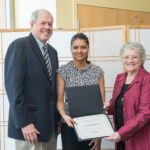
When Dean Jeffries retired as Dean of the College of Arts, Humanities, and Social Sciences (CAHSS) in 2013, an anonymous donor established the John W. Jeffries Dean’s List Award in his honor. The fund—which recognizes Dean Jeffries for his dedication to UMBC students and his commitment to seeing them excel—provides critical support for high-achieving students who aren’t already receiving a specialty scholarship. If they’ve demonstrated their drive by reaching the Dean’s list for three consecutive semesters, they’re eligible for the award.

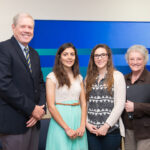
This spring, Dean Jeffries had the chance to meet with some of the students who had received the award and learn a bit about their UMBC journeys.

Sunita Mengers ’16, biological sciences, had just returned from Spain when she met with Dean Jeffries. “Receiving this award helped me fully immerse myself in the local culture and allowed me to adapt to a new environment,” she explains. Hoping to continue her studies at med school, Sunita said UMBC’s close-knit and supportive environment played a big role in helping her reach her goals.

“The whole [UMBC] community helps you succeed,” she adds.

That sense of community and support is a feeling common across campus, especially among the award recipients. “I received personalized classroom instruction from quality professors who truly care about the well-being of their students,” says Ayushi Aggarwal ‘16, biochemistry and molecular biology.

The students also felt the impact of the reward well beyond their initial acceptance. Thanks in part to this scholarship, Olsi Leka ’16, computer engineering, is achieving his career goals.

“I have accepted a position [at Texas Instruments in Dallas] as a product engineer, a position that will allow me to continue my learning process beyond the doors of UMBC,” he says.

For Marianne Kirchgessner ’16, social work, the Dean John Jeffries Award is allowing her to continue her education. “[Receiving this scholarship] was a blessing because it lessened the burden for me and my parents and freed up some money to pay for grad school,” she says.

Given Dean Jeffries’ long history of helping students, it seems fitting that the fund established in his honor should do the same, as it prepares these talented Retrievers to take everything they’ve learned at UMBC into their bright futures.

“I’m both delighted and honored by the award, which helps high-achieving Dean’s List students who do not hold UMBC specialty scholarships complete their undergraduate education,” said Dean Jeffries. “I’m especially honored to have my name associated with these remarkable young men and women.”

Katharine Scrivener

Phenomenal World: Juliana and Homer Schamp Memorial Scholarship seeks to inspire the next generation of teachers

Think back to the science classes you took as a child. What do you remember about them? Did you watch a caterpillar spin a cocoon and emerge a butterfly, or a tadpole grow into a frog? Did you turn baking soda and vinegar into a fuming volcano, or set off a homemade hot air balloon from the school parking lot? Did you feel a sense of wonder as you watched the world work its unique magic?

That’s the sense of wonder the late Homer W. Schamp, Jr., UMBC’s first dean of the faculty, professor emeritus of education, and trained physicist, pursued science with, and one he sought to instill in both his students and his own children. His wife Juliana Reese Schamp, who worked on important sociological research for the state of Maryland, treated life the same way, until her passing in 2009.

With the Juliana and Homer Schamp Memorial Scholarship, their sons, Brough and David Schamp, hope to keep their parents’ legacy of intellectual curiosity alive in the next generation of K-12 science educators.

Throughout his life, Dr. Schamp, a former College Park physics professor who joined UMBC in 1965, emphasized early education as a crucial part of a child’s intellectual development. His own introduction to science began during his childhood in rural Ohio, when, according to his son David, he became fascinated with the engineering of farm equipment. It’s a curiosity he emphasized to the education classes he taught here, and something he brought up his own children with as well.

“He exposed us to all kinds of different things as we were growing up,” says Brough. “Mushroom hunting, […] botany, the stars, everything. […] His main field was physics, which is really pretty abstract, but what he really was interested in was the phenomenal, real world that we live in.” After his retirement, Brough says, Dr. Schamp built several kinetic sculptures and interactive physics-based artworks, including a large kaleidoscope on display at the American Visionary Art Museum in Baltimore.

Brough shares his father’s belief that science “should be a hands-on subject,” and says that computers and technology can create a distance between students and the physical world around them.

“The kids should be inspired by something they saw, heard, felt, experienced,” he says. “[That] inspiration is something that is often lost if you’re just looking at something on a computer and answering questions.”

In keeping with his philosophy on education, Dr. Schamp made sure to hire only the highest-quality professors, and it’s doubtful that UMBC would be the hub for innovative teaching and experiential learning it is today without the Schamps’ early influence.

“UMBC was my father’s life’s work and both of my parents conceived of it as a first rank teaching institution,” David says. While his mother, Juliana, was never a faculty member, she was “instrumental in [UMBC’s first faculty] being hired, as recruitment usually began as an evening in our home where my parents could converse [with candidates] on almost any topic.”

Giving back to UMBC seems to run in the family: Homer and Juliana Schamp established the Joseph D. Reese Memorial Prize, a biennial award given to history students, in memory of her father. “It seemed only natural to want to contribute to a place so dear to [our parents],” says David.

He agrees with his brother that their parents raised them to be thinkers, to ask questions.

“I often later felt I had learned my most important lessons at home — specifically how to learn — [and] that curiosity and thoroughness were rewarding and that it had to come from within. Knowing how to learn is the most crucial skill a teacher can pass on and my parents really encapsulated that skill. I would hope any future teachers would want to engender that in their pupils,” he says.

We don’t know exactly what science education will look like when the first Schamp scholar teaches their first class, but we do know that they’ll have the intellect, leadership, and natural curiosity to inspire a new generation of learners.

Julia Celtnieks ’13

Make a gift to UMBC today, and help inspire a new generation.


Meet SCIART: Groundbreaking fellowship opens students’ eyes to interdisciplinary careers

In early June, eight undergraduates arrived at UMBC for the first edition of SCIART. The unique summer fellowship program funded by the Andrew W. Mellon Foundation seeks to “continue to develop the students’ science expertise while also developing their appreciation for the arts and humanities,” says Zeev Rosenzweig, UMBC chemistry and biochemistry chair, who spearheaded SCIART.

Interdisciplinary programs like SCIART prepare students for a widening range of possible career paths, helping to address the challenges and opportunities presented by an evolving career landscape that emphasizes teamwork and creative problem-solving.

SCIART students work on scientific research projects under the guidance of faculty from UMBC and Johns Hopkins University. Each project has a specific art conservation application at the Walters Art Museum in Baltimore, and museum staff collaborate closely with UMBC to run the program. “I’m so thankful to my colleagues here at UMBC and our partners at Johns Hopkins and the Walters,” Rosenzweig says. “SCIART would not be possible without their commitment to the program, and more importantly, to the students.”

Students make frequent field trips to the Walters. The program also includes visits to the conservation science laboratories of the National Gallery of Art in Washington, DC; New York’s Metropolitan Museum of Art; the Winterthur Museum, Garden, and Library in Delaware; and the Library of Congress. The trips give students the opportunity to interact with conservators, conservation scientists, curators, and other museum professionals whose careers blur the boundaries between art and science.

sciart1

“One of the best parts has been getting to work with people in the conservation community who have so much experience,” says Marie Desrochers, an art history major with a chemistry minor at the University of Central Arkansas. Before arriving, Desrochers already planned to pursue graduate study in art conservation. “I really love art,” she says, and as a conservator, “You get to be the person that goes behind the scenes and gets the most intimate experience with the objects.”

Janaya Slaughter, a chemistry major at Stevenson University, was planning on pursuing a master’s degree in forensic science. This summer, however, opened her eyes to how much science is involved in art conservation. “Every time we go on a museum trip I get more excited,” she says.

Feddi Roth, a rising sophomore at Stanford University, is still undecided on her major, but she is interested in chemistry and loved her first art history class. She knew SCIART would be the perfect summer opportunity. Now she’s “definitely thinking of art conservation as more of a career option.”

Julie Lauffenburger, director of conservation and technical research at the Walters, discussed with the students how the path to a conservation science career is still not clear-cut. “That’s why this is such an important program,” she explains.

SCIART is also an opportunity to work in a team of peers with varied expertise. Slaughter, Roth, and Khalid Elawad, a materials science major at Johns Hopkins University, are investigating how vibrations from music during events at the museum may affect the structural integrity of art nearby. They needed an abundance of physics knowledge, learned new software programs, and even wrote their own code to analyze data. None of them had any programming experience before SCIART.

“The learning curve was the biggest challenge,” says Elawad, but the team rose to the occasion. In the end, “We all walked away with skills that we never thought we would have,” he adds.

sciart2Alex Taylor, a chemistry and archaeology double major at Johns Hopkins, and Sam Maina, who studies biology at UMBC, are working with Desrochers to analyze the effects of different cleaning methods on ancient objects. This team, too, faced its challenges, but the end goal is more than answering a scientific question. “It’s about bringing together people from different disciplines to problem solve,” Desrochers says.

Part of what makes SCIART unique is that the students get to work on real problems. Terry Weisser, Lauffenberger’s predecessor at the Walters, told the students, “What you’re doing here has potential to be really important in the field.” High expectations make the experience that much richer for students. “It’s easy to stay motivated when you know you’re really going to help somebody,” shares Elawad.

A few students may be offered extended fellowships to continue work with the Walters after the summer program concludes. All students, however, will come away with their eyes open to the possibilities for interdisciplinary careers and the team-building and problem-solving experience they need to succeed.

For more information about SCIART and how to apply, click here.

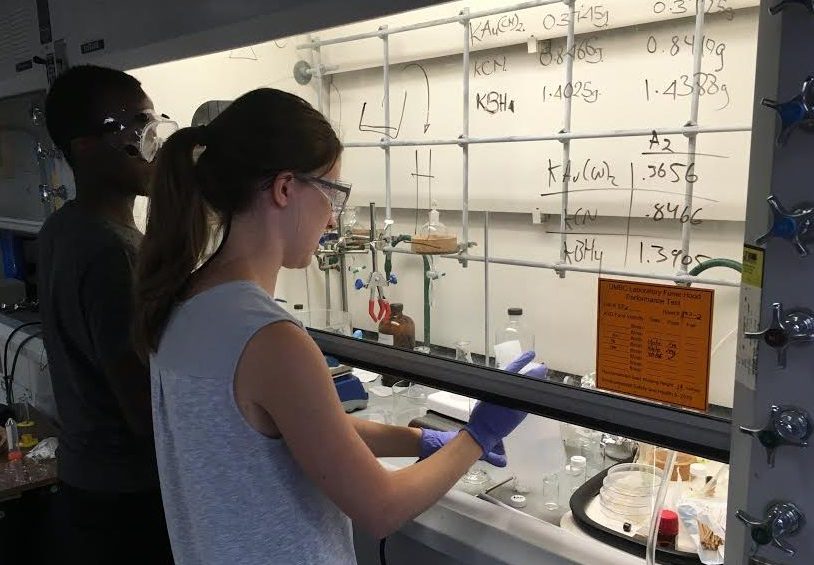
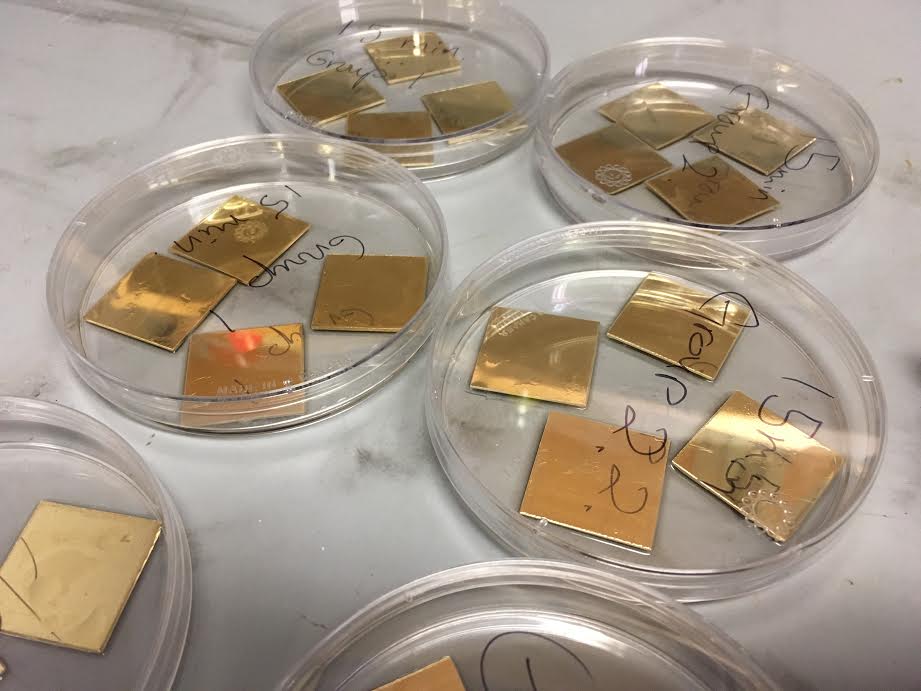
Header: Students tour the conservation labs at the Walters Art Museum; photo Jason Putsché. Top image: Sam Maina (l) and Marie Desrochers (r) work in the lab. Bottom image: Gold-plated “coupons” on which Maina, Desrochers, and Taylor will test cleaning techniques. Photos by Sarah Hansen.

Hacking the Real World: Donor support gives students hands-on experience in their fields

This spring, more than 350 students joined in this year’s annual HackUMBC, a 24-hour “tech innovation marathon” where participants were challenged to come up with creative solutions to specific challenges. The slogan: “Dream big. Make it happen.”

Students worked individually and on teams to build projects, or “hacks,” which were judged on technical complexity, elegance, and creativity during an expo at the conclusion of the event.

Contrary to popular belief, not all hacks require computer coding. “We call it an idea marathon,” explains Michael Bishoff ’16, computer science, a founder of HackUMBC. “It doesn’t have to be an app or a computer program.” In the past, participants have built tangible things like pop-up showers and coffee makers. Next year, HackUMBC would even like to incorporate a social good component, challenging students to come up with solutions to societal challenges.

“I’m trying to see where tech could come into play for disadvantaged groups,” says current HackUMBC co-president Celestine Wong, a rising senior studying computer science and social work. “I find a lot of joy in doing good for someone else.”

Wong’s dual major in social work and computer science has fueled her interest in finding real-world intersections between the fields, and she’s not alone. Many hackathons focus on how hacks can make the world a better place. As both Bishoff and Wong point out, these events can be great resume builders, but they’re even better when they create an opportunity to help the community.

The event has drawn interest and sponsorship support from a variety of leading tech companies and government agencies. Dan Hood ’01, computer science, is the chief technology officer for one of those companies, ClearEdge IT Solutions, which provides provides software engineering and data solutions and services. Hood says that for ClearEdge, getting involved with UMBC and the hackathon makes sense — it gives their company a chance to see some of the brightest upcoming students, and they get to help those students by providing learning opportunities and exposure to the career options that await them.

“I think it’s important to support the next generation of the workforce,” says Hood.

The National Security Agency (NSA), a top employer for UMBC alumni, provided “technical talks, mentors, and recruitment opportunities” for students during the event, says Kathy Hutson, NSA’s associate director for human resources.

“NSA and UMBC work closely together to help build the leaders of today and tomorrow to ensure that the Agency can protect and defend the country,” Hutson explained. “UMBC graduates have contributed greatly to our mission and we are proud of all we have accomplished together.”

Tenable Network Security, a firm that provides comprehensive security technology solutions, supports the Hackathon because it values UMBC’s educational initiatives, its students, and its cyber-focused extracurricular activities.

“The platform UMBC provided, which allowed companies to help students with hacking-related questions, was very useful in creating an innovative and collaborative atmosphere,” said Tenable Network Security’s spokesperson.

That innovative atmosphere goes a long way to helping students gain the valuable real-world experience they’ll need to land a job. In fact, those extracurriculars can help students stand out amongst a crowd of applicants.

“While classroom experience is fantastic, we encourage students to engage in personal projects that help them apply the skills learned within the curriculum,” says Tenable Network Security’s spokesperson. “These are qualities of very successful employees at Tenable and something we feel is important for students to realize early on.”

Hands-on experience is one of the chief benefits of HackUMBC, says Bishoff. “It’s like a 24-hour recruiting event,” he explains. “The students who come to these events are passionate about programming. They’re the kinds of people who want to work on weekends.”

Hood adds that the Hackathon gives students the chance to work in a team environment, navigate the stress of a time crunch, and be innovative. “To see [participants] go from nothing to concept to prototype in a day is pretty remarkable,” he says.

See more news coverage: http://technical.ly/baltimore/2016/03/07/5-innovative-projects-hackumbc/ AND https://umbc.edu/students-turn-ideas-into-inventions-at-hackumbc-tech-innovation-marathon/

Learn about Hack UMBC: https://hackumbc.org/

HackUMBC was sponsored by Tenable Network Security, ClearEdge IT Solutions, the NSA, McCormick, TowerSEC, Northrop Grumman, PayPal, T. Rowe Price, VentureStorm, Namecheap, Soylent, Google, and Square.

— Meredith Purvis

New mentoring program connects refugee youth in Baltimore with opportunities to pursue a college education

A new college access mentoring program for refugees in Baltimore has demonstrated tremendous success in its first year, with all of the graduating seniors in the program accepted into college.

College JUMP (Journey Upward Mentoring Program) started last year through the Baltimore City Community College (BCCC) Refugee Youth Project (RYP) in partnership with The Shriver Center at UMBC. RYP operates a series of programs that work with refugee youth in Baltimore City and County.

Christina Smith ’15, global studies, Sondheim Public Affairs Scholar and Honors College member, serves as the coordinator for the program as UMBC’s Maryland-DC Campus Compact (MDCCC) AmeriCorps VISTA. She says the goal is to work with 11th and 12th grade refugee students to provide a near-peer college access mentoring program.

College JUMP has three areas of focus: college exploration, applying to college, and college preparation. Each refugee student in the program is paired with an undergraduate college student who works closely with them to provide resources and assistance throughout the college application process. College JUMP has a team of four undergraduate students who serve as mentor leaders.

“We want to make sure students start that first day of college feeling prepared for success,” explains Smith.

Francine Mukobwajana graduated from Western High School earlier this year and is starting at UMBC in the fall as a biochemistry major. She participated in the program last year and was mentored by Asma Qaiyumi ’17, biology and psychology.

“UMBC was my first choice,” shares Mukobwajana. “Asma helped me a lot. I moved here in 2014, so everything was new to me, but I really appreciated working with Asma.”

Mukobwajana says Qaiyumi helped her by identifying scholarships, senior year activities, and navigating the college application process. Part of College JUMP also included a campus visit to UMBC.

“A big part of the preparation is seeing a campus and seeing students going to class, events, and leading tours,” says Qaiyumi. “All of that is important for students like Francine to know.”

The origins of College JUMP are traced back to when Jodi Kelber-Kaye, associate director of the Honors College, received a BreakingGround grant to partner with community organizations for her race, poverty, and gender in Baltimore seminar. In 2013, her class worked with the International Rescue Committee (IRC) to create a proposal for encouraging refugee families to remain residents of Baltimore City past their initial resettlement period. After the director of the IRC asked about creating a college mentoring program for refugee youth, her 2014 seminar students partnered with Brittany DeNovellis at RYP to design such a program.

Eloise Grose, Shriver Center program coordinator for service-learning, partnered with Kelber-Kaye and others on campus to get the College JUMP funded and started through a MDCCC AmeriCorps VISTA grant.

DeNovellis, RYP volunteer specialist, was instrumental in the creation and implementation of the project and worked closely with Grose to create the grant proposal to receive funding and also serves as a co-supervisor for the program. Kursten Pickup, RYP coordinator, also assisted in the grant writing process.

Three years later, College JUMP was a tremendous success in its first year and has provided opportunities for refugees to continue their education and remain in the Baltimore region.

“If you think about what a refugee family endures, they leave their home country for reasons that are traumatizing for them, and are eventually relocated to the U.S.,” says Kelber-Kaye. “So it’s important for UMBC students to provide welcoming and supportive environments for refugee youth and families as they navigate this complicated aspect of US culture.”

Building off of incredible results this year including a 100 percent college acceptance rate and FAFSA completion rate, Christina Smith says there are plans to expand the number of students served and add more activities to the program for next year. Thirteen students completed a full year of programming, and an additional 31 students attended events and workshops focused on college access.

“UMBC values diversity among students and open mindedness and acceptance of a wide range of cultures and backgrounds,” says Smith. “The refugee community in Baltimore can be such an asset not just to the university but to the city and the state of Maryland.”

Any UMBC student who is interested in serving as a mentor for the program should contact Christina Smith at csmith24@umbc.edu.

For more information about service-learning at UMBC, contact The Shriver Center.

For more information about the Refugee Youth Project, visit www.refugeeyouthproject.org.

Image: Photo by Brittany DeNovellis. A group of mentors, students, and a Chesapeake Hall resident pose at the College JUMP kickoff event. 

Why are fairy tales so fascinating, and what can we learn from them?

Why are fairy tales so irresistible? Honors College Professor Ellen Handler Spitz recently joined the Jesse Mulligan program on Radio New Zealand to explore the topic.

During the segment, Spitz, who has conducted extensive research on children, psychology, and the arts, explained that fairy tales are powerful because “they give us access to a world of imagination throughout our culture.”

“They are such marvelous connectors. They take us back historically, and everybody knows these tales,” Spitz explained. “What’s so curious is nobody has to learn them.”

Spitz also described why scary fairy tales can be good for children to read and experience at a young age. She explained how it can be healthy to learn from them by discussing them with an adult throughout the process.

“The fears that children have don’t only come from the outside world and they don’t only come from the stories that they are told,” she said.”There are fears that come just simply from the process of maturation and you cannot sanitize the world,” adding, “…fairy tales in stories and all forms of art are kind of like a safe space, especially when you as the adult are there and think the child might be afraid of something, you can stop and talk to the child and discuss it. ”

Listen to the full segment “Why scary fairy tales are good for kids” on the Radio New Zealand website.

Image: Crane, Beauty and the Beast (London: George Routledge and Sons, 1875) 

Kimberly Moffitt reflects on community responses and reactions to recent violence across the country

Kimberly Moffitt, an associate professor of American studies, joined The Baltimore Sun’s “Roughly Speaking” podcast with Dan Rodricks on July 20 to discuss reaction surrounding recent shootings across the country.

In a lengthy segment that covered a range of issues, Moffitt described how she has been talking about the news with her children.

“I’m speaking as a mother right now by saying I really struggled with making the decision to even watch and put those visual images in my head because I knew I then had to process what this means for my own children,” she explained. “This is my mantra in my classroom as much as it is in the realm of being a parent is trying to talk to them about how human beings right now are really struggling with how to treat each other fairly and nicely in many respects…that whole sense of humanity seems at a loss for many people.”

Moffitt also responded to reaction and criticism surrounding President Obama’s remarks at the Dallas police officer’s memorial.

“He at the end of the day is still the leader of this country, and we need to hear him lead,” Moffitt said. “To offer his condolences, that’s part of it, in terms of the healing beginning, but there is also a need for our leader to lead us by saying here is what we need to set our sights on, here is what we need to be thinking about, and here is what we need to be working toward in order to move past these types of major and horrific incidents.”

Listen to the full podcast titled “Black lives, blue lives, and what we tell our kids,” on The Baltimore Sun website.

Image: Kimberly Moffitt speaks to students in her class. Photo by Marlayna Demond ’11.

Lauren Edwards helps bring clarity and understanding to questions surrounding this year’s election

A new eight-part series at Towson Library aims to answer questions and inform citizens about this year’s election process. The series, which started last week, is organized by School of Public Policy Assistant Professor Lauren Edwards.

Lauren Edwards

The “Voices on Government” series, recently featured in The Baltimore Sun, began July 13 with a discussion led by experts from the Maryland legislature and national committee members from the Democratic and Republican parties about the Republican and Democratic conventions. The first event included an explanation of the delegates and how party platforms are formed.

“In these times of polarization, with people talking past each other, it’s important that we have these types of open discussions in public places,” Edwards said in The Baltimore Sun article.

She explained that she was inspired to start the series when thinking about how many citizens grapple with questions surrounding how politics and elections work.

Edwards is partnering with the The League of Women Voters of Baltimore County for the series, with support from the Friends of the Towson Library and the Baltimore County Public Library. The UMBC School of Public Policy is also a sponsoring organization.

Other topics throughout the “Voices on Government” series include gerrymandering, immigration, the Electoral College, and money in politics, among several other issues.

“We wanted to think about which topics were most useful when,” Edwards said.

Read the full article “Series at library seeks to answer this year’s election questions” in The Baltimore Sun.

Image: Voting in Baltimore. Photo by  Jay Baker, CC by 2.0.

The Chronicle names UMBC a “Great College to Work For” seven years in a row

The Chronicle of Higher Education has named UMBC an outstanding academic workplace for the seventh consecutive year. UMBC is one of only 80 universities to receive the “Great Colleges to Work For” distinction and the only Maryland four-year institution to be recognized.

Each year, the Chronicle surveys faculty, staff, and administrators and asks them to rate their workplaces on a variety of factors. The assessment also includes analysis of demographic data and workplace policies. The Chronicle’s 2016 results are based on responses from more than 45,000 people at nearly 300 public and private, two-year and four-year institutions nationwide.

2016GCWFHonorRoll_TM_newFor the fifth consecutive year, UMBC was featured on the Chronicle’shonor roll,” which recognizes universities that excel in almost every recognition category. Among those categories, UMBC was recognized for its strong shared governance model, vision and strategy of its leadership, and the university’s continued investment in teaching and research.

This year, UMBC was highly rated in the following categories:

  • Collaborative Governance
  • Confidence in Senior Leadership
  • Professional/Career Development Programs
  • Respect and Appreciation
  • Supervisor/Department Chair Relationship
  • Teaching Environment
  • Tenure Clarity & Process
  • Work/Life Balance

“This ‘Great College’ recognition reflects the commitment and dedication of the people who work here,” says President Freeman Hrabowski. “It affirms what we all know: UMBC is a place that supports people, values collaboration, and fosters trust, respect, and enthusiasm for helping our students succeed.”

The Chronicle’s acknowledgment caps a month of national recognition for UMBC. Forbes and MONEY both released their rankings in early July, naming UMBC a top public university. UMBC was also recognized for its stellar academics and supportive community in the latest edition of the Fiske Guide to Colleges.

Image: UMBC’s main campus, outside the University Center and Academic Row. Photo by Marlayna Demond ’11 for UMBC.