All posts by: Jenny O'Grady


Wilderness Warriors

You’re hiking in the woods. A branch snaps…and suddenly you’re on the ground, immobilized by pain. As the sun begins to set, you wonder what you’ll do next, and who might come to your rescue…

Wilderness Warriors

It takes intense training to rescue and provide excellent medical care to patients under normal, predictable circumstances. To do the same thing in untamed wilderness? Well, that takes an extra layer of grit.

That’s why each spring for the last 33 years, UMBC’s Emergency Health Services (EHS) program has sent a group of hardy students deep into the forest to learn the finer points of search and rescue. Over the course of three days, in remote Garrett County, 17 students in this unique program will practice everything from orienteering to “dead reckoning” and learn to be a team – all under the careful watch of a community of alums and emergency volunteers.

No matter the weather, these Retrievers are ready for anything.

Story by Jenny O’Grady
Photographs by Marlayna Demond ’11


“Everybody Helps Everybody”

A fresh layer of snow covers Abbott’s Orchard, a small clearing near the lodge in New Germany State Park where students will spend their weekend training. The first challenge: pitching tents in less-than-optimal conditions. Later, as the teams gather at benches in units to compare notes and brace themselves for the weekend ahead, they meet the more than 30 alumni and friends from across the EHS program’s history and nearby rescue operations who will teach them everything they know – including bear safety.

“The biggest thing that draws them back is the camaraderie, and the fact that they overcome adversity together,” says Cole Brown ’88, EHS, who leads the training staff for the weekend. Through that, “they build friendships, and they learn how to put aside their personal views and from there come to be a team. So they go from being an I to a we.”

[nivoslider id=”4172″]


Spider Straps and Stokes Baskets

Emergency personnel refer to the “golden hour” as the all-too-limited time between the occurrence of an injury and the best window of opportunity for care to be given. Finding success as a rescuer means not only understanding how to use the best tools for the job – but how to do it quickly and carefully. To prepare for real-world rescue scenarios, EHS students practice everything from orienteering – using compass and paces to estimate locations in unknown terrain – to strapping victims with unknown injuries to back boards, to rolling them safely to care in a wheeled basket. They also study standardized lost person behaviors.

“This training is absolutely essential in wilderness medicine because you can’t always get a helicopter to the scene,” says Jeff Mitchell, a clinical professor in the department, who has run this exercise since its start in 1983.

[nivoslider id=”4259″]


Sweep and Clear

With tools and equipment skills at the ready, students take to the woods searching for clues – and hoping to find their patients in time to be helpful. Alumni like Raven Gronsbell ’15, EHS, who now works as a paramedic in Kent County, volunteer to act as “victims,” often sitting quietly for hours in the woods before being found by student rescuers.

“I will be out there sitting in the woods… waiting… and hoping they’re fast,” says Gronsbell, who in a nighttime search portrayed “Casey Wood,” a teen who wandered away from her family while exploring. Gronsbell spoke so highly of the class that her math major sister, Jessica, decided to take part this year. “I also really enjoy helping out with the training. That’s why I come back.”

[nivoslider id=”4281″]

Read more about the EHS program: Practicing What They Preach

Isabel Geisler, Reach Initiative founder, to pursue Ph.D. in sociology

Isabel Geisler
B.A., Global Studies
Cum Laude
Hometown: Middletown, Maryland
Plans: Ph.D., Northeastern University

At UMBC no one has ever told me to temper my ambitions. It was here I learned the adage of not asking if I can do something, but how I can do it. UMBC gave me opportunities I don’t think I could have gotten from any other university.

As a UMBC undergraduate, Isabel Geisler learned quickly that perseverance and planning would serve her well both academically and in bringing to life new initiatives to expand opportunities for others.

Encouraged by her professors to think critically about social problems, and to take action to address them, Geisler created the Reach Initiative, a support program for Baltimore high school girls interested in STEM. The program is based on three pillarsmentorship, research and empowermentand officially launched in 2016-17 with 20 mentors and 20 mentees, after years of intensive research, careful planning, and partnership-building, and a pilot in 2015-16.

Geisler also served as a research assistant for Felipe Filomeno in global studies, and combined her research and service interests through travel to Honduras, where she studied how fair trade coffee could empower women. She later presented her findings at UMBC’s Undergraduate Research and Creative Achievement Day.

A Sondheim Public Affairs Scholar and France-Merrick Fellow, Geisler is also a Jacqueline Hrabowski Scholarship recipient, a 2016 AAUW Campus Action Project grantee, and the recipient of a Ricardo Salinas Foundation Scholarship. She has served as a youth member of the National Commission on Social, Emotional, and Academic Development, and has remained engaged in the UMBC community through the Student Government Association and the UMBC Stilettos a capella group.

Geisler plans to pursue a Ph.D. in sociology at Northeastern University.

Portrait by Marlayna Demond ’11 for UMBC.

Faith Kamei, committed to community, prepares for Peace Corps service in Peru

Nyenpu “Faith” Kamei
B.A., Psychology and Social Work
Hometown: Germantown, Maryland
Plans: Peace Corps, Peru

UMBC provided me with an environment in which I was surrounded by like-minded individuals who were passionate about supporting my personal and professional goals. In my time here, I have been pushed beyond my comfort zone and I have been challenged to perform beyond by perceived capabilities.

Faith Kamei immigrated to the U.S. with her family from Liberia 12 years ago, and when it came time to decide on a university to attend, she knew that staying near her family in Montgomery County would be essential, but she was also excited by the possibilities of UMBC’s programs in psychology and social work. Kamei took what turned out to be an ideal college path for her, spending two years at Montgomery College before transferring to UMBC’s location at the Universities at Shady Grove (USG).

At UMBC at USG, Kamei became an active campus leader, and refined her plans for a career of serving communities. Kamei became a member of the campus Student Event Board, focused on supporting a vibrant campus life, served as a representative on the student council, and served as a student ambassador for the campus. Over time, her roles expanded to include serving as president of the USG Student Council, the International Club, and a student religious organization, for which she coordinated a banquet to raise awareness of hunger in Montgomery County.

Kamei has also informed and inspired others through sharing her own educational experience and perspective on prominent national platforms, such as through a Washington Post profile and a livestreamed forum on “The Changing Face of Education” through The Atlantic.

Kamei was recently awarded a USG Student Leadership and Service Award. After graduation she plans to volunteer with the Peace Corps, spending 27 months working as a youth development facilitator in Peru.

Image: Portrait by Marlayna Demond ’11 for UMBC.

Erin Callahan to focus on intergenerational trauma in social work graduate studies

Erin Callahan
B.A., Social Work
Magna Cum Laude
Hometown: Silver Spring, Maryland
Plans: M.S.W., University of Maryland, Baltimore

My experience at UMBC has been life changing. The social work faculty and staff are so supportive and encouraging, and this has motivated me to work hard and try things that are out of my comfort zone.

Coming to UMBC, Erin Callahan not only found a “sisterhood” of like-minded adult students, but also a pathway to help victims of trauma.

Callahan is both a Returning Women Scholar and recipient of the Susan Bernstein-Charlotte W. Newcombe Memorial Scholarship. Through her involvement with UMBC’s Women’s Center and the social work program, she participated in events and discussions that helped shape her understanding of areas of need within the community. Having witnessed the effects of intergenerational trauma within her own circles, she hopes to study the root causes of trauma in order to help people early on.

As a member of UMBC’s returning student population, Callahan found “a sisterhood of other adults experiencing similar struggles balancing the demands of life as adult students,” which helped her feel connected and offered her support when she needed it. She shares that her two children have continually served as her biggest inspiration to succeed in her time at UMBC.

Callahan has been accepted to University of Maryland School of Social Work’s Advanced Standing Program, and will next complete her master’s degree in social work.

Portrait by Marlayna Demond ’11 for UMBC.

William Klotz, double alumnus of UMBC, earns Fulbright to teach in Mexico

William Klotz
M.A.T., Foreign Language Education
Magna Cum Laude
Hometown: Baltimore, Maryland
Plans: Teaching in Mexico, Fulbright Program

My “weaknesses” of coming from poverty, having a single mother, having a disability, and being a member of the LGBTQIA community have and always will be my strengths. UMBC helped me realize that.

Coming from a single parent family living under the poverty line, William Klotz often felt like he “wasn’t meant to be in college and…couldn’t succeed,” but at UMBC Klotz came to see his personal experiences and identity as strengths, drawing from them a sense of resilience and drive, and recognizing the value of his unique perspective. Now, Klotzwho earned his bachelor’s degree from UMBC in 2014—is not only graduating with an advanced degree, but also planning to teach abroad through the prestigious Fulbright program.

In his years at UMBC, Klotz has excelled as a student leader as well as in his studies. He has taught Introduction to an Honors University seminars for freshmen, received research grants, choreographed a major dance piece, and served as a STRiVE student leadership coach.

In addition to being a Fulbright-Garcia Robles finalist, he is a Homer and Martha Gudelsky Scholar, completed a summer research fellowship in comparative literature at UC-Irvine, and received an Alliance for Language Learning and Exchange grant in Chinese at Washington University in St. Louis.

After graduation, Klotz plans to move to Mexico to teach for the Secretaría de Educación Pública for the 2017-18 academic year.

Portrait by Marlayna Demond ’11 for UMBC.

Dylan Rogers Elliott, leader of award-winning UMBC Mock Trial team, heads to law school

Dylan Rogers Elliott
B.A., History
Summa Cum Laude, Certificate: Honors College
Hometown: Broomes Island, Maryland
Plans: University of Maryland Carey School of Law

I am leaving UMBC with a much wider knowledge of the world. Attending UMBC alongside such a diverse group of students…exposed me to very different ways of thinking about the world, as well as many different cultural, racial, religious, socioeconomic, and national backgrounds.

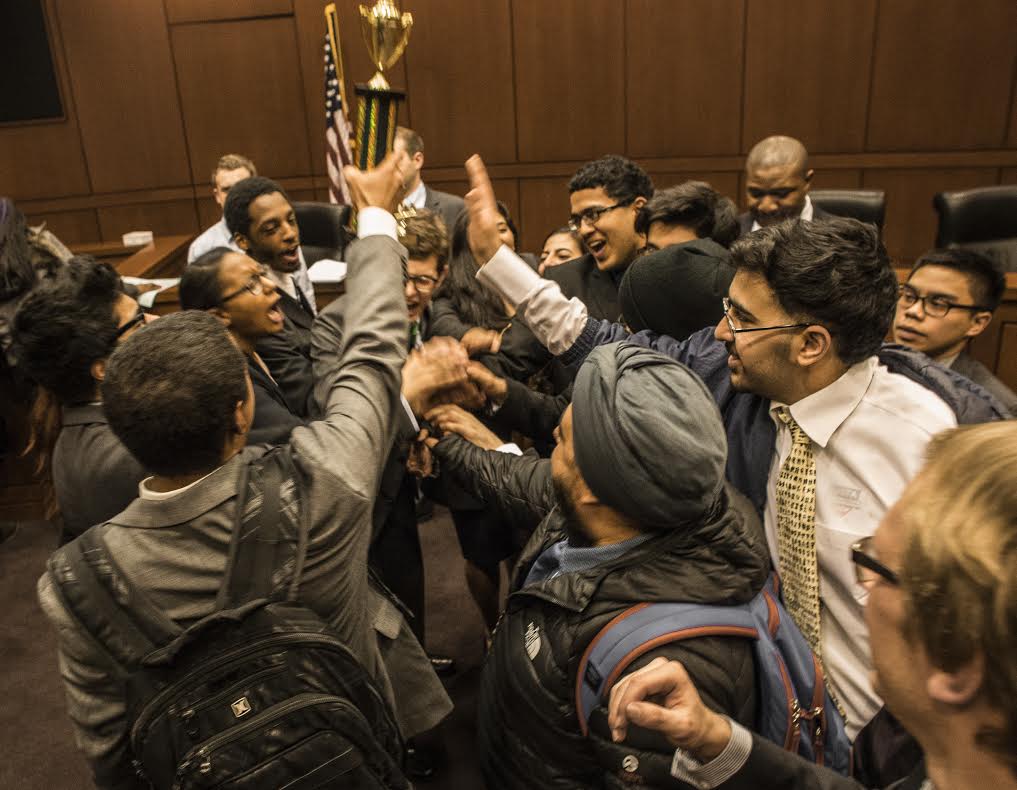
Dylan Elliott came to UMBC determined to become involved in his community by working with others. Four years later, he’s graduating from UMBC having helped lead the award-winning UMBC Mock Trial Team to its first appearance at the American Mock Trial Association’s National Championship Tournament.

Elliott has served in several leadership roles, on the Humanities Scholars Program Senate, Residential Life Peer Review Council, and Honors College Council. He has supported students as a career peer advisor in the UMBC Career Center, and served as arts, humanities, and social sciences editor for the UMBC Review. He also received the UMBC Student Affairs Leadership Award this past April for his campus leadership over the past four years.

Through a variety of experiences, Elliott has studied the legal profession, history of governance, and the work of policymakers. For his senior capstone project, Elliott spent hours in the Maryland State Archives researching Maryland’s chief tax official at the end of the Revolutionary War. His work earned the history department’s Joseph D. Reese Memorial Prize for best essay on a historical topic. He has also interned in the chambers of the Hon. Wanda Keyes Heard ’79, political science, in the Calvert County State’s Attorney’s Office, and worked as a legal assistant for the Dorsey Law Firm.

Next, Elliott will pursue his J.D. degree from the University of Maryland Francis King Carey School of Law, with the intent to focus on civil rights and criminal law en route to a career as a public defender.

Portrait by Marlayna Demond ’11 for UMBC.

Giving Back – Greg Cantori ’84, Geography

Greg CantoriThere’s a conventional wisdom that nonprofits should be run like businesses. Be accountable. Watch the bottom line. But Greg Cantori ’84, geography, argues that this thinking’s just as useful the other way around.

“Businesses need to be run more like nonprofits,” says Cantori, 52, who was appointed in October as president and CEO of Maryland Nonprofits – an advocacy group for the state’s more than 1,400 nonprofit organizations.

Corporations can learn from nonprofits, for instance, that social responsibility shouldn’t be an add-on. “It needs to be embedded into the corporate structure,” Cantori explains. “The best companies to work for watch the bottom line and take care of others.”

Cantori illustrates his point by reaching for a bag of Michele’s Granola. He points out that Michele Thornett has made a success of her Timonium-based business by employing forward-looking strategies that are as good for the environment as they are for the spread sheet.

“Everything we do has an impact on others,” he observes.

Cantori has just about finished moving into his Hampden office. Photos of his sailboat rest against the wall, waiting to be hung. Parked by the door is the bike he uses to commute each day to the Pasadena home he shares with his wife, Renee,  and their two daughters.

As head of Maryland Nonprofits, Cantori leads an organization that does more than advocate for this key sector in the state’s economy. The group also seeks to educate and engage those who run nonprofits and strengthen their organizations, offering advice on everything from fundraising to social media, and helping to develop policies and create uniform standards for excellence. It even does group buying for things like health insurance and copier services.

Cantori’s UMBC roots have stayed strong. His late father, Louis J. Cantori, was a longtime political science professor and rowing coach at UMBC. His brother, Eric Cantori ’86, computer science, is also an alumnus. And he also has two nieces in the classes of 2013 and 2014.

As a student, Cantori worked with Thomas D. Rabenhorst, director of instructional cartography in UMBC’s geography department, to produce a bicycle map incorporating slope for Baltimore City and County. “I absolutely loved cartography,” he recalls. Cantori even field tested the routes himself.

It is a “landmark work,” says Rabenhorst. “We’ve used it as a model for a number of other bike maps we’ve produced over the years.”

Now, Cantori is thinking about combining cartography and fundraising to improve Chesapeake Bay water quality. He recently met with Rabenhorst, as well as Joseph School and Sandy Parker of UMBC’s geography department to develop a graduate project in waterfront GIS (geographic information systems) database and mapping. The project will likely start as a small scale study before taking on the mapping thousands of miles of shoreline, but Rabenhorst says he’s delighted to work with a former student who has “a heart for humanity — and people in general.”

That sympathy for others and the desire to put it into action is partly why Cantori moved from a successful post-graduation career in the defense mapping industry onto his present path.

“Nonprofits have always been part of my life,” says Cantori, who also holds an MBA from Loyola University. He’s worked on both sides of the equation as a director of operations with the Marion I. & Henry J. Knott Foundation (a key source of philanthropic giving to Maryland nonprofits) and helping run nonprofits including the Downtown Sailing Center and Light Street Housing – a nonprofit that endeavors to move people from homelessness to homeownership.

Cantori’s heart – and his savvy as a businessman and leader – are going to be necessary as he helps guide Maryland nonprofits through the continuing challenges of a recession that tamps down philanthropic giving and the effects of a federal government sequestration process that is only beginning to be understood.

Donations to nonprofits may drop in a worsening economy, he observes, but the human capital of volunteerism may increase in that climate.

“Philanthropy is something we can do all the time,” Cantori says. “You can see it making a difference.”

–  Mary K. Tilghman ’79

Did you know UMBC still produces a bike map? Get one here for $5.

Discovery – Summer 2013

CENTER STAGE

On a hazy day in Baltimore, Ray Hoff can tell you if the smog that you see is from the Midwest, from Quebec, or from Baltimore itself.
Hoff, a UMBC professor of physics and senior science advisor to the Joint Center for Earth Systems Technology (JCET), began his career at Environment Canada with two projects: studying the deposition of toxic chemicals in the Great Lakes and looking at particle concentration in the atmosphere using a laser technology called LIDAR (Light Detection and Ranging) to take those measurements.
When Hoff moved to UMBC in 1999 to become the director of JCET (a collaborative center run by UMBC and NASA’s Goddard Space Flight Center), he abandoned chemical research to concentrate fully on efforts using LIDAR.  Yet Hoff’s desire to use research to explore environmental concerns never waned.
“I remained interested in thinking about what kinds of things a physicist could apply to environmental problems,” he recalls.
Hoff’s thinking eventually took the shape of what’s now known as the “Smog Blog” – a website he started with Jill Engel-Cox, ’04. Ph.D., marine estuarine environmental science, in 2004. The website merges real-time satellite imagery and air quality data with analysis of air pollution across the United States for people interested in air quality. It’s been a tremendous success, logging more than 50 million hits during its first eight years.
Hoff’s arrival helped boost UMBC’s research culture by expanding its funding base. “The university,” he says, “was hungry to increase its research portfolio.” So Hoff got to work. During Hoff’s tenure as JCET director, the university brought in $130 million to be spread out over 10 years for GEST (Goddard Earth Sciences Technology Center) from NASA, and an additional $18 million for JCET which was spread out over five years.
These centers brought significant research dollars to the UMBC between 2000 and 2005.  And with that funding came recognition. From 2001 to 2005, UMBC ranked third in the number of published earth science citations according to an analysis by Thompson-Reuters (ISI).
“These research centers were critical in helping transform UMBC to a research class university,” Hoff says.
This year Hoff won the NASA Distinguished Public Service Medal for the use of satellite data in the study of pollution and bringing public awareness to NASA research for projects including the Smog Blog. Hoff joined such luminaries as Carl Sagan and Robert Heinlein in receiving the prestigious award.
At the end of June, Hoff will retire from UMBC to pursue other interests while also keeping a hand in science research. One of his activities may come as a surprise after a career spent using lasers to help study the skies.
“I’m thinking of writing a book on the Spanish Civil War,” he says.
– Nicole Ruediger

COMMUNICATING WITH COLOR

Fish communicating with color

Animals have all kinds of ways of communicating – colors, smells, sounds, dances. Indeed, the diversity of communication channels can make it difficult to figure out exactly why animals make the choices they do.
“Most of the time, we don’t know why different species – such as cardinals and blue jays – don’t mate with each other,” says Tamra Mendelson, an associate professor of biology at UMBC. “Is it because they’re different colors, or because they have different songs?”
The streams of Kentucky may just have an answer. Mendelson and a UMBC graduate student, Tory Williams, work on two closely-related species of small fish, called darters, which are found in the waters of that state. Like many animals, including birds, male darters are brightly colored. Female darters have a drab brown color.
Darters can’t communicate with song, so Mendelson and Williams hypothesized that female and male darters may base their mating preferences on the coloration of the opposite sex in their species.
“There are many examples where you have groups of closely related species that seem to differ almost exclusively in color,” says Mendelson. “And it’s almost always the males that express this color. So the default assumption is that when they’re together in nature, the females are attracted to the colors of their own species and that’s how they tell each other apart. But really there’s been pretty poor evidence for that.”
To test the idea experimentally, the researchers selected two species of darters (one with reddish males and one with greenish males) and then built color models of them. These “fish decoys” – which look something like a fishing lure – were attached to a long stick that was rotated back and forth using a motor to simulate swimming behavior. Each model was then placed on the opposite end of a tank from the other behind a plate of glass.
Eventually, a real female was added to the tank and allowed to acclimate. The fish would then make a selection. Mendelson and Williams found that each darter in their experiment selected the model of the opposite sex that most closely represented its own species.
Using models of darters instead of actual fish ends up playing a key role as a control for the experiment.  “If you were to use live fish to see if a female was attracted to a live green male or a live red male,” explains Williams, “you couldn’t control for how those males decide to behave.”
The researchers say that the study tells us just as much about how animals think as it does about how they mate. The darters’ colors, for instance, may have evolved due to different evolutionary pressures and could convey different information. The red coloration might reflect good diet. The green color might express good camouflage.
“We think of colors as their own specific language,” says Mendelson. “So each species has a different language.”
Williams agrees: “We learned that these colors have a biological role in these fish. The fish see these colors and they are meaningful to them.”
– Nicole Ruediger

NOW HEAR THIS

For all the world to hear event image

When UMBC’s Center for Art, Design and Visual Culture (CADVC) brought its award-winning exhibit For All the World to See back for a triumphant return to campus after a national tour, the center also extended the reach of the project beyond those images and into another realm: storytelling and oral history.
This affiliated project, titled For All the World to Hear: Stories from the Struggle for Civil Rights, was created as a collaboration between CADVC and Heritage Theatre Artists’ Consortium founder Harriet Lynn. The project was curated by Sandra Abbott, the CADVC’s  curator of collections and outreach, and it received funding from the Maryland Humanities Council.
Lynn recruited veterans of the Civil Rights movement to tell their stories on stage, seeking them out via advertisements in publications read avidly by seniors in the Mid-Atlantic region.
“I was looking for diversity,” Lynn says. “Different voices. Some actively engaged in the Civil Rights movement, and others who were supportive of it.”
The participants whom she gathered together shared deep personal connections to the movement. Robert Houston is a photographer who covered the 1968 Poor People’s Campaign for Life magazine. Patricia Brown Leak, a former music educator in Washington, D.C., talked at length about her family’s involvement with the movement – and specifically the prominent role played by her brother, H. Rap Brown, who was head of the Student Nonviolent Coordinating Committee and Minister of Justice for the Black Panther Party. Another member of the performing troupe, Deryck Charles, was born in South Africa, studied at Cambridge University, and joined up with the Freedom Rider movement in 1961.
“We were very lucky to get the wonderful people we got,” Lynn observes.
Many of the stories told by the project’s participants – augmented by song and simple props – recounted the small indignities and insults of an American society steeped in racism and unwilling to change its ways. Yet as For All the World to Hear built to its climax, the participants shaped their accounts of the brutality of the nation’s racism – and the determination required to overcome it – into intensely harrowing personal tales.
The price paid by some of the storytellers was heartbreaking. In a few vignettes, John and Shirley Billy recounted the story of his blossoming career as a singer and the almost instant love that John (a young black man from Washington, D.C.) and blue-collar Irish girl Shirley felt for each other upon meeting. But their subsequent marriage (which is still going strong after 54 years) and the birth of their son left the couple at the mercy of Maryland’s harsh miscegenation laws – which landed Shirley in jail and compelled them to place their child in an orphanage for a time.
These stories of police beatings and incarcerations and contempt and insult remain powerful and poignant despite the fact that America’s Civil Rights struggle – while continuing – has scored immense and important victories. By showcasing the voices of those who worked and suffered to win those victories unite in hope and song at the end of For All the World to Hear provides another window into the tragedies and triumphs of our shared history.
 – Richard Byrne ’86
– Watch a video from For All the World to Hear here.

FAULT LINES

When disastrous events take place, it’s common to try to find a single person to hold responsible for failure.
“It was George Bush. It was Dick Cheney. It was Michael Brown. It was [British Petroleum]’s CEO,” says John Rennie Short, a professor of public policy at UMBC. “In other words, there was one person, a bad person, to blame.”
But Short urges caution in settling on singular scapegoats. In Stress Testing the USA: Public Policy and Reaction to Disaster Events (Palgrave Macmillan), he examines four major traumas the United States experienced from 2000 to 2010:  the Global War on Terror, the flooding of New Orleans after Hurricane Katrina, the global financial meltdown, and the Deepwater Horizon spill in the Gulf of Mexico.
“The point of the book was to move beyond the surface appearance [of what caused each event], to move beyond the easy points of criticism, and to look for much deeper and more profound structural concerns,” Short explains. “I think we’ve missed some profound lessons if we don’t look at these things in some detail.”
Analysis of Katrina, for instance, reveals a chain of responsibility that includes local, state and federal elements. Environmental policies that led to the erosion of coastal barriers over 50 years set the stage for catastrophe. When the storm hit, Short explains, “it was not the hurricane itself that drowned New Orleans, but the failure of the levees.”
The idea of a stress test to assess stability or health is concept that is familiar from engineering and medicine. The application of pressure to a material or a human being can help reveal weak spots – preferably before any collapse. Short says that disasters can provide a similar test for larger elements of our political and economic infrastructure.
“Stress testing is really a form of looking at the effects of big pressures on a system,” observes Short.
In Stress Testing the USA, Short identifies specific structural flaws with the potential to fracture our nation: a large, active military that promotes a state of permanent war; an aging physical infrastructure with bridges and roads that receive failing grades; financial and corporate deregulation; and a blind acceptance of major institutions’ increasingly risky behavior.
Identifying these systemic problems also clarifies broader concerns for Short, particularly the problem of “cognitive capture.”
Cognitive capture involves paying attention only to what is immediately in front of us, to the detriment of the less clearly visible. In terms of disaster prevention, cognitive capture can mean sidelining unpopular perspectives or more subtle voices that might alert us to possible threats.
“There were people who argued that the invasion of Iraq was wrong, people who said that there was a housing bubble, people who said that the levees were inadequate, people who said that the oil drilling was becoming more dangerous,” Short emphasizes.
But as alarming as the disasters and structural problems in the book are, Short’s goal is not to simply scare readers; it’s to inspire action.
“Almost all these events were completely predictable when you look at the underlying structural flaws,” says Short. “For every event there was a small group of people who knew exactly what was happening, we just didn’t listen to them. So the point of the book is we should be more careful and more attentive to alternative, dissident voices.”
—Dinah Winnick
Watch a video interview with John Rennie Short here.

Back Story – Summer 2013

The Hrabowski Fund for Innovation – established in honor of UMBC President Freeman A. Hrabowski, III, to help UMBC faculty pursue new approaches to teaching – made its inaugural awards in January. Among the recipients were Marie desJardins, a professor of computer science and electrical engineering, Nagaraj Neerchal, chair of the department of mathematics and statistics, and Leslie Morgan, a professor of sociology and anthropology.

Each project pushed UMBC’s already burgeoning culture of curricular innovation and pushed it into new directions and disciplines. DesJardins created the ACTIVE (Active Computing Teaching and InnoVation Environment) center to create a more collaborative environment for computer science students. Neerchal piloted a new “Math Gym” that allows students to exercise and improve specific mathematics skills. Morgan was the co-creator of a new “Wisdom Institute” that will harness the talents of UMBC’s emeritus professors.   

As the deadline for the next round of the awards approaches on Friday, October 11, 2013, UMBC Magazine asked these awardees what inspires them to think creatively about teaching and the university – and how they took that extra step to make their vision happen.


* * * *

UMBC Magazine: How did you get the idea for ACTIVE?

DesJardins: In some ways, ACTIVE started with the CNMS Active Science Teaching and Learning Environment (CASTLE).  I knew the CASTLE was a College of Natural and Mathematical Sciences thing, so I didn’t know anybody who was in there. But at some point someone mentioned that I might be able to use it for a class I was teaching.

And so I asked: “Would it be possible to use the center for some labs that I was doing for a class?” And it was available. So we did that for a few sessions. It was really nice to have this collaborative space where students can work online on something together. So I was wondering: Why don’t we have these kinds of labs in computer science? What we have now are the kind of sucky ones in the basement of the engineering building, with rows of big monitors that you can’t see past.   So we started talking about: “Wow, wouldn’t it be cool if we had a resource like this.”

I started asking some of the people involved in CASTLE how they had put it together. And around that time our department got a corporate donation from BAE Systems. It wasn’t enough money to do something like the CASTLE, but it was a start. And then our department chair [Gary Carter, a professor of computer science and electrical engineering] said: “You know, I have a space you might be able to use.” So we started to believe that maybe we could do something like this.

When the Hrabowski Fund was announced, I was talking with Penny Rheingans [ a professor of computer science and electrical engineering] and I said: “We have to propose something.” I didn’t know what to propose but knew we had to propose something. And we settled on trying to do something like the CASTLE. But we knew that the Hrabowski Fund money wouldn’t be enough money to build the room. But we thought: “What if we assume that we have enough money from corporate donations to get the room. What would we do with it?”

And that was when inspiration struck. I knew we would never get enough money to build it if we had to buy 50 computers. And we’d never be able to maintain it if there are 50 computers in there. So we thought – what if we had a room like the CASTLE, but more configurable, and we call it a “laptop lab” and we make the students bring their own laptops? So we needed some resources to figure out just how to do that – and all those threads came together in our proposal.

What makes Math Gym innovative? The university already has programs for remediation for students who have trouble with mathematics.

Neerchal: You said the key word: “remediation.” When students don’t have the skills they are supposed to have we recommend that they take a remedial class. The word “remediation” has a negative tone to it, like “rehab.” In the Math Gym we substitute the negative terms with positive words such as “working out” and “building strength” instead of remediation, “coaches” instead of “helpers” or “assistants”.  Students are not going there to work on a deficiency, but they are “working out” to build strength. It’s a paradigm change. If you want to be good at math, you have to work out.

There are a lot of parallels between sports and athletics.  Like sports, Mathematics is also about skill. Just as you don’t build any muscles watching football, you don’t build any skills by just watching your teacher do mathematics.

So that’s why I called this project a “Math Gym.” Students will think of going there as a positive experience.

The “Wisdom Institute” seems to channel the power that emeritus faculty can provide to a campus in a new and attractive concept and name.

Morgan: I triggered the idea unintentionally. I had been doing a lot of work on aging. My research is on aging and the social dynamics of aging. And when I was named the Lipitz Professor of the Arts, Humanities and Social Sciences two years ago, I decided to focus on age and ageism as issues in society.

So I put together my talk, and Craig Saper [professor and chair of the Language, Literacy, and Culture program] came to my talk, and we then started an email exchange about the fact that as a maturing institution, UMBC is seeing a lot more retirements – and more retirements on the horizon – and that there is a lot of talent and experience and wisdom that those people have.

You can think of it as a brain drain or a talent drain or a wisdom drain, but there are a people who remain engaged with UMBC in a variety of ways. And the Provost’s Office had put together a list of ways that people can remain engaged. But there is no entity that brings that to people’s attention, or that actively moves forward to invite people who might be interested in staying engaged to do that.

So the idea of the Wisdom Institute is to both create a nexus where we can identify all of the opportunities, and collect all of these people and utilize their wisdom and experiences – including creating a course that would be more about life skills, and that would bring the experience and wisdom of emeritus faculty to bear on finding a path through life for graduate students, perhaps, or even for faculty and staff.

It has broadened a bit from the original proposal to approach this issue in a more holistic way. There are a lot of organizations in the country for retirees, but some of them are purely social. And knowing the faculty and staff at UMBC, people would like something with a little more engagement, where their wisdom and experience can be put to use at a level that they would like.  It’s a way of keeping our heritage and tradition as part of the momentum moving forward.

UMBC has a tradition of curricular innovation. It also has a tradition of getting things done even when there is a scarcity of funding. How does the Hrabowski Award encourage both impulses at the university?

DesJardins: First of all, these innovations are risky. Sometimes they don’t go so well. And they also represent a lot of effort on the part of the people doing them. I also think that there is great variability across time and space and departments and economic cycles about how much support and recognition there is for that effort.

The reason I came to UMBC was to teach students. At the root, that’s what I care about.  So if it has a benefit for students that is my primary motivator and my primary reward. But after a while of draining yourself to do that, if no one else around you is recognizing that value, it can get tiring/ so it makes such a huge difference when you feel like your efforts are valued.

The funding [provided by the Hrabowski award] is nice, but just the fact that there is a program, and a recognition and visibility is important. When there is an appreciation of the effort and the amount of energy that it takes to do those things, it creates a culture where it snowballs. People start thinking: “Oh, he did that and everybody really liked it.” There’s a glow around that activity that makes people feel like it would be worthwhile for them.

It also makes you feel like you’re not working in a vacuum. The award draws attention to the fact that people are doing these things and that you should do it too – and that we value that effort in our culture.

Neerchal: In our department, certain elements that make up the Math Gym were already being done.

A key piece of Math Gym is Quiz Zero. It started about five years ago. Students take a quiz on day zero – on the weekend before the class begins. Quiz Zero is diagnostics and placement all rolled into one.  Some of our faculty members were doing it and we decided to scale it up for all our foundation courses.

We also have faculty who are giving extra help to students outside the classroom. Bonny Tighe [a senior lecturer in the department of mathematics and statistics], for instance, hosts a Friday afternoon extra office hour for her students in CASTLE. They’re basically doing problems. Math Gym combines these two ideas scaled up to all our foundations classes.

DesJardins: But it’s the commitment. We’re trying to get this space for ACTIVE renovated. We don’t have a huge amount of clout, but we can say that this is associated with the Hrabowski Fund and it helps get it done.

Morgan: You can say this is an entity. And we’ve gotten some funding. We are building.

So the awards provide a certain amount of momentum too?

Neerchal: Freeman mentions Math Gym almost every time I see him speak. The Hrabowski award enabled us to pilot the idea for two semesters. Hopefully we will get to continue to help the students beyond the pilot.

Morgan: That’s one of the hallmarks of the innovation culture at UMBC. People of good will can make it happen. And then it does happen.

DesJardins: Yes and when you get one of these awards you actually do have to make it happen!

Morgan: The award keeps a project on the agenda in a way that you feel responsible for. And we all set our goals and it gives us a reason to fit this in amongst all the different priorities.

Neerchal: We are already up and running. We are in the corridors of the math department. Based on the Quiz Zero scores, we targeted about 750 students with low QuizZero scores, and close to 600 showed up for a total of 1800 visits.  One student came 34 times.

DesJardins: How did he do in his classes?

Neerchal: He did very well. In fact, he told me it was a life saver. And he is a non-traditional student.

A key aspect of Math Gym is what I call “closing the communication gap.” Students are sent to Math Gym by their instructors with the prescription: “You need to work out.” They come to Math Gym. We log them. We have an algorithm to determine a personalized workout plan. We keep track of their hours. When they are done, we provide the instructors feedback: “This student just finished the prescribed workout in the Math Gym.” We’re closing that communication loop.

DesJardins: We have three students who are going to be working for us to support ACTIVE. They are undergraduates who are interested in education and learning and teaching and pedagogy. It creates a lot of energy. We just went over to our space. It was a lab and it’s been disused for a few years. We’ve removed all the detritus. It’s a big open room. We’re going to have moveable furniture and moveable chairs and moveable white boards and projector screens. I was over there with one of these students and she was getting excited and that made me excited too.

Neerchal: Changing the language really helps to generate student interest. When we were recruiting student coaches for the Math Gym, we did not call them “tutors” or “helpers.” Words with negative connotation are out. Instead they are called “coaches.”

DesJardins: Language is important.

Neerchal: We made a call through the instructors for 8 positions, and we had 32 applications. So we decided do a group interview. Forty plus students showed up for the event.

Morgan: There is an Association for Retired Faculty and Staff that exists but the connotation of that is so different than a Wisdom Institute. A lot of these things are about the lens we use to frame the problem.

DesJardins: Our name is an acronym. Tim Finin [professor of computer science and electrical engineering] came up with that. He’s a genius with acronyms, with coming up with names for things that capture the feeling you want people to have. All three of these projects have names that crystallize their sense.

Neerchal:  The name Math Gym is self explanatory. Recently I was introduced to an alumnus, who is a major donor to the university, as the creator of the Math Gym. Before I could begin my explanation, he said: “I wish it was there when I was a student here.”

It was inspiring to see Freeman donate his entire award check to start a foundation dedicated to promote innovation in the campus.

DesJardins: He’s taken this energy that was already there but a little dissipated and put a name and a program to it. It makes a big difference.

Morgan: I think it encourages people who have a great idea to not toss that idea away because they say I’m too busy.

– Richard Byrne ’86

Learn more about the Hrabowski Fund for Innovation here.

Composition as Conversation – James Polchin ’89, PoliSci and English

Teaching students how to write more clearly and powerfully in introductory writing classes is at the heart of the university’s mission. But technology is transforming the task, says James Polchin ’89, political science and English, who teaches writing and founded a website – WritingInPublic.com – that celebrates the contemporary essay. Polchin has taught in the Princeton Writing Program, the New School for Social Research, and is currently on the faculty of the Global Liberal Studies Program at New York University. 

by James Polchin ’89

It has been nearly 30 years since I walked into a small, green-walled classroom in what is now the Robert and Jane Meyerhoff Chemistry Building for my first session of English composition. The course included the usual curriculum of academic writing exercises and ended with a large research essay.  For my final essay, I wrote about the 19th century British painter J.M.W. Turner’s influence on the French Impressionists. Along with my classmates, I created a stack of note cards scribbled with fragments of quotes copied from books and journals, organized the note cards, and then wrote outlines. Some of my peers had those early, boxy versions of personal computers, but I drafted my essay by hand and then typed it out, footnotes carefully measured, on an electric typewriter.  The Internet was still a sci-fi fantasy several years down the road.

Just about the time that I was tackling Turner on my typewriter, a professor of English at the University of Pittsburgh named David Bartholomae published an influential article entitled “Inventing the University.” It began with some provocative first lines: “Every time a student sits down to write for us, he has to invent the university for the occasion…. He has to learn to speak our language, to speak as we do, to try on the peculiar ways of knowing, selecting, evaluating, reporting, concluding, and arguing that defines the discourse of our community.”

Bartholomae argued that each writing assignment did more than ask students to turn thinking into sentences and paragraphs, but rather it asked students to turn thinking into forms of academic discourse – a term that would later become common usage in my graduate school years in the 1990s, when exposure to Bartholomae’s essay helped shape my training and work as a future instructor of writing.

My own UMBC English Composition class had a focus on “inventing the university,” presenting us with isolated exercises in academic writing. Very few of my classmates wrote much beyond the work assigned to them. For many of us, writing seemed divided into either creative efforts (personal and often private) or class assignments that didn’t venture beyond the professor’s tote bag.

Alumni Essay image laptop library

Teaching writing today is much different than in 1985. So what’s changed? Today, my students have access to a vast global archive of facts and figures both common and strange.  They have more evidence for writing an essay than at any other time in history, and certainly more than I did in the bowels of the Albin O. Kuhn library, searching for ideas about J.M.W. Turner.  My more sophisticated first-year students come into the writing class with their own blogs or online sites. Many share writing across borders in ways that I could have never conceived in English Composition.

In our digital world, where writing is increasingly more public than private, more social than solely anchored in classroom assignments or private journals, the teaching of writing, like most things today, is more complex. I am often wondering what are we asking students to invent when we ask them to write at the university today?

Recently I gave my first-year students an essay by cultural historian Neal Gabler entitled “The Elusive Big Idea.” Gabler argues that we are in an age where the concept of the big idea, such as Freud’s unconscious or Betty Friedan’s the “feminine mystique” have become passé. Information is more important than big ideas. “In the past,” Gabler explains, “we collected information not simply to know things. That was only the beginning. We also collected information to convert it into something larger than facts and ultimately more useful – into ideas that made sense of the information.”

I was surprised to find many of my students agreed with Gabler, and even believe that we have found all the great ideas already. “We are simply building on the big ideas from the past,” one student claimed. This claim is the echo of the information culture, where facts and sound bites and fragments of knowledge stand for knowledge itself.  It is a bit like having all those note cards with quotes and comments and ideas but not actually turning them into the essay.

If English Composition taught us the rigors of academic research, today’s writing classes have to engage with the very fragmented process of writing and thinking, a vast network of facts and figures and frauds. If big ideas are difficult to find today, the work of reflecting on evidence and ideas is even harder to grasp. Reflection requires a distance, a stepping back from all the information, getting out of the net.

For years I have been trying to recover the essay from mere assignment, or a tool used only to invent the university. I have wished to give it a more active and engaged place.  For my students, conversation, rather than pure self-contained argument, is crucial and necessary to the kind of writing they need to invent.  While many of us may have been taught how to form arguments, our students today need to find ways of becoming interlocutors.  They need to be able to gather facts, evaluate evidence, come up with ideas. But they also need to see how their ideas are in a larger conversation. They need to see that forming ideas is not the end of the process but a step along the way.

Those of us who teach need to confront this reality.  In her recent book, Planned Obsolescence, Kathleen Fitzpatrick, shows how digital technologies are changing the way we think about university scholarship.  In assessing the increasing demands of scholarly output placed on university professors, Fitzpatrick claims that “writing has been reduced from a process of discovery, exploration, and communication to a system for the assembly of more and more new products.”  Writing as product offers, in Fitzpatrick’s view, a disincentive to the dynamic nature of scholarly work.  She writes about how blogging, for example, can shift scholarly work toward a more public and more collaborative, international process.

Our digital lives are only just beginning to reshape our writing lives, and these changes are becoming more and more central to my work in the classroom. Last year, The New York Times published an article that wondered if the blog was replacing the term paper.  The conclusion was “not exactly” but the article pointed to a Stanford University study on the use of new media in writing education. “The students love writing for an audience, engaging with it,” the article noted in summarizing the study. “They feel as if they’re actually producing something personally rewarding and valuable, whereas when they write a term paper, they feel as if they do so only to produce a grade.”

Shifting perspective from grade to audience, from argument to interlocution and inquiry allows for new approaches to writing so crucial in our digital age. In many respects, it allows college students to invent the university in a whole new way.  While I can get nostalgic for English Composition, much of it now sadly feels as old as that electric typewriter.

At Play – Summer 2013

BLADE RUNNERS

On a Thursday night at the Retriever Activities Center, amidst a hard-fought pickup game of basketball  and  wrestling practice on large mats, a group clad in loose-fitting, traditional Japanese-style garments clashes with wooden training swords called shinai.

These warriors are members of the UMBC Kendo Club, students of the samurai tradition of kendo, or “The Way of the Sword.” Over a 90-minute training session, they engage with head-and-body-armored instructors from a group called Baltimore-Annapolis Kendo in controlled exercises and watch demonstrations of the sort of action group members might expect in kendo competitions.

The club was founded in 2010, when club president and co-founder Christopher Nam ’13, biology, transferred to UMBC from Virginia Tech, where he’d taken up kendo as a way of dealing with ADHD. “When I thought about all the clubs UMBC had to offer, I felt that kendo was a better alternative to many,” says Nam, who observes that kendo disciplines not only the body, but also the mind.

Instructor Phil Van Den Berghe ’09, computer science, agrees. “On the surface, it looks like just a lot of fighting and hitting with sticks, but it’s a lot deeper than that,” he says. “The real purpose of kendo isn’t to learn how to fight, but to learn how to be a better person.”

The club initially held its sessions off campus due to lack of space, but full recognition as a club sport last year has spurred interest and membership. Kendo club vice president Mirsaid Parmanov ’13, biology says: “I can definitely see the club being here for a long time.”

 – Nathan Glover ’12

POWER PLAY

Chess team at state house imageUMBC’s chess team is a regular contender at the annual President’s Cup, also known as the “Final Four” of chess. But UMBC’s elite chess players recently sought out a game in a different venue: the state capitol building in Annapolis.

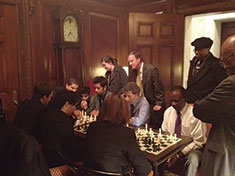
During this year’s session of the Maryland General Assembly, UMBC’s chess team was formally recognized on the floor of both the state’s Senate and its House of Delegates with a citation from Speaker Pro Tem and UMBC alumna Adrienne Jones ’76, psychology.

Members of the team also stayed to play a series of friendly chess matches with the members of the Maryland General Assembly Chess Challenge, including Senators Jamie Raskin, Bryan Simonaire and Ulysses Currie. (Currie co-sponsored the Senate recognition of the team with Senate President Thomas V. Mike Miller, Jr.)

“We ended up playing for about two hours games with some of the senators,” said Sabina Foisor ’12, modern languages and linguistics, a team member who is currently a graduate student at UMBC.  “We all had a good time and hope to be able to do it again.”

Collin Wojciechowski ’13, political science and media & communication studies, who also serves as UMBC’s government relations assistant, observed that the event was not set up as tournament-style play, but rather a sort of round-robin in which each student played a legislator multiple times.

“From what I saw,” says Wojciechowski, “a legislator never won a game.”

–  Nicole Ruediger

WORD POWER

Scrabble imageFor most people, Scrabble is just a word game. For Linda Oliva, it’s a ticket to the world.

Oliva, an assistant professor of secondary education at UMBC, plays in three local clubs, including one on campus, and teaches the game at school Scrabble clubs. She has played on the national competitive circuit for 12 years, attended the national tournament six times and even competed in Italian.

This summer, in fact, she’s going on a three-week Adriatic cruise, “playing Scrabble when we’re not visiting amazing places.” It’s her fourth Scrabble cruise.

The game got her started, but fellow players keep her interested. “You play with such diverse people,” she said. She’s met musicians and mathematicians, retired librarians and a man determined to visit every Starbucks. “They’re a colorful group,” she said.

Dr. Oliva usually travels with her friend, Dave Engelhart, to two tournaments a month.  They’ve taken their boards — hers is custom-made — to tournaments in South America, New Zealand and Southeast Asia.

“The good thing about scrabble is anybody can play,” she said.

And, in fact, Oliva is such a believer she has spread the Scrabble obsession to several Baltimore area schools, including Mount Pleasant Christian School, her first club, and Arbutus Middle School, where she has led their club to regional and national tournaments for three years.

She teaches strategies for winning — rules about words and keeping an eye on those double- and triple-word scores.

“There’s always the first play. And then there’s the best play,” she said.

Her students have learned.

“And then they beat me,” she said.

“Coaching kids when they make a great move and get all these points, it’s really joyful,” Oliva explains. “They really enjoy playing and learning,”

Oliva got hooked on the game playing with her family in Silver Spring. They not only played Scrabble, they finished each game by using all the words on the board to tell a story.

Eventually Oliva discovered study is the key to winning and she started beating her older sister, Debbie, who is now a teacher.

Important words good players know:

  • All the two-letter words. “You shouldn’t even step foot in the club if you don’t know your two letter words,” she warned.
  • Unusual words such as “howf.” “They are all good Scrabble words,” she said.
  • Seven-letter words. (Remember “retinas.” It’s a high-frequency bingo word.)

Oliva has a curiosity about words — from their meanings to working out anagrams – to the point where she’s worn out a dictionary. “I love it because I keep learning,” she said.

–  Mary K. Tilghman ’79

UMBC’s Scrabble Club meets Mondays in the Administration Building lobby, 7-11 p.m.

A SIDELINE VIEW

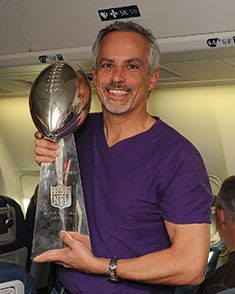
Doc with super bowl trophyIt doesn’t get much better than watching your favorite team win the Super Bowl – especially if you work closely with them and get to be there in person.

Alan Sokoloff ’82, health science and policy, headed to New Orleans earlier this year as one of the team chiropractors for the Baltimore Ravens. Sokoloff helps tend to player injuries, but he also assists healthy Ravens in getting their joints functioning as efficiently as possible in order to gain a competitive edge.

“At the NFL level, that one one-hundredth of a second makes a huge difference between getting tackled and scoring a touchdown,” he says.

A back injury in college from carrying disc jockey equipment was what first prompted Sokoloff to see a chiropractor. He grew so fascinated by the profession that he ended up studying it.

After attending chiropractic school in Iowa, Sokoloff returned to Baltimore to open his own practice. He interned with the United States Olympic Training Center, earning a spot on the medical team for the 1998 Goodwill Games and 1999 Pan Am games. Those experiences led him directly to a spot with the Ravens, with whom he has worked for 13 years.

Sokoloff says that being able to make a difference when it comes to a player’s performance is the real motivation for his football work. “It’s not all glamour,” he says, “but there’s so much satisfaction in knowing you’re one of the thousands of doctors who have actually gotten that far.”

And it doesn’t hurt, of course, to get to see the Ravens win it all in the Superdome.

“There’s just something about all that confetti falling,” Sokoloff says.

 – Laura Lefavor ’13

A Volume Business – Eduard Berlin ’70, Political Science

The books may sit quietly on their shelves, but the rest of The Ivy Bookshop buzzes with the activity of book selling.

In the back of the Baltimore shop on this particular early evening, employees race to load Bill Clinton biographies onto a cart in time to sell at a symposium downtown later that night. And near the reading nook, UMBC professor Robert Provine prepares for a reading and Q&A in the bookshop about his new book on the psychology of hiccups.

At the center of the commotion in his favorite leather reading chair sits Eduard Berlin ’70, political science – cool as a cucumber despite the frenetic activity spinning around him.

Berlin and his wife, Ann, took over The Ivy Bookshop a little more than a year ago from its previous owner, Baltimore arts philanthropist Darielle Linehan. They’ve thought long and hard about what the future of independent bookstores could – and must – become to survive a changing reading landscape, and have already taken big steps to do so: upgrading the bookstore’s web presence, forming selling partnerships with a bevy of big-time area organizations and schools, and organizing events at the shop.

“It’s not just about selling a book anymore,” says Berlin, a member of UMBC’s first graduating class who now has a 30-year career in corporate and financial tech behind him. “People can buy a book anywhere. What we’re doing is making an experience that’s unique for this community.”

Knowing a bit about Berlin’s former career – one in which he repeatedly surfed ahead of the curve, taking chances on web solutions that didn’t exist until he conceived and built them – makes his choice to start a second career at an independent bookstore seem a little less, well, crazy. After graduating from UMBC, Berlin got his law degree and practiced corporate law for the FCC before moving on in the 1980s to help companies including Citibank, Deutsche Bank and Reuters implement global reporting systems when the Internet was still a novelty. Talk about pioneering.

Berlin also credits his alma mater with helping to develop his business sense. “The real pioneers of UMBC were experimenting on so many different levels that I think maybe subliminally I took this concept of being out-of-the-box, being willing to try different things, not needing as much structure,” he said. “My entire career, I was always the first person to do a particular job, or open up new territory, or build new product, or explore things that maybe on the surface at least seemed to be cutting edge. And the fact that I went to a new school like UMBC maybe had a lot to do with that.”

That drive to innovate (and succeed at it) – along with a genuine love of reading – made The Ivy the perfect match for Berlin. It helps, too, that his wife spent a career in publishing.

“We’ve always been a book family,” said Berlin, whose son Sam – the spitting image of his parents – helps direct traffic from behind the front counter.

“I thought it was less crazy than his original plan, which was to have an art gallery,” Sam quips. “This seems slightly less volatile by comparison.”

Keeping the place busy is a key to the plan. On any given night, visitors might stumble upon a reading by an interesting author, or a book club talking animatedly in a corner nook. Berlin’s staff is quick to help browsers, and the owner prides himself on choosing every book that lines these shelves.

“There are things that simply cannot be replaced on a tablet or online,” he says. “People like being with other people. They like to discuss things together. There will always be people who value that.”

Mid-interview, a customer taps Berlin on the shoulder. Has he seen the book she’s looking for? Why yes, he says, pinpointing the spot on the shelf behind him. She smiles and wanders to the counter, book in hand.

He returns to his seat and apologizes for the interruption.

“The customer comes first, of course.”

— Jenny O’Grady