We use cookies for analytics and, unless you opt out, advertising.
You can opt out of advertising at any time.UMBC uses essential cookies to run this site. With your permission we would also use analytics cookies (to understand how the site is used) and advertising cookies (to measure and target our ads on other platforms). Nothing else loads unless you accept. You can change your choice any time from Cookie Settings in the footer.Privacy Policy
EssentialRequired for the site to work (login, security, your cookie choice). Always on.
The Lion Brothers Building, part of the southwest Baltimore landscape for over 130 years, was once used for sewing Girl Scout patches and screen printing. Now the former factory space is a physical tie between downtown and UMBC. The exposed brick walls and floor-to-ceiling windows house spaces to learn, create, exhibit, and connect to the culture that is unique to Baltimore.
Academic programs in the arts, humanities, and social sciences now have a designated space to experience civic engagement, service learning, and cultural exploration outside of a traditional campus setting. Located just off MLK Boulevard, the building has provided unique opportunities to UMBC’s dynamic Summer and Winter Programs, using Baltimore City as a classroom in courses focused on topics of urban anthropology, health policy, and Baltimore soundscapes.
Areas within the building, created for studio use and exhibit space, are the new downtown home for Intermedia + Digital Art graduate students. The location places the students in a culturally rich, diverse, and inspired setting, and is especially convenient to visiting artists and critics.
“We are very pleased that our graduate students have the opportunity to work in close proximity to the greater Baltimore arts community, and for that community to come in closer contact with our IMDA graduate students,” says Vin Grabill, associate professor and interim IMDA graduate program director.
The use of the Lion Brothers Building, listed on the U.S. National Register of Historic Places, continues to strengthen the relationship between UMBC, the city of Baltimore, and University System of Maryland partners who also share a footprint in southwest Baltimore – while providing a unique setting for learning.
The story of Christos FC and its unlikely ascent into the national U.S. Open soccer tournament in June is truly the stuff of fairy tales – especially considering the fact that the amateur team lacks a home field, and does not practice.
And yet, the team – a third of which played for UMBC as students – not only blasted into the fourth round of the tournament, but gave the professional players of D.C. United quite a scare before ultimately losing 4-1.
“The players were good on the team, but it was a men’s league team that really just got together and plays on Sundays and [has] fun still,” said UMBC assistant coach Pete Caringi III ’15, psychology. “It really was a crazy couple of weeks. We felt like we were professional players when, in reality, we were going to work and then taking off just to play soccer.”
Everything started when Christos scored a 3-0 victory over Fredericksburg FC in their first game in early May in a tournament featuring nearly 99 amateur and professional teams. They next faced the Richmond Kickers from the United Soccer League, a professional team. Former Retriever Geaton Caltabiano ’14, psychology, scored a late goal that gave Christos a 1-0 victory.
In the third round of tournament play, Christos headed to Chicago to play Chicago FC United, a team that competes in the top amateur level. Christos won that game 1-0 and earned a $15,000 prize for being the final amateur team left in the tournament.
D.C. United – the professional team from Washington – came next, along with tons of publicity. The game took place at Maryland SoccerPlex where another former UMBC player, Mamadou Kansaye ’15, psychology, scored to give UMBC an early 1-0 lead, sending many of the 5,286 fans (according to the Washington Post) into a frenzy.
“That was some of the most fun soccer I’ve ever played.” – Goalie Phil Saunders ’13
The game stayed close, but D.C. United took charge with two late goals for a 4-1 victory. Even with the loss, the Christos team enjoyed more attention than they ever would have expected. Named for the local liquor store that sponsors the team, Christos gained worldwide coverage during the tournament, including the Baltimore Sun, the Washington Post, ESPN, USA TODAY, and more. The team scored an Adidas apparel deal, and its bright green uniforms caught the eye of many more.
By the time Christos took on D.C. United, even people who did not follow soccer regularly knew about the team and its 15 minutes of fame. Seemingly anyone who loved soccer, and many who didn’t, wanted to know the story of this unlikely team.
Goalie Phil Saunders, who played for UMBC until 2013 and is the new men’s soccer coach at CCBC-Catonsville, laughed when talking about the publicity, saying he received more in this run than during his professional playing days (one season with the Baltimore Blast and two years in Iceland).
More than anything, he enjoyed playing with his buddies.
“Going to those away trips and hanging out with friends; that was pretty much as ideal as it gets,” he said. “It was perfect. That was some of the most fun soccer I’ve ever played.”
“It was the amateurs versus the pros. We felt that attachment. We felt this was sort of a UMBC story, too,” said Retriever coach Pete Caringi, Jr. “This is a group of players that… liked playing with one another. It’s a great reflection on the players that went through the [Retriever] program. It made us all proud.”
— Jeff Seidel ’85
Image: Permission from The Baltimore Sun. Top Row, farthest L-R: Joseph Glos ’15, Phil Saunders ’13, Pete Caringi III ’15; Bottom, second from left, Levi Houapeu ’15; far right: Mamadou Kansaye ’15
UMBC Athletics Director Tim Hall has been named the new president of the Division I-AAA Athletics Directors Association (ADA) for the 2017–18 academic year. Hall, who recently entered his fifth year as the Retrievers’ athletics director, previously served as ADA 1st vice president in 2016 – 17. The organization serves more than 1,600 institutions.
“There are so many critical issues that athletic directors face in today’s climate and this group has always put the studentathlete in the center of its bulls-eye,” said Hall. “I am anxious to get started guiding this committed group of leaders.”
Hall currently serves on the NCAA volleyball rules committee and previously served on the national Association of Collegiate Directors of Athletics Division I-AAA Executive Committee. He also chaired the NCAA Committee on Women’s Athletics (CWA) for fall 2014, after serving on that committee since 2011, and previously chaired the Disability Subcommittee of the CWA Minority Opportunities and Interests Committee, 2012 – 14.
Under Hall, the Retrievers have experienced unparalleled success in women’s and men’s soccer, multiple consecutive conference titles in men’s and women’s swimming and diving, and America East titles in men’s cross country (2013) and baseball (2017). He has hired new head coaches in men’s basketball and men’s lacrosse, Ryan Odom and Ryan Moran, who have led their teams through strong initial campaigns.
Several alumni have recently taken top government positions, bringing their expertise to national groups overseeing health and justice, as well as Maryland’s top office.
The U.S. Senate has formally confirmed Jerome Adams ’97, M4, biochemistry and molecular biology, for the position of U.S. surgeon general. He replaces Rear Admiral Sylvia Trent-Adams Ph.D. ’06, public policy, who served as acting U.S. surgeon general beginning in late April. Both alumni have prioritized serving vulnerable populations and maintaining connections with local communities throughout their careers.
In the opening statement for his nomination hearing, Adams, who has served as a practicing anesthesiologist, associate professor at the Indiana University School of Medicine, and state health commissioner under then-Indiana Governor Mike Pence, shared, “In this dual role as both clinician and educator, I see the impact of health policy decisions on both providers and the patients we serve.”
Adams plans to emphasize active engagement with communities as surgeon general, focusing on a need to “learn about their obstacles and successes, share best practices, and help empower them to implement local solutions to their toughest problems.” He intends to focus on the opioid crisis in particular – a problem he’s familiar with from his work in Indiana.
Reflecting on his undergraduate years at UMBC as a Meyerhoff scholar, Adams shared with UMBC, “one of my biggest mentors was Dr. Hrabowski, and I still stay in touch with many of my Meyerhoff colleagues and rely on them as a professional support network.” He also pays that support forward, according to Joey Fox, who worked as his legislative director in Indiana. Fox described Adams as a “compassionate leader” and told the Indy Star, “He was always willing to have his door open.”
In July, President Donald Trump announced the appointment of David Muhlhausen M.P.R. ’99, Ph.D. ’04, public policy, a veteran analyst in The Heritage Foundation’s Center for Data Analysis, as Director of the National Institute of Justice, Department of Justice. In that role, he will work with that agency to improve knowledge and understanding of crime and justice issues through science, and provide objective, independent knowledge and tools to inform the decision-making of the criminal justice community.
In Maryland, Matthew Clark ’00, history, former communications director for Governor Larry Hogan, will return to the state’s capitol to serve as chief of staff. He spent the previous year as managing director with D.C.-based FTI Consulting.
The Association of American Colleges and Universities (AAC&U) has selected UMBC as one of 10 institutions nationwide to participate in a bold, new initiative designed to “educate, prepare, and inspire the next generation of leaders to advance justice and build equitable communities.”
Participating colleges and universities will establish Truth, Racial Healing and Transformation (TRHT) Campus Centers to engage campus and community stakeholders around issues impacting racial equity, such as conscious and unconscious bias. AAC&U President Lynn Pasquerella shares that this is the first piece of a broader vision “to ensure that higher education is playing a leadership role in promoting racial and social justice” through a future national network of 150 such centers.
Frank Anderson, assistant director of The Choice Program at UMBC, coordinated UMBC’s TRHT proposal, with support from Zeevelle Nottingham-Lemon, associate director. The Choice Program has served more than 25,000 youth from Maryland’s most underserved communities for nearly 30 years, providing 24/7 wrap-around support. The program is based in UMBC’s Shriver Center, which works to realize the vision of Eunice Kennedy Shriver and Sargent Shriver to mobilize higher education to confront and solve major challenges facing urban America today.
“The Shriver Center’s Choice Program at UMBC recognizes that now, more than ever, there exists a need to create platforms for Baltimore City youth, UMBC service-learners, and our communities to voice their truth about systemic racism, and to seek opportunities for transformation,” says Anderson.
UMBC’s proposal focuses on the Shriver Center’s service-learning and community engagement work with youth, artists, advocates, and community-serving organizations in and around Baltimore. It also incorporates plans for youth-led community conversations, at UMBC and in Baltimore, around racial equality and transformation. The $30,000 AAC&U grant will support The Choice Program’s Youth in Action group, which unites students and service-learners at UMBC with youth in Baltimore through art and social justice, and college night programming for Baltimore City school students, among other activities.
The UMBC TRHT Campus Center team includes Eric Ford, associate director of the Choice Program; Beverly Bickel M.A. ’94 IDS, Ph.D. ’05, LLC, clinical associate professor of language literacy and culture; Keisha Allen, assistant professor of education; Charlotte Keniston M.F.A. ’14 IMDA, associate director of the Peaceworker Program; and Eloise Grose, program coordinator for service-learning in the Shriver Center, in addition to Anderson and Nottingham-Lemon.
UMBC President Freeman A. Hrabowski takes your questions.
Q:A majority of our alumni live in Maryland. How does the university plan to leverage that population to expand UMBC’s community impact in the coming years?
— Nicole Smith ’10, modern languages and linguistics, and president of the Chapter of Young Alumni
A: The exciting news is that we already are working in a number of ways with thousands of alumni who live in the Baltimore-Washington corridor and across the State. We bring alumni back to give us advice on everything involving the university, from the academic side to the future of the institution’s relationships. In fact, alumni played key roles in working to help UMBC develop its most recent strategic plan.
Our alumni affairs office works to collect information about alumni who are working in different professions, from education and the arts to engineering and science to policy and social work. From these connections, we host receptions with different groups and invite them to various meetings, and we ask that they get involved in our Alumni Association.
Alumni increasingly are key to our efforts to help students secure internships and jobs, as they are working to connect our students with job opportunities, and are supporting our partnerships with different companies and agencies. Most important, large numbers of alumni are on campus regularly supporting our students – and the welfare of our students is our number one responsibility.
Coming out of the 50th anniversary, we have developed a useful framework that will help us continue to increase the ways alumni connect to campus. They will be asked to engage in ways that make the most sense for their lives, no matter where they live. With the “Get Involved, Stay Involved” program, the Office of Alumni Relations will be finding ways to engage our alumni by encouraging them to attend cultural, networking, and athletic events on campus; share their love for UMBC on social media and by word of mouth; update our offices with information about their professional successes, family, and stories from beyond the loop; volunteer for events at UMBC and in other cities; hire other alumni at their places of work; and support UMBC annually.
As important, we are supporting new and ongoing connections between alumni and faculty and program staff, who often have the deepest connections to our graduates. The more we can work together as a community, the more we will be able to use these strengths to our advantage.
Q:The new Event Center looks fantastic and will be a great home for the future of UMBC athletics. What parts of our history and traditions do you plan on representing in the building?
— Christopher Strong ’86, interdisciplinary studies, and former member of the men’s basketball team
A: The Event Center provides a great opportunity to celebrate some of our traditions and past successes, while also elevating the environment for our Division I athletics programs and giving us a venue for new activities to build tradition. Everyone is excited about building on our athletic department’s reputation. We are known for recruiting athletes who are solid academically and talented athletically and this facility will allow us to build on that reputation because of its attractiveness. Of course our championship banners will be hung in the Center, and we will display trophies and memorabilia in different ways throughout the building. I understand there are also conceptual plans for a “hall of fame” display that will require private donations to be fully realized.
In addition to athletics, we will be bringing Commencement back to campus. This had been a very rich tradition at UMBC until the space became too limited for the size of the class. Now we’ll be able to bring Commencement back, and that will give everyone an added source of pride.
Do you have a question for UMBC President Freeman Hrabowski? Send it to magazine@umbc.edu, and it may appear in a future issue of UMBC Magazine.
Pictured: Dr. Hrabowski talks with students on the Administration Building’s new green roof, made possible by a $1 million gift from the France-Merrick Foundation.
What do you remember about your first day of class at UMBC? Were you excited – or perhaps a little nervous – about a particular class? Did you get lost trying to locate your classroom? Or, maybe you were the one helping classmates find their way?
I remember my first day of class at UMBC almost perfectly – because it just happened. Although I’ve worked here for more than a dozen years, enjoying the wit and expertise of many professor friends in an informal way, only recently did I make the decision to take on the role of Retriever student for the first time. The class: Korean 101. So, what was it like, you ask?
As excited as I am to be a student again, I must admit I was scared when I opened a textbook filled with an entirely new alphabet. But, the moment I walked into class and saw the welcoming smile of my teacher, Dr. Krippes, my fears drained away. As we introduced ourselves, I learned this was a class full of students from all study areas, united in their interest of a new culture, and just as nervous as I was.
As we began learning consonant sounds and characters in the Hangul alphabet, I thought of something Dr. Krippes said at the start of class: “I want you to make a lot of mistakes.” (Here, we all laughed tentatively.) “That is how we learn.” (Well, okay then.)
There’s a reason UMBC is recognized again and again for its teaching. Not only are our professors whip smart – obviously – they’re also generous and warm. You’ll see evidence of this throughout this issue, from professors working to better understand the opioid epidemic, to our capstone mechanical engineering class, where students experience the ups and downs of designing for real clients. And, I’m sure you have memories of your own.
Now, everyone enjoys donning a new outfit for the start of school, and UMBC Magazine is no exception. In honor of the new semester, we hope you’ll like our updated look and some new treats in print, and our expanded presence online including more video, Q&As, and perspective pieces. If you’re inspired by memories of your first day of school, we invite you to share them at magazine@umbc.edu. I’ll be sharing my thoughts throughout the semester in the Perspectives section.
Many of our earliest Retrievers remember fulfilling their physical education requirements in Gym I (above), while students looking for a place to lift weights from 1999 to the present spent that time in the Retriever Activities Center across from the Administration Building. Today, UMBC is mere months away from opening the new UMBC Event Center, a 172,000 square foot multi-purpose facility that will house men’s and women’s basketball and women’s volleyball, as well as provide a venue for a variety of events, such as concerts, featured speakers – and Commencement.
Color-changing cells in an Atlantic squid’s skin contain light-sensitive pigments. Alexandra Kingston, CC BY-ND
We humans are uncommonly visual creatures. And those of us endowed with normal sight are used to thinking of our eyes as vital to how we experience the world.
Vision is an advanced form of photoreception – that is, light sensing. But we also experience other more rudimentary forms of photoreception in our daily lives. We all know, for instance, the delight of perceiving the warm sun on our skin, in this case using heat as a substitute for light. No eyes or even special photoreceptor cells are necessary.
But scientists have discovered in recent decades that many animals – including human beings – do have specialized light-detecting molecules in unexpected places, outside of the eyes. These “extraocular photoreceptors” are usually found in the central nervous system or in the skin, but also frequently in internal organs. What are light-sensing molecules doing in places beyond the eyes?
Vision depends on detecting light
All the visual cells identified in animals detect light using a single family of proteins, called the opsins. These proteins grab a light-sensitive molecule – derived from vitamin A – that changes its structure when exposed to light. The opsin in turn changes its own shape and turns on signaling pathways in photoreceptor cells that ultimately send a message to the brain that light has been detected.
Most of our conscious vision stems from photoreceptors in the retina, the light-sensitive layer at the back of our eyeball. In animals with backbones (vertebrates), cells that detect light for vision are vaguely shaped like rods or cones, giving them their familiar names.
We’ve known for a while that other vertebrates have additional photoreceptors in their brains. But scientists had long thought that rods and cones were pretty much the whole story of mammalian vision. Thus, the discovery in the early 2000s by David Berson’s group at Brown University of other cells in a mouse retina that respond to light came as a shock.
Even stranger were associated discoveries in many laboratories demonstrating that these cells contained a new class of opsin proteins called the melanopsins, never before seen in vertebrates (but similar to those of many invertebrates). They seem not to be involved in conscious vision.
We can hardly call them extraocular since they’re right there in the eye. Instead they’re often referred to as “nonvisual” photoreceptors. That’s the term researchers use for all animal photoreceptors that aren’t associated with imaging pathways in nervous systems.
So now we know there are nonvisual photoreceptors in the eyes themselves in many – perhaps most – animals. Where else can we find them throughout body?
The hunt for photoreceptors not in the eyes
In general, identifying a potential extraocular photoreceptor means searching for the proteins that can detect light, the opsins. The advent of inexpensive and efficient molecular genetic technologies has made the search for opsins a cottage industry in laboratories worldwide.
Cells that contain opsins are probably active photoreceptors, but researchers use physiological or behavioral tests to confirm this. For example, they can search for electrical changes or look for a change in an animal’s activity when they expose the cell to light.
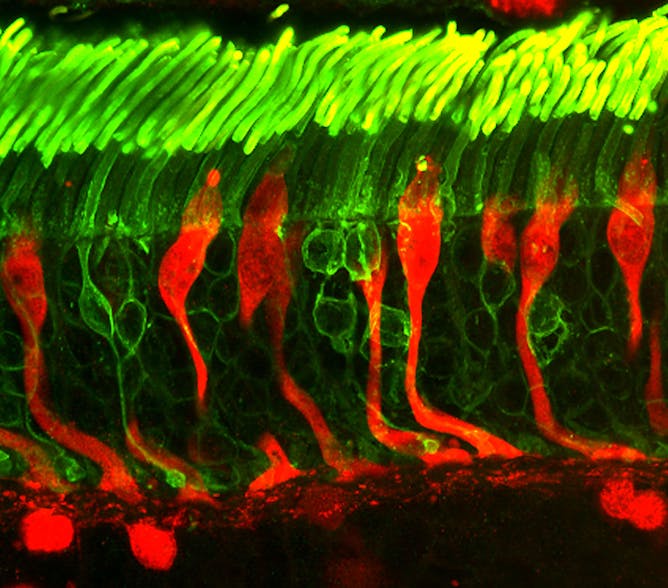
A photoreceptor cell in the brain of a horseshoe crab. Green indicates the presence of the photosensitive molecule peropsin. Membranes in the cell known to respond to light are red. Barbara Battelle, CC BY-ND
The photoreceptors scientists have found beyond the eyes are most commonly located in the central nervous system. Almost all animals have several types in the brain and often in the nerves as well.
The skin is where we see most other light receptors, particularly in active color-changing cells or skin organs called chromatophores. These are the black, brown or brightly colored spots sported by many fish, crabs or frogs. They reach their highest development in the cephalopods: octopus, squid and cuttlefish. Animals actively control their color or pattern for several reasons, most often for camouflage (to match the color and pattern of the background) or to produce bright, prominent signals for aggression or attracting a mate.
Surprisingly, there is a second class of light-sensitive molecules besides the opsins, never used for vision (as far as we know). They show up in some nervous structures, such as the brains or antennae of some insects and even in bird retinas. These are the cryptochromes, well-named because their functions and methods of action are still poorly understood. Cryptochromes were originally discovered in plants, where they control growth and annual reproductive changes.
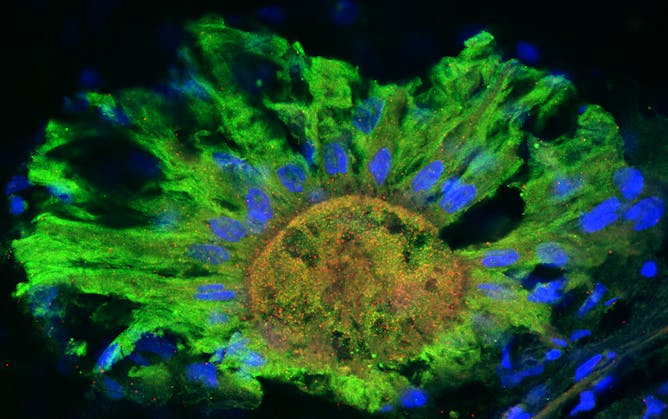
A squid chromatophore in the skin detects light. Alexandra Kingston, CC BY-ND
Why detect light outside the eyes?
Now that we know that these photoreceptors can be found throughout animals’ bodies, what in the world are they actually doing? Obviously, their function depends in part on their location.
Generally, they regulate light-mediated behavior that exists below the level of consciousness and that doesn’t require having an extremely precise knowledge of a light source’s location in space or time. Typical functions include the timing of daily cycles of alertness, sleep and wake, mood, body temperature and numerous other internal cycles that are synchronized to the changes of day and night.
Biological clocks that maintain regular physiological cycles – and cause the discomforts of jet lag – nearly always are controlled by these photoreceptors. These detectors are also important for the opening and closing of the eye’s pupil to help adjust to varying light levels. Skin photoreceptors like those in fish or octopus often control color and pattern variations.
In some animals, they have a quite different, and rather amazing, task – providing magnetoreception, the ability to detect the Earth’s magnetic field. This capacity is based on the cryptochromes, which apparently underlie mechanisms for magnetic orientation in animals as different as birds and cockroaches.
People have nonvisual photoreceptor abilities, too
With the discovery of light-sensitive retinal cells in addition to rods and cones in mammalian retinas, it became obvious that humans, too, must use nonvisual pathways for control of behavior and function.
Pupil size varies with changing light, even in functionally blind humans. A joint British-American study, published in 2007, found that patients who have lost all rods and cones due to genetic disorders can still have light-responsive daily rhythms and pupils. One patient could even report the sensation of “brightness” when shown a blue light, which should stimulate the retinal non-rod, non-cone photoreceptors.
Recent research with rodents at Johns Hopkins University by Samer Hattar’s group suggests that nonvisual pathways can regulate mood, learning ability and even the sensitivity of conscious vision.
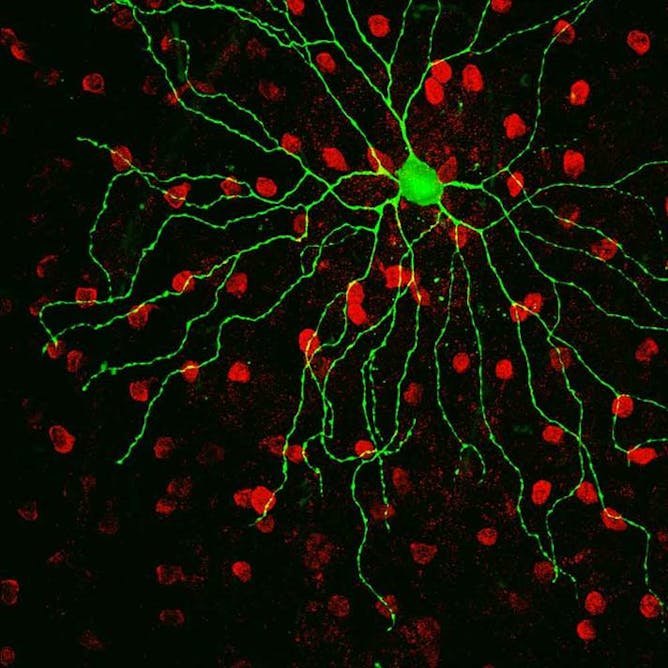
A photosensitive nerve cell in the retina of a mouse. The green color shows the location of the photosensitive pigment melanopsin, which is responsible for most nonvisual photoreception in mammals. Maureen E. Stabio, CC BY-ND
Finally, an unexpected recent finding in research led by Solomon Snyder and Dan Berkowitz, also at Johns Hopkins University, found that blood vessels in mice contain melanopsin, the opsin used in retinal nonvisual photoreception. They found that this light-sensitive protein can regulate blood vessels’ contraction and relaxation. Since humans are likely to have the same system, this could partially explain the increase in heart attacks in the morning, which are perhaps associated with blood pressure changes occurring at that time.
We know nonvisual light detection is ubiquitous and significant in the lives of animals. Future research will continue to untangle its effects on human health and well-being.
Along with the rest of the country, members of the UMBC community came together to try to catch a glimpse of August’s total eclipse of the sun. Although Maryland was not in the “path of totality,” the 80% view from Catonsville still elicited the “oohs” and “ahs” of bespectacled Retrievers in front of the Albin O. Kuhn Library – where staff offered demonstrations in pinhole viewer construction – and around campus.
[nivoslider id=”8382″]
Want to learn more about how Kate Drabinski’s summer course is exploring food justice in Baltimore? UMBC Magazine’s Jenny O’Grady tagged along for a recent walking tour, exploring local historic food markets and a community garden.
UMBC launched a new $150 million campaign on June 9, on the heels of a joyful 50th anniversary year, by coming together in harmony, quite literally. With individually toned bells in hand and the UMBC Symphony Orchestra playing along on stage, visiting maestro Boris Brott led community members in a rousing impromptu performance of Beethoven’s “Ode to Joy.”
“You’ve gotten the hang of it quickly,” Brott told the crowd. “Must be all that grit and determination that UMBC is so famous for.”
The moment capped an evening celebrating how the UMBC community works together to achieve great things. The Grit & Greatness Campaign—which focuses on ways of making big breakthroughs, forging true partnerships, and transforming lives—will raise funds to support everything from endowed professorships and teaching assistantships, to merit and need-based scholarships, to maker spaces and other innovative learning opportunities for students.
“They saw—before most others—what was possible at a place like UMBC,” said Simon Stacey, interim vice provost and dean of undergraduate education, of the featured donors. “I think you’ll agree that these individuals embody UMBC’s character and show us what we all stand to gain by investing in our future.”
President Freeman Hrabowski called UMBC “a 50-year-long American experiment”—one that tested the idea that people from all backgrounds deserve an education. Today, he said, UMBC stands as a leader in inclusive excellence.
Sondheim Public Affairs Scholar alumna Alicia Wilson ’04, political science, shared an example of this through her own story of how a visit to UMBC unlocked a future she didn’t realize was possible while growing up in East Baltimore.
College “was not a given,” said Wilson, who was only able to take the SATs because a donor paid her test fee. When she visited UMBC—and met Hrabowski—she knew where she needed to be. After earning her UMBC degree, she completed law school and joined Gordon Feinblatt’s labor and employment practice. Today, she serves as vice president of Sagamore Development, where she gives back to the community through the Lakeland STEAM Center project, a UMBC partnership.
“There’s no better investment than education. You’re guaranteed magnitudes of return,” she said. “No other investment yields returns so quickly for our economy.” To date, UMBC has raised $92 million towards its campaign goals. UMBC’s most recent campaign—Exceptional by Example, which ran from 2002 to 2011—exceeded its goal of $100 million by $15 million, and included more than 22,000 donors. Hrabowski appealed to the crowd of supporters with a call to help UMBC continue to grow as an essential education, research, and community-serving powerhouse at an important moment in our nation’s history.
“America needs its universities now more than ever. We live in a time of huge challenges and breathtaking discoveries. We live in a nation that is divided. We live in a time when too many young people are shut out of life-changing opportunities,” he said. “The UMBC community does not shy away from hard work. We show up. We show our grit. I’ve never been more excited about this University and what we can do.” Learn more about Grit & Greatness: The Campaign for UMBC.







 We know nonvisual light detection is ubiquitous and significant in the lives of animals. Future research will continue to untangle its effects on human health and well-being.