Inaugural CNMS Science Discovery Series hits the mark with community audience

The College of Natural and Mathematical Sciences (CNMS) hosted its first CNMS Science Discovery Series event on March 27. In this public series, CNMS faculty members present talks on a variety of scientific topics. The goal of the series is to give back to the community by offering an opportunity for non-experts to learn about the research happening in their backyards. 

“I grew up with the Apollo moon landings and Carl Sagan’s Cosmos. They inspired me and countless others to dream of being a scientist, to ask questions, to explore the unknown and discover new knowledge,” shares CNMS Dean William R. LaCourse. “As a public university, I believe it is part of our mission to share our knowledge and passion for science with our community to inspire others to dream of a better and brighter future.”

More than 80 attendees came out to the Fine Arts Recital Hall on a rainy night to learn about “Life, But Not As We Know It” from the inaugural speaker, Stephen Freeland, professor of biological sciences. Freeland drew in the audience as he discussed how the 20 amino acids we call our “amino acid alphabet” here on Earth evolved. He also explained how his current research could help discover alternative amino acid alphabets that might exist elsewhere in the universe.
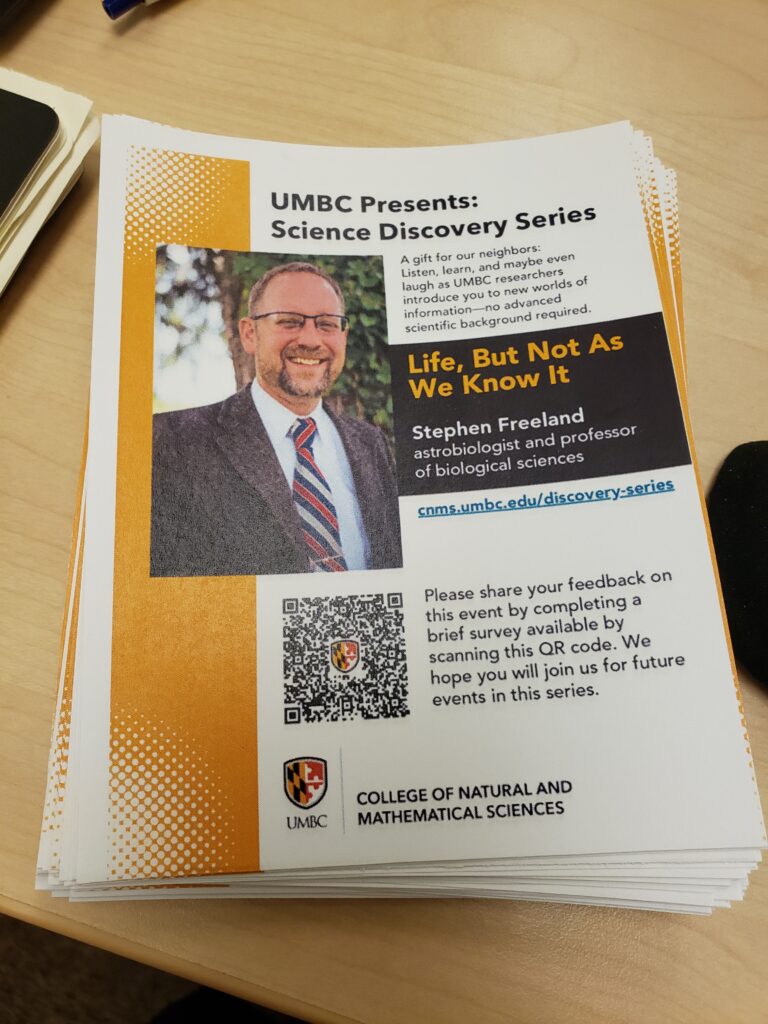
stack of quartercards on a table with headshot of Freeland, short description of the event and talk, and a QR code to the event evaluation form.

Audience members included families who had heard about the event through Catonsville Middle School, Mt. St. Joseph High School, and other local school and community organizations, as well as members of the UMBC community, including faculty, staff, and members of the UMBC Astronomy Club. 

In the event evaluation form, one middle school teacher commented, “I loved the content and learned new things I hope to bring to my classroom.” Another attendee shared that the event “grew my curiosity. I plan to read more about amino acids and DNA.” Yet another said, “Great job taking such complex concepts and making them accessible.” Attendees also reported appreciating having access to CNMS faculty ambassadors during the reception, who were happy to answer their questions on a range of topics. 

The college is already starting to plan the next CNMS Science Discovery Series event for fall 2024, incorporating feedback from the first attendees. The topic will be completely different, but the goal will be the same: connecting with the community by offering a free gift of knowledge to anyone interested in learning something new. 
Going the distance—virtual classrooms allow 300 former students to earn their degrees

The onset of COVID-19 brought a tremendous amount of uncertainty about the way students would learn going forward. But within that challenge, UMBC saw a unique opportunity to open its virtual doors to former students. 

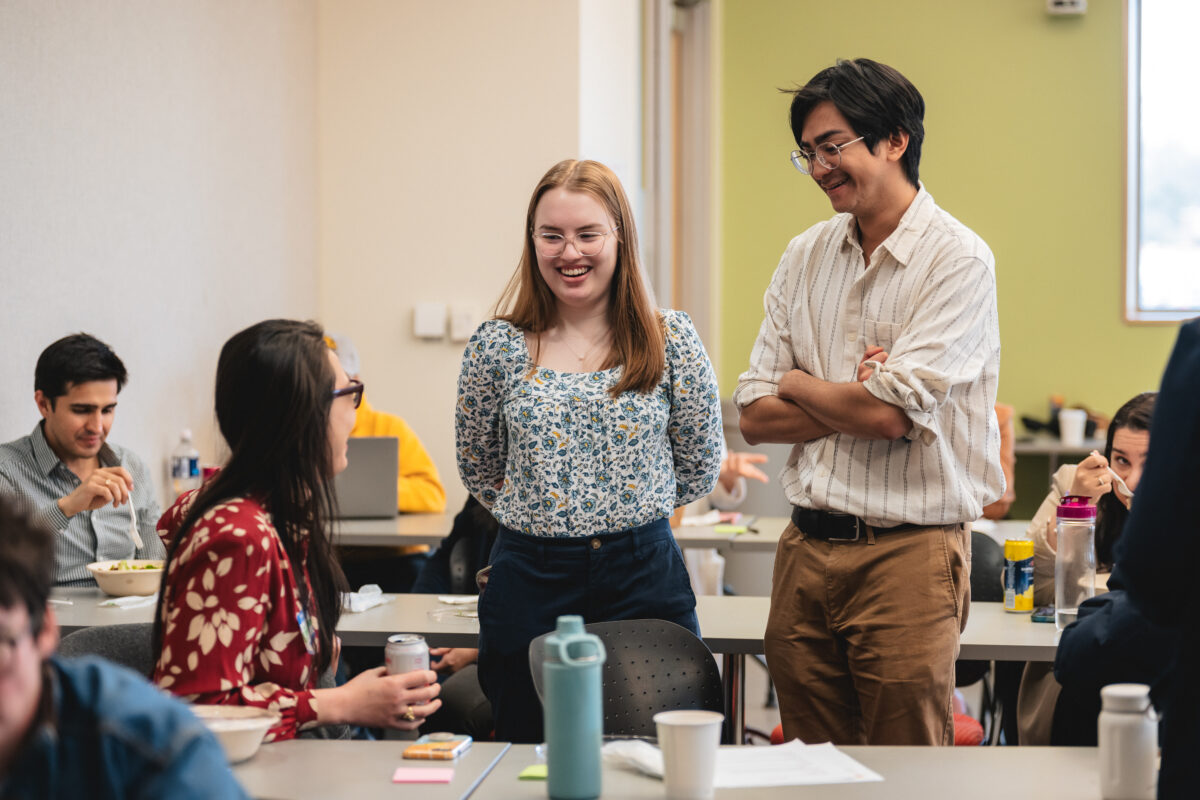
Finish Line began as an outreach program in the fall of 2020, targeting former Retrievers who had 60 or more credits but hadn’t completed their degree before leaving the university. And while these students  might not have had the opportunity to return physically to campus, the sudden availability of a virtual classroom offered them a new pathway to their degree goals. 

The intentional outreach and personalized advising offered through the program has allowed nearly 300 former students to return to UMBC to finish their degrees. 

“The Finish Line program has allowed me and others from my office to exercise some of our most creative academic advising skills to enable former UMBC students to finish degrees they had intended to complete when they first began here,” says Ken Baron, assistant vice provost for academic advising and student success. “We are passionate about degree completion, and each semester, our Finish Line graduates help us recognize and celebrate what makes UMBC special—a place where hard work brings out the best in everyone.”

With the demands that come with everyday life—jobs, families, home responsibilities, operating a restaurant dynasty, etc.—this model allows UMBC to meet students where they are. It acknowledges that most don’t have the luxury of being a full-time student and works to best suit their needs and timeline. 

“We’re proud to have redefined inclusive excellence in a way that honors UMBC’s core values and ethos,” says Baron.

UMBC joins BRAIN Center to advance innovations in neurotechnologies

Ramana Vinjamuri, associate professor in computer science and electrical engineering, recently received funding from the National Science Foundation (NSF) to support UMBC’s participation in a industry-university cooperative research center aiming to improve how we diagnose and treat people with conditions such as neurological disorders, brain injury, mental illness, limb loss, and paralysis. The center, called BRAIN (Building Reliable Advances and Innovations in Neurotechnology), brings together partners from academia, industry, and the regulatory and clinical communities to develop safe, effective, and affordable personalized neurotechnologies.

The need for such technologies is driven by an increase in survivable trauma and an aging population, Vinjamuri says. However, several challenges are holding back progress, including costly equipment, lagging standards for verifying the safety, efficacy, and reliability of devices, and an undersupply of physicians and engineers trained in emerging technologies.  

The BRAIN Center aims to tackle these challenges by bringing together experts in a wide range of topics, from neural, cognitive, and rehabilitation engineering to neurorobotics, neuromodulation, and ethical artificial intelligence. As an Industry–University Cooperative Research Center (I/UCRC), it emphasizes academic research conducted jointly with innovative industry partners, and UMBC’s location will facilitate cooperation with northeast-based biomedical companies.

“BRAIN will become a neurotechnology hub by creating a pipeline from discoveries to solutions, while helping students, scientists, and engineers solve one of the greatest unmet medical and healthcare needs of our time,” Vinjamuri says. 

UMBC’s participation will expand the center’s research into new areas such as artificial intelligence, neural signal processing, cyber-human systems, human-centered computing, neural imaging and stimulation, and virtual/augmented/mixed reality. Other UMBC researchers who will contribute to the center’s activities include Tulay Adali, Nilanjan Banerjee, Fow-sen Choa, Don Engel, Seung-Jun Kim, and Charles Nicholas. BRAIN is the second I/UCRC at UMBC, joining the Center for Accelerated Real Time Analytics (CARTA), which recently received a second round of funding.

Mellon Foundation grants CAHSS $750K to establish Global Asias Initiative 

Kimberly Moffitt, dean of the College of Arts, Humanities, and Socials Sciences, and co-pi Tamara Bhalla, associate professor of American studies and director of the Asian American studies minor, have been awarded a $750,000 grant from the Mellon Foundation to establish the Global Asias Initiative. The initiative will support the rethinking of Asian American issues on campus in a global, diasporic, and collaborative framework through community-engaged, public-facing scholarship and teaching.

“The impact and influence of the Asian diaspora in this region makes it clear that our world has more to offer in providing valuable opportunities for our students, while also creating additional partnerships with the greater Baltimore community,” says Moffitt.

Two college students stand by a table while talking to a professor who is sitting down at the Global Asias launch
(l-r) Emily Yoon and students at the Global Asias Initiative launch workshop.
(Abnet Shiferaw)

UMBC’s existing Asian studies program and Asian American studies minor will grow into a more expansive Global Asias program that better serves and represents UMBC’s Asian American community, interested students, and beyond. This includes launching an undergraduate community-based research fellowship in Global Asias and the conversation series “Reframing Global Asias,” which invites prominent leaders, scholars, and community members in the field to present and discuss key issues, possibilities, challenges, and new research.

“Together,” says Bhalla, “we will create a forum for engaging in difficult yet productive intellectual conversations in Asian American studies, Asian diaspora studies, and Asian studies.” 

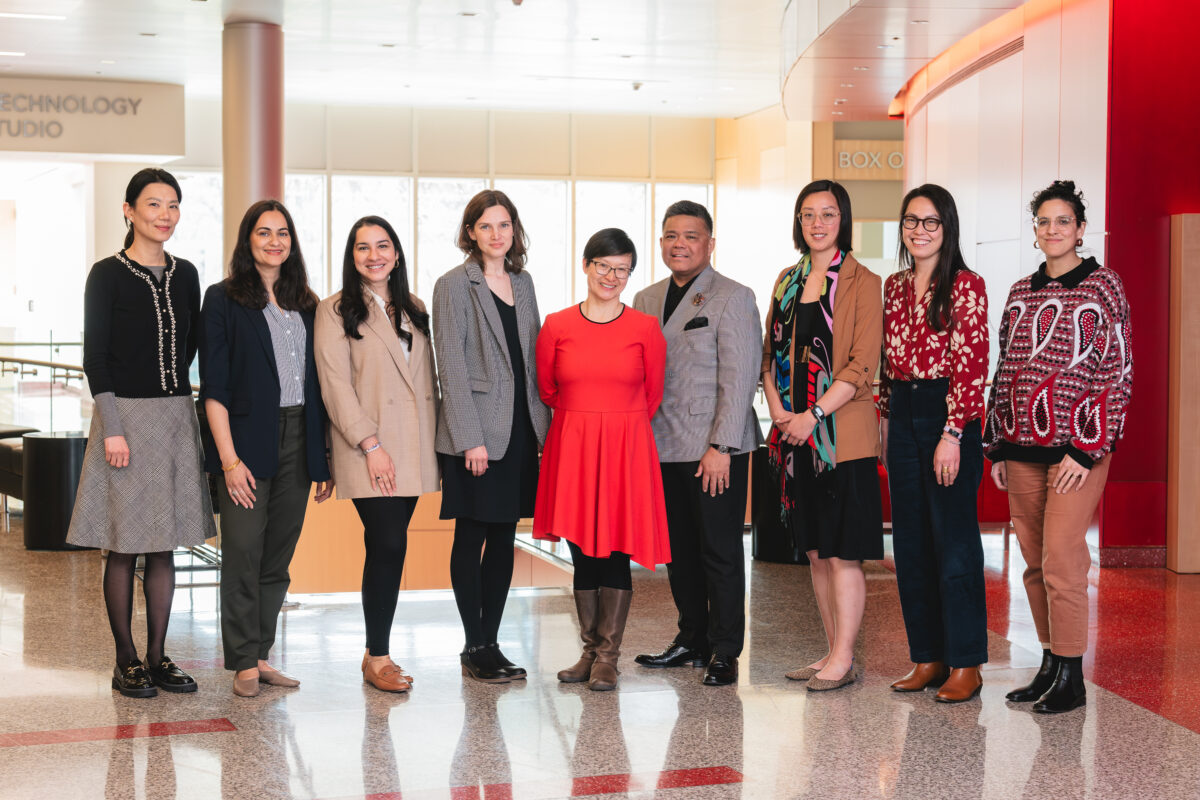
A group of seven adults stand side by side for a picture inside in a hallway with windows in the background
Global Asias Advisory Board, AY2023-2024. (l-r) Tamara Bhalla, Noor Zaidi, Meredith Oyen, Fan Yang, Theo Gonzalvez, Emily Yoon, and Priya Bhayana, project manager for the Global Asias Initiative. (Abnet Shiferaw)
Faculty across UMBC are collaborating to bring the Global Asia Initiative to fruition along with community partners:
  • Meredith Oyen, associate professor of history and director of the Asian studies program
  • Shin Yon Kim, Asian studies lecturer
  • Fan Yang, associate professor of media and communication studies
  • Emily Yoon, assistant professor of English
  • Noor Zaidi, assistant professor of history
  • Christopher Tong, associate professor of modern languages, linguistics, and intercultural communication
  • Theo Gonzalves, former American studies chair and professor, curator of Asian-Pacific American history at the Smithsonian National Museum of American History
  • Robbin Lee ’13, visual arts and media and communications studies, director of partnerships and mobilization at UpSurge Baltimore

Learn more about the Global Asias Iniatiave and Asian studies program.

Hundreds of East Coast chemical engineering students to gather at UMBC for regional conference

Over the weekend of April 6 – 7, the UMBC student chapter of the American Institute of Chemical Engineers (AIChE) will host the 2024 Mid-Atlantic Regional Conference on campus. The event will feature workshops, research presentations, and a career fair with companies such as AstraZeneca and Astek Diagnostics and schools including Johns Hopkins University, Rutgers University, the University of Delaware, and Lehigh University. It will also feature the conferences’ two signature competitive events: Chemical Engineering Jeopardy and ChemE Car—a competition to build and operate a car powered and stopped by chemical reactions.


Organizers expect more than 350 attendees from more than 30 universities across the region. UMBC students are encouraged to register to attend, even if they aren’t chemical engineering majors. “As the premier student chemical engineering conference in the region, this event will offer great opportunities for networking, presenting research, landing internships and jobs, and general professional development,” says Terra Miley ’25, chemical engineering, who is serving as the communications chair for the student organizing committee.

‘Your work is so important,’ White House environmental justice leader tells UMBC ICARE trainees

UMBC’s Interdisciplinary Consortium for Applied Research in the Environment (ICARE) program, a cohort-based master’s program focused on local environmental research, held its first annual ICARE CoNavigator Day on Friday, February 23, in the University Center Ballroom. The all-day event consisted of research planning activities for ICARE trainees, poster sessions highlighting the trainees’ research, and a keynote address given by Jalonne White-Newsome, senior director for environmental justice in the White House Council for Environmental Quality. The Maryland deputy and assistant secretaries of the environment and representatives from the League of Conservation Voters also attended.

“ICARE is a unique training model in which master’s students in the environmental sciences and engineering are co-mentored by UMBC faculty mentors, professional scientists or engineers, and community leaders. This day brought together all the trainees and their mentors to conceptualize their research through CoNavigator and present their research in well-attended poster sessions,” shares Tamra Mendelson, ICARE director and professor of biological sciences. 

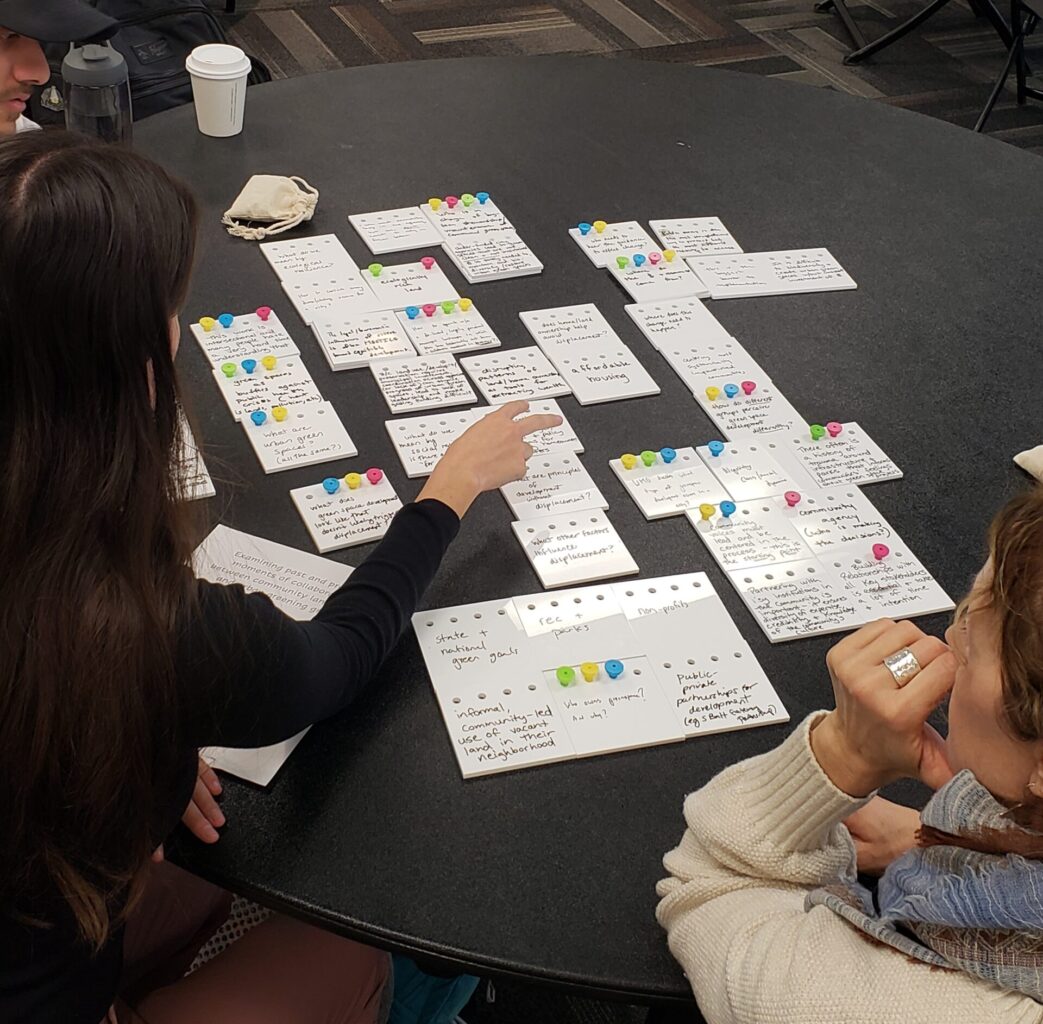
CoNavigator is a unique three-dimensional concept mapping protocol the ICARE trainees and their thesis committees used to brainstorm. The structured format encouraged creative thinking about their projects’ goals and implementation.

Danish researchers created CoNavigator in 2015, and “UMBC was a big part of the genesis of this,” shared Katrine Lindvig, one of CoNavigator’s founders who facilitated the ICARE session. UMBC was one of the first institutions to apply the unique protocol, Lindvig said.

White-Newsome said in her keynote that addressing environmental problems “takes multiple perspectives; it takes creativity; it takes ensuring that those folks who are most impacted are part of and given the space to implement and co-solve and create solutions that will benefit us all.” 

She also encouraged the ICARE trainees: “To read about the questions you’re asking, and the way you’re going about answering them— your work is so important.”

Learn more about ICARE.

A black round table with white tiles arranged on it; tiles have writing on them and some have colorful tokens placed on them. People sit around the table; a hand is pointing at one of the tiles.
CoNavigator concept mapping in action (Image by Sarah Hansen, M.S. ’15/UMBC)

Dean Moffitt interviewed about media and Black hair and body politics

Kimberly R. Moffitt, dean of UMBC’s College of Arts, Humanities, and Social Sciences, speaks about the inspiration for and journey of her career in an interview with mastersincommunications.com, which offers research-based data on graduate programs in media and communication studies nationwide along with insights from leaders in the field.

Moffitt shares that one of the key inspirations for her work in media and communication studies is her children. Her research and discourse on colorism, her Black hair syllabus website, and her criticism of Disney’s programming have come from observing how her children and other children of color are perceived and talked about in media. She also analyzes the major challenges with feminism and her identity as a womanist.

“I do not consider myself a feminist. I do embrace and consider myself a womanist, as Audre Lorde discusses it, however. I believe in seeing the uplift of African Americans in this nation,” says Moffitt. “I think it takes all of us to make that happen, and I am not really interested in privileging or prioritizing my own existence as a Black woman over that of a Black man.”

Leadership and communication

The scholarship that fueled Moffitt’s career paved a path to leadership as a dean during a worldwide pandemic and global calls for social justice. Moffitt credits her skills and knowledge of media and communication in helping her navigate these challenges, with grace and patience.

“The beauty of being in a discipline like communication is that we have space to engage a set of theoretical frameworks and concepts that other disciplines cannot,” says Moffitt. “Some of that is because we are a much younger discipline than most, but it is also because we are dealing with a number of contemporary issues that allow us to speak back to society about things as they are currently going on.”

Learn more about Dean Moffitt’s additional work with the Mellon Foundation-funded Global Asias Initiative. 

William Gao, mentee of UMBC statistician Yi Huang, named finalist in Regeneron Talent Search

William Gao, a senior at Centennial High School in Howard County, Maryland, has been selected as one of 40 finalists in the 2024 Regeneron Science Talent Search. Yi Huang, associate professor of mathematics and statistics, has served as his research mentor for the past three years.

The Regeneron competition is one of the oldest and most prestigious youth science competitions in the country, and past finalists now include 13 Nobel Prize winners and 22 MacArthur Fellows. Judges select finalists whose projects demonstrate scientific rigor and who they believe have the potential to become world-changing scientific leaders. The 2024 finalists were selected from among nearly 2,000 entrants nationwide, and each received $25,000 to be used for their education. 

Gao and Huang’s research led to the development of a mobile diagnostic system to identify cancerous regions in tumor samples, which they hope will eventually benefit patients in remote areas. The system applies modern data science technology, including artificial intelligence, to a prominent healthcare challenge. The findings were published in Cancer Informatics.

“I am beyond humbled and grateful to be a finalist in Regeneron’s Science Talent Search this year. I have always loved all things science and technology, and I have felt enormously lucky to grow as a young researcher under the guidance of Dr. Yi Huang,” Gao shares. “In the future, I plan to pursue a career that bridges my interests in technological innovation, research, and policy. Wherever I land, I hope to emulate Dr. Huang’s passion as a mentor and pay it forward.”

The finalists will participate in a week-long competition in March in Washington, D.C., where they will compete for more than $1.8 million in awards. The comprehensive judging process will not only test the students’ knowledge of their own projects, but also the depth of their understanding across multiple scientific disciplines.

“Serving the community and helping talented minds from various backgrounds get a boost from research early on has always been a core part of my career in education,” Huang says. “Since the start of his research journey in 2020, William has not only shown an impressive intellectual curiosity and resilience, and maturity in dealing with research challenges, but has also demonstrated exceptional initiative and independence. What sets William apart is his ability to bridge technological innovation with real-world problem solving, always considering the ethical and humanistic implications and the broad social impact of his research in the healthcare system.”

UMBC fusion researchers get TV spotlight at world’s largest physics meeting

The American Physical Society, an influential professional society founded in 1899 to “advance and diffuse the knowledge of physics,” is highlighting the fusion research of UMBC’s Carlos Romero-Talamás at its largest annual meeting, held March 3 – 8 in Minneapolis this year. A short film showcasing Romero-Talamás and colleagues’ work on a relatively simple and cheap approach to fusion power will be broadcast on APS TV, a channel that plays on screens around the meeting venue, in selected local hotels on dedicated TV channels, on the virtual meeting platform, and on YouTube.

Fusion, which is the reaction that powers stars, releases enormous amounts of energy when light atomic nuclei combine to form heavier ones. Initiating, sustaining, and controlling the process in a way that allows humans to generate clean, safe, and near limitless commercial power has long been a goal in the physics community and beyond. The film, created by the international film and broadcasting company WebsEdge, brings viewers into the lab where Romero-Talamás, alongside colleagues and students from UMBC and the University of Maryland, College Park, are questing to bring this celestial energy down to Earth.

Romero-Talamás’s group is exploring a promising alternative to traditional fusion power approaches, using equipment that is smaller, cheaper, and more simple to operate. The group’s current experiments are going well, and they are working to attract public and private investment to build a next-generation machine that could be fitted to produce more power than it takes to run, a key milestone on the road to commercial fusion power.

“The APS March Meeting is an opportunity to connect and promote our research with the largest physics audience in the world,” Romero-Talamás says. The video aligns with the lab’s work to raise their visibility and attract additional students and researchers interested in fusion energy. “At the levels of effort that we will require for the next step in our quest for fusion energy, we will need to grow quickly,” Romero-Talamás says.


Learn more about fusion research at UMBC in this interview with Carlos Romero-Talamás and in his GRIT-X talk.

National Institutes of Environmental Health Sciences highlight Professor Upal Ghosh’s work cleaning contaminated waterways

The positive environmental and health impacts of work led by Upal Ghosh, professor of chemical, biochemical, and environmental engineering at UMBC, was recently highlighted by the National Institutes of Environmental Health Sciences (NIEHS). The agency showcased a low-cost technology that Ghosh and his colleagues developed to clean waterways contaminated with polychlorinated biphenyls (PCBs), a group of likely carcinogenic chemicals that were used in insulation, coolants, and electrical equipment for decades before being banned in the U.S. in 1979. 

The chemicals are stable and persist in the environment, often accumulating in fish that live in contaminated waterways and posing a risk to humans who consume those fish. NIEHS funded Ghosh’s research into using activated carbon pellets to bind the chemicals in place at the bottom of the waterways. This prevents the PCBs from circulating through the aquatic food chain. In projects carried out in contaminated lakes, rivers, and harbors in Delaware, Maryland, and elsewhere, Ghosh’s team demonstrated that the technique could significantly reduce the concentration of PCBs in the water and in aquatic lifeforms. Importantly, the technique is also significantly cheaper than standard clean-up approaches, such as dredging and disposing of contaminated sediment. 

In related work performed with Kevin Sowers, from the Institute of Marine and Environmental Technology, Ghosh’s team also developed a way to combine the activated carbon with microbes that break down PCBs, reducing their toxicity.

With NIEHS support, Ghosh has co-founded two companies—Sediment Solutions and RemBac—to commercialize the technology and deploy it at full-scale to clean up contaminated sites across the country, such as at Mirror Lake in Delaware.

“The technology brings together innovations in material science and biology,” says Ghosh. It’s an honor, he says, that the NIEHS, the leading agency in the country that funds research on public health and the environment, recognized “the real impact our research is having on improving public health.”

UMBC-led Aquaculture Research Center donates thousands of pounds of seafood to local food pantries

The Aquaculture Research Center (ARC) at the Institute of Marine and Environmental Technology (IMET), led by Yonathan Zohar, professor of marine biotechnology, has been focused for years on advancing sustainable methods of growing fish on land to meet the growing global demand for seafood. In addition to helping develop new, environmentally responsible ways of producing nutritious food for the long term, the ARC is helping to meet immediate needs in the local community. 

Today, the center donated 1,200 pounds of Atlantic salmon to DC Central Kitchen, a food pantry in Southwest Washington, D.C., after donating 1,400 pounds in November 2023. ProFish, located in Washington, DC, processed the salmon for the donations.

The ARC’s seafood donation program launched in 2017, when the Feeding Individuals to Support Health (FISH) initiative was formed in partnership with several local businesses and non-profit organizations. The first major donation distributed thousands of pounds of European sea bass (also known as bronzino) grown in the ARC’s marine tanks to communities in need in the Baltimore area.

“The U.S. is the largest importer of seafood in the world. Currently the oceans are overfished, and IMET is working on innovative aquaculture platforms that will reduce U.S. and global dependence on wild fisheries stocks,” Zohar says. “Through these donations, we can also provide a small level of societal benefit right away and close to home.”

Learn more about groundbreaking work at the Aquaculture Research Center here.

Professor Curtis Menyuk honored for pioneering work that helped transform global telecommunications

Curtis Menyuk, professor of computer science and electrical engineering at UMBC, has won the 2024 SPIE G.G. Stokes Award in Optical Polarization. The award honors Menyuk’s pioneering work in the 1980’s developing equations to describe how light propagates through optical fibers, as well as his ongoing contributions to the fields of optics and photonics.

The fast and reliable internet we enjoy today would not be possible without the fundamental work that Menyuk and his colleagues performed decades ago. Modern global telecommunication systems are built on backbones of optical fiber, and the rate of information flow through the fibers is limited by physical phenomena that affect the way light spreads. Over time and distance, these phenomena can turn a crisp signal into indecipherable garbage, and so optical communication system engineers must account for them in their designs. 

Menyuk developed equations that allow engineers to effectively model optical communication, most importantly by being the first equations to incorporate the effects of a property of light called its polarization. (Light travels as an oscillating electric field coupled to an oscillating magnetic field, and the direction of the electric field determines the polarization.) 

One consequence of the equations was the realization that spinning optical fiber can minimize signal distortion. 

“Curtis is a renowned pioneer in the field of optical communications, and over the years I witnessed the tremendous impact of his group’s work on the telecom industry, photonic technologies, and the field of optics in general,” says DEVCOM Army Research Laboratory physicist Michael Brodsky in a news story from SPIE announcing the award. 

For his part, Menyuk credits much of the impact of his work to his successful collaborations with colleagues and students. “It’s what comes from working with good people,” he says.