Susan McDonough, history, receives prestigious membership to the Institute for Advanced Studies to continue research on sex workers in medieval Mediterranean

Susan McDonough, associate professor of history, received a 2024 – 2025 research membership to the Institute for Advanced Studies (IAS) at the School of Historical Studies in Princeton, New Jersey. 

McDonough will join scholars from around the world in one of the leading centers for theoretical historical research. This includes research on the history of medieval, early modern, and modern Europe, the Islamic world, East Asian studies, art history, history of science, and musicology. McDonough will spend the year writing chapters of her forthcoming book about the lives of sex workers in the medieval Mediterranean and sharing her progress in weekly seminars with historians as well as mathematicians, natural scientists, philosophers, and social scientists.

“I am incredibly energized by this opportunity to immerse myself in the archival materials I’ve been gathering concerning sex workers and their communities in the medieval Mediterranean,” she shares. Previously, McDonough earned a 2019 – 2020 National Endowment for the Humanities fellowship to conduct archival research at six Mediterranean Sea ports: Barcelona, Mallorca, and Valencia in Spain; Marseille, France; and Genoa and Palermo, Italy. 
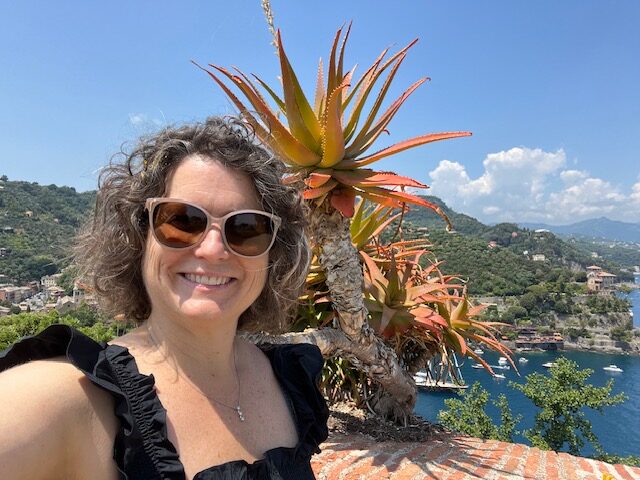
Susan McDonough, a person with neck-length brown and white wavy hear wearing a black ruffled tank top stands in front of an orange and yellow palm tree with a view of an Italian seaport in the background.
Susan McDonough in Nervi, a suburb of Genoa, Italy. (Image courtesy of McDonough)

“I tell a story of movement, of community, of connection, and of resistance. Sex workers lived under the threat of forced expulsion and were usually migrants to the towns in which they sold sex,” explains McDonough. “They worked, fought, competed against each other in brothels, and left each other precious belongings in their final wills and testaments.” 
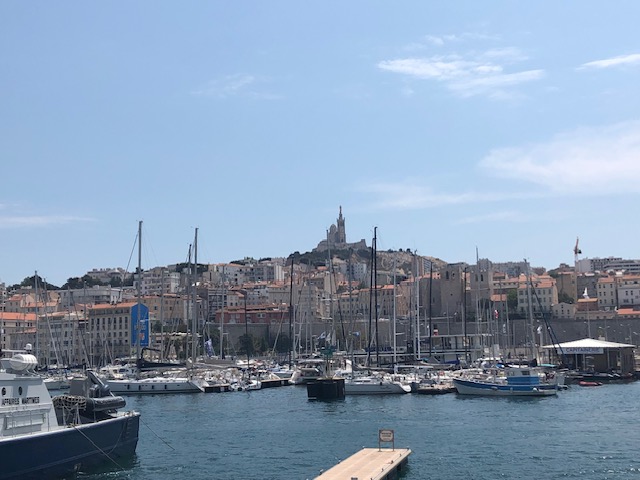
A seaport in Marseille, France in the Mediterranean with a view of a grand cathedral at the top of a hill.
Marseille’s Vieux Port, with a view of the Cathedral of Notre Dame de la Garde. (Image courtesy of McDonough)

Her research is developing a more inclusive understanding of women’s experiences during this period. “To have the freedom to refine and deepen my ideas in the company of some of the most exciting thinkers, writers, and scholars—many of whose ideas have already been foundational in my conceptualization of this book—is extraordinarily lucky.” 

McDonough is the second faculty member at UMBC to receive an IAS membership. Constantine Vaporis, professor of history, received a 2020 – 2021 IAS membership to work on his upcoming book, Sword and Brush: Portraits of Samurai in Early Modern Japan, 1600 – 1868.
Learn more about UMBC’s history department.

UMBC-designed STEM study abroad program in Spain launches in 2025

In January 2025, UMBC will facilitate its STEM-focused research study abroad program in Barcelona, Spain.

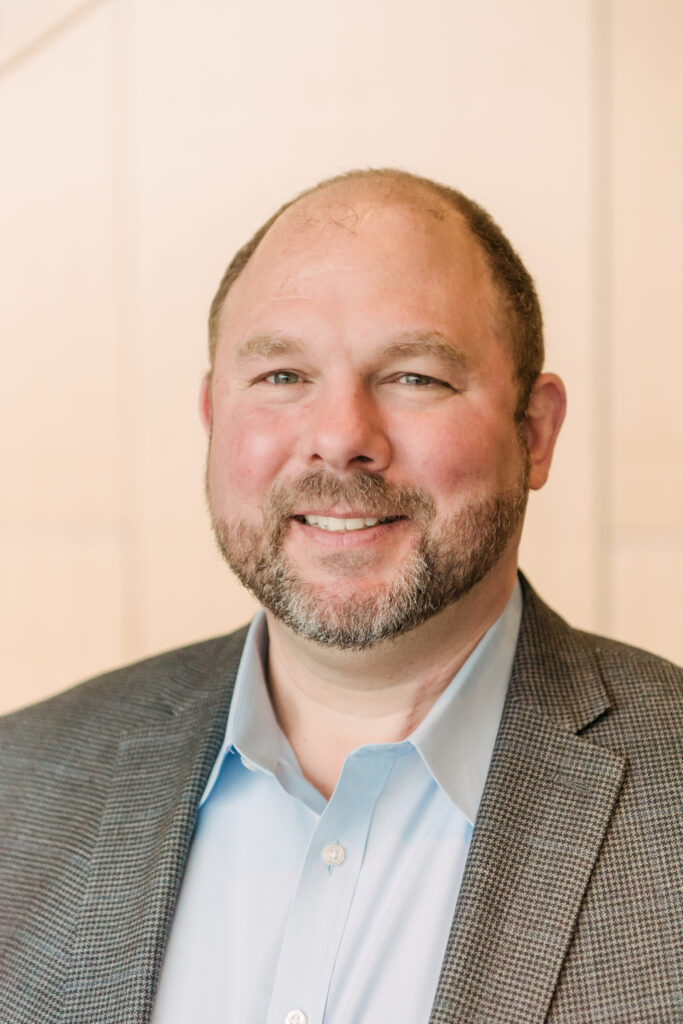
headshot of man in jacket and open collared shirt, beige background
Steven Caruso. (Marlayna Demond ’11/UMBC)

The program, developed by UMBC’s Center for Global Engagement’s Education Abroad Office and the College of Natural and Mathematical Sciences, was created to provide students with an affordable study abroad experience while expanding study abroad access for students in technology, engineering and mathematics fields. 

Steven Caruso, principal lecturer of biological sciences, will lead up to 18 undergraduate students on a three-week program to Barcelona to investigate bacteriophage biology research. Caruso ’94, Ph.D. ’02, biological sciences, is the co-leader of UMBC’s SEA-PHAGES program, called Phage Hunters, a two-course undergraduate genetics and bioinformatics sequence.

In 2023, UMBC received the institution’s first capacity-building grant for study abroad from the U.S. Department of State’s Increase and Diversify Education Abroad for U.S. Students (IDEAS) initiative to develop the “Phage Hunters in Barcelona” program. The study abroad program combines asynchronous online learning and hands-on training opportunities at research institutes in Barcelona.

“The IDEAS grant helps to make education abroad more accessible for UMBC students,” said Katherine Heird, UMBC’s director of education abroad and global learning. “This innovative program offers students an unparalleled opportunity to delve into biomedical research, hone their intercultural communication skills, and build connections across the globe.” 

Find out more about the UMBC faculty-led Phage Hunters in Barcelona, Spain, study abroad program

Watch: A recap of UMBC-led NASA Dissipation sounding rocket launch

Planetary scientist Mehdi Benna of UMBC’s Center for Space Sciences and Technology, along with a team of collaborators, recently released a video recounting the launch of NASA’s Dissipation sounding rocket mission. 

The Dissipation sounding rocket, which launched from the Poker Flat Research Range in Fairbanks, Alaska in November 2023, carried a suite of six instruments designed to measure how Earth’s upper atmosphere at high altitudes responds to large energy inputs from the sun during auroral storms. 

The video recaps how Benna, principal investigator of Dissipation, and his team of scientists and engineers overcame a series of obstacles to successfully launch the sounding rocket during the peak of the auroral activity that took place in Alaska on November 8.

The launch of NASA’s Dissipation sounding rocket from the Poker Flat Research Range in Fairbanks, Alaska on November 8, 2023.

“It was an exciting but nerve-racking experience. The countdown had to be precisely timed to target the peak of the auroral activities, which lasted less than 30 minutes from its growth to recovery phase,” said Benna in an article. “The last four minutes of the countdown felt like hours as we waited for the last items on the launch checklist to be completed before the rocket could lift off.”

Along with Benna, the Dissipation team included scientists and engineers from UMBC, Goddard Space Flight Center, the Wallops Flight Facility, the University of New Hampshire, and the University of Alaska Fairbanks. 

Benna shares that the video encapsulates “the human aspect of space engineering that is rarely shown, and demonstrates that the success of these types of missions are often hinged on the real time and quick decision-making of the engineers.”

Molly Mollica wins American Heart Association Career Development Award

Molly Mollica, an assistant professor in mechanical engineering who joined UMBC in August 2023, has been selected for an American Heart Association (AHA) Career Development Award, which will provide more than $200,000 to fund her research for the next three years.

Mollica studies the biomechanics of blood platelets, which play an essential role in healthy blood clotting, but can also contribute to the formation of blood clots that cause heart attacks and strokes. Bleeding and clotting have been shown to vary between males and females, but the reasons are not well understood. In her AHA-funded research, Mollica will investigate how platelets from males versus females, and from donors with varying hormone levels, respond to and generate mechanical forces. She hopes the information she uncovers will help doctors better understand healthy platelet function, design more inclusive health research, and develop better treatments.

“I’m honored to receive this award,” said Mollica. “We look forward to better understanding sex and hormone differences in platelet function. This research is important in providing tools to develop new preventative and curative therapeutics.”

UMBC’s College of Engineering and Information Technology aligns with UBalt’s Merrick School of Business to deliver enhanced degrees

An agreement between the College of Engineering and Information Technology at UMBC and The University of Baltimore’s Merrick School of Business will offer students from both institutions enhanced opportunities for their graduate-level degrees and future careers. 

UMBC students may apply credits from UMBC’s M.S. in Engineering Management, Post-Baccalaureate Graduate Certificate in Project Management, or the Post-Baccalaureate Graduate Certificate in Engineering Management to UBalt’s MBA. UBalt students may apply credits from the MBA program or the Post-Baccalaureate Graduate Certificate in Business Fundamentals to UMBC’s M.S. in Engineering Management. This collaborative effort to satisfy certain requirements for these programs is intended to increase the marketability of students at both institutions, as they build out their career paths in a growing number of fields that require multiple areas of focus.

A candidate for an engineering job, for example, may benefit from having educational experience in business. The MBA degree, a stalwart of business professionals across a wide range of fields, is made even more attractive when combined with graduate-level learning in a vital area such as project management.  

Both UMBC and UBalt are members of the University System of Maryland, the state’s longtime organization of 12 colleges and universities, three regional centers for higher education, and the system office, all working together to improve the quality of life in Maryland. The partnership maximizes the strengths at each of the USM sister institutions so those seeking managerial education at UMBC will have access to programs offered by an AACSB-accredited School of Business and those in the UBalt MBA may continue to evolve their professional goals with technical skill sets offered by the UMBC School of Engineering.

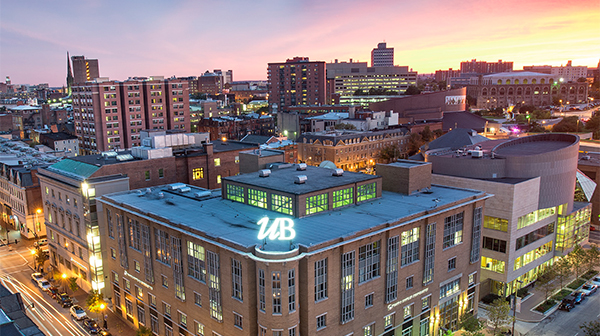
A view of city building at night.
The Thumel Business Center, home of the Merrick School of Business, at The University of Baltimore. (Photo courtesy of UBalt.)

“This agreement leverages the strengths of UMBC’s engineering program and UBalt’s business program to provide students with accelerated pathways to earn graduate degrees or certificates from both institutions,” says Dr. Raju Balakrishnan, dean of the Merrick School of Business. “This is another excellent example of how USM institutions collaborate to provide students with even more enhanced educational opportunities.”

UMBCs acting dean of the College of Engineering and Information Technology Anupam Joshi adds, “We are excited to provide students from both institutions additional options to grow and acquire valuable knowledge and skills. We also look forward to exploring new ways to expand this partnership.”

Admission into these collaborative courses is straightforward:

  • UMBC students must be enrolled in or have completed an M.S. in Engineering Management or Post-Baccalaureate Certificate in Engineering Management or Project Management at UMBC. These UMBC students may apply to either or both of the UBalt programs in the final semester of their respective programs and will be subject to standard application procedures. 
  • Similarly, UBalt students will have to be enrolled in the MBA or the Graduate Certificate in Business Fundamentals and may apply to any of the UMBC programs in the final semester of their respective programs and will be subject to standard application procedures.
  • Both UBalt and UMBC will accept up to 12 transfer credits of the other institution’s courses.

The introduction of the new collaboration is expected to be available to applicants in Fall 2024.

For further details, visit UBalt’s page.

Learn more about the Merrick School of Business at The University of Baltimore.

Learn more about the College of Engineering and Information Technology at UMBC.

CNMS Awards and Recognition Day honors students, faculty, and staff

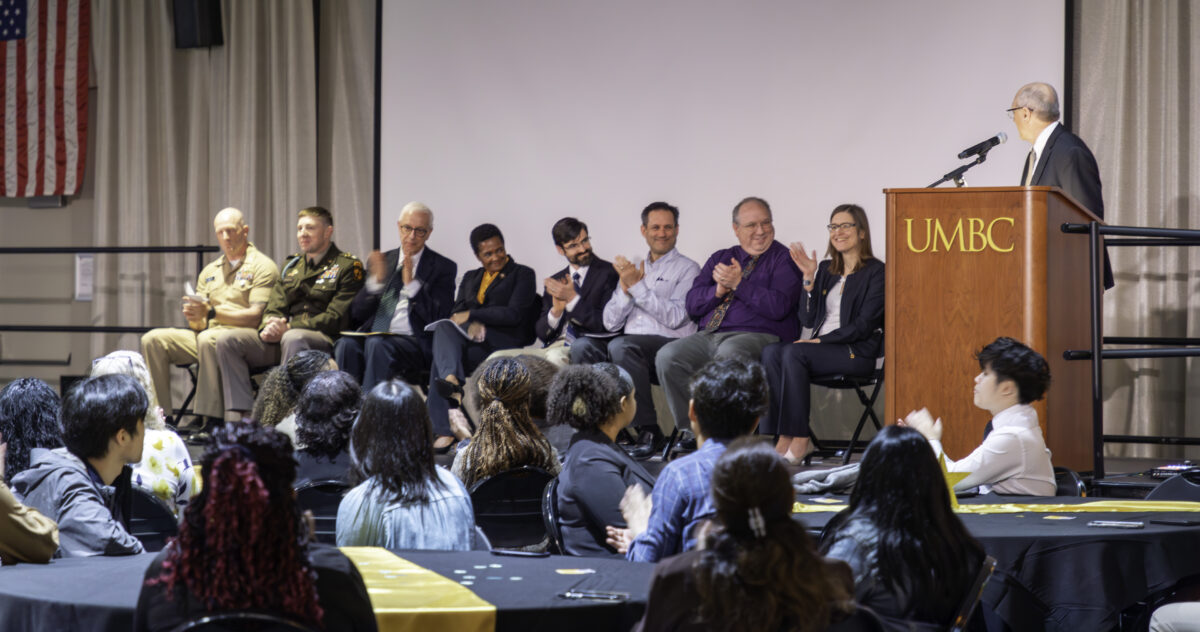
The College of Natural and Mathematical Sciences (CNMS) held its annual CNMS Awards and Recognition Day on May 10. Nearly 270 UMBC community members and friends attended the event in the University Center Ballroom. The department chairs presented 45 awards established by donors in support of students, faculty, and staff, such as the Carl S. Weber Award for Excellence in Teaching, awarded this year to Tamra Mendelson, professor of biological sciences. 

“I would like to thank the members of the UMBC community—alumni, parents, faculty, staff, and friends—who have made possible many of the awards we are presenting here today. These are not just names on a page—they are stories of gratitude and giving, honoring loved ones and families,” shared William R. LaCourse, CNMS dean. “You are fueling the academic success of our students, helping us recruit and retain top-notch faculty, ensuring support for programs and people across the university, and inspiring others to give. On behalf of UMBC, thank you!”

The recognition day also honored eight CNMS faculty at all levels with Faculty Excellence Awards for research and teaching designated by the college, awarded college-level Staff Excellence Awards for outstanding service, and distributed departmental awards for undergraduate and graduate students recognizing academic excellence, research, and teaching. 

person standing at podium on stage, eight people seated on the same stage are clapping and smiling; a few tables visible in foreground
Dean LaCourse, at the podium, introduced the awards ceremony, and individual chairs or their designees presented the awards to members of their departments. From left to right: Commander Christopher Boehm, naval science; Captain John Howrey, naval science; Yonathan Zohar, professor and chair, marine biotechnology; Annica Wayman ’99, mechanical engineering, associate dean for Shady Grove affairs; Jason Kestner, associate professor and associate chair, physics; Bradford Peercy, professor, mathematics; Brian Cullum, professor and chair, chemistry and biochemistry; Michelle Starz-Gaiano, professor and chair, biological sciences. (Melissa Penley Cormier, M.F.A. ’17/UMBC)

CNMS also celebrated students who had been inducted into national honor societies, including Sigma Pi Sigma, the physics and astronomy honor society; Pi Mu Epsilon, the national mathematics honor society; Mu Sigma Rho, the national statistics honorary society; and the Phi Beta Kappa Society, which recognizes overall academic excellence. 

LaCourse closed the ceremony by recognizing students in scholars programs within the college. The CNMS Scholars program supports students interested in the advancement of women in STEM fields where they are still underrepresented, and the Beckman Scholars program, funded by the Arnold and Mabel Beckman Foundation, supports students desiring to pursue doctoral study in the biological and chemical sciences.

“Students who have been recognized at this ceremony have met UMBC’s academic requirements and have excelled at high levels in their academics and/or service to their departments, college, and university,” LaCourse shared. “These honorees are poised to become scientists, physicians, mathematicians, teachers, and leaders in their chosen fields. These students are our leaders of the future, and we are fortunate to have the opportunity to help provide the critical foundations for their promising futures.”

The full event program, including additional remarks from Dean LaCourse and a complete list of awardees and award descriptions, is available here

Lee Blaney awarded funding to develop new ways to remove “forever chemicals” from water

Professor Lee Blaney, in the Department of Chemical, Biochemical, and Environmental Engineering, received $750,000 in funding from the Department of Defense’s Strategic Environmental Research and Development Program (SERDP) to develop new ways to remove substances dubbed “forever chemicals” from water.

Per- and polyfluoroalkyl substances, or PFAS, are used in products ranging from cleaning products and clothing to fire-fighting foam. They earned the nickname “forever chemicals” because of the way they persist in the environment. PFAS have been linked to decreased fertility in women, developmental effects in children, reduced immune function, and increased risk of cancer and obesity. The Environmental Protection Agency recently announced limitations on the amount of certain PFAS in drinking water. 

Current technology such as activated carbon and anion-exchange resins can effectively remove the most common PFAS found in water, but do not perform well at removing short- and ultrashort-chain PFAS (which have fewer than eight carbon atoms in their chemical structure.)

The award from SERDP will fund Blaney’s work to develop materials called adsorbents specifically designed for treatment of these short-chain PFAS. Blaney’s colleagues on the project include Ke He, Ph.D. ’17, chemical and biochemical engineering, an assistant research scientist at UMBC, Wenqing Xu, an associate professor in civil and environmental engineering at Villanova University, and Jessica Ray, an assistant professor in civil and environmental engineering at the University of Washington.

COEIT convenes inaugural research day to encourage interdisciplinary collaborations

On April 19, more than 150 people gathered for the inaugural College of Engineering and Information Technology (COEIT) Research Day. The event was an opportunity for faculty and students to showcase their research and forge interdisciplinary collaborations, including with potential industry partners in attendance. Close to 100 COEIT researchers presented work, either in talks during four concurrent morning sessions or in the afternoon poster session. 

“We are asking you to see how you can get together and solve major societal problems,” said Anupam Joshi, acting dean of COEIT, in opening remarks. 

To incentivize such collaboration, COEIT is offering funding to teams that propose projects involving researchers from two or more of the colleges’ departments. 

“The day was very well attended and several folks made new connections across departments in COEIT,” said Vandana Janeja, the associate dean for research and faculty development in COEIT. “I am already seeing a lot of interest in the interdisciplinary proposals.” 

For Tasnim Nishat Islam, a Ph.D student in computer engineering, the day was a great chance to share her work and engage with other researchers. Islam presented a poster about research she is conducting with Mohamed Younis, computer science and electrical engineering, investigating ways to measure mental stress. “I’ve already connected with others who study similar ideas,” she said.

Ryan Bloom, English, receives 2024 Guggenheim Fellowship for translation

Ryan Bloom, senior lecturer in English, has received the 2024 Guggenheim Fellowship for translation to work on the first complete edition of the French-Algerian author Albert Camus’s notebooks, journals, and other works. This year, 188 grants were awarded from more than 3,000 applicants from over 52 academic disciplines across the U.S. and Canada. Fellows are provided funding to freely pursue their creative projects through their unique process without any special conditions. 

“In many ways, the situation Camus experienced in post-World War II Paris bears similarities to our own times here in the States. To give just one example, one of Camus’s great fears was a world where, in support of ideology, people were willing to excuse, if not actively cheer, the murder of other human beings,” says Bloom. “We need only turn on the news or scroll through our social media feeds to understand how some might feel that same fear today.”

Bloom has been translating Camus’s work for more than a decade. Most recently, he completed translations of Camus’s North and South American journals, Travels in the Americas: Notes and Impressions of a New World (Chicago University Press, 2023) as well as Camus’s Caligula and Three Other Plays (Penguin Random House, 2023). His translation of Albert Camus’ Notebooks 1951 – 1959, (Ivan R. Dee Publishing, 2008) was a finalist for the French-American Foundation and the Florence Gould Foundation’s Translation Prize for outstanding published English translations of prose originally written in French; his translation of Travels in the Americas is again a finalist for this year’s prize, to be awarded in June. Bloom notes that his drive to translate Camus’s work stems from the relevance the author’s work still has today, more than 65 years after Camus received the Nobel Prize in Literature in 1957.

“Humanity faces some profound existential challenges,” said Edward Hirsch, award-winning poet and president of the John Simon Guggenheim Memorial Foundation. “The Guggenheim Fellowship is a life-changing recognition. It’s a celebrated investment into the lives and careers of distinguished artists, scholars, scientists, writers, and other cultural visionaries who are meeting these challenges head-on and generating new possibilities and pathways across the broader culture as they do so.”

In 2017, Deborah Rudacille, professor of the practice in English, was the first UMBC faculty to receive a Guggenheim Fellowship. Rudacille received it for science writing.

“Ryan Bloom’s Guggenheim shows the wide range of research and teaching that takes place in the English department,” says Jessica Berman, professor of English and director of the Dresher Center for the Humanities. “That students have access to a translator of Ryan’s caliber when they sign up for his composition or creative writing classes and have the opportunity to learn from his careful approach to language adds immeasurably to their experience. UMBC is very lucky to have him in our midst.”

Learn more about UMBC’s English department.

Students inspire William Blake’s paper on constitutional amendments in the prestigious ‘American Political Science Review’ 

The American Political Science Review, the leading political science peer-reviewed journal,  publishedSocial Capital, Institutional Rules, and Constitutional Amendment Rates,” a new research article by lead author William Blake, associate professor and associate chair of political science. 

The study addressed why some constitutions are amended more frequently than others. The team gathered data from democratic constitutions worldwide and U.S. state constitutions for a cross-sectional and longitudinal analysis of the effect social capital has on how often constitutions are amended. The findings show social capital like group membership, civic activism, and political trust can create a more favorable political environment for amending constitutions. 

“Unlike previous studies, we demonstrate how these factors affect constitutional reform over time and across the stages of the amendment process,” the authors write. “We also build upon prior research that finds social capital facilitates social movement organization and elite coalition formation.” 

The research was inspired by Blake’s Contemporary Constitutional Conflict honors seminar. “The students read and critiqued a flawed article looking at the effect of constitutional culture on amendment frequency, which led me to think that I could conduct a better study,” says Blake. He also assigned a draft of the article the next time he taught the seminar. The students of the Honors College received an acknowledgment in the article.

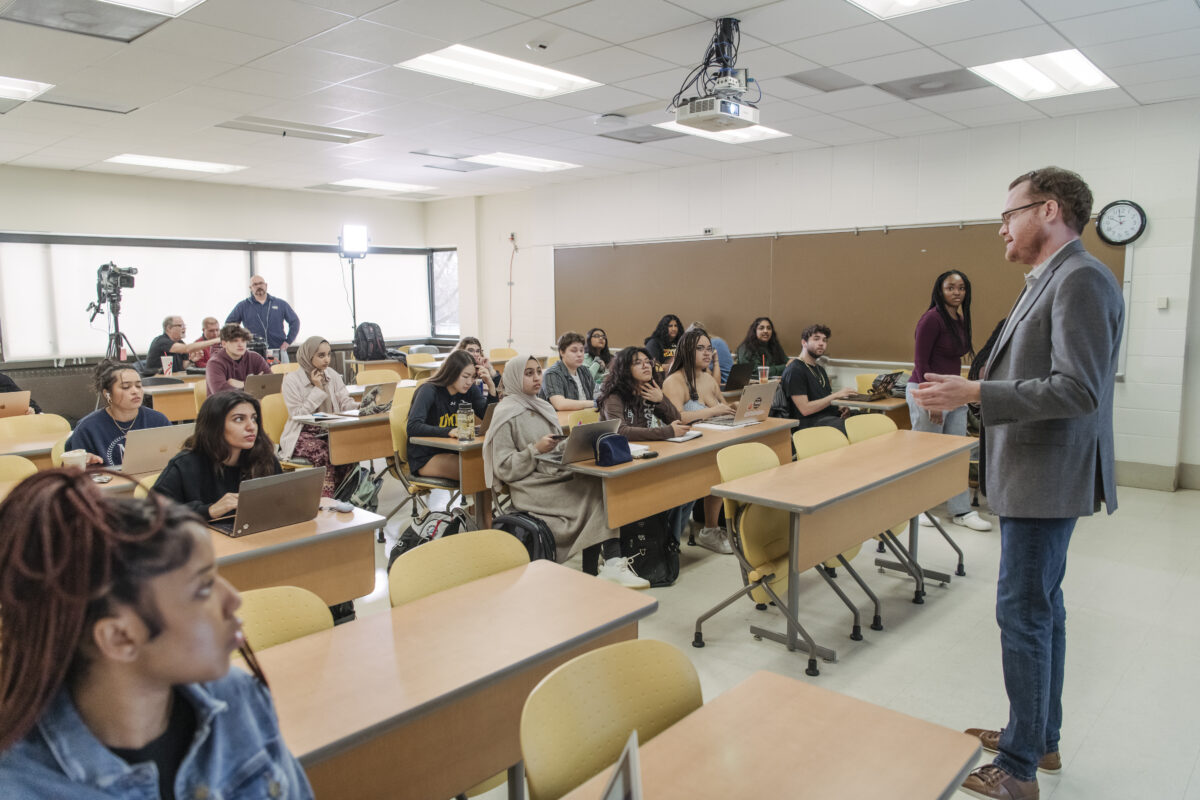
William Blake, a college professor, gives a lecture in a class full of students.
Blake’s “Women and Employment Laws in the Early 20th Century” class on laws regulating minimum wages and maximum hours for female workers on C-SPAN’s “Lectures in History” series. (Marlayna Demond ’11/UMBC)

Blake is the only UMBC faculty to publish in The American Political Science Review since Nicolas Miller, professor emeritus of political science, published “Pluralism and Social Choice” in 1983.

Blake’s co-authors for the journal article are Joseph Francesco Cozza, assistant teaching professor of political science and associate director of the Politics, Law, and Social Thought program at Rice University; David A. Armstrong II, associate professor of political science at The University of Wisconsin–Milwaukee; and Amanda Friesen, Canada research chair in political psychology at Western University in Canada.

Watch Blake’s “Women and Employment Laws in the Early 20th Century” class on laws regulating minimum wages and maximum hours for female workers on C-SPAN’s “Lectures in History” series. Enroll in his POLI 220: The Constitution and American Democracy summer course.

First CNMS GradFest fosters interdepartmental interaction among grads, postdocs

On April 12, more than 150 students, staff, and faculty attended the first College of Natural and Mathematical Sciences (CNMS) GradFest in the University Center Ballroom. The event was the result of listening sessions held with CNMS graduate students last summer, and it addressed their desire for more opportunities to forge interdepartmental connections and present their research.

“Every day, I hear about the great work being done by graduate students and postdocs in CNMS departments,” William R. LaCourse, CNMS dean, shared in his opening remarks. “Today is my chance to meet all of the graduate students the faculty are always bragging about.” 

The event began with six “lightning talks,” where Ph.D. students were challenged to present the big idea of their thesis projects in only five minutes. Naghmeh Akhavan, mathematics, led off, presenting her project on cell migration in fruit fly development. She is co-mentored by Brad Peercy in mathematics and Michelle Starz-Gaiano in biological sciences. Misti Cartwright, chemistry and biochemistry, discussed her work with Aaron Smith on a post-translation protein modification called arginylation. 

Sandra Cheng, physics, talked about her work with Todd Pittman in quantum computing, and Manju Ojha, chemistry and biochemistry, explained her work on RNA-based plant viruses with Deepak Koirala. Ji Li, statistics, described a protocol he developed under the mentorship of Yi Huang to improve data sets for randomized controlled trials. And Prableen Chowdhary, biological sciences, explained her work with Rachel Brewster on zebrafish development.

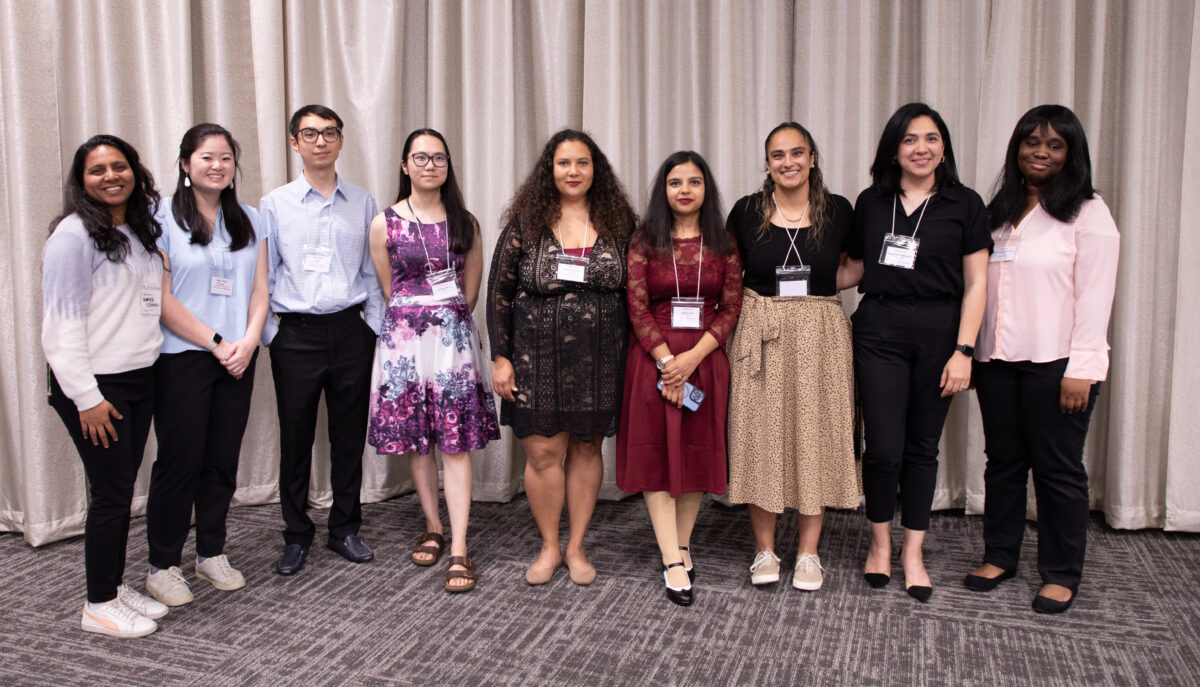
group of nine people stands in front of a beige curtain
GradFest lightning talk presenters and the planning committee, from left to right: Ronita Sequeira, Ally Kido, Ji Li, Sandra Cheng, Misti Cartwright, Manju Ojha, Prableen Chowdhary, Naghmeh Akhavan, and Ayokunnumi Ogunsanya. (Image by Melissa Penley Cormier, M.F.A. ’17)

After the talks, two sessions featuring 46 posters allowed attendees to learn about the presenters’ research, ask questions, and make suggestions. A novel arrangement of posters in the ballroom facilitated interaction: Placing four posters each on round tables allowed guests to meander among the posters in many directions, unimpeded by long, linear poster displays.

Tasty mocktails, hors d’oeuvres, and desserts rounded out a successful event that brought graduate students and postdocs—collectively, the research engine of UMBC—together to socialize, practice presenting, and learn about each other’s work. 

CAHSS dean establishes a $400,000 education abroad scholarship  

CAHSS students, are you ready to study abroad? Kimberly Moffitt, dean of the College of Arts, Humanities, and the Social Sciences (CAHSS), has established the CAHSS Dean’s Education Abroad Scholarship.  

The scholarship guarantees $100,000 per year for the next four years to help offset the financial costs of studying abroad. Undergraduate and graduate students with at least one major in CAHSS, and who need additional financial support to study abroad can apply for awards ranging from $1,500 – $5,000. The inaugural round of scholarships have been awarded to 24. 

Power of education abroad

Joseph Patarini ’25, environmental science and geography, is one of the CAHSS Dean’s Education Abroad Scholarship recipients. “Studying abroad is important to me because gaining a diverse global perspective is paramount to solving today’s top environmental issues. By getting outside of our comfort zone and exploring new academic opportunities we can deepen our understanding of global interconnectedness,” says Patarini, who will study in Morocco and Spain in summer 2024., “We can learn from new, diverse perspectives to enhance our problem-solving skills, contributing to a more holistic and adaptable approach.”

This grant makes it possible for me to study abroad and make the most of my undergrad experience,” says Ria Smith ’25, dance, CAHSS Dean’s Education Abroad Scholarship summer 2024 recipient to Italy. “I really appreciate how the College of Arts, Humanities, and Social Sciences is showing real commitment to the value of international exposure.”

For additional eligibility details contact the Education Abroad Office at educationabroad@umbc.edu. Scholarship applications for the 2024 – 2025 academic year are due September 10, 2024.