
Biologist Tom Cronin co-authors ‘Color in Nature,’ a beautiful and accessible tour of color’s role in our world

Color in Nature, co-authored by Thomas W. Cronin, professor of biological sciences, covers the world of color from the first principles of physics to the use of color in art and design. An even mix of text and beautiful images, Color in Nature (Princeton University Press, November 2024) is written in an accessible style for any reader who harbors curiosity about color in our world, without sacrificing technical accuracy.

“The book is a comprehensive look at the roles of color in the biology of plants and animals, but also its role in human society and art,” Cronin says. The authors consider the roles of color in mating, hunting, fighting, deceiving, and hiding, and call upon disciplines such as physics, genetics, chemistry, physiology, and psychology. The book’s images support concepts in the text, but they “are also intended to be beautiful and to show off the diversity of colors and patterns in the natural world,” Cronin says.

Cronin contributed to the new book alongside six other authors from England, New Zealand, and the U.S. Contributors include experts in evolution, optical sciences, neuroscience, marine science, and the creative use of color. 
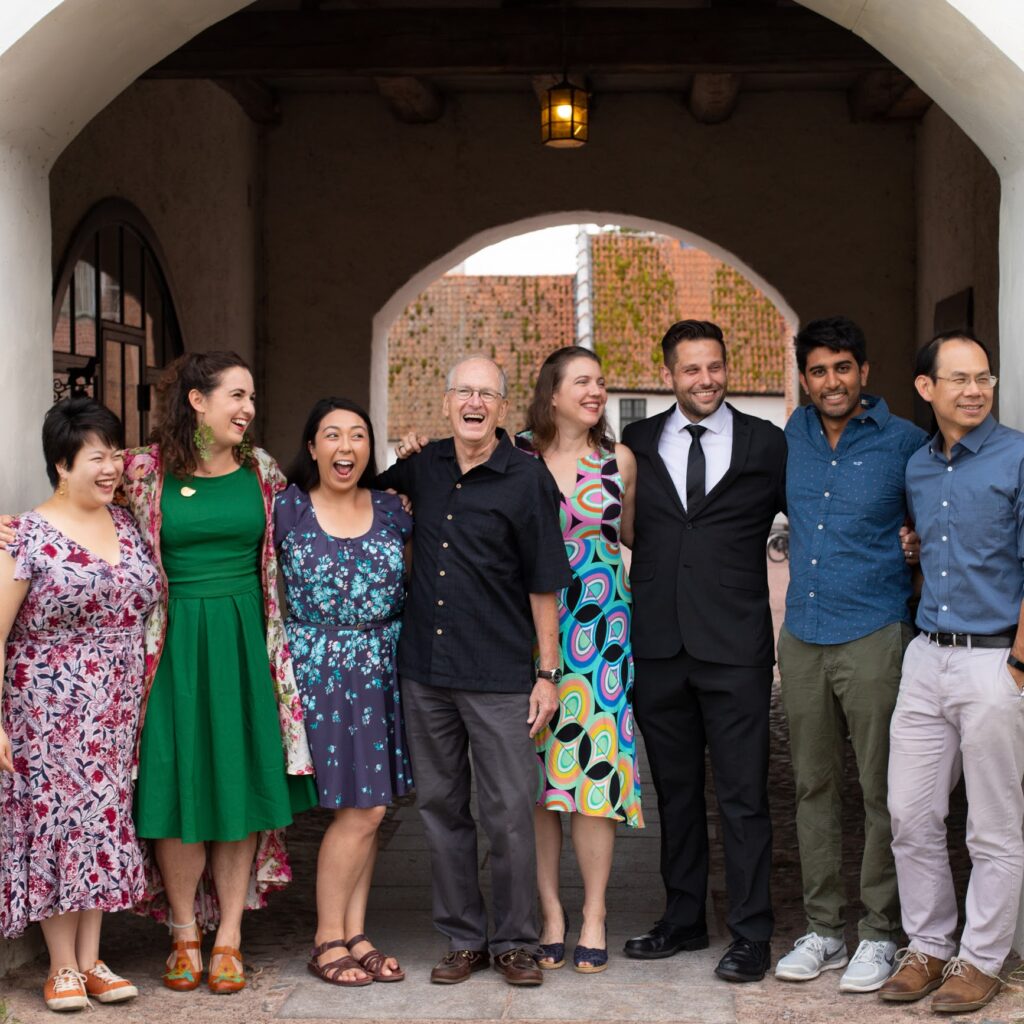
group photo of eight people dressed nicely under an outdoor arched breezeway
Tom Cronin, fourth from left, with current and former members of his research group at the International Conference on Invertebrate Vision in 2019. (Courtesy of Cronin)

Cronin’s four-decade career at UMBC has been primarily spent studying the unique visual system of mantis shrimp—unusual, wildly colored crustaceans with astoundingly capable eyes and a nasty punch. Cronin’s research group has also studied the chromatophores—light-sensing and color-changing cells—on the skin of cephalopods like squid, octopuses and cuttlefish. 

According to the The Wall Street Journal, Color in Nature provides an accessible scientific entrée into the colors of our world, with bold, glossy images and detailed diagrams.”

David Gascoigne, an expert birder and nature blogger at Travels with Birds, found Color in Nature to be “an eminently fascinating book covering an eminently fascinating topic which has relevance to every aspect of life on Earth. I will be referring to it often, and I will cherish its wisdom. I suspect you will, too.”

For 15 consecutive years, UMBC‘s faculty and staff shine in the Great Colleges to Work For survey

In the early hours of the morning, as the windows of Albin O. Kuhn Library begin to reflect the sunrise, UMBC’s faculty and staff are making sure all the campus needs—technology, buildings, streets and sidewalks, lessons, and social media—are ready for students. A close-knit community of over 2,500 faculty and staff is at the heart of UMBC’s vibrant campus, and for the 15th consecutive year, UMBC has garnered the distinction of being on ModernThink’s Great Colleges to Work For list

Retriever Nation spoke loud and clear, sharing what makes their work fulfilling on the 2024 Great Colleges to Work For survey. The survey covered 10 categories, including faculty and staff wellbeing, compensation and benefits, and confidence in senior leadership. The resounding feedback secured UMBC a spot on the Honor Roll among the top 10 four-year institutions with an enrollment exceeding 10,000 students out of 75 outstanding workplaces.

“Great workplaces don’t just happen,” says Lynne Adams, UMBC’s chief human resources officer. “They are built through a collaboration of the community, care, connection, and a shared vision. Our culture really does reflect a team working together continuously evolving into an inspiring workplace for everyone.”

Faculty and staff flourish and enjoy sharing their talents and personal journeys, adding to the campus life through events like yoga and other classes at the RAC taught by Joella Lubaszewski ’10, theatre. UMBC gives space for people to be brave and share their whole selves, as executive administrative assistant Melessia Jasper knows. Visit a McNair Scholars information session to see leadership in action with Michael Hunt ’06, computer engineering, and current Ph.D. student leading the pack. The dedication of our faculty and staff allows students to receive support and shine.

“As we nurture an inclusive and welcoming community and support the professional development of our staff and faculty, they see themselves fully in our mission and believe deeply in the transformative power of education,” says President Valerie Sheares Ashby. “Staff and faculty know their work serves both individual students and the public good. They know their work matters and that they are seen and valued.”

Kaitlyn Sadtler ’11 named to TIME100 Next list for interdisciplinary biotech research

Kaitlyn Sadtler ’11, biological sciences, has been selected for the TIME100 Next list. In its fifth year, the list aims “to recognize rising leaders in health, climate, business, sports, and more—and by doing so, not just show the stories that are capturing headlines in 2024, but also introduce you to the people who we believe will play an important role in leading the future.” 

Since 2019, Sadtler has been a tenure-track researcher and chief of the Section on Immunoengineering at the National Institute of Biomedical Imaging and Bioengineering. Her interdisciplinary research straddles bioengineering and immunology.

“I’m super excited and absolutely surprised to be included on the TIME100 Next list. Working in regenerative medicine, our lab gets to look forward to where we could build therapies to help regrow our damaged tissues after traumatic injuries,” Sadlter shared. “I’m also thrilled that there is excitement for bioengineering at the National Institutes of Health. Biomedical engineering is a field that’s able to connect the basic fundamental biology discoveries with clinical translation and application of those discoveries.”

In 2020, Sadtler led a study published in Science Translational Medicine looking for undiagnosed COVID-19 cases in more than 9,000 blood samples that never-diagnosed participants mailed in. The study found that during the first several months of the pandemic, for every diagnosed case of COVID-19, an estimated 4.8 cases went undiagnosed. That suggested a total of 16.8 million undiagnosed (and therefore mild or asymptomatic) cases by July 2020.

Undiagnosed cases were more likely in certain demographic groups, including younger people, people in urban areas, and people without risk factors for severe disease. The findings provided important insights for the pandemic response by suggesting that immunity acquired from infection among the young and healthy population and in dense areas was higher than previously understood, meaning herd immunity might be reached faster than first anticipated. 

After graduating summa cum laude from UMBC, Sadtler completed her doctorate at the Johns Hopkins School of Medicine and a postdoctoral fellowship at MIT. Sadlter has received numerous awards, and her 2018 TED Talk was one of the 25 most-viewed TED talks that year. Sadtler also presented at UMBC’s GRIT-X speaker series in 2022. 

UMBC’s 2024 Cybersecurity Leadership Exploratory Grant Program recipients announced

The UMBC Cybersecurity Institute and the Division of Research and Creative Achievement, in partnership with the College of Engineering and Information Technology, recently announced the recipients of the 2024 Cybersecurity Leadership Exploratory grant program.

The internal funding opportunity is designed to promote innovative, interdisciplinary research and education focused on enhancing UMBC’s leadership in cybersecurity research. Awardees received up to $45,000 in funding to develop their exploratory projects—an increase compared to its inaugural recipient cohort in 2023. 

The 2024 recipients are:

  • Alan Sherman and Enis Golaszewski for “Modeling and Formal-Methods Analysis of the Secure DNA Protocol”
  • Manas Gaur for “Cybersecurity Research: MetamorphicLLM: Robust Understanding of Metamorphic Malware Through Attacks and Defenses Using Neurosymbolic Large Language Models”
  • Meilin Yu and Zhiyuan Chen for “Detecting Stealthy Long-Term Cyber Attacks on Wind Energy Assets with Physics-Informed Neural Network Technologies”
  • Naghmeh Karim for “Artificial Intelligence and Hardware Security: From Research to Classroom (Educational Proposal)”
  • Nilanjan Banerjee and Mohamed Younis for “Implementing Endpoint Security for Cyber-Physical Systems”
  • Tera Reynolds for “Swiss Cheese Please: Analyzing Cybersecurity Risks in the Digital Health Ecosystem with Patients with Complex Care Needs”

Learn more about UMBC’s internal funding opportunities. 

GESTAR II center awarded $47 million extension on cooperative agreement with NASA Goddard Space Flight Center

The UMBC-led Goddard Earth Science Technology and Research (GESTAR) II center has been awarded a two-year, $47 million extension to continue its cooperative agreement with the NASA Goddard Space Flight Center (GSFC).

In fall 2021, NASA awarded $72 million for UMBC to establish GESTAR II in collaboration with primary partner Morgan State University and six other institutions. Since its launch, GESTAR II has employed more than 150 scientists who are distributed across nearly all of GSFC’s earth science division laboratories. GESTAR II scientists and engineers are currently working on active NASA earth science missions, such as the Plankton, Aerosol, Cloud, ocean Ecosystem (PACE) satellite mission, which launched into orbit earlier this year

“Our scientists and engineers are continuing to contribute toward the advancement of earth science at NASA Goddard. We want to continue to do more of the same with this agreement extension,” said GESTAR II director Charles Ichoku. “With GSFC, we are making progress to keep our planet safe while continuing to make a lot of discoveries.” 

GESTAR II is one of three cooperative agreements that UMBC has with GSFC, a partnership that began nearly 30 years ago. Earlier this month, the university collaborated with GSFC to host the “NASA-UMBC Interaction Days,” an interactive, three-day event series (concluding on September 30) that takes a closer look into the center’s current research activity, with insight into how faculty and students can engage with Goddard scientists and engineers. 

In addition to contributions to NASA’s missions and earth science scholarship, GESTAR II also provides funding support for UMBC students with its undergraduate and graduate fellowships. The center also hosts a recurring seminar series for scientists. 


Learn more about the research happening at the Goddard Earth Science Technology and Research (GESTAR) II center.

UMBC launches new Center for Ethics and Values as a hub for students, researchers, and the broader community

UMBC’s College of Arts, Humanities, and Social Sciences (CAHSS) opened the new Center for Ethics and Values this semester. Through a series of campus, alumni, and community events, the center will foster thoughtful, informed, and nuanced discussions and exploration of pressing ethical issues across a wide range of fields including art, humanities, health care, science, and engineering.

Leading the charge is Jessica Pfeifer, associate professor of philosophy and former executive director of the Philosophy of Science Association. Pfeifer oversaw the development of the center and organized the Public Forum series with additional funding from the CAHSS Office of the Dean. The annual speaker series will feature leading experts on significant ethical issues faced by the campus community and society. Launching the series are experts on Journalism, Ethics, and Democracy, U.S. Presidential Elections, Neuroscience, Freewill, and Moral Responsibility, and more. 

“We all face ethical issues in nearly everything we do, from work to family life to our interactions with friends, to our role as citizens,” says Pfeifer. “The center will provide the campus community the opportunity to develop a more sophisticated understanding of the complexities of the ethical issues they face, as well as the relevance of ethical training for daily real-world decisions.”

Whitney Schwab, associate professor of philosophy, will lead the daily workings of the center as its inaugural director. “The Birth of Belief,” an article Schwab co-authored with Jessica Moss, professor of philosophy at New York University, received the 2019 Best Article Prize from the Board of Directors of the Journal of the History of Philosophy and was listed as one of the 10 best philosophy papers of 2019 by Philosopher’s Annual. Pfeifer notes that Schwab brings a wealth of knowledge about the history of philosophy, including the history of ethics, as well as his skills in public and student engagement to the position. “He is one of our most popular teachers,” says Pfeifer, “and is an excellent public speaker and discussant, who can hone in on central philosophical issues.”

The public forum kick-off event, Journalism, Ethics, and Democracy, on Thursday, September 26, includes Kim Yoshino, editor-in-chief of the Baltimore Banner, Melissa Block, longtime NPR host and correspondent, and Joe Saunders, associate professor of philosophy at Durham University, a public research university in Durham, England. UMBC’s Mike Nance, associate professor of philosophy, and a 2024 UMBC Dresher Center for the Humanities research fellow, will moderate the conversation.

In addition to establishing a new public forum series, the center will be home to UMBC’s Ethics Bowl team and a new host in the national line-up of the Association for Practical and Professional Ethics regional competitions. This year’s Chesapeake Regional Ethics Bowl Tournament will be held on December 7, bringing teams from colleges throughout the Mid-Atlantic region to UMBC.

“Activities like the Ethics Bowl engage students to think more critically about their own values and decisions, and thereby be better able to engage with those whose views differ,” says Pfeifer. “This will make them better scientists, doctors, programmers, entrepreneurs, lawyers, parents, and citizens.”

Pre-register for the Journalism, Ethics, and Democracy public forum.

Learn more about a major, minor, or certificate in philosophy and the philosophy honors program.

Upal Ghosh appointed to D.C. mayor’s Leadership Council for a Cleaner Anacostia River

On September 12, UMBC’s Upal Ghosh, from the Department of Chemical, Biochemical, and Environmental Engineering, was sworn in as a member of the Washington, D.C., mayor’s Leadership Council for a Cleaner Anacostia River (LCCAR). The council consists of 25 high-level government officials, community leaders, and environmental experts who support the vision of a swimmable and fishable Anacostia River. The members meet quarterly to advise the D.C. government on ongoing restoration projects. 

The Anacostia River, which runs from Prince George’s County in Maryland into Washington, D.C., before joining the Potomac River and ultimately flowing into the Chesapeake Bay, has historically suffered from high levels of industrial pollution and contamination from sewage overflow. In recent years, government officials have been making concerted efforts to clean up the river. UMBC was invited to sit on the council, with Ghosh as the representative, based on the university’s key contributions to these clean-up efforts. 

Screen shots shows people on conference call on top and agenda for meeting below. Some people raise their hands for a swearing in.
On Sept. 12, Upal Ghosh (top left) and other members of the LCCAR were sworn in during a virtual meeting of the council. (Image courtesy of Ghosh)

Since 2016, Ghosh and his UMBC colleagues and students have developed innovative methods of measuring contaminants in the river and created models to elucidate where the contaminants come from and how they travel through and accumulate in the water, sediment, and aquatic life, such as fish. Nathalie Lombard, a research assistant professor at UMBC who has played a significant role in the projects, will serve as the alternate representative on the LLCAR when Ghosh cannot attend. 


In addition to his work on the Anacostia, Ghosh and his students have studied and contributed to the cleanup of the waterways throughout Maryland, Delaware, and across the country.  “Students learn a lot from being out in the field,” Ghosh says. “They learn how the science and engineering we do helps guide major decisions. Our ultimate goal is making a positive difference in the health of the river, lake, or bay. That gives me a lot of excitement, and it really motivates the students too.”

Hrabowski Fund for Innovation awardees announced

UMBC’s Faculty Development Center has announced the projects selected to receive grants in the 2023 – 2024 rounds of the Hrabowski Fund for Innovation competition. The Fund supports initiatives to enhance teaching and learning at UMBC, with specific emphasis on innovative approaches to increase student success. 

“These high-profile awards emphasize the university’s ongoing commitment to support faculty and staff efforts in innovation in teaching and learning,” says Kerrie Kephart, interim director, Faculty Development Center. “Projects funded from the Hrabowski Fund are often catalysts for the broader adoption of innovative teaching and student success initiatives across campus.”

Proposals for the next round are due by October 25, 2024. For more information and to apply, visit UMBC’s Faculty Development Center website. Many awardees will be sharing their work during the poster/demo session at the Eighth Annual Provost’s Teaching and Learning Symposium (PT&LS) on Friday, September 27. Please see the PT&LS myUMBC post for more information and to register for the symposium.

Creative, scientifically accurate eclipse animation selected for screening at Iron Mule Film Festival

An animated short co-directed by UMBC’s Robin Corbet, senior research scientist in the Center for Space Sciences and Technology, and Laurence Arcadias, an animation professor at the Maryland Institute College of Art, will screen at the Iron Mule Film Festival—a short comedy film fest—in New York City on October 7. Corbet and Arcadias will attend the screening and take questions from the audience about science, art, and how they can complement each other. 

The playful and zany short film features animations representing the 2024 total eclipse. The soundtrack showcases a delightful and scientifically accurate track, “The Sun Song,” performed by The Chromatics, an a cappella group consisting primarily of NASA scientists.

A large group of astronomy researchers attending a meeting of the American Astronomical Society took part in a collaborative art and science workshop where they developed the animations just before viewing the eclipse. 

“The Eclipse”

The final product “uses the first film ever made of an eclipse, produced by magician Nevil Maskelyne in 1900, as a basis,” Corbet explains, “but the astronomers and artists added quite a few of their own wild embellishments.” 

The eclipse workshop was a project of AstroAnimation, an ongoing collaboration led by Corbet and Arcadias. AstroAnimation brings together art students at MICA and NASA scientists to produce animations based on cutting-edge science. The eclipse film represents AstroAnimation’s effort to expand its impact beyond the classroom.  

Recipients of UMBC’s 2024 – 25 START, SURFF grant awards announced

UMBC’s Division of Research and Creative Achievement recently announced the recipients of the 2025 Strategic Awards for Research Transitions (START) award, and the 2024 Summer Research Faculty Fellowship (SURFF) award—two of the university’s internal funding opportunities that support faculty research and creative scholarship. 

For fiscal year 2025, 13 faculty members across all of UMBC’s colleges and researchers with the university’s research centers were individually awarded up to $25,000 in START funding to advance their research and creative achievement endeavors. The award assists recipients in competing more effectively for external support and pursuing new areas of inquiry.

In summer 2024, 14 faculty members received a SURFF award. The SURFF award supports non-tenured, tenure-track faculty members in pursuing research and creative achievement projects during the summer. Recipients are awarded up to $8,000 in funding. 

View the full list of this year’s START and SURFF recipients.

Quantum photonics expertise earns UMBC spot in DOE Frontiers in Energy Research Center

UMBC has been selected to participate in the Quantum Photonics Integrated Design Center (QuPIDC), which is led by Purdue University and also includes Los Alamos National Laboratory, Stanford University, Northwestern University, the University of Chicago, the University of Oklahoma, and Virginia Tech. The collaboration is one of 10 new Frontiers in Energy Research Centers recently funded by the U.S. Department of Energy. The centers support top-tier interdisciplinary teams as they pursue transformative basic research that will advance energy technologies. The quantum optics center will receive $13.9 million overall, and UMBC will receive $570,000.

QuPIDC aims to develop ways to generate states of light and matter with the property of “entanglement,” a unique phenomenon that was the subject of the 2022 Nobel Prize in Physics. The goal is to simultaneously entangle many photons and/or many electrons, which enables technologies like extremely precise measurement, faster-than-ever communication and computing, and much more. 

UMBC’s partnership in the center leverages the university’s longstanding strength in quantum photonics and quantum information. In particular, Matthew Pelton, professor of physics and UMBC lead for the center, has expertise in developing quantum light sources and integrating them into photonic structures at the nanometer scale. 

In addition, UMBC is well known for including many undergraduates from a wide range of backgrounds in hands-on research. The new center will only increase the number of students who can participate in the groundbreaking field of quantum technology. 

“I’m very excited to have this opportunity to work with some of the world-leading researchers in quantum photonics,” Pelton says, “and I’m especially excited about the collaboration and networking opportunities that the center will provide for UMBC students.”

With eye to research, UMBC expands partnership with Baltimore-based energy company Constellation

UMBC is strengthening the university’s research connection with the energy company Constellation, expanding on a partnership of more than 20 years with the Baltimore-based business. Constellation, the nation’s largest producer of carbon-free energy, funds scholarships and has endowed a professorship in mechanical engineering at UMBC, regularly recruits students for internships and jobs, and hosts its annual Youth Energy Summit on the UMBC campus.

In March, UMBC and Constellation signed a Master Research Agreement, which will facilitate greater research collaboration between the two organizations. In April, Constellation sent representatives to the College of Engineering and Information Technology’s (COEIT’s) inaugural Research Day to connect with UMBC faculty and students. And in June, research leaders from both organizations met to discuss potential areas of joint work, including carbon-free energy generation, environmental protection and pollution remediation, and efforts to make the power grid more resilient and secure. 

“The best research will happen as we grow this partnership organically,” says Anupam Joshi, acting dean of COEIT. “We are proud to be a Tier 1 university partner of Constellation Energy. The interactions of our faculty and students with Constellation’s representatives during Research Day have already led to initial ideas where we can work together. We are also actively pursuing collaborations in other areas of mutual interest and environmental importance.” 

“As part of our efforts to accelerate the nation’s clean energy future, it’s vital that we enhance our understanding of the emerging technologies being developed today,” said Uuganbayar “Ugi” Otgonbaatar, Constellation’s director of Technology Strategy, Grants, and Partnerships. “We are grateful for our longstanding partnership with a leading local institution in UMBC and look forward to continuing to explore its research portfolio as part of our broader collaboration.”