UMBC to honor faculty and staff at presidential awards ceremony

UMBC President Valerie Sheares Ashby will host the 2026 Presidential Faculty and Staff Awards Ceremony on Wednesday, May 13, in the University Center Ballroom. The event will take place from 3 to 5 p.m. and will include an awards ceremony and reception recognizing faculty, staff, and university honorees for excellence in teaching, research, mentorship, service, and creative achievement.

Several UMBC community members have received the University System of Maryland Board of Regents awards, including Tara Carpenter for Excellence in Teaching, Michael Summers for Excellence in Mentoring, Curtis Menyuk for Excellence in Scholarship or Research, Brian Kaufman for Excellence in Creative Activity, and Laura Schraven for Outstanding Service for Students.

Other featured honorees include Lindsay DiCuirci, named 2026 – 2029 Presidential Teaching Professor, and Weidong Zhu, selected as 2026 – 2029 Presidential Research Professor. Joby Taylor, Ph.D. ’05, will receive the 2026 Presidential Distinguished Exempt Staff award, while Michele Kimery will be recognized as the 2026 Presidential Distinguished Non-Exempt Staff honoree.

Additional university honors will be presented to David Clurman and Michael Canale, recipients of the 2026 Diane M. Lee Teaching Award; Keith Harmon, recipient of the 2026 Jakubik Family Endowment Staff Award; Maisha Cron, recipient of the 2026 Karen L. Wensch Endowment Award for Outstanding Non-Exempt Staff; Ramana Vinjamuri, recipient of the 2026 Marilyn E. Demorest Award for Faculty Advancement; David Hoffman, Ph.D. ’13, recipient of the 2026 Teresa Lupinek Endowment Award; and Mehdi Benna, recipient of the 2026 UMBC Research Faculty Excellence Award.

Anupam Joshi named 2025 AAAS Fellow

Anupam Joshi, vice provost and chief AI officer for UMBC, has been named a 2025 Fellow for the American Association for the Advancement of Science (AAAS). AAAS is one of the world’s largest general scientific societies and the publisher of the Science family of journals. 

Joshi is among nearly 500 scientists, engineers, and innovators who have been elected 2025 fellows for their scientifically and socially distinguished achievements throughout their careers. 

Joshi is a pioneer in data management and security for mobile and ad-hoc networks using AI approaches. His research interests are at the intersection of AI and systems. Over the last decade, Joshi has explored this intersection to improve cybersecurity—using distributed AI approaches for attack detection and resilience in CPS/IoT systems that undergird critical infrastructure and policy-driven approaches to security and privacy.

In addition to serving as vice provost and chief AI officer, Joshi is the Oros Family Professor and director of the UMBC Cybersecurity Institute. A prolific scholar, Joshi obtained a B.Tech degree from Indian Institute of Technology (IIT) Delhi in 1989, and a master’s and Ph.D. from Purdue University in 1991 and 1993. 

A tradition dating back to 1874, election as a AAAS Fellow is a lifetime honor, and all fellows are expected to maintain the highest standards of professional ethics and scientific integrity. Joshi is the ninth fellow to be elected from UMBC throughout its history. Phyllis Robinson was the most recent UMBC fellow elected in 2024. 

“This year’s AAAS Fellows have demonstrated research excellence, made notable contributions to advance science, and delivered important services to their communities,” said Sudip S. Parikh, AAAS chief executive officer and executive publisher of the Science family of journals. “These fellows and their accomplishments validate the importance of investing in science and technology for the benefit of all.”

Senior Caly Ferguson recognized with National Society of Black Engineers’ ‘25 Under 25’ award

Mechanical engineering senior Caly Ferguson will be honored with a “25 Under 25” award at the upcoming meeting of the National Society of Black Engineers (NSBE), held March 18 – 22 in Baltimore. The award recognizes exceptional students and young professionals under the age of 25 who are making a measurable impact in science and technology fields through leadership, innovation, entrepreneurship, and community advancement. 

Ferguson is a Meyerhoff Scholar and current president of the UMBC chapter of NSBE. Last year he was one of three UMBC students recognized with the prestigious Goldwater Scholarship, established to promote a strong STEM workforce in the U.S.

Since his first year at UMBC, Ferguson has worked in the lab of Ramana Vinjamuri, an associate professor of computer science and electrical engineering, on a project to develop a prosthetic forearm and hand. The device employs machine learning to interpret electrical signals from the nerves in the arm and translate them into desired movements of the prosthetic hand. Ferguson is interested in a career developing biomedical devices—in particular making them more affordable so that more people can benefit from them. 

“I am truly blessed to be considered as one of the awardees for this esteemed honor,” Ferguson says. “I feel as though God, my family, my friends, and all of my mentors and colleagues have played such integral roles in my successes over the past years.”

UMBC members of the National Society of Black Engineers stand next to a sign that reads 'Welcome: Fall Regional Conference"
UMBC attendees at the 2025 fall regional conference of the National Society of Black Engineers. From left to right: Amir Walton-Irvin, Glen Larbie-Mansah, Jessica Slaughter, Nathan Bolima, Kayla MaGruder, and Caly Ferguson. (Image courtesy of Kayla MaGruder)

Ferguson says being a part of the NSBE community has positively shaped his career trajectory and he plans to stay involved with the society after graduation. He is running for a regional executive board position with the organization at this year’s annual meeting.

“One of the things I am most proud of is seeing the consistent growth of the organization on campus throughout my undergraduate career,” he says. “I know that this student org will continue to rise and achieve amazing feats after I graduate from UMBC.”

Celebrating the misunderstood: Mercedes Burns featured in new book on North America’s overlooked critters

GRIZZLED: Love Letters to 50 of North America’s Least Understood Animals spotlights the quirky, often-misunderstood inhabitants of our backyards and beyond. It hits bookstores this week, and Mercedes Burns, associate professor of biological sciences, is featured in an essay that dives into the world of harvesters—better known as daddy longlegs. 

The essay debunks the common myth that harvesters are the most venomous spiders in the world, but only harmless because their mouthparts are too small to bite a human. In fact, rather than being spiders at all, Burns shares that they are intriguing arachnid relatives. She unpacks their survival tactics, like shedding legs to escape predators, and other eccentric behaviors that make these gangly denizens more endearing than eerie.

“I’ve studied arachnids for over a decade, and learning about them has opened my eyes to the diversity of less-appreciated and absolutely fascinating species that occur in North America,” Burns shares. “I am excited to join the league of researchers who contributed to this book, and I hope that readers find a new local species to love.”

Burns’ passion for arachnids isn’t new—and it’s been weaving its way into public consciousness for years. In a 2020 New York Times piece, she demystified the fuzzy clusters of daddy longlegs that sometimes “grow” on buildings, turning a gross-out moment into a lesson on their harmless, communal nature. She’s also weighed in on arachnid feats, such as spiders devouring snakes up to 30 times their size, as featured in a 2021 Smithsonian article.

closeup of a woman's hands extending from the white sleeves of a lab coat holding a misunderstood daddy longlegs
Mercedes Burns handles one of her study organisms in the lab. (Marlayna Demond ’11/UMBC)

At UMBC, Burns’ impact extends beyond the page. Her 2023 NSF CAREER Award funds research on arachnid evolution in Japan, blending fieldwork with student mentorship to nurture the next generation of scientists and champion arachnid appreciation. There is even a trapdoor spider species named Ummidia mercedesburnsae in her honor.

Burns’ work reminds us that even tiny creatures deserve our attention and care. Dive into science journalist Jason Bittel’s GRIZZLED to discover your own “local species to love.” 

UMBC physicist wins Amazon award to build AI-orchestrated scientific assistant

Fabio Anza, an assistant professor in UMBC’s Department of Physics, Quantum Science Institute and Cybersecurity Institute, has won an Amazon Research Award to develop Physics Co-Pilot—a scientific AI assistant that combines large language model (LLM) orchestration with reliable computational algorithms to address critical bottlenecks in modern physics research.

The problem isn’t just coding. Theoretical physics, like many other areas of scientific research, is currently facing two major challenges: knowledge fragmentation and hyperspecialized computational tools. The open-access, online scientific paper repository ArXiv alone publishes over 25,000 new papers monthly across computer science, math, and physics. Meanwhile, using sophisticated computational methods requires mastering ultra-niche software ecosystems—work that diverts researchers from scientific discovery.

“Researchers spend increasingly large amounts of time wrestling with software issues rather than exploring scientific questions,” Anza explains. “Valuable human capital gets diverted from discovery to dealing with technical problems that could be avoided with better infrastructure.”

A hybrid approach to scientific computing

Physics Co-Pilot takes a fundamentally different approach from pure AI code generation systems. Rather than having language models write code—which, at scale, produces unreliable results—the system uses LLMs only for natural language understanding, while delegating all computational work to pre-written, validated algorithms.

Researchers spend increasingly large amounts of time wrestling with software issues rather than exploring scientific questions. Valuable human capital gets diverted from discovery to dealing with technical problems that could be avoided with better infrastructure. — Fabio Anza, assistant physics professor

“The LLM acts as an orchestrator, not a programmer,” Anza says. “It translates natural language into structured commands that call expertly implemented computational routines. This maintains computational rigor while making advanced techniques accessible through conversation.”

The tool features specialized software routines for literature analysis and physics simulations. For the initial release, the system will focus on modeling a a narrow set of physical systems, serving as proof-of-concept for future community-driven expansions.

From concept to open-source release

Anza has recruited computer science senior Samuel Truong to help develop the system over the next year, with plans to expand the team as the project progresses. 

The project follows a short timeline: an initial prototype with literature analysis capabilities will be released in the first six months, enabling researchers to conduct natural language-driven searches and synthesis of ArXiv papers. The complete system, including simulation and visualization capabilities for dynamical systems, will be released (under the MIT open-source license) by the end of 2026.

“Physics Co-Pilot represents a new paradigm in scientific assistants,” Anza notes. “By combining conversational accessibility with computational reliability, we aim to give researchers access to advanced computational techniques without the need to know any programming languages.”

The system aims to enable physicists to discover and synthesize knowledge across disciplines, eliminate programming barriers to sophisticated analysis methods, and accelerate research cycles through rapid hypothesis testing—all without researchers writing a single line of code themselves.

UMBC’s Steven Caruso honored for leading authentic undergrad research in the classroom

Steven Caruso ’94, Ph.D. ’02, biological sciences, received an honorable mention for the inaugural Outstanding Instructor Award from Microbiology Resource Announcements. The award celebrates instructors like Caruso, a teaching professor in biological sciences, who have published in the journal with their undergraduate students as part of a course or program. Caruso is being honored for the many bacteriophage genomes he has published with UMBC students as part of the UMBC Phage Hunters program. Phage Hunters at UMBC creates opportunities for authentic scientific inquiry for scores of students who might not otherwise conduct mentored research.

“Students participating in our Phage Hunters classes are challenged to carry out experiments as if they were working in a research lab on campus,” Caruso says. “Their work includes engaging in scientific communication; having students write and publish papers provides a tangible result at the end of their experience.”

UMBC was one of 12 institutions to pioneer the SEA-PHAGES program in 2008. Since then, almost 1,700 UMBC undergraduates have participated. UMBC students have isolated, characterized, and archived nearly 800 phages—viruses that infect bacterial cells. Of those, 87 have been sequenced and 66 submitted to GenBank, a global genetic database.  

“Dr. Caruso has done a remarkable job in providing authentic research experiences to students at a very large scale. For example, this semester he had almost 100 students in his class,” shares Michelle Starz-Gaiano, professor and chair of biological sciences.

Based on conversations with students at their end-of-semester research presentations, Starz-Gaiano adds, “It is clear that they found the work challenging, but they also feel supported. It’s through this kind of experience that they learn firsthand what it is like to conduct original research, and many of them feel inspired to keep exploring what is next to discover.”

UMBC hosts 2025 IEEE Baltimore Technical Colloquium

On November 15, more than 120 engineering and computer science professionals and students convened on the UMBC campus for the 2025 IEEE Baltimore Technical Colloquium, co-sponsored this year by the Department of Information Systems. It was the second IEEE Baltimore Technical Colloquium, and saw approximately 20 percent growth in attendance compared to the inaugural event.

The colloquium focused on innovation and leadership in cutting edge areas such as artificial intelligence, data analytics, quantum computing, computational medicine, trustworthy computing, and more. The event, held in the Interdisciplinary Life Sciences Building, was a chance for academic experts, industry leaders, and students from around Baltimore to share their research, network, and find new inspiration.

Chinonso Ezeobi, M.S. ’22, electrical engineering, and a current Ph.D. student, served as conference vice chair. “Curating programs for our IEEE professional community has been incredibly rewarding,” he said. “Serving as chair has provided invaluable opportunities to expand my network and develop my leadership capabilities.”

The event attracted major area universities, companies, and organizations including the Army Research Lab, Northrop Grumman, JP Morgan Chase, and the National Institute of Standards and Technology. Ezeobi delivered opening remarks and, along with several other UMBC students and faculty, presented research. Student and alumni volunteers helped keep the program running smoothly. 

Jeanne van Briesen, dean of the College of Engineering and Information Technology, delivered keynote remarks on how engineers and scientists can tackle complex, modern problems, such as reverse engineering the human brain and preventing nuclear terror. In these so-called “wicked problems,” engineered, natural, and data systems interact with human and social systems, creating situations where there is no clear, single solution and oftentimes attempts to fix the original issue create new problems. 

Van Briesen described how “convergence research,” which integrates knowledge, methods, and expertise from different disciplines to form novel frameworks that catalyze new discoveries and innovations, can help humanity tackle its most intractable problems. She gave examples of convergence research at UMBC addressing challenges such as improving mental health, increasing the safety of first responders and soldiers, and making medicine cheaply and on-demand. 

“A wicked problem is sometimes described as a problem that cannot be fixed—but never tell an engineer something can’t be done,” she said.

Chemical engineering professor Tyler Josephson chosen as Simons Foundation Pivot Fellow

Tyler Josephson, an assistant professor in the Department of Chemical, Biochemical, and Environmental Engineering, was selected as a 2025 Pivot Fellow by the Simons Foundation. The fellowships support top researchers as they pivot to making contributions to a new discipline.

At UMBC, Josephson leads the AI & Theory-Oriented Molecular Science Lab, which develops computational methods to simulate the behavior of molecules and, potentially, to automate the discovery of new scientific theories. His current research includes National Science Foundation-funded projects to digitize chemical theories using a programming language developed by researchers at Microsoft called the Lean theorem prover and a DARPA-funded project to develop AI tools that can check the feasibility of scientific claims.

During his Pivot fellowship, Josephson will join the research group of Jeremy Avigad, a professor of philosophy, computer science, and mathematics at Carnegie Mellon University in Pittsburgh, where he’ll study advanced topics at the intersection of formal mathematics and computer science. He plans to formalize statistical thermodynamics derivations in Lean, develop computational workflows for auto-formalizing science using AI, and build molecular simulation software integrated with formal proofs of mathematical correctness.

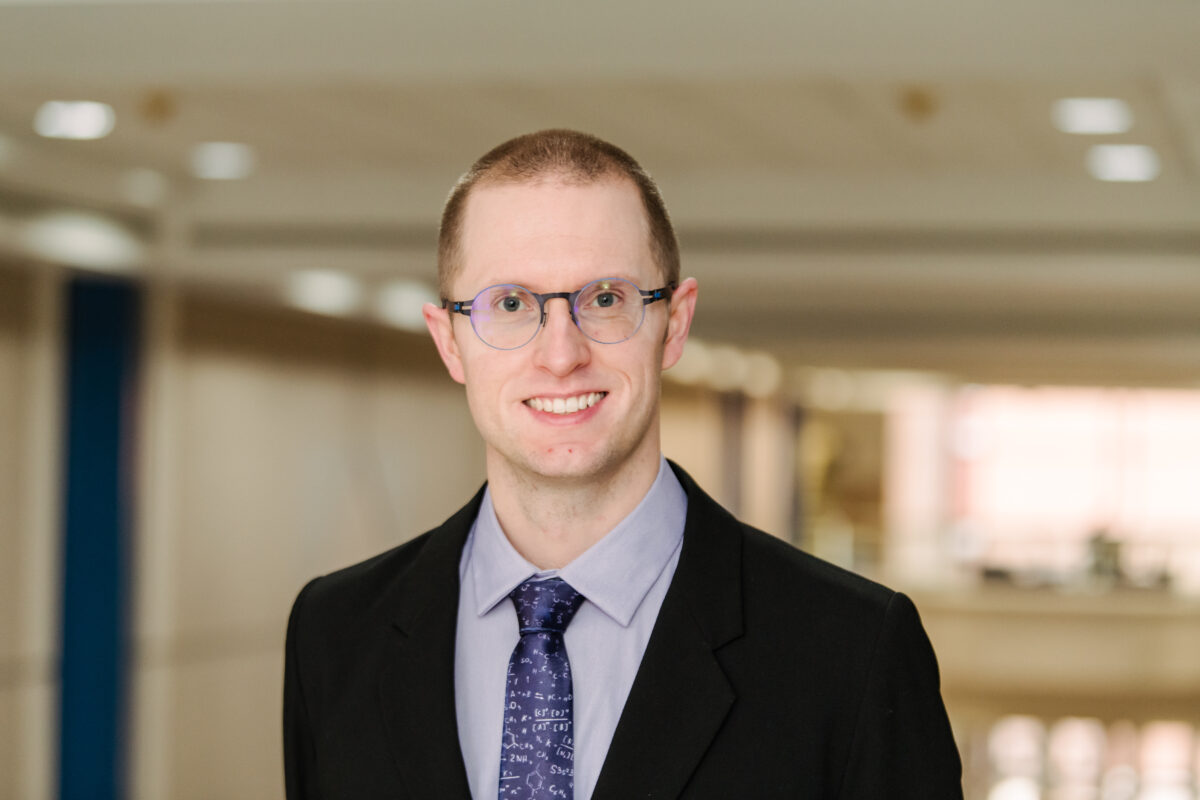
Man in suit smiles at camera.
Tyler Josephson (Marlayna Demond ’11/UMBC)

The skills, knowledge, and connections Josephson develops will strengthen his ongoing work with his UMBC students and colleagues.

“As an engineer, I didn’t formally study these topics in school. I’m really excited by the opportunity to dive deeper and learn new things,” he says.

UMBC sophomore wins first place at NSBE fall regional conference technical research exhibition

Members of UMBC’s chapter of the National Society of Black Engineers (NSBE) traveled to Raleigh, North Carolina, for their annual regional conference this November, where multiple members presented their work in the Technical Research Exhibition. Sophomore computer engineering student Amir Walton-Irvin, a Meyerhoff Program Scholar and Howard Hughes Medical Institute (HHMI) Scholar, earned first place for his research presentation.

Walton-Irvin investigates brain connectivity and health disparities in the Machine Learning for Signal Processing Lab of computer science and electrical engineering professor Tülay Adali. He uses statistical signal processing techniques to identify subclinical biomarkers that may predict neurological diseases such as stroke and dementia. 

Student in suit stands next to scientific poster.
Amir Walton-Irvin stands next to his scientific poster. (Image courtesy of Kayla MaGruder)

At the conference, Walton-Irvin gave a 5-minute technical talk about his research, followed by questions from the competition judges and audience.

“Presenting research is a huge part of engineering and science that makes it accessible,” says senior mechanical engineering student Kayla Magruder, vice president of the UMBC NSBE chapter, who also gave a talk at the conference.

“I’m extremely grateful for every opportunity to share my work, and being recognized for it is an incredible feeling,” shares Walton-Irvin. “Moments like this motivate me to keep pushing research that can improve people’s lives, and I’m excited for what the future holds.”

Other UMBC students who attended the conference include mechanical engineering senior Caly Ferguson, mechanical engineering sophomore Nathan Bolima, computer science and financial economics junior Glen Larbie-Mansah, and computer engineering junior Jessica Slaughter.

UMBC’s NSBE chapter supports members with conference preparations and also offers activities such as mentoring, networking, leadership development, and community outreach.

Hrabowski Fund for Innovation awardees continue to drive new approaches to teaching and learning

A cross-disciplinary incubator rooted in theatrical storytelling. Artificial intelligence and machine learning ethics education that blends ethical inquiry with hands-on technical exploration. Letterpress printing and bookmaking while students uncover “The Secret Lives of Books.” These are several of the 2024 – 2025 projects selected to receive grants in the Hrabowski Fund for Innovation competition. The fund supports initiatives to enhance teaching and learning at UMBC, with specific emphasis on innovative approaches to increase student success.

“The Hrabowski Innovation Fund has helped to drive innovation in pedagogy and student success at UMBC for the past 13 years. Recent projects have enhanced course and curriculum development, built generative AI literacy and introduced AI-powered tools, and engaged students in cross-disciplinary, international, and community-based projects that prepare them for their majors and careers.” says Kerrie Kephart, interim director of the Faculty Development Center.

Implementation and Research Awards
  • IMPACT Lab: Interdisciplinary Music, Performance, Art, Collaboration, and Theatre Lab – Nigel Semaj (THTR) and Colleagues
  • Developing Ethical Inquiry: A Participatory and Exploratory Lab Model for AI/ML Ethics Education – Rebecca Williams (CSEE)
  • Computing for All: Cultivating a Culturally Responsive and Inclusive Computing Ecosystem – Patricia Ordóñez (IS) and colleague
Adaptation Award
  • Hilltop Print Shop: Supporting Applied Learning in a Humanities Makerspace – Lindsay DiCuirci (ENGL) and colleague
Scholarship of Teaching and Learning Award
  • Developing an Approach to Creating and Refining Innovative Learning Outcomes in a University Music Education Program – Brian Kaufman (MUSC) and colleague 
SEED Awards
  • Transforming Graduate Writing Support – Nicole Morse (LLC) and colleagues
  • Centering Student Perspectives on Generative AI Integration in a Design Classroom – Yasmine Kotturi (IS)

The Hrabowski Fund for Innovation exemplifies UMBC’s commitment to investing in faculty initiatives that fuel creativity and enterprise and also create opportunities for student engagement. Proposals for the next round are due by October 31, 2025. For more information and to apply, visit UMBC’s Faculty Development Center website

Living the mission—UMBC recognized for 16 years as a ‘Great College to Work For’

UMBC’s values and mission are what unite this community of Retrievers together. When we work in service of our students and our academic mission of inclusive excellence, it’s hard not to feel connected to the work on another level. The ongoing success of those shared efforts has been recognized once again by ModernThink’s Great Colleges to Work For survey. 

This is UMBC’s 16th year of recognition, and 14th on the Honor Roll—a distinction that goes to the top 10 four-year colleges recognized the greatest number of times in each enrollment size category.

“It is no accident that UMBC has been recognized as a Great College to Work For for more than 15 years running,” says President Valerie Sheares Ashby. “UMBC staff and faculty are dedicated to one another, to our students, and to our mission. That dedication inspires us to continually improve, to support the growth of others, and to participate in setting the course for our future. I am grateful every single day for this extraordinary community.” 

ModernThink surveys current employees, and based on responses, UMBC fell into nine recognition categories, including Mission and Pride; Faculty and Staff Well-Being; Shared Governance; Inclusion, Belonging, and Community; and more.

“Our faculty and staff are the best of the best and work to provide an environment where our students can thrive,” says Lynne Adams, associate vice president and chief human resources officer. “I am so proud of the passion and compassion that our employees continue to show each day. We come together as one with one focus and that is demonstrated in big and small ways throughout campus. It is truly exciting that our university continues to be celebrated as one of the top places to work each year.”   

Following where curiosity leads them—COEIT celebrates student summer research

Students from across the College of Engineering and Information Technology (COEIT) spent the summer diving into research—embarking on new projects or deepening their focus. The college celebrated their work in August with a poster session and networking lunch. Students showcased their research on diverse topics including how artificial intelligence can help K-12 teachers monitor student engagement; how best to model environmental phenomena like wildfires and cloud patterns; and how the sex hormone estradiol affects the behavior of blood platelets, which play an essential role in healthy blood clotting.

Julia Chapman, a rising senior in mechanical engineering who conducted research on a mathematical model that replicates aircraft wing flutter, says she was inspired by the curiosity on display at the poster session. “I’m so thankful for the opportunity to share my summer research and engage in thoughtful conversations,” she says.

“I really enjoyed sharing my work with faculty and fellow students. Since everyone comes from different backgrounds, the variety of questions helped me see my research from multiple perspectives,” says Zahid Hassan Tushar, a Ph.D. candidate in information systems who presented his research studying how machine learning techniques can help predict properties of clouds and aerosols from data gathered by one of NASA’s recently launched Earth-observing satellites. 

Many of the participating students were supported through the inaugural COEIT Student Summer Projects (CSSP) awards, which provided stipends to 10 students—both graduate and undergraduate—across all academic departments of the college. 

The CSSP-funded students were joined by faculty-nominated members of various labs across COEIT and students from REU (Research Experiences for Undergraduates) programs—National Science Foundation-funded opportunities that bring undergraduates from around the country to UMBC for summer research. The students’ summer research experience also included attending professional development seminars, in which campus leaders shared their own research journeys and COEIT faculty ran skill-development workshops on topics such as making effective presentations, writing papers, and more. 

Students and faculty pose with President Sheares Ashby in meeting room.
COEIT student summer researchers pose with UMBC President Valerie Sheares Ashby (center in yellow dress). Sheares Ashby spoke with the students as part of a professional development program. (Photo courtesy of Vandana Janeja)

“The poster session was the culmination of a summer of research exploration for our students, and it was an honor to meet them and learn about their work,” says COEIT Dean Jeanne van Briesen. “Their excitement at the challenges they’d faced and the new ideas they’d generated reminded me of why I love research!”

“It was an honor to celebrate the hard work of these students,” says Vandana Janeja, associate dean for research and faculty development in COEIT. “We look forward to seeing where our students’ curiosity leads us next.”