



 We’ve seen many images of the impact of Hurricane Katrina over the last six months: photographs of the hordes displaced from their New Orleans homes, video footage of the volunteers rebuilding, house by house.
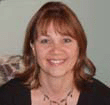
But Cindy Dahlstrom McNitt sees another side of the damage. As a licensed clinical social worker from the small town of Slidell, La. – which sustained major damages, falling within the eye of the storm – she witnesses the emotional effects of the flooding on a daily basis.
“Since everyone here is experiencing some degree of stress, my clinical work is not confined to the office,” said McNitt, who graduated from UMBC in 1981 with a degree in psychology.
“More people are seeking help (wisely), but are frustrated by the limited help available to them,” due to the destruction of health providers’ offices, records – even suicides by practitioners, she said. “This only adds to the general sense of hopelessness that takes over at times.”
McNitt got her start in social work at UMBC. A native of Illinois, she originally chose UMBC because of the strong psychology program and to be close to her high school sweetheart, Tom, who was attending the Naval Academy at the time.
“While there, I took a social work class that really resonated with me,” she said. After college, she and Tom married and she earned her master’s in social work from the University of Illinois. McNitt spent several happy years working in the schools of Chicago’s suburbs while raising their first three children.
In 1995, just after the birth of her fourth child, the Navy transferred the family to New Orleans. McNitt quickly set up her private practice in the town of Slidell, which lost forty percent of its housing to Katrina, she said.
Despite the obvious troubles of the citizens of Slidell, McNitt stays positive in hopes she might help her neighbors. Since her home made it through the storm relatively unscathed, her family has opened the doors to a number of guests, including her older daughter’s family and a local contractor. McNitt’s office was “torpedoed,” however, so she has been working from home and taking to the streets to talk clients through their problems.
In addition to the issues that naturally arise from close-quartered living, loss of jobs and homes, and general disarray, McNitt has dealt with everything from suicides to peoples’ worries about “the next hurricane” to fears of falling branches.
“We’re all trying to assimilate something known locally as the ‘New Normal.’ This is one of the biggest challenges in this huge region of destruction and lost, but evidence of hope, too,” she said. “We’re not ‘all better’ yet, but with help, we can get there. This can be a pretty city again…maybe a new ‘New Normal!’”
– Jenny O’Grady
Originally published April 2006
All posts by: Magazine Editor
Engineering a Bright Future: Brian and Annica Wayman '99
 Many people claim to know the formula for true love.
In the case of Brian and Annica Wayman ’99, both Meyerhoff Scholars and mechanical engineering grads, however, it’s easy to see how it all adds up. For them, math + science + UMBC = lasting romance.
“I guess it was probably a combination of having the same classes and seeing each other all the time,” laughed Brian, who, like his wife, the former Annica Warrick, is pursuing his doctorate in mechanical engineering at Georgia Tech. Married since 2001, they also have an eight-month-old son, Donovan.
Like so many relationships, the Waymans might never have met if not for a particularly well-timed intervention by fate. In this case, fate went by the name of UMBC President Freeman Hrabowski.
Close to graduating from high school, Brian had already decided to attend UMBC, but Annica was far from making the same decision.
“I hadn’t even applied to UMBC,” she said. However, during an appearance by Dr. Hrabowski at a cultural diversity event at her high school, the two met and started talking about UMBC. “He was telling me about the Meyerhoff Scholars and he offered me the scholarship on the spot…I was floored.”
The two met soon after, at the “Summer Bridge” program held for Meyerhoff Scholars in the months before their freshman semester began. From the start, they found themselves working well together.
“We had to get together in groups of four or five and build a portable shelter” for the homeless, said Annica. “We had to work closely together a lot, and it just sort of went from there.”
As students at UMBC, both Brian and Annica stayed very active in campus activities. Brian served as president of UMBC’s chapter of the National Society of Black Engineers and the Engineering Council of Majors. Annica, a dance minor, also took part in MARC U*STAR, or Minority Access to Research Careers Undergraduate Student Training in Academic Research, and acted as president of UMBC’s chapter of the Delta Sigma Theta public service sorority.
They also completed internships, which helped them to focus in on their doctoral research, which for both involves bioengineering. Brian’s research focuses on how mechanical factors such as blood flow affect arteries. Annica is conducting research concerning certain types of cell adhesion. Both of them have received honors in their studies, and both hope to finish their degrees this year and work in the medical device industry.
Despite the pressures of balancing their research and family life, the Waymans seem remarkably cool, calm and collected – just like an average family.
“It’s challenging, but rewarding,” said Brian. “We do our best to balance our work and our family life.”
The best reward, Annica said, is seeing her son at the end of the day.
“The challenges presented to us are the same as those presented to any working family trying to balance their careers with raising a child,” she said. “You can have a day when nothing goes right (in the lab), but then you can come home to see this smiling face who doesn’t care about that at all…It’s wonderful.”
– Jenny O’Grady
Originally published March 2006
A Writing Life: Jadi Keambiroiro '79
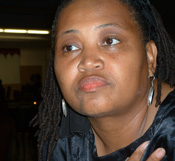 Every morning, before she does anything else, Jadi Keambiroiro sits down at her desk to work on her novel, Killing Ants. Nothing can distract her – she’s worked too long to get to this point to take it for granted.
“I am really where I need to be right now,” said Keambiroiro (formerly Gloria Green), who earned her bachelor’s in English in 1979.
Today, nearly 25 years after graduating from UMBC and following a 15-year career in development, she has what she always wanted: a writing life. In addition to her creative writing projects, Keambiroiro also started her own press, Three Sistahs Press, with two friends two years ago.
A Baltimore native, Keambiroiro’s experience at UMBC nurtured the writer already blossoming within her. As an English major with a minor in fine arts, she became involved with the Black Student Union, organizing arts festivals and poetry readings. She also wrote for the BSU’s publication, Voices, and took advantage of the many literary opportunities her teachers offered her, in particular Professors Acklyn Lynch (Africana studies) and Reza Baraheni (English).
“Between the two of them, I read just about everything,” she said, explaining that both teachers also helped her to meet a number of poets, such as Paul Robeson, Jr., Angela Davis and Allen Ginsberg. “That’s probably the roots of my writing, right there.”
Following graduation, Keambiroiro worked for a slew of local newspapers, including the Afro-American in Baltimore. She spent three years living in Bermuda – the birthplace of her husband – and then came back, with her family, to live in Baltimore. Instead of pursuing writing, however, she chose a more “stable” career in fundraising, working 15 years for the Baltimore Zoo, the National Aquarium and Mercy Medical Center.
All along, though, the urge to write never left her.
“I never stopped writing,” said Keambiroiro, who tends to focus her creative works on “strong women” carving out paths for themselves. “I tried to stop, but then it would hit me that I needed to be writing again.”
This time, the decision meant a major life change. Keambiroiro quit her fundraising job and started working as an associate publisher for Black Classic Press, the second oldest African-American press in the country. She also started a master’s degree in creative writing and publishing arts at the University of Baltimore, which she completed in May of 2005.
The decision has paid off. In October, Essence magazine published her poem, “Death and the Sea.” Over the summer, she taught creative writing at the Community College of Baltimore County, and this semester, she’s an adjunct professor at Villa Julie College. As for Three Sistahs Press, the group published its first book of poetry last year, and is currently working on putting together an anthology of writing by 19th century African-American women entitled Broken Utterances.
For Keambiroiro, the life she has achieved has been well worth the journey.
“When I left UMBC, my intention was to become a writer,” she said. “I just got a little sidetracked.”
– Jenny O’Grady
Originally published January 2006
All the World's A Stage: Jeff Ware '74
 They say practice makes perfect, but Jeff Ware might beg to differ.
After more than 30 years of practice as a working actor – all the years on stage, the bit parts in television shows, the movie roles – Ware is well aware of the reality of his craft. He knows the learning never really ends.
“Acting is really like plumbing or like woodcutting,” said Ware ’74, theatre, who is appearing this month and next in CenterStage’s production of Motti Lerner’s The Murder of Isaac. “It’s a craft. You have to practice it.”
Given the challenge of his current role as Eliahu – an Orthodox Israeli ex-soldier hospitalized with post-traumatic stress disorder, for which he studied endlessly the history of fundamentalism in Israel – it’s a good thing Ware has never been one to rest on his laurels.
The son of two actors, Ware didn’t actually realize his interest in the “family business” until he was 19. As a freshman at Ohio University, it took getting incredibly sick at a rock festival – and a semester of recovery and deep reflection – for him to discover his love for theatre.
“I’d always been around (acting), but I was a wise guy. I thought I was going to be a lawyer,” he said. “When I decided to act, I knew I needed to change schools.”
Ware’s father, whose family was from Baltimore, pointed him in the direction of UMBC. As a transfer student, Ware immediately took to the close-knit theatre department, learning as much about the technical aspect of the stage as acting itself.
In his senior year, Ware competed for acting scholarships at the Kennedy Center’s American College Theatre Festival, earning regional “best actor” accolades for his performances from Hatful of Rain and Constantinople Smith. He later competed nationally, winning enough scholarship money to study at the Webber Douglas Academy for Dramatic Art in London for three years.
As much as he loved London, however, Ware had already set his sights on New York.
“I came back to New York and I just started acting,” he said. “New York is a tremendous town, a big town. Everyone comes in thinking they’re a big shot. And then you get beat up for a little while.”
Over the years, Ware has appeared in a little bit of everything, from Samuel Beckett’s Waiting for Godot and August Wilson’s Joe Turner’s Come and Gone, to episodes of “Law & Order,” to movies such as Stephen King’s Thinner and Teachers with Nick Nolte.
In The Murder of Isaac, which Ware describes as “a brilliant political expose” of politics in Israel, Ware’s character Eliahu participates in a “play within a play” about the actual assassination of Israeli prime minister Yitzhak Rabin. To prepare for the role, Ware researched not only the current political climate of Israel, but post-traumatic stress disorder and fundamentalist cliques within the orthodox Jew community.
Though he admits the show may seem heavy, Ware encourages viewers to come to it with open minds. As in all good theatre, he said, the audience must allow itself to be overcome by the story, the characters.
“It asks people to think a little bit. It asks them to use their imaginations,” he said. “But if we do our job, the audience should have a wonderful time.”
– Jenny O’Grady
Originally published February 2006
Two of a Kind: Robert Cartwright '80 and Ryan Cartwright '06
Not surprisingly, Robert Cartwright ’80 felt a bit of déjà vu watching his son, Ryan, cross the finish line at the America East Conference Championship in Binghamton, NY, last month.
Almost exactly 30 years before – as a freshman economics major at UMBC in 1975 – his team also came from behind to win the Mason Dixon cross country conference championship.
“This is such a coincidence, it’s just unbelievable,” said the elder Cartwright, of Perry Hall, an All Conference performer during his years at UMBC. “It sort of choked everybody up.”
The father-son connection was just the icing on the cake for this year’s men’s team. Picked fifth in the pre-season rankings, they placed five runners in the top 16 to take the Division I conference title. The team later finished 21st overall in the NCAA Mid-Atlantic Regional meet, with the women’s team placing 22nd.
Runners Izudin Mehmedovic of Columbia and J.J. Wetzel of Crofton earned all-conference accolades for their performances in the America East conference, while head coach Murray Davis and staff were selected as men’s coaching staff of the year for the conference.
“You know it’s really nice to be able to be successful at all levels,” said Davis, who is in his fifth season coaching the team. “So many things have to come together for a season like this.”
UMBC recently honored the 30th anniversary of the 1975 cross country team’s Division II conference title during Homecoming. Like the current men’s team, their predecessors were not favored to win.
“I was just a freshman. We were a young school and we didn’t have such a good record,” said Robert Cartwright. “Then, all of a sudden we started winning meet after meet, and nobody could really believe it.”
Cartwright’s son, Ryan, a senior information systems major, was UMBC’s sixth finisher during the American East conference and third for UMBC at the Mid-Atlantic Regional meet.
The pair started running together after Ryan was injured playing soccer in middle school. The father gave his son tips, and soon encouraged him to join his high school track team.
“I would run with him for about a year and I couldn’t keep up with him,” said Ryan. “Later on, though, I got better. He would say, ‘I was successful (running at UMBC), maybe you would be, too.’”
Over the years, the pair has accumulated numerous running medals and trophies. And though the elder Cartwright no longer competes, he can always look to the father-son awards wall in his basement for inspiration.
“He has a lot more awards than I ever got,” he said. “I’m really proud of him.”
– Jenny O’Grady
Originally published December 2005
From UMBC to Costa Rica: Justine Wagner '04
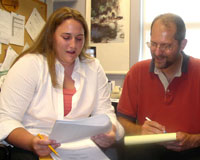 Just a few months after graduating from UMBC, Justine Wagner, Spanish and economics ’04, traveled to Costa Rica on a Fulbright Research Award.
Wagner conducted research for a study on the effects of government social spending on poverty at the Institute of Economic Science Research of the University of Costa Rica with Professor Juan Diego Trejos, who has worked with UMBC Professor of Economics and Wagner’s mentor, Tim Gindling.
As part of her award, Wagner also had the opportunity to attend a Fulbright Enhancement Seminar in Honduras, where Fulbright Scholars studying in Central America presented their research. “The seminar was really the capstone of the whole experience; it was great to meet with other young scholars and discuss our work,” said Wagner.
At UMBC, Wagner took advantage of the many opportunities available to support research by undergraduates. As a sophomore, she spent a semester at the University of Granada. In her junior year, she began working with Gindling on his research on minimum wages in Costa Rica and received a Provost’s Undergraduate Research Award, which she used to travel to Costa Rica in order to collect data, talk with government policy makers and meet Costa Rican researchers. It was on this visit that she first met Trejos. Wagner then presented her work at Undergraduate Research and Creative Achievement Day in her senior year, and published in an article in the 2005 UMBC Review.
Wagner said that her experiences at UMBC were invaluable and that she received a great deal of support. “The community of faculty and staff at UMBC want to see the best for every student,” she added.
“Justine was an excellent research partner,” said Gindling, who has received two Fulbright Fellowships to conduct research and teach in Costa Rica. “She has the ability to both work well with others and also the initiative to take a research problem and solve it on her own. The combination of fluent Spanish and knowledge of economics was especially valuable for our research project and for her ability to obtain the Fulbright Fellowship.”
Wagner is now using her skills and experience in economics at the Department of Justice’s Antitrust Division, where she is a research analyst, but she is also interested in applying her interest in language and international affairs in a graduate program.
Originally published November 2005
Using Chemistry Every Day: Dr. Adam Freeman '95 (M3)
What’s it like being a pioneer?
Ask Dr. Adam Freeman ’95, chemistry, an innovator in the chemistry of paper and one of the first generations of UMBC’s Meyerhoff Scholars. He’ll tell you the secret – keeping your eyes open for opportunity.
“You know, when I look at where I am and what I wound up doing, most of it was unplanned,” said Dr. Freeman, Senior Research Scientist for the Eastman Kodak Company in New York.
“But over time, I realized everything I was learning was part of a flow that wove together over time.”
A native of Silver Spring, Dr. Freeman knew he was interested in the sciences in high school, but he wasn’t sure what he wanted to study in college. One day, during his AP history class, the vice principal of his high school called him into a meeting to discuss the Meyerhoff Scholars program, which was still in its infancy at UMBC.
Though many of his friends planned to attend nearby College Park, he found his niche at UMBC. He also praised the “support structure” of the Meyerhoff program.
“UMBC seemed more digestible and more tangible (than College Park),” said Dr. Freeman, an “M3,” or third generation graduate of the Meyerhoff program. “It wasn’t like this big beast. It was small and I saw that I would get individual attention.”
Though he started off studying chemical engineering because it seemed to offer the most money as a career, Dr. Freeman quickly figured out his priorities lay elsewhere.
“I quickly learned that money wasn’t the driver…and I switched over to pure chemistry right away,” he said.
Following graduation from UMBC, Dr. Freeman went on to do graduate work in materials science/polymer chemistry at Cornell University and later earned his Ph.D. at the University of California, Berkeley.
Today, at Eastman Kodak, he uses chemistry on a daily basis to create technologies that support current and future imaging technologies, such as fade-resistant papers for printing photographs. His wife, Thuy Pham ’95, biochemistry and molecular biology, also uses the knowledge she learned at UMBC on a daily basis as a researcher at Bausch & Lomb.
As a researcher and innovator, Dr. Freeman urges current students to keep their options open. One never knows where or when opportunities to use one’s knowledge will arise.
“I really do think chemistry is so central to everyday life,” he said. “It’s in the things we eat, it’s in the computers we use and the plastic that’s used to make the computers…it’s all chemistry.”
– Jenny O’Grady
Originally posted November 2005
Back to School: Bradford C. Engel '89
 When was the last time you thanked a teacher?
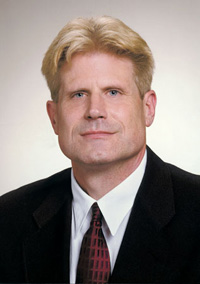
As morning bells begin to ring in a new school year, Brad Engel ’89, B.A. American studies, cert. secondary education, is doing his part to make sure teachers get some well-earned pats on the back. His new book, “T.E.A.M. (Thanking Educators Across Maryland),” features 300 thank-you letters from parents to teachers who have changed their children’s lives.
“My vision for this project was to let teachers know they are truly appreciated,” said Engel, Maryland’s 2005 Teacher of the Year, who recently was promoted to Assistant Principal at Kent Island High School on the Eastern Shore. He has taught history there for 17 years.
“T.E.A.M.” is just one of the results of Engel’s tenure as Teacher of the Year. Since accepting the honor last October, he’s also spoken at more than 100 schools, conferences and other venues, and been congratulated personally by everyone from Maryland State Superintendent of Schools Nancy S. Grasmick to President George W. Bush.
“It has been a very busy year,” said Engel, who came to UMBC as a student while working as an instructor for the Arc of Baltimore, which offers programs and services to people with mental retardation. Although he enjoyed teaching adults all of the useful life skills they would need to make it on their own, he longed to teach and mentor younger students.
“I wanted to work in the high school setting so that I could be a real role model to the students,” he said.
Over the years, he has learned that actions speak louder than words. In addition to chairing the Social Studies department and acting as Leadership Coordinator at the school, he also served on the School Improvement Team and chaired the Middle States Steering Committee. Engel also chairs the school-wide Mentor Advisory Program, where he advises 100 student leaders, and wrote and published “The Four Challenges of Leadership,” a textbook for the program, in 2003.
Although Engel didn’t always see himself as an administrator, his conversations with teachers across the state over the last year changed his mind.
“It completely changed my perspective of what administrators do,” he said. “It showed me that you really are still an educator no matter what you do.”
As a new vice principal, Engel looks forward to working with students in areas of discipline and leadership. He feels strongly that students need individualized attention, and that students must be treated with dignity and respect – something he has always tried to do in the classroom.
“You have to listen to them and help them understand that they are valuable members of society,” he said. “It’s almost magical when you can see a child turn around. It happens one student at a time.”
“T.E.A.M.” will be released within the Maryland school system on October 8. To read passages from the book, visit “T.E.A.M.” online at www.thankyou.ws.
– Jenny O’Grady
Originally posted September 2005
Eyewitness to History: Vikki Valentine '96
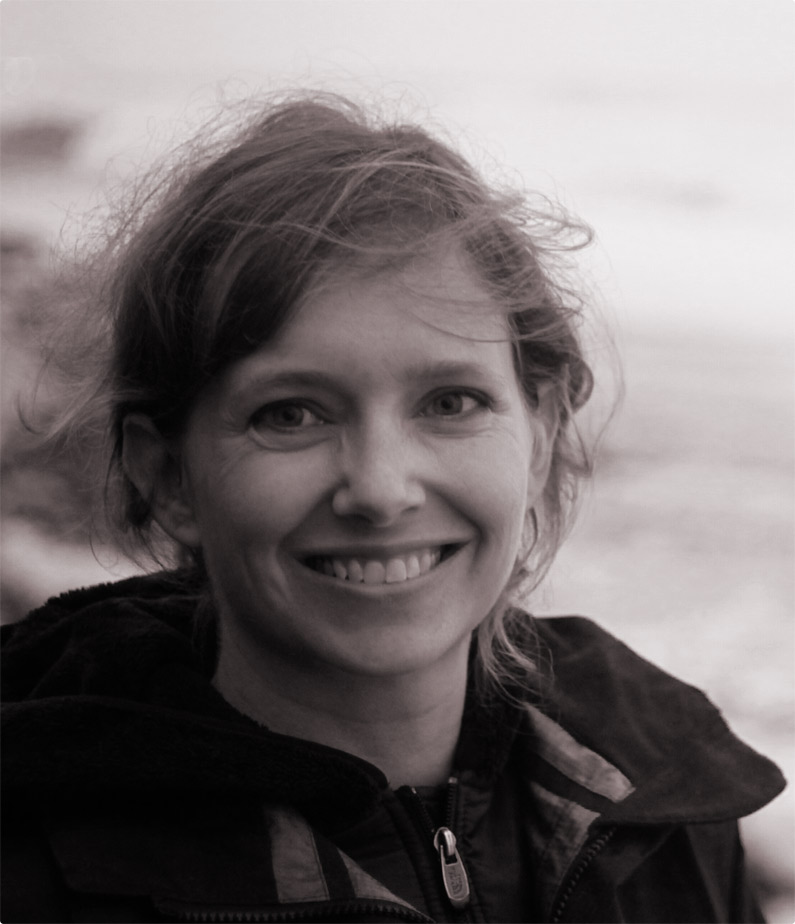 As the world reeled amid the latest terrorist attacks in London last month (July 2005), Vikki Valentine pushed her fears aside to do what she does best – tell it as she sees it.
Even as the world appeared to crumble around her, the former Retriever reporter and editor gathered tidbits of color commentary from the front lines in order to write the stirring “An American in London, Watching Brits ‘Press On,’” for National Public Radio online.
“It is hard, nearly impossible to put your emotions aside when in a situation like that,” admits Valentine, who studied English at UMBC and later went on to write for the Baltimore Sun, Discovery News, NPR and an assortment of other print, radio and web news outlets.
“I haven’t been in a bombing situation before, and hope not to do it again…but I tried to block out the sadness, anger and fear by thinking about how angry my editor would be if I screwed up,” she said. “It’s a mind game, but it worked!”
On leave from National Public Radio for a year while studying for her master’s in the history of medicine in London, Valentine found herself smack dab in the middle of history on July 7 when terrorists bombed the city’s subway system in several places, killing more than 50 people. In covering the event, Valentine called upon her powers of observation to record the average citizen’s reaction to the tragedy, everyone from white collar workers to drunks to Marylinn Benniman, an ambulance driver during World War II who now volunteers with the Red Cross:
She had spent this day trying to ‘soothe’ the injured with ‘extra cups of tea.’ She was not without righteous indignation and not above rebuke, however mild. ‘It’s a wicked, wicked thing he did,’ she told me, referring to the planner of the attacks. ‘I hope he can’t sleep at night.’
Valentine has plenty of practice documenting the details of life in her writing. At the Sun, she wrote local features – a profile on the one-armed high school tuba player, for instance – and later moved on to stories of more national interest, such as the 30th anniversary of Dungeons & Dragons. As her career progressed, Valentine wound up specializing in science and health journalism, which drove her to London to study the history of medicine.
But Valentine’s initial interest in journalism began at UMBC, when she joined the Retriever news staff her junior year. Not only did the experience convince her to switch majors from anthropology to English, it gave her the confidence she needed to start a career in journalism.
“The Retriever was great practical experience…and a way to see whether reporting would be a good fit for me,” she said. “It was a good chance to learn and practice a totally different form of writing. There’s a big difference in how you write an essay or research paper vs. a newspaper story.”
– Jenny O’Grady
Originally published August 2005
The Wedding Planner: Linnyette Richardson-Hall '84
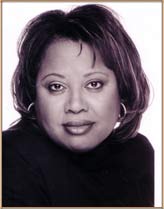 This time of the year, Linnyette Richardson-Hall’s phone never stops ringing.
The brides – 22 of them this season, to be exact – call her about the important details of their weddings at all hours of the day. Should they go with organza or satin gowns? Fresh tulips or gardenias? Garden tents or opulent ballrooms? At every turn, Linnyette’s ready.
“People think being a wedding planner is so glamorous, but it’s not,” said the Baltimore native who, in addition to running a high-profile business – Premiere Event Management – also serves as a consulting “wedding diva” on the Style Network’s “Whose Wedding is it Anyway?”
“It’s really hard work,” she said. “Television has glamorized this business, but there’s a lot of pressure. (Weddings are) a financial investment and an emotional investment.”
So, how did a sociology major with interests in religion, politics and economics wind up becoming an expert on all things matrimony? Richardson-Hall certainly didn’t see it coming following her 1984 graduation from UMBC.
“Did I have any idea I was going to be a wedding planner?” she asked. “Of course not. I had a degree, but I wasn’t quite sure what I wanted to do.”
Following graduation, Richardson-Hall “fell into” the financial industry, working her way up the ladders of a variety of local institutions. She then moved into telecommunications, serving as a regional administrative manager for what would later be known as MCI World.com. While her career fulfilled Richardson-Hall’s need to work with people, it still left her craving more.
It wasn’t until Richardson-Hall planned her very own wedding for 300 guests in 1993 that she truly found her calling. She thrilled in the planning, the details – and the compliments she received from her guests.
A year later, she launched Premiere Event Management and www.theWeddingDiva.com, “and it’s been going gangbusters ever since,” she said, laughing.
With an ever-growing list of clients, television and publishing commitments and a side business training wedding planner wannabes, Richardson-Hall appears to have found a niche, catering to a clientele interested in creating something new and different – often while preserving the traditions of a variety of cultures.
“I don’t do cookie-cutter weddings,” said Richardson-Hall, whose Web site touts several of her weddings, including a Carribbean-themed “Moonlight on the Beach,” a formal “Hollywood Glamour” event, and a “Fall Fantasy” wedding, complete with wreaths and décor meant to bring the colors of autumn indoors.
In handling such events, Richardson-Hall seems to have found the secret to wedding planner success: knowing that the bride is always right.
“I get very close to my clients. There are so many details, but they trust me implicitly,” she said. “They’re all a creative challenge.”
– Jenny O’Grady
Originally posted in July 2005
Investing in his Future: Don Blair '89
 Question: How do you surprise a guy whose job it is to see ahead into the financial future?
Answer: Make him think he’s emcee for the night, then — quick! — pull a fast one and hand him the award.
“They got me!” admitted investment banker Don Blair ’89, of Tampa, Fla., who was named this year’s UMBC Economics Alumnus of the Year. “It was great to be back and to catch up with everybody.”
The economics department honors one graduate every year and celebrates the winner’s work at a banquet. Dr. Charles Peake, economics professor emeritus, said Blair exemplifies what the department is all about.
“Number one, he was a great student,” he said. “Number two, he’s been an active alum and he’s contributed to the university. That’s exactly the kind of person we look for.”
Blair started out at UMBC an engineering major, taking economics classes as electives just for fun. However, the more econ classes he took, the more the Catonsville native got hooked.
“I just got a lot more excited about those classes,” including “Money and Capital Markets” with Dr. Peake, he said. “The topics we covered were really relevant.”
After graduation, Blair worked as an accountant for two years in Baltimore. When he passed his CPA exam the same year, he did so with flying colors, earning the Elijah Watt Sells Gold Medal Award for the highest score in the nation.
Blair later earned his MBA from the Darden Graduate School of Business at the University of Virginia in 1994, which allowed him to move into investment banking. After working for Goldman, Sachs & Co. in New York for three years, he joined Raymond James & Associates in Tampa, where he currently serves as Managing Director of Investment Banking and head of IT services.
Somehow, he manages to balance his career with his family life. He and his wife, Laura, have three kids — Allie, Bo and Luke — which mean Blair spends an awful lot of time coaching T-ball.
“We’ve got a lot going on,” he said, laughing. “It’s challenging, but you’ve got to keep your priorities straight.”
— Jenny O’Grady
Originally posted June 2005
A Winning Strategy: Kathleen Warnock '80
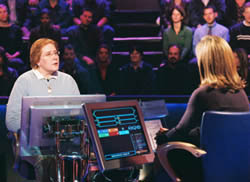 If you’re ever in the position of having to choose teammates, pick Kathleen Warnock.
Not only was she calm and collected in “the hot seat” on ABC’s “Who Wants to be a Millionaire,” she walked away from the game with a cool $50,000.
“I’m a big fan of game shows,” said Warnock, an editor with Frommers travel guides in New York who graduated from UMBC with a degree in interdisciplinary studies in 1980.
Warnock may be understating her devotion a bit. In fact, she has appeared on no less than four trivia game shows – from an obscure VH1 flop to the heights of gamedom, Jeopardy – always leaving at least a little richer than when she arrived.
Warnock seems the perfect candidate for tests of random knowledge. In addition to her work as a travel editor, she’s a playwright – one of her shows, “Grieving for Genevieve,” will be performed in New York this summer – and she’s a contributing editor with ROCKRGRL magazine. While a student at UMBC, she acted as sports editor and editor-in-chief of the Retriever, minored in ancient studies, and even took a stab at fencing.
But her winnings on the daytime version of “Millionaire” in March blew all of her other game show appearances away. Warnock attributes her good fortune to the fact that she was able to sit in on a taping before hitting the hot seat herself.
“I had a chance to spend the day watching and coming up with my strategy,” which was to use all the tools provided to her, she said. “I used all of my life lines, and all of them got me further along in the game.”
Warnock breezed through the early rounds, easily answering questions concerning compote and geldings. When a tough math question came up, however, she called her first life line, her brother-in-law, a science teacher in Montgomery County. Later on in the game, the audience helped her correctly narrow down the answer to a question about a NATO embassy bombing and up the stakes to $25,000.
After successfully using up her final strategic play – the option of switching one question for another – Warnock finally met her match with the following $100,000 question: What planet was once named “Georgium Sidus” in honor of England’s King George III?
Really, now. Does anyone know the answer to that? (It’s Uranus, by the way.)
“It was like, OK, it’s time to go home,” said Warnock, happy enough with the fifty grand. “And I walked away a winner.”
– Jenny O’Grady
Originally posted May 2005