All posts by: Sarah Hansen, M.S. '15


UMBC’s Songon An discovers new molecular mechanism likely involved in cancer cell metastasis

Cancer is most devastating when it metastasizes—when tumor cells break away, travel through the bloodstream, and then attach elsewhere, only to grow another tumor. A significant amount of scientific research has focused on finding ways to prevent metastasis. For some time, scientists have understood that a particular biochemical pathway, known as the PDK1 pathway, is active in metastasizing cancer cells. But no one knew why.

In a new paper published in PLOS ONE, Songon An and colleagues have shown for the first time that the PDK1 pathway regulates the formation of a three-protein complex that facilitates two chemical pathways: One builds purines (two of the four building blocks of DNA) and the other produces thiamine, a B vitamin. While it’s still unknown how purine and thiamine levels contribute to metastasis, the authors hypothesize ways they could be related, and they are planning further research to reveal any links.

For example, the three-protein core complex that PDK1 regulates is sometimes joined by three more proteins. Together, the six proteins form a larger complex called the purinosome, which carries out all 10 reactions necessary to build purines. Without the three peripheral proteins, however, purine production only goes halfway, and the molecule the core complex makes is more likely to end up as the vitamin thiamine.

Making purines is an energy-intensive process, so one hypothesis is that decreasing purine production during metastasis helps the cell survive while it is detached from a nutrient source like an organ. “Looking at this metabolic switch—which pathways are in use during metastasis versus when the cell is attached—may be where our research goes in the future,” says An.

The team’s immediate next step is to validate the function of the three-protein core complex. After that, they’ll investigate whether the core complex and the six-protein purinosome are actively coming together and breaking apart in metastatic cells. “Blocking those dynamics could be an alternative way to block metastasis,” An says.

A broader goal for An and collaborator Greg Szeto, UMBC assistant professor of chemical, biochemical, and environmental engineering, is to map the various protein complexes and the signaling pathways they regulate in cancer cells. “We want to put every signaling pathway into the same context,” An explains. “Whenever the proteins have different spatial assemblies, we would like to know which pathways are on and which ones are turned down.”

So far, the researchers have only looked at one pathway at a time (such as PDK1), but by using a cutting-edge technique that can detect many proteins at once within a cell, “now we are going to target multiple signaling pathways at the same time, so that we can understand the complete picture of the regulatory map for purine metabolism.” That knowledge could provide more new insights into the causes of metastasis and how to prevent it.

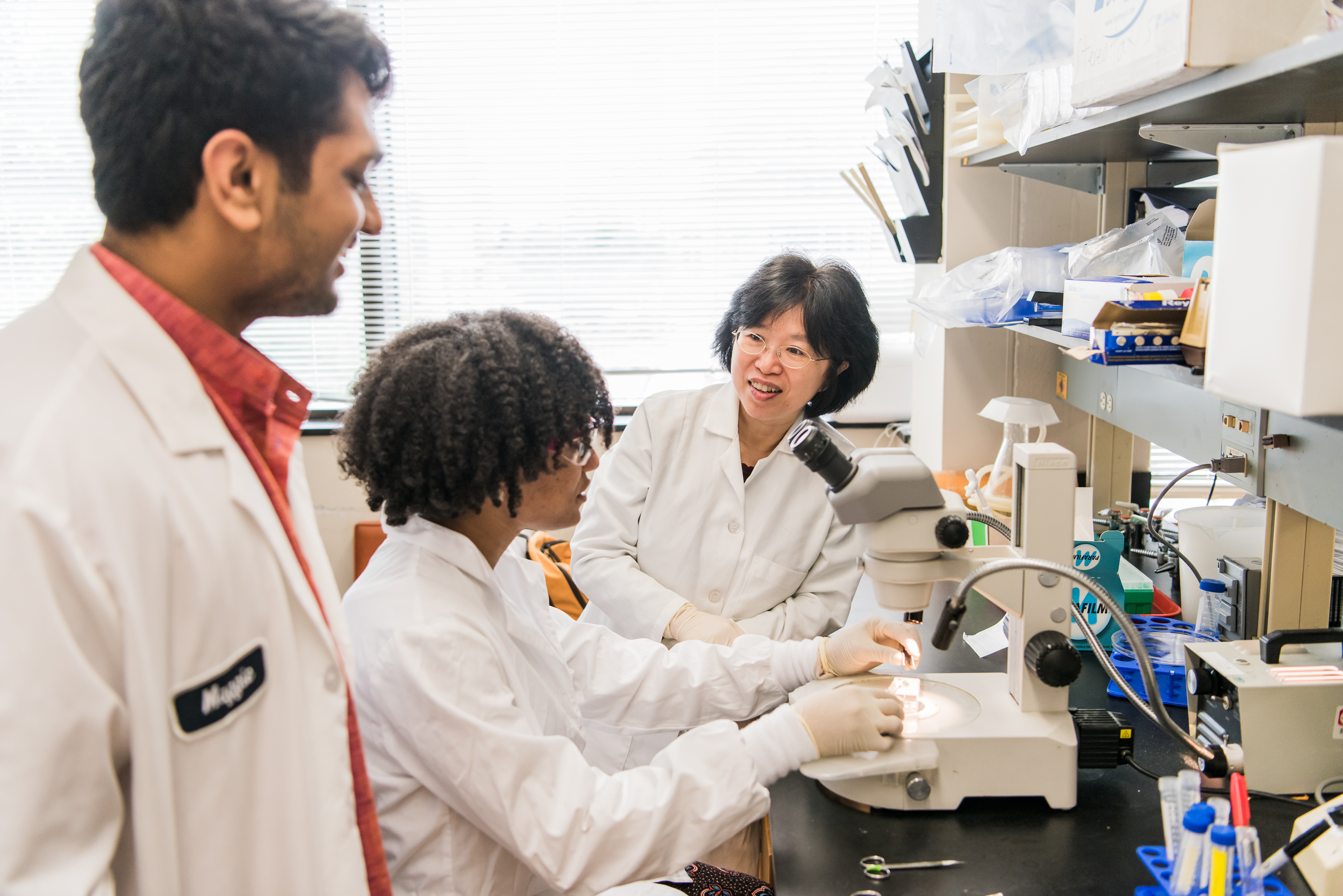
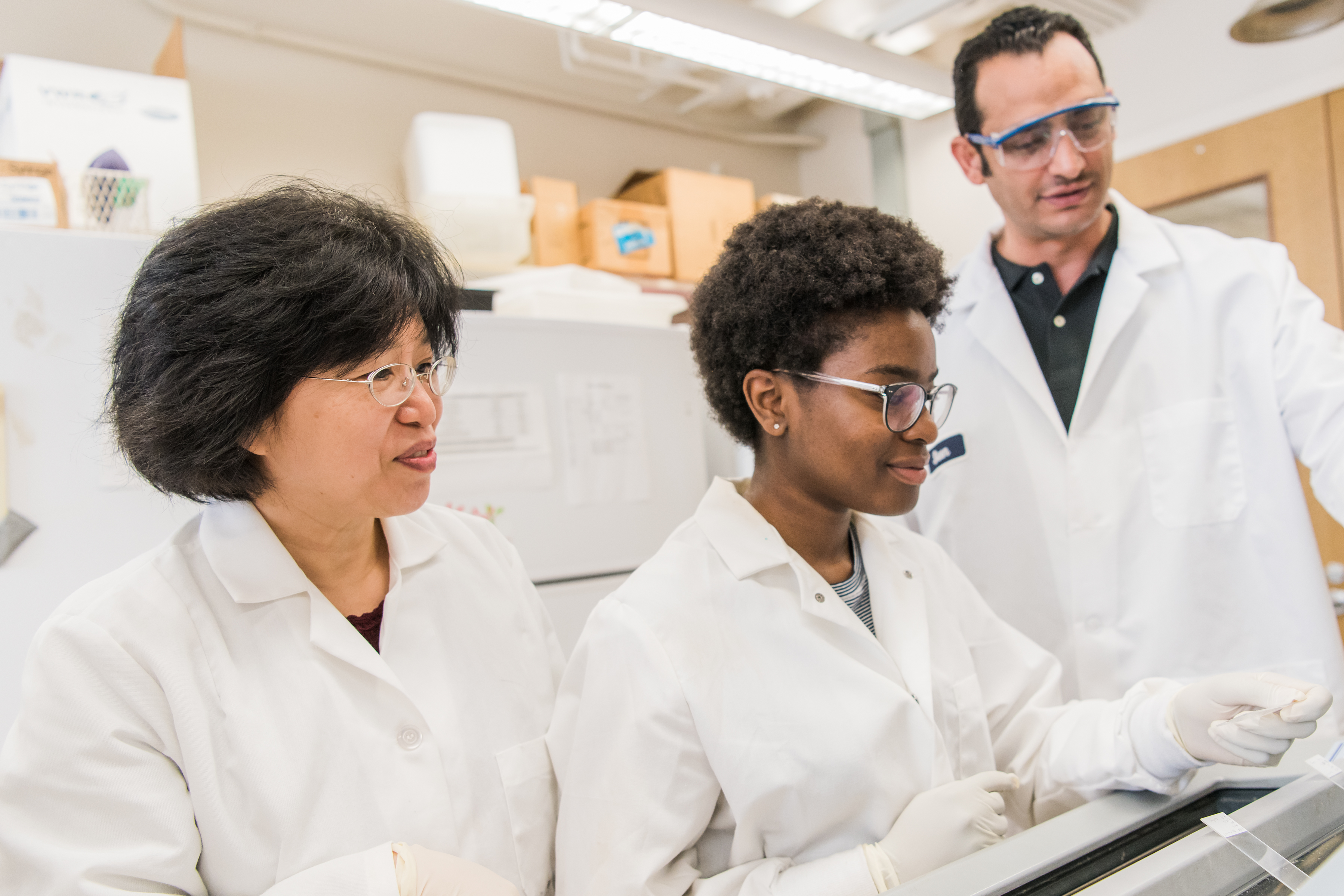
Image: Songon An and Danielle Schmidt in the lab. Photos by Marlayna Demond ’11 for UMBC.

NSF Graduate Research Fellowship Program honors 18 UMBC students and alumni

The National Science Foundation (NSF) has awarded prestigious Graduate Research Fellowships (GRF) to 10 UMBC-affiliated STEM students, including eight alumni and two seniors who will soon begin their graduate studies. Their awards include a $34,000 stipend and $12,000 toward tuition and fees for each of three years.

NSF also recognized three UMBC students and five alumni with honorable mentions. Of the 17 UMBC students and alumni honored, 13 are Meyerhoff or MARC U*STAR Scholars. These programs aim to increase the number of first-generation college students, students from low-income families, and underrepresented minorities in STEM.

This large number of honorees “shows the quality of student we have here at UMBC and what they’re doing,” says Keith Harmon, director of the Meyerhoff Scholars Program. “It also shows the quality of their research experiences at UMBC, and the commitment of the faculty to mentoring these students as undergraduates.”

Randi Williams ’16, M24, computer engineering, received a fellowship for her work as a master’s student in the personal robots group at the MIT Media Lab. She studies children’s interactions with artificial intelligence and is developing a curriculum to help young children learn about AI by building, programming, and training their own autonomous robots. “I was drawn to this research because of my interest in developing a platform that helps decrease the technology gap for low-income and underrepresented communities in tech,” she says.

Williams finds the work rewarding because it combines her aptitude for engineering with her passion for education and social justice. “The greatest thing about receiving the fellowship is support and validation for my diverse research interests,” she shares. “I’m looking forward to chasing my dreams and being a bridge between disciplines.”

Jonathan Werner ’18, M26, bioinformatics and computational biology, has been conducting research with Rachel Brewster, professor of biological sciences, since his freshman year. By studying zebrafish development, “we aim to provide the basic research necessary for the future clinical treatment of neural tube birth defects, the most common birth defects in humans,” he says.

Werner’s interests span computer science and traditional experimental biology. “In graduate school, I’m hoping to join both a computational lab and an experimental lab to further train as an interdisciplinary scientist,” he says, “and winning the NSF GRF gives me the freedom to do so. It’s going to allow me to be as creative as I want when designing my graduate research projects, which I’m really looking forward to.”

Jamshaid Shahir ’18, M26, mathematics and statistics, works with Hye-Won Kang, assistant professor of mathematics and statistics, on mathematically modeling the dynamics of cell polarization—how cells develop distinct front and back ends. That process allows cells to move and transmit information. It is particularly important for wound healing, the immune system, and embryonic development.

“Winning the NSF Graduate Research Fellowship is a powerful affirmation that I can both pursue and excel in a research career,” Shahir says. “I look forward to the freedom of pursuing questions that interest me, and growing as a researcher.”

All three students spoke to the impact of their UMBC experiences on their success. Williams includes UMBC President Freeman Hrabowski among her mentors and shares, “Honestly, I wouldn’t be at MIT pursuing a Ph.D. without UMBC.” Werner adds, “I reached out to a lot of professors here asking for advice, and every single one was more than happy to help.” He also shared his gratitude for UMBC alumni mentors Keisha John ’03, M12, biochemistry and molecular biology, and Kafui Dzirasa ’01, M8, chemical engineering. Shahir is particularly thankful for UMBC’s supportive culture, including guidance he received from Kang and John. “I believe UMBC promotes a healthy balance between cooperation and competition that has motivated me to push myself harder,” he shares, “allowing me to grow as both an aspiring scientist and as a young adult.”

The honorees are pursuing graduate study at top institutions across the nation, from UMBC and MIT to Duke and Georgia Tech. Whether students receive NSF fellowships or honorable mentions, Harmon describes this level of national recognition as very meaningful validation. “I think students are always questioning, even the most accomplished,” he says. “It’s nice for them to see yes, I can do this. Another affirmation that yes, I am on the right path. I have ability. I have something to offer. There is a place for me in STEM.”

2018 UMBC-affiliated NSF Graduate Research Fellows:

William Dean ’16, chemistry
Sarah Hemler ’15, mechanical engineering
Teisha King ’16, biological sciences
Rachael Knoblauch ’15, theatre, and current Ph.D. student in chemistry
Samantha McDonald ’16, information systems
Sean Najmi ’17, chemical engineering
Jamshaid Shahir ’18, mathematics
Gwenaëlle Thomas ’16, biochemistry and molecular biology
Jonathan Werner ’18, bioinformatics and computational biology
Randi Williams ’16, computer engineering
Jasmin Zarb ’16, biochemistry and molecular biology

2018 UMBC-affiliated NSF Graduate Research Fellow Program honorable mentions:

Roy Anderson ’16, mechanical engineering
Anya Byrd ’18, biological sciences
Adrian Davey ’18, chemical engineering
Skylar Fisher, ’16, biological sciences
Alvaro Fletcher ’16, mathematics
Kori McDonald ’16, chemistry
Theresa Sheets ’18, mathematics

Image from UMBC’s Keith Porter Imaging Facility, by Marlayna Demond ’11 for UMBC.

UMBC “rising star” Linda Wiratan receives Goldwater Scholarship for leadership in scientific research

UMBC is again celebrating major national recognition for talented student researchers with the announcement that Linda Wiratan ’19, biochemistry and molecular biology, has been named a 2018 – 2019 Goldwater Scholar, and Yasmin Graham ’19, mechanical engineering, received an honorable mention. The Barry Goldwater Scholarship and Excellence in Education Program seeks to identify and support undergraduates in the natural sciences, engineering, and mathematics “who show exceptional promise of becoming this nation’s next generation of research leaders.”

Wiratan began her UMBC research career as a high school senior, working with mentors Marcin Ptaszek, associate professor of chemistry and biochemistry, and Nopondo Esemoto ’12, biochemistry and molecular biology, and a current Ph.D. student in chemistry. “She learned both theoretical concepts and experimental techniques quickly,” Ptaszek recalls.

After only a few months, she was working independently in the Ptaszek lab. During her two years in the lab, she contributed significantly to two academic papers, one of which was featured on the cover of Inorganic Chemistry. Based on her rapid progress, Ptaszek says, “I am sure in just a few years she will be a world-leading researcher.”

With gratitude for his mentorship throughout that initial lab experience, Wiratan shares, “Dr. Ptaszek’s patience and real-world advice have shaped my early successes in college and maturation as a researcher.”

Once enrolled at UMBC, Wiratan began work with Hua Lu, associate professor of biological sciences, and Chong Zhang, a postdoc in the lab. “Dr. Lu constantly encourages me to be a creative and driven scientist and cares deeply about my well-being in and out of the lab,” Wiratan shares.

Wiratan’s research today focuses on the relationship between the circadian clock and innate immunity in Arabidopsis thaliana, a model plant species. Specifically, she is examining how the plant’s defense system, when activated by pathogens, can alter the plant’s circadian clock. Her results demonstrate that the relationship clearly exists, but is complex. The research has important disease-control applications for agriculture and even human medicine.

“Linda has been a key member in my laboratory to study this topic,” says Lu. Wiratan independently developed an undergraduate research award proposal and is a co-author on a research paper under revision in Nature Communications, a premier international journal.

Beyond her impressive scientific journal articles, Wiratan has also written for broader audiences. She co-authored a piece in The Conversation, an online news outlet that connects researchers with the general public. Her article introduced readers to the idea that studying plants can inform precision medicine, and it was republished in Smithsonian Magazine online. Wiratan has even founded her own social entrepreneurship organization, City of Cells, LLC, which focuses on improving the public perception of science through creative work, such as an online journal, science-inspired home furnishings, and educational animations. She does all this while maintaining a 4.0 GPA.

“Disseminating science concepts to the general public is one of Linda’s ways to show her passion for research,” says Lu. “She is clearly a rising star who will make a difference in science education.”

For Wiratan, being named a Goldwater Scholar is particularly gratifying because her success has not come easily. “This scholarship symbolizes the culmination of years of hard work and endurance,” she says. “I have always loved science and research, but growing up I have been faced with so many challenges.” She thanks her mentors—Ptaszek, Lu, and Simon Stacey, director of the UMBC Honors College—for their support in helping her confront those challenges and grow a sense of inner strength, resilience, and confidence that has propelled her forward.

“Now I see the proof that I am strong enough to create my own future and inspire others,” she says. “The Goldwater Scholarship is that final push that will help me fly.”

In 2016, Daniel Ocasio ‘17, Naomi Mburu ‘18, and Andreas Seas ‘17, all chemical engineering majors, received Goldwater Scholarships.

Banner image: Linda Wiratan stands in front of flats of her research plants. Photo by Marlayna Demond ’11 for UMBC.

UMBC pilots management boot camp for early-career science faculty

New science faculty come to UMBC as experts in their fields, often with a decade of research experience. What may be less familiar is how to manage a large laboratory, from the ground up. How do you balance time spent teaching, researching, and mentoring students? Should you buy that useful but expensive piece of equipment? If, through your research, you discover something that could be commercially viable, how do you get it to market?

UMBC’s College of Natural and Mathematical Sciences (CNMS) is helping faculty learn how to answer these questions through a new five-day Entrepreneurial Skills Training (EST) program at the UMBC Training Centers. This winter, a pilot of the program, developed by Gib Mason ‘95, economics, and executive director of the Center for Leadership and Innovation at the UMBC Training Centers, taught 16 faculty members in biology, chemistry, physics, math, and marine biotech essential skills to grow their labs. Participants learned about leadership styles, maintaining work-life balance, and project management approaches, as well as entrepreneurial skills like marketing, negotiating, and intellectual property development.

“When a newly-hired assistant professor arrives on campus, we provide them with start-up funds, office and laboratory space, classes to teach, committee assignments, and the list goes on. Similar to an entrepreneur, they take upon themselves the full responsibility (including the liabilities) of starting a research enterprise,” says CNMS Dean Bill LaCourse. “This Entrepreneurial Skills Training program provides them with the tools they need to set up and operate a productive research program while living a more balanced life.”

“The things that we’ve been taught here, you aren’t taught in a traditional scientific career pathway,” said Fernando Vonhoff, assistant professor of biological sciences, at the end of the week-long training. He plans to apply philosophies he learned in the program, such as Agile Project Management, in his lab.

Like Vonhoff, Erin Green, assistant professor of biological sciences, appreciated expanding her project management skillset, as well as learning about the importance of emotional intelligence and how to develop a short, accessible description of her work. By developing business plan blueprints and elevator pitches, she and her colleagues learned how to more effectively explain to investors and the general public why their research matters—research from neurodevelopment to next-generation energy storage, from quantum computing to epigenetics.

LaCourse sees the cost of providing the Entrepreneurial Skills Training for new faculty as an investment in their career success—a way to help faculty effectively take on the challenges of leading research groups in a world where funding for basic science can be scarce. Ultimately, says Michelle Starz-Gaiano, associate professor of biological sciences, “The training has set us up to better seize opportunities as they arise.”

Mason and LaCourse are already planning future EST opportunities for new faculty, adjusting the program based on feedback from the pilot. One ongoing challenge remains how to make sure the training can help faculty answer the different kinds of management questions that might emerge in different settings, given the diversity of CNMS research. By continuing to refine the program, LaCourse is excited to develop a model that other institutions could emulate and grow further, helping to propel even more science faculty toward successful careers.

Image: Gib Mason instructs an entrepreneurship course at the UMBC Training Centers. Photo by Marlayna Demond ’11 for UMBC.

Valedictorian Eudorah Vital to pursue neurobiology-focused M.D./Ph.D. at Emory University

Eudorah Vital
B.S., Biochemistry and Molecular Biology
Summa Cum Laude
Hometown: Silver Spring, Maryland
Plans: M.D./Ph.D., Emory University School of Medicine

UMBC prepares its students to be productive members of society who strive to understand others and bring people together. I came to UMBC thinking I knew what I wanted to do, and I am leaving with a refined version of my goals, which reflect the values of inclusivity, support, and grit.

Valedictorian Eudorah Vital is remarkable not just in her tremendous academic success and dedication to high-level scholarship, but also in her drive to support fellow students and the broader Baltimore community.
A Meyerhoff Scholar and Howard Hughes Medical Institute Scholar since her freshman year, Vital dived into research as soon as she arrived at UMBC. She quickly advanced to independent research in Rachel Brewster’s developmental biology lab, learning to troubleshoot challenges on her own. Soon, she was mentoring undergraduates newer to the lab. As a result of her dedication to her work, Vital has co-authored two papers in top-tier academic journals, and a third is on its way.

This photo “symbolizes my UMBC journey, as it shows that I did not make it through alone,” says Eudorah Vital. “I had many friends who encouraged me along the way.” Photo courtesy Eudorah Vital.

Vital, who is also a MARC U*STAR Scholar, goes above and beyond to support others. She serves as a peer supplemental instructor for organic chemistry courses and works as a tutor in the Chemistry Tutorial Center, often creating her own worksheets to help struggling students. As a member of Phi Delta Epsilon, an international co-ed medical fraternity, Vital has volunteered often at Baltimore City food kitchens and health fairs.
It is her joint commitment to both research and supporting people on a more personal level that led Vital to choose an M.D./Ph.D. graduate program. Her goal to pursue clinically relevant research in a diverse and inclusive environment, like the one she has cherished at UMBC, helped her select Emory University’s neurobiology program among the numerous offers she received.
Portrait by Marlayna Demond ‘11 for UMBC.

Greg Huxtable to begin Ph.D. at UC Irvine, building on high-level research in quantum computing

Greg Huxtable
B.S., Physics and Mathematics
Hometown: Gambrills, Maryland
Plans: Ph.D., University of California, Irvine

UMBC was a great environment for preparing me for graduate school, due to the large number of research opportunities available to undergraduates.

Greg Huxtable is heading to the University of California, Irvine to pursue a Ph.D.  in physics after conducting theoretical physics research at UMBC on the optimization of quantum heat engines (engines consisting of single ions). How did he decide on this particular area of focus? Reflecting on the unique research and learning opportunities he accessed as a UMBC undergraduate, Huxtable says, “I’ve attended dozens of weekly colloquiums in the physics department, which has exposed me to current developments in many fields of physics and has helped shaped my interests.”
Huxtable’s mentor, Sebastian Deffner, assistant professor of physics, has also played a major role in his success. “Sebastian has been a terrific mentor to me,” Huxtable shares. “From explaining to me how to balance research and life, to our talks on what life is like at every stage of academia—from undergrad up to professorship—he exposed me to the academic world in a way that classes could not.”

Group photo of UMBC lacrosse team and their coaches.
Greg Huxtable ’18 (no. 11, center) with the UMBC club lacrosse team. Photo courtesy Greg Huxtable.

“Greg is one of the most mature and dedicated undergraduate students that I have met,” says Deffner. “Visiting scientists frequently mistake him for an advanced graduate student.”
With Deffner’s support, Huxtable applied for and received the Donald N. Langenberg Undergraduate Research Award in Physics in 2017. The award honors a prior chancellor of the University System of Maryland and supplies a monetary award to support an undergraduate student’s research in physics. Huxtable will also travel to Telluride, Colorado this summer for a week-long conference co-organized by Deffner on nanoscale statistical physics and thermodynamics.
In addition to his academic success, Huxtable has been a member of the UMBC men’s club lacrosse team for three years and served as the team’s captain and vice president his senior year. “I’ll forever cherish the bonds I’ve made with my teammates and coaches,” he says. “I looked up to my older teammates my first year, and I did my best to build on what they left behind for the next generation of UMBC men’s club lacrosse leaders.”
Portrait by Marlayna Demond ’11 for UMBC.

Jamshaid Shahir pursues research at the interface of math and biology through Ph.D. at UNC-Chapel Hill

Jamshaid Shahir
B.S., Mathematics and Statistics
Magna Cum Laude
Hometown: Woodstock, Maryland
Plans: Ph.D., University of North Carolina at Chapel Hill

The mentorship and guidance I received from the Meyerhoff Scholars staff and my professors has been invaluable in clarifying my resolve to earn a Ph.D. and has opened many doors for me, such as presenting at conferences around the country, from Harvard to Hawaii.

Jamshaid Shahir, M26, is a Meyerhoff Scholar, MARC U*STAR Scholar, and member of the Honors College at UMBC. With his mentor Hye-Won Kang, assistant professor of mathematics and statistics, Shahir has worked on mathematically modeling the process of cell polarization, a mechanism that enables the cell to move and transmit information. This mechanism is important for a broad range multicellular functions, such as wound healing and embryonic development. Understanding how cells polarize is a fundamental question in cell biology.

Shahir was named a 2018 NSF Graduate Research Fellow, which will fund his graduate work at University of North Carolina at Chapel Hill for three years. In 2017, he received an honorable mention for the prestigious Goldwater Scholarship. Shahir is also a member of several honor societies, including Pi Mu Epsilon, the national mathematics honor society; Mu Sigma Rho, the national statistics honor society; and the Golden Key International Honour Society, as well as a member of the American Statistical Association.

He has also supported fellow Meyerhoff Scholars by serving as a Meyerhoff Peer Advisor. “My time at UMBC has made me more resilient, learning from failure and overcoming it,” Shahir shares. “I believe UMBC promotes a healthy balance between cooperation and competition that has motivated me to push myself harder, allowing me to grow as an aspiring scientist and a young adult, with a strong and supportive network of peers and mentors that I believe will endure well beyond my time at UMBC.”

Portrait by Marlayna Demond ’11 for UMBC.

Stormy Hill heads to data science position at Nielson after transformative UMBC experience

Stormy Hill
B.S., Applied Statistics
Summa Cum Laude
Hometown: Columbia, Maryland
Plans: Emerging Technologist Program, Nielsen Holdings

UMBC has been a transformative experience. I have made great friends and found inspirational mentors here that have shaped me as a person. UMBC has helped me find my passions and fulfill my goals, big and small.

UMBC leaves its mark on every student, but Stormy Hill’s time as a Retriever has been particularly transformative. Hill joined the UMBC community after two highly successful years at Howard Community College. At UMBC, Hill was selected to become a member of the inaugural cohort of Hill-Lopes Scholars, a program designed to support women in STEM, and her interest in statistics flourished.  
“Without a doubt, UMBC helped me achieve my career goals,” Hill says. “Through networking opportunities provided through the Hill-Lopes Scholarship Program, I found the most amazing internship with T. Rowe Price. Later, the wonderful Career Center was where I found my dream job with Nielsen, which will take me to Florida this summer.”

Stormy Hill (front row, center) with the UMBC Jujitsu Club in May 2017, just after graduating from a white belt to a yellow belt. “I like this picture because I am surrounded by my friends and senseis,” Hill says, “and it shows how much more I have gotten from UMBC than an education.” Photo courtesy Stormy Hill.

With a perfect GPA, Hill is a member of the Phi Beta Kappa and Tau Sigma honor societies. When it comes to her academic achievements, she is thankful for the support of faculty who weren’t just excellent teachers in the classroom, but who also proactively reached out to her with praise for her work and encouraged her to pursue further study and opportunities. “This type of support gave me confidence in my ability to branch out of my comfort zone and learn new things,” she shares, “and even to consider jobs in areas I never would have considered otherwise.”
Hill also tutored children in math at Lakeland School in Baltimore through the Sherman STEM Teacher Scholars Program. “I discovered a way I can give back to my community and make a positive difference in the lives of children,” she reflects. “I have enjoyed the experience so thoroughly that I intend to seek out opportunities to continue tutoring after moving to Florida.” A member of both the scuba diving and jujitsu clubs at UMBC, she also plans to continue her martial arts training after graduation.
Hill will soon begin work at Nielson Holdings through the data science track of their highly competitive Emerging Technologist Program.
Portrait by Marlayna Demond ’11 for UMBC.

Biochemistry researcher and award-winning figure skater Arissa Falat to pursue Pharm.D./J.D.

Arissa Falat
B.S., Biochemistry and Molecular Biology
Summa Cum Laude
Hometown: Columbia, Maryland
Plans: Pharm.D./J.D., University of Maryland School of Pharmacy

UMBC is peerless regarding the interest faculty members take in the well-being of students across academic and extracurricular endeavors. Naturally, this gives rise to a tight-knit community of highly motivated individuals.

Arissa Falat is a University Scholar and member of the Honors College who has received numerous scholarships in her time at UMBC, including the 2017 Smithsonian Earth Optimism Summit Student Scholarship, 2017 Lise Satterfield Scholarship, and UMBC Undergraduate Research Award for her work in Kathy Seley-Radtke’s chemistry lab. She was invited to join the National Society of Collegiate Scholars, Golden Key International Honour Society, and Honor Society of Phi Kappa Phi.

Beyond her own studies and research, Falat serves as a teaching assistant for courses in molecular and general genetics and cell biology, including teaching discussion sections, writing exams and quizzes, conducting review sessions, grading, and more. She has also counseled, hosted, and welcomed to campus on visit days prospective and admitted students as a UMBC Office of Undergraduate Admissions Student Ambassador.

On top of her academic accomplishments, Falat has performed in more than 100 figure skating shows and participated in even more competitions. She passed the senior level test in three figure skating disciplines, making her a triple gold medalist in U.S. Figure Skating.

Falat became a professional in 2017, and she shares her skating skills by volunteering to teach lessons in Baltimore’s Inner Harbor and performing in benefit shows. “For me, figure skating provides the essential balance between the rigors of a demanding academic schedule and the relief of that mental tension,” she says.

With so many interests, Falat had a difficult time choosing a particular path forward. “Deciding on which graduate path to pursue used to eat me alive, but UMBC nurtured my passions and made me realize that I don’t have to pick just one interest,” she says. She plans to pursue a dual Pharm.D./J.D. degree.

Portrait by Marlayna Demond ‘11 for UMBC.

Janae Baptiste, dedicated HIV researcher and educator, to continue as a postdoc at UMBC

Janae Baptiste
Ph.D., Chemistry
Cum Laude
Hometown: Pensacola, Florida
Plans: Postdoctoral researcher, UMBC

At UMBC, I have been able to pursue my passion for research and explore questions that interest me…The terrific mentorship I have received here has given me confidence to continue in research and, ultimately, enter the professoriate.

Janae Baptiste is a Meyerhoff Graduate Fellow and an NIH Chemistry-Biology Interface Fellow, dedicated to both research and teaching. Her research in the lab of Michael Summers at the Howard Hughes Medical Institute facility at UMBC focuses on determining the structure of proteins involved in the replication of HIV, which is a necessary step toward developing new therapies to block viral replication. Baptiste will continue her research in the Summers lab as a postdoctoral researcher after graduation, as well as teach biochemistry to undergraduates.
“UMBC helped me to discover that I love to teach,” she says, “by providing several opportunities to interact with undergraduates in research and teaching laboratories.” An ability to explain chemistry in an accessible way is critical for teaching, and Baptiste demonstrated that skill when she won People’s Choice Award and second place overall at UMBC’s 2017 Three-Minute Thesis (3MT) competition. She also volunteers with Baltimore City youth to increase their exposure to STEM activities and mentorship.

Janae Baptiste just after successfully defending her dissertation. She is holding a model of one of the protein structures that she determined in her research. She says the photo reminds her “of all those in the UMBC community that guided me and helped make my dream of earning a Ph.D. possible.” Photo courtesy of Janae Baptiste.

Portrait by Marlayna Demond ‘11 for UMBC.

Daniel Morris to pursue microbiology Ph.D. at Penn without losing sight of love for the arts

Daniel Morris
B.S., Biochemistry and Molecular Biology
Summa Cum Laude
Hometown: Lexington Park, Maryland
Plans: Ph.D., University of Pennsylvania

UMBC connected me with professors and mentors who could guide me toward my career goals. They taught me how to be an effective researcher, a helpful teacher, and an avid learner.

Daniel Morris proves that UMBC students need not choose between STEM and the arts and humanities. As an enthusiastic researcher in Michael Summers’ biochemistry lab, Morris contributed to the group’s work studying HIV. As a member of UMBC’s Honors College, Morris excelled in the classroom and the lab, receiving the Faculty Award for Excellence in Biochemistry and the Roger Michael Davis Endowed Scholarship in recognition of his research.

Daniel Morris (left, gray pants and red vest) performs in UMBC’s production of Shakespeare’s Twelfth Night. “As the only non-theatre major in the production, I was welcomed into the community with open arms,” Morris shares. “UMBC is much like this picture: welcoming, diverse, and memorable.”

Morris has also enjoyed helping other students learn molecular biology concepts, working as a teaching assistant for molecular and general genetics. “The faculty and staff here have helped me to discover my three academic passions,” he shares, “a love of learning, an excitement about pursuing new knowledge, and the fulfillment I get from teaching.”
Outside the world of STEM, Morris has enjoyed performing with the Down and Dirty Dawg Pep Band, the Musical Theatre Club, and in the theatre department’s production of Shakespeare’s Twelfth Night. “Being involved with performing and social student groups helped me to appreciate the value of being a well-rounded individual,” he says.
Morris will continue in research at the University of Pennsylvania by pursuing a Ph.D. in microbiology, virology, and parasitology.
Photos by Marlayna Demond ‘11 for UMBC.

Jonathan Werner pursues Ph.D. combining interests in experimental and computational biology

Jonathan Werner
B.S., Bioinformatics and Computational Biology
Summa Cum Laude
Hometown: Glen Burnie, Maryland
Plans: Ph.D., Cold Spring Harbor Laboratory

The Meyerhoff program taught me how to be a scholar and a life-long learner, and the professors and staff here at UMBC taught me how to use my natural curiosity and intellect to be successful in my chosen career path.

Jonathan Werner, M26, has been conducting research with Rachel Brewster, professor of biological sciences, since his freshman year. By studying zebrafish development, “we aim to provide the basic research necessary for the future clinical treatment of neural tube birth defects, the most common birth defects in humans,” he says.

Werner has co-authored two papers based on research in Brewster’s lab and is currently working on his first first-author publication. The College of Natural and Mathematical Sciences recognized his efforts with the Faculty Award for Excellence. He is also a member of the academic honor society Phi Beta Kappa.

Werner was recently selected as a National Science Foundation Graduate Research Fellow. The fellowship provides three years of funding for his graduate studies, which he will pursue at the Cold Spring Harbor Laboratory in New York state. Werner intends to blend his interests in experimental and computational biology in his Ph.D. work, a goal the fellowship will facilitate.

As a Meyerhoff Scholar and the Meyerhoff Student Council President, Werner is grateful to the Meyerhoff community for supporting his success and connecting him with exciting opportunities. “While here at UMBC, I have received phenomenal support in both my academic and research pursuits,” he says.

Portrait by Marlayna Demond ’11 for UMBC.