Meet Amanda Sharp, director of academic advocacy in UMBC’s Academic Success Center. What keeps her coming back to work each day? Supporting students! She says she is privileged to sit with students in some of their hardest moments and also see them reach their highest successes. We’re excited to hear more about your work, Amanda—take it away!
Q: What’s one essential thing you’d want another Retriever to know about you?
A: My name is Amanda, and I’m a director in the Academic Advocacy Office here at UMBC! One essential thing you should know about me is that I’m deeply passionate about helping students succeed and thrive in their academic journey. When I’m not working, you can usually find me with my pup, Jayla, or with my sorors. I’m a proud member of Zeta Phi Beta Sorority, Incorporated.
Q: What’s the one thing you’d want someone who hasn’t joined the UMBC community to know about the support you find here?
A: The people at UMBC are genuinely committed to student success, and this commitment permeates every aspect of campus life. From the moment you step onto campus, you’re surrounded by a network of dedicated professionals, staff, and faculty who are invested in helping you achieve your goals. They will motivate you, support you, and recognize the work you do. For example, many of my colleagues nominated me for the Outstanding First-Year Student Advocate Award at the 2024 FYE® Conference. When I won, I dedicated that award to the staff and students who devote themselves to uplifting others.
Q: What do you love most about your job and why?
A: Every day, I witness the transformative power of the support and guidance my colleagues and I provide. Seeing a student who once struggled academically or personally now thriving and succeeding is an incredibly rewarding experience. It’s the moments when students share how our support helped them stay on track or graduate that remind me of the significance of the work we do as academic advocates.
Q: Tell us about someone in the community who has inspired you or supported you, and how they did it.
A: I’ve been consistently inspired by the dedication, compassion, and wisdom of our Academic Peer Advocates (APAs). These students, who come from diverse academic disciplines and backgrounds, have stepped up to provide a listening ear, offer guidance, and connect their peers with the resources and support they need to succeed. Their commitment to normalizing the challenges that students face and creating a safe, non-judgmental space for their peers to share their struggles has been truly remarkable.
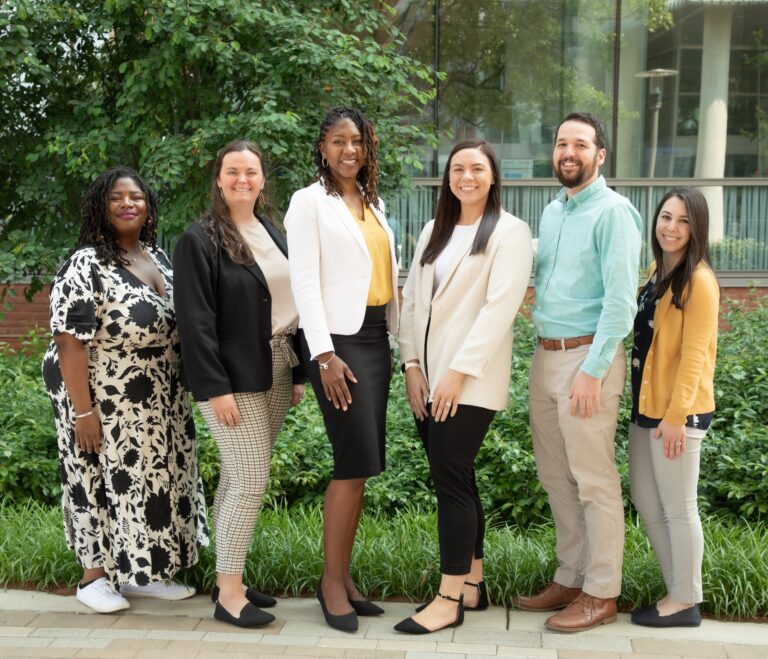
The Academic Advocacy team (Tanay Adams, Alison Larsen, Cari Godin, Amanda Sharp, Cliff Saul, and Hope Weisman) on campus.
Q: Tell us what you love about your academic program or an organization you’re involved in.
A: I love empowering students through our Academic Advocacy and Academic Peer Advocacy program. By connecting students with caring staff and peers and providing holistic support, we help them build confidence, overcome barriers, and thrive academically and personally.
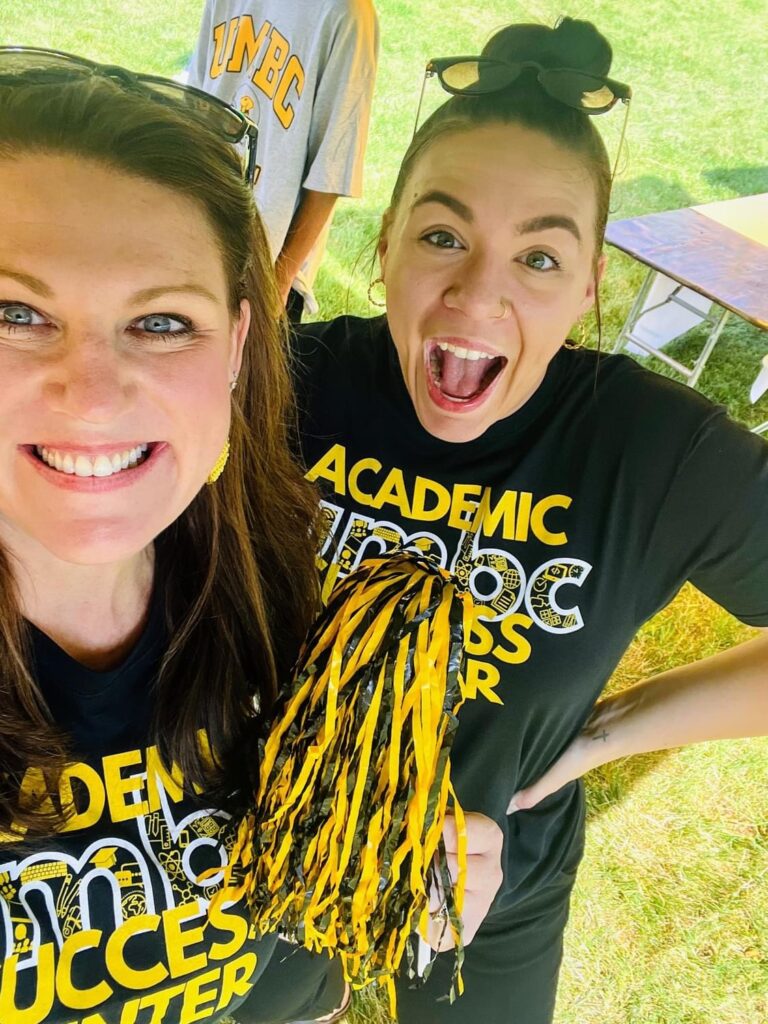
Sharp, at right, at Retriever Fest with colleague Amanda Knapp. (Photo courtesy of Sharp.)
Q: Tell us about your primary WHY, and how it led you to UMBC.
A: I came to UMBC because I believed in its mission, values, and commitment to students. I saw an opportunity to make a lasting, positive impact on the lives of the students we serve. I’m grateful for this decision every day, as I continue to be inspired by the resilience, dedication, and achievements of our remarkable students and the unwavering support of the UMBC community.
“
By connecting students with caring staff and peers and providing holistic support, we help them build confidence, overcome barriers, and thrive academically and personally.
Amanda Sharp
Q: Since you’ve been a part of the UMBC community, how have you found support of your WHY?
A: I’m truly humbled to have had the privilege of supporting so many students across the country through some of the most challenging moments of their lives, some of which were filled with extreme personal loss or immense feelings of failure. As I sit in those moments with students, with the weight of those feelings on their shoulders, my main goal is to instill in them the belief that they are truly worthy of success and happiness. As I watch them leave my office, I oftentimes see that weight they walked in with, the weight that tells them that they can’t succeed, lift just a little, and is replaced with confidence and compassion. These are the moments that support my “why.”
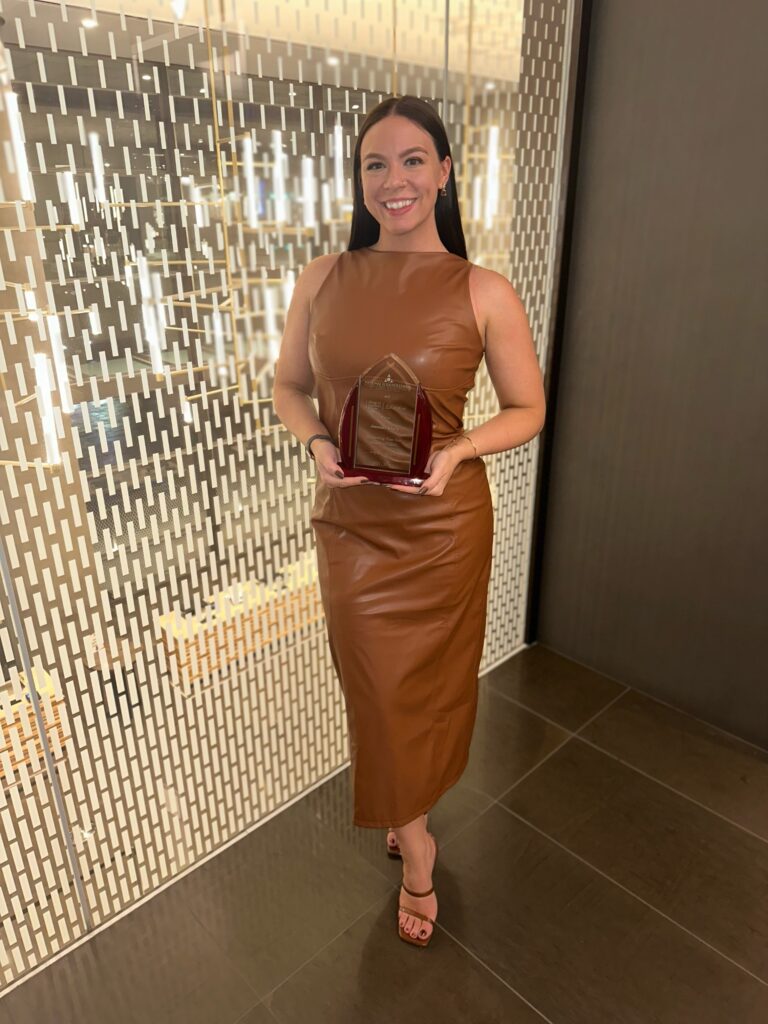
Sharp after winning the Outstanding First-Year Student Advocate Award at the 2024 FYE® Conference in Seattle, Washington. (Photo courtesy of Sharp.)
Q: Are you involved in any other campus organizations?
A: I’m on the Women’s Center Advisory Board, and I couldn’t be more proud of the work they do. The center’s staff focuses their efforts on raising awareness, facilitating dialogue, and implementing policies and practices that support marginalized students and communities. These efforts have been crucial to fostering a sense of belonging and ensuring that every student has the resources and support they need to thrive.
Q: What would you tell someone considering working at UMBC?
A: I would tell them that they have the opportunity to be part of an exceptional community that is deeply committed to making a positive impact on student’s lives and contributing to society’s greater good. If you are passionate about education, committed to excellence, and eager to contribute to something greater than yourself, UMBC is the perfect place to build a fulfilling and meaningful career.
* * * * *
UMBC’s greatest strength is its people. When people meet Retrievers and hear about the passion they bring, the relationships they create, the ways they support each other, and the commitment they have to inclusive excellence, they truly get a sense of our community. That’s what “Meet a Retriever” is all about.
Please join us in congratulating Vice Provost and Dean of the Graduate School Janet Rutledge, who has informed us of her intention to retire, effective June 30. Janet retires after 15 years in the role and 25 years with the University System of Maryland (23 of those at UMBC).
Under Janet’s leadership, the Graduate School has developed tremendously, and its enrollment has grown from 2,596 to 3,657. The Graduate School manages the full life cycle of a graduate student—from recruitment and admission through completion and graduation—and among Janet’s accomplishments was the creation of a graduate student development unit that focuses on issues and activities related to diversity, retention, and student success. That unit has expanded to include postdoctoral professional development. Grant funding through the National Science Foundation (NSF) Alliances for Graduate Education and the Professoriate and other sponsors spurred innovative programming that now has been institutionalized. This past year, the Mentoring Others Results in Excellence (MORE) program was launched to improve communications between faculty and graduate students.
A member of the faculty in the Department of Computer Science and Electrical Engineering, Janet has served previously in the Graduate School as associate dean, senior associate dean, and interim vice provost. Long dedicated to the development of students and faculty, before joining UMBC, she spent several years at the NSF, serving as the program director for the Graduate Research Fellowship Program. Janet chaired the NSF’s coordinating committee for the Faculty Early Career Development Program (CAREER). She has been very active in the graduate education community nationally and internationally, serving as a member of the Alfred P. Sloan Foundation Minority Ph.D. Program Advisory Committee and chairing the Council of Graduate Schools (CGS) Advancement Advisory Committee and the Advisory Committee on Strengthening Connections to Postgraduate Education in the Global South. She formerly served on the CGS Board of Directors, the TOEFL (English language test) Advisory Board, and the GRE (graduate admissions test) Advisory Board (serving as chair 2017 – 2018).
Janet’s academic career includes several years on the faculty at the University of Maryland, Baltimore and at Northwestern University. She has served as principal investigator or co-principal investigator on more than $25 million in grant funding for research and graduate education and was co-PI on NSF’s ADVANCE grant that aimed to increase the number of women faculty in STEM and support their career advancement.
We are grateful to Janet for her many years of service to UMBC and the Graduate School. And we extend our gratitude, as well, to Jeffrey Halverson, associate dean of the Graduate School and professor of geography, who has agreed to serve in an interim capacity as vice provost and dean for the upcoming academic year.
We look forward to the arrival in July of our incoming provost, Manfred H. M. van Dulmen, who will lead a national search for the next dean of the Graduate School.
For now, please join us in expressing our deepest thanks and congratulations to Janet on a wonderful career and best wishes for a happy retirement!
Sincerely,
President Valerie Sheares Ashby
David P. Dauwalder
Interim Provost and Senior Vice President for Academic Affairs
The third time’s the charm. Against a calm and crisp dark night sky on Florida’s Cape Canaveral on February 8, 2024, just after 1:30 a.m., the Plankton, Aerosol, Cloud, ocean Ecosystem (PACE) spacecraft rocketed to orbit carrying on board Hyper-Angular Rainbow Polarimeter (HARP2)—UMBC’s wide-angle imaging polarimeter. The launch marked the first time NASA deployed a university payload on a large operational Earth science space mission.
Written by: Anne Wainscott-Sargent
Following two scrubbed night launches the two previous nights due to strong winds, Thursday’s successful takeoff was well worth the wait for the core team of UMBC Earth and Space Institute researchers, graduate students, and their families and friends who journeyed from Baltimore to watch the historic launch.
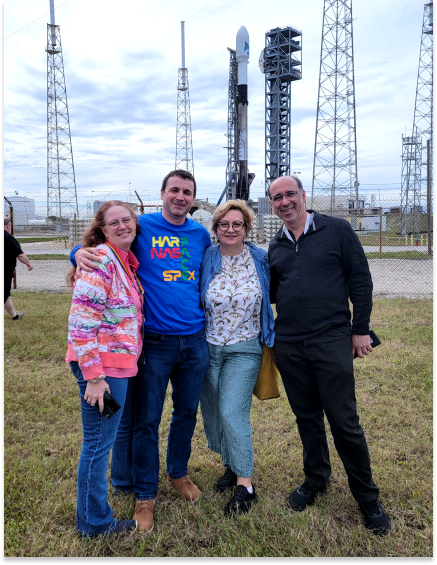
Left to right: Margo Young, Dominik Cieslak, Magdalena Kuzmicz-Cieslak, and Vanderlei Martins stand in front of the PACE spacecraft the day before its launch. Photo credit: Margo Young
Arriving by bus a little before midnight to the Banana Creek Launch Viewing Area at Kennedy Space Center, just over six miles from Space Launch Complex-40, the close-knit UMBC entourage huddled together waiting for the final countdown.
When it came, they—along with hundreds of other space launch watchers—held their breath and then yelled and clapped as SpaceX’s Falcon 9 rocket blasted off and propelled PACE 400 miles above Earth into sun-synchronous orbit. Minutes later the Falcon 9’s first stage—SpaceX’s reusable rocket booster—successfully landed at Landing Zone 1. The crowd gasped audibly at the sonic boom, caused when the spacecraft broke the sound barrier.
“It still doesn’t quite feel real,” said Noah Christian Sienkiewicz, a calibration scientist who earned his master’s degree in atmospheric physics from UMBC in 2019 and expects to complete his physics doctorate this summer. “I grew up watching Carl Sagan and dreamed of going into astrophysics. I never thought I’d be the person making the instruments that will go up and do the measurements.” “It’s so exciting—I’m going to cry,” uttered Margo Young from the upper bleacher. “I don’t always see the pieces and parts put together, so this is really historic.”
Young serves as UMBC’s HARP program administrator, where she has overseen procurement and other back-end support for HARP since the program’s inception in 2013. “I get to see students come full circle—working in the lab and then graduating and becoming civil servants where they continue to be involved because it’s such an amazing project,” she explained.
On the path to PACE
The UMBC HARP team’s remarkable journey from idea to mission reality spanned over 15 years, and involved countless hours of design, modeling, testing, and validation. Earlier iterations of HARP flew first on private aircraft over the Maryland countryside and then an award-winning “cubesat” version launched into orbit from the International Space Station (ISS), all stepping stones on the path to PACE. For the three multidisciplinary HARP2 physics, optics, and research engineering leads, Vanderlei Martins, Roberto Borda, and Dominik Cieslak, HARP2’s launch represents a career-defining moment that at times seemed against all odds for a mid-size public university. UMBC’s strong partnerships with NASA, such as the Goddard Earth Science Technology and Research (GESTAR) Center II that supports Borda’s and Cieslak’s roles, help enable milestones like this.
“I feel like I’m still dreaming,” said a visibly emotional Cieslak, research engineer, who captured the launch on his long-range camera. Transfixed by the sight of live satellite footage of the PACE spacecraft heading to orbit, he added, “This is the last time we will physically see it [HARP2],” before hugging his long-time colleague, Borda.
“We’re very proud to have UMBC in space,” added Martins, professor of physics, who watched the big moment from a VIP viewing area three miles from the launch site. “We dreamed big from the beginning. The team persevered and just kept going.”
Always more to do
“I never despaired of having HARP2 on the PACE satellite,” admitted UMBC’s HARP2 manager, Lorraine Remer, research professor in the Joint Center for Earth Systems Technology. Her bigger worry wasn’t HARP2’s viability, but whether PACE would ever launch. “PACE was canceled four times and reinstated four times,” she recalled, noting that the program “survived a lengthy government shutdown and a global pandemic that destroyed our supply chains.”
Immediately after launch, Remer had to return to Maryland and the Goddard Space Flight Center to oversee HARP2 being turned on within 36 hours of launch. “It would be nice to bask in the successful launch, but I haven’t had much time to contemplate the success. There is just more work to do all the time,” she said.
Remer and the rest of the team would soon be relieved to learn that HARP2 had successfully begun its operations and was transmitting data back to Earth as designed. The first data, known as “first light,” from HARP2 and the other instruments on PACE arrived as planned, and NASA released the first wave of data on April 11. All of the data from PACE will be free to access and completely public, allowing anyone to conduct their own analyses and contribute to our understanding of Earth’s complex systems.
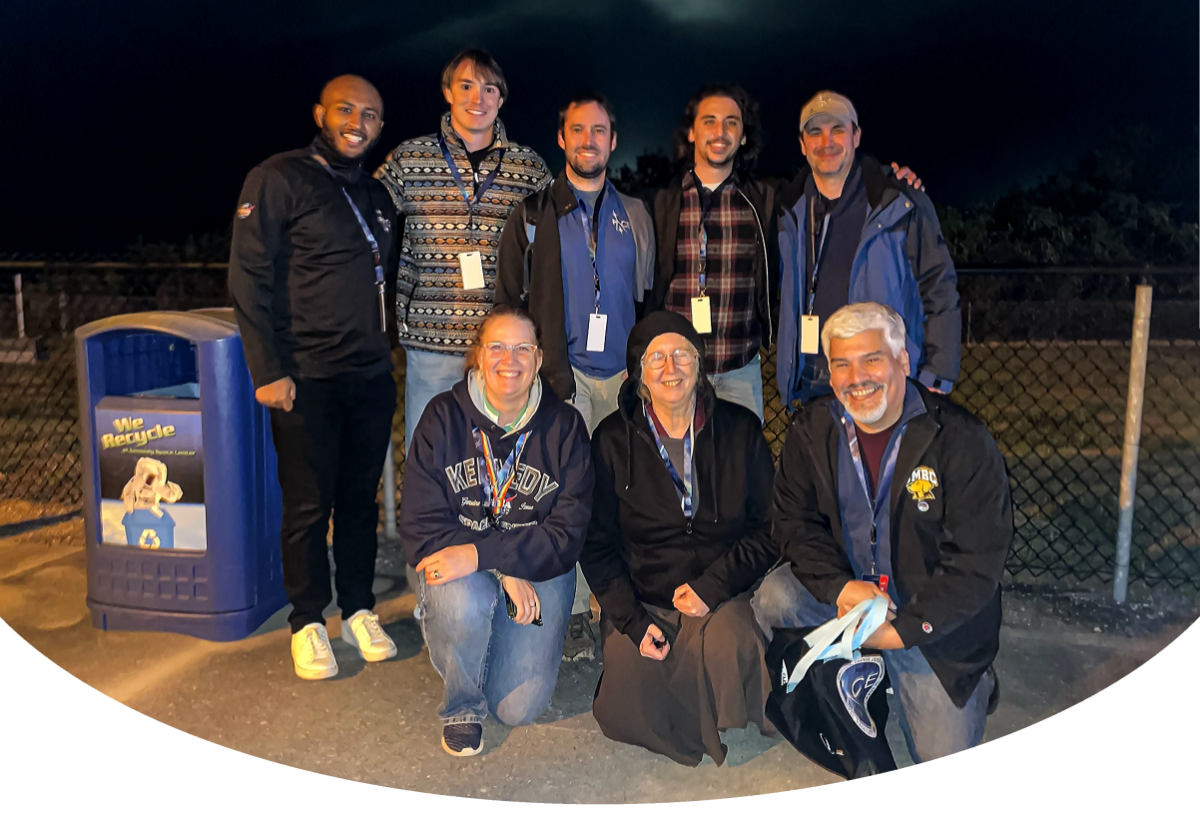
Members of the HARP team eagerly await the PACE launch at Kennedy Space Center’s Banana Creek Launch Viewing Area before the final countdown. Top, left to right: Yomiyu Fekadu, Ian Decker, Ben Cramer, Noah Sienkiewicz, Dominik Cieslak. Bottom, left to right: Margo Young, Lorraine Remer, Roberto Borda. Photo credit: Anne Wainscott-Sargent
An international effort
NASA’s PACE mission clears the path for revolutionary new measurements of Earth’s oceans and atmosphere. HARP2 measures aerosol particles and clouds, as well as properties of land and water surfaces. By analyzing particles like dust, wildfire smoke, or urban pollution, the science community gains deeper insights into air quality as well as global warming and its impacts. Scientists will be able see through things like sun glint to ascertain patterns never before possible.
A second polarimeter on PACE, the Spectro-polarimeter for Planetary Exploration (SPEXone), developed through a Dutch consortium consisting of SRON Netherlands Institute for Space Research and Airbus Defence and Space Netherlands, will measure sunlight reflected from Earth’s atmosphere, land surface and ocean.
“
“There are undergraduate students and Ph.D.s integrated into the team who put in a lot of effort to make this real. We’re really thankful for the environment at this university—we’re able to work with students who find a career in this industry and field of research.”
Robert Borda
These two companion polarimeter instruments are important because the interaction between aerosols and clouds is the biggest unknown factor in atmospheric temperature change, according to reports from the U.N.’s Intergovernmental Panel on Climate Change.
“I have watched Dr. Martins and his team work toward this moment for about a decade, and have been aware of the trials and tribulations along the way. Seeing the smiles on their faces in the control station after the launch made it all worthwhile,” shared UMBC Vice President for Research Karl V. Steiner. “The HARP2 mission as an integral part of PACE is making all of us proud here on the UMBC campus. We cannot wait to see the science that will come from this engineering masterpiece conceptualized and created right here in Maryland.”
Waiting game
In the days leading up to the PACE launch, the HARP2 team knew there might be delays because of the weather so they rented a large Airbnb in neighboring Cocoa Beach for the full week. Earlier in the week, over grilled food at the shared house, the team reflected on their journey.
According to Martins, a key strategy was bringing together engineering and physics students, who typically don’t communicate well across disciplines.
“We introduced engineering students to the physics students and made them work together very quickly so they spoke the same language,” he said, crediting this multidisciplinary collaboration to the team’s ability to rapidly iterate and problem solve.
Borda, senior research engineer overseeing HARP2’s optical design, said a key technical challenge was determining how to best compensate for the effects of polarized light waves inside the instrument.
“It’s continuous work and you cannot do it alone. We needed a fantastic team with not only the staff but also students working at different levels,” Borda said. “There are undergraduate students and Ph.D.s integrated into the team who put in a lot of effort to make this real. We’re really thankful for the environment at this university—we’re able to work with students who find a career in this industry and field of research.”
Nurturing future career scientists
Martins echoed Borda’s pride in the broad level of participation in the HARP program, from high school students to senior scientists. “We’ve had people from our team who now work in all levels of industry—at NASA, at NOAA, or in private industry. We’ve even had some students start their own company.”
Young, the program administrator, estimates that the cooperative agreements between UMBC and NASA have resulted in 20 UMBC graduates finding roles with NASA.
UMBC alumna Elissa Ogburn is one such graduate. She began working on HARP2 as a computer science major, tasked with creating a database that supported ground communications so researchers could communicate with the instrument when it was in space.
After graduating from UMBC in 2021, Ogburn joined NASA on the PACE project as a test conductor—responsible for integrating and testing the instruments onto the PACE spacecraft. During launch, she was one of five test conductors in the PACE Control Room in Titusville, Florida, who powered up the spacecraft for the last time and configured it for launch.
“I never imagined having a job at NASA or working with people who were this smart, helpful, and kind. Every single person I’ve worked with was so fun. It’s also cool to have seen the whole process beginning as a student at UMBC. PACE is my first mission, so I’m learning everything as I go,” Ogburn said.
Close collaboration
The partnership between NASA and UMBC goes back over two decades. NASA Goddard Space Flight Center and UMBC are located just up the road from one another.
Jeremy Werdell, PACE project scientist at Goddard, recalled how initial calls to industry and academia for a polarimetry instrument for PACE were not promising due to cost and other factors.
However, Martins immediately suggested to Werdell that his lab develop a polarimeter, given his team’s experience with airborne instruments and the HARP cubesat, and the rest is history. In the end, NASA selected two polarimeters—HARP2 and SPEXone. Each instrument measures polarization differently: HARP2 is multispectral (measuring only four wavelengths of light) and hyperangular, so it looks at the same piece of real estate multiple times from dozens of different viewing directions. Its wide swath coverage means HARP2 will cover the globe every two days. SPEXone, on the other hand, is hyperspectral (measuring a continuous spectrum of light from the ultraviolet to near-infrared) but only views Earth at five angles. It has a narrower swath, meaning it will take almost a month to cover the globe.
“They’re small and mighty and miraculously complement each other very, very well,” said Werdell. “Having multi-band, multi-angle polarimetry is going to open up a lot of really interesting opportunities for discovery, because we can see clouds and aerosols in very different ways.” HARP2 provides daily views that will help scientists understand how aerosols and clouds interact and their role in warming and cooling in the atmosphere.
“Understanding where aerosols are, how they’re transported, how they interact with clouds, and whether they absorb or reflect radiation is important to everybody because those characteristics are what drive warming of the atmosphere.” Werdell said.
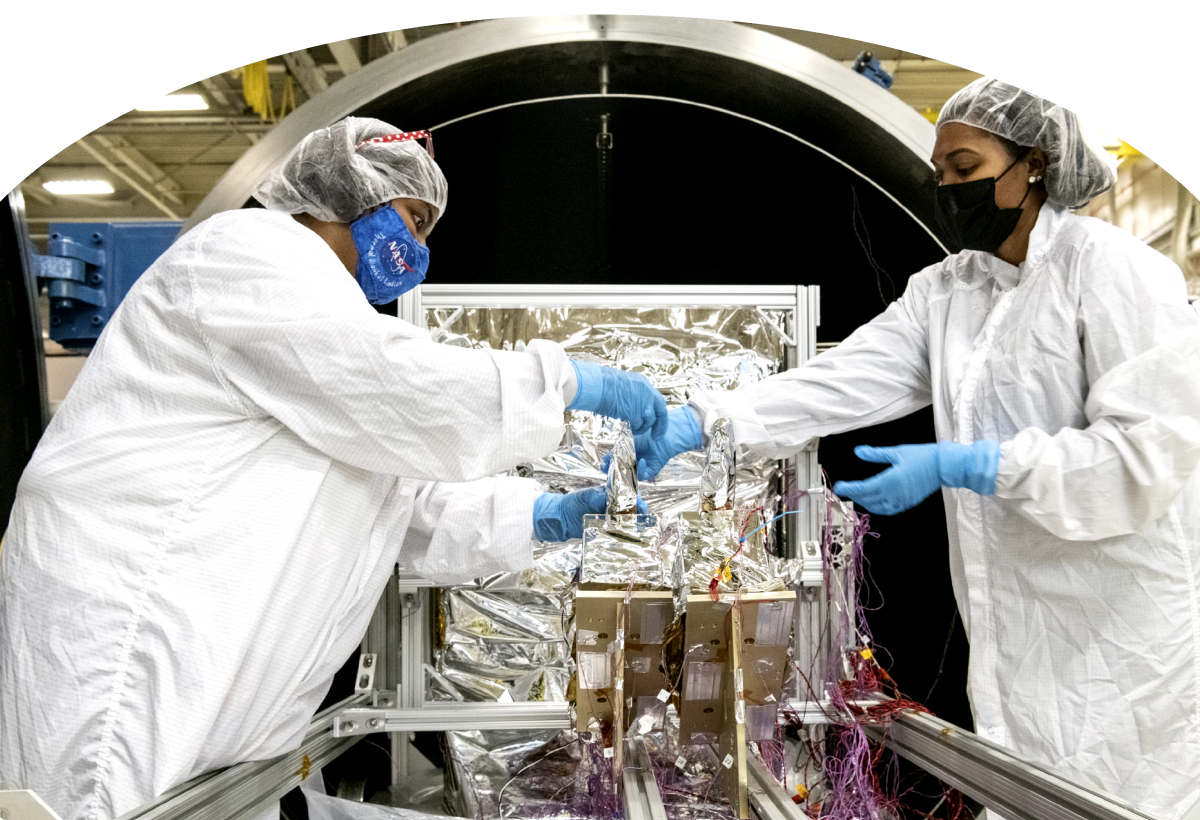
HARP2 calibration testing at Goddard Space Flight Center in Maryland, before the instrument was delivered to NASA. Photo Credit: Katherine Mellos/NASA
Better air quality models
Onsite at the Cape for the first launch attempts, Nirandi Jayasinghe and Rachel Smith, both physics graduate research assistants at UMBC, shared their excitement for the PACE mission and HARP2’s potential to help modelers predict air quality, rain, or if the atmosphere is warming or cooling.
Jayasinghe is a data modeler who comes up with different methods to retrieve information from HARP2. Originally from Sri Lanka, Jayasinghe notes that her hometown used to be one of her country’s cleanest cities, and now due to development in Sri Lanka’s dominant neighbor, India, the air quality is extremely bad. She said HARP2 can help close the gap that exists in understanding the twilight zone—where a cloud starts and where it stops—by providing more accurate measurements.
“
“No other place would have let me be involved in the entire process…. Not only did I get to do hands-on stuff, but I also was part of the design and saw it all come together on a NASA mission.”
-Yomiyu Fekadu '20, mechanical engineering, M.S. '23, engineering management
Smith adds that this will go a long way in understanding cloud formation processes, weather patterns, forecasting, and climate modeling—information important for agriculture, transportation, disaster preparedness, and infrastructure planning.
“Even simple things like weather forecasting are impacted by how much dust is in the air,” said Smith, a 2026 doctoral candidate who earned her M.S. in atmospheric physics from UMBC in 2023. HARP2 will help address whether clouds have a net cooling effect or a net warming effect, which will allow for more accurate models of where Earth’s climate is headed. Smith notes that during events like the Canadian wildfires in 2023 no one could accurately predict rainfall, because the forecasting models were not accounting for the number of airborne aerosols.
“I’m really excited to see what new science questions come out of the instruments that we’re putting up in space,” she concluded.
Bouncing back from disaster
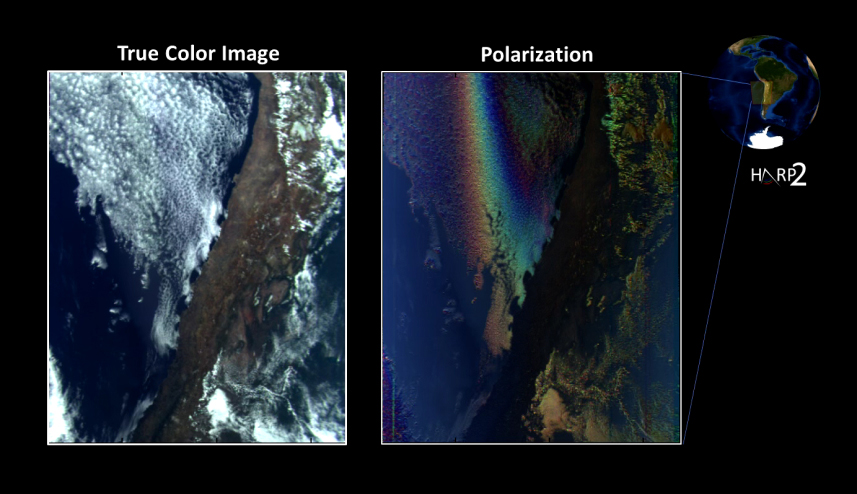
The first images from PACE’s HARP2 polarimeter captured data on clouds over the west coast of South America on March 11, 2024. The view of polarized light that the polarimeter “sees” (on the right) can help scientists better understand the droplets that make up the cloudbow—a rainbow produced by sunlight reflected from cloud droplets instead of rain droplets—which can reveal how the clouds respond to pollution and other particles in the atmosphere. Photo Credit: UMBC
The HARP2 team has come a long way from initial concept to PACE. What impresses Werdell the most is the UMBC team’s resilience in the face of setbacks.
The most devastating moment came in February 2022, one month before the team was set to deliver HARP2 to NASA for integration on the spacecraft. As the instrument was in the last few seconds of vibration tests, the bonding on one of the prisms loosened and shattered.
“It tactically put us to point zero,” recalled Cieslak, who was shocked and humbled when so many NASA scientists volunteered their time and expertise to help the HARP2 team get back on track. “We got an extension, and within two months we had built a new engineering model and were able to prove the new solution worked. By September, we were back to where we were before the incident,” he added.
First-time NASA launch attendee Yomiyu Fekadu ’20, mechanical engineering, M.S. ’23, engineering management, recalled that time well, as he helped assemble HARP2 as an intern under Benjamin Cramer ’17, M.S. ’20, mechanical engineer on the program.
“Especially after the failure, and the review board assessment, I helped put everything back together and do the test plans for construction and other documentation so NASA could give us the go-ahead to move on,” Fekadu said.
The experience was pivotal to his career. “It was everything I could have asked for,” said Fekado, now a systems engineer at Northrop Grumman. “No other place would have let me be involved in the entire process, including making parts for HARP2 in the machine shop. Not only did I get to do hands-on stuff, but I also was part of the design and saw it all come together on a NASA mission.”
As the HARP2 group left the viewing platform to line up for bus rides back to the Space Center, the smiles and easy camaraderie conveyed a collective sense of pride, relief, and excitement.
“I‘m now just anxious to see the first bytes of data,” said Cieslak, echoing the feeling of his colleagues.
In addition to the HARP team, several additional UMBC GESTAR II scientists and engineers were instrumental in their contributions to the overall PACE mission, including Ivona Cetinić, Andrew Sayer, Violeta Sanjuan Calzado, Bridget Seegers, Susanne Craig, Dirk Aurin, Meng Gao, and Ian Carroll.
Spring on UMBC’s main campus brings a host of familiar sights and sounds: blooms on the magnolia trees, the chatter of red-winged blackbirds calling from the reeds around Library Pond, greening grass on the campus Quad, and black-and-gold-bedecked Grit Guides leading groups of prospective Retrievers around what may soon become a home away from home.
The guides cover the usual highlights—Academic Row, the Retriever Activity Center, the AOK Library, eating establishments, and residential halls. UMBC is a place to live, to learn, and to find community. And while some of the functions of campus spaces are obvious, others are often hidden.
Look more closely, and you’ll see faculty and students turning the everyday infrastructure and green oases of UMBC into out-of-the-ordinary laboratories. Beeswax sculptures, tactile maps, robots helping other robots—read on to discover some of the amazing ways Retrievers are using the campus itself for experiential learning and diverse research.
Written by: Catherine Meyers & Sarah L. Hansen, M.S. ’15
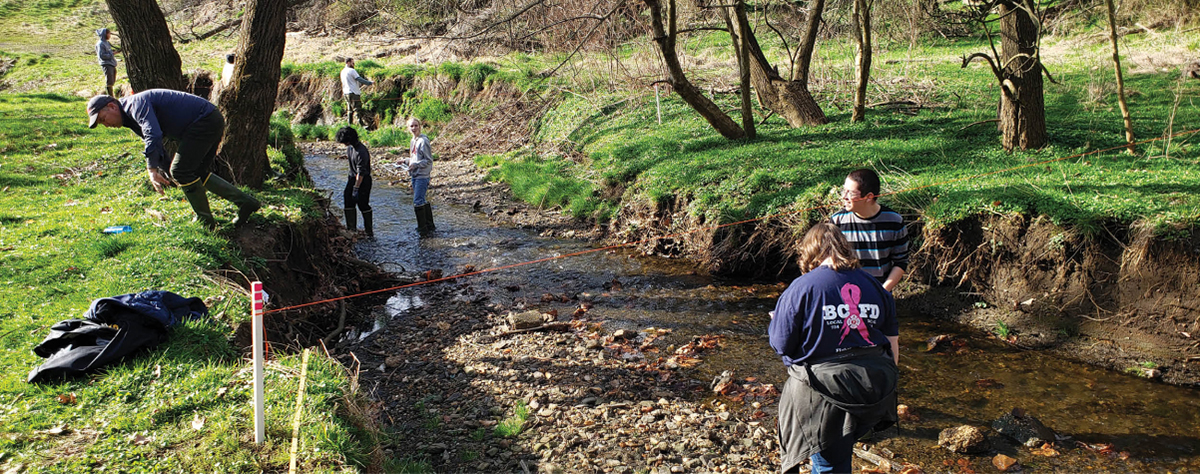
Two students wearing knee-high waders stand several meters apart in the middle of a rapidly flowing stream at the north end of UMBC’s campus. One releases a Ping-Pong ball, which bobs along with the current, as the second starts a timer, stopping it when the ball reaches his feet to determine the stream’s flow rate.
Nearby, another student measures the size of rocks in the streambed using a device called a gravelometer—a rectangular piece of metal with square holes of various sizes. The smallest hole a given rock will fit through becomes its measurement.
Farther along, other students capture photos that include reference posts on the stream bank. Each small group of students also takes measurements of the water depth at one-foot intervals along strings hung from one bank to the other. The students (with the help of specialized software) will use these measurements and photos to generate 3D models of the streambed.
“It’s a little DIY, but we get some amazing pictures,” says Charles Kaylor, the instructor and director of GIS and cartography labs in the Department of Geography and Environmental Systems (GES).
This is the “stream lab” in Exploring the Environment: A Geospatial Perspective, a course best known in the UMBC community for its semesterly launch of a dozen or so brightly-colored balloons that dot the campus skyline. Throughout the semester, students train their brains in the ways geographic data can help answer a wide range of research questions.
For the students, there are a range of perks to the course. “It’s cool to see different applications of computer science, which can sometimes feel pretty theoretical,” says George Rush ’24, computer science. Luke Thomas ’27, GES, who was partnered with Rush, is grateful for the senior’s support with the programming aspects of the coursework.
Rhonda Plofkin, Ph.D. student in GES and the graduate assistant for the class, concurs that having students with different strengths facilitates peer learning. “This is real-life stuff that geomorphologists do in the field,” she adds.
For some, the benefits are just as real, but simpler: “The cold water wakes me up,” Anthony Roytenberg ’24, computer science, says with a smile.
Students collect data that measure flow rate, depth, pebble size, and more as part of the “stream lab” in a popular, interdisciplinary GES course. Photo by Sarah Hansen, M.S. ’15.
When Alieh Rezaei arrived at UMBC from Iran, she couldn’t take her eyes off the ground. Almost immediately she was mesmerized by the flora and fauna of her new residence, and as an master of fine arts student in the intermedia and digital arts (IMDA) program, she decided to incorporate pieces of UMBC into her artwork. She walked around campus, picking up windfalls of seeds and exploring hidden nooks of nature. A place that would come to be her sanctuary, Rezaei, M.F.A. ’22, says, was Joseph Beuys Sculpture Park.
“The solidity of the stones alongside the growth of the oaksand the evolving shape of the garden reflect concepts of erosion and growth,” says Rezaei. “As an immigrant, I found solace in my attachment to the settled and solid stones, representing a sense of grounding to me.”
Rezaei was drawn to UMBC’s M.F.A. program because of its multidisciplinary approach and the freedom she felt to choose an unconventional path. She praised Kathy O’Dell, IMDA professor emerita, who was her advisor. “Kathy was someone who—it was like I was floating in the air and Kathy held my hand and grounded me. She was very supportive for the whole journey.”
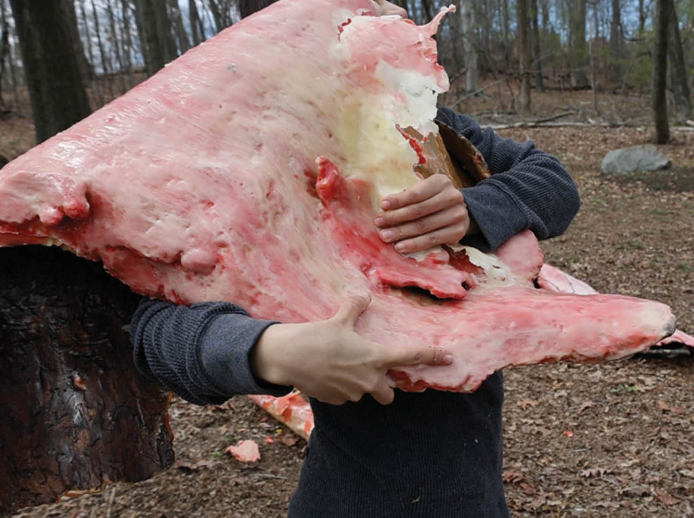
A photograph from Rezaei’s three-hour performance “The Tongue in the Landscape” at the Joseph Beuys Sculpture Park featuring the artist laboriously peeling the wax layer off the pieces of bark. Photo courtesy of Rezaei.
To create the art for her thesis project, Rezaei used almost exclusively materials collected on or near campus, including fallen tree bark, shattered wood, and seeds. She bought her main material—beeswax— from Baltimore beekeepers. One piece, “The Collective Womb,” featured hundreds of native seeds, called Devil’s Darning Needles, held together by beeswax around orange peels.
When the pieces were finished, Rezaei immediately knew the stage she wanted to showcase them on—Joseph Beuys Sculpture Park. “I installed my pieces there and had a performance as a way to extend the concept of public sculpture, aiming to reactivate the space and revive the concept of ecological engagement central to Beuys’ 7000 Oaks project.”
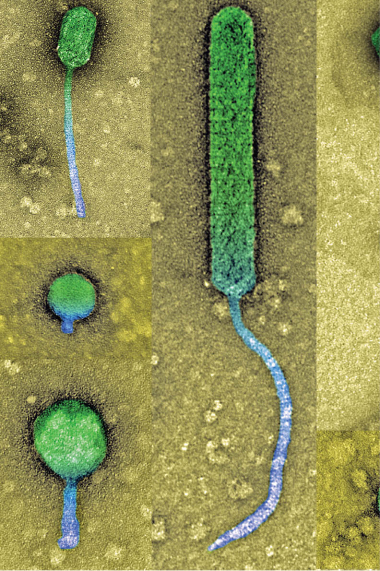
A composite of several microscope images of phages discovered by UMBC students in the Phage Hunters program demonstrates the variety of shapes phages can take. Photo by Tagide deCarvalho.
IchabodCrane. MindFlayer. Annihilus. TonyStarch. These are viruses previously completely unknown to science discovered by UMBC students in the Phage Hunters program, a two-course undergraduate genetics and bioinformatics sequence.
Since its launch in 2008, UMBC students have discovered 661 viruses that infect bacteria, called phages. Ninety-seven of them originated in samples collected on campus, with the most popular location being the Library Pond. Seventy-seven phages have been sequenced and 60 have been fully characterized and submitted to GenBank, an international digital repository of genetic and protein sequences.
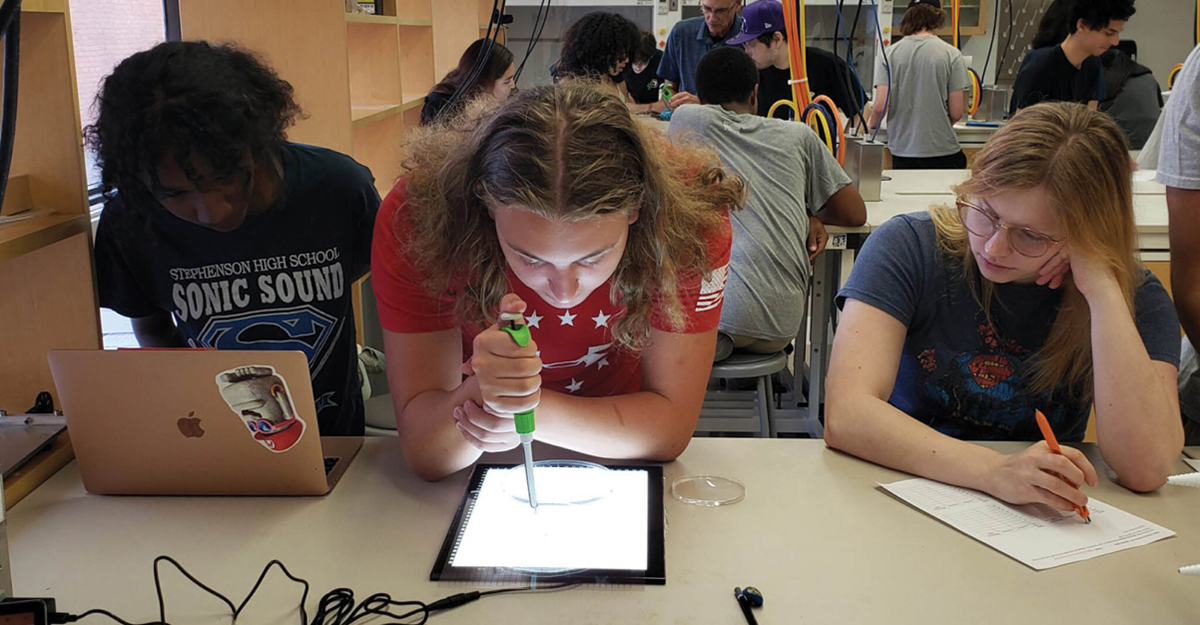
Steven Caruso ’94, Ph.D. ’02, biological sciences, principal lecturer of biological sciences, runs the genetics course where the students collect samples, isolate their phages, image them with help from Tagide deCarvalho, “and growth,” says Rezaei. “As an immigrant, I found present their findings. They learn foundational laboratory techniques and get a taste for research.
Phage Hunters gives students “a first glimpse of what research is, with all that goes with it: determination, grit, inspiration, frustration, and more,” says Ivan Erill, professor of biological sciences and co-instructor for the bioinformatics course with Caruso. “Students get to see all the possible outcomes of a research project, from total success culminating in a DNA extraction for sequencing to failure to isolate a phage in the first place.”
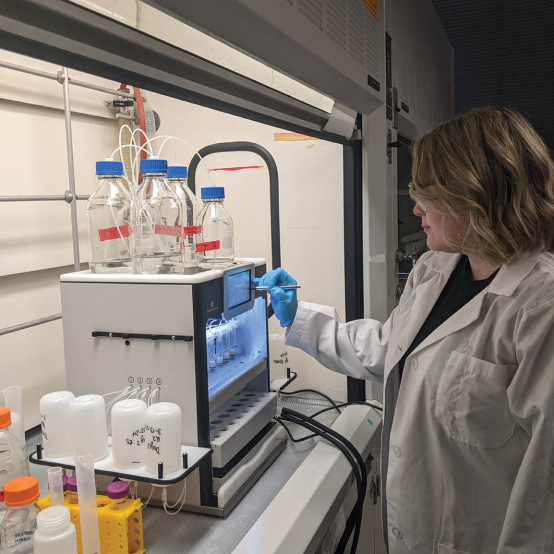
In the basement of the Meyerhoff Chemistry Building, in a tiled expanse called the Molecular Characterization and Analysis Complex, sits a sleek, roughly human-sized instrument with the power to measure extremely tiny amounts of chemicals. Amanda Belunis, a chemistry Ph.D. student now in her final year, knows the instrument like an old friend, having turned to it to analyze a smorgasbord of UMBC water samples.
Belunis studies a group of chemicals called per- and polyfluoroalkyl substances, or PFAS. The chemicals are used in products as varied as makeup, clothing, and fire-fighting foam and are found in trace amounts in many water sources as well as in human blood. Dubbed “forever chemicals” because of the way they persist in the environment, they present a growing concern to human health.
Belunis’s research is part of a growing effort by scientists to understand how PFAS enter and travel through the environment and, ultimately, figure out ways to remove them.
To validate her procedures for measuring PFAS concentrations, Belunis tested water from drinking fountains, the sink in her chemistry lab, the pool, and the pond and streams around UMBC, all of which contained trace amounts of PFAS, as would be expected. Confident her methods worked on real-life samples, she then turned her attention to analyzing water in aquaculture fish tanks.
“My lab mates and I sometimes discuss how all of us have these chemicals in our bodies,” says Belunis. “It’s concerning, which is why we need to do more studies.”
Amanda Belunis prepares samples for later analysis in the Molecular Characterization and Analysis Complex. Photo by Catherine Meyers.
In addition to measuring buildings, students in Math in Action discovered other ways that math naturally interacts with their lives and studies. Here they are recording the movements of brine shrimp. Photo by Sarah Hansen, M.S. ’15.
When asked how to measure the height of a building, most students in Math in Action, a new laboratory course for non-STEM majors, “came up with various ways to measure the height directly—for example, by dropping down a string and then measuring the string or stacking up various objects,” says Alexis O’Malley ’18, mathematics and psychology, who teaches the lab.
But today, students are peering along the edges of homemade clinometers—plastic protractors with drinking straws attached—taking measurements from safely on the ground with a meter stick, and running simple calculations based on the properties of triangles to measure the height of UMBC’s Administration Building (123 feet, 2 inches).
Throughout the course, “I want students to see how math can be used to solve problems creatively,” O’Malley says.
Math in Action covers different math concepts each week through hands-on activities. The purpose of the clinometer activity is to remind students that “science is based on measurement, and you can build a tool to measure almost anything,” shares William R. LaCourse, dean of the College of Natural and Mathematical Sciences, who originally generated the idea for the course to help a wider range of students develop math skills relevant to their everyday lives. The course, he adds, “is a doorway to a lot of different math concepts.”
Shawn Abraham ’24, political science, has gotten lost on the UMBC campus more times than he can remember. As a blind student, he finds his way using a white cane, auditory cues, mental maps, and by asking people for directions. “People are surprised when I tell them, but big cities are much easier to navigate,” Abraham says. “College campuses are hard to get around.”
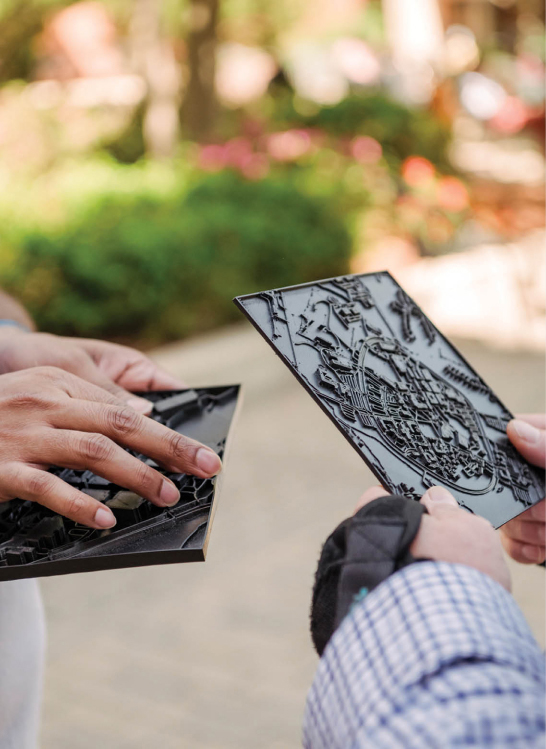
Tactile maps are one tool that could help. Erin Higgins and Kirk Crawford, Ph.D. students in human-centered computing, have recently been working with blind students at UMBC to create and test 3D-printed maps of campus.
The researchers launched the project after being approached by Michael Canale, assistant director of the Office of Student Disability Services. He says UMBC currently has four completely blind students enrolled and his office wants to provide personalized maps that each student can carry with them as they navigate campus. He’d also like to see a large 3D-printed map mounted somewhere on campus.
“A beautiful tactile map could be used by visitors of all kinds,” Canale said. “It’s the principle of universal design.”
Meanwhile, Md Osman Gani, an assistant professor of information systems, is spearheading a new project, named MyPath, to develop a Google Maps–style app to help wheelchair users navigate campus.
“Uneven surfaces, discontinuous sidewalks, and steep slopes can make wheelchair travel challenging, and even impossible” Gani says. The MyPath app would help by providing users with personalized turn-by-turn navigation with real-time updates. The app will rely on a machine learning model that recognizes path accessibility conditions based on crowd-sourced data, and Gani is currently recruiting wheelchair users to contribute data using their smartphones.
Shawn Abraham (left) tests prototype tactile maps made with 3-D printers with Michael Canale (right).
It’s 7 a.m. in July, and Megan Curtiss ’23, GES, is standing next to a tree just outside The Loop on UMBC’s southeast corner. It’s wrapped in a thin metal band at about chest height. Curtiss carefully measures the small gap between the two ends of the band with digital calipers three times, takes the average, and then moves on to the next tree. Only 98 to go.
This scene played out weekly from March to October 2023 as Curtiss collected data for a study led by Matthew Baker, GES professor, and Nancy Sonti, a research ecologist with the U.S. Forest Service. “It became like a morning meditation,” Curtiss shares.
The metal bands, call dendrobands, “are a cheap and easy way to get pretty detailed information,” Curtiss says. By measuring the trees’ growth over time, the goal is to look at how trees of different species and in different immediate environments (such as a parking lot versus a forest) handle conditions like fluctuating temperatures and water availability.
After attending Anne Arundel Community College in her 30s, Curtiss then found a home at UMBC. She began working with Baker in fall 2022 and will enter the GES master’s program at UMBC this fall. A graduate degree was not something Curtiss originally planned on, but now she’s excited about the further experiences it will bring. “I’m looking forward to the unexpected,” Curtiss says.
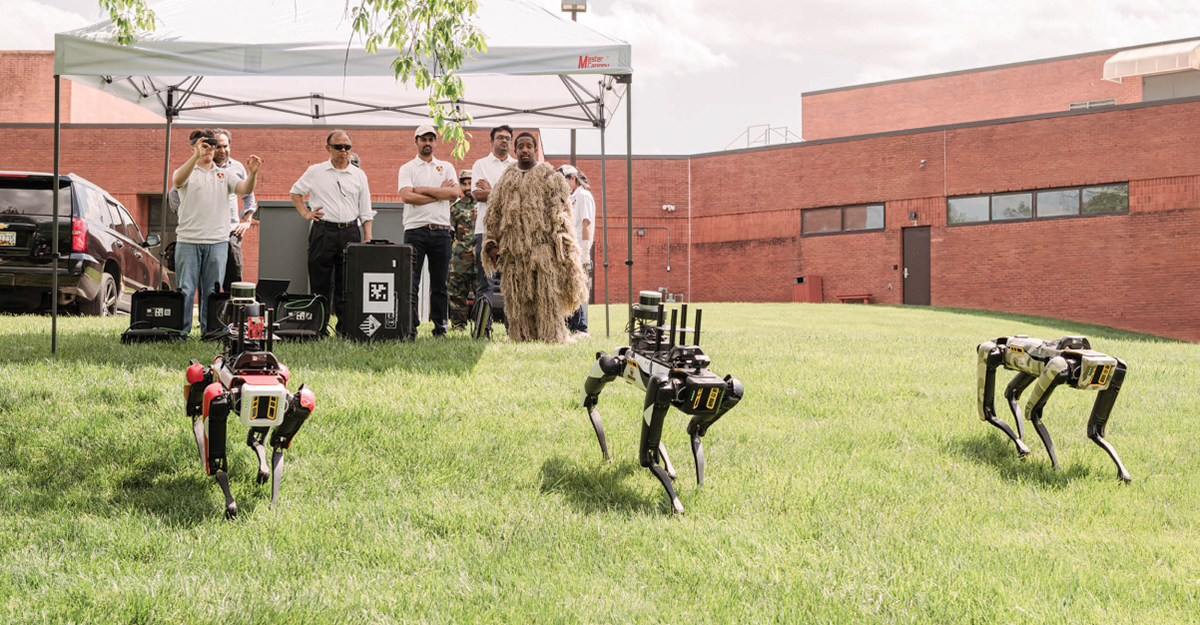
Take a left off Hilltop Circle, just past the greenhouse on the right and toward the Walker Avenue apartments, and you’ll find yourself outside a traditional brick building that used to house trial rooms and detention cells. In 2021, UMBC turned this former courthouse into the main hub for the Center for Real-time Distributed Sensing and Autonomy (CARDS). Researchers here develop artificial intelligence-enabled smart robots for military and search-and-rescue operations.
On a sunny day in spring, you will likely see students gathered in the courthouse’s “backyard,” huddled around dog-like Spot robots and wheeled vehicles called Jackals and Huskies.
The researchers outfit the robots with a host of custom devices, such as cameras and radar to sense their surroundings and microprocessors to run on-board algorithms. While the robots can be commanded via voice and gesture, the ultimate goal is for them to operate mostly autonomously.
On the back lawn of the courthouse building, student researcher Kevin Rippy, left, controls three Spot robots with gestures. Another student stands by in a ghillie suit, a type of camouflage clothing.
Recently, the team has demonstrated this capability by verbally assigning the robots the task of jointly surveying a given area. The robots must translate the instructions from plain English into machine-level commands, divide up duties, detect and avoid obstacles, come to a fellow robot’s aid in the case of unexpected problems, and identify and keep track of the objects and people within their assigned perimeter.
“People from around campus will see us testing and will stop to watch,” says Aryya Gangopadhyay, a professor in information systems who directs CARDS. “The robots are an attention getter.”
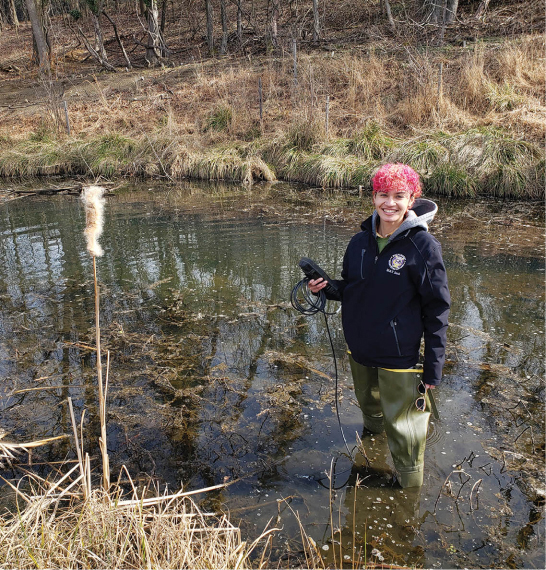
Erin Hamner collected weekly water quality data from this stream for six months, using the battery-powered digital probe she’s holding. (Image by Sarah L. Hansen, M.S. ’15)
After traipsing across a swampy field between research sites, Erin Hamner ’22, GES, and a current master’s student in the Interdisciplinary Consortium for Applied Research in the Environment program, scampers down a streambank in thigh-high waders and plunges a battery-powered probe into the water. It reports concentrations of ammonia and nitrates—key water quality measures. The probe also measures the water’s conductivity, which indicates the level of ions, such as salts used to melt snow.
It’s beautiful out today, but Hamner completed the trek to a dozen campus sites weekly from September 2023 to February 2024, sometimes dealing with mud, snow, or rain. The goal of her master’s thesis is to confirm that stormwater management features UMBC has installed to reduce flooding, filter storm runoff, and otherwise improve water quality are working as intended—or if they aren’t, to suggest improvements.
Hamner and her collaborators in Facilities Management and the Office of Sustainability want to see the data collection effort continue after she graduates. So she is working with faculty in GES to incorporate crowd-sourced stormwater monitoring into the undergraduate curriculum, including generating a public dashboard.
“Erin has done incredible groundwork collecting water quality data across our campus, generating useful data that can tell us about the health of UMBC’s waterways,” says Taylor Smith, assistant director of sustainability.
Long-term data will help the university “see how our development affects our watershed so we can continue to be good stewards,” Smith adds, noting that, “data like Erin’s can help us advocate for more greenspace and stream buffers around campus.”
An agreement between the College of Engineering and Information Technology at UMBC and The University of Baltimore’s Merrick School of Business will offer students from both institutions enhanced opportunities for their graduate-level degrees and future careers.
UMBC students may apply credits from UMBC’s M.S. in Engineering Management, Post-Baccalaureate Graduate Certificate in Project Management, or the Post-Baccalaureate Graduate Certificate in Engineering Management to UBalt’s MBA. UBalt students may apply credits from the MBA program or the Post-Baccalaureate Graduate Certificate in Business Fundamentals to UMBC’s M.S. in Engineering Management. This collaborative effort to satisfy certain requirements for these programs is intended to increase the marketability of students at both institutions, as they build out their career paths in a growing number of fields that require multiple areas of focus.
A candidate for an engineering job, for example, may benefit from having educational experience in business. The MBA degree, a stalwart of business professionals across a wide range of fields, is made even more attractive when combined with graduate-level learning in a vital area such as project management.
Both UMBC and UBalt are members of the University System of Maryland, the state’s longtime organization of 12 colleges and universities, three regional centers for higher education, and the system office, all working together to improve the quality of life in Maryland. The partnership maximizes the strengths at each of the USM sister institutions so those seeking managerial education at UMBC will have access to programs offered by an AACSB-accredited School of Business and those in the UBalt MBA may continue to evolve their professional goals with technical skill sets offered by the UMBC School of Engineering.
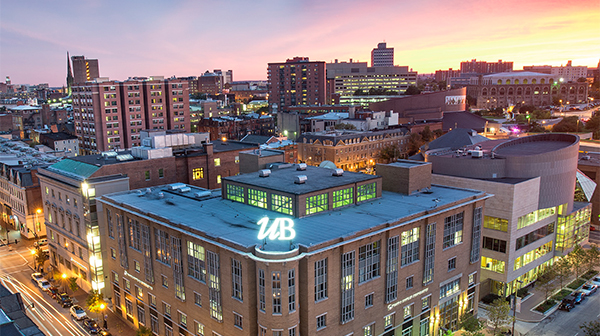
The Thumel Business Center, home of the Merrick School of Business, at The University of Baltimore. (Photo courtesy of UBalt.)
“This agreement leverages the strengths of UMBC’s engineering program and UBalt’s business program to provide students with accelerated pathways to earn graduate degrees or certificates from both institutions,” says Dr. Raju Balakrishnan, dean of the Merrick School of Business. “This is another excellent example of how USM institutions collaborate to provide students with even more enhanced educational opportunities.”
UMBCs acting dean of the College of Engineering and Information Technology Anupam Joshi adds, “We are excited to provide students from both institutions additional options to grow and acquire valuable knowledge and skills. We also look forward to exploring new ways to expand this partnership.”
Admission into these collaborative courses is straightforward:
UMBC students must be enrolled in or have completed an M.S. in Engineering Management or Post-Baccalaureate Certificate in Engineering Management or Project Management at UMBC. These UMBC students may apply to either or both of the UBalt programs in the final semester of their respective programs and will be subject to standard application procedures.
Similarly, UBalt students will have to be enrolled in the MBA or the Graduate Certificate in Business Fundamentals and may apply to any of the UMBC programs in the final semester of their respective programs and will be subject to standard application procedures.
Both UBalt and UMBC will accept up to 12 transfer credits of the other institution’s courses.
The introduction of the new collaboration is expected to be available to applicants in Fall 2024.
The end of the spring semester is upon us, and we are speeding toward Commencement! As our students complete final projects and exams, and as our graduating students prepare to head out beyond UMBC to begin their next chapters, I want to extend my congratulations for everything you have accomplished during this semester and year.
It has been a challenging set of circumstances in which to have achieved so much, and that makes me especially grateful—to you and to UMBC. So, with this end-of-semester message, I want most of all to express that gratitude directly.
I am grateful to the entire UMBC community for caring for one another and for this great institution; for sharing your ideas and your feedback for how to make our community even better; and for showing up in pursuit of our academic mission and in service in so many places where you have been needed. Your work, your voices, and your care matter so much and are valued so deeply. Thank you.
To our faculty and staff, I would take that one step further. I am grateful to you for continuing to deliver the world-class education that our students expect and deserve, despite the many challenges, both on campus and in our world, that could have disrupted or distracted us from this core mission. You kept teaching, you kept mentoring, you remained in service to our students and our mission throughout, and, as a result, our students have continued learning and stayed on their educational paths.
Our shared governance leaders—students, faculty, and staff—are deserving of our gratitude as well, for taking on vexing issues while continuing to attend to the critical day-to-day functioning of our shared governance system. I am also grateful to all those who have taken on roles in the monumental process to prepare for our Middle States Commission on Higher Education accreditation evaluation.
My thanks to the co-chairs of this effort—psychology Professor and Chair Anne Brodsky, Interim Provost and Senior Vice President for Academic Affairs David Dauwalder, and Associate Vice Provost for Institutional Research, Analysis, and Decision Support Connie Pierson—as well as to the many individuals who are participating in myriad working groups and committees in support of this process. Your dedication will set a course for UMBC’s continued excellence.
I am grateful for and moved by the overwhelming support we continue to see for UMBC from within the campus community; from our alumni, parents, and friends; from the University System of Maryland; and from across the state, including elected officials. They all know, as I do, that UMBC is an extraordinary and special place, and they are with us on the journey to create UMBC’s future.
It is a bright future, to be sure, and I am excited for what lies ahead in the near term, including welcoming our new provost and new vice president for communications and marketing this summer, and moving forward together into strategic planning in the next academic year.
As I reflect on our path together these last several months and imagine all that is ahead for us, I am truly grateful to be here, in this role, at UMBC, at this moment in the history of this institution and our world. I am privileged to serve this university, one whose values are clear and unshakable, and one whose impact on individual lives and on the public good is truly transformative. I am honored to continue to move UMBC forward with all of you.
Members of the UMBC community gathered this week to celebrate members of the faculty and staff who received Presidential Faculty and Staff awards, University System of Maryland awards, and additional distinguished university awards.
Congratulations to this year’s honorees!
Presidential Teaching Professor Award Amy Froide Professor and Chair, History
Presidential Research Professor Award Tülay Adali Distinguished University Professor and Professor of Computer Science and Electrical Engineering
Presidential Distinguished Staff Award, Professional Staff Fritzie Charne-Merriwether Acting Associate Vice President for Student Engagement and Diversity, and Director of Parent and Family Engagement, Division of Student Affairs
Professional Distinguished Staff Award, Non-Exempt Staff Laura A. Weathers ’80, M.A. ’87 Library Services Supervisor, Albin O. Kuhn Library and Gallery
USM Board of Regents Faculty Award for Excellence in Mentoring Liang Zhu Professor, Mechanical Engineering
USM Board of Regents Faculty Award for Excellence in Scholarship or Research Vandana Janeja Professor of Information Systems and Associate Dean for Research and Faculty Development, College of Engineering and Information Technology
USM Board of Regents Staff Award for Extraordinary Public Service to the University or Greater Community Stanyell Odom Director, Alumni Engagement, Office of Institutional Advancement
USM Board of Regents Staff Award for Effectiveness and Efficiency Margo Young Director, Earth and Space Research Administration, Goddard Planetary Heliophysics Institute
Diane M. Lee Teaching Award Janet R. Gross Lecturer, English and Academic Engagement and Transition First Year Seminar
Jakubik Family Endowment Award B. Collier Jones ’16 Campus Portal Architect, Division of Information Technology
Karen L. Wensch Endowment Award for Outstanding Non-Exempt Staff Donique J. Lewis Executive Administrative Assistant II, College of Engineering and Information Technology
Marilyn E. Demorest Award for Faculty Advancement Lee Blaney Professor, Chemical, Biochemical and Environmental Engineering
Marilyn E. Demorest Award for Faculty Advancement L.D. Timmie Topoleski Professor, Mechanical Engineering
Teresa Lupinek Endowment Award Sundiata Jangha, M.P.P. ’18 Director of Pipeline Programs, Upward Bound Mathematics and Science Center, Graduate School, Office of Academic Opportunity Programs
UMBC Research Faculty Excellence Award Roberto A. Fernandez Borda Senior Research Engineer, Joint Center for Earth Systems Technology
UMBC and Carroll Community College recently signed a new dual-admissions agreement that will offer students who transfer to UMBC directly from Carroll a clear pathway to a bachelor’s degree after completing an associate degree at Carroll.
UMBC President Valerie Sheares Ashby and Carroll Community College President James D. Ball, along with Rosalie Mince, provost at Carroll, signed the memorandum of understanding on April 10 during a ceremony held at Carroll.
The agreement, which goes into effect for students planning to transfer to UMBC, establishes a collaboration between Carroll and UMBC that encourages Carroll students to graduate with an associate degree prior to transferring to receive guaranteed admission to UMBC. Students transferring from Carroll through this program will receive an application fee waiver, and students will have access to a pre-transfer advisor at UMBC for academic planning to ensure their Carroll courses align with their expected bachelor’s degree.
“UMBC’s partnership with Carroll Community College reaffirms our commitment to the recruitment, enrollment, and graduation of transfer students,” said President Sheares Ashby. “By building on successful programs like the Transfer Student Alliance and Transfer Plus, we can, together, make the very best education accessible to every student who desires it. I am so pleased to welcome future CCC students into the UMBC community so we can fully support them in achieving their goals.”
UMBC is excited to announce Candice Hill as the new head coach for UMBC women’s basketball team. Hill is the 11th coach in the history of the program.
Hill returns to her home city of Baltimore after spending the last three seasons as associate head coach and recruiting coordinator at perennial Big East contender St. John’s University in New York.
“We are delighted to bring Candice to UMBC to lead our women’s basketball program,” said UMBC President Valerie Sheares Ashby. “Her approach to leadership, her coaching philosophy, and her values will help ensure the success of and support for our student-athletes, both on and off the court.”
Hill joined St. John’s as assistant coach and recruiting coordinator in April of 2021. She was elevated to associate head coach following the 2021-22 campaign and previously served in various roles at her alma mater, Loyola University Maryland, the University of Massachusetts (UMass), and Wilmington University in Delaware.
Photo courtesy of St. John’s.
“I want to thank President Sheares Ashby and the entire athletics administration for believing in me and granting me the opportunity to be the leader of the UMBC women’s basketball program,” says Hill. “As a Baltimore native, UMBC has been a part of my journey and has always held a special place in my heart. The moment I stepped foot on campus I knew this is where I needed and wanted to be.”
Following the 2019-2020 season at UMass, Hill earned the Women’s Basketball Coaches Association’s prestigious Thirty Under 30 Award, an honor that recognizes up-and-coming coaches at all levels of women’s basketball.
“Candice is a fantastic addition to the Retriever family,” said Whitney Ames, associate athletics director and senior woman administrator. “Throughout the hiring process, Candice clearly communicated her passion for creating a student-athlete experience that encompasses athletic and academic success at the highest level. We’re excited to welcome her to campus and participate in her continued development of our women’s basketball program.”
Student Government Association (SGA) election season is upon us! Every undergraduate student is a member of the SGA, and the SGA serves to represent undergraduates in the shared work of creating the best possible student experience and advancing the university.
The 2024 SGA elections are soon to be under way: Online early voting begins at 5 p.m. on Friday, April 12, and runs through Sunday, April 14. You can vote in person on campus between 10 a.m. and 7 p.m. Monday, April 15, through Thursday, April 18.
The elections matter, because SGA’s work is important—to you and to all of UMBC. Please take some time to visit SGA’s website to learn about the candidates in all of the races and find out about voting locations and hours. Then, cast your vote so that your voice is heard.
I am thrilled to announce the appointment of Tracey A. Reeves as Vice President for Communications and Marketing at UMBC. Tracey is a strategic thinker whose experience, expertise, and capacities as a highly collaborative leader will enable us to take communications and marketing at UMBC to great new heights in service of our ambitious aims. She joins UMBC from Bates College in Lewiston, Maine, where she serves currently as vice president for communications and marketing. She will begin at UMBC on June 3.
In her role at Bates, Tracey has been a trusted advisor to the president and senior leadership team on all aspects of strategic communications, and she has led a 17-member team of professionals in advancing Bates’ enrollment marketing, media relations, storytelling, and crisis and emergency response communications efforts, among others. She is a data-driven planner who is skilled at change management, building and supporting teams, and leveraging technology to help strengthen organizations and their brands.
At Bates and, before that, at the Georgia Institute of Technology, where she served first as assistant vice president for campus communications and then as associate vice president for research, academic, and faculty communications, Tracey developed and led comprehensive strategic plans for communications and marketing. She successfully implemented those plans through myriad challenges both local and global, including the COVID-19 pandemic, a national racial reckoning, deepening political and cultural divides, and, tragically, a mass shooting in Lewiston. Her skills and sensitivity in navigating crises are matched by her ability to envision and deliver innovative strategic initiatives, including several to promote Georgia Tech’s $1.2-billion research enterprise and the impact of its research on the communities it serves.
In joining our community at UMBC, Tracey is returning to the Baltimore area that she loves, a region where she spent more than two decades, including for the 10 years she served as director of media relations at the Johns Hopkins University. At Johns Hopkins from 2008 through 2018, she led a team of media relations representatives for the university’s central communications office, crafted high-level messaging and announcements, and served as a university spokesperson. She joined Johns Hopkins following a successful career as a newspaper reporter, including as a national and congressional correspondent for Knight Ridder Newspapers and as a staff writer and assistant editor with The Washington Post.
I know that Tracey is excited to return to Maryland and deeply inspired by UMBC’s mission and vision and the opportunity to join this institution she has long admired. As we welcome her, we embark upon a new era for communications and marketing at the university—to build upon UMBC’s remarkable momentum to help strengthen and sustain our position among the nation’s leading institutions and create the future we envision for UMBC. I could not be more enthusiastic about Tracey taking on this role, and I am grateful to the search committee and all who participated in this effort that has resulted in such an outstanding appointment. Thank you, and welcome, Tracey!
Today,UMBC voluntarily entered into an agreement with the U.S. Department of Justice that will bring meaningful improvements to the university’s work to prevent and respond to reports of sexual misconduct and sex discrimination under Title IX. This agreement concludes the DOJ investigation of UMBC’s Title IX compliance, the findings of which were announced on March 18. If you have not already viewed my letter and video message about the DOJ’s findings, which focused on the period 2015-2020, I encourage you to do so.
The agreement we signed today commits UMBC to implement measures to enhance the strength, accountability, and independence of the university’s Title IX office; provide specific support for student-athletes and the Athletics Department staff who serve them; expand training for students and employees to improve UMBC’s prevention and response to sex discrimination; and provide financial relief to certain current and former members of the Men’s and Women’s Swimming and Diving team, as determined by the DOJ. The agreement requires regular reporting by UMBC to the DOJ and will remain in effect through the 2028-2029 academic year. You can read the full agreement here.
Many of the agreement’s provisions are already under way. In the agreement, the DOJ acknowledges the significant steps the university has taken recently to help prevent and strengthen our response to sex discrimination and sexual misconduct. Those efforts have enhanced our Title IX reporting structures and procedures, expanded training and prevention initiatives, and provided additional support and resources to students and employees. The work is ongoing, and it has included the following improvements since my tenure began in 2022:
Created the role of and hired a Vice President for Institutional Equity and Chief Diversity Officer to oversee the work of the Office of Equity and Civil Rights, which is well on its way to being staffed with five full-time, permanent positions, including a Director and Title IX Coordinator, Training and Prevention Manager, Case Manager, and two investigatorsRestructured the Office of Equity and Civil Rights to provide greater access and privacy for students and employeesAppointed an external specialist to provide interim Title IX expertiseUpdated the Title IX website and developed targeted educational resourcesUndertook the process of strengthening the university’s Title IX and anti-discrimination policies and proceduresLaunched an annual mandatory online Title IX training module for all studentsImplemented mandatory reporter training for employeesExpanded Title IX training for all athletics staff, coaches, and student-athletes
Those efforts, combined with the additional measures to which we have committed in the agreement, will help us better serve our students and all members of the UMBC community. You can access our resources here. If you need immediate help, please contact the Retriever Support Line at 410-455-3167 or retrieversupport@umbc.edu.
As I have shared with many of you in recent days, the DOJ investigation has caused us to reckon with the past. We cannot take away the suffering and trauma that many of our students endured in those years, nor can we undo the actions or inactions of the past.
We can control how we respond to that painful past and how we ensure that this never happens again. Our resolve and resilience are our strengths, and my confidence in the UMBC community has never been greater. Today’s agreement with the DOJ is an important step forward toward healing and accountability. Our commitment and our work to ensure a safe and vibrant environment where all students may thrive will continue well beyond today.