All posts by: Megan Hanks Mastrola


Neuroscientist Kafui Dzirasa to receive Presidential Early Career Award for Scientists and Engineers

Kafui Dzirasa ‘01, chemical engineering, has been named a recipient of the prestigious Presidential Early Career Award for Scientists and Engineers (PECASE). He will be presented with the award during a White House event in spring 2016. This award is the highest honor that the U.S. government presents to science and engineering professionals in the early stages of their research careers.

Dzirasa’s award is funded by the U.S. Department of Health and Human Services.

While he was a student at UMBC, Dzirasa was a Meyerhoff scholar. He is now an assistant professor of psychiatry and behavioral sciences at Duke University, where he received both his MD and his PhD in neurobiology.

Duke’s announcement of this award describes: “Dzirasa’s research uses multiple small electrodes in the brains of mice to measure interactions of genes and environment. Ultimately, he would like to develop a ‘pacemaker’ for the brain to restore neural circuits affecting mood and cognition.”


Learn more about PECASE and this year’s recipients in the White House press release and read about previous PECASE recipient Justin Jacobs ‘14 Ph.D., statistics, who received his award while a graduate student at UMBC.

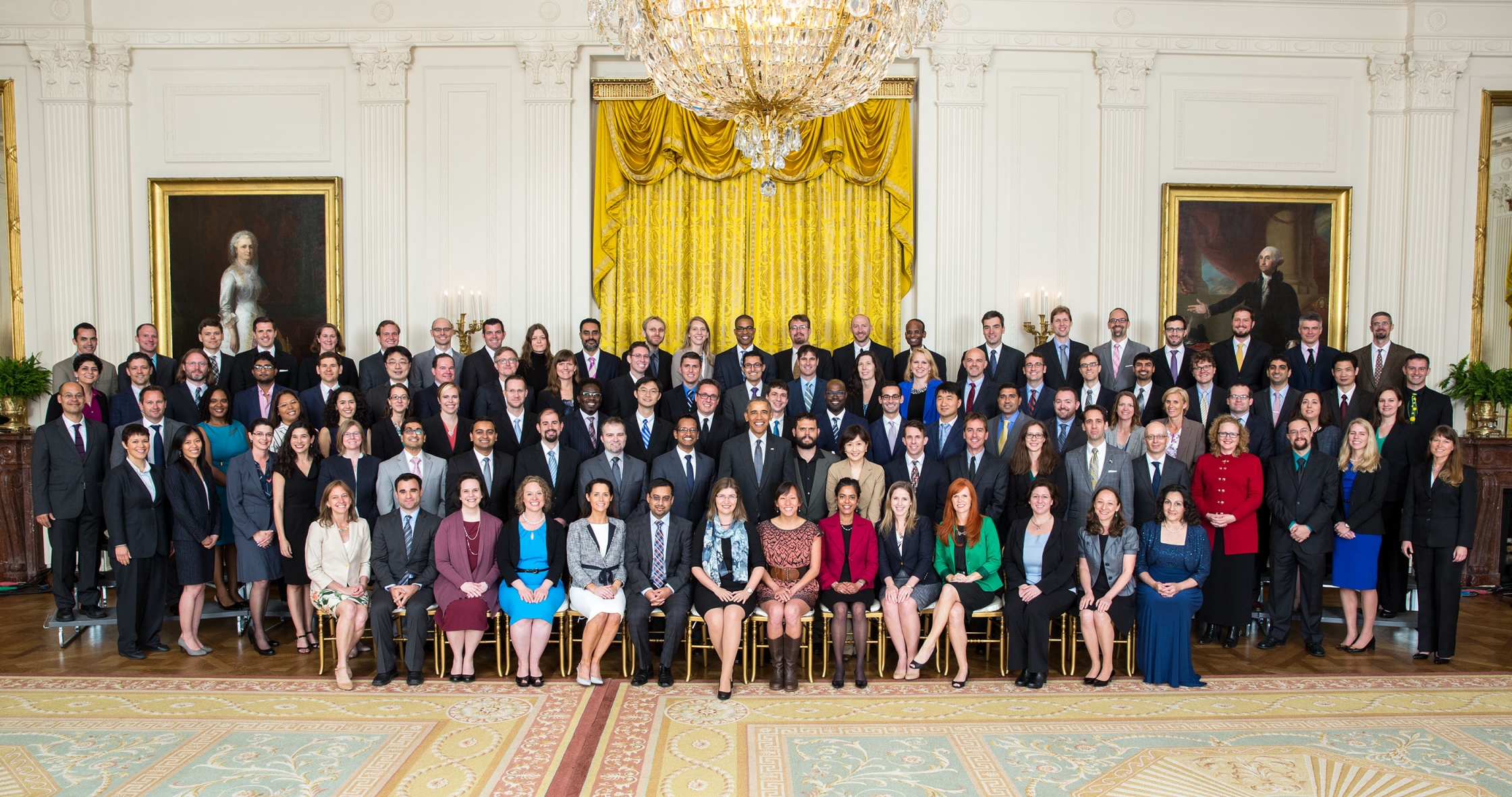
Update: Dzirasa received his award at the White House on May 5, 2016. A photo from the event is below. Dzirasa is one row behind and two people to the right of President Barack Obama.

P050516LJ-0033 (002)_0

Image: Dr. Kafui Dzirasa, top; PECASE recipients at the White House event, bottom. Photos by Les Todd, Duke Photography (top), and Lawrence Jackson, official White House photographer (bottom). 

Helena Mentis receives NSF CAREER Award for advancements in surgical telemedicine

UMBC’s Helena Mentis, assistant professor of information systems, has received the distinguished CAREER Award from the National Science Foundation (NSF) to advance her research on surgical telemedicine. Beginning in June 2016, the $518,121, five-year award will enable her to examine the benefits of collaborative image interaction through gesture-based tools for remote surgeons to share expert knowledge in the operating room.

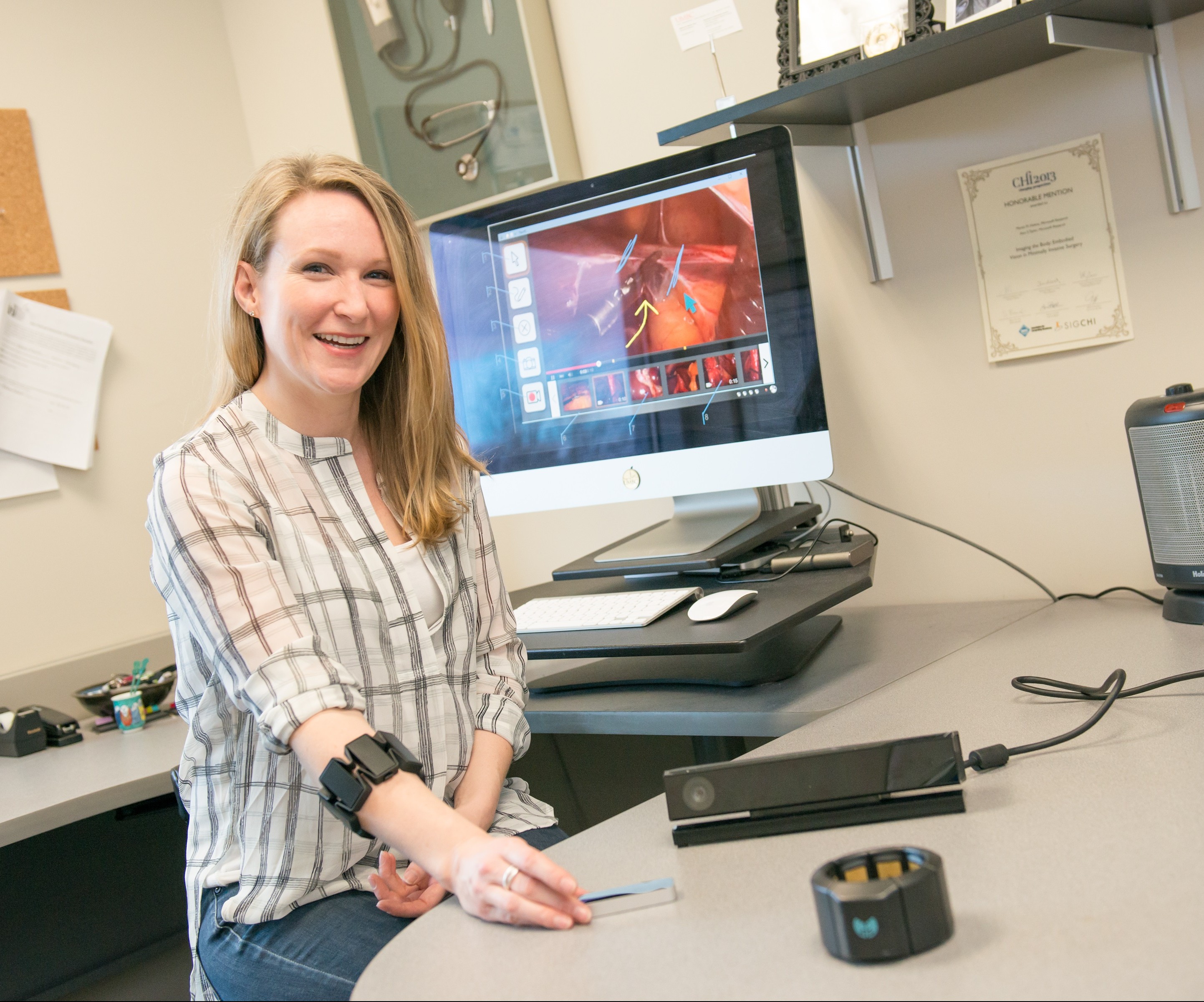
Mentis’ work focuses on “touchless interaction” interfaces and how physicians, specifically surgeons, can utilize technologies while remaining sterile during surgery. The technologies that she uses in her lab are commercially available, she explains, and surgeons can wear the devices under their scrubs. Mentis began her research with the Xbox Kinect and eventually began working with the Leap Motion. Most recently she has worked with the Myo armband and Google Glass.

Karl V. Steiner, vice president for research, shares, “We congratulate Dr. Mentis on her NSF CAREER Award, a highly-deserved recognition of her innovation and growing national reputation as a researcher and scholar of human-computer interaction and health informatics.”

The CAREER Program is one of NSF’s most prestigious awards, created to support “junior faculty who exemplify the role of teacher-scholar through outstanding research, excellent education and the integration of education and research within the context of the mission of their organizations.” The funding will support Mentis’ project, “Collaborative Image Manipulation and Annotation in Surgical Telemedicine.”  

Mentis will advance understanding of which tools and best practices can most effectively facilitate telemedicine, teleconsulting (consulting between surgeons with similar expertise and experience), and telementoring (interaction between two professionals, one of whom has more experience and expertise than the other). In addition, she will determine the verbal and nonverbal mechanisms that medical professionals can use to share knowledge and images quickly, while avoiding contamination in the operating room.

Helena Mentis 3

“The NSF CAREER Award will allow me to take my work to the next level,” says Mentis. She explains that although telemedicine is a popular topic in discussions about the future of medicine, and many promising technologies are now available, “there are no clear directions yet about the best ways to do telemedicine.”

Mentis utilizes a surgical training space at Anne Arundel Medical Center in Annapolis, Maryland, to test gestural interface functionality before bringing technologies to surgeons in operating rooms. She predicts that over the course of the grant she will continue to incorporate new emerging technologies into her research.

In addition to having clear benefits for medical practitioners and patients, Mentis’s work also provides research opportunities for graduate, undergraduate, and high school students. Bringing students into the training room early on, to work closely with these new technologies, gives them a more direct connection with engineering careers and encourages them to stay in STEM fields, she explains.  

“It’s not just about data systems or solving computational problems,” says Mentis. “We get to show and explain what the students can do with a degree.”

UMBC faculty have received 29 NSF CAREER awards in the last two decades. Most recently Christopher Hennigan, assistant professor of chemical, biochemical and environmental engineering, received a CAREER award of over half a million dollars to further his atmospheric particle research. Gymama Slaughter, assistant professor of computer science and electrical engineering, received a CAREER award in December 2013 for to develop a self-powered implantable glucose monitor, research she recently presented at TEDxBaltimore.

Image: Helena Mentis demonstrating a few of the gesture-based tools that she uses in her work. Photos by Marlayna Demond ’11 for UMBC. 

Yoni Zohar explains how his lab became the first to farm bluefin tuna in land-based aquaculture

UMBC’s Yonathan Zohar, professor and chair of marine biotechnology, offers a glimpse into his groundbreaking work farming bluefin tuna in land-based aquaculture through a new, in-depth interview with the Baltimore Business Journal.

Zohar and his team of researchers, including John Stubblefield, faculty research assistant, Jorge Gomezjuardo, faculty research assistant, and Odi Zmora, research supervisor, start with bluefin tuna eggs from halfway around the globe and carefully grow them to larvae to adult stage at the Institute of Marine and Environmental Technology (IMET) in Baltimore. Their goal is to develop a sustainable way to farm the tuna in closed aquaculture systems, cultivating a healthy food source while also protecting wild bluefin tuna populations, which are rapidly decreasing.

“Tuna is a fish that has been largely and strongly overfished in the marine environment,” Zohar explains.

Zohar and his team successfully brought bluefin tuna to the juvenile stage in 2015, reaching an important new milestone in land-based aquaculture. “The bottleneck was always the first 25 to 30 days, and this year we were able to open that bottleneck,” he says. “We had bluefin juveniles that were about 60 to 70 days of age.”  

Previously, the team’s work was focused on “developing technologies to induce commercially important marine fish to spawn in captivity.” The researchers were able to determine one hormone in the brain that jumpstarts the tuna’s reproductive processes.

Zohar notes that one of the keys to successfully raising tuna to the juvenile stage is developing a feeding protocol. “They had to be fed a diet that would mimic what they eat in the wild, which we don’t know exactly, and because tuna grow so fast they had to be fed with different types of live organisms at very high densities,” he explains.  

Looking ahead, Zohar wants to raise the tuna in larger tanks or ocean-based floating nets, and aims to grow the tuna to weigh approximately 50 pounds. Although this is much smaller than bluefin tuna that live in the wild and weigh around 500 pounds, it would represent a remarkable step forward in tuna aquaculture. 

Image: Bluefin tuna. Photo by Marlayna Demond ’11 for UMBC. 

Tom Cronin decodes the unique eye of charismatic mantis shrimp in National Geographic

The latest issue of National Geographic Magazine features research by UMBC’s Tom Cronin, professor of biological sciences, on the photogenic and compelling mantis shrimp. Cronin studies the visual physiology of invertebrates, especially those of marine and estuarine crustaceans, and his mantis shrimp research works to decode one of the most unique visual systems in the animal kingdom. 

The brightly colored mantis shrimp is known for powerful arms that protrude from beneath its head and have the ability to rapidly punch and break hard surfaces, from seashells to aquarium glass. The unique physiology of the mantis shrimp’s eyes enables the animal to see parts of the ultraviolet spectrum that are not visible to humans. Whereas humans have only three types of color receptors, mantis shrimp have twelve, Cronin’s research reveals.

Scientists previously thought that the receptors in mantis shrimp were able to detect tiny differences between hues, but that theory was debunked in 2013. One newer theory suggests the receptors in a mantis shrimp’s eyes pass input from visual stimulation directly to their brain, allowing the brain to compare the raw data against, essentially, a table of different colors. Theoretically, these unique visual receptors could enable the species to make quick decisions. Based on his research, however, Cronin isn’t convinced  He says, “There remains the question, ‘What’s it all for?’”

Read the full article, “Inside the Eye: Nature’s Most Exquisite Creation,” in National Geographic Magazine.  An excerpt of the National Geographic Magazine article, “The eyes of the animal kingdom,” appeared in The Week  

Photo by Prilfish, CC by 2.0

Cybersecurity expert Rick Forno comments on Dept. of Justice order for Apple to unlock cell phone

The U.S. Department of Justice has a issued a court order to Apple for their assistance with unlocking an iPhone that may contain information about the San Bernardino shooting that took place in December 2015. Rick Forno, director of UMBC’s graduate program in cybersecurity and assistant director of the UMBC Center for Cybersecurity, reflected on how this case puts Apple in an unusual and challenging position, during an interview on the BBC’s Up All Night program.

umbc-faculty-Rick-FornoFrom his perspective, Forno thinks it is possible for Apple to update one specific device so that the Department of Justice can access the content on that device, which would allow Apple to comply with the order. However, Forno explains that the real issue involved is the question of the future. “What is to stop the FBI or law enforcement—state, local, global—from contacting Apple asking for the same consideration on other devices,” he says.

Forno also spoke with Southern California Public Radio (KPCC) about the issue. He says that there is some information that may be solely on the phone and may point investigators to encrypted data and communications.

“A phone is a almost a digital archive of our entire lives,” he said.

On February 23, Forno was a guest on WEAA’s The Marc Steiner Show to discuss the ongoing issue between Apple and the FBI. He talks about the importance of acknowledging the nature, capabilities, and risks that the technology presents.

Listen to the full interview, “Up All Night: 18/02/2016” on the BBC. Forno’s interview begins around 1:21:00. Read “What the FBI might be looking for on the San Bernardino shooter’s iPhone,” on Southern California Public Radio. Listen to the full episode of The Marc Steiner Show. Forno is introduced around 02:50.

Photo by Yuri Samoilov, CC by 2.0

Engineering professors Spence and desJardins honored for commitments to mentorship and advocacy

Two faculty in UMBC’s College of Engineering and Information Technology (COEIT) have been named recipients of notable awards for their work mentoring students and advancing engineering education in K-12 schools.

Anne Spence, professor of the practice in mechanical engineering, will be presented with the Engineering and Technology Education Advocacy Award by the Technology and Engineering Educators Association of Maryland (TEEAM) on Thursday, February 18.

Each year, the Engineering and Technology Education Advocacy Award is given to a person who advocates for engineering and technology education at the local and state level by promoting and supporting technology and engineering professions, and emphasizing the importance of being technologically literate. This year’s award recognizes Spence’s contributions to Project Lead the Way, a national organization focused on increasing the number, quality and diversity of engineers that graduate from educational systems in the United States.

Her work with Project Lead the Way is centered on identifying the best ways to educate teachers who will go on to effectively engage K-12 students in engineering through energetic, hands-on learning experiences.

desJardins, Marie (CSEE)In July, Marie desJardins, COEIT associate dean and professor of computer science, will receive the Computing Research Association-Education (CRA-E) Undergraduate Research Faculty Mentoring Award during the annual Computing Research Association banquet. The award recognizes faculty who have provided unique mentorship and undergraduate research opportunities for students, while guiding the admission and matriculation of these students to graduate programs in computing.

desJardins has worked in many different capacities to advance computer science education in K-12 schools, and to inspire and educate young women to pursue majors and careers in computer-related fields. She has written several pieces for popular media about the underrepresentation of women in computing, including in artificial intelligence.

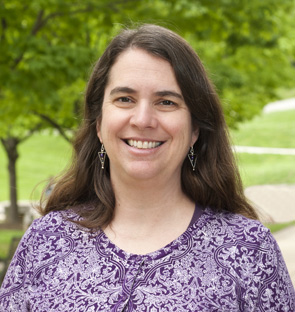
Images: Anne Spence during a Project Lead the Way meeting (top); Marie desJardins (bottom). Photos by Marlayna Demond ’11 for UMBC.

UMBC student Sabah Muktar delivers opening remarks during President Obama’s historic visit to Baltimore mosque

UMBC’s Sabah Muktar ‘17, biological sciences, delivered the opening remarks introducing President Barack Obama during his historic visit to the Islamic Society of Baltimore (ISB) on February 3, 2016. The high profile event was President Obama’s first visit to a mosque during his presidency.

Muktar, an ISB member, found out just one day before the event that community members had selected her to introduce the president, in a visit that she described as a “gesture that invites inclusiveness of all faiths and color.”

During her speech, she spoke candidly and thoughtfully about her American and Muslim identities. “We are all Americans, and as such, we are all obligated to uphold the rights of every individual,” said Muktar, referring to the right to religious freedom and importance of valuing diverse identities and forms of expression.

Muktar shared stories of her experience growing up in a welcoming Baltimore County community, particularly during her teenage years at Pikesville High School, when she began wearing the hijab. “Never did I feel as though I wasn’t a part of the community,” she said. “I was just as American, and just another high schooler.”

“Thank you, Mr. President,” Muktar concluded, “for this historic visit that will serve to inspire every American to engage in the work of building bridges across communities.”

Sabah Muktar’s remarks were covered widely in the news media, including on ABC News, Voice of America, NPR, and in TIME. Both CNN and Vox posted full video of her comments and the speech by President Obama that followed, with CNN featuring the Muktar’s remarks in the story “Muslim student’s powerful Obama introduction,” and Vox titling their video “Muslim woman’s touching speech during Obama’s first public visit to a US mosque.”

Muktar was also interviewed by CBS Baltimore (WJZ) in a video titled “UMBC Junior Introduces President Obama Before Historic Speech.”

“The experience has been such a privilege,” reflects Muktar. “Having the President of the United States come to our local mosque is the ultimate assurance that regardless of a person’s faith or color, if you’re an American, you are an American.”

All eight core organizers of the event at the Islamic Society of Baltimore are current students or alumni of UMBC. Muktar credits her involvement in campus life, including UMBC’s Interfaith Center and Muslim Student Association, with leading to her opportunity to introduce President Obama. As a Sherman Scholar at UMBC, Muktar is committed to a career in science supporting underserved communities.

Image: Sabah Muktar ’17, who delivered the opening remarks during President Obama’s visit to the Islamic Society of Baltimore. Photo by Marlayna Demond ’11 for UMBC.

New blood-clotting agent shows promise for soldiers in combat zones with extreme temperatures

When soldiers suffer traumatic battle wounds in combat, there is a window of just around 10 minutes for medics to apply blood-clotting agents before they will likely lose too much blood to survive. The U.S. military has relied on injectable blood-clotting agents to save soldiers lives for years, but many are unstable at extreme temperatures. This is where the Lavik Lab comes in.

Erin Lavik, professor of chemical, biochemical and environmental engineering (CBEE) and a new faculty member at UMBC, has developed nanoparticles that, as a new article describes, “act like bridges between platelets to make clots form faster.” The have effectively stimulated platelet aggregation in cell culture,  remained stable temperatures, and performed well in animal testing. Her team’s research, including a recent successful phase of testing in rats with traumatic liver injury, was featured in Chemical & Engineering News.

To test their ability to remain effective after storage at high temperatures, similar to those found in many combat zones, the nanoparticles were heated to 122 degrees Fahrenheit for one week. Lavik found that the agents performed just as well as in earlier tests. Further tests will determine if this blood-clotting agent could be applied clinically, to serve as a more stable and less expensive alternative to current drugs.

Read more about Lavik’s work in “Artificial Clotting Agent Could Treat Internal Bleeding in Combat Zones,” in Chemical & Engineering News.

Image: The Information Technology and Engineering building, by Marlayna Demond ’11 for UMBC.

UMBC researchers introduce innovative curriculum that INSPIRES high school students to explore engineering

UMBC engineering and education researchers have partnered with Baltimore County Public Schools (BCPS) to develop and implement an innovative curriculum that exposes high school students to engineering earlier in their educational careers, through existing science and technology classes. The current implementation phase of the INcreasing Student Participation, Interest, and Recruitment in Engineering and Science (INSPIRES) program is supported by four-year, $3 million grant from the National Science Foundation, and the project has received nearly $7 million in total funding over the past decade of development.

The principal investigator leading INSPIRES is Julie Ross, dean of UMBC’s College of Engineering and Information Technology (COEIT). Jonathan Singer, associate professor of education, and Christopher Rakes, assistant professor of education, are co-principal investigators. This year, 38 Teacher Leaders are implementing the curriculum in their classrooms in 13 BCPS schools.

“Many educational innovations that are developed by universities and target K-12 learning are not translated into large scale adoption by K-12 school systems,” says Ross. “In close partnership with BCPS, our research project provides professional development to high school teachers that will lead to integration of engineering concepts into biology and technology education courses throughout the county.”

The INSPIRES curriculum offers students essential hands-on experience with engineering, demystifying the field and building their problem-solving skills. As Rakes explains, “The Next Generation Science Standards call for science teachers to infuse engineering design principles into their instruction. They also call for teachers to provide instruction from an inquiry/reform-based rather than a traditional format.”

new BCPS video gives a glimpse of students presenting hemodialysis machines they constructed through INSPIRES curriculum to mimic kidney function by filtering artificial blood. Rakes explains that the INSPIRES hemodialysis module in the current study is designed “to help biology and technology education teachers transform their teaching” in a way that yields both immediately tangible and long-term results for the teachers and their students.


Dialysis Machines from Baltimore County Public Schools on Vimeo.

Before implementing the INSPIRES curriculum in their classrooms, the teachers attended a five-day professional development series on integrating engineering elements into existing biology and technology education classes. The series was integral to giving the teachers the preparation and confidence they needed to teach projects based in engineering concepts, without necessarily having a background in engineering themselves.

“As the adoption of the Next Generation Science Standards is in the horizon, the UMBC INSPIRES program was an eye opening experience of what the future of science education will look like,” says Mathew Hebert, a science teacher in BCPS. “My students absolutely loved this project and I could tell that this type of teaching and learning is truly a fantastic way to engage and deepen my students understanding of the scientific phenomena around them.”

Ross, Singer and Rakes continue to receive feedback about the program through professional development meetings and monthly assessments that help them gauge the efficacy of INSPIRES. As Singer describes, “The INSPIRES project is a true collaboration.”

“We are working together to scale our innovation, the INSPIRES Curriculum, in a way that is sustainable for BCPS and our research data will help us assess our level of success,” says Ross.

Through INSPIRES, UMBC faculty and BCPS teachers hope to pique the interest of students from diverse backgrounds, so more feel excited about and prepared for the possibility of pursuing an engineering career.

Image: Douglas Handy, Coordinator, Office of Career and Technology Education, BCPS; Jonathan Singer, Associate Professor of Education, UMBC; Christopher Rakes, Assistant Professor of Education, UMBC; Julie Ross, Dean, College of Engineering and Information Technology, UMBC; Christine Schumacker, Director of Science, Pre-K-12, BCPS.  Photo by Marlayna Demond for UMBC.

Gymama Slaughter reimagines life-saving medical devices, no batteries required

Gymama Slaughter offered a thrilling glimpse into the future of medicine at TEDxBaltimore, held January 14, 2016, at Morgan State University. Slaughter, assistant professor of computer science and electrical engineering (CSEE) at UMBC, spoke about her research to develop an implantable glucose sensor powered by chemical reactions in the human body, supported through a prestigious NSF CAREER award.

This year’s TEDxBaltimore focused on “outliers”ideas that challenge conventional thinkingwith Slaughter speaking in a segment highlighting new concepts, perspective, and inventions that will influence the world in the years to come.

Despite the fact that batteries power much of our daily lives—from our cars and phones to pacemakers—“the basic construction of batteries has not changed in 100 years,” Slaughter explained. She sees a paradigm shift around the corner as demand for more efficient and effective technologies increases, and scientists push up against the limitations of current battery designs.

“If we could only remove batteries from the equation,” said Slaughter, “all of a sudden, we would have truly wearable and implantable sensors.”

In her work in the Bioelectronics Lab at UMBC, Slaughter concentrates on how chemical processes occurring naturally in the human body can power medical devices and eliminate the need for batteries in, for example, blood glucose monitors. She predicts that, soon, implanting human-powered monitors a few millimeters below the skin will allow diabetic patients to continuously monitor their blood sugar-levels without finger-prick tests several times each day.

This continuous monitoring would also result in more accurate data for physicians. Slaughter anticipates that eventually blood-monitoring devices will be able to automatically and securely transmit data to smart phones for easy access to the information, resulting in better blood sugar monitoring and diabetes management.

The concepts behind this next-generation implantable blood-glucose sensor have “far reaching implications for medical devices,” Slaughter shared. “What we are doing at the Bioelectronics Lab at UMBC is something very unique,” she said. “We are developing devices that are self-powered,” and that opens up a whole new world for engineers working at the forefront of medical technologies.

The Baltimore Business Journal highlighted Slaughter’s presentation in “Four interesting ideas I learned from TEDxBaltimore.” Read more about Slaughter’s talk on Technical.ly Baltimore in “How the body can become a battery.” View her full talk on YouTube

Images: Gymama Slaughter presenting at TEDxBaltimore on January 14, 2016. Photos by TEDxBaltimore, CC by NC-ND 2.0.

Jack Suess, CIO, predicts 2016 tech trends higher education

In a recent article in Campus Technology, Jack Suess, vice president of information technology and chief information officer, shares his perspective on the biggest technology trends in higher education coming in 2016.

The discussion kicks off with a conversation on makerspaces, which allow students, faculty, and staff from disciplines across colleges and majors to come together to learn and create. “There is a great day of variation in makerspace needs,” says Suess. “What mechanical engineering needs for instruction is different from art and information systems.”

Suess highlights UMBC’s recent research infrastructure additions, including the 3D scanning room and 3D visualization facility. He anticipates that in 2016 universities will branch out from mainstream technologies to more effectively use new tools designed to meet specific research, teaching, and creative production needs.

Suess shares his personal 2016 goal to focus on applying machine learning and data analytics to existing university systems and records to better predict student success in various programs, and more effectively support students early on if they are struggling. “We are looking to integrate this information into our system for Interactive Planning & Advising Student Services (IPASS). We want to use this predictive information to allow students and advisers to make better decisions,” explains Suess.

Additionally, Suess reflects on draft Access for All standards currently under discussion, with the potential to revolutionize web and broader tech accessibility, particularly for students with disabilities. Suess emphasizes the need to think about accessible technology holistically and not implement tools one at a time.

Read the full article, “9 Ed Tech Trends to Watch in 2016” on Campus Technology.

Image: UMBC’s Albin O. Kuhn Library and Gallery. Photo by Marlayna Demond ’11 for UMBC.

Lee Blaney’s sustainability-focused engineering research examines the potential impact and value of waste streams

The National Science Foundation has recognized Lee Blaney, assistant professor of chemical, biochemical, and environmental engineering (CBEE), as a tremendously promising researcher in concurrently funding three projects that work to reimagine waste streams as important resources and investigate threats from toxic contaminants.

The grant funding, totaling more than $800,000, will support Blaney’s work in the areas of environmental engineering, environmental sustainability, and environmental chemical sciences. The three projects focus on sustainably recovering phosphorus from agricultural waste, the photodegradation of organometallic compounds in water, and understanding how three antibiotic classes react when exposed to UV-based processes. Blaney began receiving funding for all three grants within the two-month period of July 1-September 1, 2015.

Blaney’s environmental engineering research lab focuses on the detection, fate, and transport of contaminants of emerging concern (CECs), such as pharmaceuticals, personal care products, hormones and antibiotics. Many of the projects that his group works on are centered on detecting CECs in water and wastewater, and removing them through various treatment processes.
Blaney Lab_2

“These projects build into a concept that we are calling ‘emerging contaminants and resources,’” says Blaney. “The general idea is that the products that we use everyday, and the wastes that we generate everyday, contain hidden threats and opportunities.”

Blaney’s interest in this topic stems from a gap he has seen in environmental research over the last few decades, where substantial data is available on the toxicity of inorganic metals like arsenic and tin, but much less is known about the toxicity of organometallics. In his lab, Blaney studies the impact that organometallics, including platinum and selenium, have on the environment.

He explains that several public health issues are related to his work and research. “Antibacterial resistance is widely viewed as a global challenge to public health. Each year, there are more cases of multi-drug resistant superbugs,” Blaney says. “Ultimately, we hope that this work will result in improved guidance on removal of antibiotics in water and wastewater treatment plants.”

Blaney suggests a paradigm shift is on the horizon that will impact current waste management practices, in Maryland, nationally, and globally. “We envision every ‘waste’ stream as a ‘resource’ stream,” he says, thinking particularly of his work on Maryland’s Eastern shore with phosphorus from poultry litter, which can be seen as both a contaminant and a vital nutrient.

Because of high levels of phosphorus in Eastern shore soil, due to usage of large quantities of poultry litter as fertilizer, a significant amount of phosphorus is washed into nearby bodies of water. Removing excess phosphorus from the litter would reduce the amount of phosphorus in runoff and also isolate a soil nutrient that could be sold to farmers in need of phosphorus-rich fertilizer. “The project will facilitate development of a sustainable source of phosphorus and contribute to water, food, and economic security,” Blaney says.

The grants will also enable more graduate and undergraduate students at UMBC to contribute directly to hands-on, high-impact research through positions in the Blaney Lab. Whether working with students in his lab, analyzing findings, or collaborating with farmers and partners in business or government, Blaney keeps his eye on the big picture, how “the research that we are pursuing will help to ensure sustainable development and protection of human and ecological health.”

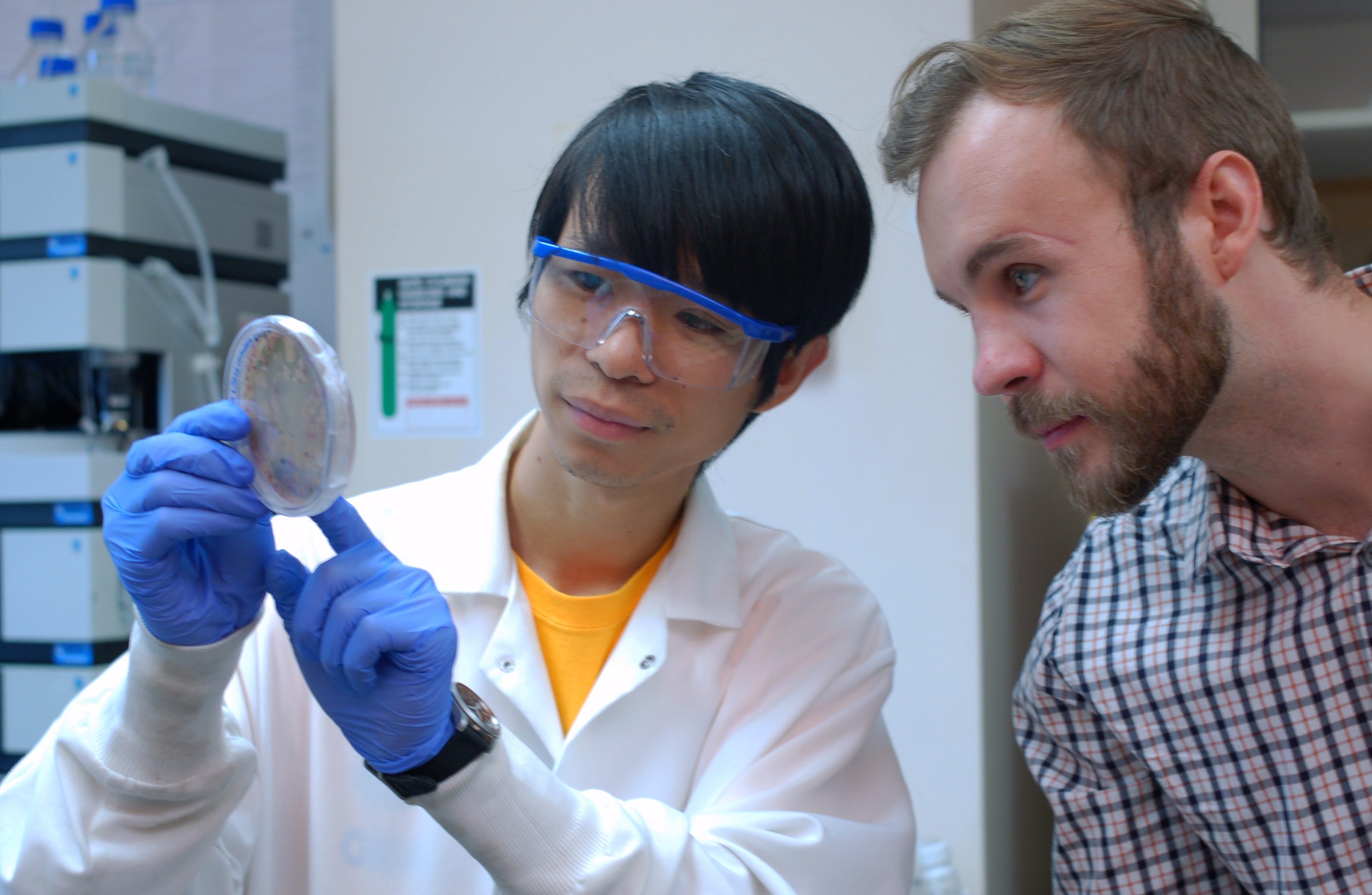
Images: Equipment in Lee Blaney’s lab (top); Lee Blaney and Ke He, chemical and biochemical engineering PhD candidate, study a sample in the lab (bottom). Photos by Tim Ford, coordinator of illustrative services in the biological sciences department at UMBC.