
All posts by: Megan Hanks Mastrola


Silicon Valley organization connects diverse tech talent from UMBC with top companies  

A recent TIME article highlights UMBC as a university that should be on the radar for top companies and start-ups seeking diverse technology talent.

Tristan Walker, co-founder and chair of CODE2040 board, and founder and CEO of Walker & Company Brands, says that it is important to assist start-up companies in the Silicon Valley in connecting with talented students pursuing tech-related degrees. Walker notes that these companies might not have the resources to fly around the country seeking out upcoming leaders in tech at universities like UMBC, but that CODE2040 can help them make those connections.

CODE2040 is an organization that creates pathways for black and Latino/a computer science students to connect with small tech startups as well as leading Silicon Valley companies like Facebook and Apple. In addition to providing highly competitive summer internships, speaker series, entrepreneurship workshops and mentorship for students, CODE2040 also works with companies that are committed to creating corporate cultures that support the success of people from all backgrounds. Walker says that CODE2040 helps “partner companies scale their recruiting efforts” to reach a broader range of talented computer scientists.

Several UMBC students have participated in the prestigious CODE2040 fellows program. Randi Williams ‘16, computer engineering, completed a CODE2040 fellowship in 2013, interning at the wearable tech company Jawbone and accessing CEO meetings and tours with companies including Google, Dropbox, LinkedIn, Facebook, and Twitter. After her return to UMBC, she was inspired to co-organize the first hackUMBC. In summer 2014, she conducted research in the robotics department of the NASA Jet Propulsion Lab in Pasadena before joining UMBC’s ECLIPSE research cluster, focusing on wearable technologies to support people with limited mobility.   

Read the full article, “Meet the Silicon Valley CEO Opening Doors for People of Color” in TIME.

Image: UMBC’s Information Technology and Engineering building. Photo by Marlayna Demond ’11 for UMBC.
Chris Swan discusses urban biodiversity on The Marc Steiner Show

Chris Swan, a professor of geography and environmental systems, appeared on The Marc Steiner Show on March 3 to discuss the Baltimore Ecosystem Study (BES), a major research initiative to understand long-term environmental changes in the Baltimore region.

Swan’s work related to the BES focuses on plants and understanding urban biodiversity, with a particular emphasis on the vacant lots found across Baltimore and many other U.S. cities. 

As part of the study, “we are asking questions about how species assemble,” explains Swan. “Can we manipulate the types of plant species that we see to confer certain ecosystem services or to improve environmental quality?”

He notes the importance of understanding these issues before developers come in and start building on the vacant land, to ensure the land is used responsibly as a resource.

The BES is supported by the National Science Foundation (NSF) and focuses on the social, economic, and ecological changes that have taken place in the Baltimore region between 1650 and 2050.

Listen to the complete Marc Steiner Show podcast “Sound Bites: Baltimore Ecosystem Study.”

Image: Baltimore’s skyline. Photo by Sneakerdog, CC BY 2.0.

UMBC’s new Grand Challenge Scholars Program invites students from all fields to tackle major issues of our time

A new UMBC scholars program is inviting students from all majors to work together on pressing challenges facing society, from sustainability to health and security issues.

UMBC’s Grand Challenge Scholars Program (GCSP), based on the National Academy of Engineering’s (NAE) Grand Challenges for Engineering, is now accepting applications for its first cohort. Beginning in fall 2016, these students will begin collaborating to develop solutions to major global challenges through coursework, research, service, and study abroad. Participants will each create their own unique approach to the program guided by their interests and including personal reflection on their experiences and growth as scholars.

Marie desJardins, associate dean in the College of Engineering and Information Technology (COEIT), professor of computer science, and director of the GCSP, describes the program as “a great match with so many things that UMBC and UMBC students are already doingapplied, project-based learning; service learning; entrepreneurial explorations; global involvement; and undergraduate research.”

Amelia Hallworth ‘17, biological sciences, is interested in the GCSP because of the interdisciplinary focus of the program. “Connections between different fields of study will emerge in unusual places, so I think it is important to share problems with people outside of your field,” she says.

While part of a national Grand Challenges initiative, UMBC’s program is unique in its outreach to students from all disciplines, including those beyond engineering fields. This very intentional interdisciplinary approach recognizes that effective, real-world solutions are developed collaboratively across fields of expertise, and that students benefit significantly from early opportunities to solve problems through teamwork.

Students who are accepted into the program will participate in seminars that explore the Grand Challenges outlined by the NAE, and will work to fulfill requirements in research, interdisciplinarity, entrepreneurship, global learning, and service. They will have the opportunity to develop their own pathway to complete those requirements based on the Grand Challenge topic they choose. The 14 core challenges include goals like making solar energy more economical, reverse-engineering the human brain, and restoring and improving urban infrastructure.

The program will combine existing UMBC course offerings, research opportunities, and co-curricular activities in ways that enable students to focus on understanding and impacting issues they care about with partners who have different approaches and ideas.

Nicholay Topin ‘18, computer science and electrical engineering (CSEE), is particularly interested in the program’s emphasis on interdisciplinary learning. “Many STEM fields are using computer science techniques to further their research, so becoming involved with a program that emphasizes interdisciplinary approaches seems logical,” he says.

Like some other scholars programs at UMBC, GCSP will also offer an affiliates program open to current UMBC students and students who intend to transfer to UMBC. Affiliates will be invited to attend events throughout the year to learn more about the GCSP and application process.

“The idea is to build on what students are already doing, and to give that activity more focus and direction,” explains desJardins. “We will provide a supportive, collaborative community and acknowledge student co-curricular activity with a formal recognition at graduation, honoring students’ hard work and commitment to addressing our world’s biggest challenges.”

Image: Marie desJardins and Anne Spence talk with students. Photo by Marlayna Demond ’11 for UMBC.

U.S. News highlights Meyerhoff Scholars Program for supporting success of minority students in STEM

U.S. News highlights UMBC’s Meyerhoff Scholars Program in a new feature article on highly successful national models for engaging and supporting black students in science, technology, engineering and math (STEM) fields. The article describes UMBC and Morgan State University as working to decrease longstanding racial and gender disparities in STEM-related employment and education.

The Meyerhoff Scholars Program enrolls exceptional students of all backgrounds who are committed to increasing the representation of minorities in science and engineering and who aspire to become leading research scientists and engineers. The program has found that offering students robust research opportunities, mentorship, and a supportive peer community, along with comprehensive financial aid, summer bridge programs, and other supports, yields tremendously positive results for student experiences and success.

Recent data from the Association of American Medical Colleges reveal that UMBC is the #1 producer of African American undergraduates who go on to enroll in MD/PhD programs. In the 2011-2015 period, 15 UMBC alumni were enrolled in MD/PhD programs, more than double the #2 university, Yale.

“It has become a point of pride for the institution,” says Brit Kirwan, chancellor emeritus and regents professor of mathematics at the University System of Maryland, speaking of UMBC and the Meyerhoff Scholars Program. “This is not a top-down mandate. Faculty, staff, students see this as a mark of distinction for the institution.”

Read the full article “Universities Ramp Up Black Students’ Interest in STEM” in U.S. News.

Image of Holly Summers (l) and Blossom Tewelde (r) ’14, biochemistry and molecular biology, from the Meyerhoff Scholars Graduation Dinner. Photo by Jim Burger for UMBC.

Penny Rheingans appointed to Computing Research Association Board of Directors

Penny Rheingans, professor of computer science and electrical engineering and director of UMBC’s Center for Women in Technology (CWIT), has been appointed to the Board of Directors of the Computing Research Association (CRA).

“I’m excited to have the opportunity to work with leaders from both academia and industry to improve the national climate for computing progress by influencing national computing research and education policy,” says Rheingans.

She was one of ten people voted on by CRA member organizations to fill four academic openings for the CRA Board of Directors. Rheingans will serve in this role for three years, beginning in July 2016.

“I look forward to being able to advocate for practical research to address societal needs, educational foundations to build capacity for innovation, and increased diversity to strengthen our research community,” she says.

CWIT works to develop programs that increase the interest, representation, and retention of women in technology and engineering programs. As the director of CWIT, Rheingans oversees the scholars program for undergraduate students who are committed to increasing gender diversity within technology fields.

The CRA is composed of more than 220 groups across academia, government, and industry in North America. The goal of the CRA is to enhance innovation by supporting collaboration to strengthen research and advanced education in computing.

For more information about CRA, visit their website.

Image: Penny Rheingans talks with a student during a CWIT event. Photo by Marlayna Demond ’11 for UMBC.

Students turn ideas into inventions at HackUMBC “tech innovation marathon”

More than 350 students joined in this year’s annual HackUMBC, a 24-hour “tech innovation marathon” where participants focus intensively on creating technical solutions to specific challenges. The slogan: “Dream big. Make it happen.”

Students worked individually and on teams to build projects, or “hacks,” which were judged on technical complexity, elegance, and creativity during an expo at the conclusion of the event.

“HackUMBC gives students the chance to work on the things that they are truly passionate about, and it really shows during the demos,” said Michael Bishoff ’16, computer science, co-president of HackUMBC.

A story on Technical.ly Baltimore highlights several student projects developed during the hackathon that solved different problems in unique, creative ways. One example is the app “Rart,” which guides job-seekers as they build resumes and helps them highlight skills that are most relevant to the position they are applying for. Another example is a voice-controlled coffee maker that wakes the user up with an alarm when their coffee is freshly brewed.

During the hackathon, participants were given opportunities to connect with mentors from industry, who were available to advise and encourage students as they developed their hacks. Industry experts also provided demonstrations and gave talks during the event.

Read the full article “5 innovative projects from HackUMBC” on Technical.ly Baltimore to learn more about HackUMBC 2016.

Image: Participants during HackUMBC. Photo by Marlayna Demond ’11 for UMBC.

Urban Water Innovation Network connects UMBC students and faculty with research partners nationwide

In “A passion for research” the Baltimore Sun highlights how undergraduate students at Baltimore area colleges and universities benefit from robust research opportunities across disciplines, including through an exciting new partnership connecting environmental scientists at UMBC with colleagues around the nation.

The Urban Water Innovation Network (UWIN), featured in the article, is one of several multidisciplinary partnerships in which UMBC is actively participating. It was recently created through a $12 million commitment from the National Science Foundation to unite the work of more than a dozen academic institutions  studying the challenges that threaten urban water systems. UMBC undergraduates are closely involved in research working toward UWIN’s goal of creating solutions to help communities become more prepared to respond to water crises.

“It’s a nice opportunity to play a part in a project of national scope. It’s quite an honor,” Claire Welty, professor of chemical, biochemical and environmental engineering (CBEE), director of the Center for Urban Environmental Research and Education (CUERE), and the lead researcher at UMBC for the UWIN grant told the Baltimore Sun.

Andrew Miller, professor of geography and environmental systems, shared, “UMBC has been doing research like this” for years, but being invited to join UWIN felt like “a baseball player getting to be involved in a world series.”

“The idea is to create a network of scientists to help solve environmental problems,” explains Chris Swan, professor of geography and environmental systems. He adds that many universities within the network are including undergraduate and graduate students who can benefit from the networking opportunities the partnership creates.

Miller says that ultimately this intensive collaboration will lead to improved research outcomes, noting, “It’s a big interdisciplinary project with networks of people working together who combine a variety of expertise.”

“One person is not going to solve these types of problems,” Miller explains. “We will all learn from each other and do things we couldn’t do on our own.”

Read the full article on The Baltimore Sun.

Image: Claire Welty and two students conducting research in the field. Photo by Chris Hartlove.

Celebrating Engineers Week as a new UMBC tradition

Student engineering groups across UMBC teamed up to host the second annual Engineers Week on campus, packed with engaging events, including hands-on exhibitions and competitions. Tau Beta Pi, UMBC’s student organization for engineering, took the lead in showcasing the many ways engineers impact society, while broadening the event to this year include a diversity of fields.

Ken Foo ’16, chemical engineering, president of Tau Beta Pi, said that he was pleased with Engineers Week events and the response they received. “This year, we had an astonishing turn-out from engineers from all disciplines, ranging from freshman to seniors, professors, alumni, and even non-STEM undergraduates,” he said.

Engineers Week_2

Engineers Week is a celebration of engineers and the important work they do in society, but it’s also a chance to raise awareness of the engineering disciplines,” said Julie Ross, dean of UMBC’s College of Engineering and Information Technology (COEIT).

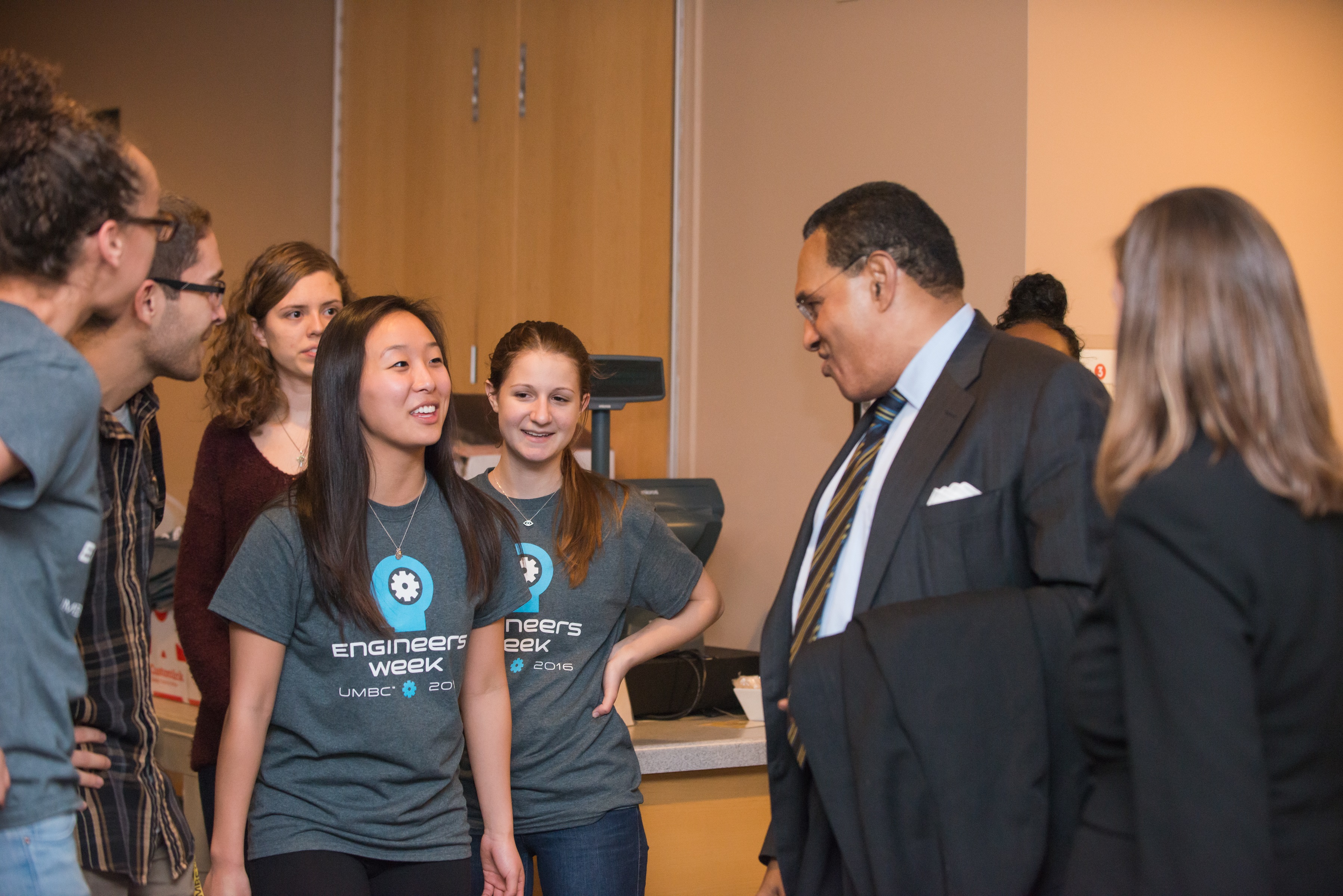
President Freeman Hrabowski kicked off the week with an energetic address on the impact of engineers, the major global challenges they tackle, and how they can collaborate across disciplines to find solutions to those issues.

Engineers Week_4

Not only did Engineers Week engage current UMBC students, but it also involved corporate partners, local K-12 students, and alumnus Corey Fleisher ‘05, mechanical engineering, winner of the Discovery Channel’s “The Big Brain Theory” competition in 2013, who offered engineering students advice through an inspiring talk.

Toward the end of Engineers Week, students from all engineering majors created teams and competed in a minute-to-win-it style competition, quickly working through a series of engineering challenges. In the end, a team of computer engineers was victorious and took home the Battle of the Engineers trophy.

“We hope that the COEIT will continue this wonderful tradition of week-long celebrations,” Tau Beta Pi’s leadership told UMBC News, “and that Engineers Week becomes known as a UMBC tradition future students and alumni can look forward to each year.”

“Together, our student organizations planned and led an amazing week of activities full of inspiration, professional development, outreach to K-12 and UMBC, and fun!” said Ross. She shared, “I am blown away by the level of participation by our students.”

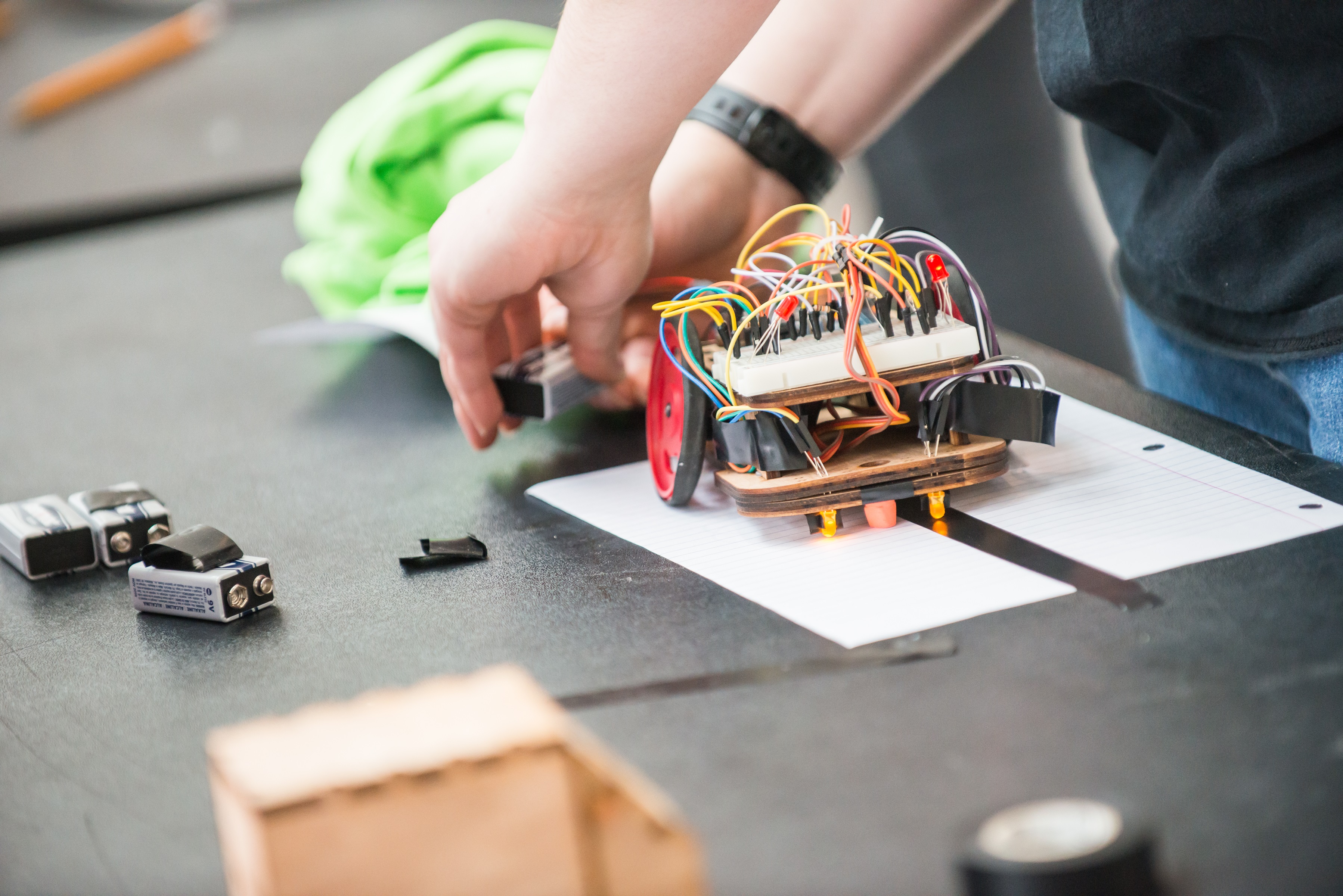
Images: A student participates in an event during Engineers Week (top); a project on display during an event (middle); and students speak with President Hrabowski during the kick-off event. Photos by Marlayna Demond ’11 for UMBC.

Engineering student’s late night caffeine craving inspires travel mug that brews its own coffee

When Joseph Hyman ‘11, mechanical engineering, was a student at UMBC, he was sitting in the library craving a fresh, hot cup of coffee, when an idea struck him: Wouldn’t it be great if a travel mug could brew its own coffee?  

When he searched for this mug of his dreams and couldn’t find anyone manufacturing something similar, he decided to create it himself. After graduating he pulled together a talented team of fellow UMBC engineering students and alumni and got started on the design and the business model to make it a reality.

Fast forward more than four years, and the combined travel mug and coffee brewer that Hyman envisioned has become the first product of the MoJoe Brewing Co., backed by more than 700 supporters of a Kickstarter campaign. The team sought $20,000 through crowdfunding to jump-start production, and ended up with more than $85,000 in pledges.

Hyman collaborated with Ezekial Kolajo ‘11, mechanical engineering, who he has known for more than 15 years, and Jingrui Wang ‘16, Ph.D., mechanical engineering, the teaching assistant for an electrical engineering course that Hyman took at UMBC, as well as Alexandre Wing to develop the personal mobile brewer for MoJoe.

One challenge they faced was developing and launching the company’s first product while maintaining full-time jobs, which limited the time they had to focus on the new company. “It’s exciting that after years of building a product, people actually want it. And that there’s a demand for it,” Hyman said. “It makes the sleepless nights worth it.”

Kolajo, co-founder and engineer for MoJoe, says that the experience has taught him the importance of believing in himself and persevering when things get challenging. “It’s been rather surreal to find ourselves in a position where an idea has come to life and is getting a lot of positive attention,” he says. “I never imagined I would find myself in a position like this.”

Although Hyman does not have any formal business education or a background in the industry, during his time at UMBC he had an opportunity to work with the Alex Brown Center for Entrepreneurship, which gave him the confidence that creating his own business was possible. He and Kolajo also credit their experience in the Meyerhoff Scholars Program with honing their collaboration skills and tenacity to succeed.

Hyman explains that it can be overwhelming for aspiring entrepreneurs to  start a business or develop a product when they look only at the big picture and do not know exactly where to begin. He  recommends examining  each aspect of the new venture on its own, and working through challenges step by step to make steady progress.

To aspiring entrepreneurs without a background in business, but with a passion for an idea and the drive to bring it to fruition, Hyman says, “When it comes to entrepreneurship, it really can be you [who succeeds]. There is no special person who that can happen to. You just need to know the steps you need to take.”

The Kickstarter campaign just ended, but the company is already looking ahead and preparing for the futurea future with a larger staff, downtown Baltimore office, and new product lines.

Learn more about MoJoe Brewing and their successful crowdfunding campaign through this media coverage: The Huffington Post, Baltimore Business Journal, MashableGizmag and Baltimore Magazine.

Image: Coffee and beans. Photo by David Pacey, CC BY 2.0

UMBC joins international network of top research universities producing STEM PhDs

UMBC is one of 25 new members of the Center for the Integration of Research, Teaching and Learning (CIRTL), a network of U.S. and Canadian universities with STEM graduate programs that are committed to improving the teaching skills and increasing the diversity of future STEM faculty members.

Janet Rutledge, vice provost, dean of the graduate school, and associate professor of computer science and electrical engineering; Anne Spence, professor of practice in mechanical engineering; and Renetta Tull, associate vice provost for graduate student development and postdoctoral affairs, form the core leadership team for UMBC’s participation in CIRTL.

As a member of CIRTL, UMBC will develop and promote learning communities for STEM graduate students. CIRTL now has 46 members, which together produce one-third of U.S. doctoral degrees in STEM fields.

“We are looking forward to being part of this renowned national network that focuses on teaching, learning, and associated research,” said Tull. She added, “CIRTL will be a rich resource for us as we develop more training opportunities to prepare our graduate students for the professoriate.”

Through evidence-based strategies, CIRTL helps STEM students succeed throughout graduate study and complete their degrees. These teaching strategies include focusing on real-world topics in classroom teaching, promoting inclusive learning, and encouraging teamwork and peer support through collaborative projects and study groups.  

CIRTL was created in 2003 through the Wisconsin Center for Education Research, and is supported by the National Science Foundation.

Photo by Marlayna Demond ’11 for UMBC.

Chuck Bieberich, biomarker tech innovator, named Bearman Foundation Chair in Entrepreneurship

Chuck Bieberich, professor of biological sciences, has been named The Herbert Bearman Foundation Chair in Entrepreneurship for 2016-2019.

The Herbert Bearman Foundation Chair recognizes and supports outstanding teaching skills, an interest in entrepreneurship, and a strong record of scholarship in entrepreneurial studies or a field related to entrepreneurship. The three-year endowed position will enable Bieberich to offer workshops and related activities to encourage entrepreneurial approaches to expanding research support and commercialization opportunities for faculty.

“For me, being appointed the Bearman Chair is not just a tremendous honor, it’s also a great opportunity to foster entrepreneurialism among my faculty colleagues. A lot of the things we already do to keep our labs running mirror those that are essential to running a business,” says Bieberich.

Bieberich will use his time as Bearman Chair to encourage faculty in the College of Natural and Mathematical Sciences (CNMS) and across UMBC to pursue entrepreneurial opportunities. In his own research, he plans to expand the application of the biomarker discovery technology in the growing field of personalized medicine.

“Dr. Bieberich is a faculty entrepreneur. No better exemplar of the intent and prestige of the Bearman Chair can be found than Dr. Charles Bieberich. He is a distinguished leader in his discipline and his research program is the solid foundation for his entrepreneurial endeavors,” says CNMS Dean William LaCourse. “His thoughtful nature and interest in exciting fellow faculty and students about the opportunities associated with the entrepreneurial mindset are highly commendable.”

Bieberich is the training program director for STEM BUILD at UMBC, a research initiative designed to enhance the success of diverse undergraduate students in STEM fields. He also is a member of the Office of Technology Development Advisory Committee, Research Park Advisory Committee and UMBC Research Park Corporation Board of Trustees. In 2015, Bieberich received a Maryland Innovation Initiative Phase II award to develop a business plan and perform market analysis for his work on biomarkers.

“Convincing a study section at the National Institutes of Health to invest in our academic research is not at all unlike convincing venture capitalists to invest in a business,” Bieberich says. He reflects that although he and his fellow scientists “are not accustomed to thinking of ourselves as business people,” exploring those connections will open doors for faculty to make a major impacts on the world.

Established by The Herbert Bearman Foundation, this endowed professorship honors the contributions of Dr. Arlene Bearman, former chair of the administrative services program at UMBC, to the UMBC community.

Image: Chuck Bieberich. Photo by Marlayna Demond ’11 for UMBC. 

UMBC’s Cyberdawgs win 2015 Maryland Cyber Challenge

The UMBC’s Cyberdawgs have emerged victorious from the finals of the 2015 Maryland Cyber Challenge (MCC), winning the top prize for a student team with a total of 18,979 points and outscoring the professional division’s winning team by more than 5,500 points.

UMBC’s winning Cyberdawgs 1 team included Tyler Campbell ‘16, computer science; Josh Domangue ‘16, computer science; Chris Gardner ‘18, computer science and mathematics; Anh Ho ‘17, computer science; Jacob Rust ‘16, computer science; and Julio Valcarcel ‘16, information systems, all members of the UMBC Cyber Defense Team. The UMBC team Cyberdawgs 2 also participated in the final round of the challenge.

The final round of competition began on October 28, but was paused due to technical difficulties. The contest resumed on Saturday, February 20, 2016, and the Cyberdawgs hit the ground running.

“We are delighted that the competition was able to finish, and are very pleased that we were able to do as well as we did,” said Charles Nicholas, professor of computer science and electrical engineering (CSEE). Nicholas is a faculty adviser of the Cyber Defense Team, with Richard Forno, assistant director of the UMBC Center for Cybersecurity and director of the cybersecurity graduate program.

Approximately 25 teams from colleges and universities across the state qualified for the semifinals of the challenge. Two of the eight teams that moved on to the finals were from UMBC, representing the maximum number allowed from an individual university.

The annual MCC competition offers participants the opportunity to complete hands-on cybersecurity challenges, and allows teams to test their ability to break into a target machine and secure the machine against other teams’ attacks.  

“The Maryland Cyber Challenge is one of several competitions that I enjoy because we get to compete as a team. Participating in this competition is a great deal of fun because we get to learn new skills every year and always come away with new ways of thinking about cybersecurity issues,” said Valcarcel.

The Cyber Defense Team is looking forward to participating in the National Collegiate Cyber Defense Competition (NCCDC) in the spring. Last year, UMBC placed fourth overall at NCCDC.

Image: A computer circuit board. Photo by Harland Quarrington, CC BY-NC 2.0