All posts by: Megan Hanks Mastrola


Marie desJardins on the past, present and future of artificial intelligence

Artificial intelligence (AI) can bridge the gap between computer scientists and other fields, including education and medicine, explains Marie desJardins, associate dean in the College of Engineering and Information Technology and professor of computer science, in a new in-depth interview in TechRepublic.

“The thing about computer science in general and AI in particular is that it’s really a very interdisciplinary field inherently, because there’s a very small number of people who are computer scientists who only work on theoretical computer science,” says desJardins, adding “whatever fields you’re interested in, you could do that in computer science.”

In the article, desJardins shares how she became interested in AI as an undergraduate student at Harvard, as well as her path in computer science and her predictions for where AI is headed.

Frustrated at the media’s focus on unlikely, attention-grabbing scenarios, like “killer robots taking over the world,” desJardins addresses more probable, real-world concerns with AI. She particularly emphasises that it is important that society makes sure technical advances benefit everybody, not just a few elites, saying “you’re really trying to have human beings work in partnership with the computer to solve some problems.”

She notes that the some of the challenges industry faces in making advances toward solving these problems could be addressed by increasing the diversity of perspectives among AI professionals. “We need more people who can break those gaps. I think that’s partly a generational issue that we’re seeing more and more students come though who are majoring in all different things, but who are taking classes in computer science and technology,” desJardins explains.

“We need to think about what do we want people to be doing that still continues to make the world a better place,” says desJardins.

She also spoke about “swarm,” a type of crowdsourcing,  can help predict things such as who will win an Academy Award this year, in a separate article in TechRepublic. “Instead of each user voting just once, independently of the other voters, it basically lets the entire community of users ‘see’ what everybody else is advocating for,” desJardins said.

This type of algorithm works because if a person sees that their first choice is not going to win, they can start advocating for their second choice, she explained.


Read the full article, “Q&A: Former AAAI chair discusses future of AI research and what’s coming up at AAAI next month,” on TechRepublicThe full article about AI to predict the Academy Award winners, is also on TechRepublic

“Science” article argues Earth has entered a new epoch defined by human impacts on the planet

Robust evidence supports the finding that humanity has entered a new geological era, reports a new paper in Science, co-authored by Erle Ellis, professor of geography and environmental systems. The Anthropocene is defined through the impacts that human activity has had on the Earth. This latest article on the concept outlines findings to justify the establishment of the Anthropocene as a new geological epoch.

Ellis is among 24 internationally-known geoscientists who make up the Anthropocene Working Group of the International Commission on Stratigraphy, the international scientific organization in charge of the geologic time scale, which produced the Science article. He explains, “This paper represents the first major review of the scientific evidence that humans have now altered Earth so greatly that we now live in a new epoch of geologic time.”

The Anthropocene Epoch acknowledges rapid changes in Earth’s environment due in part to the increased human population and increased consumption of resources during the mid-20th century. Key markers of the prior time period, the Holocene Epoch, include how humans used the land to increase food production, and built cities.

“By recognizing the degree to which human societies are changing Earth, it may be possible to guide humanity and the planet toward better outcomes than those that will come if our current trajectory continues,” Ellis shares.

Read the full paper, “The Anthropocene is functionally and stratigraphically distinct from the Holocene,” in Science.

Read additional coverage on Reuters, The Christian Science Monitor, Science World Report, and Voice of America.

Image: Erle Ellis presenting at the 2015 UMBC Research Forum on Climate Change and the Environment. Photo by Marlayna Demond ‘11 for UMBC.

UMBC researchers develop affordable incubator for vulnerable newborns in low-resource areas

In low- and middle-income countries, gaps in healthcare infrastructure and high costs for medical supplies and services can mean high numbers of babies dying in their first week of life. Often, these deaths are due to “extremely preventable causes,” says Govind Rao, professor of chemical and biochemical engineering and director of the Center for Advanced Sensor Technology (CAST) at UMBC.

Rao described for The Hindu, a major Indian newspaper, how he and a team of faculty and student researchers designed an affordable infant incubator that addresses two of the three leading causes of infant death (which include preterm birth, lack of oxygen and sepsis).

“This incubator chamber has been made using cardboard. It’s low-cost, disposable, and possesses heating and cooling functionality,” he explains. The cardboard helps regulate the temperature of the environment, which allows babies to use their metabolic energy for growth rather than regulating their body temperature.   

The device is powered by a solar rechargeable battery and can be used without electricity for up to eight hours each day.

“While in urban hi-tech hospitals, the cost of infant care would be in tens of thousands of rupees, in rural India, the medical centers have no facilitiestypically a light bulb serves as a warmer,” says Rao.

The incubator design was created and prototype developed over three years with support from the National Collegiate Inventors and Innovators Alliance and the Food and Drug Administration. The next step is for the built-in sensors to be integrated into the device and validated in a field setting.

Read the full article, “For a frugal way to save lives,” in The Hindu Business Line.

Rapid, affordable STI test designed by UMBC chemistry professor reaches clinical trial stage

Current common tests for sexually-transmitted infections (STI) require sending samples off to a lab to be grown and analyzed, which means that patients must wait a few days to receive the results and that the tests can be more expensive than anticipated. Chris Geddes, professor of chemistry and biochemistry and director of UMBC’s Institute of Fluorescence, has developed a new STI test that costs around $1 and allows health care providers to diagnose gonorrhea and chlamydia within eight minutes and at the point-of-care.

Funded by the National Institutes of Health, this rapid, affordable test will help patients receive treatment more quickly and decrease the spread of infections as patients wait to receive their diagnoses. On a large scale,“The Daily Record explains, “Faster results can lead to both lower health care costs and a healthier overall population.

This test fills a major public health need. “The significance of this, I don’t think can be overstated,” Geddes told The Daily Record. “There are no tests that are low-cost and very rapid.”

The STI test is being evaluated in an 1,800-sample clinical trial, with patients in Baltimore and Cincinnati. It not only detects whether the patient has gonorrhea or chlamydia but also can determine the specific strain of the STI. “This allows doctors to treat each case correctly and not risk building the resistance of the strains by exposing them to ineffective medications,” Geddes explains.

Read the full article, “UMBC prof pursues faster, cheaper STI test,” in The Daily Record. Read more about the test “UMBC researcher works on faster STD test seen as key to prevention,” in The Baltimore Sun 

Image: Chris Geddes in his lab. Photo by Marlayna Demond ‘11 for UMBC.


UMBC places 10th in Pan-Am Chess Championship

The UMBC Chess A chess team finished in tenth place in the 2015 Pan American Intercollegiate Team Chess Championship, held December 27-30 at Oberlin College in Ohio.

This marks the 25th year UMBC teams have participated in the event. UMBC has won or tied for first place in the Pan-Am Championship ten times, and has frequently placed in the final four, to continue on to the President’s Cup held in each spring. UMBC has not qualified for this year’s President’s Cup, but team members will go on to other competitions held throughout the year.

UMBC’s A team got off to a solid start at the Pan-Am Championship, winning the first two rounds by beating the University of Illinois B team and Princeton. In the third and fourth rounds, UMBC lost to the Texas Tech A team and the University of Texas at Dallas B team, respectively. UMBC won the fifth round against Washington University in St. Louis and sixth round against the University of Illinois A team.

UMBC’s 2015 A team includes international master Levan Bregadze ‘16, financial economics; team captain and grandmaster Niclas Huschenbeth ‘16, psychology; grandmaster Tanguy Ringoir ‘19, economics; and Dobrynya Konoplev ‘17, computer science and mechanical engineering.

The UMBC B team finished 31st overall, winning rounds against both the University of Central Florida and University of Florida. The team received a special award for the top finish of all participating U1600 teams.

Members of this team include Nathaniel Wong ‘18, Asian studies and political science; Abhilash Puranik ‘17, M.S. computer engineering; Jeffrey Carr ‘19, interdisciplinary studies; and Mustapha Diomande ‘17, biological sciences and psychology.

The teams are coached by Igor Epshteyn; Sam Palatnik, grandmaster; Joel DeWyer, business director of the chess program and associate director of The Commons; and Alan Sherman, director of the chess program and professor of computer science.

You can view the final competition results and review selected games on the tournament website.

Image: Members of the UMBC chess team before attending the 2015 PanAmerican Intercollegiate Team Chess Championship. Photo by Marlayna Demond ‘11 for UMBC.

Maryland universities see rapid growth in cybersecurity programs due to vibrant cyber job market

Bachelor’s and master’s programs in cybersecurity at Maryland colleges and universities are growing rapidly as more students become interested in careers in the industry. At UMBC, the number of graduate students studying cybersecurity has grown nearly five-fold over the past six years, explains Rick Forno, director of UMBC’s graduate cybersecurity program and assistant director for UMBC’s Center for Cybersecurity, in an article in The Daily Record.

UMBC’s proximity to government agencies like the National Security Agency (NSA) and private security and tech firms, has contributed to the growth of the university’s cybersecurity programs. One draw, engaging both introductory students and more advanced experts in the field, is the Maryland Cyber Challenge, a statewide competition for high school and college students and cybersecurity professionals held during the CyberMaryland Conference, which Forno founded.

Forno says that there are between 12,000 and 13,000 job openings in the cybersecurity industry across the state, which is good news for graduates from UMBC’s programs.   

In a separate article in The Daily Record, Tim Finholm, cybersecurity instructor at UMBC Training Center, shares his perspective on risks that companies must identify and be alert for to protect private information. He explains that companies must fend off threats that employees may unknowingly click right intolinks that seem innocuous but are really traps left by hackers, designed to gather information or lead the user to a site where a server can take control of the computer, says Finholm.

Image: UMBC cybersecurity class in 2014. Photo by Marlayna Demond ’11 for UMBC.

UMBC students explain what environmental engineers do in video for international competition

UMBC environmental engineering students have created a YouTube video to help middle and high school students and the broader public understand the kinds of work environmental engineers do and the impacts their work has on the world. They developed the video as part of a national competition hosted by the Association of Environmental Engineering and Science Professors (AEESP) with the theme “Environmental Engineers Protect Public and Ecological Health.”

UMBC students Helena Gaifem ‘16, Ph.D., chemical and biochemical engineering; Nick Rogers ‘15, environmental engineering; Utsav Shashvatt ‘19, Ph.D., environmental engineering; and Kiranmayi Mangalgiri ‘16, Ph.D., environmental engineering, approached Lee Blaney, assistant professor of chemical, biochemical and environmental engineering (CBEE), to express interest in entering the AEESP contest. Gaifem illustrated the drawings in the video and Shashvatt photographed the images and edited them before sending them to Mangalgiri, who put the video together using VideoScribe. After the visuals were completed, Rogers added narration. Environmental engineering majors Hollie Adejumo ‘16, Savannah Steinly ‘18, and Hannah Aris ‘18, also contributed to the video.

The discipline of environmental engineering is fairly new and AEESP members have been concerned it is not yet well understood by the general public, Blaney notes, in explaining the origins of the competition. “Hopefully, more efforts like this one will increase knowledge and understanding of the field,” says Blaney. He emphasizes that another major goal of the competition is to “increase outreach to younger students (K-12) and build interest in the major.”  

Competition finalists and winners will be announced on January 29, 2016, with the winning teams receiving cash prizes.

*Update (2/10/2016): The AEESP announced that the UMBC team’s video “What do Environmental Engineers do?” was awarded first place in the competition. The team will receive a $1000 cash prize.

Image taken from YouTube video.

Conference provides transformational experience for women pursuing computing degrees

The number of women in computing fields is not only well below the number of men pursuing similar careers, the proportion of women majoring in computer science has actually decreased in recent years. At this challenging moment for gender equity in the field, many college women pursuing computer science careers are using conferences and other networking opportunities to connect with mentors, support their peers, and learn about emerging developments in tech research and industries.

A group of 31 undergraduate students and nine faculty, staff, and post-doctoral candidates from UMBC attended the Grace Hopper Celebration (GHC) of Women in Computing held this fall in Houston, Texas. The event brought together women exploring careers in technology with the goals of increasing the visibility of research by women in computing and supporting women pursuing computing careers. Organized by the Anita Borg Institute, the GHC is named for U.S. Navy Rear Admiral Grace Hopper, an early computer programmer who invented the first compiler for programming languages.

Susan Martin, associate director of the Center for Women in Technology (CWIT) at UMBC; Marie desJardins, associate dean in UMBC’s College of Engineering and Information Technology and professor of computer science; and Cindy Greenwood, assistant director of the CWIT at UMBC, supported the UMBC group during the GHC event.

Sessions offered during the conference provided participants with a broad range of perspectives from within the industry and inspiration to move forward with their career goals. 

“It is a unique and transformative experience for a female computer scientist to attend the GHC,” says desJardins. “For many of them, it will be the first time they’ve been a room full of computer scientists in which women were the majority.”

desJardins continues, “It’s quite powerful to walk into the plenary session, with thousands of computing professionals, look around, and see a sea of female facesbut still a truly diverse group of people, with women of all ages, ethnicities, geographical origins, educational backgrounds, and industry/academic positionsas well as a supportive group of men.”

GHC attendees also report that the conference gives them greater resilience in facing the challenges of being a women in computing. “Being in the minority in these majors can take its toll on women’s overall confidence and perceptions of their technical competence,” explains Martin. “Women in computing often encounter microaggressions, subtle or hidden messages that may invalidate their identity as computer scientists or computer engineers, or their experiences as members of a minority group.”

After the conference, UMBC’s GHC attendees completed a survey about what the conference meant to them and how they predicted the experience would impact their futures.  

“It was a great opportunity to experience an inverse of normal gender ratios within technology,” one sophomore computer engineering major wrote. “That experience overall is valuable to women and men. It was a great opportunity to travel and meet new people, within the context of our majors, interests, and fields of study.”

The conference also allowed UMBC students to work on collaborative proposals and meet professionals who are already pursuing careers in their fields of study. “Attending GHC enabled our UMBC students to connect with each other at a deeper level and to plug into a national and global network of highly successful women in technology,” says Martin. “It is these connections that will sustain them as they encounter the typical challenges associated with their academic and professional careers in computing.”

Post-event survey responses indicated that before attending GHC nearly 56% of the participating students felt “very sure” they would complete their degree in a computing major. After the conference that proportion jumped to 83%.

As one sophomore computer science major who attended the event wrote, the Grace Hopper message was clear: “It is time for women to be inspired to do more and to go further in computing.”

Image: A panel of images at the Grace Hopper Celebration (GHC), named for U.S. Navy Rear Admiral Grace Hopper.

Photo by D Coetzee, CC0 1.0.

UMBC leaders attend White House event promoting computer science in K-12 schools

The White House Office of Science and Technology Policy (OSTP) hosted a small gathering of national thought leaders in computer science education on Friday, December 11, as part of Computer Science Education Week 2015. Julie Ross, dean of UMBC’s College of Engineering and Information Technology (COEIT), and Marie desJardins, COEIT associate dean and professor of computer science, attended the event, where participants identified obstacles and opportunities to increase access to computer science curriculum in K-12 schools.

Both Ross and desJardins are known nationally for their work to improve and promote K-12 education in STEM fields, encouraging more girls and underrepresented minority students to pursue STEM careers. desJardins’ recent media coverage related to K-12 computer science has appeared in The Conversation and Fortune.

Computer Science Education Week is celebrated annually in the U.S. around the birthday of U.S. Navy Rear Admiral Grace Hopper, an early computer programmer who received a Ph.D. in mathematics from Yale in 1934 and went on to invent the first compiler for programming languages.

Photo by Geoff Livingston, CC by 2.0.

Meteor showers significantly impact moon’s exosphere, says NASA-UMBC scientist

NASA scientists and researchers released data showing that physical processes like meteoroid stream impacts, helium and hydrogen particles from the sun, and thermal absorption impact the composition of the moon’s surface. The observations from the data, collected by the Lunar Atmosphere and Dust Environment Explorer (LADEE) spacecraft, will be incorporated into future models of the atmosphere surrounding the moon to help scientists understand how the solar system originated and how it is changing.

“We’re using these findings to build new exosphere models of how the space environment interacts with the surfaces of airless bodies, which we can use to better predict the processes and behaviors around other ‘airless’ bodies,” said Menelaos Sarantos, associate research scientist at NASA’s Goddard Spaceflight Center and at UMBC, and coauthor of the paper.

Understanding the behaviors of exospheres enables researchers to learn about the evolution and state of airless bodies, like the moon, and can help scientists better understand the soil composition and processes in atmospheres beyond our solar system.

The data was collected during LADEE’s robotic mission and features an Ultraviolet Visible Spectrometer, which orbited the moon and gathered information about the atmosphere, surficial conditions, and environmental influences. Measurements of sodium and potassium levels on the moon were collected every 12 hours for about five months. LADEE was launched in 2013, and before that time, only three measurements of potassium in the moon’s exosphere were available. The data is published in the journal Science.

Information based on press release from NASA Ames Research Center. Read the full release on the NASA website.

Read additional coverage on Spaceflight Insider.

Photo by NASA Goddard Space Flight Center, CC by 2.0.

New NASA camera gives scientists an EPIC perspective of Earth, UMBC researcher explains

The Earth Polychromatic Imaging Camera (EPIC) connected to NOAA’s Deep Space Climate Observatory (DSCOVR) is NASA’s new tool to provide scientists with a unique perspective of the Earth’s clouds, land surfaces, and aerosols. EPIC captures measurements in visible, ultraviolet, and near-infrared wavelengths, and collects color images of the Earth every two hours. Researchers use these photos to track identifying features as the planet rotates.

Jay Herman, senior research scientist at UMBC’s Joint Center for Earth Systems Technology (JCET) and the EPIC instrument lead investigator at NASA’s Goddard Space Flight Center, explains that ultraviolet and near-infrared wavelengths allow him to watch as dust from the Sahara Desert travels west across the Atlantic Ocean, for example. “It’s the only view we have like this where everything is at the exact same instant in time, even though the local times are different,” he says.

Other satellite instruments in orbit can pick up this data at fixed local times, but EPIC provides day-long views of this process. “We can see the progression in real time, as it flows across the Atlantic,” Herman adds.

The results from the first EPIC images were shared at the American Geophysical Union meeting in San Francisco on Monday, December 14.

**Update**

On March 9, 2016, EPIC captured a powerful series of images of Earth during a solar eclipse. The eclipse was viewed by the DSCOVR spacecraft located 1.5 million km from Earth. The eclipse appears as a dark circle surrounded by a brighter disk. The image of the eclipse moves across Earth as it rotates.

 Photo by NASA Goddard Space Flight Center, CC by 2.0 GIF courtesy of Jay Herman via GIPHY.

Collaboration and community key to supporting diverse students in STEM fields

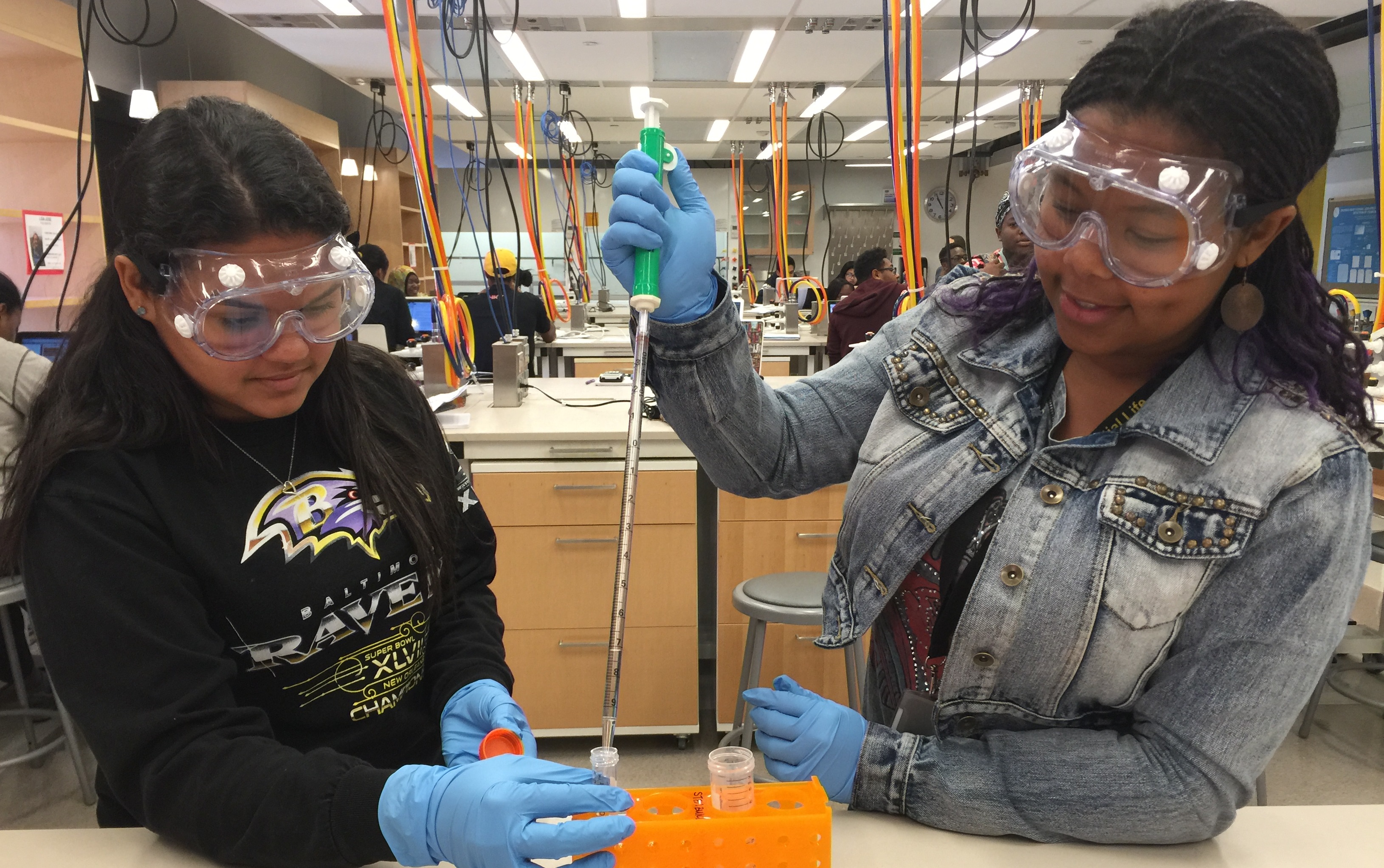
A U.S. News article on strategies to attract diverse students to STEM fields, and support their success in those fields, highlights the new STEM BUILD at UMBC program, which launched with its first cohort of students this fall.

STEM BUILD at UMBC provides a strong example of how U.S. universities are leveraging the power of community to recruit and retain student from all backgrounds (including women and minority students) in STEM majors at both the graduate and undergraduate levels. These program-based communities allow students to connect with peers who are pursuing similar majors and who are facing similar challenges.  

STEM BUILD

STEM BUILD at UMBC is a student support initiative and research study funded by an $18 million grant from the National Institutes of Health (NIH). William LaCourse, dean of the College of Natural and Mathematical Sciences (CNMS) and principal investigator (PI) of STEM BUILD at UMBC, explained to U.S. News that the program draws on interventions that have been found to effectively support students in other UMBC initiatives. These include living-learning communities, peer mentorship, co-curricular programmingwhich all work to build communityas well as intensive advising and other supports.

“One of the things that I believe in and wanted to accomplish here is a program that takes what’s best out of [UMBC’s] scholars programs and move more toward the middle of the learning curve,” he said. “We drew from all of the different programs we have on campus, looking at what’s effective in teaching, what’s effective in advising” and more.

STEM BUILD at UMBC includes 20 undergraduate students, plus 29 students not enrolled in STEM BUILD, but who are also interested in STEM (participating in the research as a control group.) UMBC is collaborating on the initiative with five community colleges, Gallaudet University, and the University of Maryland School of Medicine.

Read the full article, “Universities Collaborate to Attract Females, Other Minorities to STEM,” on U.S. News.

First image: The first cohort of BUILD Training Program Trainees with their UMBC staff coordinators at the Society for the Advancement of Chicanos/Hispanics and Native Americans (SACNAS) 2015 National Conference on October 31, 2015 at National Harbor, MD. Photo courtesy STEM BUILD at UMBC.

Second image: Victoria Baskerville and BUILD Training Program colleague, Isis Cabassa, preparing dilutions in their SCI 101L: Quantitative Reasoning – Measurement and Skills Laboratory class on September, 15, 2015. Photo by Laura Ott.