All posts by: Megan Hanks Mastrola


Capitol Hill hearing on NSF-funded INSuRE project highlights UMBC student research

Two posters created by UMBC student researchers were highlighted during an informational hearing on Capitol Hill in Washington, D.C. on Wednesday, December 16, focused on the Information Security Research and Education (INSuRE) project.

UMBC is one of seven universities nationwide participating in INSuRE, a multi-disciplinary and multi-level collaborative research initiative. Through INSuRE, undergraduate and graduate students have the opportunity to work on various problems related to cybersecurity while being mentored by industry professionals.

Alan Sherman, professor of computer science, is a co-Principal Investigator (PI) of the INSuRE project, which began in 2013. He is leading seven UMBC students across three research groups as part of a 2015 fall course connected with the project, which is funded by a nearly $300,000 grant from the National Science Foundation (NSF).

Photo by Elliott P., CC by 2.0 

3D Scanning Room opens with a 90-camera flash

UMBC’s Imaging Research Center (IRC) has debuted the 3D Scanning Room, featuring new software that allows 3D models to be created by combining dozens of 2D photographs. A ribbon-cutting event and brief remarks from President Freeman Hrabowski and Vice President of Research Karl Steiner were held on Tuesday, December 8.

The 3D Scanning Room features 90 digital single-lens reflex (DSLR) cameras that are set up in a circular formation around a space where people or objects are positioned for 2D photographs. The cameras take simultaneous photos, looking for features like textures and edges that reflect light.

Once the photos are captured, they are processed through special software called Agisoft Photoscan, to create a virtual 3D model of the subject. It takes between four and six hours for the software to render a clear and detailed 3D image from the approximately 900 photos that are taken, but a rough depiction is available within an hour of the photos being snapped.

President Hrabowski said that the technology in the 3D Scanning Room is expanding the possibilities for UMBC researchers, thinkers, and artists. “This technology connects faculty across disciplines, and is fascinating because it goes across all UMBC colleges and departments,” he said.

Steiner described the 3D Scanning Room as a “three-legged stool”—a reliable, stable, easy to use system to create 3D models through the three steps of visualization, scanning and fabrication. Fabrication refers to the actual cutting or layering of the data to create a tangible 3D model.

The subjects being photographed do not need to be stationary. The cameras can capture people or objects in motion, explained Don Engel, assistant vice president for research at UMBC.

Direct Dimensions, Inc., a Maryland-based company specializing in 3D imaging for the medical, consumer and military industries, worked with UMBC’s Marc Olano, associate professor of computer science and electrical engineering (CSEE) and principal investigator (PI), and Dan Bailey, director of the IRC and co-PI, to create the 3D Scanning space. The space was funded through a $180,000 grant from the National Science Foundation.

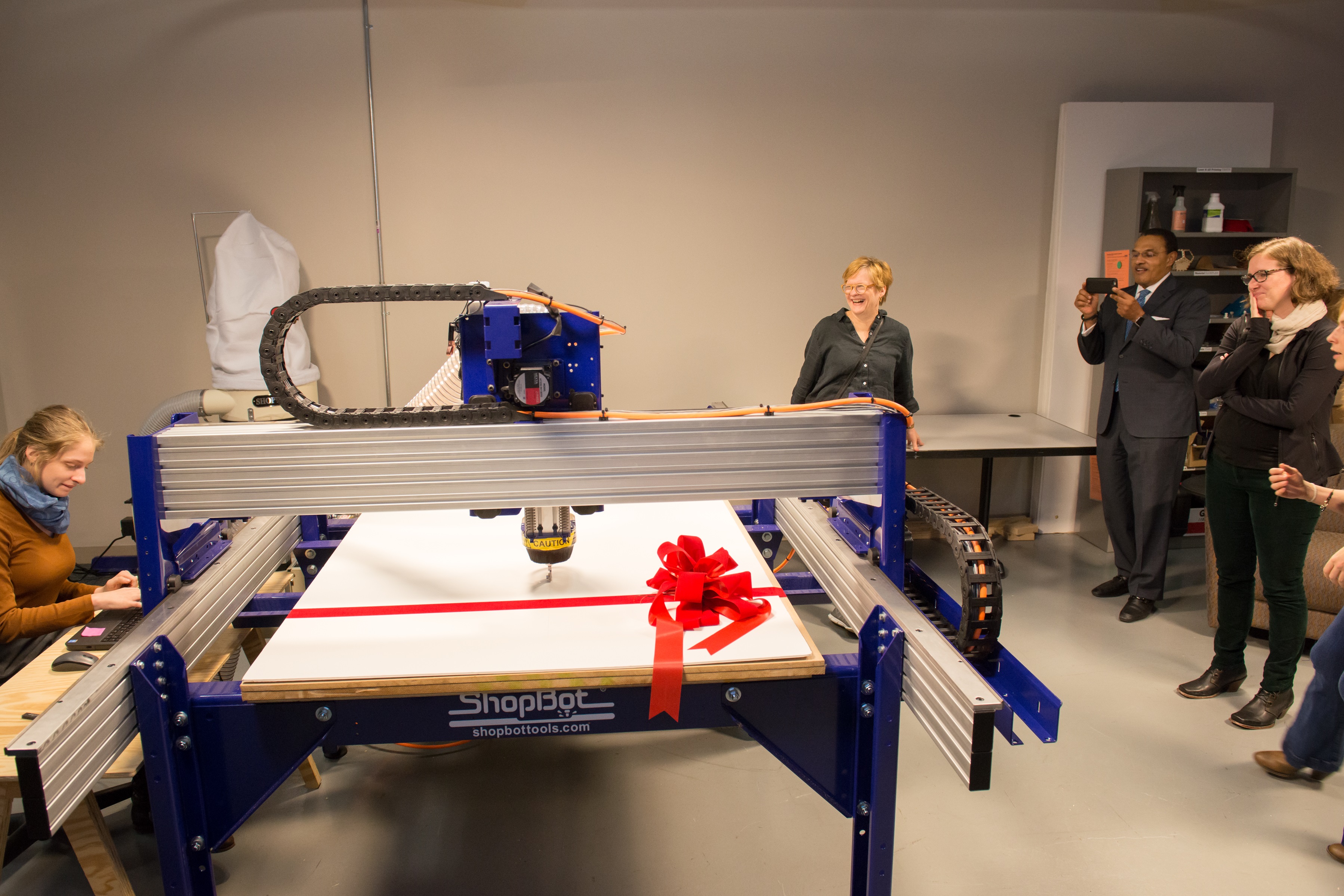
A second new tool was also introduced during the ribbon-cutting event: a four-foot-by-eight-foot ShopBot, a type of CNC mill, run by Lisa Moren, professor of visual arts, and Amy Hurst, assistant professor of information systems. Different drill bits attach the CNC tool to create various cuts and patterns in materials, including wood and stone.

ShopBot-6256

Read more about the ribbon-cutting event, “A crazy 3D-scanning room was recently delivered to UMBC,” on Technical.ly, and “Immersive, 3D scanner comes to UMBC,” on The Daily Record. 

Images: President Hrabowski and Michael Raphael, CEO of Direct Dimensions, Inc., at the ribbon cutting for UMBC’s new 3D Scanning Room (top); The ShopBot cut its own ribbon during the introduction of the second new tool in the IRC (bottom). Photos by Marlayna Demond ’11.  

3D model linked within text was created by Direct Dimensions, Inc., which used 2D photos taken by the scanning device at UMBC. 

UMBC Chess prepares for 2015 Pan-Am Intercollegiate Championship

UMBC’s chess teams are preparing to participate in the 2015 Pan-American Intercollegiate Team Chess Championship, December 27-30. The championship will be held at Oberlin College in Ohio, and marks the 25th year that UMBC teams will participate in the event.

Last season, UMBC Chess finished in fourth place at the President’s Cup. UMBC has won the Pan-American Intercollegiate Team Chess Championship ten times, and the National Collegiate Team Chess Championship six times.

The 2015 A team includes international master Levan Bregadze ‘16, financial economics; team captain and grandmaster Niclas Huschenbeth ‘16, psychology; grandmaster Tanguy Ringoir ‘19, economics; and Dobrynya Konoplev ‘17, computer science and mechanical engineering. Nathaniel Wong ‘18, Asian studies and political science; Abhilash Puranik ‘17, M.S. computer engineering; Jeffrey Carr ‘19, interdisciplinary studies; and Mustapha Diomande ‘17, biological sciences and psychology, comprise the second team representing UMBC.

The teams are coached by Igor Epshteyn; Sam Palatnik, grandmaster; Joel DeWyer, business director of the chess program and associate director of The Commons; and Alan Sherman, director of the chess program and professor of computer science.

Check the UMBC News website and UMBC Chess Tumblr in late December for updates on the team’s progress at the 2015 Pan-American Intercollegiate Team Chess Championship.

Image: Members of the UMBC Chess team. Photo by Marlayna Demond ’11. 

Common sense on social media can guard against identity theft, but it’s no guarantee, says UMBC cybersecurity expert

umbc-faculty-Rick-FornoDecember is National Identity Theft Prevention and Awareness Month, and it is a reminder to consumers to be vigilant about the security of personal information. Precautionary measures often considered to be “common sense” are some of the best ways for individuals to protect their identity, says Rick Forno, director of UMBC’s graduate program in cybersecurity and assistant director of UMBC Center for Cybersecurity, in an article on WalletHub.

Destroying unneeded documents that contain personal information, such as old medical records and tax returns, rather than simply throwing the documents in the trash, can help individuals protect their identity. However, Forno emphasizes, “Common sense precautions…are by no means a guarantee of ‘total’ security against identity theft.”

So far in 2015 alone, 690 cybersecurity breaches granted hackers access to more than 176 million records. This has led to the implementation of more aggressive measures to improve cybersecurity across industries, and to more caution by individuals sharing information online, but there are still concerning issues that are beyond consumers’ control.

“A larger problem is how to guard against company and government sites that the individual does not control access to or the security of the data on those servers,” explains Forno.

Social media can also play a role facilitating identity thefts, he notes, reminding readers that hackers can utilize seemingly innocuous personal details posted on social media, such as “your friends’ or relatives’ names, your alma mater, car make/model, favorite color, sports team, etc.” “Here again, common sense practices are key,” he says. “It’s just something to be aware of as you view online risks generally.”  

Read the full article, “2015’s States Most Vulnerable to Identity Theft and Fraud,” on WalletHub, including Forno’s advice to consumers.

Photo by Luke Jones, CC by 2.0 

Contrary to Darwin’s assumptions, female and male songbirds can be equally musical, say UMBC biologists

Contrary to the popular belief, made famous by evolutionary theorist Charles Darwin, that only male songbirds sing, female birds can be as musical as males of the same species. This is the conclusion of UMBC’s Karan Odom, a biological studies PhD student, and Kevin Omland, professor of biological sciences, from their intensive study of songbirds in Maryland and Puerto Rico. Their research on the subject, originally published in Nature Communications, is highlighted in a new article in National Wildlife Federation magazine.

The current research includes four oriole bird species. Odom and Omland studied the Baltimore oriole and orchard oriole in Maryland, and Odom and students from UMBC and the University of Puerto Rico studied the Venezuelan troupial and the Puerto Rican oriole in Puerto Rico.

The scientists identified differences between the northern birds and their southern counterparts, including in the frequency of male and female song. In Maryland, female orioles are dull in color and usually do not sing. This contrasts with males of the species, who are brightly colored and have vibrant song, which the researchers attribute to males needing to hurry through attracting mates, securing territory, reproducing and migrating south before the fall.

In Puerto Rico, the females orioles are brightly colored, like males, and often sing duets with the males. Odom points out that in the Tropics, most female songbirds sing just as long and loud as males, and similarities in the sounds and appearance of male and female birds can make it difficult for scientists to distinguish them by sex.

Read the full article, “Busting a Birdsong Myth,” in National Wildlife Federation magazine.  See also extensive previous news coverage of Odom and Omland’s research.

Image: Karan Odom holding a troupial. Photo by Kevin Omland

Inaugural Inventors’ Luncheon honors UMBC faculty innovators across disciplines

UMBC’s inaugural Innovators Luncheon, held November 30, 2015, celebrated faculty innovators from across the university who are forging new paths in their fields. Sponsored by the Office of the Vice President for Research, Office of Technology Development (OTD), Office of Institutional Advancement (OIA), and bwtech@UMBC, the event acknowledged accomplishments of UMBC Technology Catalyst Fund (TCF) and Maryland Innovation Initiative (MII) awardees.

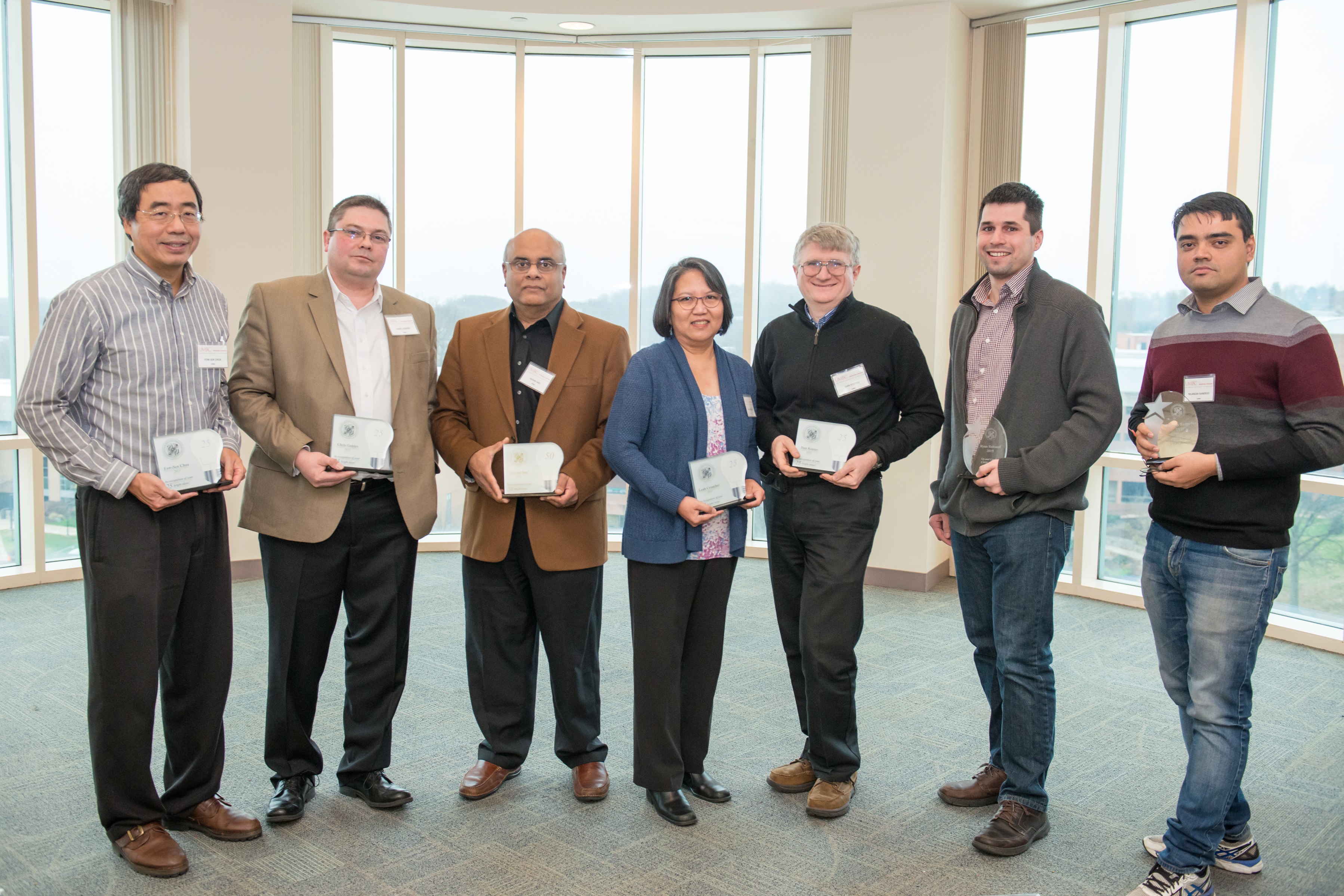
In addition to recognizing the TCF and MII awardees, five UMBC faculty were presented with awards for outstanding initiatives in disclosing their inventions. Christopher Geddes, professor of chemistry and biochemistry and director of the Institute of Fluorescence (IOF); Fow-Sen Choa, professor of computer science and electrical engineering (CSEE); Leah Croucher, research professor in chemical, biochemical and environmental engineering (CBEE) and assistant director of the Center for Advanced Sensor Technology (CAST); and Dan Kostov, research professor in CBEE, adjunct professor in CSEE and assistant director in CAST, were recognized for having submitted over 25 invention disclosures each. Govind Rao, professor in CBEE and director of CAST, was presented with an award for over 50 invention disclosures. In addition, Ryan Robucci ’02, computer engineering, and Nilanjan Banerjee, both assistant professors in CSEE, were recognized as up-and-coming inventors at UMBC for not only advancing technology in their respective academic fields but also pursuing commercial applications of those advancements.

Inventors_Luncheon15-4487

Vice President for Research Karl Steiner opened the event by drawing inspiration from John Lennon’s “Imagine.” He highlighted how the entrepreneurial spirit of UMBC’s inventors enables them to develop novel, creative solutions to pressing issues in Maryland, nationally, and globally. Greg Simmons, M.P.P ’04, public policy, vice president for institutional advancement, shared Steiner’s sentiment, and emphasized the importance of supporting faculty in their work to solve society’s biggest challenges.  

University System of Maryland (USM) Chancellor Bob Caret and R. Michael Gill, secretary of commerce for the State of Maryland, also shared brief comments. Chancellor Caret compared UMBC innovators with inventors in Silicon Valleytheir innovative spirit, fresh ideas, fast work pace, and confidence they can have a major positive impact. With that vision in mind, he argued that the State of Maryland must develop “an ecosystem where we can all come together to create that level of success.” Gill challenged the inventors to wake up each morning with the determination to figure out “how to move this forward,” moving past the setbacks and challenges that each will undoubtedly encounter along the way.

For UMBC President Freeman Hrabowski, the drive to engage talented faculty from diverse backgrounds in developing solutions to the problems our world faces is essential. President Hrabowski shared how inspired he feels by “what we do on UMBC’s campus to impact people’s lives.”

Image: UMBC TCF and MII awardee Suzanne Ostrand-Rosenberg; Seven UMBC faculty were presented with awards during the Innovators Luncheon. Photos by Marlayna Demond ’11.

Baltimore is now a cybersecurity hub attracting global talent, says bwtech@UMBC’s Hemmerly

With the flurry of recent internet hacks, how safe is the information that we post online? Who will develop the innovations needed to secure our data in cyberspace? In a new Baltimore Sun op-ed, bwtech@UMBC Executive Director Ellen Hemmerly writes that the necessary innovation will come from Baltimore, thanks to the city’s proximity to the federal government and major defense and intelligence contractors, high concentration of cybersecurity and IT startups, and early experience with “revolutionary cyber companies.”

“Ultimately, cybersecurity is not just about national security, it’s also about our own economic security,” writes Hemmerly. “We’ve been vulnerable since day one, and what has changed has been the realization of how vulnerable we truly are.”

Hemmerly explains that Baltimore is already home to many innovative cybersecurity firms, and the city is attracting even more early-stage companies from around the nation and the world that want to be near leaders in , IT, security, defense and intelligence companies.

“The University of Maryland, Baltimore County (UMBC) ranks fourth among U.S. research universities in information technology degrees and certificates awarded,” Hemmerly writes. “With cybersecurity becoming more interdisciplinary, Maryland has morphed itself into a leading ecosystem for innovation and entrepreneurship in the space.”

Read Hemmerly’s op-ed “A cybersecurity future in Baltimore,” published November 25 in the Baltimore Sun.


Image: Ellen Hemmerly. Photo by Marlayna Demond ’11 for UMBC. 

NASA’s Operation IceBridge confirms observations on ice shelf collapse, JCET researcher Shuman explains

NASA’s Operation IceBridge, a survey of polar ice, carried out parallel flights in the north and south poles for the first time in seven years. The mission to the Antarctic Peninsula recorded a big drop in height of the two glaciers at the south pole. The mission to the Arctic collected measurements of depleted land and sea ice at the end of the summer melting season.

In an article on the NASA website, Christopher Shuman, research associate professor at UMBC’s Geography and Environmental Systems department, faculty at UMBC’s Joint Center for Earth Systems Technology (JCET), and research scientist in the Cryospheric Sciences Laboratory at the NASA Goddard Space Flight Center, said that IceBridge’s findings are “not all that surprising given what we have observed with other sensors.”

Other sensors have shown that both poles are losing ice at a fast rate after years of adjacent ice shelf loss, explained Shuman, referencing a study that he co-authored in 2012 which revealed notable elevation losses for the Green and Hektoria glaciers, both in the Antarctic, from 2006 to 2011. “These IceBridge measurements show that once the ice shelves collapse, even some cooling and a good deal of persistent sea ice is not able to hold back these larger glaciers and they continue to lose mass overall,” he said.

Shuman’s research focuses on satellite and modeled temperature data sets from Greenland, where he has been deployed seven times, in collaboration with fellow researchers at NASA’s Goddard Space Flight Center. He has researched changes in ice elevation and glacier mass losses through remote sensing in the Antarctic Peninsula, where he has been deployed in the field six times. Shuman has also developed composite temperature records through data from automatic weather stations.

The 20-year JCET partnership between UMBC and the NASA Goddard Space Flight Center was recently renewed through a cooperative agreement for $46 million over five years.

Image: A glacier winds between peaks in the Antarctic Peninsula captured on Oct. 3, 2015. Photo courtesy of NASA/David Rabine.

UMBC researchers raise Atlantic bluefin tuna on land for first time in North America

A team of UMBC researchers has made history by successfully raising Atlantic bluefin tuna from eggs to juvenile stage in a recirculating, land-based mariculture system for the first time in North America. Scientists at the Institute of Marine and Environmental Technology (IMET) overcame significant challenges in creating the successful, sustainable aquaculture system roadblocks that had previously frustrated researchers for years.

A sharp increase in demand for bluefin tuna in the sushi industry has intensified fishing of the species, fueling seven-figure prices for individual fish and depleting populations. In 2015, the World Wildlife Fund’s Living Blue Planet Report identified Atlantic bluefin tuna as a species that is experiencing one of the steepest declines.

Current bluefin tuna farming depends on capturing and fattening wild fish for Japanese and broader global markets, but declining supplies and growing demand have created a strong interest in developing better aquaculture techniques.

“We must stop overfishing this major icon of the oceans. Our research aims at closing the life cycle of this fish, so juveniles can be produced in captivity to enable alternative, environmentally-responsible practices to satisfy the growing global appetite for bluefin tuna through aquaculture,” said Yonathan Zohar, professor and chair of marine biotechnology.

Zohar explained that findings from the most recent research are a first step toward developing environmentally-sustainable commercial aquaculture of this tuna species in the U.S. To raise environmentally sustainable Atlantic bluefin tuna through aquaculture, the full life cycle of the fish needs to be completed in captivity.

To acquire the larvae to begin the current cycle of research, the UMBC team partnered with a Croatian company that holds bluefin tuna in floating netpens in the Adriatic Sea. The fish, weighing 540-550 lbs. each, were injected with hormone-based, controlled-release implants, developed by Zohar, which triggered massive spawning during July-August 2015. The fertilized eggs were collected and shipped to IMET’s Aquaculture Research Center, where they arrived about 40 hours later as freshly hatched larvae and were placed in tanks equipped with recirculating water systems.

“It took an incredible amount of coordination between the university and our external partners across the Atlantic ocean, as well as internal coordination among the hatchery team members at IMET, to achieve this level of culture success,” said John Stubblefield, faculty research assistant.

The researchers tested various combinations of food, dietary supplements, and environmental factors to determine what was most effective in supporting the tuna’s healthy growth. Identifying that ideal balance of microalgae, lab-grown zooplanktonic feeds, larvae of other marine fish, plus vitamins, omega-3 oils, and probiotics enabled the team to grow tuna to 4-5 inches long at age 60-70 days, officially reaching juvenile status. The tuna were raised in simulated oceanic conditions, with careful regulated temperature, salinity, light intensity, and hydraulic currents, Zohar explained.

“We work day and night, 24/7. We grow the food for the larvae, which consists of planktonic organisms. We constantly observe, check, tweak and calibrate the culture parameters,” said Jorge Gomezjuardo, faculty research assistant. “The larvae and juveniles are so vulnerable. We are always busy, but we know that we are working to help a threatened species that is in need of help.”

The researchers began facing additional challenges once the tuna grew to between 3 and 5 inches in length because the tanks in the Aquaculture Research Center at IMET were not large enough for the fast-moving tuna to continue to thrive. Once they reach this size, the fish must be transferred to much larger tanks or sea-based floating netpens to survive. The scientists are now exploring solutions to this current challenge.

“It took many years before hatcheries could mass-produce other marine fish that are now common in aquaculture. I believe tuna production will follow this same pattern, but we learned so much from these prior experiences with other species that it will hopefully be a shorter, smoother learning curve this time,” said Odi Zmora, research supervisor.

“IMET’s unique trans-Atlantic collaboration led to great progress in reliably inducing spawning of the giant bluefin tuna in captivity and producing beautiful baby tuna in our tanks,” explained Zohar. “We are hopeful that our future research over the next couple of years will pave the way for tuna aquaculture in the U.S. and globally.”

Image: Yoni Zohar and Jorge Gomezjurado at IMET aquaculture research facility. Photo by Marlayna Demond ’11.

Yoni Zohar says FDA approval of genetically engineered salmon could have environmental benefits

The U.S. Food and Drug Administration (FDA) has just approved the first genetically modified animal for sale as food: AquaAdvantage salmon,. The FDA determined that the salmon is not biologically different than nongenetically engineered salmon and is safe to consume.

A CNN article on the news shares comments by UMBC’s Yonathan Zohar, professor and chair of the department of marine biotechnology, on the environmental benefits of the fish, which is designed to grow more quickly, to meet the continually increasing demand that is currently threatening salmon populations. Zohar’s research focuses on developing environmentally sustainable aquaculture techniques, and he has previously discussed the limitations of current fish farming practices, which can be environmentally problematic.

To prevent unintended environmental impacts, such as the escape and reproduction of the fish with wild species, the salmon approved by the FDA must be reproductively sterile and raised in tanks on land, at facilities in Canada and Panama.

Discussing the controversial issue of food labels, Zohar argued that labels identifying the genetically engineered salmon should not deter people from consuming the fish, but should make consumers aware of the product they are purchasing. As long as consumers want to continue eating fish, the science endorsed by the FDA should be accepted, said Zohar. He points to a history of consumers eating genetically modified crops like corn, tomatoes and soybeans.

Read the full article on CNN.

Marie desJardins argues ultra-competitive hackathon culture may discourage women in cybersecurity

desJardins, Marie (CSEE)There is a high demand for fresh talent in information security, but the industry has struggled to hire and retain professionals from an essential portion of their potential talent pool: women. Just 10 percent of people working in information security are women, and in a new Slate article UMBC’s Marie desJardins suggests the emphasis that recruiters and people in the industry place on competitive extracurricular activities, such as hackathons, may be dampening women’s interest in the field.

Activities such as hackathons—events where coders compete to build a new product or service, working continuously over a set period of hours or days—offer participants the chance to network with corporate recruiters, present their creations to industry experts, and even land internship offers. However, desJardins points out, “The way we train our girls, we don’t necessarily raise them to be competitive against other people.” This can leave girls at a disadvantage when recruiters expect them to have experience in highly competitive extracurricular activities, even more than demonstrating strong grades in challenging coursework.

To increase the number of women who choose careers in information security and cybersecurity, desJardins suggests emphasizing how the creations developed at events like hackathons can impact society, and creating more opportunities for students in these fields to demonstrate their skills and talent in ways that recruiters value.

“It’s not that girls don’t like these things, but it’s one kind of thing. It’s one way of testing out scientific ideas and comparing them against other people,” desJardins notes.

Read the full article, “Hackathons Have a Gender Problem,” on Slate.

Image: Information Systems PhD student Erin Buehler (standing, left) and principal investigator Prof. Marie desJardins, associate dean of COEIT, address high school teachers at the July 2015 CS Matters in Maryland pilot teacher workshop. Photo by Marlayna Demond ’11 for UMBC.

UMBC students help veterans with PTSD combat insomnia with new app

UMBC students Damola Adediran ‘17, computer science, and Sarah Kirby ‘16, computer science, were members of a standout team at the 2015 HackDC Hackathon that won top prize in the “Best Mobile Application for Clinicians” category, for their app “myBivy.”

This year’s HackDC Hackathon challenged competitors to build a mobile app to help veterans with post-traumatic stress disorder (PTSD) deal with insomnia, which is common within this population.

The myBivy app tracks veteran’s heartbeat and movements to detect night terrors, and over time works to help prevent them. The app allows veterans to observe their sleep patterns and to share the data collected overnight with their doctor.

The 36-hour-long Hackathon, held September 25-27, gave teams a chance to work on developing their apps by collaborating with clinicians, veterans, and veterans’ families and friends, who offered feedback on what information the veterans want to track.

Adediran’s job on his team was to communicate with clinicians about how the app would best serve the veterans, and to debug the app throughout the development phase.This was Adediran’s second Hackathon, and he says it was extremely empowering. He describes it as, “something I’ve never experienced before.”

In addition to a cash prize, the team will use funds collected on their Kickstarter page to develop, test and launch the myBivy app by the spring of 2016. For more information about the myBivy app and team, visit the Kickstarter page.

Image: myBivy team at HackDC Hackathon. Photo courtesy of HackDC.