All posts by: Jenny O'Grady


Formula For Success – Ronita Marple ’05, Ph.D., Chemistry

As an analytical chemist and senior scientist for consumer goods giant Proctor & Gamble, Ronita Marple ’05 Ph.D., chemistry, observes that it’s not unusual for her to walk past a lab and catch a glimpse of a robot testing a product by performing a household chore over and over again, for hours on end, to identify a product’s weaknesses without stressing out human testers in the process.

Such grueling tests are part of how all of the nearly 125 products marketed by Proctor & Gamble end up in a consumer’s shopping cart. So is Marple’s own job mundane and robotic? “Never,” laughs the recipient of UMBC Alumna of the Year Award in the Sciences, who manages a team of chemists that unravel the technology behind each line of personal care at the corporation’s Cincinnati headquarters.

“Maybe there’s a new ingredient [in a product]: It’s my job to come up with a method to measure it,” she explains. Shampoo, for example. “There are just tons of ingredients in every bottle,” she says. Her team can scan a dollop of shampoo using a technique known as “whole product NMR” to determine the identity and concentration of each ingredient in the formula.

Marple and her team must also help ensure that most important ingredients of all – those responsible for cleaning and conditioning hair – remain stable and optimally concentrated between factory and shower. After all, that dollop of shampoo must trek cross country in a sweltering delivery truck before it becomes lather on a lustrous head of hair.

You don’t want to feel like you’re washing your hair with dish soap,” says Marple. “On the other hand, you want enough conditioning that it feels good.”

To get that balance just right, Marple’s team needs hair. And lots of it. “We probably spend more than a million dollars a year just buying hair to test on,” she says. The company purchases real human hair from suppliers in the form of ponytails (or “switches” as Marple calls them), which are sent off to a lab for testing. Once a shampoo has been developed for a specific hair type, the final formulation is tested by consumers in the company’s on-site salon.

Before any of the nearly 125 products marketed by Proctor & Gamble end up in a consumer’s shopping cart, each one – personal care or not – must be beaten, battered, diluted, pressured and manipulated in every imaginable way to see how it holds up under the most grueling conditions. Growing up in the small town of Bellaire, OH, Marple’s early exposure to science was relatively simple. “We didn’t have things like AP classes or weighted graded systems,” she says. “It was just a basic public school education.”

Graduate school is never easy, but Marple remembers her time at UMBC in the doctoral program in chemistry with great fondness. “Even though it was really, really difficult,” she recalls, “probably one of the most difficult times in my life, trying to do all the research and pass my qualifying exams and finish my dissertation. I just had so much fun. It was such a satisfying experience.”

The research that she did at UMBC made it even more worthwhile, Marple says. “A lot of times you’re doing really cutting edge things that no one has ever done before,” she says. And the best part? “That whole sense of discovery; just knowing that you’re really pushing the limit and discovering new things.”

After graduation, Marple began working at Proctor & Gamble. In addition to her work as a chemist, she also encourages mentoring and networking relationships among emerging female scientists from all corners of the world through the company’s Analytical Women of Excellence program. The job also has her traveling the world – including India, Sweden, Russia, Italy, Germany, England and Belgium – to connect with Proctor & Gamble’s other technical centers and establish projects through the company’s Connect and Development program.

But regardless of how far she’s traveled on her road to becoming a chemist, she credits “the family-like culture” at UMBC with teaching her the lesson of a lifetime: “You can be what you want to be. There might be obstacles but you can overcome them,” Marple says. “Just do what you have your heart set on.”

— Ann Griswold

Formula For Success – Ronita Marple '05, Ph.D., Chemistry

As an analytical chemist and senior scientist for consumer goods giant Proctor & Gamble, Ronita Marple ’05 Ph.D., chemistry, observes that it’s not unusual for her to walk past a lab and catch a glimpse of a robot testing a product by performing a household chore over and over again, for hours on end, to identify a product’s weaknesses without stressing out human testers in the process.
Such grueling tests are part of how all of the nearly 125 products marketed by Proctor & Gamble end up in a consumer’s shopping cart. So is Marple’s own job mundane and robotic? “Never,” laughs the recipient of UMBC Alumna of the Year Award in the Sciences, who manages a team of chemists that unravel the technology behind each line of personal care at the corporation’s Cincinnati headquarters.
“Maybe there’s a new ingredient [in a product]: It’s my job to come up with a method to measure it,” she explains. Shampoo, for example. “There are just tons of ingredients in every bottle,” she says. Her team can scan a dollop of shampoo using a technique known as “whole product NMR” to determine the identity and concentration of each ingredient in the formula.
Marple and her team must also help ensure that most important ingredients of all – those responsible for cleaning and conditioning hair – remain stable and optimally concentrated between factory and shower. After all, that dollop of shampoo must trek cross country in a sweltering delivery truck before it becomes lather on a lustrous head of hair.
You don’t want to feel like you’re washing your hair with dish soap,” says Marple. “On the other hand, you want enough conditioning that it feels good.”
To get that balance just right, Marple’s team needs hair. And lots of it. “We probably spend more than a million dollars a year just buying hair to test on,” she says. The company purchases real human hair from suppliers in the form of ponytails (or “switches” as Marple calls them), which are sent off to a lab for testing. Once a shampoo has been developed for a specific hair type, the final formulation is tested by consumers in the company’s on-site salon.
Before any of the nearly 125 products marketed by Proctor & Gamble end up in a consumer’s shopping cart, each one – personal care or not – must be beaten, battered, diluted, pressured and manipulated in every imaginable way to see how it holds up under the most grueling conditions. Growing up in the small town of Bellaire, OH, Marple’s early exposure to science was relatively simple. “We didn’t have things like AP classes or weighted graded systems,” she says. “It was just a basic public school education.”
Graduate school is never easy, but Marple remembers her time at UMBC in the doctoral program in chemistry with great fondness. “Even though it was really, really difficult,” she recalls, “probably one of the most difficult times in my life, trying to do all the research and pass my qualifying exams and finish my dissertation. I just had so much fun. It was such a satisfying experience.”
The research that she did at UMBC made it even more worthwhile, Marple says. “A lot of times you’re doing really cutting edge things that no one has ever done before,” she says. And the best part? “That whole sense of discovery; just knowing that you’re really pushing the limit and discovering new things.”
After graduation, Marple began working at Proctor & Gamble. In addition to her work as a chemist, she also encourages mentoring and networking relationships among emerging female scientists from all corners of the world through the company’s Analytical Women of Excellence program. The job also has her traveling the world – including India, Sweden, Russia, Italy, Germany, England and Belgium – to connect with Proctor & Gamble’s other technical centers and establish projects through the company’s Connect and Development program.
But regardless of how far she’s traveled on her road to becoming a chemist, she credits “the family-like culture” at UMBC with teaching her the lesson of a lifetime: “You can be what you want to be. There might be obstacles but you can overcome them,” Marple says. “Just do what you have your heart set on.”
— Ann Griswold

Discovery – Fall 2011

LEARNING (FROM) THE LINGO

“Baldamoreans do not speak the king’s English.”

That’s how one Lexington Market patron jokingly described the city’s linguistic style to Inte’a DeShields ’13 in a podcast that was produced as a class assignment by the language, literacy and culture Ph.D. student.

But that’s exactly how Christine Mallinson, an assistant professor in the program, likes it.

“Not that much linguistic research has been done on the unique accents of Baltimore, but the city is a good laboratory for studying language variation,” Mallinson explains.

Charm City is a living laboratory for Mallinson’s research and pedagogy. The podcast, for example, was a product of firsthand research on linguistic variations in Baltimore by students in Mallinson’s “Language in Diverse Schools and Communities” class.

DeShields’ research and podcast explored common pronunciations among African American communities in Baltimore, especially a tendency to pronounce the city’s name as “Baldamore.” Other students researched language in multilingual communities and what Baltimore’s women say about themselves when they claim the word “hon.”

Mallinson created her own podcast, too, featuring teachers who discuss how language variation affects students and the strategies they’ve used to improve their teaching. Working with these teachers is the current focus of Mallinson’s research, and the subject of her recent book, Understanding English Language Variation in U.S. Schools, which she co-authored with Charity Hudley, an associate professor of English, linguistics, and Africana studies at the College of William and Mary.

“Language really matters in everything we do,” says Mallinson. She argues language is an important part of social identity: a definitional marker not only for others but for one’s self.

For students without a background in academic English, she continues, language can often be a barrier to achievement.

Mallinson is committed not only to describing that classroom challenge, but also to giving teachers tools to combat it. One teacher in Mallinson’s podcast tells the story of a non-native English speaker who was reluctant to participate in classroom discussions. However, when that teacher had the class read a story containing a Spanish word, the student eagerly joined in the discussion.

Mallinson has recently turned her focus to science and math teaching in K-12 classrooms, organizing workshops that train teachers to recognize and help students who struggle with the language elements of math and science curricula. If students understand the arithmetic in a word problem but produce a wrong answer because they misunderstand the question’s syntax, Mallinson and Hudley offer strategies to assist both students and teachers.

“Linguistically diverse students don’t leave their language patterns at the door when they come to math and science classrooms,” Mallinson explains. She and Hudley were recently awarded a three-year grant from the National Science Foundation to continue conducting workshops in Maryland and Virginia and follow up with teachers to learn which strategies are most successful.

“Linguists have usually studied language variation with respect to English classrooms,” Mallinson says. “Teachers are really excited that somebody is paying attention to language in math and science.”

— Chelsea Haddaway

(All of the podcasts are available at www.BaltimoreLanguage.com.)

A COLLECTING CALL

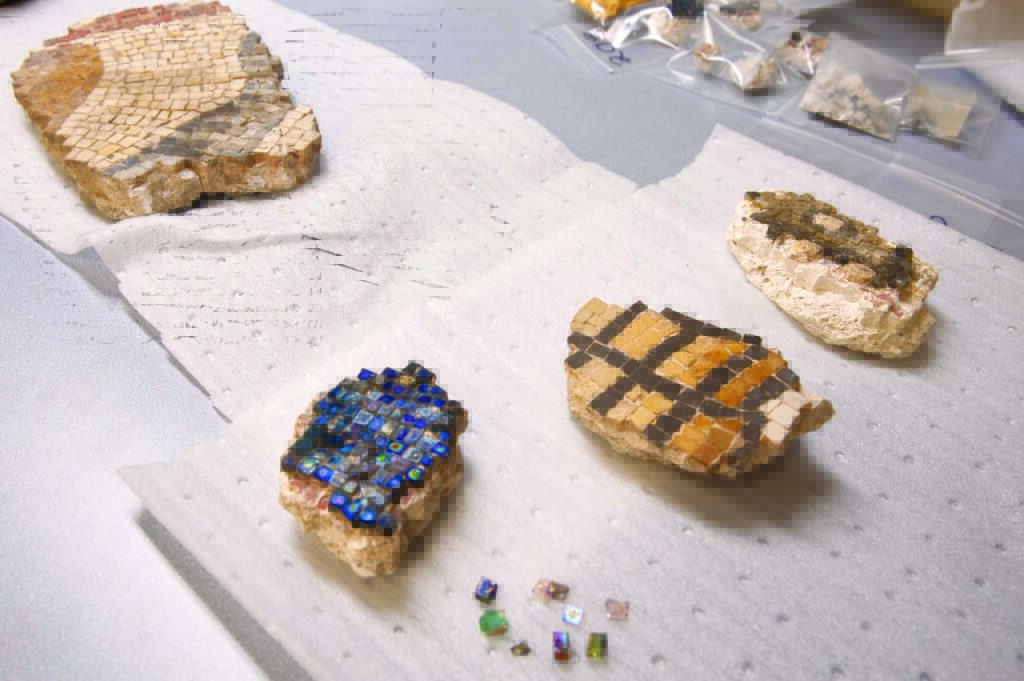
It took Marie Spiro five decades – and a bit of heavy lifting – to create her personal collection of ancient artifacts. “Anytime I came back from a site,” she quips, “I had the heaviest suitcase.”

Spiro is an associate professor emerita of art and archaeology at the University of Maryland, College Park, and her dramatic recounting of a particular object’s discovery can quiet a rowdy classroom. The collection features over 1,000 Greek, Roman and Byzantine artifacts, and contains mosaics, pottery, figurines and other pieces that date back as far as 15,000 years.

Indeed, students were at the heart of Spiro’s enterprise. She relished sharing the pieces she brought home with them in classes, encouraging them to touch and handle the objects in ways that they couldn’t at a museum, or by looking at a photograph.

So when Spiro decided to donate her collection, she looked for a place that would follow her example. She settled on UMBC’s ancient studies department, where the first third of Spiro’s collection was used in classrooms this past February. (The next third of the artifacts will come to campus in early 2012, with the final portion arriving in 2013.)

“I think the ancient studies program [at UMBC] is the best, I really do,” says Spiro. “I’m so happy that the collection has found a home. That’s my dream fulfilled.”

Hands-on learning is a priority for Marilyn Goldberg, chair of ancient studies, who says she is delighted with the gift. She points to the value in the number of objects in the collection that ancient people used in their everyday lives, and how students can now physically interact with ancient artifacts without even leaving campus.

“Students can look at a piece in its entirety, look at the back of it and the profile of it, see how it’s made,” Goldberg says. “You can’t turn a picture over.”

Goldberg and other campus leaders secured the financial support of local Greek organizations – including the Baltimore-Piraeus Sister City Committee and the American Hellenic Educational Progressive Associations of Baltimore and Washington, DC – to bring the collection to UMBC. UMBC’s plans for the collection include an archaeology lab that will be part of the second phase of construction of the university’s Performing Arts and Humanities Building. It will be a space where students can study the artifacts and display the exhibits they curate.

Students enrolled in a museum studies class taught by Esther Read, lecturer in ancient studies, in the spring semester were the first to use the collection. The class was a lecture/lab hybrid in which students discussed issues faced by museums in each session before working with the Spiro’s artifacts.

“I want them to see that these objects are more than just pretty things in cases. Whoever owned that piece originally, it had meaning to them. It had meaning to Marie Spiro when she collected it. It has different meaning now that she’s given it to us, and it’ll have a meaning here at the institution and for the student who works with it,” says Read. “You have so many groups and so many relationships with one object. Which story do you present?”

— Chelsea Haddaway

THE WRITE STUFF

Many doctoral candidates will tell you that the biggest obstacle they face in obtaining a Ph.D. is a task that’s completely in their own hands: their doctoral dissertation.

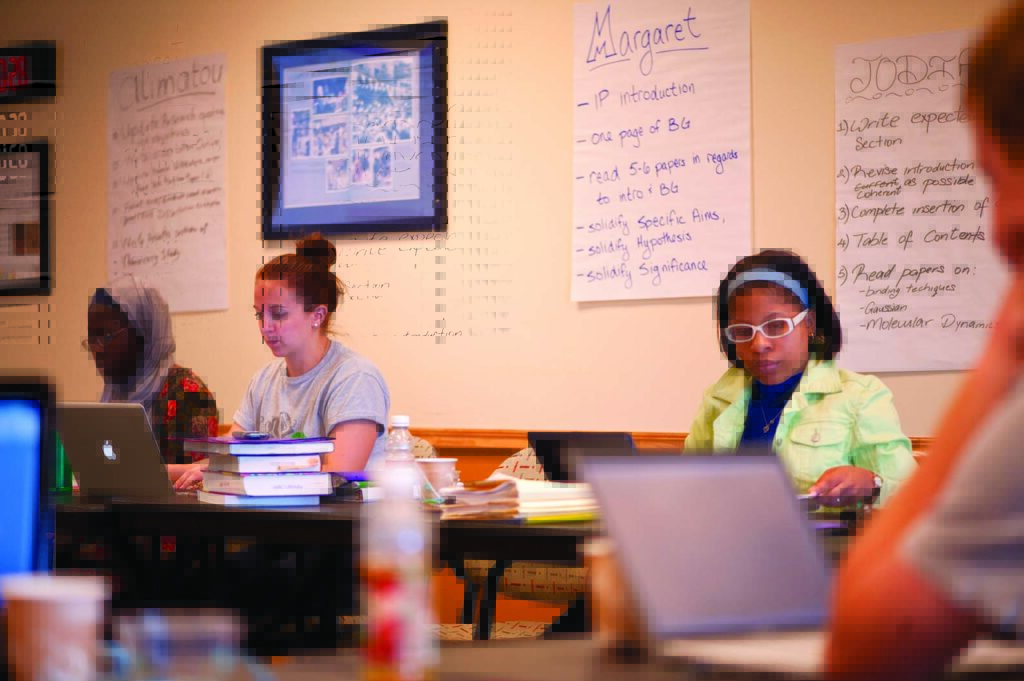
That’s why nine UMBC graduate students have assembled on the third floor of The Commons bright and early on a Monday in July to attend “Dissertation House” – a weeklong session of goal-setting, dedicated working time and concrete advice from experts aimed at getting them closer to finishing the capstone of their graduate experience.

The week of coaching was created by PROMISE – Maryland’s Alliance for Graduate Education and the Professoriate, which includes UMBC as well as the University of Maryland campuses at Baltimore and College Park. PROMISE is one of 21 alliances created by the National Science Foundation (NSF) to increase the number of U.S. students receiving Ph.D.’s in science, technology, engineering and mathematics (or “STEM”) disciplines, with a special focus on boosting the numbers of doctorates taken by minority students.

The “head coach” of Dissertation House is Wendy Carter, a nationally renowned expert on strategies for dissertation completion. (She’s even written a book and created a company – TADA!: Thesis and Dissertation Accomplished – to tackle the completion problems that students face.)

Carter shares her mantra with the assembled graduate students: “A good dissertation is a done dissertation.” After laying out challenges and offering tips (“When you read journal articles, always do a summary”), she has the students write their goals for the week on large sheets of white paper hung on the walls of the room.

The coaching starts as soon as the students present those goals to the group. Carter urges some students to clarify their tasks, and revise them towards greater self-accountability. “They need to be measurable,” she tells the group.

Renetta Garrison Tull, the director of the PROMISE program, says that participants gain valuable tips and advice from Carter and a wide range of guest speakers throughout the week – including Janet Rutledge, the dean of UMBC’s Graduate School and vice provost for graduate education, who stresses the importance of developing a strong mentoring relationship with one’s thesis advisor.

Tull also sees personal transformation and the acquisition of clarity, direction and self-discipline in the dissertation process as the key benefit of the weeklong experience. She tells the students that such things don’t come easily – and that Dissertation House is intended to be a catalyst to get them there. “We don’t leave you where you are,” she tells the group. “We move you forward. And sometimes that’s uncomfortable.” The Dissertation House was founded in 2006 and has shepherded over 70 students to Ph.D. completion in its first five years.

And when Friday rolls around for the Summer 2011 class, the sense that these nine students are on their way to joining those other alumni is palpable. The room is abuzz with activity, and the lists of goals placed on the wall on Monday are now emblazoned with items crossed out or checked off.

Look for them in a commencement ceremony soon.

— Richard Byrne ’86

DECADE OF SERVICE

When Jason Woody ’04, sociology, received his acceptance letter to be part of the first class of the Shriver Living Learning Center (SLLC) ten years ago, he wanted to be a film major. And though he was interested in the social justice focus of the new center, he was also enticed by Erickson Hall, the sleek new dorm on campus that SLLC students would call home.

Woody found the SLLC’s service mentality contagious and it quickly came to define his worldview. In his sophomore year, he came across a poster asking students to dedicate service hours to honor those killed in the 9/11 attacks and took that call to heart. Back in his dorm room, he paged through biographies of the victims.

The story of Deora Bodley – a college student who died aboard United Flight 93, which crashed near Shanksville, Pennsylvania – gripped him most personally. Friends remembered Bodley for her own dedication to serving others. In her name, Woody launched a mentorship program for elementary-aged Baltimore youth to learn team-building skills: Project Team. The Shriver Center offered a van, help recruiting volunteers and credibility with partner organizations.

Shriver Center Director Michele Wolff remembers designing the SLLC to reflect “the true essence of service-learning.” Community members are required to complete both regular service throughout their residency and coursework that provides context and promotes reflection. As an affinity program, the SLLC also offers students a purposeful living experience with a built-in peer support network to help them confront the demands of service commitments.

Woody credits the support of fellow SLLC residents for his growth as a service leader. Kelly Subramanian ’08, biology and psychology, a former SLLC resident assistant, understands his perspective. “Personal relationships develop where you’re not only living together, you’re also serving together,” she says.

By the time Subramanian arrived a few years after Woody, the SLLC had already developed a reputation for its unique way of fostering students’ intellectual and personal growth. The program itself – more than the sleek new dorm – had become the attraction. “You’re helping other people and learning about what’s out there, but you’re also learning about yourself, what you value and what you want to do with your life,” Subramanian reflects.

Senior Benjamin Davis ’12, who hopes to teach in Baltimore City after graduation, calls the SLLC “a home for people just like me who expressed passion or interest in volunteering.” Davis tackled personal hardships and shyness, he says, by “working with other civically engaged individuals.”

Jason Woody never did take a single film class at UMBC. Instead, he pursued a career serving adults with mental illness. His organization, B’more Clubhouse, offers transitional employment and social and educational programs to help adults with mental illness develop confidence, skills and meaningful relationships, and reduce stigma against mental illness in the broader community. “I’ve seen people achieve milestones, big and small, that are life-changing,” he says.

Woody adds that he is still learning from others through service. His work has helped him develop patience and understanding. In this way, he says, the members of B’more Clubhouse are now his teachers.

— Dinah Winnick

At Play – Fall 2011

WORDS AND MUSIC

Open the door to Annapolis’ Rams Head Tavern and the sounds of upbeat banjo and guitar fly out into the warm night air, followed by closely by the gruff voice of Adam Trice ’04, English – who’s in the middle of a 45-minute set with his band, Red Sammy.

“It ain’t you, it ain’t her,” Trice growls tunefully in a song called “It Ain’t You (Carolina Road Anthem).” “I’m heading south, but I’m not sure. You got me high, it’s kind of funny. I’m playing bars for gas money.”

Trice dubs Red Sammy’s music as “graveyard country” because he likes the verbal interplay of the phrase. “I feel like it brings up a lot of different connotations that are associated with those two words,” explains Trice. The band has released a few records, including A Cheap Kind of Love Song and Dog Hang Low, both of which are available online or at the band’s shows.

Studying literature at UMBC had a hand in his musical direction. “My music’s more lyric driven, and I think it really banks off my English degree,” he explains. “A lot of electives in the creative writing track. They are the strong focus from which I draw.”

While Trice also pursues a day job as director of foundation relations and grant writing and development at Capitol College in Laurel, he enjoys playing for tips in a Jeremiah Weed bucket and is going to keep playing for the foreseeable future. “My plan is to continue pushing the art and seeing where that goes,” he says.

— Derek Roper ’11
Photo: Tedd Henn

LIGHTS, CAMERA, ACTION!

The UMBC men’s soccer team’s 2010 campaign was a season to remember – and the 2011 squad will have a chance to shine on national television during UMBC’s Homecoming weekend as a result.

The America East conference announced that the Retrievers’ October 14 match against the University of New Hampshire will be televised nationally at 7 p.m. on Fox Soccer Channel as part of the network’s National Soccer Coaches Association of America Game of the Week package.

A traditional part of UMBC Homecoming, the men’s soccer game moved last year from its customary slot on Saturday afternoon to a new slot under the lights as a linchpin of Friday night’s festivities. The new tradition was a big hit: last year’s game against Boston University drew almost 3,000 spectators to Retriever Soccer Park.

This year’s game against New Hampshire is a rematch of a bitterly fought America East championship game last November at Retriever Soccer Park, which saw UMBC triumph after double overtime and a series of penalty kicks. The victory sent the Retrievers to the NCAA Men’s Soccer Tournament, where they won a thrilling come-from-behind victory against Princeton University before bowing to the College of William and Mary (also on penalty kicks) to end their season.

The national television audience won’t only get a glimpse of this year’s team and UMBC’s Homecoming spirit on October 14; they will also see a revamped Retriever Soccer Park that has added even more seats and more lights to one of the best soccer facilities in the region.

— Richard Byrne ’86

PLASTIC FANTASTIC

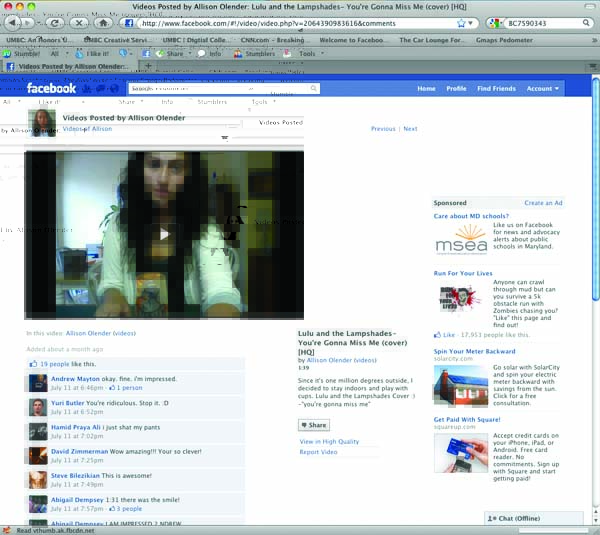
Plastic cups with UMBC’s logo and wild orange and yellow splashes were a hit at the university’s New Student Day. But incoming UMBC freshman Allison Olender decided to make a hit of her own – a sprightly video cover version of “You’re Gonna Miss Me” by Lulu and the Lampshades – in which she used the funky giveaway cup as percussion.

Olender posted her video on UMBC’s Class of 2015 Meet and Greet site – a Facebook group where incoming freshmen can find out who might be in their classes or dorm room, get a head start on making new friends and have their questions answered by fellow classmates.

The video made a splash with Olender’s fellow classmates, which isn’t surprising. The recent Bel Air High School grad with “an affinity for jazz” says that she has “been singing for the majority of my life” – in musicals, on the web and in a new band called “Prison Music.”

“When I posted the video,” Olender says, “I did not expect to generate such a warm and positive response.” She says she was attracted to UMBC by “the terrific atmosphere…. I knew that I wanted to attend a school that had excitement and integrity rooted in the system, and when I visited UMBC, my expectations were met.”

Look for UMBC’s new viral video star in person when she starts attending class in Spring 2012. “It means the world to me that the others were so responsive,” Olender says, “and I hope to share my music on campus.”

(You can check out more of Allison Olender’s music at her website: www.allisonolender.com)

— Richard Byrne ’86

CLIMBING THE LADDER

In 2008, former UMBC Retriever pitcher Zach Clark ’06, psychology, was with the Frederick Keys – a Class A affiliate of the Baltimore Orioles – when he got the news that he was needed at Class AAA Norfolk Tides for a spot starting assignment.

The good news traveled fast, but Clark didn’t. It was only after a long bus trip with the Keys from Kinston, NC, to Myrtle Beach, SC, and an early morning flight to Syracuse, NY, that Clark finally joined his new club. He pitched for the Tides that same night.

“I slept at the hotel during the day, went to the field and pitched,” recalls Clark, who has played in the Orioles farm system since 2006. “That was pretty crazy. I didn’t know anybody. That was my first time at Triple A.”

Signed by Orioles’ scout Dean Albany as a non-drafted free agent after leaving UMBC in 2006, Clark started this season pitching for the Class AA Bowie Baysox. He began 2011 with a minor league record of 24-28 and an ERA of 3.61 in 119 games.

Clark knows life as a pitcher on-call is part of the path to the big leagues. He once battled heavy traffic from Bowie to Norfolk, VA to take the mound for Tides in a night game.

In games through Aug. 4 of this season Clark was 6-7 with an ERA of 5.14 in 18 games (with 17 starts) for Bowie in the Eastern League. Clark was named the Eastern League pitcher of the week on May 2 of this season.

— David Driver

Q&A with Alumni Filmmakers

This year’s Arts and Humanities Afternoon at UMBC Homecoming on Saturday, October 15, 2011 will focus on alumni filmmakers. To whet your appetite for our afternoon discussion on the art of moving images, we’d like to introduce you to some of the filmmakers who’ll be coming to the event, which will be held in the Skylight Room of the UMBC Commons from 3 p.m. until 5 p.m. We’re also planning some screenings of the work of these filmmakers on campus in the week before the event. Please stay tuned!
Films by the alumni filmmakers will be shown at the Skylight Room in The Commons on the following dates:
Monday, October 10, 2011 at 7 p.m.: Saved! (Brian Dannelly ’97)
Tuesday, October 11, 2011 at 7 p.m.: Films by Richard Chisolm ’82, Steven Fischer ’98 and Daphner Gardner ’09
* * * * *

Daphne Gardner ’09, acting and interdisciplinary studies, makes films that focus on the young female experience in America: loneliness, complicated friendships, getting laid, and hunting down the guy that shot your friend in the leg. She and her partner Patrick Letterii ’09, acting and interdisciplinary studies, are currently directing and acting in their first feature film, Get Lost. She currently resides in Brooklyn, NY.
Getting Started: “It was a culmination of events that led me to filmmaking. I always knew I wanted to act, but it was the desire to control action that led me to realize I wanted to direct. Coming from a background in performance it seemed natural to explore the role of directing, and once I took my first production class I’d felt I’d found a way to manipulate my emotional impulses into something bigger than myself.”
What It Takes: “In my mind, to be a good filmmaker, you have to be so many different things, but right now as I work on my first feature film, I think of the following attributes: patient, flexible, positive and determined. All of these qualities of course, are extremely difficult to possess at the same time on every shoot, but I’m working on it.”
To see a selection of Daphne Gardner’s work, check out her website:
http://www.daphnegardner.com

* * * * *

Steven Fischer ’98, visual and performing arts, is a two-time Emmy-nominated writer/producer and the creator of Steve & Bluey, a modern day Abbot & Costello comedy team that has starred in two published books, on television through TCI Communications, and in a variety of radio comedies. His credits include, Carl Clark: Life at 1/125 of a Second (2000), Silence of Falling Leaves (2000), Camp Med (2005), Now & Forever Yours (2007), Freedom Dance (2007), Old School New School (2010), and Urban Paradise (2011). His latest effort, River of Stone, was commissioned by Maryland Public Television and follows noted artist Jim Sanborn (Kryptos) as he attempts to reproduce Maryland’s Piedmont Plateau in a 300-foot sculpture.
Getting Started: “There was no singular event that made me want to become a storyteller. I think growing up I just instinctively knew I was one; or let’s put it this way, I knew that I enjoyed the time in my imagination. I wrote and produced my first script at age 9. It was a silly radio theater-style adventure play, probably 10 minutes long. That’s how it was for me growing up.”
What It Takes: “I think ultimately it takes many things…. In a general sense I think it takes dedication to learning the craft, always creating, always writing, continually studying the work of the masters and of those who inspire you. It takes passion. It takes tenacity. It takes experimentation. It takes honesty. Take chances and don’t be afraid of failure. There is no such thing as failure if we learn from it and apply the wisdom to our future.”
Works written and directed by Steven Fischer available online include:
* Old School New School (Snag Films!): A documentary on the creative process including interviews with jazz pianist McCoy Tyner, actor Brian Cox and many others…
* Urban Paradise: The Director’s Cut (MPT/PBS)
Watch Fischer talk about his work:
Steven Fischer at Raleigh Studios, Hollywood, CA.
Steven Fischer on Cinematography.tv
Steven Fischer on Cine Maryland
* * * * *

Richard Chisolm ’82, interdisciplinary studies, is a national Emmy award-winning documentary filmmaker and cinematographer with over thirty years of production experience. Based in Baltimore, he has shot films and television programs on a wide variety of subjects in the U.S. and abroad working for PBS, National Geographic, BBC, Discovery Channel and HBO. He was the director of photography for both of ABC’s Hopkins prime time medical documentaries (2000 and 2008). In 2011, he directed and shot Cafeteria Man, a feature documentary on school food reform. He is also the recipient of a Peabody Award, a Columbia duPont Journalism award, two Kodak Vision awards, three CINE Golden Eagles, and received a Distinguished Alumnus of the Year Award from UMBC in 2001.
Getting Started: “I was an artist as a kid, and when I hit adolescence, was given a movie camera by my brother. My creative pack of friends and I began to play with it for fun on weekends, treating it as just another tool for making art and experimentation. Eventually we edited together some footage and submitted a short film to a local film festival. It was accepted and screened publicly to a full auditorium at the Baltimore Museum of Art. Being in that audience, hearing and feeling the reaction of the viewers, was a powerful rush of inspiration.”
What It Takes: “I think to be happy and successful in film and video production, a person must either have a deep desire to tell stories, or to make art with it, or to embrace the skills of the craft, or any combination of the three.”
Check out video clips from Richard Chisolm’s work at http://www.richardchisolm.com/video.php

* * * * *

Shawn Vanden ’87, interdisciplinary studies, says he found his career passion in his junior year at UMBC, when the (then) information systems management major took a film class as an elective. He set up his own production company, and writes and produces infomercials, commercials, and corporate video. He is best known for his creative ventures including the pilot television project Red Rivers Healing; Untold War Stories from the Archives (2001). He is currently working on a new project called Grey Angel, which weaves together a contemporary dramatic narrative with an actual supernatural legend which originated 200 years ago just a dozen miles from where he resides.
Getting Started: “Upon moving to Columbia in 1969, some neighbors were making an apocalyptic monster film in which they used me as an actor. They were also kind enough to allow me to sit in on some showing of “dailies” and some initial cuts. And in 1986, at UMBC, when I took my first film class, I realized that the early doodling in grade school and high school classes, my artistic skills, and my vivid imagination were coming full circle.”
What It Takes: “First, a passion to have a perspective, a point of view. Then a passion to tell that story in an original way – a way in which it has not been told before. This is where your unique perspective comes from.”
Check out Shawn Vanden’s work on his Vimeo site: http://vimeo.com/4109511
* * * * *
Brian Dannelly ’97, visual and performing arts, was born in Wurtzburg, Germany and spent his early years in Lederhosen skiing and climbing the cheese and sausage strewn hills of Bavaria and putting on elaborate puppet shows with puppets he designed with his grandmother. After surviving Catholic elementary school, a Jewish summer camp and a Baptist high school, he attended UMBC and graduated magna cum laude. He was a directing fellow at the American Film Institute (AFI) and graduated from the prestigious directing program in 1999. His short films have played in festivals around the world. At AFI, Dannelly met his writing partner Michael Urban with whome he wrote his critically-acclaimed comedy Saved! – which premiered at the 2004 Sundance Film Festival and was distributed by MGM/UA. He has also directed episodes of two Showtime series Weeds and United States of Tara, and is finishing a new feature film called Struck by Lightning. He was a 2005 recipient of UMBC’s Alumnus of the Year Award.
Getting Started: Looking back, I realized my need to tell stories started when I was a kid. I didn’t have a video camera so I didn’t make short films but I did make puppets and put on puppet shows….My real journey actually began when I was an International Studies major at another university and I took an “Intro to Film” class. I became so obsessed with making my first short that, during that semester, I almost got kicked out of my apartment because I spent all my money on production. I also went from being vice president of my class and an honor student to failing out of school. I loved making film so much that I lost interest in all my other classes. I also was depressed because I had no idea how to pursue this dream. Finally, after two years working a crappy job, I found UMBC. I had heard they had an amazing film department and that, back-in-the-day, John Waters had used their equipment to shoot some of his films. I crawled into the admissions office and begged them to give me a second chance. UMBC changed my life. Professors like Holly Lavenstein, Jill Johnson and Kathy O’Dell inspired me, supported me and gave me the confidence I needed to pursue my dreams. When it came to applying to grad schools, I was scared to apply to the top-tier schools so I was only pursuing the ones I thought I might accept me. Holly sat me down and scolded me- “Brian, what are you doing? You apply to the best schools. You can do this.” So, I did. To my surprise, I was accepted into Cal Arts and AFI. I chose AFI (recently rated the number one film school in the country) but I was terrified I couldn’t afford the program. I sold everything I owned, packed up my little Mazda, bought a tent and camped my way across the country to face my destiny. UMBC gave me all the tools I needed to be successful at AFI and for that I will always be grateful.
What It Takes: The first quality you need is a complete obsession and passion for making film. If you do not have this passion, you will never survive all the ups-and-downs of this industry. I do what I do because I love it and I can’t do anything else. That means I’ve been scared, poor, lonely and rejected a lot of the time and I still move forward. In addition to the obsession and passion, a good filmmaker should (among a number of things): Be observant and aware of the complexities of the human experience. Be collaborative and trust the people that he has hired to tell their story (cinematographer, production designer, wardrobe, editor, etc.). Not be afraid to say what they think but they should also know when it’s best not to say anything. Be loyal. Watch lots of movies
The trailer for Dannelly’s critically acclaimed film Saved!

Q&A with Alumni Filmmakers

This year’s Arts and Humanities Afternoon at UMBC Homecoming on Saturday, October 15, 2011 will focus on alumni filmmakers. To whet your appetite for our afternoon discussion on the art of moving images, we’d like to introduce you to some of the filmmakers who’ll be coming to the event, which will be held in the Skylight Room of the UMBC Commons from 3 p.m. until 5 p.m. We’re also planning some screenings of the work of these filmmakers on campus in the week before the event. Please stay tuned!

Films by the alumni filmmakers will be shown at the Skylight Room in The Commons on the following dates:
Monday, October 10, 2011 at 7 p.m.: Saved! (Brian Dannelly ’97)

Tuesday, October 11, 2011 at 7 p.m.: Films by Richard Chisolm ’82, Steven Fischer ’98 and Daphner Gardner ’09

* * * * *

Daphne Gardner ’09, acting and interdisciplinary studies, makes films that focus on the young female experience in America: loneliness, complicated friendships, getting laid, and hunting down the guy that shot your friend in the leg. She and her partner Patrick Letterii ’09, acting and interdisciplinary studies, are currently directing and acting in their first feature film, Get Lost. She currently resides in Brooklyn, NY.

Getting Started: “It was a culmination of events that led me to filmmaking. I always knew I wanted to act, but it was the desire to control action that led me to realize I wanted to direct. Coming from a background in performance it seemed natural to explore the role of directing, and once I took my first production class I’d felt I’d found a way to manipulate my emotional impulses into something bigger than myself.”

What It Takes: “In my mind, to be a good filmmaker, you have to be so many different things, but right now as I work on my first feature film, I think of the following attributes: patient, flexible, positive and determined. All of these qualities of course, are extremely difficult to possess at the same time on every shoot, but I’m working on it.”

To see a selection of Daphne Gardner’s work, check out her website:
http://www.daphnegardner.com

* * * * *

Steven Fischer ’98, visual and performing arts, is a two-time Emmy-nominated writer/producer and the creator of Steve & Bluey, a modern day Abbot & Costello comedy team that has starred in two published books, on television through TCI Communications, and in a variety of radio comedies. His credits include, Carl Clark: Life at 1/125 of a Second (2000), Silence of Falling Leaves (2000), Camp Med (2005), Now & Forever Yours (2007), Freedom Dance (2007), Old School New School (2010), and Urban Paradise (2011). His latest effort, River of Stone, was commissioned by Maryland Public Television and follows noted artist Jim Sanborn (Kryptos) as he attempts to reproduce Maryland’s Piedmont Plateau in a 300-foot sculpture.

Getting Started: “There was no singular event that made me want to become a storyteller. I think growing up I just instinctively knew I was one; or let’s put it this way, I knew that I enjoyed the time in my imagination. I wrote and produced my first script at age 9. It was a silly radio theater-style adventure play, probably 10 minutes long. That’s how it was for me growing up.”

What It Takes: “I think ultimately it takes many things…. In a general sense I think it takes dedication to learning the craft, always creating, always writing, continually studying the work of the masters and of those who inspire you. It takes passion. It takes tenacity. It takes experimentation. It takes honesty. Take chances and don’t be afraid of failure. There is no such thing as failure if we learn from it and apply the wisdom to our future.”

Works written and directed by Steven Fischer available online include:
* Old School New School (Snag Films!): A documentary on the creative process including interviews with jazz pianist McCoy Tyner, actor Brian Cox and many others…

* Urban Paradise: The Director’s Cut (MPT/PBS)

Watch Fischer talk about his work:
Steven Fischer at Raleigh Studios, Hollywood, CA.
Steven Fischer on Cinematography.tv
Steven Fischer on Cine Maryland

* * * * *

Richard Chisolm ’82, interdisciplinary studies, is a national Emmy award-winning documentary filmmaker and cinematographer with over thirty years of production experience. Based in Baltimore, he has shot films and television programs on a wide variety of subjects in the U.S. and abroad working for PBS, National Geographic, BBC, Discovery Channel and HBO. He was the director of photography for both of ABC’s Hopkins prime time medical documentaries (2000 and 2008). In 2011, he directed and shot Cafeteria Man, a feature documentary on school food reform. He is also the recipient of a Peabody Award, a Columbia duPont Journalism award, two Kodak Vision awards, three CINE Golden Eagles, and received a Distinguished Alumnus of the Year Award from UMBC in 2001.

Getting Started: “I was an artist as a kid, and when I hit adolescence, was given a movie camera by my brother. My creative pack of friends and I began to play with it for fun on weekends, treating it as just another tool for making art and experimentation. Eventually we edited together some footage and submitted a short film to a local film festival. It was accepted and screened publicly to a full auditorium at the Baltimore Museum of Art. Being in that audience, hearing and feeling the reaction of the viewers, was a powerful rush of inspiration.”

What It Takes: “I think to be happy and successful in film and video production, a person must either have a deep desire to tell stories, or to make art with it, or to embrace the skills of the craft, or any combination of the three.”

Check out video clips from Richard Chisolm’s work at http://www.richardchisolm.com/video.php

* * * * *

Shawn Vanden ’87, interdisciplinary studies, says he found his career passion in his junior year at UMBC, when the (then) information systems management major took a film class as an elective. He set up his own production company, and writes and produces infomercials, commercials, and corporate video. He is best known for his creative ventures including the pilot television project Red Rivers Healing; Untold War Stories from the Archives (2001). He is currently working on a new project called Grey Angel, which weaves together a contemporary dramatic narrative with an actual supernatural legend which originated 200 years ago just a dozen miles from where he resides.

Getting Started: “Upon moving to Columbia in 1969, some neighbors were making an apocalyptic monster film in which they used me as an actor. They were also kind enough to allow me to sit in on some showing of “dailies” and some initial cuts. And in 1986, at UMBC, when I took my first film class, I realized that the early doodling in grade school and high school classes, my artistic skills, and my vivid imagination were coming full circle.”

What It Takes: “First, a passion to have a perspective, a point of view. Then a passion to tell that story in an original way – a way in which it has not been told before. This is where your unique perspective comes from.”

Check out Shawn Vanden’s work on his Vimeo site: http://vimeo.com/4109511

* * * * *

Brian Dannelly ’97, visual and performing arts, was born in Wurtzburg, Germany and spent his early years in Lederhosen skiing and climbing the cheese and sausage strewn hills of Bavaria and putting on elaborate puppet shows with puppets he designed with his grandmother. After surviving Catholic elementary school, a Jewish summer camp and a Baptist high school, he attended UMBC and graduated magna cum laude. He was a directing fellow at the American Film Institute (AFI) and graduated from the prestigious directing program in 1999. His short films have played in festivals around the world. At AFI, Dannelly met his writing partner Michael Urban with whome he wrote his critically-acclaimed comedy Saved! – which premiered at the 2004 Sundance Film Festival and was distributed by MGM/UA. He has also directed episodes of two Showtime series Weeds and United States of Tara, and is finishing a new feature film called Struck by Lightning. He was a 2005 recipient of UMBC’s Alumnus of the Year Award.

Getting Started: Looking back, I realized my need to tell stories started when I was a kid. I didn’t have a video camera so I didn’t make short films but I did make puppets and put on puppet shows….My real journey actually began when I was an International Studies major at another university and I took an “Intro to Film” class. I became so obsessed with making my first short that, during that semester, I almost got kicked out of my apartment because I spent all my money on production. I also went from being vice president of my class and an honor student to failing out of school. I loved making film so much that I lost interest in all my other classes. I also was depressed because I had no idea how to pursue this dream. Finally, after two years working a crappy job, I found UMBC. I had heard they had an amazing film department and that, back-in-the-day, John Waters had used their equipment to shoot some of his films. I crawled into the admissions office and begged them to give me a second chance. UMBC changed my life. Professors like Holly Lavenstein, Jill Johnson and Kathy O’Dell inspired me, supported me and gave me the confidence I needed to pursue my dreams. When it came to applying to grad schools, I was scared to apply to the top-tier schools so I was only pursuing the ones I thought I might accept me. Holly sat me down and scolded me- “Brian, what are you doing? You apply to the best schools. You can do this.” So, I did. To my surprise, I was accepted into Cal Arts and AFI. I chose AFI (recently rated the number one film school in the country) but I was terrified I couldn’t afford the program. I sold everything I owned, packed up my little Mazda, bought a tent and camped my way across the country to face my destiny. UMBC gave me all the tools I needed to be successful at AFI and for that I will always be grateful.

What It Takes: The first quality you need is a complete obsession and passion for making film. If you do not have this passion, you will never survive all the ups-and-downs of this industry. I do what I do because I love it and I can’t do anything else. That means I’ve been scared, poor, lonely and rejected a lot of the time and I still move forward. In addition to the obsession and passion, a good filmmaker should (among a number of things): Be observant and aware of the complexities of the human experience. Be collaborative and trust the people that he has hired to tell their story (cinematographer, production designer, wardrobe, editor, etc.). Not be afraid to say what they think but they should also know when it’s best not to say anything. Be loyal. Watch lots of movies

The trailer for Dannelly’s critically acclaimed film Saved!

Policing the Pastime – Kevin Cepelak ’05, PoliSci

Kevin Cepelak ’05, political science, has a job that comes with a pass that gets him into any Major League Baseball (MLB) park. And when he gets to his office near New York City’s Grand Central Station each day, he rubs elbows with former greats of the game and a chance to work with former Federal Bureau of Investigation (FBI) agents and former New York City Police Department investigators. And he spends his days compiling reports that help MLB officials tackle problem issues in professional sports ranging from steroids to gambling.

Cepelak’s work as an analyst for MLB’s Department of Investigations – professional baseball’s internal watchdog on a variety of issues involving the sport’s integrity – is heady and somewhat surprising stuff for a recent UMBC graduate. After all, the sport that Cepelak played as a Retriever from 2002 through 2005 involved sticks, not bats.

“I never thought in a million years that I’d go from lacrosse to working in baseball,” says Cepelak over lunch at an Italian restaurant near MLB’s Park Avenue headquarters.

The MLB department where Cepelak works as an analyst is a key element in professional baseball’s strong renaissance in recent years. Starting with a 232-day player strike that shut down the 1994 playoffs and World Series, and continuing with a string of scandals involving performance-enhancing drugs that tarnished historic achievements (including wildly-popular pursuits of home run records by athletes including sluggers Mark McGwire, Sammy Sosa and Barry Bonds), pro baseball suffered a number of self-inflicted wounds over more than a decade.

The biggest step in the turnaround was a 2007 report on performance-enhancing drugs initiated by MLB commissioner Bud Selig and authored by diplomat and former U.S. Senator George Mitchell. Not only did the “Mitchell Report” help clear the air, but in 2008, Selig acted on the report’s recommendation that baseball create an independent investigations unit to help police the game.

“The main objective of our department is to protect the integrity of the game,” says Cepelak, whose portfolio ranges from diving into MLB’s database to compile research for probes into performance-enhancing drugs and gambling to helping players navigate the increasingly complex and sticky issues of social media such as Facebook and Twitter. He also creates regular reports for the department on broader trends in drug use and gambling across professional sports.

“I enjoy it a lot,” says Cepelak. “The job changes every day. No one case is like another case.”

After graduation from UMBC, Cepelak worked in local government on Long Island for county legislator Jon Cooper as he worked on a master’s degree in criminal justice from Boston University. When the job posting for his current position came onto his radar, Cepelak leapt at the opportunity to work for Major League Baseball.

“I always wanted to work on the investigative side of things,” he says, “whether it be in law enforcement or compliance.” Cepelak also relishes the opportunity to be mentored by a team of seasoned professionals put together by the league to police the game that includes former FBI and New York City Police Department investigators.

“These guys were all-stars at their jobs,” observes Cepelak. “They are the best of the best.”

Sports have always been a big part of Cepelak’s life, and his memories of UMBC center largely on the fellowship that he felt with his fellow athletes – in lacrosse and in other sports – at the university.

“Lacrosse was my big thing,” recalls Cepelak. “UMBC athletics was like one big family. You get to know the people not just in your sport but in other sports. You party together. You see each other on campus. There’s a camaraderie and great friendship that lasts over four years.”

Cepelak cites UMBC’s men’s lacrosse coach Don Zimmerman as a mentor during his UMBC years, and adds that the university’s focus on the “student” part of the student-athlete was a foundation for his success.

“Being a Division I athlete, you have to be focused and prepared to handle the academics and also playing your sport all year round,” he says. “And usually how well you did in academics reflected how well you did on the field.”

While Cepelak is understandably tight-lipped about professional baseball’s sensitive internal investigations, he does mention that the Dominican Republic’s baseball industry is much of his work and that of the department. Steroids and other performance-enhancing drugs are largely unregulated in that country, he observes, and young players are often exploited by unscrupulous trainers and other professional scouts.

“You can get steroids over the counter,” Cepelak notes. “And you have trainers down there who are injecting players [with them], and the players don’t know what they’re being injected with.”

— Richard Byrne ’86

Over Coffee – Summer 2011

The academic landscape is perpetually shifting, and UMBC is reshaping existing departments and introducing innovative new programs to stay ahead of those changes. The transformations often bring opportunity as well – especially in UMBC’s ability to attract talented researchers.

Two recent changes – a merger in the College of Engineering and Information Technology to create a new Chemical, Biochemical, and Environmental Engineering Department, and the introduction of a new interdisciplinary Asian Studies major – offer new vistas for Upal Ghosh, currently an associate professor and graduate program director in the department of civil and environmental engineering and Meredith Oyen, an assistant professor of history.

Ghosh arrived at UMBC nine years ago, and researches the environmental effects of toxic chemicals. Oyen, who studies U.S./China relations, arrived in September 2010. UMBC Magazine talked with them about the curricular changes and their own research.

Why come to work and teach at UMBC?

Upal Ghosh: I was a research associate and lecturer at Stanford University. What attracted me was that I was called in to start a new department. So that was a challenge, and somewhat intimidating at that stage of my career. But I thought it was an opportunity… to address emerging environmental problems in the field. It’s always difficult to change an established department. Here, we were starting from scratch, buying new equipment and had a clean slate to build new laboratories. It really gave me a feeling of excitement.

Meredith Oyen: What was appealing to me was that they were already talking about the Asian Studies program. It had been in the works for a long time. And what that means for me is that I get to have one foot in each field. I get to teach U.S. history. I get to teach U.S. diplomatic relations. But I also get to teach about Asia as well.

How will the new programs advance your own professional aspirations and research?

Upal Ghosh: Two opportunities come up with this merger. The first is that we can do something that we have not done: create an undergraduate program with an environmental focus. That’s very exciting, especially because there is such great demand. Industry wants graduates with an environmental engineering degree. And there is great demand from the students themselves, too… Students are smart. They know what they want to do, based on job prospects and what excites them in life and in pursuing a career.

My personal motivation in all this is that it brings me full circle. I started off as a chemical engineer and got interested in the environmental field and applied chemical engineering principles to my research, but I’ve been doing that in a civil engineering department. This brings me back in track more closely with my chemical engineering roots.

Meredith Oyen: One thing that excites me about the Asian Studies program is the focus on Asian languages and on taking them as an undergraduate. My greatest regret as an undergraduate looking back is that I didn’t take Asian languages until I got to grad school. If students have an interest in Asia – in industry or in NGOs or in government – having an exposure to its languages and its history and its economics and its politics is very important.

Before coming to UMBC, I taught for two years at the Johns Hopkins University-Nanjing University Center for Chinese and American Studies, and much of what they were doing was training up the American half of the program in Chinese language and culture and history – so that they can do anything China-related. That’s my hope for this program as well.

I see my own research – U.S./China relations – as a field that’s forward-looking and backward-looking. There is a long history in U.S./China relations, and that has a lot of implications for the future. I am looking forward to incorporating my own research into teaching U.S./East Asian relations.

— Richard Byrne ’86

How to Stay in Touch with Your Human Roots

With Dr. Jay Freyman, Associate Professor, Department of Ancient Studies

Picture yourself trapped on a desert island. What book or books would keep you best occupied for, say, the rest of your life? Dr. Jay Freyman’s answer is simple: The Oxford English Dictionary (or OED for short). At a time when fewer and fewer of us are cognizant of the history of the words that surround us, Freyman argues that this hefty tome (or the two-volume shrunken print version with magnifying glass) teaches not only the story of human language, but of humanity itself.

English is a hodgepodge of languages – some of them ancient tongues no longer in active use. Dig into the foundations – as each entry of the OED does – and you discover that these languages live on in our own.

Aside from burying your nose in a multivolume dictionary, Freyman has some other easy ways to reconnect the English of the 21st Century – and those who speak it – to its roots in history.

— Jenny O’Grady

Step 1:
Embrace Your Alma Mater

If you graduated from UMBC in the last five years or so, you likely sang the school’s alma mater. You also likely framed your diploma, hung it on the wall – and forgot about what it says. But Freyman says the language used in academia – and the fine print of your degree – is a link between old-school language and the higher education of today.

“The words alma mater in Latin mean ‘nourishing mother,’” says Freyman, who points to other Latin phrases such as in loco parentis (or “in the place of the parent”) as indicators of the university’s role as a parent, of sorts, who teaches, guides and protects the young academic.

Upon graduation, the diploma declares levels of achievement, including magna cum laude and others indicating levels of “high praise.”

“I believe most people are familiar with the terms, but not necessarily aware of what they mean,” says Freyman. “Even so, they know it sounds like an honor, it sounds good…and you know you’ve done something special to have earned it.”

Step 2:
Be (Smartly) Entertained

Sometimes, a society has so much entertainment at its fingertips, it can be difficult to choose how to spend a Wednesday evening. Not surprisingly, some choices are better for the brain – and for our purpose of exploring ancient words and ideals.

Choosing to read a book or to see a live performance like a play can feel like a step back in time. Reading a book allows you make connections between words of the past and present in a way that humans have done since ancient Egypt. And watching a play brings you in touch with centuries-old words in a way that nothing else can. Even reality television.

“It’s simply incredible to watch a play,” says Freyman. “You become a part of it. It makes you think. There’s nothing like it.”

Step 3:
Embrace Ancient Ideals

If you want to truly appreciate the ancients, you should probably try thinking like them, too. That way, if someone asks, “Why should I care about old words and ideas?” you can prepare yourself with a few answers.

“A society needs to challenge and treasure memory,” says Freyman. With the Internet at the ready with answers to everyday questions, we just don’t commit as much information to memory as citizens of the past did. Dissolving the link between memory and knowledge means we can miss lessons the past wants to teach us.

“Memory is like a muscle. If you don’t use it, it atrophies, you lose it,” he says. “Without it, we forget what brought us to where we are today. We are in danger of losing so much.”

Another ancient ideal worth adopting: improving the mind benefits the individual, which benefits society.

“If you have an idea of what a human being was meant to be…well, that’s an end in itself,” he says. “This is very corny, and it won’t sell…but that’s the best reason in the world. It simply makes you a better human being.”

* * * * *

What’s in a name?

Having a degree from UMBC is one thing, but knowing the proper usage of the word “alumni” will make you seem extra smart.

The word alumnus is used to refer to one male graduate; alumna refers to one female graduate. The word alumni is used when referring to a group of male graduates, however it is also used as a collective term for alumni of both genders. Alumnae is used in referring to a group of exclusively female graduates.

Watch our video to see these words put to use by UMBC’s on-campus alumni!

Discovery – Summer 2011

MERGERS AND MAJORS

When it comes to shifting tides in disciplines from the social sciences to the humanities to engineering, UMBC’s academic leadership and its scholars aren’t standing still. They’re exploring new vistas that respond to the challenges of our moment.

The growing importance of Asia in world affairs, for instance, has led the university to create a new interdisciplinary Asian Studies major, minor and certificate program. The effort was spearheaded by professor of Japanese and East Asian history Constantine Vaporis, who has pursued the new program since 1993 and finally achieved his goal.

“What seemed like a prohibitively expensive program to create in 1993 has become far more affordable today, due to things like the strategic hiring of professors with expertise in Asian affairs over the past few years,” says Vaporis.

Melding disciplines into a coherent course of study in Asian affairs was key. “We wanted the major to be broad-based and interdisciplinary in nature, and to strike a balance between language and area study,” observes Vaporis. “This entails a bit of a balancing act, which is why the major is structured the way it is, with five electives in at least three different disciplines (in addition to the two required courses and minimum two years language study). We felt that this broad-based curriculum would prepare students best for the various professional paths related to Asia, such as advanced academic research, international relations, international business and trade, government service and international law.”

And as America’s citizens, its government and its industry become increasingly concerned with climate change and its effects, turning the good intentions of sustainability into concrete achievements requires a new generation of engineers to assess environmental challenges and solve them.

To help train that generation, and to help them get started sooner in their academic careers, the College of Engineering and Information Technology has merged its chemical and biochemical engineering department and its civil and environmental engineering departments into a new chemical, biochemical, and environmental engineering department.

Julia M. Ross, professor and chair of the new department, says the merger “allowed us to build on the existing research synergy and develop an undergraduate track in environmental engineering and sustainability that leads to the B.S. in chemical engineering.”

Combining the departments, she adds, also “provided an opportunity for growth and increased stability.”

That research collaboration is key, continues Ross. “In the former civil and environmental engineering department,” she says, “much of the environmental research being done overlapped core areas in chemical engineering such as fluid mechanics, mass transfer, reaction kinetics and separation processes. Similarly, the research in chemical and biochemical engineering focused on bio-related areas, often on problems related to these same core areas in chemical engineering.”

Ross says that the new department will “target research areas at the interface between environmental engineering and biochemical/biomedical engineering – environmental microbiology, environmental chemistry, environmentally sustainable energy processes, biofuels and multi-scale modeling.”

— Richard Byrne ’86

CAN YOU HEAR ME NOW?

Commercials will tell you to blame your cell phone carrier for problems with reception. They’re partly right, though location also plays a role — a Metro train might not be the best place for a heart-to-heart with a loved one.

But a seldom acknowledged source of bad reception comes from a basic challenge of signal processing. Cell phones convert data from two distinct channels of radio waves into information that can be used and understood. The same signal processing challenge applies for a wide range of devices used in communications, medicine and other fields.

For decades, engineers made various assumptions to simplify the data so they could design devices efficiently. They traded clarity for speed, reducing costs but also leaving us with garbled phone calls and reduced precision for some medical tests.

Now researchers at UMBC are receiving wide recognition for describing a mathematical technique that allows researchers to avoid this tradeoff.

“People have been making simplifying assumptions that don’t make good use of the data,” explains Tülay Adali, a professor of computer science and electrical engineering. “With the framework we developed, researchers don’t have to do that.”

The technique is not technically new. The researcher D.H. Brandwood described similar ideas in a 1983 paper. But Adali describes a “lightbulb” moment in 2006 when she was discussing that paper with Hualiang Li ’08, Ph.D., electrical eningeering, who has since become a research assistant professor at UMBC.

The two researchers realized the technique could be applied broadly to process a range of data without having to simplify those assumptions.

“People had missed that one elegant, simple point,” Adali says.

Subsequent research at UMBC linked the technique to work published in the early 20th century by the Austrian mathematician Wilhelm Wirtinger. Adali and Li, along with Mike Novey ’09, Ph.D., computer science, and French researcher Jean-Francois Cardoso, described the technique and developed a framework for applying it to a range of problems in “Complex ICA Using Nonlinear Functions,” a paper published in IEEE Transactions on Signal Processing in 2008.

The four researchers were honored in May with the 2010 IEEE Signal Processing Society Best Paper Award, presented in Prague at the 2011 International Conference on Acoustics, Speech and Signal Processing. Given annually, the award recognizes up to six recent papers with significant impact on the field.

While cell phone reception problems frustrate many consumers on a daily basis, the same challenges present themselves in satellite communications, acoustics, radar, medical imaging and other fields. Adali’s research now focuses on an analysis of medical data from functional magnetic resonance imaging (fMRI) and other sources. Researchers often use fMRI to see what is happening in subjects’ brains while they are at rest or performing tasks such as driving or solving problems.

Applying Wirtinger’s techniques to analyze fMRI data, Adali and her colleagues have shown, on average, a 20 percent improvement in sensitivity detecting brain activity. The technique also does a better job highlighting which brain regions are involved in certain tasks, providing insights that can be used to more accurately diagnose mental disorders.

It’s a discovery that translates into shorter, more accurate tests and, for the broad field of signal processing, a more effective and efficient way to use data.

— Anthony Lane

BUILDING A TRADITION

The path to preserving Maryland’s traditional arts and culture sometimes begins when a jazz musician walks through an unlocked door in UMBC’s Fine Arts building.

One of Baltimore’s master jazz musicians, Lafayette Gilchrist ’92, Africana studies, was taking a summer class before his freshman year when he discovered that the building’s piano rooms were left open in the evening. One night, he finally gave in to temptation.

“The very first piano I played was this nine foot Steinway grand piano,” recalls Gilchrist, who had taken no formal lessons before coming to UMBC. “People think I’m lying when I tell them this, but the piano was in a concert hall, all the lights were off and there was a spotlight on it,” he said. “I fell in love. The music moved directly from my body to the instrument and into the air.”

Gilchrist audited composition classes during his time at UMBC and he was even hired to play at campus events. His musical passion and skill also eventually led him to Maryland Traditions – a statewide program that supports efforts to find, share, preserve and sustain traditional arts and culture.

Over the past academic year, Maryland Traditions has forged an exploratory partnership with UMBC that has not only brought Gilchrist back to campus for a March 30 event centered on introducing the program’s artists to the UMBC community, but created classes and events throughout the year.

The university installed Elaine Eff, the program’s co-director, as a folklorist-in-residence in the American studies department. In that role, Eff has connected UMBC students with internship opportunities, created a film series for campus and co-taught a humanities scholars class on Maryland’s traditions with Nicole King, an assistant professor of American studies.

“Elaine is such a force,” observes King. “She’s bringing the energy of the public programming realm here to the university.”

One of Maryland Traditions’ cornerstones is a Master-Apprentice program in which Gilchrist has been working. He first served as an apprentice to jazz saxophonist Carl Grubbs, and now Gilchrist is a mentor himself – advising pianist Ethan Simon (son of The Wire’s creator David Simon.)

Making strong connections is a key to the collaboration’s success. King says that Eff’s connections are invaluable to an American studies department, which has aspirations (especially with the recent establishment of its Orser Center for the Study of Place, Community & Culture at UMBC) to become a center for Baltimore area community studies.

“If we have these relationships with outside organizations and people,” King adds, “we don’t have to re-invent the wheel every time we go to work with the community.”

Eff says that the benefits of UMBC’s own pre-existing networks can’t be overstated. The university’s reach has allowed her to recruit interns for Maryland Traditions, inspire students to turn an analytic eye honed in campus classrooms to their own communities, and tap into the cultural knowledge of UMBC’s ethnic student organizations.

Who knows? Eff may find the next Lafayette Gilchrist practicing in the Fine Arts building after hours. “Every accomplishment we have here has tremendous value in building towards the future,” she concludes.

— Chelsea Haddaway

WE ARE THE ’80s?

Those who study 20th century America can point to many decades as culturally pivotal time spans. The boom and bust Jazz Age of the 1920s. The “Greatest Generation” and its role in World War II and the Cold War dominated the 1940s and 1950s. And the vast upheavals of the 1960s have made it perhaps the most written-about decade in all of American history.

But what about the 1980s – which began with the election of Ronald Reagan and ended with the fall of the Berlin Wall? The decade has attracted the attention of Kimberly R. Moffitt, assistant professor of American studies, and Duncan A. Campbell, lecturer in American studies, who have collaborated on an edited collection of essays: The 1980s: A Critical and Transitional Decade (Lexington Books).

Campbell points out that Reagan was the decade’s key political figure – and that with “the 30th anniversary of his inauguration and centenary of his birth, there’s been a bit of a Reaganesque revival” that is not limited to conservatives who shared the Gipper’s views.

But as a skeptic of the “great man” school of history, Campbell and his co-editor Moffitt also “seek to question just how much of what is classified as ’80s culture could be attributed to Reagan in either a positive or negative sense…. Reagan was very much a product of his time and the circumstances preceding and surrounding it.”

The essays collected by Moffitt and Campbell span the era’s politics and the culture, and the book teems with pieces that tackle the politics of AIDS and apartheid, as well as the triumphs of MTV and Bill Cosby.

Moffitt says that the significance of major black artists such as Cosby and Michael Jackson was that they “were able to broaden our understanding of this culture in ways that resembled the familiar for most Americans; hence their successful crossover appeal. This was a major shift or transition from previous decades in which we saw most black performers catering to all-black audiences or television programs and films with majority slack casts that featured the downtrodden, poverty-stricken, and racially segregated realities of a people.”

These successes, as well as the pervasive influence of hip-hop, she adds, “is paramount in that black culture received a platform, even in the midst of the conservatism of Reagan, to be seen by America (and the world) in a new perspective and embraced as instrumental to the creation of much of the pop culture of the ’80s and beyond.”

The ’80s also saw the rise of the machine that now dominates our lives, says Campbell. “Our wired world simply wouldn’t have taken the form it has without the personal computer,” he observes. “Few people used computers either at work or for play prior to 1980. By 1989 most middle-class Americans almost certainly did. We’re still in the middle of this revolution – and thus for the end results, in the words of Zhou Enlai on the French Revolution, it’s too soon to tell.”

— Richard Byrne ’86

At Play – Summer 2011

STEPPIN’ WITH A STAR

Rap legend Snoop Dogg can usually be found selling out huge venues such as Madison Square Garden or the L.A. Coliseum, so the hip hop star’s late April performance at the UMBC’s Retriever Activities Center was a unique event. What made it even more special? Step performers from a few UMBC fraternities and sororities can now brag that they opened for Snoop Dogg.

UMBC Greek organizations entertained the 2,500 people waiting for the headliner with a step show competition encompassing styles from shimmy to stomp. UMBC’s Kappa Alpha Psi walked away with top honors at the show by combining both styles and breaking out their fraternity’s traditional “cane step” – giving them a dimension that none of the other performers possessed.

Senior Kappa Alpha Psi stepper Bakari Smith credits demonstrating a variety of moves as the key element in their winning performance. “We just thought a complete show that touched all aspects of the scorecard would give us a good chance to take the crown,” he says. “When we slowed it down with our kick, then [our] shimmy, I heard the screams and knew right then we killed the show.”

You might think opening for a legend would make student performers nervous, but Smith says sharing the spotlight with Snoop Dogg provided more incentive than inhibition.

“There was a lot of pressure, but we used it to keep us pumped up to perform well,” says Smith. “Our fraternity’s fundamental purpose is achievement, so we are always under pressure to perform at a high level – regardless of the endeavor.”

— Corey Johns ’11

MIND OVER MATTER

The tough-minded attitude that pitcher Jay Witasick ’93, learned on the way to the major leagues served him well during a 12-year career there – and informs his work these days with TWC Sports Management in Timonium.

“I was mentally tough,” says Witasick. “No matter what happened in the game, I was ready the next day. When the game was over, the game was over. Even today in business, I never let any one game or one out define a whole career.”

As a transfer to UMBC as a rising sophomore, Witasick posted a 7-5 record for the Retrievers over two years. He was 4-1 with four complete games in 1993 and finished second in the nation with 12.3 strikeouts per game. He signed a professional contract with the St. Louis Cardinals, who picked him in the second round of the 1993 draft.

Witasick finally broke into the major leagues with the Oakland A’s in 1996 and pitched for seven teams over 12 years. A starter early in his pro career, he then shifted to the bullpen – from which he made 349 of his 405 appearances and retired with a 32-41 record and a 4.64 ERA.

Today, Witasick guides a new generation of players – both at TWC and as an assistant baseball coach at Harford Community College. Players under his tutelage benefit from the experiences of his battling baseball career, but his own memories center on the joys of that life in Major League Baseball.

“I enjoyed every day I played in the big leagues,” says Witasick, who played in two World Series. “I felt like a kid for 15 years straight. It’s fun. That’s the way it should be.”

— Jeff Seidel ’85

GAG REELS

Aspiring actors and videographers often yearn to be discovered. But three recent UMBC students and alumni aren’t waiting around for a big break. They’ve made their own success by collaborating on a comedy web series called Monday Wednesday Friday (www.facebookwastaken.com).

The skits are performed by former UMBC student Darrell Britt-Gibson (who also appeared as “O-Dogg” in HBO’s The Wire) and Joe King ’09, mechanical engineering, and produced by Tal Levitas ’08, political science and media and communications studies. Each episode is a freestanding story, but there are running themes to the sketches, with Britt-Gibson and King appearing as pilots, sportscasters, CIA agents and even wild animals.

“For the animal shoots, we had to be in make-up for twelve hours,” quips King.

The team for Monday Wednesday Friday is based largely in Los Angeles, the better to be close to the entertainment industry. The series started in January and recently wrapped up its third season of videos, but they are already drawing in other UMBC alumni to the process – including Adam Kurtz ’09, visual arts, who designed the show’s Tumblr website.

The Monday Wednesday Friday trio is also garnering kudos from even better-known UMBC alumni such as Ace of Cakes star Duff Goldman ’97, history, who gave the show a shout out in a recent appearance at Auburn University.

Levitas says that the Monday Wednesday Friday team wants “to create sharp, funny comedy that is written, acted and produced well. We don’t want to present slow, long performances and we’re really serious about tackling this in a new modern medium.”

— Monica Berron ’12

STERN COMPETITORS

In early May, UMBC invested in the recent success of its women’s basketball program by signing Phil Stern to a new six-year contract that will keep him coaching at the RAC through the 2016-17 season.

UMBC’s women’s hoops team has just completed one of its best seasons in recent memory – vastly exceeding preseason expectations in which the team was forecast to finish fifth in the America East conference.

Stern’s squad won the conference’s regular season title and accumulated 20 wins for the first time since the 1985-86 season. He also led the team to its second post-season berth – a spot in the Women’s National Invitational Tournament – in the last five years. (The Retrievers stormed into the NCAA Women’s Tournament in 2006.)

This year’s overachieving squad featured senior forward Meghan Colabella (who reached 600 career rebounds) and senior point guard Michele Brokans (who tallied more than 300 career assists). Next year’s prospects may be even brighter, as the team will be led by a talented tandem including center Topé Obajolu, forward Erin Brown and guard Michelle Kurowski. Kurowski finished the season ranked sixth in the NCAA with an .894 free throw percentage – a school record and the third-best ever in the America East. She was also named as America East Scholar-Athlete for women’s basketball.

Continuing that combination of skill and smarts is one of Stern’s highest priorities. “We will continue to bring in quality young ladies,” he says, “who embody the true definition of the term ‘student-athlete.’”

— Richard Byrne ’86

How to (Not) Break Your Heart

With Jennifer Lepus, Director, University Health Services

It’s February, and many of us have love on the brain. Storefronts are bathed in pink and red, and boxes of chocolates line the store shelves. You’ve made reservations at that French restaurant downtown, prettied yourself up for the big night… but wait! You’ve forgotten something: there’d be no love – or life – without the palpitating pump that makes it all possible.

In honor of Valentine’s Day and National Heart Health Month, Jennifer Lepus, director of UMBC’s University Health Services, is here to share a few tips for keeping your heart happy, healthy and strong. Like any solid long-term relationship, all you really need is a little give and take, and a lot of love.

The happily ever afters will follow.

— Jenny O’Grady

Step 1:
Everybody’s Got a Hungry Heart

Let’s pretend you’re taking your heart out to that swanky French place. You want to impress your date, right? So what do you order? The steak? The lobster? That luscious molten chocolate lava cake?

Answer: Listen to your brain and indulge your taste buds.

“The truth is, you don’t have to eat healthy every day,” says Lepus, “but you should try to follow a healthy diet at least five days a week.” She suggests staying away from processed foods and trying to balance your diet so it’s high in vitamins and fiber, but low in cholesterol and fat. “Just because you’re trying to be healthy doesn’t mean you can’t still indulge once in a while. You’ll be more successful if you don’t feel deprived.”

Lepus also warns against fad diets; regimens promising quick results can wreak havoc on your heart.

Step 2:
Groove is in the Heart

After dinner, you’ll probably want to take your heart out dancing. (Little known fact: hearts love disco.) Dancing is a great way of making exercise fun, and an even better way of keeping your heart pumping happily.

“It’s easy to sneak exercise into your routine,” says Lepus. “There are lots of ways to do it. Be the one to park a little farther away. Take the dog for a nice long walk… the dog will love it! You can break it up throughout the day.”

And if you decide to go dancing: do it in a smoke-free establishment. Smoking cigarettes – and even inhaling second-hand smoke – can seriously damage your cardiovascular health.

Step 3:
It’s a Family Affair

After you’ve been together for a while, you’ll probably want to know more about your heart, get out the embarrassing family scrapbooks, that sort of thing. Knowing your family health history is another important step in keeping your heart healthy over time.

“I’m always surprised when students come in (to the UHS office) and don’t know their family history,” says Lepus. “These are conversations people should be having. If high cholesterol runs in your family, you need to know it. Even dental history… it’s all connected.”

Lepus also recommends getting a full physical every other year.

Step 4:
Stop Draggin’ Your Heart Around

Nothing kills a relationship like stress. That’s why you should treat yourself – and your heart – to a little R&R every now and then. (Little known fact: hearts dig yoga.)

“Don’t forget to give yourself some down time for stress relief,” says Lepus, who suggests reading a book, getting that well-earned massage or just taking some time to stretch every morning. She also explained that a healthy relationship with your heart can also depend on your friends, family and co-workers.

“Engaging in healthy relationships is key,” she says. “If you’re not happy, then it’s time to re-evaluate. Otherwise you just can’t decompress… and that’s not good for your heart.”

We <3 the Web

Need a list of heart-healthy foods? Want to lower your stress? Consult these websites for answers.

  • National Heart Month: Get the lowdown on specific ways of reducing your risk of heart disease at www.cdc.gov/Features/HeartMonth/.
  • MyPyramid.Gov: Learn more about how to make healthy food choices, and access a free online diet tracking tool, at www.mypyramid.gov/.
  • Wellness in the Workplace: Take a break from the stress of your workday with guided meditations and tips on reducing office stress at www.umbc.edu/wellness/.
  • UMBC University Health Services: Click on the Wellness Works tab to find a list of resources covering everything from smoking cessation to weight management at www.umbc.edu/uhs/.