All posts by: Jenny O'Grady


How To Be Fast: David Bobb ’02

With David Bobb ’02, Track & Field Head Coach

Don’t get us wrong: there’s nothing bad about being slow. We like to relax as we sip our coffee in the morning. We like to take our time ambling down UMBC’s treelined thoroughfare on a cool spring morning. And we like to savor a long, juicy novel word by luscious word. Really, we do.

Sometimes, though, you have to be fast. And when that time comes – whether you want to beat a fellow shopper to the last deal on the sales rack, or outstep your buddies on a lunch break dare – you need to be prepared.

Where matters of speed at UMBC are concerned, we made a beeline straight to the source: David Bobb ’02, health administration & policy, UMBC’s Track & Field Coach and one of the university’s most highly decorated athletes of all time.

If it’s pep that your step is after, Bobb’s three-week plan will put you on the fast track. And fast.

— Jenny O’Grady

Step 1: Set a Goal…and Stick to it

So, you want to be fast, but first things first. What’s your goal?

“You have to have a plan,” says Coach Bobb, who was a five-time Division I All-American as a student-athlete at UMBC and was inducted into UMBC’s Athletic Hall of Fame in 2003. “Whether you’re training for an event or just want to race your friends, you have to know what you want and work toward it.”

Maybe you want to run a 5K, or maybe you want to run for five seconds. For the purposes of this story, we’re going to imagine ourselves wanting to improve our time running the classic 40-yard dash, a short-yet-deceptively-tough sprint.

Keeping a goal in mind as you begin training is important for staying focused. Without goals, it’s all too easy to stop before you even start, says Bobb. And never starting is the opposite of fast.

Step 2: “Routine” is Anything But When Training

And now for the dreaded physical first step: actually getting up and moving. Sad to say, without consistent reminders – i.e., practice – your body will not get used to moving faster than normal.

“Most of the time, people are sitting in one place,” says Bobb. “When you train consistently, for at least three weeks, you’re reintroducing those explosive moments to your body.

For Bobb, an “explosive” three-week training regimen would flow like this:

  • Monday: Run up stadium steps (or equivalent) several times
  • Wednesday: Run a couple of 40-yard dashes
  • Friday: Run a couple of 100-yard dashes

Find yourself a local track with distance markings (UMBC has one, if you’d like to visit!), and you should be on your way. And don’t forget to stretch your arms and legs well before and after each, um, explosion. Hurting yourself would be an unfortunate hurdle in completing your training.

Step 3: You Are What You Eat

Chances are, you’ve seen advertisements for this or that energy drink/powder/gel chew promising amazing results for little effort. Maybe you’ve even tasted one (yuck!) and felt an extra zip in your gait. But, when considering your meals during the three-week training period, Bobb says to steer clear of empty promises.

“Stay away from the energy drinks,” he urges. “You should be eating lean proteins, you should stay away from high fat foods, and make sure you stay hydrated.”

It may sound elementary, but treating your body to healthy foods for an extended period of time will not only make you feel better, it will improve the results of your physical training, Bobb says.

Step 4: Birds of a Feather are Fast Together

If you’re sensing a bit of a theme here (hint: consistency!), you’re already one lap ahead. But, what do you do when, two and a half weeks into training, you suddenly run out steam? How can you re-energize yourself?

“When I run, I think about the pure joy, the freedom,” says Bobb, while admitting that no one motivational tool works for everyone.

Working out with a friend or spouse is a great way of staying on track, he says, but there are also plenty of great resources online to keep you motivated, including runnersworld.com and marylandrunning.com, as well as online social communities devoted to nutrition and exercise tracking. Whatever you choose, just remember Coach Bobb’s parting words.

“Anyone can run. Anyone.”

Magazine Staff Challenge

We here at the UMBC Alumni House care about our readers’ health. That’s why we knew we had to test out Coach Bobb’s plan for getting fast and spend the first three weeks of January eating healthy (or, at least, healthier), thinking positive thoughts and racing up and down Walker Field. Did we actually improve our speeds? You’ll have to watch our video to see.


Up on the Roof – Fall 2011

UMBC President Freeman A. Hrabowski, III takes your questions.

Q. UMBC ended its successful Exceptional by Example capital campaign by raising $15 million more than the $100 million target for the effort. What gave you the faith that this target of $100 million could be met? How gratified are you that the goal was surpassed in the end?

— Richard Byrne ’86

A. I am very encouraged by the success of the campaign. We appreciate the support that people have given us. This success also lays the foundation for future campaigns.

What we’ve been doing at UMBC is developing a culture of philanthropy. The reason that we thought we could reach the target was the encouragement that we got from our partners. There are certain names that you hear and recognize on campus: Meyerhoff, Erickson, Shriver, Linehan, Dresher and Shattuck. They are very important names, because they are leaders in our community who believe in UMBC.

The campaign also speaks to the growing support we get from our alumni – and the ways that we are increasing the engagement of our alumni with campus.

Here is the challenge: We’re still in our first 50 years. But we are competing against institutions that are hundreds of years old and which have had much more experience in developing support from various groups, including alumni. We have to be as good as, if not better, than the best.

The success of this campaign reflects the fact that people are willing to support this institution, because of the quality of the enterprise. You know, 20 years ago, we hadn’t even raised $5 million. So to command the respect to raise $100 million not only shows how far we have come, but how far we could go. Because success is never final.

Q. Why has UMBC invested so heavily in Homecoming in recent years? What makes Homecoming matter – to you and to the university?

— Amanda Winters ’11

A. Homecoming gives us a great opportunity to get people back to campus. It gives alumni a chance to remember and to reflect on their experience here. It also gives alumni a chance to see how the university is changing – and to understand that the change that’s happening at UMBC isn’t just physical. Homecoming is a chance for alumni to come and talk with people here. And when they do, they have the chance to see the rise in our prominence as an “up and coming” university. They are amazed, for instance, to find out that UMBC is being compared with places like Stanford University in terms of our opportunities for undergraduates.

Homecoming is also a time for alumni to be really proud of their alma mater. To feel that UMBC really is, indeed, home. And it also provides an opportunity, with our annual Outstanding Alumni of the Year awards, to celebrate the achievements of our alumni.

And UMBC Homecoming also points to something else. Our academic program gets stronger and stronger all the time, but the university also celebrates the fact that out athletic program is getting stronger and stronger as well. One of the highlights of the weekend is the men’s soccer game on Friday night, October 14. It’s a showcase for a team that has become a national powerhouse in soccer. A lot of people don’t know that our men’s soccer team won its conference championship last year and went to the NCAA tournament, where they beat Princeton University in the first round.

Homecoming at UMBC is a chance to celebrate our academic and our athletic successes. That’s Homecoming to me.


Today's Forecast: Stellar

 
Researchers at UMBC’s newly formed NASA research center wrestle with basic questions about our neighborhood star – and the effects that its weather can create on Earth.
By Anthony Lane
On the morning of September 1, 1859, a British solar astronomer was using his telescope to look at a projected image of the sun when something strange happened: Two brilliant patches of white light pierced the thicket of sunspots he’d been tracking.
Richard Carrington, the astronomer, was astounded by what he saw. He scrambled outside to find someone to join him as a witness to the amazing spectacle, but by the time he’d grabbed a bystander and returned a minute later, the solar eruption was nearly over.
Carrington’s account of the event might have been ignored or forgotten were it not for a much more widespread spectacle that commenced about 17 hours later. Auroras – which are normally seen only from the planet’s far north and south extremes – laced the night sky above Cuba, El Salvador and Hawaii. And according to a whimsical account in the Baltimore American and Commercial Advertiser, Marylanders saw an aurora that shined brighter than a full moon, appearing to “cover the whole firmament, apparently like a luminous cloud, through which the stars of the larger magnitude indistinctly shone.”
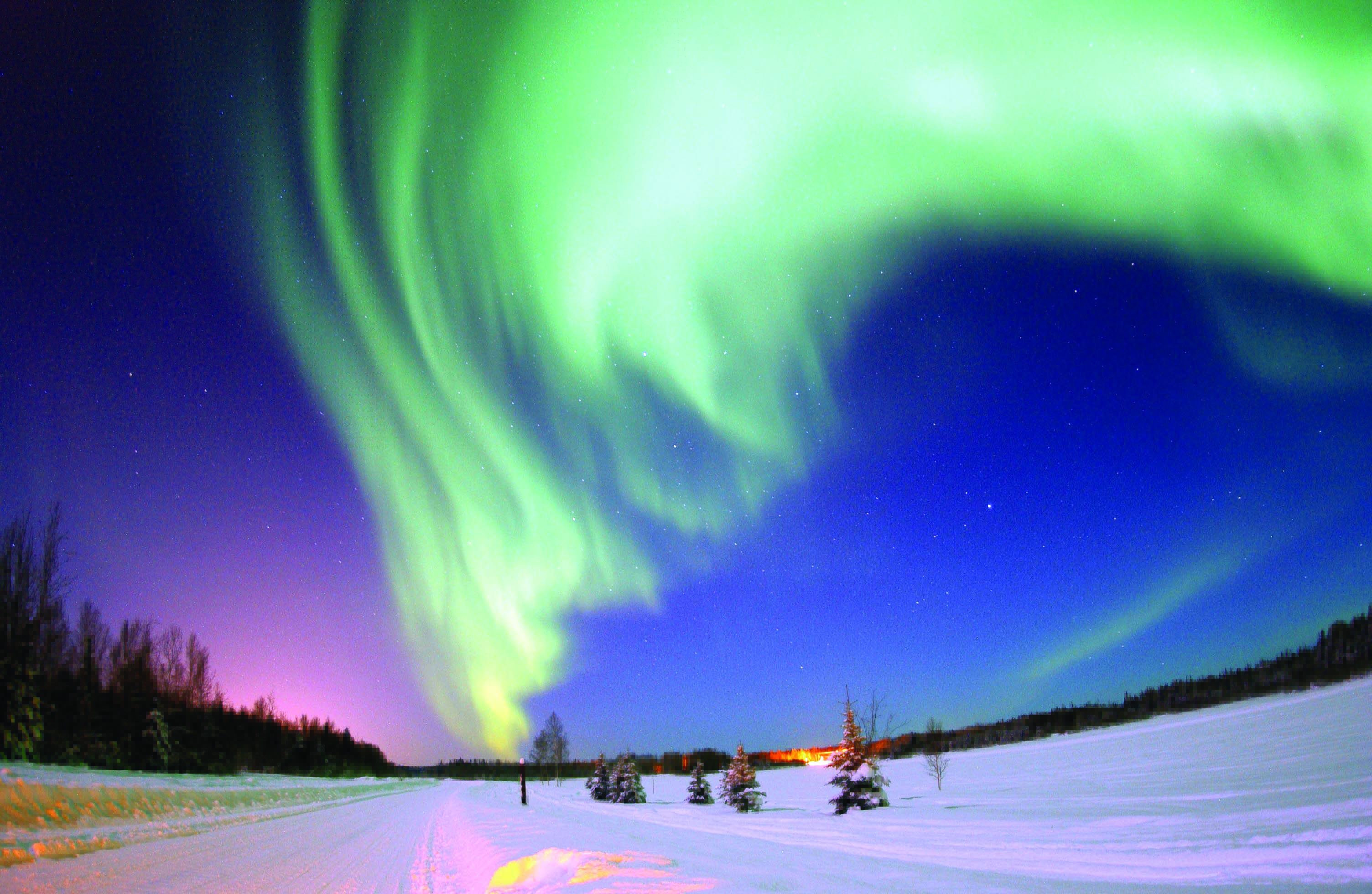
But the beauties of that 1859 light display masked the minor destruction wrought worldwide by an event that scientists now say was a once-in-every-500-year solar flare. As strands of light pulsed overhead in the early morning of that September day, Earth’s changing magnetic field induced electric currents within telegraph wires. Some transmissions were blocked, and fires erupted at a few telegraph stations. Aleksandre “Sandro” Taktakishvili, a researcher and space weather forecaster at UMBC’s newly formed Goddard Planetary Heliophysics Institute (GPHI), observes that if such an event were to occur today, the results could be calamitous. He speaks in hushed tones about the likelihood of damaged and destroyed satellites, overloaded power grids, and useless GPS devices.
“It would be devastating,” Taktakishvili says. “The more dependent we are on satellites, the more vulnerable we are to these events.”
Fortunately, our knowledge of the sun and its capacity to hurl masses of plasma toward Earth has come a long way since 1859. Taktakishvili, who works with other GPHI researchers at NASA’s Goddard Space Flight Center, is part of a rotation of scientists at NASA charged with monitoring the sun’s activity and forecasting what impacts it could have on Earth or on the satellites that orbit around it. He has live access to streams of data
coming from a battery of instruments trained on the sun, and, based on that information, he is confident he can predict the impact that routine solar flares and coronal mass ejections (CMEs) will have on Earth.
Taktakishvili admits that he and other scientists at GPHI, NASA and in the broader research community still have much to learn about how the sun produces flares such as the one that Carrington observed in 1859 – as well as the ways in which such events can play havoc with Earth’s magnetic field.
“With the monitoring we have, we are pretty well prepared,” Taktakishvili says. “Still, you cannot exclude the possibility of something major happening.”
TRACKING SOLAR WIND
Despite the possibility of damaging solar events, Jan Merka, director of GPHI, sounds a more soothing note when he talks about the lucky constellation of events that put Earth in just the right position in relation to the sun for life to thrive on this planet.
“Earth is a homey place,” Merka observes. “We need some radiation, but not too much. We need it to be warm, but not too warm.”
Earth’s magnetic field is an essential part of its suitability for life. Produced by the movement of molten iron in Earth’s outer core, the magnetic field effectively guards the planet against solar wind – a constant barrage of charged particles hurled from the sun. Without that protection, solar wind would have long since stripped away much of the planet’s atmosphere, making Earth a dreary and inhospitable place.
In the absence of solar wind, Earth’s magnetic field would send out an expanding and uniform series of field lines stretching from north to south. A drawing of this field would show lines organized in the sort of lobed race-track pattern that iron filings make when strewn around a bar magnet.
The solar wind, however, distorts the magnetic field, giving it a complex, changing form known as a magnetosphere. Artists’ renditions of the magnetosphere sometimes make it look like a ghostly octopus, with a small head facing the sun and spindly legs stretching out into the solar system.
The 16 scientists at GPHI investigate a range of topics related to solar activity and the magnetosphere. Taktakishvili and several others are concerned with making better forecasts and observations of solar events, providing information that can be used to protect satellites or inform decisions about how close airplanes should fly to Earth’s magnetic poles, where charged particles from the sun are most likely to work their way into the atmosphere.
The risk of illness or even death for those exposed to these particles is a particular challenge for space travel, making better predictions very important, especially in the event that a space crew ever ventures out from the relative safety of the magnetosphere for a months-long journey to Mars.
Other scientists at the institute work with teams that are analyzing data sent from the MESSENGER spacecraft orbiting Mercury or other NASA missions aimed at deepening human knowledge of solar activity and its impacts. Merka talks excitedly about seemingly basic questions that researchers still haven’t answered about solar phenomena. For instance, why and how are charged particles quickly accelerated to speeds of several hundred or even thousands of miles per second after they leave the sun?
“We need to understand all the pieces to reliably simulate space weather and make good predictions,” Merka says.
Merka’s own research delves into the complexities of solar wind and the interactions that occur when this torrent of charged particles collide with Earth’s magnetosphere. In the absence of major solar activity, solar wind can be relatively gentle, with particles cruising through space at about 250 miles per second before being slowed and redirected by Earth’s magnetic field. But things get more interesting when particles kicked out during solar events such as solar flares or coronal mass ejections speed through space at much greater speeds.
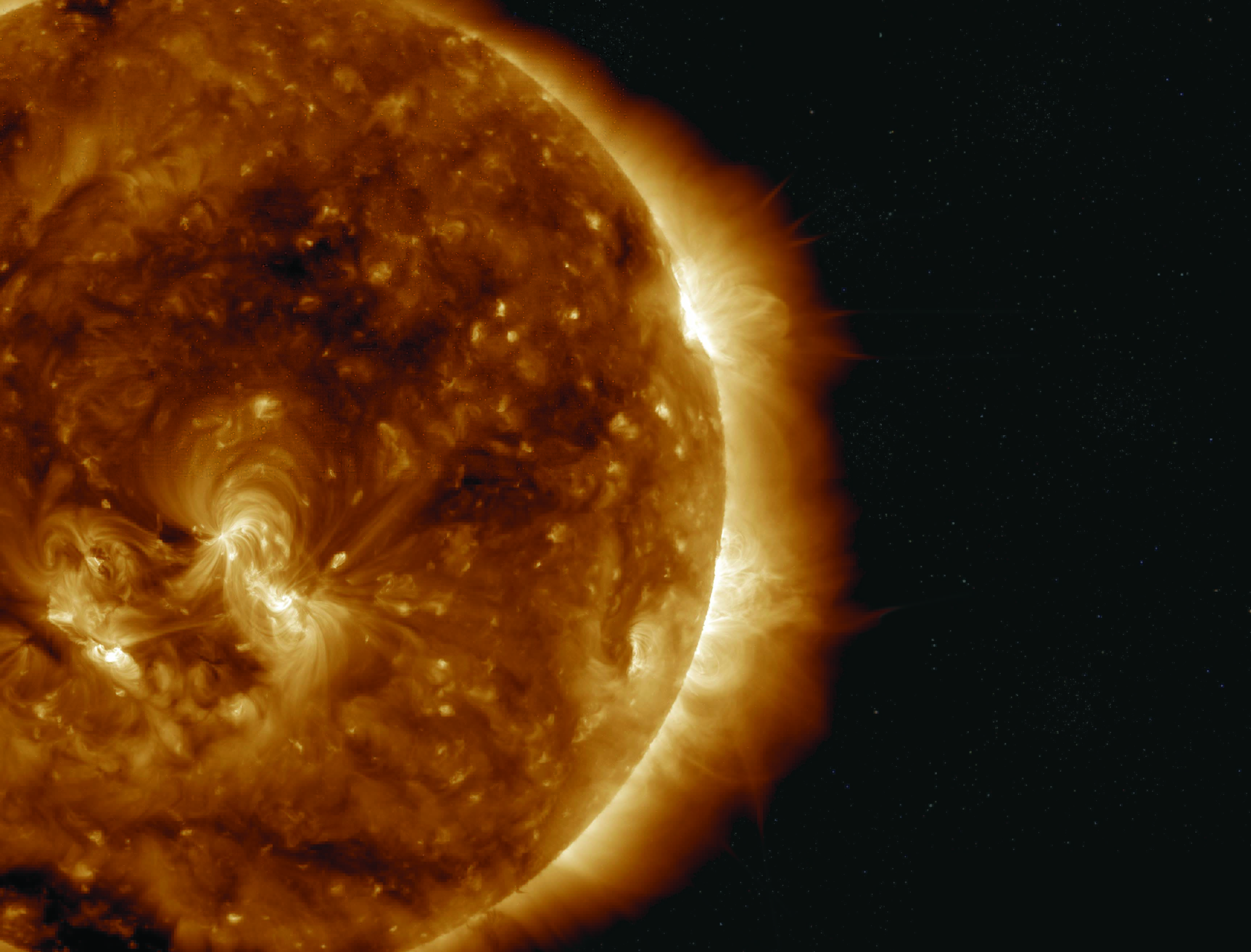
These fast-moving particles plow past their leisurely cousins. The result, Merka explains, is much like what happens when a jet breaks the sound barrier in Earth’s atmosphere. The sonic “boom” you might hear living next to an Air Force base is actually a shock wave that results from air not being able to get out of a speeding plane’s way fast enough. This forms a sharp boundary between the undisturbed air and air that has piled up in front of the plane. In space, there’s no boom anyone could hear. Instead, charged particles pile up in front of the faster-moving sections of the solar wind. This produces an “interplanetary shockwave,” accelerating particles that can then slam into Earth’s magnetosphere and force it to reconfigure.
Predicting and modeling these shocks is one challenge. Another challenge is understanding what happens when solar wind comes in range of Earth’s magnetic field. Just as charged particles pile up when fast sections of solar wind encounter slower parts, the particles start to pile up when they encounter Earth’s magnetic field and need to find a way around it. This forms another shock wave that scientists refer to as the “bow shock.”
In artists’ renditions, the bow shock often looks like a massive deflector shield from a Star Trek episode. Things aren’t totally calm behind it, however. Solar wind slows, compresses, and then heats up at the bow shock, becoming turbulent in a region known as the magnetosheath. Moving closer to Earth, the pressure from the solar particles gradually decreases until it is balanced by the outward pressure exerted by Earth’s magnetic field. The magnetopause is the final boundary beyond which relatively few particles can penetrate.
Understanding how these layers react when the barrage of particles intensifies due to solar storms and interplanetary shocks is critical for predicting the impact these events will have on satellites, power grids and a host of other systems that people on Earth care about.
GPHI scientist Yongli Wang, who works with Merka and other scientists at NASA to accurately model these changes, explains that current modeling techniques face serious limitations. To understand changes in one layer, he frets, scientists have had to treat the others as unchanging or make simplifying assumptions about their shape.
Wang believes that an alternative he is developing with Merka and other colleagues will allow scientists to “forget about assuming structure.” They are working on a new technique which will allow scientists to deal with all the layers simultaneously, drawing on a database that catalogs a wealth of satellite observations collected over four decades. Just as meteorologists have developed ever better models to understand and predict the intensification of hurricanes as they cross Earth’s oceans, Wang and Merka are putting finishing touches on a model that makes sense of data from solar storms. Such a model should help scientists at NASA and elsewhere more accurately predict both the course and consequences of these events.
“This is the golden key to solving this problem,” Wang says.
OBSERVING CYCLES
The prospect of new discoveries in the developing research field of space weather isn’t limited to tracking solar wind and eruptions on the sun.
Keith Strong, a GPHI scientist affiliated with the University of Maryland at College Park, describes a different set of challenges associated with understanding and predicting solar activity. Scientists have known for more than 150 years that solar activity waxes and wanes in cycles of about 11 years, but the mechanism that controls the sun’s magnetic activity – and ultimately produces this cycle – remains a mystery.
“That’s the holy grail of solar physics,” Strong says.
Finding that grail is not just an interesting task for researchers. Sunspots regularly appear on the sun’s surface as small, dark patches. Scientists now know that these patches are associated with intense magnetic activity which reduces the amount of energy escaping. That’s why the spots appear dark: Sunspots are actually cooler than neighboring parts of the sun with weaker magnetic fields.
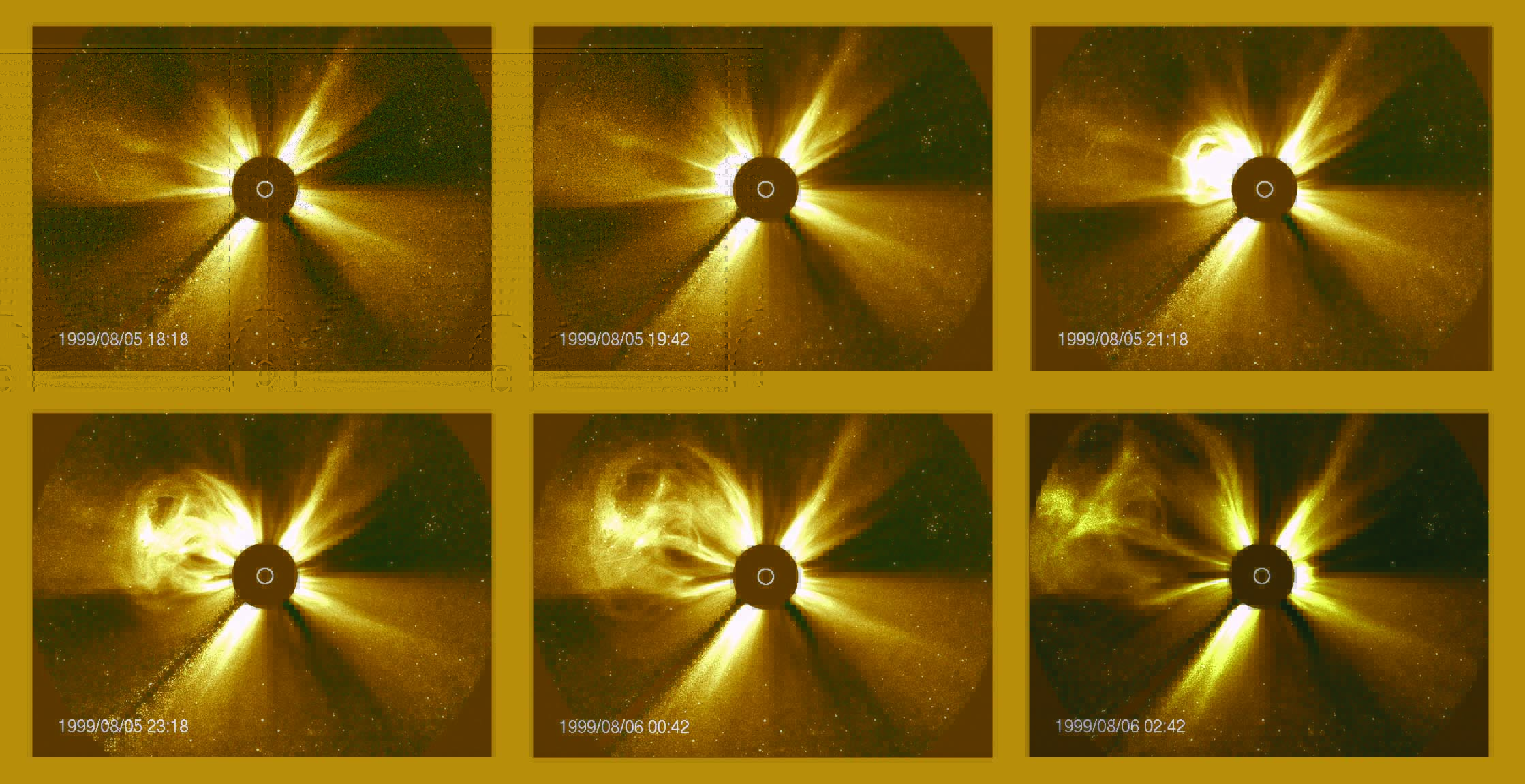
Even with limited understanding of what causes these spots, astronomers have monitored and tracked them for more than 400 years. And for a 70-year period ending around 1715, there was relatively little such activity for these astronomers to see: The sun had entered an extended period of limited activity that is known as the Maunder Minimum.
Scientists debate the extent to which this period of minimal solar activity can be linked to an extended cold snap beginning around 1650 that brought decades of abnormally rainy summers and cold and snowy winters to Europe and North America. And how and why solar activity ebbed during this period is also a mystery.
More recently, the solar cycle that started in 1996 dragged on for 12.6 years, petering out only near the end of 2008. Predictions about the new cycle have repeatedly been wrong, Strong notes, highlighting the gaps in our knowledge: “It is fascinating to realize how little we do understand.”
Ascertaining the underlying mechanism of solar activity could be a huge asset in protecting our satellites and communications systems. It will also be critical if we ever embark on a new phase of space travel. A trip to Mars, for instance, would take about two years, and astronauts during that time could be exposed to potentially lethal streams of high-energy charged particles. Being able to predict when solar activity will be at a minimum will be critical.
Despite its tendency to belch vast quantities of high-energy particles during solar storms, the sun is a much less volatile neighbor than many other stars in the galaxy. As Merka notes, our sun’s relative consistency has been essential for life on Earth to develop. With astronomers discovering an increasing number of planets in orbit around distant stars, Strong says, the ability to recognize the signature of equally stable stars could serve as a “Rosetta Stone” for picking likely candidates to support life.
“By understanding variability,” Strong says, “we might be able to understand what planets could be habitable.”
Since March, Strong has been sharing his fascination with a potentially unlimited audience by posting daily videos on YouTube under the username “drkstrong.” Each episode of “The Sun Today” lasts about five minutes as Strong guides viewers through a series of observations about recent solar activity and explains the mechanics of such events as solar flares and coronal mass ejections (CMEs).
On Aug. 2, Strong began his program with exciting news: “We’ve had a proton flare!” He notes it was a significant, though not unusual flare, and he quickly segues to the day’s trivia question: “How many times brighter than this… flare was the largest flare ever observed by astronomers?” Strong goes on to show data and images from a variety of NASA instruments and satellites, with animations illustrating the blast of charged particles surging into space. At the end of the program, he answers the trivia question, recalling that the observation of the largest flare ever was made six years ago by astronomers looking at the star II Pegasi. That flare, Strong says, was 100 million times larger than the one just observed on the sun.
“That would have had some very serious consequences for the Earth,” he observes. “Like, our civilizations would probably be reduced to rubble, assuming any of us survived.”
But you needn’t worry about that happening here on planet earth. At least not yet.
“Just be thankful,” he says, “that we live around a star that is quiescent enough that we survived, but variable enough to be interesting.”
* * * * *
Web Extras
Complex Solar Eruption
Having a Solar Blast
Spacecraft Observes Coronal Mass Ejection

Today’s Forecast: Stellar


Researchers at UMBC’s newly formed NASA research center wrestle with basic questions about our neighborhood star – and the effects that its weather can create on Earth.

By Anthony Lane

On the morning of September 1, 1859, a British solar astronomer was using his telescope to look at a projected image of the sun when something strange happened: Two brilliant patches of white light pierced the thicket of sunspots he’d been tracking.

Richard Carrington, the astronomer, was astounded by what he saw. He scrambled outside to find someone to join him as a witness to the amazing spectacle, but by the time he’d grabbed a bystander and returned a minute later, the solar eruption was nearly over.

Carrington’s account of the event might have been ignored or forgotten were it not for a much more widespread spectacle that commenced about 17 hours later. Auroras – which are normally seen only from the planet’s far north and south extremes – laced the night sky above Cuba, El Salvador and Hawaii. And according to a whimsical account in the Baltimore American and Commercial Advertiser, Marylanders saw an aurora that shined brighter than a full moon, appearing to “cover the whole firmament, apparently like a luminous cloud, through which the stars of the larger magnitude indistinctly shone.”

But the beauties of that 1859 light display masked the minor destruction wrought worldwide by an event that scientists now say was a once-in-every-500-year solar flare. As strands of light pulsed overhead in the early morning of that September day, Earth’s changing magnetic field induced electric currents within telegraph wires. Some transmissions were blocked, and fires erupted at a few telegraph stations. Aleksandre “Sandro” Taktakishvili, a researcher and space weather forecaster at UMBC’s newly formed Goddard Planetary Heliophysics Institute (GPHI), observes that if such an event were to occur today, the results could be calamitous. He speaks in hushed tones about the likelihood of damaged and destroyed satellites, overloaded power grids, and useless GPS devices.

“It would be devastating,” Taktakishvili says. “The more dependent we are on satellites, the more vulnerable we are to these events.”

Fortunately, our knowledge of the sun and its capacity to hurl masses of plasma toward Earth has come a long way since 1859. Taktakishvili, who works with other GPHI researchers at NASA’s Goddard Space Flight Center, is part of a rotation of scientists at NASA charged with monitoring the sun’s activity and forecasting what impacts it could have on Earth or on the satellites that orbit around it. He has live access to streams of data

coming from a battery of instruments trained on the sun, and, based on that information, he is confident he can predict the impact that routine solar flares and coronal mass ejections (CMEs) will have on Earth.

Taktakishvili admits that he and other scientists at GPHI, NASA and in the broader research community still have much to learn about how the sun produces flares such as the one that Carrington observed in 1859 – as well as the ways in which such events can play havoc with Earth’s magnetic field.

“With the monitoring we have, we are pretty well prepared,” Taktakishvili says. “Still, you cannot exclude the possibility of something major happening.”

TRACKING SOLAR WIND

Despite the possibility of damaging solar events, Jan Merka, director of GPHI, sounds a more soothing note when he talks about the lucky constellation of events that put Earth in just the right position in relation to the sun for life to thrive on this planet.

“Earth is a homey place,” Merka observes. “We need some radiation, but not too much. We need it to be warm, but not too warm.”

Earth’s magnetic field is an essential part of its suitability for life. Produced by the movement of molten iron in Earth’s outer core, the magnetic field effectively guards the planet against solar wind – a constant barrage of charged particles hurled from the sun. Without that protection, solar wind would have long since stripped away much of the planet’s atmosphere, making Earth a dreary and inhospitable place.

In the absence of solar wind, Earth’s magnetic field would send out an expanding and uniform series of field lines stretching from north to south. A drawing of this field would show lines organized in the sort of lobed race-track pattern that iron filings make when strewn around a bar magnet.

The solar wind, however, distorts the magnetic field, giving it a complex, changing form known as a magnetosphere. Artists’ renditions of the magnetosphere sometimes make it look like a ghostly octopus, with a small head facing the sun and spindly legs stretching out into the solar system.

The 16 scientists at GPHI investigate a range of topics related to solar activity and the magnetosphere. Taktakishvili and several others are concerned with making better forecasts and observations of solar events, providing information that can be used to protect satellites or inform decisions about how close airplanes should fly to Earth’s magnetic poles, where charged particles from the sun are most likely to work their way into the atmosphere.

The risk of illness or even death for those exposed to these particles is a particular challenge for space travel, making better predictions very important, especially in the event that a space crew ever ventures out from the relative safety of the magnetosphere for a months-long journey to Mars.

Other scientists at the institute work with teams that are analyzing data sent from the MESSENGER spacecraft orbiting Mercury or other NASA missions aimed at deepening human knowledge of solar activity and its impacts. Merka talks excitedly about seemingly basic questions that researchers still haven’t answered about solar phenomena. For instance, why and how are charged particles quickly accelerated to speeds of several hundred or even thousands of miles per second after they leave the sun?

“We need to understand all the pieces to reliably simulate space weather and make good predictions,” Merka says.

Merka’s own research delves into the complexities of solar wind and the interactions that occur when this torrent of charged particles collide with Earth’s magnetosphere. In the absence of major solar activity, solar wind can be relatively gentle, with particles cruising through space at about 250 miles per second before being slowed and redirected by Earth’s magnetic field. But things get more interesting when particles kicked out during solar events such as solar flares or coronal mass ejections speed through space at much greater speeds.

These fast-moving particles plow past their leisurely cousins. The result, Merka explains, is much like what happens when a jet breaks the sound barrier in Earth’s atmosphere. The sonic “boom” you might hear living next to an Air Force base is actually a shock wave that results from air not being able to get out of a speeding plane’s way fast enough. This forms a sharp boundary between the undisturbed air and air that has piled up in front of the plane. In space, there’s no boom anyone could hear. Instead, charged particles pile up in front of the faster-moving sections of the solar wind. This produces an “interplanetary shockwave,” accelerating particles that can then slam into Earth’s magnetosphere and force it to reconfigure.

Predicting and modeling these shocks is one challenge. Another challenge is understanding what happens when solar wind comes in range of Earth’s magnetic field. Just as charged particles pile up when fast sections of solar wind encounter slower parts, the particles start to pile up when they encounter Earth’s magnetic field and need to find a way around it. This forms another shock wave that scientists refer to as the “bow shock.”

In artists’ renditions, the bow shock often looks like a massive deflector shield from a Star Trek episode. Things aren’t totally calm behind it, however. Solar wind slows, compresses, and then heats up at the bow shock, becoming turbulent in a region known as the magnetosheath. Moving closer to Earth, the pressure from the solar particles gradually decreases until it is balanced by the outward pressure exerted by Earth’s magnetic field. The magnetopause is the final boundary beyond which relatively few particles can penetrate.

Understanding how these layers react when the barrage of particles intensifies due to solar storms and interplanetary shocks is critical for predicting the impact these events will have on satellites, power grids and a host of other systems that people on Earth care about.

GPHI scientist Yongli Wang, who works with Merka and other scientists at NASA to accurately model these changes, explains that current modeling techniques face serious limitations. To understand changes in one layer, he frets, scientists have had to treat the others as unchanging or make simplifying assumptions about their shape.

Wang believes that an alternative he is developing with Merka and other colleagues will allow scientists to “forget about assuming structure.” They are working on a new technique which will allow scientists to deal with all the layers simultaneously, drawing on a database that catalogs a wealth of satellite observations collected over four decades. Just as meteorologists have developed ever better models to understand and predict the intensification of hurricanes as they cross Earth’s oceans, Wang and Merka are putting finishing touches on a model that makes sense of data from solar storms. Such a model should help scientists at NASA and elsewhere more accurately predict both the course and consequences of these events.

“This is the golden key to solving this problem,” Wang says.

OBSERVING CYCLES

The prospect of new discoveries in the developing research field of space weather isn’t limited to tracking solar wind and eruptions on the sun.

Keith Strong, a GPHI scientist affiliated with the University of Maryland at College Park, describes a different set of challenges associated with understanding and predicting solar activity. Scientists have known for more than 150 years that solar activity waxes and wanes in cycles of about 11 years, but the mechanism that controls the sun’s magnetic activity – and ultimately produces this cycle – remains a mystery.

“That’s the holy grail of solar physics,” Strong says.

Finding that grail is not just an interesting task for researchers. Sunspots regularly appear on the sun’s surface as small, dark patches. Scientists now know that these patches are associated with intense magnetic activity which reduces the amount of energy escaping. That’s why the spots appear dark: Sunspots are actually cooler than neighboring parts of the sun with weaker magnetic fields.

Even with limited understanding of what causes these spots, astronomers have monitored and tracked them for more than 400 years. And for a 70-year period ending around 1715, there was relatively little such activity for these astronomers to see: The sun had entered an extended period of limited activity that is known as the Maunder Minimum.

Scientists debate the extent to which this period of minimal solar activity can be linked to an extended cold snap beginning around 1650 that brought decades of abnormally rainy summers and cold and snowy winters to Europe and North America. And how and why solar activity ebbed during this period is also a mystery.

More recently, the solar cycle that started in 1996 dragged on for 12.6 years, petering out only near the end of 2008. Predictions about the new cycle have repeatedly been wrong, Strong notes, highlighting the gaps in our knowledge: “It is fascinating to realize how little we do understand.”

Ascertaining the underlying mechanism of solar activity could be a huge asset in protecting our satellites and communications systems. It will also be critical if we ever embark on a new phase of space travel. A trip to Mars, for instance, would take about two years, and astronauts during that time could be exposed to potentially lethal streams of high-energy charged particles. Being able to predict when solar activity will be at a minimum will be critical.

Despite its tendency to belch vast quantities of high-energy particles during solar storms, the sun is a much less volatile neighbor than many other stars in the galaxy. As Merka notes, our sun’s relative consistency has been essential for life on Earth to develop. With astronomers discovering an increasing number of planets in orbit around distant stars, Strong says, the ability to recognize the signature of equally stable stars could serve as a “Rosetta Stone” for picking likely candidates to support life.

“By understanding variability,” Strong says, “we might be able to understand what planets could be habitable.”

Since March, Strong has been sharing his fascination with a potentially unlimited audience by posting daily videos on YouTube under the username “drkstrong.” Each episode of “The Sun Today” lasts about five minutes as Strong guides viewers through a series of observations about recent solar activity and explains the mechanics of such events as solar flares and coronal mass ejections (CMEs).

On Aug. 2, Strong began his program with exciting news: “We’ve had a proton flare!” He notes it was a significant, though not unusual flare, and he quickly segues to the day’s trivia question: “How many times brighter than this… flare was the largest flare ever observed by astronomers?” Strong goes on to show data and images from a variety of NASA instruments and satellites, with animations illustrating the blast of charged particles surging into space. At the end of the program, he answers the trivia question, recalling that the observation of the largest flare ever was made six years ago by astronomers looking at the star II Pegasi. That flare, Strong says, was 100 million times larger than the one just observed on the sun.

“That would have had some very serious consequences for the Earth,” he observes. “Like, our civilizations would probably be reduced to rubble, assuming any of us survived.”

But you needn’t worry about that happening here on planet earth. At least not yet.

“Just be thankful,” he says, “that we live around a star that is quiescent enough that we survived, but variable enough to be interesting.”

* * * * *

Web Extras

Complex Solar Eruption

Having a Solar Blast

Spacecraft Observes Coronal Mass Ejection

To You – Fall 2011

Time flies when you’re having fun. And the three years that I have spent as editor of UMBC Magazine have flown by quickly. One reason is this time has flown is the terrific stories about the university and its alumni that I encounter almost every day in the course of editing the magazine.
Sometimes they arrive in an e-mail. Occasionally, it’s a phone call. And some of them come in a stamped envelope. Many stories also come from encounters that I have with students, faculty and staff on campus. I’ve even been accosted on the MARC train as I commute to UMBC, and in my neighborhood in Washington, DC, by people with a UMBC story to tell.
Each one of these stories is individual. They are unique in their struggles and in their triumphs, their joys and their sorrows. But as the editor of the magazine who gathers them, I see them accumulate a collective weight. They weave together into patterns and create broader narratives.
Part of that narrative is rooted in UMBC’s position as a public university.
Public universities are special because their openness and academic excellence serve as engines of transformation in people’s lives. Most of us who attended UMBC in any era of the university’s 45 years of existence do not come from a position of economic privilege. So many of the stories that I hear are tales of alumni who had to work at a job as they studied through UMBC, or who had to sacrifice – personally or as a family – to obtain their degrees.
Yet the work and sacrifice and smarts that UMBC alumni put into their degrees also left them savoring their university experience that much more. We worked hard at UMBC – and we played hard, too.
I hope that UMBC Magazine is way for you to rediscover that narrative.
In this issue, for instance, you can read about how one alumnus, Joseph T. Jones, Jr. ’06, surmounted a life that began with a broken home and selling drugs to become one of the leading voices in the nation for creating economic opportunity and repairing families. You can also read about how many individuals and institutions – alumni, corporations, friends of UMBC – banded together collectively to aid the university in its successful capital campaign (Exceptional by Example) to raise $115 million to support the aspirations of students, faculty and staff.
We’ve also devoted a few stories to another collective experience for alumni and the larger university community: UMBC Homecoming (October 12-15). I hope the stories will entice you to look at the schedule of events at the UMBC Homecoming website.
Whether you like UMBC soccer under the lights, or terrific food and fellowship, or want a chance to sample the work of alumni filmmakers, UMBC Homecoming is another chance to weave your story back into the university community. And also to have a great time as you do it. I hope I’ll see you there!
— Richard Byrne ’86

The News – Fall 2011

WONDERFUL WORKPLACE

UMBC’s reputation as an “honors university in Maryland” and as a place that revels in the diversity of its community have made it a destination for students. But what do the university’s faculty and staff members think about working at UMBC?

If the Chronicle of Higher Education’s annual survey of “Great Colleges to Work For” is any indication, professor and staffers alike are finding UMBC to be a destination as well. The university was one of only 42 colleges and universities in the nation – and the only four-year institution in Maryland – to make the newspaper’s Honor Roll of workplaces.

The Chronicle conducts an institutional audit of demographics and workplace policies, and then surveys more than 43,000 faculty and staff at 310 institutions across the United States, in order to compile its list. UMBC ranked highly in eight of the 12 categories surveyed, including “collaborative governance,” “professional/career development programs,” “work/life balance,” “confidence in senior leadership,” “respect and appreciation,” and “diversity.”

Employee responses were the key factor in the rankings, and faculty and staff members were selected at random. To make the Chronicle’s Honor Roll of “Great Colleges to Work For,” a university needed to place in the top ten in one of three respective categories of enrollment.

Stanyell Bruce, associate director of alumni relations and the president of UMBC’s Professional Staff Senate, says “It’s no surprise to me that the university won this distinction. UMBC is a place where people truly care about one another, and a place that encourages innovation and out of the box thinking.”

— Richard Byrne ’86

STEPPING UP

When UMBC provost Elliot Hirshman departed in June to become the new president of San Diego State University, the university quickly tapped two of its distinguished academic leaders to fill key positions for the upcoming academic year.

On June 17, UMBC President Freeman A. Hrabowski, III, named Philip J. Rous, dean of the College of Natural and Mathematical Sciences (CNMS) as the university’s interim provost and senior vice president for academic affairs. Rous came to UMBC in 1990 as an assistant professor of physics, rising to positions as professor of physics and as vice president and president of the university’s Faculty Senate from 2003 to 2007.

William R. LaCourse, chair of UMBC’s chemistry and biochemistry department, was tapped to replace Rous as interim dean of the College of Natural and Mathematical sciences. He arrived at UMBC in 1992 as an assistant professor of chemistry.

Both Rous and LaCourse have been in the forefront of UMBC’s nationally recognized efforts to reshape the institution’s curriculum and improve student outcomes. Interim provost Rous spearheaded the creation of CNMS’ Active Science Teaching and Learning Environment (CASTLE), which is reinventing teaching practice with an emphasis on student engagement. He is also principal investigator (PI) for the Howard Hughes Medical Institute’s National Experiment in Undergraduate Science and Co-PI for the National Science Foundation’s Innovation Through Institutional Integration.

Interim dean LaCourse founded the Chemistry Discovery Center, which has become a national model in teaching innovation in the sciences, and he has been at the forefront of efforts to weave entrepreneurship in disciplines across the university through the Kauffman Entrepreneurship Initiative.

— Richard Byrne ’86

ALUMNI ACCOLADES

Among the highlights of UMBC’s Homecoming 2011 is a ceremony that honors university alumni who have achieved distinction in a wide range of disciplines and careers.

The UMBC Alumni Association – which selects recipients and presents the awards – moved the annual Outstanding Alumni of the Year ceremony back to campus in 2009, and it has since become a key element of the university’s celebration of school spirit.

This year’s recipients of the awards – which will be presented on Thursday, October 13 at 7:30 p.m. in the Albin O. Kuhn Library Gallery – include alumni who’ve reached prominence in the fields of technology, medicine, journalism and business. This year’s recipients are:

Ralph Semmel ’92, Ph.D., computer science, is the UMBC Alumnus of the Year in Engineering and Information Technology. In 2010, Semmel was named as the eighth director of The Johns Hopkins University Applied Physics Laboratory – one of the most prominent hubs of advanced technological research in the world.

Ronita Marple, ’05, Ph.D., chemistry, is the UMBC Alumna of the Year in the Natural and Mathematical Sciences. She is an analytical chemist and senior scientist for consumer goods giant Procter & Gamble.

Jamie Smith Hopkins ’98, English, is the UMBC Alumna of the Year in the Humanities. She has been a reporter at The Baltimore Sun since 1999, and writes and blogs for the paper on the housing industry in the Baltimore metropolitan region. (UMBC Magazine profiled Hopkins in its Summer 2010 issue.)

Garrett Wright ’01, theatre, is the UMBC Alumnus of the Year in the Visual and Performing Arts. Wright is a staff attorney at the Urban Justice Center’s Community Development Project, where he provides legal support to low-income tenants and tenant organizations.

Dr. Jeffery Wilkinson ’89, interdisciplinary studies, is the UMBC Alumnus of the Year in the Social Sciences. He works at the University of North Carolina’s School of Medicine, and he has won renown as a global leader in combating obstetric fistula in some of the poorest regions of the world – including Asia and sub-Saharan Africa. (Wilkinson was profiled in the Summer 2009 issue of UMBC Magazine.)

Delali Dzirasa ’04, computer engineering, is UMBC’s Young Alumni Rising Star. He is the owner of Fearless Solutions, a cybersecurity company based in the bwtech@UMBC Research Park that focuses on secure software development, and already boasts several contracts with the federal government.

— Richard Byrne ’86

Targeting Tastes – Maggie Lebherz ’08, MLL

Some students studying abroad fall in love with a place. Maggie Lebherz ’08, modern languages and linguistics, fell in love with some new tastes during her semester at the University of Salamanca.

“Tasting fresh olive oil added an entirely new dimension to it, and I also learned about the health benefits of olive oil,” she says. “I had never had true balsamic vinegar, and even the best ones on the market here could not compare to what I had in Spain.”

The love affair that Lebherz developed with balsamic vinegar and fresh olive oil while studying in Spain has translated into a most unusual business venture: Lebherz Oil & Vinegar Emporium (LOVE) in her hometown of Frederick.

After graduating from UMBC, Lebherz returned to Frederick, working as a translator for the local school system. However, when a redistricting left her with a job as a secretary, she began to consider opening her own store focused on the two products she loved: olive oil and vinegar. Many people thought she was nuts to build a business on two products. But, as Lebherz says, “I told people that Baskin-Robbins ‘just’ sells ice cream.”

Working with the local Small Business Development Center (created by a collaboration of federal, state and local agencies), Lebherz put together a business plan. “My saving grace was Chris Olson, a retired businessman who helped me pull everything together and make projections,” she says. “But it was difficult because there were no other similar businesses to compare what I wanted to do.”

After extensive research and contributions from her own savings and financial help from family and friends, Lebherz threw open the doors of her store, Lebherz Oil & Vinegar Emporium, in June 2010.

Lebherz imports her olive oil from eight different countries and her vinegars from three countries. She buys in small quantities to keep the products fresh. The emporium boasts 25 different vinegars (including lavender and vanilla balsamic) and 30 different oils, including a blood orange and a Persian lime olive oil.

Most first-time visitors expect to see bottles waiting to be picked off the shelves. But Lebherz keep all her product on tap in “fustis,” which resemble ornate samovars. Cubes of fresh bread and small paper cups allow customers to sample oils and vinegars before making a purchase. “The stainless steel fustis ha

ve gaskets on top, which prevent oxidation and are key to keeping the oil from deteriorating,” says Lebherz, “and they also block the sunlight.”

Of course, Lebherz is on hand to offer suggestions to customers. “Believe it or not, wild blueberry balsamic vinegar is great on vanilla ice cream,” she says. “It really is a great complement to a number of desserts.” And her customers come up with their own twists – reducing wild blueberry balsamic and pouring it on pancakes, or using a dark chocolate balsamic to craft a terrific mole sauce. Indeed, a Frederick gelato store rustles up one of its flavors with that wild blueberry balsamic, which is so popular that Lebherz has a hard time keeping in stock.

Frederick is increasingly being seen as a food destination, and the emporium has forged a strong local following. But the shop does face challenges. A two-week period between ordering olive oil and actually receiving it requires some fine tuning in managing inventory. And when winter weather delayed a delivery of bottles from a California factory, she had to close the store for several days last year. “The trucks that were bringing the bottles got stuck in a snowstorm, and by law I can only sell the oil and vinegar in my store’s own bottles,” notes Lebherz.

Lebherz credits her family for providing practical assistance as well as investments. Her father helped make the store’s shelving. An aunt designed the shop’s website. And her mother and sister worked part-time in the store for no financial compensation for a few months. But the business has done well enough that her mother is now on the payroll on a part-time basis, and Lebherz has also hired another part-time staffer. And while the emporium isn’t showing a profit yet, Lebherz is very optimistic about the future.

“My main reason for doing this is for the health benefits of fresh olive oil and it is something that everyone can enjoy,” she says. “And this store feels like it is a little piece of Europe.”

— Mary Medland

Targeting Tastes – Maggie Lebherz '08, MLL

Some students studying abroad fall in love with a place. Maggie Lebherz ’08, modern languages and linguistics, fell in love with some new tastes during her semester at the University of Salamanca.
“Tasting fresh olive oil added an entirely new dimension to it, and I also learned about the health benefits of olive oil,” she says. “I had never had true balsamic vinegar, and even the best ones on the market here could not compare to what I had in Spain.”
The love affair that Lebherz developed with balsamic vinegar and fresh olive oil while studying in Spain has translated into a most unusual business venture: Lebherz Oil & Vinegar Emporium (LOVE) in her hometown of Frederick.
After graduating from UMBC, Lebherz returned to Frederick, working as a translator for the local school system. However, when a redistricting left her with a job as a secretary, she began to consider opening her own store focused on the two products she loved: olive oil and vinegar. Many people thought she was nuts to build a business on two products. But, as Lebherz says, “I told people that Baskin-Robbins ‘just’ sells ice cream.”
Working with the local Small Business Development Center (created by a collaboration of federal, state and local agencies), Lebherz put together a business plan. “My saving grace was Chris Olson, a retired businessman who helped me pull everything together and make projections,” she says. “But it was difficult because there were no other similar businesses to compare what I wanted to do.”
After extensive research and contributions from her own savings and financial help from family and friends, Lebherz threw open the doors of her store, Lebherz Oil & Vinegar Emporium, in June 2010.
Lebherz imports her olive oil from eight different countries and her vinegars from three countries. She buys in small quantities to keep the products fresh. The emporium boasts 25 different vinegars (including lavender and vanilla balsamic) and 30 different oils, including a blood orange and a Persian lime olive oil.
Most first-time visitors expect to see bottles waiting to be picked off the shelves. But Lebherz keep all her product on tap in “fustis,” which resemble ornate samovars. Cubes of fresh bread and small paper cups allow customers to sample oils and vinegars before making a purchase. “The stainless steel fustis ha
ve gaskets on top, which prevent oxidation and are key to keeping the oil from deteriorating,” says Lebherz, “and they also block the sunlight.”
Of course, Lebherz is on hand to offer suggestions to customers. “Believe it or not, wild blueberry balsamic vinegar is great on vanilla ice cream,” she says. “It really is a great complement to a number of desserts.” And her customers come up with their own twists – reducing wild blueberry balsamic and pouring it on pancakes, or using a dark chocolate balsamic to craft a terrific mole sauce. Indeed, a Frederick gelato store rustles up one of its flavors with that wild blueberry balsamic, which is so popular that Lebherz has a hard time keeping in stock.
Frederick is increasingly being seen as a food destination, and the emporium has forged a strong local following. But the shop does face challenges. A two-week period between ordering olive oil and actually receiving it requires some fine tuning in managing inventory. And when winter weather delayed a delivery of bottles from a California factory, she had to close the store for several days last year. “The trucks that were bringing the bottles got stuck in a snowstorm, and by law I can only sell the oil and vinegar in my store’s own bottles,” notes Lebherz.
Lebherz credits her family for providing practical assistance as well as investments. Her father helped make the store’s shelving. An aunt designed the shop’s website. And her mother and sister worked part-time in the store for no financial compensation for a few months. But the business has done well enough that her mother is now on the payroll on a part-time basis, and Lebherz has also hired another part-time staffer. And while the emporium isn’t showing a profit yet, Lebherz is very optimistic about the future.
“My main reason for doing this is for the health benefits of fresh olive oil and it is something that everyone can enjoy,” she says. “And this store feels like it is a little piece of Europe.”
— Mary Medland

Over Coffee – Fall 2011

UMBC Homecoming has undergone major changes over the past three years, and a trio of dedicated staffers who lead the university’s Homecoming Committee – Kevin Gibbons O’Neill ’86, economics, assistant athletic director, Jen Dress, coordinator of major events in the Office of Student Life and Stanyell Bruce, associate director of alumni relations – have spearheaded the makeover. We got them together to talk about why the university has spent so much time and energy improving the Homecoming experience – and just what’s in store when you visit us over the weekend of October 12 through 15!

* * * *

Why did UMBC decide to shift more emphasis to celebrating Homecoming as an event for students and alumni? And what’s changed as the university has done so?

Jen Dress: I think about the student who’s been here for four years. Our focus has been building an experience that students will think about when they are here – and that makes them want to come back as alumni. Four years ago, we had a lot of the same events, but they felt isolated from each other. Now we’re connecting them and increasing them in size and scope.

Take the Wednesday night bonfire. We now need an agricultural permit for the bonfire – which means a bigger, better, blazing fire. Students had skepticism about it: Will this really be cool? But you look at pictures and see how students are real close at the beginning and then have to move back as the bonfire ramps up. They see it’s a much bigger thing.

Kevin Gibbons-O’Neill: We in the athletics department have become better partners. For instance, we moved the soccer game to Friday night under the lights, and that’s created an amazing atmosphere. From Midnight Madness on Wednesday through the 5K Dawg Chase and club sport games on Saturday, we’re trying to make the experience fun. If students don’t have fun as freshmen and sophomores, they won’t come when they’re juniors or seniors – or when they are 40 years old.

What recent changes do you think will attract alumni – who are, after all, the traditional audience for Homecoming?

Stanyell Bruce: The alumni piece is challenging. But we’re getting better at it. We’ve only been doing Homecoming for 11 years, so alumni who graduated before 1999 really don’t identify with the event as much.

So we’re trying to let alumni know that there are a lot of options for them – and many events on the calendar are designed to appeal to different audiences. We have a community picnic on Saturday because we know that a lot of our alumni have families – and we wanted to have an event with an atmosphere that makes them comfortable bringing the entire family. But we’re also having a number of more grown-up events in the afternoon and evening, including a Taste of UMBC with live music from alumni bands. There is something for everyone.

Dress: Last year, the community picnic was a real gamble. We didn’t know what it was going to look like. But it was cool, because the event really does epitomize what sort of community we have at UMBC. There were athletics alumni coming over after a club game in the morning, or alumni coming for afternoon events stopping to eat first.

Bruce: We’ve put a lot of the day’s activities under the umbrella of “UMBC Festival” – the community picnic, carnival attractions, the Taste of UMBC. For me, it’s going to be exciting to see what the Quad looks like from 11 a.m. to 7 p.m. on Homecoming Saturday.

Gibbons-O’Neill: Stanyell mentioned that we’ve only been doing Homecoming for 11 years. And as a university, we’re only 45 years old. You have to wonder what Homecoming was like at Harvard in 1681. Right now, we’re still the founders of what the tradition of Homecoming will be at UMBC.

— Richard Byrne ’86

How To Grow Your Big Idea

With Vivian Armor ’73, director, Alex. Brown Center for Entrepreneurship

You wake up one morning with a big, bright light bulb bobbing above your head. You start your day, feed the dog, the light getting brighter by the minute. Pretty soon, it’s keeping you up at night. Well, congratulations. Your “big idea” has arrived – and with it, a world of possibility.

So, now what? Do you cash in your life savings for seed money? Get a fancy business degree? Buy the book by that guy in the suit covered in question marks?

Maybe you take some (absolutely) free advice from Vivian Armor ’73, American studies. She is director of UMBC’s Alex. Brown Center for Entrepreneurship and has some tips about how to move ahead safely and smartly so you can make all your wildest dreams come true.

— Jenny O’Grady

Step 1:
Reality Check

our idea is precious and perfect and unique like a snowflake. But, how does it stand up to the scrutiny of others?

“Nobody wants to hear the baby’s ugly, but maybe it needs braces,” says Armor. She suggests running your brainchild past a few friends or family members you trust to be honest with you, as well as professionals in the industry related to your idea. Doing so can help you step away from your idea, and more objectively assess the pros and cons. The more feedback you get and the more open-minded you are about tweaking your idea to address potential flaws, the better chance you have of starting off strong.

Step 2:
Write a Business Plan

Once you’ve put your idea through the blender, it’s time to write up some solid plans. Questions to consider: What is your timeline? What kind of support will you need to execute your plan? How will you promote your idea to potential buyers? Who are your competitors and why is your idea better? How much work is this really going to be?

“It helps to take out a piece of paper and really think about these things,” says Armor. Questions like these may take a bit of the wind out of your sails, but they’re important to answer early on.

Step 3:
Perfect Your Pitch

A concept is never enough on its own – you also need to be able to quickly convince investors why it’s a great idea that they should care enough about to support. And that means perfecting your so-called “elevator speech.”

“Look, I don’t know what you’re selling, but if you can describe it well, you’ll help people to connect the dots,” says Armor, who again suggests turning to friends for practice. If you find you can’t describe your plan quickly and easily, you might need to take a quick detour back to Step 2.

Step 4:
Know There’s Help Out There

As in so many steps before, one fact rises above the rest in the world of entrepreneurship: it’s rarely a one-person show. Counting on trusted partners to refine your plan and give you new ideas is crucial, but so is relying on the many resources available to you as a budding entrepreneur.

Armor cites the Alex. Brown Center for Entrepreneurship as a one-stop shop for all things “start-up.” The center works with faculty to help infuse courses across UMBC’s curriculum with entrepreneurial material. It also offers a campus “Idea Lab” and mentoring and internship opportunities. In addition, Armor touts the center’s Raymond V. Haysbert, Sr. Entrepreneurship Lecture Series, which provides a platform for successful entrepreneurs to candidly share their experiences and insights with the public.

“People are here to help you,” she says. “We want you to succeed.”

* * * * *

Video: Intro to Entrepreneurship

What’s it really take to succeed as an entrepreneur? UMBC entrepreneurship experts Armor, “serial entrepreneur” Gib Mason ’95, economics, and Interim Dean of the College of Natural and Mathematical Sciences William R. LaCourse discuss how passion, creativity, determination – and a combination of the right skills – can open up a world of opportunity to young entrepreneurs. WATCH THE VIDEO

Highways to Healing – Omolola Eniola-Adefeso '99, ChemEng

Once upon a time, Omolola Eniola-Adefeso ’99, chemical engineering, was on track to attend medical school. But she became a chemical engineer instead – so she could better attack problems such as her number one target: heart disease.
Eniola-Adefeso, an assistant professor of chemical engineering at the University of Michigan, investigates radical ways of delivering medicine that could prove efficient and effective than current practice. And she may succeed because she is thinks like an engineer – and not a doctor. Eniola-Adefeso came to Maryland from her native Nigeria the age of 16. She began her studies at Catonsville Community College, before transferring to UMBC, where she met the late Janice Lumpkin, an African-American chemical engineering professor. Lumpkin not only guided her student into a field where her passion for technology and medicine could intersect, but also helped her become a member of the first class of UMBC students in the Minority Access to Research Careers program.
After graduating from UMBC, she took a doctorate at the University of Pennsylvania in 2004. Her scholarship for graduate studies there was actually named after Lumpkin – who also attended Penn and died tragically after childbirth in 1997.
In 2006, Eniola-Adefeso (pronounced ah-DAY-feso and known to everyone as “Lola”) joined the faculty at Michigan where her lab seeks ways to create and use miniscule synthetic pellets to mimic white blood cells and deliver medicine more efficiently.
So far, she is succeeding with laboratory mice specially bred to have cardiovascular disease. She is moving next to larger animals before she attempts experiments on humans.
Why white blood cells? When there is an infection or injury in the body, nearby cells send out a chemical alarm. On receiving that signal, white blood cells – especially those known as neutrophils – leap to action.
Normally, neutrophils are spherical, but they can change their shape as they charge to the scene of injury, producing a sticky surface protein to match proteins at the target site. As the neutrophils pass injured tissue, their protein grabs onto proteins on the tissue and the neutrophils hoist themselves out of the blood stream, infiltrate the cell walls and go about the work of healing.
The system is incredibly efficient and it’s the reason most of us recover from our illnesses by doing nothing but letting the immune system do its thing.
But sometimes the forces of healing need help (such as antibiotics) which come in the form of pills or injections. And that’s where Eniola-Adefeso’s research comes in.
Current methods of drug delivery lack efficiency. A pill goes through the digestive system and is absorbed into the blood stream. Injections take a more direct route into the blood stream. But in both cases, only some of the drug winds up at the target site. Plus, extra medicine can occasionally cause serious and even fatal side effects.
Eniola-Adefeso’s proposed technique solves both issues. And because her father died of a heart attack five years ago, she’s focused her attention on cardiovascular disease. She’s trying to produce pellets that mimic white blood cells and go straight to heart muscle or blood vessels to repair them. Injected into your body, Eniola-Adefeso’s pellets – loaded with the right proteins and medicine – would find their way directly to damaged heart muscles or arteries and deliver medicine contained within it. Ideally the pellets would be designed to release the medicine for weeks or months, possibly even years.
The complexities include identifying target proteins in the cardiovascular system and factoring in significant variations in blood flow in the body. When the heart pumps blood, the arteries proximate to it surge like a river. But by the time the blood gets to your big toe or the skin of your elbow, it has slowed to a mild stream without the surge.
To actually deliver the medicine, Eniola-Adefeso’s pellets must also be biodegradable, so she is also working on testing polymers and plastics, seeking substances which degrade at just the right rate for what she wants to accomplish.
Then there is size. Eniola-Adefeso needs pellets about the same size as the neutrophils, which measure about 100 nanometers to about three micrometers and require a microscope to be seen. “Shape and size matter,” she says.
Eniola-Adefeso also believes the system would work for other diseases as well, including cancer. And her work is already receiving recognition. In April, she was the 2011 recipient of the Lloyd N. Ferguson Young Scientist from the National Organization for the Professional Advancement of Black Chemists and Chemical Engineers (NOBCChE), an award that recognizes and honors scientific contributions and achievements and dedication to research.
— Joel N. Shurkin

Highways to Healing – Omolola Eniola-Adefeso ’99, ChemEng

Once upon a time, Omolola Eniola-Adefeso ’99, chemical engineering, was on track to attend medical school. But she became a chemical engineer instead – so she could better attack problems such as her number one target: heart disease.

Eniola-Adefeso, an assistant professor of chemical engineering at the University of Michigan, investigates radical ways of delivering medicine that could prove efficient and effective than current practice. And she may succeed because she is thinks like an engineer – and not a doctor. Eniola-Adefeso came to Maryland from her native Nigeria the age of 16. She began her studies at Catonsville Community College, before transferring to UMBC, where she met the late Janice Lumpkin, an African-American chemical engineering professor. Lumpkin not only guided her student into a field where her passion for technology and medicine could intersect, but also helped her become a member of the first class of UMBC students in the Minority Access to Research Careers program.

After graduating from UMBC, she took a doctorate at the University of Pennsylvania in 2004. Her scholarship for graduate studies there was actually named after Lumpkin – who also attended Penn and died tragically after childbirth in 1997.

In 2006, Eniola-Adefeso (pronounced ah-DAY-feso and known to everyone as “Lola”) joined the faculty at Michigan where her lab seeks ways to create and use miniscule synthetic pellets to mimic white blood cells and deliver medicine more efficiently.

So far, she is succeeding with laboratory mice specially bred to have cardiovascular disease. She is moving next to larger animals before she attempts experiments on humans.

Why white blood cells? When there is an infection or injury in the body, nearby cells send out a chemical alarm. On receiving that signal, white blood cells – especially those known as neutrophils – leap to action.

Normally, neutrophils are spherical, but they can change their shape as they charge to the scene of injury, producing a sticky surface protein to match proteins at the target site. As the neutrophils pass injured tissue, their protein grabs onto proteins on the tissue and the neutrophils hoist themselves out of the blood stream, infiltrate the cell walls and go about the work of healing.

The system is incredibly efficient and it’s the reason most of us recover from our illnesses by doing nothing but letting the immune system do its thing.

But sometimes the forces of healing need help (such as antibiotics) which come in the form of pills or injections. And that’s where Eniola-Adefeso’s research comes in.

Current methods of drug delivery lack efficiency. A pill goes through the digestive system and is absorbed into the blood stream. Injections take a more direct route into the blood stream. But in both cases, only some of the drug winds up at the target site. Plus, extra medicine can occasionally cause serious and even fatal side effects.

Eniola-Adefeso’s proposed technique solves both issues. And because her father died of a heart attack five years ago, she’s focused her attention on cardiovascular disease. She’s trying to produce pellets that mimic white blood cells and go straight to heart muscle or blood vessels to repair them. Injected into your body, Eniola-Adefeso’s pellets – loaded with the right proteins and medicine – would find their way directly to damaged heart muscles or arteries and deliver medicine contained within it. Ideally the pellets would be designed to release the medicine for weeks or months, possibly even years.

The complexities include identifying target proteins in the cardiovascular system and factoring in significant variations in blood flow in the body. When the heart pumps blood, the arteries proximate to it surge like a river. But by the time the blood gets to your big toe or the skin of your elbow, it has slowed to a mild stream without the surge.

To actually deliver the medicine, Eniola-Adefeso’s pellets must also be biodegradable, so she is also working on testing polymers and plastics, seeking substances which degrade at just the right rate for what she wants to accomplish.

Then there is size. Eniola-Adefeso needs pellets about the same size as the neutrophils, which measure about 100 nanometers to about three micrometers and require a microscope to be seen. “Shape and size matter,” she says.

Eniola-Adefeso also believes the system would work for other diseases as well, including cancer. And her work is already receiving recognition. In April, she was the 2011 recipient of the Lloyd N. Ferguson Young Scientist from the National Organization for the Professional Advancement of Black Chemists and Chemical Engineers (NOBCChE), an award that recognizes and honors scientific contributions and achievements and dedication to research.

— Joel N. Shurkin