We use cookies for analytics and, unless you opt out, advertising.
You can opt out of advertising at any time.UMBC uses essential cookies to run this site. With your permission we would also use analytics cookies (to understand how the site is used) and advertising cookies (to measure and target our ads on other platforms). Nothing else loads unless you accept. You can change your choice any time from Cookie Settings in the footer.Privacy Policy
EssentialRequired for the site to work (login, security, your cookie choice). Always on.
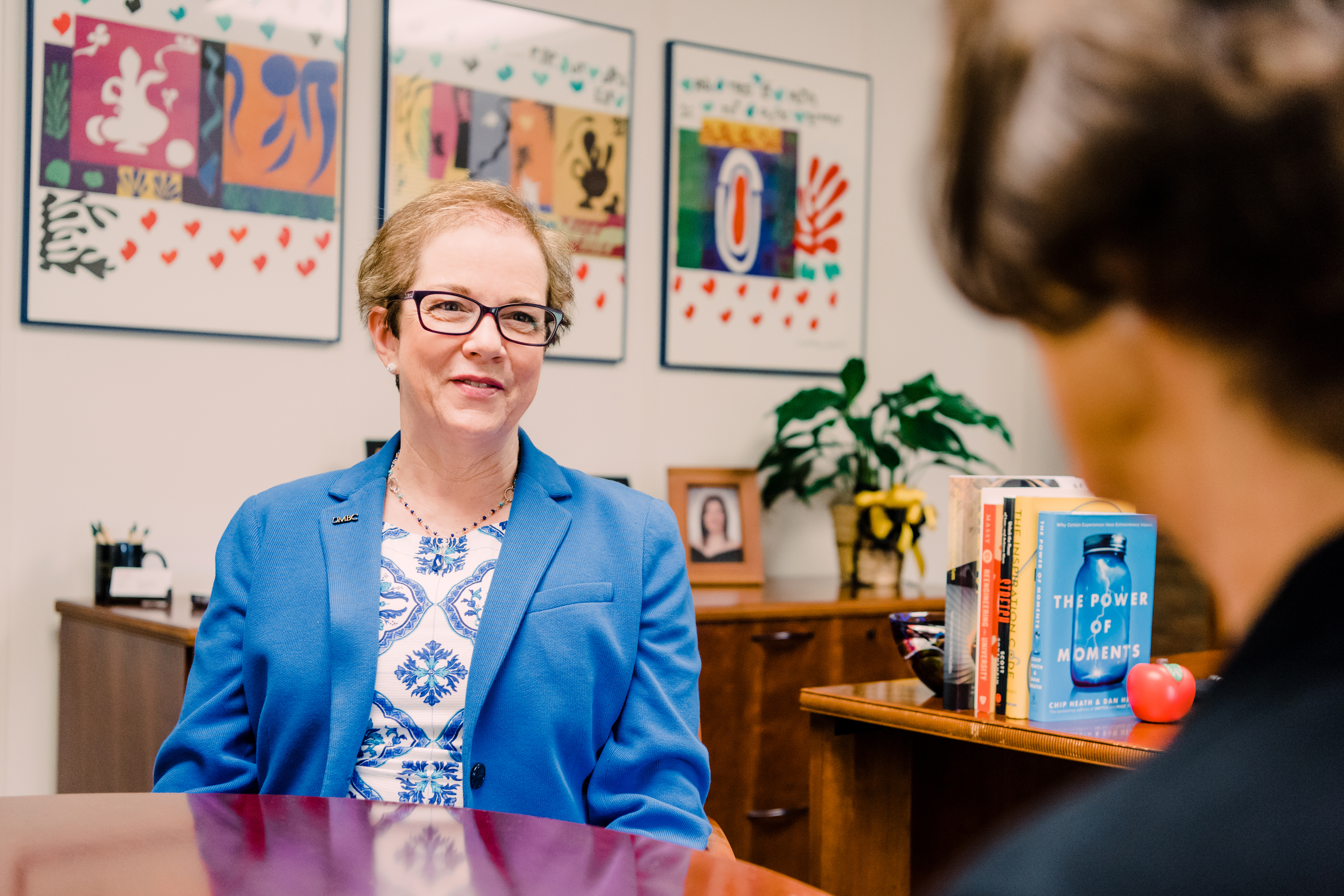
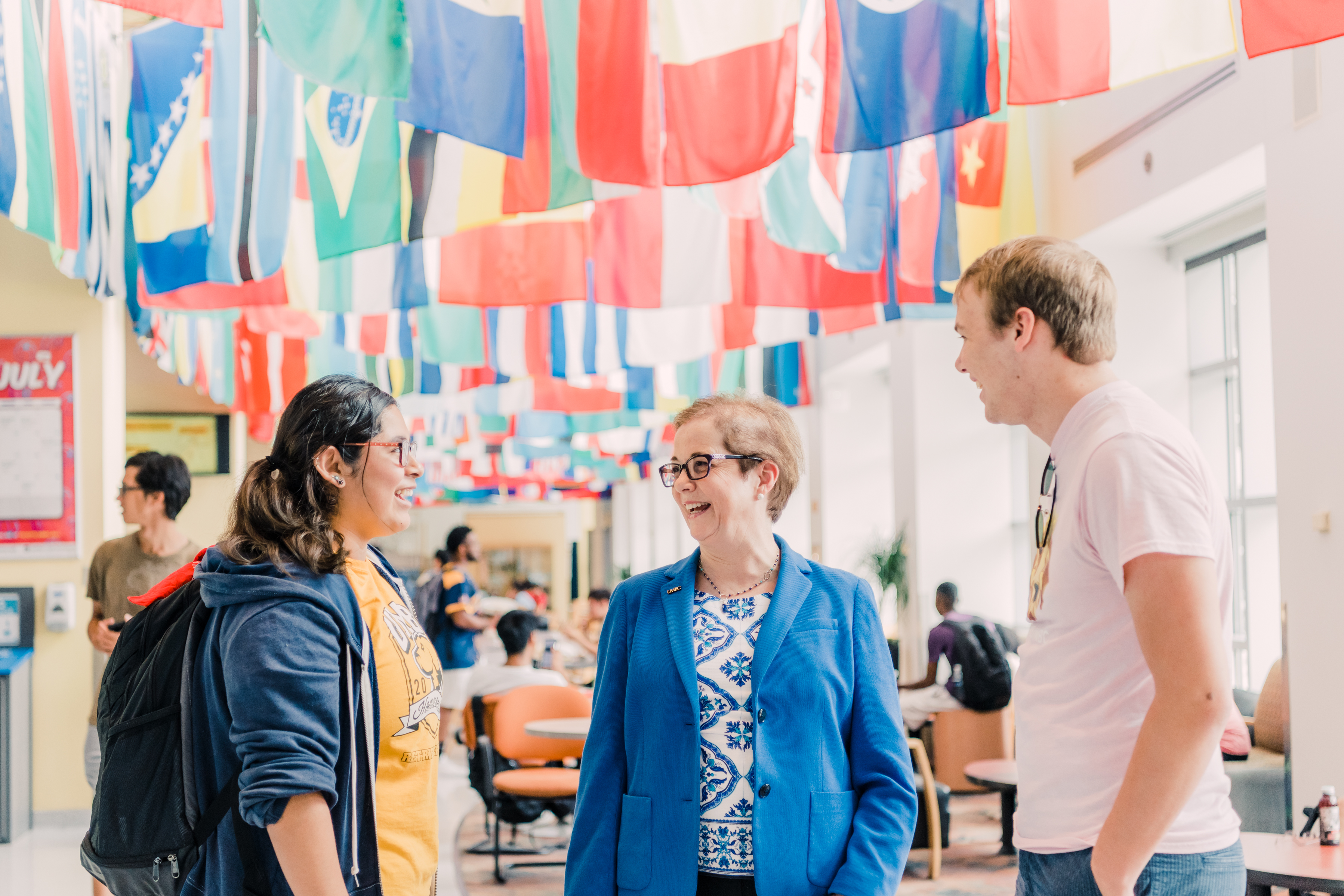
Lynne Schaefer and Jack Suess are known across UMBC for their essential roles in shaping and sustaining the university’s strong and steady growth over the years. As UMBC’s vice president for finance and administration (Schaefer) and vice president of information technology/CIO (Suess), they have worked on major projects, from creating UMBC’s data warehouse to developing shared service centers to overseeing campus sustainability and information security initiatives. They also have deep personal ties to UMBC—Schaefer as a UMBC parent and Suess as an alumnus (’81, mathematics, M.S. ’94, information systems).
But the impact that they have had over decades of combined service has reached far beyond the university. Both Schaefer and Suess are currently leading the boards of directors of national higher education organizations, bringing what Suess calls “UMBC’s collaborative style” along with them.
Schaefer has served on the National Association of College and University Business Officers’ (NACUBO) Board of Directors for five years and became its chair on August 1, 2018. Looking for a way to share her extensive financial management and administrative experience beyond UMBC, Schaefer initially joined the Eastern Association of College and University Business Officers (EACUBO) in 2008. She served in a series of leadership positions culminating with a term as chair of the board of directors, 2016 – 2017, before moving on to her new position as chair of that group’s national partner organization, NACUBO.
In addition to her desire to give back to her field through national-level service, Schaefer also sees her leadership of NACUBO as an opportunity to learn from colleagues at other universities. In this way, she’s discovered “unique, innovative practices that can help UMBC solve problems and move us forward,” in areas such as multi-year financial forecasting.
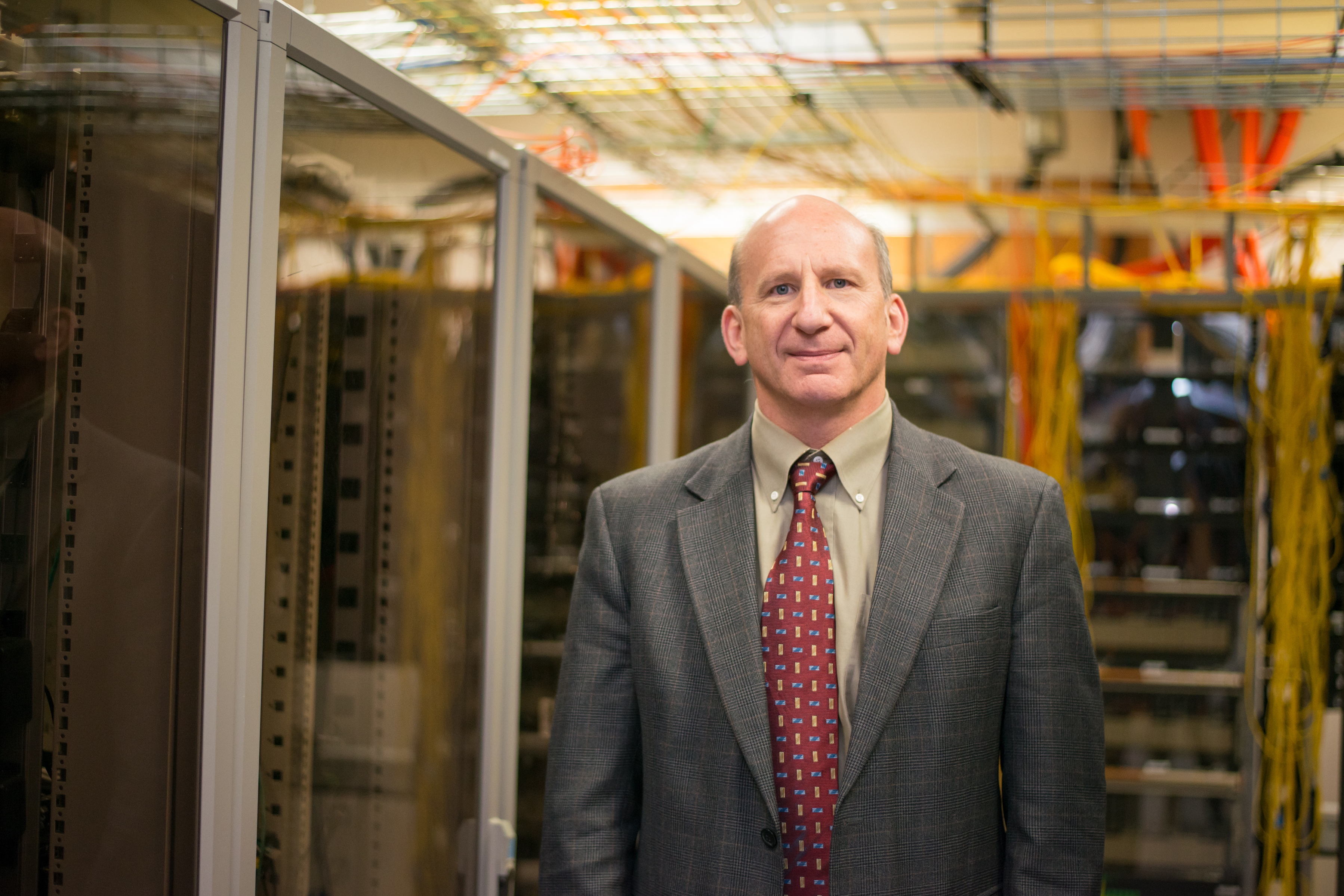
Suess has been a member of EDUCAUSE’s Board of Directors since 2014, and will complete his current term as its chair in November 2018. He got involved in EDUCAUSE’s predecessor organizations, CAUSE and Educom, more than two decades ago, when a UMBC colleague suggested he present at a conference; those groups merged to form EDUCAUSE in 1998.
Suess sees his tenure as EDUCAUSE chair as “a culmination of a long history within the higher education IT community” and a way to “help others who have helped me.” He also enjoys and values learning from colleagues in the national higher education community, saying “it’s about being exposed to a richer set of ideas, thinking, and practices.”
Schaefer and Suess are taking their collaborative spirit on the road at EACUBO’s annual meeting, taking place in Buffalo, NY, October 21 – 24, 2018. EACUBO and EDUCAUSE collaborated to organize a half-day program called “Technology Transforming Higher Education,” during which Suess will participate in a panel discussion on data privacy. Elsewhere during the meeting, Schaefer will participate in panel discussions about advocating for the value of higher education and about developing and supporting women leaders.
Because of their positive experiences with national organizations, both administrators encourage their teams and their colleagues university-wide to take advantage of leadership, educational, and networking opportunities.
“Lynne and Jack are innovative leaders who have achieved breakthroughs at UMBC that are models for the national higher education community,” says UMBC President Freeman Hrabowski. “Through their collaborative efforts, they are advancing UMBC’s reputation as a national leader – both academically and administratively.”
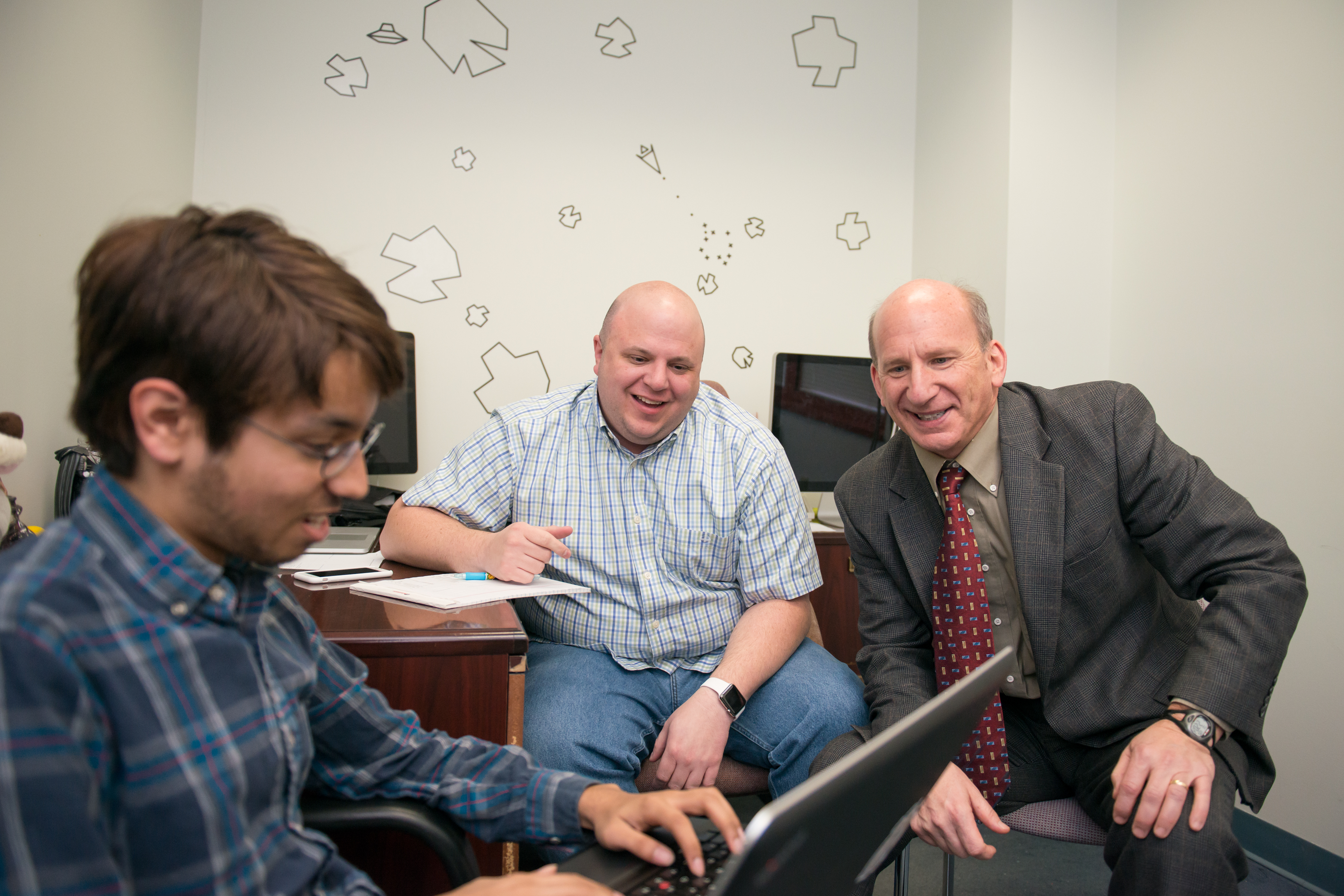
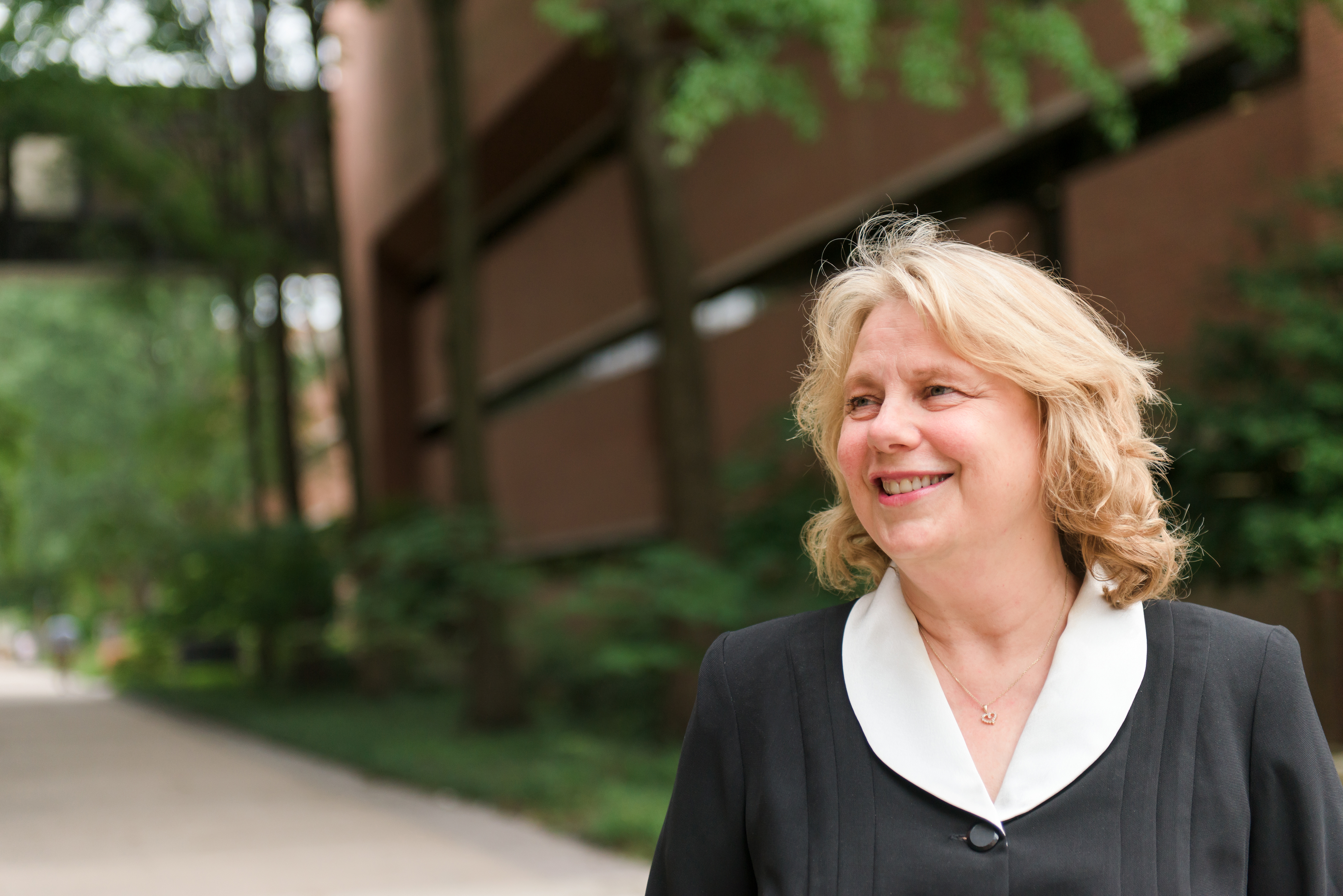
Featured image: Lynne Schaefer and Jack Suess. All photos by Marlayna Demond ’11 for UMBC.
This story was written by Mary Ann Richmond ’93, history.
UMBC has taken important early steps in the long-term work of making the university a safer, more supportive learning community for all, with a focus on improving sexual assault prevention and response. This follows last Thursday’s community listening session on sexual misconduct and campus safety—an event that resonated deeply with attendees, who filled the Fine Arts Recital Hall and two overflow spaces across campus.
Guiding next steps is a leadership committee appointed by President Hrabowski, which met for the first time on Monday, September 24. This group will engage with student partners; faculty, staff, and student shared governance organizations; and other community members to review comments and recommendations received through the listening session and other outreach; engage external expertise to evaluate current policies, practices, and resources; and keep the UMBC community updated on progress.
Collaborative approach
Co-chairing the leadership committee are Vice President for Student Affairs Nancy Young and Vice President for Administration and Finance Lynne Schaefer. Also serving are psychology professor Christopher Murphy, whose research focuses on abuse and violence in intimate adult relationships, and Jess Myers, director of the Women’s Center and advisor to the survivor-advocate student organization We Believe You. Additional members include Assistant General Counsel Morgan Thomas ‘13, political science, who has deep familiarity with Title IX, and Chief of Staff Candace Dodson-Reed ‘96, English.
“As we’ve talked with and heard from community members over the past couple of weeks, it is clear that we must do more to support our students,” says Schaefer. “Having an environment where students, faculty, and staff take care of each other is essential. I am committed to doing all I can to make sure our community lives up to our values.”
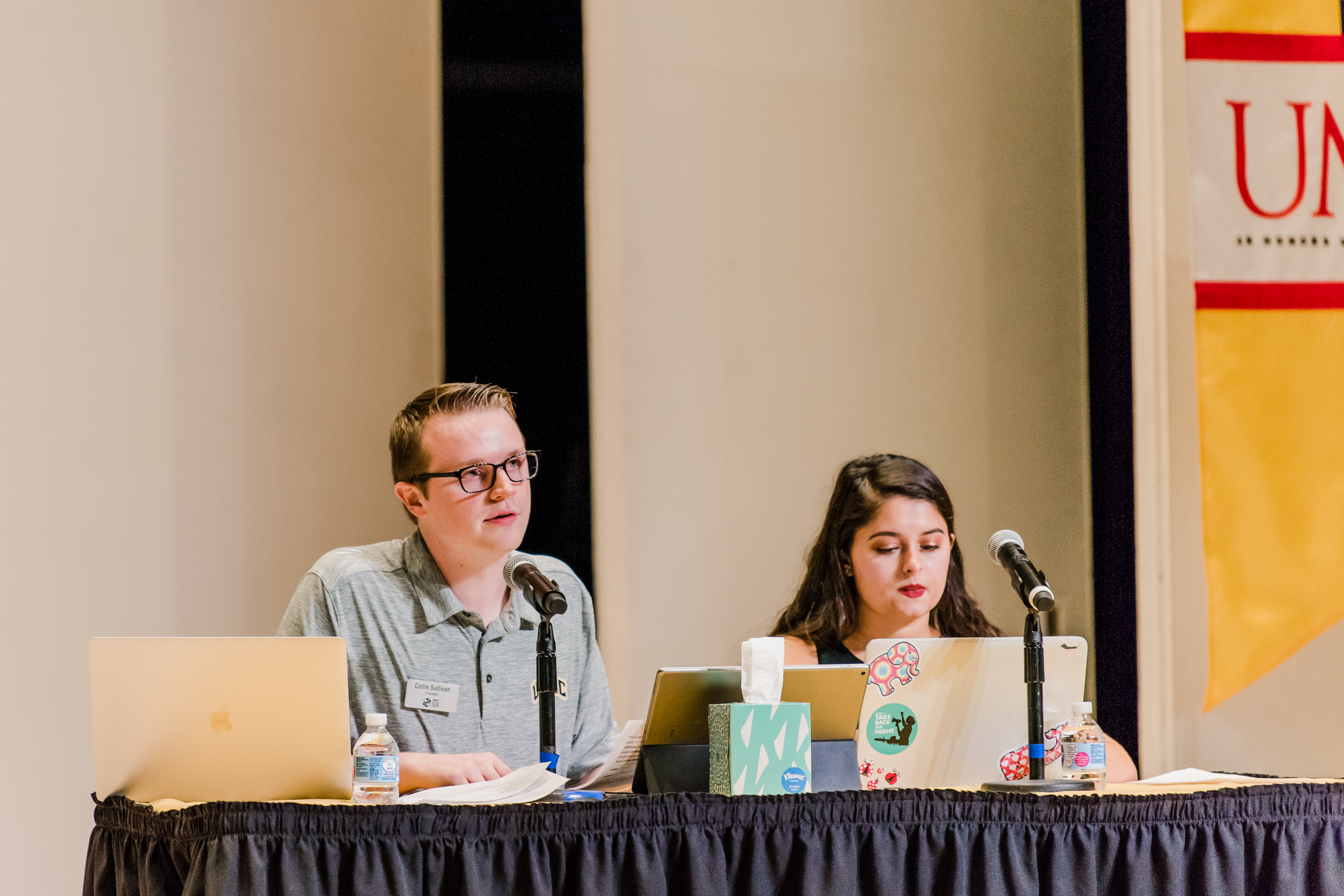
Student Government Association (SGA) and We Believe You will be among the leadership committee’s core partners in the work ahead. SGA President Collin Sullivan ‘19, information systems, and We Believe You Vice President Kim Spadafora ‘20, mathematics, served as moderators for last week’s listening session, and have voiced their commitment to being engaged in this work for the long term.
“The past couple of weeks have been difficult for everyone in our community,” says Sullivan. “SGA’s first priority is to represent the undergraduate student voice. We are committed, more so than ever, to uphold this value through collaboration so we can all create lasting, meaningful change on campus together.”
“The best thing we can do right now,” Spadafora says, “is support survivors and continue to advocate for change.”
Institutional courage
Informing the committee’s work is current scholarship, highlighted by Myers and Murphy, on how the quality of institutional responses to sexual assault can profoundly impact students, potentially exacerbating prior traumas.
Myers explains that University of Oregon psychologist Jennifer Freyd coined the term “institutional betrayal” to describe the additional trauma that survivors of sexual violence can experience when an institution fails to prevent or respond appropriately to wrongdoings committed within the context of the institution. “This can happen in acts of commission or omission,” Myers notes, “such as failing to take necessary steps to prevent abuse, creating difficult processes for reporting, or failing to respond adequately. But UMBC has the opportunity to do something different—to embrace institutional courage.”
Institutional courage is another term coined by Freyd to describe, as Myers explains, “institutions working actively to listen to survivors and their allies, to hold themselves accountable for the harm done, and to honor transparency in the changes that need to be made. Institutional courage is about culture change.”
Thinking about how UMBC can embody institutional courage, Murphy says, “I believe in a multi-level and survivor-focused approach to violence prevention and response that includes universal messaging and media campaigns; mandatory preventive education for everyone (faculty, students, and staff); trauma-sensitive crisis response; advocacy and empowerment for survivors; intensive indicated and secondary prevention for individuals at increased risk for abuse or assault perpetration; vigorous protection of civil rights through Title IX; and full campus cooperation with criminal prosecution of sex crimes and relationship violence.”
Long-term process, near-term actions
The leadership committee recognizes that achieving lasting change will require an extensive, long-term process, bringing together a diverse range of UMBC community voices and additional expertise. As one of its first actions, the committee will engage campus partners in selection of a third-party consultant to inventory and evaluate existing UMBC resources, policies, and practices related to campus safety, particularly preventing and responding to sexual misconduct.
The group is also looking at more near-term strategies to make UMBC a safer, more supportive community. One initial idea, recommended by student leaders, is reprinting all campus cards to include clear information on how to report sexual misconduct and where to find support and resources. President Hrabowski, Facilities Management, UMBC Police, and student leaders will also soon complete a lighting tour of campus, to see where additional lighting may be needed.
Moving forward, the university can expect to hear regularly from the leadership group about action steps and how community members can be involved.
“It’s time,” Murphy says, “for all of us to listen to survivors, engage in serious and deep self-reflection as a campus, and to work together to invest the time and resources needed to provide everyone with a safe and productive educational experience at UMBC.”
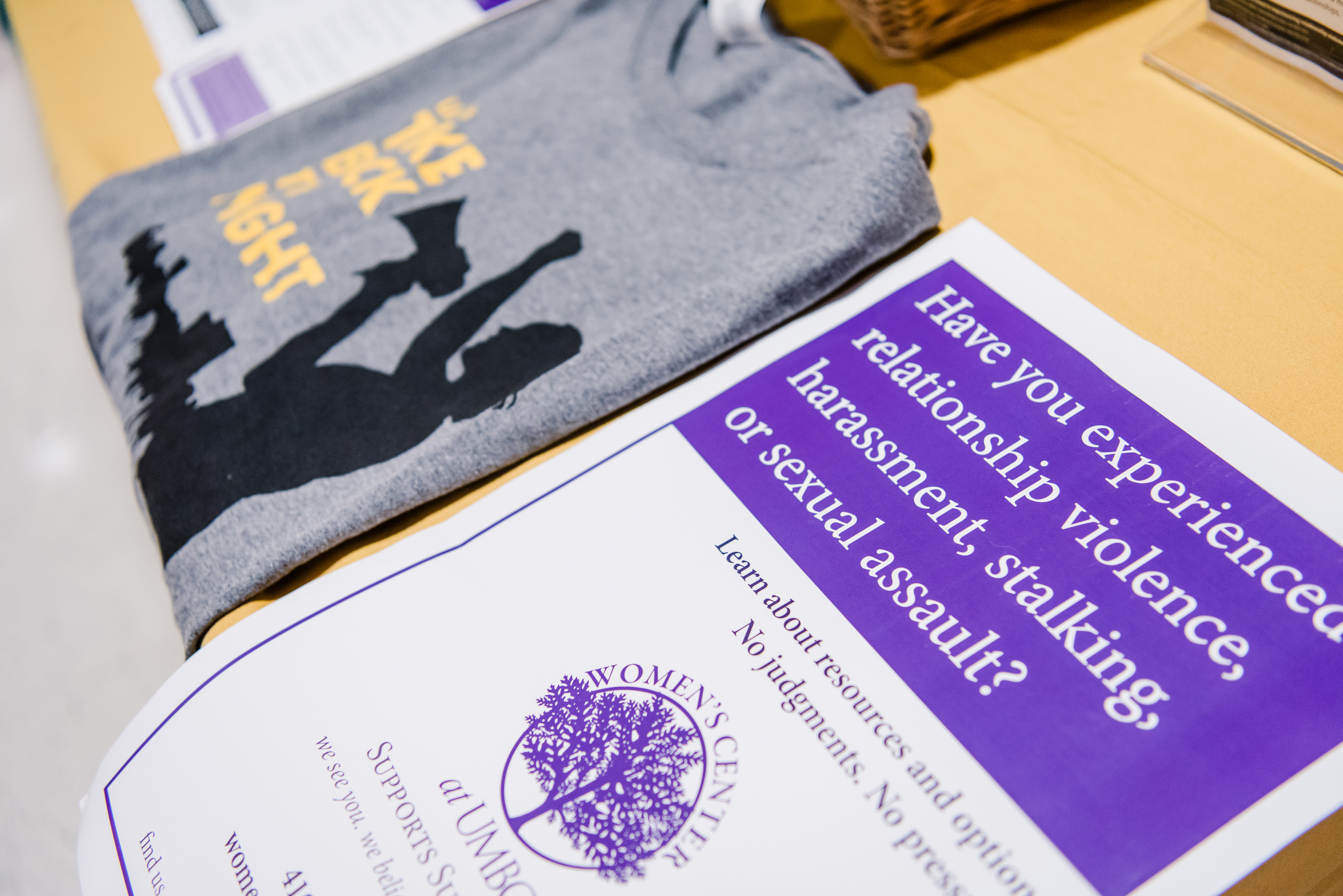
Header image: Women’s Center resource table at the campus listening session. All photos by Marlayna Demond ’11 for UMBC.
Hundreds of UMBC community members gathered on Thursday, September 20, for an open listening session on sexual misconduct, in a painful and powerful moment for the university.
A large crowd rapidly filled the Fine Arts Recital Hall and then two overflow spaces in the biology building and library, connected through a live video feed. As everyone took their seats, ready to begin, a sense of quiet tension filled the space—a community taking a breath, ready to speak and to listen.
UMBC leadership, the Student Government Association (SGA), Graduate Student Association (GSA), We Believe You, Resident Student Association, National Pan-Hellenic Council, and Student-Athlete Advisory Committee co-organized the session. Collin Sullivan ‘19, information systems, president of the Student Government Association, and Kim Spadafora ‘20, mathematics, vice president of We Believe You, served as moderators.
Representatives from the UMBC Counseling Center, Women’s Center, University Health Services, Green Dot, and Relationship Violence Awareness and Prevention advocates were onsite to provide support if needed.
“This event is about listening,” said Spadafora, in her introduction. Sullivan emphasized that although the session was for all community members, and their support was appreciated, the organizers’ goal was to “center the voices of UMBC students.”
UMBC President Freeman Hrabowski also gave a brief introduction at the start of the session. Reflecting on a week of meetings with students, faculty, staff, and alumni, and in particular hearing from survivors of sexual assault, he said, “I am so sorry. I want to say to all of you that I apologize, because we can do better and be better for you.”
All students deserve to be heard, President Hrabowski said, “So now, I’m going to listen.”
Over the next two hours, students and others came to the microphone or submitted anonymous comments through index cards and a webform. Many shared anger about painful experiences of sexual assault and struggles navigating campus support services and the Title IX process.
One core focus was the need for students to feel safe, and to feel that their concerns about safety are taken seriously. “I want to feel safe walking around campus,” said one student. “It’s important that we are heard. It’s important that we all feel safe,” said another. A third stated firmly, “Everyone on campus deserves an equal amount of safeness.”
Students also emphasized the need for the university to engage students in honest conversations about sexual assault, beyond a single listening session. “The university needs to find new ways to engage students on these difficult topics,” said one student. Another said, “Stop silencing our voices and start making changes.”
Many students simply wanted to be heard, to be taken seriously, and for the university to take to heart their experiences in determining active steps to make campus a safer place for all. “It takes courage to seek help,” said one student, “UMBC should make it easier, not harder.”
Students powerfully argued for change in how the university works to prevent and respond to incidents of sexual misconduct. Examples include requiring evidence-based sexual assault prevention training for all new students, faculty, and staff; expanding health services; and making the Title IX investigation process more responsive.
Speaking directly to the university leaders on the stage, one student said, “As the administration, you are in a position of power. Take that power and use it to fix this institution, and then share that knowledge with other institutions.”
Some students, as well as staff, also spoke of their deep connection to the UMBC community, and of that feeling as a driving force to improve the university. “I love this university too much,” said one student. “We can’t let this happen here.”
Following the event, President Hrabowski, Provost Philip Rous, and listening session partners responded with a firm commitment to taking both immediate and longer-term action to address several concerns brought by students. To begin next steps, they named a team to lead this work in collaboration with student, faculty, staff, and alumni leaders, effective immediately.
This team will be responsible for reviewing recommendations heard through the listening session, other meetings, and formal statements, in collaboration with campus partners. Members include Vice President for Student Affairs Nancy Young; Vice President for Administration and Finance Lynne Schaefer; Assistant General Counsel Morgan Thomas ‘13, political science; Chief of Staff Candace Dodson-Reed ‘96, English;Women’s Center Director and We Believe You Advisor Jess Myers; and psychology professor Christopher Murphy, whose research focuses on abuse and violence in intimate adult relationships.
In addition to moving the work forward, this group will also keep the campus updated on next steps and how UMBC community members can stay engaged.
The morning after the listening session, President Hrabowski spoke with the University System of Maryland Board of Regents about the event, and how student voices continued to echo through his thoughts. He was joined by Sullivan, Spadafora, and Adam Harvey, M.S. ‘17, a physics Ph.D. student serving as GSA vice president and newly elected chair of the University Steering Committee.
“Yesterday’s listening session was a powerful experience for all of us,” said President Hrabowski. “I continue to think about the voices, faces, and experiences of our students who spoke…I continue to feel the care and empathy shown by them and our staff and faculty who joined them to be supportive yesterday…We know we can be better.”
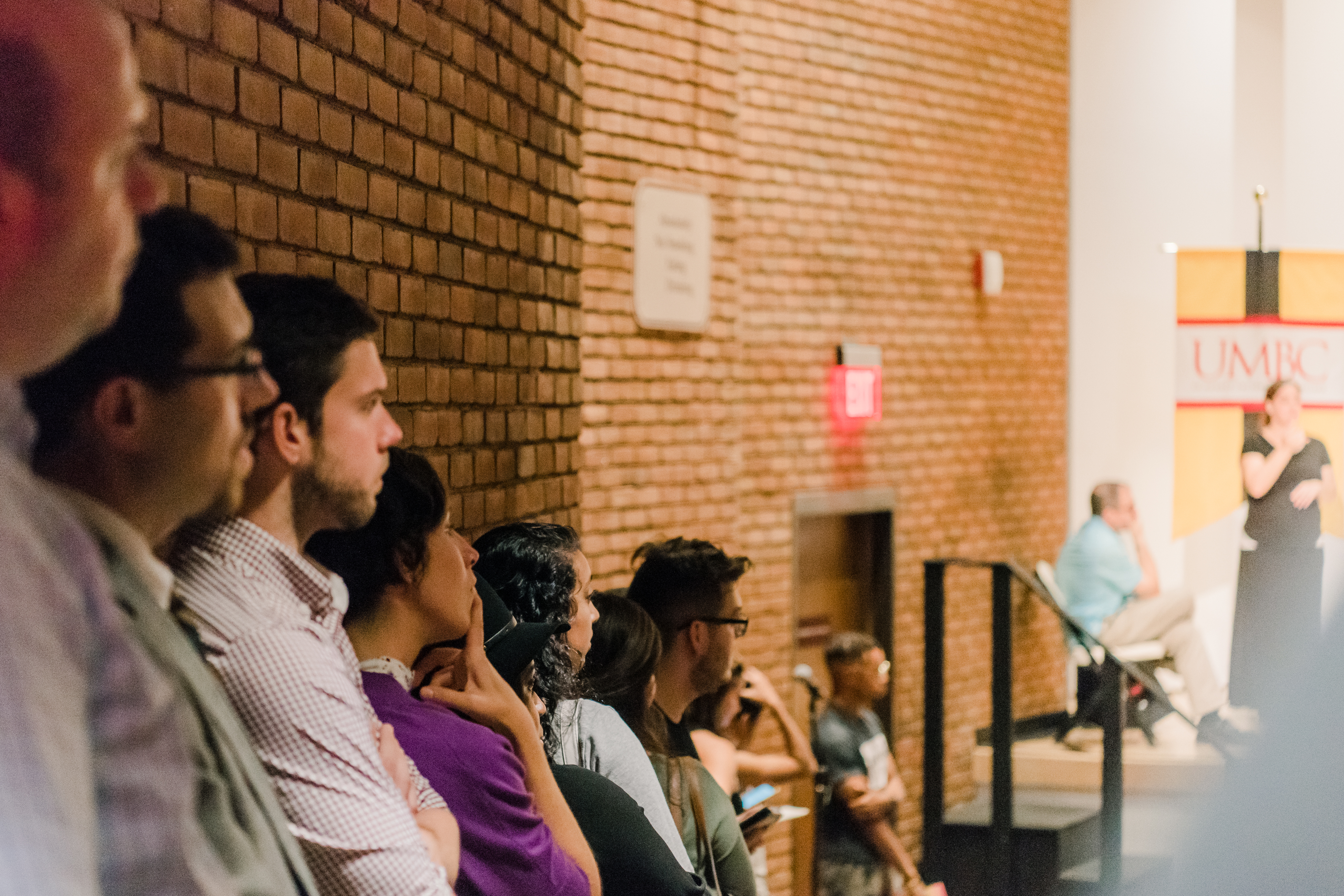
Header image: UMBC community gathers for the listening session, with university leaders onstage. All photos by Marlayna Demond ’11 for UMBC.
A group of 125 UMBC faculty, staff, and students gathered today for UMBC’s annual Title IX/Sexual Misconduct Seminar, focused on caring and effective response to sexual misconduct.
“There is nothing more important here than a climate and culture that focus on respect for all people,” said UMBC President Freeman Hrabowski at the start of the full-day workshop. “Some people think this is the work of a few, but it is all of our responsibility.”
Faculty, staff, and students from across UMBC joined in the workshop, including representatives from Residential Life, Athletics, the Women’s Center, university administration, UMBC programs at the Universities at Shady Grove, and many other offices and groups.
To lead the seminar, UMBC welcomed Gina Maisto-Smith and Leslie Gomez, former child abuse and sex crimes prosecutors who are now chair and vice chair of the Cozen O’Connor’s Institutional Response Group. Their practice focuses on response to sexual and gender-based harassment and violence, child abuse, and other forms of harassment and discrimination.
Maisto-Smith and Gomez’s interactive talk reviewed requirements under Title IX, the Clery Act, the Violence Against Women Act, and updates on current federal policy and guidance. Gomez also emphasized, “The law alone isn’t enough.” She noted that values-based organizations like UMBC focus on “care for community,” as well as law, policy, and guidance available.
In addition to legal requirements, the speakers helped participating faculty, staff, and students better understand how to remove barriers to reporting, treat all community members fairly, and quickly and sensitively connect community members to support resources. At every level of response, Gomez noted, “Language is very important.”
While each annual seminar includes many similar components, such as a review of law, policy, and best practices, each one also has a unique focus. This year’s training follows a 2017 fall seminar for university leaders that focused on neurobiological responses to trauma, to support trauma-informed care.
A common thread in each annual training, said Provost Philip Rous, is that “coordination and collaboration” are essential for effective response to sexual misconduct — working together to fulfill UMBC’s commitment to providing a safe, supportive learning community.
As President Hrabowski said to the group at the start of the day, “Thank you for being here this morning. We know it is because you care.”
UMBC is again one of the top ten national universities in both undergraduate teaching and innovation, according to the 2019 Best Colleges rankings released today by U.S. News & World Report. This news comes as UMBC welcomes its largest-ever class of nearly 3,000 new undergraduate students.
U.S. News ranks UMBC as #8 nationally on its closely-watched list of universities with a “strong commitment to undergraduate teaching,” alongside Princeton, Dartmouth, Brown, and Rice, and ahead of Duke and the University of Virginia.
“UMBC is committed to a holistic approach to undergraduate teaching,” says Katharine H. Cole, vice provost and dean of Undergraduate Academic Affairs. “We provide our students with a supportive community that values innovative inquiry and interdisciplinary thought.”
UMBC is #9 on the list of Most Innovative Schools in the country, alongside other research universities including MIT, Stanford, Carnegie Mellon, UCLA, and UC Berkeley. The “most innovative” distinction highlights colleges and universities making leading-edge improvements in areas from curriculum to campus life to technology.
These honors will sound familiar to many across the country, given the number of years UMBC has been recognized as a leader on both U.S. News lists. They remain an exciting point of pride for #RetrieverNation, demonstrating the staying power of UMBC’s vision of inclusive excellence.
“These teaching and innovation rankings include institutions specifically identified by college and university leaders across the country as being at the forefront of higher education,” says UMBC President Freeman Hrabowski. “They speak to our core commitments to student and faculty success and to constant learning and growth.”
This year, UMBC jumped up 23 spots on the ranking of top undergraduate engineering programs at U.S. universities that offer doctoral degrees in engineering. UMBC now appears at #87 on the national list, tied with Texas Tech, George Washington University, and other notable programs.
U.S. News also recognizes UMBC this year on its list of top national universities where students are most likely to encounter undergraduates from a different ethnic group than their own. UMBC appears alongside UC Berkeley and the University of Southern California.
The 2019 U.S. News rankings demonstrate the broader strength of Maryland’s public universities. The overall top public universities list includes both UMBC and the University of Maryland, College Park. The list of top regional universities (north) includes three University System of Maryland institutions: Towson University, Salisbury University, and Frostburg State University.
See additional recent rankings stories on UMBC News.
Featured image: UMBC students write on white boards during a group exercise. Photos by Marlayna Demond ‘11 for UMBC unless otherwise noted.
The Wall Street Journal (WSJ) and Times Higher Education (THE) have just released their popular college rankings for 2019, again naming UMBC one of the nation’s top universities.
The WSJ/THE rankings focus on student success and learning. They are based on both public data and input from around 200,000 students nationwide. Key factors include available teaching resources, student engagement, educational outcomes, and diversity and inclusion in the learning environment.
This year’s rankings specifically highlight the strength of UMBC’s diverse learning community, including student and faculty diversity and the representation of international students. UMBC also performs particularly well in educational outcomes, such as graduate salary.
UMBC President Freeman Hrabowski reflects, “The world is increasingly recognizing UMBC as a place where excellence and inclusion go hand-in-hand, and as a model for the future of higher education.”
This WSJ/THE recognition is the latest in a busy rankings season. UMBC has also recently been featured in the Princeton Review‘s Best 384 Colleges, honored as a “best value” university by Forbes, and named one of the top 3.5 percent of 18,000 global higher education institutions by the Center for World University Rankings, which focuses on high-caliber research.
Photo: UMBC’s Albin O. Kuhn Library. Photo by Marlayna Demond ’11 for UMBC.
UMBC has once again been recognized as one of the top universities in the nation through Princeton Review’s popular undergraduate guide, The Best 384 Colleges.
UMBC’s Princeton Review profile speaks directly to the dedication and commitment of the university’s faculty and staff. One student reflects that UMBC is “a university where teaching comes first.” Another says, “UMBC wants to see every student succeed—they provide you with the tools, people, and resources to make sure you get where you want to go in life.”
Katharine H. Cole, vice provost and dean of Undergraduate Academic Affairs, agrees. Reflecting on the qualities highlighted by Princeton Review, she says:
UMBC provides a welcoming, enriching environment in which all undergraduate students learn to collaborate, study effectively, and engage in high impact, meaningful experiences that promote academic success. The strength and diversity of our curricular and undergraduate research experiences coupled with the dedication of our faculty as instructors and mentors, creates a culture of innovation and excellence and provides students with a distinctive undergraduate experience.
The profile also notes UMBC’s location between Baltimore and Washington, DC, as a major advantage, giving student access to arts and culture, and a broad range of learning and career opportunities. As one undergrad says, “The location of UMBC is true brilliance.”
New to the profile this year is a mention of UMBC’s rank as third nationally in invitations for theatre students to perform at the prestigious Kennedy Center American College Theatre Festival. Earlier this summer, choreographer Maia Schechter ‘18, dance, was invited to showcase her original piece Now Elsewhere at the Kennedy Center.
Princeton Review also spotlights the importance of diversity, inclusion, and supportive community at UMBC. UMBC’s profile notes that students feel diversity “enriches our school and everyone gets to know everyone” across racial, ethnic, and cultural identities.
Princeton Review profiles for The Best 384 Colleges are based on surveys of 138,000 students nationwide.
Last Sunday’s Boston Globe greeted readers with a front-page story about lessons to be learned from a top research university, but it wasn’t about local powerhouses Harvard or MIT. It was a profile of UMBC.
The article starts in a math refresher course, where students are hard at work during the summer to prepare for the semester ahead. Even in the academic off-season, the campus is buzzing with activity, reporter Laura Krantz found. “At UMBC, black and yellow flags flutter above the central sidewalk and even in the summer,” she wrote, “the campus is alive with summer camps, graduate students doing research, and the Meyerhoff students, who are still in calculus class.”
Krantz spent hours meeting with students, faculty, staff, and alumni, and shadowing President Hrabowski, to learn what makes UMBC tick. “It’s never about the one person” at UMBC, President Hrabowski explained. “It has to be a tone that when the person comes in it’s not us versus them, but how do we work together.”
Working together to constantly improve is one of the secrets behind UMBC’s success, the article suggests. “We’re not perfect,” said Dean Bill LaCourse of the College of Natural and Mathematical Sciences. “But when we look in the mirror we don’t…blame the students, we don’t blame external aspects, we look at ourselves first and see what can we change.”
The supportive community that this kind of growth-oriented collaboration creates is meaningful for faculty, staff, and students alike. “It’s a very safe environment to try new things, to innovate, so that’s huge,” said Katharine Cole, vice provost and dean of undergraduate academic affairs.
State investment in education is another key to the university’s growth and its ability to serve as an economic engine for the region, the article also emphasizes. “The state feels that it is important to support higher education,” said Delegate Adrienne Jones ’76, psychology, Maryland House Speaker Pro Tem. “We see that as a link to the economy of the state and a well-educated workforce.”
Thanks to everyone who makes UMBC such a special community. “It’s one of those places where everyone always seems to be upbeat, even when it’s raining out and you’re dodging raindrops,” said @DelegateAJones.https://t.co/ebR7k5xyFf
Ultimately, said President Hrabowski, “We want working- and middle-class people to believe that they have opportunities to go to first-rate institutions that they can afford.”
It’s official: UMBC is one of the best universities to work for in the nation, for the ninth year in a row.
UMBC is one of a select set of universities across the country to be named to the Chronicle of Higher Education’s 2018 “Great Colleges to Work For” list. The university is also distinguished as an exceptional “honor roll” university for the eighth year in a row, excelling in nearly every measured category.
This year, UMBC’s categories of top achievement include:
Collaborative Governance
Compensation and Benefits
Confidence in Senior Leadership
Diversity
Job Satisfaction
Professional/Career Development Programs
Respect and Appreciation
Teaching Environment
Work/Life Balance
“This honor is meaningful for us because it reflects how UMBC is truly a supportive and inclusive community,” says President Freeman Hrabowski. “This is a place where we believe in mutual respect and in achieving great things when we combine our strengths and work together toward our shared vision.”
The Chronicle describes the “Great Colleges to Work For” survey as the “most comprehensive workplace study in higher education.” All accredited U.S. institutions with enrollment of at least 500 students were invited to participate, and 253 colleges and universities did so this year. The 2018 findings are based on survey responses from more than 53,000 faculty, staff, and administrators.
UMBC is the only research university in Maryland to be recognized as a Chronicle of Higher Education “Great College to Work For” this year.
CWUR currently uses seven indicators to assess universities, including quality of education (alumni who have won major international awards), alumni employment (as CEOs of top companies worldwide), quality of faculty (faculty who have won major international awards), total research output, publications in top-tier journals, publications in highly influential journals, and research citations. Metrics relating to research now account for 70 percent of each university’s total score. UMBC performed particularly well in the area of publishing research in highly influential journals.
“I am pleased that this new ranking of UMBC recognizes the growing national and international reputation of our interdisciplinary research initiatives, which focus on cybersecurity, cognitive analytics, environmental sciences and life sciences, balanced by impactful scholarship in public policy and public humanities,” says Karl V. Steiner, vice president for research.
U.S. institutions are well-represented in the 2018 – 19 ranking, taking 16 of the top 20 spots. Also highly ranked are universities in the United Kingdom, Japan, Canada, Switzerland, France, Denmark, Germany, and Sweden.
UMBC students have rewritten the record books in 2018. With graduation around the corner, and our soon-to-be new Retriever alumni preparing for graduate school, careers, and research around the world, we reflect on all they have achieved. UMBC celebrates two valedictorians for the Class of 2018. Valedictorian Kara Seidel ‘18, psychology, a Sondheim Public Affairs Scholar, discovered a particular passion for supporting families dealing with trauma through several intensive research and internship experiences. These include work at the Johns Hopkins School of Medicine in an HIV and addiction lab, a research internship at the American Psychological Association, and work as lead research assistant in the Trauma Lab of Christopher Murphy, professor and chair of psychology.
Kara Seidel. Photo by Marlayna Demond ’11 for UMBC.
Seidel is particularly appreciative of the opportunities for hands-on learning that she accessed in her time at UMBC, as well as mentorship that paired high expectations with support. She says:
One of the best things about UMBC is how supportive professors and staff are. They tell you the truth, even when you don’t want to hear it. They see potential in you and encourage you to take each mistake as a learning experience. Their ongoing support helped me feel confident about pursuing a wide range of opportunities.
Seidel will work as a behavioral therapist and researcher for the next year, before beginning a Ph.D. program in psychology, with a focus on supporting families experiencing trauma. Valedictorian Eudorah Vital ‘18, biochemistry and molecular biology, is a Meyerhoff Scholar, MARC U*STAR Scholar, and Howard Hughes Medical Institute Scholar. She pursued research from her earliest days as a freshman at UMBC, quickly advancing in Rachel Brewster’s developmental biology lab. She has already co-authored two papers in top-tier academic journals, and a third is coming soon.
Eudorah Vital. Photo by Marlayna Demond ’11 for UMBC.
Vital is also an advocate for community support, and shares that her professors and friends have been essential to her growth and success, saying, “I did not make it through alone.” In recognition of this support, she has become a mentor and tutor for undergraduates newer to her field. She shares:
UMBC prepares its students to be productive members of society, who strive to understand others and bring people together. I came to UMBC thinking I knew what I wanted to do, and I am leaving with a refined version of my goals, which reflect the values of inclusivity, support, and grit.
With a commitment to pursuing clinically relevant research, Vital will soon begin Emory University’s neurobiology M.D./Ph.D. program. UMBC’s 2018 history-makers include the graduating Retrievers of the men’s basketball team. K.J. Maura ‘18, sociology, took a few twists and turns in his college journey, as he found his path from Puerto Rico to UMBC. Once he put on the Retriever jersey, he got to work making a lasting impact, and by 2018 he was named the America East Conference Defensive Player of the Year. He helped lead the charge in UMBC’s NCAA round one victory of University of Virginia, 74-54. How does Maura think about his success? It’s all about reaching for greatness together, as a team, he says:
The chemistry and the friendships we have built helped us stay focused on our goals. I’m thankful for my teammates and coaching staff. Every single person on the team played a role to help us reach together and I’m proud to call them family.
Joe Sherburne, K.J. Maura, and Jourdan Grant (l-r). Photo by Marlayna Demond ’11 for UMBC.
When Joe Sherburne ‘18, financial economics, traveled from Wisconsin to Maryland to attend UMBC, he couldn’t have anticipated where that path would lead. He has skillfully balanced academics and athletics, becoming the first UMBC and first America East Conference men’s basketball player to ever be named to the Academic All-America Division I Basketball First Team. Sherburne served as a captain for the history-making 2017-18 men’s basketball team and still maintained his place on the President’s List each semester. After graduating, he will continue to play for UMBC while pursuing his master’s degree in data science. Jourdan Grant ‘18, media and communication studies, holds the record for playing the most men’s basketball games in UMBC history. NCAA showcased his exuberance after dethroning no. one seed University of Virginia in this year’s “One Shining Moment” tournament highlights video. Reflecting on his college experience, Grant shares:
UMBC has prepared me in the way that the university has a standard in how you carry yourself and really embrace success.
Also a member of the Class of 2018 is UMBC’s first Rhodes Scholar, Naomi Mburu ‘18, chemical engineering, who will next pursue a Ph.D. in nuclear engineering at Oxford. Mburu is a Meyerhoff Scholar, MARC U*STAR Scholar, and recipient of the highly prestigious Goldwater Scholarship, as well as president of UMBC’s chapter of the National Society of Black Engineers.
Naomi Mburu. Photo by Marlayna Demond ’11 for UMBC.
Mburu has conducted notable research at UMBC and around the world. In the lab of Gymama Slaughter, associate professor of computer science and electrical engineering, she worked to help develop a bioreactor to extend the viability of human organs awaiting transplant. She has also brought her passion for learning and creating new solutions to internships at Intel, the Johns Hopkins Applied Physics Laboratory, and the European Organization for Nuclear Research in Switzerland. She will soon travel to Europe to attend the Lindau Nobel Laureate Meeting, which invites the world’s top emerging scientists to meet with thirty Nobel laureates. UMBC’s Class of 2018 includes thousands of phenomenal graduates. In the arts, humanities, and social sciences, Shirley Basfield Dunlap, Ph.D. ‘18, language, literacy, and, culture, is finishing her doctorate at the age of 65 after steadfastly completing one course a semester for nearly a decade. She will apply her dissertation research on the history of African American stage directors to her work as coordinator of theatre arts at Morgan State University. Emmanuel Mones ‘18, visual arts, will launch a men’s streetwear brand and magazine designed to promote public dialog about gender, sexuality, and equality. Flora Kirk ‘18, ancient studies, has already traveled the world to study ancient coins, and will next research Roman coinage in Cluj-Napoca, Romania, as a Fulbright Scholar.
Emmanuel Mones. Photo by Marlayna Demond ’11 for UMBC.
Among UMBC’s impressive STEM scholars, men’s club lacrosse team captain Greg Huxtable ‘18, physics and mathematics, will build on his high-level research in quantum computing through a Ph.D. at UC Irvine. Arissa Falat ‘18, biochemistry and molecular biology, an award-winning professional figure skater, will pursue a Pharm.D./J.D. at the University of Maryland School of Pharmacy. After multiple internships with Google, CWIT Scholar Katherine Dillon ‘18, computer science, will soon work as a software engineer at the company’s San Francisco campus.
Gregory Huxtable. Photo by Marlayna Demond ’11 for UMBC.
Undergraduate research and creative work at UMBC has grown at a rapid pace over the past decade, but on April 25, April Householder wasn’t just thinking about how URCAD 2018 was the university’s largest yet. She was thinking about the talent, drive, curiosity, and hours upon hours of hard work that went into each project, and what that moment of delivering a talk or performing a dance or screening a film meant to each student presenter.
Householder, director of undergraduate research and prestigious scholarships, shared ahead of URCAD 2018, “I am most proud of the kinds of questions these students are asking in their research and creative work…UMBC undergrads are making change in the world.”
URCAD 2018: Students tackling today’s challenges
Throughout the day, students shared innovative work in venues across the university, including projects to tackle major challenges communities are reckoning with today.
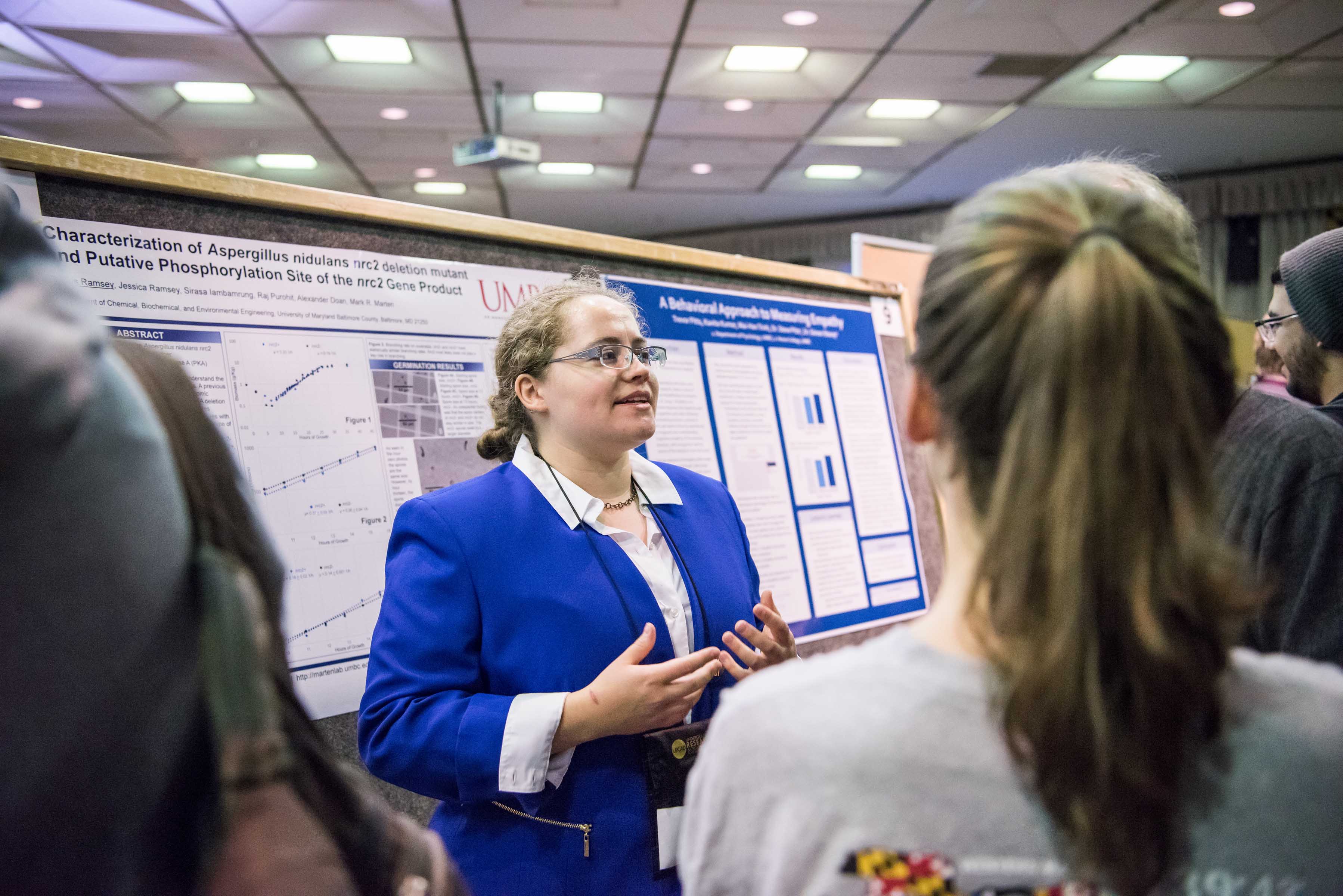
Alexis Ramsey ’18, biochemistry, works in Mark Marten’s lab on a very smelly fungus to learn about an important chemical pathway that is conserved in a wide range of species. “The work itself is kind of disgusting,” Ramsey says, “but the science behind it is so cool.”
Among the hundreds of student presenters this year were several multi-talented scholar-athletes, such as:
[nivoslider id=”10822″]
The Dance Cube featured impactful student performances and presentations:
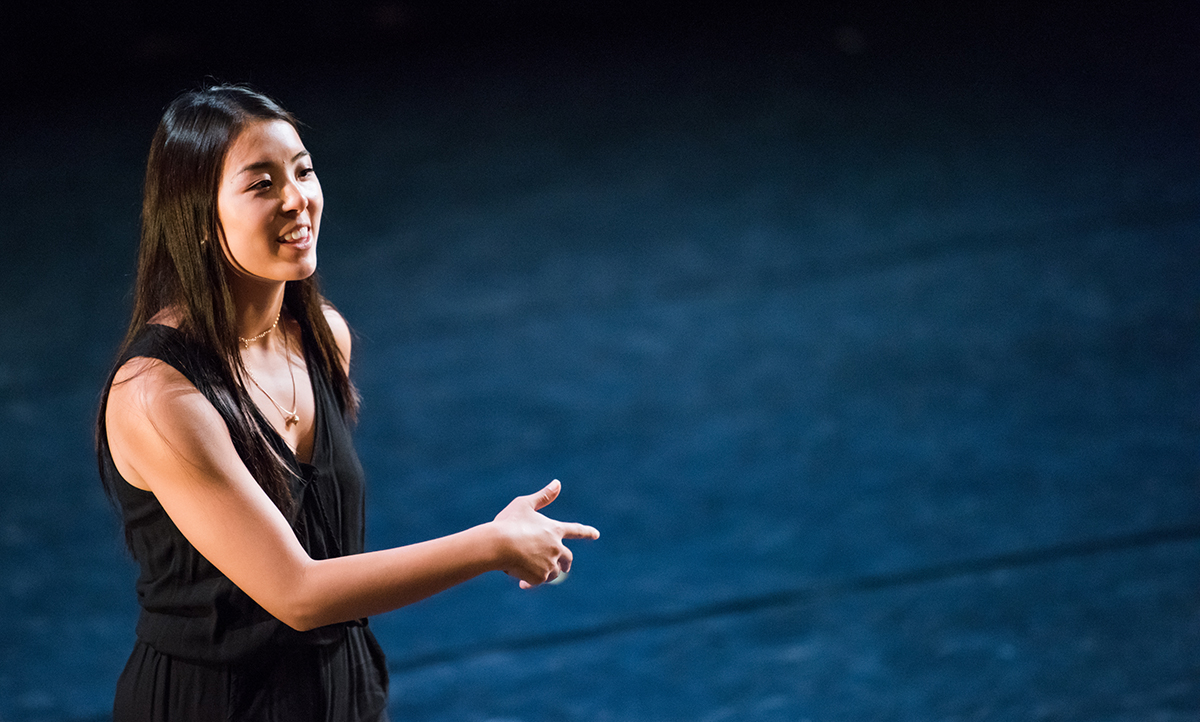
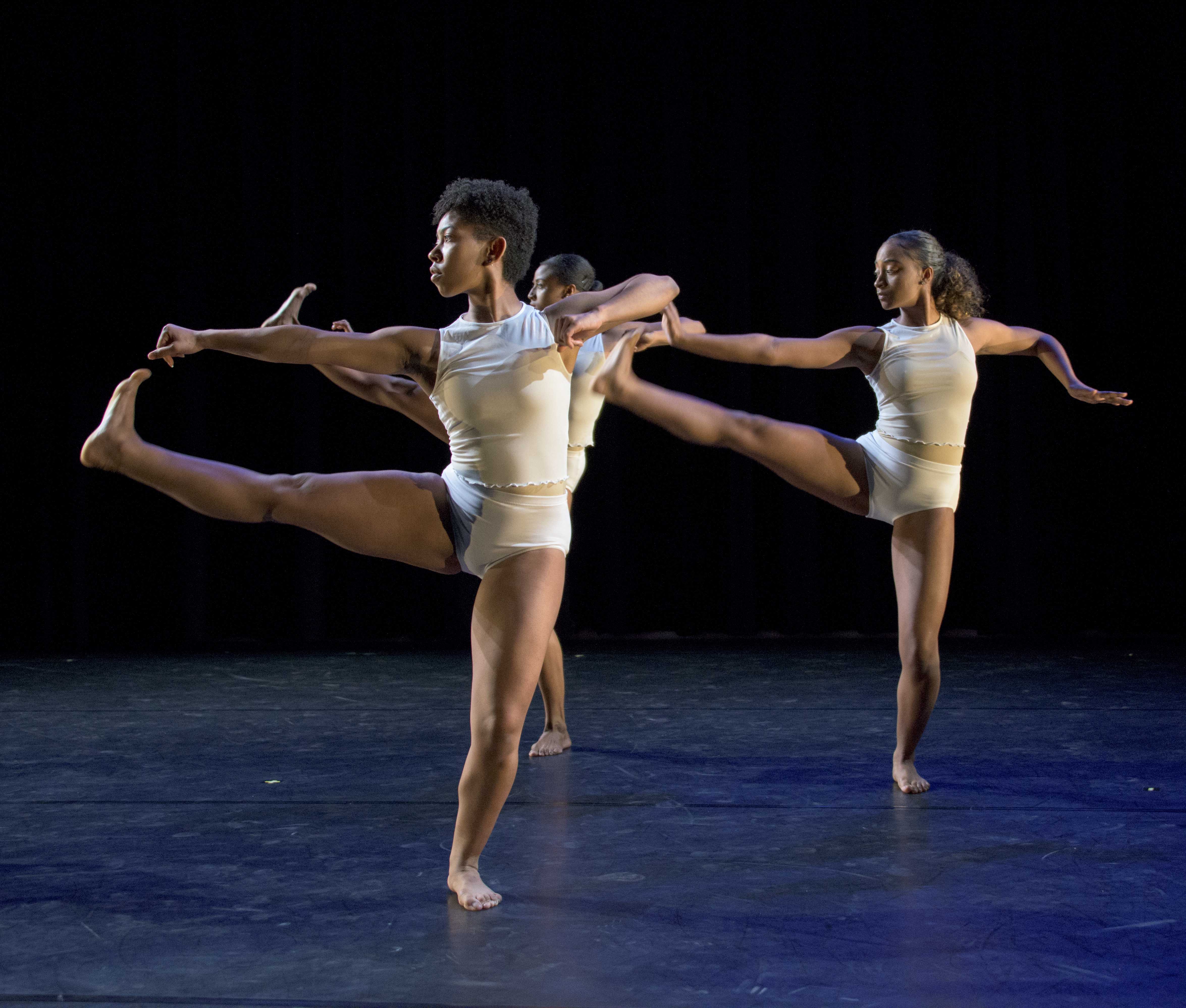
Maia Schechter ‘18, dance, (pictured in story header) presented Now Elsewhere, a performance she choreographed to explore the profound loss of loved ones, which will also be performed in June at the Kennedy Center as an official selection of the National College Dance Festival. Schechter shared, “I believe the movement and music work together to create a poignant journey that the audience can relate to.”
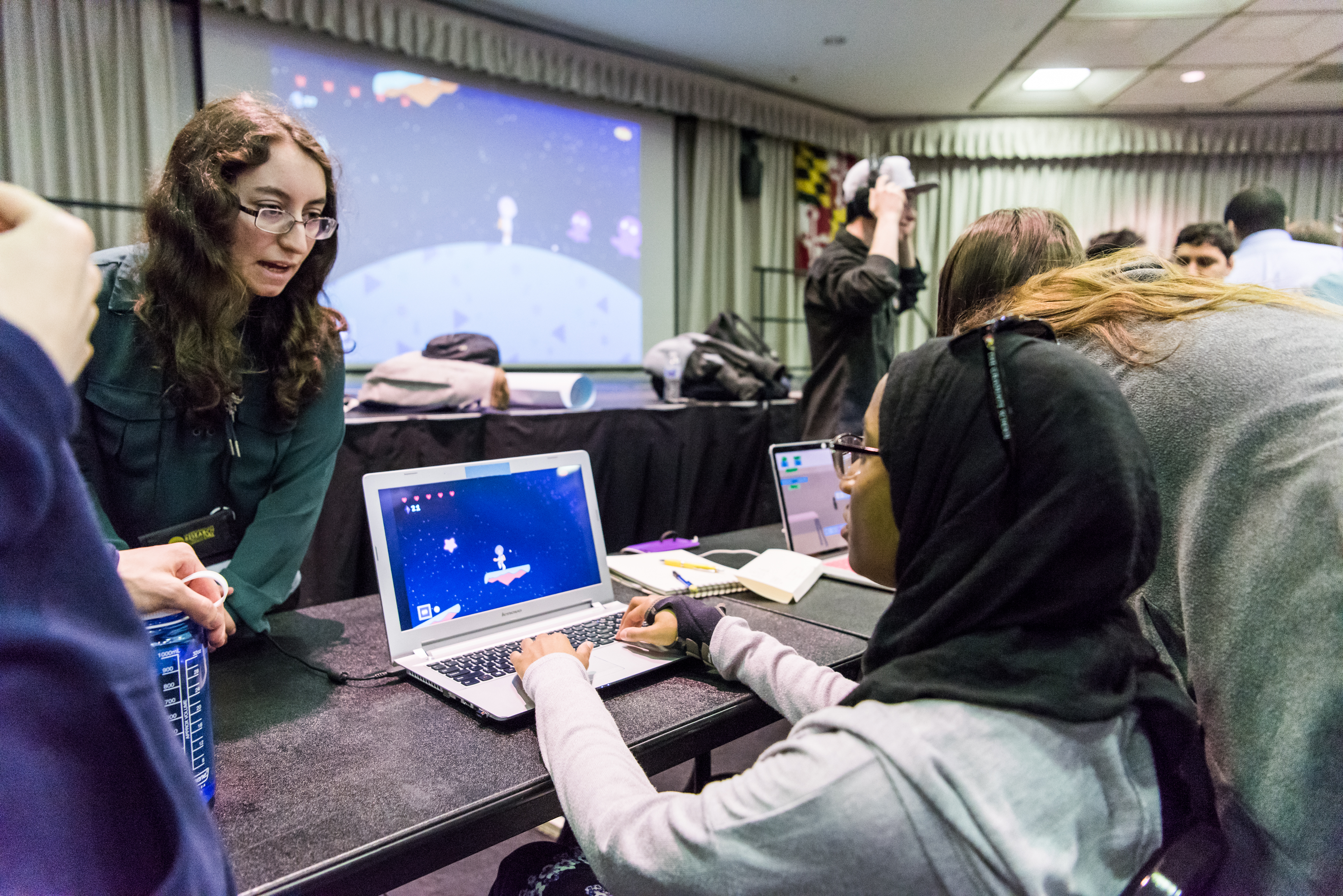
The large section of the UC Ballroom offered space for student researchers to demo and gaming and other interactive projects, and offer others the chance to play them and offer feedback. They included:
Khadijah Wali ‘18, visual arts, shared the video game “Mascarpone,” developed with a team also including Hailey Partin ‘18, visual arts; Shannon Irwin ‘19, visual arts; Tiffany Pierce ‘18, visual arts; and Joey Napolitano ‘18, visual arts. The colorful, two-dimensional side-scrolling game follows Mascarpone, a witch with the ability to control and manipulate food, and who can also take control of the various food-based monsters who try to attack her.
In addition to featuring the work of UMBC undergraduates, URCAD 2018 also highlighted advice from keynote speaker Isaac Kinde ‘05, biological sciences. Kinde received his M.D./Ph.D. from Johns Hopkins in 2015 and is now chief science officer for the biotech company PapGene, Inc., which focuses on cancer diagnostics products.
First and foremost, Kinde recommended that students commit early in their careers to pursuing work they are passionate about. “It’s important to think about what you want to do because you’re going to spend a lot of time doing it,” he said. “There’s nothing more valuable than your time.”
Now that more than a decade has passed since his own undergraduate days, Kinde also took a few minutes to reflect on how UMBC has changed and how it has remained the same. “Over the years, it’s been phenomenal to see how UMBC has grown,” he said. But one thing has held constant, Kinde reflected: “UMBC, even from before the first day, has always been about the people.”
At Top: Emmanuel “Manny” Mones ’19, visual arts, presented “ALT.MASC: Redefining Masculinity through Fashion and Photography.” His project challenges existing models of masculinity characterized by aggression and detachment. Mones instead conceptualizes alternative, more inclusive forms of masculinity through fashion and photography, encouraging public discourse on gender, sexuality, and equality.
URCAD photos by Marlayna Demond ’11 for UMBC Magazine.