All posts by: Catalina Sofia Dansberger Duque


The Power of Community

One student’s story could appear to inspired onlookers as a meteoric rise: excelling from private school to lauded scholarship programs and landing an ivy school opportunity post-graduation. But Anna Gifty Opoku-Agyeman M26 ’19, mathematics, is clear that her success is firmly grounded in a support network formed early on—and hard fought for—when circumstances seemed to isolate her from the community she knew was necessary in order for her to thrive.

In kindergarten, her principal, Anna Puma, took special notice of her skills and ability and funded a scholarship that helped Opoku-Agyeman’s family keep her in a small private elementary school. The additional support helped her prepare and be accepted to a private school in the area for middle through high school, which would later give Opoku-Agyeman access to unique academic opportunities that would not otherwise have been available. She flourished during her years in her small, supportive school and was excited about college.

However, before Opoku-Agyeman would ultimately create the first conference for Black women in economics, graduate from UMBC surrounded by peers and mentors, and join The Research Scholar Initiative (RSI) program at Harvard University, she would have to learn to keep creating support networks along the way.

“My success is not mine, it is the work of many who saw my potential before I saw it in myself,” she says.

Creating a supportive network

At the first institution Opoku-Agyeman attended—a large campus near Washington, D.C.—she found it difficult to navigate the size and make relationships. Fear, anxiety, and loneliness quickly engulfed her. Attending her classes became difficult. Thinking about her future was overwhelming. Opoku-Agyeman’s elementary school principal, with whom she retained a close relationship, was one of many who helped her see through the clouds. Her family, faith community, and various mentors all listened to the obstacles Opoku-Agyeman was facing, gave her advice, and cheered her on as she figured out her path.

Opoku-Agyeman ultimately transferred to UMBC for its diversity, community, and academic support. Within her first year on campus, she began building critical connections with staff and students. She gained the support of Simon Stacey, director of UMBC Honors College, who referred her to Jacqueline King, assistant director of the MARC U*STAR Program and Meyerhoff team member.

“I’ve witnessed Anna’s metamorphosis from a student who was unsure of her academic capabilities to a young woman who is positioning herself to impact the economic and public policy field,” King says. “Her superpower is her ability to foster connections and collaborations to make a difference.”

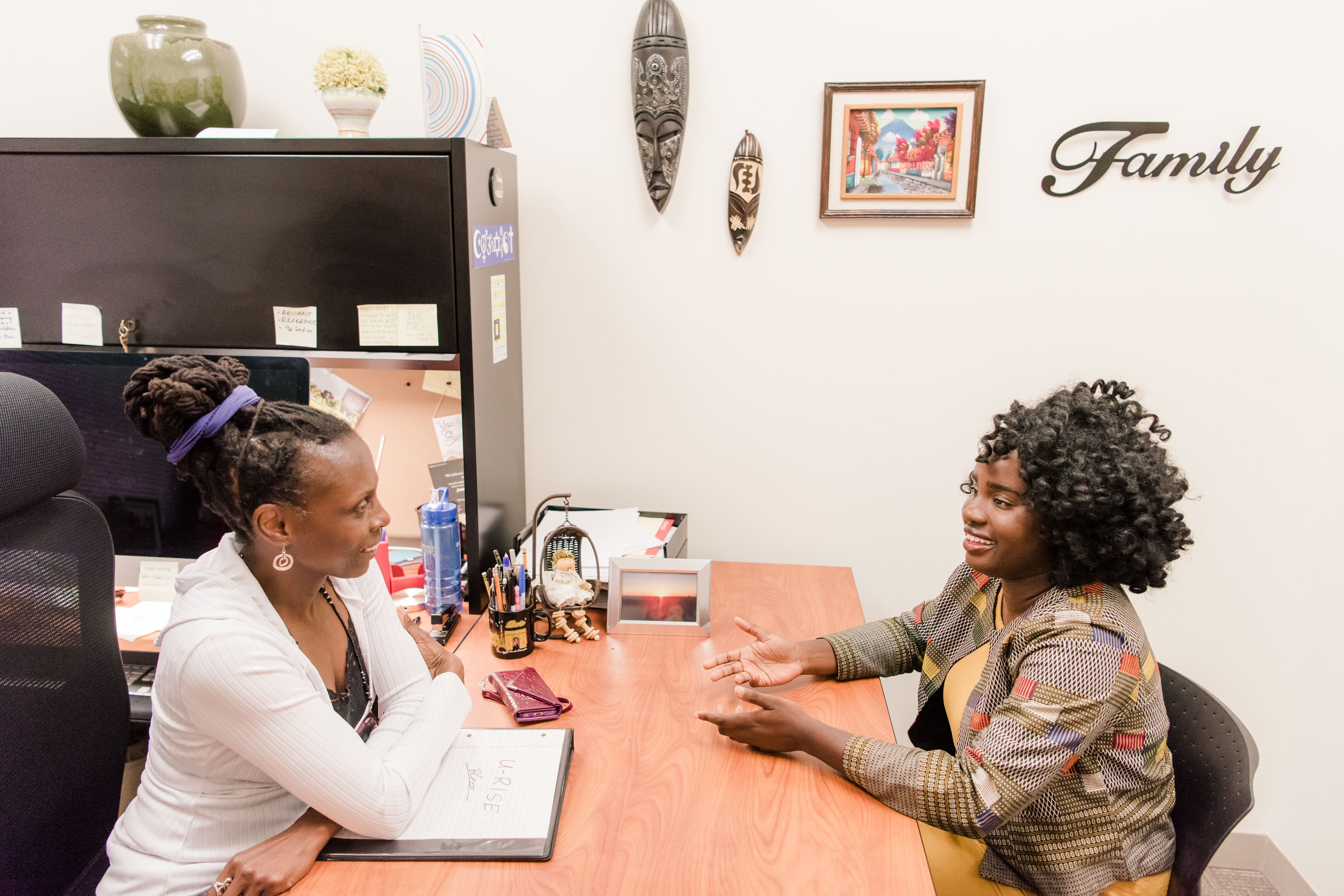
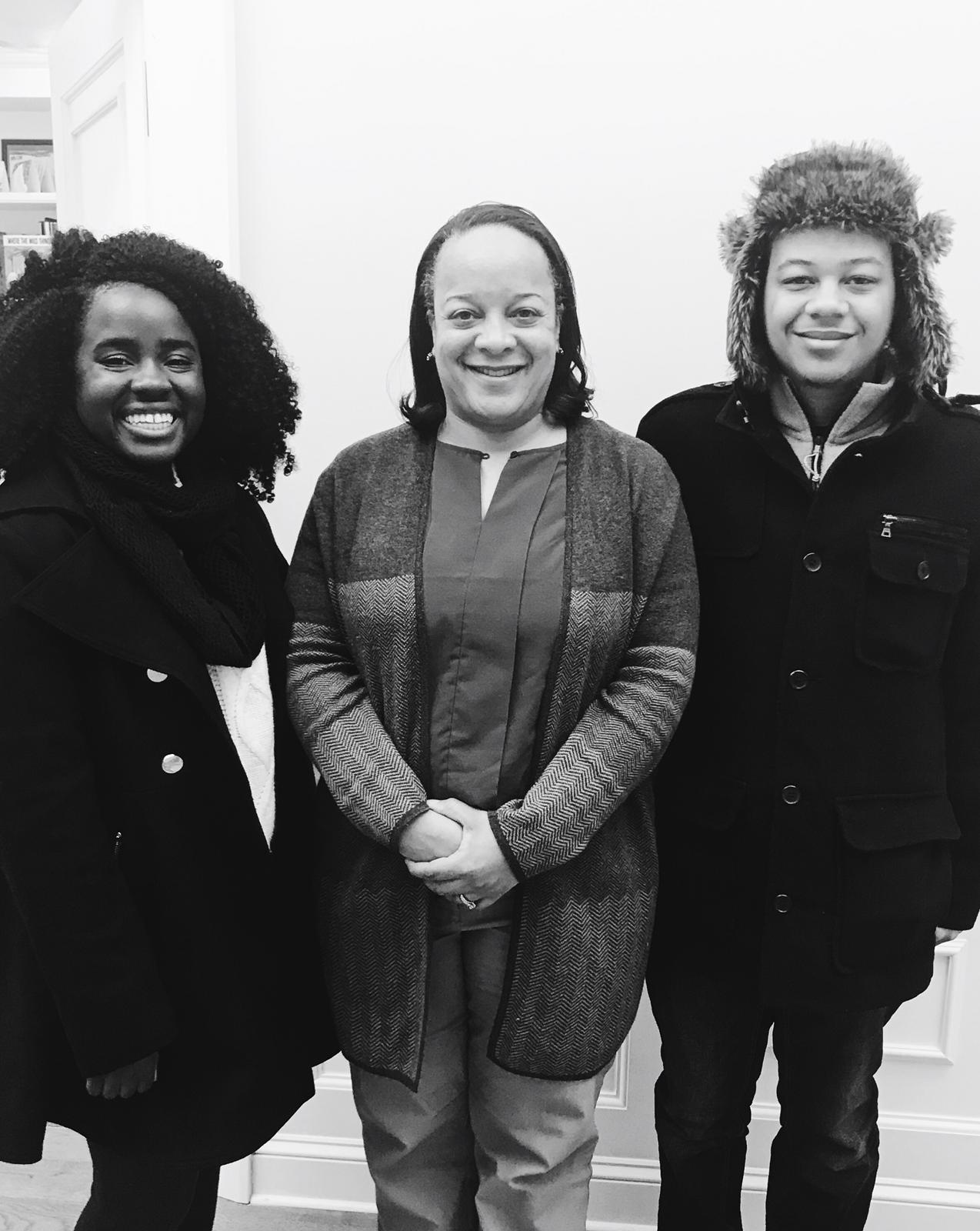
Opoku-Agyeman meets with Dr. King. Photo by Marlayna Demond '11.

With newfound supports in place, Opoku-Agyeman quickly transitioned from feeling lonely and lost to being part of both program communities. She tapped into the drive she had in high school, created strong friendships, and built a professional network.

As she embarks on her graduate studies, Opoku-Agyeman is now aware of how important it is to embrace and learn from the fear, anxiety, and confusion that sometimes occurs with new experiences. “Don’t let the temporary absence of community deter you from pursuing your goals’” says Opoku-Agyeman. “Being alone helped me to build coping skills, value my family and friends, and develop humility in my achievements.”

A family foundation

In pursuing her goals, Opoku-Agyeman conducted research on the impact of malaria on educational achievement in Ghana, pioneered the first Sadie T.M. Alexander Conference for Economics and Related Fields, and tutored middle and high school students in math throughout Howard County. Opoku-Agyeman shines her way through life with a steadfast dedication for creating opportunities for others. To balance the demands of her many pursuits, she fosters strong relationships, a method modeled by her father, she says.

“I encouraged Anna to study hard from kindergarten through college,” says Ernest Opoku- Agyeman, a registered nurse who holds his Ph.D. in epidemiology. “I wanted her to equip herself for the future and vowed to support her with anything she needed to excel in college and finish debt-free. It has been a pleasure being partners in her education and seeing her present her work widely.”

Anna with her father. Photo courtesy of the Opoku-Agyeman family.
Reciprocating kindness

As a Meyerhoff and MARC*U*Star Scholar and Honors College student, Opoku-Agyeman was able to depend on a network of faculty and staff to help navigate academic decisions and responsibilities. Her friends, Olanike Awotunde M26 ’18, biochemistry and molecular biology, Naomi Mburu M26 ’18, chemical engineering, and Brandon Enriquez M25 ’17, economics and mathematics, listened to her concerns, celebrations and, at times, served as her role models. Most importantly, her peers have provided a supportive community sharing joy, adventures, and prayer.

After Opoku-Agyeman transferred to UMBC, Awotunde was able to repay a kindness her friend had shown her in high school. “Anna approached me on my first day bubbling with excitement. She immediately introduced me to her friends making me feel welcome,” Awotunde remembers. Awontude introduced the new Retriever to Mburu and her welcoming community. ”I was impressed by her ability to lead. She voiced her opinions even when they were not popular amongst our peers in a high school with little diversity,” says Awotunde.

Throughout college, the two balanced the pressures of rigorous academic and professional paths by having fun. “We prayed together, brainstormed career ideas, and unwound by eating out, shopping, attending on-campus events, and going to the movies,” says Awotunde. A friendship they fostered even after Awotunde graduated and transitioned into a post-baccalaureate fellowship at the National Eye Institute, a part of the National Institute of Health, in preparation for a career as a physician-scientist.

Faith in friendship

Opoku-Agyeman’s strong faith is also something she shares with Mburu. “I am incredibly proud of her achievements and inspired by her discipline to stay humble and point to God throughout all of her success,” says Mburu. Their bond has grown stronger over the last year. Mburu has enjoyed cheering for Opoku-Agyeman as she inaugurated the Sadie T.M. Alexander conference for Black women in economics. “It has been beautiful to see Anna focus her energy on creating spaces for Black women and empowering other women of color to pursue and thrive in economics,” shares Mburu.

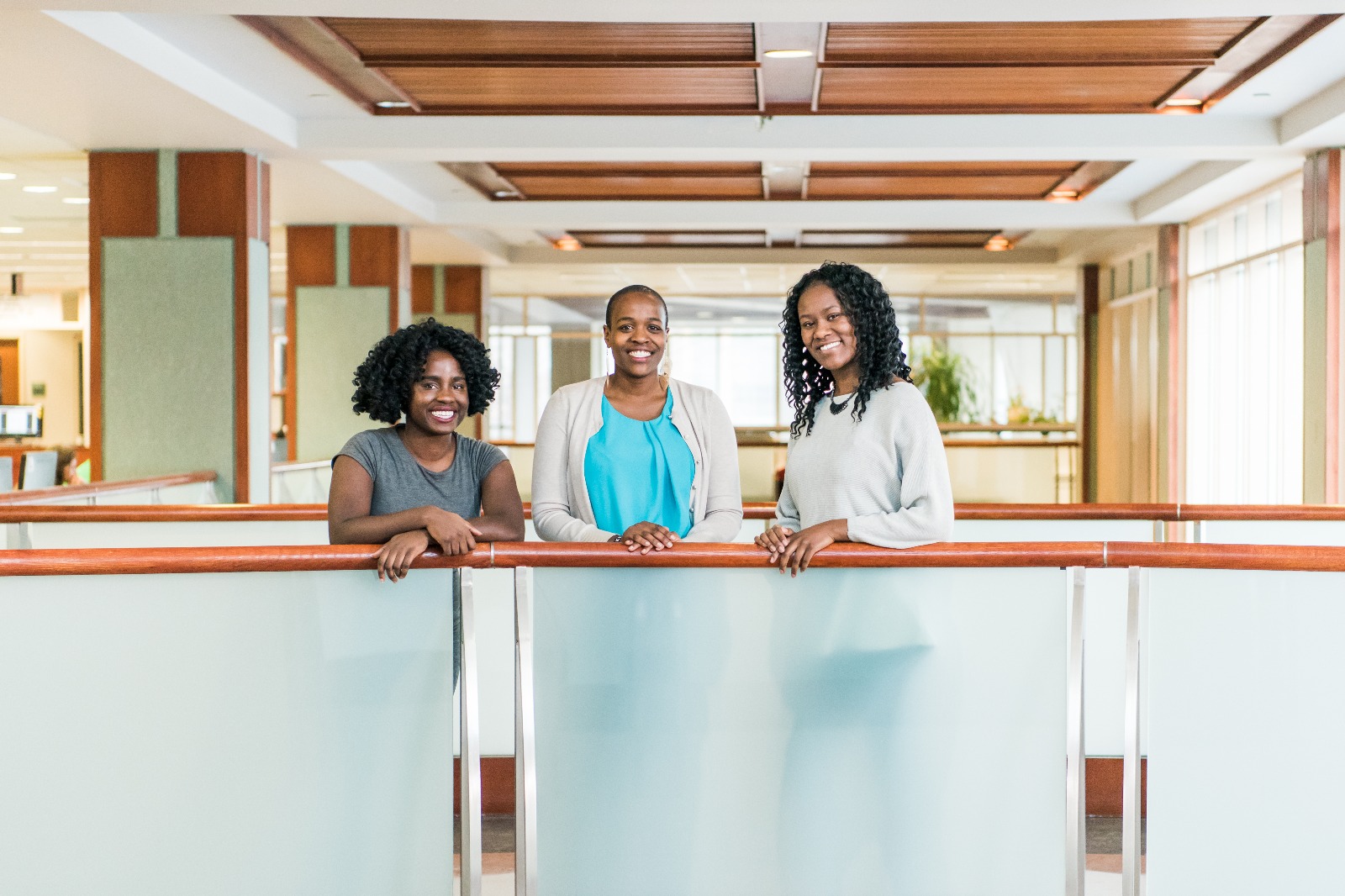
Opoku-Agyeman, Mburu, and Atowunde have retained their close friendship even as post-graduate opportunities have taken them around the world. Photo by Marlayna Demond '11.

Opoku-Agyeman has also been there for Mburu, helping prepare possible interview questions on a wide array of topics for her Rhodes scholarship interview, providing support on her road to being the first Rhodes Scholar in UMBC’s history. “Our relationship is based on mutual respect for our goals. We learn actively from each other’s experiences and habits,” says Mburu.

Sharing is caring

Opoku-Agyeman also learns from her friends who, like her, are often pursuing paths unfamiliar to them. When she began to think of switching her major from biological sciences  to economics she had concerns. She wanted to find a way to combine education and health research to improve economic mobility for underrepresented groups. After Opoku-Agyeman learned about human capital in macroeconomics class, she found that education and health had a high correlation on social and economic mobility.

Her vast network encouraged her to reach out to Enriquez, who is currently a doctoral student in economics at MIT. “We talked about how economists study more than finance, banking, and insurance,” recalls Enriquez. “I was able to share with her how economists also study strategic behavior in labor markets, public health, political systems, and other socially relevant contexts.”

In addition to questions about economics, Opoku-Agyeman had questions about life post-graduation. Topics that Enriquez could answer. “Anna was strongly leaning towards going down the Ph.D. economics route. She was especially interested in my experience during my Harvard summer research program.” Together they discussed research and classes that would help her prepare for a Ph.D. program. “I was beyond thrilled when Anna shared she will be completing a post-baccalaureate research program at Harvard.”

Strength in community

Over the summer, she will be participating in the prestigious American Economic Association’s Summer Program for Minorities, at Michigan State University, which has been a major pipeline for underrepresented people groups in economics.

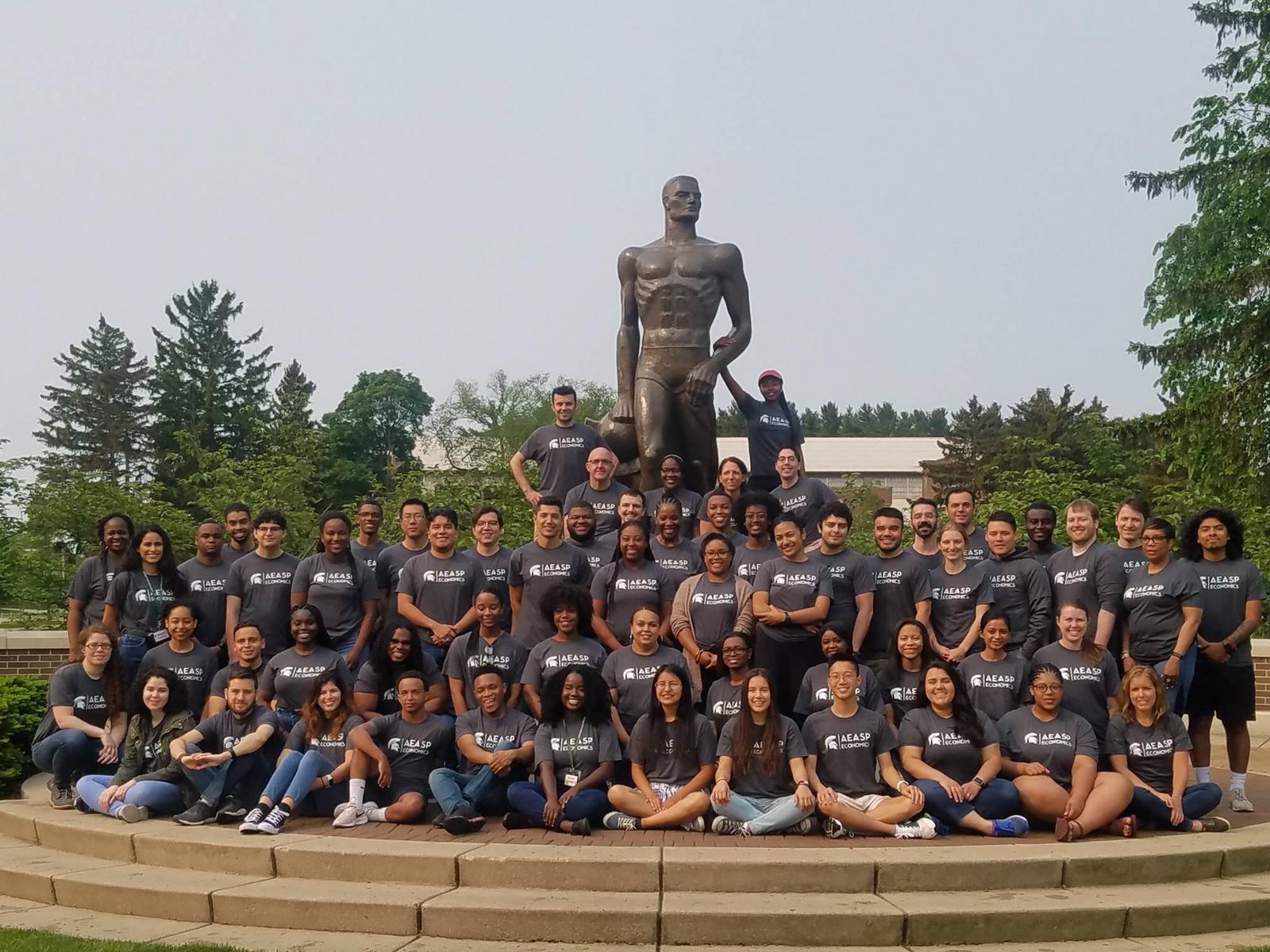
Opoku-Agyeman, front row, center, with her summer cohort at Anna at Michigan State University. Photo courtesy of Opoku-Agyeman.

In fall of 2019, Opoku-Agyeman will join Harvard’s Research Scholar Initiative (RSI) program. Over the next two years, she will have the opportunity to conduct mentored research and enroll in graduate level courses in preparation for doctoral studies.

“As a high achieving student, many people have erroneously perceived my path to this moment as one without twists and turns,” reflects Opoku-Agyeman. “I have struggled greatly. I transferred after my first semester in college, changed my major several times, and dealt with mental health challenges.”

By way of these obstacles, she discovered a network of supporters who care about her well being and success in all facets of her life.

“I hope that my journey shows people that in order to achieve, you must surround yourself with unconditional love, joy, and laughter.”

After graduation, Opoku-Agyeman is congratulated by Anna Puma, her elementary school principal and longtime mentor. Photo courtesy of Opoku-Agyeman.

*****

Header image by Marlayna Demond ’11.

UMBC celebrates student achievement in the arts, humanities, and social sciences

Faculty and staff in UMBC’s College of Arts, Humanities, and Social Sciences (CAHSS) celebrated students in the annual CAHSS awards ceremony this spring. Scholars programs and departments recognized undergraduates for academic achievements, public service, and innovation within their major and beyond.

“CAHSS’s amazing students do it all: think and learn across boundaries and borders, develop their identities as scholars and citizens, and contribute their imagination and expertise to local and global communities,” says Scott Casper, dean of CAHSS. “Given all they’ve already accomplished, it’s exciting to envision what they’ll do next.”

Dance students receive end of year CAHSS awards.
(L to R): Dean Casper; Carol Hess, dance department chair; Doug Hamby, director of the Linehan Artist Scholars program; Samantha Siegel; Giavanni Powell; Kasey Mannion ’19, dance; Emily Godfrey. Photo courtesy of CAHSS.

Combining dual passions

Among the many accolades were twelve awards to graduating students in the college’s hallmark scholar programs: the Humanities Scholars, Sondheim Public Affairs Scholars, and Linehan Artist Scholars. These include several students with dual majors.

For example, four honored dance majors were also earning a degree in another field: Linehan Artist Scholars Emily S. Godfrey ’20, dance and a psychology minor; Melissa Hudson ‘18, dance and economics; and Giavanni Powell ‘19, dance with an entrepreneurship and innovation minor; and Honors College member Samantha L. Siegel ‘19, dance and psychology.

Giavanni Powell.
Linehan Artist Scholar Giavanni Powell

Baltimore on my mind

The ceremony also honored students who committed to giving back to Baltimore communities during their time at UMBC. Vanessa Gonzalez ‘19, American studies, worked as a student teacher in Baltimore City as a Sherman STEM Teacher Scholar and received the award for outstanding achievement in American studies.

Gonzalez working with students.

Belgian international student Tanguy Ringoir ‘18, financial economics and M.S. ‘20, economic policy analysis, was named the outstanding graduating senior in financial economics. Ringoir, a chess grandmaster, learned to play chess from his father at age seven. As he strengthened his skills he began to enjoy teaching the game.

During his time at UMBC, Ringor was part of a volunteer chess coach team for a program by TouchPoint in collaboration with UMBC and the Johns Hopkins Center for Talented Youth (CTY). TouchPoint is a community organization in Baltimore that provides free chess lessons to Baltimore youth. The coaching team included volunteers from both the UMBC chess team and chess club.

Ringoir, chess grandmaster, working with CTY students. Photo courtesy of Ringoir.

Ringoir also received a Community Service Outreach and Leadership award from the UMBC Division of Professional Studies for his dedication to creating accessible chess teams. He will continue his work with Baltimore K-12 students through the CTY program.

“I personally stay in Baltimore because I can combine my passion for finance with chess,” shares Ringoir. “UMBC gives me an education at the same time that it supports my chess development through the chess team and community volunteer opportunities.”

Like Ringoir, Ciara Jones ‘19, social work, is also an award recipient who has chosen to begin her professional career in Baltimore. She received the excellence award from Africana studies, her minor. Upon graduation, Jones will work with Sarah’s House in Druid Park, as a forensic social worker. She will also serve the Canton community through Renaissance Baltimore Church.

Global skills

In addition to maximizing their academic experience on campus and participating in an exchange of skills within Baltimore communities, CAHSS students seek to sharpen their personal and professional skills by studying abroad.

Miriam Newman-Marshall ‘19, Asian studies with a Japanese minor, received the Constantine Vaporis Academic Excellence in Asian Studies Award. Newman-Marshall has traveled to Thailand and Cambodia, and has completed three study abroad trips to Japan. These trips strengthened her research skills and historical knowledge, which were critical for her work as a research assistant. She assisted Constantine Vaporis, Asian studies director, on his book, Samurai: An Encyclopedia of Japan’s Cultured Warriors.

Newman-Marshall next to a volcano in Hakone, Japan. Photo courtesy of Newman-Marshall.

Vaporis encourages all students to study a foreign language overseas to accelerate and deepen their understanding of that language and culture. “Learning a language in its country of origin equips students with skills to conduct more complex research, using multi-lingual sources,” explains Vaporis. “Miriam’s knowledge of Japanese history and her ability to read Japanese greatly facilitated her work in support of my research on the samurai.”

For more CAHSS news follow @UMBC_CAHSS on Twitter.

Banner image: Linehan Artist Scholar Emily Godfrey. All photos by Marlayna Demond ’11 for UMBC unless otherwise noted.
An Ounce of Prevention

Recovery from the flooding in Ellicott City has been long and difficult, and communities have often been left with more questions than answers. UMBC Magazine sat down with experts in public policy and emergency health services for some insight into policy issues and options for flood hazard management. Included are Susan Sterett, director of the School of Public Policy, on the role of public policy in natural disasters; John Rennie Short, public policy, researcher of urban infrastructure; Ryan Miller’99, emergency health services (EHS), former director of emergency management director and deputy chief of fire and rescue for Howard County; and Matt Levy‘00, M.S. ‘08, emergency health services, medical director for EHS, and medical director of Howard County Fire and Rescue Services.

By Catalina Sofia Dansberger Duque

Could you tell us about your emergency response to the Ellicott City floods?

Levy:  Our 911 operators and dispatchers are some of the biggest heroes of the Ellicott City Floods that most people won’t know about. They were the ones managing the phone lines and keeping people calm, giving them direction about what to do and not do as flood waters were rising and people were rightfully panicking and scared.

Once our responders received notification, they went into immediate response mode, which is to rescue and to get people out of harm’s way. We train for this. Our responders will risk their lives to try to affect rescues if it is technically feasible and capable. That is not just us but firefighters, police officers, sheriff deputies, and anyone who is responsible for getting people out of harm’s way. Rescuers from the lay public also help – neighbors helping neighbors.

We have the right equipment and use a variety of strategies and tactics to affect as many rescues as possible. Our responders have flotation devices on their apparatus to safely make entry into that environment as well as boats, rigging to remove people, and aerial ladders on trucks to reach people.There are also specially trained swift water rescue teams. The immediate response is to rescue everyone with as many strategies as possible. Once the immediate rescues are done, there is an ongoing process to try to determine that everyone is accounted for.

Eventually we shift to recovery. Once those rescues are made there is a methodical process of assessing the damage to structures after water has rescinded. We look for any potential survivors or casualties and provide a degree of stabilization of those structures to minimize the chance of secondary collapse while our personnel are in them until they can be safely turned over to private contractors who take over that work. Responder work is not as iconic as the media makes it to seem but the work is very important. We continuously train for this and are always looking for improvement to prepare for whatever may come.

What was your role in rescue operations? And how do you work with local government to create policy changes?

Miller:  I have been part of three Ellicott City floods. The first one was in 2012. It was associated with Tropical Storm Lee. That is when I personally saw the hazards associated with Ellicott City and flash flooding. It was a relatively minor storm now that we have 2016 and 2018 in perspective. Tropical Storm Lee causes roadway flooding and set off a lot of planning and mitigation planning within the county. It was the predecessor to the 2016 and 2018 which were severe.

Our role in both storms was to set up the emergency operation center in Ellicott City and bring together all the county agencies toward a common response goal and lead the recovery. We also work with the State of Maryland and the Maryland Emergency Management Agency to pull in resources from outside of the region and outside the state and interact with the Federal Emergency Management Agency (FEMA) and all federal agencies that are brought in resources to assist us. After the initial response, we chart the recovery plan, which can be anywhere between six months to a year. Howard County is unique in that we had a similar disaster twice in a short period of time. Alot of our plans and systems that we created in 2016 helped in 2018.

During emergencies, the directors work side by side with the county executive who creates policy. The director then has delegated authority or direct authority to coalesce those county resources toward a response. We are appointed by the governor, so should there be a catastrophic event, the governor can then work through the 26 directors to affect statewide responses and recovery.

What is the impact of floods on local governments? And are there policies that can be implemented to help prevent flooding?

Sterett:  It is a challenge for local governments to restrict development in flood-prone zones. Even if there is a potential for risk at the national level, local governments have reasons to want people to rebuild in flood-prone zones because they depend on property taxes. It is also an issue in areas that are fire risks like in California or Arizona where people build in areas where they don’t have access to the water that they need.

We need to be aware of changes in extreme weather events and rethink the National Flood Insurance program. The insurance models need to be reevaluated so that insurance can be priced accordingly.

Building codes would make a difference, but we need to evaluate overbuilding in areas that are at tremendous risk. Local governments need to work with developers to build communities that reduce risks. However, this is not simple. Implementing accurate government maps of flood levels would decrease property values drastically and local government taxes. There is no easy answer.

We also must think of renters and how they are affected by extreme weather. Owners have a range of choices in a devastating situation, but renters are not in control of whether their home will be rebuilt. It is also important to take into account how disasters can deepen existing racial and economic inequalities.

So much of this is about land-use planning. We don’t have a big national plan, and we are not getting rid of flood insurance. Local governments can help by developing adaptation plans as climate changes and more extreme weather occurs.

Is there a model in the U.S. to look towards?

Sterett:  Many local governments have adaptation plans developed with the help of different city departments. The Rockefeller 100 Resilient Cities, a non-profit organization, brings people together to think systematically about environmental problems. They fund a resilience officer who provides support and guidance as cities recover from a disaster.

Norfolk, Virginia can also be an example even though it has a military base. The city has a committed local government that has a multipronged plan. It tries to take advantage of every opportunity to engage the community in its adaptation plan. They hold fun community celebrations like “Retain Your Rain,” to encourage rain barrel use, and bring the public into decisions on how they repave, where public housing is built, and how traffic is guided.  

It is important to approach public problems with awareness of what the problems are, a bit of hope, and a commitment to try to work on various parts. There is no quick fix. Addressing flooding across different communities is a complicated issue that depends on collaboration between governments, residents, business owners, developers, and environmentalists.

Is there a connection between flooding and global climate change?

Short:  It is impossible to discuss flooding without talking about global climate change. When you have two, one-in-a-thousand-year flood, 22 months apart, it creates a new normal. Higher frequency of extreme events like larger hurricanes, longer lasting storm seasons, and more snow make cities more vulnerable to flooding.

What is the relationship between development and long-term environmental impact?

Short:  Suburban tracks are everywhere. Acres upon acres of roads, sidewalks, strip malls, housing, and parking lots, all create an impermeable surface leaving water nowhere to go. When you have a green field and it rains two to three inches, you can get some flooding, but it can get absorbed. Cement does not absorb large amounts of water— it just runs off.

This happens because developers push the envelope, local authorities want the revenue, and politicians want the notion of growth. There is so much growth without any sense of the long-term environmental impact. Research has shown that when more impermeable surfaces are built, there is a higher risk of flooding.

Ellicott City is very vulnerable because of its location. It originally was placed there because it was needed for hydraulic power for the mill. Over time, it became more vulnerable because of increased development in the watershed and ignored infrastructural deficits, which, when paired with larger, more frequent storms, created catastrophic events.

*****

Read more: Learning from Ellicott City 

Read more: A Timeline of Resilience 

Header image: EHS workers respond to the scene in Ellicott City. Permission from Baltimore Sun Media. All rights reserved.

Five UMBC students see their degrees as a step toward community impact

Many students see graduation as an opportunity to embark on entirely new and different experiences. For others, graduation is one more step forward on an already clear patha chance to delve wholeheartedly into passions they fostered while at UMBC. These five students fit firmly in that second group, committed to applying their talents to specific community-centered initiatives that have shaped their UMBC journeys and that strengthen their local ties.

Transforming research into activism

Being a valedictorian for me is about honoring South Asian women feminists whose achievements were not as visible when I was growing up. It is also about the need to transform research and community service skills into direct activism.

—Samiksha Manjani

During her two years as a student staff member at the UMBC Women’s Center Samiksha Manjani ‘19 has connected with and provided support for many people who have experienced sexual violence. Inspired by their courageous living, she sought to understand the roots and effects of gender-based violence. Her research, through her political science and sociology majors, has focused on inequitable sentencing of sex offenders.

In addition to research, internships have provided Manjani extensive insights into the legal field. This includes work with the Maryland State Attorney’s Office, Police Integrity and Public Trust Unit in Baltimore City, Montgomery County Police Financial Crimes Section, and Office of the Attorney General for the District of Columbia Family Division. 

These experiences prepared Manjani to be active in UMBC’s Retriever Courage initiative, focusing on improving the university’s prevention of and response to sexual violence and other forms of sexual misconduct. Manjani served as a member of the student accountability committee and leader of the police reform subcommittee. Both experiences revealed to her the need to improve integration between the law and social work in working with vulnerable populations, something she plans to pursue through a combined J.D. and M.S.W. degree.

Human trafficking is the byproduct of so many other inequalities. Bringing together artists to create art and community in the name of awareness is one way to help dismantle inequalities at all levels.

—Mia Rickenbach

Mia Rickenbach ‘19, theatre, is the founder of Create Freedom, a new Baltimore City non-profit that combines her love of the arts and commitment to increasing public awareness of human trafficking. Rickenbach became aware of the scale of human trafficking through reading Half the Sky: Turning Oppression into Opportunity for Women Worldwide as part of UMBC’s New Student Book Experience. The book informed her of the many industries that create and sustain a demand for human trafficking around the world.

Rickenbach was able to explore her next steps through an Entrepreneurship Undergraduate Research Award, granted by UMBC’s Alex. Brown Center for Entrepreneurship. It was an opportunity to combine both her passions through a community arts organization. The award helped her research the idea, complete a feasibility study, develop a business plan, and map out a timeline for implementation.

Rickenbach working on theatre set models.

Create Freedom is now home to artists committed to creating community and awareness. Throughout the year, the organization will host events where local artists and community members can gather to create and sell art to build awareness about human trafficking and build a network of like-minded people.

Mindful education

Today is a moment. I don’t have to judge it. I just accept it. Being open to the present opens you to a world of peaceful possibilities that help to manage great challenges.

—Phillip McKnight

After two years walking through the UMBC campus, Phillip McKnight ‘19 will walk across the stage this May to receive his master’s degree in instructional systems design and then walk along the Appalachian Trail for five months. The trek is part of his lifelong practice to live a mindful life.

McKnight leading a mindfulness practice for Department of Public Works in Baltimore City.

McKnight leading a mindfulness practice for the Department of Public Works in Baltimore City. Photo courtesy of McKnight.

McKnight, a fellow in UMBC’s Shriver Peaceworker Program, strengthened his practice through guided meditation during his time in Jamaica as a Peace Corps volunteer. Meditation helped him overcome challenges that came with being away from home and engage meaningfully with the community he was placed in.

During his graduate studies, McKnight helped connect Baltimore youth to urban green spaces through the Patterson Park Audubon Center. On his return from the Appalachian Trail, he plans to work with children in Baltimore City to further develop their mindfulness skills as an additional strategy for lifelong success.

Science is everywhere and for everyone

Science is everywhere, but it is also personal. The power of science comes from understanding how it applies to the communities we live in.

—Olivia Grimes

Olivia Grimes ‘19 has crafted her own individualized major around improving children’s access to science education using culturally and geographically relevant teaching practices. While sharpening her teaching skills in Baltimore City through the Sherman STEM Scholars Program, she realized science was not covered in the same depth as state-tested subjects. Seizing the opportunity, Grimes began to develop place-based science lessons that students would find fun, engaging, and relevant to their lives.

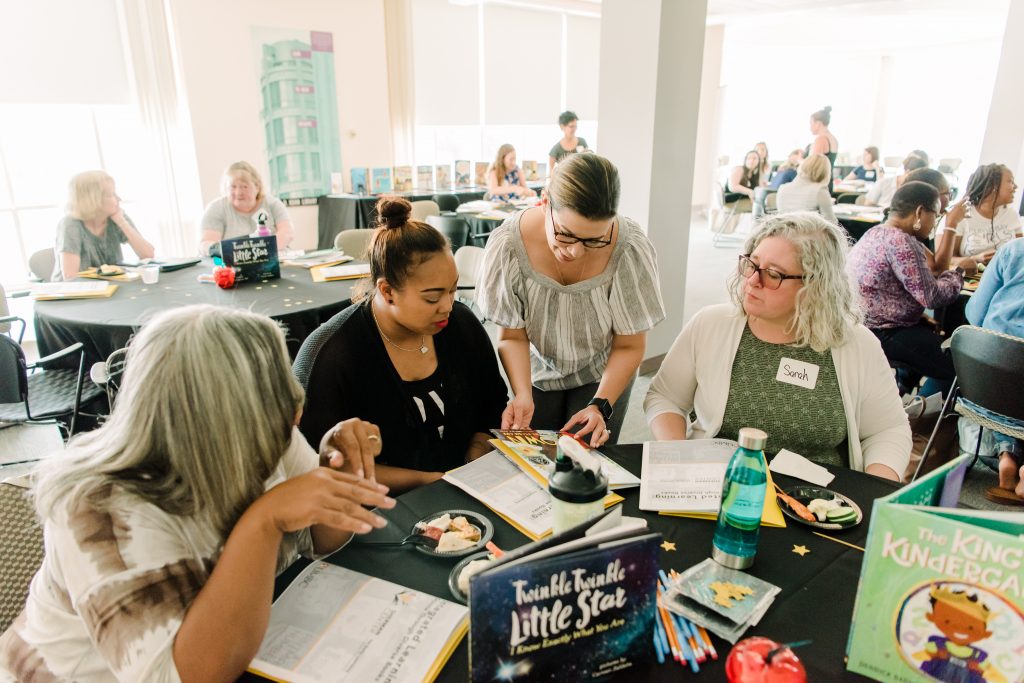
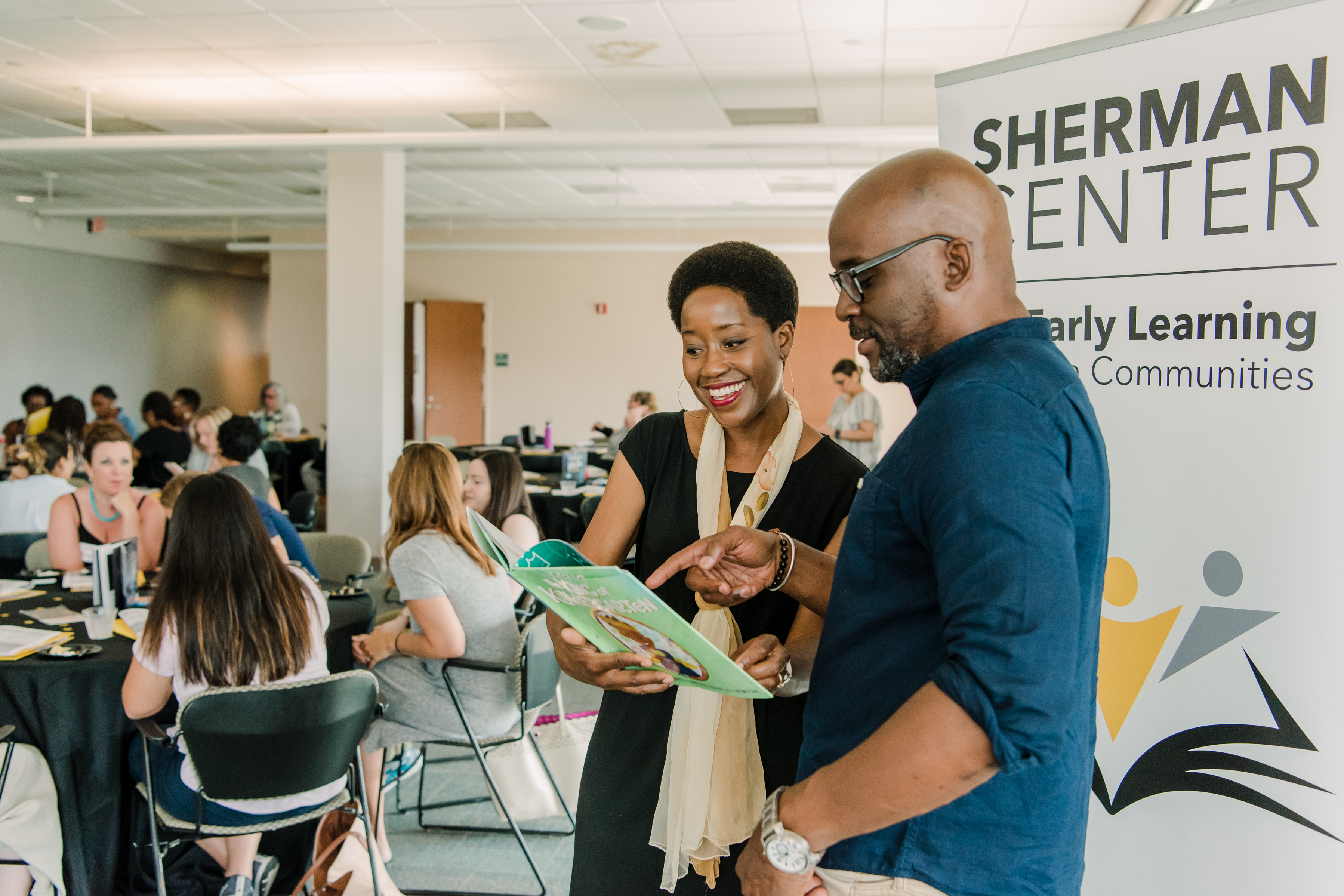
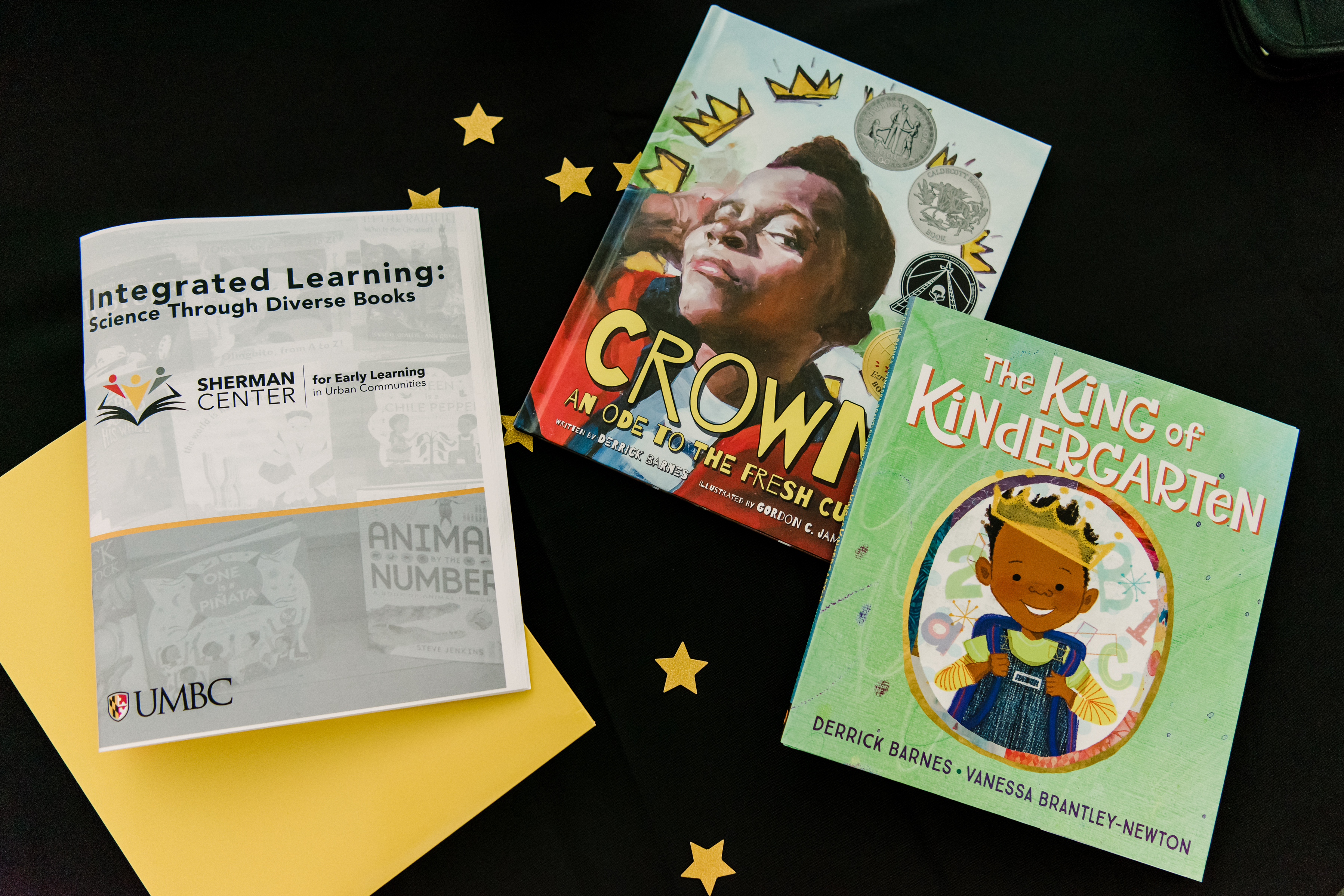
Grimes at Lakeland during the Sherman Center for Early Childhood Learning and Families diverse books event

Grimes at Lakeland during the Sherman Center for Early Childhood Learning and Families diverse books event.

Grimes adapted environmental science lessons relevant to students’ neighborhoods and lives through an afterschool program at Lakeland. She also brought her passion for place-based science to her student teaching placement at Maree G. Ferring Elementary/Middle School. She plans to continue to adapt more science curriculum to support teachers in implementing lessons into tested subjects through fun experiments as a Baltimore City early childhood educator after earning her UMBC degree this month.

Science has always been my happy place, but as a first-generation college student from Dundalk/Essex, Maryland, I didn’t know how I could afford college. Through a lot of hard work, with the support of my family, and the UMBC community, I was able to find my place as a gay scientist in the geosciences.

—Zachary Hunter-Lee Little

Zachary Hunter-Lee Little’s life as a scientist began while playing on the Ocean City shoreline. As he let the current take him down the shore he became aware of how the sand and water interacted. He began to ask questions about how the natural world worked, and years later, this curiosity led to him to major in geography and environmental science (GES).

To support his UMBC education, Little ’19 worked as a maintenance assistant in Residential Life and as a lab proctor. During the summers, he took advantage of unique research experiences. The National Science Foundation’s Research Experiences in Solid Earth Science for Students (RESESS) program enabled him to work in Boulder with UNAVCO, a university consortium that supports Earth science research. The next summer, the scholars program connected him with a research opportunity at Duke University.

Zachary Little, a 2018 RESESS intern, discusses his summer research with CU Boulder’s Greg Tucker. August 2, 2018. Boulder, Colorado. (Photo/Daniel Zietlow, UNAVCO)

Zachary Little, a 2018 RESESS intern, discusses his summer research with CU Boulder’s Greg Tucker on August 2, 2018. Photo by Daniel Zietlow, UNAVCO.

Those experiences helped Little sharpen his research skills and develop his identity and confidence as a scientist. Before long, he was presenting his own research at geoscience conferences across the country.

Back at UMBC, he grew his science communication and advocacy skills as an eco-ambassador and Blue Water Baltimore volunteer. And he’s always supporting more students along his journey, encouraging them to apply for research opportunities and internships that can help them reach their goals.

Little in the field.

Little in the field. Photo courtesy of GES department.

Little’s hard work is paying off. He recently learned that he’s been awarded a highly competitive three-year National Science Foundation Graduate Research Fellowship. He’ll soon begin an M.S. at North Carolina State University in biological and agricultural engineering.

As Little looks toward the future, his mind goes back to that moment on the Ocean City shoreline and knows his heart will remain with local waterways and communities.

Banner Image: Photo of Samiksha Manjani at Take Back the Night, courtesy of the UMBC Women’s Center. All photos by Marlayna Demond ’11 unless otherwise noted.

Fourteen UMBC students and recent alumni receive Fulbright awards, setting new record

Kelly Wan ’18, global studies and financial economics, and Humanities Scholar is one of fourteen UMBC students and recent alumni to receive Fulbright U.S. Student Program awards — a new university record.

During her junior year, the Ellicott City local, who is Chinese-American, studied abroad in Shanghai to learn more about Chinese language and culture. There, she became acutely aware of the challenges of managing different identities. “As a Chinese American I encountered misconceptions that Chinese citizens and foreigners alike had about who could be considered an American based on an individual’s physical features,” explains Wan. Through her Fulbright experience in South Korea, she’ll further explore Asian and Asian-American identities.

Wan is currently a graduate student of American studies at Columbia University. Through her Fulbright teaching assistantship, she will gain more insight about South Korea’s political, social, and cultural history. She’ll also seek to understand how Asian Americans construct their identities while reconciling both their Asian and American heritage.

As she connects with students in South Korea, Wan shares, “My hope is to dispel the stereotypes that people often associate with the United States and demonstrate that anyone, regardless of physical appearance, can be American.”

Wan’s story resonates with UMBC’s other Fulbright recipients, the university’s largest group to date. As students prepare to leave over the coming months to connect with people around the world, they share how they hope to challenge stereotypes and encourage peace-building through a shared humanity.

A history of international excellence

UMBC began participating in the Fulbright U.S. Student Program in 1970. Since then, Fulbright has chosen more than 70 UMBC students and recent alumni to represent the United States through conducting research, teaching English, or pursuing graduate studies internationally. UMBC has been particularly successful in the past five to ten years. In the last decade, UMBC has had 65 recipients.

The United States government established the Fulbright Program in 1946 to increase mutual understanding between people of the U.S. and other nations around the world. Today, this “flagship international educational exchange program” is active in over 160 countries. It is highly competitive, receiving over 11,000 applications each year. Recipients are chosen based on academic or professional achievement and demonstrated leadership potential.

Souders with Fulbright class of 2019.

Brian Souders Ph.D. ’09, language, literacy, and culture, has been a key leader in collaborating with faculty across campus to identify qualified students in all majors. He then provides one-on-one support for students beginning the summer before the Fulbright announcement and continues providing placement, academic, and social support while students are abroad. As the Fulbright program coordinator, Souders’s attention to detail and passion for connecting Retrievers with this prestigious experience has resulted in a steady increase of recipients over the last ten years.

Embracing different languages and identities

As a linguistics major, Bryce Moore ’19, modern language, linguistics, and intercultural communications (MLLI), is most at home surrounded by people who speak a variety of languages and traveling to countries unfamiliar to him. While studying abroad in Portugal he learned Portuguese and traveled to the U.K., Spain, and Germany. “I have not been anywhere east of Germany,” explains Moore. “Teaching in Kazakhstan is an opportunity to learn Russian and understand more about surrounding countries, each with their own unique identities.”

Bryce in Portugal.
Moore in Portugal. Photo courtesy of Bryce.

Dymond Elliott, ’19, psychology and MLLI, also accepted a Fulbright placement in a country unfamiliar to her: Malaysia. Elliott has studied Japanese culture and language extensively through her minor and her study abroad experience. Malaysia presents an opportunity to expand her knowledge of Asian cultures.

“I don’t speak Malay but I am excited to learn and deeply interested in immersing myself in a culture that doesn’t expect assimilation but embraces immigrant identities,” says Elliott.

Deepening cultural ties

After teaching English for two years in Costa Rica, Michael Schapiro, M.A. ’19, TESOL, is ready to apply those skills in Colombia. He is particularly excited about the opportunity for cultural exchange.

“The Latin American people I have met in the U.S and abroad have been very friendly, welcoming, and hospitable,” says Schapiro. “I enjoy that type of rapport and want to continue to build more relationships throughout the continent as I become more fluent.”

Similarly, Corey Simon’s prior experiences in Barcelona and Uruguay, supporting community education organizations, inspired her to explore teaching English further. “I chose Uruguay because I was already familiar with the language, culture, and country so I could jump right in and be most effective with the time I have,” shares Simon ‘18, MLLI, and M.A. ‘19, intercultural communication. “But more than anything I want to give back to the country that has given me such a great experience.”

An experienced world traveler, Rebekah Kempske sees the exchange of ideas as the most pivotal takeaway of her upcoming Fulbright adventure. Kempske ’19, mechanical engineering, a Center for Women in Technology (CWIT) Scholar, joined her family during breaks and holidays to travel the U.S., Europe, Australia, and Latin America. Through her travels, she saw different applications of engineering concepts, which sparked an interest in global engineering.

Kempske (right) snorkling with her sister at the Great Barrier Reef in Australia.
Kempske (right) snorkeling with her sister at the Great Barrier Reef in Australia.

Kempske chose to learn more about global engineering through a master’s in industrial design at Delft University of Technology, in the Netherlands. She believes engineering is successful when technical skills and people skills are combined maximizing different working styles and ideas. “International collaboration based on respect takes engineering from a concept to an applicable change agent,” says Kempske, “improving the quality of life for the people who need it the most all over the world.”

A full list of UMBC’s 2019 Fulbright U.S. Student Program awardees for graduate study, English teaching assistantships, and research is below. UMBC’s Fulbright semifinalist story from earlier this spring includes additional student features.

Research Assistant Awards

  • Jessica Linus ’19, health administration and policy, Rwanda

English Teaching Assistant Awards

  • Jennifer Bohlman ’19, M.A., ESOL, Germany
  • Liam Connor ’19, information systems, Vietnam
  • Dymond Elliot ’19, psychology and MLLI, Malaysia
  • Chanler Harris ’19, ancient studies, Taiwan
  • Leah Ginty ‘14, modern languages, linguistics and intercultural communication, and M.A. 19, TESOL
  • Bryce Moore ’19, MLLI, Kazakhstan
  • Manneha Qazi ’18, biological sciences, Uzbekistan
  • Michael Schapiro ’19, M.A., TESOL, Colombia
  • Corey Simon, ’18, MLLI, and M.A. ’19, intercultural communication, Uruguay
  • Kelly Wan ’18, global studies and financial economics, South Korea

M.A./M.S. Study Awards

  • Rebekah Kempske ’19, mechanical engineering, Delft University of Technology, Netherlands
  • Jacob Schubbe ‘18, mechanical engineering, Lappeenranta University of Technology, Finland
  • Julian Tash ’19, Asian studies and history, Taiwan

Banner image: UMBC Fulbright recipients hold flags of countries from their respective placements. Images by Marlayna Demond for UMBC unless otherwise noted.
URCAD 2019 features diversity-focused student research, with Baltimore, LGBTQ+, and international focus areas

UMBC students are diligently making final touches to their presentations in preparation for the 23rd annual Undergraduate Research and Creative Achievement Day (URCAD) on Wednesday, April 24. Students’ research projects are as diverse as UMBC students themselves. This year, URCAD has highlighted research that explores diversity and inequalities through three thematic series, focusing on research about Baltimore, LGBTQ+ topics, and international topics.

These presentations affirm a core goal of URCAD. As Katharine H. Cole, vice provost and dean of undergraduate academic affairs, has shared, “UMBC encourages students of all disciplines to engage in mentored projects and through creative thought and focused inquiry, to discover in themselves their passion.”

STEM identities in Baltimore

Shadia Musa ‘19, American studies, focused her research one exploring how sixth-grade students of color at James McHenry Elementary/Middle School in Baltimore City come to identify with STEM fields. Through her work as a Sherman STEM Teachers Scholar, Musa explored the impact of restructuring learning environments to increase students’ involvement in STEM disciplines.

Musa at giving instruction at James McHenry Elementary/Middle School.

At James McHenry, where many families don’t have confidence with science and math topics due to historic inequalities in education, teachers, parents, and community organizers collaborate with each other to create more and earlier points of entry into STEM education for students, using an inquiry-based approach.

“I worked with students to identify issues important to them, like having a grocery store nearby. We then created a 3D model of the store out of cardboard,” explains Musa, who plans to continue teaching in Baltimore City. “Through this interactive process, students learned and strengthened their grouping, measurement, computation, and spatial skills as well as cooperative learning skills, and involved their families in the process.”

Musa will present Combating Academic Inequity: A Community-based Approach to Cultivating a Love for STEM within Students of Color at 2:15 p.m. in UC 310.

Intersections of LGBTQ and Jewish identities

Cliel Shdaimah ‘19, gender, women’s, and sexuality studies, researched intersecting identities in her own queer and Jewish communities through interviews with five LGBTQ rabbis in the United States and in Israel. “In the last five years I realized that I was queer and wanted to find a way into my Judaism that was natural but that also celebrated that part of myself,” explains Shdaimah.

The interviews revealed three insights into how the rabbis were managing their identities. First, they described their visibility as queer people and as Jewish family members in Jewish religious spaces. They also dealt with addressing their LGBTQ identities with social justice work. Third, the rabbis had to find ways to incorporate their values as both Jewish and LGBTQ people when interpreting Jewish religious texts and teachings.

“Through this and other research projects at UMBC I had the joy of reading feminist and queer ways of thinking and the Torah,” says Shdaimah. “I have been able to bring all of my identities to my personal life but also to my academic life through different research projects that helped me understand what my possibilities are for the future.”

Shdaimah will present Keshet L’Am: Perspectives of LGBTQ+ Rabbis on Intersecting Identities, 1-2:30 p.m. in the UC Ballroom.

Sharing complex feelings through animation

Julia Blurton-Jones ‘21, visual arts, took a very personal perspective in creating a short animation based on her experience growing up as a gay woman in Catholic private schools. Her film shares the experience of being asked to read a passage from a textbook that implied same-sex marriage should not be allowed. Through animation, she explores this dilemma of having to betray yourself and conveys the fear the protagonist is experiencing.

In her experience with members outside of the LGBTQ community, Blurton-Jones feels coming out is seen as a black and white situationyou are either in or out. But that’s a  misconception, she says.

Animation still by Blurton-Jones.

“There is a greyness to coming out,” shares Blurton Jones. “People in the closet have to actively hide and lie a lot and pretend to disagree with homosexuality. People out of the closet have to decide to continuously come out in different environments.”

This project proved tremendously gratifying for Blurton-Jones. “I am passionate about animation,” she says. “It is a medium where I can mess with reality to portray complex feelings.”

Blurton-Jones will present “Traitor: An Animated Short” at 2:30 p.m. in the Fine Arts Recital Hall.

Separation of voice from body

As a sound professional, Daniel Goldstein ‘18, media and communications studies, is used to mixing different voices to convey ideas, events, and information. For his independent research project, he was interested in researching the effect on different communities of the separation of the voice from the body that occurs in voicing animations, doing voice-over narrations, and creating voices for new digital platforms.

“I wanted to think critically, holistically, and analytically about what it means to cast a specific person as a narrator or a character for animation, and how over time they have created norms about gender and race based on stereotypes,” says Goldstein.

One major example is The Simpsons, where the South Asian character of Abu is portrayed by a white male voice referencing stereotypes of English spoken with a South Asian accent. “This has many negative social and political ramifications,” says Goldstein. “Abu’s voice has been used to create voice norms for an entire community that is not adequately represented on the show.”

Goldstein also shares that he found positive examples of inclusion for a broader range of voices. He describes that theatre voice coaching has helped some members of the trans community match their voice with their identity. Also, looking at growing digital platforms, he notes, “Modern consumer technology like Alexa, Siri, and podcasts, allows traditionally non-normative voices to be successful and fulfill roles that are historically very gendered.”

Goldstein will present Will You Listen?: A Critical Analysis of Gendered and Racialized Disembodied Voices in Contemporary Media Culture at 1:15 p.m., UC 204.

Evolution of Korean art, 2013-1017

Sparked by her sister’s interest in Korean culture, Sarah Natterman ‘20, modern languages, linguistics, and intercultural communication and Asian studies, began learning the Korean language in high school. At UMBC, she began studying Korean art, culture, and social issues in greater depth. Natterman says, “I combined both my academic and personal interests in visual and performing arts to research how the South Korean regime of Park Geun-hye in between 2013 and 2017 affected Korean contemporary art.”

Her research explored the effects of Park Geun-hye censoring 10,000 artists and how censorship restricted and grew art in Korea. As a result of the regime, Korean art developed two movements. One was reminiscent of a past cultural movement, with prominent Korean cultural themes. The other included more abstract themes for a global market. Both influenced the evolution of contemporary South Korean art and culture in the world today.

“I want people to see South Korea as a whole. Politics are important but they can often mask South Korea’s vibrant literature, culture, and theatre,” shares Natterman. She will further her study of South Korean culture next year through UMBC’s academic exchange program with Seoul National University.

Natterman will present Modern Dualism in Korean Contemporary Art at 9:45 a.m. in UC 310

Options in social work delivery

As a student of social work, Rebeccah Mann ‘19, is familiar with the U.S. social work model, which depends largely on federal, state, and local funding to provide services. She was in search of a different perspective on social work delivery models. Through the University Studies Abroad Consortium, Mann enrolled in a social work program at the University of Ghana.

Mann with other social work students introducing themselves to class.

She found that in Ghana there isn’t a vast network of federal, state, or local funding. Social workers in Ghana pursue a more creative and collective approach to fundraising to support the delivery of social work services.

“Through local sales of goods, international sponsors, and a barter system, organizations could be paid for the services they provided and communities could continue to access those needed services,” says Mann. “The innovation has inspired me to see possibilities instead of obstacles as I become a professional social worker.”

Mann will present A Comparison Between Social Service Delivery Systems in Ghana and the United States, 10-11:30 a.m. in the UC Ballroom.

URCAD guests are encouraged to learn more about the broad range of presentations on Baltimore, LGBTQ+, and international research topics. A full listing of all student presenters and their topics and presentation times is available through the URCAD website.

Banner image: URCAD 2018 by Marlayna Demond ’11 for UMBC.

Evan Avila is named a Truman Scholar, the fourth in UMBC history

“I want to pursue a career in economics to inform policy that can dismantle structural barriers to economic equality for immigrant communities,” says Evan Avila a junior majoring in economics and political science.

“As a first-generation American from a Mexican-Peruvian immigrant family, I understand well how mastery of English is fundamental to economic prosperity in this country,” Avila says. “Through the Esperanza Center,” he explains, reflecting on a community group he maintains a strong connection with, “I help my community refine their English skills to better defend their rights as essential participants in U.S. economic growth.”

Now, he’ll be even better positioned to do this work. Avila, a Sondheim Public Affairs Scholar, has just been named a 2019 recipient of the distinguished Harry S. Truman Scholarship, an affirming recognition of both his achievements and his potential.

Avila becomes the fourth Truman Scholar in UMBC history. He follows Alicia Wilson ‘04, political science, who was selected in 2003 and now serves as a senior vice president and senior legal counsel for Port Covington Investments.

“It is thrilling to welcome Evan into the Truman Scholarship Program. I have had the pleasure of having dinner with him and entrusted with knowing his dreams,” says Wilson. “This award is a huge step in the direction of fulfilling his vision to help some of the most vulnerable populations realize their dreams.”

After an intensive application and panel interview process, Avila was chosen for one of just sixty scholar positions out of 840 applicants nationwide. Now, he joins a network, built over the past 40 years, of over 3,000 scholars dedicated to public service in the United States and around the world. These past recipients now serve in leadership positions at the highest levels.

https://vimeo.com/171802452

The award grants Avila $30,000 toward a competitive graduate school of his choice. In addition, scholars gain access to continuous leadership development programs, such as the Truman Scholars Leadership Week and the Summer Institute. Scholars also benefit from mentorship by top leaders in government agencies, nonprofit organizations, public and private educational institutions, and advocacy organizations.

UMBC has a rigorous selection process to nominate a student for a Truman Scholarship. It begins with recruitment from scholars programs, research initiatives, and departments across campus. April Householder, director of undergraduate research and prestigious scholarships, guides a committee that works with candidates. They prioritize the most important factor for Truman applicants: their ability to demonstrate a strong potential as a change agent in their chosen field.

“Evan has taken on endeavors that some students might not see as exciting-—income tax preparation, working for the U.S. Census Bureau, being an English language tutor, and writing policy proposals about retirement—and turned them into deeply meaningful experiences,” reflects Householder. “His work is inextricably linked to empowering people that are invisible to many: immigrants, retirees, and the poor.”

Dreams, words, actions

Avila will spend his senior year finalizing his law school applications. He plans to pursue both a J.D. degree and a master’s of law in taxation, to specialize in taxation and employee benefits law. His goal is to work for the IRS before informing policy on Capitol Hill.

Avila began to prepare for these opportunities last summer as an intern at the U.S. Census Bureau and Treasury Department. This summer he will begin to fulfill his dream of working in Capitol Hill as an intern in the Senate Committee on Health, Education, Labor, and Pensions.

He will also present his winning iOME challenge policy proposal, Rethinking Millennial Retirement: Policy Recommendations for a Gig Economy, at the inaugural Latinxs Making Money Moves Conference hosted by Latinos for a Secure Retirement coalition in Washington, D.C. The proposal provides innovative policies to help millennials save for retirement. It will also soon become course material at UMBC in the Erickson School of Aging Studies course How Boomers are Revolutionizing Aging.

As workers, families, and students face unpredictable retirement, Avila, who has worked with these communities, takes these issues personally. “These trends will lead to greater wealth inequality and division,” says Avila. “My driving ambition is to combine the intersections of financial services, taxation, and employee benefits to address this significant challenge.”

A purpose-driven life

UMBC’s Sondheim Public Affairs Scholars program has nurtured Avila’s desire to serve communities most affected by structural inequalities. Notably, the program requires scholars to engage in, and reflect on, applied learning opportunities. Avila began by volunteering as a tax preparer with the UMBC Volunteer Income Tax Assistance (VITA) program, which helps low-income households prepare their taxes for free.

During his sophomore year, when VITA’s leadership was graduating, Avila secured funding to continue the program and became its president and site manager. This year VITA reached a milestone by helping 500 clients for the season, 145 more clients than last year.

While he worked in the VITA program, Avila received support from the Shriver Center, which provides opportunities for engaged scholarship and applied learning, for his work at the Esperanza Center.  The Shriver Center acknowledged Avila as a France-Merrick Scholar for his commitment to service, leadership, and civic engagement on the UMBC campus and in Baltimore City. He is also a member of UMBC’s Honors College and board member of UMBC’s Financial Literacy Education Committee.

Avila credits Arthur Johnson, provost emeritus and former director of the Sondheim program, for his mentorship in shaping his path in public service. Johnson has written and spoken often about the meaningful legacy of Walter Sondheim, the program’s namesake. In 2015, he wrote in USM’s The Faculty Voice, “Mr. Sondheim’s career was an ideal model for illustrating the values of public service and dedication to the public interest.”

Johnson explained that Sondheim “led Baltimore City school integration and the transformation of Baltimore’s inner harbor.” He wrote, “We want our students to understand what a ‘life of purpose’ looks like and the good it can accomplish, no matter their chosen career path.”

In becoming a Truman Scholar, Avila joins other Sondheim Scholars who have been recognized through prestigious honors. Rosa Rada ‘17, food systems policy, was a Truman Scholar finalist and became a Bill Emerson National Hunger Fellow through the Congressional Hunger Center. In 2016, Zainab Alkebsi ’09, political science, was admitted to the Bar of the United States Supreme Court through a historic swearing-in of deaf and hard of hearing attorneys. Ari Ne’eman ’10, political science, co-founder of the Autism Self-Advocacy Network, was appointed by President Obama to the National Council on Disability. The Financial Times named Greg Lowe ’05, political science, among its Top 100 LGBT+ executives in 2017, as global head of resilience and sustainability at Aon.

The Sondheim program also has strong global reach and regional impact, with seven Fulbright Student Scholars and three Newman Civic Fellows.

“In the Sondheim Public Affairs Scholars Program, we seek to support students who want to live impactful lives,” says Laura Hussey, associate professor of political science, and director of the program. “Evan is already doing that and with great excellence, integrity, and care for people.”


Banner image (l to r): Simon Stacey, director of the Honors College, and members of the UMBC Truman Selection Committee: Lori Hardesty, associate director of the Shriver Center; Avila; David Hoffman, director of the Center for Democracy and Civic Life; Householder; Brian Souders, Fulbright program advisor.

UMBC Mock Trial takes 8th place at AMTA National Championship

UMBC Mock Trial has finished the most successful season in its eight-year history, placing eighth at the American Mock Trial Association National Championship Tournament in Philadelphia. This impressive ranking concludes a season where over 750 teams competed across the nation. Sophomore Sydney Gaskins received the All-American Attorney Award, the highest individual honor in college mock trial.

The team swept Penn State in the first round and tied with University of California, Berkeley and Columbia University in the second and third rounds, respectively. In the fourth round, UMBC fought Yale University, the eventual champion, to a draw, narrowly missing advancing to the final round.

Each round highlighted the team’s preparation and allowed for individuals to demonstrate expertise gained over a rigorous season. “I am so honored to make my community proud and represent not only our program but UMBC as a whole in such a positive way,” says Gaskins.

UMBC’s leading Mock Trial A-Team includes Gaskins, ’21, political science; Linnea Collins ’21, global studies; Thomas Kiley ’21, chemistry; Ethan Hudson ’21, English; Natalie Murray ’21, biological sciences; Nihir Nanavaty ’19, political science; Thomas Azari ‘21, individualized study, and Amrita Sarma ‘22, psychology. The team also included four non-competing alternates: Lauren Wotring ‘22, political science; Amanda Hampton ‘22, biological science; Wendy Zhang ‘22, economics and psychology; and Kaitlyn Kauffman ’20, political science.

“In addition to earning an All-American Award at Nationals, Sydney earned two attorney awards at the national Opening Round Championship in 2019,” explains head coach Ben Garmoe, who also coached the first UMBC team to compete at nationals two years ago. “I lost count of how many coaches came up to me after the round and marveled at how Sydney is one of the greatest competitors they’ve ever seen. I am extremely proud of her and the team.”

Building success together

The UMBC Mock Trial program began in 2011. Ben Garmoe ’13, political science, a litigation attorney in Baltimore, co-founded the intellectual sports team with Travis Bell ’14, psychology and political science, a public defender in Alabama. Throughout the years the program’s success has drawn highly diverse, skilled, and committed student scholars, some of whom, like Garmoe, return as coaches during or after law school.

UMBC Mock Trial seniors (l-r) Kayla Smith, Dylan Elliott, and Zuhair Riaz.

Current coaches include Summer Akhtar ’18, financial economics and political science; Dylan Elliott ’17, history; and Kayla Smith ’17, interdisciplinary studies, all members of the first UMBC Mock Trial team to go to nationals in 2017. Additional alumni coaches are Bell; Zachary Garmoe ’17, environmental studies; Jaedon Huie ’18, financial economics; and Cheyenne Smith ’16, biological sciences and psychology. Whitney Whilder, an attorney at Bodey law firm in Baltimore City, also supports the team as a coach.

“As a competitor, qualifying for Nationals for the first time was incredible. UMBC Mock Trial was the underdog,” recalls Akhtar, now a student at the University of Maryland Francis King Carey School of Law. “That is no longer the case. As a coach, I am proud to see how students built a name for themselves as a formidable team competing and winning against the very best.”

Learning to manage challenges

For some A-Team members, the road to Philly began before UMBC. Hudson, Kiley, and Gaskins joined Mock Trial at Franklin High School. Hudson helped his team finish second out of over 120 teams in the 2016 state championship. He joined UMBC’s B-Team his freshman year and watched the A- team compete in Nationals in 2017. The following year Hudson earned a spot on the A-Team, and he was elected president two years later.

Mock Trial, for Hudson, is about following his dreams while managing severe anxiety. He says that his family, his teammates, and Garmoe have helped him to learn to manage his anxiety. “I take my victories where I can get them, day by day,” shares Hudson. “A win for me means being able to give a statement without twitches or body movements, or approaching someone whom I have anxiety to speak with.”

His hard work has paid off tremendously. In addition to developing coping strategies and gaining confidence, he’s also been honored for his work on the team with an All-Region Attorney award at the 2019 regional competition.

Hudson also now shares his strategies with his teammates and his students as a coach for three high school Mock Trial teams. He plans to follow in Garmoe and Akhtar’s footsteps and give back to UMBC as a coach after law school.

Mock Trial also helped Gaskins persevere through difficult times in high school and college, and instilled in her a desire to be a lawyer. “I found my voice in high school mock trial when I felt I had nowhere to turn,” says Gaskins. “College mock trial is much harder. It helped me strengthen my voice as a self-assured woman and speak up against society’s biases about how women should act.”

As Gaskins has gained confidence through the years, she has learned to enjoy and observe the impact of her performance, and to make calculated adjustments throughout the process.

“For me, this is like Division I sports,” Gaskins explains. “It’s extremely rigorous and competitive. Mock Trial demands a great deal of hard work, dedication, and commitment, to compete against some of the best teams and win. I always aim to win.”

Banner image: UMBC Mock Trial A-Team at AMTA 2019. All images courtesy of UMBC Mock Trial unless otherwise indicated.

UMBC’s Tyson King-Meadows becomes an ACE Fellow, as an emerging national higher ed leader

The American Council on Education (ACE) announced this week that UMBC’s Tyson King-Meadows, associate dean for research and college affairs in the College of Arts Humanities and Social Sciences (CAHSS), has been selected as a 2019-2020 ACE Fellow. King-Meadows will join a cohort of thirty-nine fellows from institutions across the United States in the distinguished education leadership program.

Established in 1965, the ACE Fellows Program is designed to strengthen institutions and leadership in American higher education. The program identifies and prepares faculty and staff for senior positions in college and university administration through its distinctive and intensive nominator-driven, cohort-based mentorship model.

“I am excited and grateful for this opportunity to further deepen my leadership skills and goals,” says King-Meadows, thanking his nominator, President Freeman Hrabowski, whom he has worked with on leadership and diversity initiatives that support UMBC’s vision and values.

Inspired leadership

The fellowship affords King-Meadows the opportunity to shadow a president or provost to prepare him for the complexities of leading an institution of higher education. Over the course of a year, each cohort member will be able to observe and learn from top leaders in higher education as they manage crises, connect with donors, understand curriculum in different fields, and engage with stakeholders across their university communities.

The fellowship will also provide King-Meadows insight into areas of personal interest, like faculty development, strategic planning, external partnerships, and research infrastructure. 

“There is a direct correlation between how people think about their scholarship and how people think about their teaching,” explains King-Meadows. “It is an interactive, reciprocal relationship. If you have the best research infrastructure you will have the best teachers and the best students.”

King-Meadows feels UMBC strengthens the relationship between research and teaching through engaged scholarship and applied learning opportunities through the Shriver Center and Career Center. He also wants to further bolster that connection by learning from the approaches of other institutions.

Immersed in UMBC

During his sixteen years at UMBC, King-Meadows has served in several key leadership roles within CAHSS and across the university. He has led as co-chair of the Provost’s Executive Committee for the Recruitment, Retention, and Advancement of Underrepresented Minority Faculty and chair of the department of Africana studies. He is also an affiliate faculty member in the School of Public Policy, the department of Africana studies, and the language, literacy, and culture doctoral program.

“Tyson King-Meadows has long been a visionary leader at UMBC at every level, from department to College to University,” shares Scott Casper, dean of CAHSS. “I’m delighted that ACE has recognized his record of accomplishments, and I look forward to the exciting ideas and approaches he will bring back to us from institutions across the country.”

Tyson King-Meadows

In addition to being recognized for his support of faculty and students in the social sciences and the humanities, King-Meadows is also an esteemed scholar. His scholarship has been supported by the National Science Foundation, Congressional Fellowship Program of the American Political Science Association, Ford Foundation Postdoctoral Fellowship Program, and U.S. Fulbright Scholar Program.

Higher education leaders of tomorrow

Over the last fifty years, more than 2,000 higher education leaders have participated in the ACE Fellows Program. Eighty percent of ACE Fellows have gone on to serve as senior leaders of colleges and universities.

Along with highly acclaimed faculty from other institutions, King-Meadows joins a respected group of UMBC scholars who have participated in the ACE Fellows Program. UMBC’s ACE alumni include Sarah J. Shin, associate provost for academic affairs; Marie desJardins, former professor of computer science and associate dean for academic affairs, who is now a dean at Simmons College; Julie Ross, former dean of the College of Engineering and Information Technology, who is now a dean at Virginia Tech; and Anne Brodsky, associate dean of CAHSS, and chair and professor of psychology.

Like faculty before him, King-Meadows plans to use the strategies and techniques he learns as an ACE Fellow to further support the implementation of UMBC’s strategic plan and advance UMBC’s vision to connect innovative teaching and learning, research across disciplines, and civic engagement.

Banner image: Tyson King-Meadows. All images by Marlayna Demond ’11 for UMBC.

UMBC’s Maheen Haq receives 2019 Newman Civic Fellowship, affirming the importance of supporting local and global communities facing discrimination

Whether she’s in Jordan or Baltimore, UMBC’s Maheen Haq brings a deep sense of duty to her work with communities facing discrimination. Now, Haq ‘20, global studies and economics, a Sondheim Public Affairs Scholar, has been named a Newman Civic Fellow in recognition of her work.

Haq follows in the footsteps of public service-minded Retrievers who have earned the Newman Civic Fellowship across the nine-year history of the Campus Compact program. They include Stephanie Milani ‘19, computer science and psychology; Sophia Lopresti ‘17, global studies; Maxwell Poole ‘18, computer science; economics; and Kelly Cyr ‘12, biological sciences, and M.S. ’13, applied molecular biology.

With support from the Shriver Center, Haq has engaged with local organizations that work to help communities negatively impacted by social and political issues. As a volunteer at the Esperanza Center, she helped teach English to recent immigrants. She has organized clothing and food drives and distributions for people facing homelessness in Baltimore City. Haq has also been able to work with youth managing social and economic challenges and helped organize protests around issues she cares deeply about, combating hate speech, racism, Islamophobia, and fighting for the rights of immigrants.

Internationally, she’s participated in relief efforts for Syrian refugees in Jordan, working closely with UMBC’s study abroad office to connect with local service organizations. She’s also supported women who are survivors of violence in Pakistan. 

Maheen playing soccer with Syrian children in a Jordanian refugee camp after passing out soccer jerseys she helped fundraise for.

Discrimination and privilege

“Because I experienced discrimination growing up, it has opened my eyes to the experiences of other communities who face discrimination,” says Haq.

Haq was born in Maryland after her parents immigrated to the United States from Pakistan. As a Muslim American, she grew up experiencing both subtle and direct Islamophobia, but was also in a position to help others. “In high school, a Syrian refugee visited my mosque asking for support,” says Haq. “I became aware of my own privilege within the United States. I still have access to education, food, and general safety, even while I face discrimination.”

As a student at Smithsburg High School in Hagerstown, this awareness flourished. Haq served as president of the International Awareness Club, Spread the Love Club and the CoExist Club to support students facing any type of discrimination. She also traveled to Pakistan to help with Depilex Smileagain Foundation, a Pakistani organization that helps women who are survivors of acid attacks and ostracization with medical support and workforce development skills.

Maheen posing with boys from Syrian refugee camp after handing out soccer jerseys she helped to fundraise.

Recently, Haq advocated against exclusion and prejudice through op-eds in the Baltimore Sun. Her first piece focused on her experience living as a Muslim in the United States, and her faith that the Declaration of Independence’s promise of freedom for all will be fulfilled. Her second piece, written as a letter to the Hagerstown’s mayor, reflects on Islamophobia she experienced growing up in the town. Haq followed her op-eds by helping to organize a community town hall and a rally against hate speech.

Amanah is a word in Arabic that means trust. For me this means that if I have knowledge of oppression, I have been trusted with the task of standing up against it,” explains Haq. “I study very hard so that I can develop the best skills to serve communities dealing with grave injustices because they deserve the best.”

Research for the greater good

Haq has used her time at UMBC to develop research skills and a greater understanding of global issues. Through a course on globalization with Felipe Filomeno, assistant professor of political science and global studies, she developed a research study to better understand the role of faith in helping refugees cope with the challenges of daily life. Haq traveled to Jordan to conduct her study, working with Helping Hand for Relief and Development, an organization that provides services to Syrian refugees.

Through qualitative interviews, I found that the majority of refugees did not leave their faith, but drew strength from it to manage daily survival,” shares Haq. She hopes to use her findings to develop literature to enhance the way aid is provided to the refugee community.

UMBC President Freeman Hrabowski has recognized Haq’s leadership and commitment to social justice as emblematic of UMBC values and the goals of the fellowship program. “Maheen is a charismatic and dedicated leader with a sustained commitment to promoting intersectional activism locally and globally,” he shares. “She is an ideal recipient of the Newman Civic Fellowship.”

Banner image: Maheen giving out toys to children in a Syrian refugee camp.  

All photos courtesy of Maheen Haq with permission from Helping Hand for Relief and Development.

UMBC delegation joins students from three continents at International Model African Union

A delegation of UMBC Africana studies students recently joined teams from three continents for the 17th annual International Model African Union (MAU) Conference in Washington D.C., hosted by Howard University. Participants represented the 54 countries on the African continent in the simulation event, discussing economic, social, political, and security issues.

“The MAU is an important experiential learning exercise to study the role, structure, and activities of the African Union,” explains Gloria Chuku, professor and chair of the Africana studies, and the delegation’s faculty advisor. “As model representatives, students enhance their skills and understanding of global diplomacy and public speaking through simulations.”

Gloria Chuku, professor and chair of Africana Studies.

UMBC’s team included Damarius Johnson ’19, Africana studies; Maurice Cates ’21, Mahlet Gebre-Egziabher ’21, and Marion Sillah ’22, political science; Kemi Biaou ’21, biological sciences; and Enzo Walker ’20, computer science. The group represented the southwestern island nation of São Tomé and Príncipe.

Johnson served as head delegate and member of the simulation’s Committee on Pan Africanism and Continental Unity. In preparation for the event, he led the independent study group in researching the country’s history and current status. This advance preparation proved essential for drafting policy proposals to present to parliament during the simulation.

Understanding Africa’s core policy issues

Participants started the conference at the African Union (AU) Representational Mission in Georgetown. A panel of scholars of  Africana and African diaspora studies, including professor Chuku, and a member from the African Union Representation Mission led a question and answer session on significant topics discussed by African policymakers today, a half-century after independence. The session included discussion of economic development, youth employment, female genital mutilation (FGM), LGBTQ civil rights, collaboration with countries in the African diaspora, and the emigration of high-skilled African professionals to other continents.

“The world seems small when we stay in one place, but when we travel we come to understand issues beyond our own culture,” Silla shares. Silla moved to the U.S. from Sierra Leone four years ago and, during the simulation, she served on the Committee on Democracy, Governance and Human Rights. She says, “Broadening my point of view made me think about where I stand as a woman, a black woman, a Muslim woman, and an immigrant on a global scale.”

Simulating the Pan-African Parliament

Over a four day-period, committees presented their proposals during a simulated session of the Pan-African Parliament. They followed parliamentary procedure, led by a student chair, parliamentarian, rapporteur, and vice chair. Committees presented, debated, amended, and adopted, their proposals during the moderated caucus, before moving on to negotiations and proposal revision. They then submitted the revised proposals for a final vote leading to a resolution.

Johnson asking for permission to speak during parliamentary proceedings

“I learned that compromise is an integral process of diplomacy,” Johnson reflects. “You must listen and engage with fellow delegates in ways that demonstrate the value of their interests and their needs.”

In addition to the committee proposals, the event also included a simulated crisis situation, managed through the African Union’s Executive Council. This year’s crisis was a contested election in the Democratic Republic of Congo, with allegations of voter fraud.

Cates, a member of the Executive Council, helped decide what course the AU would take. “We deliberated on whether to send AU troops and make it an international matter. This meant discussing how to manage refugees,” he explained. “It was not a simple process. Governments are often challenged to choose between peace and democracy.”

Common vision for a prosperous Africa

The simulation proved to be a pivotal moment of inspiration for the UMBC delegation. They were excited to live out their aspirations as leaders in supporting the development of a stable and prosperous Africa.

Cates hopes to become a lobbyist and Johnson will soon head to a Ph.D. program in history at The Ohio State University. As African American students who see themselves as part of the African diaspora, but have not had an opportunity to travel to Africa, they particularly valued the chance to speak with African representatives who were at the event. “It was a unique opportunity to discuss issues like pan-Africanism and current affairs in African countries with Africans who have an investment in their countries,” shares Cates.

Biaou, a member of the simulation’s Peace and Security Committee, and Walker, part of the Economic Matters Committee, are immigrants from Benin and Liberia, respectively. “My parents left their engineering and business careers to be in a country that grants me a great deal of privilege,” explains Biaou. “The MAU helped confirm my desire to use my professional skills to be part of a thriving Africa.”

Both Biaou and Walker aim to eventually return to West Africa to contribute, as professionals, through STEM, business, and education initiatives.

Gebre-Egziabner and Sillah, originally from Ethiopia and Sierra Leone, plan to pursue careers as diplomats focusing on women’s issues. “The official African Union is located in my home city of Addis Ababa,” says Gebre-Egziabner. “It excited me to think of what I can do when I return.”

Sillah, who left Sierra Leone for the United States to avoid FGM, hopes to address FGM and economic issues facing women in Africa. She sees her UMBC experience as giving her a strong foundation for that future work.

“That is something UMBC has done for me. It makes me interact with different people and different ideas every day,” Silla says. “Every day is a learning experience.”


Banner image: [L to R] Biaou, Walker, Sillah, Chuku, Johnson, Gebre-Egziabher, and Cates holding their certificates of completion. Photo courtesy of Chuku.

UMBC School of Public Policy and APPAM work to diversify the field through outreach to students

Frances Carter-Johnson, M.S. ’07, applied physics, and Ph.D. ’11, public policy, is used to getting questions about why she jumped from physics to public policy and explaining how, in her career path, it’s really all connected.

Frances-Carter leading an interview and listening skills excercise.

“I thought I was going to go to law school but I found physics and fell in love,” says the UMBC triple alumna. Carter-Johnson earned bachelor’s degrees in physics and engineering, then a master’s degree in physics. “During that time, I also realized I enjoyed working in the community,” she says. Her mentors, President Freeman Hrabowski, Associate Vice Provost Renetta Tull, and Dean Janet Rutledge, pointed her in the direction of a Ph.D. in public policy. Today, she combines her love of analytics, physics, and math as an education data scientist at the National Science Foundation.

Learning from stories like Carter-Johnson’s, the UMBC School of Public Policy is working to create more opportunities for diverse students to see future careers for themselves in the field.

Reaching out

To move this work forward, the UMBC School of Public Policy is partnering with the Association of Public Policy Analysis and Management (APPAM), a national organization that fosters excellence in research, analysis, and education in public policy. On March 12, the partners hosted a day-long public policy camp to connect with undergraduate and graduate students, particularly from underrepresented groups, who may not be exposed to public policy as a field of study.

Public policy professionals and students discuss current policy issues in Baltimore City.

Susan Sterett, director of the School of Public Policy, and Jane Lincove, associate professor of public policy, envisioned the event and proposed it to APPAM. Their goal was to draw diverse students from across UMBC and the broader mid-Atlantic region.

“We felt that UMBC was uniquely positioned to meet APPAM’s goals in helping to diversify the field because of UMBC’s strong, diverse student scholars, many of whom are first-generation or come from underrepresented groups,” shares Lincove. UMBC’s proximity to Washington D.C., Pennsylvania, Virginia, and New York also provided an opportunity to connect with a large number of students about professional possibilities that exist in the field.

Sterett and Lincove worked with UMBC’s College of Engineering and Information Technology and the College of Natural and Mathematical Sciences to reach students usually not exposed to public policy. They also drew participants from other University System of Maryland schools, area HBCUs, local community colleges, and additional private universities, such as Johns Hopkins, Temple, American, Virginia Commonwealth, and Columbia.

Alumni share their perspectives

Several public policy alumni, as well as faculty and current doctoral public policy students, participated in the event, to share how they have applied their skills in the field in a broad range of ways. They shared their experiences through both small group conversations and a panel discussion.

Chris Curran (right), assistant professor of public policy, introduces the panel.

Understanding the practical value of a diverse team was an important message for Steve Sharkey, M.P.P. ’06, public policy, who serves as director of Baltimore’s Department of General Services. “We need more women and people of different races [in the policy field]. That is the future,” explained Sharkey. “Different perspectives are important for creating policy and to understanding community impact.”

Other participants focused on the need to develop policy through a more holistic, systems approach. This approach allows Margarita Cardona, a UMBC doctoral student in education policy, to implement rules and regulations for research with human subjects in her work as assistant provost of sponsored research at the University of Baltimore. “I manage a review board that depends on implementing policy to ensure the best practices in research,” explains Cardona. “Having real-world conversations about policy-driven solutions to community problems helps demystify what public policy is and can do.”

Huddleston leading a discussion on what defines public policy.

Qubilah Huddleston, M.P.P. ’17, education policy, a program manager for Code in the Schools, agrees. Huddleston is avid about sharing the realities of policy implementation at the local level. “There are only four Baltimore City schools that provide computer science education,” she explains. “Managing a program that fills that need means understanding government and education policy. We have to be intentional about making decisions for long-term positive impact.”

Hands-on learning

Throughout the day, students also focused on interactive activities led by alumni and other professionals in the field. Groups practiced foundational public policy skills like interviewing and active listening. They also practiced conducting research and implementing policy on two current Baltimore City issues: food deserts and lack of reliable heating in public schools. The second half of the camp focused on an interactive game to understand budget and fiscal policy.

Incoming freshman Shriya Samala ‘23, who has been interested in public policy and political science, appreciated the opportunity to network with professionals and peers who are in different stages of their journey. She compared notes with Emmanuel Caintic, a CCBC student interested in constitutional law, and Daniel Kozlowski ‘19, mechanical engineering and a Sondheim Public Affairs Scholar, who, like Carter-Johnson, is combining his love of a STEM field with public service. Together, they were excited about the many future paths open to them in public policy.

“The public policy camp was a great opportunity to meet UMBC’s public policy faculty and professionals in different areas,” explains Samala. “I have been working in local politics in Virginia throughout high school. I want to run for office someday,” she says. “Today was a step towards meeting my goal.”

Banner image: Amanda Latimore (left), assistant scientist at Johns Hopkins Bloomberg School of Public Health, leads a table discussion with students. All photos courtesy of UMBC’s School of Public Policy.