All posts by: Catalina Sofia Dansberger Duque


The Future of W.E. B. Du Bois: Nimi Wariboko presents UMBC’s 41st annual W.E.B. Du Bois lecture

What is the future of W.E.B. Du Bois? Nimi Wariboko, the featured speaker at UMBC’s 41st annual W.E.B. Du Bois lecture, aims to address this question. “I want to bring Du Bois’s rich and complex concept of consciousness to the study of citizenship and epistemology in Africa,” says Wariboko, the Water G. Muelder Professor of Social Ethics in the School of Theology and chair of the philosophy, theology, and ethics department at Boston University.

The lecture bridges generations who may not be familiar with Du Bois’s work with scholars whose research is significantly influenced by him. “W.E.B. Du Bois’s foundational work on black consciousness, citizenship, and racial inequality is as relevant today as it was in 1903,” shares Maleda Belilgne, assistant professor of Africana studies and English. “The future of Du Bois is the striving for a global order that recognizes the intrinsic value and unlimited potential of every black life.”

The 41st W.E.B. Du Bois lecture will take place on November 13, 6 p.m. 8 p.m., in UMBC’s University Center Ballroom. Find out more about the lecture, organized by the Africana studies department, at the Dresher Center for the Humanities.

Banner image: W. E. B. Du Bois. Photo from creative commons. 

UMBC’s newest Postdoctoral Fellows for Faculty Diversity explore who has a voice in literature, policy, and social movements

“UMBC is giving me the ultimate opportunity of time and support to think, write, and teach about what matters to me the mostconducting research about my community,” says Fernando Tormos-Aponte, public policy and political science. He shares the same enthusiasm that Emily Yoon Perez, English, and Blake Francis, philosophy, have about their new appointments as 2019-2020 Postdoctoral Fellows for Faculty Diversity in UMBC’s College of Arts, Humanities, and Social Sciences (CAHSS). 

The postdoctoral fellows are pursuing research in a broad range of topics. Perez researches diverse twentieth- and twenty-first-century texts. Francis studies the ethics of environmental problems. Tormos-Aponte focuses on identity and social movements. What connects them all is a dedication to pursuing research involving diverse communities and working closely with students who are eager to explore these subject areas.

Reflecting diversity in literary texts

Perez was born and raised in Baltimore by immigrant parents from Korea who were small business owners in Northeast Baltimore. She was constantly surrounded by the rich diversity Baltimore has to offer and saw that reflected in some of the texts she read throughout high school. “I read African American texts throughout my time in secondary and higher education, which provided an opening to explore other minority literatures,” remembers Perez. In graduate school, she was able to take an African American literature course. This reaffirmed for her the desire to pursue an academic career in English, which was first inspired by Toni Morrison’s writing.

Her current research areas focus on twentieth- and twenty-first-century literature, critical race theory, postcolonial and transnational studies, and feminist theory. Perez’s book project is titled Little Intimacies: Race and Oceanic Migrations in Minority U.S. Fiction. It brings together transnational literary studies, comparative racialization studies, postcolonial theory, and ethnic studies.

“I choose to teach in a way that is inclusive. My courses always center on twentieth- and twenty-first-century authors from marginalized identities,” shares Perez. “Diversity is also what is not seen—students may have jobs or take care of family members. They have lives beyond the classroom that I do not always know about. I use a range of assessments to allow students to show their mastery of the material in different ways and to be mindful of different modes of learning.”

Emily Yoon Perez

Her teaching mentor, Lindsay DiCuirci, English, notes Perez’s background and research focus are a great match for the needs of UMBC students. “Emily’s expertise in contemporary multiethnic U.S. literature and world literatures resonates with our students’ desire to read literature that reflects their own diverse backgrounds,” says DiCuirci. 

“Perez’s Analysis of Literary Language course draws from writers like Audre Lorde, Ocean Vuong, Toni Morrison, Jhumpa Lahiri, and Viet Thanh Nguyen,” DiCuirci notes. “She invites students to not only study literary form, but to think about how these forms enable writers to engage with subjects of race and ethnicity, belonging, sexuality, migration, family, language, and power.”

Climate change responsibility

This sense of responsibility to students also drives Francis. He will be teaching a course on climate change and intergenerational justice social justice in the spring that explores issues of environmental racism.

Francis grew up in the southwestern U.S. with a great appreciation for the outdoors. When he identified as a masculine woman, he found it safer to be in distant natural environments, where he did not have to manage issues like which bathroom he could use.

“I began identifying as a transgender man around the time I decided to specialize in environmental ethics,” shares Francis. “Protecting the wild places that have made me who I am is part of what motivates me to work on climate change, intergenerational justice, and environmental values.”

In particular, Francis focuses on moral questions that come up in environmental policy and decision making, including the responsibility of nations to address climate change and what happens when they don’t take responsibility. He is currently examining the responsibility of the U.S. to provide reparations for the victims of climate change and whether taxpayers should be responsible for underwriting those costs.

“I am committed to working across disciplines (including science, public health, and economics) to make progress on climate change,” explains Francis. “I model this commitment to my students, and I design classes at the intersection of ethics, political philosophy, environmental studies, and economics, which are open to students from all backgrounds.” 

Blake Francis headshot.

Francis hopes to build connections with scientists and social scientists at UMBC and other institutions in the region who are doing intergenerational work on environmental justice issues. “I’ve seen students at UMBC from across all majors gather to protest for sound environmental policy,” he adds. “Successful political action on climate change requires an interdisciplinary approach. It won’t make their message stronger necessarily, but it probably makes it smarter.”

Jessica Pfeifer, philosophy, appreciates Francis’s ability to work across different fields for the greatest impact. “Blake Francis’s work has significant implications for how we balance different sorts of harms and goods and whether we can hold collective agents (such as nations and corporations) accountable for climate change,” explains Pfeiffer. “He also helps build connections to other departments and programs on campus, including the Human Context of Science and Technology Program.”

Identity and social movements

Climate change also underlies much of Tormos-Aponte’s work. “I was born and raised in Puerto Rico,” he shares. “You can’t live in a place like Puerto Rico and not care about the beauty of this planet, the politics that drive it as well as who is impacted by it and who is ignored in that political process.” 

Fernando Tormos-Aponte headshot.

Tormos-Aponte spent time working on climate change research and social movements during the 2015 Climate Change Conference in Paris. While there he was able to join a delegation of indigenous people from all over the world protesting for their rights to be included in the climate change agreements. “You cannot separate identity and social movements,” he says. 

Tormos-Aponte at the 2015 Climate Change Conference in Paris.

Professor Pamela Bennett, public policy, mentors Tormos-Aponte and sees him as an excellent model for students who want to learn how to combine their scholarly research interests with real-world engagement. “From his work on social justice movements such as Black Lives Matter to his work on climate change and the ongoing impact of Hurricane María in Puerto Rico, Fernando’s research engages with a range of issues that are vitally important to the Baltimore metropolitan region, the state, and around the world,” says Bennett.

For all the fellows, accepting the opportunity to come to UMBC as a postdoctoral fellow was not only about exploring their research in an inclusive scholarly community but also about finding a home for themselves that is open to their many identities and affiliations. 

“Being at UMBC is about being able to be myself,” says Tormos-Aponte, “to be proud of my heritage and its positive influence on my research.”


Banner image: (L to R) Francis, Perez, and Tormos-Aponte at UMBC. All photos by Marlayna Demond ’11 for UMBC unless otherwise noted. 

In Baltimore Revisited, UMBC and community authors reflect on the city’s history of inequality and resistance

UMBC’s Nicole King, American studies, and Kate Drabinski, gender, women’s, and sexuality studies, have published Baltimore Revisited. The anthology, edited with the University of Baltimore’s Joshua Clark Davis, reflects the complex history of Charm City and efforts currently underway to address the city’s pervasive inequalities. These issues continue to resonate with Baltimore residents almost five years after the death of Freddie Gray and the Baltimore Uprising that followed. 

(L to R) King, Drabinski at the launch.
(L to R) King, Davis, and Drabinski at the Baltimore Revisited launch. Photo by Dinah Winnick.

“Many issues in our city are the result of long histories, whether it’s about the history of policing, environmental justice, vacancy, redlining, or gentrification,” shares Davis. “The roots of these issues are much deeper than a lot of us are aware of. History is not about dusty things in the past. It has usefulness today.”
Baltimore Revisited is a compilation of perspectives from activists, artists, community members, and academics, including several from UMBC. It is also accompanied by a website, Baltimorerevisited.org, for the community to access more information about the project and related events.
“We hope the book raises questions about how history can inform the present to understand the roots of the city’s many inequalities,” says Drabinski. “We wish readers to imagine new ways of being in and organizing for Baltimore in the future.”

Community focus

King and Drabinski, trained as interdisciplinary scholars, are long-time collaborators. The inspiration for Baltimore Revisited came a few years ago when they taught a Humanities Scholar seminar at UMBC. During a labor history walking tour with the class, they realized the content of the tour did not sufficiently incorporate gender, sexuality, race, ethnicity, and other points of view to give a holistic picture of Baltimore. 
King and Drabinski recognized the need for an updated history of Baltimore, written by and for scholars and community members alike, so they took up the task. “We wanted our work to reach beyond the academy because these histories belong to everyone,” shares Drabinski. “We hope readers can find pieces that speak to them.”

Nicole King opening the Baltimore Revisited launch.

The book reflects a wide range of methodological approaches to keep up with changes in the fields of history and American studies. The five sections cover a wide range of topics from the Jim Crow era to the present. They include: Place and Power: Roots of (In)Justice in the City; Histories of Contestation and Activism in a Legacy City; Voices from Here: Listening to the Past; Surviving in the Neoliberal City: Redevelopment in Baltimore; and Democratizing the Archives. 
The book’s contributors approached these themes through writing in several different formats, such as interviews, analysis of archival research, poetry, and essays. The breadth and diversity of material in the book makes it accessible and useful for a range of audiences. Baltimore Revisited is already being applied at UMBC in media and communication studies and American studies courses.

UMBC perspectives

The authors and supportive community members recently gathered at Red Emma’s restaurant and bookstore in Baltimore City to celebrate the book’s launch. Some read excerpts from the book and others shared reflections. Of the many book contributors, several are from UMBC. 
Shawntay Stocks Ph.D. ‘19, language, literacy, and culture, read two poems at the book launch event, including “Placed Love,” which appears at the very start of the book. Ashley Minner, American studies, also spoke at the event, about the chapter she contributed on her Lumbee community in Baltimore’s Fells Point neighborhood. 

Stocks doing a poetry reading at the Baltimore Revisited launch.
Stocks doing a poetry reading at the Baltimore Revisited launch. Photo by Dinah Winnick.

Additional UMBC contributors include Denise Meringolo, history, who shared her public archive project to preserve the Baltimore Uprising. Joe Tropea ’06, history, and M.A. ’08, historical studies, explored censorship by Maryland’s Board of Motion Pictures. April Householder, visual and performing arts, and M.A. ‘00, comparative literature, and Jodi Kelber-Kaye wrote about Baltimore’s socialist feminists, with coauthor Elizabeth Morrow Nix. Householder is director of undergraduate research and prestigious scholarships at UMBC and Kelber-Kaye serves as associate director of the Honors College. And Michael Casiano, American studies, wrote about criminalizing Black neighborhoods in Baltimore during the Jim Crow era. 

Public humanities

While King and Drabinski worked to include a broad range of voices in a way not often seen in academic volumes, they also note that this is just the beginning. “There are many change agents in Baltimore whose voices need to be heard and many histories that have yet to be documented,” says Drabinski, who also co-authored a chapter with Louise Parker Kelley on Baltimore’s LGBTQ community. 
Supporting the collection and sharing of research by and for the communities Baltimore represents is an essential aspect of King and Drabinski’s work and the book. “We can not forget the public in public humanities,” shares King, who also wrote a chapter about development in Baltimore. 
During the launch event, the editors emphasized the importance of public-serving institutions, particularly public libraries. “Without institutions like the public library, these histories would not have as much of an opportunity to reach the communities they represent,” said King. With this in mind, the editors are donating all proceeds of the book to the Enoch Pratt Free Library, which they note remained open for city residents during the Baltimore Uprising. 
Ultimately, says Drabinski, “The book comes from our love of Baltimore, a city both of us now call home.”
Banner image: Stocks doing a poetry reading at the Baltimore Revisited launch. Photo by Dinah Winnick.

UMBC’s Erle Ellis crowdsources global archaeological research to trace the history of human impacts on Earth

For decades, UMBC’s Erle Ellis, professor of geography and environmental systems, has examined the history of humanity’s impact on the planet, but he’s had lingering questions about just how far back in time scientists can trace that impact. To answer these questions, he and a team of colleagues from all over the world created ArchaeoGLOBE, an international collaborative for archaeologists to document the history of human impacts on the environment. Their crowdsourced findings, dating back thousands of years, now appear in Science and the New York Times.

Archaeological perspective

The ArchaeoGLOBE crowdsourcing project brought together research from over 250 archaeologists from around the world. The experts shared their historical knowledge on how humans have used land across 146 regions, spanning all continents except Antarctica, through a questionnaire.

“Archaeologists have unrivaled tools for investigating human changes in environments over the long term,” explains Ellis. “The ArchaeoGLOBE project brought this expertise together at global scale.” 

The results represent the first global inventory of archaeological research about how humans have impacted the Earth through hunting and gathering, raising livestock, and cultivating crops for millennia. Findings suggest that foraging was common around the world 10,000 years ago, raising livestock began 8,000 years ago (originating in Southwest Asia), and by 6,000 years ago agriculture was practiced in some form across nearly half of the world, becoming common by 3,000 years ago.

ArchaeoGLOBE world map of hunting and gathering from 10,000 to 100 years ago.                          (Click to view GIF)

 From this data the first global archaeological map of long-term changes in land use was created. “Human use of land created the transformed planet of the Anthropocene that we live in now, by driving species extinct, deforesting the planet, tilling Earth’s soils, and releasing carbon into the atmosphere, changing Earth’s climate,” explains Ellis.

Importantly, the research team found that these changes began earlier than other studies have reported. ArchaeoGLOBE brings clarity to this transformation by using archaeological expertise to map global land use, the underlying cause of these changes, past, present, and future.

Collaborative approach to research

Ellis and former UMBC post-doctoral fellow Lucas Stephens, current senior research analyst at the Environmental Law & Policy Center, led the process of analyzing data from the 250 archaeologists, with critical support from three undergraduate researchers. Alexa Thornton ‘18, environmental science and geography; Santiago Munevar Garcia ‘18, environmental science and geography; and Jeremy Powell ‘18, geography, made essential contributions to the work, focusing on geospatial analysis and mapping the data set.

(L to R) Thorton, Ellis, and Powell working in the GES lab.
(L to R) Thorton, Ellis, and Powell working in the GES lab. Image courtesy of Erle Ellis.

Stephens recollects how challenging it was to collect a data set that would be a first approximation of the global history of land use. “Figuring out how to split the world up into analytical regions was a big challenge in and of itself. Clicking through an unsolicited email to participate in someone else’s project is a very generous act, so to receive over 700 contributions from over 250 archaeologists was fantastic,” remembers Stephens. 

He notes that the response from the scholarly community was, “surprising and uplifting,” and he hopes this example will spur more synthetic research in the future.

ArchaeoGLOBE map on the growth of urban centers 10,000 to 100 years ago.                                     (Click GIF to view)

“Our hope is that this is only the first achievement of what will become a new, massively collaborative scientific approach to understanding the global environmental changes caused by humans over the long term,” shares Ellis.

The ArchaeoGLOBE project was conducted in collaboration with the Global Land Programme. The Programme is scientific community promoting the study of land systems and the co-design of solutions for global sustainability. ArchaeoGLOBE is also an extension of the NSF-funded GLOBE (Global Collaboration Engine) project. GLOBE is a platform for researchers to share, compare, and integrate local and regional studies with global data, and to measure the global relevance of their research.

Learn more

Ellis will be speaking about Understanding Human Transformation of Earth at The Center for Social Science Scholarship on Wednesday, September 25, 2019 at noon in the Information/Technology building room 229.

The complete findings on this research can be found in the Science articleArchaeological assessment reveals Earth’s early transformation through land use.” Additional insights comparing previous mapping projects can be found inHumans Dominated Earth Earlier Than Previously Thought” (The New York Times). 

The Conversation published an article by Ellis and Stephens, as well as Ben Marwick of the University of Washington and Nicole Boivin of the Max Planck Institute, which reviews different points of view on the history of human impacts on the Earth. This piece has surpassed 120,000 views and has been republished by Popular Science, EcoWatch, ScienceAlert, EarthSky, and Live Science. (Click here for a complete list of media coverage.)

Banner image: Val de Navarrés, País Valenciano, Spain with permission from Michael Barton. All maps courtesy of Lucas Stephens.

Sherman Center for Early Learning in Urban Communities hosts literacy-focused institute for Baltimore teachers

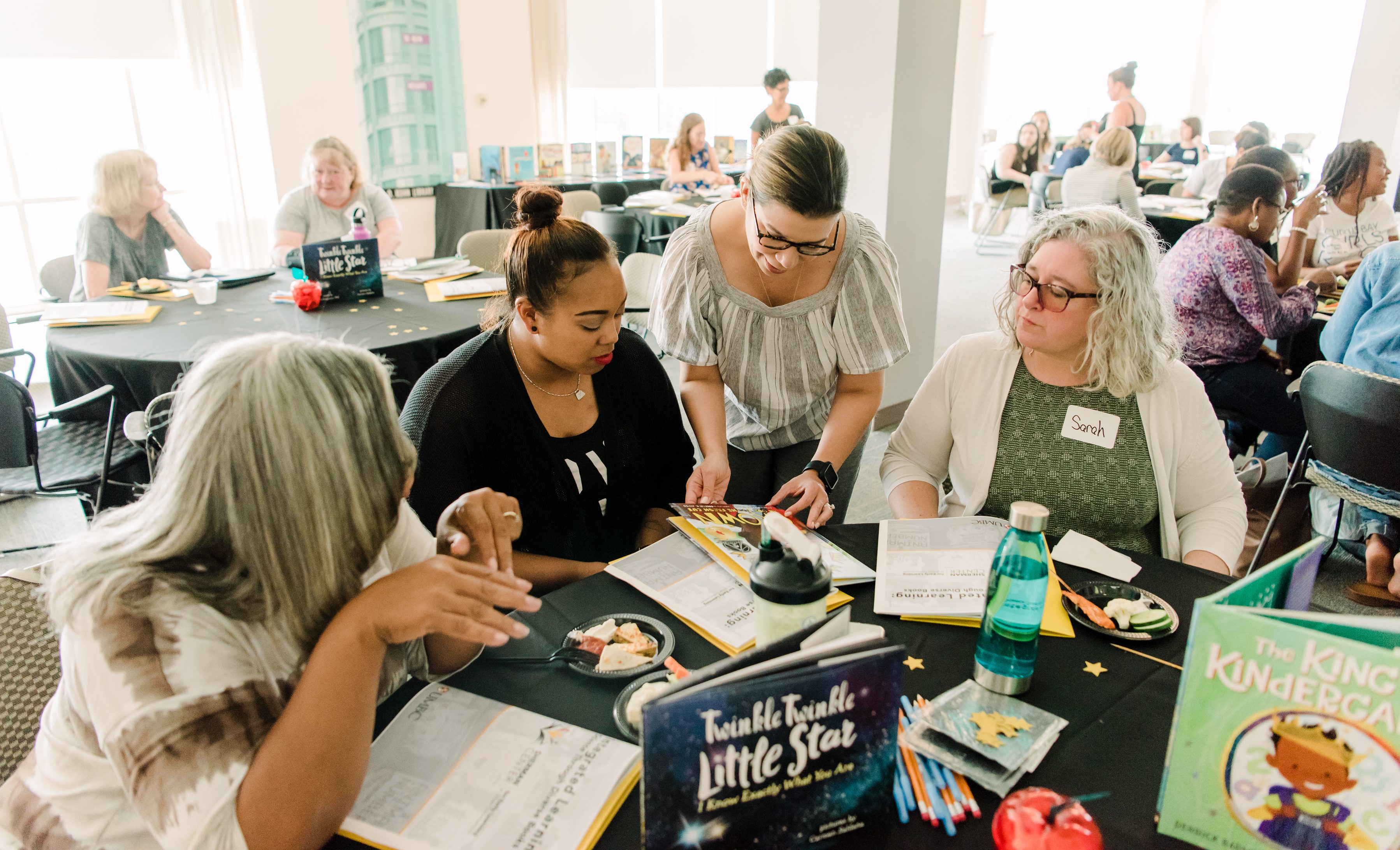
UMBC’s Sherman Center for Early Learning in Urban Communities recently welcomed to campus early childhood educators from four Baltimore City public schools. They gathered for a Summer Teacher Institute focuses on improving literacy and outcomes for pre-K-2 students, particularly young English language learners. 
Participants represented four of UMBC’s partner elementary/middle schools: Lakeland, Maree G. Farring, Curtis Bay, and Bay-Brook. These schools have strong connections with UMBC, including providing placements for UMBC student teachers and welcoming volunteer tutors. The institute addresses topics identified by the teachers as essential focus areas, explored through a series of interactive, research-based workshops.

Our language toolbox 

Jennifer Mata-McMahon, associate professor of early childhood education, led the main two-day workshop. She shared with the teachers her research on translanguaging and early literacy strategies for diverse learners. Translanguaging, the use of a person’s unique linguistic repertoire shaped by their cultural and social context, can be a powerful instructional tool.
Mata-McMahon offered teachers a deep dive into how to use students’ formal, informal, home, school, and playground languages to access curriculum content. Her presentation responded to a crucial need teachers are experiencing: effective strategies to support the increasing number of English language learners in their schools.

Meta-McMahon (third from left) working with Baltimore City teachers.
Mata-McMahon (third from left) working with Baltimore City teachers.

Quiana Zamarron, a first grade teacher at Curtis Bay Elementary/Middle School, experienced the benefits of having additional resources to support English language learners last year. UMBC literacy volunteer, Maia Parker ’22, English, a Sherman STEM Teacher Scholar, worked with students in Zammarron’s class as part of the Sherman Center/Shriver Center Literacy Fellows Program.
 “Many of my students are English language learners. Maia, who was learning Spanish at UMBC, was not only able to work with small groups but also to provide support to my Spanish non-English speaking students,” explains Zamarron. “What she gave my class was something I wasn’t able to offer.” 
She notes that continuing to learn about literacy strategies for English language learners will make her more confident in her classroom, and help her meet the needs of her students.

Quiana Zamarron (third from left) with fellow teachers from Curtis Bay Elementary/Middle School.
Quiana Zamarron (third from left) with fellow teachers from Curtis Bay.

Diverse books

The institute also focused on how teachers can use diverse books in the classroom as an effective translanguaging strategy. Each teacher received a copy of Derrick Barnes’ The King of Kindergarten and Crown:Ode to the Fresh Cut. Mavis Sanders, director of the Sherman Center, invited Barnes as the keynote speaker to share his path as an award-winning author of children’s literature and perspectives on the importance of culturally diverse books in early childhood classrooms.
Barnes described his core motivations for writing books that place the experiences of young black families front and center. “I set out to write the blackest children’s books I could write to show the diversity within black culture and simply because there are so few that show that strength,” he said. “Teachers need more books that reflect not only their students’ cultural and social experiences, but also their language.” 

Sanders with Barnes reviewing The King of Kindergarten.
Sanders (left) with Barnes reviewing The King of Kindergarten.

Patricia Escafer has been teaching since 1997 and is currently teaching second grade at Lakeland Elementary/Middle School. She finds translanguaging training through the use of diverse books has been pivotal for her and her students. 
“This training is about representing the whole child. It gives me and the children hope because it shows how they can also be heroes and that they matter,” says Escarfuller. “Through diverse books students can reflect on their talents and know that those career choices are an option for them. Learning through diverse books is about respecting all of who a child is, socially and academically.”

The science lesson guide and diverse books given to teachers at the Institute.

Reading together

Kindel Nash, associate professor of early childhood education, and doctoral student Josh Michael ’10, political science and education, assistant director of UMBC’s Sherman STEM Teachers Scholars Program, also presented their Read Two Impress Plus research, funded by the Sherman Center.
Nash discusses this new research in the article, “Parents can help kids catch up in reading with a 10-minute daily routine,” published in The Conversation. “By activating the senses of hearing, seeing and touch, this approach makes recognizing familiar words easier and faster, increasing fluency,” explains Nash. “The strategy works best when it’s repeated regularly – ideally 10-15 minutes per day.” 
Nash points out that this approach is enhanced by involving family members. Further, she writes, “We also found that when families read books that reflected their culture and language, they enjoyed reading together more.”

(L to R) Michael, Nash, and Grimes discussing Grimes' new science lesson guide.
(L to R) Michael, Nash, and Grimes discussing Grimes’ new science lesson guide.

Skill integration

Teachers walked away from the conversations on translanguaging, literacy, and diverse books with strategies to help their students access content knowledge at a higher level. Olivia Grimes ‘19, individualized study, also demonstrated how the educators could apply their new strategies to teaching specific topics in a science classroom. 
Grimes, a current first year early childhood teacher at Maree G. Farring Elementary/Middle School, presented each teacher with a copy of Integrated Learning: Science Through Diverse Books, a lesson guide she created. The guide is based on her research as a Sherman STEM Scholar and program assistant at the Sherman Center for Early Learning in Urban Communities. The center funded and provided support for the research, development, creation, and dissemination of the guide. It provides lesson plans and learning activities based on 13 books covering ecology, space, engineering and design, the senses, and weather from the Sherman Center’s Diverse Books Collection. 
This type of applied, research-based resource is the reason teachers value this professional development event and want to return for future trainings.
“Integrating science into our lessons, along with diverse texts, exposes students to science content beyond state-tested subjects. The books help reflect the diversity of the science field and allow students to see themselves as scientists, making science personal,” explains Grimes. “These strategies support and build on the skills students have and open worlds of unexplored possibilities.”
Banner image: Zamarron with colleague reviewing Crown: An Ode to the Fresh Cut. All images by Marlayna Demond ’11 for UMBC.

UMBC partners with Latino Racial Justice Circle and Maryland Humanities in community-engaged research in Baltimore

In their work with communities in Baltimore, the Latino Racial Justice Circle (LRJC) observed a recurring issue: immigrant, white American, and African American communities share faith-based spaces but rarely engage in community dialogue. As a result, members of these communities may never get to know each other – or may even live in fear of each other. 

Through a partnership with LRJC, UMBC’s Felipe Filomeno, professor of political science and global studies, a member of LRJC, and Tania Lizarazo, assistant professor of modern languages, linguistics, and intercultural communication and global studies, worked to develop, design, execute, evaluate, and disseminate the Honest Conversations on Immigration project. Through a course of dialogue, interviews, and digital storytelling, the program aims to foster dialogue between U.S.-born citizens and immigrants.

(L to R) Lizarazo and Filomeno preparing for the first Honest Conversations public forum.

“Our goal as researchers was to use dialogue and digital stories as two ways to bring different communities together around religion, race, and immigration,” explains Filomeno, “and through that process create the potential to change the relationships within individuals, and between communities and society for the better.”

Community intersections

The Latino Racial Justice Circle (LJRC) is a volunteer, faith-based, immigrant support group based in Baltimore. It funds legal services, scholarships, and advocacy for federal immigration reform on behalf of Latino communities. This new project – similar to one addressing racism that has been implemented in more than 18 Catholic parishes in Baltimore – aims to bring faith-based groups from different backgrounds together to reveal their commonalities and build on shared strengths.

“We fear what we don’t know. And what we need to learn is vast,” shares Ryan Settler, president of the Maryland Chapter of Call To Action (CTA), a progressive social justice organization that created the Racial Justice Circle (RJC ) five years ago. “Immigrant and refugee stories in the media leave us confused, concerned, and even fearful.  Honest Conversations begins to address those concerns.”

Through the Honest Conversations projects, volunteers from the LRJC, immigrants, and U.S.-born citizens in faith communities agree to engage in dialogue about perceptions of immigration and race. These initial steps towards understanding highly politicized issues can lead to collective action for racial justice and immigrant rights. 

“Our project crosses boundaries between the humanities and the social sciences, academia and community, between immigrants and U.S.-born citizens, inner-city and suburbs,” explains Filomeno.

https://youtu.be/YFAKEE-X3EQ

Defining dialogue

The goal of the Maryland Humanities-funded project is for communities to move from confusion and anger to collaboration. For that to happen, participants first took part in two group dialogues consisting of 12-14 members from three faith-based communities. The dialogues were followed by the collection and sharing of personal experiences of religion, race, and immigration in Baltimore through digital storytelling. Both processes centered around the power of community dialogue to create respectful places in which difficult conversations might be had.

“Dialogue is a process of listening to others with the purpose of understanding. It does not aim to pass judgment, ‘just talk,’ mediate, debate, or negotiate,” explains Filomeno. He led the scientific implementation of structured dialogue and provided a framework for active listening. He also served as the facilitator at four churches in and around Baltimore: St. Ann’s Catholic Church; St. Michael the Archangel Catholic Church; Church of the Annunciation; and St. Clement Mary Hofbauer Church.

Filomeno facilitating.

“Because the dialogues happened in a familiar shared faith space the participants began with prayer, which was an entry point into a shared experience,” explains Filomeno. “I was then able to support where the participants wanted to take the conversation and guide them through clarifications,” he reflects.

Giuliana Valencia, co-chair for the LRJC, found the structured talks powerful and hopes other faith-based organizations will begin the program in their communities. “We recognize dialogue is the best way to change the human heart,” Valencia shares. “No matter how controversial the topic, you can always find common ground.”

Dialogue through digital storytelling

Digital storytelling is another key aspect of community-engaged research because it shifts the focus from the researcher creating information towards information being created by the community.

“Collaborative audiovisual pieces can share personal perspectives. These not only complement academic writing but help disrupt mainstream narratives as the only sources of knowledge,” explains Lizarazo. They can also create new ways for academics to think about primary sources. “Digital stories can serve as primary sources in different fields because they engage audiences and give access in ways writing doesn’t.” 

This type of community-based digital storytelling also addresses the issue of access. Lizarazo explains how academic journals, while useful in academic circles, also limit who shares in the knowledge. The power of digital storytelling is in its accessibility – often opening spaces for nonacademic conversations through social media networks. “These stories where the narrative and the message is controlled by the community member can be used for pedagogical and research purposes,” notes Lizarazo. 

https://www.youtube.com/watch?v=3PNZi3PyZyE

The digital stories Lizarazo helped create for Honest Conversations on Immigration present personal experiences of faith, race, and immigration in Baltimore. Some delve into the first reactions of relocation to Baltimore. Others focus on employment experiences as well as how faith-based organizations supported their transition into Baltimore.

The research also shows lived experience is linked to scholarship and the context in which it’s produced, explains Lizarazo, who brings a personal component to her work. “As a Colombian immigrant, I understand first-hand global hierarchies of passports that affects mobility. I also know how stereotypes affect people’s daily life and recognize the privilege a tourist, student, and work visa brings.” 

https://www.youtube.com/watch?v=Z5AzE_wQszA&authuser=1

Romi Pal ‘20, assisted Lizarazo in recording, transcribing, and producing the video testimonials along with a multimedia story for the overall project. Pal appreciated the opportunity to see the theories about race and immigration, learned through her global studies and political science majors, play out first-hand in a unique and relevant project.

Similar to Lizarazo, Pal was drawn to the project because of her immigrant background. “The dialogue emphasized how immigrant communities are not a monolith,” notes Pal. “As the daughter of immigrants myself, it made me feel thankful for the sacrifices my parents made when they came to the U.S. Baltimore still has a long way to improve race relations within religious communities.” 

Lessons from Baltimore communities help others 

After the talks, Filomeno and Lizarazo presented the research results to the general public at the Enoch Pratt Southeast Anchor Library in Highlandtown. The data revealed that private structured group dialogues had great advantages.

With the support of faith leaders and in collaboration with familiar community organizations, Honest Conversations on Immigration helped facilitate critical dialogue about controversial topics in a respectful manner. Participants also developed empathy toward each other and organized a multi-parish potluck as an initial step to collaborate across differences.

This initial project serves as a foundation for organizations across the United States who are working with similar issues and need support. Filomeno has created a digital guide for communities outside of Baltimore to implement their own Honest Conversations on Immigration project.

“As xenophobic discourses become mainstream,” notes Lizarazo, “I’m committed to learning and collaborating with members of immigrant communities. I want to help produce knowledge and show the nuances of our experiences.”

Learn more about Honest Conversations on September 10, 4 – 5:30 p.m., in the Theatre Rehearsal Space of the Performance Arts and Humanities Building (PAHB 127) at UMBC.


Banner image: (L-R) Pal getting ready to record and Lizarazo storyboarding with participant.  All images and digital stories courtesy of the Honest Conversations project.

Preminda Jacob focuses on building connections as new associate dean of research and community engagement

Preminda Jacob, visual arts, has been named the new associate dean of research and community engagement for UMBC’s College of Humanities, Arts, and Social Sciences (CAHSS). She will join the current team of associate deans in providing support for the College’s many departments, programs, and research centers. Together they will continue to implement CAHSS’ strategic goals and objectives, focusing on projects around recruitment and retention of diverse faculty, promoting interdisciplinary collaboration, and further developing community engagement work. 

Scott Casper, dean of CAHSS, is excited about the level of expertise Jacob brings to the team. “Preminda Jacob brings a wealth of experience as a scholar, teacher, and UMBC citizen, and leader to the Dean’s Office,” says Casper. “I am delighted that she has joined our leadership team and look forward to her continued contributions to the College and the University in this new role.”

Jacob at graduate commencement.

Engaging faculty

Jacob will begin by joining the team of associate deans in working to further foster the current research community within CAHSS and build broader awareness of CAHSS research. One way Jacob hopes to share faculty research is by collaborating with campus partners on updating the university’s current faculty research database capabilities. This digital tool will help academics, researchers, educators, and students from around the world more easily access information about UMBC researchers and their areas of study.

“I see part of community engagement as an accessibility issue,” explains Jacob. “UMBC faculty conduct top-level research. A searchable database elevates our commitment to provide research-based answers to the world’s most pressing questions by placing the research within everyone’s reach.”

Jacob will also help faculty better connect with each other across departments, including for research that involves community partnerships. She looks forward to working with faculty who have research expertise on community engagement by exploring topics through existing brown bag lunch series and working groups in the five CAHSS research centers as well as across UMBC’s colleges. 

Engaging the community

Prior to joining the Dean’s Office, Jacob served as chair of visual arts from 2015 to 2018. As a professor of visual arts specializing in art history and visual culture, she worked to connect her passions for research and community engagement.

Jacob recalls a four-year partnership between the Benjamin Banneker Historical Park and Museum in Catonsville and her Space, Place, and Public Art class as a particularly significant collaboration. Jacob partnered students with the museum’s staff to create public art pieces from start to finish in one semester. “Students were excited to work directly with a local organization and leaders within the organizations were equally excited to serve as guides and mentors in the process,” she says. 

Over the years, Jacob’s students have created object and wall labels, interactive and interpretive recordings, and works of art for the museum. They produced a video featuring interviews with local leaders and archaeologists talking about the archaeological dig conducted by the Maryland Historical Trust in the 1980s on Benjamin Banneker’s property.

Exhibit that three teams of students helped designed

Victor Pineda ‘15, visual arts, who went on to serve as a museum intern after participating in Jacob’s class, helped record an actor’s interpretation of the voice of Benjamin Banneker. The recording became part of an interactive device in the Banneker Gallery. Today, visitors can listen to Benjamin Banneker discuss his letter to Thomas Jefferson. 

Pineda recording audio for exhibit.

“Through the museum’s partnership with the visual arts department at UMBC,” says Willa Banks, the museum’s former director of education and curatorial affairs, “Dr. Jacob’s public art class provided a phenomenal service that not only benefited UMBC faculty and students but also the museum and the general public as well.”

Jacob plans to work with faculty already engaged with community partners in the Baltimore region to amplify relationships like this one. She is also dedicated to opening pathways for new community engagement opportunities, in the greater Baltimore region and beyond. 


Banner Image: Preminda at MFA celebration. All images by Marlayna Demond ’11 for UMBC with the exception of the images of student work at the Benjamin Banneker Historical Park and Museum which were courtesy of Willa Banks.

UMBC’s Mejdulene B. Shomali receives Woodrow Wilson Foundation fellowship for research on gender and sexuality in transnational Arab culture

The Woodrow Wilson National Fellowship Foundation has selected UMBC’s Mejdulene B. Shomali as a Career Enhancement Fellow. She is one of just 32 professors selected from institutions from across the country. The program, funded by The Andrew W. Mellon Foundation, supports junior faculty with particularly promising research. The fund seeks to increase the presence of faculty members who are underrepresented in their fields and other faculty committed to eradicating racial disparities in the arts and humanities.

The highly competitive fellowship funds career development opportunities for junior faculty whose scholarly projects promote the well-being of diverse and democratic societies. Shomali’s award includes funding for a sabbatical year; a stipend for research, travel, or publication support; mentoring from a tenured faculty member in a related field of study; and a professional development retreat.

Diversity in the Arab world

Shomali came to UMBC in 2015 as a member of the third cohort of UMBC’s Postdoctoral Fellows for Faculty Diversity. She is now an assistant professor in gender, women’s, and sexuality studies and is the fourth UMBC junior faculty member to receive the Career Enhancement Fellowship. 

Shomali is devoting her fellowship year to completing a book manuscript, Femininities: Queer Critique and Transnational Arab Culture. Her research is a cultural study about how femininity and queerness in Arab and Arab-American cultures are represented by Arab and Arab-American writers and artists. “I am very interested in how Arab and Arab-American artists, producers, and writers navigate the discourse that shapes their culture,” explains Shomali.

Cultural productions by Arab and Arab-American creative professionals create and communicate identities not defined by the West and can help dispel monolithic views of Arab identities. However, to fully understand the meaning and process of this work, explains Shomali, it has to be contextualized within a wider world—a world that does not truly understand who Arabs are and what Arabness is.

“Most people don’t know there are twenty-two countries in the Arab league. These countries share Arabic as the primary national language. Many are Muslim-majority nations,” shares Shomali. “Many, but not all.” She notes, “There is great linguistic, cultural, ethnic, and religious diversity within the Arab world.”

Shomali’s work explores how Arab perspectives are countering stereotypes of Arab culture created by the United States and other Western nations, which are exacerbated by racial and political tensions. She shares, “Arab and Arab-American artists must create while managing the effects of Orientalism, anti-Arab racism, Middle Eastern politics, and politics of cultural authenticity, which influence how they portray gender and sexuality in their worlds.”

Representations of gender and sexuality

Shomali’s teaching also focuses on the diversity of Arab cultures, identities, and experiences, helping students move past stereotypes of the Arab world as being uniformly misogynistic, anti-woman, and homophobic. As a professor of transnational queer literature, Shomali teaches multiple interdisciplinary courses about issues related to gender, sexuality, race, the media, and transnational feminism.

In these courses, Shomali has seen some students struggling with stereotypes created by Western media about Arab culture and identity. “The creation of these gender and sexuality stereotypes is a tactic that the U.S. and the West have used to feel exceptionally inclusive about gender and sexuality,” explains Shomali. “The same statistics of homophobia, anti-queer legislation, and gender-based sexual violence exist in the Western world.” 

A strong tradition of humanities scholarship

The Career Enhancement Fellowship will help Shomali delve further into the complexities of Arab identity and its effect on Arab and Arab-American artistic work through text analysis. It will also inform her teaching practices and course development upon her return. 

“I want to document, analyze, and create an awareness of this creative process to spotlight the amazing work that is happening within the Arab art world as defined by Arab and Arab-American artists,” says Shomali.

Shomali’s work reflects a strong tradition of UMBC faculty doing important humanities scholarship recognized by the Woodrow Wilson Foundation. Professor Michelle Scott, history, was UMBC’s inaugural recipient of this fellowship in 2005-2006. Scott also served as a program mentor in 2013 and continues to support faculty through the application process.

Scott used her fellowship year to complete a draft her first manuscript, Blues Empress in Black Chattanooga: Bessie Smith and the Emerging Urban South. “The fellowship time was invaluable in creating a network of like-minded scholars to help me navigate manuscript research and publishing while learning the landscape of my first tenure-track job,” remembers Scott.

Professor Michelle Scott.

Viviana MacManus, a former assistant professor of gender and women’s studies, now at the University of Maryland, College Park, was UMBC’s second Woodrow recipient. She used the sixth-month fellowship to work on her book manuscript We Are Protagonists of This History: Gender, Political Violence, and Testimonies of Resistance in Latin America’s Dirty Wars. It centered on Latin America’s history of gender and state violence during the “Dirty Wars” of Argentina and Mexico from the 1960s through the 1980s.

Maleda Belilgne, assistant professor of Africana studies and English, is currently completing her year-long fellowship. She used her award to complete her book manuscript, which explores space, sound, and the speculative in the literature of the African diaspora.

After her year of research and writing Shomali plans to return to the classroom to share new perspectives and resources with her UMBC students.


To learn more about professor Shomali’s work visit her website, read her blog, and watch the Race and Religion in the U.S. panel she organized in spring 2019 with the UMBC Dresher Center for the Humanities. Follow @UMBCHumanities on Twitter for more stories.

Banner image: Postdoctoral fellows for 2015 (L to R) Keisha Allen, Nkiru Nnawulezi, and Mejdulene Shomali. All photos by Marlayna Demond ’11 for UMBC. Race and Religion in the U.S. video by UMBC New Media Studio. 

Jessica Berman is named the 2019 UMBC Lipitz Professor for her global radio research

UMBC has named Jessica Berman, professor of English and director of the Dresher Center for the Humanities, the 2019 – 2020 Lipitz Professor. This prestigious endowed professorship is awarded to one UMBC faculty member each year in recognition of innovative and distinguished teaching and/or research in the College of Arts, Humanities and Social Sciences (CAHSS). Berman has been selected for both her original research in global radio and her impactful work leading the Dresher Center. 

Global radio research 

The Lipitz professorship will support Berman’s travel to research different cultural approaches to producing radio. It will also provide time for her to write about the complex collection of voices, languages, literatures, and music that are interconnected through radio programming. 

“I will now have the opportunity to research and outline my book’s third chapter as well as shape my existing archival resources,” explains Berman. “I hope to delve deeper into research about global radio environments and the power of media to create complex transnational and often interlinguistic relationships in Latin America, which will inform later research in West Africa.”

Jason Loviglio, founding chair and associate professor of media and communication studies, primarily researches media history and radio studies. As part of the selection committee, Loviglio saw Berman’s research as pathbreaking work in understanding this transnational movement. 

Loviglio speaking about diversity in podcasts.

“Berman’s new book will be an important contribution to the growing academic literature on a previously ignored medium,” shares Loviglio, “pushing radio studies and modernist studies in important new directions.” 

The value of sharing research

 For faculty in CAHSS, the Lipitz professorship doesn’t only mean an opportunity to focus extra time on research. It is also an opportunity for scholars to share their work with the campus community. The Lipitz Lecture is the culminating event of the professorship. Each spring the selected faculty member shares their work with faculty, staff, and students as part of the Humanities Forum lecture series hosted by the Dresher Center for the Humanities.

Dan Bailey, a professor of visual arts who focuses on animation and interactive media, was the 2018 – 2019 recipient. In the spring of 2019, he presented his work about human scale, perception, and natural landscapes. 

Bailey continues to work on projects involving long-duration photography of landscapes and reconstruction of Baltimore’s geographic past. “Research requires time,” he reflects. Through the Lipitz professorship, he says, “I was able to focus on my research and collaborate with professors in history and visual arts, and work with UMBC’s Imaging Research Center and student interns.” 

Berman will share her work with the campus community in the spring of 2020 Humanities Forum.


Banner image: Berman at the Dresher Center for the Humanities faculty book celebration. All images by Marlayna Demond ’11 for UMBC. Lipitz lecture video by UMBC New Media Studio.

UMBC’s Erickson School celebrates new grads as innovators in aging services

Lauren Mortimer ‘19, management of aging services, remembers visiting a nursing home for the first time during middle school. What she saw deeply saddened her. “It was the first time I had been in a nursing home,” she recalls. “All I could see were disregarded senior citizens who were lonely and being talked to like children.” Mortimer knew at that moment that she needed to change the senior care experience.

This year, a decade after she found her career path, the Centreville local earned an Erickson School alumni pin, marking her graduation from UMBC’s aging services program. At the end-of-year Erickson School ceremony, students also presented their capstone projects on research designed to inform and improve aging services. Topics included strategies for working with patients with dementia, workforce development, combating financial exploitation, exercise and sports, and communication between health care providers.

Joining the longevity economy

“Our ceremony provides an opportunity to reflect upon the tremendous personal growth of each of our graduates,” explains Dana Bradley, dean of the Erickson School. “We celebrate the amazing opportunities our graduates have as leaders in aging services to ensure that our society is ready to embrace the longevity economy.”

Jackie Hrabowski with Dean Bradley at the Meyerhoff 30th anniversary.

At UMBC’s Erickson School, Mortimer developed leadership skills through internships in aging care focusing on dementia, transitional housing, assisted living care, and independent living. Her last internship, at Brightwood Senior Living in Severna Park, evolved into a full-time staff position.

Her new role with the facility is enabling her to move forward on her career plan. Rather than provide direct care, she shares, “I wanted to be in health administration to help influence policy and improve the care of senior citizens” more broadly.

With this in mind, Mortimer has focused on growing as a leader. As a student, she served as president of the aging services council of majors, where she organized service activities to support local older adults. And while pursuing her new role at Brightwood, she’ll also begin a master’s in healthcare administration at the University of Maryland University College.

Path to innovation

Diane Tichnell ’70, political science, a member of UMBC’s first graduating class, shared advice with the program’s graduating students at the celebration event. She encouraged them to stay connected to UMBC as they launch their careers, to help open doors for future innovators. Tichnell recalled, “Even in the earliest days, UMBC was about innovation. Stay innovative and stay connected to UMBC.”

Diane Tichnell at a UMBC event.

Tichnell’s emphasis on UMBC’s innovative and community-oriented spirit struck a chord with Mortimer. She used her capstone project as an opportunity to create a new support for people with dementia. Mortimer’s “Comfort Book” (currently going through the patent process) provides tools for people with dementia to soothe themselves during periods of confusion and irritability. Filled with familiar sounds, sights, and materials, it’s designed to de-stress and empower people with dementia who are experiencing challenging moments.

This is the type of creative thinking that John C. Erickson, founder of Erickson Retirement Services, had in mind when he gave a $5 million gift to establish the UMBC Erickson School in 2004. “UMBC’s forward thinking is the pathway to new products, service development, and delivery” in the field of aging, Erickson shared at the event. “It influences better aging policy, and is the foundation for innovative uses of technology to improve the quality of life for all seniors.”

Banner image: 2018 commencement mortarboards. All photos by Marlayna Demond ’11 for UMBC. Video, “Why MAgs,” courtesy of the Erickson School of Aging Services.

UMBC convenes research forum on immigration and mobility in higher education

In the late spring, the UMBC Center for Social Science Scholarship (CS3) convened researchers for the 2019 Research Forum: Immigration and Mobility in Higher Education. The event was the fifth in a UMBC research forum series that highlights original research and interdisciplinary discussions about pressing national and international issues. Christine Mallinson, director of CS3, co-hosted the event with Karl Steiner, vice president for research, to spotlight UMBC’s immigration research and to enable new collaborations.

Mallinson welcoming forum attendees.

Through the forum, Mallinson aimed to create a space for discussion and brainstorming for both students and faculty. “This critically relevant forum creates new collaborations and research that can change conversations about the effect immigration has on education, economics, workforce, and policy,” she explained. 

Panelists and attendees included UMBC faculty, staff, and students from the College of Arts, Humanities, and Social Sciences (CAHSS), College of Engineering and Information Technology (COEIT), and College of Natural and Mathematical Sciences (CNMS), as well as the Office of International Education Services

Julie Park, associate professor of sociology and director of Asian American studies at the University of Maryland, College Park, delivered the event’s keynote address. Park spoke to the changing demographics and intergenerational mobility of new immigrants who are working to attain secondary and postsecondary degrees.

Trauma-informed services

The first panel, “Borders of Opportunity: Migration, Education, and Mobility and Immigration Policies,” focused on global education, the social welfare of immigrants in the U.S., and the information-seeking behavior of highly educated immigrants. 

In this panel, Jayshree Jani, associate professor of social work, shared research on the burdens that undocumented students carry. Daunting situations such as being separated from their parents, having a parent incarcerated, and being unable to access social services cause long-term trauma for children, even years after reunification or receiving support services. “When someone is undocumented and living in fear, it is really hard for them to have a stable life,” explained Jani. 

Jani, center, discussing immigrant family separations.

Her research showed how visible and invisible consequences of trauma currently overwhelm local schools, communities, and law enforcement. She described a significant need for training in how to provide trauma-informed services, and noted that this gap has had major negative impacts.

Jani’s call to action was to inspire her colleagues and future providers to conduct more research. “In order to support trauma-informed services in schools,” she argued, “universities need to encourage research on this population and prepare future professionals to create, expand, and provide services.”

International student perspective

Awareness of and access to services is a hurdle that undocumented and documented immigrants, as well as international students and faculty, must navigate. Doctoral student Wajanat Rayes, information systems, attended the forum, bringing to the event her perspective as both an international student and a researcher.  

Rayes investigates the role that information networks play in the lives of international students. She specifically focuses on the transition to the U.S. of highly skilled Saudi Arabian international students who are also mothers. “I like how information can empower people and mitigate the challenges we have day today,” she says. 

“I am a faculty member at a university in Saudi Arabia and a mother,” Rayes shares. “I have had a lot of challenges in my transition to studying in the U.S. I hope my research will help other mothers navigate the system in the future.”

Immigration and higher education

The second panel examined “Immigration Policies and Politics: Local, National, and International Impact.” Four UMBC faculty presented the latest research about higher education policies and their effects on immigrant and international students. They also discussed the current landscape of international research exchange in higher education and the role of higher education associations in immigration policy debates.

Mortarboard from commencement 2018.

In this session, UMBC researchers Tim Gindling, professor of economics, and Lisa Dickson, associate professor of economics, focused on access to higher education for undocumented youth. Their ongoing research covers the cost-benefit analysis of policies that determine the price of higher education for undocumented students—access to-state resident tuition and additional financial aid. They also examine the impact of the national Deferred Action for Childhood Arrivals (DACA) policy on students’ enrollment, graduation, and persistence in higher education.

Gindling in his office.

“The takeaway, however we looked at the data, was that the benefits were greater than the costs,” explained Gindling. The research results showed that for each undocumented student who graduates from a four-year college, who would not have gone otherwise, the net benefits to the state were $350,000. 

“Providing access to higher education and financial aid to undocumented youth is a good investment for the individual, for the state, and for the government as a whole,” said Gindling.

The power of listening

After participants and audience members listened to the panelists they were given an opportunity to share different perspectives on these issues through microtalk roundtables. Groups joined sessions on law and policy, transnational migration, and higher education. 

One discussion centered around what a stronger, more positive relationship between immigrants and the United States would look like. Immigrants who are able to access higher education and financial aid are more likely to move into the white-collar workforce. Entering the professional workforce means immigrants also earn more and pay higher taxes. Greater earning power opens opportunities to buy property, start businesses, and contribute to a thriving state and national economy. 

“It is important to listen to the array of immigrant experiences,” explained Ruth Temesgen ‘19, sociology, who attended the event as part of her Immigration and Refugee Law class. Her parents were highly skilled government employees in Ethiopia who left during the country’s civil war. Their credentials did not transfer in the United States. They could only access service-level jobs.

Seeing how much her parents and other immigrants have struggled inspired Temesgen to pursue a path to law school. “Reaching beyond our comfort zones to understand how global events impact people at a personal, economic, educational, and mental health level can change what is now an isolating experience to a welcoming and prosperous partnership.” 

To learn about future CS3 events, join the conversation on Twitter at @UMBCSocSci.

Banner image: (L to R): Steiner, Mallinson, Don Engel, assistant vice president for research, and Casper. All images by Marlayna Demond ’11 for UMBC.

UMBC honors social work students for commitment to social change

“I am learning at fifty-four that when you walk into communities and do the work that you are all doing, you have to be your authentic self,” said Jodi Kelber-Kaye, in a room of UMBC social work students days before their graduation. 

Kelber-Kaye with President Freeman Hrabowski.
Kelber-Kaye with Pres. Freeman Hrabowski at an Honors College event.

Kelber-Kaye is the associate director of UMBC’s Honors College. She joined the students at the induction ceremony for the UMBC Delta Omicron Chapter of the Phi Alpha Honor Society, the national social work honor society, to accept an honorary membership.The twenty-four inductees were poised to hear advice from leaders in the field as they prepared to enter social work careers, known for being both highly rewarding and demanding.

Megan Meyer, associate dean for academic affairs at the University of Maryland School of Social Work, also spoke at the event. She reminded the new members to have hope and embody the ideals of the Phi Alpha Honor Societycompassion, social justice, and equityby being present in the moment. “In order for you to maintain, lead, and make your greatest contribution you have to engage in self-care,” explained Meyer.

UMBC student executive board of Phi Alpha Honor Society. Photo courtesy of  the social work program.

Her message resonated with the social work students from both UMBC’s Shady Grove and Catonsville campuses, several of whom have overcome personal challenges through self-care and community support. Encouraged by their own abilities to persevere through personal obstacles, they are now pursuing careers in social work to connect families to the services they need to care for themselves.

Self-actualization

“I decided to become a social worker because I survived the last six years of my life with the help of social workers,” remembers Maria Bruno ‘19, social work, who experienced a difficult divorce and the death of her mother in the same year. “If it wasn’t for one in particular social worker, I wouldn’t be where I am today.”

A single mom of three teenagers, Bruno felt the best way to take care of herself was to be the first person in her immediate and extended family to attend college. She plans to earn a master’s degree and a doctorate in social work as well. She shares, “I am really proud of myself. I am getting a Ph.D. because I want to give opportunities, just as I have been given.”

Phi Alpha Honor Society inductees. Bruno is fourth from the right. Rantas is first on the left in the back row. Courtesy of the social work program.

Upon hearing Bruno’s story, Jennifer Rantas ‘20, social work, felt an instant connection with her classmate. “There were many times I also felt lost,” explains Rantas. “I spent a couple of years out of school battling mental illness.” The youngest of four, Rantas leaned on her family for support. When she was ready, Rantas committed herself to a social work major wholeheartedly.

Still, sometimes her confidence falters, and it is in these moments when community affirmation means so much. “It is incredible to be recognized,” says Rantas. “Sometimes I very much doubt my work and it is an honor to have people tell you that you are on the right path and are doing really well.”

An enduring commitment to social change

At one memorable moment during the event, students paused in anticipation, preparing to hear their names and light white candles to symbolize their transition to full honor society members.

Carolyn Tice, associate dean of social work at UMBC, spoke to the group, encouraging them to stay strong through self-doubt and to always remember their motivation. “You committed to academic excellence,” she said, “but you also demonstrated a commitment to community and overwhelming service to peoplepeople who are often left behind.”

To maintain a lasting focus on people who truly need support, over the course of a career, Meyer emphasized her strategy for staying centered. “Be appreciative of the moment that you are in. Mindfulness is an important part of self-care,” she shared. “Taking care of yourself will allow you to endure beyond overwhelming demands into the rewards of being a catalyst for great positive change.”

Visit UMBC social work website to learn more about programs and locations.

Banner image: Graduation cap from UMBC commencement. All photos by Marlayna Demond ’11 for UMBC unless otherwise noted. “Why Study Social Work” video courtesy of the UMBC Division of Professional Studies. “Networking Advice from Dr. Tice…” video courtesy of the UMBC Career Center.