

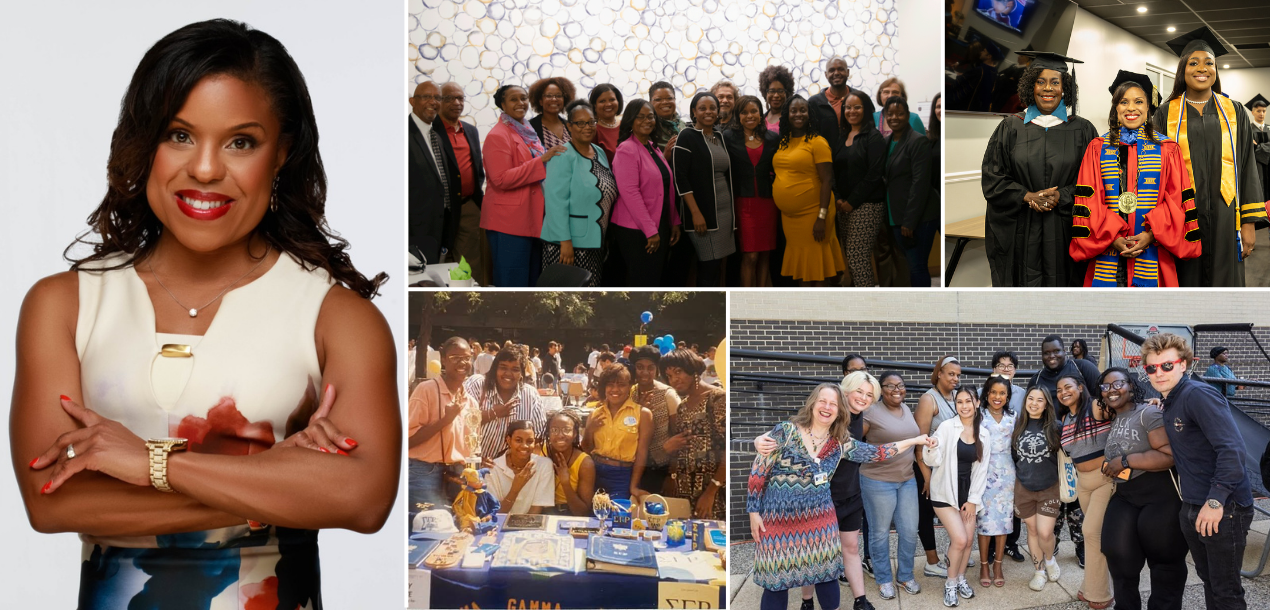
They say a rising tide lifts all ships—the idea that when an ecosystem prospers, everyone within it is propelled upward by the same powerful current. The same can be said for UMBC’s Meyerhoff Scholars Program. At least that was the experience of Alycia Marshall ’95, mathematics. The Meyerhoff tide eventually lifted her higher than she imagined: president of the Community College of Philadelphia.
As an undergraduate student at UMBC, Marshall wasn’t a Meyerhoff Scholar by title, but she felt like one by proximity. Many of her friends were Meyerhoff Scholars. Her peers were Meyerhoff Scholars. Her line sisters Sigma Gamma Rho Sorority Incorporated were Meyerhoff Scholars. Everywhere she turned, she was surrounded by Meyerhoff Scholars.
“Even though I wasn’t a Meyerhoff, I was sucked into this culture of high achievement,” says Marshall. “I call it ‘the Meyerhoff Effect.’”
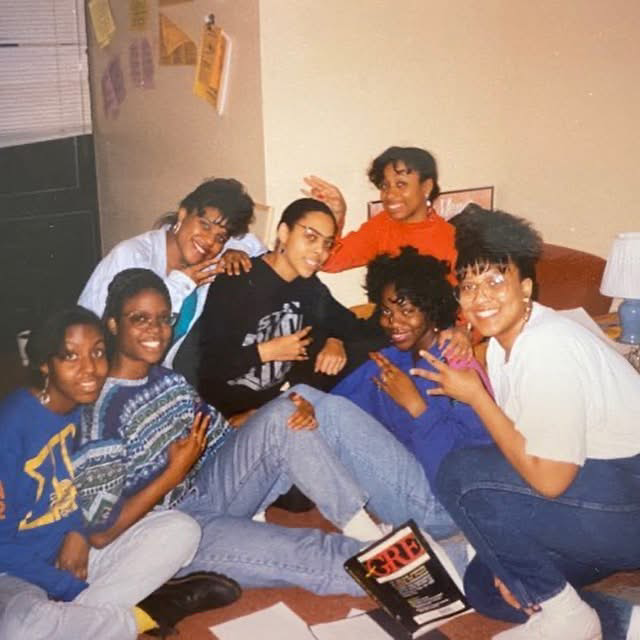
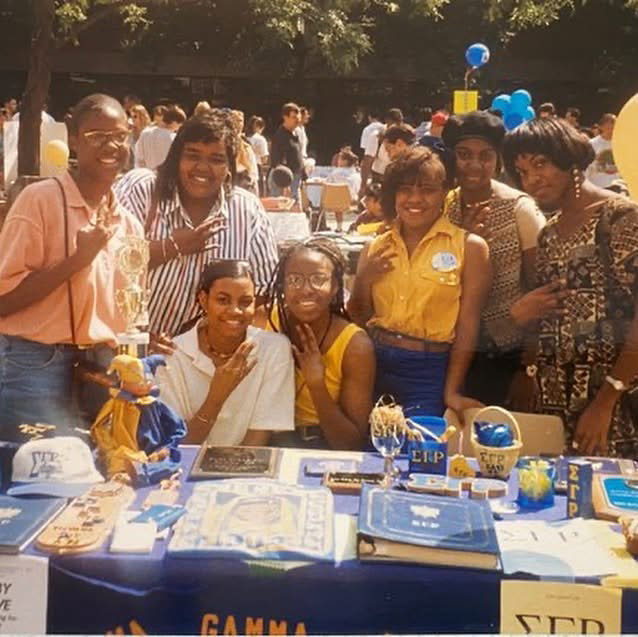
Pictured above: Marshall and members of Sigma Gamma Rho Sorority Incorporated on campus.
Brilliance was the baseline, and everyone strived to do their absolute best. It became a friendly peer-to-peer competition. But more than that, for Marshall, it was inspiring to see so many high-achieving Black students in one place, pushing each other to be the best versions of themselves.
“I had been in talented and gifted classes my entire school career,” says Marshall. “I was used to being around high-achieving students, but I was always the one person of color in the room. I was just floored to actually see so many people that looked like me who were high achieving at one time, in one place.”
For Marshall, that “Meyerhoff Effect” caused a fundamental shift in her internal barometer for success. She began to see her own potential through a wider lens—one that would eventually take her from a shy undergraduate student at UMBC to the President’s Office at CCP.
The teaching bug
Marshall started her UMBC journey as a biology major. Math and teaching were not even on her radar as potential careers—but that all changed pretty quickly during Marshall’s first year. Her “aha moment” occurred during a Calculus 1 lecture. Marshall was doing well in the course, but she knew she could do even better. She wanted that “A.” So, when the professor offered extra credit to anyone who could go to the board and explain the solution to a problem, Marshall couldn’t help herself. While other students were intimidated by the hundreds of students in that lecture hall class, and the difficulty of the material, Marshall regularly volunteered. She found that she wasn’t just good at solving the equations—she was good at communicating the logic behind them. “I got something out of that,” she says. Before she knew it, her classmates were asking to study with her, and Marshall started tutoring a few of her peers.
“That experience encouraged me to think about mathematics and teaching as a profession,” says Marshall.
After graduating from UMBC in 1995 with a B.S. in mathematics, Marshall began her teaching career at Bishop McNamara High School, a private school in Forestville, Maryland, before moving to Frederick Douglass High School, a public school in Prince George’s County. Around the same time, she began a master’s program at Bowie State University, eventually earning her masters of arts in teaching in 1998. Then, she got the higher education itch.
Education that changes lives
“I was very intrigued by the idea of teaching at the college level,” says Marshall, who quickly found an adjunct role at Anne Arundel Community College (AACC), teaching developmental math part-time. She was teaching high school students during the day and non-traditional college students twice a week in the evenings for AACC at Fort George G. Meade, a United States Army installation in Maryland.
“That was a whole different experience for me,” says Marshall, “understanding how important education was and how people were seeking that to change their lives.”
She was hooked. So, when a full-time position opened up, Marshall jumped at the opportunity and for the next 23 years she built an impressive career at AACC. During this time, Marshall also earned a Ph.D. in mathematics education from the University of Maryland, College Park in 2007. Her career saw her move from a professor of mathematics to the first African American woman to chair the department. Eventually, she worked her way up to associate vice president of learning and academic affairs. However, the work Marshall says she is most proud of is what she’s done throughout her career to support underrepresented students in STEM and leadership—an effort to replicate aspects of the Meyerhoff Scholars Program at the community college level.
When the idea initially occurred to Marshall, the first thing she did was reach out to her mentor, Freeman Hrabowski, III, UMBC president emeritus. He invited Marshall and AACC leaders to UMBC to meet with him and LaMont Toliver, then the director of the Meyerhoff Scholars Program and assistant dean of undergraduate education.
“It was great,” says Marshall. “That never would have happened had it not been for my connection to UMBC, my relationship with Dr. Hrabowski, and his continued interest in supporting me well beyond my graduation.”
The UMBC field trip and a National Science Foundation grant helped Marshall start the Engineering Scholars Program at AACC, connecting underrepresented students with scholarships, mentoring, and support services. Marshall also created the African American Leadership Institute to develop highly qualified, diverse leaders through targeted leadership development to improve the retention rates for this population and increase the diversity of college leadership.
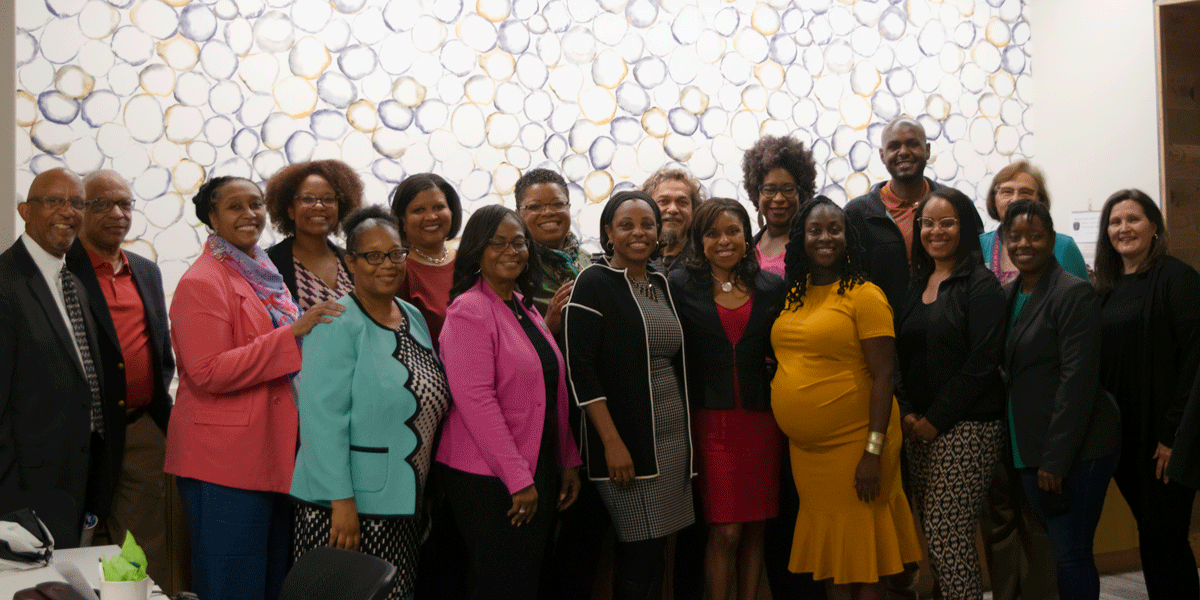
For years after that, whenever Hrabowski was in a room with Marshall, he would introduce her with a bold proclamation: “This is Dr. Marshall. She’s a UMBC graduate, and she’s going to be a president one day.”
“When Doc pours into people that way, he has a way of speaking their future into them,” says Marshall. “I leaned on that. Knowing that he knew I could do it helped me know I could do it, too.”
Marshall left AACC in 2022 to become the provost and vice president for academic and student success at the Community College of Philadelphia (CCP). And it didn’t take long for her to make an impact. Soon after joining CCP, Marshall started the Aspiring Leaders Fellowship Program for employees interested in moving into higher education leadership roles. The program, now in its third cohort, matches participants with senior leaders from different institutions who serve as mentors.
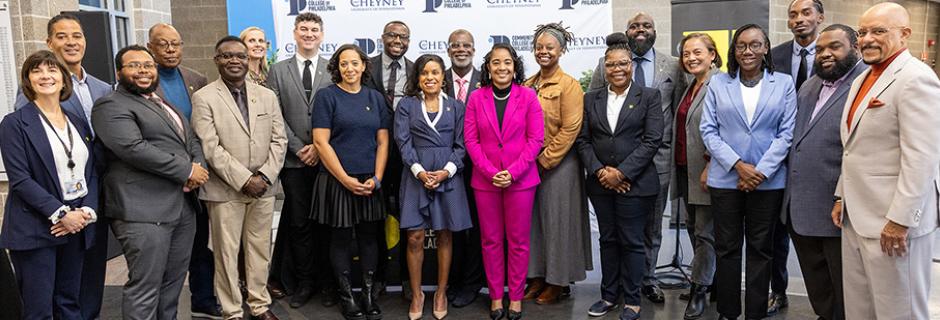
Marshall also started a new faculty onboarding program to provide newly hired faculty the tools they need to succeed—time to learn ways to enhance their pedagogical practices and build on their teaching skills in their first year at CCP—as well as a new department head onboarding program.
“There’s a similar theme with all this about professional development, continuous improvement, and making sure folks have the tools that they need,” says Marshall.
In 2025, Hrabowski’s prophecy came true. Marshall was named CCP president, the first Black woman to serve in the role in a permanent capacity.
Upon receiving the news, one of Marshall’s first calls was to the man who believed in her future before she believed it herself.
“When I told Doc I got the job…he was emotional,” says Marshall. “He was so very proud of me. It was a wonderful day.”