



From UMBC Magazine Food Issue, Winter 2010. Video by Jenny O’Grady.
All posts by: Magazine Editor
Video: How to Build a Ramen Bridge
From UMBC Magazine Food Issue, Winter 2010. How to Build a Ramen Bridge, featuring Tim Topoleski.
Video by Jenny O’Grady.
Art History – Christina Ralls ’07, IMDA
Christina Ralls ’07, imaging and digital arts, recently completed a public art project that allowed her to dive into her family history and tell a story about one of the most turbulent moments in Baltimore’s recent history. UMBC Magazine asked her to share that experience:
Cold concrete blocks have replaced glass windows and front doors. An abandoned Catholic church casts its ominous afternoon silhouette on the abandoned intersection at Eager and Valley streets.
Many would say this sight is a familiar one in East Baltimore today, but this visit was different for me. It was my first day as community artist-in-residence for University of Baltimore’s Baltimore ’68: Riots and Rebirth initiative. I was here to look into an ugly shadow of my family’s past.
This neighborhood was my mother’s home before the race riots of April 1968, when Baltimore’s city blocks exploded in anger and grief after the assassination of Martin Luther King, Jr. During the uprisings, my mother’s family returned to find almost every belonging in their house – including cherished photographs – destroyed. The National Guard escorted them from their neighborhood. They did not return.
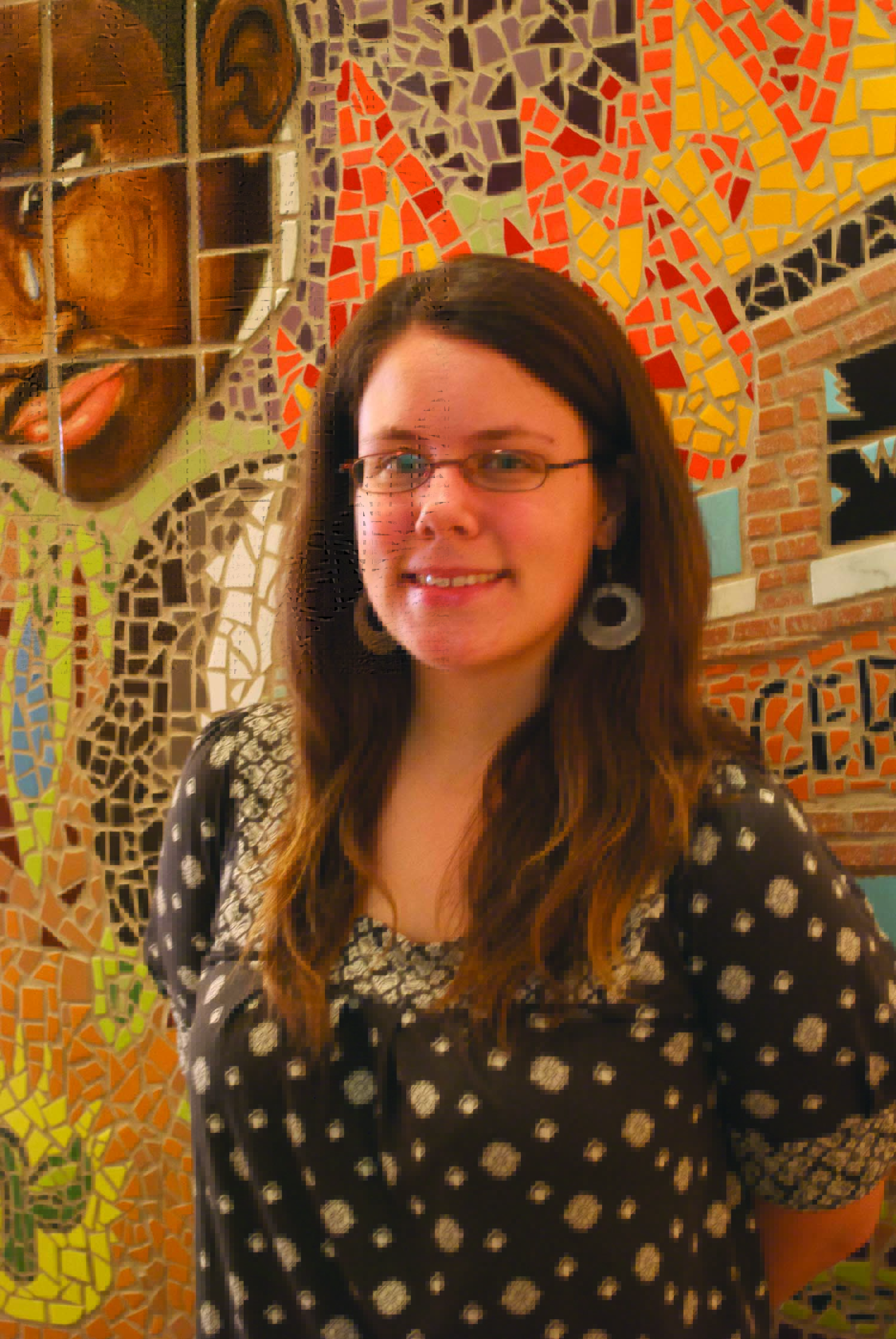
The Baltimore ’68: Riots and Rebirth initiative sought “to explore the causes and effects of the social unrest in Baltimore” in April 1968 and chronicle attempts at civic healing. The university told that story through various projects: an online archive, an oral history, a community-driven theatre production, a three-day public conference and an anthology of research papers.
My job was to bring community arts into that mix. Communal storytelling within a group of diverse individuals often results in a more encompassing and equitable documentation of that community’s shared history. Art is an effective and underutilized tool to tell those often-untold stories. Visual depictions of events can concretize memories and allow those who participate to better understand their past and its relation to the present.
I contacted approximately 60 participants in the initiative’s oral-history project and asked if they would be willing to create a mosaic about the events of April 1968. Our first workshop in January 2008 drew 12 people, including my own parents, who were both witnesses to the events of that year.
The attendees shared their experiences and perspectives about the riots, and how those events impacted their lives. Each story brought a unique perspective: A priest who led an Easter vigil while chaos ensued outside. A lawyer who defended curfew violators arrested for simply returning home after work. A present-day community activist who admitted to looting when she was a teenager. A former Baltimore Sun reporter who had recorded the turmoil in snapshots. A man who remembered living in a peaceful middle-class black neighborhood suddenly surrounded by the National Guard.
The openness and candor was astonishing. I was especially proud of my mother, who for the first time in her life shared a full account of her experience losing everything in the riots. The session concluded with everyone working in teams to create a paper mosaic about a relevant theme – and these dozen people who were strangers when they walked in seemed like friends at a 40-year reunion by the end of the day.
Moments of enlightenment continued as the process moved forward. When one participant described his experience with segregated hospitals, my father admitted his ignorance of race relations in that era. “I had no idea that hospitals refused patients based on the color of their skin; I always thought they were to treat everyone who needed help and care,” he said. “I understand now why anyone would riot if they were treated like that.”
Robert Birt, another participant, later told the Christian Science Monitor: “As I looked at the riots while they happened in my neighborhood, I knew the stores of white merchants were burned. But to be frank, after King was killed, I didn’t give a damn. That was my attitude. But when you hear the story of Christina’s mother – somebody’s family – come on. And she was my neighbor, too, I realized.”
In the seven meetings that followed over a three-month period, a dedicated group of ten people continued to attend workshops. Together, we worked through issues of design aesthetic, critique, and storytelling, and plans for a large mosaic and individual 6” x 6” ceramic story tiles emerged. A growing sense of shared ownership also took hold. I gave them tools, but our collaboration went beyond anything I could have ever imagined.
In late spring of 2008, several of us worked tirelessly to create the final mosaic. We finished it in time for an unveiling at Baltimore’s annual Artscape festival in July. The overall assessment of the project was positive. Some members of the team believed that the mosaic brought them together as a community that was reminiscent of the Baltimore they remembered and loved – a place of respect and belonging.
The mosaic project was grueling and rewarding. But it allowed participants to claim ownership of their individual stories and collective history through art – and share what they had discovered with the wider community. In the intimacy of respectful interaction, we might accept and even embrace our differences and the tensions and arrive at a greater understanding and community with one another.
At Play – Fall 2009
Discovering Japan
When UMBC men’s lacrosse team returned from an 11-day trip to Japan to play in the 2009 International Friendship Games, they came back with more than an undefeated record in the competition. They also returned with a sense of what makes Japan unique and a camaraderie that spanned cultural divides.
Members of the team opened up a window on their journeys in Japan with postings during their trip at The UMBC Dawg Blog.
“A trip to Nagoya Castle,” wrote Alex Hopmann ’09, business technology administration, “was capped with a trip to the gift shop to purchase rubber nunchucks and wooden swords.”
Tim Eagan ’10, added that Hopmann “managed to break his chucks before we even left the castle.”
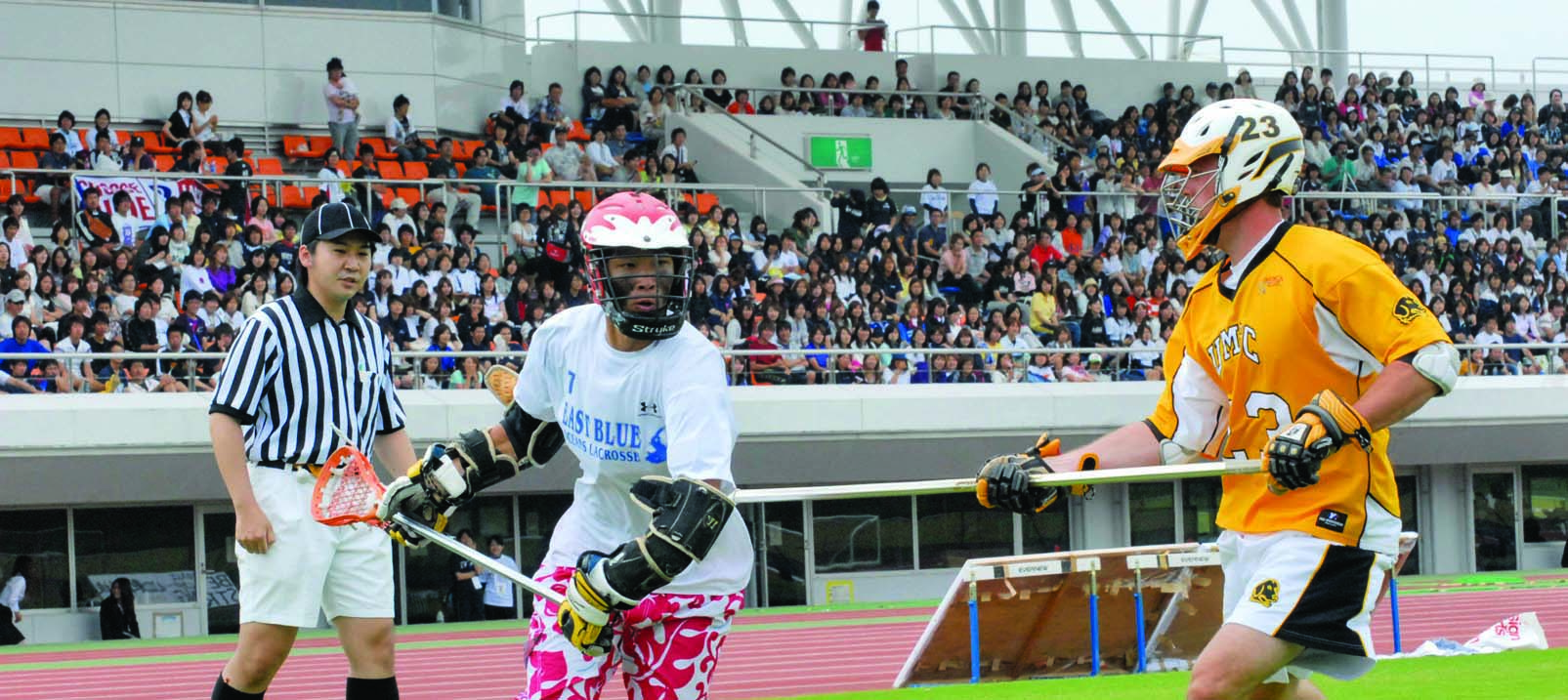
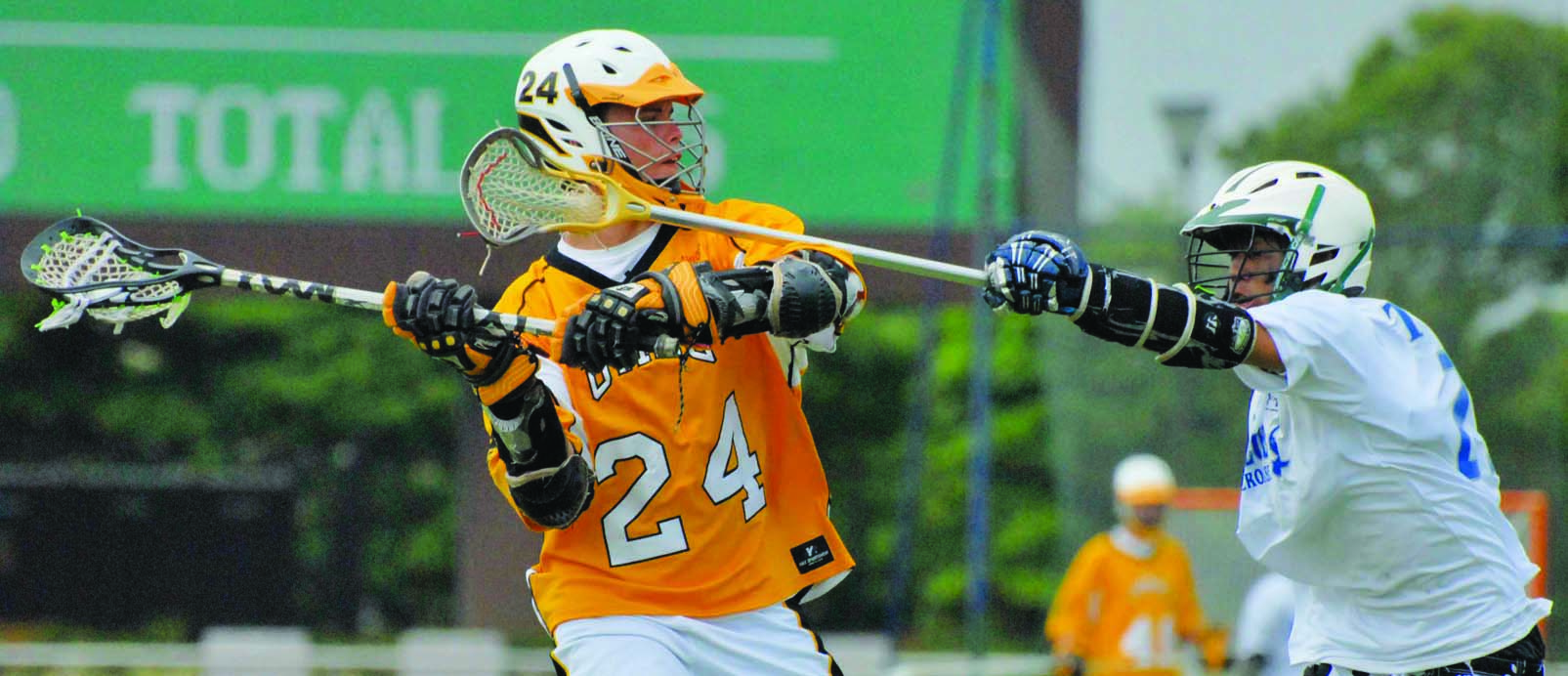
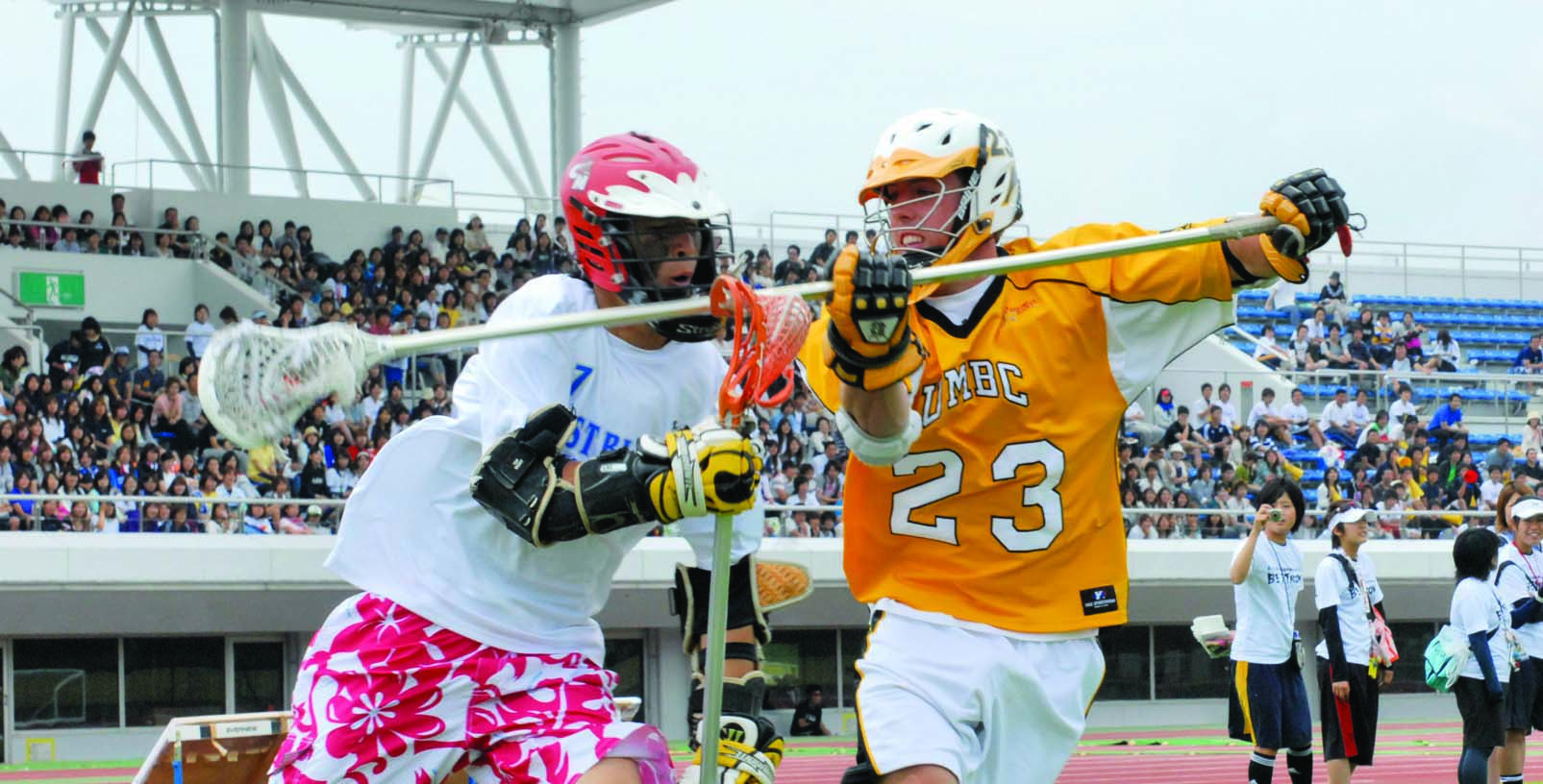
Encounters with Japanese cuisine – including the surprise of rice, pasta and veggies served for breakfast and a chance to taste cow tongue – were a big feature of the diaries.
Eagan also blogged about his impressions of the tour. In one post, he described a meal in which team members ordered blindly from a menu without pictures. He noted the surprised reaction of teammate Michael Camardo ’10 when he “was served a bowl of cold noodles and seaweed, topped off with an obnoxious amount of coconut shavings.”
The trip also celebrated the 20th anniversary of the Games and a nearly two-decade-long relationship between UMBC and the Japan Lacrosse Association (JLA). The team competed against numerous collegiate and national squads, including a one-goal win over Japan’s national lacrosse team.
For more information about the UMBC Dawg Blog, visit umbcdawgblog.wordpress.com/.
Field of Dream Teams
It isn’t often that soccer players valued at hundreds of millions of dollars parade on the Bermuda grass pitch at UMBC’s Soccer Stadium, but that’s just what happened on July 23, when two of the best professional teams in the world held practices there.
English giants Chelsea and Italian titans AC Milan were in Baltimore for a sold-out match at M&T Stadium on July 24, and both teams found a congenial pregame practice site on UMBC’s campus. (Chelsea won the exhibition match 2-1.)
It was a chance for some lucky members of the UMBC athletics community to watch players such as Chelsea’s captain, John Terry (who was the object of a nearly $50 million offer from rival English team Manchester City over the summer), and AC Milan’s Brazilian superstar Ronaldhino kick the ball around in Catonsville.
AC Milan players also headed over to the RAC after their practice ended, where the team shot some baskets, played a game of dodgeball and mingled with slightly-starstruck members of the UMBC community.
Chelsea and AC Milan are powerhouse professional teams in their respective countries and on the larger European stage. Both teams won automatic qualification to the Champions League for the 2009-2010 campaign, which begins on September 15.
Many of the 71,000 fans who attended the exhibition would have loved to get the close-up view of the teams that a few lucky UMBC fans got on a sunny late-July day in Catonsville.
Pete Caringi, men’s soccer coach at UMBC, says that “it was a once-in-a-lifetime opportunity to have two of the best teams in the world train at our facility. We got a chance to interact with the coaches, their staffs and legendary players.”
The Mascot Game
These days, Steve Butz ’97, biological sciences, spends much of his spring and summer flapping and frolicking with fans in Camden Yards as the mascot for the Baltimore Orioles.
Yet Butz got his start in the mascot game as UMBC’s True Grit – the ultimate Retriever Believer at athletics events and in other public venues – at the suggestion of a roommate who played men’s basketball. He says he took to the mascot game quickly, developing new hijinks all the time.
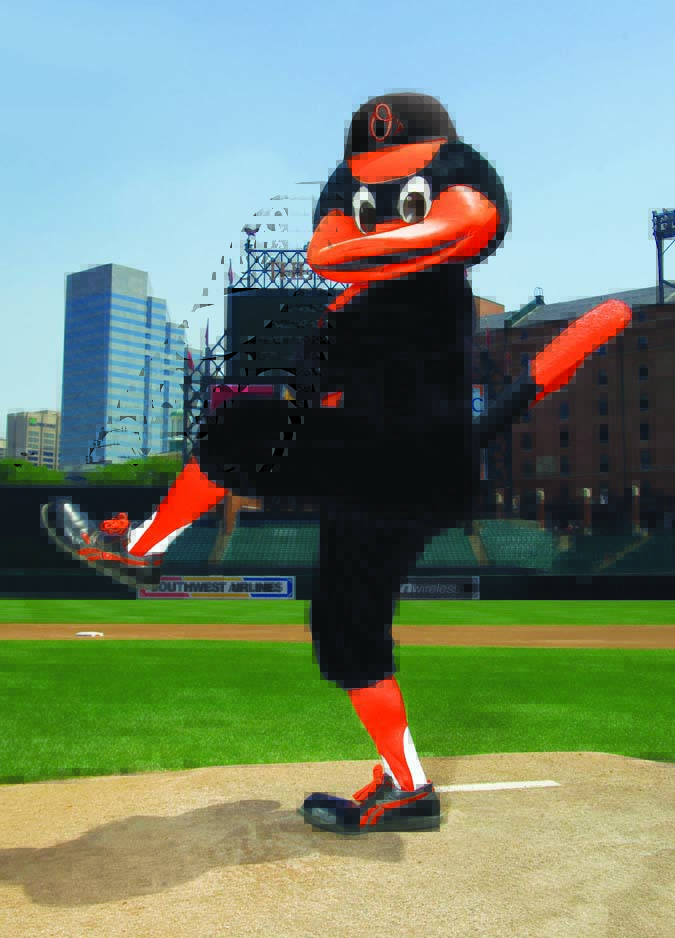
“Sometimes when an opposing team visited, I would take an opposing team’s cheerleader, direct her to UMBC’s side of the court, swap out the pom-poms she was holding for UMBC’s, and direct her in a UMBC cheer,” he recalls.
The True Grit gig also had more duties, including off-campus trips to Camp David to visit military families. And when he started the serious work of pursuing a doctoral degree in psychology at Loyola College in Maryland in 2002, he replied to an ad for the Oriole Bird slot and won the coveted position.
“In my work as a Retriever I learned what worked and what didn’t in terms of how everything has to be exaggerated as a mascot,” he says.
Butz now works full-time as a clinical psychologist, but he still roams the ballpark as the Oriole Bird. Psychology has proven invaluable during his mascot career, he says: “You have to think quickly and react on your feet. You want to push the limits to be a good mascot. The situation can change just like that, and you have to be able to react to that in a hurry.”
Machines in Motion
From his boyhood, former UMBC provost Homer W. Schamp, Jr. was always interested in mechanical things.
“I got a windup train when I was three years old and that was a defining toy for me,” Schamp says. “At five, I asked my mother, ‘How do they make the machines that make the machines that make the machines?’ I still don’t have an answer for that one.”
Now retired after a career at UMBC that began with the university’s founding, Schamp makes toys that draw on his interest in how mechanisms work. At a shop in East Baltimore called Funny Things Ltd., he creates kaleidoscopes and oscillators as a hobby. Schamp’s toys were even exhibited last year at the Creative Alliance in Baltimore.
An object called “Funny Things Oscillator” was Schamp’s first creation. Two long strips of metal are attached perpendicularly from a block of wood. Magnets placed on each of the metal strips move them back and forth at different frequencies. His kaleidoscopes have three mirrors facing each other in a triangle. Some of them have motors that move colored panels and create patterns. One kaleidoscope’s motions are even set to music.
Schamp makes his toys with children – and sparking interest in science – in mind. “I want to make people outside of science to think elementary science is important for the way it shapes [children’s] interests,” he says.
Schamp hopes to place his pieces in a children’s science museum by the end of the summer. “In the meantime,” he says, “I don’t mind. I just enjoy making them.”
Center of Attention – Andre Gudger ’99, ISM
Ask Andre Gudger ’99, information systems management, how he recalls his undergraduate years at UMBC, and he sums it up in a single word: “intense.”
Gudger remembers a swirl of study and ambition at the core of his college experience.
“There were a lot of classes, a lot of books, a lot of push to achieve,” he says.
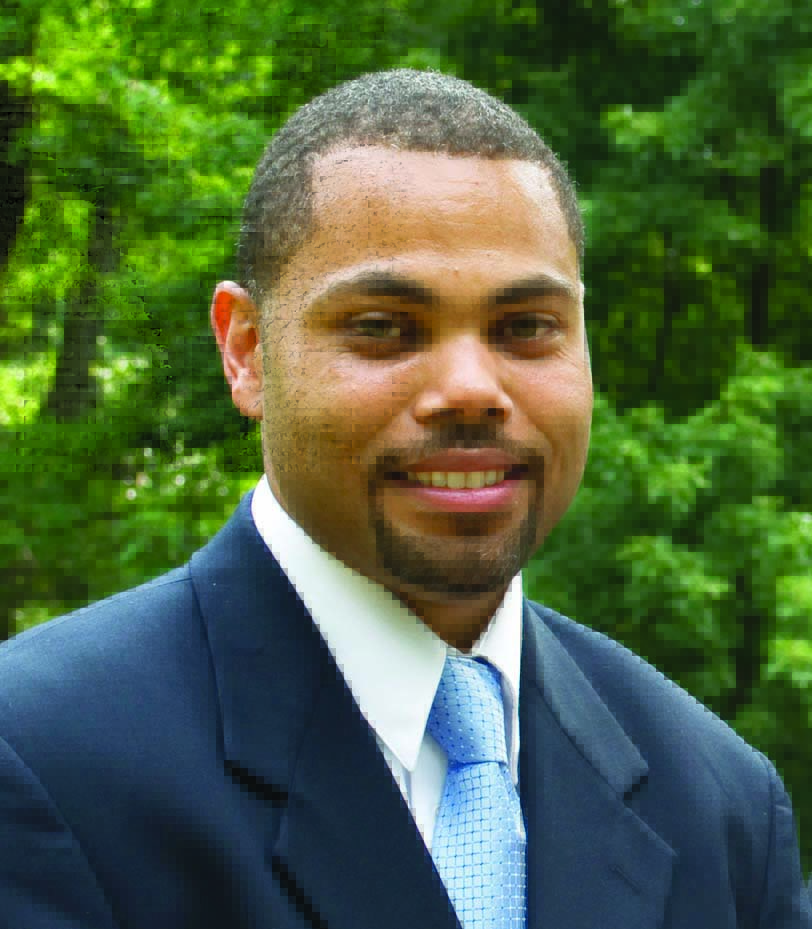
Intensity also defines Gudger’s approach to the business of information technology and its applications in business and government. Gudger is the CEO of Solvern Innovations, a company he founded in 2003 to help corporate executive and public servants cope with various opportunities and pitfalls in an increasingly tech-oriented world.
Solvern Innovations started off fast out of the gate, quickly picking up a host of clients that included Fortune 500 companies. After a year, it extended its vision to military, intelligence and other government work.
Recognition of success – both for the company and for Gudger – was not long in coming.
Solven Innovations was named by SmartCEO Magazine as one of its “Future 50” growing companies for 2008. Inc. Magazine placed Solvern at number 52 in its survey of the fastest growing privately-owned companies in the country. (The magazine also ranked Solvern as the fifth fastest-growing government services company and as the fastest-growing company in the Baltimore region.)
Gudger himself has also garnered a number of individual awards for his achievements, including the 2003 Granville T. Woods Award for top African-American CEO – established by the National Association of Black Telecommunications Professionals to honor famed African-American inventor and engineer.
Solvern Innovations is based at the bwtech@UMBC Research and Technology Park, and Gudger observes that in some ways, he never really left UMBC after completing his undergraduate work. He says that he was always involved with UMBC in some way: whether it was through communicating with old instructors, catching up with other graduates individually or through UMBC’s Alumni Association.
Gudger says that those principles of making connections – and staying connected – have influenced Solvern’s approach to business. The company strives to connect recent college graduates with experienced senior staff, he observes, in order to be both innovative and practical. The company is currently working with the university to create technology that detects Web-based vulnerabilities in government computer systems.
The latest innovation that Solvern has brought to UMBC’s research park is the establishment of an accredited Center of Excellence at the company’s headquarters. The center will train Department of Defense employees and contractors in business management, and it was the fruit of a two-year accreditation process for the company. Solvern’s center is the first of its kind to focus on how to make government agencies more conversant with and effective in implementing sound business management.
“We have worked hard to become a world-class solutions provider to the Department of Defense, where employees and contractors can come and gain the knowledge needed to accomplish their mission,” says Gudger. The new center will also work as a “think tank” with over 10 employees researching and developing effective business management techniques.
Gudger says that some recollections of his time as an undergraduate remain vivid – including a memory of how leadership can be accompanied by courtesy.
He recalls one of those windy days on campus with which most UMBC students are painfully familiar. He was sitting outside the University Center – “the old UC,” he adds – when a strong gust of wind rushed past and blew open some students’ notebooks. Gudger says that UMBC President Freeman A. Hrabowski, III just happened to be walking by as the gust of wind blew through, and he watched as Hrabowski immediately began running to catch the flying papers.
Gudger says that the moment made a strong impression. “It just helped me understand what people at his level are responsible for,” he says.
Charmed City
You might know John Strausbaugh ’74, interdisciplinary studies, from the books that he’s written on odd and controversial topics – including Elvis culture (E: Reflections on the Birth of the Elvis Faith), boomer rock (Rock ‘Til You Drop: The Decline From Rebellion to Nostalgia), blackface (Black Like You: Blackface, Whiteface, Insult & Imitation in American Popular Culture) and the sissification of America (Sissy Nation: How America Became a Culture of Wimps & Stoopits).
But Strausbaugh’s been influential behind the scenes in contemporary journalism as well. As the editor of New York Press in the 1990s and the early part of this decade, Strausbaugh discovered and/or nurtured a wide array of new literary and journalistic talent including Oscar-winning screenwriter William Monahan, and a host of columnists-turned-authors such as Jim Knipfel (Slackjaw, Quitting the Nairobi Trio), Jonathan Ames (What’s Not to Love?: The Adventures of a Mildly Perverted Young Writer), Norah Vincent (Self-Made Man, Voluntary Madness) and Amy Sohn (Run Catch Kiss).
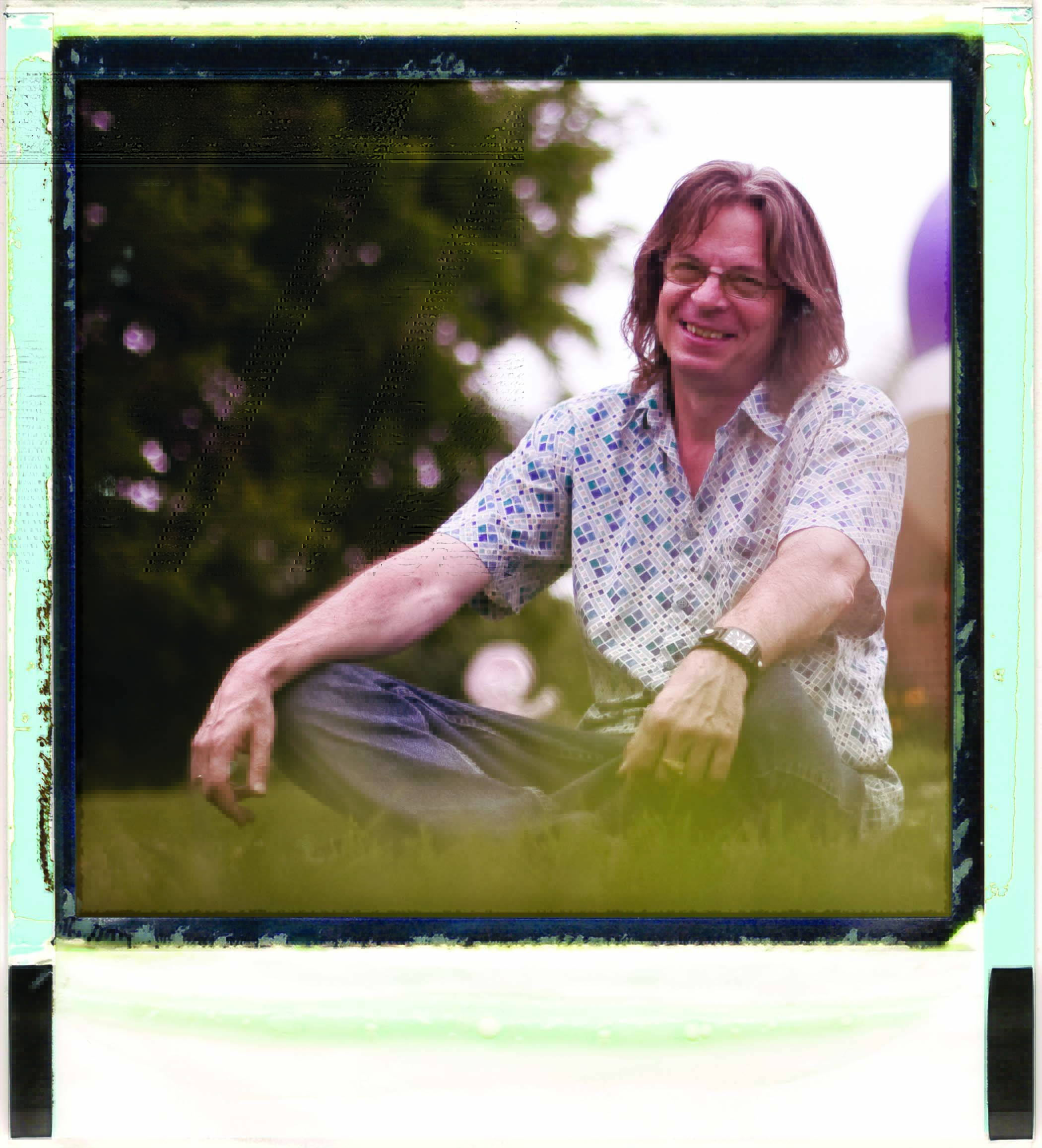
Strausbaugh is also well-known for an occasional column (and web-video feature) that he writes for the New York Times called “Weekend Explorer.” In each column, he investigates the disappearing legacies and odd tales of various New York City neighborhoods. So UMBC Magazine asked Strausbaugh to do something similar – and more far-reaching – with his own hometown. Here’s what he found….
My twin brother, Richard, and I were born in Baltimore on Halloween, 1951. He was the treat, I was the trick. I went to Loyola High School and UMBC, and lived in and around Baltimore until 1990, when I moved to New York City, where I’ve been since. When I come back to visit, I’m always struck by what’s changed in my absence – some new things I like, some I hate. And I go looking for familiar haunts, remnants of the Baltimore I knew. Old Bawlmer.
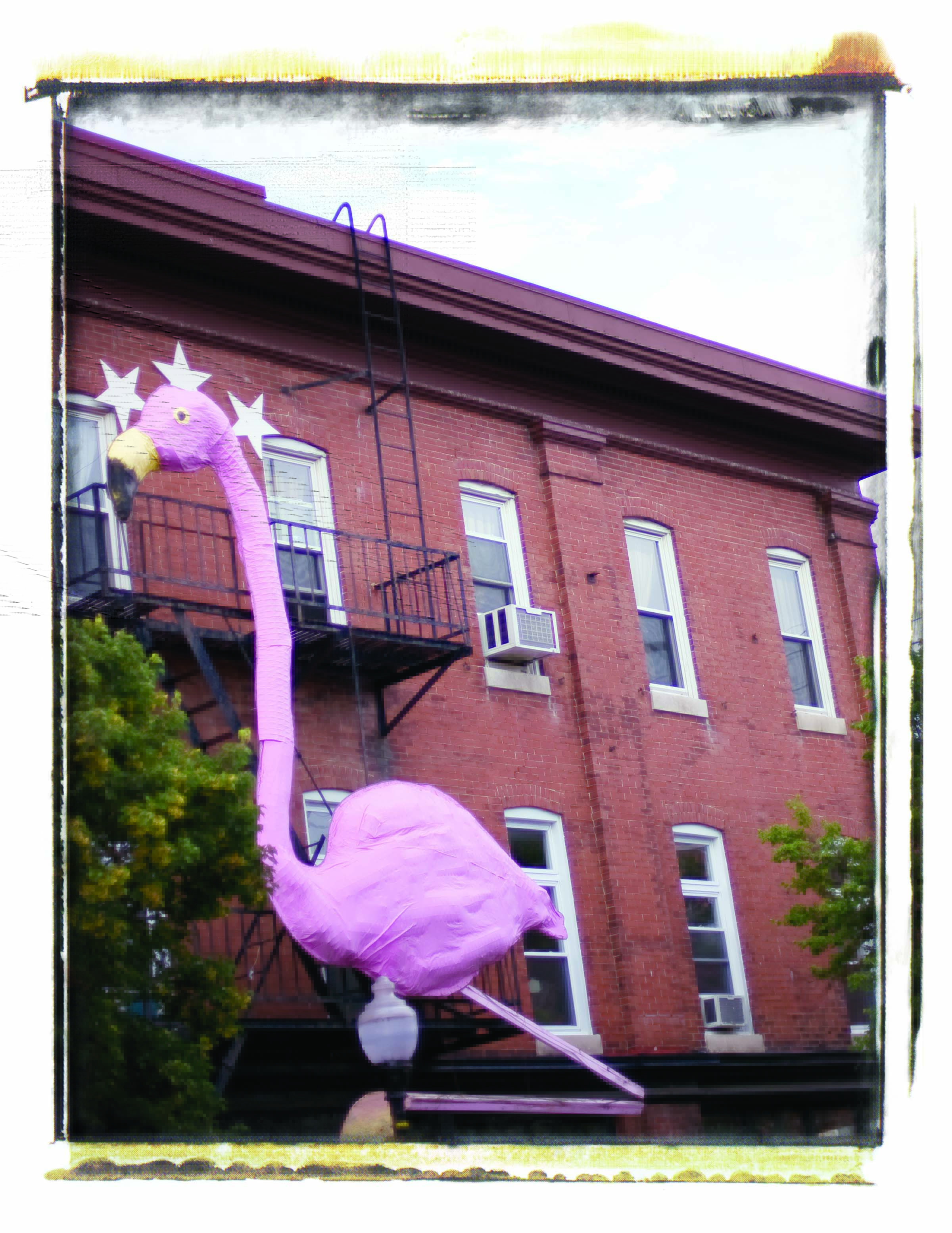
Hampden is one of the Baltimore neighborhoods that feels the most changed since I moved away. In my day it was not hip, cute, gentrified or ironically self-aware. You might well have been addressed as “hon” there, or anywhere else in the city, but never in a place called Cafe Hon. Hampden was a bastion of white, working-class Baltimore, mostly urbanized country folk. They spoke some of the purest deep-dish Bawlmerese you ever heard. Outsiders needed a native interpreter. I remember watching a parade on W. 36th Street – maybe it was Fourth of July, 1976 – standing behind a young Hampden dad with his son on his shoulders. The kid pointed to a patriotic balloon going by.
“Wazzat dad?”
“Atza blune, son. See whatzawnit? Atza iggle.”
Hampden was where Santy come dayna chimbley and also, I believe, where I was first stumped by the verb “obble.” As in, “Ah dayn knayow what the problum is, but Ahm gonna obble it and fahnd ayut.”
Frazier’s, the W. 36th Street bar and restaurant, seems to me to do a pretty good job of balancing Old and New Hampden. (The current location is the “new” Frazier’s; the old one, several blocks away and harder to find, was very Old Hampden.) Maybe it works only because Old Hampden tends to have its elbows on the bar in one room, while New Hampden is shooting pool in the larger, loungey other room. Anyway, everybody seems to coexist in peace. It’s not chic, and the waitstaff don’t work too hard at charm-citying you, hon. It’s just a bar where you go for cheap drinks and platters of respectable food.
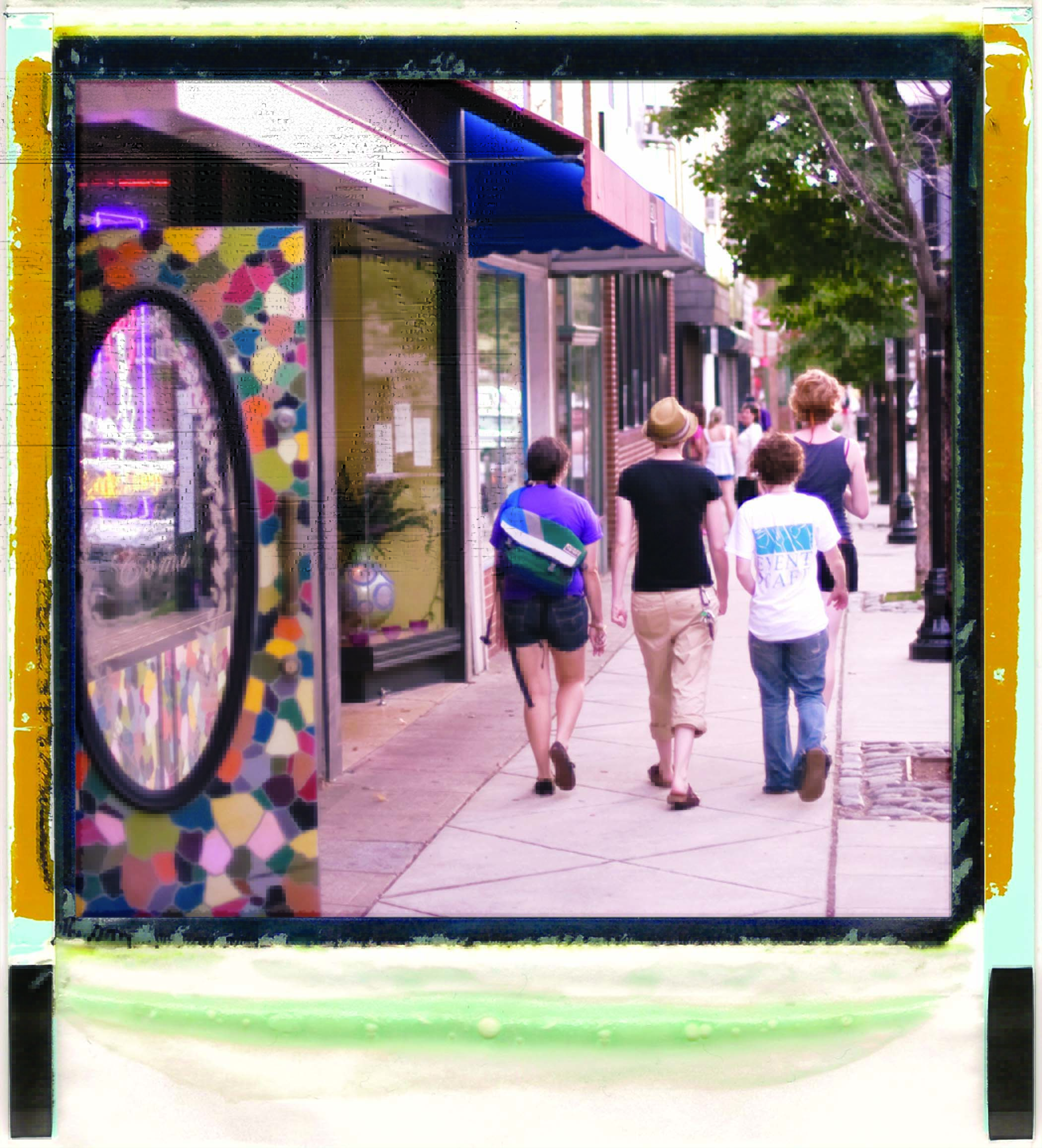
Besides my friends and family, what I miss most about Baltimore is the crabs. It’s axiomatic that you can’t get steamed crabs in New York or a crabcake worthy of the name. They’re all cake, no crab. And forget about such delicacies as scrapple, pit beef or Taylor Pork Roll.
For steamed crabs, my sister Jane takes me to L. P. Steamers, an old-school, family-run crabhouse on Fort Avenue in Locust Point. Afterward, to wash down the Old Bay, we drive a few blocks farther east to J. Patrick’s Pub on Andre Street, one of the last of the traditional Irish music spots that in my day included Kavanaugh’s and the Gandy Dancer. At J. Patrick’s they pull one of the best pints of Guinness I’ve tasted in the U.S. – neither warm nor chilled but basement-cool, with a creamy head.
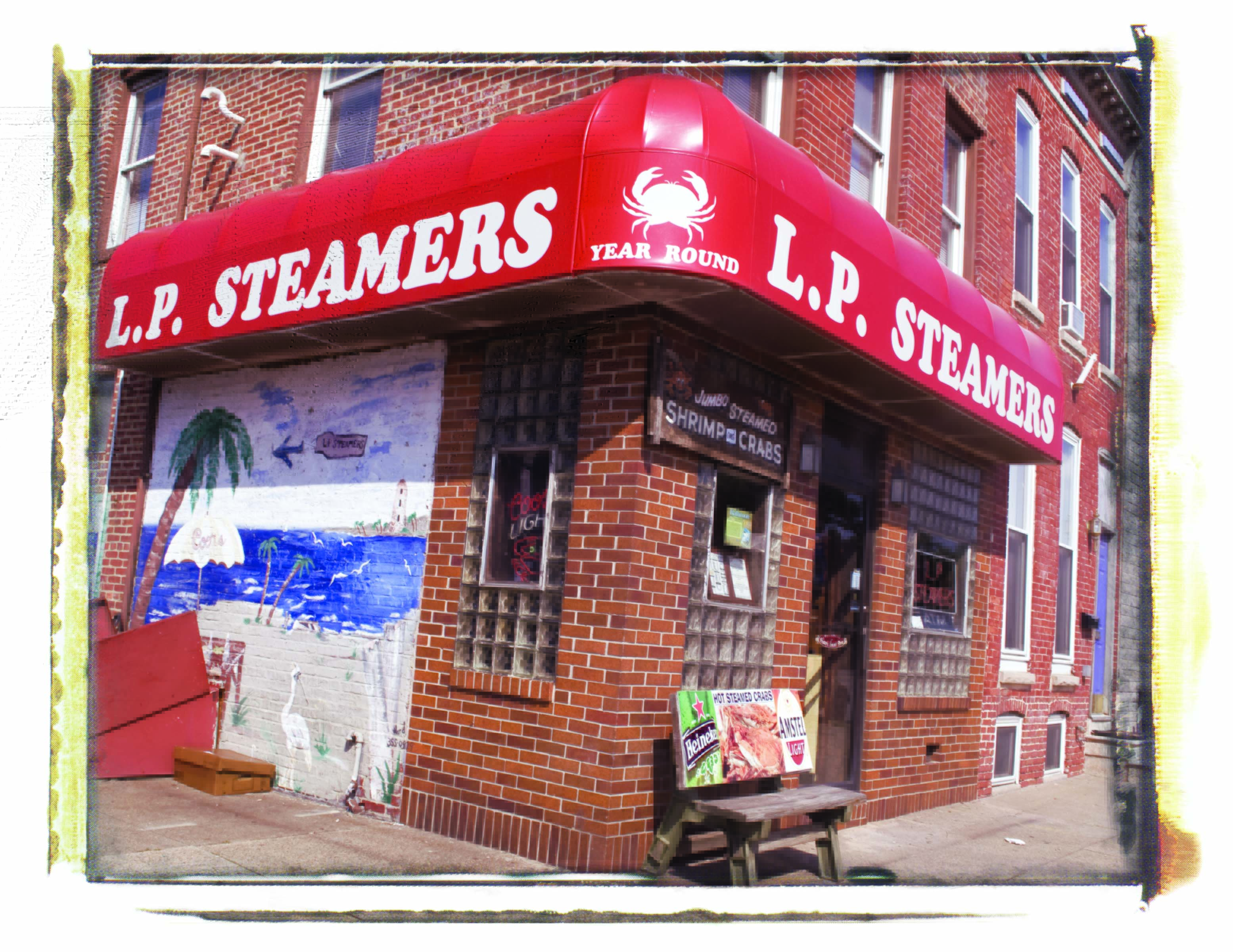
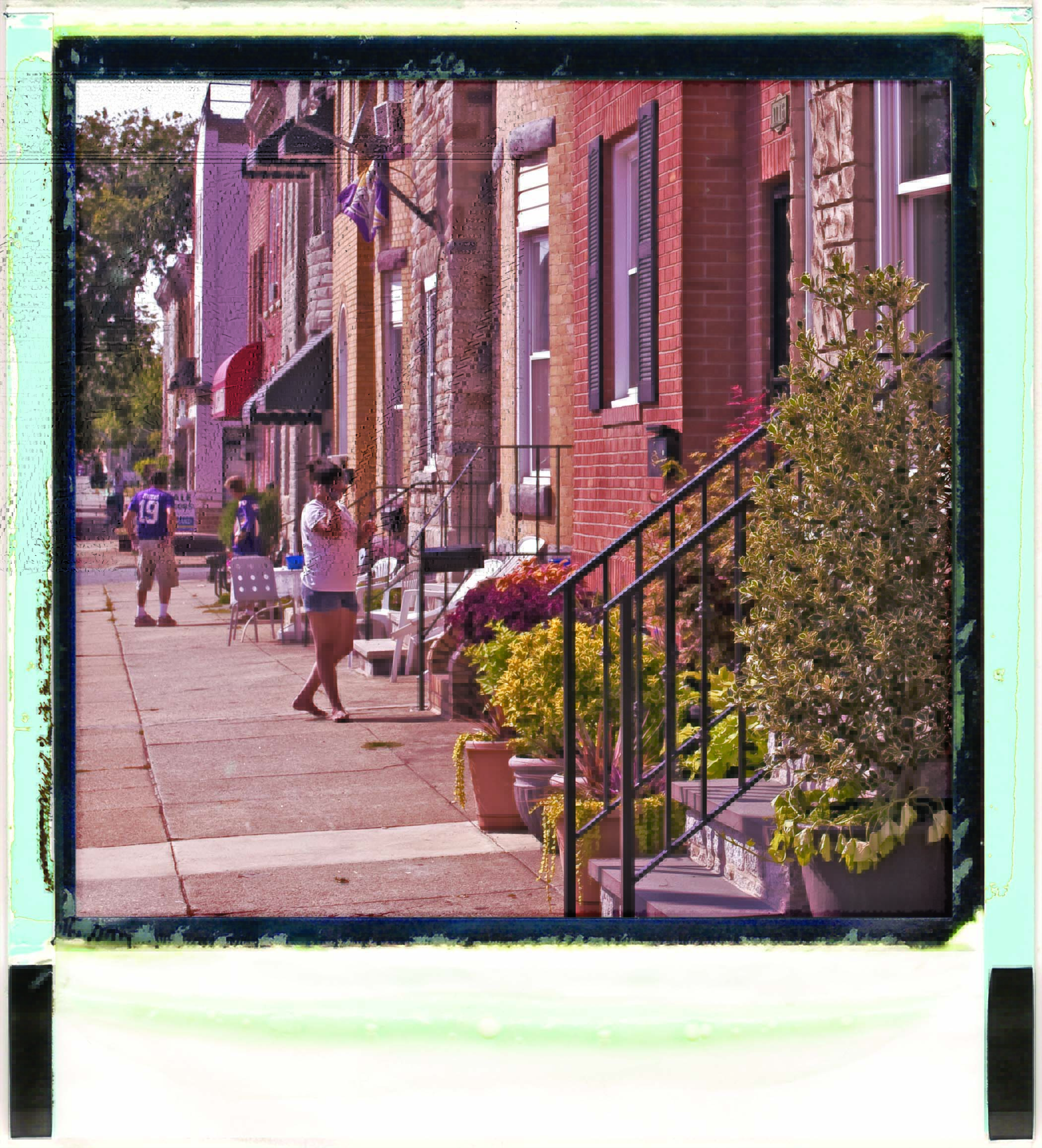
Unlike Hampden, Fells Point, Canton or the Inner Harbor, Locust Point looks and feels mostly unchanged to me. Narrow streets lined with small rowhouses run down the gentle slope from Fort Avenue to the waterfront and the Domino sign. Young mothers sit out on their stoops on a summer evening, smoking and gabbing quietly as their kids splash in tiny plastic wading pools on the meticulously swept sidewalks. The buildings are low and the sky is wide and you can watch the weather sweeping over the city from the west and not hear or acknowledge the hubbub over in Camden Yards and Harborplace.
When I was growing up, Bawlmer kids’ three favorite places on earth were Ocean City, Gwynn Oak Amusement Park and Enchanted Forest. (Well, Gwynn Oak was a favorite for white Bawlmer kids: It was segregated, until the early ’60s, as were swimming pools and other recreational places. Old Bawlmer had its nasty side, too.)
The Ocean City I knew was obliterated by the current metropolis-by-the-sea decades ago. Gwynn Oak closed in the early ’70s. Enchanted Forest, on Route 40 near Ellicott City, lasted into the late ’80s. It was fairytale-themed and magical in a low-rent way.
For a couple of years in the ’70s I rented a woodframe shack on Frederick Road just west of Ellicott City with my friend James Taylor. (Not the folksinger, but the co-founder of the American Dime Museum, another great, lamented Baltimore institution.) We were told the house was built as slave quarters and that it was haunted. We believed both. It was certainly haunted by bees, a giant hive inside one whole wall. If you put your ear to it you could hear them in there humming like fluorescent lights.
Our neighbors to one side were a poor white family, to the other a poor black one. The white family didn’t like us and rarely spoke. Their hound used to stand in the little stream that trickled just behind the houses and bay at the moon all night. The black family was more friendly. The dad used to call both me and James “Cap’n,” as in, “Nice morning, eh Cap’n?” Cows and horses wandered the big green hill across the road. Mornings they’d drift down to the fence and blink at traffic racing by.
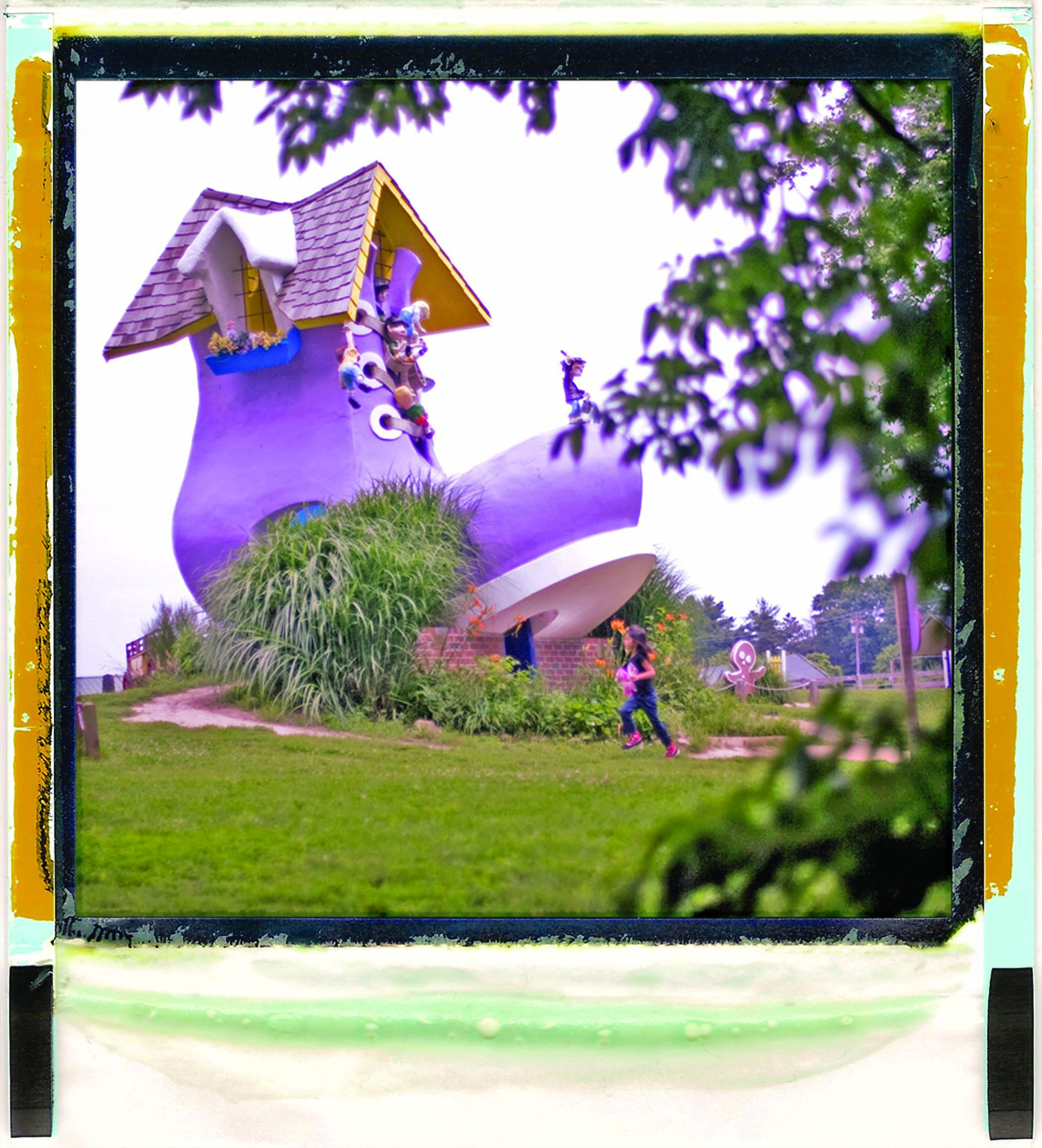
Enchanted Forest was still open, and we’d go over there once in a while. It wasn’t doing much business in those days and looking pretty forlorn. I fantasized about buying it and turning it into a private compound for me and my friends. I’d take the Three Little Pigs’ House and put apartments in the Old Lady’s Shoe.
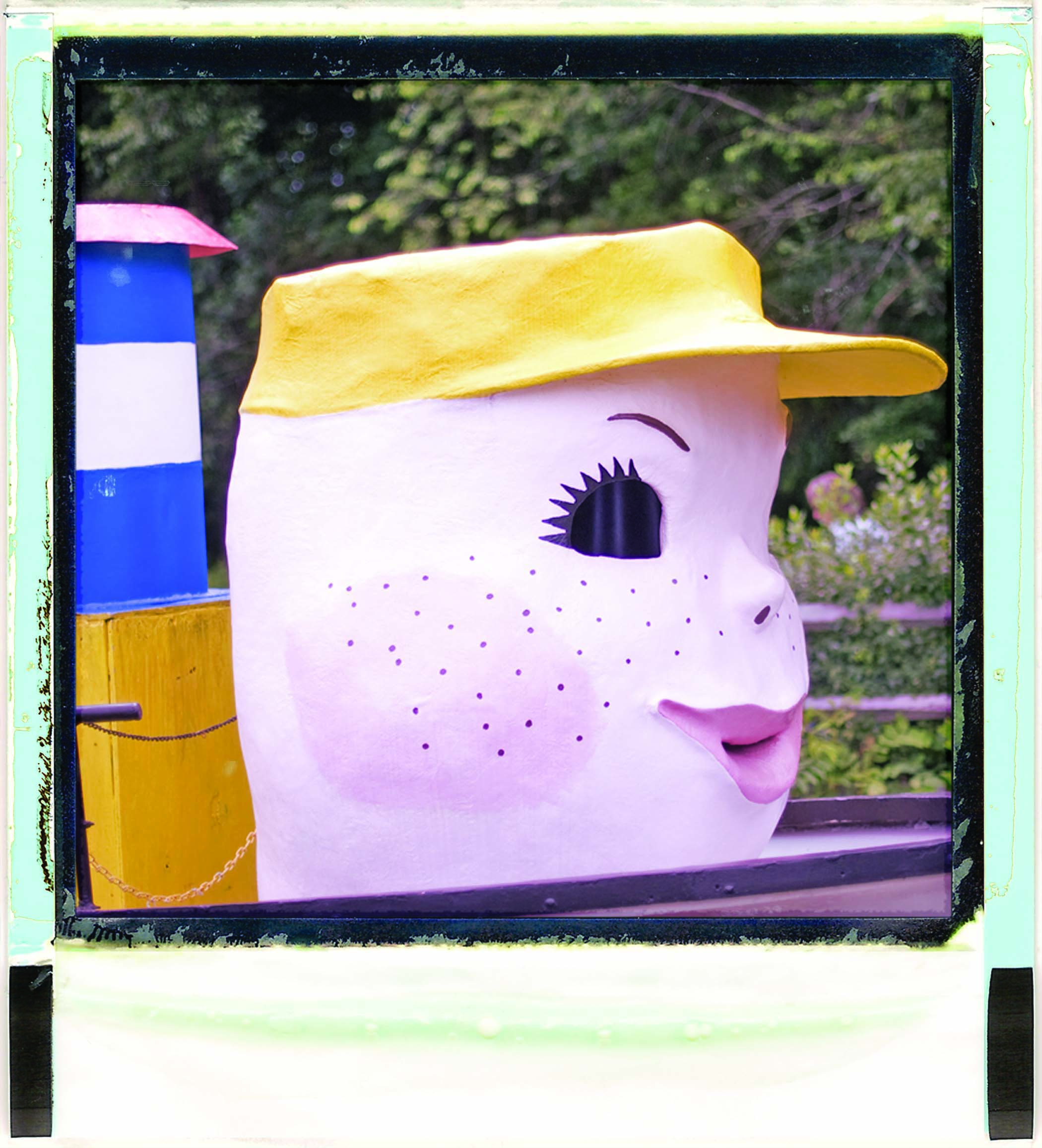
What did happen, inevitably, was the Enchanted Forest Shopping Center, incorporating the park’s Old King Cole sign and its storybook castle entrance, but letting the rest of the site sadly deteriorate. Starting in 2004, the Clark family, whose Clark’s Elioak Farm is on Route 108 between Ellicott City and Columbia, cut a deal with the shopping center to move a lot of Enchanted Forest there. They and volunteers (including Mark Cline, sculptor of the wonderful Foamhenge down near Natural Bridge, Va.) have beautifully restored and re-created the institution. They’ve got the Shoe, and Cinderella’s pumpkin coach, and the Three Bears’ House, and Li’l Toot the Tugboat, and the Easter Bunny’s Easter Egg house, and a bunch more, all spread out nicely on the farm’s fields and through its woods. When I was there this summer there were lots of families, of course, but also some unaccompanied adults like me, wallowing in guilt-free, unself-conscious nostalgia.
Baltimore was always an Elvis town. Old-timers will remember Miss Bonnie’s Elvis bar on Fleet Street. It closed after Miss Bonnie died in the early ’90s. Around the same time, my friend Carole Carroll started the annual Night of 100 Elvises, which will happen for the 16th year this Dec. 4-5. As a big fan of the King, I’ve been honored to come down and help emcee the event a few times. I’ve been to Elvis tributes in Memphis and elsewhere, but the Night is sui generis, featuring dozens of Elvis tribute artists (not “impersonators,” thank you) of all ages, sizes and skills, from little kid Elvii to kung fu Elvii to the fabulously matronly all-Canadian-ladies revue, the Graceliners.
Working the stage at an Elvii event is a treat. True Elvii are the King’s ministers here on earth, and they take Elvis’ code of behavior seriously. I’ve never been around more polite entertainers. Meanwhile, the crowd that stuffs the hulking old Lithuanian Hall in the ghetto of Sowebo is always an interesting mix of the real Elvis faithful and curious hipsters. On the Sunday after, Carole and some of the Elvii participate in the Hampden Christmas parade, another excellent Baltimore tradition, even if the weather always seems to be viciously cold. Carole and the Elvii ride in beautiful vintage cars provided by the Karb Kings club (klub?). It’s a hoot.
For a relatively small city, Baltimore is rich in museums. I’ve been to a lot of museums around this country and a few others, and two of my favorite are in Baltimore: the Walters, which I’d say is a world-class museum of its type, and the American Visionary Art Museum, which I believe is pretty nearly unique. Being an entire museum devoted to art by visionaries, outsiders, loners, the untrained and the institutionalized, it makes great sense that it’s in Baltimore, too.
The big group show that opens at AVAM in October of this year, “The Marriage of Art, Science & Philosophy,” curated by the outsider art expert Roger Manley, will include work by an amazing artist I met earlier this year in Raleigh, N.C., Renaldo Kuhler. Over decades, Renaldo created a private fantasy world, Rocaterrania, which he conceived in stupendous detail – the people, their political history, their language and alphabet, architecture, clothing, cinema, music. When I met him, it was clear that Renaldo, a man as funny and courteous as he is eccentric, lives with one foot in this world and the other in that one. Brett Ingram, a North Carolina filmmaker, made a fascinating documentary about him, Rocaterrania.
This summer Jane took me to a bit of Old Bawlmer that was new to me: North Point State Park, out at the tip of Sparrows Point. It’s a mix of beach, farmland and untrammeled marshland, on a peninsula jutting into the Chesapeake. In September 1814, British invaders slogged through it and many perished of the heat and humidity. A hundred years ago it was an amusement park that folks from the city reached by streetcar. The old trolley pavilion has been restored.
There’s also a long, narrow pier from that era, poking well out into the water, where shirtless, tattooed fishermen dropped their lines against a sweeping vista of the bay, the low blue smudge of the Kent County shoreline across the way, the bluish tracery of the Bay Bridge in the distance.
Beside the pier is a small crescent of beach, not fancy, where white, black and hispanic families, whom I judged to be mostly working-class, lay around or stood laughing up to their hips in the bathtub-warm bay. Back from the beach are tree-shaded picnic groves where charcoal smoke rose from grills and dragonflies bobbed in breezes that tasted of hot dogs and hamburgers. In one grove a group of Russian men in Speedos kicked around a soccer ball.
Behind the beach there are trails through back-bay woodlands and out along the fringes of wide, wet marshlands where egrets crank their long wings and muskrats build “sheds,” like down-market beaver lodges. Except for an occasional jet high overhead it got very quiet out there, just the sound of breezes sifting the heads of the marsh grasses. I’d never been there in my life, but it made me pine fiercely for Chester Peake and The Land of Pleasant Living and the lazily, languidly beguiling city where I grew up.
Discovery – Fall 2009
Austen in Motion
UMBC’s annual Undergraduate Research and Creative Achievement Day (or URCAD) is always a date circled in red on the university calendar – and for good reason. This past April 22, more than 180 students in 28 majors – ably mentored by the university’s faculty – presented their scholarly work at locations across the UMBC campus.
At times, the work presented by undergraduates finds its energy by crossing over disciplinary boundaries. Such was the case with “Letters from Jane: A Tribute to Jane Austen,” a project conceived by Hannah Mary Rzasa ’10 and mentored by Doug Hamby, a professor in UMBC’s Department of Dance.
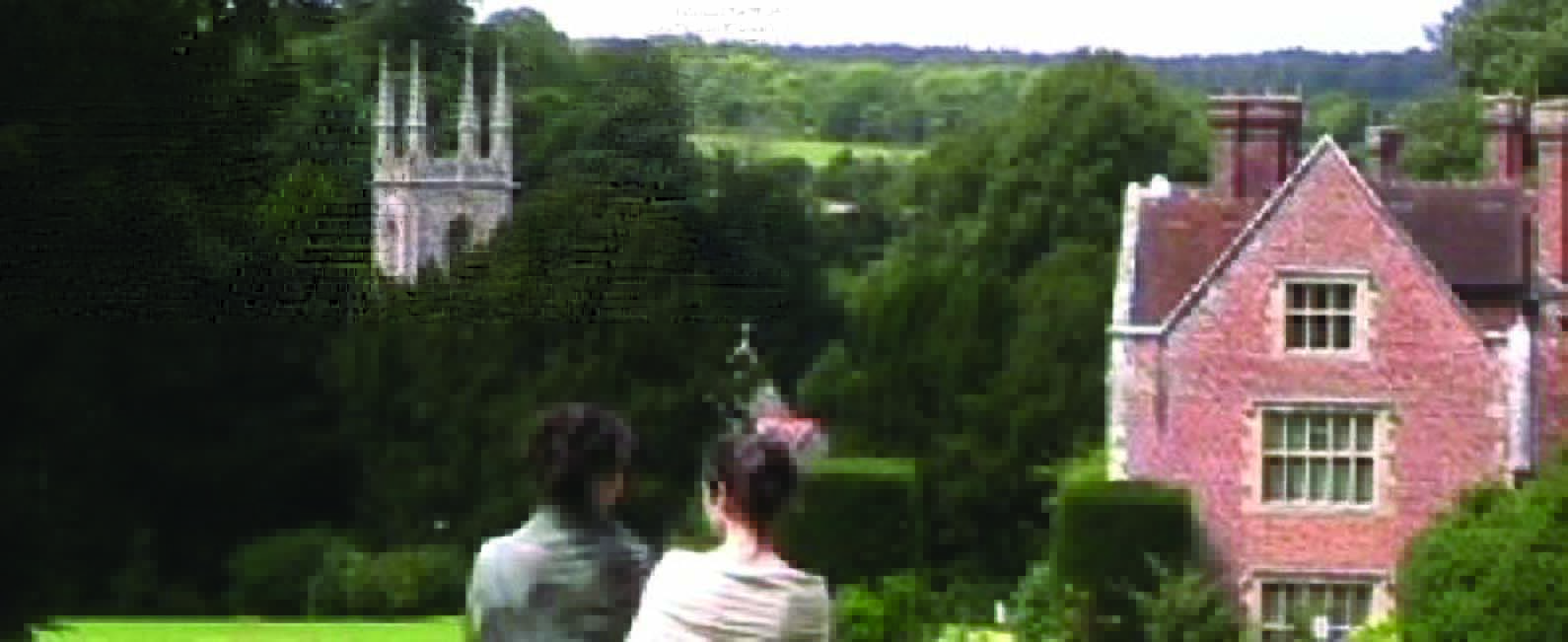
Rzasa’s project melded movement with literary study of the life and literary work of Jane Austen – specifically incorporating excerpts from letters between Austen and her sister, Cassandra, into the project.
“You will not expect to hear that I was asked to dance,” Austen wrote to her sister in 1809, in one of the letters excerpted by Rzasa. “But I was.” In Rzasa’s video project, Austen dances again, both in words and in Rzasa’s choreography of scenes from her life and untimely death in 1817.
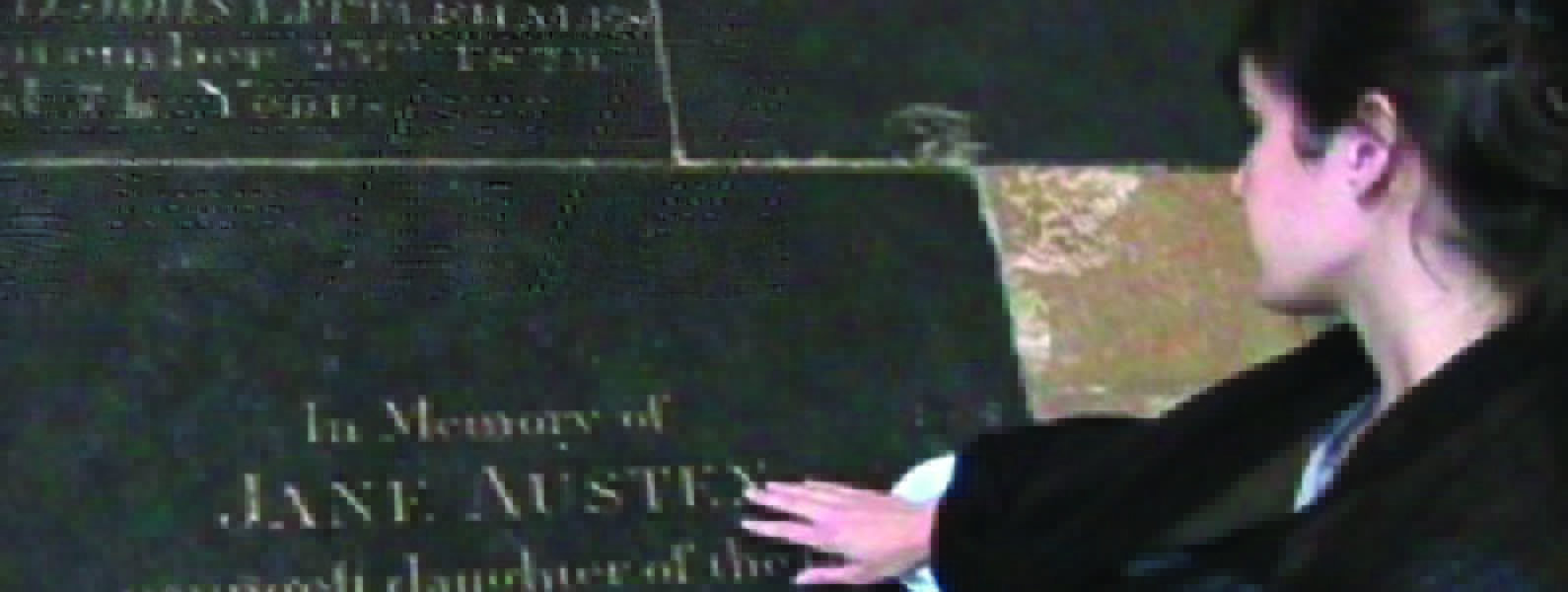
What makes Rzasa’s video project unique was that it was shot in many of the places where Austen lived in England. With the aid of a research award from UMBC’s Office of Undergraduate Education, Rzasa went to England to shoot her video at locations closely associated with Austen in Hampshire, including Chawton House (which is now a museum dedicated to Austen) and in Winchester Cathedral, where Austen is buried.
Rzasa says that officials at all of the locations were almost instantly obliging with permission to perform in these spaces. The bigger problems were the shortness of the time that she had to actually shoot the piece (less than a week) and creating a piece for spaces that were largely unfamiliar and had potential logistical constraints.
“I kept a lot of it as simple gestures,” Rzasa told the URCAD audience in a question-and-answer session after the video screening. “And I did test runs of the choreography.”
She was joined in performing the 20-minute-long piece by Elena Consoli ’07, dance, who lived in England and undertook graduate study at the University of Southampton when Rzasa made her video.
As Rzasa and Consoli romp through the meadows outside a parish church, or giggle together in pews, the viewer obtains a sense of the playful sensibility beneath the sense of Austen’s work. And as Rzasa literally dances tenderly on Austen’s grave in Winchester Cathedral, the project also conveys the tragedy of the author’s life cut painfully short.
Rzasa observed that the purpose of the piece was to use dance and Austen’s own words to cut through the fictions that have surrounded Austen’s biography and work. “The life and novels of Jane Austen have found frequent portrayal through film adaptations and television programs, but have rarely been depicted through a predominately dance medium,” she wrote in an abstract of the work.” The use of letters, she added, “sought to portray Jane Austen’s life without the biographical falsifications or embellishments noticeable in recent film productions concerning her.”
For more information about Undergraduate Research and Creative Achievement Day, visit www.umbc.edu/undergrad_ed/research/urcad/.
Oriole Observer
The appeal of studying orioles is obvious: They are arrestingly beautiful and easy to find in the Mid-Atlantic region – even on UMBC’s campus. The eye is easily caught by the contrast between the Baltimore oriole’s brilliant orange belly and its black head and wings. The state bird’s song is nearly as striking: a clear, loud, undulating whistle.
But Kevin E. Omland, an associate professor of biological sciences at UMBC, insists that the visuals are not what have drawn him to study these startling birds. It’s their evolutionary history.

Over the course of five million years, he explains, a single ancestral species gave rise to some 30 different species, most of which live in Central and South America. “We are using orioles as a model group to understand evolution,” he says.
Omland has used the DNA of the birds to work out a detailed family tree. From its branches, he can tell which birds are most closely related to each other, and, more importantly, begin to work out when various traits evolved and why. For instance, DNA evidence suggests that the birds had their origins in Mexico.
The family tree also led Omland to realize that Maryland’s orioles are “pretty strange.” Most of the rest of the oriole species do not migrate. And in many, if not most, of the other species, female birds are brightly colored and sing fluently, just like males.
“Some of the females sing more than males!” he exclaims.
The assumption that male birds are the ones that sing and wear showy plumage has led many scientists to ask the wrong questions about evolution, Omland says. Instead of asking how and why males evolved to be gaudy and musical, he argues, it makes more sense to ask how and why females evolved to be drab and mute.
For orioles, ancestral males and females probably looked and acted similar, shooting like orange-and-black balls of fire among the trees of Mexico, singing to each other.
Today, the description fits many tropical orioles – but not the Baltimore oriole or orchard oriole. Compared to the males, the females sing a simpler tune and look like a drab cousin, with a dull orangey-tan or yellow breast and olive-brown head and wings.
Why did the females lose their color and song? Perhaps predation targets females during migration or at the nest, and so they have adapted by blending in with their surroundings. Omland does know that over time, female orioles lost their bright color and song more than once – Baltimore and orchard orioles independently evolved these adaptations.
Omland has been studying orioles for 13 years to learn about evolution, and has no intention to stop: “We’re looking back in time. Sure, the view is fuzzy. You’re really squinting to see anything. That you can look back in time at all is so cool.”
For more information, visit www.umbc.edu/biosci/Faculty/OmlandLabWebpage/NewPages/.
Leading the Way
UMBC recently filled two key academic leadership posts with faces who have become quite familiar on campus.
• Janet Rutledge has been tapped as Vice Provost and Dean of the Graduate School, leading the university’s efforts in graduate education. After taking her undergraduate degree at Rensselaer Polytechnic Institute and her doctorate in electrical engineering at Georgia Tech, Rutledge taught at Northwestern University and worked at the National Science Foundation. She has held numerous leadership positions in UMBC’s Graduate School, including Acting Dean of the Graduate School and Interim Vice Provost before assuming the position permanently.
• The university has selected Geoff Summers as its new Vice President for Research, leading UMBC’s efforts to advance research and creative activity. Before arriving at UMBC, Summers took undergraduate and graduate degrees (including a Ph.D. in physics) at the University of Oxford, and he taught at the University of North Carolina at Chapel Hill and Oklahoma State University. At UMBC, he has served as the chair of the Physics department and founding dean of the College of Natural and Mathematical Sciences.
Coming of Age
For a U.S. population that is living longer and healthier, the Erickson School at UMBC is “the right school with the right topic in the right location,” says Erickson School professor Joseph Gribbin.
The school’s emphasis on combining the study of aging itself with courses on management and public policy means that its 341 students in graduate and undergraduate programs are receiving a unique multidisciplinary education that is a model for other U.S. colleges and universities.
“Aging isn’t a bubble,” says Judah Ronch, who was recently named interim dean of the Erickson School. “This program requires multiple perspectives and collaboration. Students enrolled in our courses don’t have to major in the subject. It’s just about opening our eyes to major social issues.”
UMBC’s leadership position in aging studies was sparked by John Erickson, the founder and chairman of Erickson Retirement Communities. A donation of $5 million to the university from the eponymous foundation created by Erickson and his wife, Nancy, was the impetus for the school’s creation.
While the ailing economy has forced the Erickson School to be more conservative about its expenses (including layoffs and cutbacks earlier this year), student enrollment in its programs at all levels has been strong and growing.
The momentum makes Ronch confident in the school’s future success. “Our mission remains the same,” he says. “How to fulfill the mission will be modified. There will be changes in strategy, and we’ll be doing more with less.”
New courses in entrepreneurship, diversity, mental health and others are part of the change in strategy. This fall’s executive education offerings have been re-tooled to appeal to a broader market – from junior management to upper level executives. For example, the school’s most popular executive education offering, Business and Finance, will address immediate economic realities in the seniors housing and care markets.
Increasing use of online resources is another innovation. Courses such as an online version of Aging 100 will be an option for fall 2009, and Aging 200 and Aging 300 will be online by spring 2010.
These strategic changes and others – graduate courses are now eligible for financial aid –were spurred not only by student feedback, but by simple demographics. A majority of the school’s students come from nontraditional backgrounds, and have personal obligations such as family care. The changes will allow greater flexibility in earning a degree.
Another nontraditional key for growth at the Erickson School is its use of social media as a recruiting tool, weaving blogs and video into more traditional media outreach.
“Our blog, ChangingAging.org, gives us a global presence and uses a variety of multimedia,” says Bill Thomas, a professor at the school. “It’s driven by what we think is going on and how it’s going to play out.”
The Erickson School is already counting successes among its high-profile alumni.
“Collectively, we’ve had mostly high-level executives as part of our program,” said Gribbin. “Those executives have rebuilt plans for their companies as a test of their degrees. That’s validation right there.”
The school’s new leadership is ready to capitalize on that success and the power of the nation’s changing demographics. Aging studies presents “the greatest opportunity of the century,” says Thomas. “I foresee a day when UMBC is known for [aging studies] like it is for science, engineering and technology.”
Practically Minded
Uri Tasch, a soft-spoken Israeli-born mechanical engineer, has always had an eye for the practical. First, it led Tasch – a professor of mechanical engineering in UMBC’s College of Engineering and Information Technology – to develop a device for detecting lameness in dairy cows.
And over the past five years, Tasch has developed a variation of that same veterinary device that may be useful for human medicine – including the early diagnosis of neurodegenerative conditions like Amyotrophic Lateral Sclerosis (ALS), popularly known as “Lou Gehrig’s disease.”
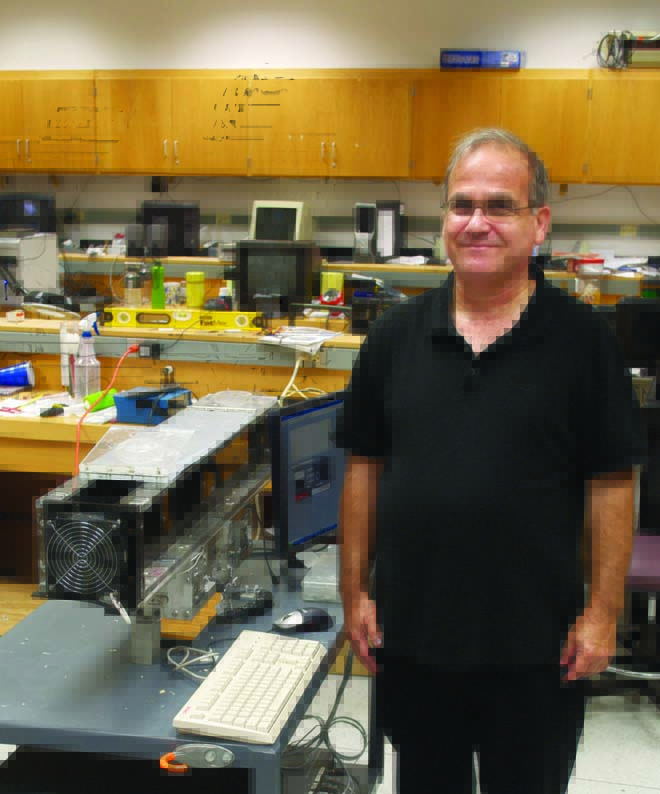
Time spent every summer on his uncle’s kibbutz led Tasch to want to develop a “smart” system to automate milking and provide feedback to farmers about each animal’s productivity. But after graduating from the Massachusetts Institute of Technology with a Ph.D. in mechanical engineering in the early 1980s, he discovered that the automated milking field was highly competitive.
So Tasch browsed the agriculture journals looking for other ideas. Eventually, he stumbled across a paper describing the problem of lame cows – a dilemma that, at the time, cost the U.S. dairy industry about $600 million annually. Many factors can cause lameness in cows, including injury, arthritis and infection, but diagnosing the problem at an early stage is difficult and laborious.
Intrigued by the problem, Tasch invented a device to automate the diagnostic process. It measures three characteristics of each animal’s gait: the body-weight distribution, the foot placement, and the vibrations generated as each foot strikes the platform. If an animal is experiencing pain in one leg, it typically puts less pressure on that limb. The lame or injured limb strikes the floor more gently and generates fewer vibrations in the device.
Tasch developed software that creates a single number denoting the probability that the animal is lame and even identifies the limb needing treatment. The device was granted a patent in 2004 and marketed as The StepMetrix TM.
Along with a similar device for horses, Tasch also developed a variation of the machine for rats to test the device’s application in a new arena: diagnosis of progressive degenerative neuromuscular diseases like ALS in rats that have been genetically engineered to develop the condition.
“ALS, Parkinson’s Disease, Huntington’s are all neurodegenerative diseases that affect the way you move,” explains Tasch. He is betting that analyzing the forces generated by an animal as it moves across the platform may yield clues to a diagnosis.
In back-to-back publications within the last six months, Tasch has shown that his device can identify rats that are genetically programmed to get ALS with 98 percent sensitivity. Tasch receives his rats when they are just 28 days old.
“At 120 days these rats will be dragging one foot or not using it,” says Tasch. “We can detect ALS at about 50 days.”
Before Tasch can get approval to build a device for humans, he must prove that the device can accurately detect disease by testing it on a much larger group of animals.
“The earlier we can detect these diseases, the more time we have to experiment with drugs and see which ones are effective. It’s a race.”
Fund-Amental Leader – Gustavo Matheus ’90, biological sciences
Over the past decade, Gustavo Matheus ’90, biological sciences, has demonstrated his pride in UMBC in a most tangible way: helping to persuade his fellow alumni to give back to the university.
Now UMBC is giving something to Matheus: its 2009 Outstanding Alumni Award for Distinguished Service to the university and it’s alumni.
Matheus has a successful health law practice in Rockville. But he has also spearheaded a number of alumni projects at UMBC, including mentoring young alumni who helped create the university’s Esperanza Endowment Fund – which supports UMBC students of Latino or Hispanic ancestry and/or students committed to the advancement of minorities, especially of Latino or Hispanic descent.
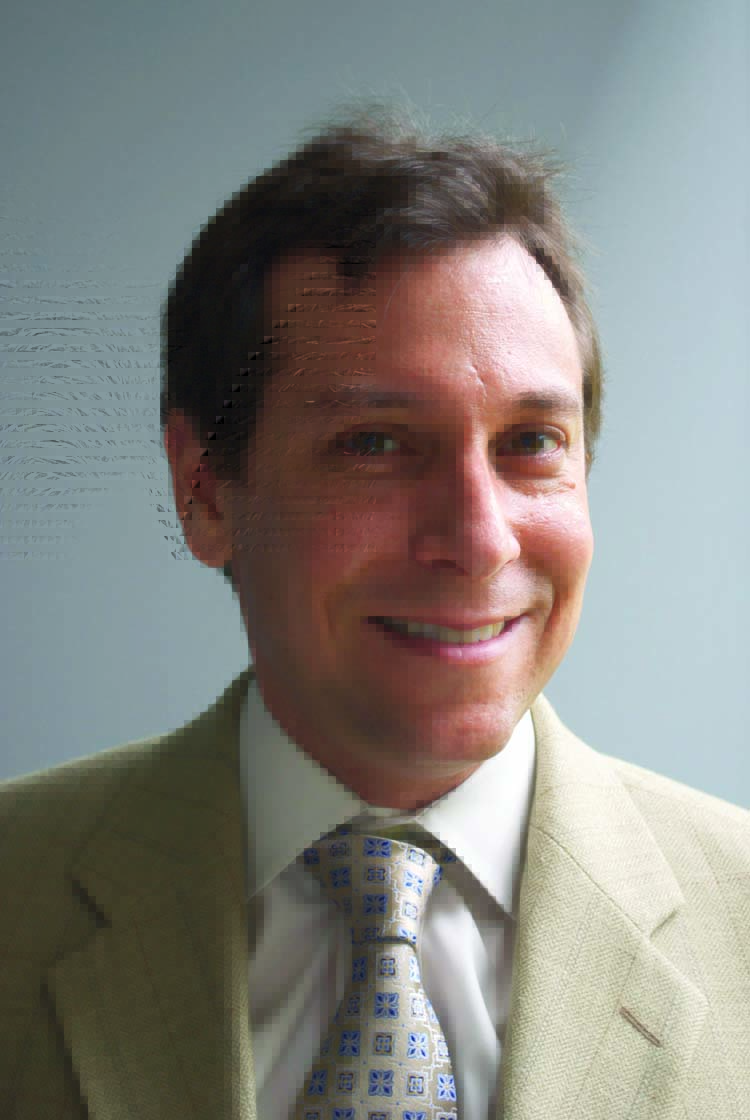
He has also worked with alumni staffers on a number of events designed to support UMBC, focusing in particular on outreach to alumni in Montgomery County. “Every student has a unique reason for coming to UMBC,” Matheus says, “and I believe every graduate has a uniquely personal reason to return as an alumnus.”
Matheus observes that “what makes UMBC different to me today, as an alumnus, is that I took the school for granted when I attended the university. It was more like, ‘Okay, this is from where I will graduate.’ That was enough for me then.
“Later, I realized that UMBC is increasingly being recognized for its excellence, which didn’t happen on its own,” he continues. “Then I realized that, like all universities, UMBC needs the assistance of its alumni. There is a place for us in the student-to-alumni continuum.”
Matheus is particularly passionate about his latest project to help students: the establishment of a new fund in honor of his friend and classmate Maryland State Police Trooper Tobin Triebel ’92, emergency health services, who died in an accident late last year.
As it grows, says Matheus, the new Trooper Tobin Triebel Fund will support majors in the university’s emergency health services program in two ways.
Its first objective is to help UMBC’s emergency health majors defray the cost of the mandatory EHS exam – which must be passed in order for EHS students to graduate.
“We want to say to students, ‘You do not have to pay that, it’s already been paid for,’” says Matheus. Eventually, Matheus and the others involved in the origination of the new fund hope to also provide scholarship assistance to emergency health majors.
Matheus spearheaded the creation of the fund, but he points to the efforts of fellow classmates Jonathan Hart ’96, political science, and Yvonne Gazelle ’91, modern languages and literature, in establishing it. Walter Kerr ’96 and M.S. ’97, emergency health services, a lieutenant with the Maryland State Police who worked with Triebel and was a 2005 UMBC Outstanding Alumni of the Year award winner, also played a key role in creating the new endowment.
“When we have several ordinary people with ordinary means, a synergy is created that can accomplish more than just one person,” reflects Matheus. “We have several of us graduates to push forward with this.” The fund is now gathering donations. One year after it reaches a total of $25,000, the fund will officially begin disbursing money.
Matheus also observes that giving isn’t all a one-way street. “There is a huge network of alumni with a common vision for the school. It’s not me alone, or her alone who cares about UMBC. It’s us both – along with many others.
“Being active with alumni has been useful, too, professionally speaking,” he concludes. “As an attorney, I have met colleagues to whom I have referred clients. Or when they have needed help in the health law arena, some alumni attorneys have reached out to me for assistance. That has been a really nice, unanticipated benefit of being an active UMBC alumnus.”
Killer Mix Tapes Cont’d
After spending the summer jamming on guitars in their living room together, Professor Morin and his son, Nick, traded mix tapes to commemorate the experience. They worked on their lists separately, but clearly have some similar tastes. (All tracks link to Amazon.com)
Mix tape for Nick Morin From Dad (2009)
by Professor Joseph “Skip” Morin
Track 1: “Funk #49”
by James Gang
Track 2: “(Night Time Is) The Right Time”
by Ray Charles
Track 3: “Ain’t Too Proud to Beg”
by The Temptations
Track 4: “Sad-Eyed Lady of the Lowlands”
by Bob Dylan
Track 5: “One Mint Julep”
by The Clovers
Track 6: “Blackbird”
by The Beatles *Original not available, Paul McCartney version substituted
Track 7: “Hold On, I’m Comin’”
by Sam & Dave
Track 8: “All You Need is Love”
by The Beatles *Original not available, Beatles Tribute Band version substituted
Track 9: “Gone for Good”
by The Shins
Music CD Mix Tape (2009)
by Nick Morin
Track 1: “Mix Tape”
by Brand New
Track 2: “Aeroplane”
by Red Hot Chili Peppers
Track 3: “Purple Haze”
by Jimi Hendrix
Track 4: “No Hardcore Dancing in the Living Room”
by Chiodos
Track 5: “Feathers”
by Coheed and Cambria
Track 6: “From the Second I Wake Up”
by Valencia *Not available on Amazon
Track 7: “Something”
by The Beatles *Original not available, The Beatles Tribute Project version substituted
Track 6: “Blackbird”
by The Beatles *Original not available, Paul McCartney version substituted
Track 9: “Roundabout”
by Yes
Track 10: “Jenny Was a Friend of Mine”
by The Killers
Over Coffee – Fall 2009
Establishing a legacy that spans generations is important for a school that is only 43-years-old – and one father and son team has created such a legacy as student-athletes at UMBC. John Goedeke ’79, economics, was one of the school’s better-known basketball players in the late ’70s, when he was a two-time academic All-America selection and a seventh-round selection by the NBA’s Atlanta Hawks. He is now a senior vice president in the treasury management division of Sandy Spring Bank. Kevin Goedeke ’10 has been a key member of the men’s lacrosse team in the last two years, helping the Retrievers earn two trips to the NCAA tournament. (He is on course to graduate next spring with a degree in aging services.) They talked with UMBC Magazine about their family’s involvement in UMBC and its athletics program.
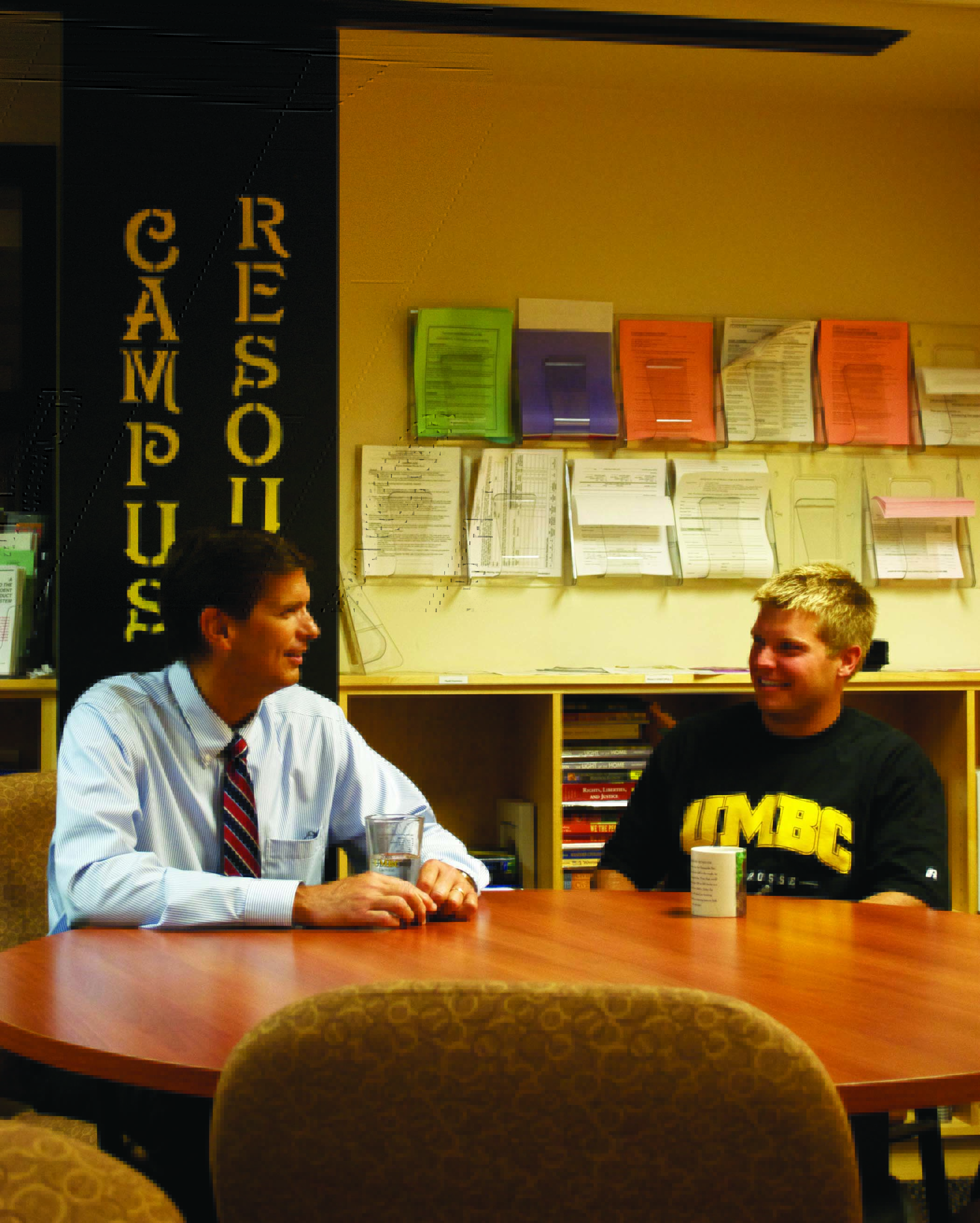
What has it been like having another Goedeke as a prominent athlete at UMBC?
John: For me, it’s been a lot of fun. It enabled me to reconnect with a lot of people, although I’ve been active there over the years…. I have a lot of great memories, and to see him have success there is a lot of fun.
How has the legacy of your dad affected your time at UMBC?
Kevin: It was really cool to see all the pictures in the gym of him and all the old teams. It was nice when some of the faculty and professors knew my last name. A lot of people knew who he was, especially those who’d been there a long time. It opened up a lot of doors for me, and I definitely liked it.
How much did you talk about Kevin going to UMBC during the recruiting process?
John: We really didn’t. If he went to school at UMBC, I wanted it to be his decision…. I remember the day he went for the campus visit, my wife went with him. He really made the decision on his own. When you play sports in college, it really is a commitment. You’ve got to be happy and you’ve got to be in a place you want to be at.
Kevin: I always knew it was an option. He let me make my own decisions. He would answer any questions I had, but he’d never favor UMBC over any other choices. I know how my dad is, and I know he didn’t want to put any pressure on me to go where he went. He just wanted me to go where I’d be happy.
John: Once Kevin did make the decision, then there was a lot to talk about. He has played against some of the top teams in the country, and that was a thrill for him. I have never seen a team of players as close-knit as this team this year. It was unbelievable the way they worked together on and off the field.
Kevin: It’s more of a family than it is a team. That made it for me. We had a great group of people and that made the experience better.
Aside from its athletics, what makes the UMBC experience special?
John: Academics, obviously, is very important. I think UMBC has a great academic reputation, and that reputation is growing. I joke with everyone that I’m glad I went there when I did because I don’t know that I could get through now.
Kevin: I knew it was considered a good academic school, and it was nice to get to go and play lacrosse also. It was nice knowing that I’d be getting a good education. It’s hard to find a school that has really good athletics, but still has small classes and is still known as an honors university and still known as a good school.
John: It’s all about the people, and UMBC has great people. They did when I went to school there, and they still do today, and I think that’s a testimony to the university that a lot of the same people that were there when I went there are still there.
Pedal Power
Two weeks after completing a grueling bicycle race that ran from Oceanside, Calif. to Annapolis, Adam Driscoll ’04, information systems, is still waiting for sensation to return to his fingertips.
Driscoll’s hands are still numb from gripping the handlebars of his Cannondale geared bicycle for a week. But he says that the lack of feeling is a small price to pay to take first place in the two-man division of the 2009 Race Across America (RAAM) – a 3,000-mile contest which they won in a time of seven days, one hour and 33 minutes.
The other member of the winning team, Patrick Blair ’03, computer science, is also a UMBC alumnus. The two men met when they were runners on UMBC’s varsity track team. Racing together under the name of their non-profit organization (Adventures for the Cure), the duo bested a pair of Slovenians who chased them from the outset and two other two-man teams in the race.
“To push yourself like that and to race like that, you truly feel alive,” says Blair. “You are truly, truly alive. There were nighttime shifts for like two hours where I would put my angry-music headphones in and race up those hills.”
The ardors of the race included a week in which the only sleep came in the passenger seat of a moving van. But while the physical sacrifices and satisfaction of competition excite Driscoll and Blair, the charitable aspect of their cycling also plays a big role in their ambitions.
Inspired in part by Driscoll’s life with Type I diabetes (he was diagnosed at age 12), Adventures for the Cure focuses on raising money for scientific research and for camps for children with diabetes. The charity also supports Kupenda for the Children, an organization that assists children with disabilities in Kenya.
Raising money for a camp for teenagers with diabetes is one of the duo’s recent endeavors. Driscoll says that the goal of the project is to show campers that diabetes is a manageable condition and it is possible to be athletic and adventurous while living with the disease.
“It’s also good for young diabetic kids to see other kids with diabetes and know that they’re not alone,” says Blair.
Driscoll and Blair – who have a tendency to finish each other’s sentences – have taken on extreme-cycling challenges like RAAM to raise money since 2005. Their first such challenge was a ride from Baltimore to Ocean City in two days, which netted $7,000 for charity.
Faith has also played a role in their endeavors.
“We got involved in a Bible study,” Blair recalls. “I guess we really became more Christian after college – and along with that came this desire to do something that mattered other than just work. It seemed like we had accomplished everything, graduated from college, got good jobs and everything, but we weren’t really doing anything to make a difference.”
Matching their love of cycling to causes that they believe in has made a difference. It’s also made the topic for a documentary film. A cross-country ride that the duo organized with their friend and fellow UMBC alumnus Jesse Stump ’06, engineering and information technology, was the subject of a film called Adventures for the Cure: The Doc. The project took the trio of riders on a three-month fund-raising ride from the state of Washington to Maryland on single-speed, fixed-gear bikes.
In 2008 the duo completed their first RAAM challenge as part of a four-man team, which they admit was a little easier to complete than this year’s journey.
“It was like 80 percent harder,” says Blair of the two-man trip.
“The four-person was like a party, like a fun time,” Driscoll concurs. “You had 12 hours off the bike…” “And you only had to bike 110 miles a day,” says Blair.
For more information about Adventures for the Cure visit http://adventuresforthecure.com/
The Best of Both Worlds
How a decade-long battle over bwtech@UMBC Research and Technology Park created a thriving link between campus and business and a dedicated green space for research and teaching.
When a new wooden footbridge linking UMBC’s main campus to the university’s bwtech@UMBC Research and Technology Park and its Conservation and Environmental Research Areas (CERA) opened earlier this year, the walkway represented more than a convenient new path between previously disconnected areas of campus.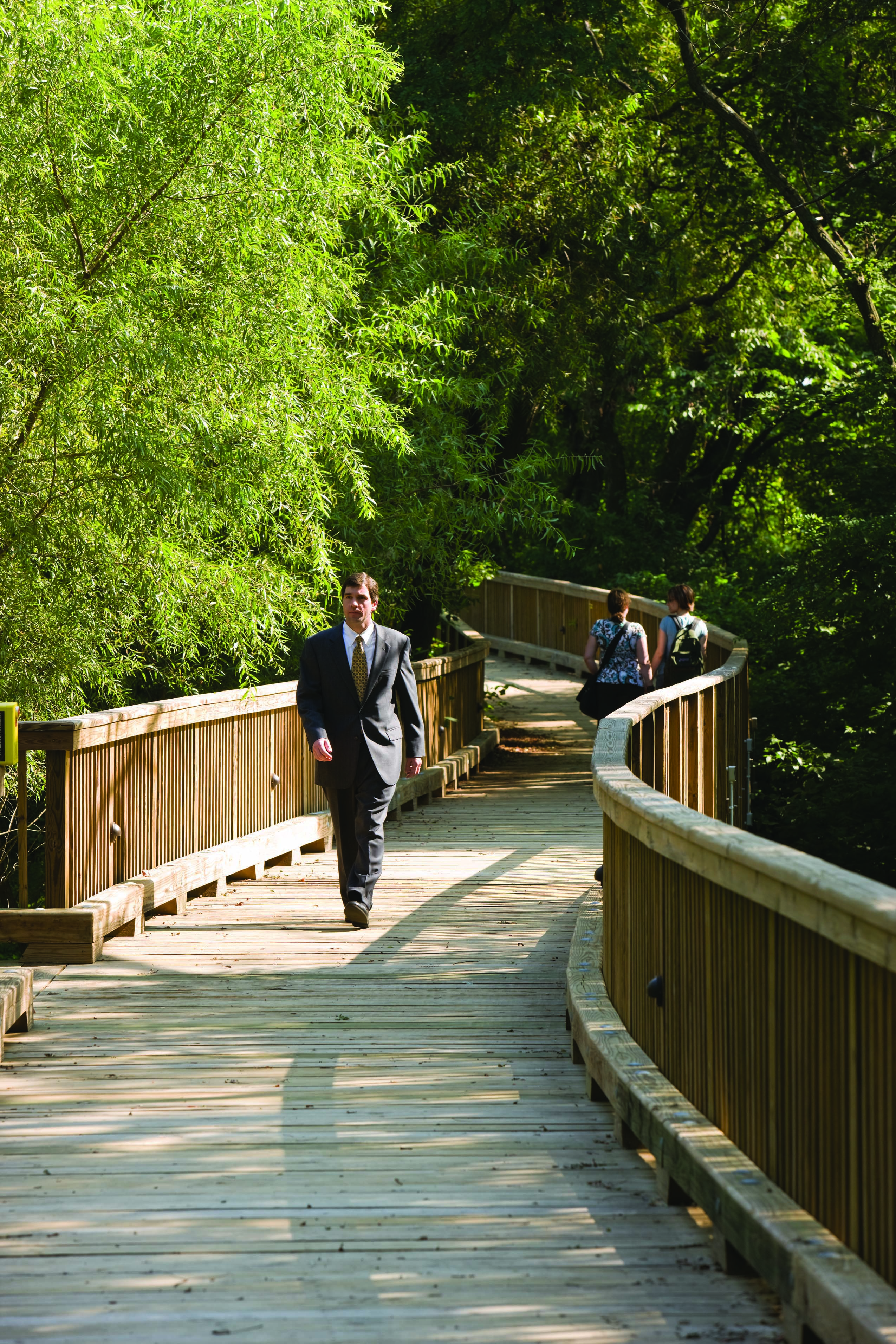 The new bridge also links UMBC’s larger efforts related to commerce and sustainability back to campus. The research park has capitalized on the opportunities presented to the university in technology and in entrepreneurship. The green spaces of the CERA are a dedicated space for research and teaching about our climate and our natural resources.
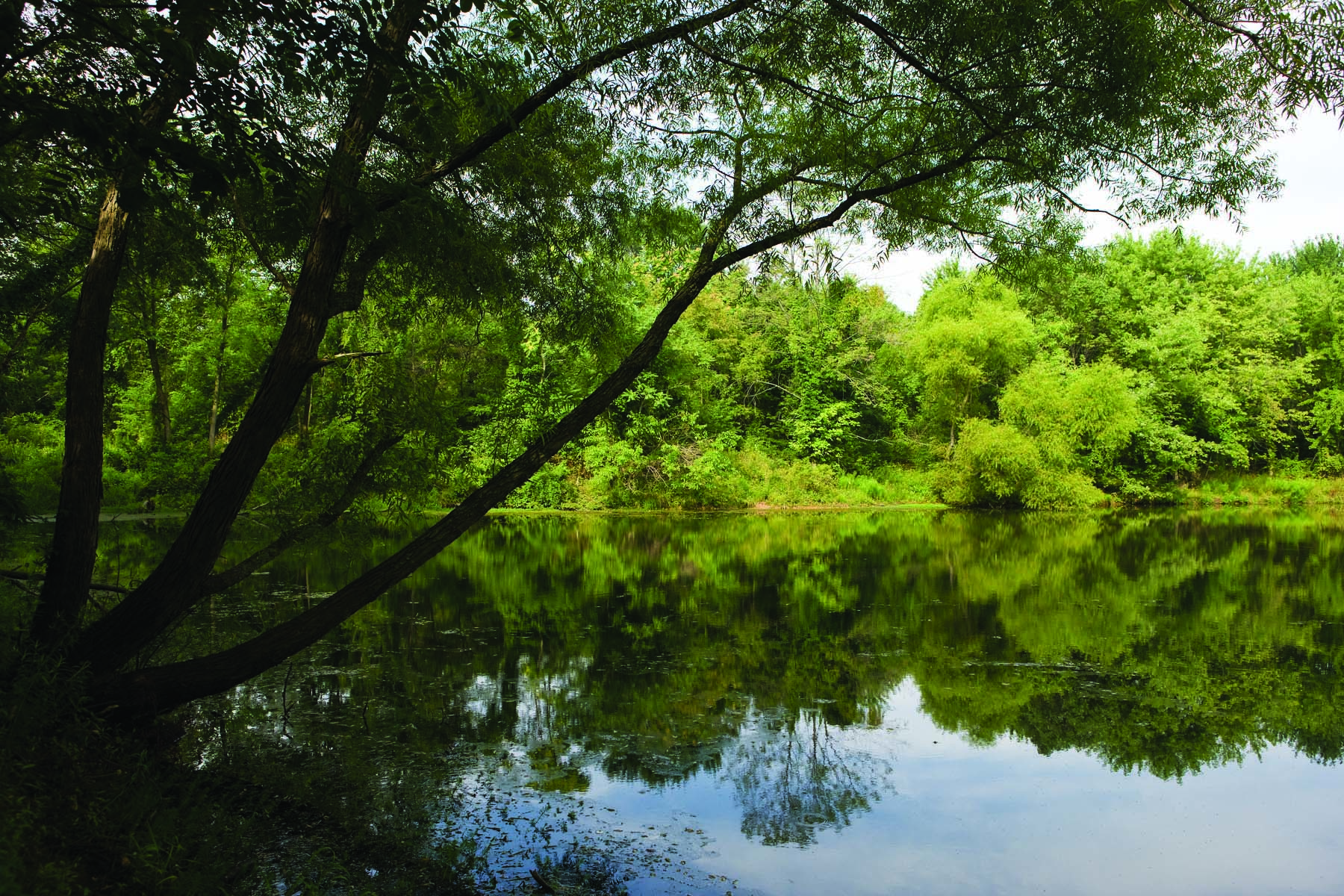
Walk across the bridge on a pleasantly cool summer day, and one feels an immediate connection to nature – even as the tips of buildings in the research park peek out over the trees. Foliage shades much of the walkway from sun, and the Herbert Run gurgles charmingly underneath the bridge and onward past Pig Pen Pond.
The new bridge also links UMBC’s larger efforts related to commerce and sustainability back to campus. The research park has capitalized on the opportunities presented to the university in technology and in entrepreneurship. The green spaces of the CERA are a dedicated space for research and teaching about our climate and our natural resources.
Walk across the bridge on a pleasantly cool summer day, and one feels an immediate connection to nature – even as the tips of buildings in the research park peek out over the trees. Foliage shades much of the walkway from sun, and the Herbert Run gurgles charmingly underneath the bridge and onward past Pig Pen Pond.
 But the waters on this site have not always run so smoothly. The land now shared by the research park and the CERA was the scene of a sustained and divisive battle unparalleled in UMBC’s 40-plus years. Vocal opposition to the research-park project development – both on-and-off-campus – and lawsuits held up the project for more than a decade.
Only a hard-won compromise between the administration, the research park advocates and UMBC faculty finally pushed the project forward. But that compromise has paid dividends: creating space on campus for innovative companies and boosting UMBC’s efforts in environmental research, teaching and sustainability. The university even lured the U.S. Geological Survey to locate a regional water center in the park.
UMBC President Freeman A. Hrabowski, III credits “shared governance” between various campus constituencies as the key to the deal. And the payoff?
“The research park has become a major indicator of the value we bring to this region,” he observes. “The CERA is a physical representation of our interest in the environment. And it’s also a great research space.”
But the waters on this site have not always run so smoothly. The land now shared by the research park and the CERA was the scene of a sustained and divisive battle unparalleled in UMBC’s 40-plus years. Vocal opposition to the research-park project development – both on-and-off-campus – and lawsuits held up the project for more than a decade.
Only a hard-won compromise between the administration, the research park advocates and UMBC faculty finally pushed the project forward. But that compromise has paid dividends: creating space on campus for innovative companies and boosting UMBC’s efforts in environmental research, teaching and sustainability. The university even lured the U.S. Geological Survey to locate a regional water center in the park.
UMBC President Freeman A. Hrabowski, III credits “shared governance” between various campus constituencies as the key to the deal. And the payoff?
“The research park has become a major indicator of the value we bring to this region,” he observes. “The CERA is a physical representation of our interest in the environment. And it’s also a great research space.”
Growing the University
When former UMBC President Michael Hooker died in 1999, the Baltimore Sun observed that “he laid the philosophical foundation for [Maryland’s] current drive to marry academic research and economic development.” The university research park proposed by Hooker in the late 1980s was designed to be a tangible sign of that marriage. The proposal called for 12 new buildings to be built on 94 acres of land just south of UMBC’s campus. “Michael Hooker understood well that major research universities play a significant role in the economies of the regions in which they reside,” says Hrabowski. “We had strengths here that could be used to do that.” The project was also meant to signal UMBC’s growth and maturity, adds Hrabowski. “We needed to be viewed by the state as a major research university,” he says. “We were still evolving, and it was very important to show what we could do.”
When Hooker left UMBC in 1992 to head the University of Massachusetts system, however, ground had not yet been broken on the project.
As UMBC’s new president, Hrabowski inherited not only the vision, but also considerable vitriol. Some residents in nearby communities vocally opposed the project for a number of reasons. UMBC was big enough already, some argued. Others cited wetlands and potentially-sensitive archaeological sites. Still others feared potential health risks associated with industries that might locate in the park.
University officials tried to quell opposition by emphasizing the economic benefits to the region. They also insisted that strong covenants were in place to control what sort of companies would populate the park. Unmollified by these efforts, a coalition of local residents eventually filed lawsuits in 1994 and 1996 to block the project altogether.
Skepticism among UMBC faculty members was also an issue confronting the research-park project. Many professors wondered aloud about the park’s potential impact on the environment and on their own research.
“The faculty had legitimate concerns,” recalls Andrew J. Miller, an associate professor of geography and environmental systems who sat on the research park’s board as a faculty representative in the 1990s. “What’s in it for the campus? Will this project lose money?”
The project was also meant to signal UMBC’s growth and maturity, adds Hrabowski. “We needed to be viewed by the state as a major research university,” he says. “We were still evolving, and it was very important to show what we could do.”
When Hooker left UMBC in 1992 to head the University of Massachusetts system, however, ground had not yet been broken on the project.
As UMBC’s new president, Hrabowski inherited not only the vision, but also considerable vitriol. Some residents in nearby communities vocally opposed the project for a number of reasons. UMBC was big enough already, some argued. Others cited wetlands and potentially-sensitive archaeological sites. Still others feared potential health risks associated with industries that might locate in the park.
University officials tried to quell opposition by emphasizing the economic benefits to the region. They also insisted that strong covenants were in place to control what sort of companies would populate the park. Unmollified by these efforts, a coalition of local residents eventually filed lawsuits in 1994 and 1996 to block the project altogether.
Skepticism among UMBC faculty members was also an issue confronting the research-park project. Many professors wondered aloud about the park’s potential impact on the environment and on their own research.
“The faculty had legitimate concerns,” recalls Andrew J. Miller, an associate professor of geography and environmental systems who sat on the research park’s board as a faculty representative in the 1990s. “What’s in it for the campus? Will this project lose money?”
A Timely Solution
When Ellen Hemmerly came on board as executive director of the research park in 1995, the proposal was bogged down. In contrast to Hooker’s grand vision, the park itself was comprised of an incubator with two trailers located on campus. Hemmerly recalls being surprised at opposition to the project and frustrated by the delays. “We thought the project was providing clean and high-paying jobs that were going to rejuvenate the local economy,” she says. A bit of luck helped break the project out of the quagmire. In the process of consolidation following the 1995 merger between aerospace and technology giants Lockheed Corporation and Martin Marietta, a laboratory owned by Martin Marietta just off Gun Road and close to UMBC’s campus came onto the market in late 1996.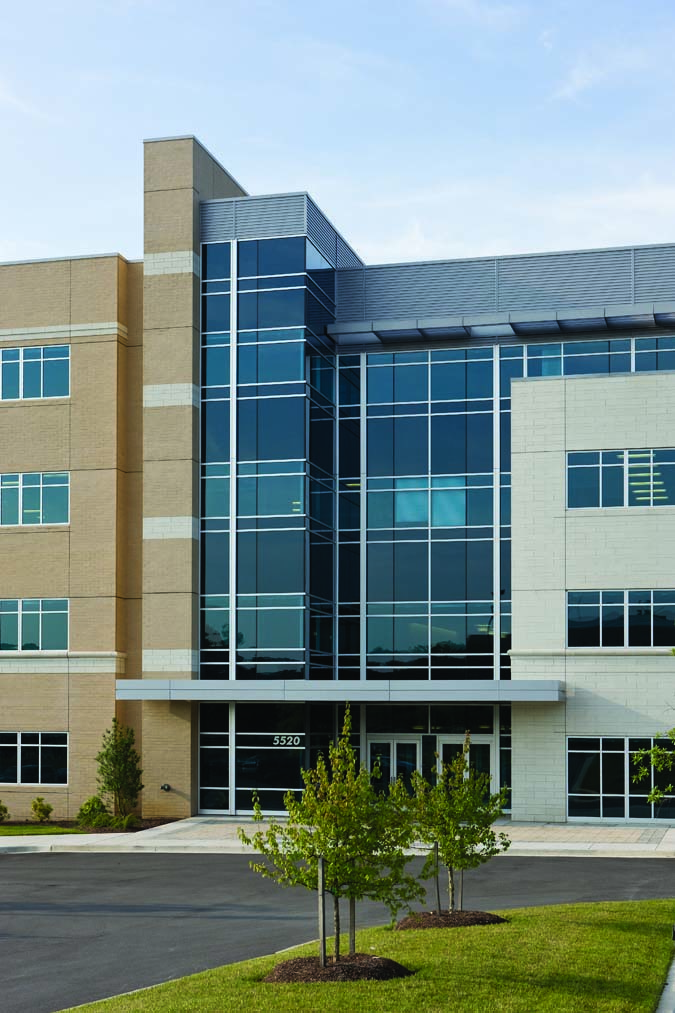
-
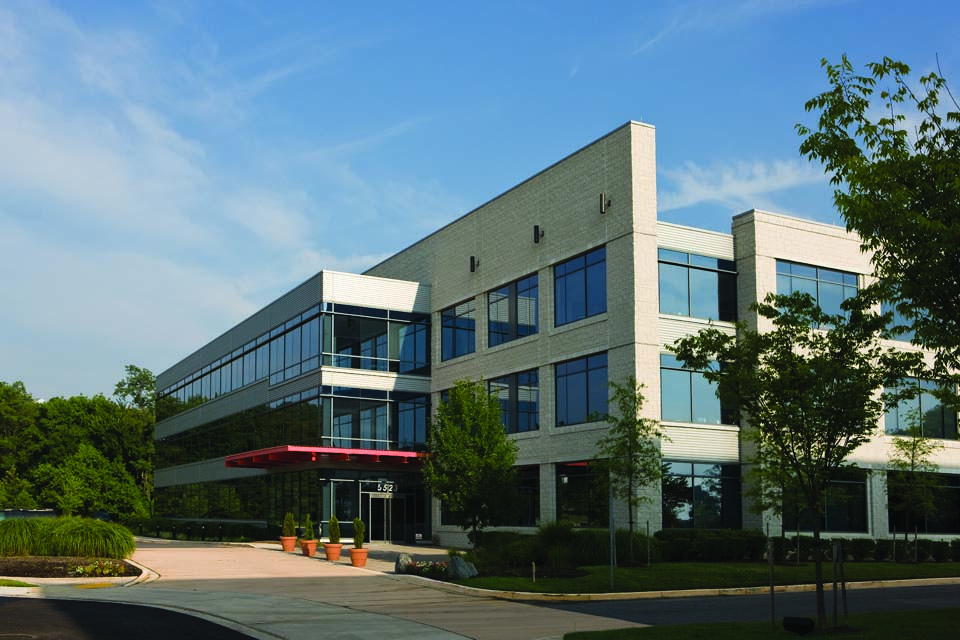
- BWTtch Research Park
-
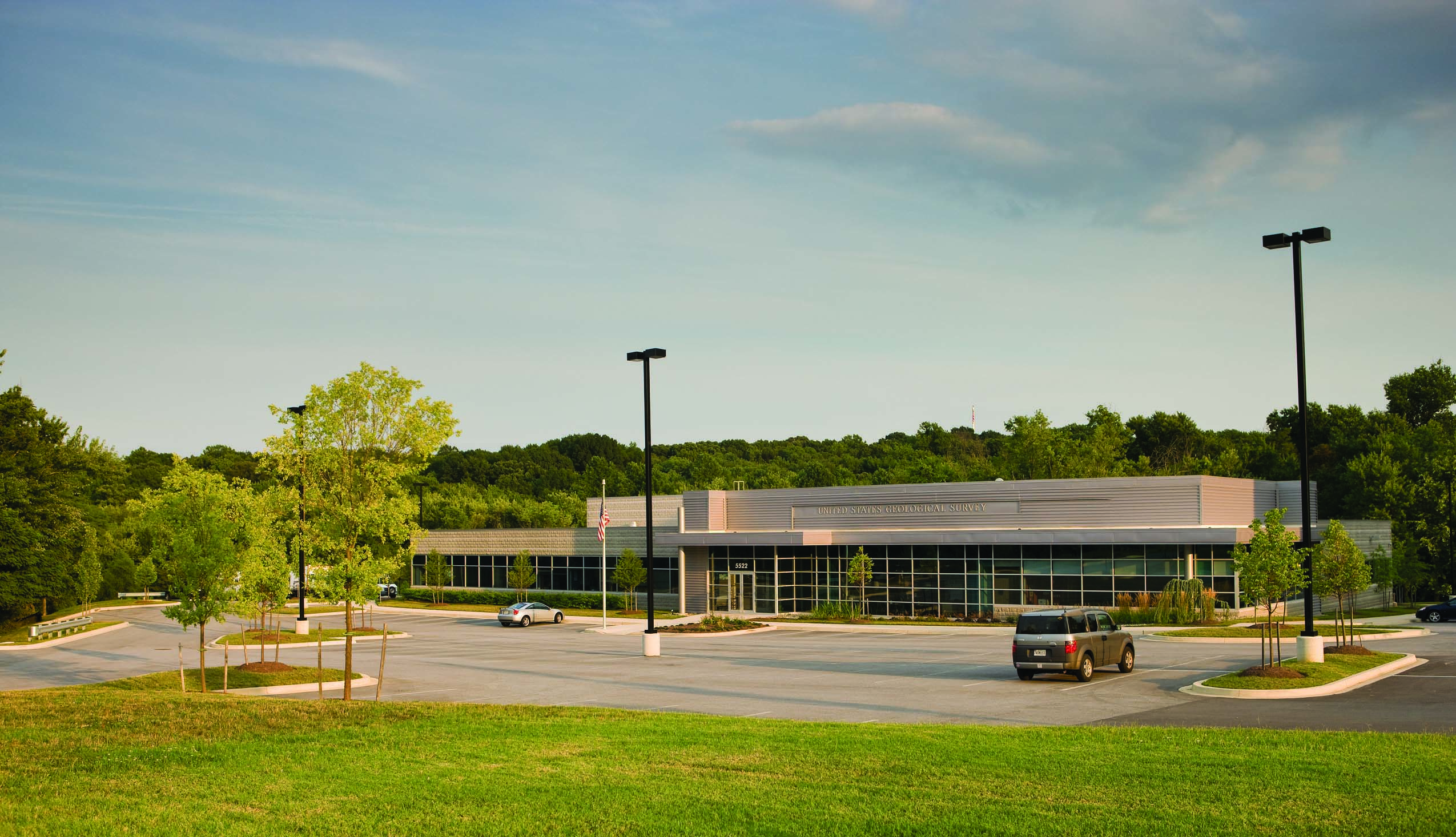
- UMBC / BWTech Park
Green Synergies
As the university scaled down its own plan and ramped up its new laboratory site, a number of UMBC faculty members also had been pondering how the research park fit into their vision of the campus. Would there be true synergy between scholarly research and the companies at the park? And where did the environment fit into the vision? In late 1994, the university’s Committee on University Priorities created a subcommittee on campus environment, co-chaired by Robert Burchard, now an emeritus professor of biological sciences, and Patricia La Noue, director of UMBC’s interdisciplinary studies program, to weigh in on these issues.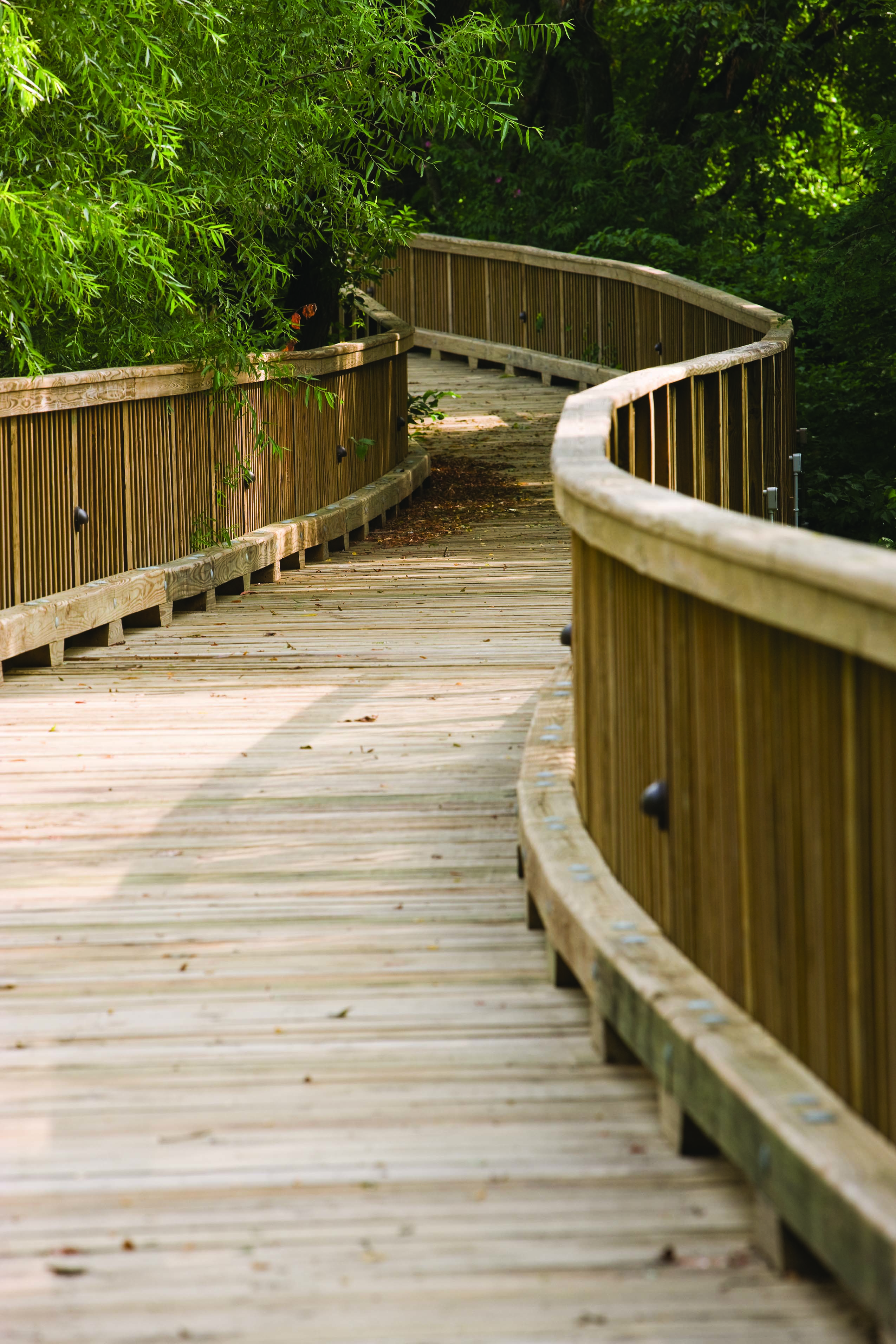 La Noue tackled similar questions with her students in a Fall 1995 seminar examining various approaches to the planning and creation of a campus greenway. The class had a tangible result: The creation of the Herbert Run Greenway, which connects various green spaces on campus, including what is now the Beuys Sculpture Garden and the land that would eventually become the CERA.
La Noue recalls that the seminar was also concerned with larger questions: “What is a stewardship ethic? How do we use our space?”
Sandy Parker, now the chairman of the geography and environmental systems department, was thinking along the same lines. And as UMBC announced its revised plan, Parker developed a proposal to create a new entity for research and teaching on the unused acreage in concert with a working group on the Campus Environment Committee and the Faculty Senate.
Drawing on a series of master plans for the university that envisioned the “protection of natural woods,” Parker’s proposal noted that the area offered “a wide range of research and teaching opportunities for faculty and students alike.” Equally important, the CERA would also encompass archaeologically sensitive sites – including pre-Columbian sites – that had sparked opposition on-and-off-campus.
Parker recalls that when the university revised its plans, “suddenly the landscape snapped into focus… I wrote the proposal and put it forward as a quid pro quo strategy.”
The pitch for a conservation and environmental research area took little over a year to wind its way to approval by the university. (The Faculty Senate approved it in late 1996.) The CERA was officially dedicated at a ceremony in front of the Albin O. Kuhn Library on April 28, 1997.
Almost five more years and settlement of remaining lawsuits passed before the RWD Applied Technology Laboratory became the first building to open in the new bwtech@UMBC Research and Technology Park in March 2002. Despite more than a decade between vision and reality, UMBC was still the first university in Maryland to successfully construct its own research park.
The agreement to create the CERA was a key moment in making the research park a reality. “The compromise did make it so that people on campus felt more comfortable with [the research park],” recalls Miller. “We had positives on both sides.”
La Noue tackled similar questions with her students in a Fall 1995 seminar examining various approaches to the planning and creation of a campus greenway. The class had a tangible result: The creation of the Herbert Run Greenway, which connects various green spaces on campus, including what is now the Beuys Sculpture Garden and the land that would eventually become the CERA.
La Noue recalls that the seminar was also concerned with larger questions: “What is a stewardship ethic? How do we use our space?”
Sandy Parker, now the chairman of the geography and environmental systems department, was thinking along the same lines. And as UMBC announced its revised plan, Parker developed a proposal to create a new entity for research and teaching on the unused acreage in concert with a working group on the Campus Environment Committee and the Faculty Senate.
Drawing on a series of master plans for the university that envisioned the “protection of natural woods,” Parker’s proposal noted that the area offered “a wide range of research and teaching opportunities for faculty and students alike.” Equally important, the CERA would also encompass archaeologically sensitive sites – including pre-Columbian sites – that had sparked opposition on-and-off-campus.
Parker recalls that when the university revised its plans, “suddenly the landscape snapped into focus… I wrote the proposal and put it forward as a quid pro quo strategy.”
The pitch for a conservation and environmental research area took little over a year to wind its way to approval by the university. (The Faculty Senate approved it in late 1996.) The CERA was officially dedicated at a ceremony in front of the Albin O. Kuhn Library on April 28, 1997.
Almost five more years and settlement of remaining lawsuits passed before the RWD Applied Technology Laboratory became the first building to open in the new bwtech@UMBC Research and Technology Park in March 2002. Despite more than a decade between vision and reality, UMBC was still the first university in Maryland to successfully construct its own research park.
The agreement to create the CERA was a key moment in making the research park a reality. “The compromise did make it so that people on campus felt more comfortable with [the research park],” recalls Miller. “We had positives on both sides.”