All posts by: Magazine Editor


The News – Fall 2009

Top Dawgs

“We’re Number One! We’re Number One!”

It isn’t often that UMBC President Freeman A. Hrabowski, III’s “State of the University” address is interrupted by an impromptu chant. But this year’s speech – given on Aug. 20 – was something different. Local media flocked to cover the address, and the crowd packed into the University Center was bursting with school spirit.
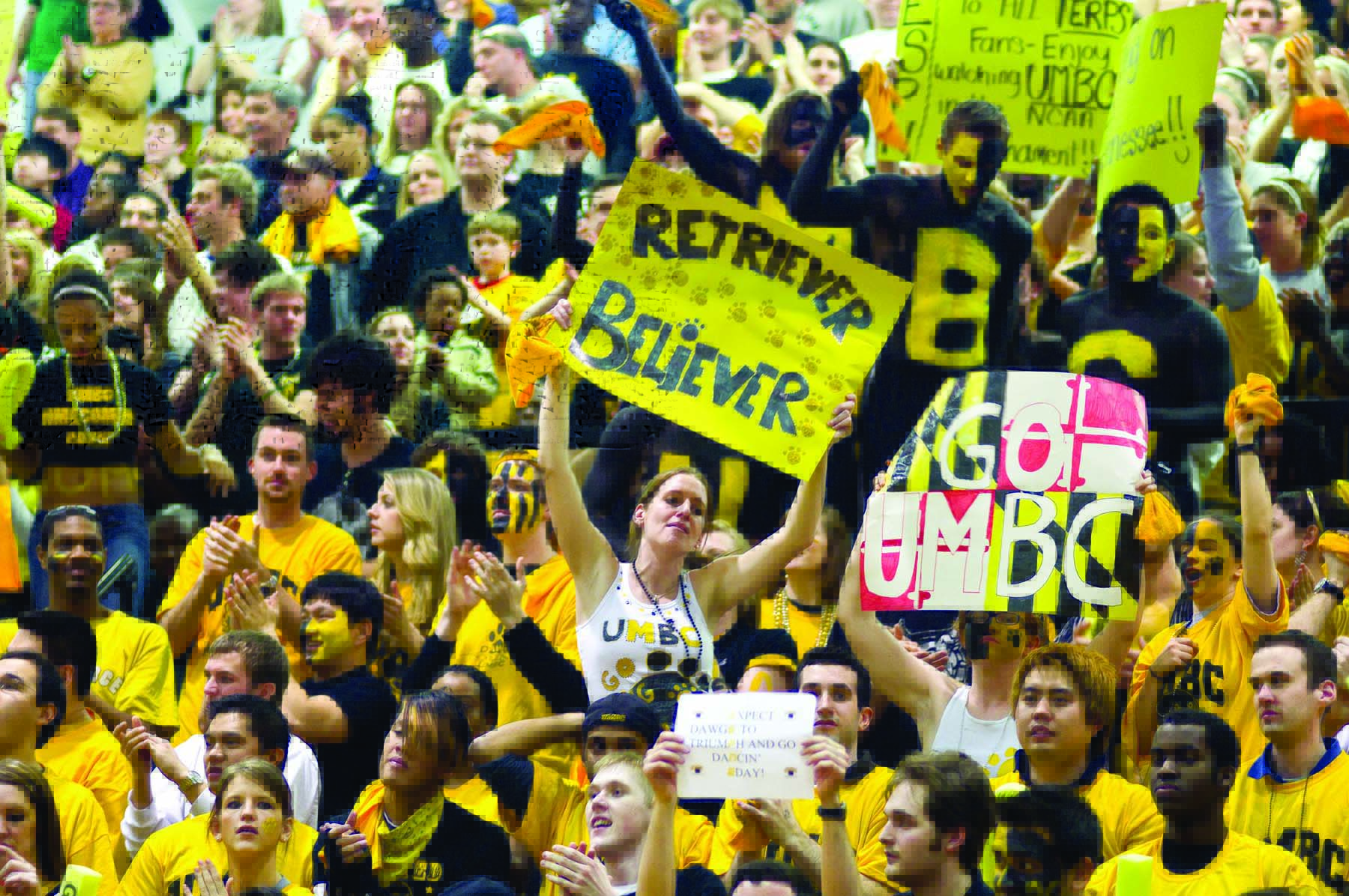
The press attention and pride was in response to news that the editors of U.S.News & World Report’s “America’s Best Colleges” guide had released only hours before: UMBC was ranked in the top spot for national universities in the guide’s “Up-and-Coming Schools.”

UMBC was also the top-ranked public university in a separate measure of schools showing “unusual commitment to undergraduate teaching” that placed only Dartmouth, Princeton and Yale Universities above the Retrievers in the tally. (Stanford was tied with UMBC.)

The U.S. News guide is one of the most influential such publications in higher education – a resource for parents and potential applicants. UMBC’s recognition “speaks volumes about how the country is looking at our progress,” Hrabowski said. UMBC already had placed fifth in the “Up-and-Coming” category in 2009.

UMBC also was named with 20 other universities as a “Program to Look For” in the category of “Undergraduate Research/Creative Projects.”

Hrabowski noted that the prestigious U.S. News rankings sent a strong message to alumni, philanthropists and politicians: “When you give us the resources we need, we can do great things.”

For more information about the U.S. News rankings, visit www.umbc.edu/bestcolleges.

— Richard Byrne ’86

Exceptional Alumni

UMBC’s alumni excel in a wide range of fields – and in service to the community and the university. That achievement is recognized every year in a very tangible way: UMBC’s Outstanding Alumni of the Year Awards.

In 2009, a committee comprising members of UMBC’s Alumni Board of Directors picked seven award winners whose career success and service make them exceptional examples of what the university can produce.

James P. Clements ’85, computer science, and ’91 M.S. and ’93 Ph.D., operations analysis, president of West Virginia University, is the Engineering and Information Technology Alumnus of the Year (Clements was profiled in the Summer 2009 UMBC Magazine).

Jeffrey “Duff” Goldman ’97, history, star of Food Network’s Ace of Cakes, is the Humanities Alumnus of the Year.

Crystal Watkins ’95, biological sciences, a researcher at The Johns Hopkins Medical Institutes, is the Alumna of the Year in Natural and Mathematical Sciences.

Delegate Jon Cardin ’96, M.P.S., policy sciences, a member of Maryland’s House of Delegates, is the Social Science Alumnus of the Year.

Laura Pasquini ’98, visual arts, director of community programs at the Corcoran Gallery of Art, is the Visual Arts Alumna of the Year.

Gustavo Matheus ’90, biological sciences, is the recipient of the Distinguished Service Award. (See profile on page 41.)

Alicia Wilson ’04, political science, the first UMBC student to win the prestigious Truman Scholarship, is the recipient of the award: The Alumni Association’s new “Rising Star” Award.

For more information about these Exceptional Alumni, visit http://retrievernet.umbc.edu/alumawards.

— Richard Byrne ’86

Ladies First

For the first time in UMBC history, three female students hold the top leadership positions on campus. But Yasmin Karimian ’11 (Student Government Association president), Jen Kent ’11 (SGA vice president) and Gaby Arevalo ’10 (Retriever Weekly Editor) care much more about the tasks ahead of them than any history that they’ve made.

“While I think it’s wonderful that Yasmin, Jen and I are all women and minorities,” says Arevalo, “that isn’t what we’re known for. We’re known for the positions we hold, not for our backgrounds or gender.”

Karimian and Kent are the first female duo in the SGA in the group’s history. But they had no idea they were in a position to achieve that distinction until after turning in their applications to run. Both officers point to generational changes as a reason for their success.

“We’ve been fortunate enough to have grown up in a generation where female leadership is encouraged, and the idea of gender equality is second nature,” says Kent.

While all three women feel lucky to be at a school where it’s not uncommon for women and minorities to hold leadership positions, they also acknowledge that it wasn’t always so common for those who came before them. “We take for granted the support we receive by being women and being able to hold these positions without skeptics surrounding us,” says Karimian. “That certainly was not the case for some of our predecessors, like the first female SGA President, Lisa Dickerson.”

Dickerson ’78, political science (who was profiled in the Winter 2009 UMBC Magazine) gave a speech at the SGA Inauguration in Spring 2009 and noted the struggles she faced 32 years ago.

“I have had the most incredible role models in my two years here, and they shared everything they knew and gave me all the opportunities they could so I would one day be able to serve as SGA president. I hope to do the same for someone else,” says Karimian.

— B. Rose Huber

Co-Creating Campus Citizenry

“Students’ power to create the campus life they want hinges on being able to pull together and express a reasonably unified point of view. When you have student leaders elected in a high-turnout election, the people to whom they speak on behalf of students – campus administrators, public officials and others – know they have to listen. If you don’t vote, you actively make it harder for next year’s SGA to accomplish anything on your behalf.”

When David Hoffman posts on his blog, Co-Create UMBC, about issues that concern students and their role at the university, they (and many others on campus) read and respond.

Hoffman is the assistant director of Student Life for Civic Agency at UMBC, which endeavors to enlarge student participation and empowerment at the university.

He says that Co-Create UMBC is part of a larger effort “to saturate the UMBC environment with opportunities and messages that suggest to students that they have power here. And that being a citizen isn’t just a matter of casting a vote every couple of years. It’s a state of mind that you’re in all the time.”

Hoffman says that the blog gets roughly 1300 hits every week, a number that increased from 600 after the content started to stream from the university’s myUMBC site.

The posts on Co-Create UMBC include candid anecdotes about his own time as a student leader at the University of California, Los Angeles (part of his job at UMBC is to advise the Student Government Association) and a feature drawn from statistics about campus life. (Example: “2 = Number of times UMBC has been closed for an entire day due to snow in the past four years.”)

“‘UMBC by the Numbers’ is an attempt to start a conversation,” he says. “Things that just might wash over you if you see yourself as a customer and not a citizen.”

— Richard Byrne ’86

The Tweet Science

UMBC assistant professor of sociology Zeynep Tufekci investigates how we use Facebook, Twitter and other new social-networking services to define ourselves.

By Joab Jackson ’90
Illustration by Michael Glenwood

UMBC assistant professor of sociology Zeynep Tufekci is not a big fan of technology for its own sake. But if a new electronic gadget helps her get through the day more easily, she is all for it.

Take the baby rocker, for instance. She loves this device. On a summer day at home on maternity leave, Tufekci replaces the hulking C batteries of a pendulous crib that gently rocks her seven-week-old boy to sleep. Babies enjoy an easy back-and-forth motion when sleeping – the rhythmic lull reminds the infant of comfort of the womb. This crib creates a few minutes of space for Tufekci to attend to other matters.

The best technology not only solves human problems, but it can actually change our world – sometimes in ways we don’t fully recognize. And Tufekci has become one of the country’s most called-upon academic experts in explaining how new technologies of social networking—such as Facebook and Twitter—are changing the way we live. She has been interviewed by the New York Times, the Philadelphia Inquirer and other media outlets about the topic.

Although the term “social networking” is relatively new, the concept has been around since at least the 1980s, when people found that bulletin-board systems (which were nothing more than personal computers that other computers could dial into) provided a virtual meeting ground for exchanging messages, jokes, photos, recipes and anything else of interest.

From those humble beginnings, such virtual spaces are becoming an increasingly large part of our lives. Facebook alone reports having over 200 million users. And these spaces have impacts on external events. In June, thousands of disgruntled Iranians logged onto Twitter, another popular service that allows users to post 140-character messages for others to see, to protest the outcome of their presidential election. The cumulative effect of the angry and informative bursts of information from Tehran and elsewhere in the country not only brought more global news coverage to the election, but also helped protestors evade disruptions of mobile telephones and other messaging services by the government .

“People wonder why these technologies spread so much,” Tufekci says. “It’s kind of like asking: ‘Why do people like foods that are high in salt and sugar?’ Being deeply social is part of being human. It is part of your biology.”

Limits to the Digital Self

Researchers theorize that the average person can, at most, maintain cognitive relationships with about 150 people. Not surprisingly, then, the average number of the people who are “friended” in a typical Facebook user account is about 120, according to the company that runs the service.

Tufekci studies how social networking blurs the boundaries between public and private spaces, a topic she came across almost by accident, thanks to a group of students who “took a short cut they shouldn’t have,” she says.

In an introduction to a sociology class she taught, five students turned in sheets to a quiz with identical handwriting. When she confronted the students about it, they all swore that they didn’t know each other. She already knew they were acquaintances, however, even if they didn’t sit together in class. Each of their Facebook profiles had listed the others as friends. Eventually, they ’fessed up.

After Tufekci disciplined the students involved in the incident, she reflected at greater length on the interaction. “What got me really interested was the fact that these were very smart students, but they did not figure out that their Facebook profile was public,” she says. “I saw that these students are conceptualizing Facebook as a private place, but it is potentially a very public space.”

Tufekci found this peculiar conflation of private and public in digital space revealing. She argues that social networks are a natural extension of our social lives – albeit with some subtle but important differences. When the use of the Internet first became widespread in the mid-1990s, many assumed that users would adopt new roles online, expanding beyond the confines of their physical selves. “On the Internet, nobody knows you’re a dog,” was the caption of a famous New Yorker cartoon of the time.

But this perception that one has the ability to create a new self online largely hasn’t turned out to be the case. Most people use the Internet in general, and social networks in particular, as an extension of their lives, rather than as an alternative to them. “They want to do mundane things. They want to do people things,” she says.

Sam Gosling, an associate professor of sociology at the University of Texas at Austin who also studies social media, agrees with Tufekci. Social media, he observes, “is kind of like the telephone. It’s a new technology for expressing the sorts of things we need to do anyway.”

A Slippery Space

Nonetheless, such online social gathering spots can differ from our normal meeting places, such as a friend’s house or a restaurant, in subtle ways that most users don’t fully appreciate. This disparity in perceptions is what Tufekci’s work centers upon.

In a study published last year in the Bulletin of Science, Technology & Society, Tufekci examined the actions and perceptions of 704 college students who used Facebook. A peculiar conundrum emerged: Many students expressed privacy concerns about posting information in a public forum. Yet their concerns did not inhibit them from posting a great deal of revealing information about themselves – including their relationship status, their birth date and their cellular telephone numbers.

What are the dangers of having such information out there? In the real world, two individuals may meet and have a conversation. Both people see each other and the conversation fades into their memories. We traditionally think of this interaction as a private conversation. With social-networking sites, however, those same words can be preserved for the ages, and they are available for others to see.

“Usually intimate interactions are in closed space, and public spaces are civic stuff and they are not intimate. Here we have intimate stuff that is public,” Tufekci says. This “collapsing of the boundaries and conflating of characteristics of private and public spaces” can muddy the way people think about how to use such spaces, such as underestimating how many people will actually see that photo of late-night merriment that you posted only for a few friends.

“I’m a big fan of her work,” says Timothy Finin, a professor in UMBC’s Computer Science and Electrical Engineering Department who studies ways to bridge machine languages and human languages. “We’ve developed an understanding about information-sharing based on the physical world. And a lot of those same intuitions don’t apply to the virtual world, and that’s where people can run into problems.”

Talking about Tufekci’s work, Finin is reminded of something called the Wason Selection Task, in which sociologist Peter Wason showed that people may use a different part of their brains for thinking about social rules than they do for solving abstract problems. “Maybe, while on the Internet, you do most of the thinking with your [logical] part of the brain you use with the computers, and not the social part,” Finin says.

Computer Science to Social Science

Tufekci is no stranger to large, sprawling communities. She grew up in Istanbul, which, with about 12 million residents, is the fourth largest city in the world by most estimates. She actually started her career not in sociology, but in computer programming. But she found herself more fascinated by the social effects of technology than with the minutiae of the C programming language.

After taking a Ph.D. at the University of Texas at Austin in 2004, Tufekci studied the effects of technology on low-income people. As part of her research, she followed a group of people going through a computer-skills training program that held out the promise of high-paying jobs upon the completion of the courses.

“That was a time when people were saying that the Internet would solve everything for everyone,” Tufekci says. “I found it was not so great for people, especially if you are low-income and available jobs are being automated and outsourced.”

Tufekci’s work spans multiple disciplines – sociology, social psychology, computer science, psychology, anthropology and communications. “My work doesn’t fit into an existing discipline. It’s fairly grounded in sociology, but it has been very interdisciplinary,” she says.

Gosling observes that Tufekci’s work is “dispersed over many disciplines, many of which have difficulty talking with each other.”

UMBC has been instrumental in helping Tufekci follow this emerging field of study. When she was in the academic job market, she wanted to find a university that was open to her pursuit of a multi-disciplinary approach.

Surprisingly, such schools were hard to locate. While many hiring committees voiced appreciation for the benefits of studying across departmental lines, they were shyer about hiring such a wandering academic.

At UMBC, however, Tufekci says that she found kindred spirits.

“They hired me knowing that I would be cutting across different disciplines,” she says.

It would be a mistake to dismiss social-networking services as a fad. MySpace and Facebook are this year’s popular virtual destinations for many, and their influence may fade within a few years, but chances are they will replaced by other services. Social-networking services have gained their present popularity by reflecting both innate human behaviors and contemporary trends.

By and large, the Internet started out as a male-dominated domain. But in another 2008 study, published in Information, Communication & Society, Tufekci found that the gap has closed. More women than men whom she studied used Facebook, by a slim margin. “What this showed was that if you have the kind of application that is appealing to women, then they are perfectly willing to adopt it,” she says.

In the same study, Tufekci also found that the difference of how men and women used social-networking services reflected traditional gender roles. Men would use services as a search mechanism for finding things on the Internet. (“What they were searching for, we never found out,” Tufekci jokes.)

Women, by contrast, use such services to connect with existing friends. “I thought this is so stereotypical. You think we’re past that – but apparently not,” she says.

At present, Tufekci is working up an academic review that she hopes will explain how social networks fit in the larger picture of how people have traditionally related to one another. For Tufekci, the use of social-networking services represents a return, in at least some aspects, to a time when we lived in smaller and more close-knit communities.

Only in the past 150 years or so have the vast majority of people left their villages to live and work in larger cities, she notes. Such moves to larger urban centers have brought about a sense of isolation and even alienation, to judge from popular analysis from books such as 1950’s Lonely in the Crowd (written by David Riesman, Nathan Glazer and Reuel Denney) and 1956’s The Organization Man (William Whyte). In many ways, the social-networking sites are returning elements of this older way of living to us, for better and for worse.

“That is the kind of environment our species has lived in for the past 100,000 years,” Tufekci says. “We’re not going back to the village, but we’re bringing back some of its aspects. I want to explain why this is an important development in human history. The questions on the table are not trivial.”

Find UMBC Alumni On Facebook.

Up On The Roof – Fall 2009

UMBC President Freeman A. Hrabowski, III takes your questions.

Q. What book do you recommend that every young person read before they go out into the “real world?”

— Shivonne L. Laird ’99, biological sciences

A. Right now, I think it’s important for students to be constantly reading. And to read even more when they go into the real world, because life is changing in so many ways.

Now if I were forced to choose a book, I would say Thomas Friedman’s Hot, Flat, and Crowded today. Because it focuses on the need for a green revolution, the impact of technology, the critical role that research on energy will play and the need for innovation and nation-building. It puts America into the global context.

Q. I am impressed by UMBC’s growth, but it seems like the arts are getting the short side of the stick. Are there plans to increase the budget for the arts at UMBC or to expand course and degree offerings in visual arts, theatre, writing and music?

— Maria E. Watters-Mahone ’87, English and M.A. ’00, instructional development systems

A. It’s a great question. The arts and humanities are very much alive here. The fact that we have a new College of Arts, Humanities and Social Sciences (CAHSS) has to do with our continued commitment to build those disciplines. And our number-one capital project – a $150 million facility – is the new performing arts and humanities building for which we have gotten planning funds, and hope to receive construction funds, in order to break ground in 2010.

I spent time today presenting our proposal for construction funds for that facility. And we’ll be spending time every day with legislators and people representing the Governor’s office, about the importance of that building. The fact is that the arts and humanities building, over the next few years, will transform the campus physically and aesthetically.

The development of our Humanities Scholars Program and our Linehan Artist Scholars program is especially significant in attracting high-achieving, talented students in the arts and humanities and getting them support here. Building a community of scholars. And the Dresher Center for Humanities itself is a very strong intellectual initiative on our campus, focusing on research and teaching in the humanities.

More and more is happening in those areas. I invite alumni to come back to some of these activities. And to serve as mentors to our current students.

I’m especially excited about the Kauffman entrepreneurship grant, which is heavily focused in the arts. People expect it to be in economics and engineering – and while those programs are involved, we have a lot of faculty in the arts and the humanities involved in entrepreneurship initiatives, with the thought that we should be preparing students through infusion of entrepreneurship into the curriculum, to be businesspeople. Because if you think about it, when someone starts a photography studio or a dance studio, it is a business that is designed to elevate people culturally, but also to make money. We are being creative about connecting entrepreneurs and the arts.

Q. Aesthetically, where do you think the university will be in five years? What kind of campus should I look forward to seeing when I visit a few years down the line?

— Elan Schnitzer ’06, political science

A. The greening of UMBC. That is our theme. Every time alumni come back, they will see more trees, bigger trees, more shrubbery, more flowers and more initiatives focused on the environment…. An emphasis on making the campus physically and aesthetically appealing to newcomers and alumni as well as faculty, staff and students.

With $400 million in new construction – and with the new arts and humanities building, it will be half a billion – it has been important to focus on the well-being of the environment. I think the biggest difference between the campus today and the campus 20 years ago is grass and trees. We’ve gotten rid of a lot of the concrete and laid down grass. And there are never enough trees. The growth of the trees is symbolic of the growth in the stature of the university itself.

Venus, If You Will – Deborah Randall ’94, Theatre

Many theatre companies are born out of a mixture of inspiration and frustration. Take The Venus Theatre in Laurel, for instance.

When its founder, Deborah Randall ’94, theatre, graduated from UMBC, she pursued a career as a playwright and a performer in Washington, D.C. Like many recent graduates, Randall had a desire to succeed in a challenging profession. But she also found some of the roles she played and the theatrical atmosphere that surrounded her to be stifling her creativity. She craved a theatre that valued women and living playwrights.

Randall recalls UMBC theatre professor Wendy Salkind’s advice to her. “Every time I would gripe to her,” Randall recalls, “she’d say: If it doesn’t exist, create it. That was her mantra to me.”

The theatre company that Randall founded in 2001 is dedicated to filling what she sees as a gap in the Baltimore-Washington region, presenting shows with a decidedly female perspective and recent work by contemporary playwrights.

The company is in the middle of its current season, which features new plays that include a fresh look at the experience of women characters in Shakespeare and a contemporary retelling of Medea set in Los Angeles. The series concludes this coming fall with a new World War II memory play called Why’d You Make Me Wear This, Joe? by acclaimed writer Vanda and a comedic look at a very difficult Helen of Troy in a new play called Helen of Sparta.

Randall says that the emphasis on new work – especially by women playwrights – is important to her. A steady cultural diet of reality television and revisiting the classical repertoire, she observes, has meant that “there are so many writers who are not getting an opportunity.”

Finding and nurturing new work, she says, “is part of the life of the theatre…. Finding the pulse in a new work is kind of what I wake up in the morning to do.”

Creating what ultimately became Venus Theatre took time, however. Randall started small, crafting one-woman shows for herself that played in various venues in Washington, D.C. She also started a reading series for women writers and tried her hand at children’s theatre before settling on more adult fare.

After a series of misadventures and mishaps, including one show that had its last week in a D.C. theater interrupted by a street explosion that rendered the space unusable, Randall decided that she needed to find a more permanent home.

The constant scrapping and hustling for space to rent “was not cute anymore,” says Randall, especially after the street explosion. After a long search, she finally settled on a storefront space just off Laurel’s Main Street, which she dubbed “The Venus Theatre Play Shack.” She and a dedicated crew of volunteers transformed the place into a black box theater that’s become a new home base for the company, perched halfway between Washington and Baltimore and drawing from both cities and the surrounding community.

Randall recalls her time at UMBC fondly. “I was a nontraditional student,” she says. “So I was a few years older than everyone else. I had been to community college, worked for three years, sown some wild oats…. I wanted to squeeze everything I could out of the experience.”

Along with Salkind, she counts professors Xerxes Mehta and Alan Kreizenbeck as influences on her current career path. Randall also recalls that her roles in a production of Peter Weiss’ Marat/Sade (directed by Mehta) and in Cinders – a play by Polish playwright Janusz Glowack, directed by Kreizenbeck – were particularly memorable.

Though Randall still writes plays (one of her works, Molly Daughter, is included in Anthracite! An Anthology of Pennsylvania Coal Region Plays, which was published by the University of Scranton Press), she says that she “has ended up more of a producer and a director than a writer and actor anymore.” Running a theatre company also involves a lot of logistics and fundraising.

But Randall’s commitment to helping produce new works by playwrights – especially women playwrights – remains a primary challenge that she’s happy to take on. With the classics, she observes, “all the kinks have been worked out in a way.” New work, she says, is where the sizzle and satisfaction is.

“If it has been done too often,” she says, “it doesn’t interest me.”

— Richard Byrne ’86

For more information about Venus Playhouse, visit http://www.venustheatre.org/.

Video: Early Risers at UMBC

From UMBC Magazine Summer 2009, Early Risers, featuring Crew Club practice, ROTC morning routine, True Grits dining hall, and other UMBC voices — including one hungry squirrel.

Video by Jim Lord.

Up on the Roof – Summer 2009

President Hrabowski

UMBC President Freeman A. Hrabowski, III, takes your questions.

Q. How does UMBC prepare students for the real world? What is UMBC doing to instill a work ethic in students?

— Monique Jones Cephas ’92, information systems management

Q. I’m curious to know what UMBC is doing for its students and alumni in helping them to bridge the “backpack to briefcase” gap between the academic world and the professional world? How is UMBC helping students to prepare for professional careers even while they are still students? And, is it enough? What more can be done?

— Tom Briggs ’05, psychology

A. I think the most important strategy we’ve been using for years is getting students involved in internships. Students who have the opportunity to work in companies, in national agencies, and in schools get a sense of what’s important in the workplace. They also learn how to deal with other people. They come to understand that getting an “A” is not enough. You have to be able to collaborate.

And most important, they have the opportunity to see the relationship between expectations in the workplace and the work they’re doing in the classroom – whether it’s in computing or in the broad liberal arts. Students who work as interns or in part-time jobs are far more realistic about what’s possible after college – and far more proactive in seeking interviews for possible jobs. What’s really exciting is that a large number of our students who work as interns are offered full time work even before they graduate.

As far as preparing students, we have the Shriver Center – which encourages students to take advantage of resources on campus for developing a resume, knowing what jobs are available, and for discussing with advisors what kinds of positions one might apply for. And we have the Office of Career Services, which works with people in obtaining both full-time and part-time opportunities. Both offices are very important. They are involved in building partnerships. They can be very helpful to students – and to alumni, who in many cases are coming back for career days and other services.

The Social Security Administration was on campus on April 29. That agency is hiring 5,000 people in the next five months. Twenty percent of the jobs will be on Security Boulevard. It’s an exciting prospect.

Q. What are your feelings on the Obama administration’s initiatives related to science and how do you think they will impact the ongoing programs and initiatives at UMBC and the current graduating class?

— Camelia Owens ’99, chemical engineering

A. I’m fortunate now to be chairing the National Academies of Science Committee on Underrepresented Groups and the Expansion of the Science and Engineering Workforce Pipeline. So I get a chance to see the official papers of this administration, and to listen to the different national agencies talk about particular initiatives designed to broaden participation in science and engineering. I also had the privilege of reading President Obama’s April 29 speech on investment in science fairly early.

What’s very clear is that the president and his advisors agree that we will need to do much more to encourage students to excel in sciences. We need to strengthen math and science teaching at the K-12 level. We need to get more people to think about becoming math and science teachers. And we need to strengthen teaching and learning at the college level to ensure that students remain in science. Our Chemistry Discovery Center, which is funded by the National Science Foundation and the UMBC Annual Fund, is designed exactly for that purpose.

UMBC is uniquely positioned in our country right now to contribute in two broad ways. We produce the highest percentage of students in science and engineering in the University System of Maryland – and the highest of any school, private or public, in the state with the exception of the U.S. Naval Academy. Forty-five percent of our bachelor’s degrees are awarded in science and engineering.

At the same time, UMBC is producing hundreds of liberally-educated students across disciplines. Our society will need both to ensure that America’s future is bright.

Top Mountaineer – James P. Clements ’85, CompSci, and ’91 M.S. and ’93 Ph.D., operations analysis

According to Google Maps, it takes a little over three hours to get from Catonsville to Morgantown, West Virginia. For James P. Clements ’85, computer science, and ’91 M.S. and ’93 Ph.D., operations analysis, the journey has taken a little bit longer than that – about 27 years, in fact.

But the destination has been worth the drive, which also took detours through The Johns Hopkins University (where he took an M.S. in computer science in 1988) and Towson University, where he has served as provost and vice president for academic affairs for the past two years. On June 30, Clements will arrive in Morgantown to become West Virginia University’s 23rd president.

It’s not hard to see why West Virginia University tapped Clements, whose career as a scholar and researcher took wing quickly after he received his Ph.D. from UMBC in 1993. He was tenured at Towson University only two years after receiving his doctorate.

His ascent in academic leadership has been even more dizzying – including stints as vice president of Towson’s Economic and Community Outreach division, as provost, and a key role in devising and monitoring that university’s 2010 Strategic Plan.

Clements says that the first strides of his time on the fast track began at UMBC. Like many students of his era, he chose UMBC for factors of proximity and cost – and found an unexpectedly rich academic experience in Catonsville.

Clements says that he realized the quality of the education he got when he went out into the workforce. “When I came out, and went to work for industry – I worked for a company called General Physics, which is run by Robert W. Deutsch, who has been very generous to UMBC – I felt so prepared. I was working with people who’d been at some of the top institutions in the country, and I felt that I had an equal level of education to anyone in that building.”

A job in industry after his graduation in 1985 did not sidetrack Clements from his dream of becoming a professor, however. “I started right away on graduate school,” he says. “I didn’t take a semester off.” But he did so at nights and on weekends – at one point even cutting a deal with his employer for reduced hours to obtain his Ph.D. at UMBC.

In a happy coincidence, Clements received his Ph.D. from UMBC on the same day – and in the same ceremony – that his brother Joseph H. Clements Jr. ’85 computer science and M.S and Ph.D., mathematics, received his doctorate. “We were side-by-side on the stage,” he recalls. “It was one of my mother and father’s happiest days.”

When Clements did finally end up in academia as a professor at Towson University, he says that he found it to be “probably the best job in the world. I love to teach. I love writing papers. I love doing research. I love working with the students.”

Yet he soon acquired the itch to try his hand at administration. Clements discovered that he had a knack for the coordination and fundraising that goes along with academic leadership – and also that he liked it. And those talents led him all the way to Morgantown.

The challenges of being president of any flagship state university are immense. They’ve been made even more difficult at West Virginia because of a scandal involving the improper awarding of a degree that rocked the university and forced the resignation of its president, Michael S. Garrison, last year.

Clements acknowledges those unique challenges. He credits West Virginia University’s interim president, C. Peter Magrath, for calming the waters before his arrival. “That has really given me an opportunity to come in and say, as I did when I interviewed on the campus: ‘WVU has been around since 1867. It has a great history. It’s going to have a great future. We just have to get past where we’ve been stuck right now and think about who we want to be in 10 and 20 years down the road.’”

Looking back at UMBC from across more than two decades (and across town from his perch at Towson University), Clements feels a lot of pride and appreciation at the growth of his alma mater.

“Let me put it this way: Every time I see [UMBC’s president Freeman A. Hrabowski, III], I thank him for raising the value of my degree,” Clements says with a laugh. “It’s true. Freeman is so dynamic and so charismatic. And it’s not just him. The institution has great faculty members. Great administrators. It has just continued to climb up and up and up. And for me, even though I work at Towson, I love UMBC. It’s been great watching it skyrocket into one of the hottest universities in the country.”

— Richard Byrne ’86

To You – Summer 2009

Richard ByrneWe were gratified by the enthusiastic response that greeted our first issue. We have also been eager to obtain your constructive feedback. There is a sampling of both on our “From You” page, and we will incorporate the best of your suggestions to create an even better magazine.

As the 21st Century sweeps toward the conclusion of its first decade, readers might be wondering: “Why is the university publishing a print version of this magazine?”

It is a question that seems particularly pertinent in a moment when headlines about the “death of newspapers” and other print media are very much in the air.

You might also be asking: “Just how ‘green’ is the decision to print a magazine?”

Here are some answers.

The university established its new alumni publication in print because alumni – surveyed online and in focus groups held at the university in 2008 – expressed a strong desire to receive a print publication.

The survey group spanned ages and disciplines, and many respondents stated that they continued to read a number of general interest publications (including The New Yorker and Vanity Fair) in their print editions. In addition, more than two-thirds of the respondents read a book every week. So for our alumni, print isn’t dead yet.

Alumni also stated that they associated pleasure, indulgence and the investment of time with their reading of print media. We want your experience of UMBC Magazine to carry those connotations.

Also, as an editor and a journalist who has spent a number of years reporting and writing on media, I can add this observation: Web publications are still grappling with how to present broad swathes of information. The Web is good at creating channels that sort and foreground information of particular interest.

But since our project here at UMBC Magazine is to show connections and expose readers to the university’s progress as a whole, print continues to be the best way to achieve that aim. We are, however, working hard at establishing content on our Web site – and wherever you see the icon, we urge you to look in on our extended versions of stories and multimedia presentations.

On the topic of the environmental footprint of UMBC Magazine, we are happy to report that our publication is striving to be a part of the university’s larger sustainability efforts. You can see how UMBC is going green at our “Sustainability Matters” Web site.

As far as the magazine’s environmental footprint, we made the decision to publish on partially-recycled paper (30 %) from our very first issue – which qualified for the Forest Stewardship Council’s Mixed Sources certification.

Each ton of the Rolland Opaque30 paper on which UMBC Magazine is published reduces our ecological footprint by five trees, 324 pounds of solid wastes, 904 pounds of air emissions and 2,472 cubic feet of natural gas.

So enjoy your new issue of UMBC Magazine – and know that we’re doing our best to not only give you something good to read, but something that’s better for the environment than virgin paper as well.

— Richard Byrne ’86

The Power of Parallels

UMBC’s Multicore Computational Center (MC2) unleashes new energies in the race to make computers faster.

By Joab Jackson ’90

Here’s a Silicon Valley secret: Computer microprocessors aren’t getting any faster. The limits of processor technology have been reached. If they ran any speedier, they’d melt their cases. And all those snazzy new desktop and laptop computers on sale at the local consumer electronics store? They seem sprightlier not because they have faster chips, but because they have more of them. New computers usually come with either two or four processors, or “cores.”

And even then the difference in speed may not be all that impressive. Computer makers are learning what restaurant owners already know: Hiring a second cook doesn’t mean pasta will boil more quickly.

The exciting news is that UMBC is on the cutting edge of a discipline, called parallel programming, that may show Silicon Valley – and computer programmers worldwide – how to speed things up.

Parallel processing is a way for computers to spread their applications across multiple processors so that they will run faster. Exploring how to do it – or parallel programming – is the mission of UMBC’s Multicore Computational Center, or MC2.

In July 2007, IBM gave UMBC computer science professors Milton Halem and Yelena Yesha a grant to launch the center with cash and equipment that have totaled more than $1 million over the past three years. Supporting funding from NASA also helped the effort.

“Not only are we ahead of the curve,” says Charles Nicholas, chair of the department of computer science and electrical engineering, “but we hope to stay ahead of the curve…. The partnerships with IBM will let us keep the technologies up to date.”

Halem says that government and private enterprise are in dire need of “trained graduate students who know how to apply the new methods of parallel programming to the problems they face,” Halem says. “We’re one of the few schools in the nation that is teaching these courses.”

Researchers who are using the MC2 are also excited by the chance to map out this hitherto unexplored territory in processing.

“We don’t have a complete picture of how it will work, but it is definitely the trend we’re trying to catch,” says Yesha. “And UMBC is definitely on the frontier of this development.”

Blades and Building

For all the potential power that it offers, the MC2 is not meant to dazzle the naked eye. The center is buried deep in the Information Technology/Engineering (ITE) building on UMBC’s campus in a windowless room. Inside that space are stacked clusters of about 50 IBM ultra-thin computers, called blade servers.

IBM donated a number of these high-powered computers that contain an innovative new type of chip, called the Cell Broadband Engine. The Cell chip, which is used to power PlayStation3, is actually a collection of eight different processors, all in a single package. It also serves as a good introduction for students to parallel processing.

The center was the brainchild of Yesha and Halem, who envisioned a powerful center to spur research and teaching. Its establishment, says Yesha, is a tangible sign of how far UMBC has come in the past 20 years – since the days when students logged on to the school’s VAX mainframe system by going into the basement of the library and grabbing a seat behind a monochrome terminal.

Yesha arrived at UMBC in 1989 as an assistant professor after getting her Ph.D. in computer science at the Ohio State University. Once she settled in, Yesha honed her skills in the sub-discipline of distributed systems, or computing systems tied together from multiple, and sometimes geographically dispersed, components. In 1994, she started to lend a hand to NASA’s Goddard Space Flight Center, located a few miles south of the UMBC campus, as director of the Center of Excellence in Space Data and Information Sciences (CESDIS) unit.

Her mission? Solving large problems with parallel programming. “I appreciated the power of big supercomputers, and worked with supercomputers for a number of years,” she says.

It was at CESDIS that Yesha met Halem, who was the assistant chief information research scientist and chief information officer at Goddard. Halem also saw the potential power of parallel processing, having overseen the construction of the first supercomputer built entirely from thousands of processors, called Goodyear. (It is now in the Smithsonian.)

When Halem retired from NASA in 2002, he signed on at UMBC to teach and continue his research. Of like minds, Halem and Yesha won grants and government awards to expand research into parallel programming, with MC2 as the culmination of this work.

All Together Now

Computer industry companies such as Intel and Microsoft have also begun to fund research into parallel programming, but computer science research faculty member John Dorband, who is MC2’s chief computational scientist, bluntly says that “the results are rather mediocre.”

As the former head of system software research for the NASA Goddard Space Flight Center, Dorband is entitled to talk some smack. He also knows a thing or two about how to get computers to pull together as a single entity.

In the early 1990s, while Dorband was working at CESDIS, he and two other colleagues refined a way to lash low-cost computers together so that they work in harmony as a single machine. Called “Beowulf Clustering,” the approach can be used to build machines as powerful as the dedicated supercomputers used for weather forecasting and other humongous jobs, but at a fraction of a supercomputer’s multi-million-dollar price tag.

It is hard to overestimate the influence Beowulf has had in supercomputing. Today, over 80 percent of the world’s 500 most powerful supercomputers are clusters. And the center is hoping to apply the lessons that Dorband and others have learned in supercomputing to making more common applications, such as your spreadsheet or e-mail reader, run faster.

Using multiple processors at once can be a challenge for several reasons, Dorband explains. For one, you don’t want to break up the job in such a way that whatever gains in speed achieved would be offset by the additional work needed to manage the job across all the processors. Also, how do you get two different processors to communicate with one another the results of their computations?

These are the types of tricky problems that students – and their professors – tackle at the MC2.

From Master to Student

The Multicore Computational Center is already having a big impact on teaching at UMBC. The university offers a number of parallel programming classes with hands-on experience – including an elective class for undergraduates.

“Basically we are creating people who are able to take advantage of this thing. There are very few experts in this field,” Yesha says.

Nicholas concurs, observing that MC2’s presence on campus is “giving students access to hardware and to interesting problems that otherwise they wouldn’t have come across.”

The MC2 has also come in handy in research. For David Chapman, a UMBC graduate student, the center has been an invaluable resource for understanding how to work on such large datasets. Chapman’s latest research project will show how using the cell processors could help the search engine giant Google – and other search engines – index the Web more quickly.

“The architecture is very different. It forces the programmer to design the problem around the hardware,” Chapman said of the Cell processor. “If you write your code one way, it runs slower than a regular processor, but if you rewrite it for the machine, it runs 100 times faster. It’s a tricky thing.”

UMBC researchers also use the MC2’s cluster for numerous scientific and mathematical projects. The muscle of many processors has been especially useful for those projects that involve summarizing complex relations within sprawling data sets.

For instance, Halem led an effort to develop a system that would analyze large sets of infrared earth imagery to show how the climate changes in a given region over a period of time. Such work, done in conjunction with NASA Goddard, has already helped better characterize recent fluctuations in global temperature. Another UMBC professor, Tim Finin, plans to use the cluster to analyze how people interact with each other across the hundreds of thousands of Web logs (or blogs) on the Internet. Who takes the lead in spurring online communication?

In particular, Finin is looking to develop ways of having a computer automatically identify who the most influential individuals are across many different communities, from knitting aficionados to wine lovers. When people post and comment and point to each other’s blogs, they leave behind links. These links allow Finin and his team to identify leading members of these groups by looking to where the links point.

This is easy to do with a few blogs, but for thousands, the work can expand rapidly. To do this, the group uses what is known as matrix-multiplication, a tedious process of multiplying one large group of numbers with another large group of numbers.

Fortunately, it is a problem that can be broken into smaller subsets – one for each computer core. Now Finin’s research group wants to expand the research to hundreds of thousands of blogs. For this, the multicore computers would be essential.

Another project Finin has embarked on with the MC2 involves helping computers reason more deeply about human writing and speech. Can a computer tell that a newspaper article is about basketball star Michael Jordan – and not about Michael Jordan, the English soccer goalkeeper?

Finin is developing a way that computers can use a large number of descriptive words, such as an online encyclopedia, to build up vocabulary and make meaningful relations between different sets of words. (Such as “Michael Jordan” and “basketball.”)

“These uses were not possible before without having access to this computational power,” Yesha says. Knowing a thing or two about working in tandem, the center’s managers are now banding with the Georgia Institute of Technology, the University of California San Diego, and the University of Minnesota to start a multi-institution “National Center of Excellence” for parallel programming. The group has applied to the National Science Foundation for funding of this project. If this partnership moves forward, it will no doubt push the frontiers of parallel processing even further.

“The uniqueness of the UMBC facility is not just the iron and the configuration, but also the intellect and the brain power we have in terms of our staff,” Yesha says. “They know how to not only configure and operate it, but also take advantage of it in a number of different dimensions.”

The News – Summer 2009

Sketches to Shovels

Right now, the site is marked on campus maps as Parking Lots 9 and 16. But next summer, the university hopes that shovels will be busy breaking that ground to build a new $150 million Performing Arts and Humanities Facility.

At a forum held at UMBC in late April, architects showed off the latest plans for the new building, which is slated to be built in two phases between 2010 and 2014. The first phase will house the Theatre and English Departments – as well as the Dresher Center for the Humanities and the Linehan Scholars Program – and include a new 250-seat proscenium theater.

University planners hope to start the second phase immediately upon the completion of the first section in 2012. That piece of the project will give four additional departments – Music, Dance, Ancient Studies and Philosophy – new homes, and will be capped by new dance and concert halls. Both phases will include new classrooms.

In addition to being a linchpin of UMBC’s humanities education and a magnet for artistic events in the larger community, the university and the design team – Grimm and Parker Architects and William Rawn Associates – are also aiming for a Leadership in Energy and Environmental Design (LEED) certification. The new facility would be the first building on campus to qualify for this third-party rating of the building’s environmental efficiency.

The plans are contingent on approval of the funds by Maryland’s legislature next year.

— Richard Byrne ’86

Reconnecting Alumni

Greg Simmons ’04, M.P.P. was named UMBC’s Vice President for Institutional Advancement in late December – a position that includes leadership on alumni issues for the university. He has worked at UMBC in a number of positions, including stints at The Shriver Center, in Corporate Relations, and as a Special Assistant to the university’s president, Freeman A. Hrabowski, III.

UMBC Magazine talked with Simmons about his career, the recent $100 million campaign for UMBC and his vision for alumni relations in the next few years:

Q. How were you attracted to UMBC and to institutional advancement work?

I originally became connected with UMBC as an undergraduate, not even knowing that the work I was doing – as a tutor for at-risk kids – was a program that was run by UMBC. I was a tutor at Loyola College for the Choice Program. After I graduated, I went out West and spent a year working with the Jesuit Volunteer Corps, and then came back to Baltimore to work with the Choice Program as a case worker in East Baltimore.

During that that year, I started to understand — OK, there’s a university that runs the Choice program. And then at the end of that one year contract, I had the chance to move up to campus to run the undergraduate internship program. I got to interview with Michele Wolf and John Martello. I was actually applying for a job in community service, and John said, “Really, I see you as someone who’d be better working with the corporate community and the business community. Maybe you like community service, and you always can do that. But I see you working with a different stakeholder.” And I said, “All right, I’ll give that a try.”

So I ran the internship program for five years at the Shriver Center. And it was great. I met a lot of students and a lot of companies. What I really got a sense of was what [Freeman A. Hrabowski, III]’s mission was in terms of building relationships with companies, and getting people to understand the quality of UMBC through the partnerships that we have.

I see the internships and the full-time hiring as the base of the pyramid, and as I got more comfortable in understanding the different parts of the pyramid, I was interested in seeing what happened at the higher order of the pyramid. And when there was an opportunity to work in corporate relations, and fundraising, and corporate partnership development, I took that chance to work with [former UMBC Vice President, Institutional Advancement] Sheldon Caplis and with the president. I did that for a couple years before going to work directly for the president on a number of different initiatives. It was just a great experience. Almost an apprenticeship.

When the chance to come back to advancement came up, I took it for a couple of reasons. First, it was to see if I could take the things I learned with [President Hrabowski] and use them on a day to day basis. I wanted to be able to manage people. I wanted to be responsible for programs. I wanted to be able to build in some areas that I thought we could get stronger.

And as I stepped into this role, people asked me: “Did you ever see yourself being a professional fundraiser?” I don’t think anyone ever sees themselves as a professional fundraiser. I see myself as someone who cares deeply about this place. The programs and the people and the students. And it’s very easy for me to get excited about that. And whether it’s a company or an individual or a federal agency, I feel very good about helping people understand how their investment can make this place stronger. This place has given me a lot of tremendous opportunity. It’s introduced me to a lot of very smart and talented people. If I can take the skills and ability that I have to put those people and those programs in a place where they can be successful, that’s very exciting for me.

Q: UMBC is near the end of its $100 million campaign. What’s your assessment of that effort and its impact?

It is a big campaign for us. It’s only the second campaign that UMBC has ever had. And if you look at an institution of our profile and size, most of the research would say – and our own feasibility study suggested – that we could only do an $80 million dollar campaign. And we’re here, at the end of a seven year campaign, on the threshold of breaking $100 million. It’s a real testament to the people and the programs. The academic leadership. And the way that we’ve helped people in the region and across the country understand the value proposition of UMBC.

So to raise $100 million is a big deal. And it’s something that the entire campus community can take pride in.

As I think about what’s happening in the economy right now, and what has to happen going forward, we knew that because of our age and where our alumni are, that our alumni would have to have a role in this campaign. But we really need to see this campaign as a staging platform for the next campaign. Of our $100 million goal, the alumni portion of that was $3 million or 3 percent. So what we really are looking forward to now is “How can we help alumni see themselves as part of our fundraising going forward? How can they, in the future, have a bigger part in our fundraising, How they can really take pride in this place and invest in places that are going to make us stronger in the future.

It is a difficult time to raise money, whether you’re a business or a nonprofit. The things were doing now is letting people know what things are really important to us. Student based need, Particular programs where there are strengths – or where we have to invest heavily to continue the momentum. How do we help people see in a clear way the impact of their giving .That’s not something that we have always put a premium on – and it’s more important than ever, because peoples’ giving habits are changing.

Q: What’s your vision of alumni relations in the next few years?

I think we have to completely rethink how we connect with our alums. Geographically, we’re in a place where 90% of our alums are within 90 miles of campus. It’s a great opportunity. There are alums driving up and down I-95 every day to get to work or get home. But they can’t see the campus from the highway, and you almost forget that we’re right there…They haven’t had a chance to see how we’ve grown and changed.

My vision is: How do we make our alumni a central part of the campus on a daily basis. How do we make it easy for them to interact with our students and faculty? How do we become a destination for them, whether they’re looking for additional education, or they want to go to a lacrosse game or a basketball game, or whether they want to go to a theatre performance or meet an author or a scientist?

Nobody owes us their philanthropy. We have to make people understand why we’re deserving of it. And part of that is getting them to come here. Whether they’re a graduate from the 70s or graduating this year, we have to get them to understand that this is their place – and it can be as strong as they want it to be.

— Richard Byrne ’86

From Patapsco to Punts

When it comes to age, the University of Cambridge in England has a 757-year head start on UMBC. But more Retrievers are making the leap to graduate study at the second-oldest university in the English-speaking world these days – some of them via their selection for prestigious Gates Cambridge Scholarships.

Three UMBC alumni – Ian Ralby ’02, modern languages and linguistics, M.A., intercultural communications, Simon Gray ’08, chemical engineering, and Philip Graff ’08, physics and mathematics – are currently enrolled at Cambridge through these highly-competitive awards. Two other UMBC alumni – Ian’s brother Aaron Ralby’ 05, modern languages and linguistics and Skylar Neil ’06, ancient studies – are also studying at Cambridge.

These alumni say that the Cambridge experience is different in many ways from their time at UMBC. “It’s a bit surreal,” says Neil, “attending lectures, going to formal dinner, conducting research in buildings older than one’s home country!”

Gray observes that the dress code shifts from black & gold sweats to black tie at many Cambridge events. “We wear academic gowns to dinner and formal attire is assumed for almost all events,” he reports. “I have worn my tuxedo more times this year than I can count, but ask any student here, and they will tell you that is par for the course.”

There are similarities between Catonsville and Cambridge as well – including an emphasis on hard work and hard play. “The rigorous academic environment is enhanced by strong social traditions and commitment to athletics.” says Aaron Ralby, who is pursuing a Ph.D. in Medieval Studies. “There is a wonderful natural balance here between academic work, sports, and socializing.”

As a former rugby player at UMBC, Neil was eager to play in the country where the sport began. “I am set to play with the Blues team in our annual Varsity Match against Oxford in a little over a week,” he says, “an honor which probably would not have been possible without the time spent on the rugby pitches at UMBC.”

Those who made the journey from Catonsville to the banks of the River Cam say that UMBC prepared them well for the trip. “I have had some excellent professors at Cambridge,” says Gray, “but nothing to match some of the exceptional lecturers and professors I had at UMBC.”

Aaron Ralby agrees: “Rarely have I felt out of my depth, and whenever I’ve uncovered weaknesses in knowledge, my education at UMBC has provided the tools to go research, learn, and imbibe.”

As fond as she is of the academic rigors and the rugby, Neil reports that there are some things that she misses from her time at UMBC: “The Archaeology Department at Cambridge has been nothing but supportive since my arrival, and is well equipped for an incredibly vast range of research enquiries; however, I do sometimes find myself missing the familiarity and rapport of the Ancient Studies department at UMBC.”

— Matthew Morgal ’09

Green for Green

Think MTV and students and you likely conjure the image of Daytona Beach – and not harnessing biogas from farms. But UMBC Biodiesel Club members Nick Selock, Marsha Walker, Donterrius Ethridge and Angela Nealen may have you thinking again.

In March, just around the time that many students head off to spring break, the four UMBC chemical engineering students won $1,000 in MTV Switch’s “Dream It, Do It Challenge.”

Inspired by Indian inventors who have harnessed cow dung to convert into cheap and environmentally-friendly cooking gas, these four club members pitched their idea to harness horse manure collected at a farm in Burtonsville for conversion to methanol to earn their prize.

The Biodiesel Club has been a strong voice for green initiatives on campus, even powering their own vehicles with a “biodiesel brew” of used cooking oil from local restaurants.

Selock says the prize money “will enable us to purchase and set up an anaerobic digester to collect methane, which is a more potent and harmful greenhouse gas than carbon dioxide.”

For more information on the UMBC Biodiesel Club, please visit www.umbc.edu/news

— Chip Rose

Plotting Pedagogy – Scott Jeffrey ’81, geography and environmental systems

The importance of community colleges in educating students in Maryland and elsewhere in the United States is often overlooked. So perhaps the Council for Advancement and Support of Education (CASE) and Carnegie Foundation for the Advancement of Teaching were underscoring the key role played by community colleges when they named Scott Jeffrey ’81, geography and environmental systems, as Maryland’s 2008 U.S. Professor of the Year.

Jeffrey is an associate professor of geography at the Community College of Baltimore County (CCBC), where he is the director of the college’s Geospatial Applications Program. The program teaches students to analyze map data for a wide variety of organizations that range from everyday businesses to Homeland Security Administration.

Competition for the prize was stiff, with 300 nominees vying for awards in each of the fifty states plus Guam. The judging process is an intense, multi-step affair.

“I was shocked,” says Jeffrey, describing his initial reaction to the award. “I was really excited, but I was also shocked because I knew what I was up against.”

The term “geospatial applications,” he observes, “has evolved because of the growth of the industry over the last decade…. There was a lot of overlap in between Geographic Information Systems (GIS), remote sensing, and global positioning systems (GPS), so it became the geospatial field.”

Much of Jeffrey’s teaching in this hybrid discipline takes a practical cast, encouraging students to engage in direct work with local companies. After completing an introductory course in basic theories surrounding geospatial applications, the students’ remaining class work integrates traditional lectures with the completion of client-based projects that prepare them for real world situations.

Students in the geospatial applications program have completed tasks involving everything from poison distribution to vegetation mapping. “The whole concept, what really makes the students attractive when they graduate,” says Jeffrey, “is having done the on-the-ground work that you can show as a portfolio. It gives you credibility.”

The results have been tangible. “We’ve had a student’s map published in a national atlas,” Jeffrey recalls. “We’ve had students win regional conferences. Student maps have been presented at board meetings.”

Jeffrey also has maintained close connections with UMBC. Not only does he teach as an adjunct professor at the university, but he recently created an articulation agreement with UMBC that closely tracks a similar agreement made with Towson University in 2006. The agreement allows students to begin a geographic systems education at CCBC and then transfer these course skills to either university.

“There are no undergraduate institutions in the state of Maryland that offer the depth and breath of (GIS) courses that CCBC offers,” Jeffrey notes. “What ends up happening is that students that get out of my program, when they transfer to UMBC or Towson, they have far better GIS skills then someone who has started at UMBC or Towson in the geography program.”

UMBC will see its first group of CCBC transfer students in the coming academic year, and Jeffrey says that the students who have transferred to Towson have already found success. Yet he adds that the articulation agreement will help these students round out their skills sets.

“When students transfer to UMBC or Towson, they are going to have GIS skills that exceed students that are already in those programs,” he observes. “What they won’t have is the content coursework for the field. What they won’t have is the depth and breadth of the geography field.”

Jeffrey reflects fondly on his days at UMBC, and he proudly cites his experiences in the UMBC geography department and the research projects he worked on during his undergraduate education as his guide in creating the Geospatial Applications Program at CCBC.

“The ability of the faculty [at UMBC] to provide those experiences to me, I have built that philosophy into this program,” he says. “If this program is successful, it is because of that.”

— Matthew Morgal ’09