



 When Leslie Walker-Wilson ’74 and ’76 M.A., psychology, recalls her days as a student at UMBC, she thinks of the gorgeous plot of land the University sits on and taking 8 a.m. classes to ensure that she could get a good parking space—memories that even the newest UMBC students will share.
“I didn’t really appreciate what I had then, studying under a tree in spring or in the library on the winter evenings,” she says. “Things are so hectic now.” When Walker-Wilson says hectic, she means it. She’s the Assistant Superintendent of the Division of Accountability and Assessment in the Maryland State Department of Education.
“I attribute a lot of the successes I’ve had in my professional life to the good education I received at UMBC,” said Walker-Wilson, who decided to make a planned gift to UMBC’s Department of Psychology because of the solid foundation it provided for her life.
Walker-Wilson started her studies at UMBC as an English major, but then she took a psychology course and sensed her destiny.
“English was something I loved,” she says, “but I could see psychology as a career. I loved all of the professors in that department – they were all wonderful, bright, people who made us think.” The professor’s ability to make students think is something that is critical for Walker-Wilson, who views learning as the great equalizer.
“You can be rich or poor, male or female, etc. but if you have an education, you can go anywhere and do anything,” she says. As far as Walker-Wilson is concerned, UMBC is a great place to get an education because the school really cares about the whole individual.
“[At UMBC] it isn’t just about the classes you take, the grades you get and the credits you accumulate, it is about preparing you to be a contributing citizen and have a successful career,” she says.
Because of everything that Walker-Wilson got from her time at UMBC, she decided to make a planned gift to the University that will support the Department of Psychology.
“Providing for UMBC in my will is another way that I can make a bigger gift that I may not be able to afford now. The people who benefit may not know who I was or anything about me, but I can still leave a positive mark on their lives,” she says. “What greater way is there to leave something to the world, even if it is a very small part?”
Originally published in September 2010.
All posts by: Magazine Editor
Shaping Our Sons and Daughters: Meyerhoff Scholars Program
 Few days in a person’s life that are truly unforgettable; others we carry with us for our entire lives. In a way, Edie Windsor and Fizza Gulamali-Majid share just such a moment – the days they found out their children had been accepted into the Meyerhoff Scholars Program at UMBC.
“I will always remember when [my son] Andy called to tell me he’d been accepted,” says Windsor. “I knew that this was the place for him.” Founded in 1988, the program has graduated more than 800 students, most going on to earn graduate degrees from institutions like Harvard, Stanford, MIT, Yale, Johns Hopkins, and Carnegie Mellon.
That unforgettable moment grew into a lifelong commitment for both Windsor and Gulamali-Majid, both of whom give back through donations and their work with the Meyerhoff Parents Association because of the enormous impact the program has had on their children.
“It helped shape the person my son has become,” says Windsor, whose son received his M.D. from University of Maryland School of Medicine in May and is now an Emergency Medicine Resident at University of Maryland Medical Center.
Although their scholarships lifted a monetary burden, the benefits that Windsor and Gulamali-Majid’s children received are unquantifiable: a sense of personal pride and a community that cheers them on in their endeavors and celebrates their accomplishments. When their children became Meyerhoff Scholars, the mothers explained, they joined a family, one that reaches far beyond the years students spend at UMBC.
“A remarkable trait we’ve seen in every person involved with the Meyerhoff Program is an incredible sense of the importance of giving back,” says Windsor. “They know how much they’ve been given, and they want to help others.”
Windsor and Gulamali-Majid will be the first to tell you that they know how fortunate their children have been, and they—along with the rest of the Meyerhoff family—want to be sure that other students have the same opportunities.
“My daughter wouldn’t trade her experience in the Meyerhoff Program for the world,” says Gulamali-Majid, whose daughter is currently pursuing a Ph.D. in translational biology and molecular medicine at Baylor University in Texas. “It became a second family to her and to us.”
Originally posted in 2010.
A Passion for Teaching: Honoring Dr. Carl Weber
 Teachers — for all they do — so often fly under the radar, inspiring students to succeed while taking little credit for themselves. The late UMBC biology faculty member, Carl Weber, was one of those teachers. His legacy, however, will ensure that excellence in teaching at UMBC will be recognized and nurtured—in part through a yearly award in his name that is given to outstanding faculty at UMBC. This year’s winner of the 2010 Carl Weber Excellence in Science and Mathematics Teaching Award was Dr. Jeff Leips, Associate Professor and Graduate Program Director in the Department of Biological Sciences. “It is an honor to be compared to someone who was so well respected as a teacher,” said Dr. Leips. The award was established in 2006 by his family in memory of Dr. Weber, Assistant Professor Emeritus and founding faculty member in the UMBC Department of Biological Sciences, as a tribute to his passion for classroom teaching. It honors a faculty member from the College of Natural Sciences and Mathematics for exceptional dedication to teaching as demonstrated by his or her enthusiasm, up-to-date teaching materials, effective mentoring, community service in the teaching area, approachability, rigorous learning requirements, coherent teaching philosophy and inspirational teaching style. At a recent lunch with members of the Weber family and a few colleagues of Dr Weber, Leips, inaugural award winner Bonny Tighe (senior lecturer in the Department of Mathematics and Statistics), Dr. Weber’s wife, Catherine, explained that the professor was not one to call attention to himself. In fact, the very thought of creating an award in his honor might have made him embarrassed. “He was the kind of person who shared who he was quite willingly,” said Mrs. Weber. “And if he saw everyone here at the table today, he’d probably be hugging them and laughing…and wanting to move on to something else.” Together, the group shared memories of Dr. Weber, from his love of classical and folk music, to his evolving passion for ecology, and to his many trips to streams in the Baltimore area doing insect larvae assays. “He had that kind of mind, in which something went in, and then everything just…stayed,” said Mrs. Weber. “If he was interested in something, he would just jump in.” “He was a pretty cool guy,” said Liesa Ann Weber-Frutchey, Dr. Weber’s daughter, a dance instructor, who spent many hours in the biology department as a child, often learning from her father and other professors as she played. “I used to catch butterflies and insects and then I learned how to preserve them…it was bonding time with my dad.” Dr. Leips seems to have followed in Dr. Weber’s footsteps, in a way, teaching the ecology section of UMBC’s Ecology and Evolution course. He has also worked with his colleagues to design a new advanced course in evolution (Evolution: From Genes to Genomes) and has developed a new course for graduate students, Mentoring in the Sciences. “It’s a beautiful thing to honor someone’s legacy through teaching,” said Dr. Leips, who has several of Dr. Weber’s old textbooks on his own shelves. “Plus, he was a wonderful guy, so this is really special.” Originally published in 2010.
Leaving a Legacy: A Father’s Wisdom
 If Jo Anne Sabas ’77 could give you a piece of advice, she’d pass along something her father, Captain Samuel Joseph Sabas, once said to her: “You can lose your job, you can lose your home, you can even lose your health, but when you earn a college degree it can never be taken away from you.”
Jo Anne knows just how true those words are. From an early age, her father encouraged her pursuit of knowledge, and later on inspired her to make a lasting mark with a planned gift to UMBC.
Sam Sabas grew up in grinding poverty in south Chicago doing back-breaking work to support his mother, younger brother, and sister. His hard work also paid for his sister’s catholic high school tuition. He continued to support his family until he married. He then supported successfully a wife and two daughters. It wasn’t until much later in life that he had his chance at higher education. At 63 he retired as a sea captain to become a full-time college student. He graduated with honors from a two-year college.
So when Sam told Jo Anne she needed an education, she believed him. In fact, it was at his urging that she decided to return to school. At UMBC she was a non-traditional student—a decision that would leave its mark on her for the rest of her life. Thanks in part to her education, Jo Anne was able to strike out on her own as a writer.
“I got a sterling education from UMBC. I just think that UMBC is such a fine university,” Jo Anne says. “I am proud to be a graduate.” Several years ago, she decided to establish the Jo Anne Sabas Scholarship Endowment, an endowment that will benefit non-traditional students who are majoring in English or who include English with another (double) major. The endowment was inspired by her father.
“My father gave me that chance to return to school,” she says. “The credit really belongs to him.” So she decided to give someone else that opportunity.
Jo Anne knows what it’s like to try to squeeze getting an education into an already hectic life. While at UMBC, Jo Anne worked full-time for the then Dean of Social Sciences. “Because I was non-traditional, I couldn’t get involved in activities. I took courses during lunch time. I took courses at other colleges and transferred the credits to UMBC,” she says. “When I got down to the last 18 credits, I was bone tired. I took a four-month leave of absence from my job with the Dean’s permission and finished,” she adds. She would like to give another non-traditional student the support needed to make it through the tough moments.
Highways to Healing: Omolola Eniola-Adefeso '99, chem eng
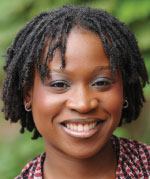 Once upon a time, Omolola Eniola-Adefeso ’99, chemical engineering, was on track to attend medical school. But she became a chemical engineer instead – so she could better attack problems such as her number one target: heart disease.
Eniola-Adefeso, an assistant professor of chemical engineering at the University of Michigan, investigates radical ways of delivering medicine that could prove efficient and effective than current practice. And she may succeed because she is thinks like an engineer – and not a doctor. Eniola-Adefeso came to Maryland from her native Nigeria the age of 16. She began her studies at Catonsville Community College, before transferring to UMBC, where she met the late Janice Lumpkin, an African-American chemical engineering professor. Lumpkin not only guided her student into a field where her passion for technology and medicine could intersect, but also helped her become a member of the first class of UMBC students in the Minority Access to Research Careers program.
After graduating from UMBC, she took a doctorate at the University of Pennsylvania in 2004. Her scholarship for graduate studies there was actually named after Lumpkin – who also attended Penn and died tragically after childbirth in 1997.
In 2006, Eniola-Adefeso (pronounced ah-DAY-feso and known to everyone as “Lola”) joined the faculty at Michigan where her lab seeks ways to create and use miniscule synthetic pellets to mimic white blood cells and deliver medicine more efficiently.
Read the full story in the Fall 2011 issue of UMBC Magazine.
Read more about UMBC alumni at Retriever Net, UMBC’s alumni online community.
Targeting Tastes: Maggie Lebherz '08, MLL
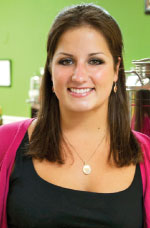 Some students studying abroad fall in love with a place. Maggie Lebherz ’08, modern languages and linguistics, fell in love with some new tastes during her semester at the University of Salamanca.
“Tasting fresh olive oil added an entirely new dimension to it, and I also learned about the health benefits of olive oil,” she says. “I had never had true balsamic vinegar, and even the best ones on the market here could not compare to what I had in Spain.”
The love affair that Lebherz developed with balsamic vinegar and fresh olive oil while studying in Spain has translated into a most unusual business venture: Lebherz Oil & Vinegar Emporium (LOVE) in her hometown of Frederick.
After graduating from UMBC, Lebherz returned to Frederick, working as a translator for the local school system. However, when a redistricting left her with a job as a secretary, she began to consider opening her own store focused on the two products she loved: olive oil and vinegar. Many people thought she was nuts to build a business on two products. But, as Lebherz says, “I told people that Baskin-Robbins ‘just’ sells ice cream.”
Read the full story in the Fall 2011 issue of UMBC Magazine.
Read more about UMBC alumni on Retriever Net, UMBC’s alumni online community.
Formula for Success: Ronita Marple '05 Ph.D., chemistry
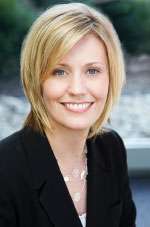 As an analytical chemist and senior scientist for consumer goods giant Proctor & Gamble, Ronita Marple ’05 Ph.D., chemistry, observes that it’s not unusual for her to walk past a lab and catch a glimpse of a robot testing a product by performing a household chore over and over again, for hours on end, to identify a product’s weaknesses without stressing out human testers in the process.
Such grueling tests are part of how all of the nearly 125 products marketed by Proctor & Gamble end up in a consumer’s shopping cart. So is Marple’s own job mundane and robotic? “Never,” laughs the recipient of UMBC Alumna of the Year Award in the Sciences, who manages a team of chemists that unravel the technology behind each line of personal care at the corporation’s Cincinnati headquarters.
“Maybe there’s a new ingredient [in a product]: It’s my job to come up with a method to measure it,” she explains. Shampoo, for example. “There are just tons of ingredients in every bottle,” she says. Her team can scan a dollop of shampoo using a technique known as “whole product NMR” to determine the identity and concentration of each ingredient in the formula.
Marple and her team must also help ensure that most important ingredients of all – those responsible for cleaning and conditioning hair – remain stable and optimally concentrated between factory and shower. After all, that dollop of shampoo must trek cross country in a sweltering delivery truck before it becomes lather on a lustrous head of hair.
You don’t want to feel like you’re washing your hair with dish soap,” says Marple. “On the other hand, you want enough conditioning that it feels good.”
Read the full story in the Fall 2011 issue of UMBC Magazine.
Read more alumni stories at Retriever Net, UMBC’s alumni online community.
How To Grow Your Big Idea: Vivian Armor '73
With Vivian Armor ’73, director, Alex. Brown Center for Entrepreneurship
You wake up one morning with a big, bright light bulb bobbing above your head. You start your day, feed the dog, the light getting brighter by the minute. Pretty soon, it’s keeping you up at night. Well, congratulations. Your “big idea” has arrived – and with it, a world of possibility.
So, now what? Do you cash in your life savings for seed money? Get a fancy business degree? Buy the book by that guy in the suit covered in question marks?
Maybe you take some (absolutely) free advice from Vivian Armor ’73, American studies. She is director of UMBC’s Alex. Brown Center for Entrepreneurship and has some tips about how to move ahead safely and smartly so you can make all your wildest dreams come true.
Read the full “How To” story by Jenny O’Grady in the Fall 2011 issue of UMBC Magazine.
A Decade of Service: Shriver Living Learning Center
When Jason Woody ’04, sociology, received his acceptance letter to be part of the first class of the Shriver Living Learning Center (SLLC) ten years ago, he wanted to be a film major. And though he was interested in the social justice focus of the new center, he was also enticed by Erickson Hall, the sleek new dorm on campus that SLLC students would call home.
Woody found the SLLC’s service mentality contagious and it quickly came to define his worldview. In his sophomore year, he came across a poster asking students to dedicate service hours to honor those killed in the 9/11 attacks and took that call to heart. Back in his dorm room, he paged through biographies of the victims.
The story of Deora Bodley – a college student who died aboard United Flight 93, which crashed near Shanksville, Pennsylvania – gripped him most personally. Friends remembered Bodley for her own dedication to serving others. In her name, Woody launched a mentorship program for elementary-aged Baltimore youth to learn team-building skills: Project Team. The Shriver Center offered a van, help recruiting volunteers and credibility with partner organizations.
Shriver Center Director Michele Wolff remembers designing the SLLC to reflect “the true essence of service-learning.” Community members are required to complete both regular service throughout their residency and coursework that provides context and promotes reflection. As an affinity program, the SLLC also offers students a purposeful living experience with a built-in peer support network to help them confront the demands of service commitments.
Woody credits the support of fellow SLLC residents for his growth as a service leader. Kelly Subramanian ’08, biology and psychology, a former SLLC resident assistant, understands his perspective. “Personal relationships develop where you’re not only living together, you’re also serving together,” she says.
By the time Subramanian arrived a few years after Woody, the SLLC had already developed a reputation for its unique way of fostering students’ intellectual and personal growth. The program itself – more than the sleek new dorm – had become the attraction. “You’re helping other people and learning about what’s out there, but you’re also learning about yourself, what you value and what you want to do with your life,” Subramanian reflects.
Senior Benjamin Davis ’12, who hopes to teach in Baltimore City after graduation, calls the SLLC “a home for people just like me who expressed passion or interest in volunteering.” Davis tackled personal hardships and shyness, he says, by “working with other civically engaged individuals.”
Jason Woody never did take a single film class at UMBC. Instead, he pursued a career serving adults with mental illness. His organization, B’more Clubhouse, offers transitional employment and social and educational programs to help adults with mental illness develop confidence, skills and meaningful relationships, and reduce stigma against mental illness in the broader community. “I’ve seen people achieve milestones, big and small, that are life-changing,” he says.
Woody adds that he is still learning from others through service. His work has helped him develop patience and understanding. In this way, he says, the members of B’more Clubhouse are now his teachers.
— Dinah Winnick
This story originally appeared in the Fall 2011 issue of UMBC Magazine.
Climbing the Ladder: Zach Clark '06, psychology
In 2008, former UMBC Retriever pitcher Zach Clark ’06, psychology, was with the Frederick Keys – a Class A affiliate of the Baltimore Orioles – when he got the news that he was needed at Class AAA Norfolk Tides for a spot starting assignment.
The good news traveled fast, but Clark didn’t. It was only after a long bus trip with the Keys from Kinston, NC, to Myrtle Beach, SC, and an early morning flight to Syracuse, NY, that Clark finally joined his new club. He pitched for the Tides that same night.
“I slept at the hotel during the day, went to the field and pitched,” recalls Clark, who has played in the Orioles farm system since 2006. “That was pretty crazy. I didn’t know anybody. That was my first time at Triple A.”
Signed by Orioles’ scout Dean Albany as a non-drafted free agent after leaving UMBC in 2006, Clark started this season pitching for the Class AA Bowie Baysox. He began 2011 with a minor league record of 24-28 and an ERA of 3.61 in 119 games.
Clark knows life as a pitcher on-call is part of the path to the big leagues. He once battled heavy traffic from Bowie to Norfolk, VA to take the mound for Tides in a night game.
In games through Aug. 4 of this season Clark was 6-7 with an ERA of 5.14 in 18 games (with 17 starts) for Bowie in the Eastern League. Clark was named the Eastern League pitcher of the week on May 2 of this season.
— David Driver
This story originally ran in the Fall 2011 issue of UMBC Magazine.
Words and Music: Adam Trice '04, English
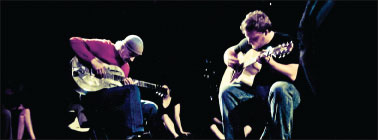 Open the door to Annapolis’ Rams Head Tavern and the sounds of upbeat banjo and guitar
fly out into the warm night air, followed by closely by the gruff voice of Adam Trice ’04, English – who’s in the middle of a 45-minute set with his band, Red Sammy.
“It ain’t you, it ain’t her,” Trice growls tunefully in a song called “It Ain’t You (Carolina Road Anthem).” “I’m heading south, but I’m not sure. You got me high, it’s kind of funny. I’m playing bars for gas money.”
Trice dubs Red Sammy’s music as “graveyard country” because he likes the verbal interplay of the phrase. “I feel like it brings up a lot of different connotations that are associated with those two words,” explains Trice. The band has released a few records, including A Cheap Kind of Love Song and Dog Hang Low, both of which are available online or at the band’s shows.
Studying literature at UMBC had a hand in his musical direction. “My music’s more lyric driven, and I think it really banks off my English degree,” he explains. “A lot of electives in the creative writing track. They are the strong focus from which I draw.”
While Trice also pursues a day job as director of foundation relations and grant writing and development at Capitol College in Laurel, he enjoys playing for tips in a Jeremiah Weed bucket and is going to keep playing for the foreseeable future. “My plan is to continue pushing the art and seeing where that goes,” he says.
— Derek Roper ’11
Originally published in the Fall 2011 issue of UMBC Magazine.
Alumni Accolades – Outstanding Alumni of the Year 2011
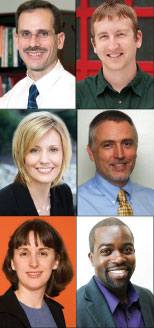 Among the highlights of UMBC’s Homecoming 2011 is a ceremony that honors university alumni who have achieved distinction in a wide range of disciplines and careers.
The UMBC Alumni Association – which selects recipients and presents the awards – moved the annual Outstanding Alumni of the Year ceremony back to campus in 2009, and it has since become a key element of the university’s celebration of school spirit.
This year’s recipients of the awards – which will be presented on Thursday, October 13 at 7:30 p.m. in the Albin O. Kuhn Library Gallery – include alumni who’ve reached prominence in the fields of technology, medicine, journalism and business. This year’s recipients are:
Ralph Semmel ’92, Ph.D., computer science, is the UMBC Alumnus of the Year in Engineering and Information Technology. In 2010, Semmel was named as the eighth director of The Johns Hopkins University Applied Physics Laboratory – one of the most prominent hubs of advanced technological research in the world.
Ronita Marple, ’05, Ph.D., chemistry, is the UMBC Alumna of the Year in the Natural and Mathematical Sciences. She is an analytical chemist and senior scientist for consumer goods giant Procter & Gamble. (Read a profile of Marple)
Jamie Smith Hopkins ’98, English, is the UMBC Alumna of the Year in the Humanities. She has been a reporter at The Baltimore Sun since 1999, and writes and blogs for the paper on the housing industry in the Baltimore metropolitan region. (UMBC Magazine profiled Hopkins in its Summer 2010 issue.)
Garrett Wright ’01, theatre, is the UMBC Alumnus of the Year in the Visual and Performing Arts. Wright is a Bridge Fellow at the Center for Constitutional Rights, where he puts his legal skills to work combating racial profiling in New York City’s Police Department. He is also a staff attorney at the Urban Justice Center’s Community Development Project, which provides legal advice to tenants and tenant organizations.
Dr. Jeffery Wilkinson ’89, interdisciplinary studies, is the UMBC Alumnus of the Year in the Social Sciences. He works at the University of North Carolina’s School of Medicine, and he has won renown as a global leader in combating obstetric fistula in some of the poorest regions of the world – including Asia and sub-Saharan Africa. (Wilkinson was profiled in the Summer 2009 issue of UMBC Magazine.)
Delali Dzirasa ’04, computer engineering, is UMBC’s Young Alumni Rising Star. He is the owner of Fearless Solutions, a cybersecurity company based in the bwtech@UMBC Research Park that focuses on secure software development, and already boasts several contracts with the federal government.
— Richard Byrne ’86
This article appeared in the Fall 2011 issue of UMBC Magazine.