All posts by: Magazine Editor


Supporting the Whole Student

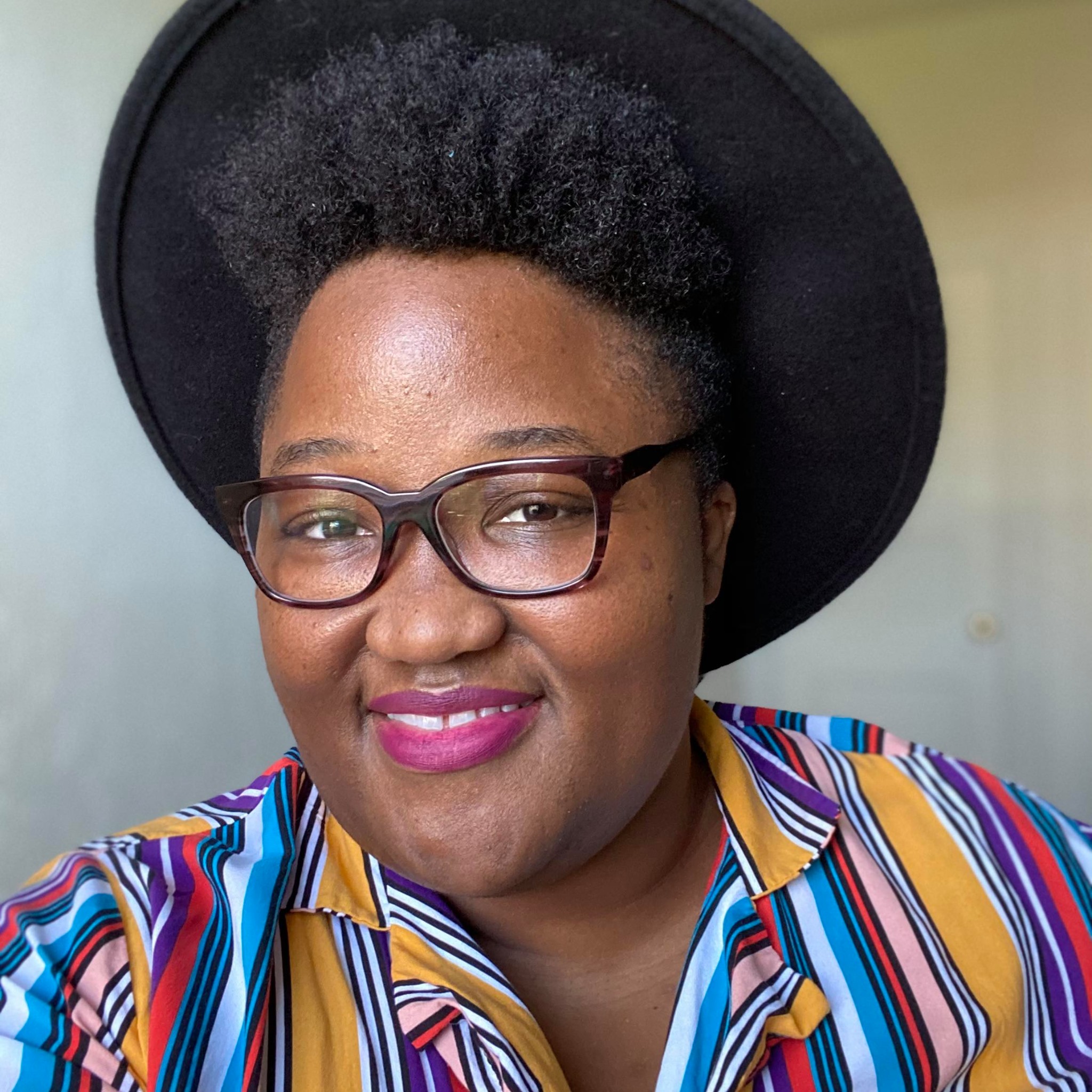
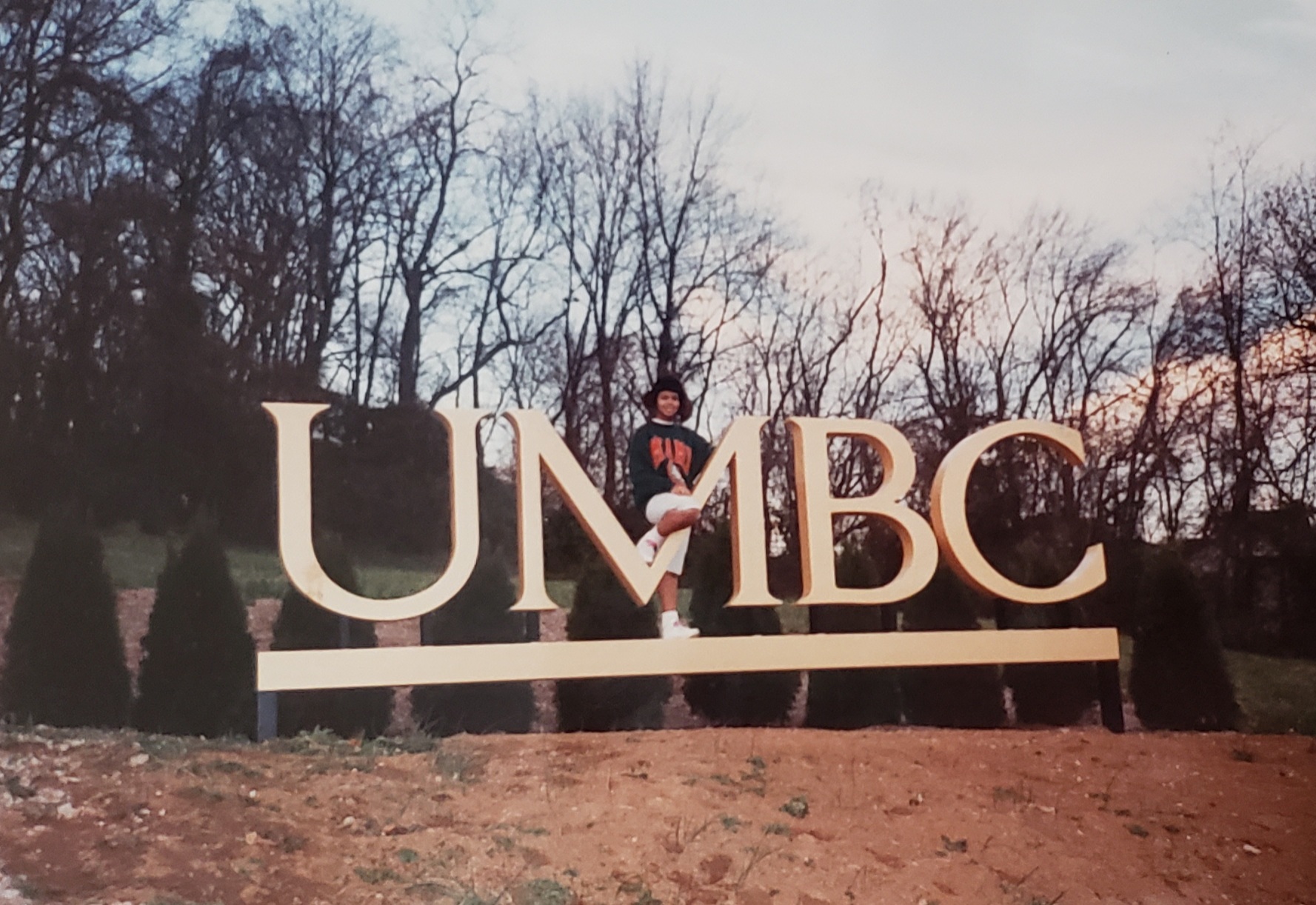
Lewis on campus in 1992. Photo courtesy of Lewis.

“To me, UMBC opened up the world,” says Tamara L. Lewis ’92, psychology. As a student, that meant joining Alpha Kappa Alpha Sorority, Inc., for instance, holding multiple jobs all around campus, and ultimately re-envisioning her career path. 

Lewis began her studies focusing on industrial and organizational psychology. However, it was her many on-campus jobs—conference assistant, desk staffer, and student worker in the admissions office—that allowed her to realize that she was actually drawn to counseling. Working across campus let Lewis see how a university can support student success, so she began to explore how she could work with students.

Thirty years later, Lewis still feels a sense of real connection to the campus and actively works to help other alumni engage with students and the institution. And her career pathway has allowed her to continue to support students in the manner she first observed at UMBC.

The need to belong

Academic support has defined many aspects of  Lewis’s career and philanthropic life. After UMBC, Lewis received her master’s degree in counseling from Hampton University—UMBC President Freeman Hrabowski’s alma mater. She then began her career in the counseling center at Baltimore City Community College. 

“Being in the academic realm got me thinking more about college student experiences,” she shares, and she started thinking about what structures exist to help young people succeed. She drew on lessons learned at UMBC that helped her understand the value of community and support in educating the whole student. 
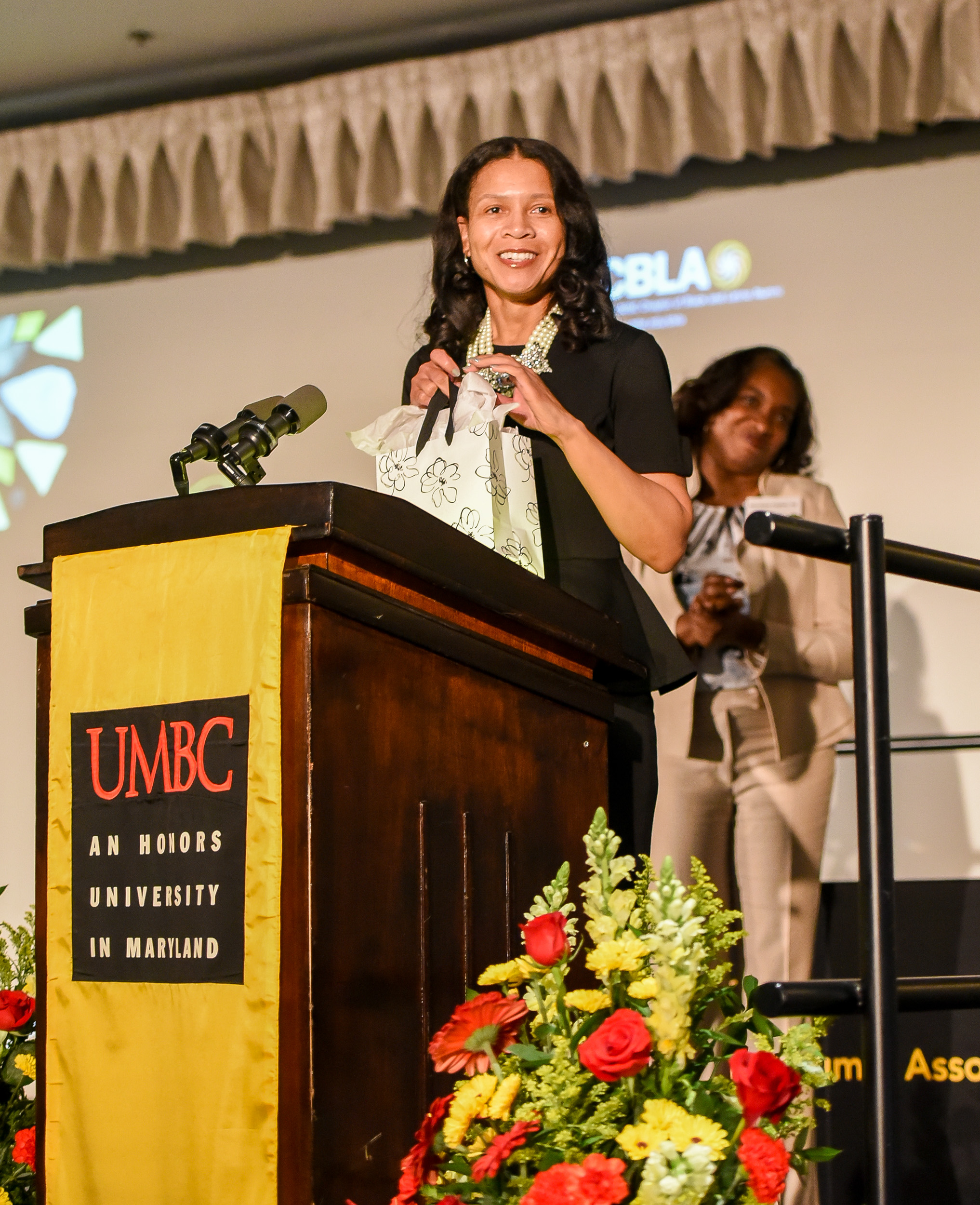
Lewis speaking at a CBLA event. Photo courtesy of the Alumni Association.

Lewis continued exploring the topic of academic success in her dissertation for her doctorate from Morgan University. After earning both her graduate degrees from Historically Black Colleges and Universities, Lewis understood the advantages of students feeling a sense of belonging while at school. Her own experience, along with research and alumni work, has shown her the importance of making students feel important and valuable within their community.  

Carving out space

Creating a space for Black and Latinx alumni to come together came organically through events and outreach supported by UMBC’s Office of Alumni Engagement, says Lewis. What started as a UMBC-hosted evening for Black and Latinx alumni at Baltimore’s Reginald F. Lewis Museum of African American History, would result in the creation of the Chapter of Black and Latino Alumni (CBLA) at UMBC in 2006.

“Tamara was instrumental in creating the CBLA and leading events and initiatives that would speak to and acknowledge the unique experiences of our Black and Latine/x graduates,” says Stanyell Odom, director of Alumni Engagement. “Her love for UMBC is evident in the way she gives back her time, talent, and resources through the CBLA, the Alumni Board and her beloved sorority.”

In 1991, Lewis became a member of Alpha Kappa Alpha Sorority (AKA), one of the first historically Black sororities on campus. She remembers how important it felt to build community within the “small community” of Black students on campus. Through her student work in AKA, as well as her residential life involvement, she saw the value of supporting Black students to do their very best at UMBC, a vision that was shared through the administration, she says. 

Now, nearly 30 years after joining her sorority, she continues to connect with members to support UMBC. In 2011, Lewis helped plan the first AKA Homecoming reunion. Anita Jackson ’80, health science and policy, then a member of the Alumni Association Board of Directors, and the Office of Alumni Engagement leveraged connections to the alumni community to make the event a success. AKA members have gathered at Homecoming every year since. The event also fundraises for the UMBC Second Generation Scholarship, which is dedicated to students who show a commitment to the advancement of minorities. In 2020, during the COVID-19 pandemic, the sorority sisters came together virtually in honor of the charter anniversary of their chapter.

“It’s important that people give what they can; even if it’s not money but time,”  Lewis says, emphasizing the value of expanding the ways alumni can support the UMBC community.

Integral part of the community

Now, as the state test security officer and the National Assessment of Educational Progress state coordinator for the Maryland State Department of Education (MSDE), Lewis continues to ensure students have everything they need to succeed on standardized testing. The Assessment Branch of MSDE works to create uniform and accessible testing standards so students, educators, and community members can best support students and address any gaps in education. Working in Baltimore City, Lewis understands the value of equitable testing practices so students can use every support available. Her continued curiosity about addressing gaps and building community has made her an integral part of the UMBC alumni community.

As a student, Lewis realized that being an active member of the UMBC community was the best way to get the most of her education. Now, she wants to help current students—who she sees as future alumni—realize how important it is to give back to UMBC when they do graduate. “When I tell people I went to UMBC, they’re impressed,” she says, which just inspires her to give back even more.


— Imani Spence ’16

*****

Header image: Lewis, right, at an AKA Homecoming reunion in 2014. Photo by Marlayna Demond ’11.
Vaccine Victories

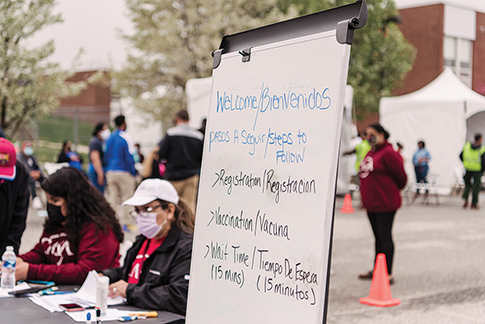
UMBC students and staff have shown their resilience in myriad ways during the pandemic, but maybe nothing showcases the Retriever spirit more than the volunteer hours put in to assist in the region-wide vaccination challenge. 

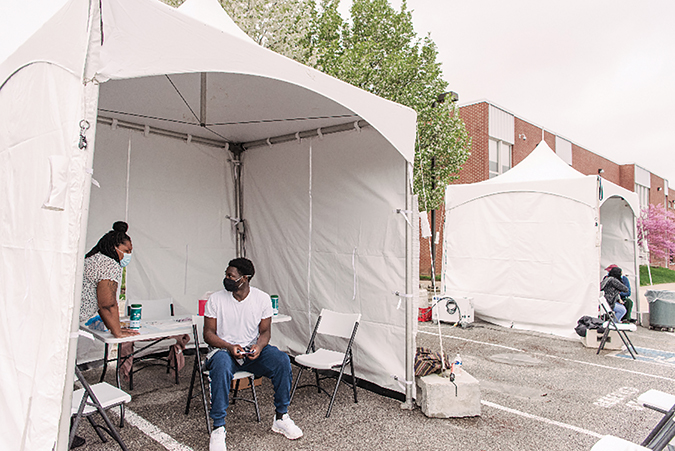
Vaccine hunters Jen Dress, associate director of Campus Life, and Candace Martinez-Doane, assistant director of Leadership and Government, started their journeys by finding appointments for people within their immediate circles. As more people became eligible for vaccines, those circles widened to include more than 600 people they’ve helped register.

Part of their efforts focused on frontline UMBC community members, including over 30 ABM staff, who help maintain and clean UMBC facilities and residential buildings. Dress and Martinez-Doane partnered with UMBC Transit to organize UMBC coach buses to transport the ABM workers to and from their vaccine appointments. Next up on their list is helping 60 Chartwells dining staff members be successfully vaccinated to prepare for fall 2021 operations on campus.

UMBC students are also going above and beyond to volunteer their time. Of students in the University System of Maryland, Retrievers led the way attending 30 volunteer shifts at the M&T Bank Stadium mass vaccination site, giving approximately 175 hours of their time. According to Chris Bankert of the State of Maryland’s COVID-19 response team, “UMBC has been doing fantastic work at M&T Bank Stadium, and I have been hearing great feedback from the management staff on site.”

In mid-April, UMBC leveraged its long term partnership with the Lakeland community in south Baltimore to co-sponsor a pop-up vaccine event to serve 100 members of the community. “With deep community connections and strong partners like Casa de Maryland, we were ready to bring health resources to the community,” says Joshua Michael ’10, political science, director of the Baltimore School Partnerships and the Sherman Scholars Program,.

In other ways, Michael notes, Retrievers have adapted to meet the opportunity of the moment.  In summer 2020, 15 Sherman Scholars taught math online to 150 Lakeland students. And this fall, 30 UMBC students will provide additional support in mathematics through evening tutoring. “At UMBC,” says Michael, “our humanity has guided us to meet this moment.”

— Morgan Casey ’22 and Randianne Leyshon ’09

A version of this story was originally published by The Retriever.

Retrievers Behind the Scenes—Courtney C. Hobson, M.A. ’14

During the pandemic it has become even more important to find ways of engaging students in learning activities beyond the classroom. Fortunately, we have Courtney C. Hobson, M.A. ’14, historical studies, program coordinator for the Dresher Center for the Humanities, to help make these special moments happen.

What is your favorite thing about the work you do at UMBC and why?

As program coordinator, I do exactly what the title says—COORDINATE. This covers a multitude of things such as maintaining budgets, crafting social media posts, and other various administrative tasks. My favorite part of my job is helping to plan and coordinate the Humanities Forum, our free public lecture series. I essentially have a wish list of different artists, professors, writers, etc. who I would love to hear from and/or meet; through the Humanities Forum, sometimes that gets to happen! But mostly, I get to constantly learn new ideas and hear from different perspectives, which has been an enriching experience.

Tell us something people don’t really know or understand about your job.

Coordinating events or programs requires so much multitasking, juggling—any euphemism that you want to apply. It requires the ability to think about both the smaller and bigger picture and prepare for contingencies. You also have to be aware of the various people or groups that you interact with and anticipate their potential needs. Doing all of this and making the experience appear to be seamless is also a skill.

Is there someone in the campus community who has been particularly supportive? 

I can’t really pick out one person in particular because I have so many wonderful friends and colleagues at the university. As an alumna of the university, it’s a unique experience to transition from student-professor relationship to colleague or even friend with some of the professors in the History Department; they were my cheerleader when I was a student and continue to be so now.


Learn more about the Humanities Forum at https://dreshercenter.umbc.edu/humanities-forum/current/.

Header image: Hobson works with faculty members during an Humanities Teaching Lab. Both photos courtesy of Hobson.

Creating Technology that Protects Us—Rising Together

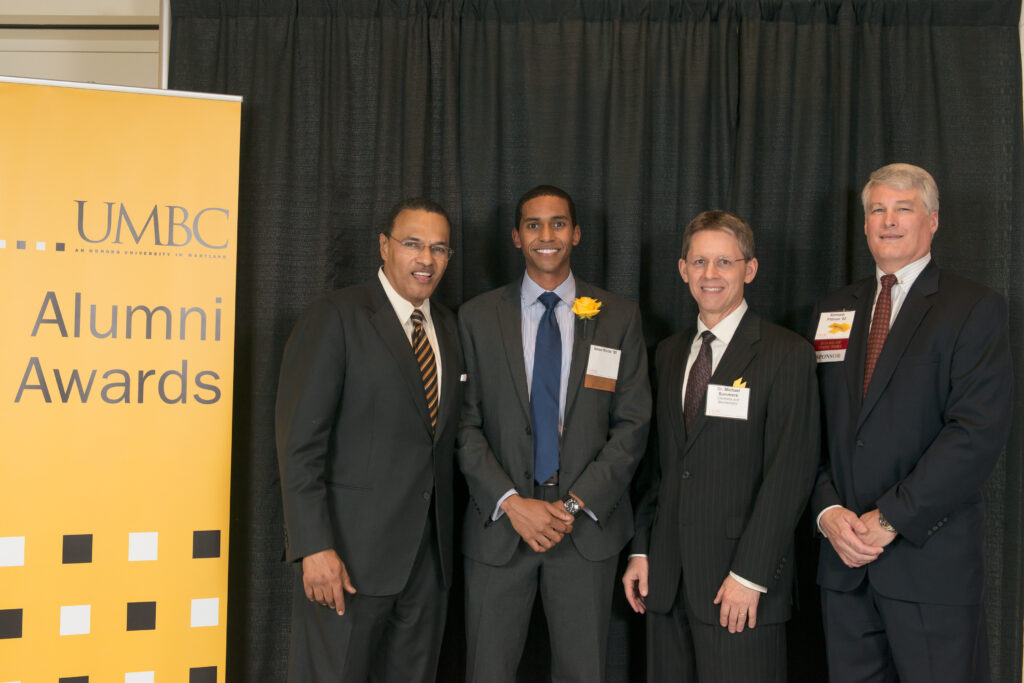
Since 2009, as part of its Alumni Awards celebration, the UMBC Alumni Association names one “Rising Star” recipient each year who exemplifies early career and professional achievement. In the coming weeks, we will spend some time with awardees from the past decade to see where they are now—and how they’ve grown in their fields while maintaining ties to UMBC. In this installment, UMBC Rising Stars Isaac Kinde ’05, M13, biological sciences, and Christopher Valentino ’02, M.S. ’06, information systems, discuss their roles in the healthcare and defense industries, respectively. Both alumni discovered their passion for their work while at UMBC and aim to harness technology to protect us from disease and cyber warfare.

As we embrace life in a technologically immersive world—scrolling out of habit or relying on a life-saving medical device—there’s a common question many of us have about the tech we’ve come to depend on: How can we best harness it to protect us? From malware and scams, but also from disease and unnecessary pain?

Two UMBC graduates, who previously received Rising Star alumni awards, are diligently working to create and influence technology that innovates and protects us.  

Protecting lives with early detection technology

Isaac Kinde ’05, M13, biological sciences, is advancing healthcare technologies that work to protect people from possibly fatal diseases. Kinde is co-founder and vice president for technology assessment at Thrive, an Exact Sciences Company. Thrive was recently acquired by Exact Sciences for up to $2.15 billion assuming successful completion of certain milestones, says Kinde. He and his team work to save lives threatened by cancer by creating early detection technologies.

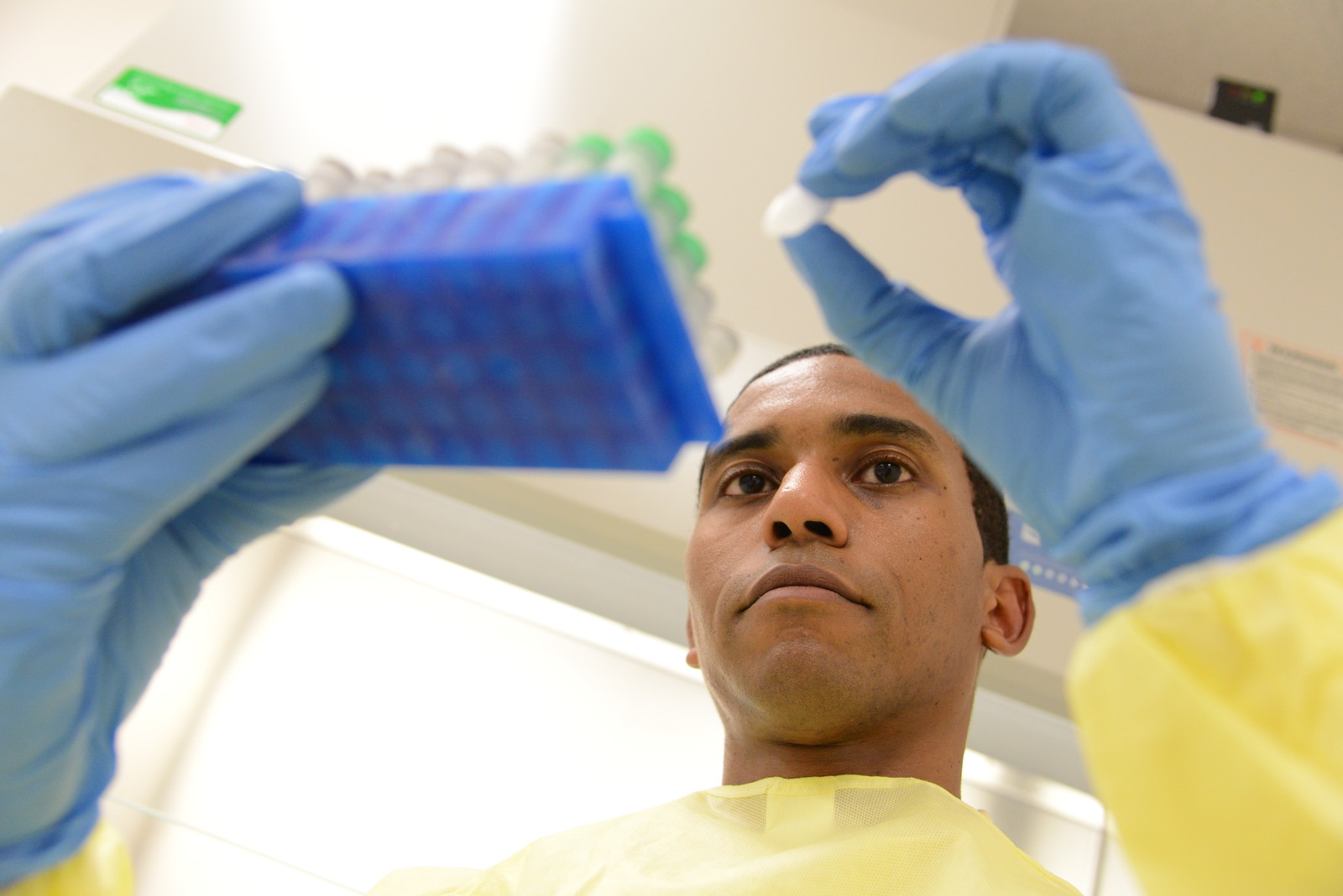
Kinde at work in his lab at Thrive Early Detection in Baltimore, Maryland
Kinde at work in his lab at Thrive Early Detection in Baltimore, Maryland. Photo courtesy of Kinde.

“There’s two million cancer cases in the U.S. annually and 70 percent of those cases don’t have a screening test available,” says Kinde. “If you can find cancers earlier, particularly in the earliest stages, survival can be as high as 90 percent or greater. The technology that my company is developing really leverages decades of research into how cancers work, their biology, as well as method developments in order to exploit that biology.”

Getting an early start

Since being named a Rising Star alum in 2014, Kinde received his M.D.-Ph.D. from the Johns Hopkins University School of Medicine. He was named one of Forbes magazine’s 30 under 30 “Rising Stars Transforming Science and Health.” Kinde also received The Daily Record’s Innovator of the Year award in 2015.

While at UMBC as a Meyerhoff Scholar, Kinde’s appreciation for research blossomed. He said that his first research mentor, Michael Summers, a professor in the Chemistry and Biochemistry department, influenced his love of research after spending a summer in his lab. “I just got hooked and I just didn’t stop doing research. It was a continuous effort until I graduated,” Kinde recalls.

Kinde speaking at the 2014 Alumni Award ceremony, and pictured with President Hrabowski, Mike Summers, and Kenneth Pittman ’80. All photos courtesy of the Alumni Association, unless otherwise noted.

It was his doctoral work at the Vogelstein Lab at Hopkins that helped to propel the technological initiatives at Thrive. “We set out to apply the latest and greatest technologies to identify cancers in their earliest stages. It took new method creation. We had to develop new technologies in order to find the earliest signs of cancer in routine clinical specimens,” Kinde says.

The future of cancer detection technology 

Thus, came about the creation of CancerSEEK, a blood test that has shown the ability to detect 65 percent of cancers prior to clinically evident metastasis in individuals without any history of the disease. Kinde noted that a test like CancerSEEK can detect multiple cancers from a single test and do so in real time.

“There was the prototype version [of CancerSEEK] that our academic lab published. Then there was another prototype version that our company collaborated with Hopkins in order to demonstrate how we could work in a real-world setting,” says Kinde. “It’s the first of its kind to demonstrate real world detection and intervention of cancers. We’re preparing to get FDA approval, to do the full clinical validation of the CancerSEEK test.”

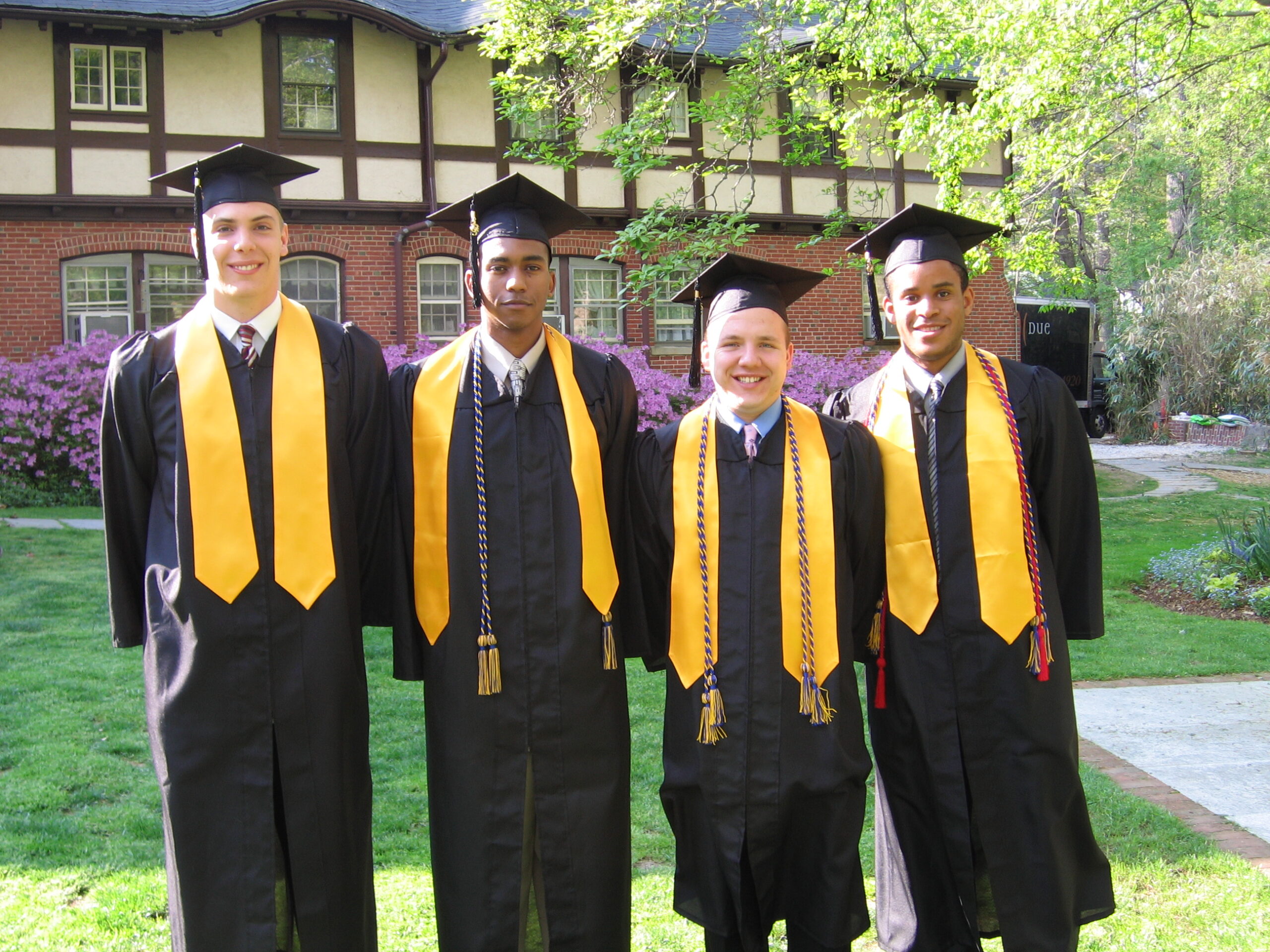
Kinde, second from left, with his roommates Andy Windsor, Seth Miller, and Kenneth Gibbs, all fellow Meyerhoff Scholars, at a graduation celebration in 2005. Photo courtesy of Kinde.

Kinde recalls the moment he saw successful Black Americans who were in the top M.D.-Ph.D. programs and top graduate programs while he studied at UMBC as an influential factor in his career progression. In fact, UMBC undergraduate alumni who identify as African American have gone on to pursue and earn more M.D.-Ph.D.s than alumni from any other institution across the country, largely in thanks to the support from the Meyerhoff Scholars Program.

“To me, that said, ‘well, why can’t I do that too?’ As I’ve progressed in my career, it’s the lesson that I remember. It’s something that I want to help future generations of people by being that example that they can look to.”

Valentino with his family at the 2012 Alumni Award ceremony.

Cybersecurity at the highest levels

Christopher Valentino ’02, M.S. ’06, information systems management, has more than two decades of expertise in domestic and global cybersecurity, which began during his undergraduate tenure at UMBC. Valentino spent 24 years working with Northrop Grumman Corp., a global aerospace and defense technology company, and its predecessor companies. 

He started working at Northrop as an intern—working in what he called the “cyber mailroom”—and worked his way up. When he received the UMBC Alumni Association’s Rising Star award in 2012, Valentino was the then-director of contract research and development at Northrop.

“I had a parallel experience of working and going to school at the same time,” says Valentino, “while I was also starting a family. There are things I learned at UMBC as a student that I would not have learned anywhere else. The bottom line is UMBC is a really hard school. And it’s very underappreciated until you actually show up and become part of the institution, and go through the rigor that’s there.”

A leader in influencing cyberspace infrastructures 

Nearly 10 years since being named a UMBC rising star, Valentino now serves as the chief strategy officer at Peraton, a next-generation national security company that provides technology solutions to space and intelligence, cyber mission, defense and security, and civil and health customers. Peraton acquired Northrop’s IT services business in February 2021 when Valentino transitioned into being the point person for shaping the future of the company.

“Peraton is a national security company focused on providing capabilities and solutions across the Department of Defense intelligence community—federal, civilian, and Homeland Security. I am responsible for operationalizing our strategy across those businesses,” Valentino says.

Valentino’s work emphasizes the importance of cybersecurity protection at the highest levels. While in his role as vice president of information warfare and cyber survivability at Northrop, Valentino shared insight on how some of the most powerful warfare structures in our country, such as the military and aerospace defenses, work to approach information warfare and how they keep our protections secure in the face of international threats on the Defense & Aerospace Report Podcast last June. 

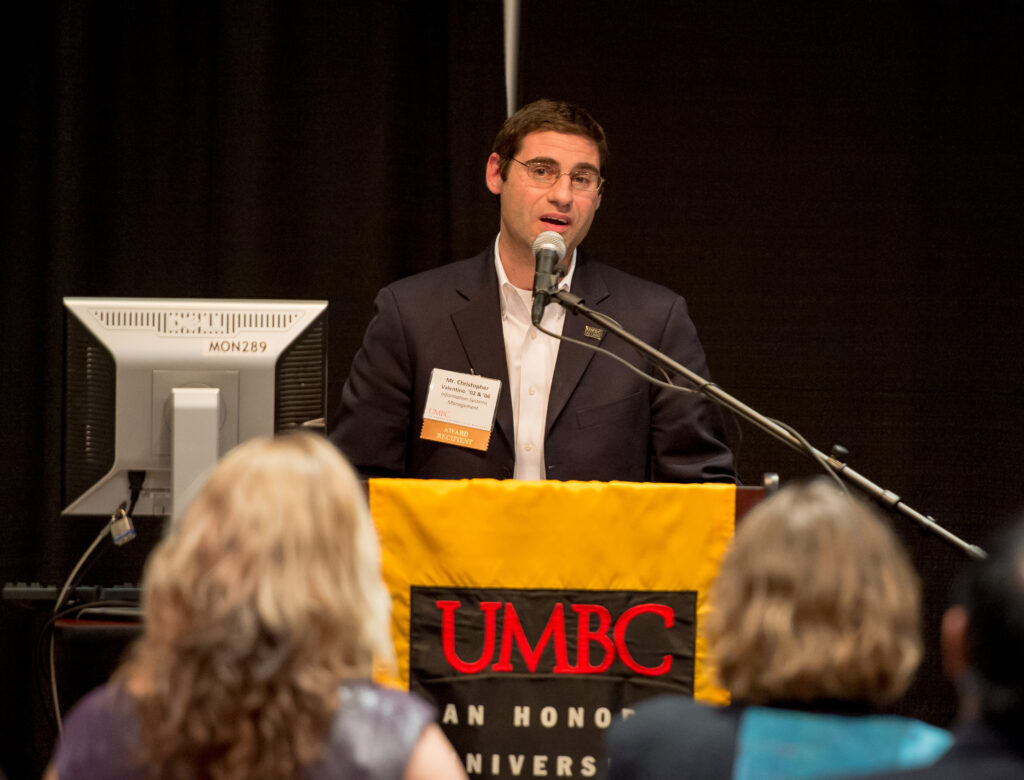
Valentino speaks at the 2012 Alumni Award ceremony.

“You train as you fight. In this domain, things move fast and things can change. You have to know the right environments to be able to train your mission operators,” Valentino told podcast host Vago Muradian. “From an exercise perspective, you would always go out and train, train, train and then execute. It’s the same thing in information warfare.”

The past, present, and future of tech 

In his long tenure in the cyber security field, Valentino is able to appreciate innovative technological protections while understanding that these advancements are interconnected with all the efforts of past researchers.

“The one thing that I can appreciate from being in the industry now for over two decades is that there’s repetition and then there’s innovation in the seams between the repetition,” says Valentino. “There’s a lot of concepts that were new 20-plus years ago that will still be new 20 years from now. Artificial intelligence is probably one that I would point to and say, 20 years ago, we were doing research and trying to apply technologies, and two decades later, we’re still working to operationalize that technology.”

Valentino with Provost Philip Rous, Aryya Gangopadhyay, information systems chair, and Bennett Moe '88 at the 2012 Alumni Award Ceremony.
Valentino with Provost Philip Rous, Aryya Gangopadhyay, information systems chair, and Bennett Moe ’88 at the 2012 Alumni Award Ceremony.

Threat protection

Valentino and Kinde’s efforts have created an impactful ripple effect in our understanding of how technology can protect us from threats. Kinde’s work in early detection technology is on track to save more lives ahead of a cancer diagnosis that can be fatal. One blood test may have the potential to accurately detect a variety of different cancers. Valentino, on the other hand, is continuing to fortify the infrastructure and systems that protects our land, air, space, and digital domains from threats. 

Whether it be a threat against our immune systems or a threat to our cyber safety, these former UMBC rising stars are raising the bar and redefining what protections in technology look like. 

— Adriana Fraser

Read more about other Retrievers rising together and stay tuned for more information about UMBC’s 32nd annual Alumni Awards in October.

Study Shows AI-Generated Fake Reports Fool Experts

By Priyanka Ranade, doctoral student in Computer Science and Electrical Engineering (CSEE), UMBC; Anupam Joshi, professor, CSEE, UMBC; and Tim Finin, professor, CSEE, UMBC

Takeaways
· AIs can generate fake reports that are convincing enough to trick cybersecurity experts.
· If widely used, these AIs could hinder efforts to defend against cyberattacks.
· These systems could set off an AI arms race between misinformation generators and detectors.

If you use such social media websites as Facebook and Twitter, you may have come across posts flagged with warnings about misinformation. So far, most misinformation – flagged and unflagged – has been aimed at the general public. Imagine the possibility of misinformation – information that is false or misleading – in scientific and technical fields like cybersecurity, public safety and medicine.

There is growing concern about misinformation spreading in these critical fields as a result of common biases and practices in publishing scientific literature, even in peer-reviewed research papers. As a graduate student and as faculty members doing research in cybersecurity, we studied a new avenue of misinformation in the scientific community. We found that it’s possible for artificial intelligence systems to generate false information in critical fields like medicine and defense that is convincing enough to fool experts.

General misinformation often aims to tarnish the reputation of companies or public figures. Misinformation within communities of expertise has the potential for scary outcomes such as delivering incorrect medical advice to doctors and patients. This could put lives at risk.

To test this threat, we studied the impacts of spreading misinformation in the cybersecurity and medical communities. We used artificial intelligence models dubbed transformers to generate false cybersecurity news and COVID-19 medical studies and presented the cybersecurity misinformation to cybersecurity experts for testing. We found that transformer-generated misinformation was able to fool cybersecurity experts.

Transformers

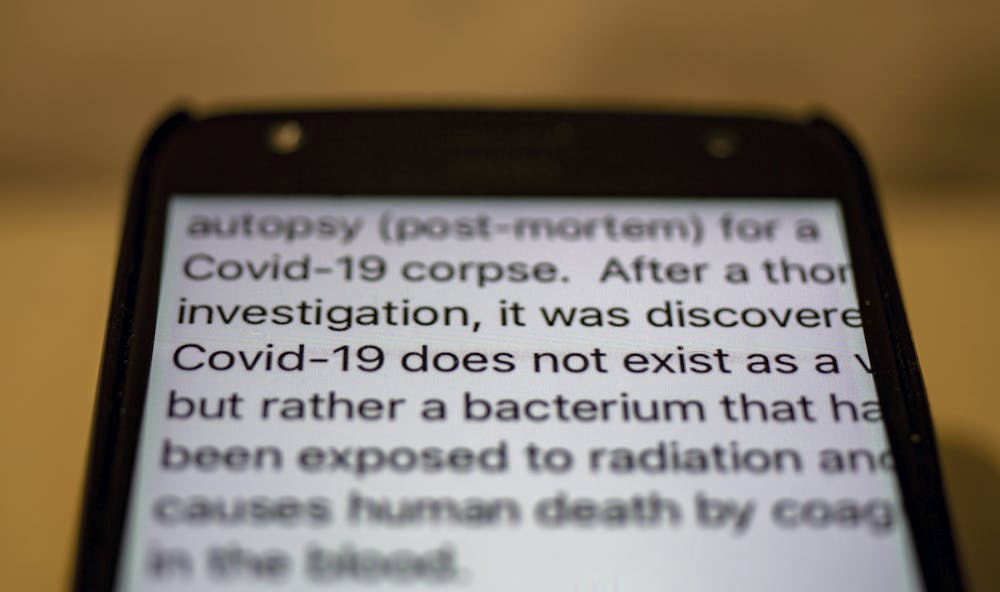
A block of text on a smartphone screen
AI can help detect misinformation like these false claims about COVID-19 in India – but what happens when AI is used to generate the misinformation? AP Photo/Ashwini Bhatia

Much of the technology used to identify and manage misinformation is powered by artificial intelligence. AI allows computer scientists to fact-check large amounts of misinformation quickly, given that there’s too much for people to detect without the help of technology. Although AI helps people detect misinformation, it has ironically also been used to produce misinformation in recent years.

Transformers, like BERT from Google and GPT from OpenAI, use natural language processing to understand text and produce translations, summaries and interpretations. They have been used in such tasks as storytelling and answering questions, pushing the boundaries of machines displaying humanlike capabilities in generating text.

Transformers have aided Google and other technology companies by improving their search engines and have helped the general public in combating such common problems as battling writer’s block.

Transformers can also be used for malevolent purposes. Social networks like Facebook and Twitter have already faced the challenges of AI-generated fake news across platforms.

Critical misinformation

Our research shows that transformers also pose a misinformation threat in medicine and cybersecurity. To illustrate how serious this is, we fine-tuned the GPT-2 transformer model on open online sources discussing cybersecurity vulnerabilities and attack information. A cybersecurity vulnerability is the weakness of a computer system, and a cybersecurity attack is an act that exploits a vulnerability. For example, if a vulnerability is a weak Facebook password, an attack exploiting it would be a hacker figuring out your password and breaking into your account.

We then seeded the model with the sentence or phrase of an actual cyber threat intelligence sample and had it generate the rest of the threat description. We presented this generated description to cyber threat hunters, who sift through lots of information about cybersecurity threats. These professionals read the threat descriptions to identify potential attacks and adjust the defenses of their systems.

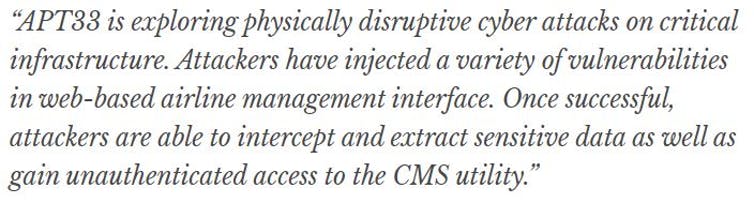
We were surprised by the results. The cybersecurity misinformation examples we generated were able to fool cyber threat hunters, who are knowledgeable about all kinds of cybersecurity attacks and vulnerabilities. Imagine this scenario with a crucial piece of cyber threat intelligence that involves the airline industry, which we generated in our study.

A block of text with false information about a cybersecurity attack on airlines
An example of AI-generated cybersecurity misinformation. The Conversation, CC BY-ND

This misleading piece of information contains incorrect information concerning cyberattacks on airlines with sensitive real-time flight data. This false information could keep cyber analysts from addressing legitimate vulnerabilities in their systems by shifting their attention to fake software bugs. If a cyber analyst acts on the fake information in a real-world scenario, the airline in question could have faced a serious attack that exploits a real, unaddressed vulnerability.

A similar transformer-based model can generate information in the medical domain and potentially fool medical experts. During the COVID-19 pandemic, preprints of research papers that have not yet undergone a rigorous review are constantly being uploaded to such sites as medrXiv. They are not only being described in the press but are being used to make public health decisions. Consider the following, which is not real but generated by our model after minimal fine-tuning of the default GPT-2 on some COVID-19-related papers.

A block of text showing health care misinformation.
An example of AI-generated health care misinformation. The Conversation, CC BY-ND

The model was able to generate complete sentences and form an abstract allegedly describing the side effects of COVID-19 vaccinations and the experiments that were conducted. This is troubling both for medical researchers, who consistently rely on accurate information to make informed decisions, and for members of the general public, who often rely on public news to learn about critical health information. If accepted as accurate, this kind of misinformation could put lives at risk by misdirecting the efforts of scientists conducting biomedical research.

An AI misinformation arms race?

Although examples like these from our study can be fact-checked, transformer-generated misinformation hinders such industries as health care and cybersecurity in adopting AI to help with information overload. For example, automated systems are being developed to extract data from cyber threat intelligence that is then used to inform and train automated systems to recognize possible attacks. If these automated systems process such false cybersecurity text, they will be less effective at detecting true threats.

We believe the result could be an arms race as people spreading misinformation develop better ways to create false information in response to effective ways to recognize it.

Cybersecurity researchers continuously study ways to detect misinformation in different domains. Understanding how to automatically generate misinformation helps in understanding how to recognize it. For example, automatically generated information often has subtle grammatical mistakes that systems can be trained to detect. Systems can also cross-correlate information from multiple sources and identify claims lacking substantial support from other sources.

Ultimately, everyone should be more vigilant about what information is trustworthy and be aware that hackers exploit people’s credulity, especially if the information is not from reputable news sources or published scientific work.

*****

Header image: It doesn’t take a human mind to produce misinformation convincing enough to fool experts in such critical fields as cybersecurity. iLexx/iStock via Getty Images

Priyanka Ranade, PhD Student in Computer Science and Electrical Engineering, University of Maryland, Baltimore County; Anupam Joshi, Professor of Computer Science & Electrical Engineering, University of Maryland, Baltimore County, and Tim Finin, Professor of Computer Science and Electrical Engineering, University of Maryland, Baltimore County

This article is republished from The Conversation under a Creative Commons license. Read the original article.

Musical Roots

As children, Andy Stack and his older brother Dan listened to Miles Davis as they fell asleep each night in their Catonsville home. His brother had an affinity for Sketches of Spain on repeat, and Stack ’10, music, listened with the hopes of being a great jazz composer like Davis. He started to play any available instrument—steel drums, saxophone, guitar, piano—each one telling a different story; that’s what Stack loved.

The musical layering that fascinated Stack at such a young age found ground to flourish in “the old Fine Arts building,” says Stack, who, after a brief time at the Berklee College of Music, shifted away from jazz composition and returned to Catonsville to finish his degree in music technology at UMBC. “The recording program at UMBC proved to be a really powerful tool to develop my interest and springboard my career.”

In Wye Oak, Stack provides drums, keyboards, and backup vocals. Photos courtesy of Stack, unless otherwise noted.

At UMBC in 2007, Stack began collaborating with high school friend and fellow Retriever Jenn Wasner to form Wye Oak, an indie rock/dream pop duo whose name pays homage to Maryland’s state tree. The duo found praise and a national audience early on. Reviewing their first album, If Children—produced at UMBC—Pitchfork lauded the 2007 debut, “Vocals trade between Wasner and Stack; her voice bears more sweetness, but the light variety is a palette cleanser. Their total defiance of novelty is almost minimalistic; it’s a reminder that someone who understands food can make a good dish with three or four ingredients.”

Reaching a wider audience

“Wye Oak is really a recording project,” Stack says. Using foundational theory he learned at Berklee and the music technology skills from UMBC, Stack and Wasner find a lot of their excitement in the recording process and on-stage experimentation. During their 2010 NPR Tiny Desk Concert, Wasner opens with the title song from Civilian, their third album, and says that it came up in the studio with all the tools at their fingertips. “We just figured out how to do it live,” Stack says of the result.

Wasner and Stack started collaborating musically in high school. Photo by Lissa Gotwals.

Since the days in Fine Arts, the band has played around the world. They’ve also collaborated with groups like the Baltimore Symphony Orchestra and Future Islands, and Wasner has been touring with Bon Iver. Their music has been used in films and TV shows like Gossip Girl and The Walking Dead

Stack and Wasner recorded their first two albums (If Children and The Knot) using student resources available to them on campus. Keeping connected to his Retriever lineage The Knot, which served as Stack’s senior thesis project, featured a cover image that Stack’s father had taken as a photography student at UMBC in the 1970s.

Catonsville connections

Rooted is the word that begins to describe Stack’s connection with UMBC. Every member of the immediate Stack family attended UMBC, including his brother, Dan Stack ’10, visual arts, his sister-in-law, and more than several cousins. Stack credits a lot of his success to his parents, William Stewart Stack ’78, interdisciplinary studies, and Anne Brant Stack ’72, English, for their support and involvement in the Baltimore film community—the family runs Serious Grip & Electric, a local user friendly grip and lighting rental house.

Stack with members of his immediate and extended family, all fellow Retrievers (or future Retrievers).

While still at UMBC, Wye Oak’s work found its record label home in Merge Records. This didn’t change a lot of things for Wasner and Stack, but it did mean more tours in places like New York, Philly, and Boston. Stack says his professors in the music department were supportive of the touring and worked with him to make sure he was able to finish course work.

Alan Wonneberger, director of the recording and music technology program at UMBC, remember enjoying Stack’s contribution to all his classes. “He was a great student, and is a wonderful musician. He excelled at music technology, where he used his musicianship to great advantage,” says Wonneberger.

Still telling stories

Both members have solo projects of their own that add strength to their collaboration. Alongside Wye Oak, Stack tours with bands around the world, and in 2019, he released solo work under the name Joyero.

In a recent song, “AEIOU,” Wye Oak collaborated with the Brooklyn Youth Chorus. In the song the chorus is at the forefront with quiet, small voices beatboxing or scatting A-E-I-O-U throughout. The song is majestic and sprawling, using musical tools and techniques to evoke emotion and story, building on what Stack had begun to explore listening to Sketches of Spain to fall asleep.

— Imani Spence ’16

*****

Header photo by Kendall Atwater.

How To Paint a Mural

With Zaynub Siddiqui ’21, psychology

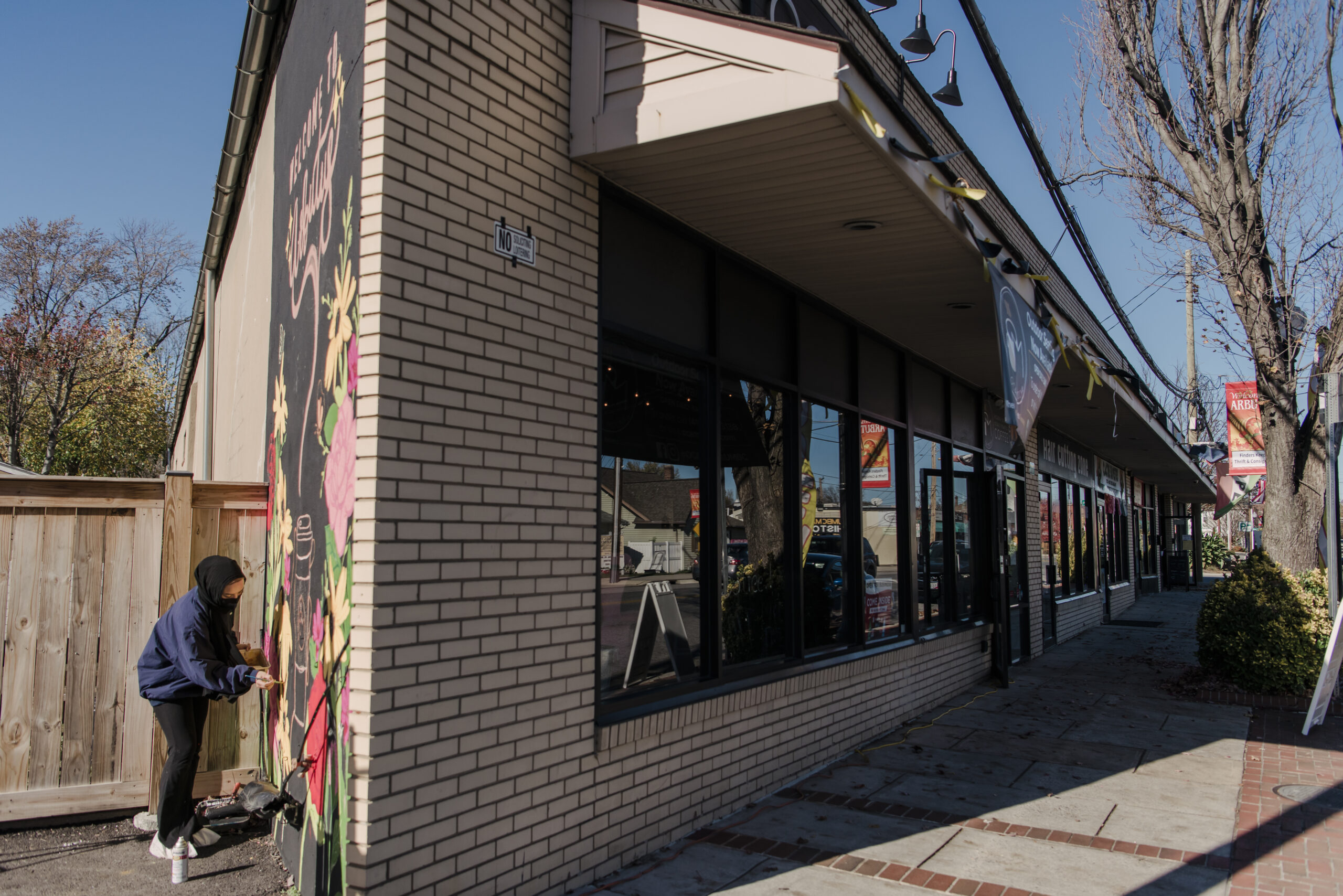
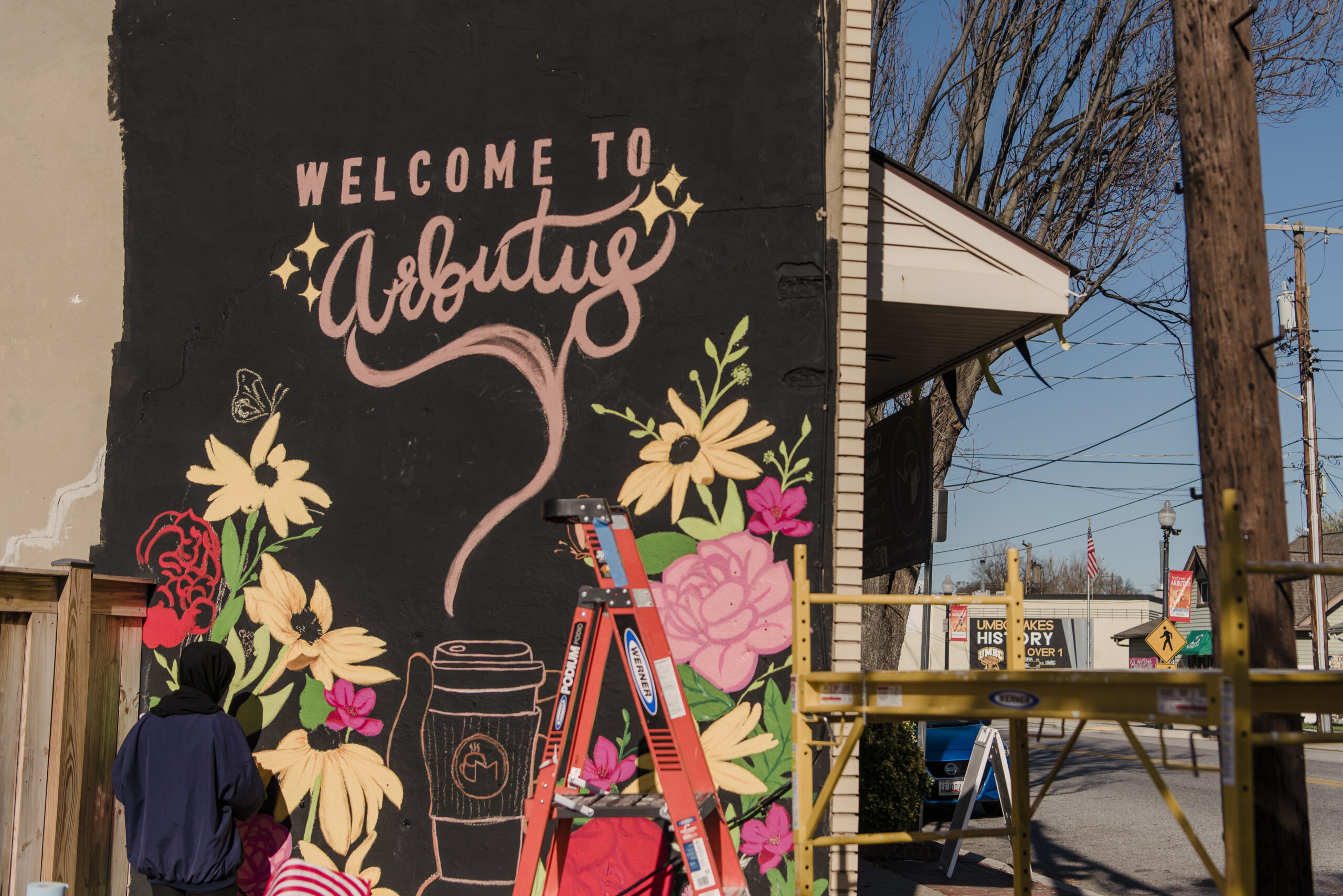
Last November, Zaynub Siddiqui ’21, psychology, set out to paint the town red—and yellow, green, pink, and black. Jumping at the chance to contribute creatively to OCA Mocha—the community-centered UMBC-affiliated coffee shop in neighboring Arbutus—the UMBC senior took a drab wall and transformed it over the course of her 20th birthday weekend. So, how exactly does one tackle a 150-square-foot blank space? For Siddiqui, it took vision, daring, and multiple iced matchas. But in the end she left local coffee lovers a floral feast for the eyes.

Tools of the Trade:

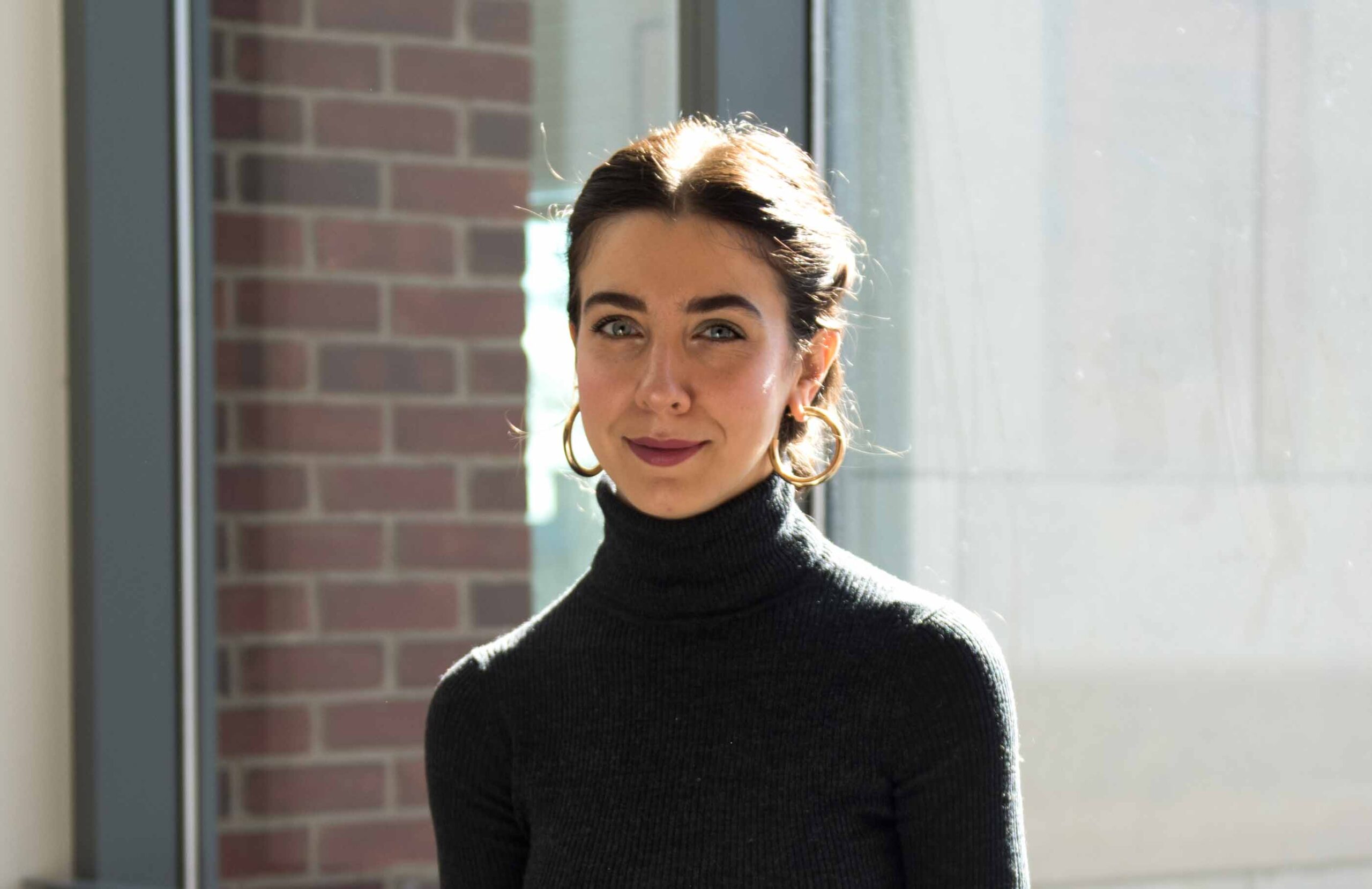
Headshot courtesy of Siddiqui.

  • A projector, a scaffold, and no fear of heights—To translate a design from the page to the side of a building, it helps to use an Epson 4K projector.
  • Shoe coverings—“Paint gets everywhere,” says Siddiqui. 
  • A passion for the subject matter—“I love plants, I have a whole bunch. I love gardening,” she says. 
  • A favorite coffee shop drink—“I really love an iced matcha,” says Siddiqui.
  • Advil—because that’s a LOT of standing.

Step 1: Find a Wall

In Siddiqui’s case, the wall found her. The people behind OCA Mocha put out a call for artists to decorate the wall adjacent to their outdoor patio and parking lot. Even though she is a psychology major (with a sociology minor), the notice caught her eye. “I’ve always wanted to be a part of UMBC’s art scene,” she says. “I would see their art building and their exhibit areas and think, I want to do that.”

As such, armed with a love of arts and crafts and her experience helping out with collective murals at the college she attended briefly before transferring to UMBC, Siddiqui submitted her ideas for consideration, and was excited to be chosen.

Step 2: Create a Design and a Plan

Siddiqui’s vision started with the idea of a steaming cup of coffee and adding her own spin with lots of florals. “Nature really inspires my artwork,” she says. She also wanted to create a space where people could easily snap fun photos of themselves. After a series of meetings and emails with OCA Mocha staff, they settled on a design.

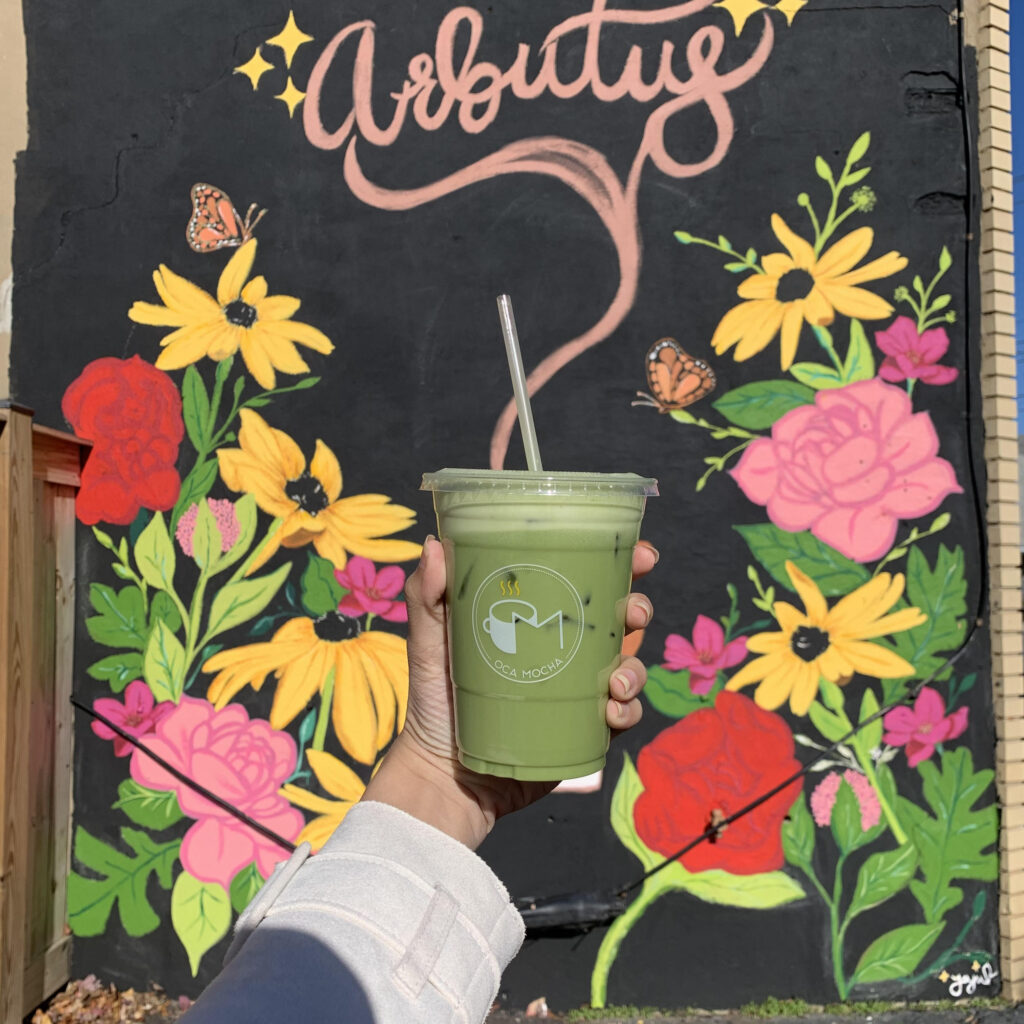
Photo of her favorite drink in front of her mural, courtesy of Siddiqui.

Siddiqui was excited that the timing of the mural aligned with her senior year. “Since this is my last year at UMBC, I’d sort of leave off with a bang,” she says. Siddiqui also appreciated being able to paint it on her birthday, showing growth artistically and personally. “Entering my 20s by doing this was something really exciting for me,” she says.

Step 3: Scale Up Your Art Supplies

Got paint brushes? Get bigger ones. Siddiqui also ditched regular art trays for mixing in favor of big foil trays usually used for food. For paint, you’ll need something a lot more durable than the stuff in your everyday art kit. Buy exterior primer for the base and exterior flat finish for the design.

And, don’t forget about clean-up. With a mural, paint splashes up, down, and all around, so Siddiqui suggests being prepared to cover up and wash up. “You think you’re not going to touch something…and then you’ll find it,” she says. “I had paint on myself a week and a half after. I’d say, ‘I thought I scrubbed my arms!’”

Step 4:  Be Prepared to Grow Your Art

When the time came to start painting, the huge wall size came as something of a surprise to Siddiqui once it was right in front of her. Undeterred, she painted flowers and more flowers, and then added more until the space was full. The end result? A burst of color (and coffee) that explodes into an otherwise humdrum parking lot.

Florals often find their way into Siddiqui’s work. As such, she packed it with some of her favorites, including a peony and roses. She also made sure to include flora and fauna that are special to the area. There is a monarch butterfly, native to the region, as well as plenty of Maryland’s state flower, the Black-Eyed Susan. Siddiqui even included a White Oak leaf in an homage to the famous Arbutus White Oak that fell in 2019.

Step 5:  Go and Dream Bigger Dreams

The mural may be done, but Siddiqui’s work is far from over. She plans to pursue a master’s degree in psychology and possibly mix her love of art with her love of how the mind works.

“They both provide different insights to people and how they think and their emotions,” she says. Eventually she’d like to possibly get into art therapy—but the scaffold sitting in her house now proves murals are still in her life. “I would love to have a mural in New York City or Los Angeles or Amsterdam…something that people would be able to take pictures of and remind them of nature.” Ultimately, she thinks that “just to put a smile on someone’s face would be really fun.”

— Karen Stysley

*****

All photos by Marlayna Demond ’11, unless otherwise noted.

Building a Better Baltimore—Together

As a first-generation college student from southeast Baltimore, Sondheim Scholar Stefanie Mavronis ’12, political science and media & communication studies, was initially hesitant to talk openly about her past. As she made a home—and a name for herself as an organizer—on campus, Mavronis realized that she could bring her whole self to UMBC. Now deputy director of communication for Baltimore City Mayor Brandon Scott, Mavronis channels her hometown pride and Retriever confidence to tackle connecting with constituents during a pandemic and what feels like an all-time low of public trust in government. 

In 2000, all eyes were on the presidential election—mine included—except I was fixated on winning the highest office of fifth grade. 

My teacher must have seen something in me, and she encouraged me to run for class president and generally explore things that I didn’t know were possible. It turns out that I naturally gravitate to these opportunities, whenever I’m in a new space or a new school or a new class—I end up organizing the people around me and working to make change.

All photos courtesy of Stefanie Mavronis. Portrait by Egan Jimenez, Princeton University.

Despite that, it wasn’t until my senior year at UMBC that I would explicitly share with people that I was from Dundalk. When people heard that about me first, there were stereotypes and assumptions about what I was capable of achieving and who I was.

Learning local history through my coursework at UMBC, reading books like Not in My Neighborhood, and having opportunities to explore and embed myself in the Baltimore community, where I was from became something that I wasn’t ashamed of. I wasn’t ashamed to be a first-generation college student—I was proud of it, and I started to see some of the unique leadership skills and insights that I brought as someone who came from that experience in Baltimore. UMBC was a safe and supportive space for my development as a young person and ultimately brought me to the position in the Mayor’s Office I have today.

Actively creating culture

At UMBC, I was always bursting at the seams with ideas and motivated to change the culture on campus. I have gratitude for my professors and mentors, who not only made time for me, but helped point me in new directions. In a big way, they were my support system. Delana Gregg, M.S. ’04, instructional development systems, Ph.D. ’19, language, literacy, and culture, who co-led the Sondheim Scholars program; Jodi Kelber-Kaye and Simon Stacey in the Honors College; Lisa Akchin in Institutional Advancement; Jason Loviglio in media and communication studies—I’m sure in his office alone, I probably spent tens of hours. 

When I came to campus at UMBC, I fully intended to be part of the Student Government Association (SGA) but instead got involved with another student leadership organization in my first semester: the students events board (seb). When it came to the people on campus who I saw actively shaping and creating campus culture—taking the reputation that the school had at that time as a “commuter school”—I was really interested in being one of the students making campus culture more inclusive and just, and helping incoming students find their place. 

As I got close to graduation, I realized one of the reasons why UMBC people stick together. We are collectively coming out of an institution that has gone to great lengths to not cushion us but help us find our individual paths, forge our unique lanes, and identify our strengths in a way that was very supportive. 

Mavronis in her office at City Hall. Photo by Mark Dennis.

The shift into the “real world” can be challenging. For me, it felt like I was being asked to fit myself into a box after being embraced for my whole, multifaceted self. I’m so grateful for my mentors and friends who sent me the message that they didn’t want me to change, who supported me in finding ways to communicate my strengths to the outside world.

Supporting a homegrown leader

In my last year of college, I applied for a mayoral fellowship which I ultimately did not get. Brandon Scott, a councilmember at the time, was part of my interview panel. I developed a proposal for how to address Baltimore’s vacant housing crisis over a summer, leveraging public-private partnerships in a different kind of community-based way. It was a wild plan, but Brandon recognized my passion, big ideas, and hometown pride.

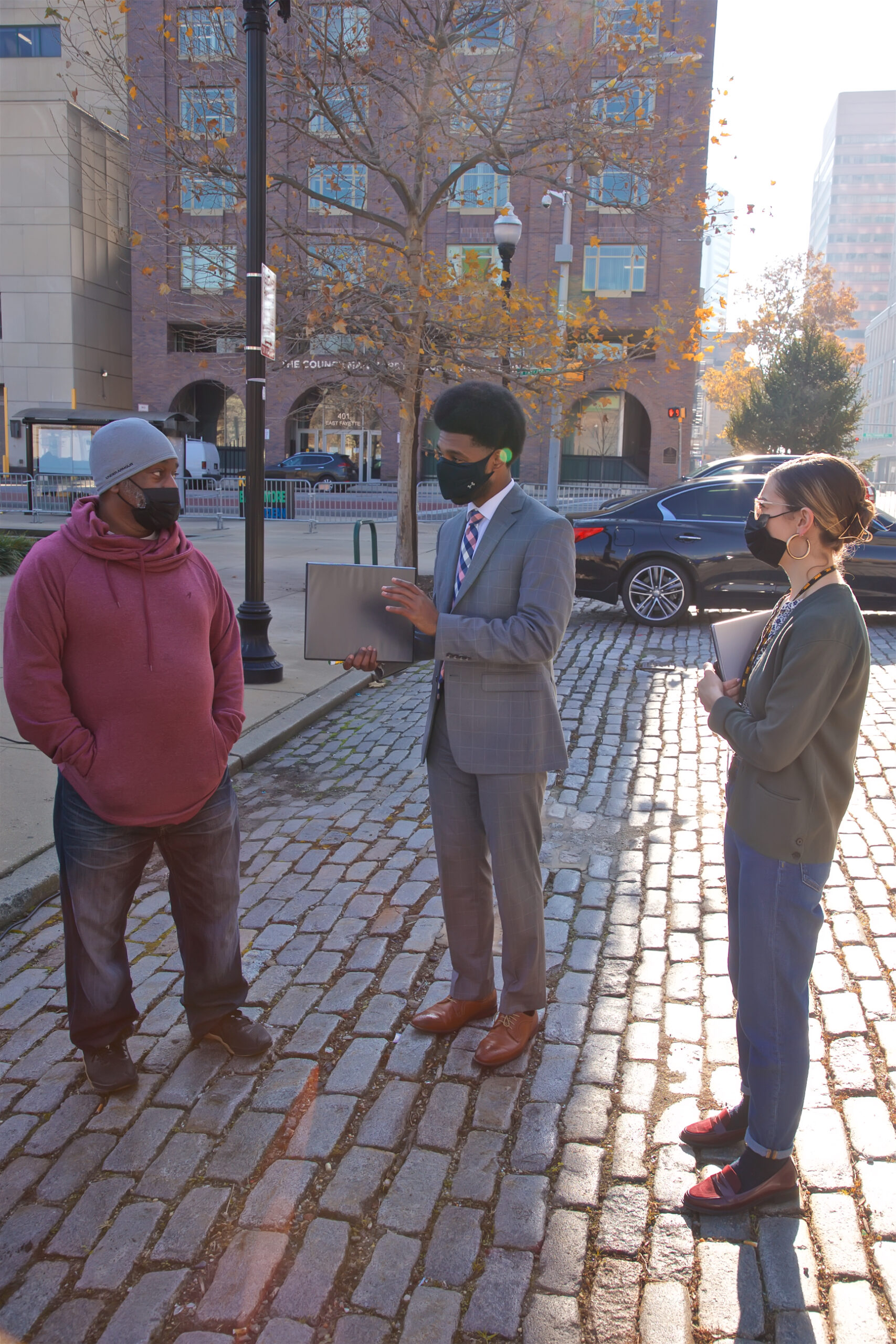
In December 2020, Mavronis accompanies Mayor Brandon Scott to talk to Baltimore residents about the city’s COVID response. Photo by Mark Dennis.

Brandon was a frequent guest on the Marc Steiner Show on WEAA 88.9-FM, where I worked as a producer for several years. Even back then Brandon often spoke about the need for local control of our police force and holistic strategies to combat gun violence. When I left to attend Princeton for graduate school, one of the ways I stayed connected to Baltimore was working with Brandon on the development of his strategy as the public safety chair of the City Council. After getting my master’s, I returned to Baltimore and landed a job at City Hall in Councilmember Zeke Cohen’s office.

After Brandon won his bid for council president in 2019, I was tapped to serve as his Communication Director. I was energized to work for a homegrown leader, someone who has a keen sense of what Baltimore needs and unconditional love for the people of the city in a way that I have not always seen or felt from leaders in the past.

Calling all visionaries 

If you don’t like the way that things are, play an active role in changing them. There’s a lot of people who have made me feel like that’s possible throughout history and in my own life, from my successful bid for  fifth grade class president to running a more competitive race in high school to represent southeast Baltimore County at a county-wide level in student government. 

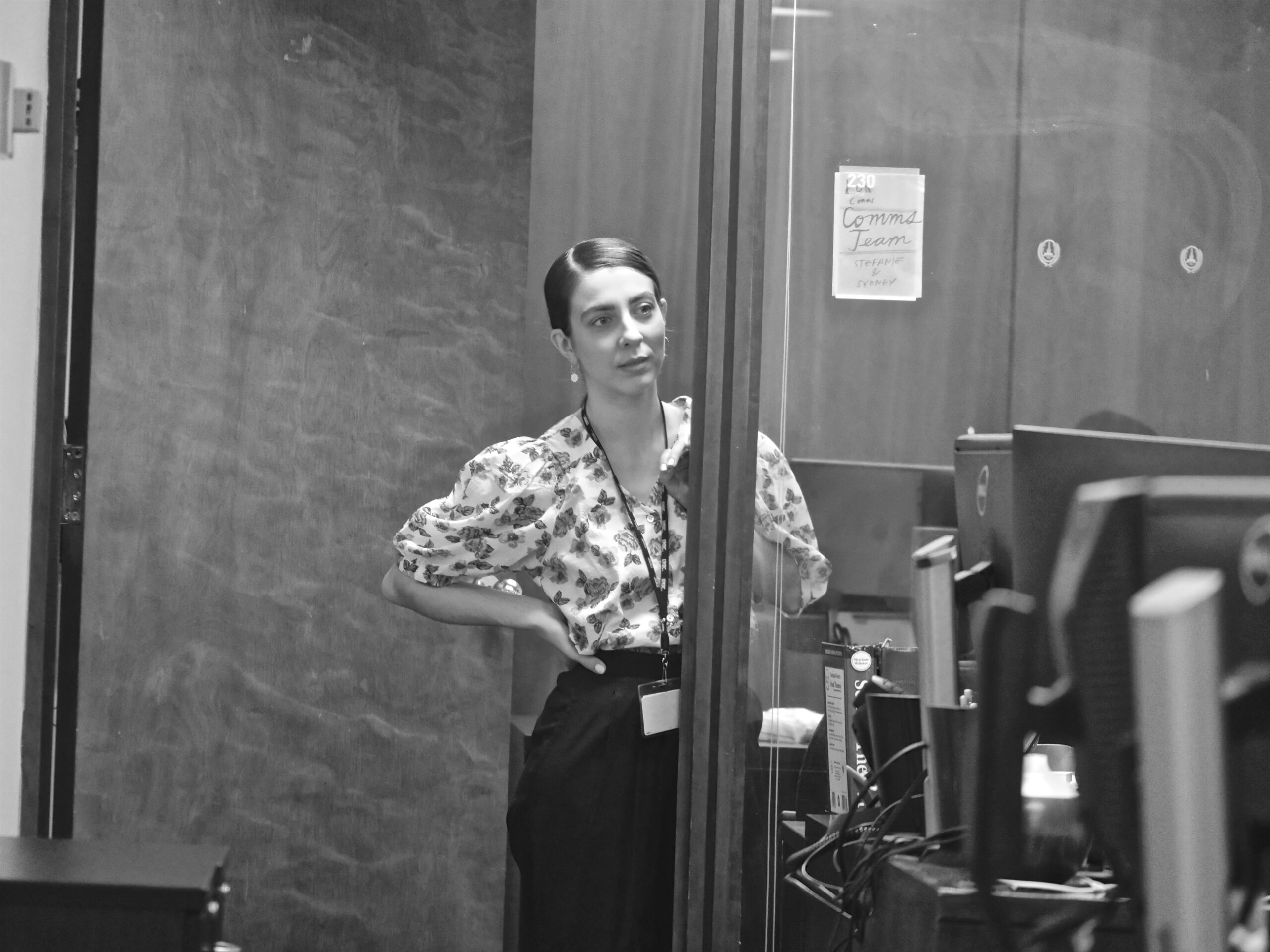
Mavronis working alongside Mayor Scott and Press Secretary Sydney Burns in the Mayor’s Office at City Hall. 

I never expected to work in local government, but am so glad I landed here. And now being here, I often wish there were even more people in this space with visionary ideas who aren’t deterred by boundaries, willing to try new things. Confronting the legacy of redlining and inequitable systems is not overnight work—but I now see how it takes people finding new ways to work together inside and outside of government to make transformative change and rebuild the trust that’s eroded over time. 

I’m excited to be tasked with the opportunity and responsibility to be part of shaping this administration and bringing more people into this project of building a stronger Baltimore City, one that’s more equitable and accountable and that works better for people.

*****

Header image: Mavronis, in yellow coat, accompanies Mayor Brandon Scott to a UMBC co-sponsored vaccination pop-up event for the Lakeland community in southeast Baltimore. Photo by Marlayna Demond ’11.
Crossword Puzzle Genius (14 letters**)

When Andrew Beck ’21, individualized studies, was a kid playing his first Game Boy Advance puzzle platform game, Mario vs. Donkey Kong, he didn’t know that video game design was a career option. After his freshman year living with the Individualized Studies Living and Learning Community, Beck caught a glimpse of a future he could look forward to—creating immersive game experiences. Although Beck is drawing on computerized games for his capstone project, his affinity for sudoku and crossword puzzles has grown as his trivia knowledge has flourished at UMBC. Get out your pencil—or pen, if you’re really feeling confident—and give his latest game a go.
**A New York Times-worthy 14-letter word for “crossword puzzle genius” is “cruciverbalist.”

[umbccrossword]
======REPLACE WITH YOUR PUZZLE BELOW======
exolve-begin
exolve-id: andrew-beck-crossword-puzzle-genius-spring-2021
exolve-width: 15
exolve-height: 15
exolve-grid:
FOOD.CRETE.BAJA
ARNO.LONAS.ATON
RETRIEVERS.STUT
MOO.OVERT..MILE
…RUE.GAS.ACE.
POGO..MINUET…
TRUEGRIT.SPIRIT
ANA.LOA.CHI.IDA
POMPEY.ERICKSON
…REALLY..EELS
.EMO.LAE.PAY…
SNAP..SMIRR.SOL
ASIA.CHESAPEAKE
KILN.HENRY.AURA
ESSE.ASTER.TRAP
exolve-across:
1 Energy provider (4)
5 Minoan land (5)
10 Mexican peninsula (4)
14 Italian river in Florence (4)
15 Chamomile genus (5)
16 “This is so heavy, it must weigh __!” (4)
17 Dog breed and team name? (10)
19 Trip over words (4)
20 Cow speak (3)
21 In the open (5)
22 A few thousand feet (4)
23 To regret (3)
24 Fuel, or excrement (3)
26 Highest or lowest card (3)
27 Hopping device (4)
30 Slow dance (6)
32 Dining hall and mascot? (8)
35 Being from beyond the grave (6)
39 Quote collection (3)
40 Half a volcano (3)
41 Greek letter X (3)
42 Zeus’ mountain (3)
43 Roman general, Caesar rival (6)
45 Hall, field, and school? (8)
47 Emphasis (6)
49 Snake-like fishes (4)
50 Emotional punk music (3)
52 WWII supply base for Japan (3)
53 Give money (3)
55 Finger click (4)
56 Drizzle (5)
58 Relating to the Sun (3)
61 Substantial continent (4)
62 Residence hall and bay? (10)
64 Clay baker (4)
65 Eight kings (5)
66 Energy field (4)
67 Philosophical essence (4)
68 Daisy type (5)
69 Admiral Ackbar finding (4)
exolve-down:
1 Animal and crop home (4)
2 Milk’s favorite (4)
3 Get on (4)
4 Buzzing bug (3)
5 One’s house, for some (5)
6 Move without purpose (4)
7 Czech jazz fusion band (7)
8 Scots’ design (6)
9 Feminine ending (3)
10 Long grain Indian rice (7)
11 Upper storage (5)
12 Energy measurement (5)
13 Place a bet (4)
18 Debt agreement (3)
23 Inner fish eggs (3)
25 Japanese cuisine (5)
27 Slang for UMBC bldg. (4)
28 “Is that a yes __” (4)
29 U.S. Territory (4)
30 Whereabouts unknown (3)
31 Homer’s poems (4)
33 Joy and excitement (4)
34 The highest nobility (5)
36 Proving dough causes this (4)
37 Adored one (4)
38 Takes in the rays (4)
41 Shout out (3)
44 Grill requirement (7)
45 Periodic table unit (7)
46 Essential (3)
48 Eye hair, real or otherwise (6)
50 Old and wise (5)
51 Sends in postage (5)
53 Speak with a god, shorter (5)
54 French artist Jean (3)
55 Hot rice alcohol (4)
57 River in SE France (4)
58 Jurassic suffix (4)
59 Podded veggie (4)
60 Spring up (4)
62 Half of a dance (3)
63 Consume (3)
exolve-end

======REPLACE WITH YOUR PUZZLE ABOVE======

[/umbccrossword]

If you find yourself wanting a few answers, look no further.

An Interrupted Education, Completed

In the late 1960s, Bob Bolton ’70, mathematics, caught glimpses of his mother around UMBC’s new relatively small campus. While he was heading to or from class, he’d spot her in the French Department, where Elinora Bolton ’70, French, was getting her undergraduate degree, or in the library, studying.

“It was quieter than at home,” Bolton says, laughing. He had nine brothers and sisters, and most of them still lived in their Elkridge home at the time.

In spring of 1970, Bob in his cap and gown followed his 52-year-old mother, in her own commencement regalia, across the stage. Mother and son were awarded their undergraduate degrees in the same first graduating class of UMBC.

“I was so proud of her,” said Bolton, the second son in the family and now the chief executive officer of an actuarial firm. “I didn’t really appreciate then how hard it was for her.”

A tribute to the matriarch

In 2018, Bolton wanted to honor his mother, and all his family. So he endowed the Bolton Family Scholarship, to support two students annually in UMBC’s Individualized Studies Program (INDS), with stipends of $1,000 a semester. “Education was the most important thing” to his parents, Bolton says, though they were agnostic about their fields of study. “They gave us no particular direction, they just made sure we were well educated.”

Bolton explains that he chose to give the scholarship to INDS majors to reflect the breadth of interests of the Bolton family members who attended UMBC, studying everything from math and music to French, sociology, and geography.

“The INDS program is grateful for the generosity of the Bolton family,” says Carrie Sauter ’96, psychology, INDS assistant director. “Their commitment to support the INDS student community offers a wonderful family tribute of hard work and success.”

An international childhood

Born into Baltimore society in the elegant townhouse that is now the Brewer’s Art restaurant, Elinora Bowdoin moved to France at age 7 with her mother and sister after her parents’ divorce, according to Steve Bolton, her son and family historian. At 18, Elinora was presented in a flowing white dress to King George VI, Steve says. She studied at the Sorbonne in Paris for 18 months, but the onset of World War II and her mother’s death interrupted her education.

Elinora and her sister returned to Baltimore in 1939. “Feeling foreign” and a bit at sea, Steve says. The sisters kept themselves busy with becoming nationally ranked as tennis doubles champions, and attending balls at elegant locations, such as the Alcazar Hotel (now the Baltimore School for the Arts), where Elinora met her future husband in 1940.

Elinora and Robert Bolton in an undated photo.

Robert Harrison Bolton was a pilot in the Army Air Corps and married Elinora on a three-day pass. Their first child was born in 1944, and for more than 20 years, Elinora stayed home to raise her children. The family remembers her as an energetic mother, an indifferent cook, and an avid reader.

“She did have the life of the mind,” Steve says.

A family tradition

The same year her tenth and final child entered kindergarten, Elinora started at UMBC. Her records from the Sorbonne were lost in the war, so she began again at the beginning. Almost tripped up by having to kill and dissect a frog in a biology course, Elinora persevered for four years while her “well-trained” children looked after one another when she was on campus, Bob says.

After her graduation from UMBC, she remained close friends with May Roswell, a UMBC founder who established the modern languages department. Elinora went on to earn her master’s degree in French literature at the University of Maryland, College Park, and teach for decades at UMBC, College Park, and Catholic University. She died in 2012 at the age of 92.

Following mother and son’s trailblazing graduation, the family has established a legacy at UMBC. In 1975, Chris, another of Elinora’s sons graduated with a degree in sociology, and in 1986 her two youngests, Andy and Jim, graduated together with degrees in music and sociology, respectively. Her granddaughter Erin Bolton, geography, graduated from UMBC in 1999.

Education is a family tradition. At their childhood home, complete with a family goat and all those siblings, the brothers remember their mother’s books and papers spread out on the dining room table, evidence of her life of the mind. But mostly Elinora studied outside her house. It was quieter.

— Susan Thornton Hobby

*****

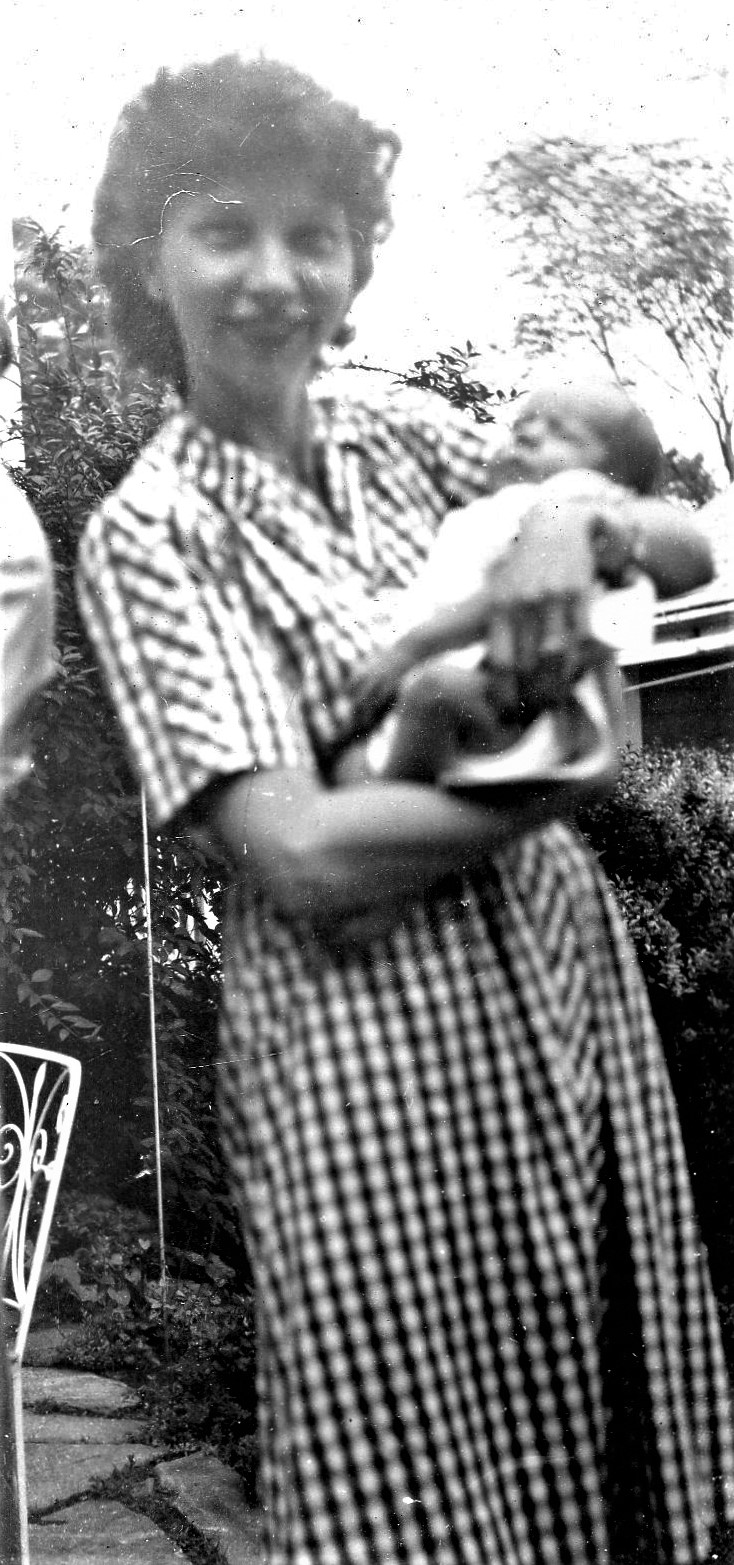
Header image of Elinora Bolton with her husband Robert and their 10 children in 2002. All photos courtesy of the Bolton family.

Losing Winter

Losing Winter, a new exhibition opening in mid-July at the Maryland Center for History and Culture (MCHC) in Baltimore, examines changes in winter weather patterns through photographs, video, and personal memory.

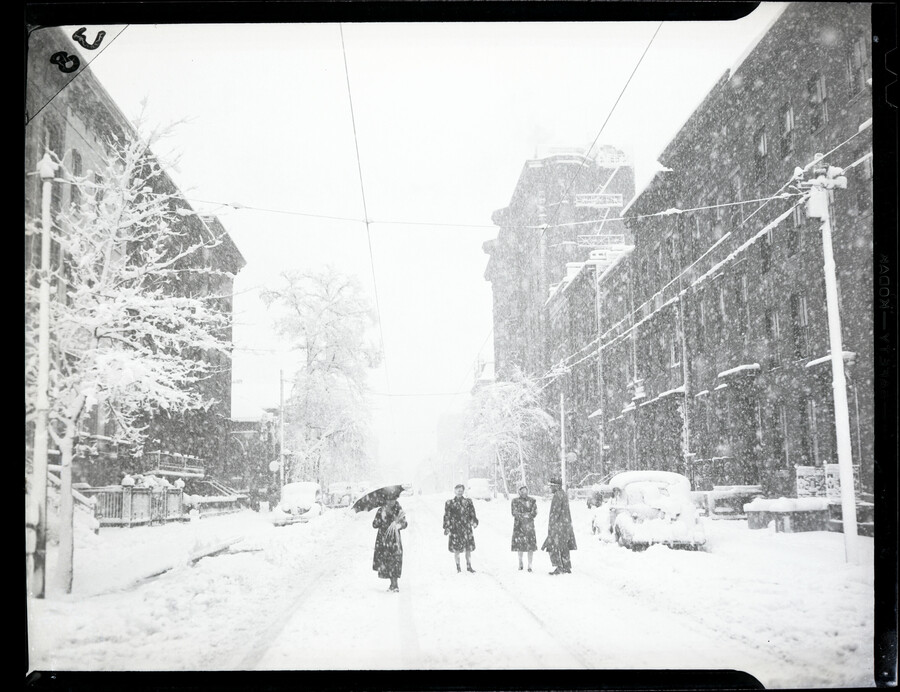
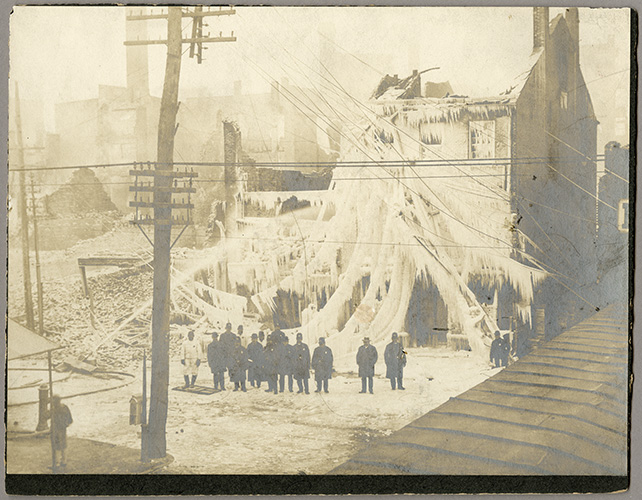
The brainchild of Lynn Cazabon, professor of art and director of CIRCA, and co-curated for MCHC by UMBC history alumnus Joe Tropea ’06, history and M.A. ’08, historical studies, the exhibit includes images as varied as a news report by a young Oprah Winfrey, “Snowmageddon” in 2010, icy conditions during the Great Fire of Baltimore in 1904, and the 1899 blizzard.

Although the exhibition doesn’t directly address climate change, it’s certainly a subtext, said Cazabon, whose interdisciplinary work has often centered on the intersection of environmental and social issues. 

“Things are changing,” she said. “What are we doing about it?”

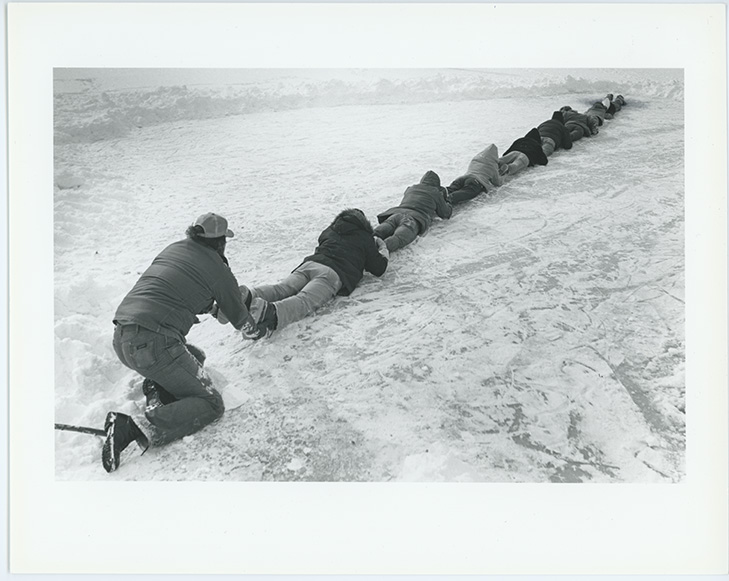
Untitled. Winter Survival Class, Ice Rescue. Tim Ford (?-?) 1986. Gelatin silver print, 10 x 8 inch. Tim Ford photographs, the Photography Collections, University of Maryland, Baltimore County. UARC2015-07-01-0091

Winter Memories

Losing Winter was sparked by Cazabon’s own memory of freezing as she ice skated at age 14 in Michigan where she grew up. “That lake, in fact, doesn’t reliably freeze anymore,” she added. The idea percolated further in 2014 while Cazabon was making a film about women who had moved to the Yukon.

Talking about the weather used to be the quintessential conversation starter, she noted. “Now it’s fraught with emotion and worry. The weather is not an innocent topic anymore.”

“It forces us to think about the possibility of climate change. Why is our climate changing?” said Tropea, curator of films and photographs at MCHC.

The MCHC show features Maryland memories while a concurrent mounting of the exhibition at VisArts in Rockville will pair recorded reminiscences by area senior citizens with children’s artwork inspired by those memories. The VisArts exhibition opens in May.

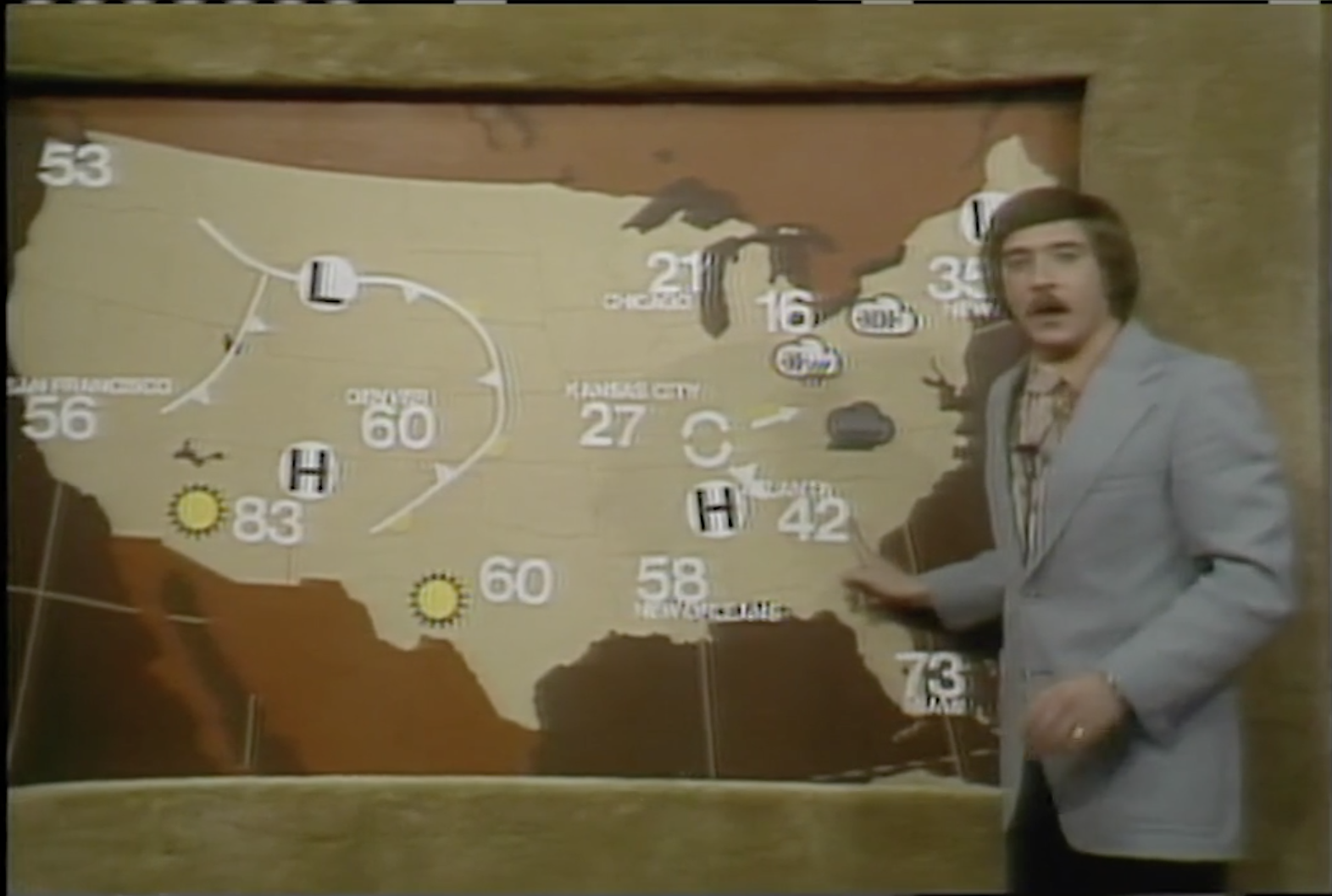
At MCHC, home movies and weather reports from the 1970s, ‘80s and ‘90s will be on display, including a report from Oprah Winfrey, then on the WJZ news staff, interviewing ice skaters at the old Memorial Stadium.

“It’s an experience that takes you through the decades,” Tropea said.

Snow on Palm Sunday. Park Avenue. A. Aubrey Bodine (1906-1970). March 29, 1942. 5 x 4 inch acetate negative. A. Aubrey Bodine Photo Collection. Baltimore City Life Museum Collection. Maryland Center for History and Culture, B1548-2.

Cazabon said she discovered “little moments of joy” along the way, such as a woman in her 80s recalling street skating in her boots, Baltimore Sun photographer A. Aubrey Bodine’s historic photos of Groundhog Day ceremonies, and old weather forecasts.

One of Tropea’s favorite pieces is 1928 industrial footage taken at the Holtwood Dam over the Susquehanna River. Ice floes rushing toward the bay caused extensive damage near the shoreline before the dam was built, Tropea said. The film, which will be projected on a large wall, depicts ice floes going over the dam and breaking apart as they fall. 

“Just watching it makes me feel cold,” Tropea said.

For the MCHC show, Cazabon and Tropea delved into the archives at MCHC as well as in the Special Collections Department of the Albin O. Kuhn Library with the help of Lindsey Loeper ’04, American studies, reference and instruction archivist.

Since Covid-19 restrictions have closed the library to researchers, Loeper collected 35 photos to show the professor and Tropea via video conferencing. 

“There were things I’ve never seen before,” she said, noting that the collection has millions of pieces. Among the items she shared were glass negatives and works by well-known photographers such as Marion E. Warren. The oldest photo featured children throwing snowballs in 1914.

Ice covered ruins of Anderson & Ireland Hardware. Unidentified photographer, February 8, 1904 or after. Photo print, 8.5 x 7 inches. Subject Vertical File. MCHC.

Evolving Exhibit

Cazabon mounted her original Losing Winter exhibition at the National Museum of Contemporary Art in Bucharest, Romania, in 2018. It featured audio memories of past Romanian winters, along with melting ice sculptures by a local artist.

As part of the Losing Winter experience, Cazabon is also working with UMBC’s Imaging Research Center on an augmented reality app to display and allow people to experience the winter memories of others. Cazabon received a 2020-21 Saul Zaentz Innovation Fund grant to produce the app. The exhibition at MCHC will include a display of the app playing memories collected from people in Maryland. Cazabon has been working with MCHC Community Engagement Manager Martha Oster-Beal to host virtual workshops during which memories are shared and recorded.

Marty Bass WJZ, circa 1978

The yearlong exhibition will be housed on the second floor of MCHC, in gallery space across from the H. Furlong Baldwin Library. Visiting at the hottest time of year, when the exhibit launches, “you might be dreaming of winter,” Cazabon said.

Cazabon said the project keeps evolving. The modular format of her project also makes it adaptable. She invites members of the UMBC community to contact her to participate. She’s open to a variety of memories and opinions. 

“The project is designed to evolve with each new site,” she said, adding, “I would like it to be a collection that includes people from around the world.”

— Mary K. Tilghman ’79

“Baltimore Hucksters,” Roland Freeman (1936- ), 1970. Gelatin silver print, 14 x 11 inch. Roland Freeman photographs, Special Collections, University of Maryland, Baltimore County, P79-42-004.

* * * * * *

MCHC will host participatory virtual workshops for residents to record their memories on April 29 and May 27. Go to www.mdhistory.org/events for details and registration.

For more information on how to participate in the project, visit https://www.losingwinter.net.

* * * *

Header image: Blizzard of 1922, Saturday afternoon. Unidentified photographer, January 28, 1922. Photo print, 10.25 x 13.5 inches. Municipal Museum Collection. Maryland Center for History and Culture, MC1909.

Are America’s schools safe for Asian Americans?

By Charissa S. L. Cheah, professor, psychology, UMBC; Aggie Yellow Horse, Arizona State University, and Kevin A. Gee, University of California, Davis

The rise in anti-Asian hate crimes during the pandemic has prompted many Asian American parents to enroll their children in remote learning out of concern for their child’s safety at school. Asian American youths are enrolled in remote learning at much higher rates than other racial groups. Federal data show that 78% of Asian American eighth graders attended school virtually in February 2021, whereas just 59% of Black, 59% of Latino and 29% of white students attended school virtually.

Here, three scholars address school safety for Asian American students.

Are American schools dangerous for Asian American students?

Aggie J. Yellow Horse, assistant professor of Asian Pacific American Studies at Arizona State University.

Data show that many Asian American youths have experienced anti-Asian violence in the past year.

Asian Americans have experienced a great deal of racial harassment amid the COVID-19 pandemic. A recent survey found that 1 in 8 Asian Americans reported experiencing anti-Asian hate incidents in 2020. The victims of that harassment aren’t just adults – they include students.

Since the beginning of the pandemic, more than 3,800 hate incidents targeting Asian Americans and Pacific Islanders have been reported to the Stop AAPI Hate National Reporting Center. Among the incidents early in the pandemic, 16% percent of the targets were Asian American youths ages 12-20.

A group of mask-wearing protestors hold signs in the middle of the street.
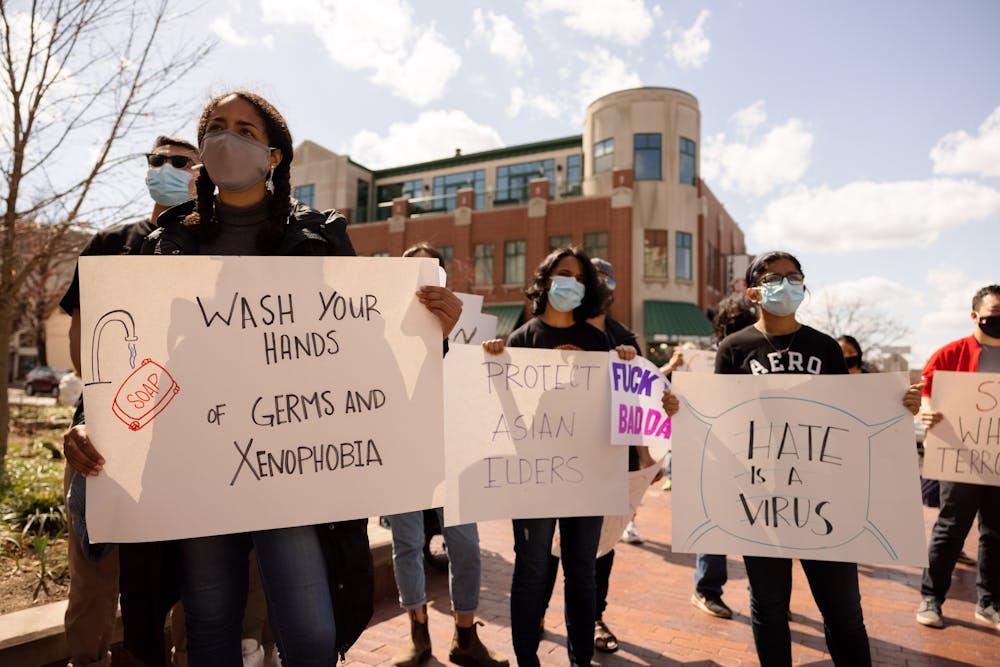
Anti-Asian hate crimes have been on a steep rise during the pandemic. Jeremy Hogan/SOPA Images/LightRocket via Getty Images

The majority of the young victims, about 80%, reported being bullied or verbally harassed. In over half the incidents, the perpetrator used anti-Asian hate rhetoric. About 1 in 5 hate incidents happened at school.

National trends before the pandemic suggested that Asian American students were already more likely to experience racial discrimination, such as race-related name-calling, from their peers at school than other categories of students. About 11% of Asian American students reported being called hate-related words, compared with 6.3% of white students in 2015. A separate study found that bullying and physical violence were less of an issue for Asian American students. Only about 7.3% reported being bullied at school in 2017, compared with 23% of white students.

How common race-based harassment against Asian students is can vary based on different factors, such as where students live, their gender, grades or immigration status. For example, a study from California found that Asian American sixth graders in California reported being bullied and victimized at higher rates than other racial groups.

What are the biggest worries for Asian American youth and parents?

Charissa S. L. Cheah, professor of psychology at the University of Maryland, Baltimore County

Many Asian American parents are worried that their children will be the victims of discrimination once school reopens.

Asian American parents are worried about schools reopening. NPR3.38 MB (download)

In one survey, nearly 1 in 2 Chinese American parents and 1 in 2 Chinese American youth reported being directly targeted with COVID-19 racial discrimination in person or online. About 4 in 5 of these parents and their children also reported witnessing racism directed at someone else of their own race either online or in person.

Despite their concerns, some parents may avoid talking to their children about anti-Asian racism to avoid scaring them while they are at school. Even if parents want to have the “race talk” with their children, many struggle with how to talk to their children about the potential racism they might encounter. Some parents may not have been taught these lessons while growing up and are grappling with how to make sense of these experiences.

Anti-Asian racism is also associated with greater depressive symptoms and anxiety in Chinese American parents and their children. A majority of Americans blame China for its mishandling of the coronavirus outbreak. Researchers have found that even thinking that one’s racial or ethnic group is viewed by the general public as a threat to the health of Americans is linked to poorer mental health in both Chinese American parents and youths.

Asian Americans are less likely than non-Hispanic white Americans to seek mental health help. This is due in part to perceived stigma, language barriers and lack of mental health providers of the same ethnicity. These disparities are even greater for Asian American families with fewer financial resources.

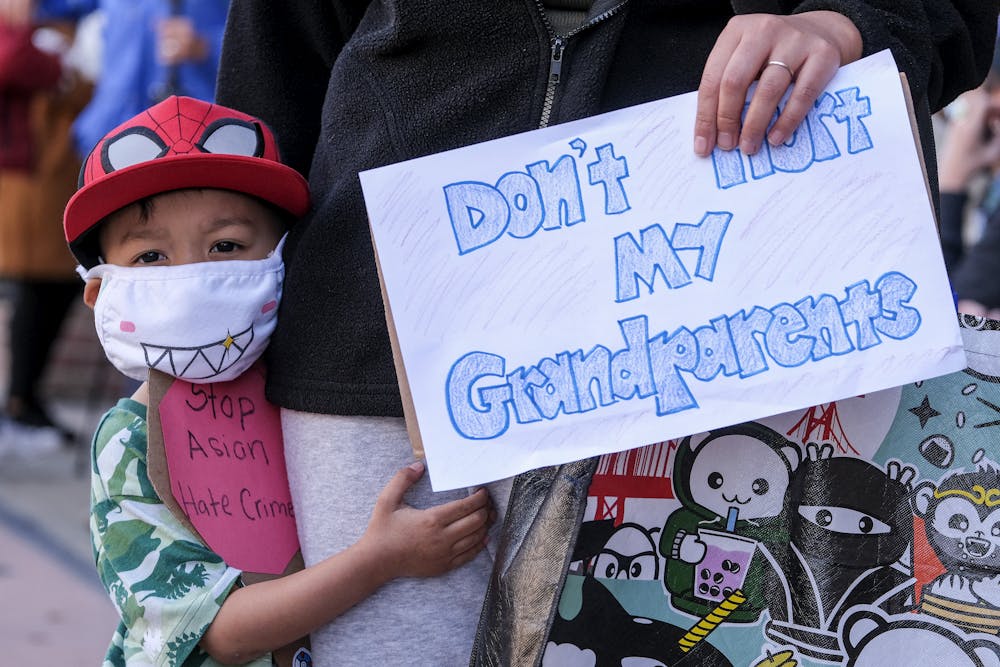
A young Asian American boy wearing a mask stands next to someone holding a sign which reads 'Don't hurt my grandparents.'
Elderly Asian Americans are at a higher risk of being hospitalized or dying from COVID-19. Ringo Chiu/AFP via Getty Images

Some Asian American parents have also expressed concerns about the ability of schools to maintain appropriate COVID-19-related health and safety measures. They are worried about the health risks that children exposed to others at school might bring home. Asians Americans are more likely to live in a multigenerational household, in which older adults might be at a higher health risk.

Even if parents choose to keep their children home because of one or several of these concerns, they are getting the message that in-person education is superior to virtual education. Being out of physical school could cause Asian Americans to miss out on these opportunities and resources even more. Also, due to the “model minority myth,” which characterizes Asian Americans as successful, the needs of this very diverse group, including a large number of immigrant and refugee Asian families in the U.S., are often overlooked. With 30% of Asian Americans reporting limited English proficiency, these families are more difficult to reach. The fears of being harassed also make some parents reluctant to access educational materials or free meals or even reach out to teachers or counselors for help.

What can schools do to reduce threats to Asian American students?

Kevin Gee, an associate professor in the school of education at the University of California Davis

Helping students build strong and supportive relationships with each other can reduce their physical victimization and buffer the negative effects of discrimination Asian Americans face.

Schools can also create supportive environments by implementing a range of evidence-based approaches, such as building teachers’ cultural knowledge and strengthening teacher-student relationships. Activities like engaging students in class discussions about bullying have been shown to reduce bullying.

Students and their teacher sit around desks engaging themselves in a class discussion.
Class discussions around the harms of bullying in schools can prevent harassment toward Asian American students. RichVintage/E+via Getty Images

Alongside initiatives to build supportive environments, schools should also consider partnering with parents. Directly engaging Asian American parents in anti-bullying initiatives can help reduce victimization. For example, schools can collaborate with parents to craft disciplinary policies on bullying. Schools can also hold workshops to teach parents how to handle and prevent bullying.

In order to reduce threats and eradicate harm, I believe schools will need to consider whether they are doing enough to protect Asian American youth. One landmark case underscores this. In the aftermath of violent attacks on Asian American students at South Philadelphia High School in 2009, a Department of Justice investigation revealed that the school district was “deliberately indifferent” to harassment against Asian students that fueled the attacks.

A key takeaway: Harms against Asian American students can be systemic and require broader structural solutions. When South Philadelphia High School began to do more to promote multicultural awareness and improved systems to report and investigate harassment, the school saw fewer violent incidents.

To make Asian American youth feel safe and protected, schools need to track, report and respond to incidents of hate against Asian Americans, especially among Asian American ethnic subgroups. Subgroup data, often lacking on Asian Americans, can be a powerful tool in revealing potential disparities and highlighting groups that schools need to target for support.

I believe schools also need to invest in longer-term systemic changes such as including a more complete history of Asian Americans in U.S. social studies curricula.

*****

Header image: Eight out of 10 Asian American youths reported being bullied and harassed during the pandemic. RyanJLane/E+ via Getty Images

Charissa S. L. Cheah, Professor of Psychology, University of Maryland, Baltimore County; Aggie Yellow Horse, Assistant Professor of Asian Pacific American Studies, Arizona State University, and Kevin A. Gee, Associate Professor of Education, University of California, Davis

This article is republished from The Conversation under a Creative Commons license. Read the original article.