All posts by: Magazine Editor


Why rural white Americans’ resentment is a threat to democracy

Written by Thomas F. Schaller, professor of political science, UMBC

Rural white voters have long enjoyed outsize power in American politics. They have inflated voting power in the U.S. Senate, the U.S. House and the Electoral College.

Although there is no uniform definition of “rural,” and even federal agencies cannot agree on a single standard, roughly 20% of Americans live in rural communities, according to the Census Bureau’s definition. And three-quarters of them – or approximately 15% of the U.S. population – are white.

Since the rise of Jacksonian democracy and the expansion of the vote to all white men in the late 1820s, however, the support of rural white people has been vital to the governing power of almost every major party coalition. Which is why my co-author Paul Waldman and I describe rural white people as America’s “essential minority” in our book White Rural Rage: The Threat to American Democracy.

As a political scientist, I’ve written or co-written five books addressing issues of racial politics at some level of government or part of the country. My latest, White Rural Rage, seeks to understand the complex intersections of race, place and opinion and the implications they hold for our political system.

The unfortunate fact is that polls suggest many rural white people’s commitment to the American political system is eroding. Even when they are not members of militant organizations, rural white people, as a group, now pose four interconnected threats to the fate of the United States’ pluralist, constitutional democracy.

Although these do not apply to all rural white people, nor exclusively to them in general, when compared with other Americans, rural white people:

  • Express the most racist, least inclusive, most xenophobic, most anti-LGBTQ+ and most anti-immigrant sentiments.
  • Subscribe at the highest rates to conspiracy theories about QAnon, the 2020 presidential election, Barack Obama’s citizenship and COVID-19 vaccines.
  • Support a variety of antidemocratic and unconstitutional positions and exhibit strong attachments to white nationalist and white Christian nationalist movements inimical to secular, constitutional governance.
  • Are most likely to justify, if not call for, force or violence as acceptable alternatives to deliberative, peaceful democracy.

Let’s examine a few data points.

Xenophobia

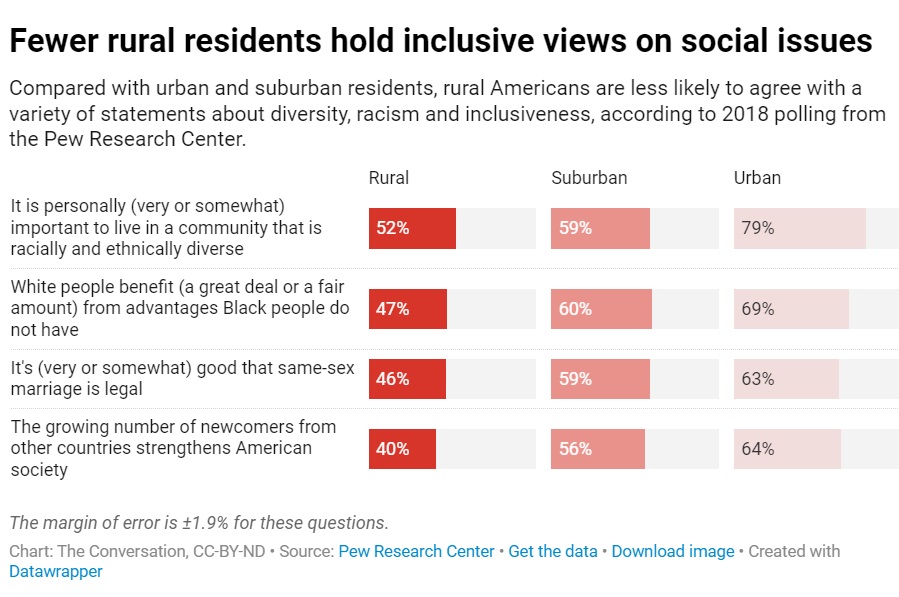
A chart comparing the percentages of rural, suburban, and urban residents that agree on statements about diversity, racism, and inclusiveness

In a Pew Research Center poll conducted in 2018, 46% of white rural Americans said it is important to live in a diverse community. That’s a lower proportion than urban and suburban dwellers and even nonwhite rural residents.

And in rural areas, fewer than half the people said white people have advantages Black people do not, approve of the legalization of same-sex marriage, and say immigrants make American society stronger.

In addition, Cornell researchers found that rural whites reported feeling less comfortable with gay and lesbian people than urban whites do. And 49% of rural LGBTQ+ people between the ages of 10 and 24 called their own towns “unaccepting” of LGBTQ+ people – nearly twice the rate of suburban and urban LGBTQ+ young people who said the same about their communities.

Conspiracism

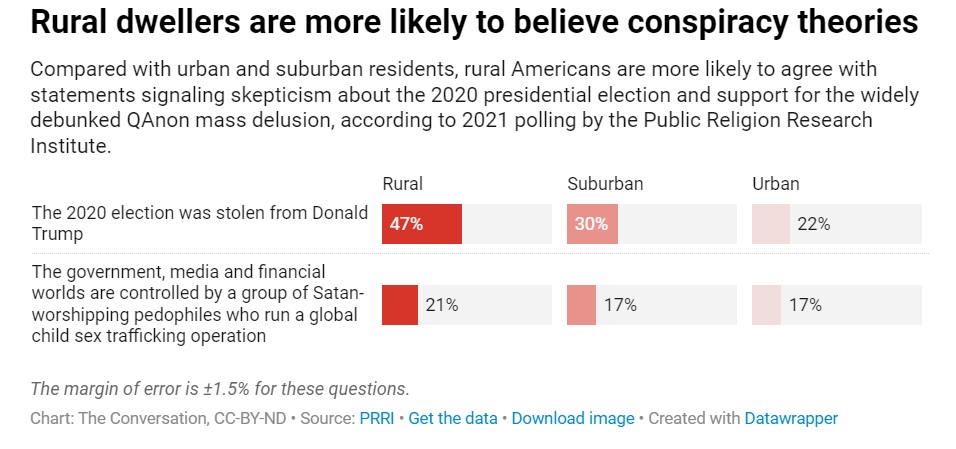
Chart on the percentages of rural, suburban, and urban dwellers who are more likely to believe in conspiracy theories

Polls in 2020 and 2021 indicated that QAnon supporters are 1.5 times more likely to live in rural areas than urban ones, and 49% of rural residents – 10 points higher than the national average – believe a “deep state” undermines Trump.

Rural residents are also more likely than urban and suburban residents to believe the 2020 election was stolen from Trump, according to 2021 polling by the Public Religion Research Institute.

And people who live in rural areas are also less confident as a whole than those who live in urban areas that votes will be counted accurately and fairly in their state or across the country, according to a 2022 poll from the Bipartisan Policy Center.

In addition, by our analysis, of the 139 U.S. House members who voted to reject the certification of Joe Biden’s presidential election just hours after a violent mob of Trump supporters rampaged through the Capitol, 103 – 74% – represented either “purely rural” or “rural/suburban” districts, as categorized by Bloomberg’s CityLab project.

Rural antidemocratic beliefs

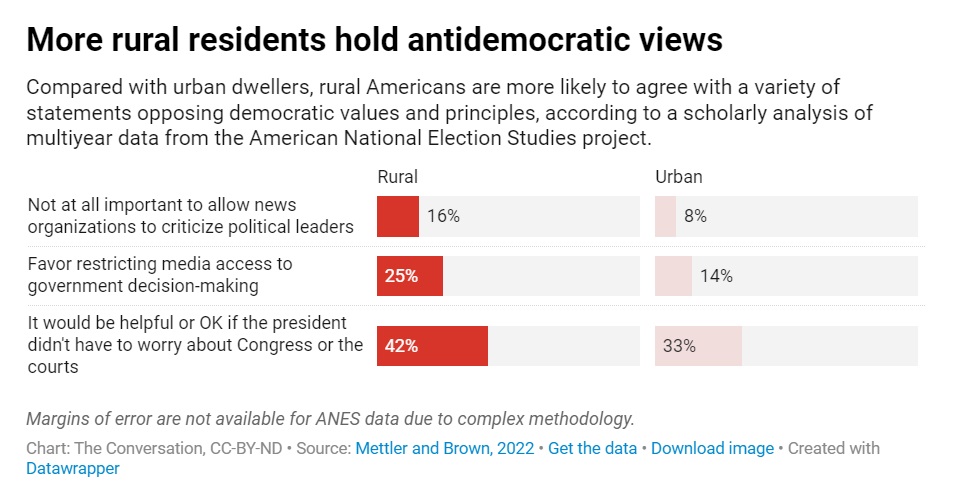
A chart comparing rural and urban antidemocratic views

A scholarly analysis of multiyear data from the American National Election Studies project finds that rural citizens are “much more likely (than urban residents) to favor restrictions on the press” and to say it would be “helpful if the president could unilaterally work” without regard to Congress or the courts.

In addition, more than half of rural residents surveyed by the Public Religion Research Institute said being a Christian is important to “being truly American” – 10 percentage points more than in surburban or urban areas.

This is one of several signals that rural residents are disproportionately likely to support white Christian nationalism, an ideology that reaches beyond Christian ideas of faith and morality and into government. Its followers want the United States to base its laws on Christian values rather than maintain the centuries-old separation of church and state the founders saw as fundamental to a secular democracy.

Justification of violence

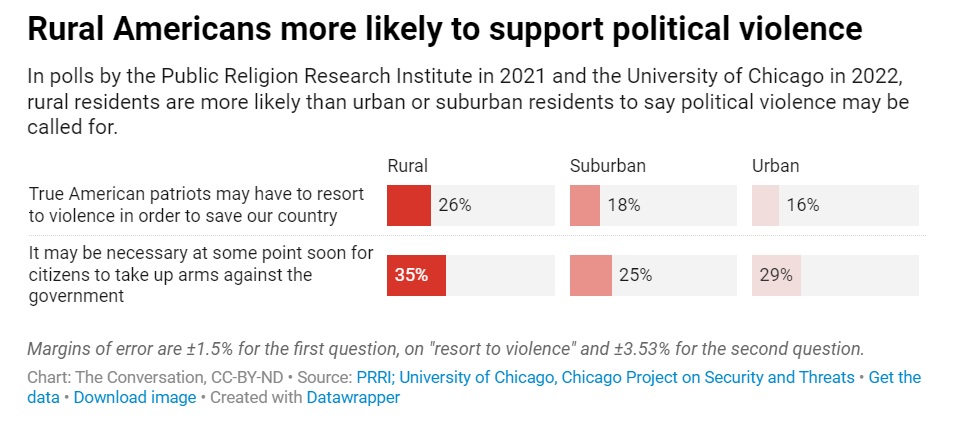
Rural residents are more likely than urban or suburban residents to say the political situation in the country is heading to a point where violence may be necessary to preserve the nation, according to polls from the Public Religion Research Institute in 2021 and the University of Chicago Institute of Politics in 2022.

Of the estimated 21 million Americans who in late 2021 said Joe Biden’s 2020 presidential win was “illegitimate,” according to the Chicago Project on Security and Threats, 30% lived in rural areas. And 27% of Americans who say Trump should be returned to office even if “by force” are rural residents. Those are minority views, but both proportions are significantly higher than the rural proportion of the overall population.

With the 2024 election fast approaching, the views of rural white people are once again of vital importance because they and the members of Congress who represent them disproportionately believe the 2020 election was stolen from Donald Trump by Joe Biden. A Pew Research Center study found 71% of rural white voters voted for Trump in 2020, so their preference in November will be key to who returns to the White House for a second term.


This article is republished from The Conversation under a Creative Commons license. Read the original article and see more than 250 UMBC articles available in The Conversation.

Meet a Retriever—Aiman Raza ’22, applied environmental researcher in UMBC’s ICARE graduate program

Meet Aiman Raza ’22, biological sciences, and a current biological sciences master’s student in the Interdisciplinary Consortium for Applied Research in the Environment (ICARE) program. After studying at UMBC as an undergraduate, Aiman is thrilled to continue her graduate journey at UMBC studying brook trout using environmental DNA (eDNA). She says building connections in her cohort has helped enrich her academic experience and see the importance of interdisciplinary collaborations in environmental work. 

Q: What’s the one thing you’d want someone who hasn’t joined the UMBC community to know about it?

A: The diversity of the UMBC community is one of the biggest strengths of this institution. No matter your background or interests, there is always a space for you to grow and thrive at UMBC. 

Q: Tell us about someone in the community who has inspired you or supported you.

A: My faculty advisor, Tamra Mendelson, professor of biological sciences, has inspired and supported me throughout my academic journey. I first met Tamra when I was a freshman, and her passion for her research left such an impression on me that I decided to join her lab three years later as a graduate student. 

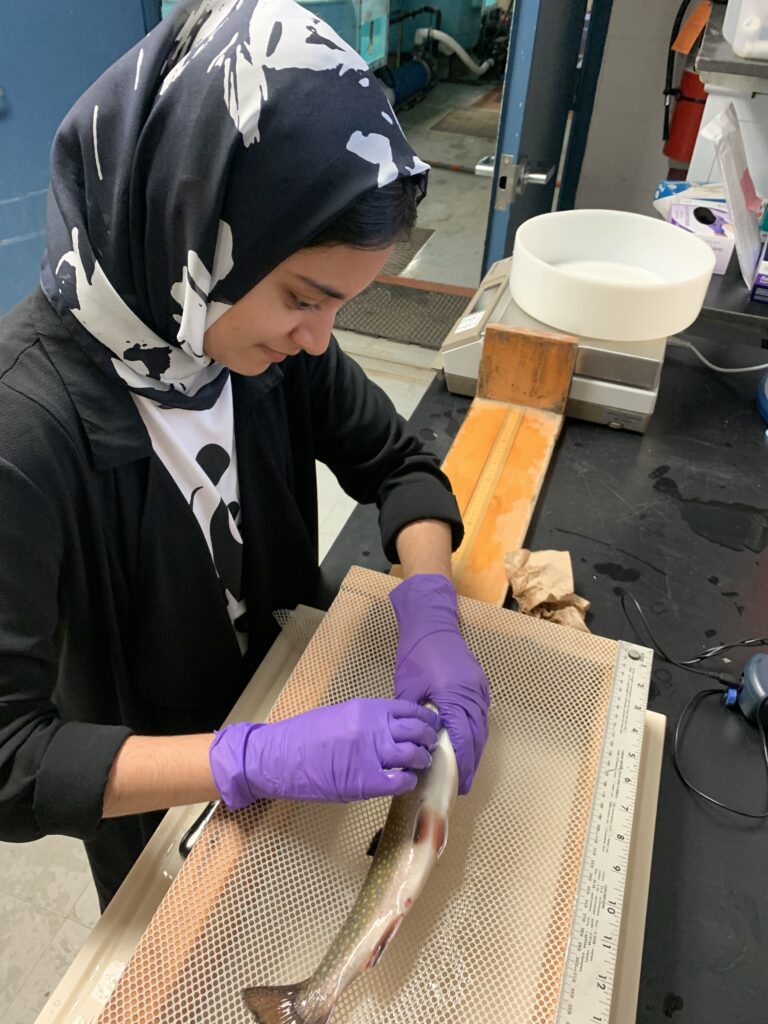
woman wearing scientific gloves holds a fish in a bin and affixes a tag to its body
Aiman Raza tags a brook trout at the USGS Eastern Ecological Science Center in Leetown, WV, in January 2023. (Courtesy of Raza)

Q: Tell us about what you love about your academic program.

A: The ICARE program is making incredible strides in bridging the gap between research and environmental justice around Baltimore. With an interdisciplinary network of scientists and community leaders, ICARE is fulfilling its dual mission of increasing the diversity of the environmental workforce and conducting community-engaged research in and around Baltimore. 

Q: What led you to pursue graduate education at UMBC? 

A: I came back to UMBC as a master’s student because I was drawn to the ICARE program’s mission. I am passionate about conducting applied research with practical implications for my community. As an undergrad, I was involved with research in the biology department and heard about the ICARE program through my mentor. I knew that graduate school was the next step in pursuing a career in applied research, and the ICARE program’s goals aligned well with mine. I wanted to learn and grow in a program that brought diverse perspectives and focused on environmental justice in addressing environmental issues. 

The ICARE program is making incredible strides in bridging the gap between research and environmental justice around Baltimore.

Aiman Raza '22

Q: How has being part of a cohort-based program influenced your experience? 

A: The ICARE program has cultivated a community of professionals who care deeply about building a more just and equitable future for all. Every day, I get to learn from my cohort members, who come from various backgrounds and disciplines. Their unique research projects and diverse perspectives have helped me realize the importance of interdisciplinary collaborations in environmental work. Building close connections with my cohort has enriched my graduate school experience both professionally and personally. I am constantly inspired by their passion and look forward to seeing the great work we accomplish in the future. 

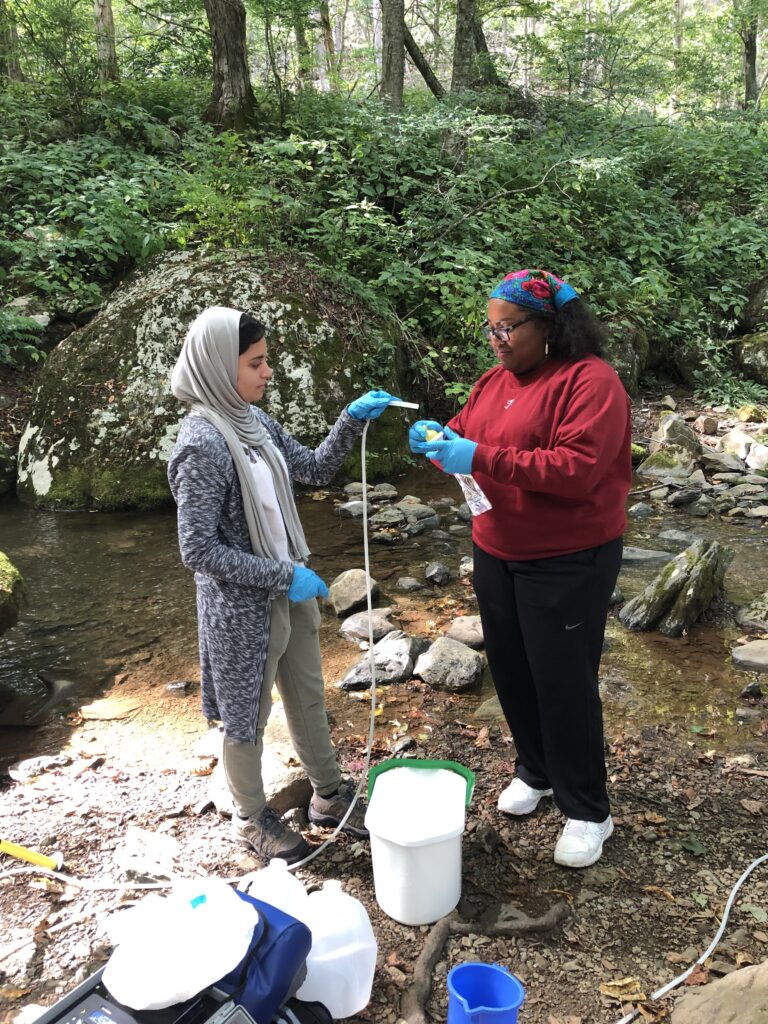
two women stand on the bank of a stream; one holds the end of a long thin tube above a plastic bag held by the other. Some buckets and other equipment are on the ground nearby.
Aiman Raza (left) and fellow ICARE program member Autumn Powell collect water samples in Shenandoah National Park in September 2023. (Courtesy of Raza)

What is Volt Typhoon? A cybersecurity expert explains the Chinese hackers targeting US critical infrastructure

Written by Richard Forno, principal lecturer in computer science and electrical engineering, UMBC

Volt Typhoon is a Chinese state-sponsored hacker group. The United States government and its primary global intelligence partners, known as the Five Eyes, issued a warning on March 19, 2024, about the group’s activity targeting critical infrastructure.

The warning echoes analyses by the cybersecurity community about Chinese state-sponsored hacking in recent years. As with many cyberattacks and attackers, Volt Typhoon has many aliases and also is known as Vanguard Panda, Bronze Silhouette, Dev-0391, UNC3236, Voltzite and Insidious Taurus. Following these latest warnings, China again denied that it engages in offensive cyberespionage.

Volt Typhoon has compromised thousands of devices around the world since it was publicly identified by security analysts at Microsoft in May 2023. However, some analysts in both the government and cybersecurity community believe the group has been targeting infrastructure since mid-2021, and possibly much longer.

Volt Typhoon uses malicious software that penetrates internet-connected systems by exploiting vulnerabilities such as weak administrator passwords, factory default logins and devices that haven’t been updated regularly. The hackers have targeted communications, energy, transportation, water and wastewater systems in the U.S. and its territories, such as Guam.

In many ways, Volt Typhoon functions similarly to traditional botnet operators that have plagued the internet for decades. It takes control of vulnerable internet devices such as routers and security cameras to hide and establish a beachhead in advance of using that system to launch future attacks.

Operating this way makes it difficult for cybersecurity defenders to accurately identify the source of an attack. Worse, defenders could accidentally retaliate against a third party who is unaware that they are caught up in Volt Typhoon’s botnet.

Why Volt Typhoon matters

Disrupting critical infrastructure has the potential to cause economic harm around the world. Volt Typhoon’s operation also poses a threat to the U.S. military by potentially disrupting power and water to military facilities and critical supply chains.

FBI Director Christopher Wray testified at a congressional hearing on Jan. 31, 2024, about Chinese hackers targeting U.S. critical infrastructure.

Microsoft’s 2023 report noted that Volt Typhoon could “disrupt critical communications infrastructure between the United States and Asia region during future crises.” The March 2024 report, published in the U.S. by the Cybersecurity and Infrastructure Security Agency, likewise warned that the botnet could lead to “disruption or destruction of critical services in the event of increased geopolitical tensions and/or military conflict with the United States and its allies.”

Volt Typhoon’s existence and the escalating tensions between China and the U.S., particularly over Taiwan, underscore the latest connection between global events and cybersecurity.

Defending against Volt Typhoon

The FBI reported on Jan. 31, 2024, that it had disrupted Volt Typhoon’s operations by removing the group’s malware from hundreds of small office/home office routers. However, the U.S. is still determining the extent of the group’s infiltration of America’s critical infrastructure.

On March 25, 2024, the U.S. and U.K. announced that they had imposed sanctions on Chinese hackers involved in compromising their infrastructures. And other countries, including New Zealand, have revealed cyberattacks traced back to China in recent years.

All organizations, especially infrastructure providers, must practice time-tested safe computing centered on preparation, detection and response. They must ensure that their information systems and smart devices are properly configured and patched, and that they can log activity. And they should identify and replace any devices at the edges of their networks, such as routers and firewalls, that no longer are supported by their vendor.

Organizations can also implement strong user-authentication measures such as multifactor authentication to make it more difficult for attackers like Volt Typhoon to compromise systems and devices. More broadly, the comprehensive NIST Cybersecurity Framework can help these organizations develop stronger cybersecurity postures to defend against Volt Typhoon and other attackers.

Individuals, too, can take steps to protect themselves and their employers by ensuring their devices are properly updated, enabling multifactor authentication, never reusing passwords, and otherwise remaining vigilant to suspicious activity on their accounts, devices and networks.

For cybersecurity practitioners and society generally, attacks like Volt Typhoon can represent an enormous geopolitical cybersecurity threat. They are a reminder for everyone to monitor what’s going on in the world and consider how current events can affect the confidentiality, integrity and availability of all things digital.


This article is republished from The Conversation under a Creative Commons license. Read the original article and see more than 250 UMBC articles available in The Conversation.

James Clavell’s ‘Shōgun’ is reimagined for a new generation of TV viewers

Written by Constantine Nomikos Vaporis, professor of history, UMBC

In 1980, when James Clavell’s blockbuster historical novel “Shōgun” was turned into a TV miniseries, some 33% of American households with a television tuned in. It quickly became one of the most viewed miniseries to date, second only to “Roots.”

I’m a historian of Japan who specializes in the history of the Tokugawa, or early modern era – a period from 1603 to 1868, during which the bulk of the action in “Shōgun” takes place. As a first-year graduate student, I sat glued to the television for five nights in September 1980, enthralled that someone cared enough to create a series about the period in Japan’s past that had captured my imagination.

I wasn’t alone. In 1982, historian Henry D. Smith estimated that one-fifth to one-half of students enrolled in university courses about Japan at that time had read the novel and became interested in Japan because of it.

“‘Shōgun,’” he added, “probably conveyed more information about the daily life of Japan to more people than all the combined writings of scholars, journalists, and novelists since the Pacific War.”

Some even credit the series for making sushi trendy in the U.S.

That 1980 miniseries has now been remade as FX’s “Shōgun,” a 10-episode production that is garnering rave reviews – including a near-100% rating from review-aggregation website Rotten Tomatoes.

Both miniseries closely hew to Clavell’s 1975 novel, which is a fictionalized retelling of the story of the first Englishman, Will Adams – the character John Blackthorne in the novel – to set foot in Japan.

And yet there are subtle differences in each series that reveal the zeitgeist of each era, along with America’s shifting attitudes toward Japan.

The ‘Japanese miracle’

The original 1980 series reflects both the confidence of postwar America and its fascination with its resurgent former enemy.

World War II had left Japan devastated economically and psychologically. But by the 1970s and 1980s, the country had come to dominate global markets for consumer electronic, semiconductors and the auto industry. Its gross national product per capita rose spectacularly: from less than US$200 in 1952 to $8,900 in 1980 – the year “Shōgun” appeared on television – to almost $20,000 in 1988, surpassing the United States, West Germany and France.

Many Americans wanted to know the secret to Japan’s head-spinning economic success – the so-called “Japanese miracle.” Could Japan’s history and culture offer clues?

During the 1970s and 1980s, scholars sought to understand the miracle by analyzing not just the Japanese economy but also the country’s various institutions: schools, social policy, corporate culture and policing.

In his 1979 book, “Japan as Number One: Lessons for America,” sociologist Ezra Vogel argued that the U.S. could learn a lot from Japan, whether it was through the country’s long-term economic planning, collaboration between government and industry, investments in education, and quality control of goods and services.

A window into Japan

Clavell’s expansive 1,100-page novel was released in the middle of the Japanese miracle. It sold more than 7 million copies in five years; then the series aired, which prompted the sale of another 2.5 million copies.

In it, Clavell tells the story of Blackthorne, who, shipwrecked off the coast of Japan in 1600, finds the country in a peaceful interlude after an era of civil war. But that peace is about to be shattered by competition among the five regents who have been appointed to ensure the succession of a young heir to their former lord’s position as top military leader.

Black and white photo of middle-aged man sitting at a typewriter by the ocean.
‘Shogun,’ which James Clavell published in 1975, has sold millions of copies. Michael Ochs Archives/Getty Images

In the meantime, local leaders don’t know whether to treat Blackthorne and his crew as dangerous pirates or harmless traders. His men end up being imprisoned, but Blackthorne’s knowledge of the world outside of Japan – not to mention his boatload of cannons, muskets and ammunition – save him.

He ends up offering advice and munitions to one of the regents, Lord Yoshi Toranaga, the fictional version of the real-life Tokugawa Ieyasu. With this edge, Toranaga rises to become shogun, the country’s top military leader.

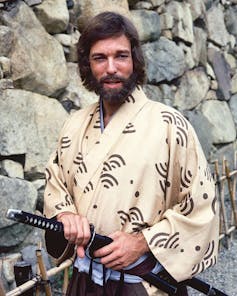
Bearded man with shoulder length brown hair wearing a kimono and holding a samurai sword.
Actor Richard Chamberlain as John Blackthorne in the 1980 NBC miniseries ‘Shōgun.’ Silver Screen Collection/Getty Images

Viewers of the 1980 television series witness Blackthorne slowly learning Japanese and coming to appreciate the value of Japanese culture. For example, at first, he’s resistant to bathing. Since cleanliness is deeply rooted in Japanese culture, his Japanese hosts find his refusal irrational.

Blackthorne’s, and the viewers’, gradual acclimatization to Japanese culture is complete when, late in the series, he is reunited with the crew of his Dutch ship who have been held in captivity. Blackthorne is thoroughly repulsed by their filth and demands a bath to cleanse himself from their contagion.

Blackthorne comes to see Japan as far more civilized than the West. Just like his real-life counterpart, Will Adams, he decides to remain in Japan even after being granted his freedom. He marries a Japanese woman, with whom he has two children, and ends his days on foreign soil.

From fascination to fear

However, the positive views of Japan that its economic miracle generated, and that “Shogun” reinforced, eroded as the U.S. trade deficit with Japan ballooned: from $10 billion in 1981 to $50 billion in 1985.

Japan bashing” spread in the U.S., and visceral anger exploded when American autoworkers smashed Toyota cars in March 1983 and congressmen shattered a Toshiba boombox with sledgehammers on the Capitol lawn in 1987. That same year, the magazine Foreign Affairs warned of “The Coming U.S.-Japan Crisis.”

Newsweek magazine cover that reads 'Japan Invades Hollywood' and features a graphic of a woman in a kimono posing like the woman in the Columbia Pictures logo.
Newsweek’s Oct. 9, 1989, cover describes Sony’s purchase of Columbia Pictures as an invasion. Newsweek

This backlash against Japan in the U.S. was also fueled by almost a decade of acquisitions of iconic American companies, such as Firestone, Columbia Pictures and Universal Studios, along with high-profile real estate, such as the iconic Rockefeller Center.

But the notion of Japan as a threat reached a peak in 1989, after which its economy stalled. The 1990s and early 2000s were dubbed Japan’s “lost decade.”

Yet a curiosity and love for Japanese culture persists, thanks, in part, to manga and anime. More Japanese feature films and television series are also making their way to popular streaming services, including the series “Tokyo Girl,” “Midnight Diner” and “Sanctuary.” In December 2023, The Hollywood Reporter announced that Japan was “on the precipice of a content boom.”

Widening the lens

As FX’s remake of “Shōgun” demonstrates, American viewers today apparently don’t need to be slowly introduced to Japanese culture by a European guide.

In the new series, Blackthorne is not even the sole protagonist.

Instead, he shares the spotlight with several Japanese characters, such as Lord Yoshi Toranaga, who no longer serves as a one-dimensional sidekick to Blackthorne, as he did in the original miniseries.

This change is facilitated by the fact that Japanese characters now communicate directly with the audience in Japanese, with English subtitles. In the 1980 miniseries, the Japanese dialogue went untranslated. There were English-speaking Japanese characters in the original, such as Blackthorne’s female translator, Mariko. But they spoke in a highly formalized, unrealistic English.

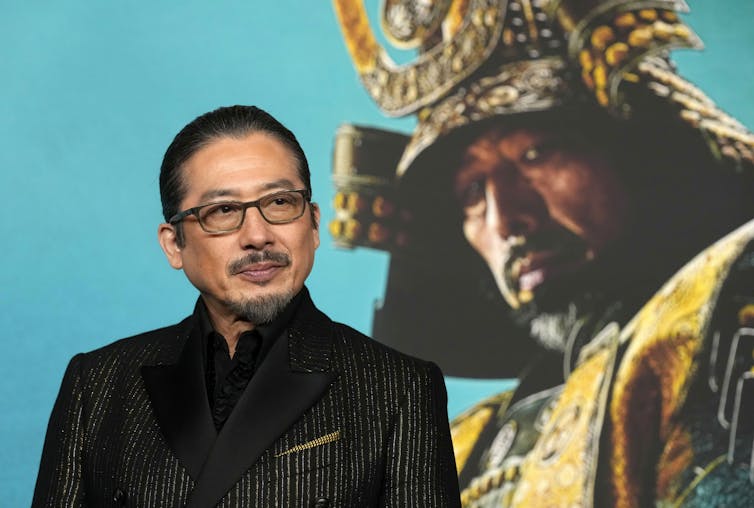
Japanese man wearing glasses and a suit.
Actor Hiroyuki Sanada plays Lord Yoshi Toranaga in FX’s ‘Shōgun.’ Though Sanada’s character speaks in Japanese, there are English subtitles for viewers. AP Photo/Chris Pizzello

Along with depicting authentic costumes, combat and gestures, the show’s Japanese characters speak using the native language of the early modern era instead of using the contemporary Japanese that made the 1980 series so unpopular among Japanese viewers. (Imagine a film on the American Revolution featuring George Washington speaking like Jimmy Kimmel.)

Of course, authenticity has its limits. The producers of both television series decided to adhere closely to the original novel. In doing so, they’re perhaps unwittingly reproducing certain stereotypes about Japan.

Most strikingly, there’s the fetishization of death, as several characters have a penchant for violence and sadism, while many others commit ritual suicide, or seppuku.

Part of this may have been simply a function of author Clavell being a self-professed “storyteller, not an historian.” But this may have also reflected his experiences in World War II, when he spent three years in a Japanese prisoner of war camp. Still, as Clavell noted, he came to deeply admire the Japanese.

His novel, as a whole, beautifully conveys this admiration. The two miniseries have, in my view, successfully followed suit, enthralling audiences in each of their times.


This article is republished from The Conversation under a Creative Commons license. Read the original article and see more than 250 UMBC articles available in The Conversation.

Ballet dancer Misty Copeland shares personal mission in visit with students at UMBC

By Lisa Traiger

Misty Copeland is a ballerina on a mission—and last week she brought that mission to UMBC. Renowned for both her ethereality and powerful muscularity, as well as her activism in diversifying a white-dominant field, in 2015 Copeland became the first Black woman promoted to principal dancer at American Ballet Theatre, a top U.S. ballet company. And she continues to break down barriers to democratize this art form born of European privilege and monarchy.

On March 6, Copeland spent a day on campus—meeting with dance majors in the Dance Cube, speaking one-on-one with alumni and young dancers at a reception, watching student dancers perform, and participating in UMBC’s first annual Artful Conversations, a public Q&A in Linehan Concert Hall.

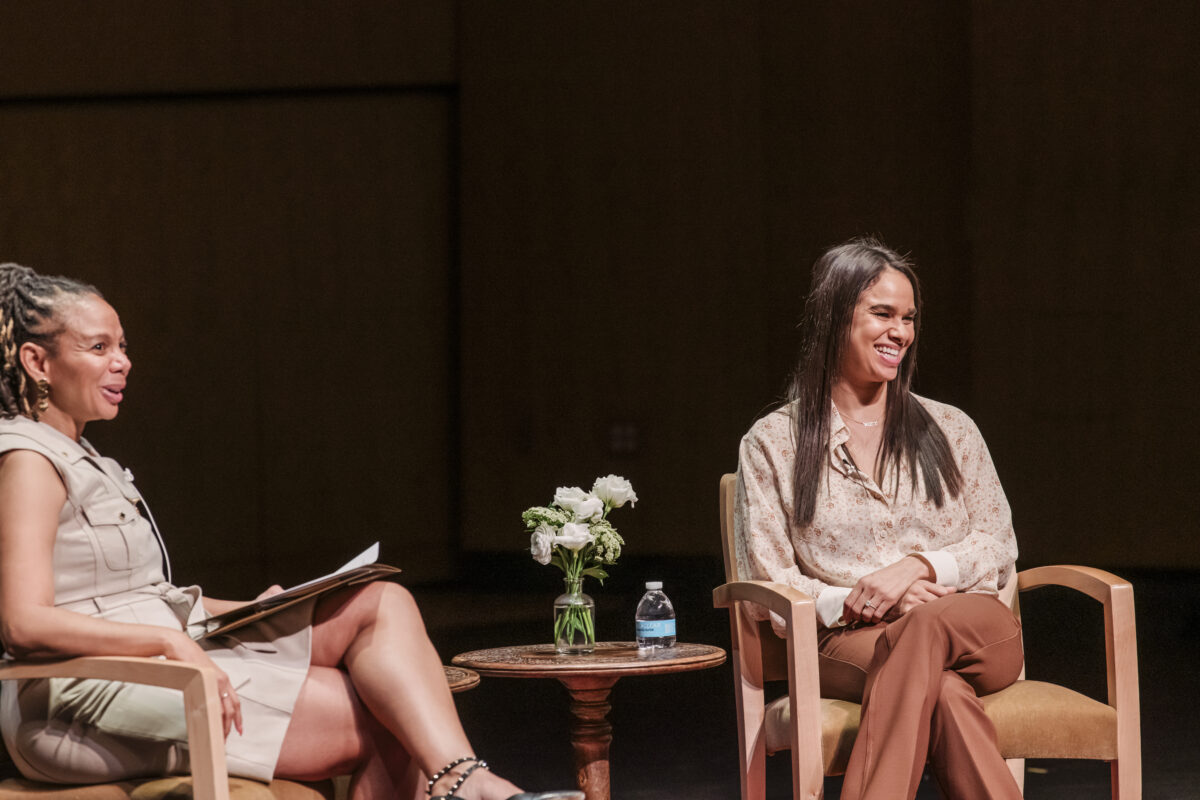
Misty Copeland and Dean Moffitt are in conversation in front of a crowd
Dean Kimberly Moffitt and Misty Copeland during the Artful Conversations event in front of a sold-out crowd at the Linehan Concert Hall. (Marlayna Demond ’11/UMBC)

“You are my people,” the lithe dancer in smart slacks and stilettos told about 35 UMBC dance students and prospective students in an afternoon session. “I came into the ballet world at a late age—13,” she said, recalling her first ballet classes sponsored by a YMCA Boys and Girls Club in a gymnasium. She wore socks and shorts and had never heard classical music before. What she initially described as a “weird” experience, soon became an epiphany. “I felt so free… I was very shy. I didn’t have the tools or the confidence to say everything I wanted to say at 13, but I realized this might be the last time I had this chance,” said Copeland. “So I always took advantage of every opportunity I’ve been given.” And through ballet, she found her voice—and purpose.

Breaking ballet’s glass ceiling 

Raised by a single mother, she and her five siblings were sometimes “house-less,” as Copeland described it. The ballet studio “was the first time I felt physically protected in a space and I could be naked and vulnerable,” Copeland said. “That’s the feeling we should all have: what it’s like to be in a space of freedom and creativity and no judgment.” These days through her eponymous charitable foundation, Copeland supports programs that provide funding and classes that break ballet’s glass ceiling through diversity, equity, and inclusion activities.

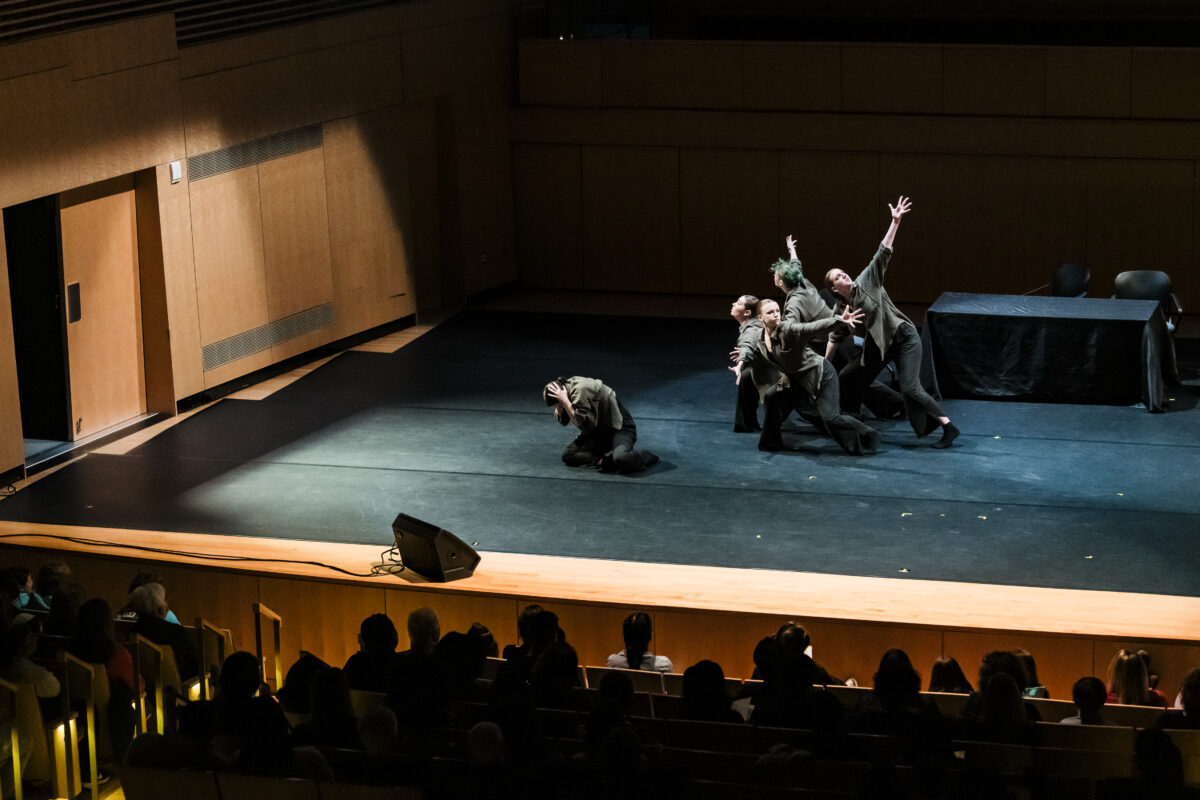
Victoria Davies, a junior dance major and Linehan Artist Scholar, performed in “Boundless” by faculty member Shaness D. Kemp, one of three modern works dance students shared with Copeland and attendees during the early evening public event in the sold-out Linehan Concert Hall. “For me,” Davies said, “to see another person of color who has been very successful in her dance career and hear about all the things she went through, hopefully I can get to that point in my own career.”

Left: Capstone work by dance major Eva Mclaughlin, “Episodic Abrasion” (dancers: Sarah McHale, Cassidy Cipolla-Milchak, Ria Murphy, Katelyn O’Connor, Gwyneth Watson). Right: “Boundless” (2022) repertory work by Assistant Professor Shaness D. Kemp (dancers: India Blake, Victoria Davies, Sophia Papparotto.) (Marlayna Demond ’11/UMBC)

First-year dance major Ashley Baer said that learning more about Copeland “makes everything so much more real. She has been so influential to so many. As dancers, it’s so amazing to be able to hear her perspectives on performing and life.” Baer shared a quote she jotted down from Copeland’s talk: “’Continue to explore life and live your life…. As dancers we get so caught up in our training and we need to continue to live life.’” 

Ask for the roles you want

a laughing photo of a woman in a tan shirt and long straight brown hair
Misty Copeland. (Marlayna Demond ’11/UMBC)

Students asked Copeland about her challenges, transitioning from student to professional, taking care of her body, work-life balance, and dealing with microaggressions as one of the few Black women at the top of the ballet company hierarchy. She was frank, yet gracious, in her responses, noting she moved to New York the day after graduating from high school and it took her about five years to understand the complexity of rehearsal and casting schedules. “Having a support system has always been key,” she advised. “You need people you can turn to. This [career] takes a lot out of you, physically, mentally, emotionally.”

One lesson she learned from her close friend and mentor, the late African American ballet dancer Raven Wilkinson: Do not be afraid to ask for roles you want. Copeland desired a specific role, but had never been cast. With Wilkinson’s encouragement, she approached American Ballet Theatre artistic director Kevin McKenzie and asked. His response: “Oh, I thought you had danced that role.” Then she was cast. She noted: “As a woman, as a dancer with a Black body…it felt like [my success] was this collective effort of all my ancestors. It never felt like my accomplishment singularly.”

While Copeland hasn’t been back in the studio since the birth of her son two years ago, she remains active on other fronts: as an author of now six books for children, teens, and adults, and as designer of her own line of athleisure wear, Greatness Wins, in collaboration with athlete Derek Jeter. As well, she acknowledges the ongoing importance of being a ballet dancer.

Stars aren’t made overnight

According to College of Arts, Humanities, and Social Sciences Dean Kimberly Moffitt, who moderated the public Q&A, Copeland proved the perfect choice to inaugurate Artful Conversations, which will invite a high-profile creative to campus annually. “First and foremost, I want my dance students 10 years from now to say, ‘I had the chance to interact with Misty directly,’” Moffitt said. “That’s a special moment from their academic experience here at UMBC.” She continued, “And other students who are drawn to attend will learn something really interesting about Misty’s trajectory to becoming not just another ballerina. She has a really interesting story to tell. Often, we believe that these [stars] are overnight successes. We forget how much work, effort, and energy individuals put into making it.” 

Introducing Copeland, Dawn Moore, first lady of Maryland and an advocate for the arts across the state, said, “We have gathered to celebrate the power of dance to inspire and unite…[because] dance nurtures compassion, contemplation, and healing.”

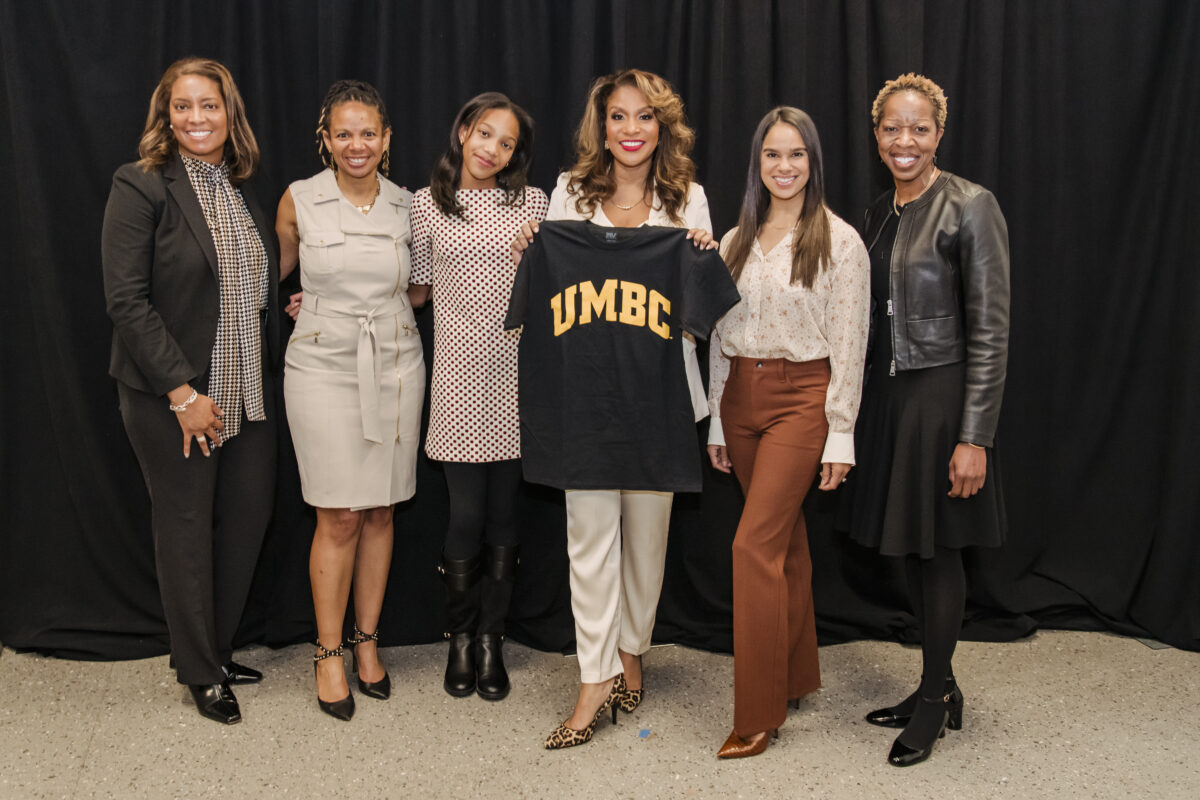
a group of women pose together and one is holding up a t-shirt that says UMBC
Left to right: Candace Dodson-Reed ’96, Dean Kimberly Moffitt, Mia Moore, First Lady Dawn Moore, Misty Copeland, and President Valerie Sheares Ashby. (Marlayna Demond ’11/UMBC)

And Copeland left the dance students of all ages with this message: “As a dancer, it’s so easy to get caught up in the minutiae of daily battles, and a lot of those are within ourselves. Every day, it’s important to remind yourself why you’re doing this. I love being on stage—it’s where I feel the most free. It’s liberating. You need to remind yourself of the things that matter to you.”

Learn more about UMBC’s dance and Linehan Artist Scholars programs.

Meet a Retriever—Madelyn “Maddy” Pollack ’24, Humanities Scholar and Honors College member   

Madelyn (“Maddy”) Pollack ’24, history, is a Humanities Scholar and a member of the Honors College. She is pursuing minors in public history and Judaic studies, and she is active in Hillel and Chabad on campus. Maddy works in Undergraduate Admissions as a Grit Guide and in the UMBC Office of the President as a student archivist. When she isn’t studying or spending time with friends, she enjoys reading. Here Maddy shares the many ways she is involved on campus and why she values all of her sources of support at UMBC.

Q: Tell us what you love about your academic program or another organization you are involved in.

A: I love being part of the Honors College because it’s my home on campus. They give us all the resources we might need, like a study lounge in the library and free printing, and support us beyond that with learning opportunities, free food, and amazing interdisciplinary excursions (did someone say Hamilton at the Hippodrome?). I’m currently taking an Honors Seminar on Star Wars and puppetry, and I think it’s fantastic that we have such an amazing variety of courses. I know that I will stay connected even after I graduate, because Honors College staff have helped me grow so much academically, professionally, and personally. Plus, it’s fun to say that I’m in the Honors College at an honors university! 

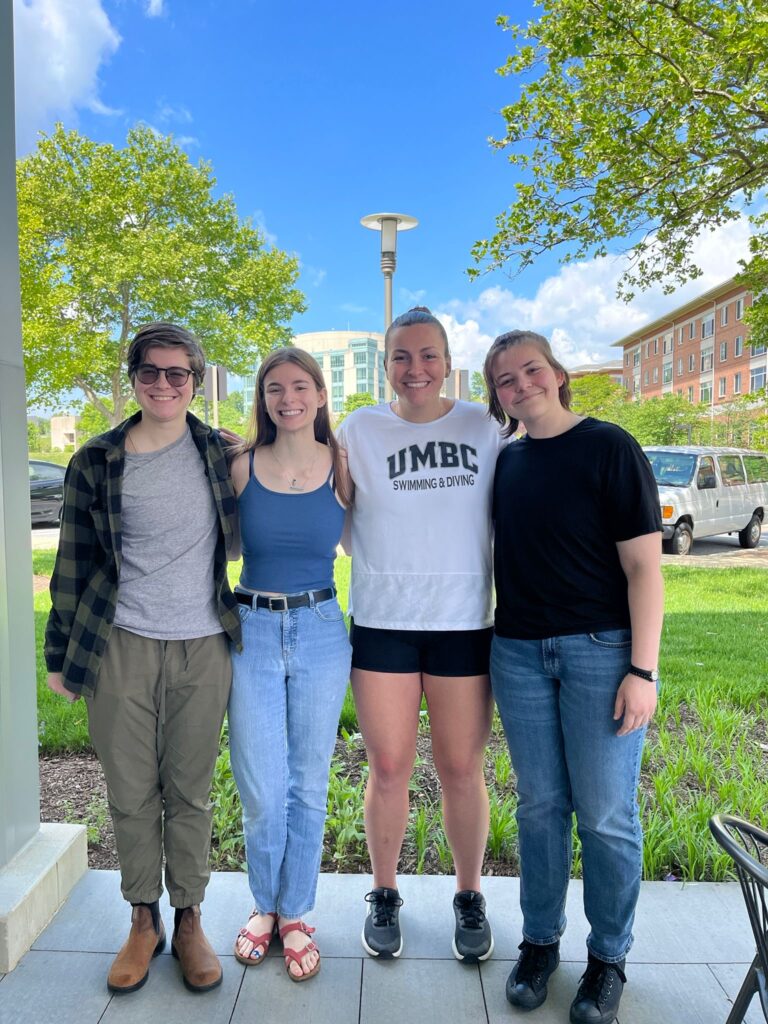
group photo of four students on the UMBC campus, spring greenery in the background
Maddy Pollack, second from left, with fellow members of the UMBC Hillel executive board for the 2022 – 2023 academic year. (Image courtesy of Pollack)

Q: Why did you choose UMBC?? 

A: I came to UMBC because I wanted to have the resources of a large university and the feel of a small university. We have the best of both worlds—not too big, but not too small. I love that I can see people I know everywhere I go on campus, but I also feel so lucky to have connections with professors and mentors who can help me do anything I want after graduation.

Q: Since you’ve been a part of the UMBC community, what sources of support have you found to help you reach your goals? 

A: My professors in the history department have been the biggest help in jump-starting my future. They’ve not only provided important skills training in the classroom, but also career planning and networking advice. I even got to intern at NASA—not something you’d expect of someone so far removed from STEM disciplines!

I know that I will stay connected even after I graduate, because Honors College staff have helped me grow so much academically, professionally, and personally.

Maddy Pollack '24

Q: Are you currently part of a scholars program at UMBC? Tell us what you enjoy about it!

A: Being part of the Humanities Scholars Program means I get extra enrichment as a UMBC student. First, we are lucky to have multiple excursions each semester that bring us to local arts events and theatrical performances. Each spring, we get to go on a trip to New York City to visit a museum and see a show on Broadway. (I’m especially excited about this year’s tickets to Six!)

Finally, each Humanities Scholar is encouraged to study abroad, and our scholarships are transferable to our institutions abroad. We can also apply for additional study abroad scholarships to fund our experiences as we become global citizens. I just got back from a semester in London this past fall, and you can see my blogs as an ambassador for our Education Abroad office.

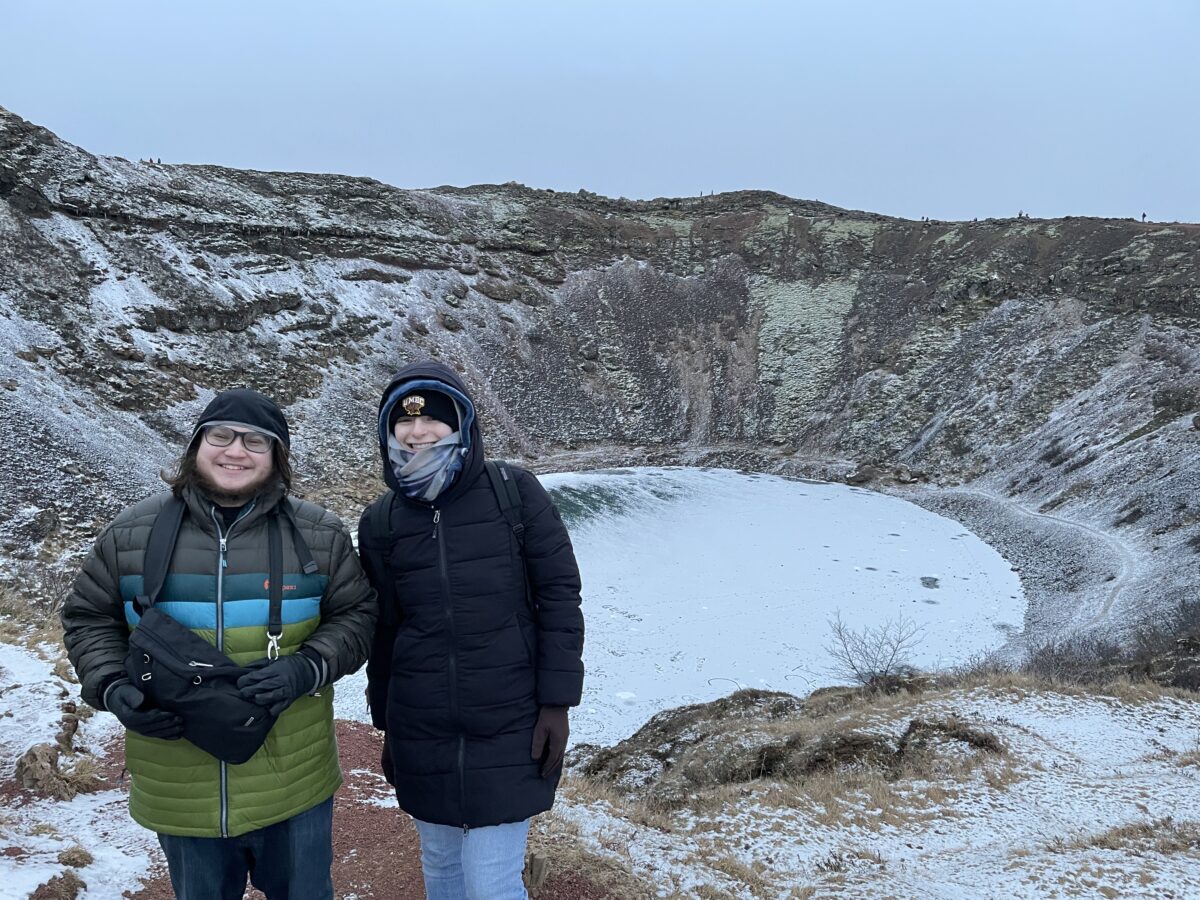
Maddy and another UMBC Humanities Scholar bundled in warm clothes stand in front of a frozen cirque with steep rock walls on all sides.
Maddy Pollack, right, and Humanities Scholar Evan Royston ’25, history, visited Iceland while both of them were studying abroad in Europe. Here they stand in front of the Kerid Volcanic Crater. (Image courtesy of Pollack)

Q: What’s the one thing you’d want someone who is new to the UMBC community to know?

A: Don’t be afraid to ask for help! Everyone remembers what it was like to be new to UMBC, and although the first few times you ask for help might be scary, our community is dedicated to being a family, and you’ll find your place soon!


UMBC’s greatest strength is its people. When people meet Retrievers and hear about the passion they bring, the relationships they create, the ways they support each other, and the commitment they have to inclusive excellence, they truly get a sense of our community. That’s what “Meet a Retriever” is all about.

Learn more about how UMBC can help you achieve your goals.

Meet a Retriever—Kisha Parker ’00, Alumni Association PR Committee Chair

Meet Kisha Parker ’00. Kisha is a dual-degree alumna with a B.S. in biological sciences and a B.A. in psychology, and an active member of the UMBC Alumni Association Board of Directors, serving as Chair of the Public Relations Committee. As a student, she was very active, taking leadership roles in several organizations, including the Student Government Association (SGA) as the director of state and national affairs, and the Lambda Kappa Chapter of Delta Sigma Theta Sorority Inc., as president. UMBC is also where Kisha found love–meeting her future husband, Kevin Parker ’99, mechanical engineering, who was also involved in Greek Life as president of Alpha Phi Alpha Fraternity, Inc., Nu Kappa Chapter, and served on the SGA executive board. This alumni power couple is now married with three children and is forever grateful that their paths crossed at UMBC–their forever home. Take it away, Kisha!
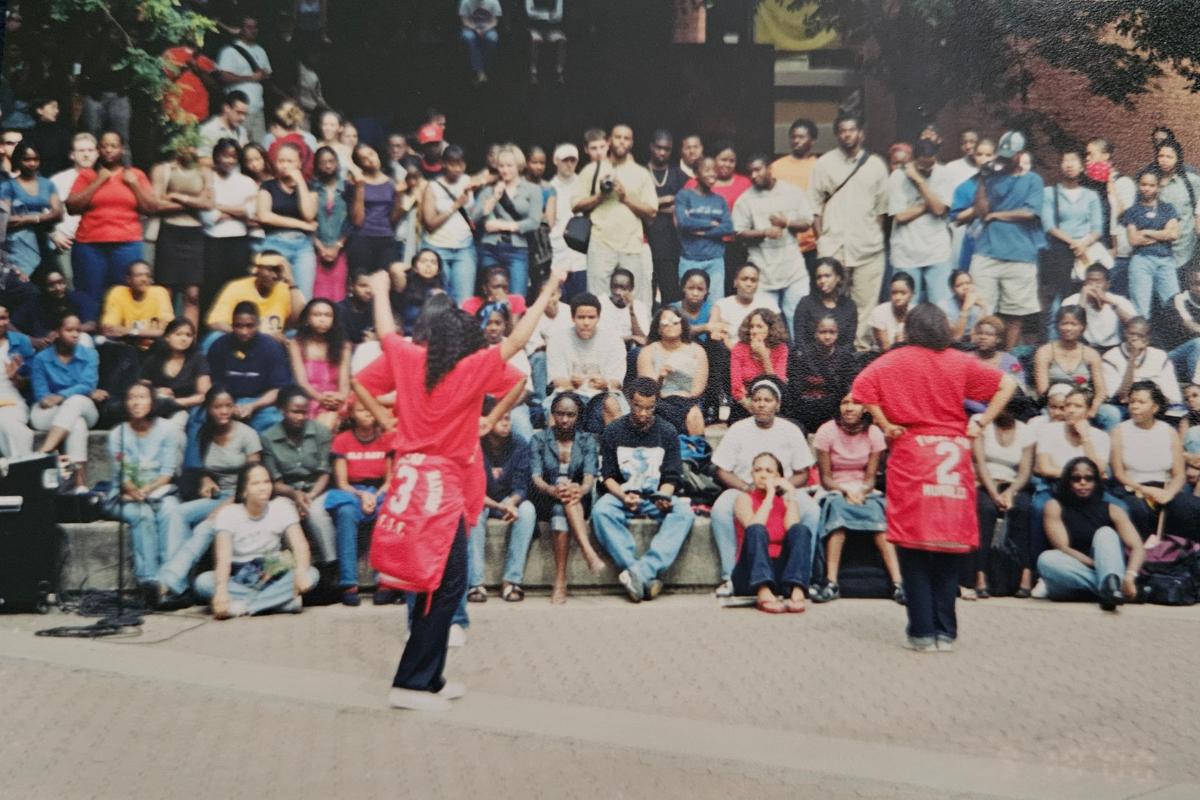
Two sorority sisters dressed in red stand in front of a crowd of students.
Kisha Parker and her Delta Sigma Theta Sorority Inc. sorority sister at the Greek preview outside the University Center.

Q: What is your WHY? What brought you to UMBC?

A: What led me to UMBC was the size of the classes, academic reputation, and affordability. The bonus was the amazing avenues of support and opportunities to grow once I became a student. My experience at UMBC has led to an amazing circle of friendships, partnerships, resources, and career opportunities.

Delta Sigma Theta Sorority Inc. sorority sisters over 25 years

Q: What’s your favorite part of being a part of Retriever Nation?

A: Retriever Nation is diverse and multi-faceted. I love bragging about our chess team and mock trial championships, just as much as sports and academic entities. I love celebrating the wide net of accomplishments our alumni are doing around the world and the history we are making with UMBC roots.

Q: Where have you found support in the UMBC community?

A: I had a mentor in LaMont Toliver of the Meyerhoff Scholars Program, lived with inspiring, smart, and motivated roommates as consistent models of achievement, and became a part of a legacy of like-minded, multifaceted women in my sorority. These relationships have led to many experiences (too numerous to count…and still ongoing!) that helped me grow mentally, academically, professionally, and as a public service enthusiast.

(On the left, Kisha Parker and her Delta Sigma Theta Sorority Inc. sisters over a 25-year span.)

Q: What’s the one thing you’d want someone who hasn’t joined the UMBC community to know about the support you find here?

A: UMBC has a bit of everything. While strong academic programming is already established, our inclusive culture is invaluable. The support to be successful is here and in multiple forms. Whether it is in the form of day-one-ready mentorship, financial support opportunities, well-thought-out facilities to enhance the student experience and future studies, or administrative planning with students, staff, and alumni in mind, the avenues of support are multifaceted.

Q: Tell us about what you love about an organization you’re involved in.

A: I am a member of the Board of Directors of the UMBC Alumni Association. What I love about this organization is being able to further engage alumni in different ways, contribute to efforts to keep our community connected and aware, and promote UMBC’s brand. I have been able to see UMBC through a very different lens as an alum than I was as a busy and active student, and it has been integral to happily volunteering my time, financial support, and event support.

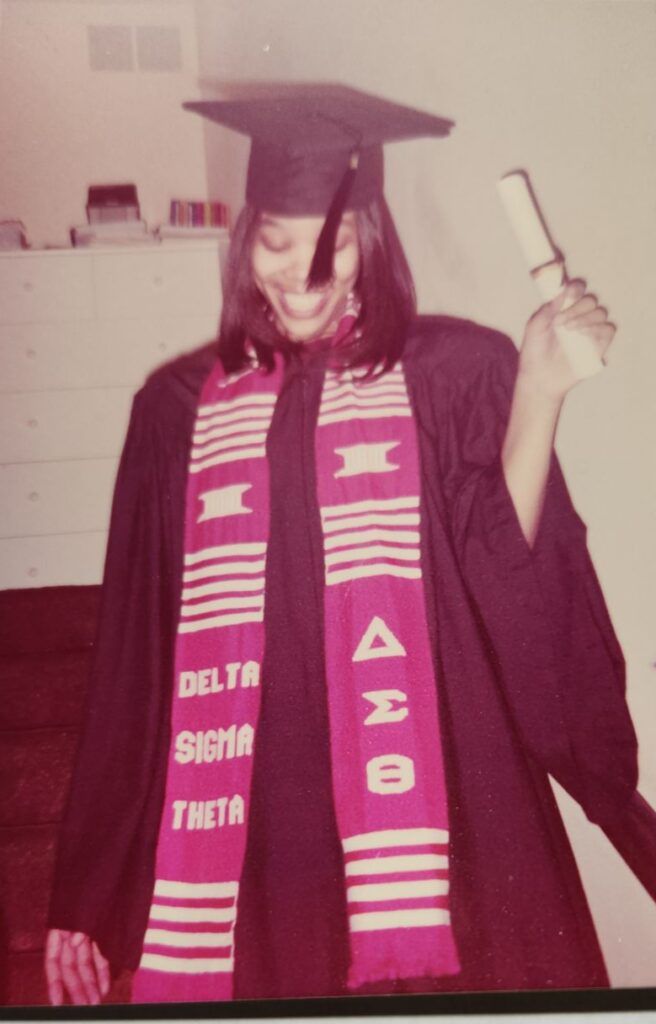
(On the right, Kisha Parker in her cap and gown on graduation day.)

Kisha Parker in her cap and gown on graduation day.

Q: What drives you to support UMBC?

A: Over the years, I have supported many programs financially, but the Alumni Endowed Scholarship Fund is one I make sure to always support. It allows an avenue for the Alumni Association to award current, deserving students an opportunity to continue their education in ways they need. I have been able to see the impact of these scholarships through the personal testimonies of the recipients, witness the process of awarding these scholarships, and am confident that this donation (and many others!) is going to good and immediate use!

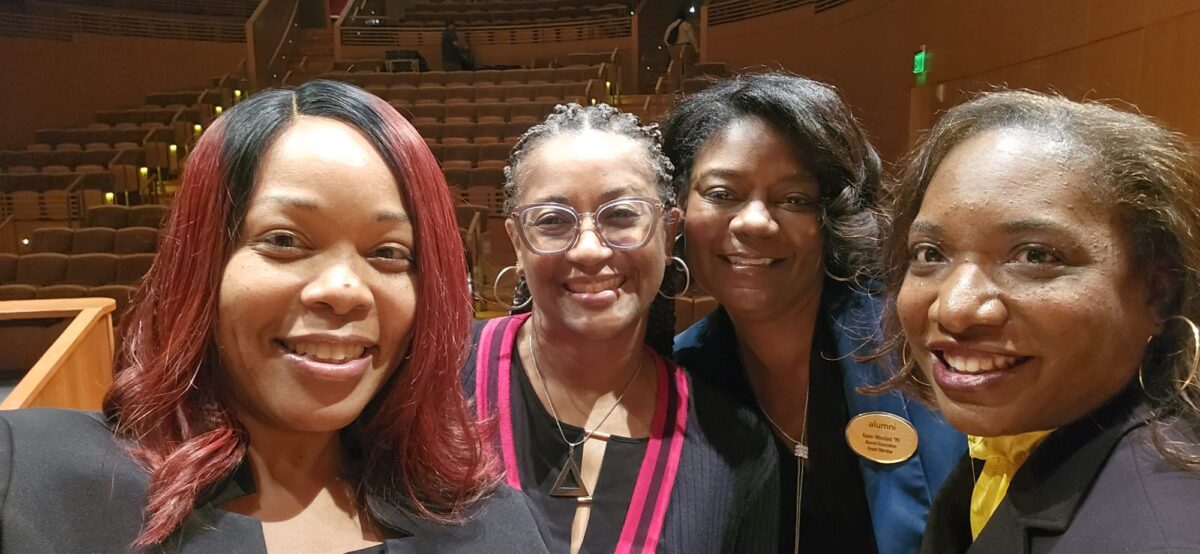
Kisha Parker and three other women at the UMBC Alumni Awards.
Members of UMBC’s Alumni Association Board of Directors, Kisha Parker ’00, Vanita Murray ’95, Monique Jones Cephas ‘92, and Karen Woodard ’90, at the Alumni Awards ceremony.

About the Alumni Association Board of Directors

UMBC’s Alumni Association is a non ­dues-paying organization and is led by a volunteer Board of Directors—volunteer graduates, like Kisha, who support advancing the mission and vision of the association and, by extension, UMBC, through their visibility as alumni leaders and active participants in the ongoing work of the board and its committees.

* * * * *

UMBC’s greatest strength is its people. When people meet Retrievers and hear about the passion they bring, the relationships they create, the ways they support each other, and the commitment they have to inclusive excellence, they truly get a sense of our community. That’s what “Meet a Retriever” is all about.

Learn more about how UMBC can help you achieve your goals.

The Anthropocene is not an epoch − but the age of humans is most definitely underway

Written by Erle C. Ellis, professor of geography and environmental systems, UMBC.

When people talk about the “Anthropocene,” they typically picture the vast impact human societies are having on the planet, from rapid declines in biodiversity to increases in Earth’s temperature by burning fossil fuels.

Such massive planetary changes did not begin all at once at any single place or time.

That’s why it was controversial when, after over a decade of study and debate, an international committee of scientists – the Anthropocene Working Group – proposed to mark the Anthropocene as an epoch in the geologic time scale starting precisely in 1952. The marker was radioactive fallout from hydrogen bomb tests.

On March 4, 2024, the commission responsible for recognizing time units within our most recent period of geologic time – the Subcommission on Quaternary Stratigraphy – rejected that proposal, with 12 of 18 members voting no. These are the scientists most expert at reconstructing Earth’s history from the evidence in rocks. They determined that adding an Anthropocene Epoch – and terminating the Holocene Epoch – was not supported by the standards used to define epochs.

To be clear, this vote has no bearing on the overwhelming evidence that human societies are indeed transforming this planet.

As an ecologist who studies global change, I served on the Anthropocene Working Group from its start in 2009 until 2023. I resigned because I was convinced that this proposal defined the Anthropocene so narrowly that it would damage broader scientific and public understanding.

By tying the start of the human age to such a recent and devastating event – nuclear fallout – this proposal risked sowing confusion about the deep history of how humans are transforming the Earth, from climate change and biodiversity losses to pollution by plastics and tropical deforestation.

Ellis explains this process in an article written by Vox reporter Laura Bult, “Should humans get their own geologic era?” [This is additional content posted on 5/6/2024 courtesy of Vox]

The original idea of the Anthropocene

In the years since the term Anthropocene was coined by Nobel Prize-winning atmospheric chemist Paul Crutzen in 2000, it has increasingly defined our times as an age of human-caused planetary transformation, from climate change to biodiversity loss, plastic pollution, megafires and much more.

Crutzen originally proposed that the Anthropocene began in the latter part of the 18th century, as a product of the Industrial age. He also noted that setting a more precise start date would be “arbitrary.”

According to geologists, we humans have been living in the Holocene Epoch for about 11,700 years, since the end of the last ice age.

Human societies began influencing Earth’s biodiversity and climate through agriculture thousands of years ago. These changes began to accelerate about five centuries ago with the colonial collision of the old and new worlds. And, as Crutzen noted, Earth’s climate really began to change with the increasing use of fossil fuels in the Industrial Revolution that began in the late 1700s.

A chart reflecting timing of the ‘Anthropocene Event’ shows how various human activities have affected the planet over millennia in the recent geologic time scale. Click the image to enlarge. Anthropocene epoch human societies
A chart reflecting timing of the ‘Anthropocene Event’ shows how various human activities have affected the planet over millennia in the recent geologic time scale. Click the image to enlarge. Philip Gibbard, et al., 2022

The Anthropocene as an epoch

The rationale for proposing to define an Anthropocene Epoch starting around 1950 came from overwhelming evidence that many of the most consequential changes of the human age shifted upward dramatically about that time in a so-called “Great Acceleration” identified by climate scientist Will Steffen and others.

Radioisotopes like plutonium from hydrogen bomb tests conducted around this time left clear traces in soils, sediments, trees, corals and other potential geological records across the planet. The plutonium peak in the sediments of Crawford Lake in Ontario, Canada – chosen as the “golden spike” for determining the start of the Anthropocene Epoch – is well marked in the lake bed’s exceptionally clear sediment record.

The Anthropocene Epoch is dead; long live the Anthropocene

So why was the Anthropocene Epoch rejected? And what happens now?

The proposal to add an Anthropocene Epoch to the geological time scale was rejected for a variety of reasons, none of them related to the fact that human societies are changing this planet. In fact, the opposite is true.

If there is one main reason why geologists rejected this proposal, it is because its recent date and shallow depth are too narrow to encompass the deeper evidence of human-caused planetary change. As geologist Bill Ruddiman and others wrote in Science Magazine in 2015, “Does it really make sense to define the start of a human-dominated era millennia after most forests in arable regions had been cut for agriculture?”

Discussions of an Anthropocene Epoch aren’t over yet. But it is very unlikely that there will be an official Anthropocene Epoch declaration anytime soon.

The lack of a formal definition of an Anthropocene Epoch will not be a problem for science.

A scientific definition of the Anthropocene is already widely available in the form of the Anthropocene Event, which basically defines Anthropocene in simple geological terms as “a complex, transformative, and ongoing event analogous to the Great Oxidation Event and others in the geological record.”

So, despite the “no” vote on the Anthropocene Epoch, the Anthropocene will continue to be as useful as it has been for more than 20 years in stimulating discussions and research into the nature of human transformation of this planet.


This article was updated to clarify that a new attempt at an official Anthropocene Epoch declaration is unlikely soon and to add the Vox interview link and YouTube video. It is republished from The Conversation under a Creative Commons license. Read the original article and see more than 250 UMBC articles available in The Conversation.

Meet a Retriever—Lisa Nissley ’01, Alumni Association Nominating Committee Chair

Meet Lisa Nissley ‘01, political science. Lisa is a legislative liaison at the Department of General Services, as well as the chair of the nominating committee on the UMBC Alumni Association Board of Directors. In her spare time, you can find her at the ice rink (her two children are involved in figure skating and ice hockey), the pool (swim team), or the lacrosse field. Lisa also enjoys reading, cooking (when it’s not required), walking, and being creative. Take it away, Lisa!

Q: What’s the one thing you’d want someone who hasn’t joined the UMBC community to know about the support you find here?

A: It truly is a community, and that is a feeling that stays with you. I have worked in the political world of campaigns and government relations and always seem to connect with UMBC grads, some I knew and others who were there before or after me. Also, the community is diverse, so there is always someone to connect with and learn from. 

Q: Where did you find support when you were here?

A. When I came to UMBC, I was eager to find community and feel like I belonged and I wanted to build my career. The interesting thing is how those two goals aligned. I joined student organizations, interned in Annapolis, and made friends in class. Some of those very people have been in my corner ever since.

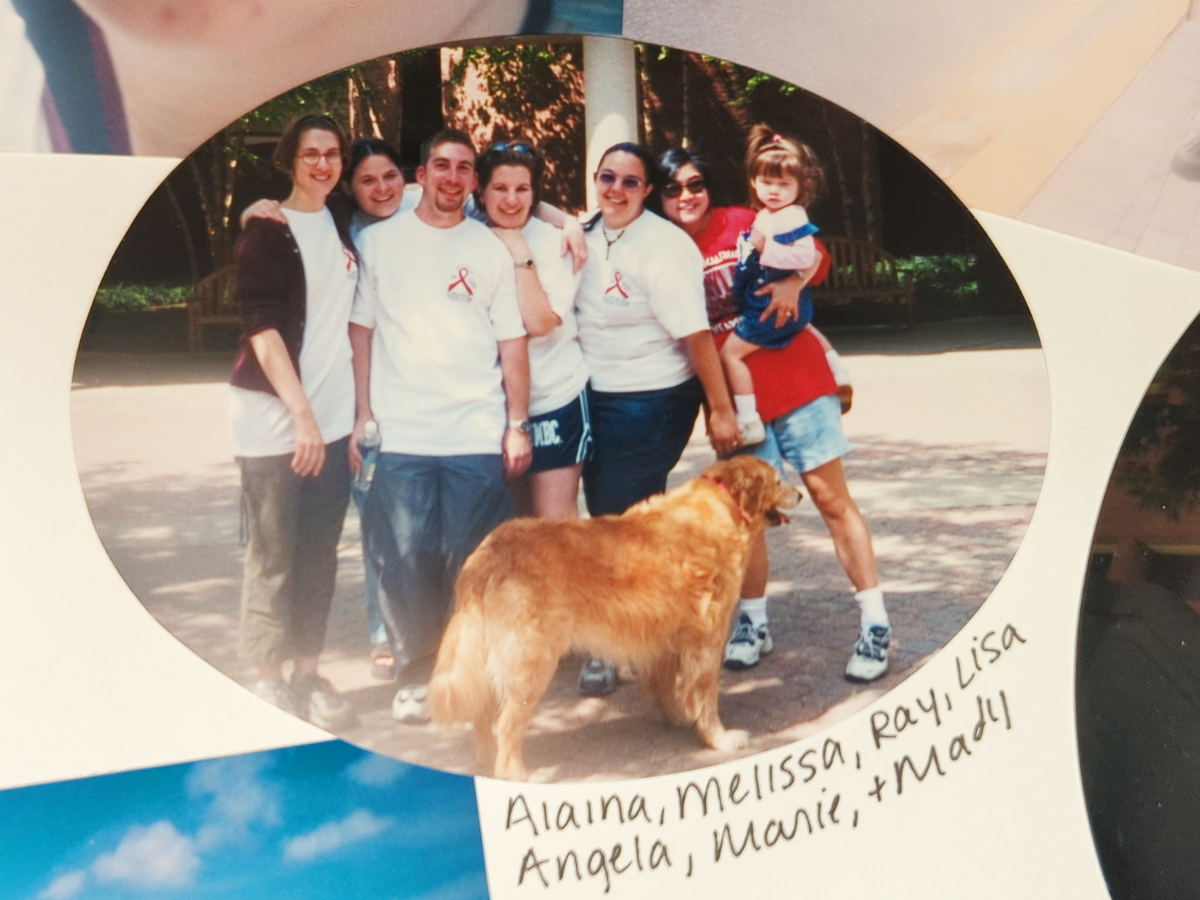
In front of the University Center with friends from Peer health and ANGELS, a student group that raised awareness of HIV/AiDS. We had organized a 5k fundraiser.
In front of the University Center with friends from Peer Health and ANGELS, a student group that raised awareness of HIV/AIDS during a 5k fundraiser. (Photo courtesy of Nissley)

Q: Who is someone in the community who has inspired you or supported you?

A: Dr. Tom Schaller—I always enjoyed his classes and he was involved in the political world, so I would see him out in the world doing what he talked about in class. He assigned long research papers we worked on throughout the semester, and what seemed daunting at first turned out to be very interesting. I was lucky to assist in his research. We have stayed in touch over the years and he has shared advice and guidance throughout my career.

I love finding UMBC alumni just about everywhere I go.

Lisa Nissley '01

Q: Tell us more about your journey from UMBC to your current role.

A: I actually transferred to UMBC and didn’t expect to stay, but I loved it! I eventually graduated in 2001 with a political science degree. Over the years since graduating, I have been a state employee working in the legislative branch and various state agencies doing policy and government relations. Recently, I started at the Department of General Services in the legislative office. I am enjoying being back in Annapolis full-time and being part of the legislative process.

Q: How have you given back?

A. I serve on the UMBC Alumni Association Board of Directors (AABOD) as chair of the nominating committee. I really enjoy giving back to the UMBC community in this way. We work to have a diverse board that represents the alumni community, and I’m always impressed by the exciting things our alumni are doing out in the world. I also give annually to the Alumni Endowed Scholarship Fund. Through the Alumni Endowed Scholarship, the AABOD strives to make a difference in the lives of deserving students, to help them achieve their dream of receiving a university degree and joining the alumni community.

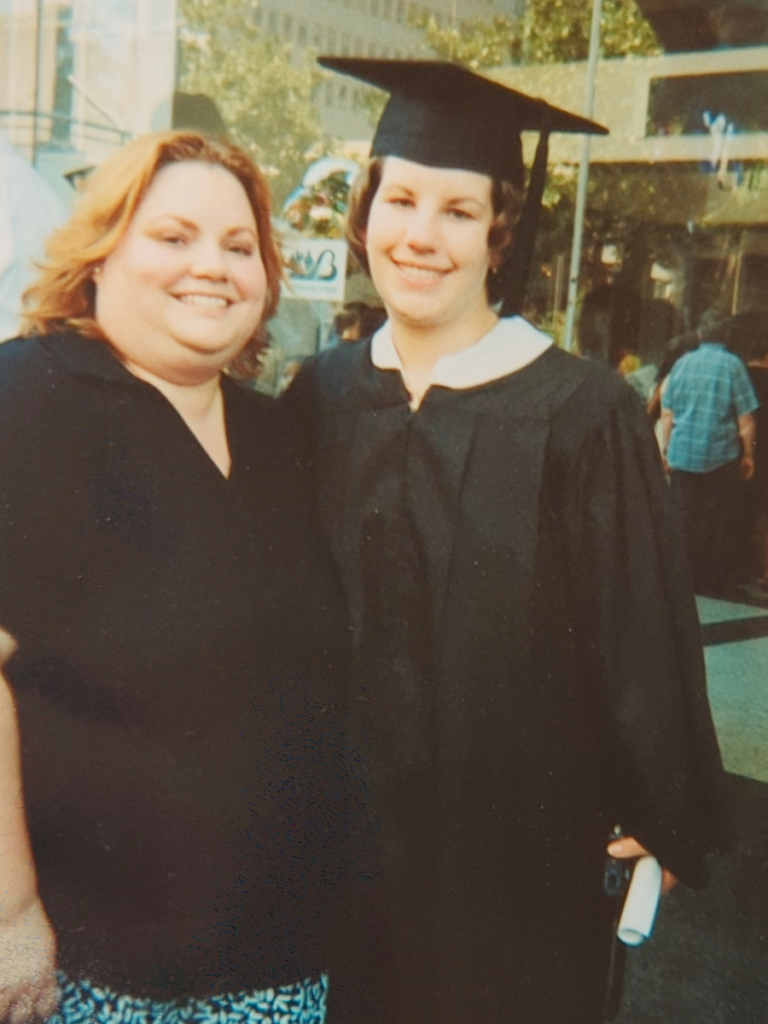
Lisa Nissley in her cap and gown at graduation. She is standing next to her sister.

About the Alumni Association Board of Directors

UMBC’s Alumni Association is a non ­dues-paying organization and is led by a volunteer Board of Directors—volunteer graduates, like Lisa, who support advancing the mission and vision of the association and, by extension, UMBC, through their visibility as alumni leaders and active participants in the ongoing work of the board and its committees.

A meeting of the Alumni Association Board of Directors. Lisa and Brian Frazee ’11, M.P.P. ’12, Alumni Association President.
Lisa and Brian Frazee ’11, M.P.P. ’12, Alumni Association president, before a meeting of the Alumni Association Board of Directors.

* * * * *

UMBC’s greatest strength is its people. When people meet Retrievers and hear about the passion they bring, the relationships they create, the ways they support each other, and the commitment they have to inclusive excellence, they truly get a sense of our community. That’s what “Meet a Retriever” is all about.

Learn more about how UMBC can help you achieve your goals.

Meet a Retriever—Nathan Wooddell ’23, graduate student specializing in Russian and cybersecurity 

Meet Nathan Wooddell ’23, computer science. Nathan is a member of UMBC’s CyberCorps: Scholarship for Service cohort, and is getting his master’s in cybersecurity as a graduate researcher at the National Nuclear Security Agency. Nathan attributes much of his success to the connections he’s made with the staff and faculty at UMBC who have helped him to discover his true passions. During his time as an undergraduate at UMBC, Nathan also completed a Russian language certificate, and has found a way to combine his interests of both cybersecurity and the Russian language in the professional world. Take it away, Nathan.  

Q: What’s one thing you’d want someone to know about the support you find at UMBC?

A: In many classes, casual visits to professors during office hours, polite interactions during class, and expressing interest in the subject matter can go a long way. Such interactions help with all aspects of student life. Too many students fail to take proper advantage of the fantastic support that the university faculty can offer. The best way to do this in my experience is simply to speak with your professors after class or outside of class.

Such interactions help with all aspects of student life. The faculty can offer support in the form of academic resources, scholarship recommendations, professional guidance, and even letters of recommendation for work or graduate programs.

Q: Tell us about someone in the community who has inspired you or supported you, and how they did it.

A: I want to give special thanks to Russian instructor Vira Zhdanovych. Since I first transferred to UMBC, I have taken Russian language courses with Professor Zhdanovych. It was through her guidance that I got my first research experience when she advised me on my 2022 Undergraduate Research and Creative Achievement Day presentation Analyzing the Russian Federation’s Impact on Global Cyber Security. This was also the first time that I was able to merge my interest in cybersecurity and Russian language. 

Students learning Russian pose for a photo with their professor, holding up different Russian letters to spell out the phrase "Happy New Year!" in the language.
At the MLLI winter and New Year celebration, hosted by the Russian Area in December 2023, Zhdanovych stands in the center holding an “M” and Wooddell is to her right holding the Russian letter “ы.” The full sign reads “Happy New Year!” (Photo courtesy of Zhdanovych)

I have worked extensively with Professor Zhdanovych to study and research the impact of the Russian-speaking world on the cybersecurity and intelligence communities—I owe so much of my professional and academic success to her.

Q: Tell us what you love about your academic program or an organization you’re involved in.

A: I am a participant and former officer in UMBC’s Russian Club. The meetings of this club are especially good for learning about contemporary Russian culture, as well as the geopolitical history, which still shapes the diplomacy of the Russo-American relationship.

“Had I known then what I know now about the university’s programs, rigor, faculty, and opportunities, UMBC would have been a shoo-in. Ultimately, I am so grateful that I applied to, and attended UMBC.”

Nathan Wooddell '23, current master's student

Q: What is your WHY? What brought you to UMBC?

A: I came to UMBC in my sophomore year as a transfer student. Admittedly when I was accepted I toyed around with the idea of going to a variety of different schools, but eventually decided on UMBC for the price, and the relative vicinity to my home in northern Maryland.

Had I known then what I know now about the university’s programs, rigor, faculty, and opportunities, UMBC would have been a shoo-in. Ultimately, I am so grateful that I applied to, and attended UMBC.

Q: Tell us about the people who are helping you grow at UMBC, and why their HOW made such a difference to you.

A: In addition to Professor Zhdanovych’s support with my Russian language and research, Professor RJ Joyce in computer science encouraged me to become invested in cybersecurity. It’s because of him that I’ve become involved in many of the clubs and organizations I am currently enrolled in. Such interest in security was able to earn me recipient status in UMBC’s Scholarship for Service cohort.  

Q: What clubs, teams, or organizations are you a part of? What do you love about them?

A: First and foremost, I am a member of UMBC’s National Science Foundation-funded CyberCorps: Scholarship of Service (SFS). This program has allowed me to pursue my interest in security outside of the traditional academic venues. Thanks to SFS, I was able to attend and present at DEFCON 31 in Las Vegas, one of the largest cybersecurity conventions in the world [Photo: Wooddell, left, at DEFCON 31 with a fellow student].

I am also a member of the UMBC Cyberdawgs. I never miss an opportunity to compete in the annual competitions they hold on campus. Beyond this, I attend the bi-weekly Cyber Defense Lab meetings, which allow me to keep up to date with all sorts of security research projects being conducted on campus.

Q: Are you a student leader? Tell us about it! 

A: Through SFS, related organizations, and clubs on campus, I have been lucky enough to meet and work with some of the most amazing and intelligent people I have ever met. From these associated labs, clubs, and programs I have met and been influenced by more people than I could ever hope to list here.

Two men (one is a Russian speaker) take a smiling selfie in front of a lot of lit up billboards in Las Vegas at a cybersecurity conference

I am incredibly honored to have been able to lead these organizations, as they have provided me with opportunities to give back to my university and community.

* * * * *

UMBC’s greatest strength is its people. When people meet Retrievers and hear about the passion they bring, the relationships they create, the ways they support each other, and the commitment they have to inclusive excellence, they truly get a sense of our community. That’s what “Meet a Retriever” is all about.

Learn more about how UMBC can help you achieve your goals.

Turkey will stop sending imams to German mosques – here’s why this matters

Written by Brian Van Wyck, assistant professor of history, UMBC

For decades, the Turkish government has sent imams to work in mosques across Germany. But the German Ministry of the Interior recently announced that it had reached an agreement with the Turkish government to put an end to the practice.

These imams, approximately 1,000 at present, are Turkish civil servants. Imams are sent to Germany on four- to six-year rotations, based on a long-standing agreement between the two governments. They work with Germany’s more than 2.8 million residents with Turkish citizenship or heritage.

The practice had come under intense criticism in Germany in recent years. German politicians have accused Turkish imams of spying on their flocks or abusing their positions to promote support for Turkey’s ruling Justice and Development Party.

The German government described plans to replace “imported imams” with imams trained in Germany as an “important milestone for integration.” On the other hand, some observers have questioned whether it will change anything for Germany’s 5 million Muslims.

As part of my ongoing research into the history of migration between Turkey and Germany, I have investigated the origins of this exchange and the goals both governments pursued by bringing Turkish imams to Germany.

Efforts by both states to intervene in the religious lives of Muslims by selecting which imams can preach in German mosques have a long history – although such efforts might not always achieve the goals of governments.

The ‘strategy’ of sending imams

A 1961 agreement led to Turkish “guest workers” being sent to Germany to meet the labor demands of its booming postwar economy. Many recruited workers and their families chose to settle permanently in Germany. By 1974, a year after labor recruitment ended, at least 1 million Turkish citizens were residing in Germany.

It was only in the 1980s that the Turkish government began sending cohorts of imams abroad, after it had become evident that a large Turkish population was in Germany to stay.

This step was motivated by several goals. One was to use state imams to create an alternative to Islamic groups active in Germany who opposed the secular Turkish state. Another was to use imams to foster continued ties to Turkey among the Turkish diaspora in Germany, encouraging them to continue to invest in Turkey.

In the 1980s, conservative governments made increasing use of Islam to encourage national unity in Turkey by, for example, mandating religious education in schools and revising curricula to emphasize Turkey’s Islamic heritage. Sending imams abroad was an example of this strategy being exported to Turkey’s overseas diaspora.

Only Turkish imams for Germany

An ivory-colored German mosque with two tall minarets with a dome in their center, set against the backdrop of a clear, blue sky.
The Sehitlik Mosque in the Berlin district of Neukoelln. Kaveh Rostamkhani/AFP via Getty Images

In the early 1980s, German authorities, like their Turkish counterparts, had become concerned about Islamic institutions in the country. Historian Alexander Konrad has demonstrated that unsubstantiated reports about corporal punishment and political extremism in courses devoted to learning the Quran achieved wide currency in Germany in the 1970s.

When German diplomats and Turkish officials began to discuss their shared concerns in meetings in Ankara in 1980, they quickly found common ground. As diplomatic cables in the archives of the German Federal Foreign Office reporting on these discussions reveal, Turkish and German officials agreed that having the right imams in German mosques would solve the social and political problems they believed were caused by extremist imams. And they believed that imams employed by the Turkish state were guaranteed to be well-trained and moderate.

Accordingly, as I learned from directives preserved in the State Archive of North Rhine-Westphalia, German policymakers had begun by 1982 to issue entry visas directly to the Turkish government to distribute to those imams it selected to serve in Germany. Already by the end of the 1980s, more than 500 Turkish state imams were active in Germany.

At the same time, entry visas for all other imams were more tightly controlled. This meant that imams from Turkey or anywhere else in the world who wanted to work in Germany but were not employed by the Turkish government faced new hurdles. I learned from legal judgments in the German Federal Archives that some imams who were already working in Germany were forced to leave the country as a result of the new policy.

Limits to the influence of Turkish state imams on German mosques

Both governments assumed that Turkish state imams would be able to reshape German mosques, eliminate perceived extremism and ensure secular Islamic practice in Germany. However, this agreement did not achieve the results the Turkish or German government desired.

There were a few reasons for this. For one, imams often arrived with limited knowledge of German and Germany. Because of that, they relied on members of the local Turkish community, as the sociologist Rauf Ceylan has argued.

Contrary to what German and Turkish officials might have assumed, these imams could not simply assume control over the often long-established mosques to which they were assigned. And that meant that whatever control the Turkish government exercised over German mosques through them was partial and depended on local buy-in.

Furthermore, not all mosques in Germany received Turkish state imams. Turkish-origin migrants and their descendants created Islamic institutions and organized religious life for themselves for decades without Turkish state intervention. Those institutions did not disappear when competition in the form of Turkish state imams arrived. Both now and then, many Muslims with Turkish roots choose to attend mosques with Turkish state imams, but many do not.

Imams trained in Germany?

Over the course of the more than 40 years in which Turkish state imams have been sent to Germany, the German and Turkish governments invested their work with high expectations. And now, as the end of these imam exchanges comes into sight, German officials continue to assume that changing who preaches in mosques will dramatically alter religious life for German Muslims.

In the coming years, imams trained in academies in Germany will replace more and more Turkish state imams as they end their rotations in Germany and return home. According to this plan, the eventual result will be that only domestically trained, German-speaking imams will work in German mosques at some point in the near future. German officials described the new model as “an important milestone for the integration and participation of Muslim communities in Germany.”

Ultimately, as history demonstrates, it is German Muslims themselves, and not the imams who lead them in prayer, who will determine if this is the case.


This article is republished from The Conversation under a Creative Commons license. Read the original article and see more than 250 UMBC articles available in The Conversation.