We use cookies for analytics and, unless you opt out, advertising.
You can opt out of advertising at any time.UMBC uses essential cookies to run this site. With your permission we would also use analytics cookies (to understand how the site is used) and advertising cookies (to measure and target our ads on other platforms). Nothing else loads unless you accept. You can change your choice any time from Cookie Settings in the footer.Privacy Policy
EssentialRequired for the site to work (login, security, your cookie choice). Always on.
UMBC researchers have secured a $1,031,000 congressional earmark to launch a vital new initiative tackling the escalating threat of flooding in Maryland’s most vulnerable communities.
Led by Alan Yeakley, professor, and Dillon Mahmoudi, associate professor, both in geography and environmental systems, the project establishes the UMBC Laboratory for Flood Risk Impact Assessment and Adaptation in Impoverished Maryland Communities. This lab will serve as a hub for analyzing and tracking the impacts of rising flood risks on low-income populations in both urban and rural areas across the state. Yeakley and Mahmoudi will bring on two postdoctoral researchers and graduate and undergraduate research assistants, who will gain critical skills in community-engaged research and data analytics while supporting the work.
The project focuses on communities along the Chesapeake Bay and its major tributaries, including historically underserved neighborhoods in Baltimore such as Turner Station. Researchers will investigate how the legacies of blockbusting and redlining have heightened flood vulnerability in low-income areas and assess whether flood mitigation resources have been distributed equitably. The team will also evaluate the current state of adaptation strategies at every level—from individual households to the city, county, state, and federal governments.
Alan Yeakley (left) and Dillon Mahmoudi discuss their project to help communities adapt to flood risks on the UMBC Library Pond, which itself serves as a stormwater management system for the UMBC campus. Dillon Mahmoudi studies urban geography and development. Alan Yeakley’s research centers on urban ecology.
Through hands-on workshops, interviews with residents, and discussions with government agency personnel, the lab will document communities’ existing adaptation methods and raise awareness of growing hazards. Advanced computer modeling completed in UMBC’s state-of-the-art geographic information systems (GIS) laboratory will help quantify predicted risks, which researchers will share with affected communities along with practical, low-cost strategies to enhance resilience. This approach will foster opportunities to co-create solutions, in alignment with UMBC’s commitment to bidirectional partnerships with our neighbors as we all seek to address environmental challenges.
“We’re thrilled to be able to help local communities experiencing flooding along the Chesapeake Bay,” Yeakley says. “We hope to learn what they are already doing to mitigate these hazards, and to suggest strategies that might improve their resilience to ongoing and future threats to their properties and their lives. We also hope that, eventually, communities will share successful strategies with each other directly, creating a grassroots network of neighborhood and environmental stewardship.”
GRIZZLED: Love Letters to 50 of North America’s Least Understood Animals spotlights the quirky, often-misunderstood inhabitants of our backyards and beyond. It hits bookstores this week, and Mercedes Burns, associate professor of biological sciences, is featured in an essay that dives into the world of harvesters—better known as daddy longlegs.
The essay debunks the common myth that harvesters are the most venomous spiders in the world, but only harmless because their mouthparts are too small to bite a human. In fact, rather than being spiders at all, Burns shares that they are intriguing arachnid relatives. She unpacks their survival tactics, like shedding legs to escape predators, and other eccentric behaviors that make these gangly denizens more endearing than eerie.
“I’ve studied arachnids for over a decade, and learning about them has opened my eyes to the diversity of less-appreciated and absolutely fascinating species that occur in North America,” Burns shares. “I am excited to join the league of researchers who contributed to this book, and I hope that readers find a new local species to love.”
Burns’ passion for arachnids isn’t new—and it’s been weaving its way into public consciousness for years. In a 2020 New York Times piece, she demystified the fuzzy clusters of daddy longlegs that sometimes “grow” on buildings, turning a gross-out moment into a lesson on their harmless, communal nature. She’s also weighed in on arachnid feats, such as spiders devouring snakes up to 30 times their size, as featured in a 2021 Smithsonian article.
Mercedes Burns handles one of her study organisms in the lab. (Marlayna Demond ’11/UMBC)
Burns’ work reminds us that even tiny creatures deserve our attention and care. Dive into science journalist Jason Bittel’s GRIZZLED to discover your own “local species to love.”
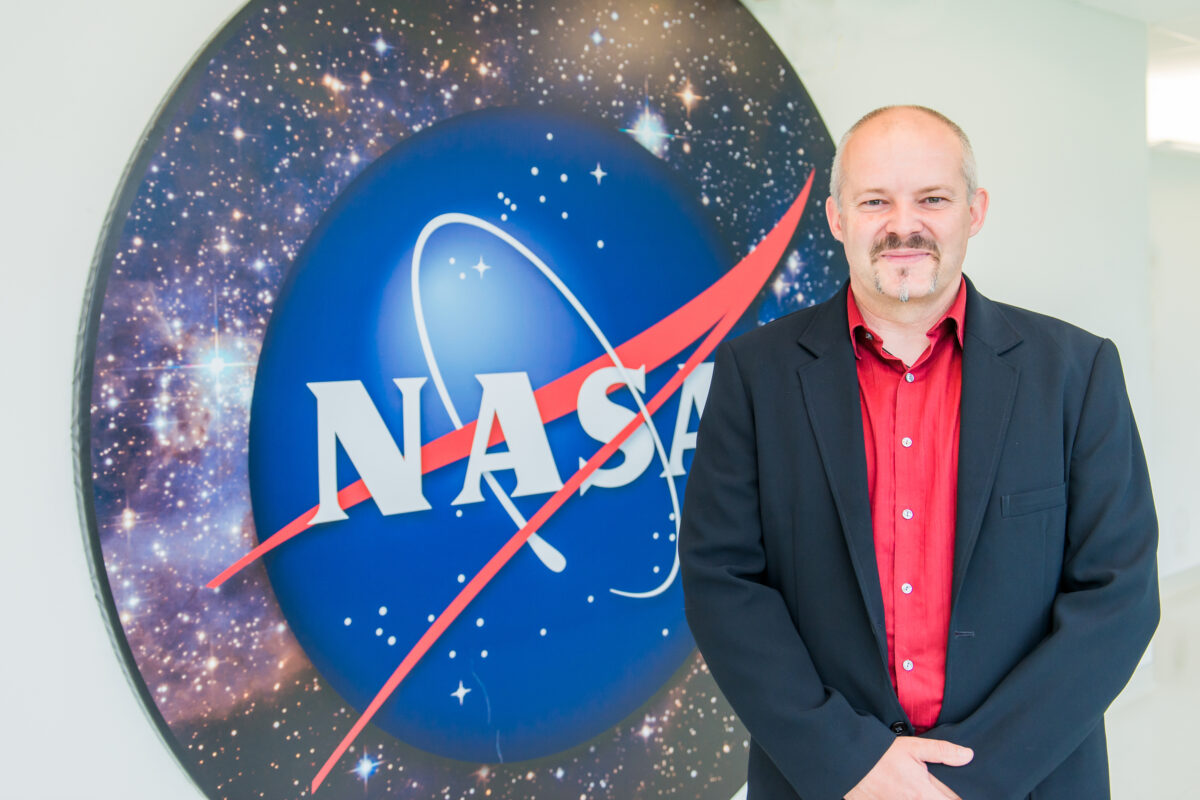
Zhibo Zhang, professor of physics, has been named director of the Goddard Planetary Heliophysics Institute (GPHI), UMBC’s arm of the Partnership for Heliophysics and Space Environment Research (PHaSER). PHaSER, a multi-institution consortium led by Catholic University of America, contributes to NASA’s Heliophysics Science Division at Goddard Space Flight Center (GSFC) through research on the Sun, its processes, and space weather, which can affect planet Earth and human technologies.
NASA allocated $10 million to UMBC in 2021 under its $64.1 million PHaSER award, underscoring the university’s contributions to heliophysics research and building on more than thirty years of successful collaboration between UMBC and GSFC, located in Greenbelt, Maryland.
Jan Merka led GPHI from from its inception in 2011 and will hand the reins to Zhibo Zhang this month. (Marlayna Demond ’11/UMBC)
“My first priority is to support GPHI faculty and help enable the outstanding science and engineering they carry out at NASA Goddard Space Flight Center,” Zhang says. “At the same time, I hope GPHI can serve as a stronger bridge between NASA and UMBC by connecting GPHI faculty with UMBC research resources, collaboration and funding opportunities, and with students and faculty who can expand our collective capacity and open doors to bigger, cross-cutting ideas.”
Zhang follows Jan Merka, who has served as the inaugural GPHI director since 2011. As director, Zhang will continue in his faculty role at UMBC, advancing his team’s research on atmospheric dust’sinfluence on climate and remaining deeply committed to teaching and mentoring. His guidance of undergraduate and graduate students has helped multiplestudents secure the prestigious NASA Future Investigators in NASA Earth and Space Science and Technology (FINESST) Fellowship and other awards, including the 2025 Elsevier/JQSRT Richard M. Goody Award, fostering the next generation of scientists.
“We are very proud of the fact that UMBC is currently ranked as the #11 institution in the nation in NASA expenditures,” say Karl V. Steiner, vice president for research and creative achievement. “Zhibo Zhang is an outstanding colleague with a broad set of relevant expertise and experiences who will provide important leadership to GPHI and to our partnership with Catholic University under PHaSER. I know that he is the right leader to strengthen our relationship with NASA, building on over three decades of successful cooperative partnership between UMBC and NASA Goddard.”
Zhibo Zhang (second from right) thoughtfully mentors undergraduate and graduate students, including Qianqian Song (right), Ph.D. ’22, who received the FINESST fellowship, and Jianyu Zheng (far left, rear), Ph.D. ’23, who received the 2025 Elsevier/JQSRT Goody Award. (Marlayna Demond ’11/UMBC)
When Jaime Miller ’06, biochemistry, was in the final stages of her M.D/Ph.D., she did not expect her 15-year educational journey to be derailed by her own medical mystery. She certainly didn’t foresee finding peace and purpose through turning her chronic illness into a life of advocacy—but that’s exactly what’s happened.
Before coming to UMBC, Miller seized early opportunities: Her teachers encouraged her interests in STEM, leading her to attend the Baltimore Polytechnic Institute (Poly), a STEM magnet high school requiring a combined bus and light rail commute from her home in Baltimore’s Morrell Park neighborhood. After her junior year, a summer neuroscience program for high schoolers at the University of Maryland further ignited her love for life science. As a first-generation college student, she entered these unfamiliar spaces with an uncommon boldness.
“I didn’t wear a plain Jane suit to the interview for the University of Maryland program. It was mint green, which is hilarious, looking back,” she says. “I didn’t know what I was doing. But I’ve just always been somebody that hasn’t feared failure. You just learn and keep on going. It’s like a building step.”
The summer program, where Miller thrived in a lab studying Alzheimer’s disease under mentor Mervin Monteiro, extended into her senior year through Poly’s research practicum, where she continued lab work, wrote a thesis, and won first prize at the Intel Science Talent Search (now the Regeneron STS). When Miller learned from a lab colleague that most M.D./Ph.D. programs pay for medical school, it was “like fireworks going off in my head,” she says, knowing medical school would be beyond her family’s budget. Aware of UMBC’s reputation for preparing STEM majors to excel in graduate study, Miller decided to use the local institution as a launchpad for a funded graduate program.
Right on track
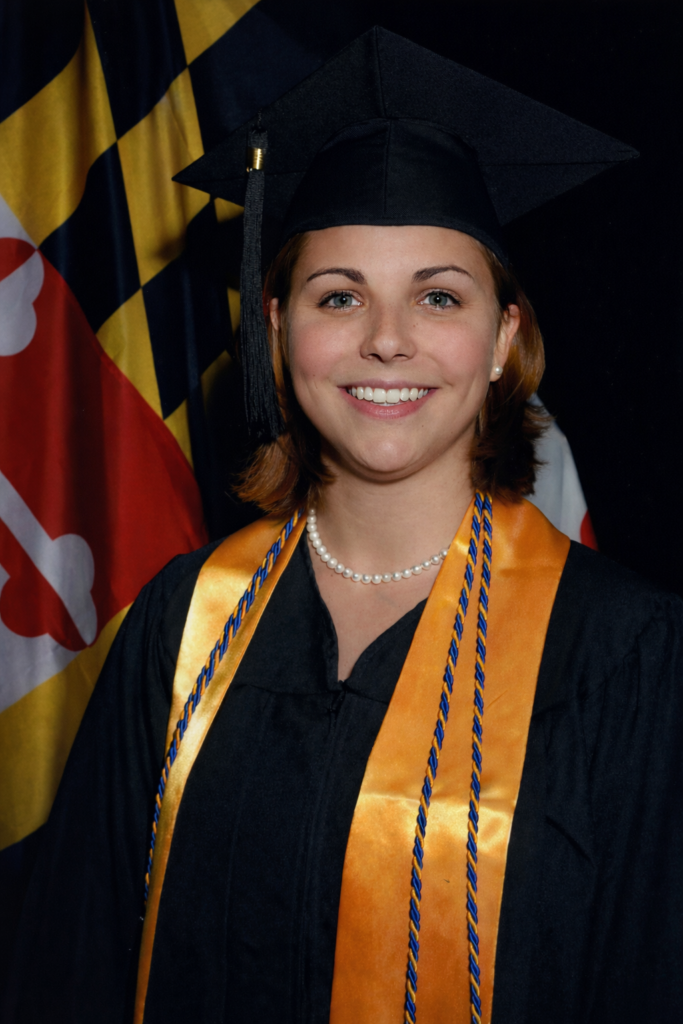
Jaime Miller graduated magna cum laude from UMBC and was inducted into the prestigious Phi Beta Kappa National Honor Society. (Courtesy of Miller)
Drawn to UMBC’s supportive environment, strong science programs, and proximity to home, Miller accepted a College Bound scholarship and a small award from a pharmaceutical company. Miller found a minor in philosophy complemented her scientific pursuits by honing her critical thinking and providing diverse insights. She particularly enjoyed courses in moral theory, she says, exploring challenging topics like euthanasia, abortion, and pornography in a safe environment for discussion.
The emphasis on clarity, precision, and organization in philosophical arguments directly enhanced her scientific communication and planning skills, too: “You want to make sure any experimental design is clean and succinct, so that when you present it, everybody understands what you’re doing and what your goal is.”
Again seizing opportunities, Miller emailed Michael Summers, distinguished professor of chemistry and biochemistry, about joining his lab, even negotiating her pay. “It was my first foray in advocating for myself,” she reflects. Summers remembers Miller as “a wonderful, caring person” with standout “resilience, professionalism, and commitment to others in need.” Her work with his research group led to a publication in Proceedings of the National Academy of Sciences.
After UMBC, Miller pursued an M.D./Ph.D. at the University of Virginia, focusing on epigenetics and blood disorders. “There was something about blood and blood cancers that I was just really drawn toward,” she says. After being selected for a fellowship in hematology-oncology at the University of Pittsburgh Medical Center (UPMC) in 2015, Miller seemed poised for a thriving clinical and research career.
Redirected by chronic illness
In 2018, however, a constellation of nagging symptoms escalated: extreme fatigue, joint pain, swollen lymph nodes, and, finally, pneumonia. After seemingly endless testing and specialist visits, she was diagnosed with systemic lupus erythematosus, an autoimmune disease. Lupus, she explains, “can affect literally any organ in the body” and manifests in every patient differently. Unfortunately, “I ran into a lot of obstacles” when requesting accommodations like no overnight shifts, she says, including dismissive comments about her “mystery illness.” Ultimately, UPMC terminated her, refusing a part-time option.
Jaime Miller (Courtesy of Miller)
This setback could have been devastating after 15 years of rigorous training, but Miller channeled it into purpose. “Despite how negative it sounds, it’s not tragic. My husband could see I was mentally breaking from sacrificing so much of my quality of life for my career. Leaving medicine was a brutal reality check, but it also showed me how much else I could explore and enjoy,” Miller says. For example, “When I was too sick to do much, I started small things I’d always wanted: I bought a guitar to learn music, a sewing machine to make clothes—simple activities I could do sitting in a chair. It was an eye-opener. I’m happier now—100 percent.”
As an ambassador for the Lupus Foundation of America, she co-facilitates a Pittsburgh support group and organized the city’s first officially sponsored Walk to End Lupus Now in 2025, raising $60,000. She has also found a way to continue her medical career on a part-time basis by voluntarily consulting for All4Cure, an online platform where specialists like her provide guidance for multiple myeloma patients, ensuring equitable care for those in rural areas treated by general oncologists.
From adversity to purpose
Miller spent years practicing self-advocacy on her academic journey, and now she’s using those skills to benefit others, as well. This resilience shines in her advice for the chronic illness community: “You have to take care of yourself. You can’t take care of anything else unless you take care of yourself, both physically and mentally.” She emphasizes seeking counseling early and advocating fiercely for one’s needs, even when it feels isolating.
Miller was raised in the Catholic church but drifted toward atheism during her medical training. After her diagnosis, however, she found herself sensing the voice of her grandmother, a committed Christian who also had lupus: “Maybe this is happening for a reason. You’re a physician and you’ll be able to educate and advocate a lot better for those that can’t advocate for themselves.” Today she is still navigating her spiritual life, but for now she believes in “something out there in the universe that makes things the way that they are”—an energy or presence that gives meaning to hardship and opens new paths.
UMBC played a foundational role in where Miller finds herself today, fostering her confidence and research skills in a nurturing setting. Today, at 41, Miller embraces a fuller life than a traditional physician path would have allowed. Her mantra extends to younger generations, who she hopes will try new things, take risks, and forge their own paths. “Failure is okay,” Miller reiterates. “It’s nothing more than a learning step to success.”
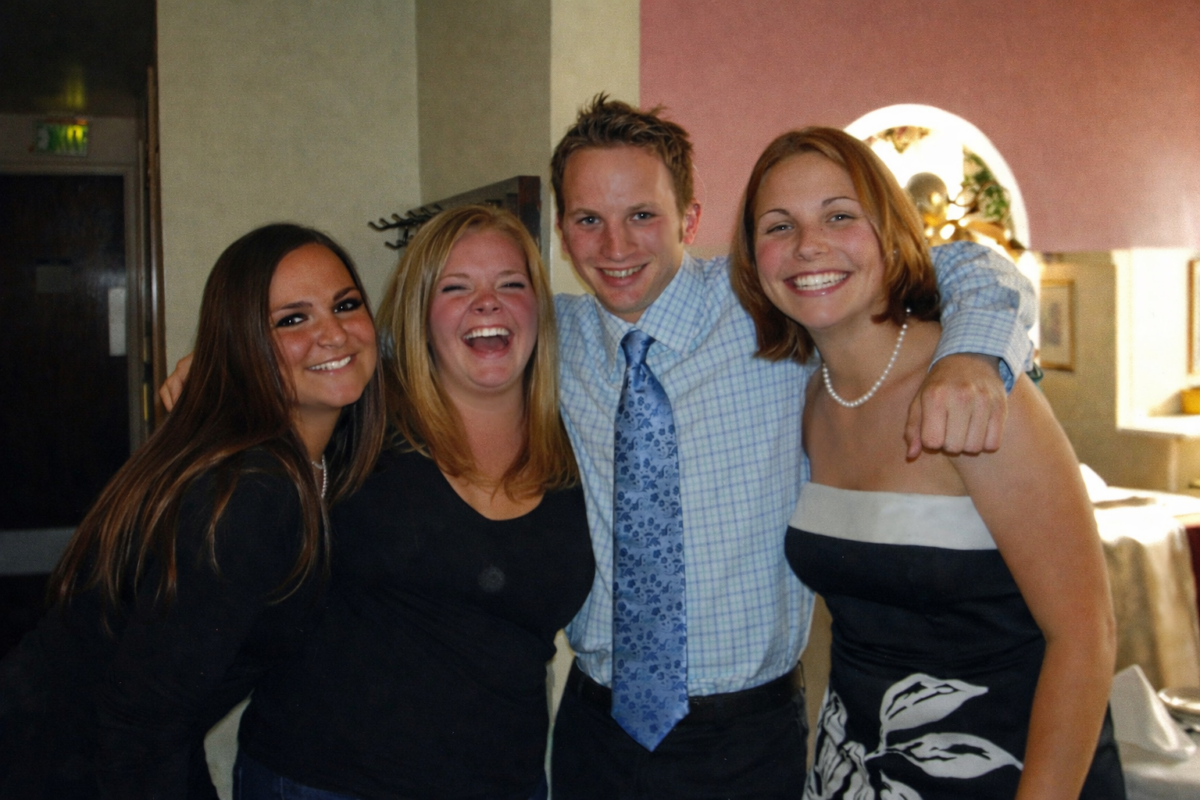
Jaime Miller, right, celebrates with close friends in Baltimore’s Little Italy after her UMBC graduation. (Courtesy of Miller)
On the fourth floor of UMBC’s Meyerhoff Chemistry Building, where students are hard at work exploring the intricacies of RNA molecules that may hold the key to combating viral diseases, a unique family tradition has taken root. Three sisters—Huda, Reem, and Rowah Abdelghani—have each stepped into the same research space and found the thrill of discovery, the warmth of community, and a mentor who welcomes eager learners at all levels.
It began with Huda, the trailblazing eldest of the three sisters. As a high school junior in Howard County’s Applications and Research Laboratory (ARL) biotechnology program, she dove into the program’s intensive training—mastering lab basics like micropipetting, PCR, and gel electrophoresis alongside students from across the county. ARL encourages seniors to pursue off-site internships, so Huda cold-emailed labs at nearby universities. “It was tough,” she recalls. “Some of my friends emailed over 30 people before finding a spot. I got lucky with Dr. Koirala.”
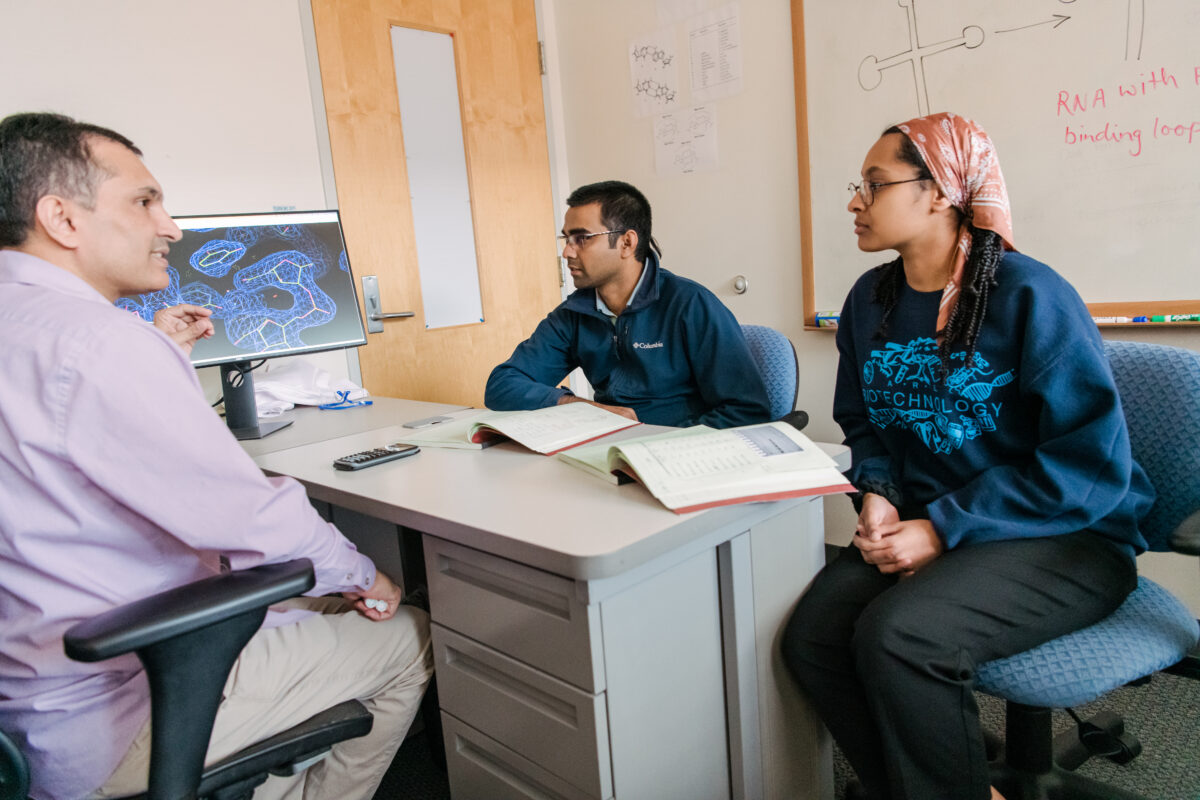
Huda Abdelghani (left) was the first of her three sisters to work in Deepak Koirala’s lab through Howard County’s Applications and Research Laboratory program. At right: Deepak Koirala (left), Naba Krishna Das (center), and Huda Abdelghani discuss their research in Koirala’s office. (Photos by Marlayna Demond ’11/UMBC)
Skills that apply everywhere
Deepak Koirala, associate professor of chemistry and biochemistry, leads a UMBC research group that studies the structures of RNA in enteroviruses—a family of pathogens behind illnesses like hand-foot-and-mouth disease, polio, and myocarditis. Huda joined in the summer of 2022 and stayed through spring 2023. Mentored by a Ph.D. student in the lab, Hasan Al Banna, she quickly learned that scientific research frequently involves failure—but that’s no reason to give up.
“You can do everything right and still not get results,” she says. “It’s not personal—that’s just science.” This lesson in perseverance stuck with her, as did Koirala’s individualized attention. When her graduate student mentor was away, he spent hours helping her set up trays of crystallization plates for her experiments.
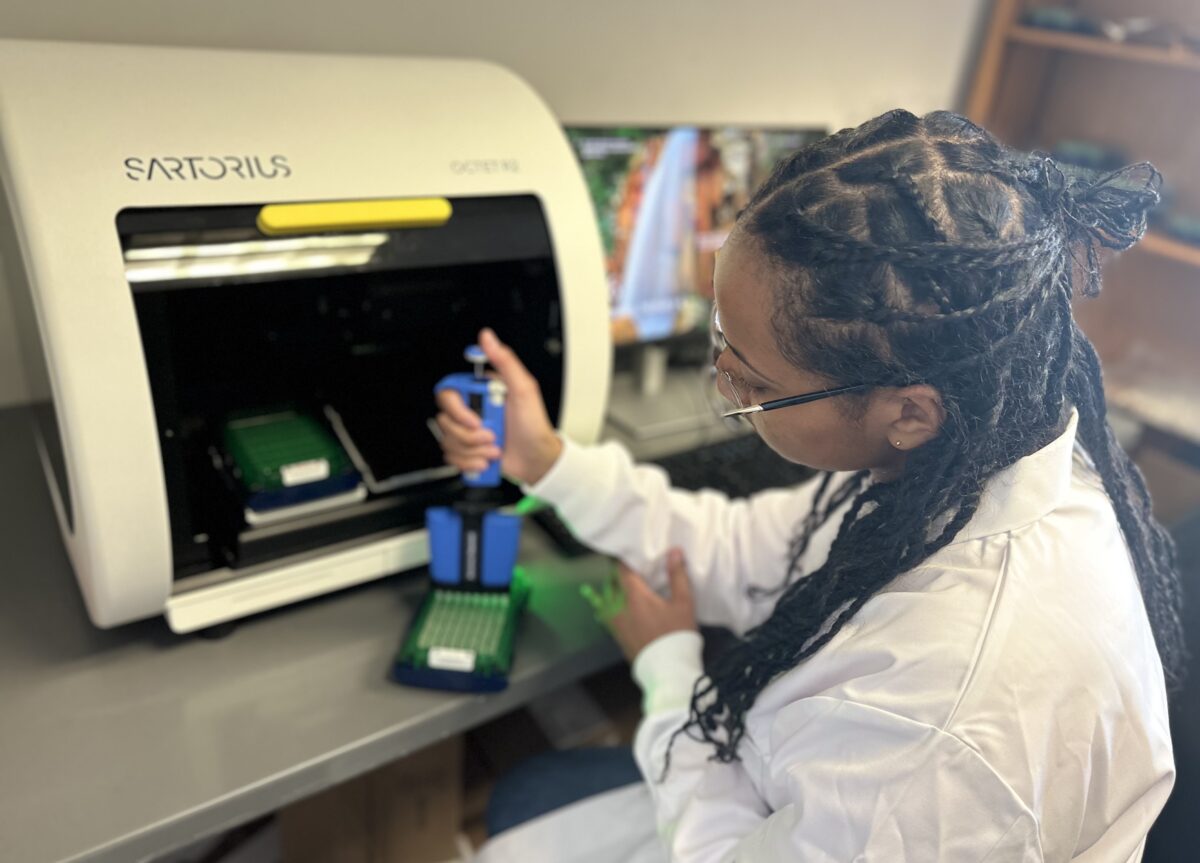
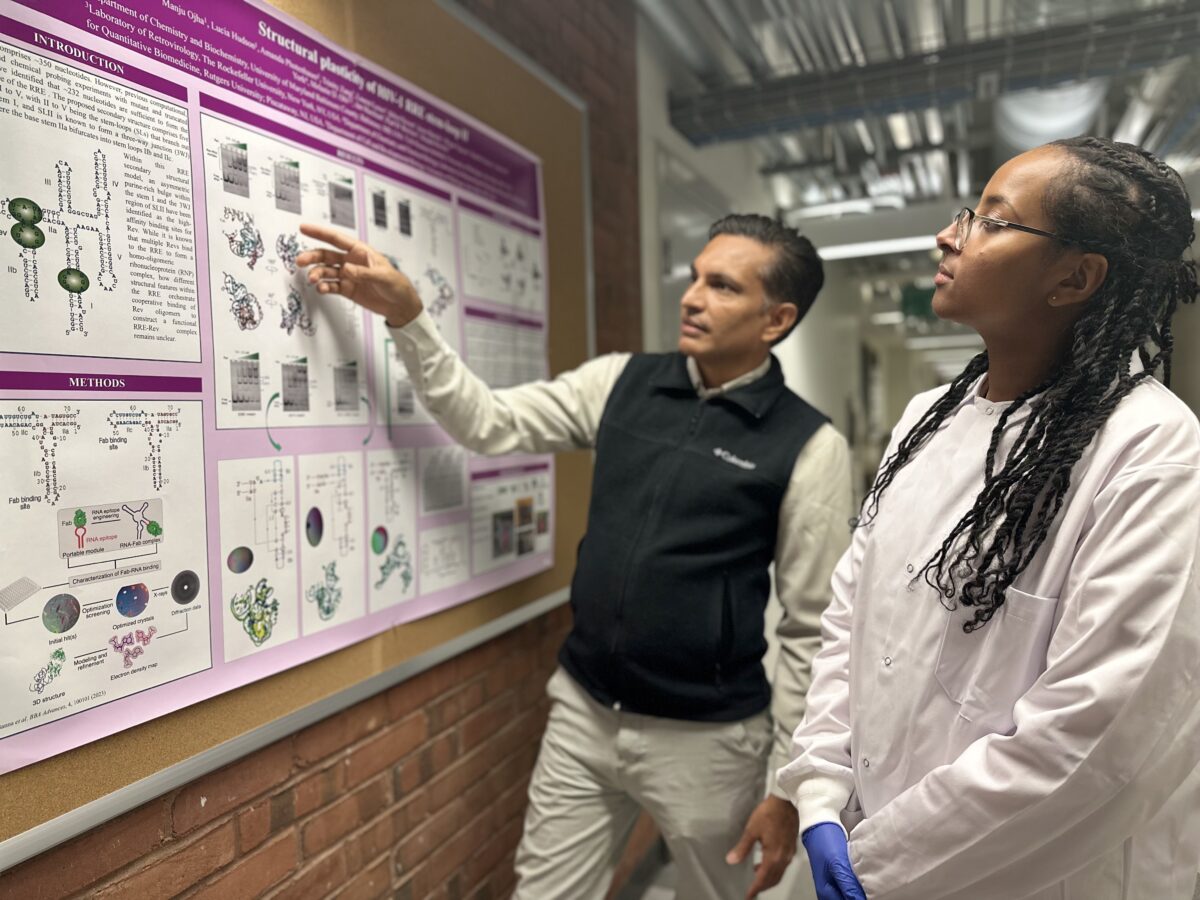
Left: Reem Abdelghani works with a multi-channel micropipet in the lab. Right: Reem and Deepak Koirala discuss research at a poster in the hallway outside Koirala’s lab. (Photos courtesy of Deepak Koirala)
Huda is now a junior mechanical engineering major at MIT, spending this semester on co-op with Apple’s Mac product design team in Austin, Texas—but the lab’s influence lingers. It sparked her interest in tools that help accelerate biochemistry research, like imaging platforms. “The technical and soft skills I gained at UMBC can apply anywhere,” she reflects. Even her first MIT lab connection came from a conversation overheard down the hall from her bench in Koirala’s lab. “It showed me the interconnectedness of academia,” she says.
Shattering preconceptions
Huda’s enthusiasm inspired Reem, the middle sister, to reach out to Koirala for her own ARL biotech internship. She started in Koirala’s lab in the summer of 2024, before her senior year of high school. “I saw how happy Huda was—and it looked like something I’d enjoy, too,” Reem says.
Mentored by Ph.D. student Naba Krishna Das, who isnow a postdoctoral fellow at the National Cancer Institute in Frederick, Maryland, Reem immersed herself in the lab’s operations, from presenting at lab meetings to executing tasks like sterilizing equipment and generating crystal structures of RNA and protein complexes. The lab’s collaborative vibe shattered her preconceptions. “I was worried grad school could be isolating, but it’s so interactive, with people at every stage of their scientific careers,” she explains.
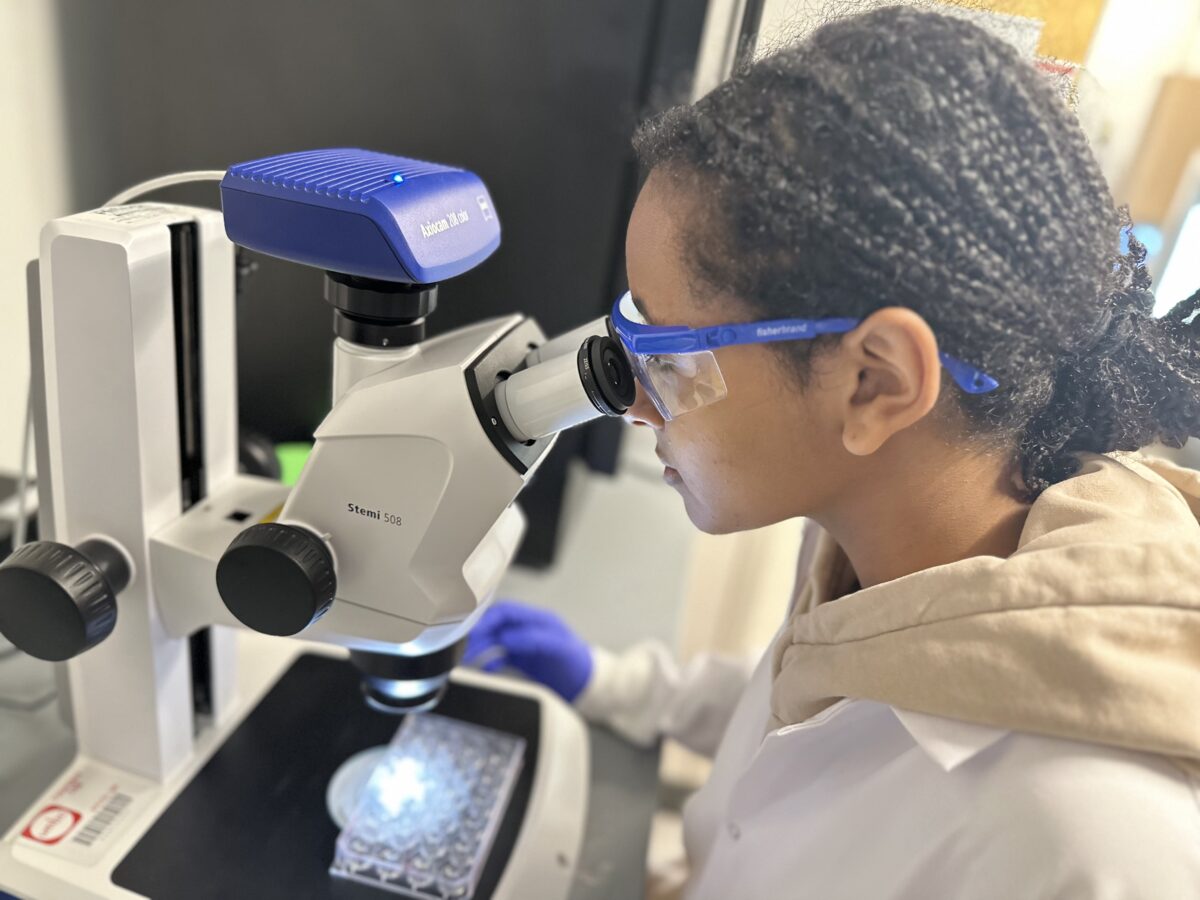
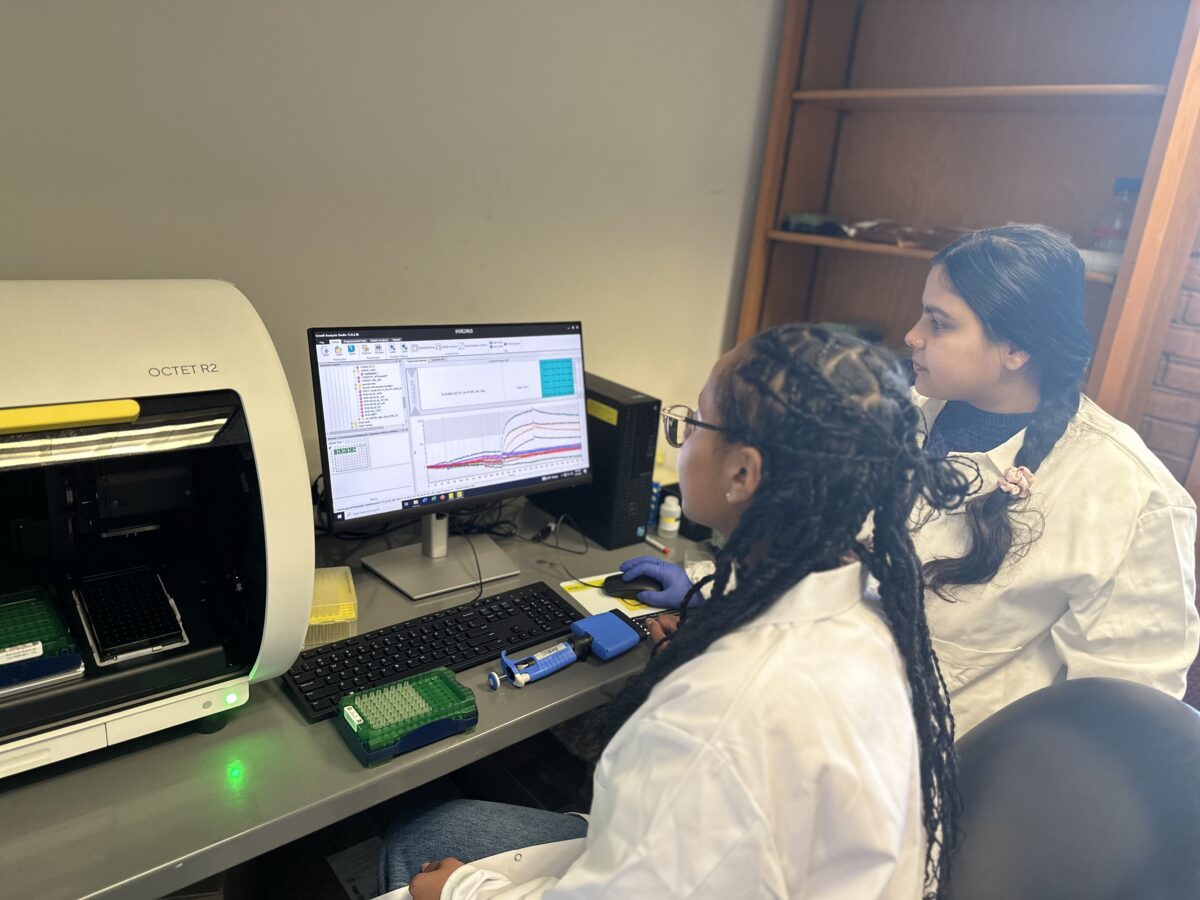
All three sisters gained valuable experience and skills working with Koirala. Left: Rowah looks at experimental wells under a microscope. Right: Reem (left) and Manju Ojha analyze data. (Photos courtesy of Deepak Koirala)
Reem conducted experiments for a project on viral replication, earning co-authorship on a 2025 Nature Communications paper as a high schooler. “I never expected to be so involved—I feel privileged,” she says. The process taught her the value of replication and troubleshooting. “Sometimes it’s trial and error as you’re exploring something new,” she says.
Now a first-year student at UMBC majoring in biochemistry, Reem plans to return to the Koirala lab as soon as space becomes available. “I didn’t consider grad school before, but now it’s definitely on the table,” she says—a perspective born of early research experiences that revealed what the scientific process is really like.
A real community
Rowah, a high school senior, joined the lab last fall. Her expectations of a “scary, strict PI” melted away. “Dr. Koirala is one of the kindest people I’ve met,” Rowah says. The lab’s supportive dynamic impressed her, too. Members shared resources, brainstormed next steps, and lifted each other up. “They push each other to do better—it’s a real community.”
Building on her ARL skills, Rowah felt like a valued member of the team. Her mentor in the lab, Ph.D. student Bethel G. Beyene, provided scientific papers for context, ensuring she grasped the concepts behind the team’s research, not just individual lab techniques. She, too, came face to face with failure and learned from it.
Rowah (at left and pipetting on right) received supportive mentorship from Ph.D. student Bethel Beyene (right photo, background). (Photos courtesy of Deepak Koirala)
“When things go wrong, we sit down and figure it out. It’s not that failure means you’re wrong; overcoming it is how you succeed.” That creative problem-solving carried over into her high school robotics competitions. “I applied lab thinking by evaluating all the possible sources of error to debug our robot—it felt great,” Rowah says. With her interests across biology and engineering, Rowah is considering a biomedical engineering major in the future. “The Koirala lab showed me that I don’t have to choose between my interests,” she says.
Making science better
The sisters’ bond fueled their experiences. “We talk openly—about lab life, plans, even arguments,” Reem laughs. Rowah says her admiration for Huda encouraged her to pursue working in Koirala’s lab. Though they never overlapped in the lab, Huda’s path reassured the others. “If I hadn’t had that chance, I couldn’t have shared it with my family,” Huda says.
Koirala credits the ARL program for bringing talented high schoolers like the Abdelghanis into his group. “They’re not just mentioned in the acknowledgments for completing experiments, but contributing intellectually at the level of authorship,” he says, noting the paper Reem co-authored.
His inclusive approach welcomes students with diverse backgrounds, training the next generation of scientists. “High schoolers, undergrads, women and men from varied backgrounds—they’re all making science better,” Koirala says. Clearly, including less experienced scientists isn’t hurting the lab’s output. Koirala has received multiplemajor grants and published high-profile papers since he arrived at UMBC in 2020.
In Koirala’s welcoming space, beginners become contributors, failures forge innovators, and family ties amplify ambition. As Rowah troubleshoots gels, Reem eyes graduate school, and Huda designs bioimaging tech at MIT, their paths affirm that science thrives on curiosity, community, and the courage to explore.
On a cloudy Saturday in January, UMBC buzzed with the energy of over 1,200 high school students from across the Mid-Atlantic region. For the third consecutive year, UMBC’s College of Natural and Mathematical Sciences (CNMS) hosted its Science Olympiad Invitational Tournament, transforming the campus into a vibrant hub of hands-on scientific discovery for the high school competitors.
From building hovercrafts and bridges to tackling exams in anatomy, astronomy, and beyond, the event showcased 23 competitive challenges across an array of STEM disciplines. What started as a modest gathering of 40 teams three years ago has ballooned into Maryland’s largest invitational, drawing participants from Virginia, Delaware, New Jersey, Pennsylvania, and D.C.
The tournament exemplifies UMBC’s commitment to nurturing young talent and building community connections. “A couple of years ago, I suggested a Science Olympiad tournament as a way to invite more high school students onto the campus and get them excited about science—and UMBC,” shared event co-organizer Bindu Abraham, Ph.D. ’06, chemistry, assistant teaching professor of chemistry and biochemistry, and executive director of Maryland Science Olympiad.
Abraham first encountered Science Olympiad as a homeschool parent watching a passion for science emerge in her son. Now, she is happy to be involved in encouraging a similar enthusiasm for science in students across the region. This year’s event also spotlighted partnerships with organizations like STEM Champions of Baltimore, ensuring under-resourced Baltimore City schools could participate in a dedicated league and envision futures at UMBC.
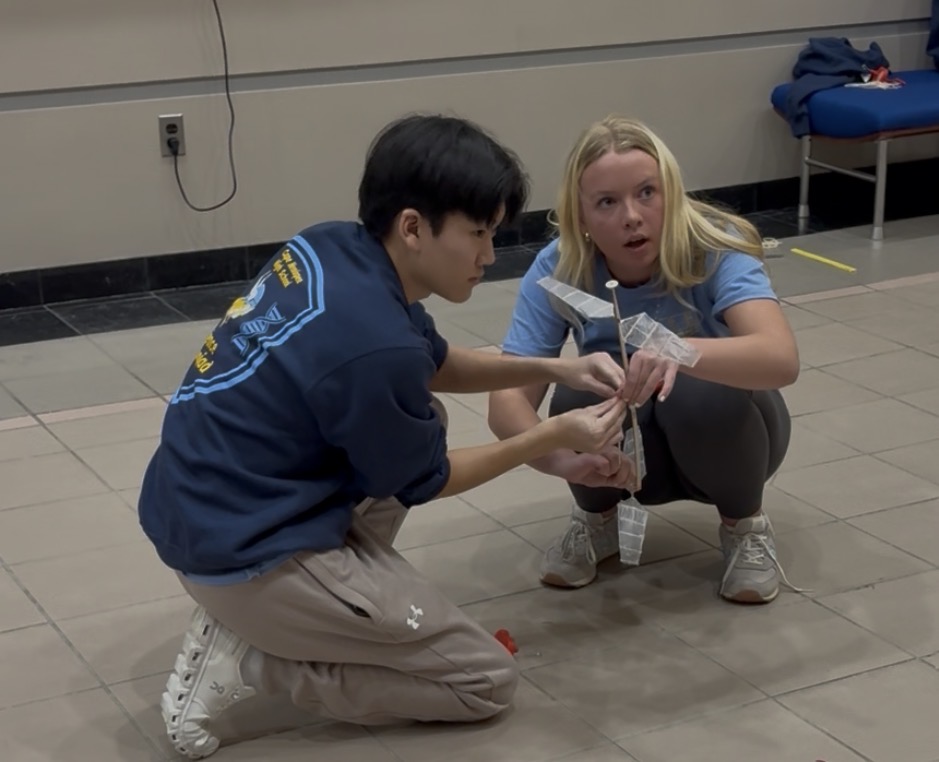
Cape Henlopen High School in Delaware brought three complete teams to the Science Olympiad at UMBC. Left: Nathaniel Hoang and Ellie Sprague compete in the helicopter event. Right: Quinton Eisenmann and Ava Lewis prepare for the hovercraft event. (Photos courtesy of Priscilla Coolbaugh)
Inspiring students’ interest in science
Volunteers—including UMBC faculty, alumni, current students—made the day possible, each driven by motivations rooted in their own journeys. Mark Grzanna, M.S. ’15, biological sciences, today a Science Olympiad coach at John Carroll High School in Bel Air, Maryland, brought two teams of eager students for his third year at the UMBC tournament. Grzanna teaches biology, anatomy and physiology, and a biotech course he designed at John Carroll, and he views the Olympiad as a gateway to scientific curiosity.
“Education is so important. I became a teacher to get kids interested in science—or at least to help them understand enough science to navigate their world,” he said. His co-coach, John Carroll teacher Andrew Ketchum, echoed the sentiment: “It’s a great experience for our kids to see other students excited about science.”
Frank Tagaytay, a senior physics and math major, supervised the “boomilever” event, where teams tested structures’ strength and integrity. Based on experience as president of his high school Science Olympiad club, Tagaytay patiently guided participants through event regulations, offering encouragement amid the occasional structural mishap.
Left: Frank Tagaytay (left), a senior UMBC physics and math major, encourages Aalyna Johnson (center) and Cassidy Mehegan from Cape Henlopen High School as they set up their “boomilever” for competition. (Photo by Sarah Hansen, M.S. ’15/UMBC) Right: Cape Henlopen students Theodore Noe Fellows, Shouta Sano, Quinton Eisenmann, and Ava Lewis (left to right) carry their equipment to the competition site in the UMBC Physics Building. (Photo courtesy of Priscilla Coolbaugh)
“It’s an early season event for teams to work out the kinks,” he explained, highlighting how the low-stakes environment builds confidence and resilience. For Tagaytay, volunteering bridges his past and present, reinforcing UMBC’s supportive community.
Fareedah Owolabi, a junior chemical engineering major who recently transferred from the Community College of Baltimore County, found the event particularly meaningful. “I have a soft spot for STEM outreach, because it’s how I was introduced to UMBC,” she shared. Through the Upward Bound Math and Science program, Owolabi connected with UMBC tutors as a high schooler. Now, as a volunteer, she fielded questions from participants about campus life. “I want to inspire younger students,” she said, embodying the cycle of mentorship that defines the tournament.
Broadening their horizons
Priscilla Coolbaugh, Science Olympiad coach at Cape Henlopen High School in Delaware, started her team three years ago after loving Science Olympiad as a student herself. “I want to share that love,” she said. Her three full teams traveled far to compete. “They get to see themselves at these universities. They might have planned to stay close to home, but this way they get exposure to out-of-state schools,” Coolbaugh said. “It broadens their horizons to different schools as well as different STEM fields.”
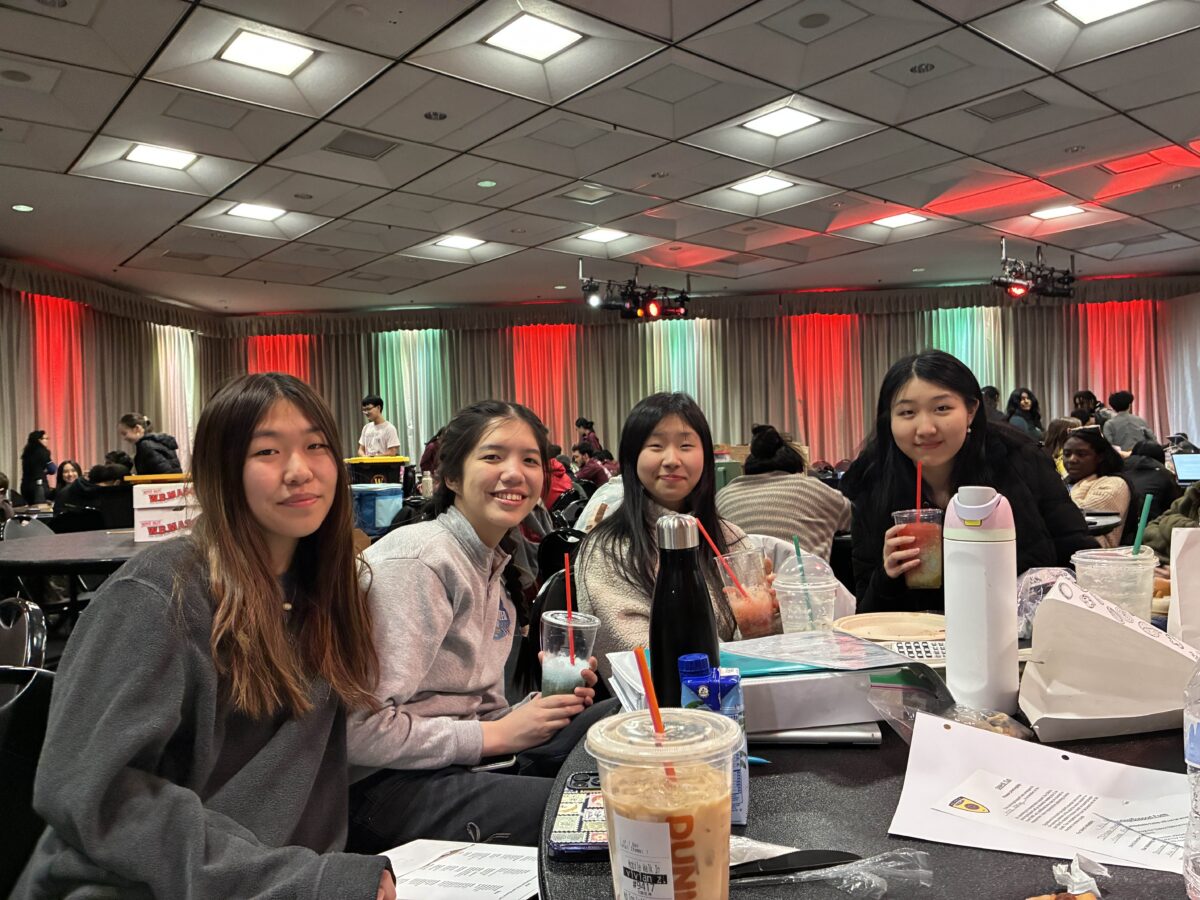
Students and a coach from Winston Churchill High School in Potomac, Maryland, relax in the UMBC Ballroom between events. (Photos courtesy of Jonathan Lee)
Students expressed their sense of community and excitement about their experiences at the UMBC event. Cape Henlopen freshman Aalya Desai noted how the event helped her make friends despite starting as a newcomer, and sophomore Grace Eanes appreciated the chance to bond with peers across grades while exploring the beautiful campus. Michael Song, a junior from Winston Churchill High School in Potomac, Maryland, who with his teammate, Leo Jiang, earned the top score in the hovercraft event, commented, “UMBC is much bigger than I expected. It’s a lot of fun to travel to Olympiad events.”
In good hands
Faculty and staff volunteers underscored the event’s broader impact. CNMS dean William R. LaCourse, surveying the awards ceremony, reflected on the promise of the participants. “As I stood on the stage looking over the ballroom filled with excited and creative students, I couldn’t help feeling as if I was looking into the future and thinking, ‘We (all of us) are in good hands,’” he said.
Zeev Rosenzweig, professor of chemistry and biochemistry, supervised the rocks and minerals test with three undergraduates and three of his graduate students. “Being here is just an important thing to do,” he said. “It’s a great outlet to show them that their interests matter,” he noted. “The kids who come to the Olympiad—they’re our people.” Ph.D. student Kushani Mendis, a Ph.D. student in Rosenzweig’s lab, added, “The best way to support the next generation in STEM is to organize events like this and spend time with them.”
In April, UMBC will host the Maryland State Science Olympiad for the first time, building on this invitational’s momentum. “It’s fun to see young people so excited about different areas of STEM,” shared Michelle Starz-Gaiano, professor and chair of biological sciences, adding, “It’s critical to foster the growth of young scientists. We love the energy and enthusiasm that they bring.”
More than 20 years ago, Padmanabhan “Padhu” Seshaiyer, Ph.D. ’98, applied mathematics, observed researchers stretching aneurysm tissue samples in a neighboring lab, generating a dataset to describe the resilience of artery walls under varying conditions. Those mathematical computations could then be used to help doctors predict how likely an aneurysm in a patient’s artery was to rupture and choose the safest effective treatment—potentially saving lives.
For Seshaiyer, that exposure was a revelation. “Mathematics has a place to change people’s lives,” he realized. Today, as a professor of mathematical sciences at George Mason University (GMU), he directs the Center for Outreach in Mathematics Professional Learning and Educational Technology (COMPLETE). Previously, he also directed the STEM Accelerator Program for the College of Science at GMU, where he later served as associate dean for academic affairs. Both initiatives embody his mission: reform STEM education so every student experiences that same powerful connection to real-world impact.
Learning from mistakes
Seshaiyer grew up in India, earning a bachelor’s degree in electrical and electronics engineering and a master’s in mathematics. He loved math but, like many kids, kept asking, “Why do I need to know this?” Seeking applied graduate programs abroad, he chose UMBC in 1993 for its strong faculty and focus on applied math research—plus a presidential scholarship that made it possible. “UMBC had some really top-notch professors, and in particular, really good people doing applied mathematics,” he recalls.
At UMBC, mentors lit Seshaiyer’s path in research and teaching. With Manil Suri, professor of mathematics,he studied finite element methods, which break a complex problem into many simple pieces, solve each separately, then combine the results to approximate the behavior of the whole. His scholarship didn’t require him to teach, but he pursued classroom opportunities anyway to enrich his experience—which they certainly did. For example, “four into eight” means multiplication in Indian English, but division to American students. “Unless you’re in front of the classroom, make that mistake, and learn from it—well, that’s how you become a good teacher,” he reflects.
From “how” to “why”
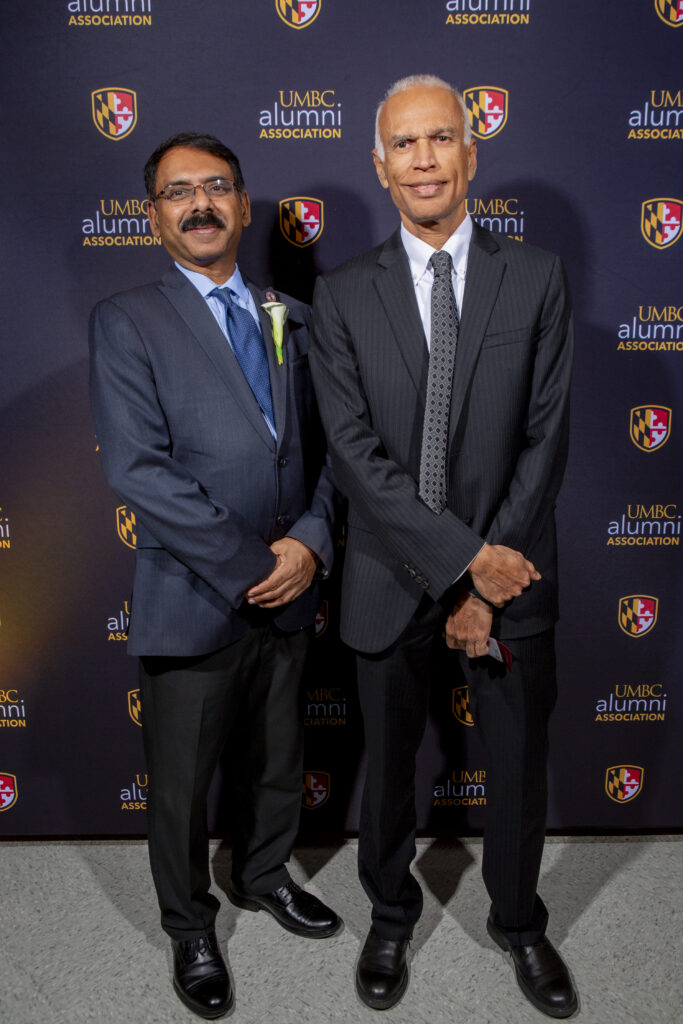
Padmanabhan Seshaiyer (left) with Manil Suri, one of his UMBC mentors, at the 2024 UMBC Alumni Awards. (Photo by Jill Fannon, M.F.A. ’11)
A course with former UMBC engineering professor Jay Humphrey exposed Seshaiyer to biomechanics. Impressed, Humphrey later recruited him for a postdoctoral position at Texas A&M University. It was there that Seshaiyer observed the aneurysm experiments that sparked his pivot to education reform. Traditional teaching, he had seen, often skipped the “why,” leaving students disengaged.
“There was a gap,” he says, “between understanding how to do the mathematics and the why.” That idea inspired him to found the COMPLETE Center, which has trained over 2,500 teachers since 2010 in blending procedural skills with conceptual understanding. The training is grounded in evidence-based pedagogy, such as the 5E instructional model: engage, explore, explain, elaborate, and evaluate.
“Students are not just consumers of mathematics,” Seshaiyer emphasizes. “They are producers of mathematics. It’s important to treat them as producers.” He starts lessons by making connections to real life. When teaching conic sections—the various cross-section shapes created if one slices through a cone—he begins with GPS satellites, which draw intersecting circles to pinpoint a location: “Now, I just told you why we need to learn what we’re learning.”
UMBC has emphasized this same shift toward relevance and active discovery in its own curriculum. MATH 110: Math in Action, launched in fall 2023, is a lab-based class for non-STEM majors that replaces traditional lectures with hands-on experiments—such as tracking brine shrimp movement to explore velocity or using clinometers to measure real-world heights—to demonstrate how math permeates everyday life. By encouraging students to investigate, analyze data, and forge their own connections, the course helps transform math anxiety into curiosity and shows that understanding the “why” can make the subject engaging and empowering for all learners.
Student-led discovery
Seshaiyer has realized that reforming mathematics education at the college level is insufficient, though. As chair of Virginia’s STEM Advisory Board, he spearheaded the state’s first K – 12 data science standards, in part responding to employer demands for a data science-ready workforce. Data science sits at the intersection of statistical reasoning, mathematical foundations, and computational thinking and may not carry the emotional baggage that straight-up “math” does for some students, Seshaiyer explains.
In Virginia’s data science curricula, students follow a hands-on cycle: acquire data, process it, visualize trends, generate a model, use it to predict future results, and communicate the findings. Students often get to choose their own projects, which have included everything from river pollution to rates of depression among high schoolers.
The process follows a framework Seshaiyer developed called the “five Cs.” It starts with “context” (a real-world problem), followed by creating a meaningful “curriculum” that incorporates integrated “content” presented via effective teaching “concepts.” Throughout the process, the teacher cultivates student “competencies” including communication skills, collaboration, critical thinking, and creativity.
Sometimes, the best thing a teacher can do to foster these skills is step away: A high school student interested in modeling the spread of Zika virus was in Seshaiyer’s office when an undergraduate student arrived who was interested in gang violence in Puerto Rico. Seshaiyer stepped out (ostensibly for a cup of coffee) and encouraged the two to discuss their ideas. When he returned, the two students had come up with modes of gang violence “transmission” that paralleled the ways Zika spreads. The research eventually yielded a published paper on which both students were co-authors.
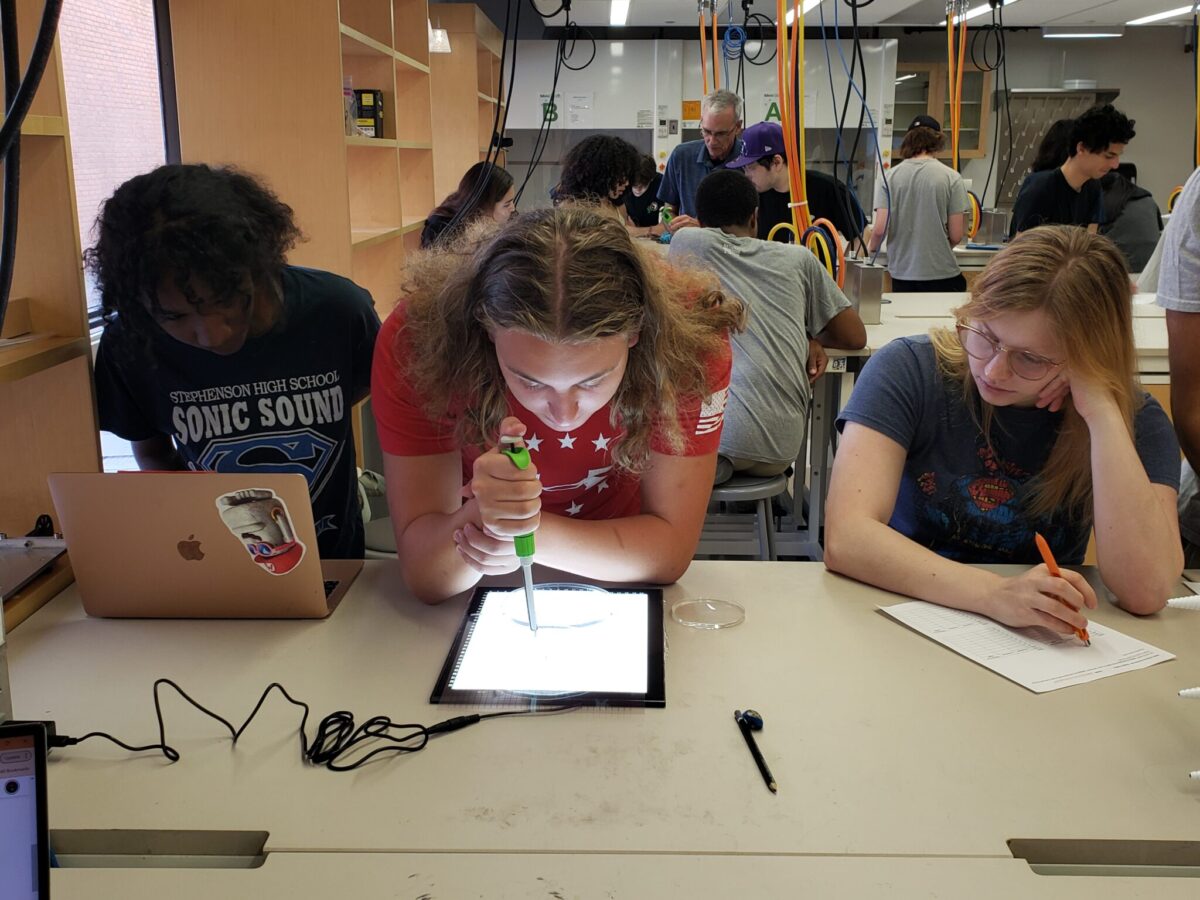
Left: Students in the Building STEPs program run a trial in a lab activity about potential and kinetic energy. (Photo by Brad Ziegler/UMBC) Right: Students in MATH 110: Math in Action record the movements of brine shrimp. (Photo by Sarah Hansen, M.S. ’15/UMBC)
“Mathematics for impact”
Seshaiyer’s experiences at UMBC remain foundational, including a personal relationship with president emeritus (and fellow mathematician) Freeman Hrabowski, with whom he’s shared the stage for keynote addresses. “UMBC has definitely taught me so much,” says Seshaiyer, who received a 2024 Outstanding Alumni Award from the UMBC Alumni Association Board of Directors.
Recently nominated for Virginia’s Math Educator of the Year, his core passion—“mathematics for impact”—endures. UMBC is extending that same impact into K – 12 classrooms through strategic partnerships with Baltimore City high schools. A longstanding collaboration with Building STEPs brings MATH 110-style hands-on labs to rising seniors, helping build math confidence and real-world connections.
Newer partnerships, such as with the Ingenuity Project at Baltimore Polytechnic Institute, include hosting campus visits for students and professional development for teachers and supporting student research in math modeling. These efforts create pipelines for engaged, math-ready learners—proving that when institutions meet students where they are, math can be an exciting path forward rather than an obstacle to overcome.
Important FDA-approved drugs to treat HIV and cancer can save lives, but they come with their own risks. Some drugs used clinically are known to cause neurological side effects in up to half of patients, ranging from confusion and memory problems to permanent nerve damage. Kamal Seneviratne, assistant professor of chemistry and biochemistry, has been studying exactly how these drugs harm the brain, in an effort to mitigate their negative effects.
Work led by Nav Phulara supplied the data needed to successfully apply for MSCRF funding; he also leads the current project. (Courtesy of Phulara)
Last year, Seneviratne’s lab published the first study to reveal disruptions to brain lipid metabolism in response to the HIV drug efavirenz. The study began to show how the drug throws the brain’s lipid chemistry out of balance in specific brain regions.
Now, the Maryland Stem Cell Research Fund (MSCRF) has awarded Seneviratne a $350,000 grant to continue this promising line of work. He and his students will investigate how drugs currently in use such as efavirenz, dolutegravir (another HIV drug), and a common chemotherapy agent (oxaliplatin) can damage brain cells over time.
Nav Phulara, a Ph.D. candidate in Seneviratne’s lab, was first author on the 2024 paper and will again take a leading role in the upcoming work, alongside other UMBC graduate and undergraduate students. The project offers an opportunity to gain hands-on experience with key techniques for work in this field, including advanced mass spectrometry imaging and human stem cell research.
From ‘what’ to ‘how’
Work supported by the new grant will take advantage of Seneviratne’s collaboration with neurologist Jinchong Xu at Johns Hopkins University, who works with human neural cells. The research team will run their trials in miniature human “brain organoids”—clusters of human brain cells grown in the lab from stem cells. Organoids mimic the physiology of a human brain far better than animal models ever could.
Herana Kamal Seneviratne uses a wide range of approaches to discover molecular mechanisms involved in neurotoxicity. (Courtesy of Seneviratne)
“Animal studies are useful, but there are major limitations due to species differences. It is extremely difficult to obtain human brain tissues,” Seneviratne says. “That’s why our collaboration with Dr. Xu has been a game-changer. With the organoids, we will finally see how these drugs behave inside human brain tissue.”
A high-resolution approach Seneviratne’s lab employed for their 2024 paper visualizes molecules directly in intact tissues, whereas other methods require grinding up the samples. The technique, a type of mass spectrometry imaging (MSI) called MALDI MSI, allows researchers to determine not only how much of various molecule types are present in the brain, but exactly where.
Seneviratne and his collaborators will be using this technique in combination with proteomics—the large-scale study of all proteins in a cell or tissue—in their MSCRF-funded work to track exactly where the drugs and their breakdown products travel inside the brain organoids and how they disturb the brain’s lipid balance. Lipids are essential for brain cells to communicate and survive, so when their function is impaired, brain cells can die, contributing to long-term neurodegeneration.
“We want to understand the ‘how’ behind the damage,” says Seneviratne. “If we can pinpoint the exact molecular warning signs, clinicians and drug companies could one day screen new medicines early in their development to help avoid these risks.”
A holistic approach
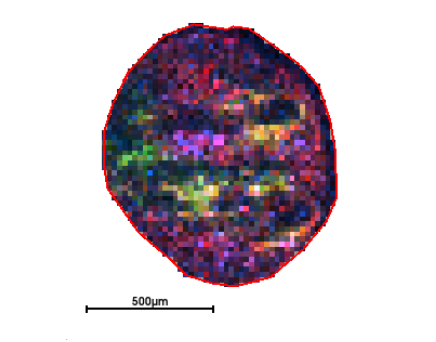
Different colors in this spectroscopy image of a brain organoid indicate the presence of different cell types. (Courtesy of Kamal Seneviratne)
“I’m driven by the scientific questions, not any single technique,” Seneviratne explains. “We’ll use whatever tools—imaging, proteomics, molecular biology, biochemical analyses—best let us answer them.”
By combining high-resolution MALDI MSI and proteomics with human brain organoids that contain the full neighborhood of neural cells, the project offers a highly relevant picture of drug-induced damage—helping bridge the gap between scientific discoveries and patient outcomes.
The grant also opens a path for future impact. Part of the goal of the MSCRF is to encourage technology transfer, meaning discoveries could eventually lead to a startup company and new tools for the pharmaceutical industry.
“This support lets us turn promising science into something that can genuinely help people,” Seneviratne says. “Ultimately, we hope to give clinicians better ways to protect the brain while treating deadly diseases.”
Steven Caruso ’94, Ph.D. ’02, biological sciences, received an honorable mention for the inaugural Outstanding Instructor Award from Microbiology Resource Announcements. The award celebrates instructors like Caruso, a teaching professor in biological sciences, who have published in the journal with their undergraduate students as part of a course or program. Caruso is being honored for the many bacteriophage genomes he has published with UMBC students as part of the UMBC Phage Hunters program. Phage Hunters at UMBC creates opportunities for authentic scientific inquiry for scores of students who might not otherwise conduct mentored research.
“Students participating in our Phage Hunters classes are challenged to carry out experiments as if they were working in a research lab on campus,” Caruso says. “Their work includes engaging in scientific communication; having students write and publish papers provides a tangible result at the end of their experience.”
UMBC was one of 12 institutions to pioneer the SEA-PHAGES program in 2008. Since then, almost 1,700 UMBC undergraduates have participated. UMBC students have isolated, characterized, and archived nearly 800 phages—viruses that infect bacterial cells. Of those, 87 have been sequenced and 66 submitted to GenBank, a global genetic database.
“Dr. Caruso has done a remarkable job in providing authentic research experiences to students at a very large scale. For example, this semester he had almost 100 students in his class,” shares Michelle Starz-Gaiano, professor and chair of biological sciences.
Based on conversations with students at their end-of-semester research presentations, Starz-Gaiano adds, “It is clear that they found the work challenging, but they also feel supported. It’s through this kind of experience that they learn firsthand what it is like to conduct original research, and many of them feel inspired to keep exploring what is next to discover.”
A study out of UMBC, published in Nature Communications, reveals how enteroviruses—including pathogens that cause polio, encephalitis, myocarditis, and the common cold—initiate replication by hijacking host-cell machinery. The research fills a knowledge gap on this critical step and could pave the way for a new class of antiviral drugs that are effective against multiple viruses.
“My lab has been really motivated to understand how RNA viruses produce their proteins inside the cell and multiply their genome to make more virus particles,” says senior author Deepak Koirala, associate professor of chemistry and biochemistry. Building on his group’s discovery of a crucial cloverleaf structure in the viral RNA, their latest paper, led by first author Naba Krishna Das, Ph.D. ’25, chemistry, has now shown how the cloverleaf recruits proteins to assemble the replication complex.
Seeing the bigger picture
Enteroviruses carry a small RNA genome that must do double duty: make viral proteins and copy itself to produce new viruses. A key player is a viral protein called 3CD. One half (3C) cuts the complete string of amino acids encoded by the virus’s RNA into individual proteins. The other half (3D) is an RNA polymerase—the enzyme that copies the viral RNA. Human cells don’t have anything like this polymerase, so the virus has to bring its own.
Deepak Koirala (center) discusses his team’s research with Senali Dansou ’23, biochemistry and molecularbiology (left), and Alisha Patel ’25, biochemistry and molecular biology, and a coauthor on the new paper. (Marlayna Demond ’11/UMBC)
“We previously determined the structure of the RNA alone, and other groups determined the structure of 3C and 3D separately, but now we’ve captured the structure of the RNA and proteins together, so we know how they are interacting,” Koirala explains. “We found that it’s the 3C domain of 3CD that binds to the viral RNA, and then it recruits the other components to assemble the replication complex.”
The same complex also works as an on-off switch: when 3CD is attached, the virus copies its RNA; when it lets go, the RNA can be read to make proteins instead.
The team also settled a debate by showing that two complete 3CD molecules (bringing two RNA polymerases) bind to the RNA independently, rather than forming a single fused pair. Why two are needed is still a mystery, but the picture is now clear.
Koirala lab members Alisha Patel, Deepak Koirala, Naba Krishna Das, and Jeffrey Vogt ’23, biochemistry and molecular biology, compare the growth on petri dishes. (Marlayna Demond ’11/UMBC)
New antiviral targets
Perhaps most exciting, the seven types of enteroviruses the paper investigated all employed a very similar binding mechanism and RNA cloverleaf structure. The extent of this conservation implies the RNA cloverleaf is very important for replication, and any mutations would likely derail it. That means the RNA and RNA-protein interface is likely to be stable over time across enteroviruses, making it an even more promising drug target—and opening the door to the tantalizing prospect of a “universal” drug targeting all enteroviruses.
Drugs disrupting 3C and 3D activity are already in development, but “now we have another layer to test,” Koirala says. “What if we target the RNA, or the RNA-protein interface, so that we break the interaction? That is another opportunity. Now that we have high-resolution structures, you can precisely design drug molecules to target them.”
“Viruses are so, so clever. Their entire genome is equivalent to about one mRNA sequence in humans, yet they are so effective,” Koirala says. His latest work demonstrates “why we need to investigate this basic science—so that it can be translated into developing drugs targeting pathogens that cause so many harmful diseases.”
It was polymath Leonardo da Vinci who declared, “Learning never exhausts the mind,” a credo that propelled a rebirth of education with people seeking to master art, science, and invention in pursuit of human potential. At UMBC today, this same spirit thrives among our many “Renaissance Retrievers”—students, faculty, and staff who blend disciplines into a symphony of diverse talents and whose stories reveal a community where interdisciplinary curiosity isn’t an exception but rather the engine of innovation.
Jazz harmonies and rhythms emanating from a grand piano echo through The Commons, mingled with the smell of coffee and student conversations. At the bench sits Elia Mascolo, who has just completed his Ph.D. in biological sciences, with a focus on bioinformatics and information science. He’s a math, biology, and computer science whiz who once thought he’d rather be a professional musician—and had a real shot at it.
Across the Quad, on the fourth floor of the Math and Psychology Building, Manil Suri, professor of mathematics, scrawls partial differential equations on his office whiteboard. In the evening, he pores over the manuscript of his forthcoming memoir, A Room in Bombay. It’s the latest of his non-academic publications—a list that includes a trio of bestselling novels and regular New York Times columns.
Meanwhile, Bonnie Lander, production coordinator for the Performing Arts and Humanities Building (PAHB), is speaking with urgency into her headset, quickly resolving a catering glitch before guests arrive for a performance of Shakespeare in Harlem. The following night, she’s onstage, lending her soprano to an experimental music festival put on by High Zero Foundation, a Baltimore-based group Lander also supports as a board member and volunteer.
While Lander sings, Mareisha Banga, a senior double majoring in information systems and design, is coding on her laptop, and Mahrukh Eijaz, a senior studying information systems and media and communication studies, is analyzing how media consumption affects our worldviews.
Mascolo, Suri, Lander, Banga, and Eijaz merge scientific rigor and technical analysis with artistic and literary expression. In a world of specialization and targeted career goals, these community members might sound like rare exceptions. But at UMBC, they’re far from alone. The university’s interdisciplinary ethos invites students, faculty, and staff to forge paths that cultivate the full spectrum of their interests and potential.
Nearly half of UMBC students are pursuing either a second major, a minor, an undergraduate certificate, or a combination of these. Looking at the most popular majors across UMBC’s three colleges, 58 percent of psychology majors are taking on an additional area of study, including dance, chemistry, and creative writing; 55 percent of biological sciences majors are working toward additional credentials, such as in music, finance, and Arabic; and 30 percent of information systems majors are pursuing something else, from entrepreneurship to Japanese.
And for students whose interests don’t fit within an established major, there is the Individualized Study Program (INDS). Launched in 1969—only three years after the university’s founding—INDS is one of the longest-standing individualized degree programs in the country. It affords motivated, intellectually mature students the opportunity to construct their own academic sequence, limited only by their ingenuity.
Employers see the value in a diversified education. A 2013 survey commissioned by the Association of American Colleges and Universities revealed that 80 percent of employers believe all college students, regardless of major, should gain broad knowledge in the liberal arts and sciences to succeed in today’s workforce. Skills like critical thinking, communication, and adaptability don’t just fill résumés, though; they build lives resilient to shifting workforce winds and position UMBC alumni to impact the world for good.
Speaking from an apartment in Vienna, Austria, where he’s about to launch a postdoctoral fellowship in theoretical biology at the Institute of Science and Technology Austria, Mascolo describes how overhearing his older sister’s piano lessons as a child inspired him to sit down at the bench. “It felt just like a big toy. But a super interesting one,” he recalls.
Eventually, he took his own lessons. “When I was studying classical music, I didn’t see the point of jazz music at all. I was like, ‘I don’t know what that is,’” he admits with a laugh. But curiosity won: Hearing a modern jazz piece, “I had to admit I had no idea what I was hearing. I didn’t like it yet, but there was structure; it was something different from random.” He found the genre’s improvisational chaos a puzzle demanding a solution. What started as an academic mission evolved into joy and appreciation. “I wanted to defeat jazz, and the opposite happened,” he says.
Poised to pursue music full time after high school, Mascolo’s parents urged him to take a detour at university. “They said, ‘You have always had this super strong interest for science. Why don’t you do one year of something scientific? If you still say after that, “I just want to do music,” we’ll support you.’”
He chose biology, thinking it would leave more room for piano gigs. But “after one year, I was like, ‘Actually, I like science a lot. I want to keep doing both.’” He was drawn to UMBC to work with computational biologist Ivan Erill, but when classmates learned he played piano, they recruited him for the department band, Fever Dream. “They said, ‘Hey, we figured out that you were a piano player,’ and I could not say ‘no.’”
Mascolo’s two passions might seem completely different, but there are surprising and profound parallels. Both biology and jazz resist tidy reduction. “Music and biology share complex structures that invite analytical exploration, despite differing contexts,” he notes. In bioinformatics, he applies information theory to gene regulation, much like decoding harmonic progressions.
“You start with these simple rules, and then something is built on those in a way that is too complex to completely figure out,” he reflects. “Biology and music demand a leap of wonder. It’s like a color; can you describe a color with words to a blind person and have them know exactly what the color looks like? It’s not clear that you can actually reduce that to language.”
This duality guards against tunnel vision. Having once obsessed over jazz stardom, imagining that “that was the only important thing in the world,” and then coming to experience just as much passion for scientific research, has taught Mascolo, “It doesn’t do justice to a person to equate fulfillment with a specific career.”
Suri, too, has found ways to meld his disparate skills. His novels, like The Death of Vishnu, long-listed for the 2001 Booker Prize and short-listed for the 2002 PEN/Faulkner Award, have graced The New York Times-bestseller list, his math-related columns have helped demystify the discipline for lay audiences, and he has contributed to progress in the mathematical field of numerical analysis. Yet his dual life as novelist and mathematician started as a lark. “Everyone has hobbies,” Suri says. “I know people in the department who act in plays, for example. My hobby was writing.”
Not until he was tenured did Suri join writing groups and classes at The Writer’s Center in Bethesda. He broke onto the literary stage when an agent excerpted his debut novel in The New Yorker.
Suri’s writing and math worlds merged with his 2022 book The Big Bang of Numbers, which traces how to “build the universe with only math.” The book was inspired in part by a math-humanities mash-up UMBC honors seminar, which he co-taught with English faculty and Folger Theatre resident dramaturg Michele Osherow. That course also led to a play, ‘The Mathematics of Being Human,’ co-written by Suri and Osherow that premiered at UMBC and then ran at the National Museum of Mathematics in New York City and other sites in the U.S. and Canada.
This fusion sharpens his teaching, too. In a writing-intensive history of math course, Suri grades students’ writing like a novelist. “They got a shock. ‘Hey! This guy is really serious about essay writing,’” Suri laughs. “Writing is so essential when you’re trying to articulate technical things.” Employers echo this claim: Broad liberal arts skills like communication boost employability across fields. Suri’s students—many future STEM teachers—emerge equipped to bridge disciplines.
Lander’s voice soars through experimental operas at night, but by day, she orchestrates UMBC’s performing arts venues. As operations and production coordinator for the College of Arts, Humanities, and Social Sciences, she books events, manages staff, and troubleshoots the rare crisis—like the time fog from a theater rehearsal triggered fire alarms mid-concert. “Everybody had to evacuate. After we all returned to the hall, the pianist sat down, picked up where she left off, and finished the last 10 minutes of a 70-minute piece. It was incredible.”
In 2007, Lander co-founded Rhymes With Opera, which premiered more than 22 chamber operas over its 15-year run. In 2018, she began working with 2640 Space, a nonprofit event venue in Baltimore. During the pandemic, “I wrote out the entire handbook and operations manual for 2640 Space. It was a big labor of love,” she says. In that role, her love of events management grew.
Lander joined UMBC in January 2023, blending her worlds. Her role in the PAHB “pays the bills and comes with a wonderful community,” she says, and “I still have plenty of time outside of work to continue pursuing performance.” On top of her production role, she teaches voice lessons and led an improv workshop for UMBC’s Linehan Artist Scholars.
The contrast in the skills required for logistics management versus performance keep her on her toes. During a performance, “Your primary role is to exist solely in the present moment,” while coordinating events requires tracking many elements on a strict timeline. “When is the caterer showing up? When is furniture being delivered?” Lander says. “But, as with a musical performance, if you’ve prepared well, you can usually just press play, enjoy the event, and go home having made an impact.”
In Lander’s experience, UMBC’s venues aren’t just stages—they’re launchpads for lives lived in 360 stereo.
Mareisha Banga fuses aesthetics and algorithms as a senior double-majoring in design and information systems. Banga is drawn to user experience and user interface (UX/UI) projects, where the visual and functional worlds collide. “I didn’t want to just make something beautiful. I wanted to make it work,” she says.
“Having both perspectives made me a more well-rounded thinker and creative,” Banga says. “The more I learned about systems and how people interact with technology, the better I became at designing visually. Similarly, design helped me understand the human element behind the technical problems I was trying to solve. They push and inform each other in ways I didn’t expect when I first declared both majors.”
Those connections have created unique opportunities for Banga, including as a designer for the UMBC Student Events Board. “Not only do I get to design and plan events, which I love, but the fast-paced environment and tight turnaround times have helped me grow as a professional in ways I didn’t expect. It’s taught me how to work under pressure, communicate with people, and what it really means to be a student leader on campus.”
Her unique skillset is attractive to prospective employers, too. “My interviewers have consistently been fascinated by my background, wanting to dig deeper into how I think about problems from both perspectives,” Banga says. “I genuinely believe I wouldn’t have the same prospects if I’d only focused on one major.”
Senior Mahrukh Eijaz has similarly merged two fields that initially might seem unrelated. “I’ve always been interested in how people and technology interact. My information systems major gives me the tools to understand how systems and data work, while my media and communication studies major helps me think critically about how messages and meaning shape those systems,” Eijaz says. “I wanted to bridge the gap between tech and storytelling, because I believe the most impactful innovations come from people who can speak both languages.”
Like Banga, Eijaz has found that her unusual double major has opened doors. “Having both degrees has made me more confident in my ability to adapt and collaborate,” she shares. “I feel more prepared to work in interdisciplinary environments, whether it’s in UX design, digital marketing, or tech policy, because I can translate ideas between technical and creative teams as well as with consumers.”
Support she found at UMBC has enhanced her ability to blend her two majors. “Professors in both departments encouraged me to find connections between the fields, instead of treating them as separate paths,” Eijaz says.
That encouragement is no accident. The way Eijaz is making connections, like the way Mascolo dissects jazz chords with the same analytical eye he brings to gene regulation, is exactly the inclination UMBC seeks to cultivate. The role of a liberal arts institution is not to slot students into pre-grooved tracks, but to offer fertile terrain where seemingly disconnected gen-eds become scaffolding for unexpected connections. In this environment, every Retriever forges a personal mosaic of ideas, methods, and passions no single major could contain.
It is here, in this complex intermingling, that Renaissance Retrievers emerge—adaptable, inspired, and whole.
On November 7, graduate students and postdoctoral researchers from the College of Natural and Mathematical Sciences (CNMS) gathered for the college’s second annual CNMS GradFest.
Prableen Chowdhary, Ph.D. ’24, biological sciences, currently a postdoc with Rachel Brewster, professor of biological sciences, and a member of the student-led planning committee, expressed hope that GradFest would “spark conversations and collaborations across disciplines.”
CNMS dean William LaCourse offered advice to attendees as the program kicked off. “Whatever you do in life, do it with all your heart. If you’re doing research, do it like you own it,” he said. “Live in the present and seize opportunities. Enjoy every moment, like this moment today. You can’t change yesterday; when I make mistakes, I’m grateful for grace and forgiveness. And you can plan for tomorrow, but you can’t control it.”
Prableen Chowdhary (left) and Hasan Al Banna, CNMS GradFest’s two emcees, welcome attendees to the event. (Brad Ziegler/UMBC)
“Part of our goal was to intentionally include graduate students with less presentation experience or early-stage projects,” shared Maria Cambraia, director for research and international affairs in CNMS, and lead staff member on the planning committee. “GradFest gives them a chance to practice in a friendly environment.”
Lightning talk presenters and CNMS GradFest planning committee members worked hard to make the event a success. Rear, left to right: Maria Cambraia, Lara Scott, Andrew Wolff, Sean Ravel, Peng Yan, Codi Hrynko, Jalil Ahmad. Front, left to right: Prableen Chowdhary, Lizbeth Joy Tan, Megha Pandya, Ronita Sequeira, Hasan Al Banna. Planning committee members not pictured: Ayo Ogunsanya, Elana Frazier, Jeanne Ngo. (Brad Ziegler/UMBC)
Following the talks, the ballroom buzzed during two poster sessions, where dozens more students discussed their projects with peers, mentors, and guests. GradFest encouraged presentations of research at all stages of development.
Muhammad Jalil Ahmad, president of the Mathematics and Statistics Graduate Student Association and a planning committee member, presented a lightning talk and poster on mathematical modeling for complex phenomena like weather or disease spread.
Ahmad, a fourth-year applied mathematics Ph.D. candidate mentored by Animikh Biswas and Kathleen Hoffman, professors of mathematics, agreed. “Presenting at GradFest is useful before heading to a bigger stage, like a national meeting,” he said. “Even at a math conference, people are studying different topics, so it’s good to practice communicating with people outside your field.” He added that GradFest offers the opportunity to network with researchers using similar methods for different applications.
Muhammad Jalil Ahmad (left) and Lara Scott (right), Ph.D. students in mathematics, presented lightning talks at GradFest. (Brad Ziegler/UMBC)
Ian Kirn ’23, physics, a second-year physics Ph.D. student, presented a poster on asteroseismology, which investigates earthquake-like phenomena on stars. Kirn chose to pursue his Ph.D. with Eileen Meyer, professor of physics, after doing undergraduate research with her. “It’s important for different disciplines to talk to each other, because they’re actually all related,” Kirn says. “This event encourages collaboration.”
Fidelia Asomani, a third-year biological sciences Ph.D. candidate working with Erin Green, associate professor of biological sciences, called GradFest “a good first opportunity to get my feet wet presenting.” Asomani studies yeast, which shares basic functions with complex organisms. “It’s important to invest in studying processes conserved across species,” she says, which can inform human disease treatment.
Ian Kirn (left) discussed his astroseismology research, and Fidelia Asomani (right) explains her research on protein regulation in yeast, with GradFest attendees. (Brad Ziegler/UMBC)
The humble heart of a scientist
LaCourse also encouraged embracing humility. “By remembering you won’t always be the best, humility helps you celebrate others’ successes and accept failure—and research involves a lot of failure,” he said. “Humility is a path you walk, not a trait you innately possess, and it leads to learning, growth, and respect.”
By late afternoon, GradFest had turned strangers into collaborators, boosted first-time presenters’ confidence, and made the ballroom a launchpad for breakthroughs. Attendees left with new contacts and the dean’s words in their hearts—proof that bold discoveries can begin with a humble “hello.”