All posts by: Sarah Hansen, M.S. '15


The Family Connection: Paying it Forward

“To whom much is given, much is required.” Meyerhoff scholars internalize this message, which is introduced during Summer Bridge and is almost as ubiquitous as “Focus, Focus, Focus,” and Langston Hughes’ “Dreams” at Meyerhoff gatherings. For many of the scholars, giving back has become a foundational principle in their lives, as they mentor colleagues, students, and interns in their roles as researchers, medical professionals, biotech entrepreneurs, and more.

This extension of the Meyerhoff program beyond UMBC amplifies its impact. Like a family tree, the DNA for the Meyerhoff program’s values and practices travels through generations of researchers as scholars graduate from UMBC and carry their experiences with the program wherever they go, cultivating the Meyerhoff culture in their new environments. Perhaps no simile is required—members of the Meyerhoff community feel that it is, indeed, a family.

“We truly are a family, full of people who accept and love each other as we are,” says Rhea Brooking-Dixon ’02, M10, biological sciences. After UMBC, she earned her Ph.D. from Duke University in experimental pathology, and today she is a scientist at Booz Allen Hamilton. She is married to Jason Dixon ’02, M10, computer engineering, so for them, Meyerhoff means family in multiple ways.

Families always help each other out, and that stuck with Dixon and Brooking-Dixon after graduation. They remember being asked by advisors at UMBC about participation in a study group, both to receive and give support to their classmates. “That showed us that the Meyerhoff Scholars Program wanted us to consider not just what a community could do for us,” they share, “but what we could also do for our community, whatever the scale, to help everyone develop into their best selves.”

Cultivating each Meyerhoff cohort as a family begins with Summer Bridge, a six-week experience that combines academics and social activities. Students learn together, eat together, and play together, forming bonds that buoy them through their years at UMBC and beyond.

“We’re developing a community. So to generate this concept of a community, they’ve got to have a shared experience,” says Keith Harmon, director of the Meyerhoff Scholars Program. “So a big part of Bridge is doing everything together. You do nothing in Bridge as an individual.”

The mentality of giving back and supporting one’s community has been inherent to the program since its early days. Crystal Watkins-Johansson ’95, M3, biological sciences, earned her M.D./Ph.D. at Johns Hopkins University and now serves as director of the memory clinic in the neuropsychiatry program in the Sheppard Pratt Health System, and as an assistant professor of psychiatry at the Johns Hopkins School of Medicine.

“When we recruit, we don’t talk a lot about Ph.D.s and M.D./Ph.D.s. We talk about legacy,
and we talk about service. We talk about leadership. We talk about being a part of
something that’s bigger than yourself.”
– Keith Harmon, Director, Meyerhoff Scholars Program

“As a graduate of the Meyerhoff Scholars Program at UMBC, I have developed a tradition of mentoring undergraduate and graduate students from the Meyerhoff program,” Watkins-Johansson says, “as the mentoring I received through the program continues to be the foundation of my success.”

Isaac Newton said, “I have only seen farther by standing on the shoulders of giants,” and that phrase, too, has resonated with Meyerhoff Scholars. Erwin Cabrera ’10, M18, biological sciences, shares, “The Meyerhoff staff, program alumni, and UMBC faculty were my giants, so I strive to be a giant for those students who come after me.”

Cabrera’s current role aligns directly with his commitment to mentoring the next generation of biomedical professionals. After earning his Ph.D. at the New York University School of Medicine, he now serves as the associate director for the Research Aligned Mentorship program at Farmingdale State University, a program that provides additional supports—similar in ways to the Meyerhoff Scholars Program—to annual cohorts of Farmingdale students.

For some Meyerhoff scholars, it was the group experience that helped them see their true potential. “Being surrounded by a critical mass of high-achieving African Americans was extremely important to my growth as an individual,” says Kamili (Shaw) Jackson ’97, M5, M.S. ’99, mechanical engineering. “It gave me confidence and humility at the same time.”

Mentoring the next generation of scientists and engineers, and changing their lives in the process, is a worthy goal and a laudable outcome of the Meyerhoff Scholars Program. But the ripple effect goes even farther. Those researchers, many of whom are from underrepresented groups in STEM, bring fresh perspectives and energy to their work, and the results of their efforts can impact an even larger set of people.

“My research experience in Dr. [Michael] Summers’ lab helped me recognize the lasting impact that biomedical research could have on the lives of patients,” shares Chelsea Pinnix ’99, M7, biochemistry and molecular biology. “I began to envision myself as more than a future physician, and instead as a young woman with the potential to heal patients in my clinic and improve medical care for patients that I would never meet through meaningful research.”

As the Meyerhoff Scholars Program enters its fourth decade, the emphasis on paying it forward is just as strong as it was at the program’s founding in 1989. Except now, there already exists a network—a family—of hundreds of Meyerhoff alumni ready to support upcoming students in all that they wish to pursue, which goes far beyond earning a degree (or three).

And that message of changing the world is part of the conversation from the start. Teaching students to think beyond the degree toward thinking about a career where they can make real change in the world, both by doing meaningful research and mentoring others, is an important part of the Meyerhoff program.

“When we recruit, we don’t talk a lot about Ph.D.s and M.D./Ph.D.s.,” Harmon says. “We talk about legacy,
and we talk about service. We talk about leadership. We talk about being a part of something that’s bigger than yourself.”

Learn more about the Meyerhoff Scholars Program at meyerhoff.umbc.edu.

Photos courtesy of the Meyerhoff Scholars Program.

UMBC’s Glenn Wolfe develops new method to gauge atmosphere’s ability to clear methane, a potent greenhouse gas

New research by UMBC’s Glenn Wolfe and collaborators is shaping how scientists understand the fate of methane, a potent greenhouse gas, in Earth’s atmosphere.

Of the greenhouse gases, methane has the second greatest overall effect on climate after carbon dioxide. And the longer it stays in the atmosphere, the more heat it traps. That’s why it’s essential for climate models to properly represent how long methane lasts before it’s broken down. That happens when a methane molecule reacts with a hydroxyl radical—an oxygen atom bound to a hydrogen atom, represented as OH—in a process called oxidation. Hydroxyl radicals also destroy other hazardous air pollutants.

“OH is really the most central oxidizing agent in the lower atmosphere. It controls the lifetime of nearly every reactive gas,” explains Wolfe, an assistant research professor at UMBC’s Joint Center for Earth Systems Technology. However, “globally, we don’t have a way to directly measure OH.” More than that, it’s well understood that current climate models struggle to accurately simulate OH. With existing methods, scientists can infer OH at a coarse scale, but there is scant information on the where, when, and why of variations in OH.

New research published in Proceedings of the National Academy of Sciences and led by Wolfe puts scientists on the path to changing that. Wolfe and colleagues have developed a unique way to infer how global OH concentrations vary over time and in different regions. Better understanding of OH levels can help scientists understand how much of the ups and downs in global methane levels are due to changing emissions, such as from oil and natural gas production or wetlands, versus being caused by changing levels of OH.

A flying laboratory

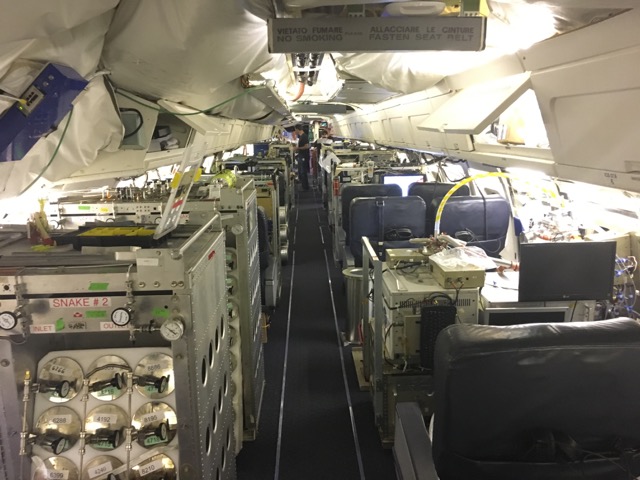
NASA satellites have been measuring atmospheric formaldehyde concentrations for over 15 years. Wolfe’s new research relies on that data, plus new observations collected during NASA’s recent Atmospheric Tomography (ATom) mission. ATom has flown four around-the-world circuits, sampling air with the aid of a NASA research aircraft.

This “flying laboratory,” as Wolfe describes it, collected data on atmospheric formaldehyde and OH levels that illustrates a remarkably simple relationship between the two gases. This did not surprise the scientists, because formaldehyde is a major byproduct of methane oxidation, but this study provides the first concrete observation of the correlation between formaldehyde and OH. The findings also showed that the formaldehyde concentrations the plane measured are consistent with those measured by the satellites. That will allow Wolfe’s team and others to use existing satellite data to infer OH levels throughout most of the atmosphere.

inside a research aircraft

“So the airborne measurements give you a ground truth that that relationship exists,” Wolfe says, “and the satellite measurements let you extend that relationship around the whole globe.”

Wolfe, however, is the first to acknowledge that the work to improve global models is far from done. The airplane measured OH and formaldehyde levels over the open ocean, where the air chemistry is relatively simple. It would be more complicated over a forest, and even more so over a city.

While the relationship the researchers determined provides a solid baseline, as most of Earth’s air does, indeed, float above oceans, more work is needed to see how OH levels differ in more complex environments. Potentially, different data from existing NASA satellites, such as those tracking emissions from urban areas or wildfires, could help.

Wolfe hopes to keep refining this work, which he says is at “the nexus of the chemistry and climate research communities. And they’re very interested in getting OH right.”

Getting it right

The current study did consider seasonal variations in OH, by analyzing measurements taken in February and August. “The seasonality is one aspect of this study that’s important,” Wolfe says, “because the latitude where OH is at its maximum moves around.” Considering seasonal shifts in OH concentrations, or even multi-year shifts caused by phenomena like El Niño and La Niña, could be one angle to explore when trying to improve global climate models.

Looking further at OH levels on a global scale using satellite data validated by airplane data could also help scientists refine their models. “You can use the spatial variability and the seasonality to understand at the process level what’s driving OH, and then ask if the model gets that right or not,” Wolfe says. “The idea is to be able to poke at all these features, where we haven’t really had any data to do that with before.”

This new research is one step in the journey to enhancing our understanding of the global climate, even as it is rapidly changing. More accurately understanding how, for example, cutting methane emissions would affect the climate, and how quickly, could even influence policy decisions.

“It’s not perfect. It needs work,” Wolfe says. “But the potential is there.”

Image: The NASA research aircraft used for the ATom mission. Photo by Susan McFadden for NASA.

From dream to drive to degree: Five UMBC journeys

Earning a degree isn’t just a milestone, it’s a special kind of growth experience full of challenges and doubts, inspiration and opportunity. Depending on their path, some students face particular challenges. They may be the first in their family to attend college, or need to work full-time or more to make ends meet while pursuing their degree. Some students are raising a family while working and taking classes.
At UMBC, students from all backgrounds are finding strength in community. They are building networks of support with peers and mentors to reach toward goals together, whether that goal is making a difference in Baltimore City, pursuing graduate school, or setting a powerful example for younger generations.

“You really have no idea what you’re capable of, until you do it.”

Vanessa Gonzalez ’19, American studies, has been completely independent since age 17 and is the first member of her family to graduate from college.
Gonzalez has worked several jobs at once since she left home, and has struggled with health challenges. And still, she’s earned an associate’s degree from Anne Arundel Community College (AACC) and is now poised to graduate from UMBC as a Sherman STEM Teacher Scholar with a 4.0 GPA. She has big dreams that she’s on the path to achieving: to teach math in Baltimore City and one day travel with the Peace Corps. And she’s happy.

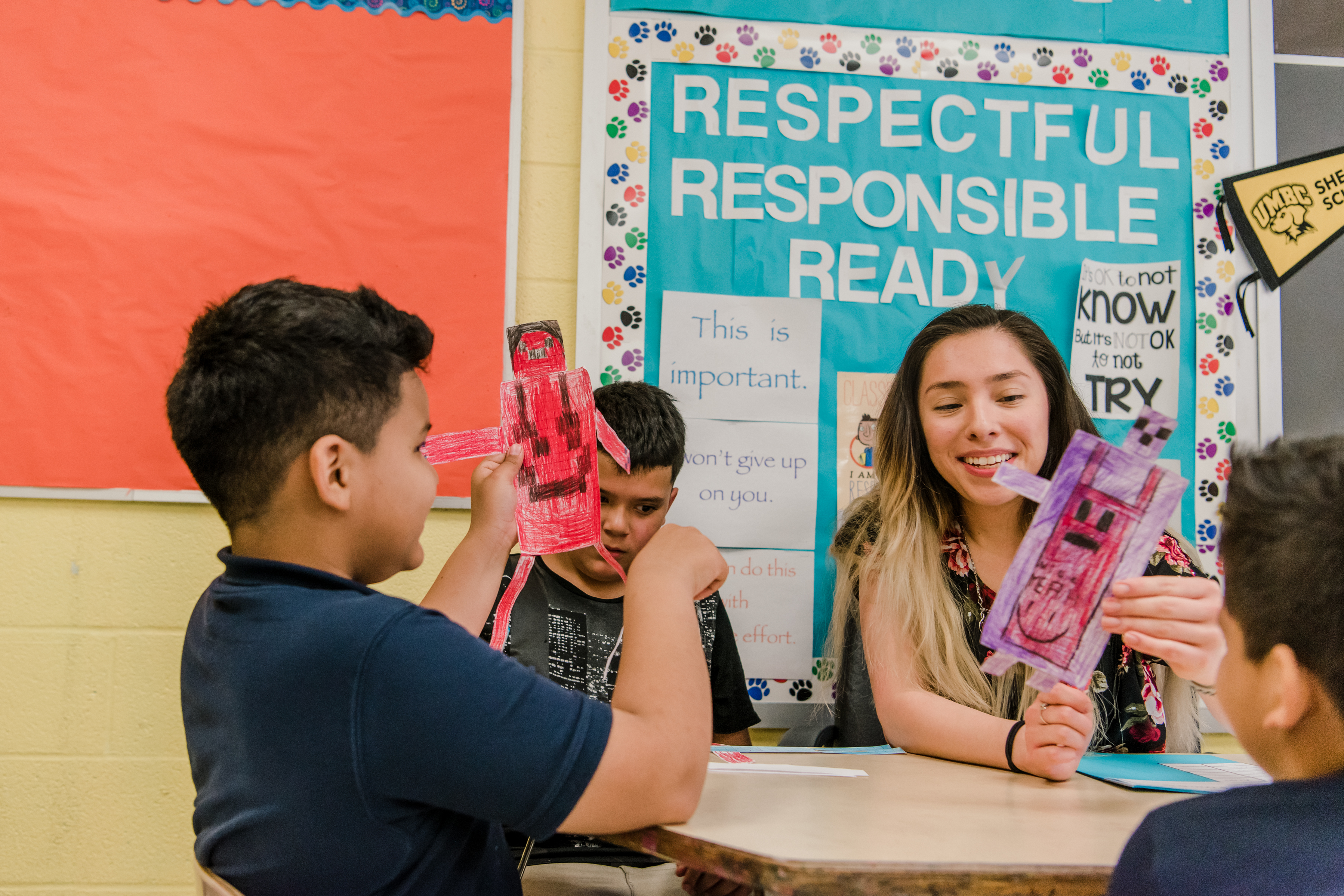
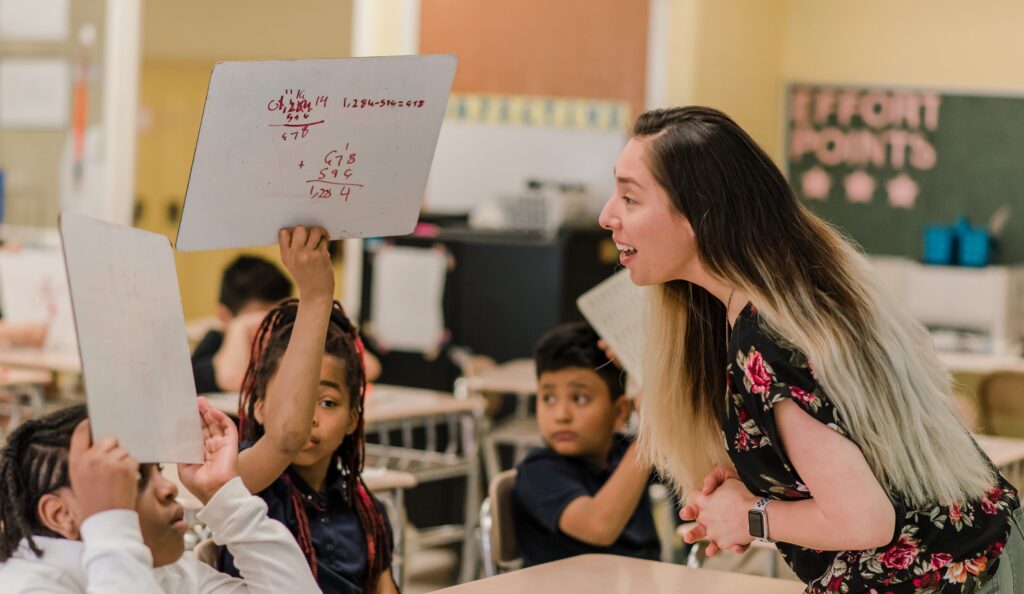
Vanessa Gonzalez ’19, American studies, works on a project with Lakeland Elementary School students. Photo by Marlayna Demond ’11 for UMBC.

Gonzalez worked at the YMCA of Central Maryland while she was at AACC. That experience “helped me find my passion for child care and educating children,” Gonzalez says. Since then, she’s continued to grow in confidence and in her commitment to her work.
“Every now and then there are hiccups, but I went from never believing that I would make it past 18 years old to being 24 and accomplishing so much…And I’m pursuing exactly what I love,” she says. “I’m excited every day. It’s just nice having happiness.”
How did Gonzalez accomplish this? “Embrace the hard times,” she says. “Accept the tears. Because you’re going to think: I’m dropping out. I give up. I quit. But the important thing is to not get to that point.”
She tells other students facing challenges: “You’ve gotta push through when you really don’t want to, so you can be where you want to be in the future. You really have no idea what you’re capable of, until you do it, and then you have this overwhelming sense of accomplishment.”
In addition to focusing on a powerful inner drive, Gonzalez notes the importance of being able to access support. Josh Michael, assistant director of the Sherman Scholars, has been one of her greatest champions. Michael juggles a busy schedule, including working one-on-one with several students in the scholars program, “but then he’s still coming in to observe me teach, and giving me feedback, and working with me through my struggles,” Gonzalez shares.

Young woman leads children in a lesson
Vanessa Gonzalez ’19 works on a project with Lakeland Elementary School students. Photo by Marlayna Demond ’11 for UMBC.

When she suffered a concussion and couldn’t use a computer for weeks, faculty members printed class materials for her and worked with her to create a long-term make-up schedule.
Another faculty member “has been exactly where I am,” shares Gonzalez. “Everything she says and she’s done for me is just to make me better and help me achieve my goals.” Seeing her mentor’s success has been encouraging for Gonzalez, especially in the most challenging moments.
Now that she’s made it this far, with the support of the Sherman Scholars staff and her American studies mentors, Gonzalez wants to give back to the community. In Baltimore, she says, “I see homelessness. I see hungry people. I see a lot of struggle. And it hurts.”
“My goal is to be a part of the change that I’d like to see,” says Gonzalez, voicing the goal of so many UMBC students graduating alongside her. “I want to be part of helping lift up a community that deserves more.”

“[My] parents came here to give me a better life, and I’m living it.”

Ashley Batista ’19, biological sciences, is the first member of her family to graduate from college. Her parents emigrated from the Dominican Republic in search of new opportunities, and Batista was determined to make the most of her college experience. She chose to attend UMBC after hearing a woman of color speak at a UMBC event about the opportunities she was able to access as a UMBC alumna.
“I felt like she represented me,” Batista says. “I just felt really empowered, and I enjoyed how rigorous the coursework would be here. I thought it would challenge me but also prepare me well for whatever I choose to do after.”

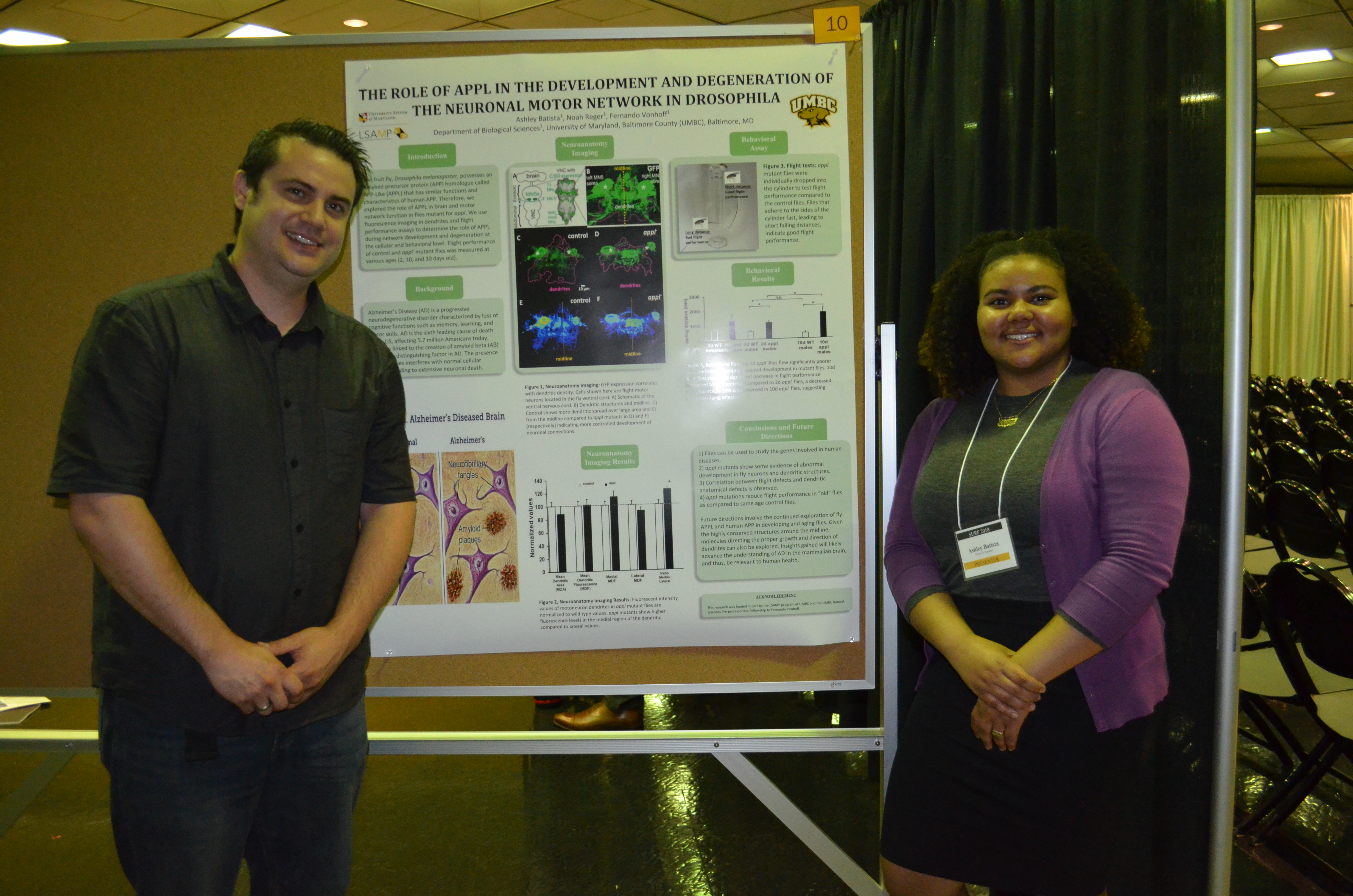
Ashley Batista ’19, biological sciences, presents her first research poster at SURF 2018. Fernando Vonhoff (left) is her research mentor. Photo courtesy Ashley Batista.

Once on campus, Batista was particularly excited to hear about the Louis Stokes Alliance for Minority Participation summer research fellowship—a program that supports students in historically underrepresented groups in STEM. But because she didn’t have a faculty mentor or research project lined up, she put the application aside. That was until Peter DeCrescenzo, project coordinator in the Office of Academic Opportunity Programs, reached out to encourage her to apply, offering to help connect her with a mentor.
That summer, Batista started working on Alzheimer’s research with biology professor Fernando Vonhoff, and it’s changed her life.
Being in the lab “opened a lot of doors for me to network and to figure out opportunities and programs I could be involved in after graduation,” she shares. She notes that the research itself “was really gratifying. It changed my whole perspective and my goals.” A reproductive health-focused Alternative Spring Break also helped Batista identify her path forward toward an obstetrics or pediatrics career.
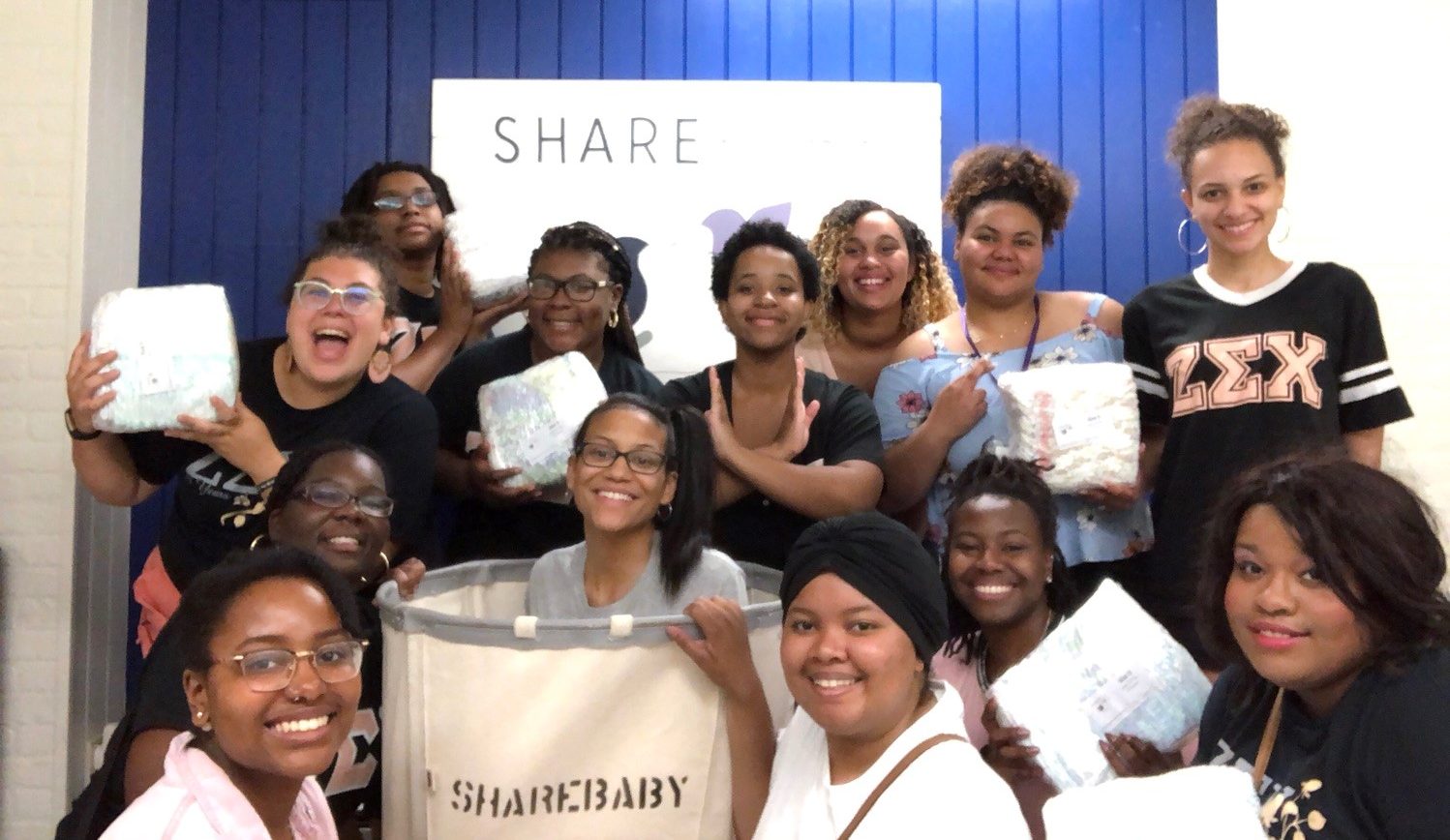
On top of her research experience, Batista began organizing multicultural learning events for the UMBC community as a sister in the Zeta Sigma Chi Multicultural Sorority, Inc. That work “helped me understand and teach others about different perspectives, and create an environment where people can be open to discussion, respectful, and nonjudgmental,” she shares. “ I think that’s something that I can transfer wherever I go.”
She adds that her sorority sisters have been a huge source of support during her time at UMBC.
Batista says that while it adds challenges, being a first-generation college student has been motivating. “Whenever I’m feeling overwhelmed, I remember that my parents came here to give me a better life, and I’m living it,” she says. “It motivates me to keep going and make them proud—and to make myself proud, because I know it will be rewarding in the end.”

Ashley Batista ’19 (standing, second from right) and sorority sisters from across the East Coast volunteer at the non-profit Share Baby. Photo courtesy Ashley Batista.

“I’m not alone in the struggles…or alone in my successes.”

Damarius Johnson ’19, Africana studies, is also a first-generation college student as well as a transfer student from the Community College of Baltimore County. Like Batista and her sorority, for Johnson, finding close-knit communities within UMBC has been the key to success. “UMBC has supportive communities that have helped me see college graduation as feasible,” he shares, “and then allowed me to go through the ups and downs that happen as a college student.”
“The McNair Scholars Program has been instrumental as far as focusing my attention on what I’d be pursuing after graduation,” says Johnson. That attention has paid off—he’ll begin a Ph.D. in history at the Ohio State University this fall.
The Transfer Engagement and Achievement Mentoring (TEAM) Program has connected Johnson with mentors and peers who have had experiences he can relate to, such as being the first in their family to attend college, transitioning from community college to a four-year school like UMBC, or experiencing college as a young black man, he says.
Johnson shares, “Having that support has been really helpful in knowing that I’m not alone in the struggles that I have, or alone in my successes. These are people I celebrate with, too.”
Several mentors have helped Johnson through his UMBC journey, and determining his next steps, including Michael Hunt, assistant director of the McNair Scholars Program; Gloria Chuku, professor and chair of the Africana studies department; and James Hamilton, an academic advisor in the College of Arts, Humanities, and Social Sciences. He started at UMBC not knowing what he might do afterward. But now, Johnson says, “I’m most excited about my transition from being an undergraduate to being a scholar in history. I’m excited for what that journey will be like, and to be learning in a new environment.”
“Hopefully it’s the beginning of something good for my family,” says Johnson, who has younger siblings. “I’m really happy to be able to honor them by getting to this point, because they’ve done a lot to support me.”

At UMBC “you can get to where you want to go.”

Like Johnson, Blake Hipsley ‘19, a dual degree recipient in physics and mathematics, was a McNair Scholar. Since his sophomore year, Hipsley has pursued research through the program with Michael Hayden, professor of physics. “Research helped me open up to what I want to do in the future,” Hipsley says. “I had the chance to see if it was something I wanted to do, and I decided it is.” This fall, he’ll begin a Ph.D. in physics at the University of Michigan.
Hipsley’s parents didn’t graduate from college, but always encouraged him to pursue higher education. “My mom always encouraged us to do our best and work hard,” he shares. “I think that’s why I have this drive to always be doing so much, and I put it on myself to pay for my own school.” By applying for a multitude of scholarships and working as a tutor, Hipsley was able fund his UMBC education on his own.
Without family members who had attended college, “The only people I really could talk to about graduate school were my professors,” he says. “They really helped me a lot with getting funding, writing a personal statement, and preparing for the GRE.”

Blake Hipsley ’19, physics and mathematics, talks about his research at URCAD 2019. Photo by Marlayna Demond ’11 for UMBC.

Hipsley also served as the McNair Scholars Program’s inaugural teaching fellow, a role where he advises other McNair students and provides feedback to program leadership. “McNair has helped me not only get into graduate school,” he says, “but also help others who may be struggling.”
The McNair Scholars also supported Hipsley’s personal growth. “One of the benefits of the program is that you get to meet people from all different backgrounds,” he says. As a result, he tried his first sushi and watched his first Bollywood film.
With such a caring community of support, Hipsley says, at UMBC, “If you work hard and keep at it, no matter where you’re from you can get to where you want to go.”

“They’re going to see you finish what you started.”

Nicole Katsikides, Ph.D. ’19, public policy, began her doctoral journey 12 years ago while working full-time for the Maryland Department of Transportation on highway freight transport efficiency. During her Ph.D. studies, she’s had two children, now 6 and 8, and her husband was deployed with the Air Force to the Middle East several times. Two years ago, based on the skills she’s gained through her graduate studies, she was also recruited for a demanding new job with the Texas A&M Transportation Institute (TTI), which she’ll continue after officially earning her doctorate this month.
“There were many times along the journey that I truly didn’t think it would happen,” Katsikides reflects. “I think the way I got through was with very gracious support from my advisor and my committee.” John Rennie Short, public policy; Tim Brennan, public policy; and Scott Farrow, economics, “wanted to see me succeed,” she shares, “and that really helped.”

Nicole Katsikides, Ph.D. ’19, public policy, says by “continuing to plug away” and with the support of “my boss, my family, and my committee, I’ve been able to make it.” She’s pictured here with her husband and children. Photo courtesy Nicole Katsikides.

For Katsikides, the public policy program’s active effort to be accessible to working professionals made all the difference. “Under Dr. [Susan] Sterrett’s leadership, the program has evolved to be something that’s really helpful for people in public positions like I had to succeed,” she says, “and to bring Ph.D. level knowledge into the public sector working environment.” Katsikides also notes that her TTI supervisor, Bill Eisele, was very supportive, especially as she approached the finish line.
Still, Katsikides struggled to balance motherhood with pursuing her career and her education. “It’s very easy for people to say, ‘Why are you doing that?’ or ‘You should be spending more time with your kids.’ There’s still a lot of cultural norms,” she says. She stayed motivated by remembering how her own parents pursued advanced degrees when she was a child.
“I hope that when my kids think about this as they grow up, that they saw what it takes to achieve something. That it’s an example for them,” she shares. “So block out the noise, and keep going—the kids are gonna be alright. They’re going to see you finish what you started.”
Banner image: Vanessa Gonzalez ’19 works with a student at Lakeland Elementary School. Photo by Marlayna Demond ’11 for UMBC. 

UMBC Meyerhoff Scholars replications at Penn State, UNC show notable success in first four years

UMBC’s Meyerhoff Scholars Program has been lauded as a national model for supporting diverse students in STEM fields. Other institutions across the United States have begun to ask if UMBC’s approach could work for them. A new paper published in Science answers that question with a resounding “yes.”

Since its inception in 1989, UMBC’s Meyerhoff Scholars Program has graduated 739 students with undergraduate degrees in science and engineering, with 76 percent continuing on to graduate or professional programs in STEM. Meyerhoff alumni have earned 300 Ph.D. degrees, 130 M.D. degrees, 54 M.D.-Ph.D. degrees, and 253 master’s degrees to date, and hundreds more are currently pursuing graduate degrees.

Culture shift

While these high achieving, research-focused students are more likely than the average student to go on to a graduate degree, research has shown that their UMBC experience has had a major impact on their trajectories. Highly qualified students who were offered admission to the program but opted to attend other universities were half as likely to graduate with a STEM undergraduate degree and about five times less likely to pursue a graduate degree in STEM than those who accepted the offer to join the Meyerhoff Scholars Program.

The program has also resulted in a culture shift that supports the success of underrepresented students in STEM who are not Meyerhoff Scholars, and has informed the creation of similar scholars programs at UMBC focused on other fields.

With all these positive results, the major question became: Is the Meyerhoff Scholars Program inherently unique to UMBC, with its charismatic African American president, status as a historically diverse institution that has welcomed students of all races from its founding, and location in a region rich in diversity? Or could similar programs be implemented at very different institutions with similar success?

A man and woman wearing lab coats and goggles work in a lab, inspecting samples.

Shared commitment

The new paper in Science, led by Mariano R. Sto. Domingo, associate director of research and evaluation with the Meyerhoff Scholars Program, reveals findings from the first four years of a five-year initiative to adapt the Meyerhoff Scholars Program at Pennsylvania State University at University Park and at the University of North Carolina at Chapel Hill, supported by the Howard Hughes Medical Institute.

While strikingly different in some ways, these three institutions now share a commitment to all components of Meyerhoff-style programs. These include intensive advising, immersive transition activities the summer before the students’ first semester of college, institutional leadership that makes the program a priority, training for faculty and staff, and other components.

Findings from Penn State’s Millennium Scholars program and UNC’s Chancellor’s Science Scholars program show exciting success at an accelerated pace, with students achieving the project’s goals at a level on par with the success of recent Meyerhoff cohorts. For example, retention in STEM among the Penn State and UNC cohorts was similar to that of current Meyerhoff Scholars. Additionally, the average GPAs and four-year graduation rates of the first Penn State and UNC cohorts exceeded that of the first four Meyerhoff cohorts, in the early 1990s. These findings are especially encouraging, because the locations, historical leadership, and student bodies at these institutions look very different than they do at UMBC.

Findings also suggest benefits for students of all backgroundsincluding, but not limited to, the 65 to 80 percent of program participants who are from underrepresented groups in STEM. At all three institutions, students in the program had higher GPAs and were more likely to stay in STEM majors than classmates who did not participate in the program, regardless of their race, ethnicity, or gender.

Naomi Mburu '18 works in the lab with faculty mentor.

Laying the groundwork

“These findings confirm that Meyerhoff-like programs and student outcomes can be achieved elsewhere, even at institutions very different from UMBC,” says Michael Summers, Robert E. Meyerhoff Chair for Excellence in Research and Mentoring and Distinguished University Professor at UMBC.

Based on the promise of this adaptation, other universities have begun exploring Meyerhoff-like programs, with the Chan Zuckerberg Initiative recently announcing a massive replication effort in University of California system. “It is my hope that this initial effort has laid the groundwork for partnership expansion with an even broader range of institutions,” Summers says.  

With the impressive results just published in Science, Summers notes, “The high level of success achieved at UNC Chapel Hill and Penn State should now show all institutions that inclusive excellence is an achievable priority, regardless of the institution’s size, location, and history. Success was dependent on the willingness of institutions to partner together and learn from each other.”

Learn more about the Meyerhoff Scholars Program.

Banner image: Eudorah Vital ’18, a Meyerhoff Scholar and Howard Hughes Medical Institute Scholar and the 2018 UMBC valedictorian, hugs President Hrabowski after giving her remarks at commencement. All photos by Marlayna Demond ’11 for UMBC.

UMBC labs share four essentials for undergraduate research success

Undergraduate research at UMBC is booming. As Undergraduate Research and Creative Achievement Day (URCAD) approaches, students across campus are preparing talks and posters on their projects with the support of faculty and graduate student mentors. Some have presented before at national and international conferences. For others, URCAD (on April 24, 2019) will be their debut on the scientific stage.

So, what creates a culture where undergraduate research thrives? Here, students and mentors across different UMBC labs share four factors they think shape the student research experience.

#1 Encourage independence to build identity as a researcher

In collaboration with their mentors, UMBC students design and implement creative and challenging research projects that directly contribute to the research mission of the lab. That independence, and the trust their mentors and labmates place in their work, contributes to the students’ development of an identity as scientific researchers.

Building confidence

Caroline Larkin ’18, M26, bioinformatics, has been working with Daniel Lobo, assistant professor of biological sciences, since April 2016. When they first met, they discussed their research interests and created a project for her that merged them together. Since then, she’s been using machine learning to define how different kinds of cells in cancerous tumors interact, because some of those interactions can lead to tumor collapse.

Left to right: Joy Roy ’19, bioinformatics and mathematics, Daniel Lobo, Caroline Larkin, and Eric Cheung. They’re looking at images of planaria. Lobo lab members use machine learning to study its gene expression patterns and regeneration ability.

At first, Larkin found herself darting across the hall to ask Lobo questions frequently, but he eventually advised her to sit with her challenges for a bit first. While Lobo is still available for the tough questions, “Now I believe in myself more,” Larkin says. “I know I’m capable of fixing something in my code, for example. I give it time before I ask for help.”

“It’s my philosophy to give the undergrads an independent project that they can own,” says Lobo, with the eventual goal being that they each become first authors on a scientific paper.

Larkin is a Meyerhoff and MARC Scholar, and those programs “have really shaped my identity as a scientist, and Dr. Lobo has fueled the validation of that feeling,” she says. “I’ve always been told I was going to become a scientist, but actually doing research with Dr. Lobo has really made me feel like one.”

This fall, Larkin will continue her scientific career as a Ph.D. student in the joint computational biology program at Carnegie Mellon University and Pittsburgh University.

Tackling impostor syndrome

Ruben Delgado, assistant research scientist in the Joint Center for Earth Systems Technology at UMBC, instills the same kind of independence in his students. Meredith Sperling ’19, mechanical engineering and mathematics, says, “Every undergraduate has a project that they can define when they first start and then fine tune it as they move along. Graduate students and Ruben are great at providing guidance, pointing out possible pitfalls, etc., but at the end of the day it’s really our research and where we want to take it.”

Members of the Delgado research group discuss a data set. Left to right: Jenna Westfall, Wambugu Kironji, Ruben Delgado, Meredith Sperling.

Sperling’s labmate Julianna Posey ’19, mechanical engineering, says she has dealt with impostor syndrome as a female engineer, but in the Delgado lab, “both your peers and your professors take you seriously,” Posey says. “And that’s pretty uplifting.”

Jenna Westfall ’20, computer science, has enjoyed the opportunity to apply her coding skills to environmental science questions. “Looking at a problem in the real world and having to come up with my own way to tackle it has helped me professionally,” she says, “and I’m grateful to be able to work on something that benefits the lab directly.”

“This really is my project”

Kevin Chen ’19, M27, biological sciences, and Jeffrey Inen ’18, biological sciences, have become experts on their projects in Chuck Bieberich’s lab. After being mentored by Ph.D. student Apurv Rege, Chen is now the resident authority on some of the mouse lines the lab needs for its cancer research.

“When people started asking me about what’s going on with a mouse line, instead of asking the graduate student, it made me think, ‘Wow, this really is my project, and people are asking me for knowledge about it because I’m the primary source for that knowledge,” Chen shares. “I think the independence we’re given in the laboratory gives you that ownership and that feeling of being a researcher.”

Jeffrey Inen works in the lab with mentor Michelle Starz-Gaiano.

This fall, Chen will take that expertise to Emory University. He’s committed to their Ph.D. program in cancer biology, where he’ll expand upon his work with Bieberich.

“He gives us a lot of independence, and I think that’s where I’ve been able to learn the most,” Inen adds. “When Dr. Bieberich starts to come to us for the answers on projects and what he needs to know for his next presentation, it makes me feel like I really belong in the lab.”

For Bieberich, investing time in his undergraduate researchers is a win-win. “As our research program has grown, it’s opened up opportunities to bring undergrads into key roles,” he says. “Having undergraduates in the lab has extended our capability to ask more complex questions than we would otherwise take on.”

#2 Support from every angle enables students to shine

Mentors who are available when you need them, understand the rigorous demands of an undergraduate science career, and can be flexible and supportive when life happens are invaluable for students deciding whether they want to start or continue in research. At UMBC, mentors proactively extend a hand to ensure their students’ success.

Jeff Inen (center) with Chuck Bieberich and Michelle Starz-Gaiano.

Investing time and care

“What I really like about Dr. Lobo is that he’s invested a lot of time into me and my project,” Larkin shares. “I know I can have an honest conversation with him when I’m struggling with something.” For Larkin, that’s included an unexpected diagnosis that left her bedridden for months. Uncertain when she would be able to return to research, Lobo was understanding and welcomed her back when she was ready.

Chen and Inen have had similar experiences with Bieberich. During a serious rough patch, “Dr. B. sat down with me and asked, ‘How can I help you?’ and we worked out a plan for him to help me through that tough time,” Chen shares. And when Inen was in the hospital for almost a week, “Dr. B. came to visit me every day,” Inen remembers. “He definitely goes above and beyond.”

On a more regular basis, “Whenever I need anything, I can just go to Dr. Bieberich and ask,” Inen says. “He’s very open to [students] coming up to him at any time, whether it’s about something in the lab or outside of the lab.” Chen agrees, sharing, “Dr. B is very supportive of everything in my personal life and in the laboratory.”

Exposure to new possibilities

Support can also come in the form of encouraging students to pursue interests beyond what they would normally consider. “The thing that I’ve always appreciated about this lab is that it’s an outlet for me to explore things outside of my engineering program,” Posey, in the Delgado lab, shares. “I’ve always been interested in meteorology and the atmosphere, and I feel like I’ve developed more of a passion for protecting the Earth.”

Meredith Sperling (left) and Jenna Westfall (center) work together in the Delgado lab.

Delgado sees expanding students’ horizons as a major part of his role. “It’s about making them aware that they have the capacity to go beyond their own expectations and imagination,” he says. “From my own personal experience, I’m where I am because during my undergrad others provided me opportunities to conduct research. Now I’m paying it forward.”

And while he pushes them toward their potential, Westfall, Posey, and Sperling all agree that Delgado understands the demands of undergraduate life. If they need to take a short break due to a spate of exams or a family situation, there’s understanding in the lab. Between being there for emergencies and supporting students through the routine challenges of being an undergrad, UMBC mentors like Lobo, Delgado, and Bieberich create an environment where expectations are high, but flexibility exists as well.

#3 It’s all about communication

As mentors help students prepare to share their work in venues like URCAD, they also help them understand why the ability to explain research is essential for a successful career in science.

Keeping your eye on the goal

In Delgado’s lab, the message has gotten through to Julianna Posey. “The communication part of research is one of the most important parts,” she says. “You should be able to explain your research to somebody as if they’re your younger sibling. And if you can’t do that, then why are you doing it?”

With Delgado’s guidance, Posey has presented at the American Meteorological Society’s annual conference, the National Ambient Air Monitoring Conference sponsored by the EPA, and URCAD. Next year she’ll continue her atmospheric research in UMBC’s master’s program in mechanical engineering.

Meredith Sperling agrees on the benefits of communicating one’s research. “When you work on a project every day, it’s easy to get lost in the numbers,” she says. “But to be able to take a step back and succinctly present your project on a poster within ten minutes, that really keeps you on the path to achieving something that’s ultimately worthwhile, because it forces you to keep your eye on the end goal.” In particular, she says, “URCAD is important because we get to show our work to the community here at UMBC and show how we fit in.”

Julianna Posey and Wambugu Kironji ’19, computer science, work with an instrument that measures concentrations of particles in liquids and gases in the Delgado lab.

Getting past the fear factor

As valuable as it is, making a first presentation can be intimidating. That’s why Lobo has his students practice at weekly lab meetings. An opportunity to get feedback from trusted colleagues in a supportive setting builds confidence. So, “By the time URCAD arrives,” Lobo says, “they have presented their research ten times already, and they are not so afraid of presenting.”

It’s worked for Eric Cheung ’19, biochemistry and molecular biology, who works with Lobo. “Presenting is not really a foreign thing to me now,” he says. Plus, Lobo requires all lab members to ask at least one question following presentations. “That drove my research,” Cheung says, “to always ask one more question.”

Caroline Larkin, working in Lobo’s lab, has also benefited from gaining experience sharing her work. She and Jamshaid Shahir ‘18, mathematics and statistics, were the only two undergraduates to present at the international Winter Q-Bio conference in 2018.

#4 Diversity makes lab groups more effective

By welcoming students from all backgrounds and encouraging open communication among lab members, mentors set the stage for a research environment that is open to questions from all perspectives. That diversity in the lab benefits both students’ individual development and the research progress a lab can make.

Same questions, different tools

Lobo’s lab group includes computer scientists, biologists, and mathematicians, among other majors. That diversity benefits the work. “It’s not like the computer scientist is doing computer science, and the mathematician is doing math. Everybody is trying to answer a biological question, with different tools.”

Members of the Lobo research group connect in the lab. From left to right: Eric Cheung, Joy Roy, Daniel Lobo, and Caroline Larkin.

Also, one of Lobo’s goals as a mentor is “to help students understand how science is made.” By working in an interdisciplinary team, they get a flavor for research as teamwork and the importance of approaching scientific questions from different perspectives. As a result, Lobo says, “They are going to be people who know how science works, and that can only benefit science.”

Valuing diversity

Chen and Inen both shared how much they value the diversity among the students in Bieberich’s lab, across gender, race and ethnicity, religion, language, and hometown (or country). For example, Inen is Catholic, and has valued a friendship and conversations he’s had with a female Muslim student in the lab, even attending her mosque for services. Chen identifies as atheist and feels equally comfortable in the lab.

“I look for undergraduates who are eager, bright, dedicated, and willing to put their heart and soul into a project,” Bieberich says. The makeup of the lab “just shows that those characteristics come from everywhere.”

“People from diverse backgrounds are drawn to this lab, because everyone knows Dr. B. is so friendly and kind,” says Chen. “It’s created this environment in the lab where we all learn from each other.” Inen agrees, saying, “We can talk about our differences, and it brings us all together.”

“If everyone recognizes that they’re all doing an essential part of a project that’s addressing a much larger problem, then it’s easy to step up to help each other out,” Bieberich says. “The only way we will succeed is as a team.”

For information about when these students, their labmates, and students from across all departments at UMBC are presenting at URCAD, see the full URCAD schedule.

Banner image: Undergraduate members of the Delgado research group at work. All photos by Marlayna Demond ’11 for UMBC.

UMBC researchers invent creative approach to remove dangerous pollutant from waterways

UMBC professors Kevin Sowers and Upal Ghosh have advanced a new technique to eliminate PCBs—one of the most persistent, pervasive, and dangerous chemical pollutants found in waterway sediments. Their innovative, environmentally-friendly approach, published in Environmental Science and Technology, resulted in reducing PCBs by over 50 percent in treated areas.

Sowers, a professor of marine biotechnology, and Ghosh, a professor of chemical, biochemical, and environmental engineering, had been working on PCB removal separately for years. Only recently did they realize their separate efforts could be combined to create a new, more-effective way to get rid of dangerous PCBs, even in ecologically sensitive or hard-to-reach areas, such as around piers and in fragile wetlands. Sowers and Ghosh have now formed a company, Rembac Environmental, to help bring their process to more areas that need PCB remediation.

From required to “remove it!”

PCBs were used extensively as fire retardants—and even required in some products—until they were banned in the U.S. in 1979 because of findings suggesting they might be neurotoxic, disrupt animals’ endocrine systems, and possibly cause cancer. Despite the fact that the ban has been in place for decades, PCBs still persist in sediments around the country, including in Chesapeake Bay. In the Mid-Atlantic, PCBs are the second most common reason for public advisories against consuming fish, just behind mercury.

“If they were to be left alone, PCBs would be in the sediments for decades, and depending on the level it could be a century,” says Sowers. “They’re very stable,” he adds. “That was their selling point.”

The best techniques to deal with PCBs are dredging, which physically removes the PCBs from the area (along with loads of sediment), and capping, which involves piling gravel on top of the sediment to keep the PCBs from interacting with aquatic life above. While each method has its place in the fight against PCB contamination, both are extremely costly, cannot be deployed in ecologically sensitive areas, and are not always effective.

People have tried for decades to develop and sell methods to remove PCBs from sediments biologically. Microorganisms that can break down PCBs occur naturally in sediment, and most efforts have focused on encouraging their populations to grow by adding cocktails of nutrients. None of those prior efforts worked especially well, and Sowers remembers hearing repeatedly that biological removal of PCBs was impossible, but he wasn’t quite ready to give up on the idea.

Never give up

“The technology itself started in the 1980s,” Sowers says, when officials were trying to show that naturally-occurring microbes alone could take care of PCBs in the Hudson River. The effort was not successful, because scientists couldn’t identify the specific microbes doing the work. In the mid-1990s, Sowers and another collaborator, Hal May at the Medical University of South Carolina, identified the species, and soon after that, they developed a method for growing them in the lab without sediment.

“Once we could isolate them, we could study them. We learned enough about them to scale them up and inject them back into sediment,” he says. And finally, about nine years ago, “We found that if we added them in high numbers, we could get rid of the PCBs.” Bingo.

Well, almost. Sowers was still delivering the PCB-eating microbes to sediment set up in the lab. How could he inject the microbes over huge bodies of water in the real world?

Sowers’s microbes need to enter the sediment and settle there, not float around in the water. He needed a delivery method that was safe for sensitive areas, relatively quick, and ideally much less expensive than dredging or capping.

Collaboration opens doors

In parallel with Sowers’s work, Ghosh had also been working for years on PCB remediation, but he’d taken a different approach. He had developed pellets made of activated carbon. When the pellets enter the sediment, they bond tightly to PCBs.

“It doesn’t eliminate the PCBs, but it reduces the risk of PCBs getting into the food chain,” he explains. This, in turn, reduces the danger to aquatic life, and the need for fish consumption advisories.

Because carbon is one of the key building blocks of all life, it also wasn’t a significant environmental threat. Ghosh founded a company called Sediment Solutions to produce the pellets, known as SediMite. But it wasn’t until Ghosh and Sowers met that they realized their projects could complement each other.

“Working together allowed us to see the bottlenecks,” Ghosh says.

One breakthrough for the new team was figuring out why the naturally occurring PCB-eaters weren’t enough to have a substantial impact in bodies of water. As an environmental engineer, Ghosh dived into examining the energy balance in the sediment environment, and found it just wouldn’t facilitate growth of those populations in large enough numbers. “You need the microbes in higher levels to see PCB degradation happen in months, and not decades or centuries,” he explains.

With that realization, they began to see the tremendous potential of their partnership. Sowers could produce the microbes that could eliminate PCBs, and Ghosh had pellets that would settle into the sediment—a novel delivery mechanism for the microbes. “When we started working and talking together, we realized, ‘I can solve your problem and you can solve my problem,’” Ghosh says.

Scaling up

Their new publication is the result of the first field trial of the new combined technology. Sowers and Ghosh found a way to bind the microbes to the pellets, and sprayed them into a polluted body of water on the Quantico Marine Corps Base, which drains into the Potomac River. The Department of Defense funded the trial as part of its commitment to clean up PCB contamination at military bases.

The experiment was a success, showing not only that the method is effective at removing PCBs, but also that it didn’t negatively impact the local environment in any detectable way. Ghosh and Sowers also found that the plot treated with the combined microbes and pellets showed a greater reduction in PCBs than a plot treated with the carbon pellets alone. This is the first concrete evidence that a biological approach to removing PCBs can work if delivered in the right way.

Ghosh and Sowers hope the technique will become popular for use in sensitive and hard-to-reach areas. For now, their company is working with another biotech firm to produce the microbes at large scale, but as they take on more remediation projects, they hope to expand their company and start growing the organisms themselves, Sowers says.

It’s taken a long time to get to this point, partly because environmental work of this sort is scrutinized so heavily, “for good reasons,” Ghosh says. But now, Sowers adds, “The most exciting thing is seeing it out there in the field.”

Banner image: Kevin Sowers (left) and Upal Ghosh in Sowers’s lab at the Institute of Marine and Environmental Technology. Photo by Marlayna Demond ’11 for UMBC.

UMBC’s Meyerhoff Scholars model heads to UC Berkeley and UCSD through a $6.9M investment from the Chan Zuckerberg Initiative

“The key to accelerating discoveries in science or the next tech breakthrough will be dependent on our ability to bring fresh perspectives to STEM fields,” says Priscilla Chan, co-founder of the Chan Zuckerberg Initiative (CZI). Now, CZI has turned to UMBC for a model of how to make that happen.

CZI announced today that it has awarded $6.9 million to support a unique partnership to replicate UMBC’s Meyerhoff Scholars Program at UC San Diego and UC Berkeley.

“California’s openness to new ways of thinking is what has made this state an innovation engine for the world,” says Chan. “With these new grants, we hope to help bring even more diversity of perspective and experience to our state—and to Silicon Valley.”

The UMBC Meyerhoff program, founded in 1989, is recognized as one of the most effective models in the nation to help engage and retain underrepresented students pursuing undergraduate and graduate degrees in STEM fields. Program participants have already earned 300 Ph.D. degrees, 130 M.D. degrees, 54 M.D.-Ph.D. degrees, and 253 master’s degrees. Hundreds more are currently pursuing graduate degrees.

A man and woman wearing lab coats and goggles work in a lab, inspecting samples.

These achievements are particularly striking in a national context. UMBC graduates more African American students who go on to earn dual M.D.-Ph.D. degrees than any other college in the U.S.—a credit to the Meyerhoff program model. UMBC is also second in the nation when it comes to graduating African American students who go on to earn a Ph.D. in any STEM field.

A thrilling combination

“It is truly thrilling to think about the national and global impact the Meyerhoff Scholars Program will have through partnerships like this,” says Michael Summers, Robert E. Meyerhoff Chair for Excellence in Research and Mentoring and Distinguished University Professor at UMBC. “By working together we can help shape the future of our national Ph.D. pipeline, with inclusive excellence as a core shared value of our work.”

The University of California system is the largest undergraduate and graduate educator of underrepresented and low-income students in the country within the Association of American Universities, and UC Berkeley and UC San Diego are major sources of top talent for Silicon Valley and STEM fields more broadly.

The CZI support announced today will enable UC San Diego and UC Berkeley to apply many of the strategies successfully used at UMBC. These include outreach to high achieving underrepresented high school students, robust research experiences, team learning, peer counseling, intensive advising, preparation in the summer before matriculation, and engagement with students’ families.

Informed by UMBC’s own approach to measuring the impact of student support initiatives, UC San Diego and UC Berkeley will provide rigorous data to measure the effects of their new programs over the five-year grant period. In this way, they hope to determine what approaches work best to create a welcoming and supportive environment for underrepresented groups, and ultimately to improve education for all in STEM fields.

As UMBC recognizes, these findings can also help a university support students beyond STEM, in any field, as they work to discover and fulfill their potential.

Extending community

UMBC Meyerhoff alumni pursuing graduate degrees at UC Berkeley and UC San Diego are particularly excited to see this new partnership grow.

University president hugs undergraduate commencement speaker in congratulations following her remarks, while colleagues clap, all in graduation attire.

“Seeing a version of the program come to Berkeley is exciting because it means there is another initiative to increase the support for students of color. It means building and extending the community that wants to see us in academic spaces,” says Robyn Jasper ‘17, M25, biological sciences, who is currently a Ph.D. student at UC Berkeley in plant and microbial biology.

“Being a Meyerhoff Scholar has connected me and continues to connect me with advocates for my personal growth and institutional change,” she shares.

Rockford “Rocky” Sison ‘13, M21, mathematics, a current Ph.D. candidate in applied mathematics at Berkeley, feels similarly. “As an alum of the Meyerhoff Scholars Program, I’m so excited to see other programs spring up across the country,” they share. “It means a lot to me that more students will receive the type of financial, professional, and emotional support I received as an undergraduate. Ideally, every student would get this level of support.”

For Sison, “being a Meyerhoff Scholar meant that I hit the ground running in college.” The Summer Bridge program before their first year and subsequent programming meant “I knew what internships were, office hours weren’t as scary because I knew a couple faculty members, and I was friends with a bunch of people that would also be in my classes.”

Sison carries on that legacy of support, sharing, “When I graduated from UMBC, being a Meyerhoff Scholar meant that I was dedicated to paying it forward, and I had a sprawling network of people with the same commitment.”

Now, UMBC’s Meyerhoff Scholars Program model will reach more people than ever before, reshaping the future of STEM in California and the nation, and unlocking new opportunities for students.

Featured image: Naomi Mburu ’18, chemical engineering, a Meyerhoff Scholar and UMBC’s first Rhodes Scholar. She is now studying nuclear engineering at Oxford. All photos by Marlayna Demond ’11 for UMBC.

Biology graduate students from UMBC earn national honors for unique aquatic research

Colorful mantis shrimps and freshwater darter fish took the spotlight at the recent annual meeting of the Society for Integrative Biology (SICB) in Tampa, Florida. UMBC biological sciences Ph.D. candidates Ricky Patel, Alice Chou, and Natalie Roberts, who study these intriguing creatures, earned four of the top student prizes awarded at the meeting, bringing well-earned attention to their own research and UMBC’s strong graduate programs.

Patel received the best student paper award for the Division of Neurobiology, Neuroethology, and Sensory Biology, and the best student oral presentation award from The Crustacean Society. Roberts was a finalist for the best student paper award for the Division of Animal Behavior. Chou received an honorable mention for the best student oral presentation from The Crustacean Society.

Quirky critters

Chou and Patel are studying mantis shrimp—small, colorful crustaceans that are “usually famous for two reasons: their very complex visual system and their very ballistic strike,” says Chou.

Patel is figuring out how mantis shrimp navigate to and from holes they call home. His inventive project has shown that at any point in time, a mantis shrimp can measure the most direct path back to its starting location—a skill humans can’t claim.

Ricky Patel with his outdoor experimental setup.

Chou is learning more about a region of the mantis shrimp brain called the central complex, which combines sensory information to help the animal decide what to do next. While much of the mantis shrimp changes drastically as it develops “from a weird little scrunchy larva to a big punching adult,” Chou recently discovered that one part of the central complex doesn’t change much at all. Now she’s asking why.

Roberts studies freshwater fish called darters. It’s common for multiple darter species to live in the same area, leading evolutionary biologists like Tamra Mendelson, professor of biological sciences, to wonder how they prevent interbreeding. Scientists had long assumed that female choice was the dominant driver, but Roberts and other students in Mendelson’s lab have shown that males are “probably much more important than we anticipated” in preventing interbreeding, Roberts says.

Independent thought

Chou and Patel both work closely with Tom Cronin, professor of biological sciences, and greatly value his approach to mentorship—encouraging them to take ownership over their work and pursue the questions that drive their passion for research. “My main philosophy is if graduate students are going to be successful career scientists, then they need to be able to work without a lot of direction,” Cronin says.

That attitude “fosters incredible independence,” says Patel. “I think we’re pretty strong at this point,” he adds, “because we had to work hard to establish exactly what we’re going to do and how we’re going to do it.”

Giving his students the freedom to explore their interests and choose a thesis project independently sometimes means they choose topics outside Cronin’s own wheelhouse, as in Chou’s case. Even so, she says, “He’s been trying as hard as he can to get me the resources I need to answer the questions I want to ask.”

Mendelson, too, works to ensure her graduate students leave her lab as confident and experienced independent researchers. “That’s my biggest goal,” she says.

Roberts can vouch for that. “Tamra was really open to me trying techniques that she wasn’t as familiar with herself,” she says. And when Roberts has a gut feeling about which direction to take her work, Mendelson trusts her to run with it. “Her confidence in my skills and my intuition for what I’m doing has been really helpful,” Roberts reflects.

Grateful for guidance

Paired with that freedom is a level of support that helps Cronin and Mendelson’s students build compelling research projects and enhance their communication skills, which can lead to awards from big events like SICB.

Natalie Roberts and Sam Hulse, grad students in biology, doing fieldwork.

“I feel like one of the reasons that we do well in the student competitions is that we have mentors who are giving us constructive feedback,” says Roberts. All three Ph.D. students expressed gratitude for the support they’ve received in preparing for presentations, from their first research talk to today.

Plus, Roberts adds, Mendelson and Cronin “help us design research questions that don’t overlap with what’s already being done. They’re cutting edge.”

“I’m happy to sit down with them constantly,” says Cronin, whether it’s to talk about their research progress or help them sort out more personal challenges. Mendelson, too, is there for her students, in the classroom and in the field. When Roberts was struggling to collect fish for her experiments, “She and I together went out into the stream,” Roberts remembers.

Community of support

Beyond the individual relationships Patel, Chou, and Roberts enjoy with Cronin and Mendelson, they also support each other. “The grad student community here, especially in our cohort, is very close,” says Chou, “and whenever we go to conferences we feel well-represented and supported in the audience of our talks.”

In preparation for SICB, Cronin shares that the students “all supported each other and each one of them made the other ones better.”

While his mentorship style focuses on independent thought, Cronin also thinks of science as a team sport. “My lab is very much a culture of people who work together,” he says. “We all want to rise together so all the boats are floating. That’s the kind of science I believe in.”

Ricky Patel, Natalie Roberts, and Alice Chou on a hike in a cypress swamp.

That collegiality benefits scientific progress. “We get a lot more done together than any one person could, and it’s non-linear,” Mendelson says. “The more people you have in the lab, you exponentially grow in productivity, and thinking, and directions you could go.”

Every person in the lab brings something unique to the mix. “From each of my students,” Mendelson shares, “I have found at least one unique characteristic that I admire and try to incorporate into my own work ethic.”

At SICB, says Chou, “You often see graduate students presenting their work right alongside high-flying lead investigators.” With the support they’ve received to pursue innovative research, and the recognition they’ve earned, Chou and her fellow Ph.D. candidates are already seeing themselves as that next generation of leaders.

Banner image: A peacock mantis shrimp. Photo by Bernard Dupont, used under creative commons BY-SA 2.0 license.

UMBC’s Bradley Arnold develops laser-based technology to safely and quickly detect IEDs and other hazards in combat zones

You’re a U.S. soldier, motoring across the desert at 60 miles an hour in an Army truck, heading back to base. Suddenly, a red light flashes on your dashboard—an instrument has detected traces of explosive material on the road surface ahead. You divert around the hazard and continue safely toward your destination.

“There is currently nothing available to do this at this speed,” says Bradley Arnold, professor of chemistry and biochemistry. But that could soon change.

Today, in order to detect hazards, service members must pause and send a robot to check an area of concern. This procedure slows progress, which can increase risk for military personnel trying to move through an area quickly. However, technology to make high-speed, near-comprehensive detection possible is close to coming to the U.S. Armed Forces, thanks to Arnold’s work.

Arnold’s research group recently received $480,000 for two years from the U.S. Army to develop a prototype of their detection device, which has been in development for three years. The Army will test it on military vehicles early next year, and if it passes field tests, it may be deployed soon after.

Molecular fingerprinting

Bradley Arnold, professor of chemistry at UMBC.

So how does it work? The device sends out 10 laser pulses per second as the truck drives along, and each laser pulse contacts about one square inch of the ground. At 60 miles per hour, one pulse hits the ground every eight feet. Arnold’s team is working to develop lasers that can pulse more rapidly. Then, the beams could overlap—even at high speeds—providing complete coverage.

The system collects the light that scatters off molecules on the ground in a specialized detector. Depending on the structure of their chemical bonds, different compounds generate unique scattering patterns. By analyzing those patterns, the detector “can identify a molecule’s characteristic fingerprint,” Arnold says.

The new system can identify “just about anything,” Arnold says, from compounds used in military or improvised explosives, to nerve agents, to biological threats. “Being able to detect these things on the fly is of critical importance,” he adds. The new device would make this possible for the first time.

The detector also stores all the data it collects, which provides additional benefits. “You could search the data for specific things afterward, and you could compare day to day what you see in specific areas,” Arnold says. “And both of these things would be a tremendous advantage.”

Outside the box

The basic technique the device employs is related to standard Raman spectroscopy, used in chemistry labs all over the world, but with one very notable difference.

In standard systems, a lens focuses the laser beam on a single point. But too much power focused at one point can destroy the thing you want to detect. To make the traditional method work in this case, Arnold’s team would need to reduce the power of the laser so much that they’d lose the benefit of having a high-powered laser to begin with. Their solution: remove the focusing lens, even though “99.9 percent of the universe insists the lens is required,” Arnold says.

Without the focusing lens, the laser beam is about three-fourths of an inch across when it strikes the ground. “We can turn the power up on the laser several orders of magnitude, and we don’t have to focus it on a single spot—that entire area is imaged onto our detector,” Arnold explains. In this setup, the detector is less efficient at collecting the scattered light, but the high power of the laser compensates for the inefficiency.

The technique is so novel that Arnold has met skepticism in the scientific community, despite publishing details of the technology in the Canadian Journal of Chemistry. “Nobody believes that it works,” he says, “but it’s actually much easier than the traditional method.” Coming up with the idea, he says, “was just a matter of recognizing the problem and thinking a bit outside the box.”

Always thinking ahead

As a future step, Arnold would like to work toward a lighter version of the device that could fly on a drone ahead of military convoys. He has submitted a Small Business Innovation Research grant to support efforts to that end.

In addition to military uses, Arnold is also thinking ahead to potential civilian applications. For example, a similar system at airport security could remove the need to swab suspect bags to detect trace materials on their surface. Instead, every bag’s surface would be automatically analyzed using this new system. It could even be used for security at stadiums or other large venues.

In the event that the military adopts the technology, and especially if civilian applications come into play, a way to produce the systems at scale will become necessary. With that in mind, Arnold has founded NuMoon Spectroscopy with support from a TEDCO Maryland Innovation Initiative grant.

Arnold loves the idea of seeing the technology do good in the world, which is why he has shepherded this project to the startup company stage. “This could be not just cool, but important,” he says.

His dream is to connect NuMoon with a more-established company to pursue larger-scale production. At that point, the potentially life-saving technology would be able to truly make a significant, positive difference, Arnold explains, and “that’s the goal that I’ve had more than anything else.”

Banner image: Brad Arnold (center) works in the lab with Sara Tahir ’21, biochemistry, and Eric Bowman (right), Ph.D. student in chemistry. All photos by Marlayna Demond ’11 for UMBC.

New GEARS symposium offers professional development opportunities to grad students across disciplines

On March 27, 2019, UMBC graduate students will gather in the University Center Ballroom to improve their communication skills, share their work, and get to know their UMBC colleagues. The new Graduate Experiences, Achievement, and Research Symposium (GEARS) aims to provide rich professional development opportunitiesfrom showcasing art pieces to mingling with alumnifor students in all fields, right here on campus.

“We want to provide an avenue for people to learn skills that they’re not going to get in the classroom or the lab,” says Alex Rittle, Ph.D. student in geography and environmental systems and chair of the GEARS planning committee.

The opportunities at GEARS include an interviewing workshop led by Susan Hindle, assistant director for internships and employment; an art showcase by students in UMBC’s Intermedia and Digital Art program; an exhibition by emergency health services graduate students; short “Gritty Talks,” modeled after the annual GRIT-X talks at UMBC Homecoming, and traditional poster presentations.

GSA VP Adam Harvey discusses science communication with a colleague.

“Preparing a good poster can be more difficult than preparing a talk, but it can provide more bang for your buck,” says Roy Prouty ’16, M.S., atmospheric physics, current M.S. student in computer science, and Graduate Student Association president. Choosing what data to include and laying it out in a way that is easy to follow can be challenging. To help, the GSA organized a workshop prior to GEARS run by Tim Ford, manager of Research Graphics in the College of Natural and Mathematical Sciences, and Joe School, director of the Cartographic Services Laboratory in geography and environmental systems. Both have decades of experience printing posters, and know what makes a good one.

GEARS will also feature a Three Minute Thesis (3MT) competition, the winner of which will compete at the Southern States Regional 3MT contest. The Graduate School supported training from renowned communications coach Scott Morgan for all students who signed up in advance to participate in 3MT.

“Regardless of whether you’re going into industry, the public sector, or academia, you need the skills to be able to tell people what you’re working on,” says Rittle.

Prouty acknowledges that a three minute explanation of one’s dissertation is not the typical talk a researcher would give at a department seminar or academic conference. However, he says, it’s also important to learn “to communicate what you’re doing and what you care about in more informal ways that will make sense to the broader community.”

Mustafa Al-Adhami, Ph.D. ’19, mechanical engineering, and a researcher at UMBC’s Center for Advanced Sensor Technology, won last year’s 3MT and found the experience transformative. After winning at UMBC, he came in second place the Southern States Regional, earning him the right to compete at the national 3MT competition this coming December.

“In real life, I feel like you don’t get more than three minutes,” Al-Adhami says. “So practicing how to do it is valuable.” Al-Adhami is also an entrepreneur, and less than a week after the 3MT regional, he won the elevator pitch contest at the Baylor New Venture Competition in Waco, Texas. “What I learned from 3MT transferred into a totally different enterprise,” he says. Al-Adhami will present his talk after the competitors at this year’s 3MT contest.

GEARS isn’t all serious professional development, though. A social hour where current graduate students can mingle with Graduate School alumni will close out the day. One of the highlights? An activity known as Powerpoint roulette, where participants are given a random Powerpoint slide from an academic presentation and must try to explain it on the spot. There will be prizes in different categories, like most realistic and most creative.

The GSA executive board and GEARS planning committee members are hoping for a strong start for this new offering, and also that it will grow into a popular event for graduate students from all disciplines. “This is something we’re creating that’s new,” says Adam Harvey, Ph.D. student in physics and GSA vice president, “and we’re trying to build on it.”

Banner image: Alex Sestok, Ph.D. student in chemistry, explains her research to a guest. All photos by Marlayna Demond ’11 for UMBC.

UMBC’s Chris Swan contributes to landmark global stream ecology study

A single leaf dropping into a stream has just a tiny impact, but, together, the billions of leaves that drop into waterways every year help keep global ecosystems going. How this works and why it’s so important are two questions addressed in a massive, new study in Science Advances co-authored by UMBC’s Chris Swan and over 150 researchers across all seven continents.

Leaves are mostly made of carbon, a primary building block for all living things. As leaves fall, organisms that live in or near rivers and streams are “supported by this pulse of carbon,” either directly or indirectly, says Swan, professor of geography and environmental systems.

“At any one point in time there’s not a lot of carbon there,” Swan explains, “but rivers serve as the plumbing system of the planet when it comes to how much carbon flows through.” So what factors drive how all that carbon is processed?

The new landmark study reveals how environmental factors drive the flow of carbon through the world’s waterways. “The study looked across the globe to learn what drives the rate of carbon decay in rivers and streams,” Swan says. “How is it transformed into energy as it travels up through the food web or transported downstream?”

Shifting patterns

The researchers first determined the overall carbon flow in waterways “across all continents and across a serious range of latitudes,” Swan says. They found that temperature was the biggest driver of carbon flow.

“That’s important because of climate change,” Swan says. “This study suggests that if temperature goes up, the rate at which carbon degrades will also go up.” This means that temperature change could reshape how carbon flows “either up the food chain or downstream.”

For example, bacteria, fungi, and aquatic invertebrates (like crayfish) are all responsible for breaking down some of the carbon in rivers. With climate change, “Bacteria and fungi that consume carbon are probably going to be more responsible for degrading it than invertebrates, because invertebrates aren’t able to evolve as fast” to adapt to the changing temperature, Swan explains. As some species succeed and others struggle, that could eventually lead to shifts in the makeup of aquatic ecosystems.

Development and dead zones

Increasing human development near waterways may also play an important role in carbon flow. Development “snips off” the smallest streams, but it’s at those abundant small streams where there’s an “intimate connection between streams and the forest,” Swan says. Those small streams are “part of the water purification process,” he explains.

Without as many small streams to break down the carbon, it ends up on pavement and runs off into larger streams and rivers. That creates higher than normal carbon concentrations, which can lead to low-oxygen “dead zones” in those larger waterways that are dangerous, even lethal, to aquatic life.

The value of partnership

The results of this study provide an important baseline for research on carbon flow in waterways moving forward. The experimental design at each site was simple, “but to manage and deploy it across the globe to all seven continents was a Herculean task that could only be done with a network of colleagues,” says Swan. “The key here is true partnerships and global coverage.”

To come to their conclusions, the scientists all used the same protocol: They each placed identical cotton squares provided by the lead author, Scott Tiegs at Oakland University, in a nearby stream. Then they carefully measured variables like the temperature, chemical makeup, flow rate, and width of the stream, plus the percentage canopy cover (how shaded the stream is). Everyone sent their cotton squares back to Tiegs, and he measured the cotton’s integrity at the end of the experiment.

Leaf chemistry can play a significant role in how quickly leaves decay—oak leaves are very slow, and ash leaves are fast, for example. But by using the cotton squares instead of real leaves, “we held all of that leaf chemistry constant and just looked at the environmental drivers,” Swan says.

“What I’m most proud about is being part of a group that was able to document the patterns on such a large scale using a consistent approach,” Swan says. Because of its extensive scope and scale, Swan expects the paper to be used in classrooms for a long time to come. As a benchmark study, it could teach generations of ecology students the fundamentals of carbon processing in waterways.

“The study is a lesson in stream ecology,” Swan says, “but the bigger lesson is that if you have partnerships you can do big things, and come up with big patterns.”

Image: Chris Swan. Photos by Marlayna Demond ’11 for UMBC.

Letitia Dzirasa to serve as Baltimore City health commissioner

Letitia Dzirasa ’03, M11, biological sciences, has been appointed by Mayor Catherine Pugh to serve as Baltimore’s next health commissioner. She will be the city’s first African American woman in the role, and preside over the health department’s annual budget of $150 million and about 800 employees.

Dzirasa always knew she wanted to have a career serving others. Her new position, which she will assume March 11, will enable her to support the health and well-being of city residents on a large scale.

“We are so proud of Letitia’s new appointment,” shares Keith Harmon, director of the Meyerhoff Scholars Program. As an undergraduate Meyerhoff Scholar at UMBC, Dzirasa conducted public health research at Johns Hopkins University. “Even then, she was interested in work that shed light on and positively impacted the health outcomes of certain populations,” Harmon says.

Commitment to populations in need

Dzirasa’s past roles speak to her commitment to improving health through innovative solutions. She most recently served as health innovation officer at Fearless Solutions, a software company she co-founded with her husband, Delali Dzirasa ’04, computer engineering. Fearless develops software solutions in the healthcare and government sectors that have a positive social impact. In 2016, the company created tools for Baltimore City to track health trends, discover risk factors, and overall help the health department more effectively allocate resources to work toward better health for all Baltimoreans.

Previously, Dzirasa worked as a pediatrician in Odenton, Maryland at a practice that primarily serves military families. She also served as the medical director of school-based health for the Baltimore Medical System, a non-profit that serves uninsured and underinsured patients.

Support leads to strength

Although it has been a lifetime calling, “UMBC was where I began to understand just how important it was to serve others,” Dzirasa shares. She says the late LaMont Toliver, former director of the Meyerhoff Scholars Program, played a significant role in strengthening her passion for this work and supported her on her journey through UMBC and beyond.

Dzirasa reflects, “To have someone who believed in me so much…was huge in pushing me to excel.”

“As I’ve grown in my career, I’ve begun to understand just how blessed I was to be afforded the opportunity to attend college and pursue my dreams,” Dzirasa says. “As I was fortunate, it is my responsibility to reach back and help others, especially those most under-resourced.”

Taking on tough challenges

As health commissioner, Dzirasa plans to focus her efforts on preventing violence (especially among youth), addressing obesity and food deserts, and tackling the opioid epidemic. She also understands that social factors play a large role in one’s health, and addressing the root causes of health challenges is critical to reducing health disparities in Baltimore.

“Her experiences have given her keen insights into the needs of individuals—including those with the least resources and the greatest needs,” says President Freeman Hrabowski. “I have known Dr. Dzirasa for almost 20 years. She is an individual of strong character, and she is deeply motivated to ensure all Baltimore residents have equitable access to care. I am delighted that she will be the city’s next health commissioner.”

Banner image: Letitia Dzirasa; photo courtesy Letitia Dzirasa.