
All posts by: UMBC News Staff


Starting at Sparrows Point, humanities research amplifies voices and histories of Baltimore communities

For 125 years, Baltimore’s Sparrows Point Steel Mill employed tens of thousands of steel workers and was a center of community life in the region. At one point the mill was the world’s largest steel producer, but after peaking in the 1960s it began a gradual decline, permanently closing its doors in 2012. Since then, UMBC students and faculty have worked to safeguard the heritage of the mill community and to amplify the voices and stories of Sparrows Point. This work has served as the springboard for a larger, ongoing project to preserve Baltimore history in neighborhoods across the city.

The project started in late 2012 after the mill and its surrounding neighborhoods were honored with a Maryland Traditions award as a vital place of enduring importance in the industrial heritage and story of Maryland. As part of the ongoing project, Michelle Stefano, visiting assistant professor of American studies, Bill Shewbridge, professor of the practice of media and communication studies, and their students have recorded interviews with Sparrows Point workers and community members.

“Through this process, we’re not giving them voice, we’re giving them an opportunity to amplify their voices and to have them heard by a wide audience,” explains Shewbridge. “We don’t talk about empathy being a learning outcome, but it really helps the students see beyond their own selves. They’re having very intimate conversations with people about their lives.”

What started out as a collection of interviews has transformed into a documentary in response to feedback from the community, to contextualize the individual steelworker stories and to build a broader narrative about what life was like at Sparrows Point.

“We realized that we were sitting on this big body of data, and we found there were common stories being told: the women’s rights movement and Civil Rights Movement, unionization,” says Stefano. “All these larger stories were playing out at Sparrows Point. We realized that we were speaking to broader issues of deindustrialization in the United States and the human side of industrial decline.”

The final cut of the documentary Mill Stories: Remembering Sparrows Point premiered at the Creative Alliance in Baltimore in April 2014. In the months that followed, Stefano and Shewbridge screened the film at several international and domestic film festivals, with future screenings planned in Italy (January 2016) and Bethlehem, Pennsylvania (April 2016).

 Baltimore Traces

The Mill Stories documentary is one piece of a much larger, ongoing collaborative project with students and faculty across the humanities at UMBC and the Center for Emerging Media, a Baltimore non-profit founded by radio host Marc Steiner. Baltimore Traces builds on Mill Stories and the Mapping Baybrook project, led by faculty Nicole King, American studies, and Steve Bradley, visual arts. It produces audio and video oral histories focused on Baltimore residents and neighborhoods, and it has continued to expand thanks to a Hrabowski Innovation Fund award and Maryland Humanities Council grant.

As part of the ongoing work, Shewbridge and Stefano are now jointly teaching the humanities seminar “Documenting Culture in Baltimore.” Through the course, first-year Humanities Scholars have learned how to create short digital ethnographies exploring micro-cultures in Baltimore City, focusing on community icons like the Trinacria Italian Deli, Krug Iron Works, and Faidley Seafood.

“It goes beyond anything you can learn by just reading about it,” explains Humanities Scholar Lane Kennedy ’19, American studies and gender and women’s studies. “Getting that face-to-face interaction is a very unique way to learn about the histories of these places, and it gives it that personality that you can only get by talking with people in person.”

Humanities Scholar Alex Armbruster ’19 shares, “It allows me to see patterns of development, how industry changed, and how cultural communities have interacted with each other across time.”

This appreciation for people’s experiences and the cultural history of places is what drives projects like Mill Stories.

“This is at its core a project about culture. It’s a vehicle to talk to these broader social, economic, and political issues. We always separate culture from these other contexts and forces, and yet it is such an integral part,” says Stefano. “Look at the power of focusing on culture and its human impact.”

Image: UMBC students and faculty at Krug Iron Works in Baltimore. Photo by Bill Shewbridge. 
Event Roundup: December 2015

12308698624_f718772bef_z.jpgWelcome back! We hope you had a restful holiday weekend. There are plenty of great alumni events coming up in the next month, so take a look here!
CAREER WEBINARS

  • Impressions: The Power of Personal Branding. Wednesday, December 2, 8-9 p.m. Coyte Cooper will give you tips on how to tweak and leverage your brand by listening to those with whom you interact, and understand who you are better to create a more authentic brand. Register here!
  • Dream Job Revolution! Get the Job You Want. Wednesday, December 9, 8-9 p.m. Author, success coach, and entrepreneur Mitch Matthews has spent the last 10 years interviewing people who have their dream jobs, and he’s here to share their wisdom with all of you. Register here!
  • How to Think Like Leonardo da Vinci. Wednesday, December 16, 8-9 p.m. Join Michael Gelb to learn more about harnessing your creative potential and unique intelligence through the Seven da Vincian Principles, from curiosity to “connessione.” Register here!
  • What Color is Your Parachute? For Retirement. Wednesday, December 23, 8-9 p.m. Nearing retirement? Wondering what the next steps are to create a happy, secure future? Let John E. Nelson give you some guidance! Register here!

ATHLETICS EVENTS

  • Men’s Lacrosse Holiday Dinner. Wednesday, December 16, 7 p.m. Join men’s lacrosse at Dalesio’s in Little Italy for buffet appetizers, a plated dinner, and dessert. Tickets are $75 ($60 fair market value). Registration and more info here!

Visit the Alumni Association website to update your contact information, submit class notes, and keep up with our calendar!

Jason Loviglio comments on boosting diversity in podcasting in National Journal

A National Journal article published November 23 examines why, even with the recent boom in podcasts, people of color are underrepresented among podcasters. Radio expert Jason Loviglio, associate professor and chair of media and communication studies, attended the 2015 Podcast Movement in Texas earlier this year and commented on a lack of diversity among podcasters at the conference.

“It felt very main­stream white,” said Loviglio in the National Journal article. “What I saw at the con­fer­ence did seem like the obstacles, or re­quire­ments, or trends, or cul­ture of pod­cast­ing at that mo­ment had the po­ten­tial to mar­gin­al­ize minor­it­ies and people who lack cap­it­al for some of these things.”

Because podcasts are still a recent phenomenon, Loviglio commented in the article that he expects diversity among podcast hosts and producers will increase as time goes on and more podcasts are developed.

“If it does be­come something big then there will be very cre­at­ive ways that dif­fer­ent com­munit­ies in the coun­try and around the world change it to make it work.”

Read “Four essential podcasts that will help you break into tech” in National Journal. For more information about Loviglio’s experience at the Podcast Movement last summer, read this previous UMBC news story.

Image: Jason Loviglio (far right) speaks at College of Arts, Humanities, and Social Sciences faculty event. Photo by Marlayna Demond ’11 for UMBC. 

From the Alumni Association to you…

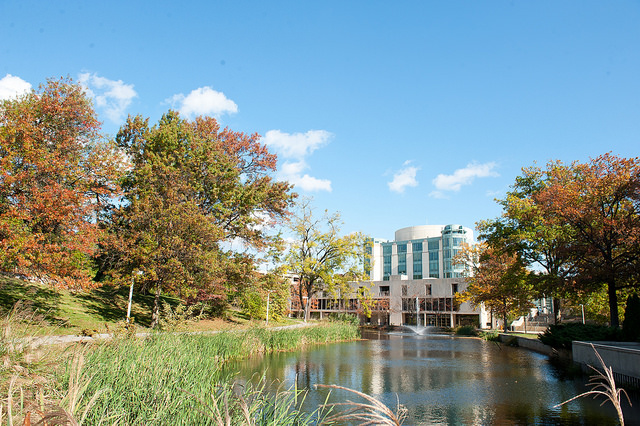
12662631454_73fd5871b4_zWe here at the Alumni Association want to wish you and yours a very happy Thanksgiving! It’s a time of year to reconnect with loved ones and reflect on what we’re truly thankful for. In our case, we’re thankful for our expanding campus (complete with a refilled Library Pond), our wonderful staff and faculty, and, of course, alumni like you. Have a wonderful holiday season!
Photo Credit: Marlayna Demond ’11. (We should mention this photo is two years old, but trust us, the pond does have water again.)

Grad student Liz Winters ’13 featured on Maryland Public Television’s Ways to Pay for College program

A recent program produced by Maryland Public Television about college affordability featured UMBC student Liz Winters ’13, psychology, and current master’s student in industrial and organizational psychology. The program “Ways to Pay for College” guided viewers through the many options of funding higher education. Several financial experts and student success stories were featured during the program which aired November 21 and 23 on Maryland Public Television.

https://youtu.be/Zsn23C-n6Us

Liz Winters (story begins at 33:50 in the video above) described her path in finding ways to finance her education at UMBC. After she served in the military for 12 years, she returned to school and needed to explore options to cover her costs for tuition, living expenses, and daycare for her children. She used the Post-9/11 GI Bill but still needed to fund her remaining expenses.

“One of the strategies I had in funding my way through college was to talk to people,” Winters shared. “I didn’t know how to navigate this on my own, so I started networking on campus. I started finding my places on campus that I felt comfortable with and started asking the staff and the faculty that were sitting in those areas to really help me find my way through college and develop my career path.”

As a student, Winters worked closely with the Women’s Center and developed a close relationship with Jess Myers, director of the Women’s Center, who worked with Liz to find the Charlotte W. Newcombe Scholarship. The scholarship is for women over 25-years-old who are returning to school to obtain an undergraduate degree.

“Liz has never been afraid to ask for help,” explained Myers in the segment. “I think so often non-traditional students will be afraid to make waves, but instead Liz really asked for help. She sought out the Women’s Center…piecing it together, I was able to realize that a scholarship that we provide would be a really good fit for her and her family.”

“I was really excited to know that his scholarship was actually perfect for me,” said Winters. “I could use it for daycare for my children, I could use it for gas money, for all the extra little things that go along with funding your education. For me, finding scholarships that addressed what I needed…the more I looked, the more I realized that this scholarship was looking to fill those gaps that I needed to be filled.”

For more about the “Ways to Pay for College” program, visit the Maryland Public Television website.

Image: UMBC campus. Photo by Marlayna Demond ’11 for UMBC. 

Constantine Vaporis presents research at University of Pennsylvania Center for Integrated Study of Japan inauguration

In conjunction with the inauguration of University of Pennsylvania’s new Center for the Integrated Study of Japan, Constantine Vaporis presented an invited talk that focused on his research about travel in Early Modern Japan and what it revealed about healing, discovery, and political obligation and coercion, among other elements of life during that time period.

Vaporis, professor of history and director of the Asian studies program, teaches Japanese and East Asian history and has received numerous fellowships for research in Japanese history including a Fulbright Scholar’s Award and an NEH Fellowship for College Teachers. He is author of Breaking Barriers: Travel and the State in Early Modern Japan; Tour of Duty: Samurai, Military Service in Edo and the Culture of Early Modern Japan; Nihonjin to sankin kôtai [The Japanese and Alternate Attendance]; and Voices of Early Modern Japan. Contemporary Accounts of Daily Life during the Age of the Shoguns.

Vaporis’ lecture “The Edo Man and the Satsuma Sweet Potato: Early Modern Travel through a Japanese prism,” highlighted how travel established connections between citizens and the state during the early modern era of 1600-1868 unlike few other institutions of the time. His talk explored the contours of the elements that defined travel during that time period with an eye to their global context. Following the lecture, Vaporis engaged with the audience in an active Q & A session about his research. To learn more about his work, visit the UMBC history department website.

Image: Constantine Vaporis. Photo by Marlayna Demond ’11 for UMBC. 

F. Chris Curran writes Baltimore Sun op-ed about educational opportunity in Baltimore City

Following up on the recent release of several education assessments for the state of Maryland, F. Chris Curran, an assistant professor in the School of Public Policy, wrote a Baltimore Sun op-ed that examined the state of education in Baltimore City Public Schools and available educational opportunities for students.

“This month saw the release of several national education assessments that paint a less than optimistic picture of the state of education in Maryland. These results shake us and make headlines because they question our state’s prominence as a high performer in education. The reality, however, is that for many of the state’s residents, particularly those in Baltimore, questioning the educational system’s success is nothing new. Changes in the state’s average performance mean little for those trapped in consistently underperforming schools,” Curran wrote.

In his column, Curran called for more policies to improve schools so that the quality of education provided to students is equal regardless of the region of the state in which they live.

“We need policies that link the fates of children in the suburbs to those in the city. We need policies that provide incentives and structures so that remaining in the public city schools is attractive even for those with the ability to go elsewhere,” he wrote. “The recent attention to the state’s performance on educational assessments is an opportunity to recognize that we require a concerted effort by not just parents but state policymakers, local district leaders, and the general populace. Educational success cannot only be defined by the success of a few or success on average, but must also include opportunity and success for all children, regardless of the ZIP code into which they are born.”

Read Curran’s op-ed “Improve Baltimore schools to attract families,” published November 20 in the Baltimore Sun.

F. Chris Curran has research interests in education policy, early childhood education, school discipline and safety, teacher labor markets, and politics of education. Read more about his work on the School of Public Policy website.

Image: Baltimore skyline from I-95. Photo by Marlayna Demond ’11.

Marjoleine Kars reveals the untold story of the Atlantic Slave Rebellion in the Dutch Caribbean

Note: This story was updated on March 22, 2016.

From 1763-1764, nearly 5,000 enslaved people in the Dutch colony of Berbice in South America rebelled. In studying the history of the rebellion on the surface, one might think it fits the pattern of many New World slave revolts. But as Marjoleine Kars discovered, an examination of the judicial records provides a much closer look into the internal dynamics of the rebellion.

Kars, associate professor and chair of history, is currently finishing a book about the slave rebellion in Berbice. She recently published a paper based on her research in the February 2016 edition of American Historical Review titled “Dodging Rebellion: Politics and Rebellion in the Berbice Slave Uprising of 1763.”

In November 2015, Kars appeared on WYPR’s Humanities Connection in advance of her Humanities Forum talk at UMBC.

“Even though the rebellion appeared massive to the Dutch, it was in fact the work of a determined minority who forced participation of their fellow slaves,” shared Kars in the segment that aired November 19 on WYPR. “In actuality, many enslaved people in Berbice were neither purposeful rebels nor active collaborators, nor did they take one position and stick with it. Rather, as one would expect in a lengthy, dangerous, and ever-changing insurgency, people moved along the political spectrum, changing their positions and loyalties, sometimes multiple times, as survival demanded.”

By focusing on the internal dynamics of the rebellion, Kars argued that it also exposes the importance of gender. While examining the rebellion from a distance, one might assume it appears men and women shared a great deal in the rebellion, however closer research reveals their experiences powerfully diverged.

Because not all of the insurgency agreed on what freedom actually meant, Kars stated that the untold story of the Atlantic Slave Rebellion in the Dutch Caribbean teaches us about the dynamics of other famous rebellions such as the American and French Revolutions.

Listen to the full segment on WYPR.

Kars has previously written a book about a farmers’ rebellion in pre-revolutionary North Carolina: “Breaking Loose Together”: The Regulator Rebellion in Pre-Revolutionary North Carolina (Chapel Hill: University of North Carolina Press, 2002), and she was a Dresher Center fellow in spring 2015.

Image: Marjoleine Kars. Photo by Marlayna Demond ’11 for UMBC.

Lisa Gray in WYPR conversation on race, activism, and free speech in learning communities

Lisa Gray

In a radio appearance and in remarks to a newspaper, Lisa Gray, assistant director of student life for cultural and spiritual diversity, offered a vision for how college students can broach difficult topics of race without diminishing one another. Gray was featured in a Maryland Daily Record article on recent student demands for diversity at Towson University, and she was one of five guests on WYPR’s Midday show exploring “Student Activism, Race, and Free Speech”

On Midday, Gray explained the import of the slighting remarks or gestures termed “microaggressions” by likening them to paper cuts. One paper cut is trivial, she said, but 1,000 paper cuts can result in a hemorrhage. The goal on a campus, she said, should to protect free speech on a topic like microaggressions and at the same time to create “a space where everybody is valued and everybody is allowed a voice.”

In the Daily Record article, Gray elaborated on the idea of such a space.  At UMBC, she said, the administration is encouraging students to talk about race and microaggressions in “brave spaces,” where participants can broach tough topics respectfully, but without the presumption of comfort.

“It’s a great concept that’s starting to take hold,” Gray said.

Image: UMBC Library in Summer 2015. Photo by Marlayna Demond for UMBC.

Pres. Hrabowski reflects on how Civil Rights movement inspired his career in education

When Freeman Hrabowski was 12 years old, he marched for civil rights in his hometown of Birmingham, Ala., part of the legendary Children’s Crusade of 1963. It was an early lesson in the way a loving community can help empower children to take hold of their own futures.

The president of UMBC recalled that and other lessons from his Birmingham childhood and discussed his latest book, Holding Fast to Dreams, in a wide-ranging podcast conversation with Dan Rodricks of the Baltimore Sun.

Hrabowski noted that UMBC, which he has headed since 1992, was the first Maryland university open from its founding to students of all races. Now UMBC has a highly diverse student body, including students from more than 100 countries, he said.

Rodricks called Hrabowski “a master practitioner of encouragement,” who had “left his mark on UMBC in the area of encouraging students, particularly minorities, in the fields of science and technology.”

Hrabowski acknowledged UMBC’s success in sending students on to graduate study and careers in those areas, while saying that the arts, humanities and social sciences are also important at UMBC.

He challenged the widespread idea that an individual is either good in math and science, on the one hand, or English and history, on the other. Both kinds of study are important, and both can be mastered by those with the determination and support to do so. “What really matters,” he said, “is the approach we take in teaching children”—that high expectations and support are combined with an emphasis on grit in achieving goals.

Listen to the podcast here.

Image: Pres. Hrabowski speaks with students in the UMBC Commons during visit with leaders from Simmons College. Photo by Marlayna Demond ’11 for UMBC.

Roundup: UMBC in the News

One of the things that makes UMBC great is how wonderful our alumni, students, faculty, and staff are. Because of these amazing people, UMBC often finds itself “in the news,” so each week, we’ll be sharing with you a round-up of the most newsworthy achievements from our community.

For more campus community news, visit UMBC Insights!

APHA national meeting features UMBC leadership in social and policy dimensions of health research

UMBC took center stage as more than 13,000 public health professionals gathered in Chicago for the American Public Health Association (APHA) annual meeting, November 1-4, 2015. President Freeman Hrabowski presented the keynote address, which examined the conference theme “Health in All Policies” and highlighted UMBC’s national leadership in research related to the social and policy dimensions of health.

“You and I together, we have the responsibility of helping the general public [recognize the core importance of] this notion of public health,” President Hrabowski asserted during his opening remarks.

His talk focused on the need to understand and address the social determinants of health, and touched on the impact of UMBC’s interdisciplinary public health and health equity research. In the days that followed, faculty, staff, students and alumni from several UMBC social sciences departments and research centers presented important new insights in their fields.

Kevin Eckert, professor and chair of sociology and anthropology, and acting director of the health administration and policy program (HAPP), observed the connections between discussions of research on the social determinants of health and issues of social justice throughout the conference.

The APHA annual meeting established three central themes for future research in public health. “Health equity” refers to striving for the highest possible standard of health for all people, with special attention given to those at greatest risk of poor health. “Health in all policies” emphasizes that health is an important dimension of nearly all social policy. Through “generation public health,” APHA argues that significant improvements in public health can and should be achieved quickly, in a generation.

“There are social, cultural, and psychological dimensions to future policy directions related to public health,” Eckert explains. “Studying the social determinants of health is a national priority, and UMBC has tremendous strengths in these areas.”

UMBC’s department of sociology and anthropology is known particularly for its research on interventions to improve quality of life and the functional abilities of people with chronic disease and disability, reproductive health, social and economic determinants of fertility, and maternal and child health. The department-based Center for Aging Studies conducts large-scale community research in Maryland, including recent studies on the efficacy of programming at adult day services centers and the subjective experience of diabetes among urban adults.

Researchers in the UMBC School of Public Policy apply an interdisciplinary approach to studying public health and health equity. Drawing from fields such as sociology, psychology, political science, and statistics, faculty investigate a range of issues related to public health and recommend policies to encourage healthier behaviors and prevent poor health outcomes. Projects include examining the environmental impacts of lead poisoning on children and the role of Medicare and Social Security in improving the quality of life for adults with disabilities.

The doctoral program in gerontology, jointly offered by UMBC and the University of Maryland, Baltimore (UMB), provides an interdisciplinary and integrative perspective on the process and experiences of aging.

The APHA meeting highlighted several of these research areas.

Professor Nancy Miller, public policy, participated in a career development roundtable and presented her research related to disability and long-term care health policies among older adult populations. “My work fits closely with the theme of health equity,” explains Miller.

“I have had a longstanding interest in understanding state-level variation in Medicaid support for community-based long-term services and supports, both across states for a given group such as older adults, and within states for multiple groups, such as older adults versus individuals with intellectual and developmental disabilities.”

Charles Cange, visiting lecturer in HAPP, served as a panel moderator and presented five papers within his two research focus areas of post-conflict health and HIV/AIDS prevention in at-risk populations. He shared his research on understanding the impact of the Gulf War on community perceptions of cancer risk in Kuwait and the role of stigma and alienation on HIV treatment in Burkina Faso.

Public policy doctoral student Shariece Johnson received an Excellence in Program Planning Award. She served as program chair for the Community Health Planning and Policy Development section of the APHA.

Jamie Trevitt, assistant professor, and Andrea Kalfoglou, associate professor, both in the HAPP program, also represented UMBC. Kalfoglou participated in discussions on the lack of e-cigarette regulation and manufacturers’ marketing to children. Trevitt’s discussions focused on disparities in prenatal care, contraceptive access and counseling, and birth outcomes.

“In public health, it is important not only to do rigorous research, but to translate findings into policy and towards advocacy,” shares Trevitt. “I always leave this conference very excited to work in this growing field and educate the next generation of public health researchers and practitioners.”

Read more about the robust health policy research and education across disciplines in UMBC’s College of Arts, Humanities, and Social Sciences. Visit the APHA website for more information about the 2015 Annual Meeting, and view President Hrabowski’s complete keynote address in the video below.

Image: UMBC Public Policy Building. Photo by Marlayna Demond ’11 for UMBC.