
All posts by: UMBC News Staff


Nurturing Engineering Talent

Connecting Ideas
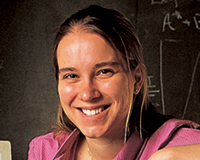
Heather Rhodes '02 is completing her master's in chemical and biochemical engineering.
Heather Rhodes ’02 is completing her master’s in chemical and biochemical engineering.

Nurturing Engineering Talent

A few months into her new job as a chemical engineer, Heather Couvillon Rhodes, a May 2002 UMBC graduate, easily sums up her enthusiasm for her new profession: “Engineers have the opportunity to take knowledge and apply it to real-world problems.” Rhodes is employed by the Department of the Army, Aberdeen Proving Ground.

In fact, Rhodes began applying the knowledge she learned in favorite subjects such as math and science to real-world problems long before graduation. As a co-op student at the Indian Head Naval Surface War Center, she worked to design rockets, warheads and rocket launchers for the U.S. Navy.

“In high school I was good in math and science and it was a natural for me to major in engineering,” says Rhodes. She received full-ride scholarships from UMBC, Cornell and Virginia Tech. She chose UMBC for its proximity to co-op and career opportunities in Baltimore and Washington.

When Rhodes came to UMBC she found supportive mentors and female role models in the sciences. Jill Randles, the 2002 recipient of the UMBC President’s Commission for Women Achievement Award, was Rhodes’ engineering advisor her first two years at UMBC. “She supported and challenged me during what was a very challenging first semester academically. She was the rock that held many of us together,” says Rhodes.

Rhodes founded WISE (Women in Science and Engineering) at UMBC to encourage and support other women in science and engineering fields. The organization helps students connect with professionals in the field through talks and networking. “Many women and girls don’t know about engineering,” explains Rhodes. “My advice is to follow your natural interests; connect with successful engineers through groups such as WISE. They can be a resource and source of inspiration for you.”

“Taryn Bayles [chemical and biochemical engineering lecturer] continues to be an inspiration for me,” says Rhodes, “I’m completing my master’s in chemical and biochemical engineering through UMBC’s combined bachelor’s/master’s program, and her door is always open to students.”

Rhodes credits undergraduate research experiences and faculty mentors for nurturing her talent for problem-solving. She conducted an independent research project on an imaging system for pressure-sensitive paints in Assistant Professor Lisa Kelly’s (chemistry and biochemistry) lab. Rhodes presented her findings, which will have applications in aerospace, aviation, automobiles and medicine, at UMBC’s Undergraduate Research and Creative Achievement Day.

“Professors at UMBC really care about students—how they think and how they solve problems” says Rhodes. It’s this initiative and these problem-solving skills that impress Rhodes’ supervisors in her new job and current undergraduate engineering students. She currently serves as an advisor to Alpha Sigma Alpha sorority members.

What are Rhodes’ future plans? After she completes her master’s degree this December, she is considering applying her knowledge to an M.B.A. program or law school. “I’d like to develop my management skills while staying technical,” adds Rhodes.

A New Perspective on a Legend

Hands-on From the Start


Ilse Schweitzer spent a year in Scotland studying Medieval Scottish literature. She will present her research at UMBC’s Undergraduate Research and Creative Achievement Day.

A New Perspective on a Legend
  

Ilse Schweitzer, a Humanities Scholar with a double major in English and history, spent a year in Scotland studying the Scot Gaelic language and Medieval Scottish literature at the University of Aberdeen. “I was fascinated with what I was learning,” says Schweitzer, who is also a student in UMBC’s Honors College. “My study abroad experience sparked my interest for going to graduate school and was the starting point for my research in Scottish literature.”

Schweitzer will present her research project, “King Arthur the Tyrant and the Scottish Call for Freedom,” as part of Undergraduate Research and Creative Achievement Day at UMBC on Wednesday, April 30. Her research looks into the 15th-century portrayal of King Arthur as a largely negative influence, and how this interpretation reflects the historical and political period of the time.

“Dr. Gail Orgelfinger in the English department helped me to develop the idea and suggested other writings, including works from England and France. I bounced my ideas off of her and she helped to direct my research,” says Schweitzer. “There has been so little research done in this area, but many of the writings of the period show strong links to historical legends including King Edward I and King James III. It is amazing to see the connections.”

Schweitzer was one of two UMBC students selected to participate in the National Conference for Undergraduate Research (NCUR) at the University of Utah and is an alternate for the Marshall Scholars program. Outside of the classroom, she has been the president and vice president of the UMBC crew club and an active member of the university’s Maryland Camerata.

She plans to continue her studies and earn a master’s degree in literature from the University of York in England before returning to UMBC for a Ph.D. in order to become a professor of English and Medieval literature.

Undergraduate Research and Creative Achievement Day (URCAD) is an opportunity to recognize outstanding student work through oral presentations, poster sessions and artistic exhibits and performances. This year’s seventh annual event is open to the UMBC community, prospective students, alumni, family, friends and campus supporters. Programs and exhibits will take place in the Albin O. Kuhn Library and Gallery, the University Center Ballroom and the Fine Arts Building.


Making Engineering Exciting

A University That Knows How to Win

Scott Bass, dean, and Janet Rutledge, associate dean, UMBC Graduate School

On a Mission to Support Women and Minority Graduate Students
 
On December 5, UMBC was honored by the Council of Graduate Schools (CGS) for its efforts to build a comprehensive, supportive environment for women and minority graduate students
“There has been a 50 percent rate of attrition for doctoral students at U.S. graduate schools over the past 20 years—and among minority students, this figure is even higher,” said Scott Bass, dean of the UMBC Graduate School, as he accepted the CGS/Peterson’s Award for Innovation in Promoting an Inclusive Graduate Community at the Council’s annual meeting in Washington, DC.
“We must diversify and support our graduate student population for the nation to remain a world leader in science, engineering, and technology,” Bass said. “I’m receiving this award today on behalf of the entire UMBC community. This is at the core of our academic mission.”
UMBC, one of Newsweek’s hottest schools in America, has earned national acclaim for its comprehensive support for minority science and technology undergrads. The university is best known for its Meyerhoff Scholars Program. Founded in 1988, the program regularly sends large numbers of minorities on to advanced studies in science, technology and engineering at such institutions as Harvard, Stanford, and MIT. The scholars are among the best in the nation, many of whom turn down scholarship offers from Ivy League schools in favor of the personal attention they receive at UMBC.
Now Bass and Janet Rutledge, associate dean of UMBC’s Graduate School, are on a mission to expand that comprehensive approach to graduate students. “UMBC has done a tremendous job at the undergraduate level, so we’re primed to do the same at the graduate level,” Bass says.  
Rutledge, the first African American female to receive a Ph.D. from Georgia Tech’s electrical engineering program, knows firsthand the challenges minority Ph.D. students face. “There’s a feeling of invisibility,” says Rutledge, who concentrated on the scarcity of minority science Ph.D.’s as program director in the Division of Graduate Education at the National Science Foundation prior to coming to UMBC. 
Hrabowski, Bass and Rutledge preach the mantra of better mentorship between faculty and graduate students as the key to getting more minorities and women to excel in science, math, engineering and technology graduate programs. “I’m a product of the national minority engineering education movement of the 1970’s,” says Rutledge. “There was a big emphasis on mentoring. If we’re to achieve the diversity we’re looking for with graduate students, we must mentor.”
Rutledge sees the two-year award from as a big step towards drawing national attention to the problem and hopefully spreading the comprehensive model to other U.S. campuses.
Earlier this year, Rutledge was instrumental in landing a $2.5 million grant from the National Science Foundation to establish the Maryland Alliance for Graduate Education and the Professoriate (MAGEP), a consortium of universities led by UMBC that includes the University of Maryland, College Park and the University of Maryland, Baltimore. MAGEP seeks to expand the principles of UMBC’s Meyerhoff Program throughout other disciplines to build graduate student recruitment, mentoring and professional development statewide.
Bass and Rutledge point out that the UMBC faculty is dedicated to the mission as much as they are. Michael Summers, the only Howard Hughes Medical Institute Investigator in Maryland and winner of the 2000 Presidential Award for Excellence in Science, Mathematics and Engineering Mentoring, recently volunteered to expand the Meyerhoff graduate biomedical program. Summers started with two minority students and has since grown the program to include 31 students across six departments.
“Our faculty sees this opportunity to be unique in the nation, and they have seized it,” Bass says. “At other campuses, often this type of mission is peripheral; you’ll see an office of minority affairs on the side somewhere. But here, as administrators, we’re just responding to faculty who really want to do this. They’re saying ‘Give us the tools and we’ll do it.’ ”


Closing the IT Gender Gap

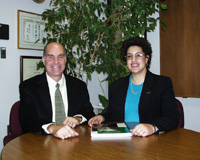
/b> to address the longstanding issues surrounding the gender gap in IT.

CWIT Advisory Board Member Anne Spence, a lecturer in the Department of Mechanical Engineering with a Ph.D. in aerospace engineering, understands the challenges of being a woman in a technical field. “One of my college professors told me that women should not be engineers, so I got the highest grade in the class to prove him wrong,” she says. “When I graduated with my degree I had six job offers. I did encounter initial resistance as an engineer at Bell Helicopter, but I was always able to get rid of the resistance by proving myself.”

“Motivating girls to get involved in IT requires that we offer opportunities for them to work with computers in non-threatening environments,” Spence adds. “Computer Mania is one of those environments. It also gives the girls an opportunity to meet role models — from college age women to business leaders and college faculty.”

Spence believes that Computer Mania will help diminish the “geek” stereotype that discourages young girls from IT and will provide resources to help them understand the importance of technology in every aspect of their lives. “Most girls start to lose interest in math and science during middle school. It is crucial that we keep them engaged during those years to make sure that they are taking upper level math, science, computer and engineering courses when they reach high school,” she says.

As a child, Spence says that both she and her brother were “raised to do anything we wanted to do. My father was an engineering professor and my mother an elementary school teacher. Often, we would go to a field near our house to launch the model rockets we had built — I thought that was normal! So it never really occurred to me that I could not succeed.”

Because not every young girl is so lucky, Spence set out to provide mentors for her female students at UMBC. She is advisor for the University’s chapter of Mentor Net, a national program that provides mentors for women studying engineering and computer science. “Some of the young women in my classes are not only the first member of their family to major in engineering but they are often the first member of their family to attend a university,” she explains. “This is a very difficult position since, often, they have very little support from home. That’s where my own role as mentor comes in to play. I can encourage them and show them that women can succeed in the field.”

Spence hopes to continue inspiring both girls and boys alike to learn more about engineering at an earlier age. She recently received a grant from the National Science Foundation to develop a program that will introduce engineering in middle and high school algebra classes across Maryland. “The students will see how algebra is used to solve engineering problems, not just how many apples and oranges you can buy for one dollar,” she says. When she’s not at UMBC, Spence is incorporating practical hands-on projects and engineering challenges at Oak Hill Elementary in her hometown of Severna Park, Maryland.


A New Target in the Fight Against HIV

Hands-on from the Start

UMBC HHMI Lab Student Researchers (left to right: Chun Tang; Isaac Kinde; and Erin Loeliger;)Not pictured: Samson Kyere.

A New Target in the Fight Against HIV
 

A team of researchers from academia and industry led by Dr. Michael Summers, UMBC professor of chemistry/biochemistry and Howard Hughes Medical Institute (HHMI) Investigator, have discovered a new target on the HIV molecule that could potentially lead to a new class of drugs to fight the virus that causes AIDS. The discovery is the cover article of the April 11, 2003 Journal of Molecular Biology.
Summers and his team of undergraduate and graduate student researchers in his UMBC HHMI lab collaborated with Achillion Pharmaceuticals, a privately held drug firm based in New Haven, CT, and a group of researchers from Oregon Health and Science University on the discovery.
“The greatest challenge in treating HIV today is drug resistance brought on when the virus mutates and renders existing drugs ineffective at stopping viral replication,” said Summers. “Our research has led to the identification of a new class of compounds that inhibit a novel target in HIV. These compounds disrupt the assembly of the HIV-1 capsid protein, which is a vital step in changing immature, non-infectious HIV into its mature, infectious form.”
The discovery is all the more remarkable considering its origin – a group of two graduate and two undergraduate students working with Summers. The team includes biochemistry graduate student Chun Tang; sixteen-year-old college sophomore and Presidential Fellow Erin Loeliger; Meyerhoff Scholar and HHMI Undergraduate Scholar Isaac Kinde; and former Meyerhoff Scholar Samson Kyere, now an MD/PhD student at the University of Maryland, Baltimore.
According to Summers, “Investigators around the world have been looking at the HIV-1 capsid protein as a potential anti-viral drug target for more than a decade, and we are therefore particularly pleased to finally have solid leads to guide these efforts. While we are encouraged by the laboratory tests of the compounds we’ve identified so far, additional testing needs to be undertaken before this approach can be tested in humans.”
“This work is yet another pivotal achievement for Dr. Summers and his students,” says Anthony S. Fauci, M.D., director of the National Institute of Allergy and Infectious Diseases (NIAID). “The fact that undergraduate students played pivotal roles in this research makes it even more impressive.”
The UMBC team’s research is funded in part by NIAID, a component of the National Institutes of Health (NIH), along with the National Institute of General Medical Sciences and the Howard Hughes Medical Institute.


Mapping the Patapsco

Tom Rabenhorst’s research blends his love of nature with modern technology to provide a valuable service to the community.

Rabenhorst, Director of Instructional Cartography in UMBC’s Department of Geography and Environmental Systems, is also an avid outdoorsman. As Spring draws nearer, the hikers from UMBC and all over Maryland who flock to nearby Patapsco Valley State Park will navigate park trails using new maps developed thanks to Rabenhorst’s dedication.

Rabenhorst combined global positioning satellite (GPS) technology and sweat equity to give the park the most detailed maps in its history. Rabenhorst spent months hiking the trails on his own or with his wife while logging points on a handheld GPS device to plot out the trail maps. GPS triangulates to rapidly and accurately locate geographic positions anywhere on the face of the earth.

“There had been no comprehensive map of Patapsco, and I thought that this would be a real benefit to the community as well as a self-serving thing for myself because I really enjoy getting out in the parks,” Rabenhorst says.

“It’s a good partnership because we’re basically neighbors,” says Lt. Christopher Bushman, the park’s manager. When you are walking on the trails and when you get up on the hills, you can see the UMBC campus. The guides are one of the best things that has ever happened to the park,” Bushman says.

Each year Rabenhorst gets students in his Advanced Cartography Class involved with a local mapping project. The class has worked with many local cyclists and the Baltimore Community Foundation to produce a handy map of bike trails in the city and county, with routes color-coded based on hill steepness. Rabenhorst’s students have also worked on a CD-ROM atlas of Maryland for elementary education.


A Global Perspective on Policy

A Global Perspective on Policy


While many UMBC students become accomplished researchers, not many have the chance to learn in an outdoor classroom with a stunning view of the Swiss Alps in the background. Every summer, the International Field Research Program in Culture, Policy and Practice, created by the Departments of Sociology and Anthropology and Health Administration and Policy, takes a small group of students to Switzerland to gain an international perspective on a variety of policy issues and to give students direct experience with social sciences field research methods.

The program is open to all students and, in the past, has accommodated a diverse group of students, from Provost’s Undergraduate Research Award winners and graduate students traveling as part of a larger research project to undergraduates looking for an exciting way to gain an upper-level elective. Now in its third year, the program, for the first time, is inviting faculty and staff from across the UMBC community to participate in one or both of the two one-week sessions and expects to have its largest student group ever.

“The origins of this program are in my own research in international health policy,” says Mary Stuart, chair of the Department of Sociology and Anthropology, who co-directs the International Field Research program with Joyce Riley, associate director for health administration and policy. “I saw how important it was to prepare our students to be active participants in the increasingly sophisticated global economy and to see how other nations address policy issues that we share in common.”

Students prepare for their trip through a course that meets seven times during the spring semester and allows them to gain background in qualitative research methods and Swiss society and culture. Once in Switzerland, students apply their new knowledge and conduct a series of field exercises that allow them to interact with Swiss culture while honing their skills in observation, interviewing and conducting opinion surveys. They also have the opportunity to visit places such as the World Health Organization, International Red Cross Museum and the United Nations.

The strongest endorsement for the International Field Research program comes from the student participants themselves. “No class, no homework assignment could ever teach me what I had learned on that trip,” says Anura Desai, whose many adventures in Switzerland included a visit to a refugee camp. “I truly felt like an international public health researcher, venturing out to any corner, in pursuit for my research. It was unbelievable.”

The 2003 Switzerland program for International Field Research in Culture, Policy and Practice will hold two sessions, June 16-22 and June 23-29. Applications and additional information are available at www.umbc.edu/happ or from Cathy McDonnell, ACIV Room 348, cat@umbc.edu, (410) 455-2342. For priority consideration, apply by December 10.


UMBC Homepage Profile Archives

>Bringing Politics Close to Home

UMBC’s resident expert on the American presidency, Tom Schaller, has more than enough to keep busy in these exciting political times. Whether he is drawing comparisons between the presidencies of William McKinley and George W. Bush or guiding undergraduates through internships in legislative offices throughout Annapolis or Washington, D.C., Schaller, an assistant professor of political science, brings his research to the most pressing political issues of the day. more…

  Diane Lee   Evolution of an Honors University

Diane Lee, vice provost for undergraduate education and associate professor of education, takes UMBC’s tagline, An Honors University in Maryland, personally. Lee works to ensure that the honors mission has practical meaning in everyday lives for UMBC students, faculty and staff. more…

Evolution of an Honors University

A Place to Learn Together

Diane Lee is vice provost for undergraduate education and associate professor of education.

Evolution of an Honors University

Diane Lee, vice provost for undergraduate education and associate professor of education, takes UMBC’s tagline, An Honors University in Maryland, personally. Lee works to ensure that the honors mission has practical meaning in everyday lives for UMBC students, faculty and staff.
Lee came to UMBC in 1986 as a visiting professor. After teaching large lecture classes at another institution, she was excited to find small, seminar-style classes at UMBC. “This campus speaks community to me,” says Lee. “It’s large enough to be diverse and small enough to get to know students beyond their names, as individuals and scholars.” UMBC brings teaching, research and service together, which is very rewarding for me,” says Lee. Her background is human development from prenatal to death and dying.
When UMBC adopted the honors university mission, Lee again revised her method of teaching. “I asked myself, ‘how do I need to teach at an honors university?’ I made a conscious effort to honor my students and what they bring to the classroom. I lectured less and listened more. My student advising focused less on course selection and graduation requirements and more on the students and their career and academic goals,” she says.
Now in her role as vice provost for undergraduate education, Lee continues to ask: “What does it mean to be a student at an honors university?” She meets with students, faculty and staff from across campus and across the disciplines, explaining, “It’s this kind of challenge and opportunity to make a difference that brings us together as a community. It’s the reason I work here. I enjoy working on things I believe in with people I respect.”
Lee is proud of the programs the Provost’s Office has initiated through a university-wide Honors Task Force Report. “The Honors Task Force Report recommendations represent a charge defined by UMBC, and values we share as a university community,” says Lee. These programs include developing an environment of academic integrity, first-year seminars, introduction to honors university seminars and a writing advisory board.
“We’re looking at the entire experience—from Orientation and Welcome Week to Commencement. We’re examining the traditions that hold us together, tweaking existing programs and creating new ones. It’s exciting to be at a university that is open to possibilities.”


Building Leaders in the Community

New Approaches to Real-World Problems

Mark Terranova is assistant director of service learning for the Shriver Center.

Building Leaders in the Community

Mark Terranova has to think like a sixth grader – literally. As part of a new Shriver Center service-learning program, Terranova is sending a team of UMBC students back to middle schools to share their talents with teachers and children. The program is funded by a three year, $1.3 million grant from the National Science Foundation called The Teaching Enhancement Partnership Project (TEPP).
In this first year of the project, Terranova’s goal is to take UMBC students studying math, science, engineering and technology and pair them with under-resourced middle schools in the Baltimore area. “I’m looking to encourage college students to explore teaching as a possible career and show the importance of being connected with their communities,” he says.
“Our students help to motivate and set good examples for the middle schoolers, who in turn find valuable role models in our students,” explains Terranova. UMBC students involved in TEPP also enhance the professional development of the teachers by working with them one-on-one in the classroom. Students are able to supply fresh content and lab work that can bring the subject matter to life.
“I see this providing a structure that can be replicated in countless schools for various subjects across the country,” says Terranova, who knows the importance of service learning in the community. He began working with the Shriver Center’s Choice Program after graduating from college, focusing on the problems of juvenile delinquency in East Baltimore for three years before becoming assistant director of service learning at the Shriver Center.
In fall 2000, Terranova was instrumental in developing the first-ever Shriver Living-Learning Community (SLLC) at UMBC in collaboration with the Division of Student Affairs and the Residential Life Office. SLLC provides 29 undergraduates with a unique and exciting residential opportunity where students live the experience of being a leader in the community. SLLC students live in Erickson Hall and are engaged in service-learning through the Shriver Center.
Terranova was also responsible for helping to build the UMBC Serves program on campus. “I looked at the campus as a whole and tied in all areas of campus who participated in service related activities,” he says. “I was able to partner with many different groups on campus to bring each of their individual activities under a single mission – to promote a continuum of opportunities of service on campus. It was a real institutional shift in thinking about how the university gives back to the community. It’s been an amazing learning experience for me.”
In addition to his work with the Shriver Center, Terranova is a student in UMBC’s M.A. in Sociology program.


Learning from the Past

Connecting Ideas

 
Jim Bailey, a history major at UMBC, is a park ranger at the Fort McHenry National Monument and Historic Shrine.

“Learning from the Past”


Jim Bailey first became interested in the Civil War on a family trip to Gettysburg as a child. “I went to a Civil War reenactment of Gettysburg when I was 8 years old. A Union soldier let me wear his coat and hold his .58 caliber Enfield musket,” he says. “History was suddenly very real to me – I felt as if I could see it, hear it, smell it. I was hooked!” Now Bailey is studying American history at UMBC.

“I wanted to be a history major because everything we do as individuals is predicated on our past experiences,” Bailey explains. “People learn from their mistakes and successes and history is simply that individual experience in a larger context. I study history to try to understand why individuals and nations act as they do, and the ways in which they may act in the future.”

Bailey is exploring his love of history in a variety of ways. Off campus, Bailey’s internship with the National Park Service at Fort McHenry National Monument and Historic Shrine in Baltimore City led to employment as a park ranger. He is one of five UMBC students currently working at the historic site.

At UMBC, he is president of the History Student Council of Majors and the history department’s representative on the Provost’s Student Advisory Committee. As a Humanities Scholar — a scholarship program for incoming freshman interested in literature, history, philosophy or languages — Bailey receives special opportunities to conduct research in his field.

He was awarded grants from both the Honors College and the Provost’s Office to research the Romney campaign, an important, but relatively unexplored chapter of American Civil War, and spent the last year and a half canvassing the National archives as well as regional libraries and museums. Bailey says, “I explored the diaries and correspondence of soldiers and civilians involved in the campaign. I also conducted field investigations and during one, uncovered a battle site believed to have been lost for 140 years.”   

In the future, Bailey plans to continue his employment with the National Park Service and to earn a Ph.D. at the College of William and Mary or the University of Virginia. “My hope is to become the chief historian of the National Park Service,” he says.


A World of Opportunity

A Place to Learn Together

Rebekah de Wit hopes to turn her love of international education into a career in study abroad administration.

“A World of Opportunity”
 
Rebekah de Wit has studied and worked abroad in six different countries. She speaks fluent French, is pretty good at Dutch and Italian, and has taught undergraduate Latin. Now, thanks to a combination of programs at UMBC, she is on her way to turning her love of languages, foreign cultures and international education into an exciting career in study abroad administration.
Both a Humanities Scholar and a Maryland Distinguished Scholar during her undergraduate years, de Wit has received numerous additional UMBC and Maryland state merit scholarships since beginning her studies at UMBC. She was drawn to pursue a B.A. in Ancient Studies in part because of the department’s overseas opportunities for archaeology and language study.
“Many students aren’t aware that there are a number of scholarships available at UMBC if you’re interested in international studies,” she says. To date, de Wit has studied or worked in Wales, England, France, Italy, the Netherlands, Belgium and Egypt.
De Wit presently puts her study abroad savvy to work as International Student Liaison for the UMBC Department of Education. She helps foreign students adjust to life at UMBC and in America. “I help them with everything from academic and cross-cultural issues to where to find the nearest grocery store,” she says. “I even meet them at the airport.”
After receiving her B.A. in 1999, de Wit began work on an M.A. in Teaching English as a Second Language and Bilingual Education through UMBC’s Instructional Systems Development program. In 2000, she traveled to the U.K., where she studied languages and education at the University of Wales, Swansea. There she also did two internships, one for the University’s American Studies Exchange Office and another with a Welsh language TV station.
While in Wales, de Wit realized that she wanted to spend her life doing what she loved. “I started out as a participant in study abroad and now it will be my career.”
Upon returning to the U.S., she enrolled in UMBC’s Language, Literacy and Culture Ph.D. program with the goal of advancing her career in study abroad administration. The L.L.C. program helped her to craft an interdisciplinary blueprint for her future career, as her dissertation topic, “The Role of Internships in Enhancing the Cross-Cultural Value of U.S. Study Abroad in Britain,” attests.
De Wit was pleased to find a program that met her unique needs. “To prepare for a career in international education, a degree in education administration wasn’t quite comprehensive enough. The L.L.C. program makes it possible to take classes in languages, education and administration, and at the same time offers exposure to people from all over the world with its multi-cultural enrollment. I’ve learned about other cultures not just from my classes, but from my classmates.”