
All posts by: UMBC News Staff


Building a Future

Hands-on from the Start


Policy Sciences PhD graduate Keith Elder’s studies how race impacts America’s health care system.

Inquiries and Inequities in managed Care


In a time when health care is one of the most urgent issues in the U.S. political spectrum, Keith Elder, Ph.D. graduate from the UMBC Policy Sciences (POSI) Graduate Program, is examining the tough questions surrounding our nation’s health care system.

Elder’s dissertation examines the racial disparities in managed care between majority and minority physicians. Specifically, it looks at health care contracts between physicians and organizations (such as HMOs) and attempts to determine if there is any connection between termination or denial of contracts and ethnicity.

“Patient demographics impact the rate of contract denials and terminations,” says Elder. “The greater the percentage of Latino and African American patients a physician serves, the higher the probability that physician will have a contract denied. The larger the percentage of Asian patients a physician sees, the higher the probability the physician will have a contract terminated.”

“After examining certain economic market level variables, the differences still exist. Some may look to other explanations for these differences in rate of contract denial and termination – namely, discrimination,” Elder says. Nancy Miller, assistant professor of policy sciences, corroborates Elder’s results, stating that they “offer evidence that requires serious reflection and action on the part of policy makers.”

Elder’s research draws data from the Maryland Physician Survey developed and conducted by the Center for Health Program Development and Management at UMBC. He drew from a sample size of about 1200 people. Elder will present his research at a symposium the center is holding March 26, The Effect of Managed Care on Minority Physicians and Socially Vulnerable Populations in Maryland: Data Findings and Policy Alternatives.

Unfortunately, the inequity that Elder identified in his research is not a new pattern in health care. “Minority physicians have reported inequities for years,” says Elder. In a 1994 survey of minority physicians, Elder says that “over 90 percent believed that they had experienced some form of discrimination. The same physicians believed that any health care reform would place them at a disadvantage in the managed care selection process.”

In addition to the Policy Sciences faculty, UMBC President Freeman Hrabowski has also been of great help to Elder: “He’s always given me support,” says Elder. “He gave me direction in how to plan for my dissertation defense, personal insights, told me what research opportunities I should be involved in. He wanted to make sure when I left here that I was ready for every opportunity that crossed my radar.”

Elder graduated from UMBC last fall and is currently doing research analysis for the POSI program. Next semester, he will begin a position as assistant professor in the School of Public Health at the University of South Carolina. While he will teach a university course, he also plans to spend a lot of time pursuing his research interests: “I definitely hope to further examine aspects of managed care and racial disparity,” states Elder.


A Global Education in Telecommunications

Outstanding Results by Any Measure


Ronald Holzloehner (right) celebrates his successful Ph.D. defense with his mentor, Prof. Curtis Menyuk.

A Global Education in Telecommunications  

Berlin, Germany native Ronald Holzloehner will receive his Ph.D. in Computer Science and Electrical Engineering at UMBC this month, after traveling the world while winning international acclaim for his research on how to make fiber optics communications faster and more reliable.

Holzloehner came to UMBC after receiving his master’s degree from the Technical University of Berlin and spending a year at UC Santa Barbara on a Fulbright scholarship. In late 1998 he came to UMBC and joined Dr. Curtis Menyuk’s research team in the  Optical Fiber Communications Laboratory, which works closely with the telecommunications industry to push the frontiers of communications technology.

During his four and a half years at UMBC, Holzloehner and the rest of the team presented their work at national and international conferences, were published in respected journals, and won prestigious awards. Holzloehner received the Best Speaker Award at the UMBC Student Conference last year, and also won an IEEE LEOS student award fellowship last fall, an award of which only 10–20 are given annually world-wide. His dissertation describes a new method for computing bit error rates in optical fiber communications systems.

“Working with Curtis Menyuk was a good experience, and I certainly learned a lot,” he says. “I worked hard, many nights and weekends, but I wrote a bunch of papers, won some awards, got to travel the world by visiting conferences, and learned much about how science is conducted and managed in the US. What’s amazing about UMBC is the energy and tenacity with which it pursues its goals — President Freeman Hrabowski does a whole lot to promote the school, much like a sports team.”

Like other high-tech researchers, Holzloehner also experienced the ups and downs of the so-called “New Economy.” At the 2003 UMBC Engineer of the Year ceremony, Holzloehner spoke about the lessons high-tech industry has learned from recent scandals. “Corporate greed existed not only at Enron, but also in the telecom industry, and I think we engineers should do whatever we can to fight for solid and sound business models,” he said.

After an arduous search, Holzloehner accepted a postdoctoral position back in Germany at the University of Nuremberg’s newly founded Max-Planck Institute, and will start working there in July. The institute focuses on quantum optics, quantum computing, and some communications, while working closely with top companies like Lucent.

As he prepares to return home for a new chapter in his career, Holzloehner carries with him memories of his American education. “The U.S. is really an amazing country, and it is still able to attract many foreigners that help it grow,” he says. “The advantage that the U.S. has over many other countries is impressive, at times frightening. People should remember that many of these achievements are due to immigrants who work extremely hard.”


Making Engineering Exciting

A University That Knows How to Win

 
UMBC’s Ram Hosmane is the 2002 Maryland Chemist of the Year

Maryland Chemist of the Year


UMBC chemistry professor Ramachandra “Ram” Hosmane was named the Maryland Chemist of the Year by the Maryland division of the American Chemical Society in a ceremony on December 11 in Towson.

Hosmane, a faculty member at UMBC for 20 years, was honored for his career contributions to biomedical research, including the development of anti-cancer and anti-viral drugs as well as for creation of a powdered, artificial blood mix for use in emergency transfusions.

Hosmane is the third UMBC chemist to be named Chemist of the Year since the Society began giving the award in 1962. “This award is well-deserved recognition for the outstanding contributions that Ram Hosmane has made to synthetic and medicinal chemistry.” says Ralph Pollack, UMBC chemistry department chair and professor.

“I was surprised and shocked to win this honor,” says Hosmane. “I thought had little chance of winning it considering the fact that the nominations come from all over Maryland, including academia, industry and government.”

Hosmane’s recent breakthroughs include development of bulkier and leaner
forms of the natural building blocks of genetic material, nucleosides and nucleotides. The compounds have shown potential to fight against cancers including prostate, breast, lung, leukemia, colon, skin, kidney, brain and ovarian. The compounds also show promise against a dozen different viral infections, the major ones being hepatitis B and C, West Nile and herpes.

Hosmane’s artificial blood invention holds promise as a universal substitute for whole blood during emergency transfusions. The artificial blood requires no typing or cross-matching, is free of bacteria or viruses and is storable as a dry powder for indefinite periods of time. It can be carried to the scene of accident and administered as a buffered salt solution in water without having to transport the patient to the
nearest hospital.

Since joining the UMBC faculty in 1982, Hosmane has contributed well over a hundred original research articles in peer-reviewed, international scholarly journals and he is also the author of a half-dozen patents and disclosures on a variety of themes. He has been continuously funded since 1984 by both federal agencies and industrial partnerships. In addition to his research endeavors, Hosmane has trained
more than 75 scientists from all over the world, including undergraduate and graduate students, postdoctoral fellows, visiting scientists and visiting professors.

Two years ago, Hosmane won the “Outstanding Educator of the Year” award from the Maryland Association for Higher Education (MAHE). He was the UMBC Presidential Research Professor during 1998-2001, and has been the Provost’s Exceptional Sponsored Research Fellow ever since that program was initiated at UMBC.


Teaching from Experience

Outstanding Results by Any Measure

 
Jim Bembry is an associate professor of social work.

Teaching from Experience


As if nearly 20 years of teaching and scholarship weren’t enough, Jim Bembry brings a lifetime of experience to future social workers in his classroom.

Bembry, an associate professor of social work, now realizes that his interest in the field began during his own childhood growing up in a tough Philadelphia neighborhood. “At one point, I got into enough trouble to be sent away for over a year,” he says, “During that time, I met a teacher who gave me a lot of wise advice and helped me learn that I couldn’t fight my way through everything.”

Bembry took that advice to heart and soon put his life back together. A few years later, while a junior majoring in sociology at the College of the Holy Cross in Worcester, Massachusetts, he was offered an opportunity that confirmed his interest in helping other young people overcome the same difficulties he faced in his own childhood. He volunteered to work with troubled students in Worcester’s public schools, where he served as a part-time counselor for three to four schools, meeting with several students at each school. “I couldn’t have been very effective,” says Bembry, reflecting on the experience, “but the kids came to school on the days that I met with them and that was a definite improvement.”

After graduation, Bembry worked for two years as a residential counselor at a facility in Virginia before returning to school for a master’s degree in social work from Temple University. His field placements at Temple included time spent teaching undergraduates, but he was a practicing social worker for seven more years before he began teaching full-time.

Bembry began teaching at UMBC 16 years ago while finishing his doctorate at the University of Maryland, Baltimore. He currently teaches the methods courses in both practice and research for social work majors–a combination that even he admits is unusual in his field.

Melding theory with experience and practice, however, has been a hallmark of Jim Bembry’s career. His research continues to examine how to address the needs of underserved and at-risk young people. Currently, he is leading an evaluation of a state program that promotes discussion between state agencies that provide services for children and youth. The program’s directors hope that Bembry’s evaluation will allow them to obtain long-term federal funding that will allow them to offer more coordinated state responses to issues such as school safety and adolescent pregnancy.


A Passion for Maryland Politics

Connecting Ideas

Don Norris, UMBC’s resident expert on Maryland politics, is director of the Maryland Institute for Policy Analysis and Research (MIPAR).
A Passion for Maryland Politics
 
In an election year that featured one of the most spirited gubernatorial races in state history, Don Norris, UMBC’s resident expert on Maryland politics, was in high demand by regional and national media.
As director of the Maryland Institute for Policy Analysis and Research (MIPAR), Norris leads one of the region’s foremost centers for applied social science and public policy research. He also has become more well-known to Baltimore/Washington political observers by lending his expertise to The New York Times, The Baltimore Sun, The Washington Post, The Marc Steiner Show, Maryland Public Television and other media.
Norris has been a “political junkie” almost his entire life. “As a child and teenager I was fascinated by politics and government, which were regular items of discussion among my family,” Norris says. Norris studied both history and political science as an undergrad, and went on to receive both a master’s and Ph. D. in government from the University of Virginia. He began following Maryland politics after moving here in 1986 and started looking closer at state elections when he came to UMBC in 1989.
According to Norris, Maryland has a unique political landscape that makes it intriguing to study. “The governor has incredible power,” he says. “Plus both houses of the legislature have four year terms, and are elected at the same time as the governor. Maryland has also traditionally been a one-party, liberal state, although that may change in the wake of this year’s gubernatorial election.”
On November 7, Norris moderated a post-election panel discussion at UMBC analyzing the 2002 Maryland General Election. The panel members were all political writers for Maryland newspapers and included The Baltimore Sun’s Howard Libit, The Washington Post’s Lori Montgomery, and The Baltimore Times’ Associate Publisher Anthony McCarthy.
Norris thinks it’s too early to gauge the effect of Republican Robert Ehrlich’s historic election as Maryland governor. “It all depends on whom he installs, what his agenda is, how well he and the legislature work together, and the economy, among other factors,” Norris says. “I’m betting it will be pretty different; a more conservative policy and a more open operating style.”
Now that the election has passed, Norris, who is also a professor in UMBC’s Policy Sciences Graduate Program, can focus his attention on leading MIPAR, which continues to bring together UMBC faculty from a variety of social science fields to analyze important national and regional issues. Current MIPAR projects are examining issues like grassroots digital government, electric deregulation, child poverty, land preservation, the economic impact of community colleges, and public school financing.
MIPAR receives over $5 million in external funding annually and has been supported by a variety of organizations, including the National Science Foundation, the U. S. Department of Housing and Urban Development, the U. S. Social Security Administration, the A. S. Abell Foundation, the Morris Goldseker Foundation, the Robert Wood Johnson Foundation, the American Library Association and various Maryland state government agencies, just to name a few.
One of Norris’ favorite parts of his job takes place each spring. MIPAR conducts an annual, all-day seminar on Maryland state government for members of the U.S. Congressional Fellows program. The seminar connects the leaders of tomorrow with those of today, bringing 20 to 30 Fellows to the Maryland State House for presentations by state senators, delegates and secretaries of state.
“Giving the Fellows a chance to see how one model of state government operates is an important part of their education,” says Norris. “There’s nothing better for a political scientist than showing future leaders how the structure and processes of government and politics impact their daily lives.”


Strengthening the Campus Community

A Place to Learn Together

Building an engaged community is what drives Patty Perillo, director of student life at UMBC.

Strengthening the Campus Community
 
Growing up in a family of eight siblings and 80 first cousins has made a profound influence on Patty Perillo. One of the fundamental lessons learned growing up as a child was the value of community, she says. And with most of the family still living within five miles of one another, there is no excuse for missing a Sunday family dinner or Tuesday game night.
Building an engaged community is what drives Perillo, the director of student life at UMBC. When she is not busy organizing Homecoming activities, advising one of 170 student organizations or running a leadership retreat, you will find her out talking one-on-one with UMBC students who greet her affectionately as Patty.
“Students need a place to connect both formally and informally, says Perillo. UMBC students are bright, active, promising, thoughtful, challenging and they have fun in very different ways. We’ve been deliberate in creating experiences for students that they can connect with on their own level. It’s a model that hasn’t been built before.”
Perillo is the chair of the Student Involvement Council Programming Committee, a group developed to address the issues of student life on campus and the university’s need for campus-wide community events. I’ve seen a real institutional change since I’ve started working here, says Perillo. Administration, faculty and staff are personally invested in the co-curricular lives of the students; and students are creating a place they will be proud to come back to as alumni. It’s a collective, synergistic relationship, says Perillo. As a campus, we are all in the midst of building lasting traditions at UMBC. It is a very exciting time.”
Along with her tightly knit staff in the Office of Student Life, Perillo continues to make life-long influences on UMBC students and the community. Programs such as the September 11 Project, LeaderShape, Into the Streets and Welcome Week are designed to foster student success from the developmental level. What I want to do is support and enhance the learning experience of our students to take what they learn in class and help them to apply it to every day situations, says Perillo. We’re all helping to shape the leaders of tomorrow.”
Perillo holds a bachelor’s and master’s degree in college student personnel from the University of Delaware and earned a Ph.D. in Public and Community Health from the University of Maryland, College Park. Her doctoral dissertation focused on the study of college student drinking behaviors.


The Art of Computer Science

Outstanding Results by Any Measure

CSEE Professor Penny Rheingans and her colleagues in the Graphics, Animation and Visualization Lab (GAVL) combine art and computer science.

The Art of Computer Science
UMBC Computer Science and Electrical Engineering assistant professor Penny Rheingans’ research combines the eye of an artist with the mind of a computer scientist to make complex data easier to understand visually.
“90 percent of the human brain responds in some way to visual stimuli,” Rheingans says. From CT scans for doctors to images of the ozone layer for climatologists, Rheingans’ specialty is making information from massive databases clearer and easier to use through colorful and often graceful visual images.
Rheingans, who has been researching and teaching at UMBC for five years, enjoys the interdisciplinary aspect of her work and getting to talk with the people in a wide variety of fields. “If you’re going to build a tool for someone, you must get to know what they’re going to do with it,” she says.
The bookshelves in Rheingans’ office are filled with art and technical illustration books as well as computer programming texts. “It’s interesting to me that anatomy textbooks use illustrations instead of photographs,” she says. “There are a lot of parallels between classic drawing or illustration and what we do with data visualization. I look at how artists use illustration principles and then try to automate them.”
Rheingans is currently involved in three research projects funded by the National Science Foundation (including a CAREER grant). She also collaborates on projects for the Department of Defense along with UMBC colleagues like Tim Oates, Charles Nicholas and Marie desJardins.
She also teaches several undergraduate and graduate courses, including one where students work for real-world clients like the U.S. Air Force, the National Library of Medicine and the techcenter@UMBC company Accelics.
“It’s very important early on for students to team up and try to solve real people’s problems,” Rheingans says.


Inventing the Rage Cage

Outstanding Results by Any Measure

Frank Reeves ’86 invented the Rage Cage, a portable regulation lacrosse goal.
Inventing the Rage Cage
 
One might call Frank Reeves’ invention — the Rage Cage— the “laptop” of the lacrosse world. That is, he has taken the heavy and cumbersome standard NCAA lacrosse goal and transformed it into a portable regulation version, which teams easily can set up, break down and transport. In three years, Reeves’ Severn, Md.-based company, First Goal, has sold 500 Official Rage Cages and has pre-orders for 20 Rage Cage Practice goals, a less expensive spin-off of the official version, which is perfect for the backyard.
This former UMBC lacrosse player—a 1986 information systems management alumnus who worked at NASA-Goddard and several high-tech companies as a systems administrator before becoming an inventor—doesn’t plan to stop with lacrosse goals; he sees soccer, street hockey and water polo in his future. Reeves also hopes to apply his patented joint technology (the mechanism that makes the goals collapsible) to other arenas including road signs and M.A.S.H. tents.
Read more alumni profiles at www.umbc.edu/generations.


Nurturing Engineering Talent

Connecting Ideas
Heather Rhodes '02 is completing her master's in chemical and biochemical engineering.
Heather Rhodes ’02 is completing her master’s in chemical and biochemical engineering.

Nurturing Engineering Talent

A few months into her new job as a chemical engineer, Heather Couvillon Rhodes, a May 2002 UMBC graduate, easily sums up her enthusiasm for her new profession: “Engineers have the opportunity to take knowledge and apply it to real-world problems.” Rhodes is employed by the Department of the Army, Aberdeen Proving Ground.

In fact, Rhodes began applying the knowledge she learned in favorite subjects such as math and science to real-world problems long before graduation. As a co-op student at the Indian Head Naval Surface War Center, she worked to design rockets, warheads and rocket launchers for the U.S. Navy.

“In high school I was good in math and science and it was a natural for me to major in engineering,” says Rhodes. She received full-ride scholarships from UMBC, Cornell and Virginia Tech. She chose UMBC for its proximity to co-op and career opportunities in Baltimore and Washington.

When Rhodes came to UMBC she found supportive mentors and female role models in the sciences. Jill Randles, the 2002 recipient of the UMBC President’s Commission for Women Achievement Award, was Rhodes’ engineering advisor her first two years at UMBC. “She supported and challenged me during what was a very challenging first semester academically. She was the rock that held many of us together,” says Rhodes.

Rhodes founded WISE (Women in Science and Engineering) at UMBC to encourage and support other women in science and engineering fields. The organization helps students connect with professionals in the field through talks and networking. “Many women and girls don’t know about engineering,” explains Rhodes. “My advice is to follow your natural interests; connect with successful engineers through groups such as WISE. They can be a resource and source of inspiration for you.”

“Taryn Bayles [chemical and biochemical engineering lecturer] continues to be an inspiration for me,” says Rhodes, “I’m completing my master’s in chemical and biochemical engineering through UMBC’s combined bachelor’s/master’s program, and her door is always open to students.”

Rhodes credits undergraduate research experiences and faculty mentors for nurturing her talent for problem-solving. She conducted an independent research project on an imaging system for pressure-sensitive paints in Assistant Professor Lisa Kelly’s (chemistry and biochemistry) lab. Rhodes presented her findings, which will have applications in aerospace, aviation, automobiles and medicine, at UMBC’s Undergraduate Research and Creative Achievement Day.

“Professors at UMBC really care about students—how they think and how they solve problems” says Rhodes. It’s this initiative and these problem-solving skills that impress Rhodes’ supervisors in her new job and current undergraduate engineering students. She currently serves as an advisor to Alpha Sigma Alpha sorority members.

What are Rhodes’ future plans? After she completes her master’s degree this December, she is considering applying her knowledge to an M.B.A. program or law school. “I’d like to develop my management skills while staying technical,” adds Rhodes.

A New Perspective on a Legend

Hands-on From the Start


Ilse Schweitzer spent a year in Scotland studying Medieval Scottish literature. She will present her research at UMBC’s Undergraduate Research and Creative Achievement Day.

A New Perspective on a Legend
  

Ilse Schweitzer, a Humanities Scholar with a double major in English and history, spent a year in Scotland studying the Scot Gaelic language and Medieval Scottish literature at the University of Aberdeen. “I was fascinated with what I was learning,” says Schweitzer, who is also a student in UMBC’s Honors College. “My study abroad experience sparked my interest for going to graduate school and was the starting point for my research in Scottish literature.”

Schweitzer will present her research project, “King Arthur the Tyrant and the Scottish Call for Freedom,” as part of Undergraduate Research and Creative Achievement Day at UMBC on Wednesday, April 30. Her research looks into the 15th-century portrayal of King Arthur as a largely negative influence, and how this interpretation reflects the historical and political period of the time.

“Dr. Gail Orgelfinger in the English department helped me to develop the idea and suggested other writings, including works from England and France. I bounced my ideas off of her and she helped to direct my research,” says Schweitzer. “There has been so little research done in this area, but many of the writings of the period show strong links to historical legends including King Edward I and King James III. It is amazing to see the connections.”

Schweitzer was one of two UMBC students selected to participate in the National Conference for Undergraduate Research (NCUR) at the University of Utah and is an alternate for the Marshall Scholars program. Outside of the classroom, she has been the president and vice president of the UMBC crew club and an active member of the university’s Maryland Camerata.

She plans to continue her studies and earn a master’s degree in literature from the University of York in England before returning to UMBC for a Ph.D. in order to become a professor of English and Medieval literature.

Undergraduate Research and Creative Achievement Day (URCAD) is an opportunity to recognize outstanding student work through oral presentations, poster sessions and artistic exhibits and performances. This year’s seventh annual event is open to the UMBC community, prospective students, alumni, family, friends and campus supporters. Programs and exhibits will take place in the Albin O. Kuhn Library and Gallery, the University Center Ballroom and the Fine Arts Building.


Making Engineering Exciting

A University That Knows How to Win

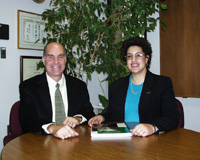
Scott Bass, dean, and Janet Rutledge, associate dean, UMBC Graduate School

On a Mission to Support Women and Minority Graduate Students
 
On December 5, UMBC was honored by the Council of Graduate Schools (CGS) for its efforts to build a comprehensive, supportive environment for women and minority graduate students
“There has been a 50 percent rate of attrition for doctoral students at U.S. graduate schools over the past 20 years—and among minority students, this figure is even higher,” said Scott Bass, dean of the UMBC Graduate School, as he accepted the CGS/Peterson’s Award for Innovation in Promoting an Inclusive Graduate Community at the Council’s annual meeting in Washington, DC.
“We must diversify and support our graduate student population for the nation to remain a world leader in science, engineering, and technology,” Bass said. “I’m receiving this award today on behalf of the entire UMBC community. This is at the core of our academic mission.”
UMBC, one of Newsweek’s hottest schools in America, has earned national acclaim for its comprehensive support for minority science and technology undergrads. The university is best known for its Meyerhoff Scholars Program. Founded in 1988, the program regularly sends large numbers of minorities on to advanced studies in science, technology and engineering at such institutions as Harvard, Stanford, and MIT. The scholars are among the best in the nation, many of whom turn down scholarship offers from Ivy League schools in favor of the personal attention they receive at UMBC.
Now Bass and Janet Rutledge, associate dean of UMBC’s Graduate School, are on a mission to expand that comprehensive approach to graduate students. “UMBC has done a tremendous job at the undergraduate level, so we’re primed to do the same at the graduate level,” Bass says.  
Rutledge, the first African American female to receive a Ph.D. from Georgia Tech’s electrical engineering program, knows firsthand the challenges minority Ph.D. students face. “There’s a feeling of invisibility,” says Rutledge, who concentrated on the scarcity of minority science Ph.D.’s as program director in the Division of Graduate Education at the National Science Foundation prior to coming to UMBC. 
Hrabowski, Bass and Rutledge preach the mantra of better mentorship between faculty and graduate students as the key to getting more minorities and women to excel in science, math, engineering and technology graduate programs. “I’m a product of the national minority engineering education movement of the 1970’s,” says Rutledge. “There was a big emphasis on mentoring. If we’re to achieve the diversity we’re looking for with graduate students, we must mentor.”
Rutledge sees the two-year award from as a big step towards drawing national attention to the problem and hopefully spreading the comprehensive model to other U.S. campuses.
Earlier this year, Rutledge was instrumental in landing a $2.5 million grant from the National Science Foundation to establish the Maryland Alliance for Graduate Education and the Professoriate (MAGEP), a consortium of universities led by UMBC that includes the University of Maryland, College Park and the University of Maryland, Baltimore. MAGEP seeks to expand the principles of UMBC’s Meyerhoff Program throughout other disciplines to build graduate student recruitment, mentoring and professional development statewide.
Bass and Rutledge point out that the UMBC faculty is dedicated to the mission as much as they are. Michael Summers, the only Howard Hughes Medical Institute Investigator in Maryland and winner of the 2000 Presidential Award for Excellence in Science, Mathematics and Engineering Mentoring, recently volunteered to expand the Meyerhoff graduate biomedical program. Summers started with two minority students and has since grown the program to include 31 students across six departments.
“Our faculty sees this opportunity to be unique in the nation, and they have seized it,” Bass says. “At other campuses, often this type of mission is peripheral; you’ll see an office of minority affairs on the side somewhere. But here, as administrators, we’re just responding to faculty who really want to do this. They’re saying ‘Give us the tools and we’ll do it.’ ”


Closing the IT Gender Gap

/b> to address the longstanding issues surrounding the gender gap in IT.

CWIT Advisory Board Member Anne Spence, a lecturer in the Department of Mechanical Engineering with a Ph.D. in aerospace engineering, understands the challenges of being a woman in a technical field. “One of my college professors told me that women should not be engineers, so I got the highest grade in the class to prove him wrong,” she says. “When I graduated with my degree I had six job offers. I did encounter initial resistance as an engineer at Bell Helicopter, but I was always able to get rid of the resistance by proving myself.”

“Motivating girls to get involved in IT requires that we offer opportunities for them to work with computers in non-threatening environments,” Spence adds. “Computer Mania is one of those environments. It also gives the girls an opportunity to meet role models — from college age women to business leaders and college faculty.”

Spence believes that Computer Mania will help diminish the “geek” stereotype that discourages young girls from IT and will provide resources to help them understand the importance of technology in every aspect of their lives. “Most girls start to lose interest in math and science during middle school. It is crucial that we keep them engaged during those years to make sure that they are taking upper level math, science, computer and engineering courses when they reach high school,” she says.

As a child, Spence says that both she and her brother were “raised to do anything we wanted to do. My father was an engineering professor and my mother an elementary school teacher. Often, we would go to a field near our house to launch the model rockets we had built — I thought that was normal! So it never really occurred to me that I could not succeed.”

Because not every young girl is so lucky, Spence set out to provide mentors for her female students at UMBC. She is advisor for the University’s chapter of Mentor Net, a national program that provides mentors for women studying engineering and computer science. “Some of the young women in my classes are not only the first member of their family to major in engineering but they are often the first member of their family to attend a university,” she explains. “This is a very difficult position since, often, they have very little support from home. That’s where my own role as mentor comes in to play. I can encourage them and show them that women can succeed in the field.”

Spence hopes to continue inspiring both girls and boys alike to learn more about engineering at an earlier age. She recently received a grant from the National Science Foundation to develop a program that will introduce engineering in middle and high school algebra classes across Maryland. “The students will see how algebra is used to solve engineering problems, not just how many apples and oranges you can buy for one dollar,” she says. When she’s not at UMBC, Spence is incorporating practical hands-on projects and engineering challenges at Oak Hill Elementary in her hometown of Severna Park, Maryland.