All posts by: UMBC News Staff


Lia Purpura named “Best Poet of 2016” by Baltimore Magazine

Baltimore Magazine recently released its “Best of 2016” edition, which highlighted leaders in arts and culture from across the city over the past year. Lia Purpura, writer in residence in UMBC’s Department of English, was named Baltimore’s top poet.

The magazine states: “In It Shouldn’t Have Been Beautiful, her latest collection published this year, Purpura impressively delivers poignant insight into our existence without pomp and circumstance. Her verses are little gems with short stanzas and an absence of flowery language, but that doesn’t make them any less profound. Instead, Purpura…proves how meaningful simplicity can be.”

Purpura has also been awarded a Pushcart Prize for her essay “Scream, or, Never Minding,” which was originally published in The Georgia Review. Also receiving recognition last month was Purpura’s poem “Resolution” which was featured on The Academy of American Poets website as the national “Poem-a-Day” on August 8.

Lia Purpura’s work frequently appears in The New Yorker, Orion, The Paris Review, Best American Essays, The Iowa Review, and other national journals. Among her numerous honors are a Guggenheim Foundation Fellowship, National Endowment for the Arts and Fulbright Fellowships, and four Pushcart prizes. Her collection of essays, “On Looking” was a finalist for the National Books Critics Award.

Read more about Purpura’s work on the English department website.

Ian Anson examines how biased perceptions of the economy could influence the presidential election

In a new article published in The Conversation, Ian Anson explains how biased economic perceptions can be shaped by news media coverage. Anson, an assistant professor of political science, argues that in such a partisan presidential election year, Republicans and Democrats are more likely to have different interpretations of the economy.

Anson’s article, titled “A tale of two GDPs: Why Republicans and Democrats live in different economic realities,” focuses on two recent research papers in which he investigates why the political parties can’t agree on even basic, straightforward economic facts.

“I take up this question by investigating how biased economic perceptions are formed and maintained. The results do not paint a particularly rosy picture of the future of economic accountability, for two reasons,” Anson writes.

“One is that contemporary partisan media play a subtle yet powerful role in forming these biases. Another is the discovery that partisans perform Simone Biles-esque mental gymnastics to maintain biases in their economic beliefs – even when they know things about the economy that go against their favorite partisan talking points.”

Anson has research interests in the study of American voting behavior, public opinion, media and politics, inequality, quantitative methods, and the scholarship of teaching and learning. He teaches courses on American politics, media, and political behavior.

His article was also picked up by other media outlets. For a complete list, see below.

Why Republicans and Democrats live in different economic realities (Newsweek) 
The next president needs the support of all to rebalance the economy (U.S. News and World Report)
The different economic realities of Democrats and Republicans (BYU Radio) 
Why Republicans and Democrats can’t agree on basic economic facts (New Republic)
A tale of two GDPs: Why Republicans and Democrats live in different economic realities (Observer Politics) 

Image: Ian Anson presents his research at a Dresher Center event. Photo by Marlayna Demond ’11 for UMBC. 

College students from across the U.S. gain summer research experience at UMBC

Each summer dozens of college students from around the nation travel to UMBC to take advantage of the university’s leading research facilities and faculty.  This year, 28 students studied climate change, diabetes, and other topics as part of UMBC’s Interdisciplinary Program in High Performance Computing, a Research Experience for Undergraduates (REU) housed in the mathematics and statistics department. At the same time, 10 students tackled projects through the new Chemical Sensing and Imaging REU, hosted by the chemistry and biochemistry department. Students learned new scientific skills, refined career goals, and practiced teamwork.

Matthias Gobbert, professor of mathematics and director of the Interdisciplinary Program in High Performance Computing, explains that the program emerged from a collaboration between the Center for Interdisciplinary Research and Consulting (CIRC) and the High Performance Computing Facility. Gobbert and math department colleagues match each student team with a client from a local company who comes to the table with a problem they’d like the students to solve. It’s not about imagined scenarios, Gobbert says, “It’s real consulting.”

“It’s a good chance to get used to working with teams,” says Lois Miller, a rising senior at DePauw University. Abigail Kramer, a rising senior at Kent State University, agrees, adding, “It’s been great to talk to math majors from other schools.”

The interdisciplinary projects have exposed students to new options. “People don’t think about how math can overlap with other things,” says Danielle Sykes ‘19, mathematics and statistics and a Meyerhoff Scholar, whose team applied a data analytics model to huge amounts of climate data from across the Missouri River Basin. “It’s definitely expanded my thinking about what my career options are,” she shares.

The National Science Foundation, Department of Defense, and National Security Agency all contributed funding for the program this year, enabling a larger student cohort to participate. Fifty percent of students come from institutions with limited research opportunities, so the program gives them rare first-hand experience and helps them decide if they’d like to pursue research further. A graduate student and faculty member are assigned to each undergraduate team, “so teams can be really well supported,” says Gobbert.

UMBC’s new chemistry REU “embraces the UMBC mission to provide research and education opportunities to students from all backgrounds, including students from underrepresented minorities in STEM,” says Zeev Rosenzweig, professor and chair of chemistry and biochemistry. Supporting these students is a team effort. “I greatly appreciate the dedication of our UMBC faculty and graduate student mentors to the participating students,” he says.
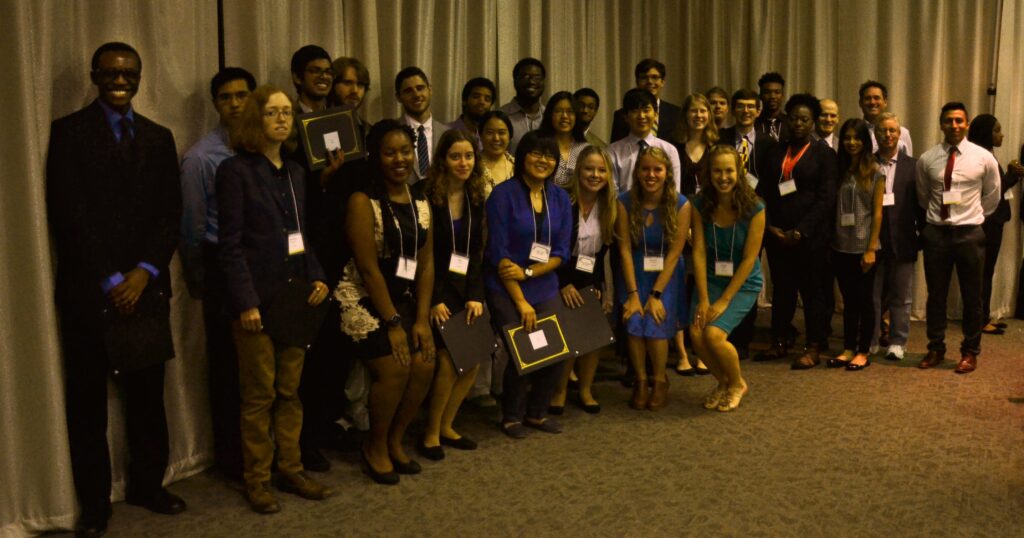
MathREU cohort 2015 surfThe 10 students in the program had eye-opening experiences in their research projects. “I’ve gained an appreciation for the principal science behind a lot of the things we use,” says Kalen Sullivan, a pre-med student at Iona College who worked with Marcin Ptaszek, associate professor of chemistry and biochemistry. Sullivan didn’t meet his project’s goal to produce a specific novel compound in the lab, although he worked long and hard, but he’s found an even greater respect for people who work “in the trenches” of science.

Kathy Barron, a 2016 chemistry graduate from Virginia Tech, worked with Jennie Leach, associate professor of chemical, biochemical, and environmental engineering (CBEE), and Erin Lavik, professor of CBEE. “I thought it would be a good opportunity to learn about a field of research I was unfamiliar with,” she says. It went so well that Lavik asked her to stay on after the REU ended. She’ll continue doing research in the lab and is considering graduate study in the same field.

Becca Pontius, a rising senior chemistry major at Clemson University, has been inspired to pursue a new field after working to develop quantum dots in Rosenzweig’s lab. Slightly uncertain about her project at first because it contained a significant biology component, “Now I know I can stretch out to new things and still be successful,” she shares. “The REU program at UMBC was a big step towards my dream job of becoming a research professor.”

All UMBC REU students presented their work at the 19th annual Summer Undergraduate Research Fest on August 10.

Rosenzweig hopes the students take away more than research knowledge from UMBC.It is my hope that the REU students will become ambassadors of UMBC in their academic institutions, and help us to promote and expand the UMBC culture of inclusive excellence.”

Faculty Mentors for Chemical Sensing and Imaging REU:
Brad Arnold, associate professor of chemistry and biochemistry
Marie Christine Daniel-Onuta, associate professor of chemistry and biochemistry
Lisa Kelly, associate professor of chemistry and biochemistry
Minjoung Kyoung, assistant professor of chemistry and biochemistry
Erin Lavik, professor of chemical, biochemical, and environmental engineering
Jennie Leach, associate professor of chemical, biochemical, and environmental engineering
Matt Pelton, assistant professor of physics
Marcin Ptaszek, associate professor of chemistry and biochemistry
Zeev Rosenzweig, professor and chair of chemistry and biochemistry, REU director
Ryan White, associate professor of chemistry and biochemistry

Interdisciplinary Program in High-Performance Computing REU:
Nagaraj Neerchal, professor of mathematics and statistics, REU co-director
Brad Peercy, associate professor of mathematics and statistics, REU faculty mentor
Kofi Adragni, assistant professor of mathematics and statistics, REU faculty mentor

Banner image: 2016 Chemical Sensing and Imaging REU cohort at SURF.
In-text image: 2016 High-Performance Computing REU cohort at SURF.
Photos by Tim Ford for UMBC.

UMBC Police awarded national accreditation

On July 30, 2016, the UMBC Police Department was awarded accreditation by the Commission on Accreditation for Law Enforcement Agencies (CALEA) for the quality of its personnel, policies, processes, and procedures.

CALEA is a national credentialing authority that reviews public safety services. UMBC joins several other University System of Maryland (USM) institutions that have become accredited by the organization.

“This exceptional acknowledgement reflects the quality and commitment of our police department and its leadership,” said Vice President of Administration and Finance Lynne Schaefer. “We have one of the finest departments in the System and the state, and this accreditation reaffirms that.”

During the three-year review, the accrediting body looked at the campus’s effectiveness and adherence to industry standards. The review team analyzed the department’s policies and procedures by reviewing its documentation and interviewing faculty, staff, and students from the campus.

“Being acknowledged by CALEA as an institution that upholds the highest standards of excellence is an incredible honor,” said Chief of Police Mark Sparks. “This exhaustive accreditation process presented a great opportunity for our department to review its processes and procedures, and it helped us to recognize ways in which we can continue to support the unique needs of our campus community.”

An important part of the accreditation process includes identifying ways in which the department plans to advance its mission to support members of the campus community. Implementing these approaches, of which there were nearly 200, is integral in maintaining compliance with CALEA. Some key areas identified include fair enforcement across all populations on campus, overall department diversity, and systems for reviewing and reporting on officer activity and behavior.

The CALEA accreditation team will visit the campus again in 2020 to review the department’s progress on its commitments.


UMBC and Reginald F. Lewis Museum announce first Africana studies postdoctoral fellow

The Reginald F. Lewis Museum, in partnership with UMBC’s Department of Africana Studies, will host postdoctoral fellow and instructor Iyelli Ichile during the upcoming year. As part of the fellowship, Ichile will be in an instructor in the Africana studies department, and she will conduct research on Maryland African American history and culture to support the Reginald F. Lewis Museum’s permanent collection.

Ichile holds a Ph.D. in African diaspora history from Howard University and a master’s degree in African American studies from Columbia University. Her research and teaching revolves around the themes of spirituality, liberation movements, music, folklore and gender among African people globally.

The fellowship is made possible by a grant from the Institute for Museum and Library Services. For more information, visit the Reginald F. Museum website.

Image: Iyelli Ichile. Photo courtesy Reginald F. Lewis Museum. 

Tim Gindling and global colleagues discuss minimum wage policies in live video chat

On August 22, the World Bank Group’s Development Policy Research Unit hosted an hour-long virtual discussion on labor regulations and enforcement. Tim Gindling, a professor of economics and expert on minimum wage policy impacts in Latin America, joined the discussion with other leading experts from around the world for the event which was broadcast live on the World Bank Group website.

The focus of the discussion was on the role wages and enforcement of minimum wage policy play in understanding both employment and economic outcomes in the developing world. Gindling has spent the last fifteen years researching minimum wage policy in Latin America and has recently expanded his research to look at policies in other developing countries such as China. He discussed his work in these areas during the broadcast.

“In a number of developing countries, mostly through Latin America, wages tend to be thought of in monthly terms. For that reason, minimum wages tend to be set for monthly minimum wages or daily minimum wages for full-time workers,” explained Gindling. “One thing this does is that it makes it very difficult for part-time workers to be paid minimum wages or to impose compliance on employers for part-time workers or overtime work effectively.”

Gindling’s research has helped lead to change in minimum wage policies and compliance in countries such as Costa Rica, where he helped implement a government program to increase compliance. The program included increased inspections, easier access for employees to voice concerns over their wages, and a large scale publicity campaign to bring attention to minimum wage non-compliance.

During the discussion, Gindling joined other experts including Haroon Bhorat, director of the Development Policy Research Unit at the World Bank Group; Piotr Lewandowski, president of the Board at the Institute for Structural Research (IBS), a research institute based in Warsaw, Poland; Lucas Ronconi, economist and Ph.D. in public policy scholar at the University of California, Berkeley; and Uma Rani, senior economist at the International Labour Office Research Department.

Watch the complete discussion on the Development Policy and Research Unit website. For more on Tim Gindling’s research, read “Living (With) Wages” in the Winter 2016 edition of UMBC Magazine. 

Image: Tim Gindling. Photo by Marlayna Demond ’11 for UMBC. 

Craig Berger named to new leadership position with the American Democracy Project

Craig Berger, coordinator of student life for campus and civic engagement, has been named chair of the American Democracy Project (ADP) Steering Committee for 2016-17. The multi-campus ADP initiative of the American Association of State Colleges and Universities (AASCU) is focused on higher education’s role in preparing the next generation of highly informed and civically-engaged students.

As steering committee chair, Berger will preside over meetings throughout the year and work closely with the ADP national manager to craft the organization’s strategic plan and to coordinate the annual awards and upcoming Civic Learning and Democratic Engagement (CLDE) leadership meeting in Baltimore.

“I’m really honored by this selection,” shares Berger. “I wholeheartedly agree with and support the mission of ADP, which is to view institutions of higher education as venues and forums for young adults to think about and experiment with being empowered in solving shared public problems.”

Berger previously served as chair-elect of the steering committee last year. He explains that his involvement with the American Democracy Project has been rewarding and has helped him in his daily work as a staff member in the Office of Student Life at UMBC.

“So much of what ADP does is something that UMBC prides itself on…being creative and entrepreneurial. I owe being named chair-elect last year and now chair of the ADP steering committee to the tradition and culture that I’ve grown in professionally in the last five years at UMBC.”

During his time at the university, Berger has been heavily involved with BreakingGround, an initiative that aligns closely with the American Democracy Project mission by fostering connections across campus and beyond to demonstrate the power of individuals and group collaboration in creating meaningful change. Last year, Berger helped organize the 2015 Imagining America Conference, which brought leaders together from around the country to emphasize the power of many voices coming together to envision our nation’s future, engaging with topics like race, inequality, and community-based approaches to spur collective action.

In his new leadership position, Berger says that he will largely benefit from the lessons he’s learned so far at UMBC.

“My experience at UMBC has taught me…that democratic engagement work is not just an activity that we do at institutions…it is a part of the campus identity.”

The 2017 CLDE National Meeting will be held June 7-10, 2017 in Baltimore. For more information, visit the ADP website.

Image: Craig Berger. Photo by Marlayna Demond ’11 for UMBC. 

Tahira Mahdi, Ph.D. student, describes how the arts and humanities impact lives in radio interview

In a new “Humanities Connection” segment on WYPR, Tahira Mahdi, a Ph.D. student in human services psychology, examines strategies for how people can evaluate the impact of the arts and humanities on a daily basis.

“The arts and humanities are scholarly fields that study how humans document and process the complexity of the human experience,” she explains in the segment that aired August 11.

Mahdi says that scholars and community workers are often challenged to assess and evaluate the impact of arts and humanities projects on communities and programs through quantitative evidence, but she offered strategies to achieve this through surveys and keeping records of attendance at events. She notes that arts and humanities are not inherently academic pursuits and by definition create change every day, perhaps more effectively measured through qualitative means.

“Qualitative research goes beyond the numbers to provide the depth of the human experience, the how and the why of the impact,” Mahdi explains.

Referencing Lee Boot’s “Art of Transformation” project, Mahdi explores a strategy that examines the less tangible aspects of what makes communities thrive through digital publishing and storytelling as an organizing tool.

“When we think about evaluating the impact of the arts and humanities, we should start by thinking about what life will be like without these everyday studies of ourselves. Some things cannot be quantified, but the impact of the arts and humanities stares us in the face all day, every day,” says Mahdi.

Listen to the complete segment “Evaluating the Arts and Humanities” on the Maryland Humanities Council website.

Image: Tahira Mahdi speaks at the 2015 Imagining America Conference in Baltimore. Photo courtesy Tahira Mahdi. 

New research highlights Dissertation House as an effective support model for minority STEM Ph.D. candidates

A new research article in CBE – Life Sciences Education analyzes 10 years of data that demonstrate one powerful conclusion: UMBC’s Dissertation House Model effectively increases degree completion among minority Ph.D. candidates.

Renetta Tull, associate vice provost for graduate student professional development and postdoctoral affairs, and Janet Rutledge, dean of the Graduate School at UMBC, developed the Dissertation House Model with colleague Wendy Carter-Veale, dissertation coach for the Dissertation House program.

“We’ve learned that providing time, space, support, and community is a winning combination for working on a milestone such as the doctoral dissertation,” says Tull. “One of our mottos is ‘From ABD (all but dissertation) to Ph.D.’”

The program puts that combination to work, and graduation rate data as well as more than 200 personal reflections from participants back up its effectiveness.

Schools can implement Dissertation House in a variety of formats, from multi-day retreats to a few hours in a classroom. The most common structure is several consecutive full days where students set goals and participate in mini-lectures on topics such as time management, public speaking, and avoiding burnout. They also receive one-on-one support from a dissertation coach and have opportunities to meet with their advisor.

At least five hours of each day are spent writing in a group setting, but the program goes far beyond providing a dedicated writing space. Many students form positive, lasting relationships with their peers and mentors through the course of the program—relationships that propel them through challenging moments in their PhD careers.

“We promote career-life balance, health and wellness, and support for peers,” says Tull. “We’ve taken care of babies for students, supported students through sickness and loss, and celebrated all successes.”

Carter-Veale, Tull, Rutledge, and Dissertation House alumna Lenisa Joseph found that participating in Dissertation House increased the likelihood of PhD students graduating by 92%, and increased their likelihood of retention by 64%. Notably, 98% of students who returned surveys said the program helped them make progress on their dissertations and that it was a good use of funding.

“We’re pleased that the model has helped so many students to reach their goals,” says Tull.

Dissertation House is part of The University System of Maryland’s Alliance for Graduate Education and the Professoriate initiative, PROMISE – AGEP, a program of the National Science Foundation. It has already been replicated at other schools around the U.S. and in Puerto Rico.

Read the original research article in CBE – Life Sciences Education: The Dissertation House Model: Doctoral student experiences coping and writing in a shared knowledge community.

Image: Graduate students at work at the University System of Maryland’s Summer Success Institute 2015; Photo by Cheriss May for PROMISE: Maryland’s AGEP.

Secret Society of Science Songwriters creates music videos inspired by UMBC chemistry labs

On a Friday afternoon in early August, a dedicated group of students from Northwest High School in Germantown, Maryland, are hard at work in UMBC’s chemistry building. It’s prime summer break time, but these teenagers are focused on learning essential chemistry concepts to create original songs and music videos explaining science for kids. Their new chemistry songs will feature crystal-clear descriptions of complex scientific research complete with rhyme, rap, multipart harmony, and catchy choruses.

The group, 60 strong, calls itself 4SW, or the Secret Society of Science Songwriters. In 2015, their work won the grand prize and second place at the Weather and Climate Day Contest hosted by the National Aquarium. In 2016, they claimed first place. Their success has earned them invitations to perform on Capitol Hill and at the White House. They’ve won three other contests so far in 2016, and they have a YouTube channel featuring dozens of original videos.

“The club started in a closet in the back of a biology room,” says Rahwa Ghenbot, a rising junior at Northwest. Avi Silber, science teacher at Northwest and 4SW advisor, ran a music studio out of his dorm room in college. When he volunteered with the school’s musical, students recorded backup tracks in his makeshift studio. A couple of them suggested producing songs about his classes, and 4SW was born.

Today, led by 4SW President Kaylyn Battle, they are producing new songs at a rapid pace. Some members are self-described “science nerds” or were struggling with science and seeking a new way to learn scientific concepts. Others were searching for a unique musical outlet or chance to work on video editing and storyboarding.

Ghenbot joined because she happened to be doing homework in Silber’s classroom during meetings. “It started out as a place to hang out,” she says, “but then it became a place where I learned lots of cool skills.”

The songs produced this summer feature research in the labs of Zeev Rosenzweig, professor and chair of chemistry and biochemistry; Michael Summers, Robert E. Meyerhoff Chair for Excellence in Research and Mentoring and University Distinguished Professor of chemistry and biochemistry; and Ryan White, associate professor of chemistry and biochemistry. UMBC’s new SCIART program is also highlighted.

Rosenzweig’s lab works on the development of non-toxic nanomaterials, specifically luminescent quantum dots for bioimaging and drug delivery. Summers’ HIV research focuses on understanding the virus’ structure to develop novel treatments that inhibit replication. White’s lab is developing nanoscale electrochemical sensors to monitor cell-to-cell communication, which has applications in neuroscience. The SCIART program aims to train undergraduate students in the use of science and engineering to identify, authenticate, conserve and restore art work.

Rob Lazenby, a postdoc in the White lab, commented that the students asked great questions, indicating they grasped the challenging topics well. He also noted how well the teams worked together. “I’m so proud of them,” says Florika Macazo, a 2016 Ph.D. graduate from the White lab. “They came up with the song really fast.”

Denise Williams, a graduate student in the Rosenzweig Lab, was inspired by the combination of talent and passion the students brought to UMBC. “They were excited to learn about the relevance of our nanoparticles in everyday life,” she says. Richard Brown, a graduate student in the Rosenzweig Lab, was “impressed with their intelligence, enthusiasm, and willingness to learn about the science behind the environmental impact of nanotechnology.”

Rosenzweig initiated the collaboration. “It is a great way to increase high school students’ interest and passion for science,” he says. “They are learning without realizing they’re learning. The students bring so much energy. It makes me happy.” Rosenzweig and Silber hope this is the start of a long-term collaboration that will eventually include labs from other UMBC departments.

Khalid Elawad, a Johns Hopkins University undergraduate at UMBC for the inaugural SCIART program, says the high school students clearly love what they are doing and are skillfully following through on their mission to “make the world more science-y, one song at a time.”

A playlist of the UMBC videos:

Banner image: 4SW students, UMBC graduate students, Avi Silber, and Zeev Rosenzweig review a track during music production at UMBC August 4; photo by Marlayna Demond for UMBC.

UMBC School of Public Policy alumni advance as leaders in higher education and public health

UMBC proudly announced the establishment of the School of Public Policy in 2014, on the 40th anniversary of the university’s public policy program. As UMBC approaches its 50th anniversary celebration in September, many public policy alumni are now moving into prominent positions in education and public health with several high-level appointments announced in the past few months alone.

Keith Elder

Keith Elder ’02 Ph.D., public policy, was named dean of Samford University’s School of Public Health earlier this year and started in that position in July. He was previously professor and chair of the Department of Health Management and Policy in the College for Public Health and Social Justice at Saint Louis University. Before that, he was a faculty member in the Department of Health Services Policy and Management in Arnold School of Public Health at the University of South Carolina and the Department of Health Services Administration in the School of Health Professions at the University of Alabama at Birmingham.

Elder’s research interests include health policy, healthcare delivery and healthcare processes.

“We have worked together as colleagues since Keith graduated, publishing several articles together,” shares Nancy Miller, professor of public policy, who served as Elder’s advisor for his doctoral work at UMBC. “Keith’s passion for minority men’s health has informed some of my own recent research directions, and it has been exciting to see Keith develop as a leader in public health and policy.”

“Our country and world continue to face numerous health-care challenges that are best addressed by a comprehensive approach that includes effective partnerships with communities, public health organizations, health systems and academic institutions, and a well-trained public health workforce,” said Elder in a news release announcing his new position.

Samuel Brown

Samuel Brown ’97 Ph.D., public policy, was recently appointed director of the Wichita State University (WSU) Hugo Wall School of Public Affairs. He was previously a professor in the School of Public and International Affairs at the University of Baltimore and associate professor of public administration at the University of Nebraska. Brown also served in positions in the private sector and state and federal government prior to his academic career.

“I believe his leadership will make a distinct contribution to WSU’s commitment of service to the community and region,” said WSU President John Bardo in a news release announcing the appointment. “He is a passionate public servant committed to cultivating people and organizations…his visionary leadership style will advance the school’s mission of integrating teaching, research and applied projects.”

Rear Admiral (RADM) Sylvia Trent-Adams ’06 Ph.D., public policy, was recently named to serve as deputy surgeon general and began that role in October 2015. In her new position, Trent-Adams is senior advisor to the surgeon general. She provides advisement and support regarding U.S. Public Health Service (USPHS) Commissioned Corps operations and communicates the best available scientific information to advance the health of the country.

RADM Trent-Adams previously served as deputy associate administrator for the HIV/AIDS Bureau (HAB), Health Resources and Services Administration (HRSA), and assisted in managing a multi-billion dollar program that serves people living with HIV.

In recognition of alumni’s significant contributions to public policy over the years, during UMBC’s 50th anniversary weekend the School of Public Policy will host the alumni panel “We can work it out: Reflections on how public policy impacts our lives.” Elder and Trent-Adams will speak at the event, along with Renny DiPentima ’84, Ph.D.; Laura Bruner ’14, M.P.P.; and Robert Cenname ’08, M.P.P.

The event will be held Friday, September 16, 4-6 p.m. in the Skylight Room of The Commons, and registration is required. For more information, visit the School of Public Policy website.

Images: (Top) UMBC Public Policy Building, photo by Marlayna Demond ’11 for UMBC. Keith Elder, photo courtesy Samford University. Samuel Brown, photo courtesy Wichita State University. 

Summer Undergraduate Research Fest spotlights next generation of scientists

A crowd of more than 250 people gathered to learn from and celebrate emerging scientists at UMBC’s Summer Undergraduate Research Fest (SURF) on August 10, 2016. The program has humble beginnings, but it’s come a long way in 19 years.

“In its first year, we had 10 posters in the engineering building,” says Lasse Lindahl, director of the MARC U*STAR Scholars Program and professor of biological sciences. This year, 131 students presented 84 posters about their work with individual faculty mentors and in 11 different summer research programs, ranging from the National Security Agency Scholars to the new SCIART program.

“SURF’s growth demonstrates the commitment of UMBC to undergraduate research and getting the next generation of researchers prepared,” Lindahl says.

Kayla Sims, a rising sophomore at the STEM magnet high school Baltimore Polytechnic Institute, had never taken chemistry when she dived into research at UMBC’s Molecular Characterization and Analysis Complex (MCAC) this summer as part of the Summer Biomedical Training Program sponsored by UMBC’s College of Natural and Mathematical Sciences (CNMS) and Graduate School. She was nervous, but, “The people at MCAC taught me a lot,” she says. Now she can explain myoglobin digestion optimization like a pro, and she is ready to tackle her first chemistry course this fall.

Anna Opoku-Agyeman ’18, biological sciences, is a MARC*USTAR Scholar and says her summer of research has been “life-changing.” She researched novel therapies for breast cancer to help prevent recurrence. She also developed a clearer sense of her interests in scientific research and policy, and she now hopes to pursue a Ph.D. related to infectious diseases that affect sub-Saharan Africa. A law degree might also be in her future, to enable policy work.

In addition to the two lively poster sessions, six student research teams gave oral presentations to the packed ballroom. Austin Gabel ‘19, biological sciences, conducted research in the lab of Rachel Brewster, associate professor of biological sciences. He discussed his work on developmental arrest in zebrafish embryos with poise, enthusiasm, and clarity. Joel Tyson ‘17, biochemical engineering, explained his pioneering work to develop a minimally-invasive probe that measures brain activity, conducted in the lab of Gymama Slaughter, associate professor of computer science and electrical engineering. Additional projects dealt with topics ranging from climate modeling to nanoscale drug delivery.

Across these diverse areas, the SURF presenters shared a commitment to developing new scientific knowledge through research, both in their future careers and in high-level work during their student years. CNMS dean Bill LaCourse reflected, “To see the joy and the excitement in the students’ faces is a wonderful thing.”

Image: SURF participants from the Summer Biomedical Training Program, with mentor Michael Summers on far left and Kayla Sims on far right; photo Tim Ford.