
All posts by: Megan Hanks Mastrola


UMBC students organize Engineers Week to “inspire wonder”

UMBC’s fourth annual Engineers Week will feature a dozen creative, hands-on activities and eye-opening events, February 1923, to highlight how engineering impacts society and contributes to solving global challenges. The week-long celebration at UMBC coincides with National Engineers Week, which aims to “inspire wonder,” encouraging children to imagine themselves in engineering careers.

This year, collaboration is the core organizing principle behind the week of exploration and discovery. Tau Beta Pi, UMBC’s engineering honors society, has teamed up with engineering organizations on campus to bring students, alumni, corporate partners, faculty, and staff together to celebrate the engineering disciplines.

“Leading this year’s planning has given me a chance to implement what I’ve learned from the past events and collaborate with more groups,” says Beth Wolinski ‘18, chemical engineering, president of Tau Beta Pi. “I am hoping these new events will allow participants to experience the innovation happening throughout our campus. That is really what Engineers Week is about.”

As part of the festivities, the UMBC Racing Team will unveil its 2018 mini Baja race car on Tuesday, February 20, at 6 p.m. on Commons Mainstreet, as a sneak peek ahead of their upcoming competition season The team is known nationwide for its skill in building high-performing, cost-conscious vehicles.

New Engineers Week events this year include a networking session focusing on careers in the defense and aerospace industries, and celebration of diversity in the College of Engineering and Information Technology. Throughout the week, the broader UMBC community will also have opportunities to tour select engineering labs and to watch 3D printing demonstrations. Students are also organizing Let’s Get Techy, an outreach event for local elementary school students to experience engineering through games. The week will conclude with the hotly anticipated Battle of the Engineers, a popular annual competition featuring minute-to-win-it-style challenges.

“Although Engineers Week has been around since 1951, it is only in the last couple decades that we fully realized celebrating engineering innovation is also a great way to engage with the public,” says Keith J. Bowman, dean of the College of Engineering and Information Technology. “We want everyone to understand that engineering is done by people inspired to create solutions for our greatest challenges.”

For the full schedule of events, visit the COEIT Dean’s Office website.

Photo by Marlayna Demond ’11 for UMBC.
NSF grants UMBC nearly $1 million to expand supports for mechanical engineering students

UMBC’s commitment to STEM education and increasing diversity in engineering and computing fields is a trademark of the university. Five mechanical engineering faculty are continuing to expand this work through a nearly $1 million grant from the National Science Foundation (NSF) S-STEM program, which focuses on retaining and graduating STEM students via scholarships and activities.

Liang Zhu, PI on the grant and professor of mechanical engineering, explains that the grant will enable UMBC to continue boosting support for diverse students in the major, to propel them toward success in mechanical engineering careers. Zhu is collaborating on the grant with Deepa Madan, assistant professor of mechanical engineering; Ronghui Ma, associate professor of mechanical engineering; Chuck Eggleton, professor of mechanical engineering; and Tim Topoleski, interim chair and professor of mechanical engineering.

This is UMBC’s third round of S-STEM funding since 2010. After the initial grant in 2010, Zhu and her collaborators received a second grant in 2014 for over $500,000 to support student scholarships. The latest round of funding extends the program another five years, and includes collaborations with UMBC’s Meyerhoff Scholars Program, Career Center, student life, and financial services, to connect students with a broad range of resources and supports.

“Scholarships, mentoring, academic support services, internships, research, and professional development opportunities all play a role in this,” says Zhu. “We are excited to test and document how effective these different approaches are at increasing mechanical engineering students’ level of engagement and success.”

Since the program began in 2010, UMBC’s mechanical engineering department has seen an increase in diversity among students in the major. According to data from the NSF, among the 20,000 students who earned bachelor’s degrees in mechanical engineering nationally between 2002-2012, 12% were women, 3% identified as African American, and 8.2% identified as Hispanic. Before the program launched, UMBC’s numbers were similar to the national figures: about 12% of students in the major were women, 11% identified as African American, and 2% identified as Hispanic. Currently, about 19% of students in the major are women, 12% identify as African American, and 5.5% identify as Hispanic. Zhu recognizes there is still a long way to go and hopes to further improve representation in the major over the next five years. Zhu estimates that the new round of funding will be used to support approximately 45 students over the course of the grant, while they earn their undergraduate degrees in mechanical engineering at UMBC.

The S-STEM program is open to incoming freshmen, transfer students, and current students who are pursuing mechanical engineering degrees, provided they maintain a specific GPA and have financial need. Students selected for the program will participate in a variety of activities to enhance their education, including research experiences, faculty and peer mentoring, community-building activities, lectures and other events, and professional development activities.

Zhu has been most energized, recently, by her collaboration with local community colleges, where she and the co-PIs travel to speak about opportunities within UMBC’s mechanical engineering program. There, she highlights unique research opportunities and internship possibilities available for UMBC’s mechanical engineering students, which are major draws for prospective students.

Ongoing support from NSF motivates Zhu to continue in her outreach work with prospective students and mentorship of current undergraduates. “Attracting community college students to our mechanical engineering program and improving the retention and graduation rates of our scholars are two key approaches to supporting the diversity of tomorrow’s engineering workforce,” says Zhu. “Receiving this grant for the third time is an indication of the high quality of our program and affirmation that we’re on the right track.”

Photo by Marlayna Demond ’11 for UMBC.

UMBC Center for Cybersecurity receives funding from T. Rowe Price to support students

Global investment management firm T. Rowe Price is supporting cybersecurity research and students at UMBC through a new sponsorship of the UMBC Center for Cybersecurity. The funding reinforces UMBC’s strength in cybersecurity research and talent development, and T. Rowe Price’s leadership in advancing cybersecurity for financial services.

“We are delighted to be working with T. Rowe Price,” says Anupam Joshi, director of the Center for Cybersecurity and chair of computer science and electrical engineering. “This new collaboration with T. Rowe Price’s security team will provide great opportunities for our students to be exposed to cybersecurity in financial services and prepare them for promising careers protecting critical infrastructure.”

The sponsorship from T. Rowe Price will support a graduate student conducting cybersecurity research relevant to financial services and will also support undergraduate cybersecurity students through UMBC’s Cyber Scholars Program. This collaboration will enhance UMBC’s efforts to cultivate new cyber talent and increase diversity in the field. The students will have opportunities to meet, interact with and learn from members of T. Rowe Price’s security team.

“We have built a strong partnership with UMBC over the past few decades that has provided us a robust talent pipeline for the firm. We currently have over 200 associates who are UMBC alumni,” says Tom Quinn, head of information security at T. Rowe Price.

UMBC and T. Rowe Price have built a strategic partnership spanning several decades that provides support to students across disciplines and a highly skilled workforce for the company. T. Rowe Price is a top employer of UMBC graduates and student interns in areas from investment research to technology development.

“For many years, UMBC has consistently provided our firm with hundreds of exceptionally talented students that we have hired across all areas of our business. UMBC students are well-rounded and diverse in their experiences and skills, which make them strong assets to our firm year over year,” said Mindy Silverman, talent acquisition leader for university relations at T. Rowe Price.

Photo by Marlayna Demond ’11 for UMBC.

UMBC’s Haibin Zhang shares tips to secure data in the cloud

As more consumers rely on cloud-based data storage for everything from family photos to financial information, both experts and general users have voiced concerns about cloud security. In a new Conversation article recently published by Scientific American, Haibin Zhang, assistant professor of computer science and electrical engineering, explains precautions consumers can take to protect their files in the cloud.

Zhang explains that data stored and secured using commercial cloud storage systems is encrypted, which means that without the key, the information looks like a series of meaningless characters. Encryption keys have the potential to be misused, if they end up in the wrong hands, which can compromise the security of files stored in a cloud.

“Just like regular keys, if someone else has them, they might be stolen or misused without the data owner knowing,” says Zhang. “And some services might have flaws in their security practices that leave users’ data vulnerable.”

Zhang notes that some cloud services allow customers to maintain their encryption key themselves, which give the consumer the control in ensuring that their data remains safe. Other services keep the encryption keys internally and manage the security for their customers. He says that while each option has benefits, it is important to recognize that “some services might have flaws in their security practices that leave users’ data vulnerable.”

To keep data secure in the cloud, Zhang suggests using enhanced security features offered by cloud storage companies and taking additional precautions that are available to individual customers. He recommends that people use a cloud storage service that allows customers to encrypt their data before uploading it for storage, and to rely on services that have been “validated by independent security researchers.”

Read “How secure is your data when it’s stored in the cloud?” in The Conversation for Zhang’s additional recommendations on securing data on the cloud. The piece also appeared in Scientific American, and has so far been read nearly 20,000 times.

Photo by Yuri Samoilov, CC by 2.0.

Trouble with your GPS? UMBC’s Stacy Branham works to improve travel apps for all users.

Many travelers find GPS technologies useful, but they can also have frustrating limitations — being less reliable inside buildings or underground, or not providing directions that meet the user’s needs. UMBC’s Stacy Branham, lecturer in information systems, received nearly $85,000 from the Maryland Industrial Partnerships Program (MIPS) and TRX Systems, Inc. to develop a technology system that will deliver start to finish routing services, including for travelers with disabilities.

“Anyone who’s tried to find their way through a confusing airport or metro station will likely appreciate the arrival of better apps for indoor wayfinding, but many people don’t realize how much the indoor navigation experience has already been improved over the past few decades through the input of people with disabilities,” Branham explains.

Branham suggests the perspectives and needs of people with disabilities in particular can inform future improvements for all GPS technology users, based on examples from earlier technologies. “Automatic door openers are installed for wheelchair accessibility, but they are also useful for people with full hands or parents pushing a stroller,” she notes, “and, the call buttons for elevators are reachable by wheelchair users, but they also allow my 2-year-old daughter to participate.”

Branham will work with TRX Systems and MIPS on next-generation GPS technologies that meet the needs of all users and that function effectively in enclosed spaces. TRX Systems will build algorithms to provide more accurate location points. Branham will work with a Ph.D. student, TRX Systems, and the American Printing House for the Blind to determine if the GPS technology will be usable and accurate enough for people with disabilities who are navigating spaces. Ultimately, the project could help public safety personnel who require accurate location and direct routing to help people in emergencies, people with disabilities who rely on accessible routes to maneuver from one point to another, or travelers using underground public transit.

“This research is important because it answers the question ‘what features do indoor navigation apps need?’ by asking people with various disabilities first,” says Branham. “We expect our findings will result in apps that are useful to people with disabilities, definitely. But these apps will likely help all sorts of people with and without disabilities in unforeseen ways.”

Image: Stacy Branham working with K-12 students during UMBC’s Hour of Code.  Photo by Marlayna Demond ’11 for UMBC.

UMBC leads nation in producing African-American undergraduates who pursue M.D.-Ph.D.s

According to new data from the Association of American Medical Colleges (AAMC), UMBC undergraduate alumni who identify as African American have gone on to pursue and earn more M.D.-Ph.D.s than alumni from any other institution across the country. In total, 44 UMBC alumni who identify as African American or black earned M.D.-Ph.D.s. M.D.-Ph.D. degrees, which combine scientific and medical education. These degrees are typically of interest to people who want to conduct research in a medical setting, such as at medical schools, universities, and research institutions.

Since the 2000-2001 academic year, a total of 413 African Americans have earned M.D.-Ph.D.s from institutions across the United States. More than 10 percent of those M.D.-Ph.D.s were awarded to UMBC undergraduate alumni who identify as African American.

“The success of our students entering and completing M.D.-Ph.D. programs is made possible by UMBC’s commitment to undergraduate research,” says Keith Harmon, director of the Meyerhoff Scholars Program at UMBC. “Our students are able to have sustained research experiences at UMBC, making them extremely competitive and attractive applicants.”

UMBC has several programs and initiatives in place that support students who plan to pursue M.D.-Ph.D.s after graduation. The Meyerhoff Scholars Program is nationally recognized as a model for increasing diversity in STEM fields, and for supporting students as they prepare to pursue advanced degrees. Since 1993, over 1100 students have graduated from the program, including nearly 275 alumni who went on to earn a Ph.D. and 49 who completed M.D.-Ph.D.s.

“Many students choose UMBC because they know it is a special place where expectations and standards are high, opportunities abound, and our culture of community and support uplifts and inspires them to pursue their dreams,” explains Harmon.

UMBC’s MARC U*STAR Program also supports undergraduate students from underrepresented groups, who are majoring in the life sciences, physical sciences, engineering, and mathematics, and plan to pursue a Ph.D. in biomedical research or mathematics. Twenty seven MARC U*STAR alumni have earned M.D.-Ph.D.s, including 13 since 2014.

Harvard University was in a distant second on the list provided by the AAMC, followed by institutions including Morehouse College, Xavier University of Louisiana, Johns Hopkins University, Hampton University, University of Virginia, Yale University, University of Illinois at Urbana-Champaign, Duke University, and Princeton University.

UMBC is also ranked in the top 10 for producing undergraduate students who earn computer science degrees, based on data from the National Science Foundation’s Integrated Postsecondary Education Data System. In addition to UMBC, the top 10 includes Carnegie Mellon University, University of Washington, Penn State, George Mason University, DePaul University, University of Texas at Dallas, Rochester Institute of Technology, University of Southern California, and New York University. The NSF data counts computer science and information systems degrees in the rankings.

Photo by Marlayna Demond ’11 for UMBC.

UMBC alumna and visiting faculty member receives grant from Microsoft’s “AI for Earth” program

Jennifer Sleeman, Ph.D. ’17, computer science, visiting assistant professor of computer science and electrical engineering, received an award from Microsoft to continue to develop algorithms to model and predict scientific disciplines such as climate change. The “AI for Earth” program aims to solve global environmental challenges by increasing access to artificial intelligence tools and educational opportunities.  

The one-year grant recognizes work with AI influence to advance trend analysis related to issues impacting the environment. Sleeman’s proposal was one of 37 projects from around the world selected to receive funding in the first round of Microsoft’s “AI for Earth” program.

Sleeman will use the $5,000 in funding to develop algorithms to model things like climate change and predict future trends. The grant will allow Sleeman to access the Microsoft Azure server, a cloud computing service. While she was pursuing her Ph.D. at UMBC, Sleeman created a modeling algorithm to identify the correlations related to reports compiled by the Intergovernmental Panel of Climate Change (IPCC), and the influence these documents have on the research and how it changes over time. The IPCC publishes a report every five years citing thousands of research papers about a range of topics.

“Our early work has shown that the theory of data assimilation, a method that is typically applied to numeric data to make predictions such as weather forecasting, can be applied to textual documents,” explains Sleeman. “By continuing this work, we would like to show the predictive power of our assimilation method so that it can be used to perform prediction for a given disciplines’ research direction.”

Microsoft launched the “AI for Earth” program in July and aims to solve environmental challenges by using AI tools and pursuing educational opportunities.

Banner image: Person using a computer. Photo by Flickr user Andrew_Writer under license CC BY 2.0.

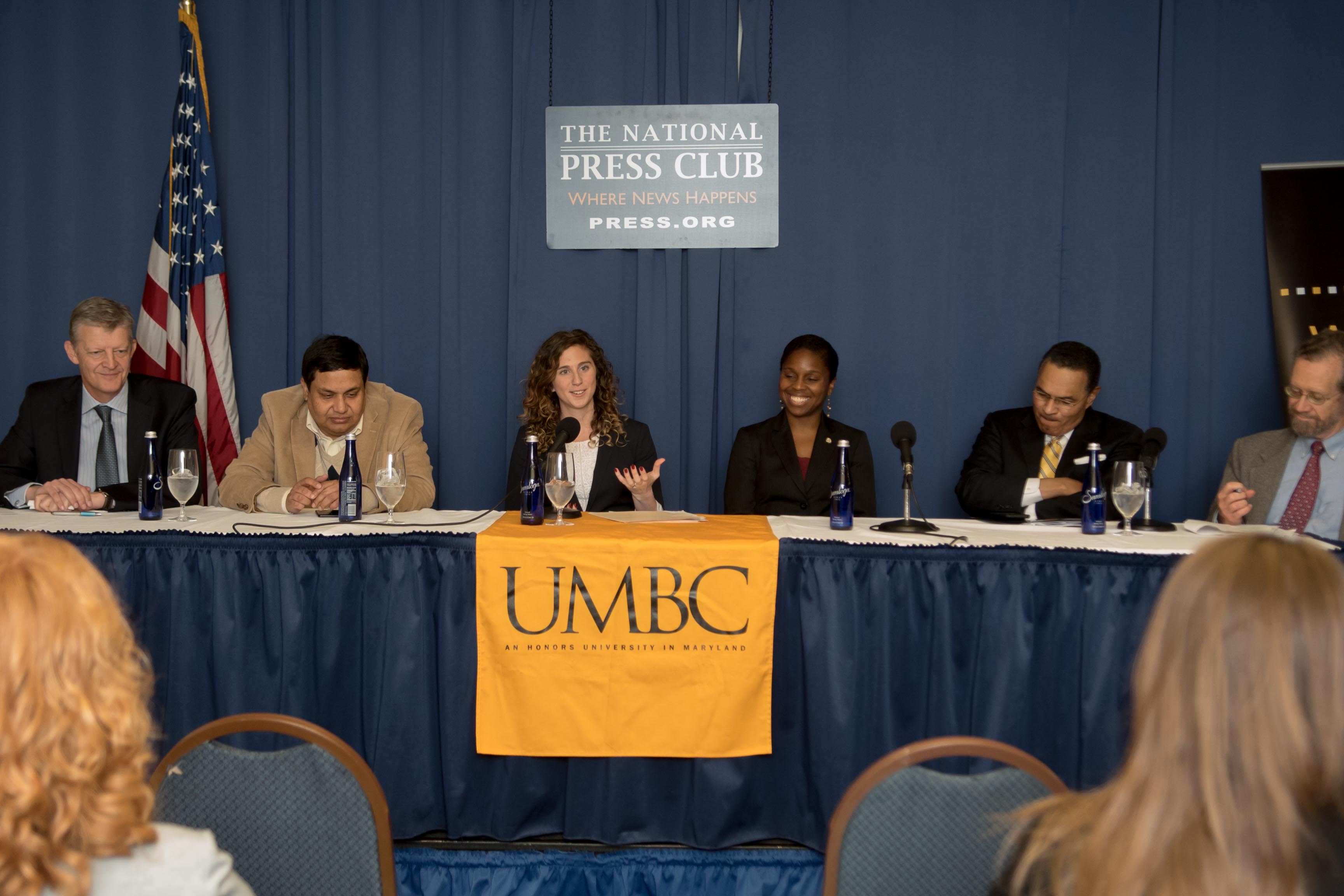
UMBC hosts faculty, alumni and corporate partners at the National Press Club to discuss cybersecurity and industry challenges

Cybersecurity is regularly a headliner in the news, especially when personal information stored online has been compromised, whether through a breach, hack, or threat. On Thursday, December 7, UMBC hosted experts from industry and academia at the National Press Club to discuss the cyber challenges professionals face, and how those groups can work together to prepare future generations of cybersecurity professionals.

Scott Shane, a reporter with The New York Times, led the discussion with five panelists representing industry, small business, and higher education. “I think it’s fair to say the internet was built without adequate attention to security,” stated Shane, who writes about cyber and information attacks regularly. “It’s almost like somebody who starts a bank with branches all over the world, and after it’s up and running and has millions of account holders, suddenly starts to think about safes, locks on the doors and bulletproof glass. I think that’s sort of the stage that we’re at right now.”

UMBC President Freeman Hrabowski and Anupam Joshi, professor and chair of computer science and electrical engineering, and director of the Center for Cybersecurity at UMBC, were joined by alumni and partners who have been working together on the urgent need to build the cybersecurity workforce. Hrabowski explained that there are currently about 350,000 unfilled cybersecurity jobs, and that number is expected to continue to grow. By 2021, it is anticipated that there will be approximately three million job openings in cyber-related fields.

Over the course of his professional career, Nigel Faulkner, chief technology officer at T. Rowe Price, has experienced the emergence of technology and many changes. “As the CTO of a medium-large company, cyber is a defensive investment for us. The best thing that can happen is nothing happens,” Faulkner said, adding that he is always thinking about whether the company is investing enough, doing the right thing, and making the right connections in the industry to keep clients’ information safe.

As president and founder of TCecure, LLC, and cybersecurity academic innovation officer for University System of Maryland (USM), Tina Williams ’02, computer science, shared the importance of building security into technology from the beginning, rather than adding these features on at the “tail end of a development cycle.” Not only does her company handle security, they also monitor threats and risks that can compromise the technology’s health. In her role at USM, Williams represents the system as a whole to integrate academia and academic research, relationships, and resources into what’s taking place nationally, at the Federally Funded Research and Development Centers.

As head of UMBC’s Center for Cybersecurity, Joshi explained that UMBC is combating these national challenges by partnering with industry and government leaders to conduct research that addresses specific real-world needs that benefit both. Collaborative relationships, such as UMBC’s work with Northrop Grumman and T. Rowe Price, is one way that UMBC is working to cultivate the next generation of cybersecurity talent.

As an alumna of UMBC and a current employee at Northrop Grumman, Lauren Mazzoli ’15, computer science and mathematics, M.S. ’17, computer science, a systems engineer in the Future Technical Leaders Program at Northrop Grumman, discussed her experience in the Cyber Scholars Program. The Cyber Scholars Program works to increase the participation of women and underrepresented minorities in the field. Mazzoli explained that her experience at UMBC, in the Cyber Scholars Program, and working alongside mentors on and off-campus led her to be involved with continuing to encourage women to pursue careers in cybersecurity. “For me it’s been a product of the relationship between academia and industry, that have allowed me to find my own career path, and at the same time help others find theirs,” she explained, noting her passion for helping students consider careers in cybersecurity and related fields.

“We know there’s a huge workforce that we need and we can’t fill that pipeline. So yes, we need more women, yes, we need students of all backgrounds, but we need diversity of thought, experience, education, and problem-solving skills,” said Mazzoli, adding that it is important for students to know from a young age that cybersecurity is a field they can pursue.

Banner image: Tina Williams, center, talking with Anupam Joshi, left, audience members during the Cyber Press Event at the National Press Club. Photo by Abnet Shiferaw ’11, visual arts. 

UMBC students recognized with “Opioid Epidemic Challenge Award” by America East for designing app for teens

Two students in the College of Engineering and Information Technology were recognized at HackAE, a 24-hour hackathon, earlier this month for developing an innovative app to help teens struggling with opioid issues. Agatha Turyahikayo ’21, computer science, and Gabrielle Watson ’21, information systems, won the “Opioid Epidemic Challenge Award.”

Now in its second year, the HackAE event brings America East conference students together to build software and hardware projects that address the real-world challenges facing our neighborhoods, cities, states, and country, with a specific emphasis on issues pertaining to cybersecurity, education, environmental sustainability, and health and wellness. This was the first time UMBC participated.

“Agatha and Gabrielle have applied the capabilities of crowdsourcing and social media with their app-development prowess to create a proof-of-concept app that can not only help teens at risk of opioid problems take confidence-building steps to try and help themselves but also help reduce the flow of new entrants to the nation’s opioid crisis and thus help society at large,” explains Rick Forno, assistant director of the UMBC Center for Cybersecurity and director of the Cybersecurity Graduate Program at UMBC, who is a faculty advisor of HackUMBC. “Empowering teens in this way, and especially in trying to overcome this devastating national problem, can help build and strengthen community ties and foster resilience within their generation, which among other things can reduce medical costs, law enforcement incidents, incarceration rates, and help create a healthier society for all.

Watson and Turyahikayo were asked to create an opioid prevention platform specifically for teens. The app they developed pairs teens in need with teens who wish to help others facing opioid challenges.

The opioid epidemic facing the country affects every community and demographic; however, Turyahikayo said that she was surprised to learn how widely teenagers are affected by the crisis. “Unfortunately, many of the resources we found for opioid abuse didn’t target teens very well and were not reaching those who needed help,” she explained, which led her and Watson to create an app that teens could access on their mobile phones.

While Turyahikayo and Watson were recognized for the app they created, they faced some challenges during the hackathon. They did not have prior experience developing Android apps, but used trial and error to figure out how the Android Studio program would allow them to develop an app during the hackathon. Turyahikayo is planning to continue to develop the app over winter break.

Not only does the app connect teens in need of help, it also offers a range of helpful resources. “It can help loved ones to recognize the signs of opioid abuse and help those who don’t realize they have a problem,” Turyahikayo explains.

Banner image: Gabrielle Watson, right, and Agatha Turyahikayo at HackAE. Photo courtesy of Agatha Turyahikayo.

UMBC faculty and alumnus honored by Maryland Science Center

A UMBC faculty member and a UMBC alumnus were recognized by the Maryland Science Center for their outstanding work in engineering and science. Lee Blaney, associate professor of chemical, biochemical and environmental engineering, was one of two people to receive the 2017 Outstanding Young Engineer Award, and Phillip Graff ’08, physics, was awarded one of two 2017 Outstanding Young Scientist Awards. The ceremony, hosted annually by the Maryland Science Center and the Maryland Academy of Sciences, highlights the work being done by young scientists and engineers in Maryland to advance the fields.

In his work, Blaney develops technology used to recover nutrients, such as phosphorus, from poultry litter. The phosphorus found in poultry litter often saturates the soil on the Eastern Shore of Maryland, making the water that runs off into the Chesapeake Bay a hazard for aquatic life. The technology he is testing in his lab could reduce the amount of phosphorus that ends up in the Chesapeake Bay from manure by about 90 percent.

I was extremely delighted to receive the 2017 Maryland Outstanding Young Engineer Award. Of course, this award reflects a much larger team, and I would like to acknowledge my graduate and undergraduate research assistants for their hard work in the laboratory. This award is theirs as much as mine,” Blaney says. “Much of our research focuses on environmental issues in Maryland and the Chesapeake Bay watershed, and so it was a particular honor to be recognized by the Maryland Academy of Sciences. One of my mentors likes to say that every award comes with a great responsibility to live up to the associated expectations. So, we are looking forward to continuing our research to ensure environmental quality in the Chesapeake Bay watershed for the coming decades.”

Earlier this year, Blaney received a CAREER Award from the National Science Foundation to address contaminants of emerging concern, from personal care products and pharmaceuticals, found in the Gwynns Falls watershed.

“Dr. Blaney is a dedicated professor with unique and innovative research ideas. He is a great mentor who encourages his students to think about research problems from multiple angles and asks tough questions to push us to reach for the best solution,” says Mamatha Hopanna, Ph.D. ‘22, environmental engineering, who works in Blaney’s lab.

Blaney is the faculty advisor of the UMBC’s Engineers Without Borders student organization. He has led several trips to Kenya, where he and his students developed a clean-water supply for a village with a population of 500.

Graff currently works as a data scientist and astrophysicist at the Johns Hopkins University Applied Physics Laboratory in Baltimore. He has industry experience in many fields including cybersecurity. Previously, he worked at NASA Goddard Space Flight Center and helped develop an algorithm for the Laser Interferometry Gravitational Wave Observatory. He has also developed algorithms to protect the nation’s computer networks for the Department of Homeland Security National Cyber Protection System.

The Outstanding Young Scientist Award and Outstanding Young Engineer Award have been presented each year since 1959 and 1988, respectively. To be eligible for the award, nominees must be 35 or younger if working in academic settings, or younger than 40, if working in industry.

Banner image: Lee Blaney. Photo by Marlayna Demond ’11 for UMBC. Videos courtesy of the Maryland Science Center.

Naomi Mburu receives first Rhodes Scholarship in UMBC history

Naomi Mburu ’18, chemical engineering, is the first student in UMBC history to receive the prestigious Rhodes Scholarship. She is one of 32 students from across the United States to receive this prestigious honor for the 2018 year. Several UMBC students have been finalists for the Scholarship in the past.

Established in 1902, The Rhodes Scholarship is the world’s oldest international scholarship award. Rhodes Scholars are selected based on their academic and research accomplishments, their leadership and commitment to others.

“Being selected as a Rhodes Scholar will provide me with the network and resources to be an influential scientist and education advocate on the global level,” says Mburu.  

“As a Rhodes Scholar, I will be completing a Ph.D. in engineering science and likely conducting my research under Dr. Peter Ireland to work on heat transfer applications for nuclear fusion reactors,” says Mburu. “I believe the Rhodes Scholarship will allow me to foster a stronger community amongst my fellow scholars because we will all be attending the same institution.”

As a UMBC student, Mburu is involved with research and scholars programs, and is a leader in many student organizations. As a Meyerhoff Scholar, she is a peer mentor for freshmen and sophomores pursuing chemical engineering. Mburu is also a MARC U*STAR Trainee. The Meyerhoff Scholars Program and the MARC U*STAR Scholars Programs aim to increase the number of underrepresented minorities who pursue Ph.D.s in STEM fields. She has a passion for supporting STEM education and increasing diversity in STEM fields, which led to her involvement with programs and organizations with similar missions.

“The UMBC community as a whole has been incredibly instrumental in preparing me to compete for these awards. As a Meyerhoff and MARC U*STAR Scholar, I have learned how to write compelling personal statements that express my desire to influence the world in terms of both nuclear fusion power generation and in the removal of barriers to quality education for all people,” says Mburu. “The staff and faculty in the Honors College and chemical engineering department have engaged in mock interviews with me to help me prepare for the broad varieties of questions I could be asked, and I actually found some of their questions to be more difficult than my actual interview questions.”

Mburu is currently working with Gymama Slaughter, associate professor of computer science and electrical engineering, to develop a bioreactor to extend the viability of human organs awaiting transplant. The sensors will track glucose levels, lactic acid, and nitric oxide to ensure that the organ remains healthy as it is transported to the recipient.

“Increasing the participation of underrepresented minorities in STEM fields reflects our changing world and is what we desperately need for working toward discoveries that will improve the human condition,” says Slaughter. “As a mentor, I’m fortunate to work with the best and brightest students at UMBC, including Naomi, who have a strong desire to change the world. Naomi’s aspiration is to become an advocate for scientific advancement in renewable energy sources and education equality. The Rhodes scholarship is a well-deserved recognition of the positive impact she will have in the field of nuclear engineering and on the human condition across the world. We are very proud of Naomi’s accomplishments.”

This past summer, Mburu interned at Intel and developed an interactive model to estimate the cost of coatings applied to equipment. Her work helped improve the pricing negotiations and paved the way for additional should-cost models to be established for other chemical processes.

Mburu’s success shows UMBC’s commitment to research and unique undergraduate academic opportunities is working, explains April Householder ‘95, visual and performing arts, director of undergraduate research and nationally competitive scholarships. “What is particularly striking about Naomi is that she is accomplished in doing high-level scientific research, has a sophisticated grasp of issues related to nuclear energy, and is thoroughly committed to becoming a leader and a role model for other young scientists in her field,” she adds. “It is truly rare to find this combination of intellectual virtuosity and attention to detail, along with the ability to bridge different disciplines and a true desire to give back to others.”

Outside of the classroom and lab, Mburu is involved with many local chapters of national organizations. She has served as the president and pre-college initiative chair of the UMBC’s chapter of the National Society of Black Engineers (NSBE), and currently is the vice chair for Region II of NSBE. Mburu is committed to mentoring youth and supporting them in their schoolwork. She spends time each week working with high school girls on STEM-related research projects, and worked with K-12 students on homework during her first semester at UMBC.

While Mburu was a student at Mount Hebron High School, she completed research with Lasse Lindahl, biological sciences. Her work focused on how the introduction of phosphate affected the ribosomal protein L4. She has also pursued research at The Johns Hopkins Applied Physics Laboratory and Vanderbilt University. In summer 2016, Mburu spent the summer in Geneva, Switzerland at the European Organization for Nuclear Research. She worked alongside physicists to measure the impurities found in the Large Hadron Collider particle accelerator.

“Rhodes Scholars come from all over the world, but they are unified by a joint passion to make great change in their communities,” says Mburu.

Mburu’s award is highlighted in The Washington PostThe Baltimore Sun, CBS Baltimore, The Washington Post, Inside Higher Ed, and CBS Baltimore.

Banner image: Naomi Mburu. Photo by Marlayna Demond ‘11 for UMBC.

Three COEIT faculty offer tips on protecting mobile devices and personal information from cyber attacks

UMBC faculty who focus on cybersecurity are sharing their expertise in articles across the web to help people protect themselves from fraud and hacks.

One of the projects – a collaboration between Ravi Kuber, associate professor of information systems, and Adam Aviv, assistant professor at the U.S. Naval Academy – looks closely at “shoulder surfing attacks,” which occur when people watch users of electronic devices to obtain their security codes. According to an article about them in Wired, the researchers found that a “casual observer can visually pick up and then reproduce an Android unlock pattern with relative ease.” Together, they are studying the most effective and secure patterns and passcodes to have on mobile devices.

“Observational attacks continue to represent a threat to mobile device users,” explains Kuber.

Kuber and Aviv conducted an online survey and asked participants to watch video of an actor entering passcodes on various devices using different length patterns and hand positions, and determine the authentication patterns that were entered by the actor. They found that six-digit personal identification numbers (PINs) were less likely to be successfully replicated by an attacker. Android unlock patterns with six steps had the highest duplication rates and led to more attacks.

“While six-length Android unlock patterns may sound like a more secure choice from onlookers, in reality, users may be better off selecting a six-digit PIN instead,” says Kuber. “Users should consider turning off feedback lines when entering patterns to lower the change of observation attacks.”

Securing mobile devices is only one aspect of what people need to consider when protecting their personal information from hackers and attacks. In an article in The Conversation, Rick Forno, assistant director of the UMBC Center for Cybersecurity and director of the Cybersecurity Graduate Program at UMBC, discussed the Equifax data breach. He explains that companies need to hire people who will be creative and solve overarching problems, rather than only address day-to-day issues. “Until then, major breaches will keep happening and may get even worse,” Forno warns.

Even though basic cybersecurity practices have been identified and discussed for several years, Forno says that many individuals, companies, and government agencies do not follow the recommended practices. “We all must take a realistic look at the state of cybersecurity, admit the mistakes that have happened, and change our thinking for the better,” he explains.

Karuna Pande Joshi M.S. ‘99, computer science, Ph.D. ‘12, computer science, assistant professor of information systems, shared several ways that people can protect themselves and their information from identity fraud in an article in WalletHub. Many of the tips that she shares are related to technology and the internet. Being mindful about who you connect with online, and regularly monitoring online accounts and credit scores can help keep information safe.

While social media may contribute to some identity fraud that consumers face, Joshi thinks that diligence can protect people from fraud. “I believe that a regular audit of all organizations managing private data of consumers should be mandated,” she says.  

To learn more about Kuber and Aviv’s work, read the article about them in Wired. This research was also featured in Gizmodo, Tech Times, Helpnet Security, Lifehack Australia, Komando.com, ThreatPost, and Thai Tech. Read Forno’s full article in The Conversation, Charlotte Observer, and Los Angeles Times. Joshi offers additional recommendations in WalletHub.

Image: Mobile technology in use. Photo by Flickr user WOCinTech Chat under license CC BY 2.0.