We use cookies for analytics and, unless you opt out, advertising.
You can opt out of advertising at any time.UMBC uses essential cookies to run this site. With your permission we would also use analytics cookies (to understand how the site is used) and advertising cookies (to measure and target our ads on other platforms). Nothing else loads unless you accept. You can change your choice any time from Cookie Settings in the footer.Privacy Policy
EssentialRequired for the site to work (login, security, your cookie choice). Always on.
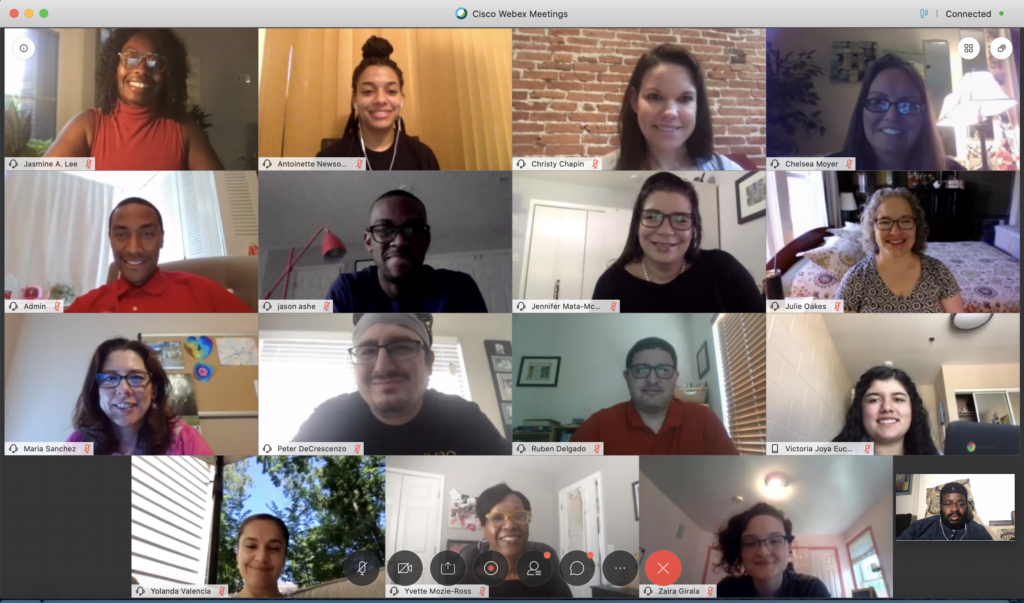
At a time when many in our nation are struggling with how best to engage in discussion along ideological divides, members of UMBC’s community came together this week to think about ways of balancing their shared commitments to free speech and equity and inclusion.
“As a university, we’re continually balancing our shared commitments to equity and inclusion with our commitment to individual’s right to free speech,” said Kathy Ibitoye ’15, financial economics, a civil rights investigator with UMBC’s Office of Equity and Inclusion. “We hope that as a community to get a better understanding of how to look at free speech, how to continue to create and maintain inclusive environments, and how to engage in dialogue when speech has a harmful impact on another individual.”
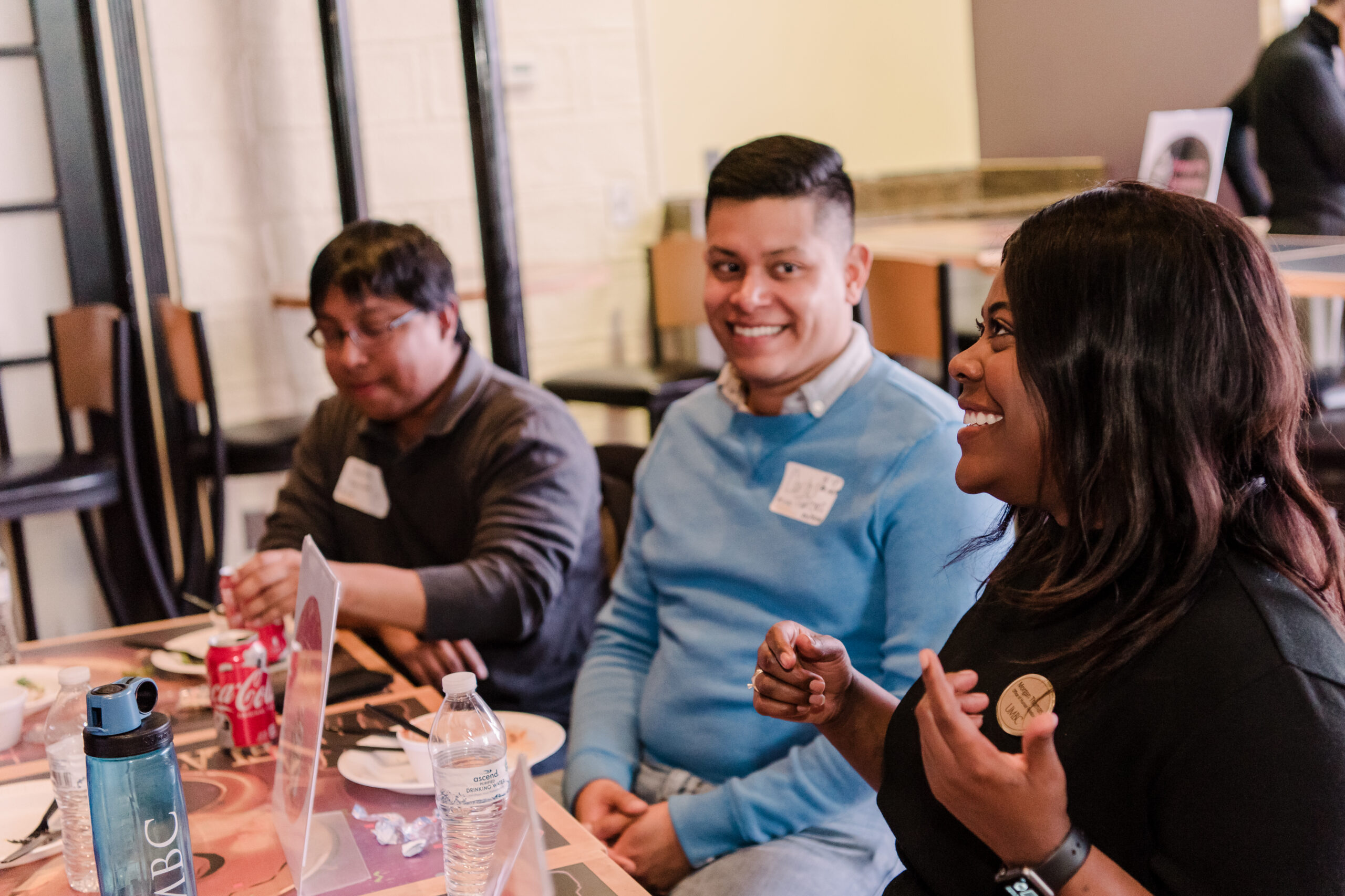
Student moderators Tirzah Kahn ’21, information systems, and Zachary Kay ’22, history, shared questions suggested by participants with the panelists, beginning with the deceptively simple question: What is free speech? Morgan Thomas ’13, political science, an attorney in UMBC’s Office of General Council, gave an overview of the laws protecting free speech and then zoomed in on how the UMBC community fits into the picture.
Morgan Thomas at a UMBC Community Conversation event in 2019. All photos by Marlayna Demond ’11.
“Public institutions such as UMBC are required to protect the freedom of speech of its community members, which in many cases works well to advance academic inquiry, knowledge, and thoughtful discussion from inquisitive minds of all backgrounds,” she said. “All of which is important for the educational, professional, and personal enrichment of the campus community.”
Learning to listen
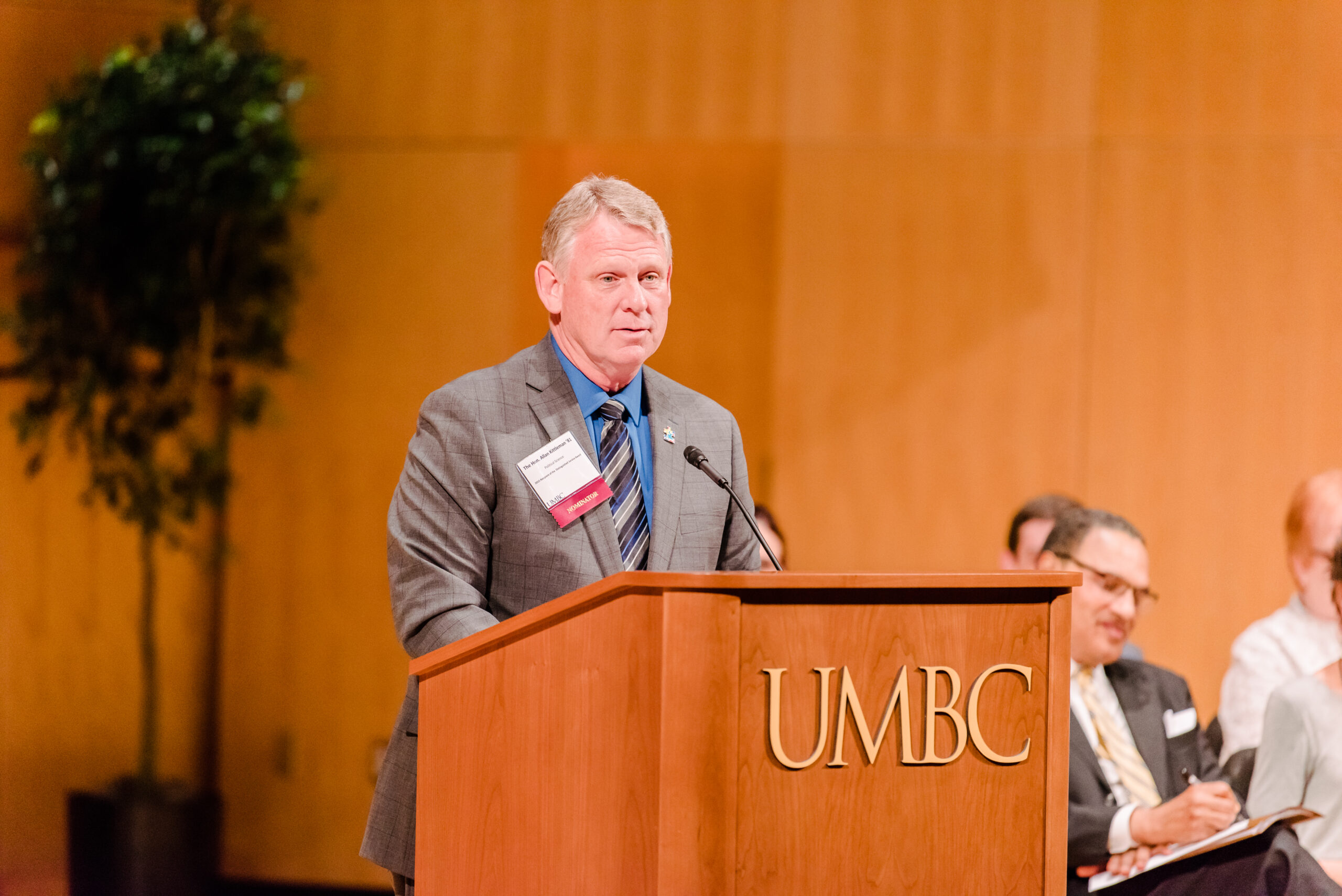
Allan Kittleman ’81, political science, former County Executive for Howard County, and a Maryland Workers’ Compensation Commissioner, spoke to the question of how best to create spaces that encourage learning, understanding, and productive respectful dialogue. After years in politics, he said the first and most important thing to do is to listen and try carefully to understand the other person’s perspective before responding.
Allan Kittleman speaks at the 2018 Alumni Award ceremony.
“We need to make sure that we look at things and find out what’s true, what’s not true,” he said. “Not jumping the gun, and making sure we investigate things…I think listening is where it starts, but then we also have to have a dialogue and we have to have it respectfully even with people we don’t agree with.”
“It doesn’t help to listen if you’re not willing to hear,” he said, after sharing a real life example of having his mind changed by a member of the opposite political party. “That’s why we have two ears and one mouth – so, we get to hear more than we talk, listen more than we talk. And so that’s, I think, the best way we can create space.”
Inclusive learning spaces
Susan Sterett, professor of public policy, shared her perspectives on how to create engaging spaces for inclusive dialogue in the classroom, including setting expectations for civil behavior early on.
“Setting some ground rules, having some faith that we can listen to each other, and recognizing that we don’t learn things that we always want to learn, are all really important points,” she said.
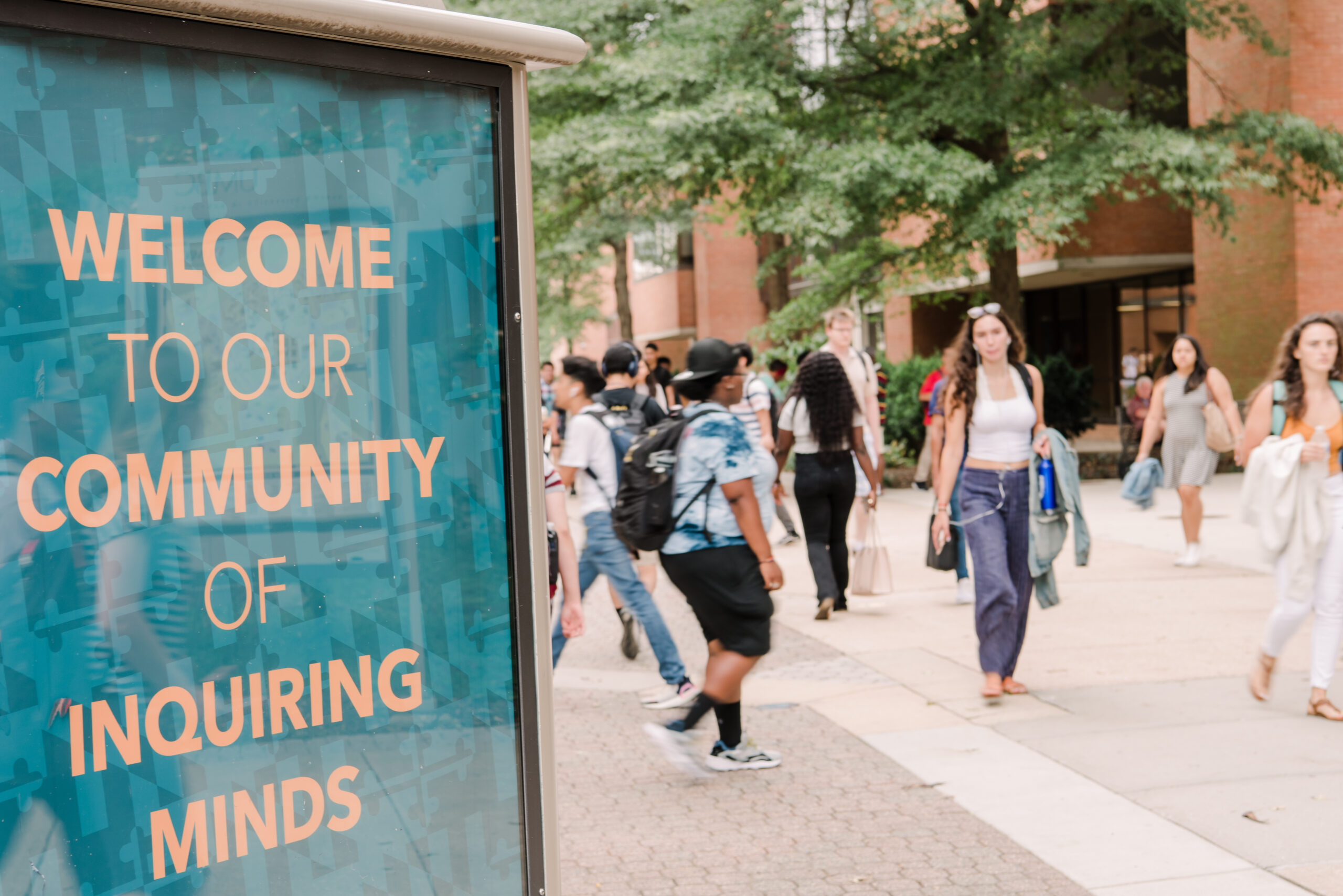
UMBC is dedicated to creating and maintaining a community of inquiring minds. Photo taken in 2019.
Among the more than 170 event participants were many students, faculty, and staff who also shared their thoughts and questions in the chat. Some pondered ways of expressing themselves while also considering the feelings of their classmates, and how to be effective allies in general.
Event panelists also shared information about a number of campus organizations focused on free speech and inclusion issues, and urged folks to take advantage of the tools and forums they provide.
Practicing core values
Being able to keep the doors open for productive conversation is an important part of any university community—and a core value at UMBC, said President Freeman Hrabowski, quoting Phi Beta Kappa head Frederick Lawrence.
“He says that ‘The purpose of a liberal education is to teach people to be able to think critically and to communicate with clarity, and to be able to…present our arguments and base those arguments on facts and evidence,’” said Hrabowski.
“And secondly, to be able to listen carefully to other points of view that may differ wildly from my own. And to breathe deeply and to listen. And then to work on ways of having debate that can lead to a clearer understanding of the common ground and most important to seeking the truth.”
For more information about future UMBC Virtual Community Gatherings, visit umbc.edu/together.
*****
Header image of The Forum in front of the Performing Arts & Humanities Building by Marlayna Demond ’11, taken in 2018.
The UMBC community was the top contributor to the 2020 Maryland Charity Campaign (MCC), supporting non-profit organizations across the state in a particularly challenging year.
UMBC’s faculty and staff contributed nearly $250,000 overall for the 2020 campaign, the highest among all state agencies and in the University System of Maryland (USM). For the past six years, UMBC has been awarded the MCC Participation Award for our commitment to giving. Contributions from UMBC community members in 2020 represent 42 percent of the USM total and 13 percent of the total from all state agencies.
“Our success this year truly demonstrates that hope is alive at UMBC,” says UMBC co-chair Dana Bradley, dean of the Erickson School of Aging Studies. “In a year of so many challenges, co-chair Chris Steele and I are so proud of our fellow Retrievers.”
Supporting causes with personal meaning
Many contributors give to organizations with personal meaning to them—from food banks to animal shelters, and even to UMBC itself.
Seth Nagle, athletics, shares, “I am always excited to support the Maryland Charity Campaign each year. I made my pledge to support The Children’s House at Johns Hopkins Hospital, Inc. because I am passionate about the work that they do.”
“I give to the Board of Child Care,” says Catherine M. Bielawski, assistant dean in COEIT, “because it helps youth who have experienced trauma, and their families, achieve success in their communities, helping to ensure that their communities remain a place to live, work, and play.”
For more information about the Maryland Charity Campaign, visit mcc.umbc.edu.
Featured photo: View of UMBC’s Albin O. Kuhn Library. Photo by Marlayna Demond ’11 for UMBC.
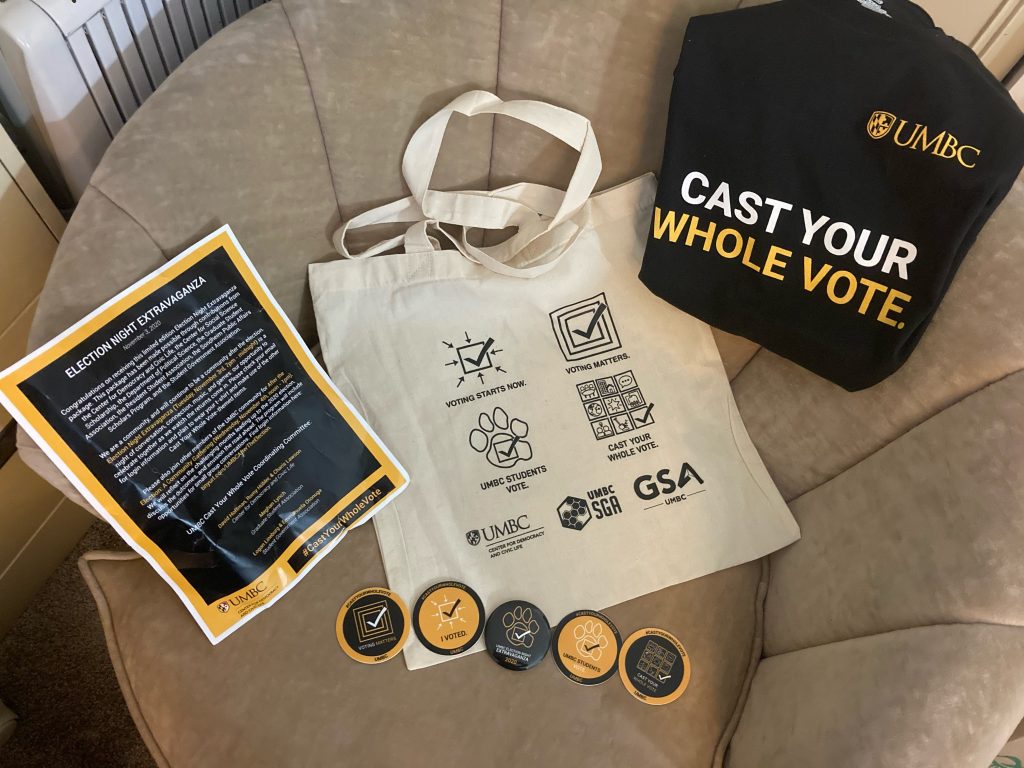
Most of us while away election night in our homes, nervously tapping away at our laptops, anxiously consulting cable TV pundits, and (possibly) eating a pint of ice cream along the way. For students away from home, UMBC has since 2004 created a much more exciting and communal way to spend the evening—an Election Night Extravaganza, to be precise—filling large sections of The Commons with balloons, streamers, and activities to celebrate democratic engagement.
Thanks to COVID, this year’s celebration was reenvisioned via the online chat platform Discord, complete with chat rooms to match the community found in the #skylight-room, #sports-zone, and other physical spaces everyone was missing this semester.
Glimpses of this year’s virtual Election Extravaganza.
Never has coming together been more important, wrote David Hoffman, director of UMBC’s Center for Democracy and Civic Life, at the start of this year’s event which drew almost 200 people. “We are a community, and will continue to be a community after the election.”
*****
Header image from the 2016 Election Night Extravaganza, courtesy of SGA.
The first half of UMBC’s academic year may have looked different from years past, but Retriever pride remained steady as the community pulled together to make the best of a challenging situation and continue to offer an exceptional learning experience for our students.
Teams of more than a hundred staff and faculty worked through the summer to plan the “Retriever Return” to campus, placing the health and safety of students, faculty, staff, and the surrounding community at the forefront of all decision-making. With 91 percent of courses fully online and 7 percent hybrid, just 2 percent took place in-person this fall. Extensive monitoring of symptoms for those on campus helped to keep the campus safe while learning and working.
“I have been amazed by the level of talent and commitment, compassion by everybody involved in the planning…Everyone has shown an unbelievable dedication to the UMBC community,” said UMBC President Freeman Hrabowski. “We have stepped up to the plate and supported our students and each other, and we should all feel inspired by this.”
A campus pivot
While the number of people working and living on campus may expand slightly in the spring, the focus will continue to be on distance learning and the safety of the community as instructors draw upon what they learned about how to best reach students remotely. Through the new Planning Instructional Variety for Online Teaching, or PIVOT, program, hundreds of faculty spent the summer training to create robust, high-quality remote classroom experiences. Many also embraced ways of making classes more personal by incorporating pets, leading group cheers, and building scientific labs in their own basements.
“I can’t wait to be back in a classroom with students…It’s my favorite thing to do. But this is a global pandemic…so how do we use the tools we have and the innovation UMBC is known for to make the best learning experience possible for our students?” said Kate Drabinski, principal lecturer in gender, women’s, and sexuality studies.
Students also took advantage of the Fostering Online Learning Improvement and Opportunity, or FOLIO, program, which offered an extra layer of asynchronous tools and support for students navigating the world of online instruction for the first time.
“My professors are being very accommodating,” says senior geography and environmental systems student Hugh O’Connor. “They all make sure students feel welcome to have a video call with them almost anytime in lieu of office hours and post recordings of lectures to help students stay on track. Some professors have even decided not to require textbooks because they know financially times are tougher for some students due to the pandemic.”
Resources for students
The cost to attend UMBC will decrease 22 percent compared to last fall for in-state undergraduate students registered for courses offered by the main campus. Since March the Stay Black & Gold Fund has distributed more than $270,000 in emergency funding and continues to assist students in need, especially those who are not eligible for funding from the federal CARES grant and have exhausted their financial aid options. Although the Retriever Essentials Food Pantry had to close for in-person visitors, organizers worked with UMBC Police to create pre-packed bags of nutritionally balanced nonperishable food and travel-sized toiletries for community members in need.
While UMBC’s incoming undergraduate students didn’t get to experience some of the firsts of a typical semester this fall, they all received a special box of swag to mirror some of the special traditions they would have experienced on campus, said Nancy Young, vice president of student affairs. Those living on campus also enjoyed Friday night bingo, Saturday night movies, and other special socially-distanced get-togethers.
“We wanted to convey the traditions to our new students and make them feel welcome,” said Young, who invited students to decorate their rooms at home with the Retriever pennants and posters they sent. “We surprised them, and it was a huge hit. They were all really excited.”
*****
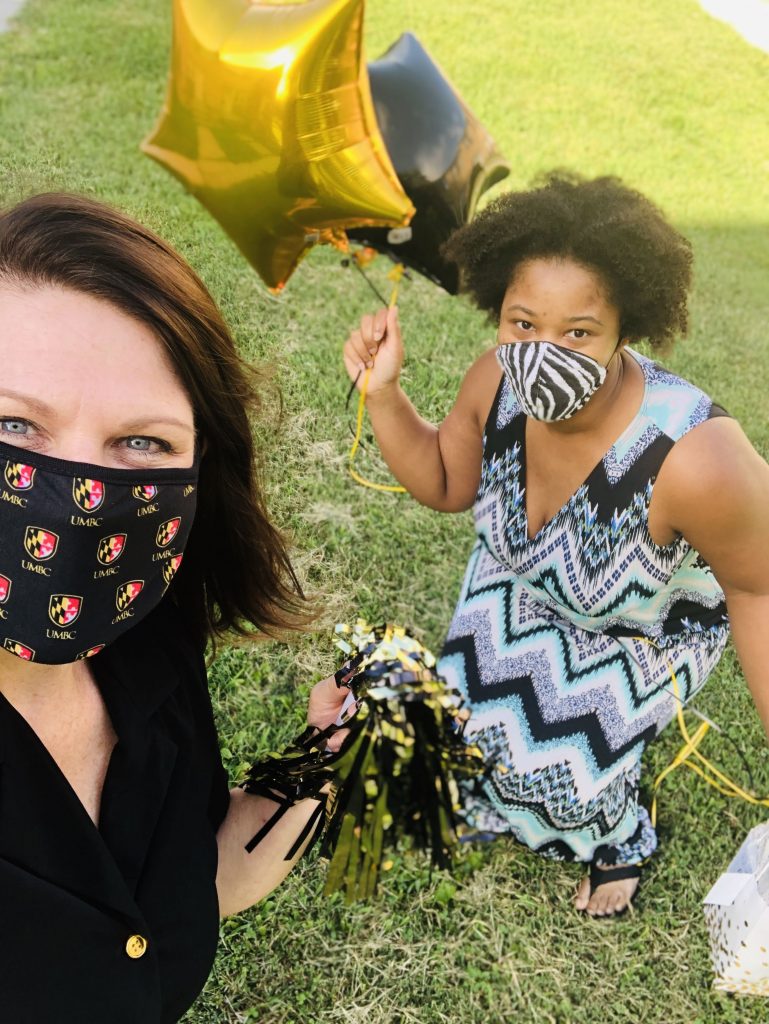
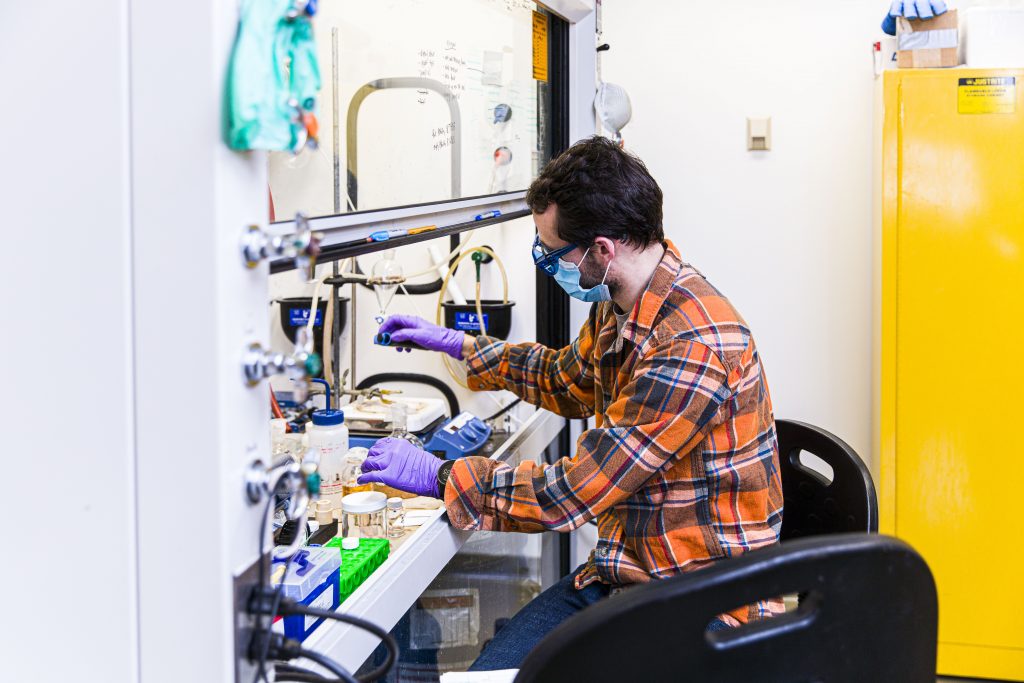
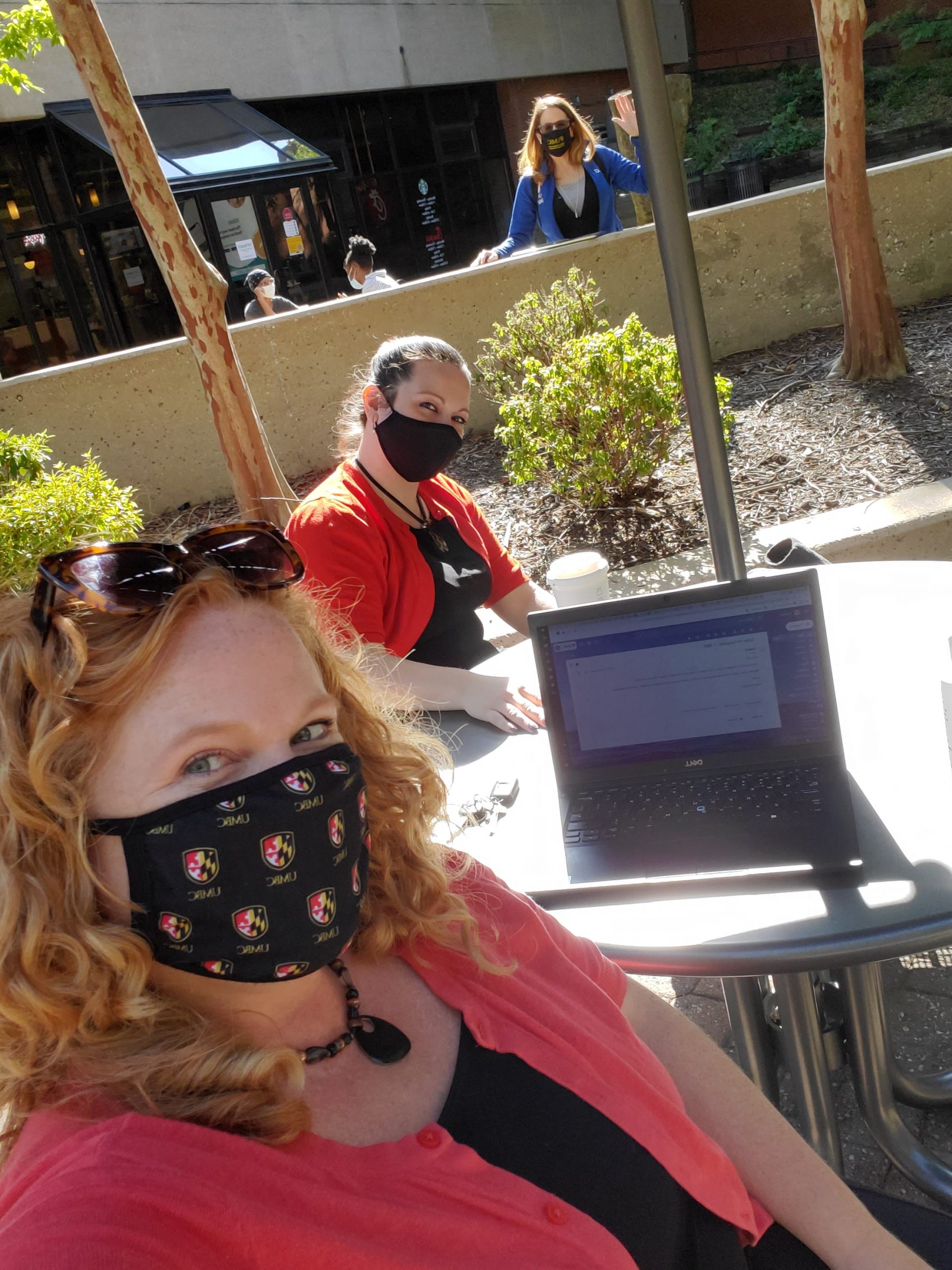
Capturing the moment Whether working from home or studying and playing (carefully) on campus, community members joyfully chronicled the strange semester in a variety of ways. Photos courtesy of Melissa Penley Cormier, M.F.A. ’17, Cindy Greenwood, Amanda Knapp, David Hoffman, Ph.D. ’13, and Marlayna Demond ’11.
It’s no secret why first generation college students thrive at UMBC. Our network of first generation staff and faculty make it the center of their work as educators and researchers.
Sometimes, an “aha moment” appears as a bright light bulb. More often than not, though, the spark that fueled it is what really matters.
For Juwon Ajayi, that moment first happened in Nigeria. As a kid, he accidentally stuck his finger in an electrical socket. He laughs about it now, but that somewhat painful experience got his brain ticking. How was the power traveling? Why did it hurt so much?
Like many kids, Ajayi found pleasure and intellectual stimulation in Legos and dreamed of someday building his own car. When his family moved to America, he had an inkling of what he might do with his academic leanings—but college felt a bit like uncharted territory.
“It was hard. There was a big learning curve,” says Ajayi, a senior computer engineering student who started off with three years at Anne Arundel Community College while other members of his family were taking similar paths. “Everything was new. Considering my major, there was really nobody that could help me when I didn’t understand…so I basically had to try to understand it myself.”
Thankfully, when Ajayi transferred to UMBC he found a home first with the Louis Stokes Alliance for Minority Participation (LSAMP) program and then with the McNair Scholars community, a nationwide program focused on helping first generation students be successful in college and graduate school. Today, he’s on his way to earning a degree, and also making a difference by helping new McNairs find their way. But for many students, the hardest part is getting in the door in the first place.
“As far as the application process, I was pretty much on my own. I really just kind of winged it, which was not the best, looking back,” says Kaitlynn Lilly, a junior majoring in physics and mathematics. Lilly wound up landing on her feet despite the challenge of writing the dreaded personal essay for her college application. “That was the biggest curveball for me. It was scary—so much depends on how you come off on a piece of paper, right?”
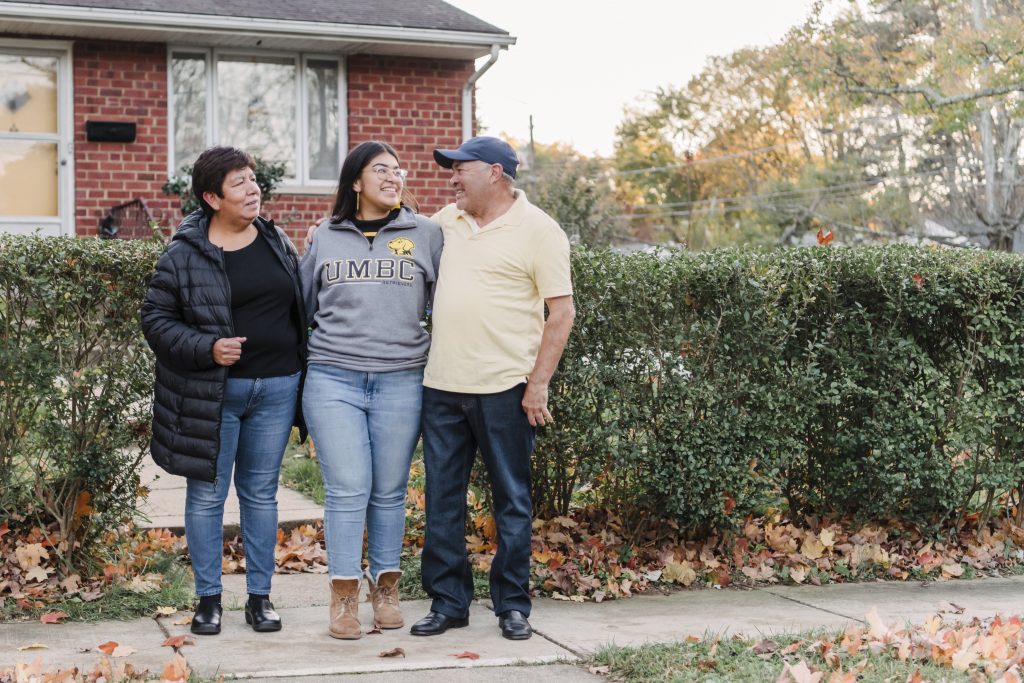
Student Julia del Carmen Aviles-Zavala (center) and her family. Photo by Marlayna Demond ’11 for UMBC Magazine.
As the first in her family to graduate from high school, Julia del Carmen Aviles-Zavala, a junior psychology major at UMBC at The Universities at Shady Grove, also found the process extremely intimidating at first.
“I was constantly feeling unsure of what class to take, and anxious as to if my classes would transfer to my major once I got to UMBC,” she says. “Honestly I was just not sure how ‘college’ worked, and I did not have a concrete idea of an outline for my next four years.”
UMBC is known for being a champion of students from all backgrounds, so it’s no surprise to find that first generation college students make up approximately 25 percent of the current student body—or that UMBC would be a huge draw for faculty and staff who come from very similar backgrounds. Fueled by their own experiences, they created the First Generation Network, resulting in programming—covering everything from social skills to financial aid to planning for grad school—and research, and a community truly dedicated to the success of first generation students.
IT’S PERSONAL
Amanda Knapp is proud of where she comes from.
As a country girl from rural West Virginia and the daughter of two parents who hadn’t finished high school (her mother later completed a BS in Nursing in 2018), Knapp took joy from the friends and ideas she found in academia. Knowing she’d need to pay her own way to college, but eager to get away, she worked multiple jobs through high school and college—including one as the bumblebee mascot for an Old Country Buffet and another loading tractor trailers with mail and heavy packages until the wee hours of night.
It was tough work, but it gave Knapp the freedom to make important connections at SUNY Buffalo, like managing a 3,000-member ski club and joining the women’s rugby team. There, not only did she find friends and professors who helped guide her, but a pathway to her current work as associate vice provost and assistant dean for Undergraduate Academic Affairs at UMBC.
“Working in this field is a way for me to give back to a profession that literally changed the course of my life,” says Knapp, whose position gives her direct ways of helping students via student success efforts, the Academic Success Center, and the year-old First Generation Network.
“To be able to help someone remove those barriers so they don’t have to face them—or just know that they have someone who cares about them—is what makes our campus so special. There are so many of us on this campus.”
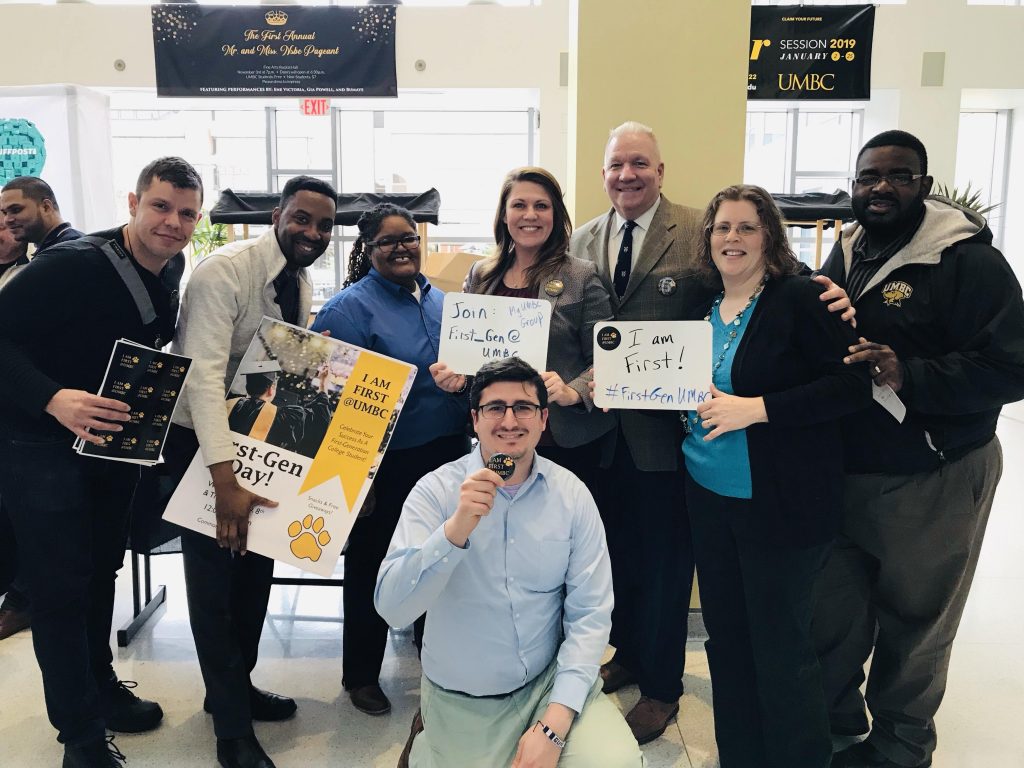
First generation faculty and staff helped celebrate their students at the 2018 First Generation Student Day. Photo courtesy of Amanda Knapp.
Faculty and staff who are first generation college graduates themselves often can see the issues their students are facing before the students themselves. That means a big part of the work is giving students tools they didn’t even know they yet need, says Michael Hunt ’06, M13, mathematics, director of the UMBC McNair Scholars Program and a current doctoral student in the Language, Literacy & Culture program at UMBC.
Hunt describes a common scenario: A student applies for summer research opportunities all over the country, and is accepted by a second choice location. The student wants to know if they have other options, but the first place is giving them a deadline to respond. The student stresses, not knowing what to do.
“So, what do I do? I say, ‘Well, did you email them? Did you pick up the phone and call them?’ And the student says, ‘We can do that? I’m allowed to do that?’” says Hunt, a graduate of both the McNair and Meyerhoff Scholars Programs. “So you get them to sort of recognize what they are able to do and help them take that to the next level. And that’s what it is for us. It’s okay; I’m going to show you how to play the game.”
Hunt has always been an outgoing person and educator, warm and affirming. In the age of social distancing, he and the McNair team have upped their game in new ways, offering fun and informal ways of socializing, including web-based “hype sessions,” student group chats to provide both academic and social structure.
As a fellow first generation college student, Bill LaCourse, dean of the College of Natural and Mathematical Sciences, loves to see and hear about these projects working for students. Growing up in Connecticut, as the first in his extended family to attend college, LaCourse worked as a bike mechanic, a hospital laundry washer, a cook, and a stock clerk in order to save up for college.
Along the way to his eventual doctorate in chemistry, LaCourse learned how personal relationships and mentorship can really make the difference for students trying to figure out their options.
“We are all mentors for each other,” he says. “We are all role models to somebody whether we are a good role model or a bad role model. That’s something that’s important to have because as I went forward, I had my good ones, but I had my bad ones as well.”
Looking back on his own experiences, LaCourse sees value in what he learned. Today he works to create inclusive environments for underserved students in his college and beyond.
“The whole mission for me is to have people not make the same stupid mistakes I did,” he admits. “They don’t have to waste their time and learn everything the hard way. I’ve done that. I’ve come through the brush and the copses to get where I needed to go. They can have it better because of what I went through.”
LOOKING DEEPLY AT CAUSES, SOLUTIONS
If personal relationships are one side of the student success coin at UMBC, the other is research.
In her work with Knapp in the Academic Success Center (ASC), Delana Gregg, M.S. ’04, instructional development systems, Ph.D. ’19, language, literacy, and culture, hears about student experiences directly. As director of assessment and analysis and a first generation student herself, Gregg’s position also lets her combine her interests and daily work into her research.
Driven by UMBC student data and surveys, Gregg’s recent doctoral dissertation focuses specifically on the experiences of first year and transfer students who are the first in their families to attend college. The goal? To determine which experiences on campus—such as service learning and internships—make the most difference, and why.
“After they had these community-based experiences, what students said was they felt socially connected, they felt like they learned how to work on a team….And they felt academically connected,” says Gregg, feeling like they were using what they learned. “And this gave them a sense of belonging. They understood what their purpose was. It wasn’t just like ‘I’m going to college because I’m supposed to.’ It’s ‘Oh, I see myself in a career that I could do with this degree.’”
As the youngest of 11 children in a low-income family, and a McNair alumna herself, McNair program coordinator Antoinette Newsome works one-on-one with students as they navigate their classes and relationships with professors, as well as plan for a future in graduate school. Because of her background, Newsome feels a deep pull to study the ways this work impacts first generation college students, and the responsibility of institutions in the retention of these students.
“It is imperative for first-generation college students to find faculty and staff who come from similar circumstances because oftentimes we feel alone in navigating this huge higher education system,” says Newsome, who is working toward a Ph.D. in Student Affairs at University of Maryland, College Park.
“Knowing that your professors and/or staff members will understand what it means when you have to miss class due to taking care of a family member or maybe have to be late since you live off campus and work multiple jobs is important,” says Newsome. “Life happens to our students and knowing that faculty understand the reality and can provide some support through it is very comforting for these students.”
The McNair Scholars community is continuing to connect virtually during the pandemic. Photo courtesy of Michael Hunt.
At this fall’s Hill-Robinson McNair Lecture, Jasmine Lee, director of Inclusive Excellence & Initiatives for Identity, Inclusion, & Belonging in the Division of Student Affairs at UMBC, reiterated the need for mentors of color for students of color, especially within the first generation community. As a product of the Eastern Michigan University McNair Scholars program, Lee’s doctoral research uses a storytelling-based approach to identify common factors for academic resilience among certain groups of underserved students—Black, first generation, and low income—at predominantly white institutions.
“Separately, any of these challenges or barriers can feel overwhelming. They can lead to hopelessness and can lead to academic disengagement. Take them together, and it is absolutely no surprise that the fourth, fifth, and sixth year graduation rate of these populations continues to fall well below the national average,” says Lee.
However, she found, when educators take an anti deficit approach to their work, seeing the value in cultural wealth and personal stories, they can begin to face a number of common barriers to success: business continuity challenges, lack of nurturing supportive resources, and lack of representation. For Lee, the research plays into her everyday work at UMBC.
“Students need affirmation, support, and advocacy,” she says. “Affirmation shows up in our micro-affirmations. Seeing them, the sense of mattering, that they belong, that when I see you across the hallway, I smile. That I remember things about you because you matter to me.”
All of these findings help our students, these researchers say. That’s a goal and an imperative, says LaCourse.
“We need to scour the data to look for the people who have excelled without anybody’s help and give them some reward for that,” he says. “And then in the meantime, we can focus our attention on those who need it—and my thing is that everyone has potential. We let them through the door at UMBC, however we do that, we are morally and ethically committed to give them the best education possible. That’s our job.”
NETWORKS OF SUPPORT
Finding the right people in college is so important, just as much for guidance and lifting one’s spirits as for having a community to cheer you on when you’ve succeeded. That’s why UMBC offers a variety of groups for new first generation students, no matter what their background or where they hope to go.
In addition to the McNair Scholars, for 30 years, UMBC—now within the scope of the Office of Academic Opportunity Programs—has run several federally-funded programs offering services and mentorship to underrepresented minority students, as well as low income and first generation students. Educational Talent Search covers grades six through twelve, and Upward Bound focuses on high schoolers.
Corris Davis ’98, biological sciences, M.P.P. ’19, M6, who oversees the office, intentionally hires first generation students as staff because it helps the pipeline of support overall.
“My office sits in a really unique place,” says Davis, who is also pursuing a doctorate in public policy at UMBC. “We’re able to see what goes wrong in K-12, and we’re able to try to correct those things in some of our participants before they get to higher ed.”
Julia del Carmen Aviles-Zavala connects virtually with Chelsea Moyer and Iris Schauerman, two Shady Grove campus staff who have helped her along the way. Photo by Marlayna Demond ’11 for UMBC Magazine.
Similarly, via the Achieving Collegiate Excellence and Success, or ACES Montgomery, program, senior del Carmen Aviles-Zavala received assistance en route from high school, and through her two years each at Montgomery College and UMBC at Shady Grove, respectively. Through the program, she also made friends with other first generation students, she explains.
“Any question I had about FAFSA, registering for classes, or keeping track of my credits, ACES was always there to guide me,” she says. “Although their profession is to help students, I always felt such genuine interest in my academic wellbeing. I truly have felt that my coaches want me to succeed, and I have been able to do just that because of them.”
Knowing that there are plenty of first generation college students beyond the ones directly affiliated with McNair and the other programs, Davis and others on campus started a First Generation Network to open up mentorship opportunities and connect faculty, staff, and students on campus. Even during the pandemic, the group has offered monthly virtual brown bag sessions, and a virtual First Gen Day celebration.
“We’re starting out small, but we’re always thinking, ‘What can we do to serve more?’” says Davis. “We’re growing into something we hope will be more structured. The goal is to just help build this community…when students can find people who are willing to go out of their way to make sure they’re successful, that’s a wonderful thing.”
SIGHTS SET ON SUCCESS
Once computer engineering student Juwon Ajayi got himself on track with the McNair program, his focus went from his own needs to those of others. As the lead McNair Student Ambassador, he checks on fellow scholars at least once a week. He’s even created detailed spreadsheets to help his friends track their grades and applications to graduate school—something he had to figure out on his own.
“When I was at my community college, that’s when I started developing an idea of trying to help other students mainly because if I am struggling at it, there’s a 100 percent chance they are probably struggling at it, too,” he says. “We’re kind of like a community helping together. So as an ambassador, if it’s something that I can help with, I will help with it.”
Senior psychology major Ting Huang has found assistance from the Shady Grove community as well as the McNair program, even from afar.
“At Shady Grove, many of the faculty and staff helped promote a diverse environment that made me feel comfortable reaching out for help. I think that that was the most important support I have gotten as a first-gen student because I remember being very afraid to reach out when I was in Montgomery College and I felt so afraid applying for transfer to UMBC,” she says. “But now, with the help of McNair, my mentors, and other campus resources, I’ve built confidence and I’m applying to graduate school in December.
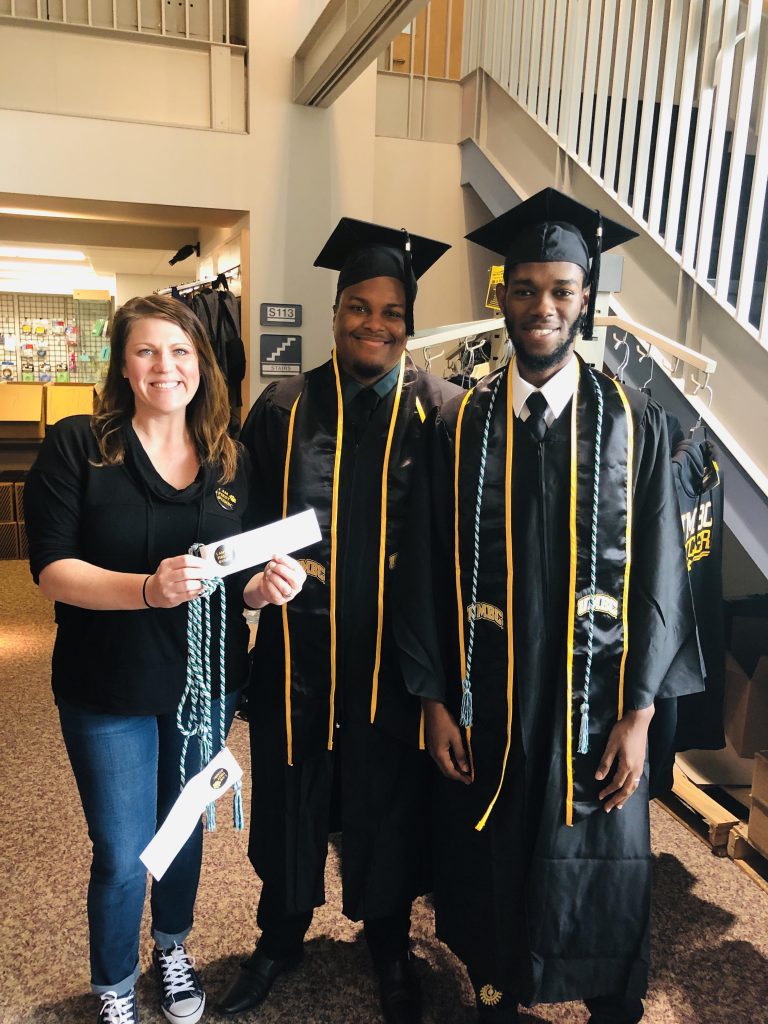
Amanda Knapp (left) awards first generation paraphernalia to some brand-new grads. Photo courtesy of Knapp.
While classes were happening in person physics major Kaitlynn Lilly found a special way of passing along the help she’s received – by tutoring students at Arbutus Middle School. The four hours a week she spends working on math with sixth graders is good practice; someday, she hopes to be a professor.
“I really like having an impact on somebody. And so I think it’s really – I think it’s a fun challenge to be able to take what you know and explain it in a way that somebody else will be able to understand. And just seeing the change in students as you work with them for a long time is really, really important to me,” she says. “And … means more than any accomplishment that I could have for myself, just seeing somebody else be able to go through those same things.”
Making it into college is one thing for first gens; finishing is quite another. So, when commencement day comes, UMBC’s first generation community likes to make a big deal of it. In December 2019, the last in-person commencement before the pandemic forced the ceremony to go virtual, Knapp posed with a group of graduating seniors wearing special green and white cords and “I am First Gen” pins.
Knapp gets a bit verklempt just thinking about it. Maybe that’s because she can see herself—and the journey—in those students.
“It’s just such a special moment for everyone,” says Knapp. “They’re so excited, like ‘Wow, you’re honoring me.’ And then we get to tell them how proud we are of them.”
Every so often, we chat with an alum about what they do and how they got there. By day, Melissa Penley Cormier, M.F.A ’17, intermedia + digital arts (IMDA), helps faculty and students at UMBC create the graphic pieces they need for presenting their research. By night, she’s building an arts practice that draws from nature and scientific processes. Here, Cormier gives us a peek into her life as an artist.
Q: Can you tell us about the type of creative work you are doing these days?
A: I love exploring different forms and processes of photography while also mixing some of the finished results and presentation with digital media. Although the current situation makes it difficult to show work and create installations, I have a small studio in the newly renovated Long Reach Village Center in Columbia that I’ve been using for a few months to test out photography, drawings, and projected works. Finding virtual ways to show art work has been a new challenge, but also this time has made it fairly difficult to fully focus on creative endeavors. As hard as it has been, I often use my work as means of allowing myself to follow interests or take time out to just look closely. So recently, my photography has centered on my garden and nature because it has been important for me to get outside as much as possible.
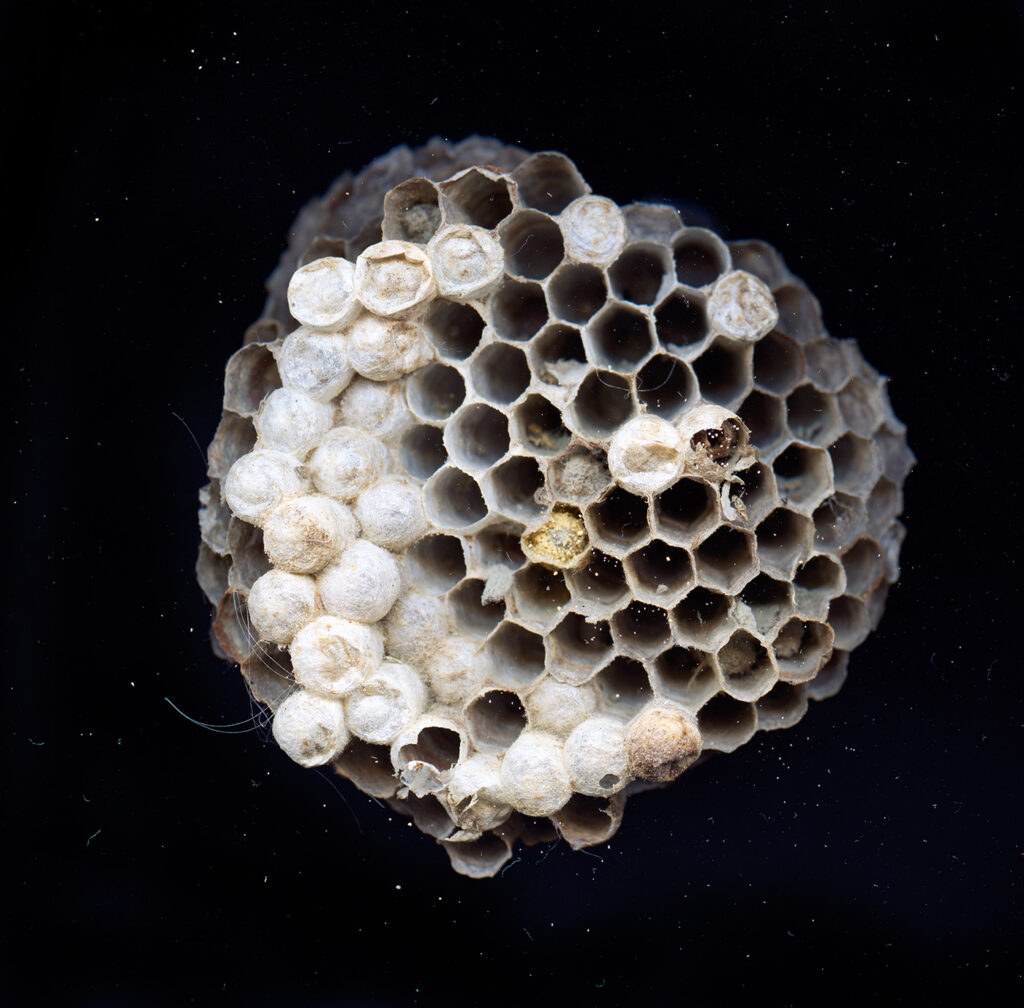
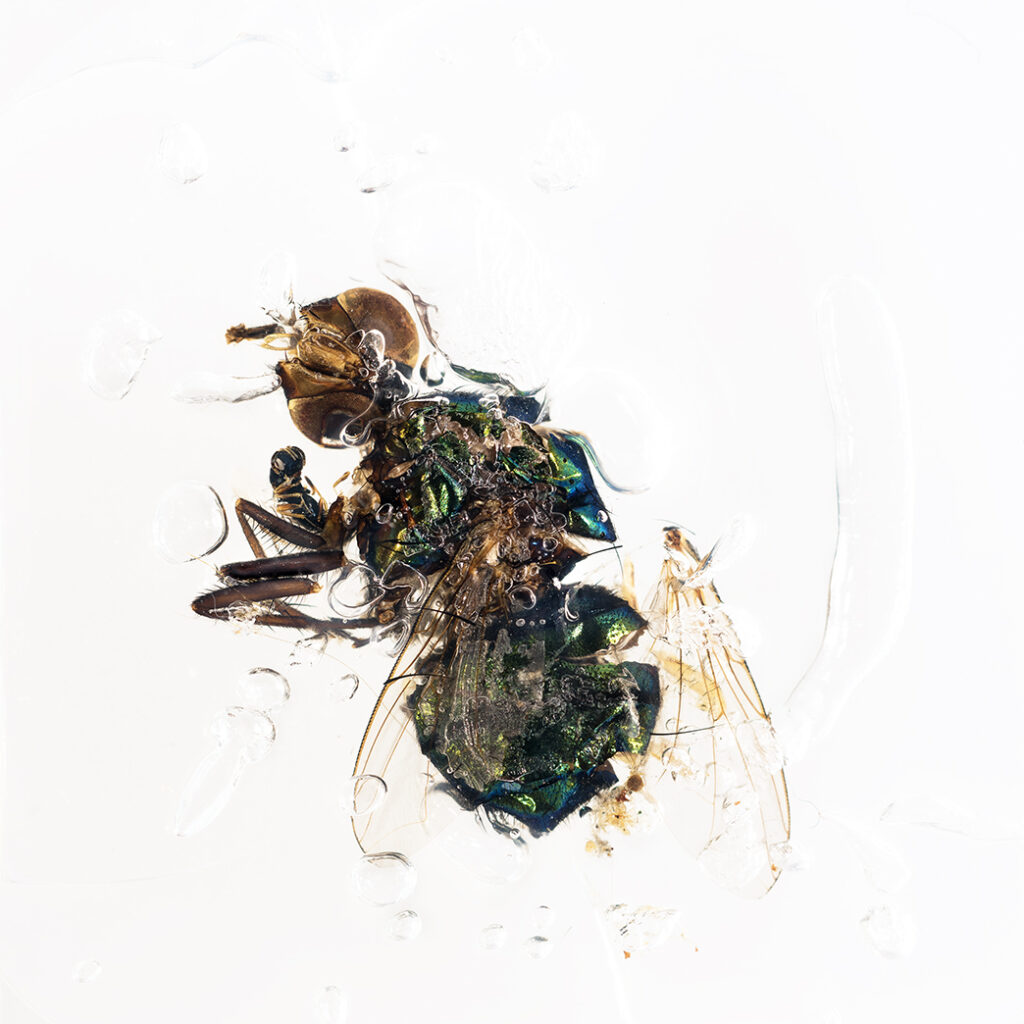
Paper wasp nest, 2019, digital photography-—one of a larger series of nests collected and imaged.Housefly, 2017—part of the Fret & Focus project.
Q: I know you’re also the manager of UMBC’s research graphics office. Can you talk about any ways that position and your creative life overlap?
A: My work with the sciences really fuels my curiosity in my personal work. It’s always amazing to me to see what students and faculty are researching, and talk to them about what drives them each day. The skills that I draw upon to make their work look its very best (either by printing their work for conferences, or helping with research figures and images for publications, or even taking professional portraits for announcements or lab websites) keeps my artistic skills sharp in a way that I’m truly thankful for.
Snap-cap centrifuge tubes, 2020
Q: Could you tell us about your experience in the IMDA program? How did it help your work grow? Is there a particular professor who was especially helpful, and how?
A: The IMDA program gave me three years and the studio facilities to explore new work in an academic setting while forging new skills and professional relationships. I have a BFA in oil painting, but needed to delve deeper into more conceptual work. My thesis committee (Dan Bailey, Calla Thompson, and Timothy Nohe) were crucial in letting me fully realize my potential for the thesis project and helped support me during the intense writing, exhibition and defense process. Because my work and my writing tend to be about process and materials as much as the concepts driving the work, it can be a little difficult to nail down, and I think without their immense insight and understanding, it would have been difficult to have it be a successful direction.
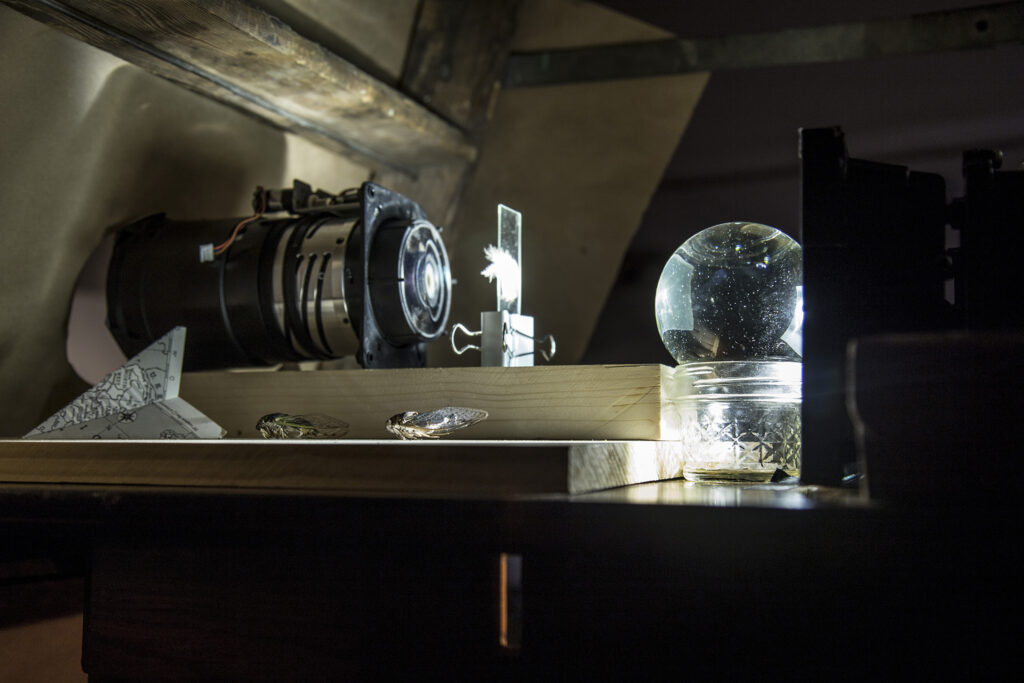
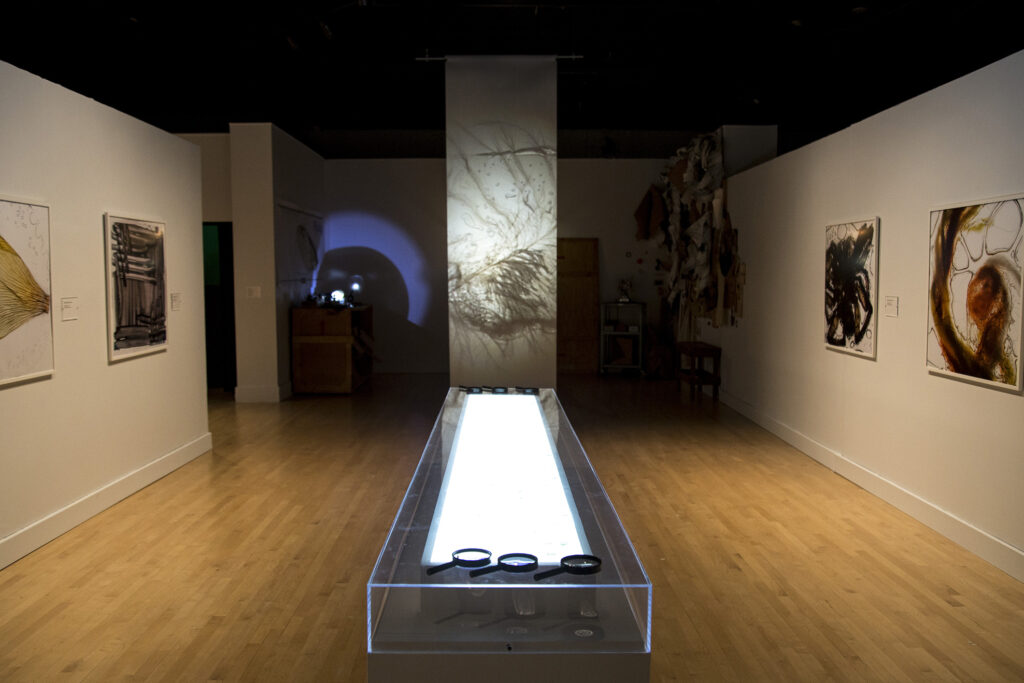
Details of installation of “Fret & Focus: worry explored through observation, projection, display, archive and documentation,” part of Cormier’s “Glass Oil Blood” 2017 MFA exhibition at the CADVC Gallery. The feather on the glass slide held by binder clips is being projected onto the long screen in the following image. Photo by Dan Bailey.Details of installation of “Fret & Focus”, 2017. Microscope slides of worries were collected for a year, then displayed in full on the lightbox in the center of the gallery, as well as large photographic prints, and projections from the installation found behind the long narrow screen.
Q: What would you tell prospective IMDA students about why they should join this community?
A: IMDA is sort of like being a part of this secret club of artists who really just want to make the best work they can possibly make in three years, even if they have no clue what that work is going to look like in the end. We draw such an eclectic crowd of creatives that it encourages everyone to see their own work differently while having critical discussions with faculty and fellow grads. Attending a creative MFA program at a research university certainly sets the bar high for the level of academic rigor as well as offers the opportunity for the work to truly be interdisciplinary.
* * * * * *
See more of Melissa Penley Cormier’s work at her website or on Instagram. Header image: Self portrait with test polaroids in small mirror in the Howard County Arts Council’s Long Reach Village Center Studios. All images courtesy of Cormier.
Every day, Retrievers are working behind the scenes to make a difference in the lives of our students. Jamie Jaegers ’14, health administration and public policy, and M.A. ’16, management of aging services, is one of them, using her work as Manager of Program Operations and Logistics with the Erickson School of Aging Studies and as a volunteer with the Maryland Charity Campaign to make her mark at UMBC.
Q:Can you tell us a little bit about your job and what you enjoy about it most?
A: I work at the Erickson School of Aging Studies and I help connect our students to people and opportunities in the field of aging. I work on building relationships with our alumni and community partners by planning and attending events and webinars that bring leaders in aging to UMBC. I also help find meaningful internship experiences for our students.
I always knew that I wanted to work in aging, but I never knew that there were so many different ways to work in the field. I love that the Erickson School finds new ways for people to get involved in aging no matter what their background is and the possibilities seem endless. The business of aging is so broad that I get the opportunity to bring things that I love outside of work to the School. I had the opportunity to start an art exhibit a couple of years ago called “The Creative Age.” I work with local retirement communities, senior centers, and art classes for older adults to showcase their artwork in our office. I get to meet new people and organizations, introduce them to our students, and learn the artists’ stories to share with our students and guests. During our first exhibit, I learned that one of the artists is Professor Emeritus in the Psychology department. His wife painted a picture of Dr. [Freeman] Hrabowski and his wife as a gift while her husband was teaching here. I love learning about UMBC’s history and how deeply tied the university is in the community when I hear stories like these through my work.
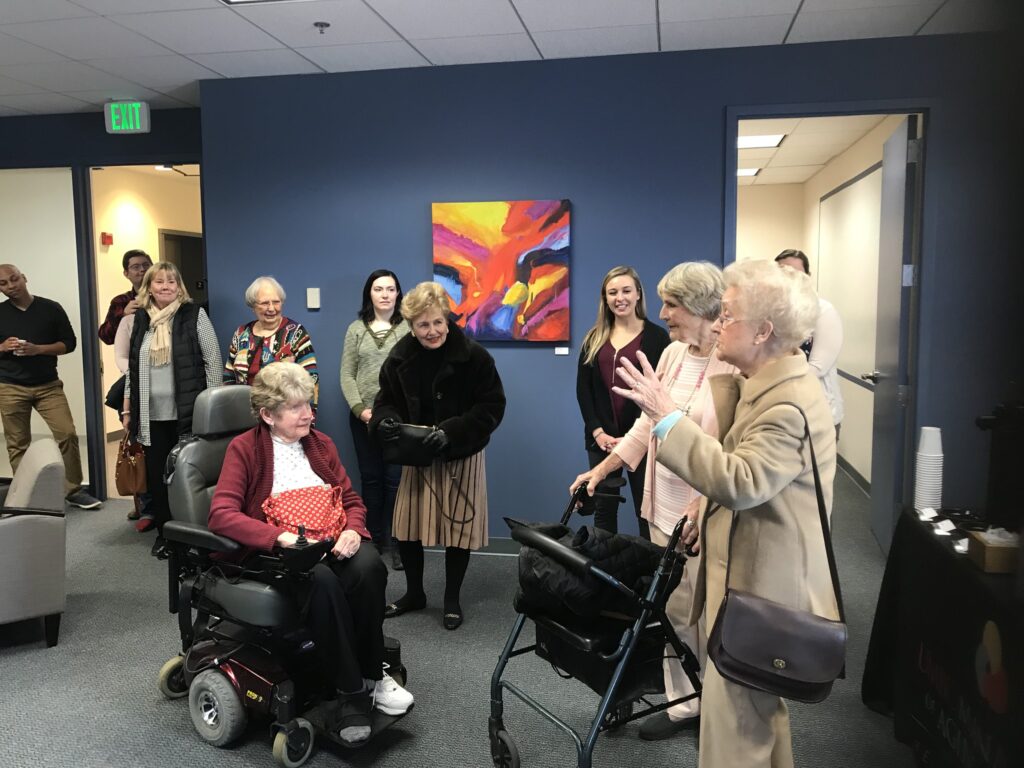
Seniors talk about their art exhibit, “The Creative Age,” which Jaegers helped to organize with local senior centers. Photo courtesy of Jaegers.
“I want to give back in any way I can to show my appreciation and supporting the [Maryland Charity] Campaign is one way I can show that.” — Jamie Jaegers ’14, M.A. ’16
A: One of my first assignments as a UMBC employee was signing up to be a Coordinator for the Maryland Charity Campaign (MCC) for the Erickson School. The MCC is an annual giving campaign where state employees have the opportunity to give back to non-profit organizations that support Marylanders. I remember attending my first kickoff breakfast to find out what I just got myself into and Dr. Hrabowski told us, “for of those to whom much is given much is required.” His remarks reminded me of all of the opportunities I’ve had while being a student and employee at UMBC. I want to give back in any way I can to show my appreciation and supporting the campaign is one way I can show that. That’s why I’ve continued to volunteer to collect donations from my department every year as a Coordinator and it has become something that means a lot to me. MCC has given me the opportunity to learn about my colleagues and what matters to them outside of the workplace. It has allowed me to experience everyone on our campus coming together to give each year. UMBC usually wins an award for having the highest percentage of participation in the campaign across all of the state agencies in Maryland! That really says something about our culture at UMBC. We work on a campus that truly cares about helping others and I am very proud to be a part of that.
Q: What is one way you’ve chosen to volunteer or give back, and why?
This year I am excited to be helping in a larger role as lead coordinator while our Dean, Dr. [Dana] Bradley, chairs the campaign that launched last week. I will help the Coordinators from other departments make this campaign a success again in a year when our community needs more help than ever.
Jamie Jaegers, bottom left, with members of the Erickson School team. Photo courtesy of Jaegers.
Q: Who is someone at UMBC who inspires you? What have they taught you?
A: I was very lucky to be a part of Jill Wardell‘s Personal Leadership and Project Management Cohort III last year. Jill inspires me to persevere through both personal and professional challenges. She is always coming up with programming and sharing resources to connect people on campus and improve our wellbeing. I admire that Jill is always willing to help and seems to know exactly what to say when you need it most. Jill taught me how to have the confidence to be a leader on campus and really helped me come out of my shell as I transitioned from my role as a student into a professional. Thank you, Jill!
Q:What is one thing you’d tell someone about why they should get involved in the UMBC community, both in your role as staff and as an alumna of UMBC?
A: I think UMBC is the most supportive and caring community you could get involved in. I felt that way when I first toured the campus as a high school junior and have continued to feel that way through my time working at the Erickson School of Aging Studies. My friends and my colleagues from UMBC are always pushing me to grow both personally and professionally and always asking how they can help along the way. Our UMBC community is filled with people who are willing to take the time to help and teach each other.
As the nation confronts generations-worth of structural racism, UMBC’s community is digging deep to learn, reflect, and take action for long-term change.
* * * * *
When Jasmine Lee describes the challenges of the last few months, she talks about them in terms of “multiple pandemics at once.” The first was COVID-19, which continues to wreak public health and economic destruction, and leaves many questions ahead unanswered.
The second, says Lee, director of Inclusive Excellence in the Division of Student Affairs at UMBC, was the swell of despair and outrage surrounding not only the death of George Floyd in late spring, but the ongoing deaths of Black people, and the rise of a collective desire for action. While so much of what needs to be done is systemic in nature, the impact has felt incredibly personal for many, including Lee.
“I’ve heard some use the term ‘intergenerationally tired’…and I think, particularly for Black folks, that is very real,” says Lee.
In the wake of nationwide protests and a pronounced desire to make lasting change, UMBC’s communities have harnessed distance learning tools in recent weeks to host workshops, trainings, and discussion circles on everything from how to become better allies and disrupt systemic racism, to smaller specific meet-ups meant to offer support during these difficult times. Further action from UMBC’s Office of Equity and Inclusion, with partnership from many other groups on campus, is also in the works.
“There’s a very clear sense of exhaustion in many forms due to historical and generational trauma that continues to be seen today,” says Lee, one of a handful of faculty, staff, and students to have spearheaded workshops in recent weeks. “But in the midst of it all, I’m seeing people who are taking up the mantle in ways that they haven’t before.”
Banding Together Through Learning
With the university closed to most in-person interaction, one might assume it would be difficult to implement weighty discussions of this sort. However, within days of the first nationwide protests in early June, the myUMBC network lit up with opportunities for online training and learning, and ways of expressing frustration and hope.
Amelia Meman ’15, gender and women’s studies, assistant director of the Women’s Center, wrote an early post on the center’s blog about “calling in white people and non-Black people of color” and providing resources to help allies move from being performative to authentic. The center, along with UMBC’s Mosaic Center and other campus groups, have also offered a variety of learning and self-care programs for students, staff, and faculty.
Mid-way through June, staff from the Division of Student Affairs led more than 70 members of the community in a “Virtual Circle for (Aspiring) Anti-Racist White Allies.” Co-facilitators Jeff Cullen, director, Student Conduct and Community Standards, and Lauren Mauriello, assistant director for Residential Life, shared information about White privilege and discussed the span of behaviors that encompass both overt and covert White supremacy.
“We thought we would create space for 50, and we quickly rocketed past that,” says Cullen, who along with colleagues has helped to ramp up Restorative Practices initiatives on campus over the last five years. The June discussion group now intends to break off into smaller groups to tackle questions that came up in the circle, many of them centered around ways of dismantling racism on the individual and system levels.
“These are the questions that people have, so let’s start there…so maybe in the coming weeks and months folks can get together and begin tackling those problems and questions” in a grounded and purposeful way, Cullen says.
More than 600 community members tuned in for “The Many Faces of Structural Racism,” a panel including Black professors of psychology, education, and political science, as well as staff working in Student Affairs and the Office of Equity and Inclusion. Led by Kimberly Moffitt, director and professor, Language, Literacy, and Culture and affiliate professor, Department of Africana Studies, the conversation covered everything from the histories of structural racism in education and voting, to ways of breaking down these persistent barriers.
UMBC Student Government Association President Mehrshad Devin ’22, biology and physics, attended the panel knowing that students were interested in getting and staying involved in between semesters, and hoping to find routes for his own work within the SGA.
“The panel answered a myriad of questions regarding how UMBC is dealing with these concerns and helped ease students’ minds a lot,” says Devin, who found what he heard aligning with his own plans. “It was heartwarming to see that the university was actively listening to the members of the community and making the changes they saw fit, and doing so in such a quick manner.”
Lee also held a very well-attended two-day workshop on “Cultivating Skills While Disrupting Racial Injustice,” which invited community members of all backgrounds to examine steps they might take to disrupt structural racism, explore options for active allyship, and more. As a university, it is important to understand what needs fixing so action can happen, says Lee, from standard implicit bias training, to expectations for hiring.
“Part of action is acknowledging that it’s okay for people to be in different spaces and at different levels in this progress, and providing the appropriate scaffolding in education and training and accountability that meets every single person wherever they might be,” says Lee.
Steps to Structural Change
Without action, talk does little to change things. And, as Keisha Allen, assistant professor, Education, noted during the “Many Faces of Structural Racism” panel, now is the “time to get to work!”
In late June, UMBC’s Office of Equity and Inclusion (OEI) rolled out a new Inclusion Council, made up of faculty, staff, students, and alumni. With a promise of “living out our UMBC values and…taking action,” the group will meet monthly to create and enact a plan for the university based on feedback acquired from the entire community.
Candace Dodson-Reed ’96, English, chief of staff and executive director of OEI, is ready to look at this time as an opportunity to continue to make lasting change. As an alumna of color, she says she has deeply felt the frustration and trauma shared by so many.
“I think the question for many of us here is how are we at UMBC going to look in the mirror and make incremental changes—both short-term and long-term—to get at the challenges that we have on our campus,” and beyond, she says. Among the goals of the new Inclusion Council will be to develop a specific roadmap of change.
“These challenges have been going on for a long time in our country, so it’s acknowledging that this is traumatic, and then also a sense of what we can do to make things better on our campus” she says. “I’m feeling that from our Black community, but also from all kinds of people who want to be allies, and who want to show up in this work.”
— Mariajose Castellanos Arroyo (@DrC_at_UMBC) June 18, 2020
Updates about the Inclusion Council’s work will be made regularly on the OEI website. The group will meet once a month and build out work groups and subcommittees including folks from across UMBC.
Devin, one of several students to sit on the Inclusion Council, is encouraging students to stay engaged. He is also seeking new students to serve on Council work groups and subcommittees.
“My biggest advice to students is to reach out and voice your opinions. Your voice matters,” he says. “Admin, faculty, and student leaders at UMBC will listen to you and will help you achieve the change you want….It is more crucial now than ever for students to stay engaged with everything that is happening at UMBC and around the world.”
UMBC President Freeman Hrabowski mirrored this sentiment in his closing remarks at the “Many Faces of Structural Racism” panel, urging the community to listen, to vote, and to be willing to look at oneself—and one’s everyday actions—with an honest eye.
“I would challenge us all to look in the mirror. This is not a time to be defensive, it is a time to realize that we can be much better,” he told the group. “There is much to do on every level…it’s not enough to say what we have done. The question is what has not been done. To listen to the voices of our faculty and our staff, and most importantly our students….There are many ways to be involved. UMBC is a special place and we can be even better.”
As the magnitude of the COVID-19 pandemic first began to reach headlines in March, many peoples’ first thoughts were of their and their loved ones’ health. But, in the days that followed, another shock wave hit, revealing drops in world markets that threatened the savings of young and old alike.
As a financial advisor, Bryan Kelly ’92, economics, took the news very personally. But then he quickly jumped to action, setting up a series of web-based “fireside chats” to keep people informed in a way that only he could.
For financially-savvy Retrievers like Kelly, helping their community get through this latest challenge just makes good sense. Here are a few examples of how our community is reaching together to offer sound advice on money, careers, and more.
Share your own stories of Retriever Resilience by using #UMBCTogether on social media.
A Matter of Trust
Kelly grew up in a small town where everyone knew their neighbors, including the beloved local doctor. Think Norman Rockwell, and you’ll get the picture.
“I went from painting his fences and tending to his flower beds to being his financial advisor and planner. I told him I wanted to be him, but in financial planning,” says Kelly, who wound up becoming founding partner at The Kelly Group, a family-focused financial planning business.
And so, when the pandemic hit, Kelly did what he did during the October 2008 recession—he offered “a reassuring voice” and delivered an hour-long financial chat to almost 300 clients and friends from his Darlington home. “And no, I’m not in my pajamas,” he joked, lightening the mood before getting into some very serious advice.
“It is at times like these that people under tremendous pressure are overcome with fear and tend to make mistakes that can affect them for years,” he told the group as he also wrote in his hometown paper, the Aegis.
Kelly credits UMBC economics professor emeritus Chuck Peake for “teaching me what investing means,” and for being “one of my pillars.”
“We want to serve as a guiding light to help prevent these mistakes, and perhaps even help you find opportunities in this adversity,” he says.
Building Blocks
Under normal circumstances, the prospect of managing one’s finances and getting a job out of college is stressful enough. Add to that a global pandemic, and college students are understandably nervous. That’s why campus experts are doubling down and going virtual to make sure students have the best footing possible.
UMBC’s FinancialSmarts program, a financial literacy education program, offers students the chance to participate in online and virtual courses and workshops, earn digital badges, and engage with alumni coaches who can help them practice their skills.
“We know that if our students are to realize the full benefit of their UMBC degrees, they will need to make good, sound financial decisions along the way,” says Hannah Sadollah ’19, psychology, program specialist for financial literacy and education. “FinancialSmarts was developed to give students the tools necessary to make informed and effective decisions about their finances. Our goal is to provide students with timely and relevant resources so that they are as well-prepared to manage their budgets, bank accounts, assets, and debt as they are to master their academic pursuit.”
In April, more than 180 students took part in Money Smart Week, an interactive series of online workshops offering everything from a Jeopardy!-style financial wellness game to “Adulting 101” and a “Credit Cafe.” Knowing that almost 70 percent of Americans have less than $1,000 in savings, and understanding the nervousness about meeting basic financial needs during the pandemic, Sadollah and her colleagues are passionate about helping students become financially literate.
“With the rise in unemployment claims due to the pandemic we are reminded of the importance of saving at least three months living expenses if you are salaried, and at least six monthsif you are self-employed,” she says. “Financial literacy is an important and necessary life skill. In a time where we are hyper focused on our health, it’s important for us to recognize the effect our finances have on mental, emotional, and physical health.”
Meanwhile, as an unsteady job market looms, the Career Center has been proactively working with students to brush up their search skills and find internships and full-time employment. Even from afar, the center is offering plenty of one-on-one advising, as well as a full calendar of virtual career-related events, including alumni panels, employer recruiting sessions, and workshops on everything from acing remote interviews, moving from internships into full-time employment, and personal branding, says center director Christine Routzahn.
“Some students are naturally concerned about their internship and career plans,” says Routzahn. “Our Career Center team is committed to making sure that students know we are available and are here to help when ready.”
Routzahn and her colleagues are actively encouraging students to reflect on their values and career aspirations while also taking time to practice self care and find opportunities to sharpen skills that will make them stand out to employers. Later this summer, the Career Center will offer a virtual career fair in collaboration with other Maryland Career Consortium institutions, offering direct connections to organizations looking to hire.
Washington Post columnist and UMBC Parent Michelle Singletary gives a shout out to the UMBC Career Center around the three-minute mark.
“During these uncertain times, you may naturally have concerns about your career plans. Remember that you are not alone and that many students are sharing a similar experience,” advises Routzahn. “We are all in this together and the Career Center team is here for you. Even though the road ahead may not be easy, there are still a lot of opportunities out there to gain great experience.”
Connections Matter
As the owner of 3 Pillars Co., a events and business consulting firm, Lois Sarfo-Mensah ’15, emergency health services, is used to working hard to stay afloat—and helping other businesses do the same. In her side gig as ambassador of the Baltimore chapter of Ladies Get Paid (LGP), she extends even further, creating networks for advocacy and support for working women, many of whom are understandably concerned right now.
“The greatest concern is what is next,” she says. “It is such an unsettling time and there is hesitation on pivoting to careers or businesses, staying put until it is over, or focusing on development during this time at home. Each having their own implications—especially financially.”
While there has been hope among many small business owners about federal and state grant and loan programs, the processes have not been easy to navigate. Going forward, coming together as a community will be more important than ever, says Sarfo-Mensah, who through LGP is working on creating events such as community conversations and virtual happy hours to allow for connection and discussion of grief and trauma brought on by the pandemic.
“From the onset of this virus and the news of the slowdown to shutdown of many industries, I have been steadfast with anyone I have spoken to about this change that we need to be on the side of solution and support rather than reaction,” she says.
“We have to support each other… whether it is referring business owners, supporting local, keeping engaged with community efforts such as PPE production, and sharing out the information you receive to any one who may need it…. This way everyone can be starting from the same place or be as equitable as possible.”
Imagine you’ve got an amazing idea—a piece of biotech or a cyber solution, for instance—with the potential to really help people in need.
Now, picture a community that helps you accomplish the steps to turn that idea into a successful business. Researchers and eager students to work out the kinks. The camaraderie of creative entrepreneurs to energize you. And partners with the business chops to help you take your idea to market.
Since launching 30 years ago as the first university research park in Maryland, bwtech@UMBC has nurtured more than 130 companies and their big ideas, bringing more than 1,800 jobs to Baltimore County and generating 4,500 direct and indirect jobs and $700 million in labor income and business sales for the state, according to an assessment by the Sage Policy Group in 2019.
As the world takes on the challenges of the COVID-19 crisis, bwtech finds itself in the position to innovate in more ways than ever. Amid it all, bwtech’s new executive director Aaron Miscenich is ready to help bwtech make an even bigger impact in Maryland and beyond.
“We will emerge from this period strong, but with a new definition of ’normal,’” says Miscenich, who previously helped launch the New Orleans BioInnovation Center in the wake of Hurricane Katrina. He notes that bwtech steadily added jobs through the 2008 recession and recovery years, and expects the community to remain strong.
“Working with UMBC’s diverse research base, talented entrepreneurs, and strong partner organizations, bwtech has achieved fantastic results. I think we have the opportunity to bring our community closer together and to learn more about what we can do for one another.”
Building Bridges to Success
A wooden footpath links UMBC’s main campus to bwtech North, the second of bwtech’s two campuses. Winding past Pig Pen Pond, it’s a convenient link between two centers of creative energy, and also the perfect metaphor for the relationship between these two enterprises.
“University research can contain tremendous market potential but often needs someone to facilitate that commercialization process,” says Miscenich, who took over for longtime executive director Ellen Hemmerly after her retirement this spring.
“Many times you have researchers who are not experienced entrepreneurs, you have students looking for real-world experiences to complement their course studies, and you have alumni that are looking for ways to bring their talents back to the university,” he says.
All of the groups converge at bwtech, along with entrepreneurs from around the globe, and the research and technology community provides assets that help them meet their goals. A recent beneficiary of this partnership is Soobum Lee, associate professor of mechanical engineering at UMBC, whose work with windmills and energy harvesting earned him a Maryland Innovation Initiative (MII) grant.
MII, a research commercialization project established by the state and five universities, including UMBC, opened up the opportunity for Lee to work with bwtech “site miners,” who help facilitate the application process for faculty inventors and accelerate their path to commercialization. As of this January, UMBC faculty have secured a total of 42 MII awards, valued at more than $4.4 million, resulting in 16 start-up companies.
bwtech also houses a number of UMBC alumni-owned businesses at its two campuses, many of which partner with professors and also bring in undergraduate and graduate students as interns. Jeehye Yun ’97, computer science, founding CEO at RedShred on the bwtech north campus, notes that these relationships have paid off for her company.
“As a part of the bwtech community, we’ve had the opportunity to develop long-standing relationships with UMBC faculty and students to advance our innovative research and impact,” she says.
The same is true for Mike Adelstein ’96, biochemistry and molecular biology, who sees a strong future for his company Potomac Photonics at his bwtech south campus location.
“Even though we’re growing, we want to keep our headquarters here [at bwtech] because it’s a great place to be,” he says. “bwtech’s environment spurs innovation and drives the success that we’re having right now.”
And by pairing new business with established ones, bwtech’s “Start here. Grow here. Stay here.” philosophy makes for a welcoming environment at any stage of growth.
“We can take these companies, introduce them to industry professionals, capital sources, and other groups that help reduce the risk of failure and increase the potential of the company’s products and services,” Miscenich says.
Challenging Times
As the realities of the COVID-19 pandemic took hold earlier this spring, many in the bwtech community quickly began working on ways of creating solutions.
Miscenich, with his 15 years as president of the New Orleans BioInnovation Center, understands the importance of close connections among partners during challenging times. Although he has not yet been able to work from his office on Research Park Drive due to the pandemic and travel restrictions, Miscenich is spending much of his time checking on his entrepreneurs from afar to make sure they have what they need to stay strong.
“We’re maintaining one-on-one contact through our facilities’ team and trying to maintain programming that will keep our entrepreneurs connected with the park,” he says. “We’ve been holding video ’socials,’ we’ve hosted speakers, and we’re reaching out to understand their individual needs. Our hope is that we can learn from this challenge and keep in place the mechanisms that allow us to work together as a community.”
Miscenich says bwtech companies have displayed a great ability to adapt to change and to step up to challenges. His role, he says, “is to help these companies to alter their course when necessary and to bring reliable resources for them to use. Our intent is to continue to use these resources to add value to our clients and support their ongoing growth.”
Community is Key
Another key element of bwtech’s success—and one that drew Miscenich from New Orleans—is the business community’s connections to Baltimore, Washington, and its next-door neighbors, Catonsville and Arbutus. Many of the companies’ 1,800-plus workers call these towns home.
The campus also lies just up the road from BWI-Thurgood Marshall Airport, Ft. George G. Meade, the National Security Agency, the National Institute of Standards and Technology, and the National Institutes of Health, putting it in a perfect spot to create partnerships with groups in need of cybersecurity, life sciences, and engineering solutions.
“An innovation district, or research park, is not just a group of buildings that sit idle throughout the day and night,” says Miscenich. That means encouraging true engagement between business and the surrounding communities.
Matt Roberson, Director of SC&H Capital, and a member of the bwtech board, knows how important those local connections are. He is raising his family nearby in Catonsville, and is looking forward to great things at bwtech.
“bwtech is an important part of the UMBC story, and growth in the area,” he says. “I’d like to see it continue to grow and foster opportunities for students, Catonsville and Arbutus residents, and businesses, in general.”
Baltimore County Executive John A. Olszewski Jr., Ph.D. ’17, public policy, notes the important role bwtech has played in the state, calling it a “true Maryland success story.”
“For the last 30 years, bwtech has strengthened our economy by giving big ideas the room they need to grow. By bridging higher education and business, bwtech at UMBC positions Maryland as an economic powerhouse within the region,” he says. “I couldn’t be prouder of what this community brings to Baltimore County.”
Miscenich says he’s looking forward to learning more about what the Greater Baltimore region has to offer. Even more, he looks ahead to continuing to build opportunities for the bwtech and UMBC communities.
“UMBC and bwtech have clearly worked very hard and have made incredible strides in building companies out of the university,” says Miscenich.
“I look forward to bringing bwtech even closer to the programming and culture of the university, attracting more partners into the ecosystem that has been created by bwtech, and attracting more resources in the development of our infrastructure.”
As the world battles COVID-19 and all of the levels of health and economic uncertainty that entails, it can be difficult to find ways of helping out on an individual basis (beyond staying home, that is).
But, as hospitals and other front-line operations find themselves in need of hard-to-find personal protective equipment (PPE), UMBC makers from all types of work backgrounds are pitching in the best way they know how. Whether sewing up a storm or finding creative uses for kitty litter boxes, these are just a few stories of how Retriever Nation is using special engineering and craft skills, tools, and grit to help in the fight against COVID-19.
(Share your own stories of Retriever Resilience by using #UMBCTogether on social media!)
Lending a Technical Hand
At Potomac Photonics, an alumni-owned fabrication operation located in the bwtech@UMBC business park, a typical day might involve anything from piercing 10,000 tiny holes in a single sheet of steel to the microfabrication of complex parts for equipment and biotech applications. When COVID-19 struck, and the nationwide dearth of PPE in hospitals became front page news, owner Mike Adelstein ’96, biochemistry and molecular biology, jumped into action.
His shop produced several thousand protective face shields in the first few weeks of the pandemic, shipping to hospitals in Maryland, New York, and Florida. And the microfluidic chips they’re working on with another client will be used for testing related to finding a vaccine or cure.
“The entire Potomac Photonics family feels a deep sense of obligation and pride when it comes to helping others. Whether we are working on products related to COVID-19 or early detection of cancer, one of the recurring themes that you will hear from our staff is how rewarding it is to be involved in the manufacturing of parts used to save lives,” says Adelstein.
“We have an extremely diverse company with people from many different backgrounds and education levels. However, we are all united in our desire to make a difference by working together and coming up with innovative manufacturing solutions that enable our customers [to get] their complex products to the market.”
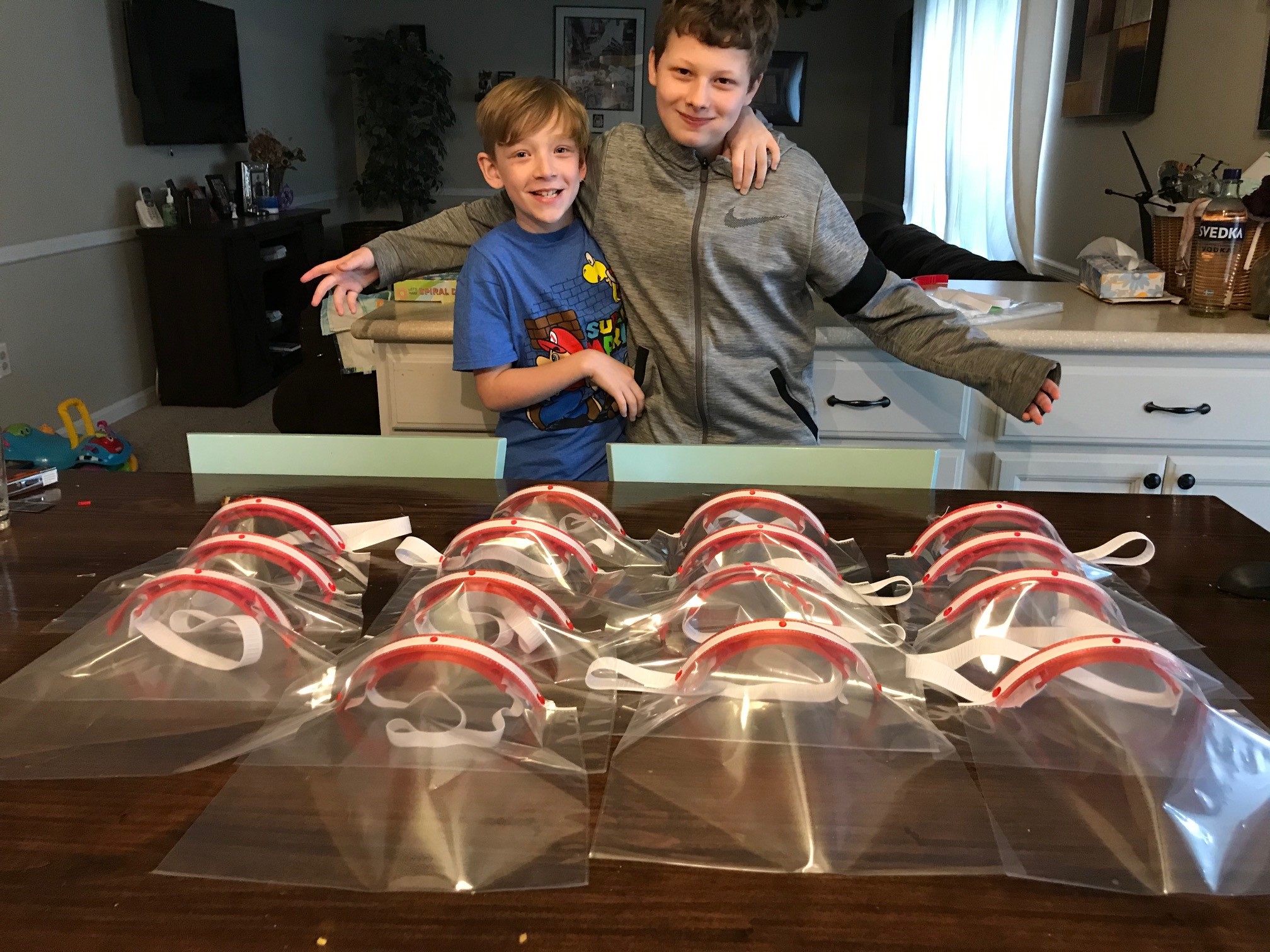
Meanwhile, in Corey Fleischer’s own home workshop, he and his kids are producing low-cost protective face shields for healthcare workers in need. Using an elastic band, a clear binder sleeve, and a 3-D printed frame, they’re printing parts on three machines “around the clock,” he says.
“My father in-law, Joe, works at a retirement center and the healthcare workers weren’t allowed to help the residents without wearing a face shield. Every store and online vendor was sold out so he reached out to me,” Fleischer says. “[My son] Aidan and I sketched out some concepts that would provide a solution with items we could find at Walmart. We decided to make face shields out of 3-ring binder sleeves.”
Three designs and six hours after the phone call, they had 10 masks ready. Since then, Fleischer and his kids Aidan, Kaleb, and Camden have made around 100 more masks for two local retirement homes, and two hospitals.
“I would encourage anyone with fabrication resources to help out if they can,” says Fleischer, who has made his design available for other 3-D printer enthusiasts to use. “There’s a lot of how-to information on the internet for making face shields and face masks. And lots of workers on the front line need them.”
Sewing as Fast as They Can
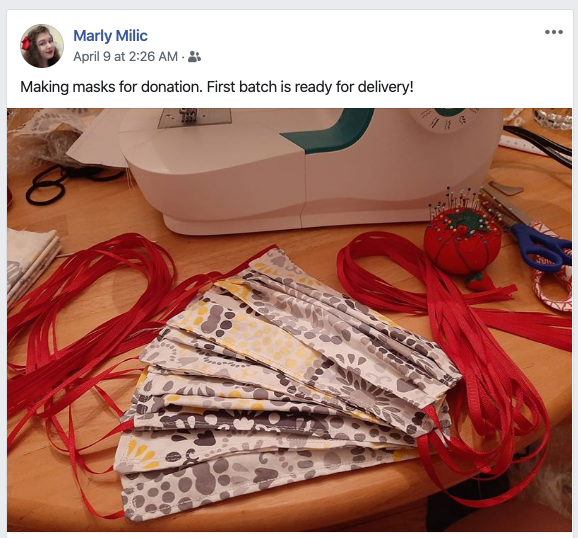
As some folks are programming their 3-D printers, others are breaking out their trusty sewing machines to construct fabric masks for hospitals, nursing homes, friends, and family. And for senior political science major and Sondheim Scholar Marly Milic, the act of sewing masks is not only a way of giving back, but a way of connecting with a loved one.
“I can sew by hand and have a little experience on the machine from when my Ma taught me when I was younger,” said Milic. “Once we saw that hospitals were asking for fabric masks, we both decided that we needed to help. She got a jump start on me because she already had supplies and tools. I ordered my first sewing machine and some materials and got to work right away.”
She sewed her first few masks by hand, but has now taken her production up significantly with her machine. Both she and her mother are sending their masks to Domesticity fabric studio in Lauraville, and Milic also shared some with a neighbor who is a truck driver.
“There are people risking their lives every day to take care of the sick and keep our state running… This is what I can do to help, and as a Sondheim [Scholar] there is no way that I could sit this out,” says Milic, who also very much enjoys her mom’s company during her hours at the sewing machine.
“We actually Skype and sew together so yes, we are very much doing this together.”
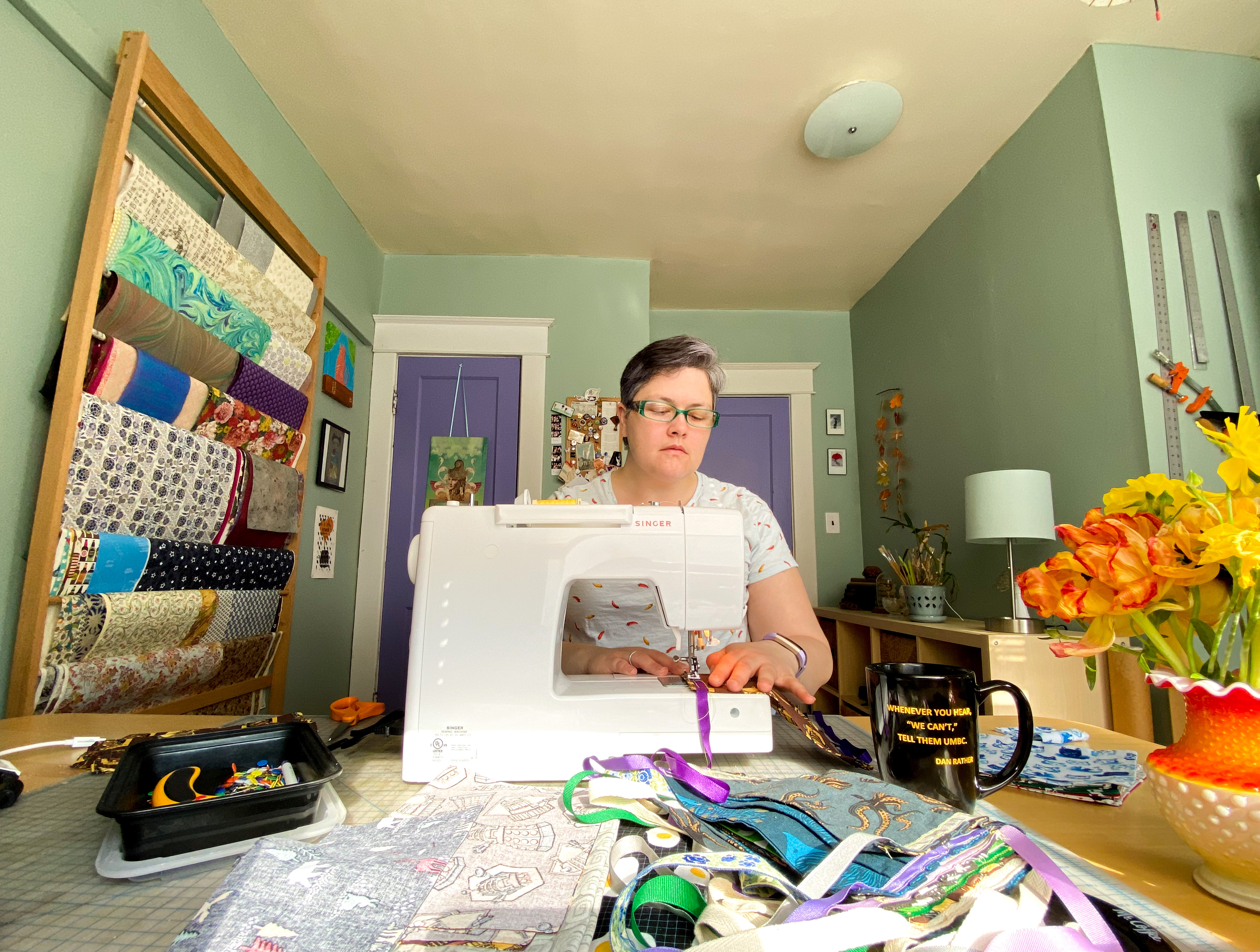
Christine Obriecht ’85, biological sciences, a research assistant at UMBC’s Molecular Characterization and Analysis Complex, started sewing masks as soon as she heard there was a need. And then—because she adores sewing and experimenting—she didn’t stop there.
“My boss showed me a picture of a headband that medical personnel can wear to make mask-wearing more comfortable. The headband has buttons one can hook the mask elastic to, instead of hooking it around their poor chafed ears. I plan to make some of those to see how well they are received. I have had one request for a scrub cap. I will try that, too. And so the ideas flow in,” says Obriecht, who has donated her work to a local hospital, but also a number of her elderly neighbors.
“I don’t really care who gets the masks, as long as they go to people who need them and who are trying to help,” she says.
Help in Unexpected Forms
Bennett Moe ’88, graphic design, found his coronavirus volunteer calling from a Facebook post. After reading about a Boy Scout creating “ear savers”—plastic contraptions that wrap around the back of the head to make the wearing of the stretchy elastic of face masks a little less uncomfortable—a chat with a nurse friend confirmed the need.
Moe, who recently started a side business creating collectible die cast models, replacement gauge lenses for vintage trucks, and other vintage-inspired items, saw a sudden use for his new tabletop laser cutter. Within hours, he had tested a design out first in clear acrylic, and then— wait for it—the far sturdier plastic of a kitty litter box.
“Seriously. Necessity is the mother of invention!” says Moe, who found the plastic to be pliable but thick enough to be durable. With materials in stock, he estimates he can produce 500 to 1,000 ear savers a week in his off hours for area hospital workers.
“It feels good to be able to contribute, even in this small way, when so much around us seems out of our control,” says Moe, a former president of the UMBC Alumni Association Board.
“I’m not very good at sitting and watching the world go by, so when my friend tagged me in that post, it was almost like a challenge. I knew there had to be a way that I could make this thing—this little thing that hardly anyone even knew was even a thing, but could make someone’s job just a little bit more bearable. And the folks that are out there helping patients every single day deserve all the help they can get.”
* * * * *
Header image: Potomac Photonics employee tests out one of the masks they manufactured. Courtesy of Potomac Photonics.
Last July, UMBC senior Karina Martinez’s world crashed down around her when an auto accident left her with two broken arms and a totaled car.
In a matter of moments, reality set in. Surgery and recovery would take at least three weeks. And even after that, without a car, she couldn’t get to school or her part-time server job, much less the required field placement she needed to complete to graduate. Her manager gave her a less physically-taxing hostess position, but losing a month’s work and switching from tip wages to hourly left Martinez in a real bind.
“I had bills I had to pay, I had a balance with UMBC on a summer course I took that summer, and I was looking to see if I could somehow buy a car for my commutes,” says Martinez, a social work and psychology major set to graduate from UMBC’s Shady Grove campus this spring.
“I thought about dropping some classes so I could work more to be able to pay off my UMBC balance but then my sister told me I should look into seeing if UMBC has an emergency fund for students.”
Addressing Emergency Needs
UMBC’s Stay Black and Gold Emergency Fund is an initiative of the Student Government Association that provides emergency funding in awards ranging from $1,000 to $8,000 depending on needs arising from unexpected crises ranging from accidents to house fires, deaths of parents, loss of jobs and other sudden losses of income that could prevent the continuation of classes.
In the past year, five students have received funding, but as the world confronts the COVID-19 pandemic, this fund will become even more important for student success, explains Vice President for Institutional Advancement Greg Simmons, M.P.P. ’04, public policy.
“The Stay Black and Gold Emergency Fund acknowledges that sometimes we are faced with circumstances we could not have predicted and we need help from others,” he says. “Donors who give to this fund are committed to helping us do all we can to help students finish their degrees in the face of challenges they hadn’t expected, and in some cases hadn’t even imagined could be true.”
Last week, longtime UMBC supporters George and Betsy Sherman made a pledge of $25,000 to reinforce the fund, and other individual donations have been coming in steadily, including gifts from more than 40 new donors since a call went out for help yesterday.
Supporters have also been making donations to support UMBC’s Retriever Essentials Food Pantry, which offers dry goods and toiletries to students with those ongoing needs. Going forward, both of these funds will be crucial in helping UMBC students affected by the COVID-19 crisis. Like many universities across the country creating similar support systems for their students, UMBC will continue to try to grow its resources to respond to its community’s needs.
A Much-Needed Helping Hand
“When the committee approved me for the scholarship it was a relief off my shoulders knowing that I would not have to drop my classes in order to work more to pay off my balance and that most importantly that I would be able to graduate this year,” said Martinez, who has been accepted into the University of Maryland Baltimore’s advanced standing master’s of social work program in the fall.
As someone who hopes to eventually work in child welfare, she keenly appreciates what it means to be on the other end of the helping hand.
“Unfortunately, sometimes unexpected things happen not to just students but, to people in general, so having funds like this available to them really makes a difference,” she says. “For me it was allowing me to graduate on time with my class. So, thank you so much for donating, it is much appreciated.”