We use cookies for analytics and, unless you opt out, advertising.
You can opt out of advertising at any time.UMBC uses essential cookies to run this site. With your permission we would also use analytics cookies (to understand how the site is used) and advertising cookies (to measure and target our ads on other platforms). Nothing else loads unless you accept. You can change your choice any time from Cookie Settings in the footer.Privacy Policy
EssentialRequired for the site to work (login, security, your cookie choice). Always on.
Peter Wilschke ’24, economics and political science, hit the ground running after graduation in May, beginning a two-year research assistant position at the Federal Reserve Board of Governors in Washington, D.C. He is working on the quarterly Z.1, a report on the financial assets and liabilities, transactions, and balance sheets for households, nonprofit organizations, and businesses. Additionally, Wilschke assists economists with research projects. For Wilschke, these tasks are a welcome set of challenges—he thrives on long-term projects that combine both his majors and allow him a level of independence he nurtured successfully at UMBC.
Just weeks before graduating, Wilschke’s article “Political Drivers of State Fiscal Cyclicality” was accepted for publication in the State and Local Government Review, the official journal of the Section on Intergovernmental Administration and Management of the American Society for Public Administration. Wilschke published as the sole author, which is rare for an undergraduate researcher.
A few weeks after graduation, Wilschke was celebrating again. This time, with his teammates Arvind Kuruvilla ’25, financial economics and philosophy, and Matthew Dyson ’25, political science and computer science. Their paper, “Improving American Retirement Prospects: Policy Solutions for the Financially Fragile,” was one of two winning submissions chosen by the Women’s Institute for a Secure Retirement (WISER) 2024 iOme (I Owe Me) Challenge national student competition. It was the first time in the 20 years since the challenge was established that two teams held the winning title. UMBC’s trio of undergraduates proudly shared the spotlight with the Johns Hopkins Carey School of Business graduate student team.
While these accomplishments came one right after another, Wilschke has been successfully merging his two passions—political science and economics—for some time.
“Once you take statistical analysis and research methods classes in economics or political science, your world is open to how empirical research is actually conducted in those fields. I would not have known where to start without these classes,” says Wilschke, the 24th recipient of the Pittman Family Scholarship, established in 2006 by Kenneth Pittman ’79, economics, and Patricia Pittman ’78, political science, who shared Wilschke’s majors.
“Peter’s accomplishments and that of his colleagues at UMBC are very impressive,” says Kenneth Pittman.“Congratulations to everyone on the iOme team!”
With a little help from my mentors
His desire to see the impact of policy for the long haul keeps Wilschke open to inspiration. A couple of years ago, Wilschke attended the economic department’s Mullen Lecture, presented by Carlos A. Vegh, the Fred H. Sanderson professor of international economics at Johns Hopkins University. Vegh discussed his research on how fiscal policy is conducted over the business cycle in developing and developed countries. What intrigued Wilschke was how developed countries contract their fiscal policy when the economy is doing well and expand fiscal policy during an economic downturn while developing countries do the exact opposite. He wondered if individual states reflected similar cycles and, if so, whether other factors influenced the expansion and contraction of fiscal policy.
“I explored whether and how political factors—political polarization, turnover, and electoral competition—work to explain why some U.S. states tend to spend more in good times and less in bad times, unlike the federal government,” says Wilschke, who presented the paper at UMBC’s 2024 Undergraduate Research and Creative Achievement Day.
This was Wilschke’s first time leading a research project. “I didn’t quite know what I was getting myself into,” says Wilschke. He shared the idea with Carolyn Forestiere, professor of political science and his professor of research methods, and she connected him with Eric Stokan.
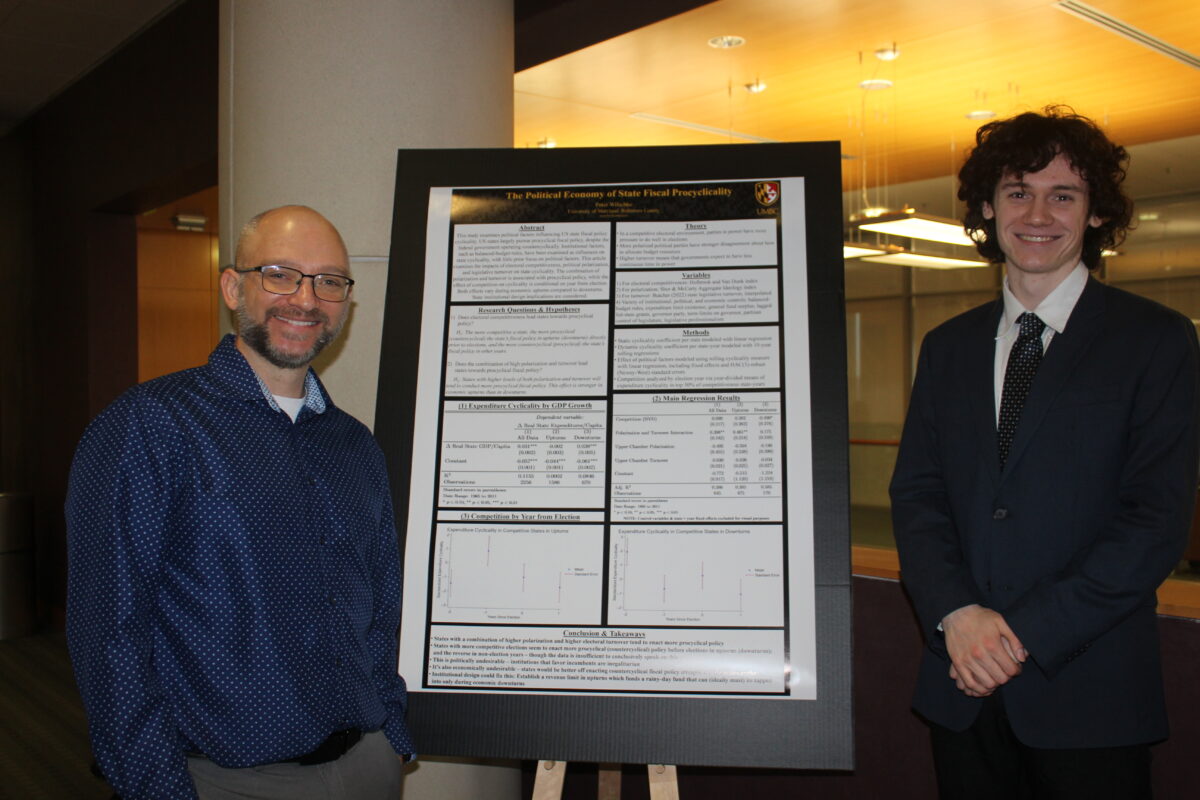
(l-r) Eric Stokan and Peter Wilschke at the 2024 Pi Sigma Alpha National Student Research Conference. (Image courtesy of Carolyn Forestiere, professor of political science/UMBC)
Stokan, associate professor of political science and now Wilschke’s mentor, says he enjoyed working with Wilschke weekly for over two semesters, which helped him think through all aspects of the work. He taught Wilschke R, a statistical computing and data visualization programming language. Stokan also suggested pieces of literature on the topic, which helped Wilschke think through the operationalization of his variables and analytic specifications and framing policy.
“For each session, I would consistently say, ‘Okay, your next step should be X,’ and he would have done X, Y, and Z,” says Stokan. “It was amazing. Peter learned R more quickly than anyone I have ever met.” Wilschke adds, “It was very helpful to have a mentor who had gone through this process multiple times before.”
“Eric and I encouraged Peter to submit his work to a professional journal,” says Forestiere. “We figured that it would be a learning experience even if it were rejected.” They were all delighted when the journal—which only accepts about 14 percent of submissions—asked Wilschke to revise and resubmit. “We were ecstatic when it was finally accepted for publication!”
WISER choices
Doug Lamdin, professor of economics, mentored Wilschke,Kuruvilla, and Dyson to the finish line of the WISER iOme Challenge. The competition raises awareness among university students about the impact of retirement security on society’s social and economic well-being. Students nationwide respond to the annual iOme Challenge question with a policy paper. This year, students were asked to imagine that Congress named them to an independent commission on retirement, with instructions to re-evaluate and modernize the retirement system from the perspective of Gen Zers (those born between 1997 and 2012).
“I put the team together,” says Wilschke. “I knew Matthew from classes and volunteering at UMBC’s Volunteer Income Tax Assistance club, and Arvind was a co-worker of mine in the Admissions Office. It was a lot of fun to work with them and much easier with three people than it would have been by myself.”
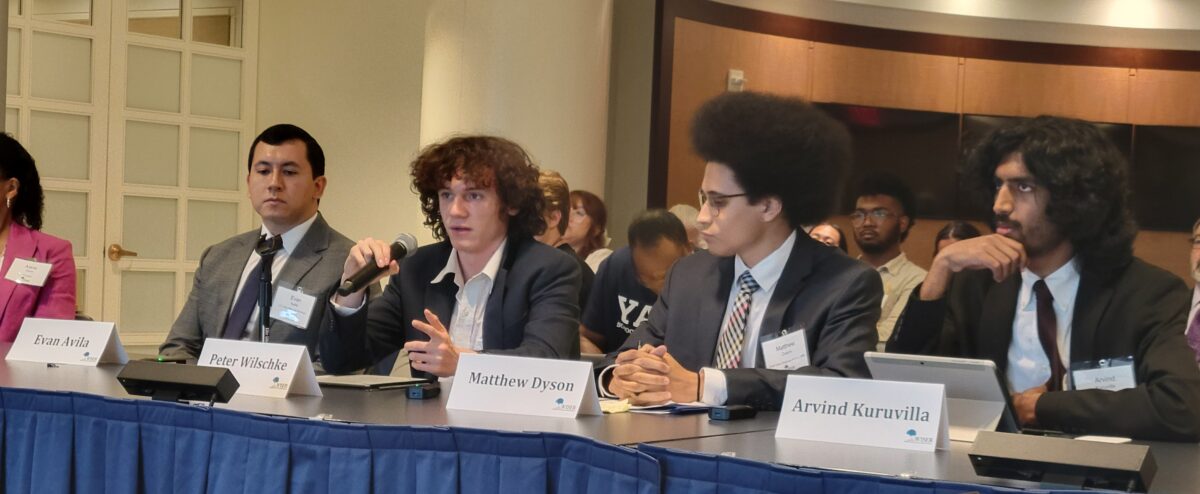
(l-r): Evan Avila, Peter Wilschke, Matthew Dyso, and Arvind Kuruvilla. (Image courtesy of Ratzsch/UMBC)
Lamdin has ushered four iOme winning teams through the process, starting in 2018 with Evan Avila ’18, economics and political science, now a financial analyst at the Securities and Exchange Commission. Avila has served as a co-moderator for the iOme winner’s presentation for the last two years. Lamdin’s mentoring approach—based on guiding mentees toward independence—has stayed consistent since he first mentored Avila. Lamdin assists them in developing a timeline for producing the essay by the due date that aligns with the judging criteria and provides students with background reading materials. From there, Lamdin steps back, trusting the team to work independently, with weekly check-ins to monitor their progress and provide feedback on their drafts.
Lamdin notes that Wilschke was proactive and professional. He appreciated his ability to find relevant research, interpret data, and consider new possible retirement policies.
“It is a rewarding experience for the students and me, so I hope to continue doing it,” says Lamdin. “I have never had a team I mentored not win, so maybe I will stop doing this when the winning streak ends—kidding, sort of.”
Motivation to follow a hunch
While Wilschke was conducting his research for his papers, he was also interning at The Hilltop Institute at UMBC, a nonpartisan research organization dedicated to improving the health and well-being of people and communities. He worked for Morgan Henderson, principal data scientist and affiliate professor of economics, and Morgane Mouslim, policy analyst, on a research project funded by the National Science Foundation on hospital pricing transparency. His two-year internship entailed helping to organize data collected from hundreds of hospitals and writing a news brief, “The Impact of Market Concentration on Hospital Pricing,” and presenting it at URCAD 2024.
“Peter is an excellent researcher who helped our hospital price transparency project significantly over the past two years,” says Henderson. “The quality of his work is top-notch—we predict that he’ll go far.”
Wilschke did not plan on contributing empirical research to the field of political science as an undergraduate student. Looking back, he is grateful for the classes and opportunities UMBC afforded him that prepared him to follow a hunch. Wilschke said that he felt that some students don’t look forward to statistical analysis or research methods classes in economics or political science because they’ve heard the classes can be difficult and may appear irrelevant at the moment.
“Most of what I accomplished as an undergrad was something I had to decide I wanted to do without having anyone to tell me I should do it,” explains Wilschke. “I’ve learned how far I can go if I try everything I can think of. It gives me motivation and a little bit of pressure to keep up that level of work throughout my time at the Fed Reserve and, hopefully, in grad school.”
As a community, farmers in the United States often face challenges that are out of their control, such as drought, livestock disease, and global pandemics like COVID-19. For Black farmers, says Loren Henderson, associate professor of public policy, these obstacles are compounded by land theft, inadequate succession planning, systemic racism, and discriminatory U.S. Department of Agriculture policies and practices. As a result, Black farmers today are facing extinction. Henderson was featured on The Academic Minute to talk about her research.
Henderson, who will be the first African American director of UMBC’s School of Public Policy this fall, is the author of Race, Ethnicity, and the COVID-19 Pandemic(University of Cincinnati Press, 2023). She began researching how Black farmers were faring amid these hurdles during COVID-19. Henderson conducted 50 in-depth virtual interviews with Black farmers in the U.S. The project addressed Black farmers’ expertise and experiences in establishing and maintaining farms under the onslaught of systemic racism and COVID-19.
“Additionally, I asked the farmers about their use of governmental and private financial resources and their understanding of social policies that impact their ability to establish or maintain their farms,” Henderson shares with Lynn Pasquerella, president of the American Association of Colleges and Universities and host of The Academic Minute, a daily show featuring faculty from colleges and universities worldwide speaking about their cutting-edge research.
The Maryland State Board of Education has unanimously elected Josh Michael ’10, political science, Ph.D. ’22, public policy, as its new president following his completion of a one-year term as vice president last year. Michael, whose career in education advocacy has been greatly intertwined with UMBC for years, began his interaction with the Maryland State Department of Education (MSDE) as a student representative on the board in 2005.
Now, as president, Michael will continue to oversee the administration of MSDE with the 11-member board, which includes public school educators, parents, community leaders, and a student. UMBC alumna Chuen-Chin Bianca Chang ’91, nursing, is also a board member, representing Howard County since 2021.
Michael will work with the state superintendent to provide oversight of Maryland’s 24 school districts and lead the board’s work in guiding the implementation of MSDE’s Blueprint for Maryland’s Future, an initiative to increase state funding for education over the next 10 years with a focus on historically underserved students.
“Over the last 10 to 15 years, Maryland public schools have slowly declined in achievement, in literacy, and math. Our rankings have dropped in many ways. Taking this head-on has been a focus of our work,” Michael explains. “We seem to have lost sight of what is most important—ensuring our students are learning. Our schools must serve children from all backgrounds at all performance levels and provide opportunities to excel. The board is focused on restoring stability, vision, and direction for the state to support public schools.”
“
Direct service in the classroom and communities has humanized the policy process for me.
Josh Michael ’10, Ph.D. ’22
Education policy at work
Michael’s work with public education began as a UMBC Sondheim Public Affairs Scholar, where he learned about education policy. After graduating, he worked as a math teacher at Baltimore City’s Booker T. Washington Middle School and The Commodore John Rodgers School. After six years in the classroom, Michael returned to UMBC in 2016 to work on growing what was then called UMBC’s Sherman STEM Teachers Scholars Program with Rehana Shafi, the inaugural director, and with the support of The Sherman Family Foundation. The program prepared STEM majors to become high-quality K-12 teachers in urban settings through academic and professional coaching. The program has since broadened its scope and is now called the Sherman Teacher Scholars Program.
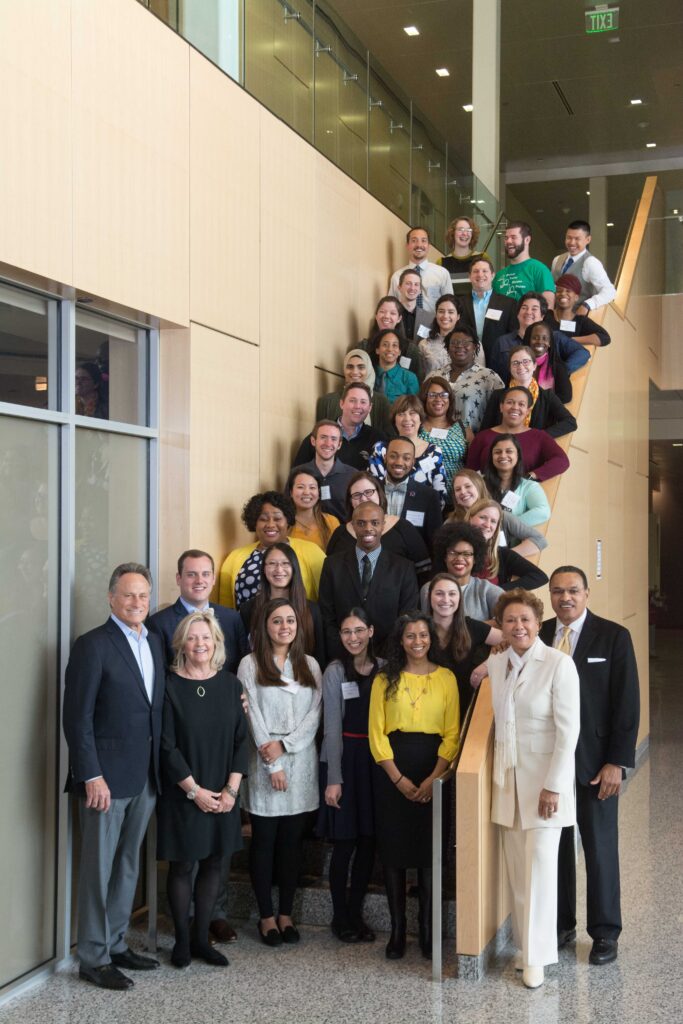
George and Betsy Sherman (first from left) in front of Josh Michael. Freeman Hrabowski, then-president of UMBC, and Jacqueline Hrabowski (first from right) next to Rehana Shafi (in yellow) at the Sherman STEM Teacher Scholars Program’s 10th anniversary.
Shafi and Michael fostered existing partnerships and helped establish the Lakeland Community and STEAM Center, where many Sherman Teacher Scholars continue to hold student-teacher placements and serve as math volunteers. During this six-year period, Michael also earned a doctorate degree at UMBC focused on mathematics achievement and improving outcomes for struggling students.
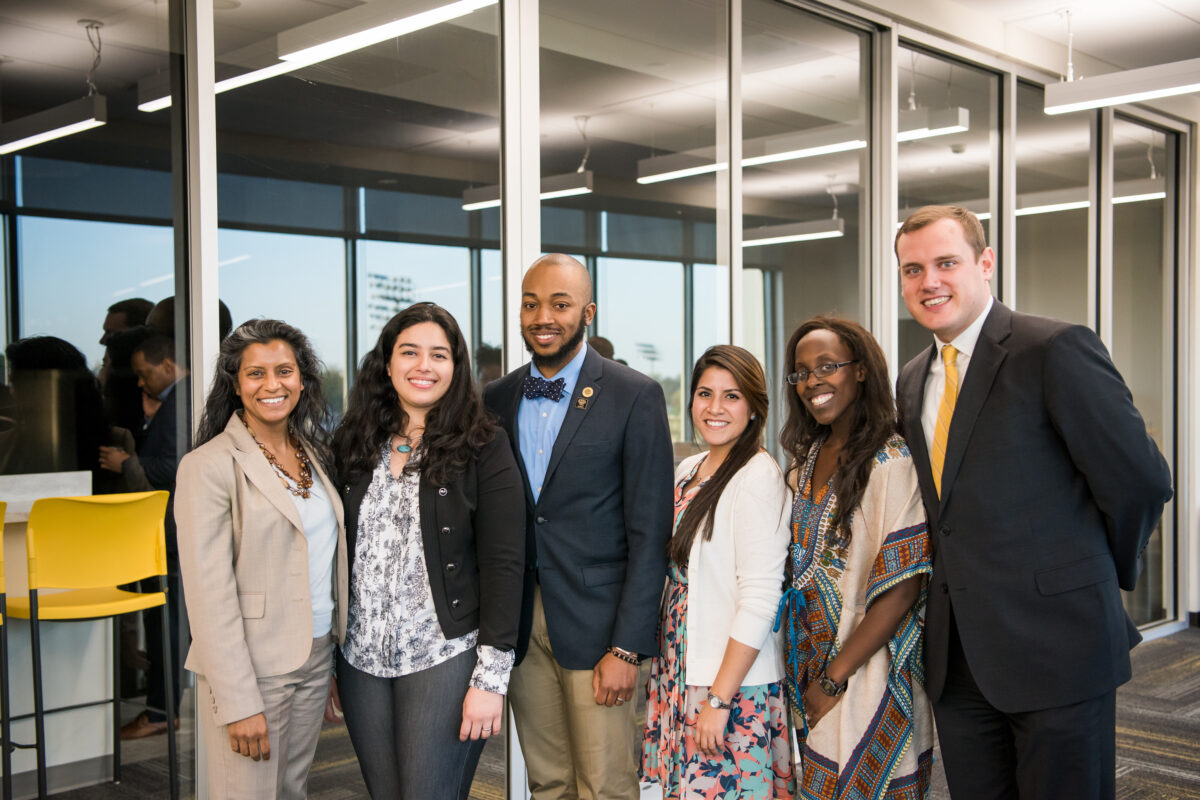
(l-r): Shafi, Monique Rivera-Velez, M.A.T ’17, education; Corey Carter ’08, biological sciences, M.A.T. ’10, education, current director of the Sherman scholars program; Emily Diaz ’16, biochemistry and molecular biology, and M.A.T ’17, education; Josephine Kalema-Kasozi ’13, dance, teaching certificate in secondary math education; and Michael at the 2018 Celebration of Teaching event. (Marlayna Demond ’11/UMBC)
Humanizing policy
“Josh’s work at the Sherman Teacher Scholars Program laid the groundwork for lasting partnerships between the university and City Schools. One example of this legacy is the Reach Together Tutoring Project (RTTP), which provides over 400 City Schools students each year with targeted math tutoring by UMBC students,” says Jane Lincove, professor of public policy and Michael’s dissertation chair. “The program is both reducing math achievement gaps and inspiring UMBC students to become math teachers. Josh’s work is a glowing example of how academic research by doctoral students in UMBC’s public policy program can be put to work to improve the lives of Marylanders.”
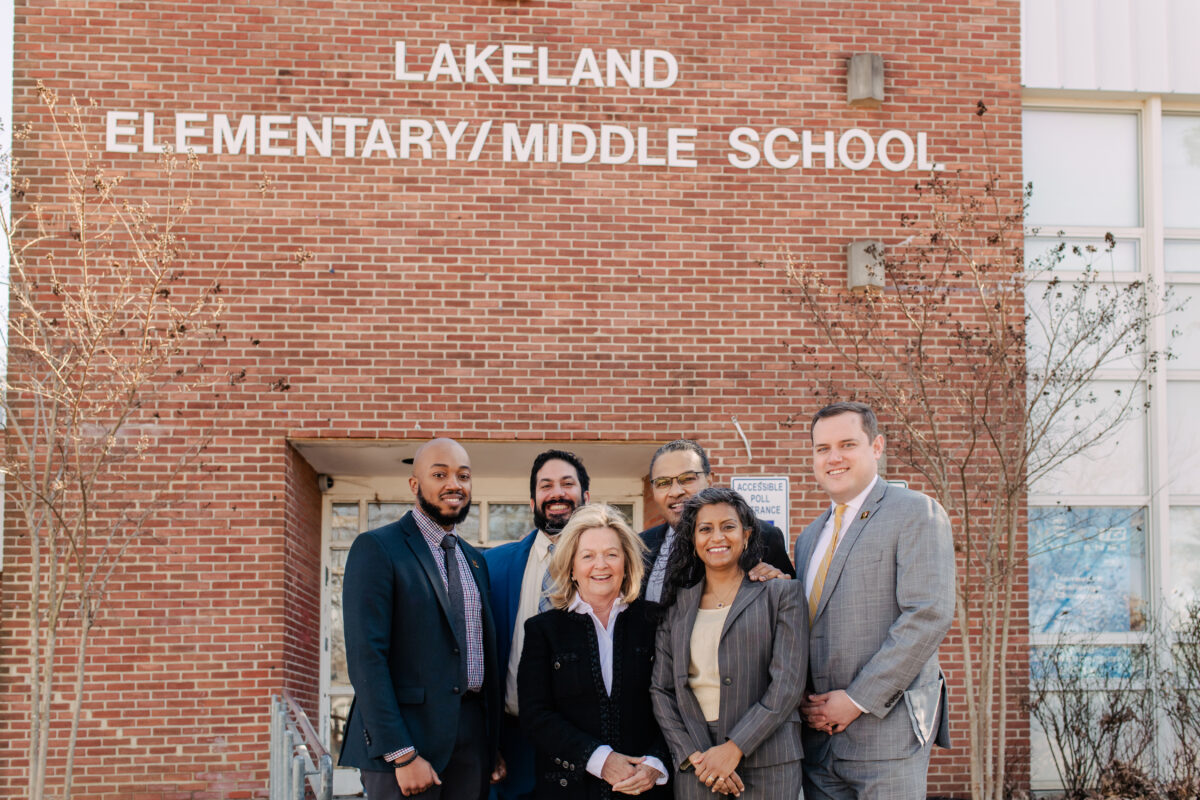
(l-r back row): Carter, Najib Jammal, then-principal of Lakeland Elementary/Middle School, Hrabowski, and Michael. (l-r front row): Betsy Sherman and Shafi. (Marlayna Demond ’11/UMBC)
“My advice to students interested in public policy is to serve in the communities you want to work with,” says Michael, currently the executive director at The Sherman Family Foundation and a board member of the Maryland Family Network, Cherry Hill Strong, and the Teach For America Baltimore Advisory Board. “Direct service in the classroom and communities have humanized the policy process for me.”
For the last seven weeks, Robert Barry ’25, ancient studies and visual arts, worked in a trench under the sweltering 90-degree sun. It may sound grueling, but this is Barry’s second year working in this archeological site in Greece with Michael F. Lane, associate professor of ancient studies and field director on the Kopaic Cultures, Economies, and Landscapes (KOCECOLA) research program. KOCECOLA is an archaeological investigation of a prehistoric settlement in its physical, human, and historical circumstances in the Kopaic Basin of central mainland Greece. Lane has conducted fieldwork in this area since 2010.
“What I really like about ancient studies is the faculty,” shares Barry. “They show a lot of interest in their students, and I feel like I belong.” Barry has taken archaeology and ancient Greek language classes with Lane, where he has excelled.
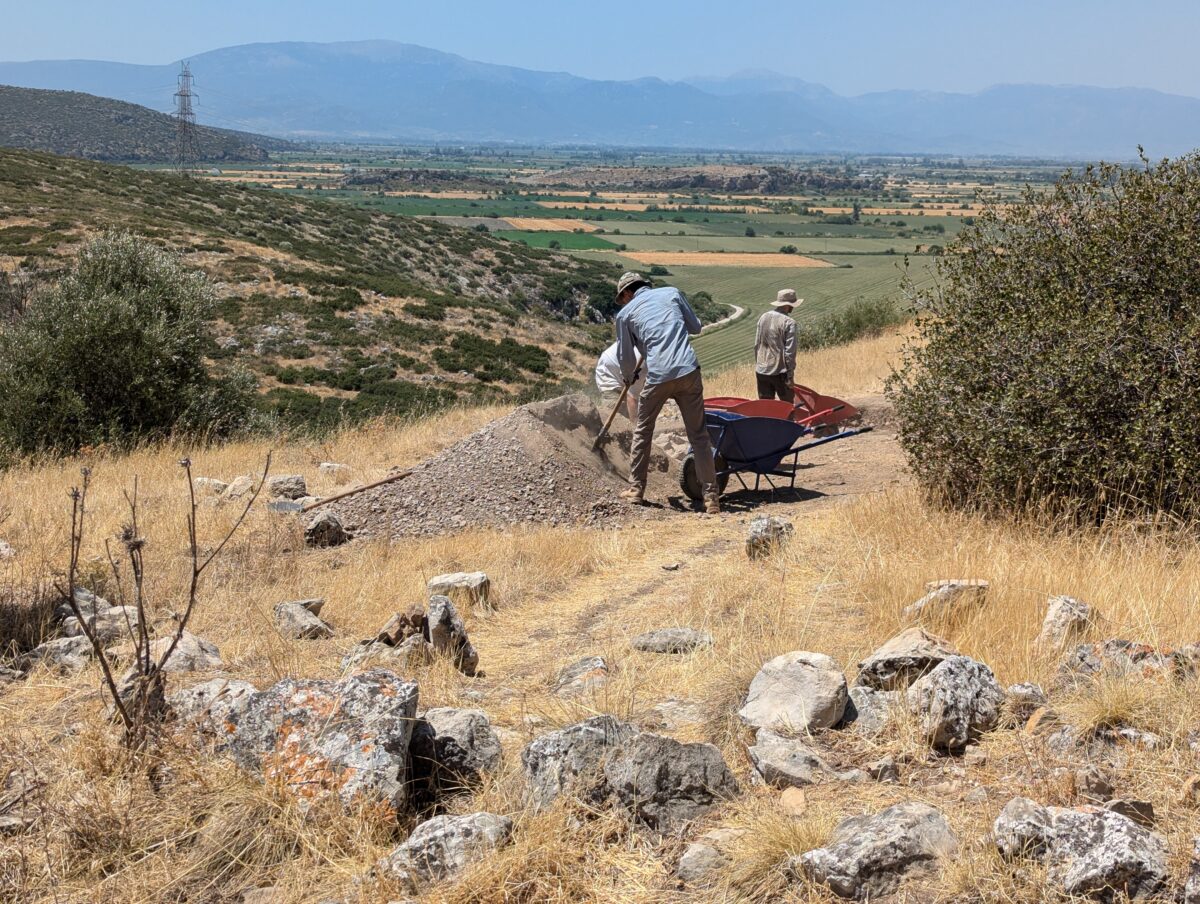
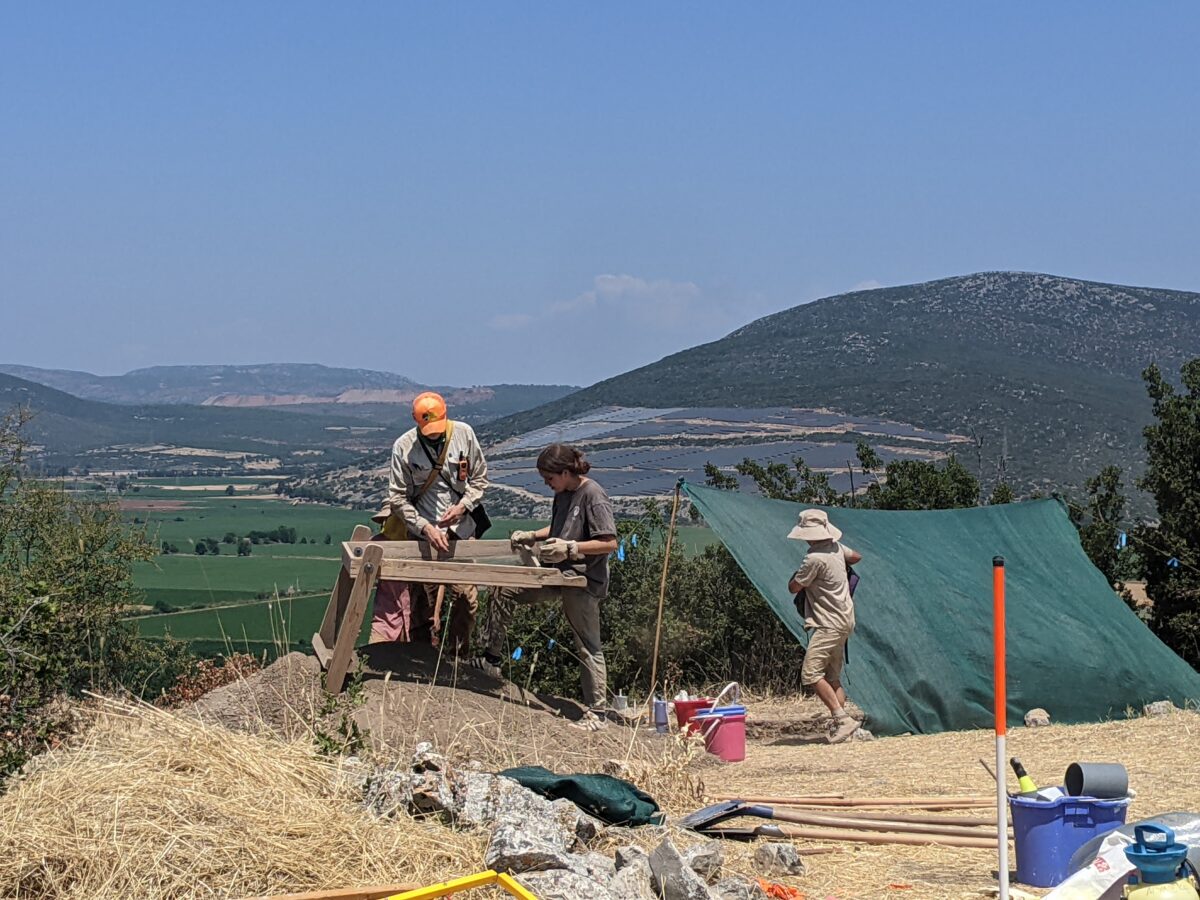
Students at UMBC’s 2024 archeological field school in Greece prepare the site for winter by backfilling trenches with soil. (Michael F. Lane/UMBC)
Barry learned about the project in Lane’s ancient Greek language class. Lane was seeking undergraduate research assistants to join the 2023 six-week summer archeological fieldwork opportunity, and Barry joined the team. This year, he returned as a trench supervisor with more responsibilities.
From excavating to supervising
Student research assistants use satellite-based differential Global Navigation Satellite Systems (DGNSS) and optical survey equipment. “We use the DGNSS and optical equipment both to plot the location of our trenches and to record the position of discoveries in three dimensions: latitude, longitude, and elevation above sea level,” explains Lane. Once an excavation site is identified, students use trigonometry to measure trenches and then large shovels to reveal distinct layers of soil. Excavation teams are made up of 2 – 3 students spread across six trenches.
“This year, I was a trench supervisor and learned a lot about myself. My priorities changed,” explains Barry. “Last year, I was digging and following directions from my supervisor. Now, I’m giving the orders and having to be responsible for the health and safety of everyone else while getting the job done.”
Lane says the senior staff at KOCECOLA regarded Barry as a peer. “He’s smart, meticulous, punctual, responsible, untiring, even-keeled, good-humored, and funny,” says Lane. “For this reason, I gave him a trench of his own to supervise for the last three weeks this summer, and he exceeded expectations.”
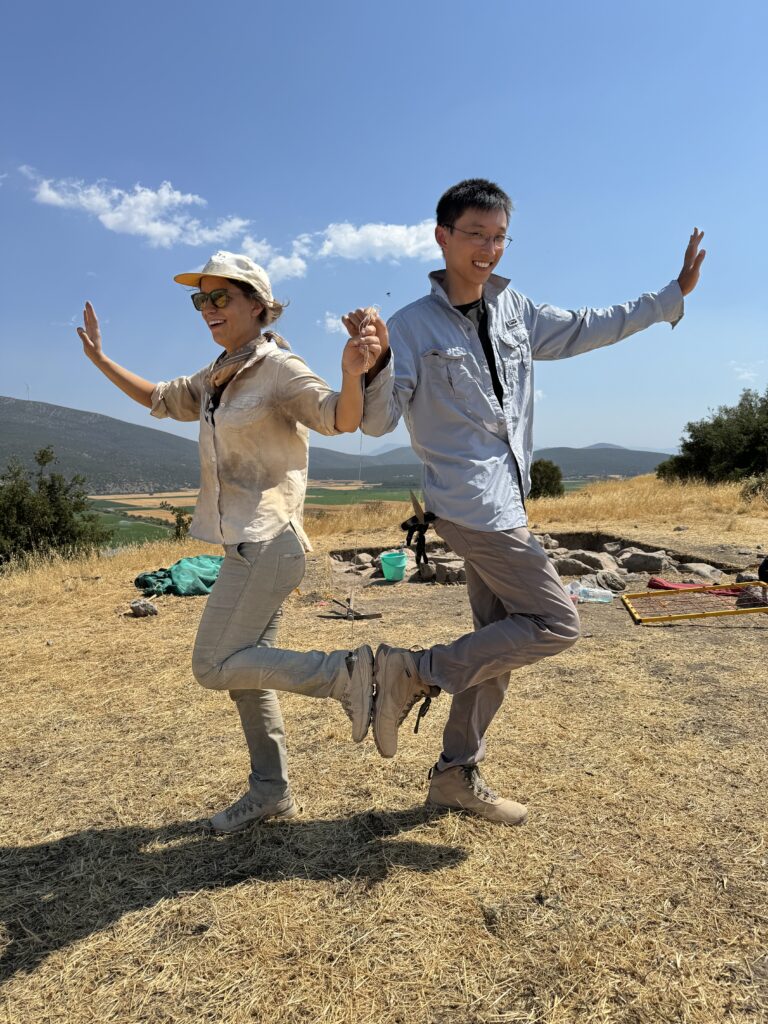
(l-r): Rachel Channell, a crew supervisor from Greece, teaches Barry a traditional Greek dance. (Brady E. Cavanagh/UMBC)
To get the job done, the team’s daily routine meant leaving the village at 5 a.m., taking a 20-minute drive to the dig site, hiking up a mountain, and beginning work around 5:30 a.m. Barry’s team of three students used small hand trowels and brushes to help reveal soil layers and artifacts, such as pottery. A fine mesh screen helped sift the soil removed during excavation, leaving behind finer artifacts. They would take soil samples for scientific dating and chemical analysis, as well as basic soil and sedimentary descriptions. Thanks to a 2024 UMBC Strategic Awards for Research Transitions grant that Lane received, students also had the opportunity to sample for radiocarbon dating and luminescence dating, which measures the energy of photons released from minerals to determine the age of exposed strata.
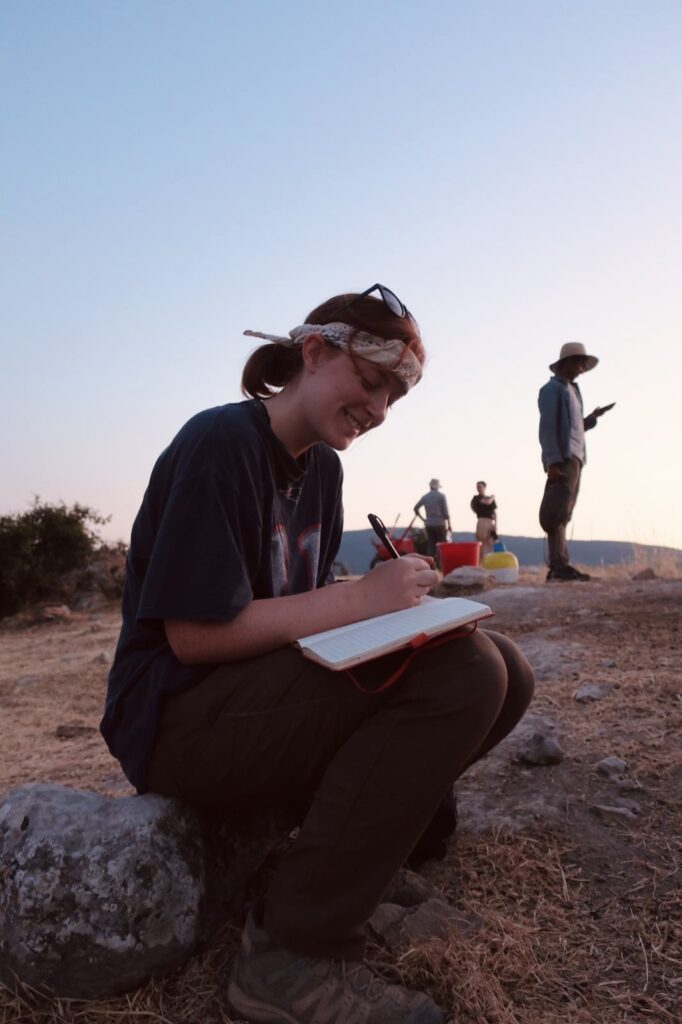
Brady E. Cavanagh ’26, visual arts, documents her work. (Elliott G. Alvey/University of Virginia)2023 crew screen soil for fine artifacts. (l-r): Damian V. Koropeckyj ’16, global studies, supervises India J. Kelly ’24, history, and Naomi Morales Glen, a master’s student at the University of the Peloponnese in Kalamata, Greece. (Michael F. Lane/UMBC)
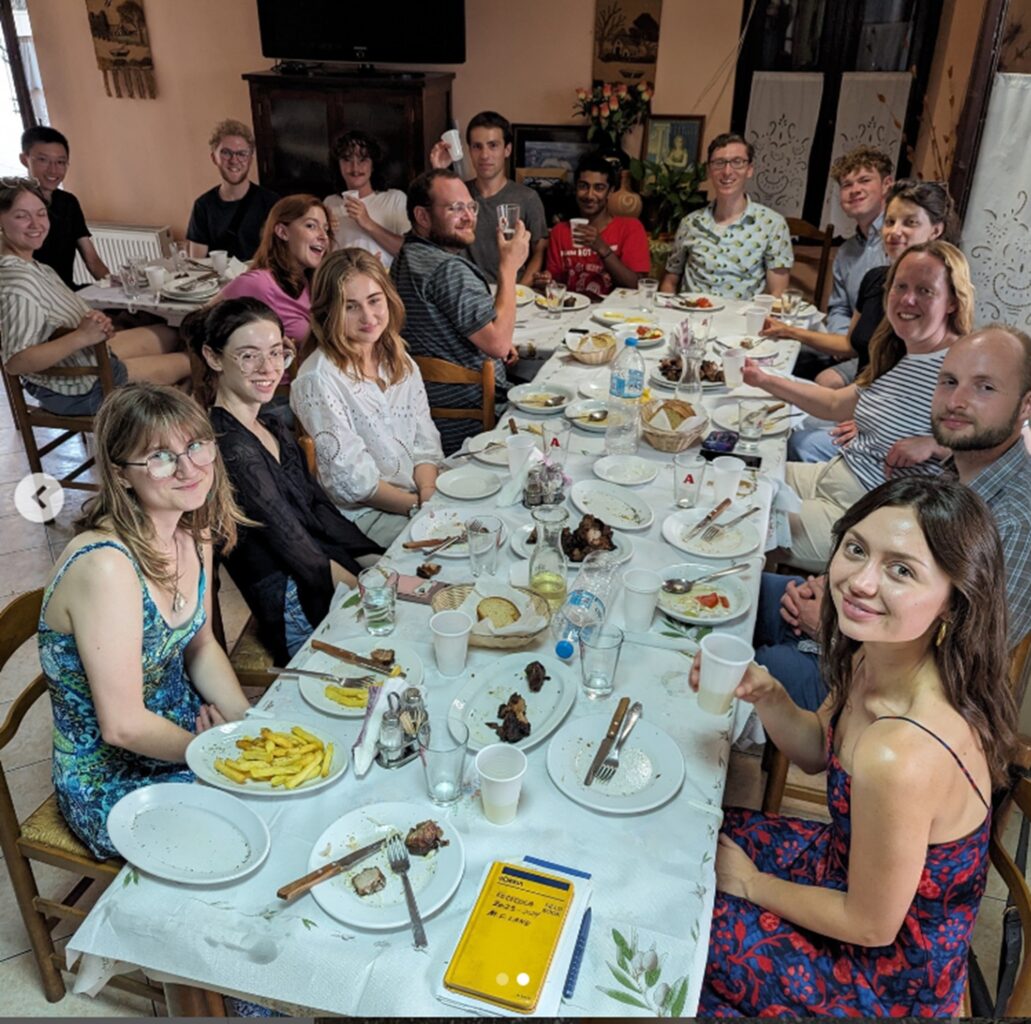
“We record where each artifact is, define its features and its chronological, historical, cultural, and social contexts,” says Barry. “It can get complicated when there are numerous artifacts to identify, map, excavate, bag, and label.” At 1 p.m., the crew would head to the lab for three hours to wash the day’s finds, scrub them with toothbrushes, and catalog finds. The rest of the afternoon would be all theirs until 8 p.m. when they would gather for a communal dinner at the local taverna (Greek for restaurant).
The 2024 crew enjoys dinner in the local village after a long day. (Michael F. Lane/UMBC)
To Greece and beyond
Now that the internship has ended, Barry is sightseeing in Austria before returning to the U.S. “My favorite part of this year’s experience was the international collaboration. I enjoyed getting to know students from the United Kingdom, the Netherlands, Germany, and Greece,” says Barry, who used these opportunities to practice his Greek and Latin skills, which are important in the ancient studies graduate programs he’ll apply to after returning to UMBC.
“Probably the moment that most touched me this summer was when Robert sat down at the kitchen table at the staff house with me and said, ‘Lane, can I tell you something…? I think I want to do this for the rest of my life’,” Lane shares. “I now consider it my duty to help him continue to excel, doing everything in my power to get him into the best academic programs and relevant jobs.”
Christopher K. Tong, an associate professor of modern languages, linguistics, and intercultural communication, has taught Asian studies for years. This fall, Tong brings a fresh perspective to his classes after spending two weeks in Mongolia as part of an award from the Council of American Overseas Research Centers (CAORC) to participate in the Overseas Faculty Development Seminar: Climate Change and Public Health—What Does Climate Change Mean for the People of Mongolia? Tong used this opportunity to advance research for his forthcoming book on the emergence of modern science and ecological consciousness in Asian and Western societies.
“Despite the grandeur of this country’s history, Mongolia as a modern nation is often understudied in Asian studies. Within China, Mongolians are an ethnic minority struggling to preserve their language and culture,” explains Tong. “Historically, the Mongolian empire stretched from Asia to Europe, so there is intrinsic value to studying Mongolia from a humanistic perspective. It was also interesting to see how present-day Mongolians understand and represent this history, for example, the life and legacy of Genghis Khan.”
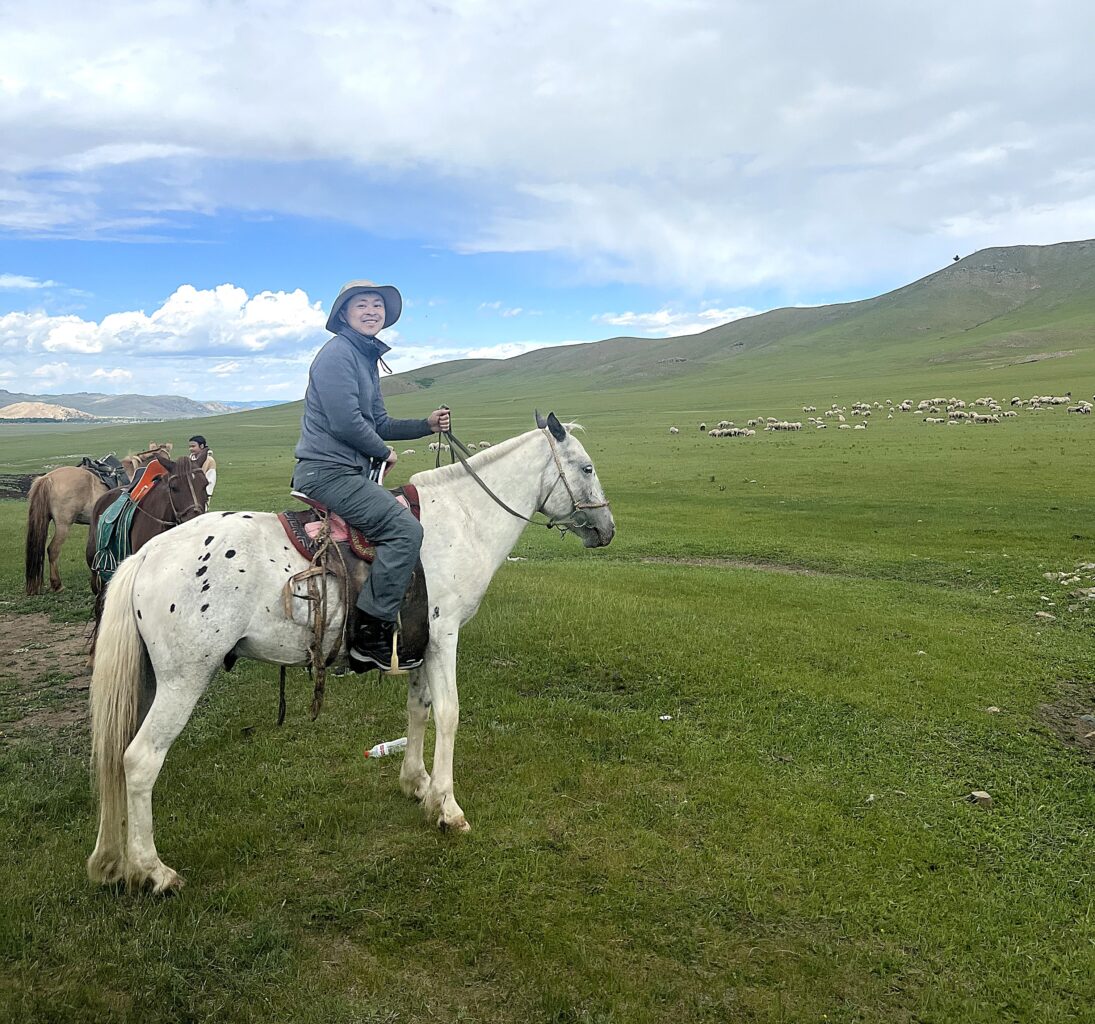
Tong rides a Mongolian horse during a visit to a nomadic family in the countryside near Ikh-Tamir in central Mongolia. (Image courtesy of Tong)
CAORC is a private, nonprofit federation of independent overseas research centers that promotes advanced research with an emphasis on the humanities and social sciences, the conservation and recording of cultural heritage, and the understanding and interpretation of modern societies. Tong was one of 44 faculty members from community colleges and minority-serving institutions, like UMBC, placed in one of three seminars that aimed to help faculty and administrators gain first-hand experience needed to develop and improve international courses, curricula, and teaching materials.
Learning from Mongolians
The seminar took place at the American Center for Mongolian Studies (ACMS) in Ulaanbaatar, the capital city of Mongolia. The 14 faculty assigned to the seminar in Mongolia visited Ulaanbaatar; the rural communities at Kharkhorin, the historic capital of the Mongol Empire; Erdene Zuu Monastery—the oldest Buddhist monastery in Mongolia; and Hustai National Park, home to the rare and endangered Przewalski’s horses. They also gained first-hand knowledge of the impact of hotter days, increasing wildfires, storms, colder winters, and drought on Mongolia’s communities and environment.
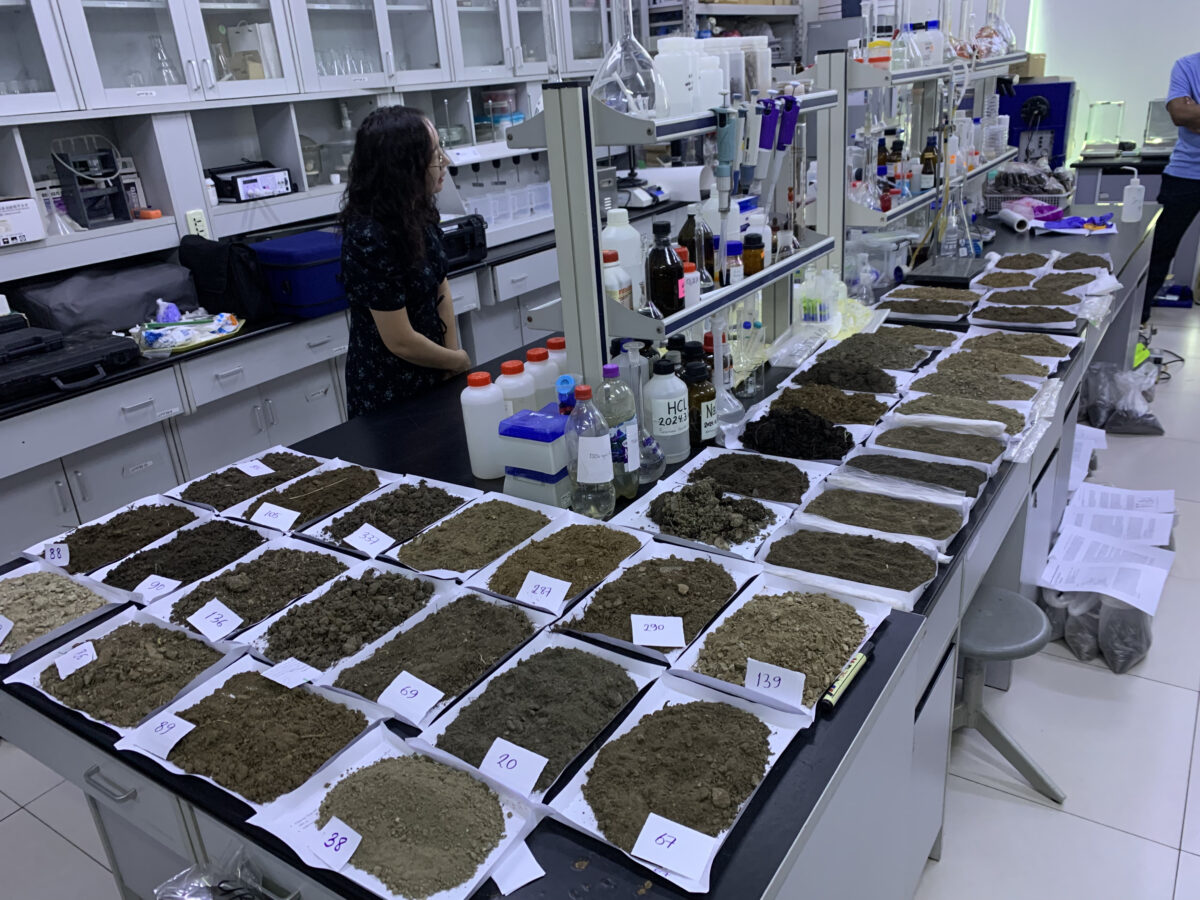
A soil scientist at the National University of Mongolia explains the different types of soil collected in the city of Ulaanbaatar and its vicinities. (Image courtesy of Tong)
“It was an eye-opening experience visiting Mongolia—meeting its people and experiencing the landscape. I have read novels and research about Mongolia,” shares Tong, “but visiting in person enriched my understanding and challenged my preconceptions.” He notes that Mongolia’s unusually cold winter this year wiped out entire herds of livestock, the primary source of income for nomadic families. Meanwhile, the use of low-grade coal for heating in Ulaanbaatar has increased air pollution and negatively impacted public health. “The effects of climate change are particularly noticeable to the people of Mongolia.”
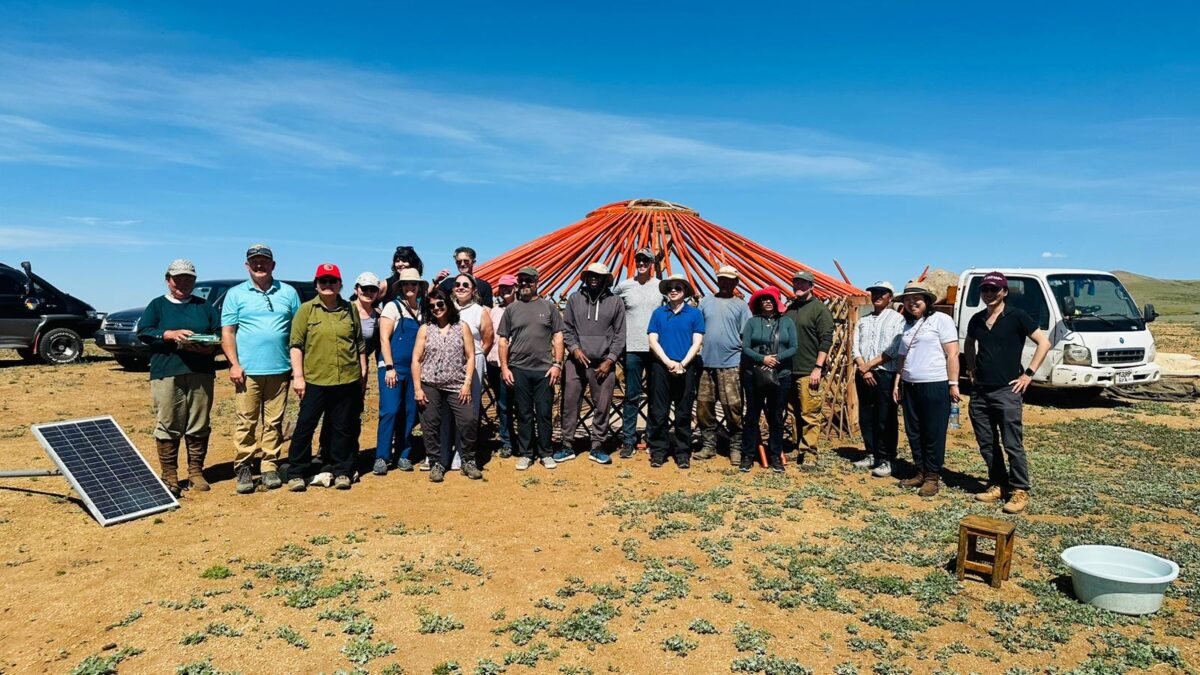
Tong (center with a blue polo and hat) stands with his CAORC colleagues and the nomadic family the team assisted in constructing their ger, a traditional Mongolian yurt. (Image courtesy of Tong)
The faculty met local officials, health specialists, climate scientists, and nomadic pastoralists to learn about their country and way of life from them. The scholars also assisted a nomadic family in constructing their ger, a traditional Mongolian yurt. These interactions and collaborations helped Tong better understand the Mongolian people’s perspectives on development and its relationship with China and the U.S. “My experience in Mongolia will inform my research in Asian studies and help me connect with Mongolian Americans back in the U.S.,” says Tong. “I’m very grateful that CAORC and ACMS allowed me to visit Mongolia.”
Bringing Mongolia to the classroom
This transformative experience will also benefit UMBC students. Tong has been teaching a course on China’s ethnic minorities, MLLI 335: Modern China: Culture, Society, and Environment, for many years. “A part of the traditional Mongolian homeland is in present-day China, an autonomous region known as Inner Mongolia,” says Tong. He teaches the novel Wolf Totem by Jiang Rong, which tells the story of a student from Beijing who travels to Inner Mongolia to live among the Mongols in the 1960s.
“Of course, the country of Mongolia is different from the Chinese region of Inner Mongolia. The field trip made these differences clear,” says Tong, who will develop new course materials on Mongolia as a modern nation and contextualize it within the broader field of Asian studies.
In addition to the CAORC award, Tong received a 2023 – 2024 short-term residential research fellowship from the American Philosophical Society to conduct research at the society’s library and museum in Philadelphia. During this time, Tong researched the history of evolutionary science in the U.S., including the contributions of Asian and African American scientists. He also helped launch UMBC’s new Mellon-funded Global Asias Initiative. The initiative supports rethinking Asian American issues on campus in a global, diasporic, and collaborative framework through community-engaged, public-facing scholarship, and teaching.
These work and research awards, along with a 2021 Early Career Fellowship in China Studies from the American Council of Learned Societies and a 2018 – 2019 Fulbright U.S. Scholar Program grant to China, have given Tong the time and resources to contribute new research to the field and new approaches to the teaching and learning of Asian studies.
McDonough will join scholars from around the world in one of the leading centers for theoretical historical research. This includes research on the history of medieval, early modern, and modern Europe, the Islamic world, East Asian studies, art history, history of science, and musicology. McDonough will spend the year writing chapters of her forthcoming book about the lives of sex workers in the medieval Mediterranean and sharing her progress in weekly seminars with historians as well as mathematicians, natural scientists, philosophers, and social scientists.
“I am incredibly energized by this opportunity to immerse myself in the archival materials I’ve been gathering concerning sex workers and their communities in the medieval Mediterranean,” she shares. Previously, McDonough earned a 2019 – 2020 National Endowment for the Humanities fellowship to conduct archival research at six Mediterranean Sea ports: Barcelona, Mallorca, and Valencia in Spain; Marseille, France; and Genoa and Palermo, Italy.
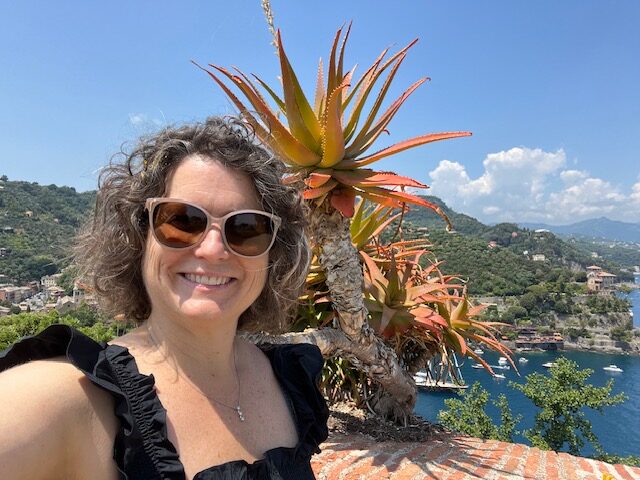
Susan McDonough in Nervi, a suburb of Genoa, Italy. (Image courtesy of McDonough)
“I tell a story of movement, of community, of connection, and of resistance. Sex workers lived under the threat of forced expulsion and were usually migrants to the towns in which they sold sex,” explains McDonough. “They worked, fought, competed against each other in brothels, and left each other precious belongings in their final wills and testaments.”
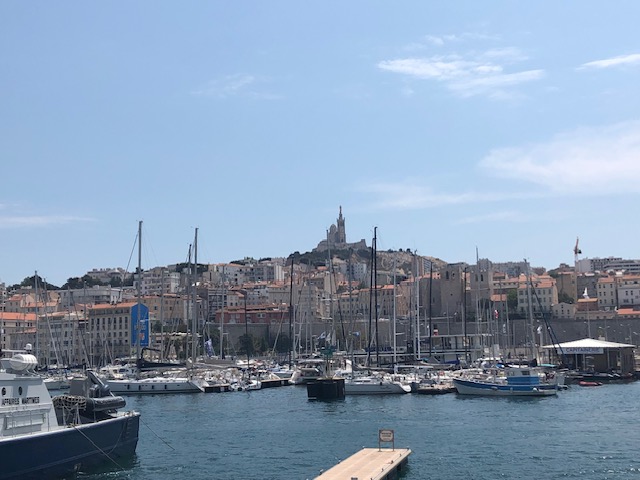
Marseille’s Vieux Port, with a view of the Cathedral of Notre Dame de la Garde. (Image courtesy of McDonough)
Her research is developing a more inclusive understanding of women’s experiences during this period. “To have the freedom to refine and deepen my ideas in the company of some of the most exciting thinkers, writers, and scholars—many of whose ideas have already been foundational in my conceptualization of this book—is extraordinarily lucky.”
McDonough is the second faculty member at UMBC to receive an IAS membership. Constantine Vaporis, professor of history, received a 2020 – 2021 IAS membership to work on his upcoming book, Sword and Brush: Portraits of Samurai in Early Modern Japan, 1600 – 1868.
UMBC’s commitment to integrating training with research and community engagement drew Sandra Barrueco, professor of psychology,tojoin the psychology department last summer. Barrueco hit the ground running with a two-year grant of over $990,000 from the Health Resources and Services Administration (HRSA) to establish ADVANCE Maryland or, in Spanish, AVANCE Maryland. The grant provides a stipend to train 14 clinical psychology doctoral candidates and 10 social work master’s students and their faculty supervisors in delivering integrated, culturally and linguistically competent behavioral health services to children, youth, and young adults in underserved and rural English- and Spanish-speaking communities in Maryland.
“I love that UMBC is a community-engaged, R1, and minority-serving institution,” says Barrueco, who founded the BIENESTAR/Wellbeing Lab at UMBC for undergraduate and graduate researchers. BIENESTAR, the Spanish word for well-being, is an acronym for the lab’s myriad but interconnected research areas.
Preparing students for complex roles
Graduate students en route to becoming licensed psychologists require hands-on training to develop expertise in promoting well-being and prevention through diagnosing, treating, and managing psychological disorders in diverse settings. Barrueco, along with other UMBC psychology faculty, dedicates time to guiding students in the clinical track of the Ph.D. human services psychology program through the complexities of their roles, ensuring they are well-prepared for the challenges they will face in their careers.
“The psychology department is exactly all I embody—community, clinical, and developmental psychology—since I work extensively with children and families. So, it is a great fit in that way,” says Barrueco, who came to UMBC after nearly 20 years at Catholic University in Washington, D.C., where she was associate dean for graduate programs and research in the School of Arts and Sciences, a full professor, director of clinical psychology, and co-founder of Catholic University’s Institute for Latin American and Iberian Studies.
“Living in Maryland, I can see the needs of our local communities,” says Barrueco, “and the big-picture perspective of what UMBC has the capacity to do at a state level.” It’s a goal that requires partners. The grant’s foundation is an interdisciplinary partnership with over 20 institutions and organizations, including partnerships with Melissa Smith, associate professor of social work at the University of Maryland School of Social Work, with experiential sites, and with community and government organizations serving children, youth, and young adults in Maryland’s underserved and rural communities.
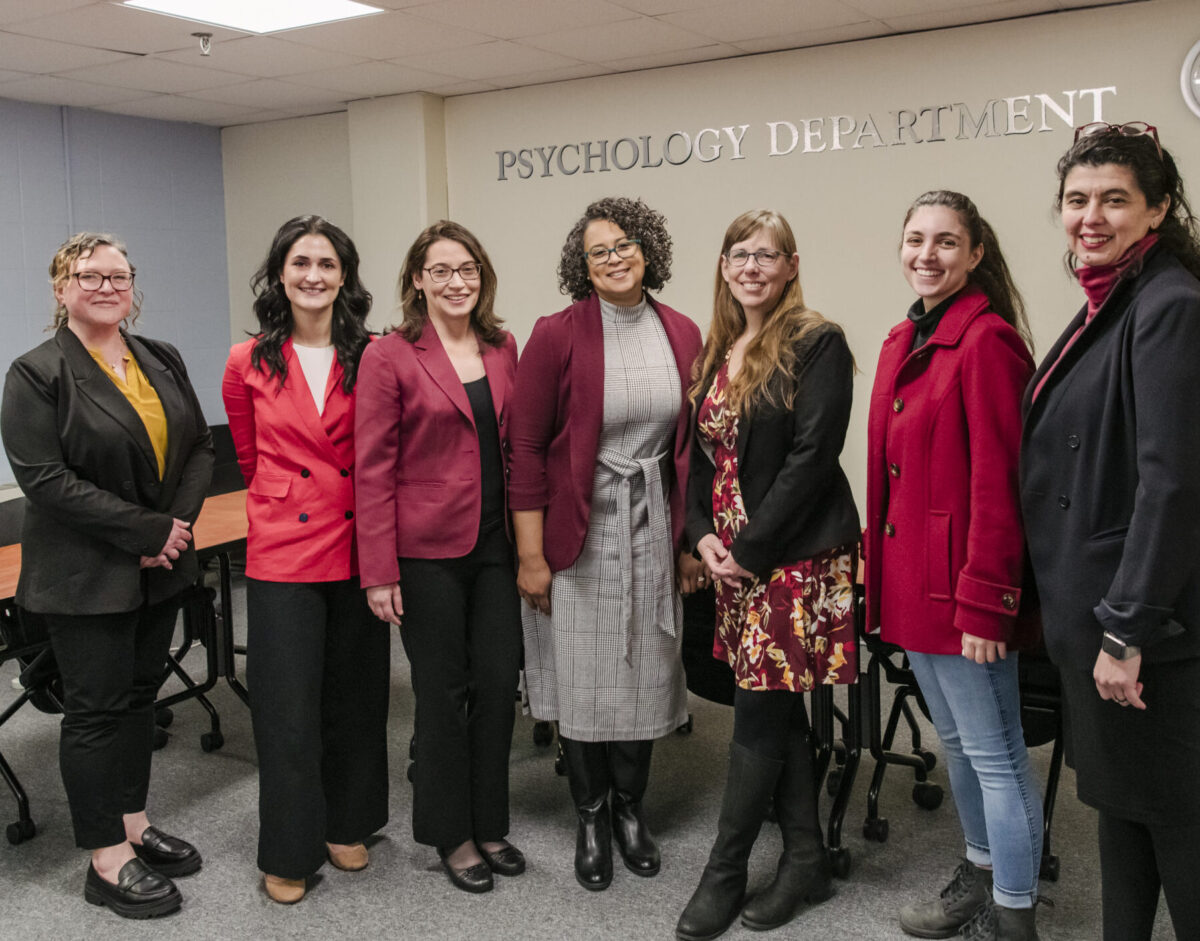
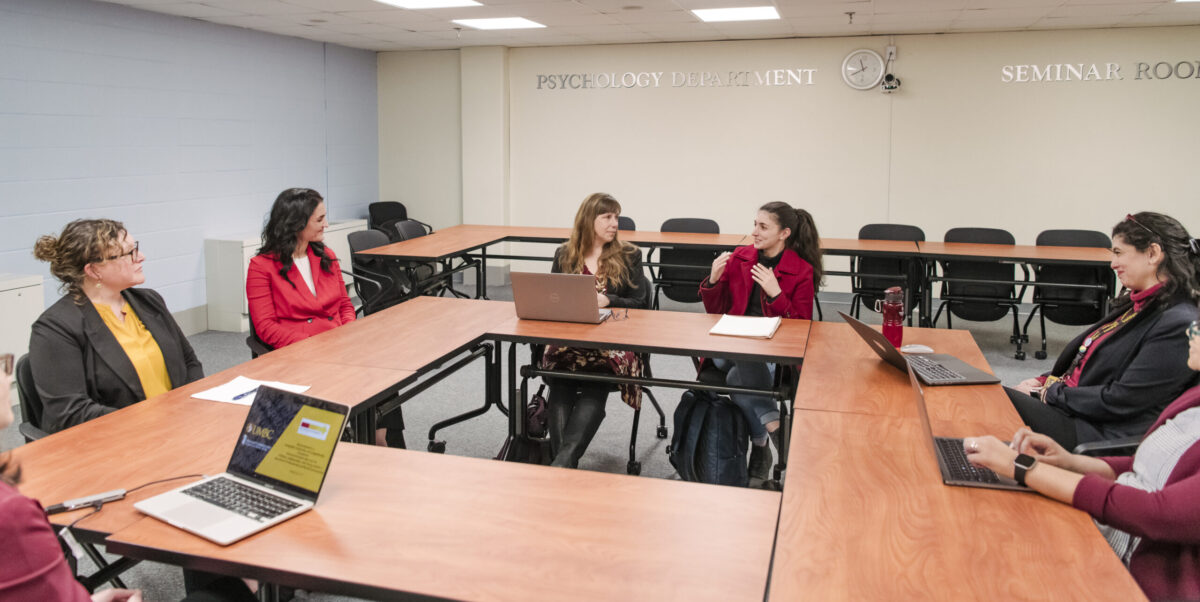
(l-r): Emily Lipsitz-Wardrick, a master of social work student at the University of Maryland School of Social Work, Pamela Rakhshan Rouhakhtar, Sandra Barrueco, Melissa Smith, Rebecca Schacht, Samantha Berg, and Doha Chibani ’08, psychology, M.P.P. ’22, public policy, UMBC psychology doctoral student, the department’s clinical coordinator, and director of clinical services at the STRIVE for Wellness Clinic. (Marlayna Demond ’11/UMBC)
“There’s often a lot of underfunding of doctoral and master’s students to pursue mental health training and to work in the field,” explains Barrueco. ADVANCE/AVANCE Maryland is changing that. Half of the grant purposefully funds graduate students and there is additional support to enhance the training of faculty and current service providers to prepare the next wave of psychology professionals to meet the needs of all communities affected by the national mental health crisis.
Barrueco notes that the students are in placements across the region with clients from various backgrounds. Through the grant, students learn how to provide services for culturally and linguistically diverse youth.
“One of the skills they are learning is how to work with interpreters. There are hundreds of languages in the immediate area, so it is a broader focus,” says Barrueco, who has expertise in Spanish. Since most bilingual speakers in the region are Spanish-speaking, students can get a strong sense of that community and learn from Barrueco’s expertise.
One-to-one solution
Samantha Berg, a fourth-year clinical psychology doctoral student in the human services psychology program at UMBC, is a research assistant at the Strive for Wellness Clinic, which provides evidence-based care to youth ages 14 – 25 through individual and family therapy, medication management, teletherapy, outreach and education, and consultation and assessment. The wellness clinic is run through a partnership between UMBC, the Maryland Early Intervention Program, the University of Maryland School of Medicine, the Maryland Coalition of Families, and On Our Own Maryland.
Samantha Berg (center in red coat) sits next to her advisor, Rebecca Schacht, sharing insights from her ADVANCE/AVANCE fellowship. (Marlayna Demond ’11/UMBC)
Berg’s passion for understanding psychopathology across a broad spectrum began almost a decade ago. It flourished when she entered UMBC’s doctoral program and met her advisor, Rebecca Schacht, an assistant professor of psychology, and co-director of the grant. Schacht’s research explores comorbid post-traumatic stress syndrome and substance use disorders. She is the director of the UMBC Psychology Training Clinic, where she supervises doctoral research students like Berg as they deliver low-cost, evidence-based individual psychotherapy related to anxiety, depression, relationship and family issues, and other types of mental health challenges. Schacht continues to be Berg’s advisor and provides clinical supervision.
Berg’s work at the wellness clinic aligned with the goals of the ADVANCE/AVANCE Maryland grant. She was one of the grant’s first doctoral fellows. “I was excited to learn new avenues for interacting with clients, such as how to work with an interpreter to do a bilingual mental health assessment. I want to be able to assess and treat as many people as possible, to serve as many populations as possible,” explains Berg. “I think it is part of my responsibility to gain new knowledge and understanding of how to engage with clients with whom I have different language proficiency. This is a one-to-one solution for this situation.”
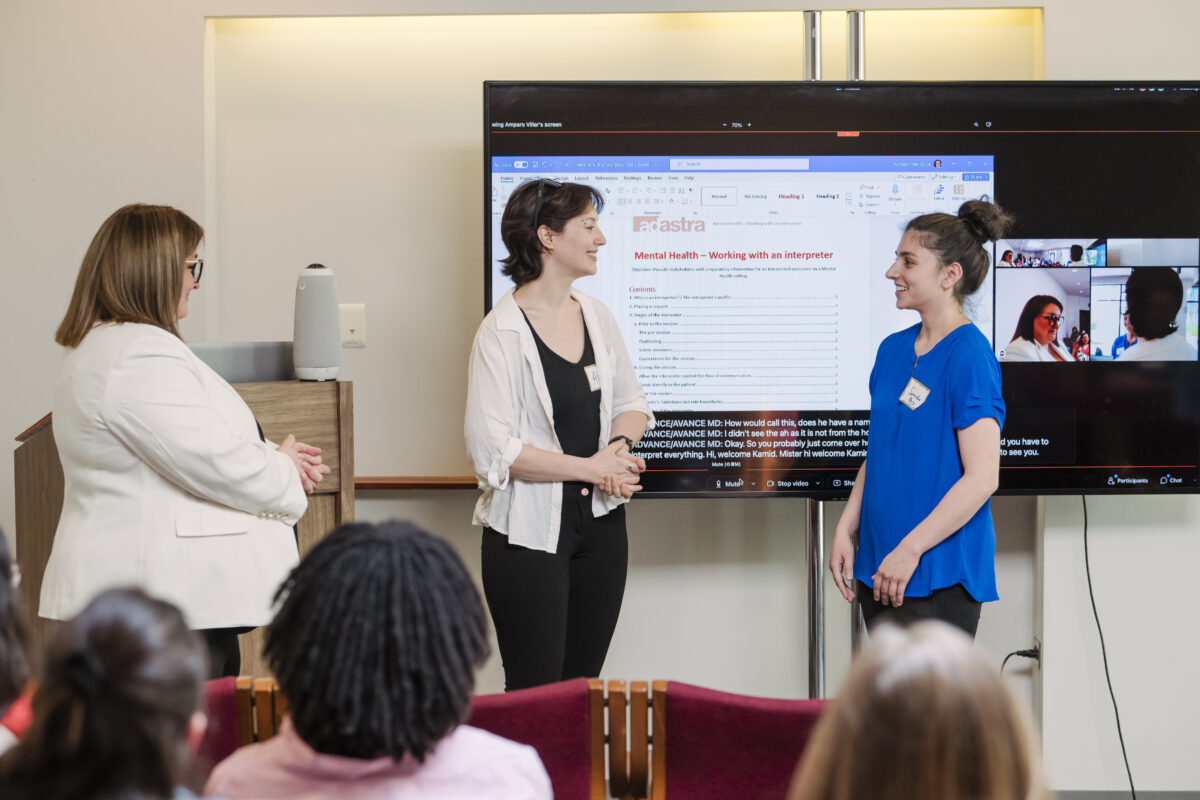
Amparo Villar Garcia (left), director of learning and development at Ad Astra language services, guides Samantha Berg (in blue) and an attendee through a role-play to train how to work with an interpreter. (Marlayna Demond ’11/UMBC)
She is excited to be part of a significant shift in clinical psychology as it moves from a medical model to a community-based intervention model. “Part of the intervention movement includes assessments,” says Berg. “I have a personal passion for wanting to be part of the change, part of the development of treatment.”
Developing a workforce
“It’s a huge pitfall of clinical work that there isn’t enough training on how to engage and serve people who don’t speak English,” says Danielle Farrell, another research fellow on the ADVANCE/AVANCE Maryland grant. As she looks forward to her fourth year as a clinical psychology doctoral student, Farrell appreciates having access to experiential opportunities.
Farrell studies intimate partner violence. Like Berg, Farrell was already engaged with the community ADVANCE/AVANCE Maryland will be focusing on as a research assistant at the Strive for Wellness Clinic. Farrell assessed and connected adolescents and young adults with early intervention referrals for a range of mental health concerns, primarily psychosis, under the supervision of Pamela Rakhshan Rouhakhtar, an assistant professor of psychology in the human services doctoral program, another co-director of the grant, and director of the Equity in Psychosis-Spectrum Services (EQUIPS) lab at UMBC. Faculty, graduate, and predoctoral students conduct research around psychosis-spectrum experiences, with an emphasis on psychosocial factors and access to care.
The grant’s workshops, professional development meetings, and job fairs are helping Farrell maximize the skills she’s developed for a successful career after graduation.
Big picture changes
ADVANCE/AVANCE Maryland is the culmination of decades of Barrueco’s unique research, which has been instrumental in addressing developmental and mental health difficulties among language minority, immigrant, and migrant children. Her work has led to methodological improvements in the assessment and early identification of bilingual children, expansion of the theoretical and research bases related to developmental and clinical processes, and the creation and examination of multisystemic preventive interventions fostering linguistic and socioemotional functioning. This research has advanced the field of psychology and informed policy.
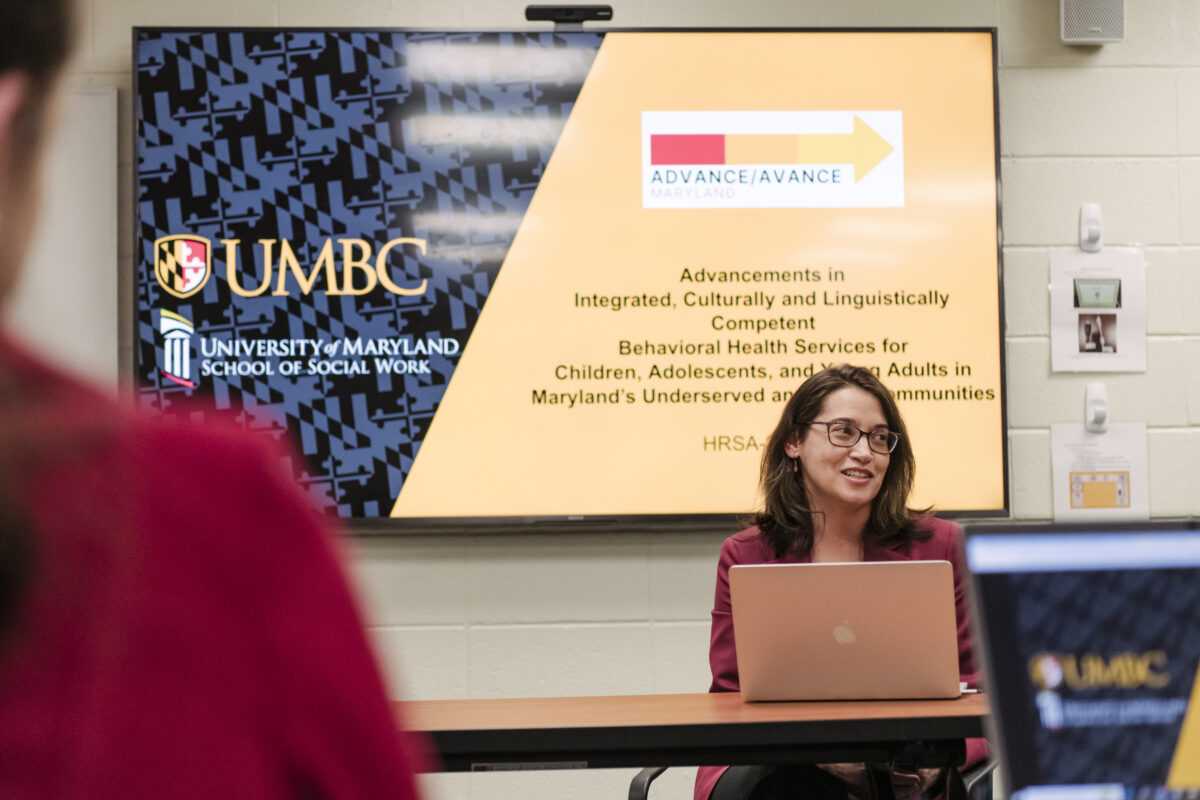
Barrueco updates the grant team. (Marlayna Demond ’11/UMBC)
Barrueco, now the director of UMBC’s clinical psychology Ph.D. program, is wholeheartedly invested in the future of UMBC’s work. “When I came to UMBC, our goal was: Let’s get some big-picture changes on the table,” she shares. “Funding psychology graduate students more quickly moves the needle on youth mental health in the nation.”
Sandra Barrueco, psicología, y sus colegas reciben casi $1,000,000 para formar a estudiantes de posgrado en servicios de salud conductual con competencia cultural para jóvenes marginados en Maryland
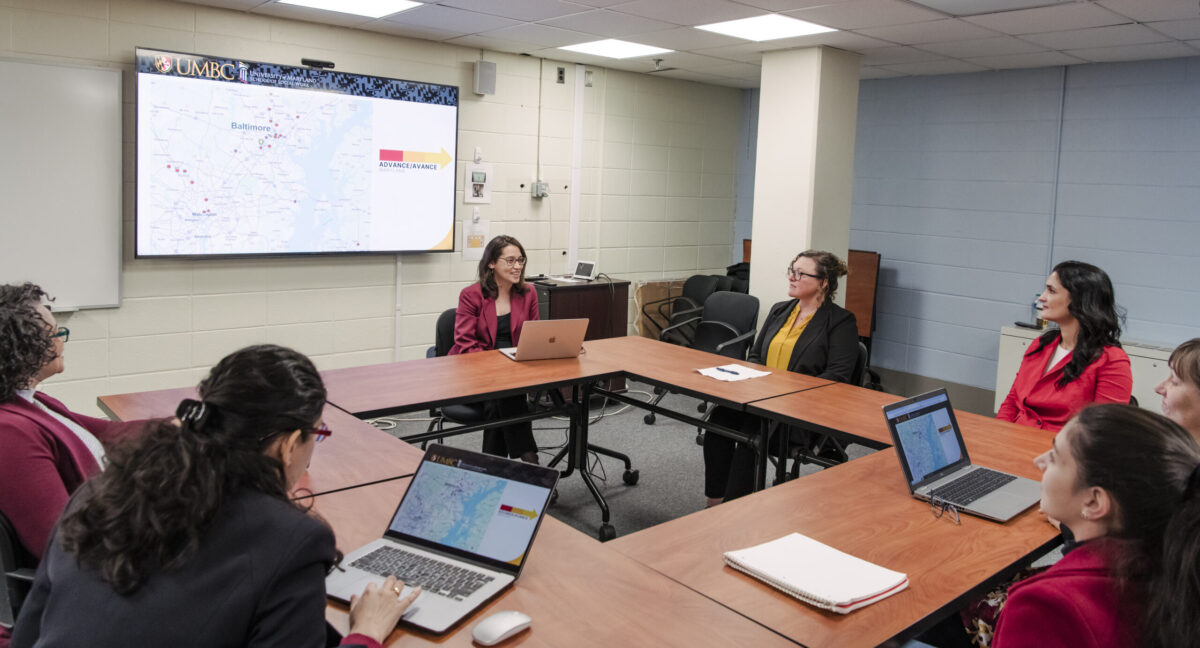
Barrueco (al frente de la sala) reunida con colaborodores de la subvención de la Facultad de Trabajo Social de la Universidad de Maryland y los estudiantes de doctorado de la Universidad de Maryland, Condado de Baltimore (UMBC, en inglés) para hablar sobre los centros de formación de ADVANCE/AVANCE Maryland. (Marlayna Demond, promoción 2011/UMBC)
El esfuerzo de UMBC para integrar la formación con la investigación y el compromiso a la comunidad fue lo que impulsó a Sandra Barrueco, profesora universitaria titular de psicología, a unirse al departamento de psicología el verano pasado. Barrueco se puso manos a la obra cuando la Administración de Recursos y Servicios de Salud (HRSA, en inglés) otorgó una subvención de más de $990,000 por dos años para fundar ADVANCE Maryland o, en español, AVANCE Maryland. La subvención consiste en un estipendio destinado a formar a 14 doctorandos en psicología clínica y a 10 estudiantes de maestría en trabajo social y a sus supervisores docentes en la prestación de servicios de salud conductual integrados y competentes desde el punto de vista cultural y lingüístico para niños, jóvenes y adultos jóvenes de comunidades rurales y marginadas de habla inglesa e hispana de Maryland.
“Me encanta que UMBC sea una institución comprometida con la comunidad, R1 (con actividad de investigación muy alta) y identificado por el gobierno por su servicio con las minorías”, dijo Barrueco, quien fundó el laboratorio BIENESTAR/Wellbeing en UMBC para investigadores de grado y posgrado. La palabra BIENESTAR es un acrónimo de las múltiples pero interconectadas áreas de investigación que tiene el laboratorio.
Preparación de los estudiantes para tareas complejas
Los estudiantes de posgrado que aspiran a ser psicólogos licenciados necesitan una formación práctica para desarrollar las competencias necesarias para promover el bienestar y la prevención mediante el diagnóstico, el tratamiento, y el manejo de trastornos psicológicos en distintos entornos. Barrueco, junto con otros profesores de psicología de UMBC, se encarga de guiar a los estudiantes de la rama clínica del programa de doctorado en psicología de los servicios humanos para que comprendan la complejidad de sus funciones y se asegura de que estén bien preparados para los desafíos a los que se enfrentarán durante su carrera profesional.
“El departamento de psicología es precisamente todo lo que me concentro: psicología comunitaria, clínica y del desarrollo, ya que trabajo mucho con niños y familias. Así que, en ese sentido, es ideal para mí”, dijo Barrueco, quien llegó a UMBC después de trabajar casi 20 años en la Universidad Católica de América en Washington, D. C., donde fue decana asociada para programas de posgrado e investigación en la Facultad de Artes y Ciencias, profesora universitaria, directora de psicología clínica, y cofundadora del Instituto de Estudios Latinoamericanos e Ibéricos de la Universidad Católica.
“Al vivir en Maryland, puedo ver las necesidades de las comunidades locales”, compartió Barrueco, “y la perspectiva general de cómo UMBC puede contribuir a nivel estatal”. Se necesitan asociados para lograr este objetivo. La subvención se basa en la asociación interdisciplinar con más de 20 instituciones y organizaciones, como las asociaciones con Melissa Smith, profesora asociada de trabajo social de la Facultad de Trabajo Social de la Universidad de Maryland; con centros de práctica de trabajo, y con organizaciones comunitarias y gubernamentales que asisten a niños, jóvenes, y adultos jóvenes en las comunidades rurales y marginadas de Maryland.
(De izq. a dcha.): Emily Lipsitz-Wardrick, estudiante de doctorado de la facultad de trabajo social de la Universidad de Maryland, Pamela Rakhshan Rouhakhtar, Sandra Barrueco, Melissa Smith, Rebecca Schacht, Samantha Berg y Doha Chibani ’08, psicología, M.P.P. ’22, estudiante de doctorado en psicología de UMBC, coordinadora clínica del departamento, y directora de servicios clínicos de la Clínica Strive for Wellness. (Marlayna Demond, promoción 2011/UMBC)
“Se suele financiar muy poco a los estudiantes de doctorado y maestría para que reciban formación en salud mental y trabajen en esta área”, explicó Barrueco. Esto está cambiando gracias a AVANCE Maryland. La mitad de la subvención está destinada a financiar los estudios de posgrado y, además, se proporcionan otras ayudas para mejorar la formación de profesores y de los proveedores de servicios actuales a fin para que puedan preparar a la próxima generación de profesionales de psicología para satisfacer las necesidades de todas las comunidades que se ven afectadas por la crisis nacional de salud mental.
Barrueco compartio que los estudiantes realizan prácticas a lo largo de toda la región y que trabajan con clientes de distintos orígenes. Por medio de la subvención, los estudiantes aprenden a prestar servicios a grupos de jóvenes diversos en términos culturales y lingüísticos.
“Una de las habilidades que están aprendiendo es cómo trabajar con intérpretes. Hay muchísimos idiomas diferentes en las inmediaciones, por lo que el enfoque es más amplio”, dijo Barrueco, que tiene un alto conocimiento de español. Dado que la mayoría de las personas bilingües de la región hablan español, los estudiantes tienen la oportunidad de conocer más de cerca a esa comunidad y de aprender de la experiencia de Barrueco.
Una solución directa
Samantha Berg, estudiante de cuarto año del doctorado en psicología clínica del programa de psicología de los servicios humanos de UMBC, es ayudante de investigación en la Clínica Strive for Wellness, en donde se ofrece atención basada en evidencia para jóvenes de 14 a 25 años mediante terapia individual y familiar, manejo de la medicación, teleterapia, divulgación y educación, y consulta y evaluación. La clínica funciona a través de una asociación entre UMBC, el Programa de Intervención Temprana de Maryland, la facultad de medicina de la Universidad de Maryland, la Coalición de Familias de Maryland, y la organización On Our Own Maryland.
Samantha Berg (en el centro con abrigo rojo) sentada junto a su asesora, Rebecca Schacht, comentando sobre su experiencia con la subvención de AVANCE. (Marlayna Demond, promoción 2011/UMBC)
La pasión de Berg por entender la psicopatología en un amplio espectro comenzó hace casi 10 años. Se potenció cuando entró en el programa de doctorado de UMBC y conoció a su asesora, Rebecca Schacht, quien es profesora adjunta de psicología y codirectora de la subvención. Schacht realiza investigaciónes sobre el síndrome de estrés postraumático concurrente y los trastornos por consumo de sustancias. Es directora de la Clínica de Formación en Psicología de UMBC, donde supervisa a los estudiantes de investigación doctoral como Berg, que ofrecen psicoterapia individual económica y basada en evidencia a personas con ansiedad, depresión, problemas familiares y de pareja, y otros problemas de salud mental. Schacht asesora a Berg y la supervisa en sus prácticas clínicas de forma continua.
El trabajo de Berg en la clínica de bienestar se relaciona estrechamente con los objetivos de la subvención de AVANCE Maryland. Fue una de las primeras becarias de doctorado de la subvención. “Me entusiasmó la idea de aprender nuevas formas de interactuar con los clientes, por ejemplo, cómo trabajar con un intérprete en el momento de hacer una evaluación de salud mental bilingüe. Quiero poder evaluar y tratar a la mayor cantidad de personas posible, atender a la mayor cantidad de poblaciones posible”, explicó Berg. “Creo que adquirir nuevos conocimientos y entender cómo relacionarme con clientes con los que tengo diferentes conocimientos lingüísticos es parte de mi responsabilidad profesional. Es una solución directa para esta situación”.
Amparo Villar Garcia (izquierda), directora de aprendizaje y desarrollo de la empresa de servicios lingüísticos Ad Astra, dirige un juego de roles con Samantha Berg (de azul) y una participante para practicar cómo trabajar con un intérprete. (Marlayna Demond, promoción 2011/UMBC)
Está contenta de poder formar parte de un cambio significativo en la psicología clínica, ya que la idea es pasar de un modelo médico a un modelo de intervención basado en la comunidad. “Las evaluaciones son parte del movimiento de intervención”, dijo Berg. “Tengo el fuerte deseo de ser parte del cambio, de la evolución del tratamiento”.
Capacitación de la fuerza laboral
“Uno de los mayores obstáculos en el trabajo clínico es la falta de formación sobre cómo vincularse con las personas que no hablan inglés y cómo atenderlas”, afirmó Danielle Farrell, otra de las investigadoras becarias de la subvención de AVANCE Maryland. Pronto comenzará el cuarto año del doctorado en psicología clínica y valora mucho las oportunidades de práctica que se le ofrecen.
Farrell se dedica a estudiar la violencia de pareja. Al igual que Berg, ya estaba involucrada con la comunidad en la que AVANCE Maryland se centrará, ya que trabaja como asistente de investigación en la Clínica Strive for Wellness. Ha evaluado y trabajado con adolescentes y adultos jóvenes que necesitaban derivaciones a servicios de intervención temprana por distintos problemas de salud mental, principalmente psicosis, bajo la supervisión de Pamela Rakhshan Rouhakhtar, profesora adjunta de psicología del programa de doctorado en servicios humanos, otra codirectora de la subvención y directora del Laboratorio de Equidad en los Servicios para el Espectro de la Psicosis (EQUIPS, en inglés) de UMBC. Tanto los profesores como los licenciados y los estudiantes predoctorales investigan distintas experiencias en relación con el espectro de la psicosis y hacen hincapié en los factores psicosociales y en el acceso a la atención.
Farrell está potenciando las habilidades que ha desarrollado para tener una futura carrera profesional exitosa gracias a los talleres de la subvención, las reuniones de desarrollo professional, y las ferias laborales.
Cambios de gran impacto
AVANCE Maryland es el resultado final de la investigación extraordinaria que Barrueco realizó durante décadas, la cual ha sido fundamental para abordar los problemas de desarrollo y salud mental de los niños pertenecientes a minorías lingüísticas, inmigrantes, y migrantes. Su trabajo ha dado lugar a mejoras metodológicas en la evaluación e identificación temprana de niños bilingües, así como a la ampliación de las bases teóricas y de investigación sobre los procesos clínicos y de desarrollo, y a la creación y el análisis de intervenciones preventivas multisistémicas que favorecen el funcionamiento lingüístico y socioemocional. Esta investigación ha contribuido a generar nuevos avances y políticas en el campo de la psicología.
Barrueco pone al corriente al equipo de la subvención (Marlayna Demond, promoción 2011/UMBC)
Barrueco, actual directora del programa de doctorado en psicología clínica de UMBC, está plenamente comprometida con el futuro de la labor de UMBC. “Cuando llegué a UMBC, planteamos el objetivo de proponer cambios de gran impacto”, contó. “Si financiamos los estudios de posgrado de psicología, lograremos impulsar el cambio necesario para mejorar la salud mental de los jóvenes del país”.
This summer, UMBC’s Center for Global Engagement (CGE) is excited to welcome its second cohort of the prestigious Mandela Washington Fellowship for Young African Leaders, the six-week flagship program of the U.S. Government’s Young African Leaders Initiative (YALI). The new cohort includes 25 innovators from countries across Sub-Saharan Africa representing education, journalism, tech, health care, and more. The fellows will spend six weeks living at UMBC networking and attending diversity and leadership skills workshops. They will also meet with campus, local, and state leaders, learn more about Baltimore’s LGBTQ+ leaders of color, developmental disabilities at The ARC Baltimore, trauma-informed practices, and more.
“The fellowship is a beacon of hope,” says Jok Thon, M.P.S. ’24, entrepreneurship, innovation, and leadership, a 2018 University of Delaware YALI fellow and UMBC’s first Global Peaceworker Fellow. Thon is a father of four and the director and founder of Promised Land Primary and Secondary School and Promised Land College in Juba, South Sudan, which has educated over 1500 displaced students. “As a witness and participant in this transformative experience, I wholeheartedly attest the journey is as profound for the mentors as it is for the fellows.”
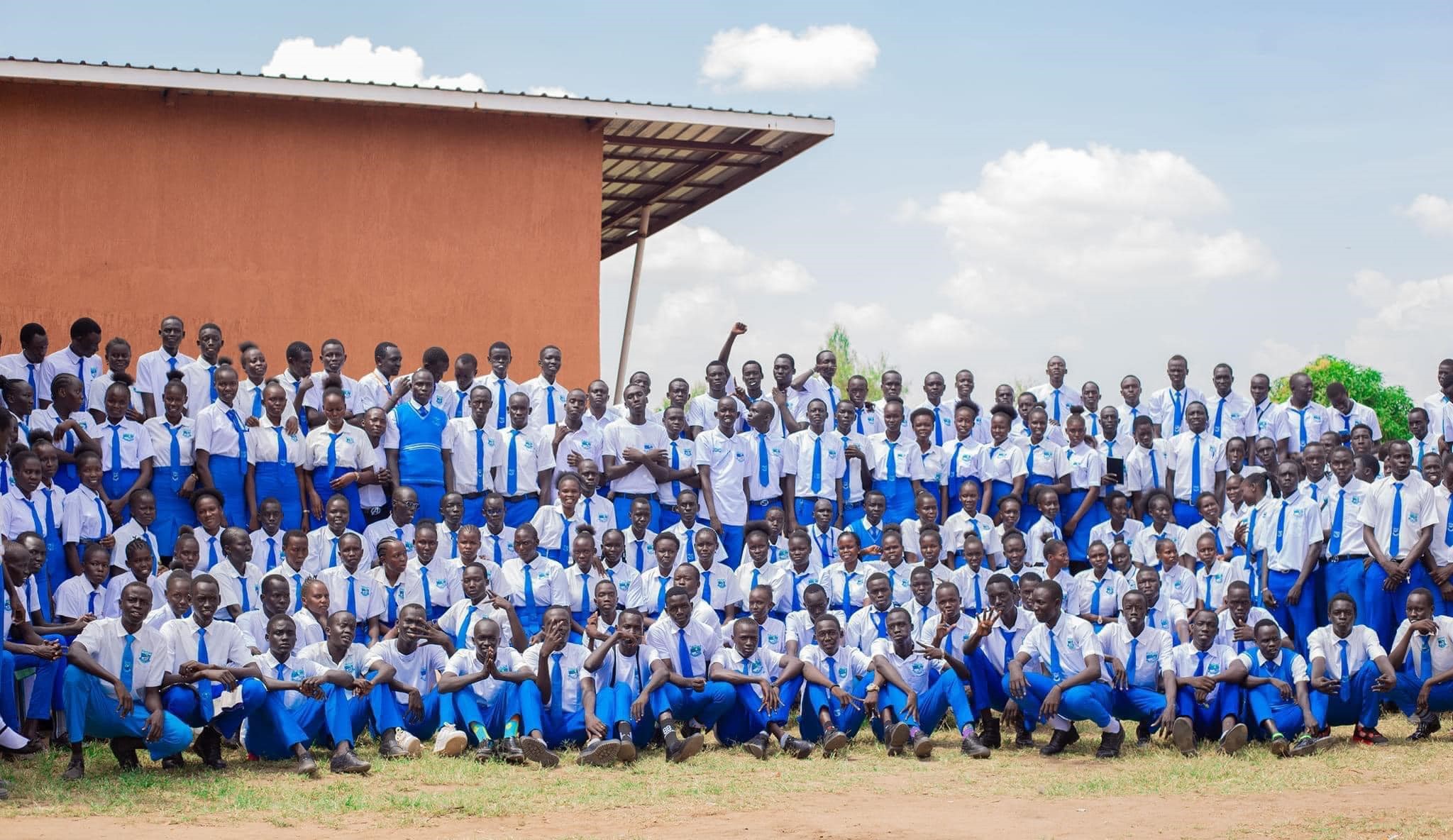
Promised Land Primary and Secondary School in Juba, South Sudan. (Image courtesy of Thon)
Thousands of leaders ages 25 – 35, across 49 Sub-Saharan African countries covet a prestigious YALI fellowship. YALI hopefuls must condense years of leadership in business, civic engagement, and public management into one application, demonstrating concrete ongoing efforts to broaden access to education, health care, and workforce development. These 700 spots across 28 U.S. educational institutions are considered a once-in-a-lifetime opportunity, for both fellows and host institutions, to strengthen connections between the U.S. and Africa and establish enduring partnerships between fellows, local communities, and private businesses through their expertise, perspectives, and experiences.
“YALI is a huge deal in my country and Africa. It’s a journey I want to take with my whole community, nation, and the world,” says 2023 UMBC YALI fellow Victoria Merab Akinyi. She is the CEO and co-founder of Streetlights Uganda, a visual and performing arts-based organization empowering children living on the streets with entrepreneurship and life skills to become self-employed and engaged citizens.
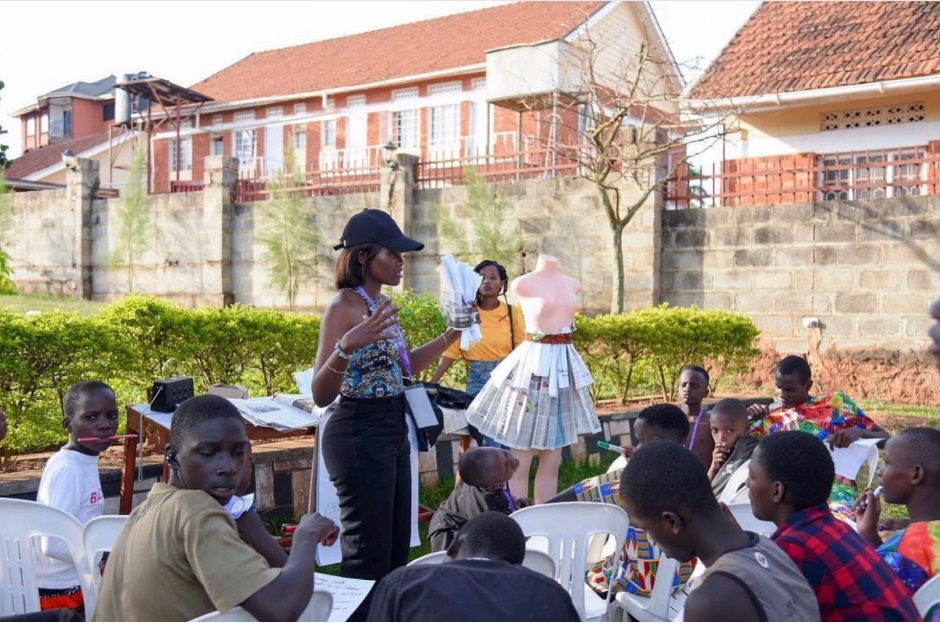
Victoria Merab Akinyi teaching a fashion design class at Streetlights Uganda. (Image courtesy of Merab Akinyi)
“I have a master’s degree in fine arts and two fashion companies. I don’t take my degrees, work with my community, and my YALI experiences for granted because they have all helped open doors for me.”
Creating a Retriever YALI Village
Becoming a YALI host is also an arduous but worthwhile process. It requires developing a six-week international residency program unique to the institution’s resources and the fellows’ needs. When Ryan Sheldon, M.A. ’15, teaching English to speakers of other languages, director of the English Language Institute and special programs within CGE, and Madison Pickard, M.A. ’24, intercultural communication, and assistant director of special programs and co-academic director of the YALI Fellowship, applied to bring YALI to UMBC in 2023, Thon was excited to join the team as a program assistant.
“It was so valuable to our fellowship having Jok as a program assistant and a resource for the fellows while they were here,” says Pickard. “Jok assisted the fellows in leadership activities, accompanied us on on-site visits, and facilitated their weekly feedback and reflection sessions as our leadership coordinator.”
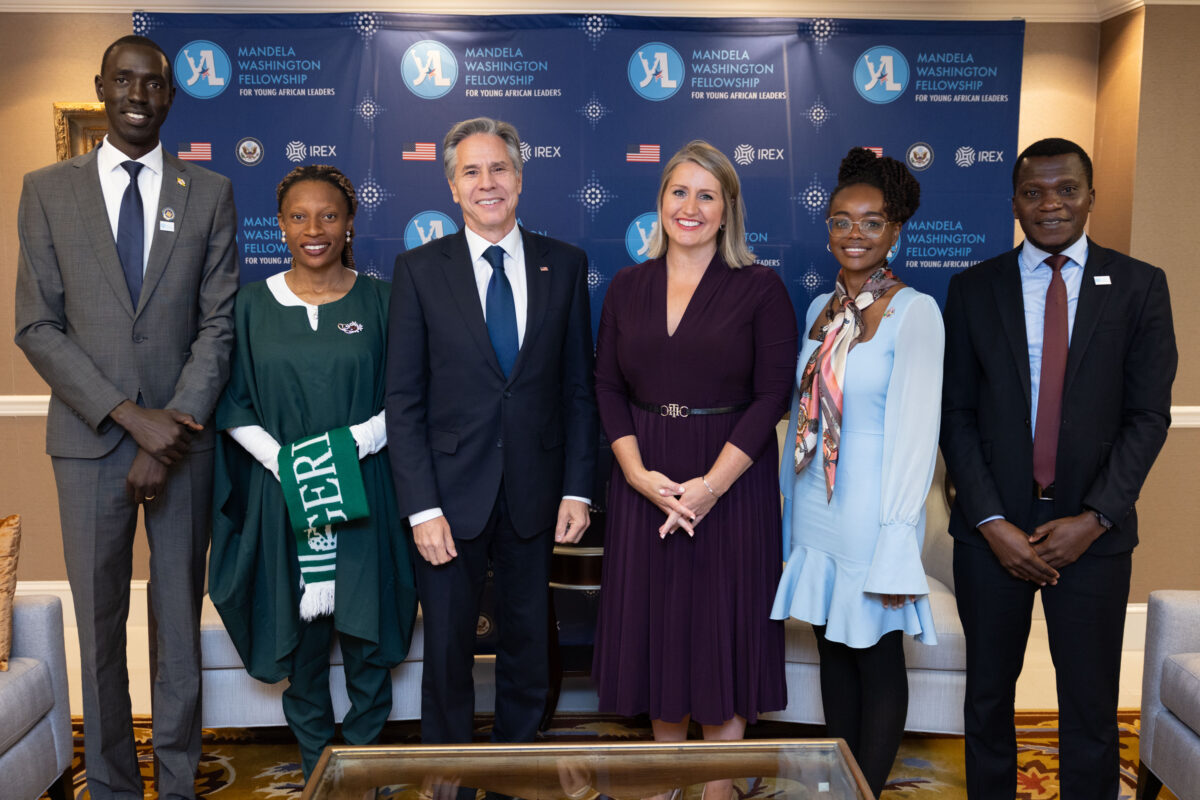
(l-r): Jok Thon, YALI fellow Blessing Ashi from Nigeria, U.S. Secretary of State Antony Blinken, Undersecretary of State Elizabeth Allen, and YALI fellows Shange-Ndamona Mungoba from Namibia and Khwima Mkamanga from Malawi. (Image courtesy of Thon)
Designing a “Retriever YALI Village” requires many hands. The village was equipped with campus housing, transportation, catering, activities, and a budget for each fellow. Thanks to campus and community partners, it also included workshops, projects, events, and speakers.
“We invited trusted partners aligned with our fellows, had conversations with them, and created a space for the fellows to choose their level of engagement,” says Pickard. The proposal was a winner.
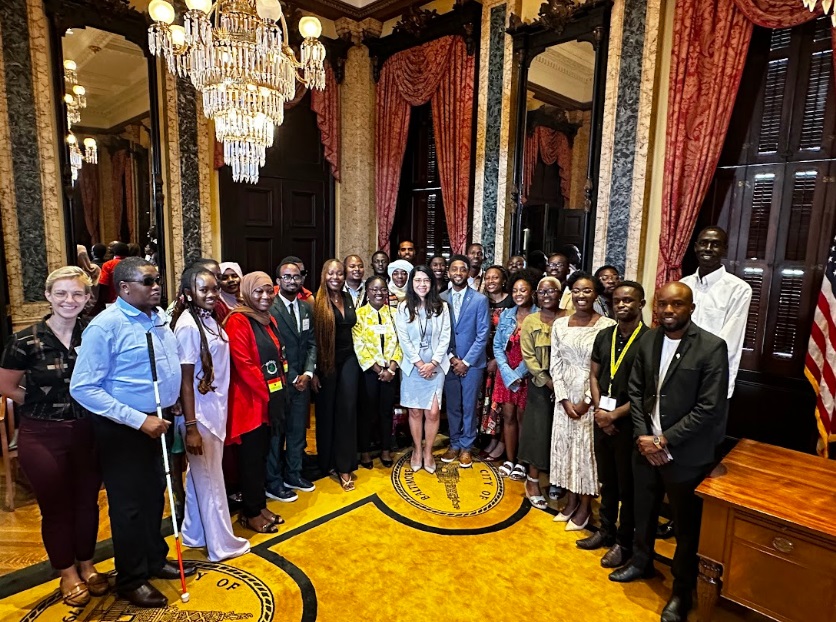
YALI fellows at Baltimore City Hall with Baltimore City Mayor Brandon Scott. (Image courtesy of Mirab Akinyi)
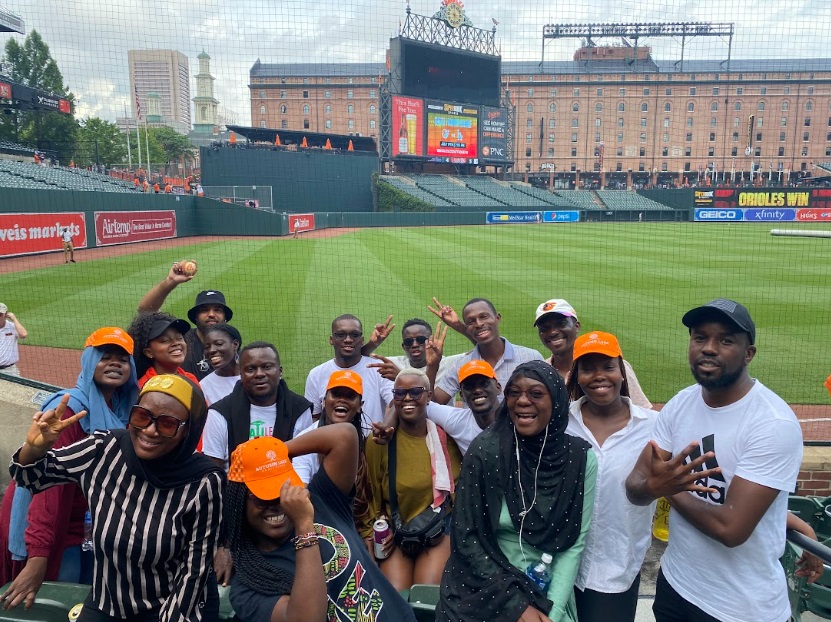
In summer 2023, 24 young African leaders came to UMBC to share and learn new skills to empower them as critical leaders in addressing issues facing women, girls, and children, mental and public health, education, community organizing, NGO management, sustainability, and more. Fellows engaged in academic sessions, community service, site visits, and networking events and met state and local government leaders, businesses, and community organizations. They also joined in Baltimore’s baseball season at the Oriole Park at Camden Yards.
YALI fellows at the Oriole Park at Camden Yards in Baltimore City. (Image courtesy of CGE)
“Together, we explored the notion that true leadership is rooted in service and that we can drive meaningful progress by embracing diversity and harnessing collective strengths,” says Thon. Due to the program’s success, UMBC was chosen to host again in June 2024.
All for all
Fellows are often inspired into action by personal experiences. Their superpower is knowing they alone are not the answer. Fellows share their community-building strategies and acquire new expertise to address ongoing challenges. It’s not all-for-one, or one-for-all, but all-for-all.
Leveraging social media for social justice is a key approach for Ellen Kalaputse Nanyeni, a financial modeling and valuation analyst from Namibia. As a survivor of sexual and gender-based violence (SGBV), she understands the victim blaming and legal hurdles survivors face to access care and protection. Nanyeni promotes equal opportunity rights and the safety of women in Namibia via the #Shutitalldown Namibia SGBV awareness social media movement and through the #Breakfree #Befree support services initiative established by Monica Geingos, the First Lady of Namibia.
In Nigeria, Sunday Emmanuel Onuche networks with schools and disability organizations to further disability justice. Onuche promotes inclusion, leadership opportunities, and self-reliance for people with disabilities like himself via his VisionLink Initiative.
Skateboarding is John Kabiye Kalenga’s community development tool. As a professional skateboarder and the coach for Zambia’s first Olympic skateboard team at the 2022 Tokyo Olympics, Kalenga lives and breathes the sense of belonging skateboarding has given him. As vice president of the Skate Association of Zambia, he teamed up with more than 30 international skatepark construction volunteers to build Zambia’s first-ever skatepark creating a safe haven for young people.
CNN World: Zambian instructor empowers kids through skateboarding
These are just a few of the 2023 YALI fellows who connected over the summer of 2023 and returned to their countries with new leadership skills and tools for change.
Implementing the YALI Way
YALI is one summer, but it’s what comes afterward when the fellows return home that the work truly becomes YALI work. Merab Akinyi returned to Uganda intent on expanding Streetlights Uganda’s reach. She fundraised to remodel old houses in areas of high need. The additional classrooms and offices launched the Ntunga project, Changing Lives Through Fashion. It equips women and children with marketable skills to sustain their families. Her team continues to run the Mwalimu Mentorship, an apprenticeship connecting artists with youth, and the Unseen Me children’s exhibition.
Currently, Streetlights Uganda manages two training centers for women and two for street children. Merab Akinyi and her team of seven organizers have reached over 60 women in the past 3 years and over 400 street children.
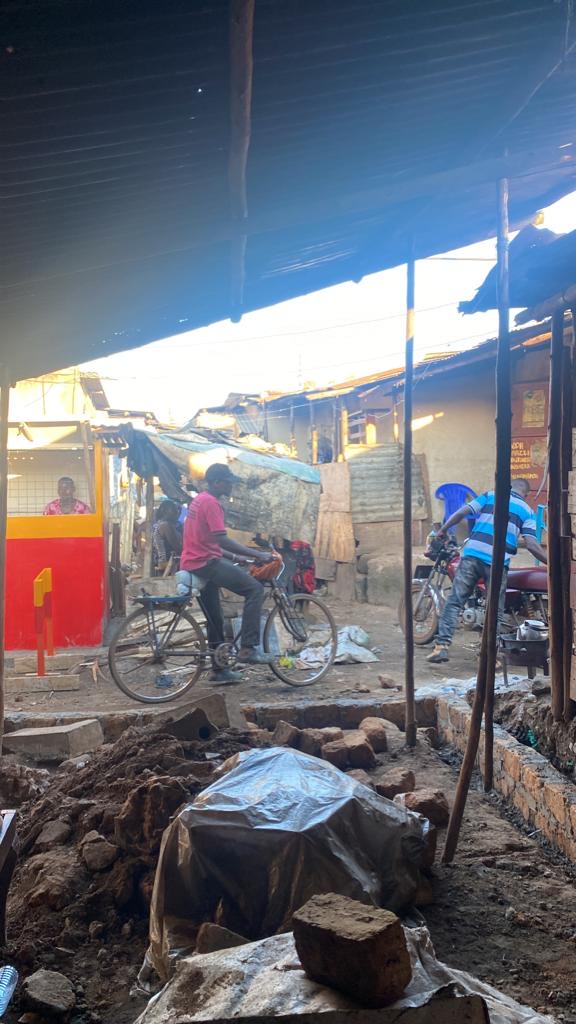
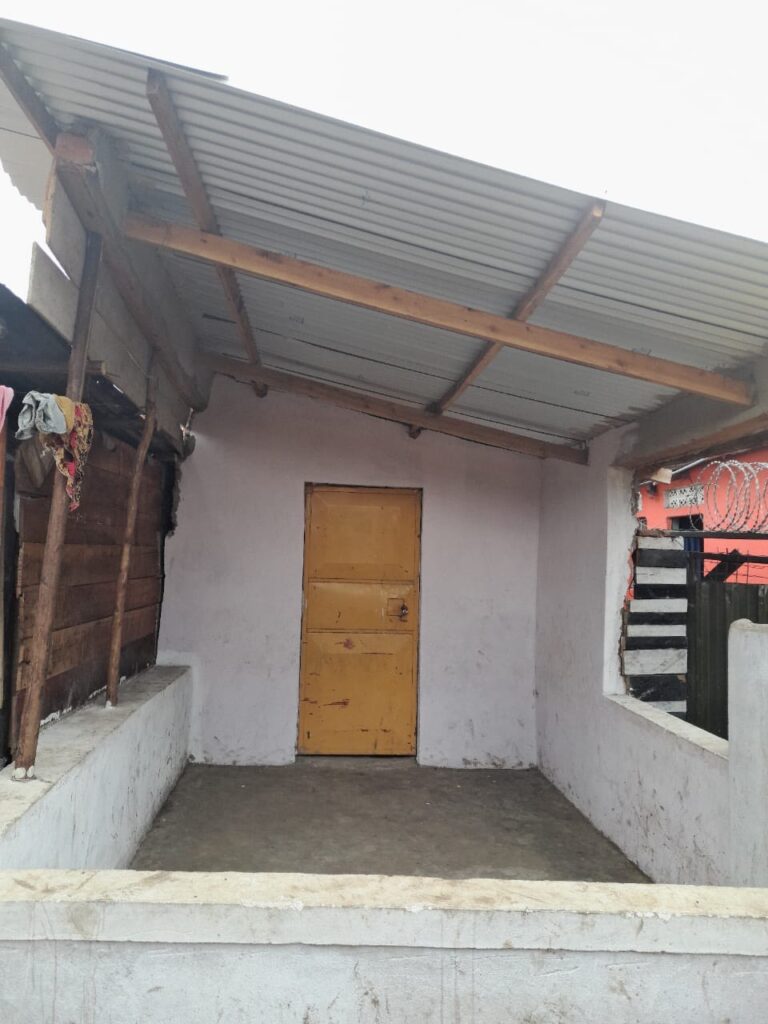
Streetlights Uganda’s phases of remodeling an additional center. (Images courtesy of Merab Akinyi)
Merab Akinyi’s next project is inspired by a YALI fellow who reuses empty bottles for building construction. “Many bottles are lying around. We are looking to develop an awareness campaign on how to use bottles to save the environment,” says Merab Akinyi. “These bottles can be repurposed to fix drainage problems around the centers and add more space.”
Pickard notes this is the goal of the fellowship. “We create opportunities for fellows to learn from each other and for everyone to challenge and develop their personal growth and values.”
Overlapping hearts and minds
The deep sense of camaraderie drew the attention of UMBC community members outside of YALI resulting in powerful friendships and mentorships that continue to this day. Pickard connected Merab Akinyi with artist Ariel Valéria Barbosa, M.P.S. ’24, community leadership, after noticing Merab Akinyi’s passion for using art as a vehicle for change. Barbosa is the program coordinator for UMBC’s food pantry Retriever Essentials and leads A Gente, an organization that gives opportunities to Black artists to travel to the African Diaspora to co-create free exhibitions for the local community.
“There are similarities in our surrealist art styles and wanting to use the little we have and our charisma and intelligence to expand impact for our people,” says Barbosa. “Victoria is really good at what she does, and I want her talents to be nurtured and supported.” Barbosa linked Pickard with DewMore, a nonprofit that uses poetry as a platform for youth leadership.
“It was full circle for me to listen to Victoria read a poem she wrote during the DewMore poetry workshop about her experience in Baltimore,” says Barbosa. “She carries herself with a lot of composure and dignity, like a voice for the people. That is just who she is.”
Ariel Barbosa and Victoria Merab Akinyi. (Image courtesy of Merab Akiniyi.)
A smile goes a long way
Lovetta Y. Qualah is the founder and CEO of Positive Actions Driving Safety (PADS), which addresses period poverty by providing free sanitary products to women and girls in Monrovia, Liberia. She found a kindred heart in Namrata Oruganti ’24, biology. As a summer conference assistant, Oruganti helped code keys, fold towels, organize sheets, and prepare comforters for the fellows. “I was blessed to be at that desk,” says Oruganti. The first night, the YALI group organized a party for a fellow who had arrived on his birthday.
(l-r): Oruganti (center with plaid pants) with fellows on their last days and (center with red shirt) at the farewell ceremony. (Image courtesy of Oruganti)
“I couldn’t believe the fellows weren’t familiar with each other. Each person contributed something they already had,” says Oruganti. They invited her to share a meal and, once they learned of her love for Afro-beats, to dance.
Oruganti had no idea they were CEOs or experts. “Not one person made me feel like I was less than them. People in leadership sometimes forget that,” says Oruganti, known to her friends—which now include the fellows—as Smiley. “Sometimes I forget.”
“Smiley took an interest in me as a person, my work, and my progress,” says Qualah. “Smiley was a really good ambassador for UMBC. She is an image of positive energy. Always checking in on everybody.”
As Oruganti applies to medical school, she keeps her YALI lessons in mind. “The fellows are the most amazing, sweet, and humble people. They taught me how to be a collective,” says Oruganti. “They will always be part of my life story.” The fellows congratulated her on her recent graduation on their WhatsApp chat. “Smiley wasn’t even a part of YALI but she became an integral part,” says Qualah. (Image courtesy of Oruganti)
Conversation + connection = action
Deep understanding is the goal. Mentorship is the path. To listen, think, share, and reflect is the YALI way. With the help of mentors like Joby Taylor, Ph.D. ’05, language, literacy, and culture, and director of the Shriver Center, fellows build mentorship tools to better communicate with their communities and instill mentorship programs. Taylor led a workshop on place, sense of place, and placemaking as social change in Africa and Baltimore City.
“Jok and I have had a two-year conversation where we have learned so much about leadership from each other and South Sudan and Baltimore,” says Taylor, who is also Thon’s host family. “Living and working with him makes you want to be a better person.”
Thon put theory to practice by helping fellows complete paperwork and hone their professionalism skills. “This was my favorite part because I saw myself in their work and they saw themselves in my work at UMBC and back home in South Sudan,” says Thon. Heplayed basketball with them every Sunday. “They called me their mentor and big brother.”
Merab Akinyi appreciated the intention, “Beyond the classes, the dedication, and humility of the facilitators—especially Ryan Sheldon, Madison, and Jok—were great lessons to me as a leader and great virtues for me to take back home.”
(l-r): Pickard, Merab Akinyi, Sheldon, David Di Maria, senior international officer and associate vice provost for international education. (Image courtesy of Mirab Akinyi)
A year later, Qualah continues to reflect on the fears she had while at YALI and how UMBC community members helped her overcome this. “While at YALI I had imposter syndrome. I was looking for validation every day,” says Qualah. “Everything changed when I met amazing people at UMBC: President Valerie Sheares Ashby, Sally Scott, Madison Pickard, Ryan Sheldon, Jok Thon, and, my dear friend and YALI fellow, Lillian Ndilwa. They challenged my perspective, highlighting the unique value I bring and the importance of my contributions. Words like ‘You deserve to be here,’ and ‘Your work is needed’ resonated deeply.” Today, Qualah puts these beliefs to work and is a visible and outspoken leader sharing PADS’ success and her UMBC YALI experience on Facebook.
Africans for Africa
This year, YALI celebrates its 10th anniversary. Nearly 6,500 leaders have taken YALI’s multi-tiered mentorship approach across all sub-Saharan countries. Thon notes convening 20-plus African leaders in one room is a feat on its own. “It’s hard bringing people together in Africa,” he says. “I can have connections in Congo or Kenya because those are my neighboring countries, but you cannot really know what the young people are doing in South Africa from South Sudan or a West African country.”
YALI 2023 fellows at their farewell ceremony with the CGE team, Peaceworker Fellows leadership, and Oruganti (center front row wearing red sneakers). (Image courtesy of Oruganti)
This summer Thon will extend the YALI ripple effect, working as a partnership associate at CorpsAfrica, a non-profit organization focused on engaging youth and helping rural communities overcome extreme poverty.
Jok Thon celebrating his 2024 graduation from UMBC. (Image courtesy of Thon)
“Every little act of peace and kindness gets us closer to building a just and prosperous society where there is no weak or strong, poor or rich,” says Thon, “but a society that thrives on the basic principles of living a dignified life guided by empathy.”
International journeys offer ample opportunities to stretch yourself—one minute you may be the expert and the next, completely clueless about how something works. Retrievers currently in the Fulbright U.S. Student Program—teaching English or researching around the globe—find themselves oscillating between their teaching and student roles on a daily or hourly basis. By engaging their host communities through openness and cultural humility (and many shared cups of tea or coffee), these Fulbrighters are finding their balance along the way.
All eyes are on Milan Richardson ’23 as she helps her co-teacher keep score in a Jeopardy-like game her students are playing. Richardson teaches English to several classes of first through sixth-grade students at Jinsha Elementary School in Kinmen County, Taiwan. As she completes the Mandarin character for the numeral 5, a wave of giggles and chatter flows through the room.
Similar to a U.S. tally—four strokes and a strike though, the Mandarin character has 5 strokes total and needs to be written a certain way to represent 1, 2, 3, 4, or 5. “The students were so confused because I wrote the character strokes in the wrong order,” says Richardson, who is used to solving complex math as a Meyerhoff Scholar having earned a bachelor’s degree in bioinformatics and computational biology and minors in computer science and modern, languages, linguistics, and intercultural communication.
“I wanted to write the character correctly. I asked, and they showed me the proper order to write the strokes,” says Richardson, a Fulbright English Teaching Assistant (ETA). “They started clapping once I got it right. This was one of the many cool moments where my students were able to teach me.”
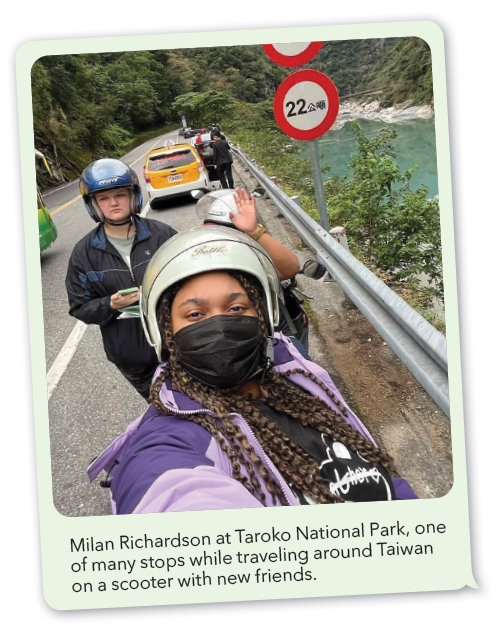
While she may be new to teaching in Taiwan, Richardson brings with her four years as an English and math tutor and a minor in Mandarin. “Taiwan was so different from any place I’ve ever been to. I was overwhelmed at first,” says Richardson. “I like it a lot, now. In my second month, I applied for a scooter license. Now I ride around the island and have taken my scooter other places on trips.”
Diplomas earned. Visas in hand. Vaccines completed. Luggage packed. Destination confirmed. Last summer, UMBC’s eight participants in the 2023 – 2024 Fulbright U.S. Student Program checked off all the important items on their to-do lists. The only thing left was to get to their placements on islands and in landlocked countries, cities, and countrysides across East Asia and Eastern Europe. It’s easier written than done. To adapt well to a new community, job, language, and culture, they must practice the art of humility and flexibility as their roles shift regularly from teacher to student.
Leading the Fulbright charge
All technicalities aside, the Fulbright experience is the beginning of building an international network of teachers and researchers who share the diversity and possibility of the U.S. with the world. In return, across the globe, communities welcome the next generation of leaders into their cities, neighborhoods, schools, and homes to share their country’s history, innovations, and culture. Since Fulbright’s inception in 1946, these reciprocal acts of kindness have created multiple paths forward to lifelong worldwide collaboration and understanding based on the simple act of giving someone different than yourself a chance.
“The Fulbright Program truly demonstrates public diplomacy in action,” says Brian Souders, M.A.’19, TESOL, and Ph.D. ’09, language, literacy, and culture, the associate director of global learning at UMBC’s Center for Global Engagement. In this role, Souders, who received a 2023 Fulbright International Education Administrator award to Germany, has led hundreds of Retrievers through the Fulbright application process as UMBC’s Fulbright Program advisor. “Whether in the classroom as teachers, students, or researchers, recipients learn about the world as much as they share what it means to be from the U.S. and UMBC alumni,” says Souders.
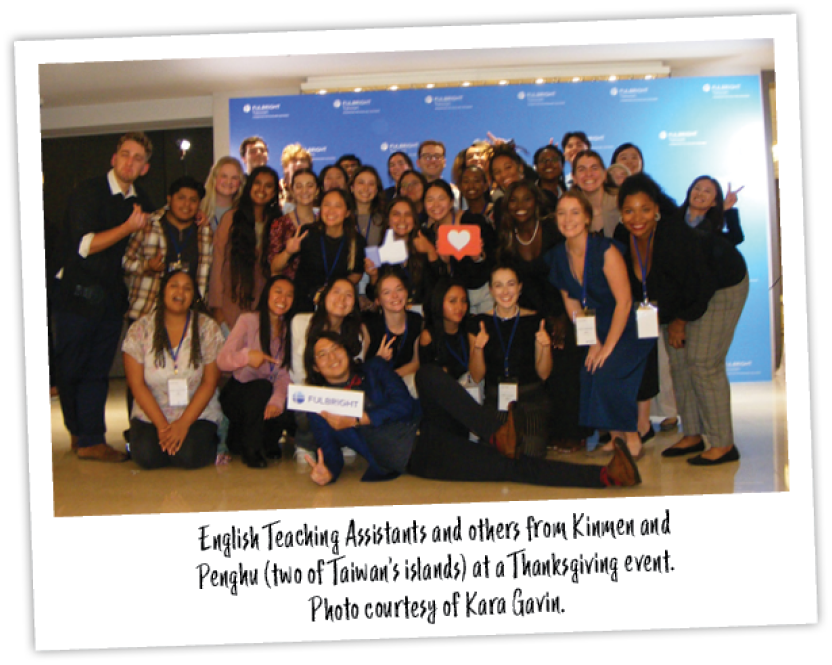
There are U.S. Fulbright student scholars in more than 100 countries worldwide. Three Retrievers were placed in Taiwan—they keep in touch regularly, see each other at ETA trainings, and are planning to travel together during their Fulbright year. But they all arrived in Taiwan separately and faced different challenges settling in.
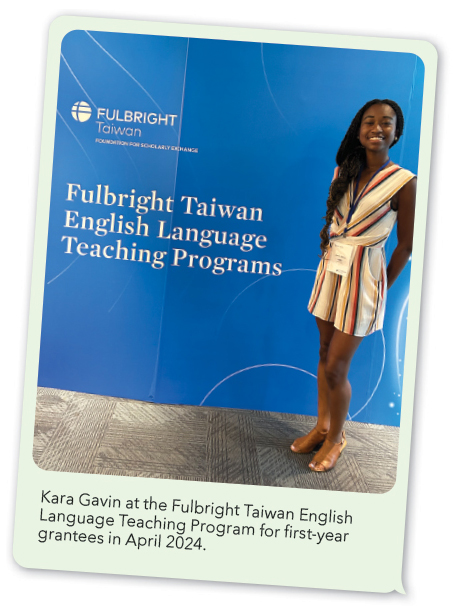
“I arrived in Taiwan and immediately changed my plans because the airline lost my luggage,” says Humanities Scholar Kara Gavin ’20, English. She was grateful to have a carry-on. “It was chaotic. I was taking it all in,” says Gavin. A day and a 50-minute plane ride later, she arrived in Penghu County, Taiwan, an archipelago of about 90 islands between China and the main island of Taiwan. “The little beach town is in its own little world,” says Gavin. “The smell of the sand gave me comfort.”
Gavin teaches beginner English at two local junior high schools. New to Asia and Mandarin, Gavin’s thinking cap is on 24 – 7, including learning Mandarin in between teaching classes. “Living independently for the first time is hard on its own, but doing it in a foreign country is a whole other ball game,” says Gavin. “I’m acquiring many new life skills that will last me a lifetime.”
One of those is sympathizing with her students and anyone learning a new language and culture. “I teach the English pronunciation and spelling of a word,” says Gavin. “Then, they like to share the Mandarin equivalent with me. It’s all about patience, balance, and trust.” She also models intercultural teamwork by developing and teaching lessons with her bilingual (Mandarin/English) Taiwanese co-teacher to foster student engagement and enrichment.
For Fulbright Scholars, it is equally important to engage with communities beyond the classroom. When they apply for the grant, the Fulbright Program asks them to develop ideas to share their passions and skills in a community project. For Gavin, this meant adding a little drama to have a lot of fun. As a performing artist, Gavin knows the theatre can be a powerful community-building outlet. “I wanted to encourage students and other community members to express themselves and share their culture with me and others,” says Gavin.
She found a kindred spirit in a professor at a local university. They formed a drama club at the university for English language learners at all levels to explore American play formats with Taiwanese traditions and histories.“Writing original bilingual plays, in English and Mandarin, based on folktales about island traditions is creating an artistic and fun cultural exchange and understanding outside of my ETA duties,” says Gavin.
Finding the right pace
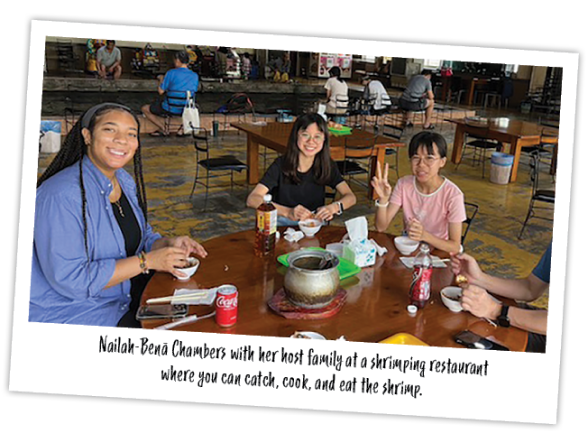
For fellow Humanities Scholar Nailah-Benā Chambers ’23, global studies, a Fulbright award to Taiwan was a natural next step. Chambers began learning Mandarin and all things Taiwanese in sixth grade at a Taiwanese Mandarin language immersion school in her hometown of Richmond, Virginia. As her Mandarin improved, she tutored other English speakers. This oscillating pattern of being a student and a teacher makes Chambers adaptable and persistent, she says.
But it hasn’t always been easy. When she first visited Taipei, Taiwan, in the spring of 2023 on a Mandarin language-intensive study abroad program, “I was so confident. I walked into a 7-Eleven to shop. No one could understand me,” says Chambers. “It was a bit embarrassing. Even with my language and cultural skills, I had a long way to go to mastering Mandarin.”
Now on her Fulbright ETA grant, Chambers arrived on solid ground, both culturally and linguistically. “I felt such a sense of calm and familiarity. Taiwan is so welcoming,” says Chambers. “It calms you down. Things are much slower here than in the U.S.” Soon enough, Chambers was balancing classrooms at Huludun Elementary and Fu Chun Elementary in Taichung City, on the main island of Taiwan, with students at both schools on the extreme spectrum of English proficiency.
The upside of working with proficient English language learners is connecting on more advanced topics and sticking to Fulbright’s English-only immersion model. At one of her schools, the students are beginning English language learners, and the administrators only speak Mandarin. “My experience as a bilingual teacher and learner with a high level of understanding of the local language and culture has helped with classroom management and fostering powerful connections with students and administrators,” says Chambers. “It also helps to advance their grasp of the nuances of American English, especially when there are gray areas or misunderstandings.”
Keeping your ears open
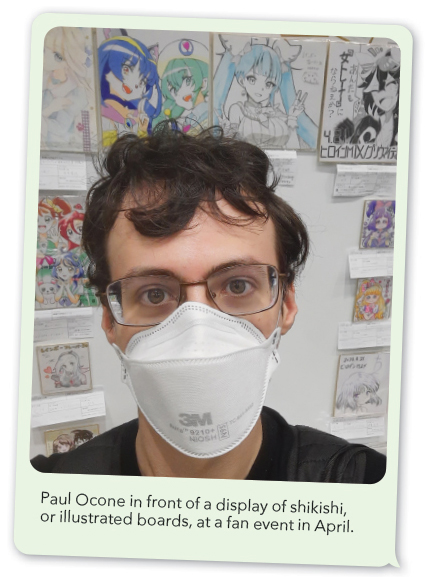
Watching anime, reading manga, (Japanese graphic novels), and participating in their fandom inspired Paul Ocone ’22, individualized study, a Linehan Artist Scholar, to research these subjects and learn Japanese. “I have deeply engaged in fan social life and communities—from leading an anime club to participating in and running conventions to moderating online communities—my affinity for and interest in anime fan spaces runs deep,” says Ocone. Part of Ocone’s observations include witnessing how some fan subcultures limit their membership in fear that a broader fanbase would weaken their subculture identity. In contrast, he says, other fan subcultures are more flexible while maintaining their identity.
“I have had some amazing experiences participating in anime pilgrimage or anime tourism, including learning much from other fans and benefitting from their generosity,” says Ocone. “My Japanese is conversational—sometimes it’s challenging to understand specialized topics, but this has not deterred me from adding anime and manga tourism as a second research project.” In January, Ocone presented his work at the Popular Culture Tourism Stakeholders Summit in Japan.
Ocone is a sort of tourist himself, enjoying various aspects of Japanese pop culture. The daily musicality of Tokyo teaches him about enjoying the rhythm of the day. “Each train station plays a unique melody when the train departs,” says Ocone. These melodies or “hassha merodii,” are catchy and echo around in his brain like the convenience store jingles that also greet customers. “I was happily surprised when I heard a loudspeaker playing a symphony in my neighborhood,” says Ocone. “Another one played the following day and the next. I learned this was a daily sunset ritual.” He knows these sound experiences will play in his head long after returning to the U.S.
Learning new languages
This is not the first time David Bullman ’22, ancient studies, visited North Macedonia. He first went in 1995 as a performing musician and public affairs representative for the U.S. Army.
“North Macedonia was very different coming out of the Cold War,” says Bullman. “The infrastructure and general state of repair of public spaces and businesses is much better than I recall from that time.”
Now, as an ETA, Bullman teaches British civilization and American civilization in addition to three different levels of English at the University of Totovo in the Republic of North Macedonia, a landlocked country north of Greece. In Totovo, students begin learning English in elementary school and are fluent by the time they reach college. “I thought I would be teaching English basics,” says Bullman, “but it’s been great to teach a complex subject in the context of where my students live.”
His students are equally glad to help him with the local language. Macedonian and Albanian are the country’s two official languages. Bullman began learning some key Macedonian phrases in preparation for his trip. However, Albanian is the preferred language in Tetovo. After traveling with the Army to more than 15 countries on three continents, Bullman is used to rapidly switching gears and accepting help.
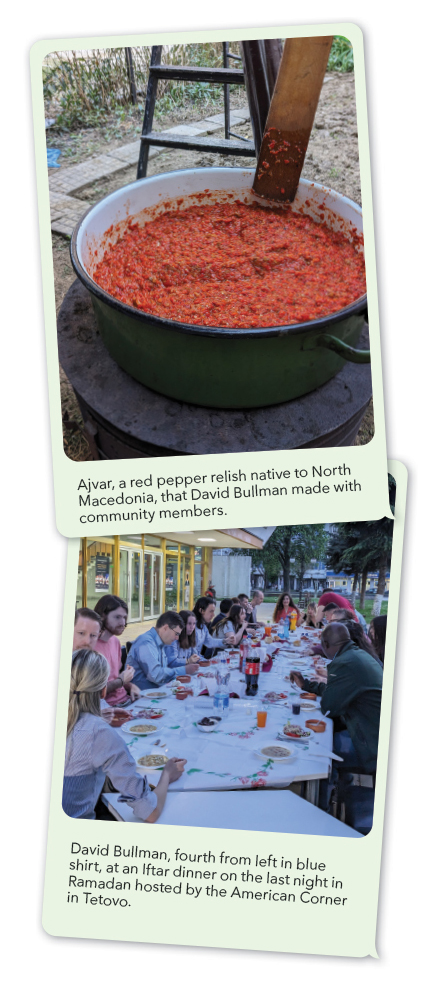
He eagerly takes on the student role when it comes to learning about new foods. Bullman’s apartment faces the Hapësira Socio-Kulturore Tetovë, a community center where locals and the nearby Peace Corps Volunteers sometimes organize activities, like an ajvar-making gathering. Ajvar is a delicacy across the Balkans made every fall. It’s a tradition passed down through centuries with many recipe variations. “Ajvar is made by charring red bell peppers that are then peeled, minced, seasoned, and cooked for hours,” says Bullman. It boils down to a relish that can be preserved for months, but locals tell Bullman that’s rare because it’s too good to keep for even one week. After participating in the preparation and getting to take home a few jars, Bullman agrees with the locals. Ajvar is now his go-to condiment on eggs, pasta, toast—anything goes.
Albanian and cooking are not the only languages Bullman tapped into while in Tetovo. As a lifelong clarinet player, Bullman hoped to create a musical exchange with local musicians. The opportunity presented itself when the dean of the Faculty of Art wanted to celebrate Thanksgiving. Bullman collaborated with the music faculty, the orchestra director, and students to create a concert of six songs. “I’m glad I returned to North Macedonia. The people are as warm and friendly as I remembered them to be,” says Bullman. “I wanted to come back and experience it myself again.”
Tapping into curiosity
On her way to her Fulbright placement, Sianna Serio ’23, computer science, went city hopping. “I was headed to Žilina, Slovakia, east of Austria and south of Poland,” says Serio. “I flew into Vienna, Austria, then I took a one-hour bus ride crossing Austria’s eastern border into Slovakia to get to Bratislava, the capital.“ There she met other ETAs for orientation. “A week later, I hopped on a two-hour train ride to my teaching placement in Žilina and I met my wonderful mentor, Maria Veršova, who became my second mom.”
Serio teaches at the Hotel Academy, Žilina. The academy focuses on hotel management, gastronomy, and tourism. “My students are beginning English language learners,” says Serio. “I teach what the class is interested in, like American pop culture, because they rarely meet a native English speaker.” During outings with her students, they ask about a wide range of topics. “There are many topics that I would not have thought to cover if it were not for time spent outside of the classroom,” says Serio, “Some of those conversations became formal lessons, like the lesson on the three branches of the U. S. government.”
Serio appreciates her students’ curiosity. She tapped into her love of website development and design to improve her students’ confidence in writing and speaking English and prepare for their Maturita exam, a national high school exit exam. “Some of my students are helping me design a class webpage for them where I will showcase their class and post some of their practice writing in English,” says Serio. “These posts will include topics covered in the Maturita exam, information about their school, and answers to questions about Slovakia.”
Serio’s mentor Maria Veršova, head of the English department, is her motivation. She guides her through lesson planning, class schedules, and the challenges of relocating to a new country. “When my original housing plans fell through, Maria found housing for me five minutes from her house,” says Serio. “She helped me find health insurance and open a bank account. Her husband set up my internet.” They have welcomed Serio almost daily into their home for dinner, tea, coffee, or wine. Serio is a gracious guest and lent her graphic design expertise to help Veršova design invitation cards for her 50th birthday party. Veršova tells Serio she will always have a place to stay in Žilina.
Fulbright: The next generation
Teaching has defined the last decade for Tiffany Powell, a master’s student in UMBC’s TESOL program, a passion she invested in as an English language learner teacher in Seoul and in Miryang City, South Korea, for five years, and in Florida this past year. Now, she is in Iași, Romania, southwest of Ukraine, at the Alexandru Ioan Cuza University teaching American studies. Powell is committed to bridging culture, community, and belonging by bringing technology into the classroom.
Powell also decided to bring the research and cultural understanding closer to home by partnering with Romanian teachers to develop a five-part series on African American women’s history. “We talked about Black women in science in the context of the movie Hidden Figures and discussed Hollywood’s portrayal of Black life,” says Powell. The class is now creating a series on Romanian women. Helping students better understand the similarities and differences between U.S. and Romanian cultures has been an eye-opening experience for Powell.
She sees the impact of a country formerly under communism. In Iași, sometimes the internet doesn’t work and, in her school, there are no clubs or student organizations to gain the skills needed to earn a Fulbright award. “My students have given me a new perspective. You may want to come in and make changes, but you must understand where they’re coming from. There is a saying in Iași, ‘It’s not impossible. It’s just difficult,’” says Powell. She is trying to help with the difficult part by leading Fulbright application and leadership workshops.
Powell, like the other Fulbrighters, will bring her experiences home with her and wherever she ends up teaching English next. When their Fulbright year ends, these Retriever ambassadors will find themselves as emissaries yet again, returning to their hometowns, sharing the good news of ajvar made in community, the freedom of a scooter ride along a Taiwanese beach, or the correct stroke order for writing the Mandarin number five. The lessons their students and host families passed along—including pausing to take a breath and appreciate their international successes small and large—will continue to form and shape the way they see the world.
“Having a flexible mindset and under-standing the historical context of your placement is key,” says Powell. “I carry myself as a U.S. representative. Living abroad teaches humility, adaptability, and open-mindedness to press on through challenging times.”
From Cameroon to Baltimore City, Alberta Ndille’s worldview has inspired her hands-on approach to understanding the underlying causes of health and social disparities. Throughout her time at UMBC, Ndille ’24, sociology, anthropology, and public health, has participated in and led groups and activities within the African Student Union, as a First Year Ambassador and Orientation Peer Advisor, in InterVarsity Christian Fellowship, STRiVE, and as an Academic Peer Advocate. Now she’s preparing to begin a prestigious summer internship at the Maryland Department of Health Cancer and Chronic Disease Bureau where she will help implement public health awareness programs and events, including during The Raven’s pregame parties at M&T Bank Stadium.
Q: What was your path to UMBC?
A: I was born in Maryland but was raised in Cameroon. I began my college experience at Prince George’s Community College. At that time, most of the classes were still online due to COVID-19. It made me crave a more traditional college experience. Once things began to open up more, I applied to UMBC and was accepted into the Honors College.
Q: How did you choose your major?
A: Internationalization has a big influence. I’m interested in global health and epidemiological research. I spoke with several people about my interests and they suggested I look into public health. Social determinants of health caught my attention. Living in the U.S., I saw a very different approach to maternal health than in Cameroon. Maternal health is discussed more openly in the U.S. and there is also more access to preventative care. Because Cameroon has less healthcare access, sometimes parents have to wait longer than they would want to seek care. I want to research the barriers to maternal healthcare in Cameroon and maybe that can help other countries as well.
Ndille with orientation peer advisors. (Image courtesy of Ndille)Ndille with fellow UMBC Alternative Spring Break participants. (Image courtesy of Ndille)
Q: What is your most transformative UMBC experience?
A: Working with the Center for Democracy and Civic Life’s Alternative Spring Break (ASB) program—as a participant and leader—helped me understand important issues outside the classroom. As a participant, I learned about educational justice for youth impacted by intimate partner violence. We visited Baltimore’s City Hall to speak with community members and non-governmental organizations (NGOs) working to dismantle these barriers. As a leader, I had the opportunity to co-organize a week of experiences on a topic of my interest.
My spring honors seminar, “Community Engaged Writing,” focused on prison narratives and counselor stories. We read books and literature by formerly incarcerated people, currently incarcerated, and recently released. We learned about the effect mass incarceration has on communities. I wanted to look at this topic within the context of Baltimore City.
I organized an ASB to understand better incarceration in Baltimore City and how to improve life in and out of prison. Throughout the week, we went to Baltimore City Hall to meet with the Department of Parole and Probation, to speak with NGOs and others who manage re-entry programs, and with people currently in re-entry programs. I learned to appreciate both the participant and the leader’s perspective.
“Working with the Center for Democracy and Civic Life’s Alternative Spring Break (ASB) program—as a participant and leader—helped me understand important issues outside the classroom. As a participant, I learned about educational justice for youth impacted by intimate partner violence. As a leader, I had the opportunity to co-organize a week of experiences on a topic of my interest. I learned to appreciate both the participant and the leader’s perspective.” (l) Ndille (Marlayna Demond ’11/UMBC)
As a participant, everything seems good and easy. You enjoy your spring break. As a leader, you start preparing in September. It can be stressful. You worry about whether the students will learn anything. There are many meetings because things don’t always go as planned. It was really interesting to experience two ASB perspectives while learning about two perspectives on Baltimore.
Q: Having grown up in Cameroon, you have an international perspective. What advice do you give students about the importance of having an international perspective on their career even if they can’t study abroad?
A: I think it is important to engage internationally. The United States is so big, it can be easy to focus on what’s happening here and forget that there’s a whole world of people out there who are different from people here. Even if you don’t have the opportunity to travel internationally, there are other ways to have international experiences like international news, talking to students from other countries, and anything that helps you have a different perspective.
We don’t all hold the same things important. If we take the time to learn about the world in all its differences, we can then understand why certain cultural practices, laws, or beliefs exist. Learning about the world helps us be less judgemental and more inclusive.
Ndille with UMBC’s Bumaye dance team. (Image courtesy of Ndille)
Q: What do you do for fun?
A: I’ve never taken a formal dance class but I love dancing. I auditioned for UMBC’s African Student Association Bumaye dance team. I made it! It’s a workout and I meet new people.
Neurodiversity inclusion and representation have been at the forefront of Michael Canale’s 20-year career in the disability services and education field. Canale, M.A. ’24, intercultural communication, is the assistant director of UMBC’s Office of Student Disability Services and teaches the first-year seminar Introduction to Disability Studies. “Sometimes parents of neurodivergent students worry that their child is incapable of learning another language,” says Canale. “I work with parents to ease their fears by showing them how their child can excel in college with the proper individualized accommodations.” These can include note-taking software, counseling services, tutoring, time management support, and more.
Michael Canale (r) has been working with Ph.D. students in human-centered computing to create personal tactile maps of campus for blind students at UMBC, like Shawn Abraham ’24, political science. (Marlayna Demond ’11/UMBC)
When Canele, who also received his post-master’s certificate in college teaching and learning science, heard that UMBC’s first Fulbright Scholar-in-Residence,Jules Buendgens-Kosten,would be teaching Language Learning and Special Education – Advanced Special Topics in Education, he was quick to enroll. The course, part of UMBC’s teaching English to speakers of other languages (TESOL) master’s program, was designed for anybody planning to work with heterogeneous groups of learners, including those of different neurotypes, both in special education and mainstream education settings.
Buendgens-Kosten, a research assistant at the Institute of English and American Studies at Goethe-Universität Frankfurt, Germany,began theirpartnership with UMBC as a research collaboration with Shannon Sauro, associate professor of education.Sauro recognized that Buendgens-Kosten’s expertise in English language teaching and teaching neurodivergent populations in Germany would add an international and non-U.S.-based perspective to UMBC’s TESOL program and education department.
My uni (@UMBC) just got so much geekier and cooler. 😎@BuendgensKosten is joining the Education department for a semester as a Fulbright scholar-in-residence. Today was spent introducing them to the campus. pic.twitter.com/kM1Ygmsc1T
“If students have not experienced an inclusive classroom, they may be afraid of managing an inclusive classroom when they become teachers,” says Buendgens-Kosten, whose research helps prepare educators to teach students with dyslexia, ADHD, autism spectrum disorder, and other minority neurotypes. “One way to reduce this fear is giving teachers tools for best practices.”
Own-voice texts
To help students learn about neurodivergent experiences, Buendgens-Kosten had students choose an “own-voice” children’s book that included characters with dyslexia, ADHD, autism spectrum disorder, and other minority neurotypes. Own-voice texts are books written by underrepresented authors, in this case, neurodivergent authors writing about neurodivergent communities. The stories veer away from narratives based on neurotypical authors’ understanding of neurodivergent people and those who champion overcoming neurodiversity to embrace a more neurotypical lifestyle.
Valeri Vanier, an international TESOL student from Dijon, France, choseNelson Beats the Odds by Ronnie Nelson Sidney II. Vanier explained Nelson’s experience as a student who has ADHD and a learning disability. “The book is very colorful and a fun story. It’s about having positive self-esteem and reflects the author’s experience with learning disabilities,” Vanier said. “But, I’m critical of it because I feel that Nelson’s success is defined by achieving academic success in a neurotypical way.”
Buendgens-Kosten agreed with Vanier, noting the info boxes about well-known neurodivergent people in the book might inadvertently send a message that it is okay to be neurodivergent as long as you grow up to be rich and famous.
Vanier began his teaching career shortly after COVID-19 forced him to close his historical guided tours company. He saw the need to support remedial learners and launched Le Goût d’Apprendre/ A Taste for Learning, which partners with parents, schools, and organizations to develop individualized learning programs. After in-person teaching came back in full swing, Vanier wanted to broaden his teaching skills and subject area to include a TESOL credential. He found a home in UMBC’s TESOL program. His advisor suggested this seminar because of his prior teaching experience.
Maia Scarabelli. (Marlayna Demond ’11/UMBC)
Fellow TESOL masters student, Maia Scarabelli, a 2022 Shriver Peaceworker Fellow, is preparing to become an early education teacher of English language learners. Scarabelli also came to UMBC with teaching experience. Before UMBC, she taught English as a Peace Corps Volunteer in Honduras and Myanmar. For Buendgens-Kosten’s class, Scarabelli analyzed Daniela Schreiter’s graphic novel The World Beyond My Shadow about her life growing up with Asperger’s syndrome. “The visuals make the story more accessible for English language learners,” says Scarabelli. “The oscillation between her life as a child and as an adult looking in from another planet—in the context of English language teaching in the U.S., feeling like an outsider from another country—resonates with the experience of many English language learners.”
Addressing English language acquisition with neurodiversity in the classroom is one of the reasons Scarabelli wanted to work with Buendgens-Kosten. Scarabelli says, “It’s not common to find a special education specialist who is also an English language acquisition specialist. We tend to keep those specializations separate. This is a refreshing and unique experience.”
Inclusion practices create pathways for neurodivergent students to learn in a heterogenous classroom and for neurotypical students to work alongside neurodivergent peers. This is key for students preparing to be teachers. It reduces the stigma of neurodivergent students.
Buendgens-Kosten speaking at UMBC’s Department of Education Research Seminar series organized by Francis Hult (in beige suit), graduate program director of UMBC’s TESOL program. (Image courtesy of Sauro)
“If you have people of different neurotypes in your language classroom, you should reflect their interests, their lived experience, communicative habits, communicative needs, and communicative interests,” Buendgens-Kosten explained to UMBC faculty at their Fulbright Scholar-in-Residence research lecture. “Sharing the experiences and needs of only the neurotypical majority cannot be the only measure of how and what we’re teaching. This also means that they deserve to see models of successful language users of their neurotype.”
Life-changing inclusion
Buendgens-Kosten at UMBC’s National Coming Out event.
While Buendgens-Koston was at UMBC, not only did they share their expertise, but they also learned about new technical tools to improve the learning process at the college level, such as UMBC’s Blackboard Ally, which improves content accessibility and usability. “The Ally accessibility feature really impressed me,” said Buendgens-Kosten, now back in Germany where they shared the tool with their IT team. “I liked that people could add a recording of their name to their official profiles—this is very helpful when you have a name like mine.”
Buendgens-Kosten also enjoyed the inclusivity of campus events. “When you log into myUMBC, there are events across all disciplines, for students, for staff, etc.,” said Buendgens-Kosten. “At my university, I know what is offered by my institute, or maybe even my faculty, but I see much less of what is going on in other parts of the university.” They also were surprised that UMBC celebrated National Coming Out Day and commemorated Trans Day of Remembrance, something they say is missing at Goethe University.
“My Fulbright experience at UMBC deeply impacted how I view the university as a community and place of learning,” says Buendgens-Kosten. “I experienced different ways of teaching and interacting with students. Such small-seeming things can make a surprisingly big impact.
Sauro says UMBC’s first Fulbright Scholar-in-Residence has inspired other faculty to apply to welcome another Scholar-in-Residence. “I think this is a wonderful opportunity for internationalizing at home and fostering the exchange of ideas with scholars from different parts of the world,” says Sauro.
UMBC’s future in neurodiversity research
Canale with his grandmother, Lillian Michalina Canale.
For Canale, learning from Buendgens-Kosten was yet another confirmation of how life-changing inclusion can be. He wishes inclusive teaching had been offered when his Deaf grandmother was growing up. Lillian Michalina Canale depended on her grandson and the rest of her family to navigate life in a hearing world. “When I enrolled in a sign language interpreter undergraduate program, my grandmother was amazed that there was formal education for sign language,” says Canale. “It was then that I realized I had been interpreting since I was nine, but had no clue. I was just telling others what Grandma said, and I’m telling Grandma what they said.” It was the foundation for his career.
The end of Buendgens-Kosten’s visit was bittersweet for Canale. “There isn’t anyone like them at UMBC right now,” says Canale. He’s grateful to have grown the disabilities services program over the last 10 years that he’s been here. However, he knows the possibilities are exponential. “It may begin with having a conversation about accommodations but UMBC has the potential to lead in accessibility and inclusion research in every field of study because neurodivergent students, professionals, clients, and consumers encompass all parts of life.”
The Institute of International Education, which manages the Fulbright Scholar-in-Residence program, has selected UMBC’s Center for Global Engagement (CGE) to facilitate the pre-departure orientation for all Scholars-in-Residence globally working at universities across the United States. This June, 43 scholars will participate in a three-day virtual orientation. CGE staff will lead sessions on various topics including campus and community engagement and networking led by Madison Pickard M.A. ’24, intercultural communication, a 2022 Shriver Peace Worker, and a graduate assistant and special programs coordinator. Classroom management led by Ryan Sheldon, director of the English Language Institute and Special Programs. Diversity and inclusion on a U.S. campus led by Viridiana Colosio-Martinez ’22, modern languages, linguistics, and intercultural communication, and M.A. ’24, intercultural communication. Intercultural communication led by Brian Souders, M.A.’19, TESOL and Ph.D. ’09, language, literacy and culture, the associate director of global learning. The U.S. higher education system led by David Di Maria, associate vice provost for international education.
Ryan Bloom, senior lecturer in English, has received the 2024 Guggenheim Fellowship for translation to work on the first complete edition of the French-Algerian author Albert Camus’s notebooks, journals, and other works. This year, 188 grants were awarded from more than 3,000 applicants from over 52 academic disciplines across the U.S. and Canada. Fellows are provided funding to freely pursue their creative projects through their unique process without any special conditions.
“In many ways, the situation Camus experienced in post-World War II Paris bears similarities to our own times here in the States. To give just one example, one of Camus’s great fears was a world where, in support of ideology, people were willing to excuse, if not actively cheer, the murder of other human beings,” says Bloom. “We need only turn on the news or scroll through our social media feeds to understand how some might feel that same fear today.”
Bloom has been translating Camus’s work for more than a decade. Most recently, he completed translations of Camus’s North and South American journals,Travels in the Americas: Notes and Impressions of a New World (Chicago University Press, 2023) as well as Camus’s Caligula and Three Other Plays (Penguin Random House, 2023). His translation of Albert Camus’ Notebooks 1951 – 1959, (Ivan R. Dee Publishing, 2008) was a finalist for the French-American Foundation and the Florence Gould Foundation’s Translation Prize for outstanding published English translations of prose originally written in French; his translation of Travels in the Americas is again a finalist for this year’s prize, to be awarded in June. Bloom notes that his drive to translate Camus’s work stems from the relevance the author’s work still has today, more than 65 years after Camus received the Nobel Prize in Literature in 1957.
“Humanity faces some profound existential challenges,” said Edward Hirsch, award-winning poet and president of the John Simon Guggenheim Memorial Foundation. “The Guggenheim Fellowship is a life-changing recognition. It’s a celebrated investment into the lives and careers of distinguished artists, scholars, scientists, writers, and other cultural visionaries who are meeting these challenges head-on and generating new possibilities and pathways across the broader culture as they do so.”
In 2017, Deborah Rudacille, professor of the practice in English, was the first UMBC faculty to receive a Guggenheim Fellowship. Rudacille received it for science writing.
“Ryan Bloom’s Guggenheim shows the wide range of research and teaching that takes place in the English department,” says Jessica Berman, professor of English and director of the Dresher Center for the Humanities. “That students have access to a translator of Ryan’s caliber when they sign up for his composition or creative writing classes and have the opportunity to learn from his careful approach to language adds immeasurably to their experience. UMBC is very lucky to have him in our midst.”