We use cookies for analytics and, unless you opt out, advertising.
You can opt out of advertising at any time.UMBC uses essential cookies to run this site. With your permission we would also use analytics cookies (to understand how the site is used) and advertising cookies (to measure and target our ads on other platforms). Nothing else loads unless you accept. You can change your choice any time from Cookie Settings in the footer.Privacy Policy
EssentialRequired for the site to work (login, security, your cookie choice). Always on.
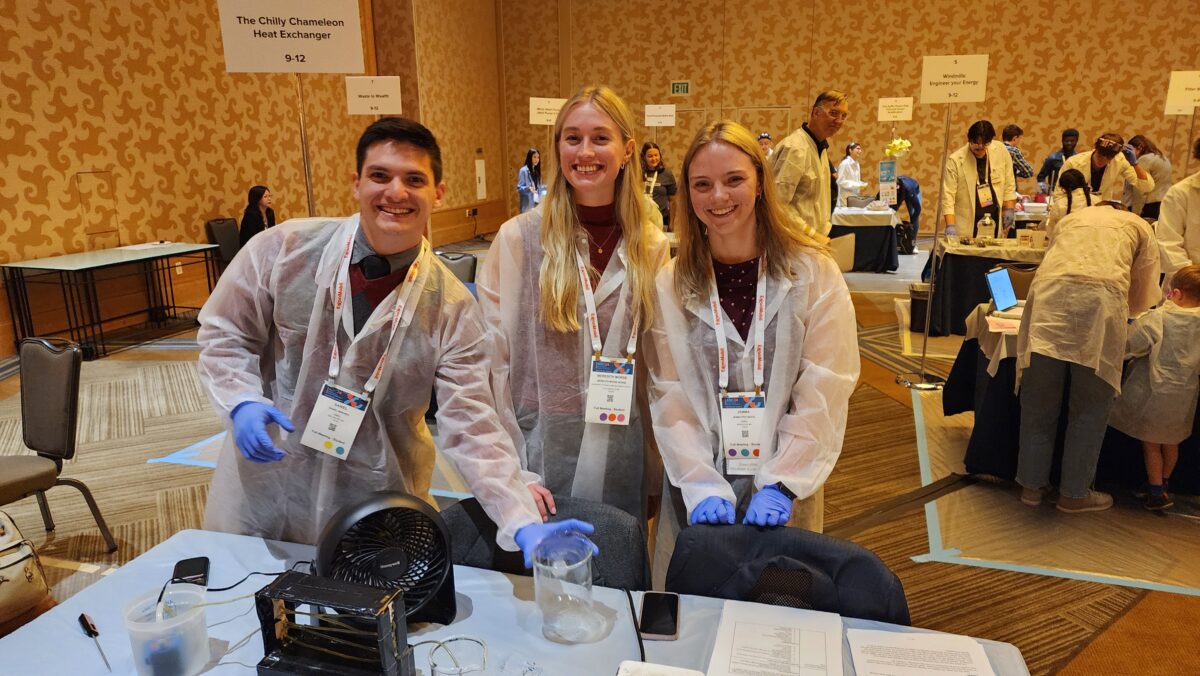
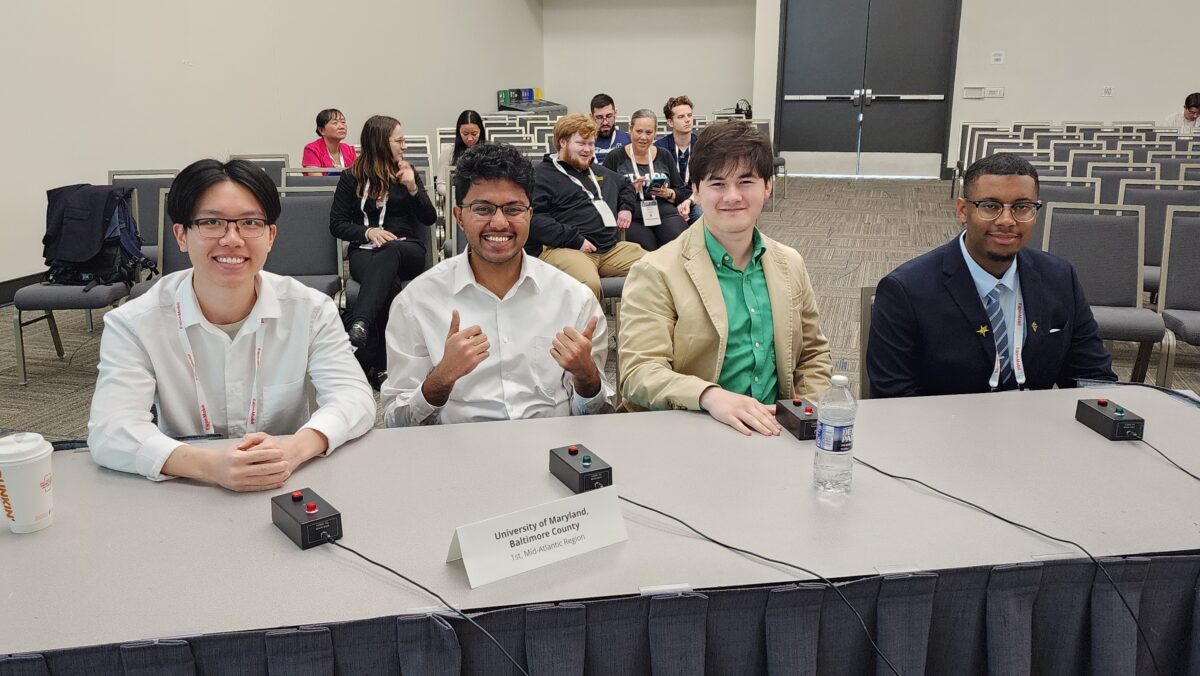
UMBC chemical engineering students excelled again at the annual meeting of the American Institute of Chemical Engineers (AIChE), held in San Diego this fall. The UMBC ChemE Jeopardy team, led by senior chemical engineering student Colin Jones, claimed third place at the national competition held during the conference; the K – 12 STEM outreach team, led by senior chemical engineering student Jemma Pryzbocki, won the top judges’ award in the high school category for designing a module to teach concepts of heat exchange; and the UMBC AIChE club won a best student chapter award.
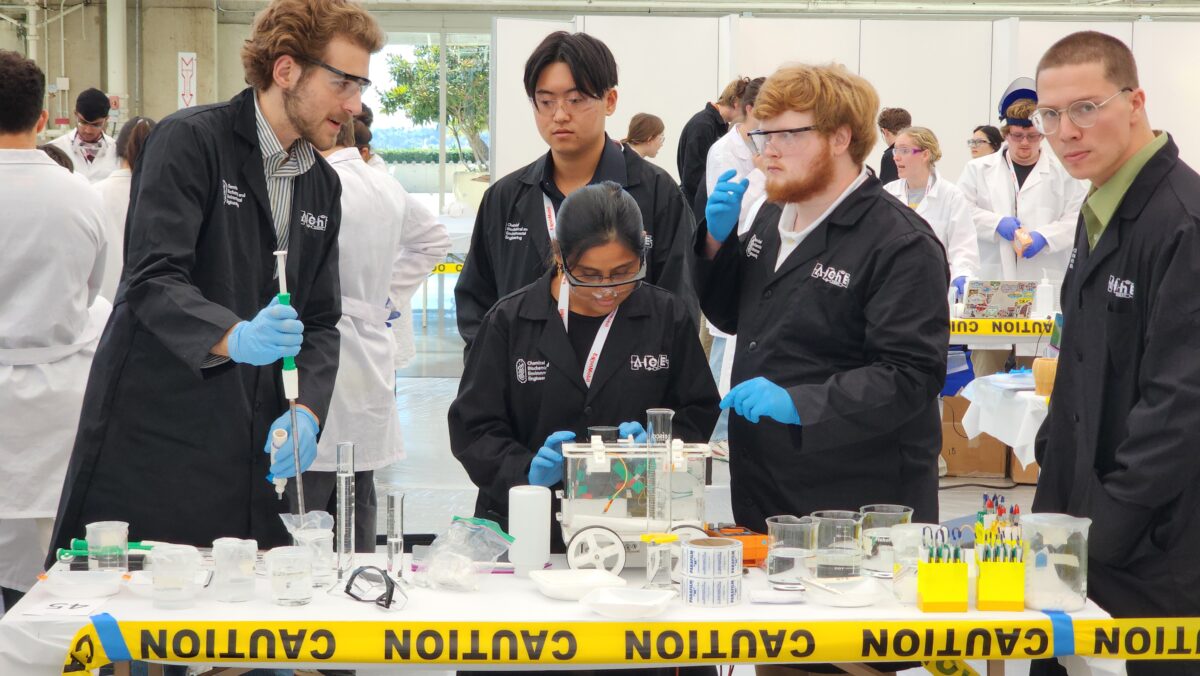
The UMBC ChemE car team, which designed a car that starts and stops by chemical reactions, also performed respectably in a competitive field. The team was led by senior chemical engineering student Ben Welling. Several students also received individual recognitions—senior chemical engineering and biochemistry student Pavan Umashankar won a Donald F. & Mildred Topp Othmer Scholarship Award and senior Meredith Morse, chemical engineering, took third place in the student poster session in the food, pharmaceutical, and biotechnology division.
K – 12 STEM outreach team members (from left to right) Daniel Miranda, Meredith Morse, and Jemma Przybocki demonstrate their teaching module, “The Chilly Chameleon Heat Exchanger.” (Photo courtesy of Neha Raikar)ChemE car team members (from left to right) Ben Welling (team captain), David Ni, Afrah Ahmed, Jacob Craft, and Michael Dinan prepare their car for competition. (Photo courtesy of Neha Raikar)
“The students deserve a big round of applause for all their dedication and hard work,” says Neha Raikar, a senior lecturer in the Department of Chemical, Biochemical, and Environmental Engineering (CBEE) and one of the advisors to the student AIChE chapter.
“The chemical engineering major demands exceptional attention to detail and hard work,” says Mariajosé Castellanos, another CBEE faculty who advises the AIChE chapter. “It is truly inspiring to see our students consistently apply their skills and make a lasting mark on the national stage!”
UMBC students have achieved impressive AIChE conference success for many years running. The ChemE Jeopardy team has reached the final every year since 2020, and the K – 12 STEM outreach team, which only began competing last year, has won awards at each event. Earlier this year, the UMBC student chapter showed off their growth and talents by hosting a regional meeting of AIChE for the first time.
ChemE Jeopardy team members (from left to right) Jonathan Wu, Pavan Umashankar, Colin Jones, and Joshua Lewis take their places behind the buzzers. (Photo courtesy of Neha Raikar)
When Patricia Mengue Bindjeme, a junior majoring in mechanical engineering, went to classes, her professors would sometimes point out how engineers’ decisions can have life-or-death consequences. But the message really hit home this past summer when Mengue Bindjeme interned at the Maryland Transit Administration (MTA), working on the Baltimore Red Line Project, a recently revived transportation project to create faster and more convenient links between the eastern and western parts of the city.
“I saw people talking about the journeys they had to make coming from West Baltimore to work at someplace like Johns Hopkins,” she says. “That’s a lot of travel.” Mengue Bindjeme realized how engineers working to ensure the safety, availability, and reliability of transportation could make huge differences to people’s everyday lives. “Having another person’s life in my hands is nerve-racking,” she says. “But the change I can make for someone else is really beautiful and impactful.”
Real tasks and real things
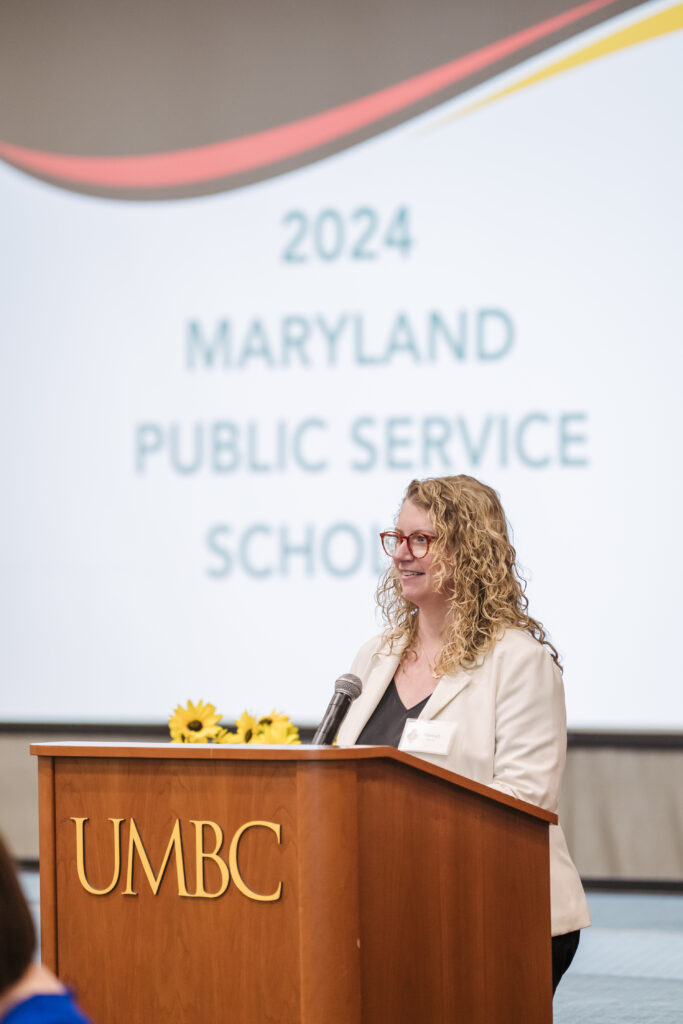
Hannah Schmitz addresses the audience at the opening gathering for the Maryland Public Service Scholars. (Marlayna Demond ’11/UMBC)
Mengue Bindjeme secured her internship at MTA through the Maryland Public Service Scholars (MPSS) program, a 12-week summer fellowship program funded by the state of Maryland and administered by the Shriver Center at UMBC. The goal of the program is to provide students across Maryland the opportunity to develop as future leaders in the state’s public and social sectors.
Mengue Bindjeme was one of five UMBC students who completed the program this past summer. The others were Tasnim Rushdan, a senior global studies major; Aziza Mattaka, a junior global studies major; Dionne Cole, a senior biology and social work major; and Samantha Fu, a junior psychology and public policy major.
The students wrapped up the fellowship with real-world experience on their résumés. “From day one, I was having real tasks and learning real things,” says Rushdan, who worked as an international affairs fellow at the Maryland Office of the Secretary of State. The international division of the office was small—with just two full-time employees—so as an intern Rushdan was immediately involved in important work such as reviewing agreements, organizing meetings, and writing memos for Maryland Secretary of State Susan C. Lee and Governor Wes Moore.
Rushdan helped organize the Pan African City Exposition to facilitate discussions with international delegates around ideas for improving economic development and making housing affordable. She also met with embassy officials, business leaders, and students from around the world.
Mattaka worked in the Governor’s Office of Crime Prevention and Policy, working with victims of crime on their compensation claims. “Sometimes when I’d call people, they would go into their stories,” she says. “It really put into perspective my privilege, but it was also rewarding to be in a place to assist.”
Pursuing the same mission
The students faced challenges throughout their fellowships, from the sometimes heavy nature of the work, to the pressures to balance their schedules, produce deliverables, and present in front of the leaders of Maryland government.
They found support from program staff, the mentors they were matched with in their workplaces, and from each other. Each Friday, all the program participants met together and attended workshops to talk through their experiences and learn new skills for success.
“We realized that, even though we come from diverse backgrounds, we were there for the same mission. We’re facing many of the same challenges, and we’re all in it together,” Rushdan says.
Clockwise from top left: Samantha Fu, Patricia Mengue Bindjeme, Aziza Mattaka, Dionne Cole, and Tasnim Rushdan.
“I made lifelong friends who are supporting me, and really wanting me to succeed,” says Fu, who worked at LET’S GO Boys and Girls, a nonprofit organization dedicated to fostering economic success in underserved communities through STEM education and workforce development.
Throughout the summer, the MPSS scholars pushed themselves out of their comfort zones and discovered how much they had to contribute.
“Before the program, I was afraid of public speaking,” says Fu. “By the end of the program, I was able to confidently present a grant proposal in front of a panel of nonprofit leaders. My group and I even won the grant proposal competition.”
Confident and capable
Cole, who worked at the Maryland Department of Health drafting policy recommendations for behavioral health care access for prison populations and others in the criminal justice system, says she feels much more confident after the summer. “Fear paralyzes us. But it’s like, no, we’re actually capable. You just have to look through the fear and realize, ‘Oh, snap, I could actually do this.’”
The group also ended the summer more confident of their commitment to public service.
“The public service sector truly is limitless and it affords any individual the opportunity to make a difference in their own way,” Cole says.
“Public service calls everyone,” Mattaka adds. “We are a collective, and society works better if we have people willing to develop the skills of leadership and empathy to do these jobs. Those are the skills we cultivated a lot this summer.”
The elevator in the Shanghai Tower in China can reach speeds of more than 45 miles per hour, whisking passengers up more than 100 floors in under a minute. For elevators this fast and tall, understanding—and ultimately controlling—the vibrations in the cables is key to keeping the ride smooth. It’s a problem that mechanical engineering professor Weidong Zhu has studied, and his analysis of high-speed elevators is just one of the ways his research touches everyday life. His work analyzing sound and vibration also has applications to improving wind turbines, automotive timing belts, and more.
The American Society of Mechanical Engineers recently honored Zhu’s pioneering body of research by selecting him to deliver the Rayleigh Lecture at the society’s annual meeting this November. The lecture is named after British scientist Lord Rayleigh, who, in addition to correctly explaining why the sky is blue and discovering the noble gas argon, wrote a groundbreaking book on the theory of sound.
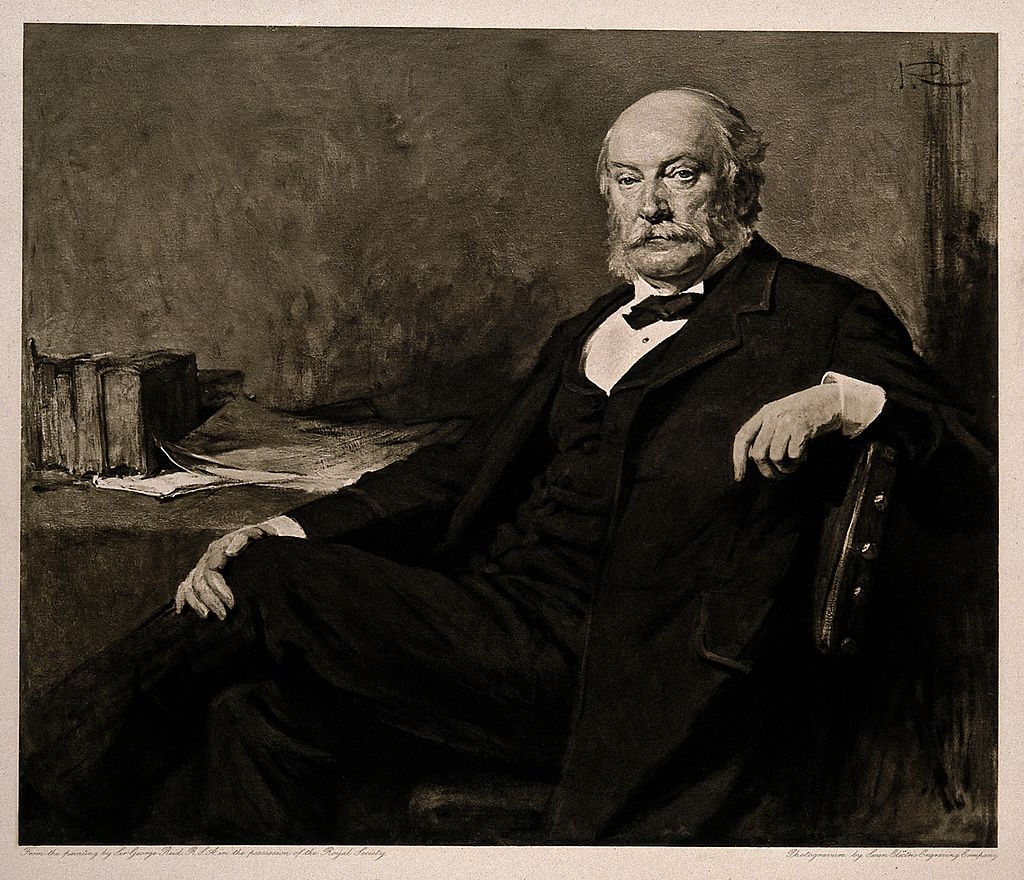
Photogravure of scientist John William Strutt, otherwise known as Lord Rayleigh. (Image credit: Wellcome Library, London, CC BY 4.0)
In his lecture delivered Nov. 20, Zhu presented new methodologies he has developed for analyzing difficult noise and vibration problems. “I’m very honored to give the Rayleigh Lecture,” says Zhu. “It’s a lifetime achievement award and one of the highest recognitions for people doing research in this area.”
Ian Stockwell ’03, information systems and financial economics, M.A. ’06, economic policy analysis, and Ph.D. ’14, public policy, has spent his 20-plus-year career analyzing healthcare operations. One major inefficiency he sees in the U.S. healthcare system is an overreliance on clinical medicine when other interventions, such as support accessing healthy food and safe housing, are also needed.
“We have a health system that under-invests on social needs,” Stockwell says. “It is failing a lot of people.”
Now an associate professor in information systems at UMBC, Stockwell recently launched a new project, supported by a five-year, $3.4 million grant from the National Institutes of Health, to address this shortcoming. He is partnering with a major Medicaid health plan to build a machine-learning-powered system to help identify patients with social needs—factors, such as food insecurity or financial stress—that impact an individual’s ability to maintain their health. The system will also help determine how best to connect these patients with social support systems on a long-term basis.
The system will use multiple individual- and community-level data sources to predict which members use the emergency department to fulfill social or non-urgent needs. It will also identify the hurdles that frequently prevent individuals from engaging with a community-based social needs organization.
The dream outcome, Stockwell says, is that the system provides robust support to healthcare providers for effectively engaging with people with social needs. “We could then take the infrastructure that we build and work to propagate it through the healthcare system. Ultimately, we want to use what we create to help people by shrinking disparities in health outcomes in this country.”
The study team brings together researchers from multiple departments and colleges at UMBC, including Tera Reynolds, James Foulds, and Osman Gani from the Department of Information Systems; Sameera Nayak from the Department of Sociology, Anthropology, and Public Health; Lucy Wilson from the Department of Emergency and Disaster Health Systems, and Joby Taylor, Ph.D. ’05, language, literacy, and culture, from the Shriver Center.
“As a career-long UMBCer, I’m excited that this project helps broaden the footprint of NIH funding at the university. It also pushes the boundaries of what an interdisciplinary collaboration can mean,” Stockwell says.
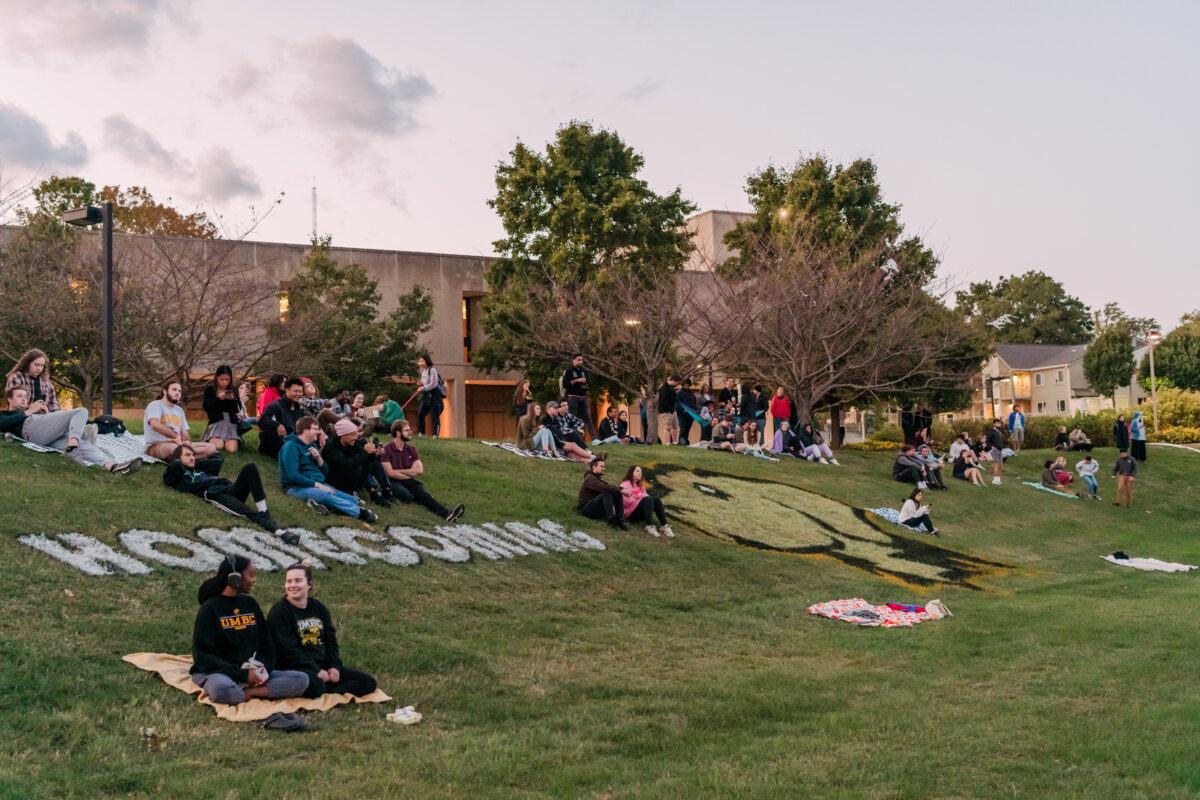
Homecoming is around the corner, and the calendar is full of favorite community events—along with some new opportunities and unique Halloween twists.
The festivities start off October 20, with the Student Org Kickball Tournament, an old tradition making a comeback thanks to Campus Life. Teams receive bragging rights (and prize money to spend on their student organizations). That night the Homecoming bonfire returns to light up the night.
People gather before the 2023 Homecoming bonfire. (Marlayna Demond ’11/UMBC)
“We do try to have something for everyone,” says Bobby Lubaszewski ’10, M.P.S. ’23, director of communications and marketing for the Office of Institutional Advancement and one of the event organizers. “This year’s event is close to Halloween, so we’re leaning into the Halloween theme with pumpkin painting for the kids and other activities.”
A chance to celebrate and reconnect
Jess Wyatt, associate director of Alumni Engagement and another of the event organizers, says Homecoming offers Retrievers of all ages and backgrounds and their families a chance to connect. Her own kids enjoy the festivities each year and have made friends with colleagues’ children.
Sara Osman ’09, modern languages and linguistics, and M.A. ’11, TESOL, recently started attending Homecoming as an opportunity to introduce her young kids to the campus where she and her husband, Karim Yergaliyev ’09, business technology administration, met. “We like to show our three-year-old and six-year-old the places around campus from our stories of the early years when we were dating,” Osman says. “It’s also a nice time to meet up with other alumni and their families.”
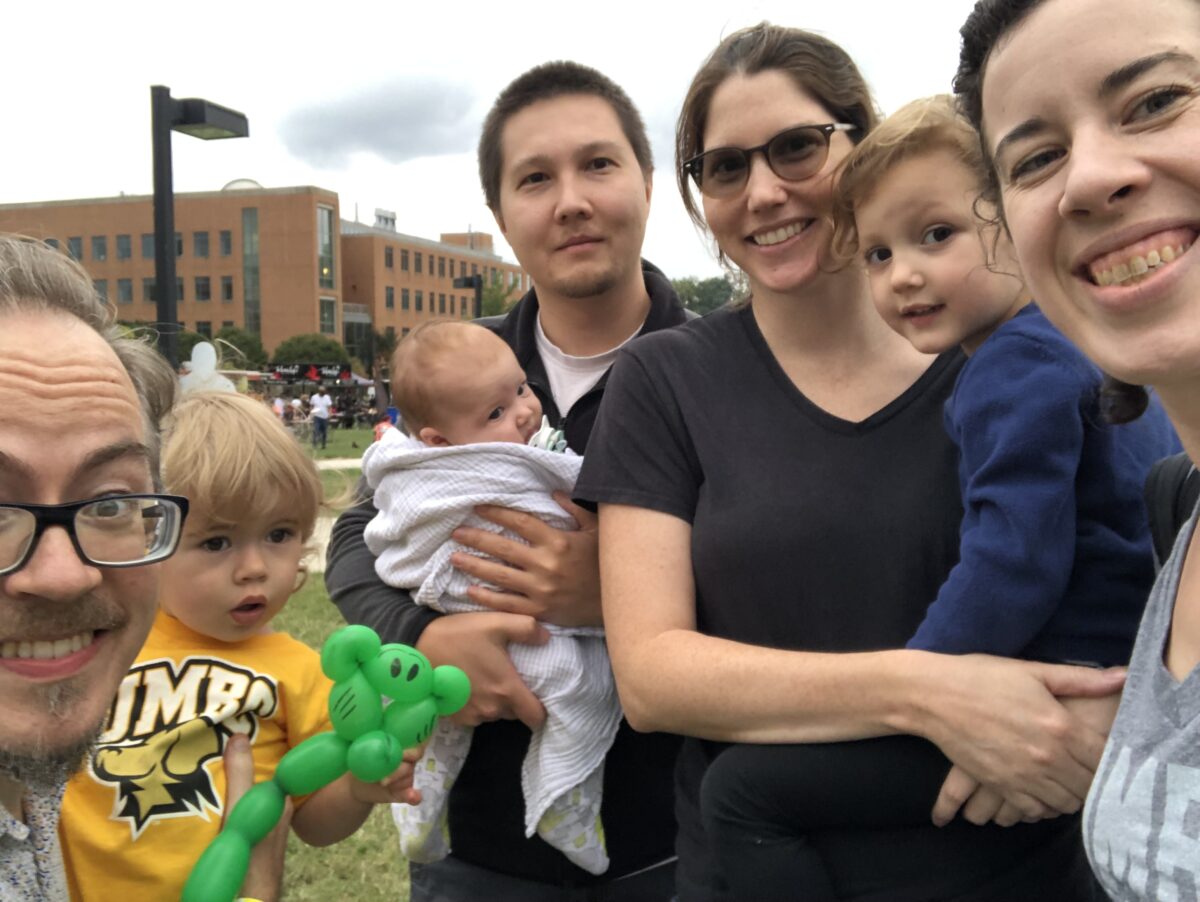
Sara Osman and her family reunite with fellow alum Randianne Leyshon ’09 and her family at Homecoming 2021. (Photo courtesy of Leyshon)
The Osman-Yergaliyev family not only re-lives old memories at Homecoming, they also create new ones. Last year, they were some of the few people still at the carnival as the rain came down. “We were playing ring toss when Karim won a stuffed unicorn so large we could barely get it home,” Osman says.
Something for everyone
The plethora of events showcase all UMBC has to offer. You can see demos of advanced AI robot technology one night, reconnect with your childhood on a carnival ride the next, and finish the weekend cheering on the UMBC soccer teams.
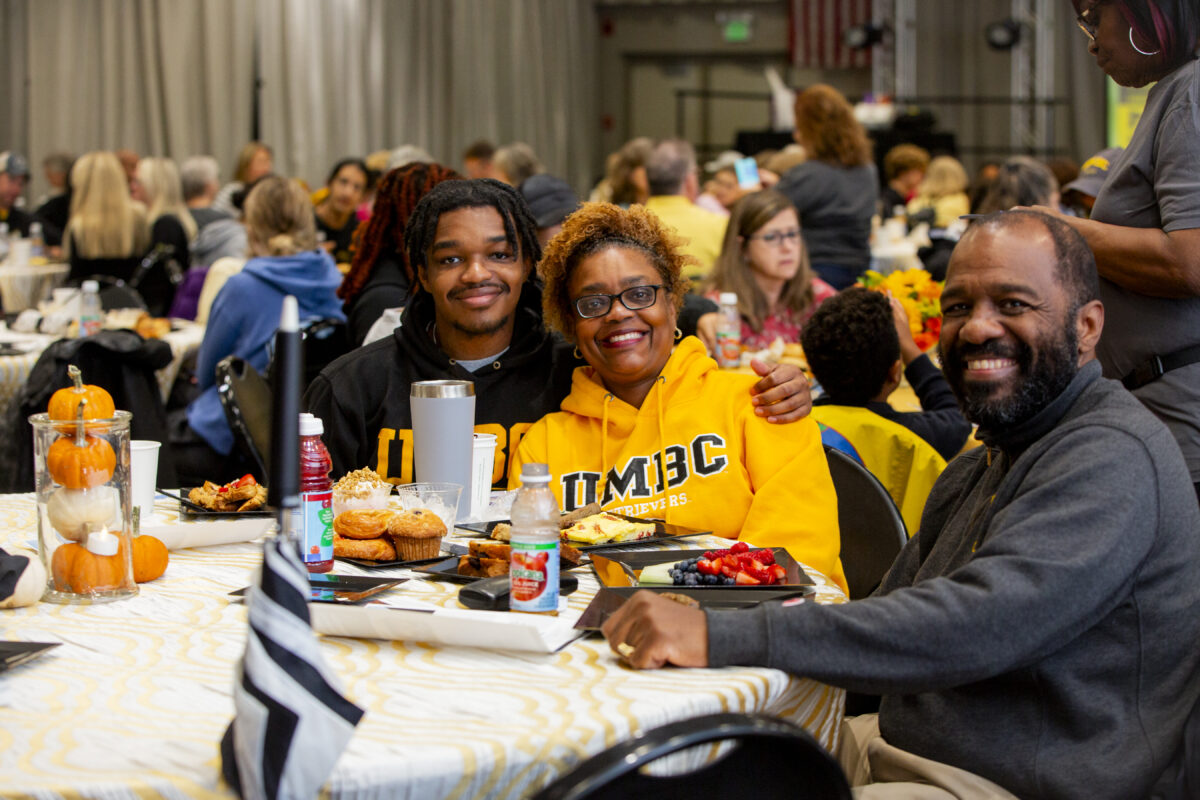
Enjoying family breakfast at Homecoming 2023. (Photo by Jill Fannon, M.F.A. ’11)
Homecoming this year also coincides with UMBC’s annual Livewire new music festival, an exploration of new sounds presented in six concerts over the three days from October 24 – 26.
New this year, the Physics Department is offering tours of the UMBC Observatory, including descriptions of telescope operations and the basics of astronomical detection. “Where else can you go to tour an observatory at Homecoming? That’s really cool!” says Wyatt.
Many scientists believe we are now on the cusp of a second quantum revolution, as quantum concepts are poised to transform the world of information science and technology too. The new revolution offers the promise, among other things, of a new type of computer called a quantum computer. Quantum computers could quickly solve some problems that are extremely difficult for traditional machines—they might also unleash some chaos we’ll have to find ways to prevent.
Lei Zhang, an assistant professor in the department of information systems, is working hard to prepare students for this quantum information future. In 2023 and 2024, with support from a Hrabowski Innovation Fund Grant, he developed new learning modules on quantum information concepts and integrated them into existing graduate and undergraduate courses in information systems.
Based partly on the success of that pilot project, Zhang recently received funding from the National Science Foundation to develop a 14-week summer program in quantum information science and technology. The program, which will launch in the summer of 2025, will be open to students from UMBC and nearby Montgomery College.
“Quantum computing is the next industrial revolution, and there will be an urgent need for skilled professionals in quantum information science and technology,” says Zhang. “This project aims to equip students with the skills and networks to meet that need and advance their careers.”
Quantum’s encryption-breaking challenge
The quantum information revolution is already smashing into our everyday world in the area of internet security. Most internet traffic is kept safe from prying eyes using a technique that works well against hackers using traditional computers but could be broken by a sophisticated enough quantum computer. No quantum computer has reached that point yet, but scientists are making steady progress in that direction, and experts are worried enough to start mandating security changes.
In 2022, the White House released a National Security Memorandum coordinating the actions of various federal agencies in a move toward quantum-resistant forms of encryption for their computer systems.
“The government will be one of the leaders in the change, but the whole private sector will need to follow,” Zhang says. “Everyone will need to update their systems.”
Zhang is focusing the summer program on this challenge. Students will learn about quantum computers and how they could break traditional encryption, and will also learn about new security algorithms, called post-quantum encryption algorithms, that are not as vulnerable to quantum attacks.
“
“Quantum computing is the next industrial revolution, and there will be an urgent need for skilled professionals in quantum information science and technology. This project aims to equip students with the skills and networks to meet that need and advance their careers.”
Lei Zhang
Assistant Professor, Information Systems
After six weeks of active and immersive learning activities, the students will engage in eight-week-long internships at local tech companies or in Zhang’s UMBC lab, where they will put their newfound knowledge and skills to use. At the completion of the summer program, the students will earn a MicroBachelors certificate from the online education company edX.
Partnerships advance outreach and teaching
Zhang is partnering with individuals and programs across UMBC to make his summer program successful. Zhang’s main collaborator on the project, assistant information systems professor Karen Chen, specializes in the study of how technology can improve learning. The team also includes information systems faculty Aryya Gangopadhyay, Michael Brown, and C. Augusto Casas.
The project will be guided by the expertise of local leaders from government and private industry and its effectiveness will be evaluated by UMBC’s Chris Rakes, a professor of mathematics education.
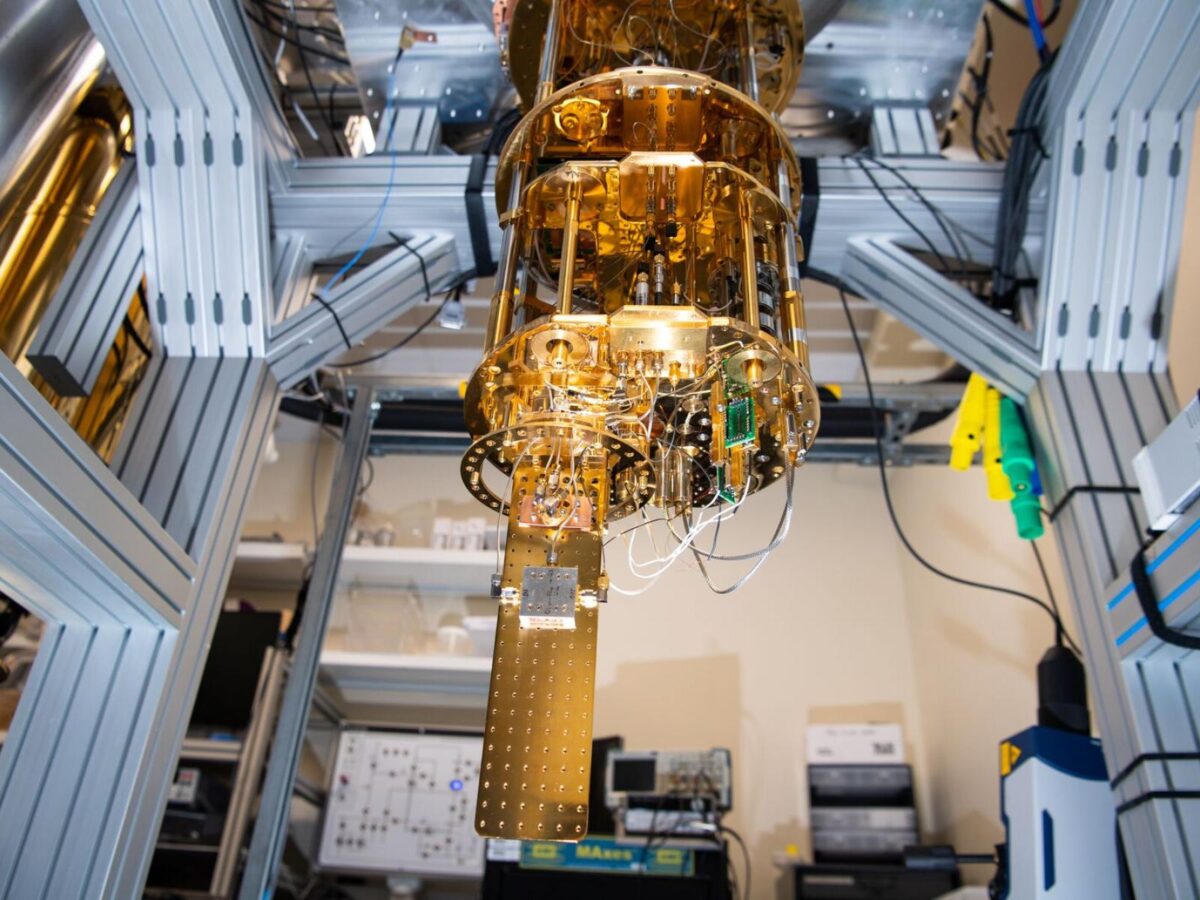
Quantum computers use qubits, the quantum version of the classic binary bit, such as this superconducting qubit, which sits in a dilution refrigerator in a Pacific Northwest National Laboratory physics lab. (Photo by Andrea Starr | Pacific Northwest National Laboratory)
Going forward, Zhang plans to continue scaling up his quantum education efforts. The coursework from the summer program will be made freely available for other educational institutions to use. It could also be incorporated into programs for adult learners.
In collaboration with the National Institute of Standards and Technology, headquartered in Gaithersburg, Maryland, Zhang also plans to use knowledge generated from the summer program to organize professional development workshops for instructors in four-year and community colleges.
The impact of Zhang’s efforts can already be seen on the individual level. Khushdeep Kaur, a master’s student in information systems, first heard about quantum computing from Zhang. “I felt amazed and eager to learn more about the technology,” she says. She is now part of Zhang’s research group, studying quantum computing topics.
Dongchan Kim, a senior majoring in information systems, also joined the lab after taking one of Zhang’s classes in spring 2024.
“I really enjoyed learning about technology that could become the ‘next big thing,’” he says. “Like AI, I think quantum computing has the power to transform industries. I look forward to contributing to its development in the future.”
On September 12, UMBC’s Upal Ghosh, from the Department of Chemical, Biochemical, and Environmental Engineering, was sworn in as a member of the Washington, D.C., mayor’s Leadership Council for a Cleaner Anacostia River (LCCAR). The council consists of 25 high-level government officials, community leaders, and environmental experts who support the vision of a swimmable and fishable Anacostia River. The members meet quarterly to advise the D.C. government on ongoing restoration projects.
The Anacostia River, which runs from Prince George’s County in Maryland into Washington, D.C., before joining the Potomac River and ultimately flowing into the Chesapeake Bay, has historically suffered from high levels of industrial pollution and contamination from sewage overflow. In recent years, government officials have been making concerted efforts to clean up the river. UMBC was invited to sit on the council, with Ghosh as the representative, based on the university’s key contributions to these clean-up efforts.
On Sept. 12, Upal Ghosh (top left) and other members of the LCCAR were sworn in during a virtual meeting of the council. (Image courtesy of Ghosh)
Since 2016, Ghosh and his UMBC colleagues and students have developed innovative methods of measuring contaminants in the river and created models to elucidate where the contaminants come from and how they travel through and accumulate in the water, sediment, and aquatic life, such as fish. Nathalie Lombard, a research assistant professor at UMBC who has played a significant role in the projects, will serve as the alternate representative on the LLCAR when Ghosh cannot attend.
In addition to his work on the Anacostia, Ghosh and his students have studied and contributed to the cleanup of the waterways throughout Maryland, Delaware, and across the country. “Students learn a lot from being out in the field,” Ghosh says. “They learn how the science and engineering we do helps guide major decisions. Our ultimate goal is making a positive difference in the health of the river, lake, or bay. That gives me a lot of excitement, and it really motivates the students too.”
Professor Lee Blaney, in the Department of Chemical, Biochemical, and Environmental Engineering, formally assumed the role of president of the Association of Environmental Engineering and Science Professors (AEESP) at a board of directors meeting in early September.
Lee Blaney (Marlayna Demond ’11/UMBC)
AEESP is a nonprofit organization founded in 1963 to foster inclusive connections between environmental engineering and science researchers and educators. It provides programs for members to develop the academic networks and career skills needed for professional success, increase equitable societal impact of environmental engineering and science scholarship and creative expression, and reimagine the skills necessary for environmental engineers and scientists to provide solutions that benefit regional, national, and global communities.
The association currently has more than 1000 members from universities around the world. AEESP assists its members in improving education and research programs, encourages graduate education, and provides information to government agencies and the public. The biennial AEESP Research and Education Conference brings the field together to share research, teaching, and outreach outcomes. Blaney’s term as president will include the next conference, which is scheduled to occur in May 2025 at Duke University.
“We’re excited about Dr. Blaney’s new role as president of AEESP,” says Mark Marten, the chair of the Department of Chemical, Biochemical, and Environmental Engineering. “His deep involvement with this organization not only makes a positive impact in our discipline, but also raises awareness of our department and UMBC in this influential community.”
Blaney and his research group study environmental contaminants of emerging concern, such as per- and polyfluoroalkyl substances, or PFAS, which are sometimes called “forever chemicals” because of the way they persist in the environment. They also research how to recover vital resources, such as nitrogen and phosphorus, from waste streams to improve water quality and ensure sustainable development. Blaney was a winner of the 2021 James J. Morgan Early Career Award from the American Chemical Society, and has also been recognized for the quality of his teaching and mentorship.
Lee Blaney (center) in his UMBC lab in 2019. (Marlayna Demond ’11/UMBC)
In 2021, Blaney was elected to the AEESP board of directors. Since that time, he has led a number of initiatives aimed at improving inclusion. During his one-year term as president, he will lead the board and executive committee, provide new charges to standing committees, correspond with members, represent AEESP at conferences and meetings, and drive new initiatives to grow the organization and support its members.
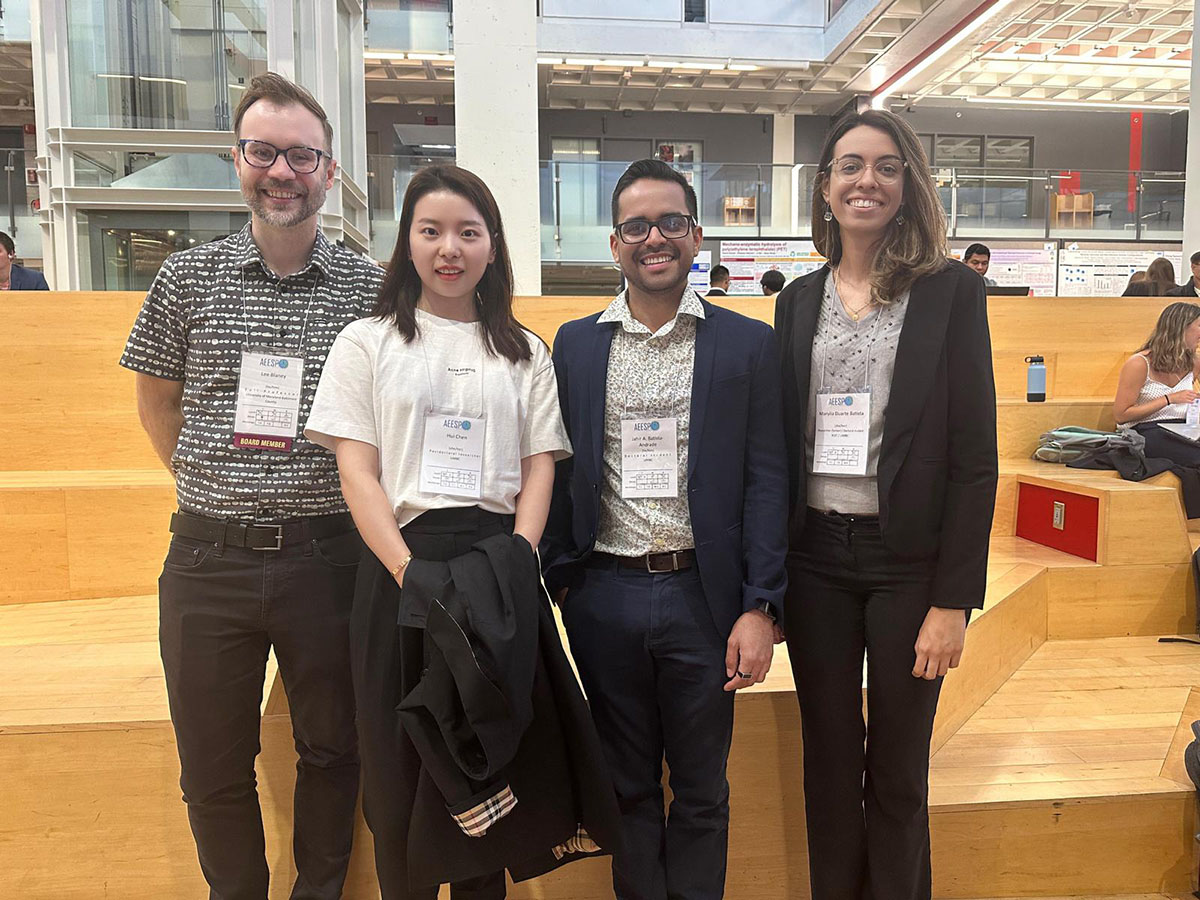
Lee Blaney (left) and his group members (left to right), Hui Chen (completed postdoc in 2024, now assistant professor at James Madison University), Jahir Batista Andrade, Ph.D. ’23, (now postdoc at University of Minnesota), and Marylia Duarte Batista (current Ph.D. student), at the 2023 AEESP Research and Education Conference in Boston. (Photo courtesy of Blaney)
In his first presidential address to AEESP, given in June, Blaney told members of how he found direction as an undergraduate student after attending a talk by environmental engineer Arup SenGupta, who spoke of efforts to remove arsenic from contaminated groundwater in rural villages in India.
“His passion and dedication to helping those without other resources inspired me, set me on the path to becoming an environmental engineer, and helped me to become a better person,” Blaney said. He hopes to bring these same values to AEESP and its members.
As president of AEESP, Blaney plans to develop an “AEESP Experts” program, which will connect environmental experts with reporters, and also an “AEESP Communities of Practice” initiative, which will gather small groups of AEESP members to develop new resources, such as new course material on climate change or best practices for graduate student recruitment, which can be shared with the whole community.
A few weeks into her summer internship with pharmaceutical company AstraZeneca, rising senior Ortisemoyowa “Moyo” Ikomi, chemical engineering, attended an event celebrating a milestone in the company’s construction of a new drug manufacturing plant in Rockville, Maryland. During the event, the organizers played a video featuring a young girl whose seemingly terminal cancer was cured with immunotherapy drugs—the same type of drugs that would be manufactured in the new facility.
“This girl was in hospice care, at home with her family who thought they might just have to wait for her life to end, and this drug gave her a new lease on life. It drove home for me how important this work is, and how I would love to keep working in the pharmaceutical industry,” says Ikomi.
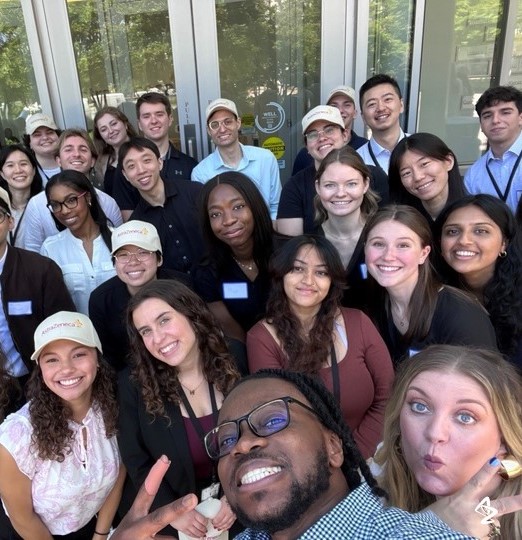
A group selfie of AstraZeneca’s summer 2024 interns. Ikomi is middle center. Photo courtesy of Mark Benesch ’08, AstraZeneca’s Americas capital portfolio director.
Ikomi landed her internship with AstraZeneca after talking with a company representative at the UMBC Career Fair. She worked on the company’s management of the planned Rockville plant, investigating a software tool that could track construction progress.
“It’s not traditional chemical engineering, more within the realm of project management of large-scale engineering projects. I’m definitely enjoying it,” Ikomi says. “I’ve learned so much during the internship. The experience has made me think I’d like to continue working in the engineering project management sphere.”
Ikomi credits the UMBC Career Center with supporting her throughout her internship application process—consulting with her on application timelines, uncovering resources for finding job openings, and offering tips for honing her resume and interviewing skills. “They offer an invaluable service,” she says. “Even more students could benefit from using them.”
Ikomi, who came to UMBC from Lagos, Nigeria, says she arrived thinking she wanted to be a scientific researcher. When she realized basic research wasn’t the best fit for her, faculty and fellow students listened as she talked through her dilemma and offered advice on other options. She found that her true passions lay in shepherding discoveries from the lab to the wider world, where they could directly impact people’s lives.
Since that celebration event at AstraZeneca, Ikomi says she often thinks back to the video of the young girl who was cured of cancer. “When I think of this internship as a whole, my mind always goes to that experience. That moment crystallized that this type of work is what I want to dedicate my career to.”
NASA holds a special place in the public’s imagination. The federal space agency has delivered astronauts to the moon, collected breathtaking images of the cosmos with space telescopes, explored Mars with robotic rovers, and sent satellites into orbit to keep watchful eyes on our own life-supporting planet.
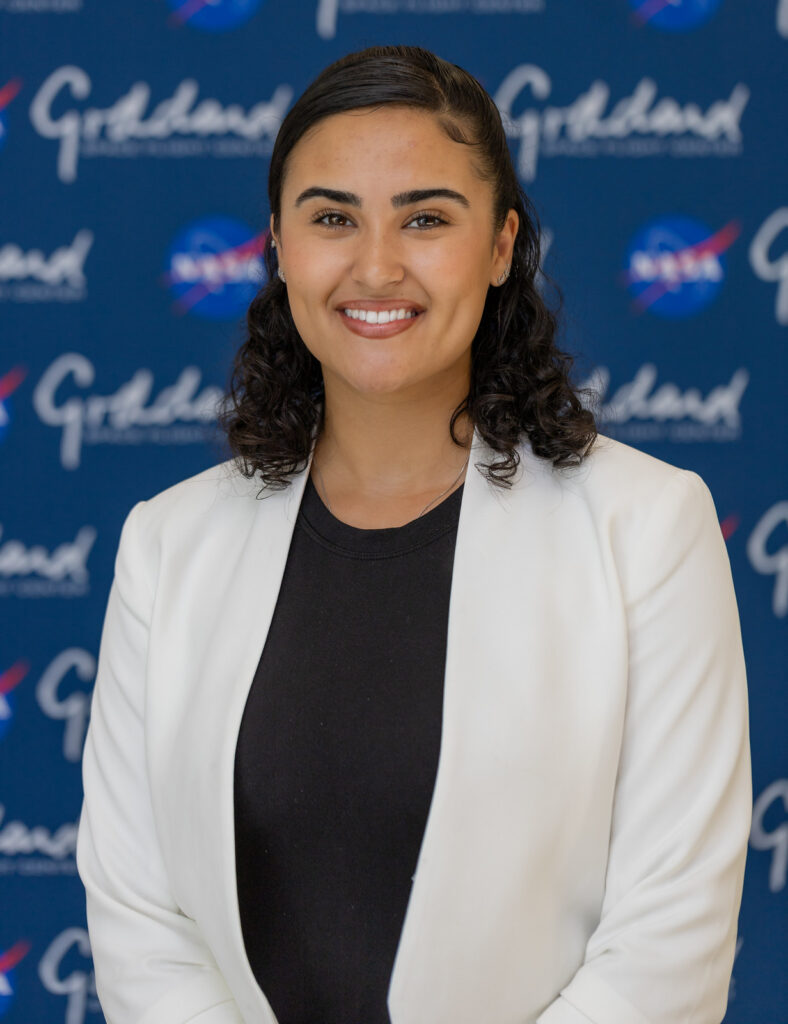
Leah Narat (Image courtesy of Narat)
Leah Narat ’24, business technology administration, shares in the awe. She knew that getting an internship at NASA was highly competitive—around 5 percent of those who apply get offered positions—but she didn’t let the high bar dissuade her from trying.
“Honestly, being at NASA was something that I never thought I would achieve, but I put my application out there, and here I am,” says Narat, who worked as a business intelligence intern at the NASA Goddard Space Flight Center in Greenbelt, Maryland, this summer. “It’s been wonderful.”
During the internship, Narat worked on computer systems that help keep NASA missions safe and its employees engaged. In one project, she created and updated databases to track awards given to NASA employees. The agency will use the information to maximize employees’ recognition and success and guide them toward career paths that best take advantage of their strengths.
“It’s been great to have this real world experience, where I can get my hands dirty and decide: Is this the type of work I want to do?” Narat says. “It’s also great that I can receive upper-level credit hours for the internship.”
In another project, Narat sorted information from meetings during which teams debriefed after they completed projects. She identified insights, recommendations, and lessons learned—valuable information that NASA can use to better manage projects in the future.
“Safety is a big priority for NASA, so they have requirements to make sure that each project is scrutinized and every possible improvement is considered,” Narat says.
Narat says her experience working at NASA helped solidify her interests in data analytics and database management. She credits Handshake, UMBC’s job and internship search platform, with helping her find and apply for the position.
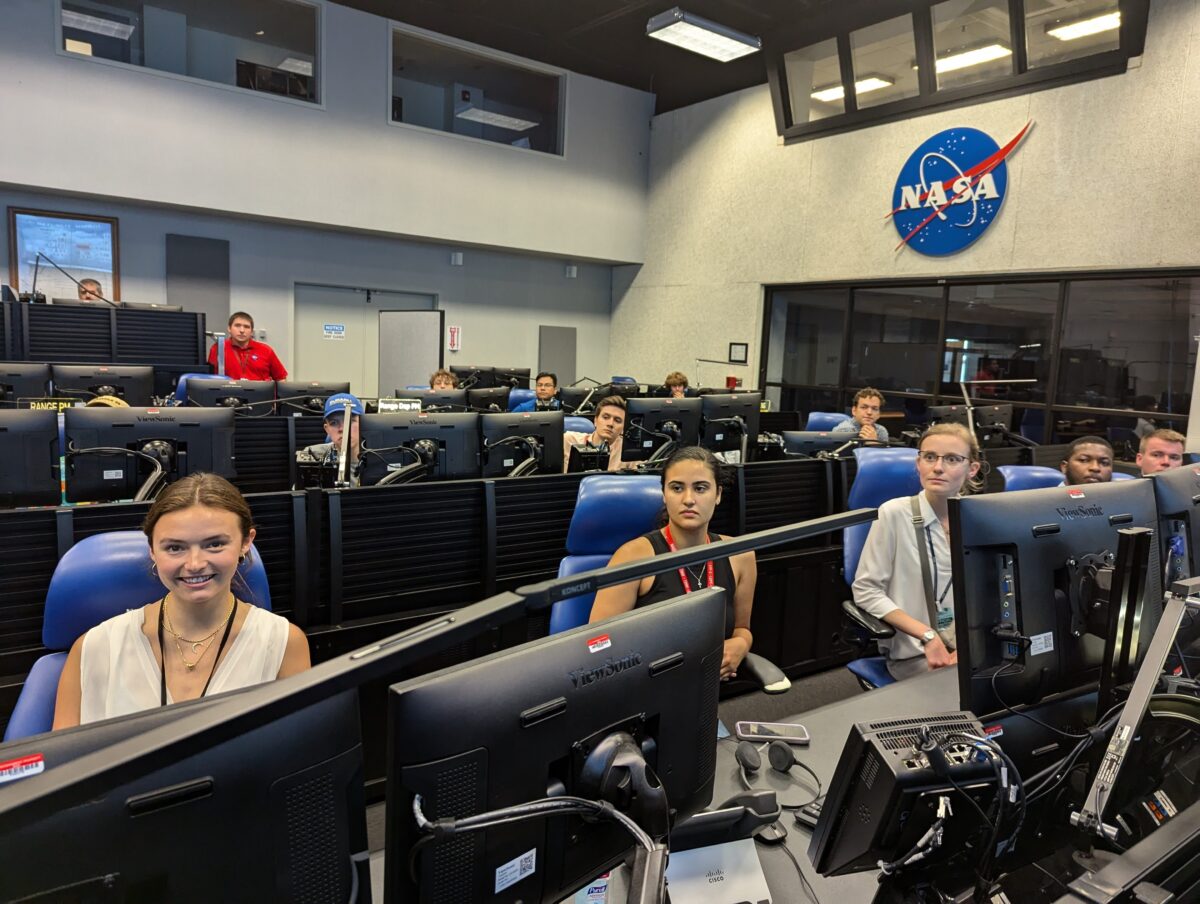
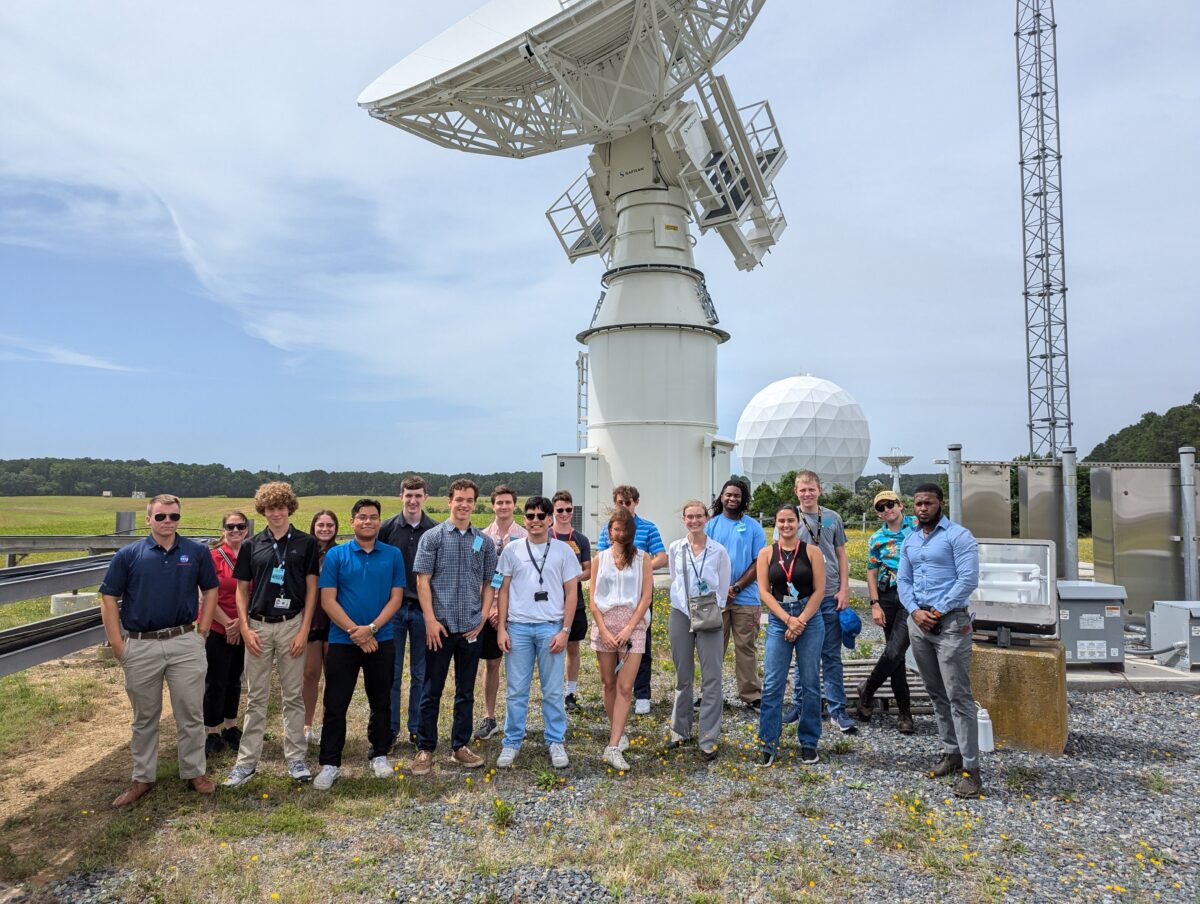
Interns from the Flight Projects Directorate at NASA Goddard, including Narat, tour the Wallops Flight Facility in Virginia. (Images courtesy of Narat)
“The best part of the experience has been meeting people, networking, and making connections,” says Narat. She was also thrilled when the interns got to visit NASA’s Wallops Flight Facility in Wallops Island, Virginia, from which the agency launches a variety of space and high-altitude missions.
“I got to actually stand on the launch pad where rockets blast off,” says Narat. “It was just wild.”
An international team of scientists, including two researchers who now work in the Center for Advanced Sensor Technology (CAST) at UMBC, has shown that twisted carbon nanotubes can store three times more energy per unit mass than advanced lithium-ion batteries. The finding may advance carbon nanotubes as a promising solution for storing energy in devices that need to be lightweight, compact, and safe, such as medical implants and sensors. The research was published recently in the journal Nature Nanotechnology.
Sanjeev Kumar Ujjain, from CAST, was a lead researcher on the work. He started the project while at Shinshu University, in Nagano, Japan, and continued after arriving at UMBC in 2022. Preety Ahuja, from CAST, also contributed to the material characterization aspects of the research.
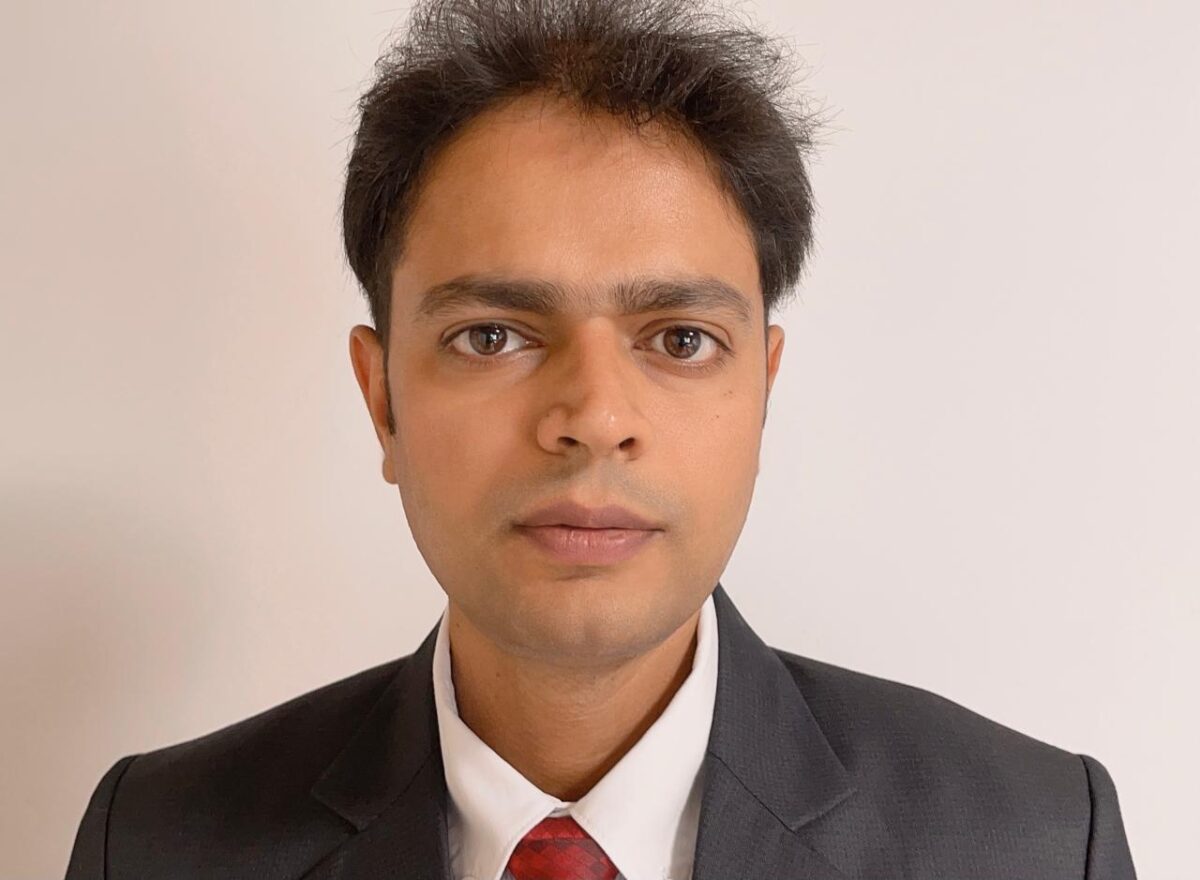
Sanjeev Kumar Ujjain (left) and Preety Ahuja (right). (Images courtesy of Kumar Ujjain and Ahuja)
Straws of 1-atom-thick carbon
The researchers studied single-walled carbon nanotubes, which are like straws made from pure carbon sheets only 1-atom thick. Carbon nanotubes are lightweight, relatively easy to manufacture, and about 100 times stronger than steel. Their amazing properties have led scientists to explore their potential use in a wide range of futuristic-sounding technology, including space elevators.
To investigate carbon nanotubes’ potential for storing energy, the UMBC researchers and their colleagues manufactured carbon nanotube “ropes” from bundles of commercially available nanotubes. After pulling and twisting the tubes into a single thread, the researchers then coated them with different substances intended to increase the ropes’ strength and flexibility.
The team tested how much energy the ropes could store by twisting them up and measuring the energy that was released as the ropes unwound. They found that the best-performing ropes could store 15,000 times more energy per unit mass than steel springs, and about three times more energy than lithium-ion batteries. The stored energy remains consistent and accessible at temperatures ranging from -76 to +212 °F (-60 to +100 °C). The materials in the carbon nanotube ropes are also safer for the human body than those used in batteries.
The researchers envision that twisted carbon nanotube ropes may one day power a range of devices, including wearable health sensors and medical implants that could harvest energy from the body’s movements. (Graphic “NanoRope Mobility” created by Sanjeev Kumar Ujjain using Copilot AI.)
“Humans have long stored energy in mechanical coil springs to power devices such as watches and toys,” Kumar Ujjain says. “This research shows twisted carbon nanotubes have great potential for mechanical energy storage, and we are excited to share the news with the world.” He says the CAST team is already working to incorporate twisted carbon nanotubes as an energy source for a prototype sensor they are developing.
UMBC is strengthening the university’s research connection with the energy company Constellation, expanding on a partnership of more than 20 years with the Baltimore-based business. Constellation, the nation’s largest producer of carbon-free energy, funds scholarships and has endowed a professorship in mechanical engineering at UMBC, regularly recruits students for internships and jobs, and hosts its annual Youth Energy Summit on the UMBC campus.
In March, UMBC and Constellation signed a Master Research Agreement, which will facilitate greater research collaboration between the two organizations. In April, Constellation sent representatives to the College of Engineering and Information Technology’s (COEIT’s) inaugural Research Day to connect with UMBC faculty and students. And in June, research leaders from both organizations met to discuss potential areas of joint work, including carbon-free energy generation, environmental protection and pollution remediation, and efforts to make the power grid more resilient and secure.
“The best research will happen as we grow this partnership organically,” says Anupam Joshi, acting dean of COEIT. “We are proud to be a Tier 1 university partner of Constellation Energy. The interactions of our faculty and students with Constellation’s representatives during Research Day have already led to initial ideas where we can work together. We are also actively pursuing collaborations in other areas of mutual interest and environmental importance.”
“As part of our efforts to accelerate the nation’s clean energy future, it’s vital that we enhance our understanding of the emerging technologies being developed today,” said Uuganbayar “Ugi” Otgonbaatar, Constellation’s director of Technology Strategy, Grants, and Partnerships. “We are grateful for our longstanding partnership with a leading local institution in UMBC and look forward to continuing to explore its research portfolio as part of our broader collaboration.”