All posts by: Magazine Editor


Five Alumnae Photographers Featured in Professor’s Gallery Opening, Oct. 5

When UMBC political science professor Carolyn Forestiere moved to Catonsville, she and her husband knew they wanted to fill their new home with local art. After thinking about it some more, they decided to take their curatorial endeavor up a notch — and open their home as a part-time gallery.

Their first show, “UMBC Through the Lens,” will feature five UMBC visual arts alumnae — Brittney Danielle ’12, Chrystal Smith ’12, Marlayna Demond ’12, Stephanie Ellis ’12, and Kimberly M. Haines ’12 — who will present photography related to their time as students at UMBC.

Forestiere said she was pleased to have five “wonderful photographers,” explaining she hopes “that the artists will receive exposure and further their professional credentials.”

The first show will be on Friday, October 5th, from 5 to 7 p.m. Read more about the show and get the gallery address here. The community is welcome.

Yun ’97, CompSci, Profiled in BBJ About Cybersecurity Company

Alumna Jeehye Yun ’97, computer science, was profiled along with her cybersecurity company Secured Sciences Group (SSG) by The Baltimore Business Journal’s Jack Lambert in an article published on September 7th.

Read the full story here.

Yun told Lambert that SSG–a member of UMBC’s Research and Technology Park, and which is in the process of working with the research park on a plan to attract investors–is particularly adept at cutting through red tape and redundancies which can occur in government applications, saying, “We can take a lot of disparate policies and figure out where the overlaps are.”

The alumna, who is CEO/President of SSG as well as a former teacher at her alma mater from the late-90′s, also told Lambert that the company’s upcoming technology will new technology will hopefully cut through the quantity of material companies have to sift through from government grant applications and contracts by finding the overlaps between for organizations like the Department of Defense, the Navy and the Marines.

Yun also noted that her company’s products also have value for colleges, management consultants and small businesses, saying, “The biggest rule of thumb for us is, actually, are we solving a problem where we would want to use the product?”

This story originally appeared in UMBC Insights.

Yun '97, CompSci, Profiled in BBJ About Cybersecurity Company

Alumna Jeehye Yun ’97, computer science, was profiled along with her cybersecurity company Secured Sciences Group (SSG) by The Baltimore Business Journal’s Jack Lambert in an article published on September 7th.
Read the full story here.
Yun told Lambert that SSG–a member of UMBC’s Research and Technology Park, and which is in the process of working with the research park on a plan to attract investors–is particularly adept at cutting through red tape and redundancies which can occur in government applications, saying, “We can take a lot of disparate policies and figure out where the overlaps are.”
The alumna, who is CEO/President of SSG as well as a former teacher at her alma mater from the late-90′s, also told Lambert that the company’s upcoming technology will new technology will hopefully cut through the quantity of material companies have to sift through from government grant applications and contracts by finding the overlaps between for organizations like the Department of Defense, the Navy and the Marines.
Yun also noted that her company’s products also have value for colleges, management consultants and small businesses, saying, “The biggest rule of thumb for us is, actually, are we solving a problem where we would want to use the product?”
This story originally appeared in UMBC Insights.

Outstanding Alumni of the Year for 2012 Announced

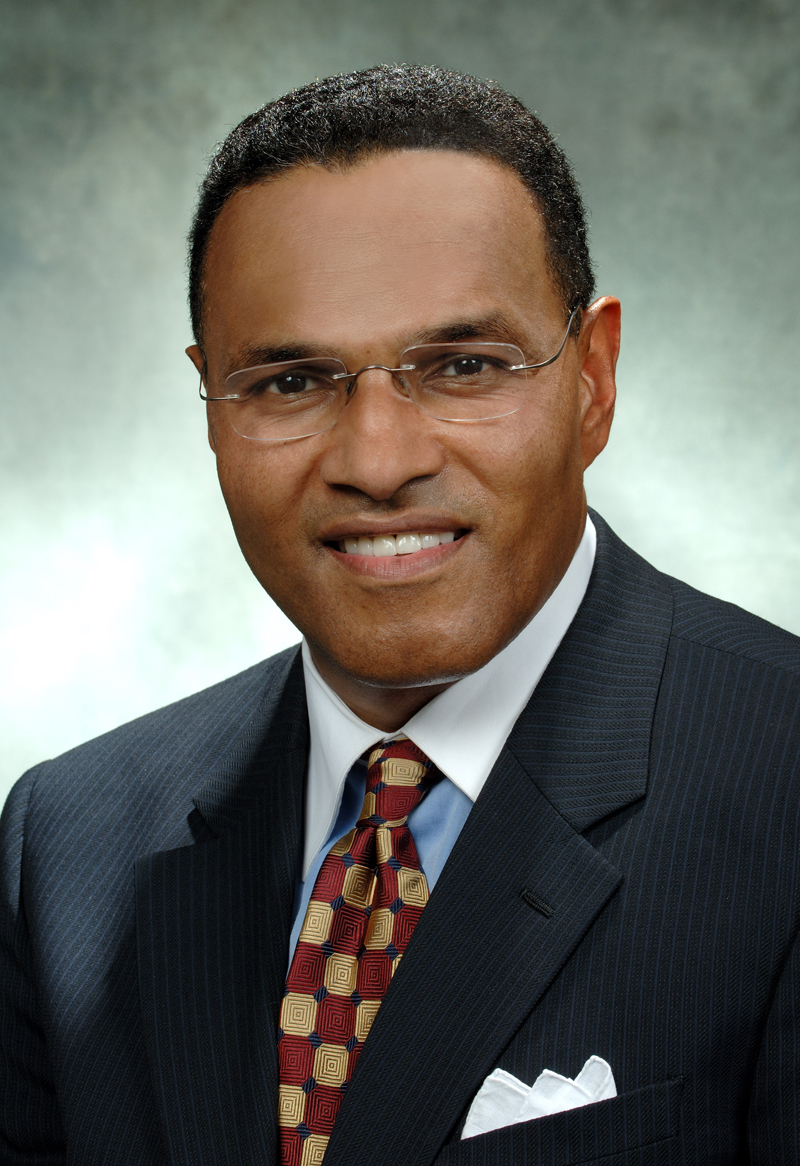
The UMBC Alumni Association will honor six alumni and UMBC president Freeman A. Hrabowski, III, at the annual Outstanding Alumni of the Year Awards ceremony on Thursday, October 11, 2012. Learn more about our past award winners.

The following alumni will receive awards:

Outstanding Alumnus of the Year in the Humanities
Greg Cangialosi ’96, English
Co-founder, Betamore

After graduating from UMBC in 1996, Greg Cangialosi launched Baltimore-based email service provider Blue Sky Factory, a company that in 2011 marked a ten-year successful track record and a global reach. In 2010, the company was named a Future 50 company by Baltimore SmartCEO magazine, an award which recognizes the 50 fastest-growing companies in the Greater Baltimore area based on employee and revenue growth. The company also made the INC 5000 list of the fastest growing companies in the United States for four consecutive years. In 2011, Cangialosi sold Blue Sky Factory to Atlanta-based company WhatCounts. Most recently, Cangialosi co-founded Betamore, an 8,000 square foot “urban campus for entrepreneurship and technology, focused on three main areas, education, community and incubation.” Cangialosi has served as a longtime leader and member of the UMBC Alumni Association and Board, and he was a member of the University’s “2016 Committee.” He has served as a frequent speaker at the Alex. Brown Center for Entrepreneurship, and he has also been a judge for the Center’s Idea Competition. At UMBC’s 2012 Career Week, Greg was keynote speaker at a networking event for students and alumni.

Outstanding Alumna of the Year in Engineering & Information Technology
Stephanie C. Hill ’86, computer science and economics
President, Information Systems and Global Solutions-Civil, Lockheed Martin Corporation

In a guest essay published this year in the Washington Post’s “College Inc.” blog, Stephanie Hill made a strong argument in favor of educating a new generation of female engineers. In her position at Lockheed Martin, Hill is an excellent example of how a woman can excel in this field. Hill began her career in 1987 with Lockheed Martin as a software engineer. Over the years she has assumed positions of increasing responsibility including Systems Engineering Manager and Director of Quality and Mission Success; Director of Technical Operations; Vice President and General Manager of the Electronic Systems-Mission Systems & Sensors Baltimore site; and, most recently, President for Information Systems and Global Solutions-Civil, which delivers IT systems and services to various U.S. government agencies, international governments and regulated commercial industries, such as energy, health care and transportation. Hill was named one of the Top 100 Women of Maryland in May 2006, Black Engineer of the Year Award (BEYA) Alumni in 2006; Lockheed Martin’s Engineer of the Year in 1999 and was named Black Engineer of the Year (BEYA) Most Promising Engineer in 1993. Hill also lends her expertise to the Governor’s P-20 Leadership Council (STEM Task Force) and serves on the Board of Directors for the Greater Baltimore Committee. She has steadily supported UMBC as a willing volunteer and a mentor to students.

Outstanding Alumna of the Year in Visual & Performing Arts
Deborah Randall ’94, theatre
Founder, Venus Theatre

Deborah Randall is the founder and visionary behind Venus Theatre. Born in Washington, DC, and raised in Prince George’s County, she began directing as a student and president of the Drama Club at Prince Georges Community College. Her first paid acting gig was at Wild World Theme Park in 1986. She later went on to graduate cum laude from UMBC under the guidance of Xerxes Mehta, Wendy Salkind, Sam McCready, Alan Kriezenbeck, and Alice Robinson. She was in Mehta’s Marat/Sade at UMBC with the Maryland Stage Company and in McCready’s Merry Wives of Windsor with Shakespeare on Wheels. After college, Randall worked as an actor regularly in Washington, DC, and then began performing her own monologues. She has performed four solo shows, written two, and had one published. She has also written and staged works for multiple casts. She began doing public staged readings of other living playwrights in 2002, which led to cultivating strong relationships with many writers. The works of Randall and Venus have been seen up and down the Eastern seaboard. Venus Theatre began in 1995 as an all female improv troupe called Venus Envy. Venus led Take Back the Night Marches and did improvisational games at the House of Ruth as well as other empowerment projects. In 2000, Randall founded Venus Theatre, known for immersion staging and award-winning world premiere work. In 2006 Venus dropped roots in the county where the founder grew up. Venus hopes to bring culture to the community that has given her so much.

Outstanding Alumna of the Year in the Social Sciences
Elizabeth Rossman ’85, political science
Vice President-Government Relations, Honeywell International, Inc.

Rossman began her pursuit of a career in public service while still a student at UMBC, where she majored in political science and interned in the Baltimore City Mayor’s office. She received her master’s degree from the University of Pittsburgh Graduate School of Public and International Affairs (GSPIA) and began work with the federal government in 1987 as a Presidential Management Intern, a prestigious program designed to bring bright young people into government service. She quickly moved from the General Services Administration to the Executive Office of the President, Office of Management and Budget (OMB). After leaving the OMB for a brief stint with the Department of Interior’s Office of the Secretary as chief of the Budget Division, in 2001, she returned to OMB as Associate Director for Legislative Affairs, during which Rossman routinely engaged in negotiations with members of Congress and their staffs during the annual federal budget process. She had lead responsibility in the Executive Branch for the development of Statements of Administration Policy on appropriation bills, and she represented the White House, OMB, and agency officials in budget negotiations. Rossman contributed to the development of the legislative strategy that was central to the enactment of the $40 billion Emergency Response Fund (ERF) omnibus spending bill to address immediate needs in the aftermath of the September 11th terrorist attacks. After completing a stellar career with the federal government in 2005, Rossman was appointed by Honeywell International to her current role as vice president of Government Relations.

Outstanding Alumnus of the Year in Natural & Mathematical Sciences
Dr. Kimani A. Stancil ’94, physics and mathematics
Howard University, Assistant Professor of Physics and Astronomy, Specialty Area – Soft Condensed Matter Physics

After receiving his degrees in physics and mathematics from UMBC in 1994, Dr. Kimani Stancil proceeded to the Massachusetts Institute of Technology (MIT) where he obtained in 2002 his Ph.D. in Physics studying polymer gels. Before beginning a postdoctoral fellowship in 2004 in nanoscience at the Lawrence Berkeley National Laboratory at University of California Berkeley, he spent a little over a year teaching mathematics, science, and chess to grades 3 through 8 at Baltimore City’s Maarifa Elementary and Middle School; he later donated all his wages earned to the Maarifa School. After his postdoc in 2008, Dr. Stancil was appointed Assistant Professor of Physics at Howard University, where he currently teaches courses in calculus-based introductory physics – mechanics, electricity, and magnetism, and a course in graduate statistical mechanics. In his short career, Dr. Stancil has also produced one Physics PhD (Graduated Summer 2012), five publications (plus two recently submitted and three more in preparation), and has received external and internal research grants. He is a master level chess player and former Maryland High School Chess Champion, and has steadily found ways to combine his interests in math and science to attract students from under-represented groups to science. He is currently seeking external funding for his program, “AYA-All You can Aspire,” which combines physics and chess in an effort aimed to inspire youth and community. Dr. Stancil regularly serves as an unofficial mentor for students at UMBC – always giving back when possible. A member of the first cohort of Meyerhoff Scholars, he was the keynote speaker at the Meyerhoff Parent Association graduate reception this year. His speech included his original poetry written when he was a UMBC student.

Rising Star Award
Christopher Valentino ’02, M.S. ’06, information systems management
Director, Contract Research & Development, Northrop Grumman

Christopher Valentino is a Cyber Security expert and business leader who provides innovative technology solutions to a diverse set of U.S. Government customers. A recognized leader in developing enterprise cyber security and information assurance solutions for critical national systems, Valentino is responsible for managing contract research and development portfolios for Northrop Grumman’s Cyber Intelligence Division. Prior to his current assignment he led the Cyber Operations business area where he managed a team of more than 200 cyber security professionals providing research, development, testing and operations support to a variety of defense and intelligence customers. As a founding member of the former company Windermere, Valentino helped to develop and build a successful technology company that was acquired first by Essex Corporation and then Northrop Grumman. Throughout his career, Chris has demonstrated ongoing involvement and support of UMBC, its students and alumni. His achievements on behalf of UMBC include developing a UMBC / Northrop Grumman strategic partnership which includes technology incubation, research, recruiting, training education; and contributing to the development of the Cyber Security MPS Graduate Degree and Certificate program. Chris is also an active member of the UMBC Cyber Security External Advisory Board.

In addition, the Alumni Association will honor UMBC President Freeman A. Hrabowski, III, with the Distinguished Service Award in recognition of his 20 years of service to university as president.

The Alumni Awards ceremony will be held on Thursday, October 11, at 7:30 p.m. in the Albin O. Kuhn Library Gallery. The event is free, but guests should register online at http://alumni.umbc.edu/homecoming.

From Aspiration to Achievement

Twenty years ago, UMBC sought a greater academic reputation and a deeper sense of community. It advanced both goals under the leadership of President Freeman A. Hrabowski, III.

By Richard Byrne ’86

Giving name to your aspirations is often the first step to achieving them. And back in 1995, the words that campus leaders summoned to encompass their hopes for UMBC were “An Honors University in Maryland.”

The university was just shy of its 30th anniversary and only three years into the tenure of its fifth president, Freeman A. Hrabowski, III. UMBC already possessed institutional strengths, including its stellar faculty, the pioneering spirit that comes with being a young university, and an increased dynamism and connection with its closest cities – Baltimore and Washington, D.C. – bequeathed to it by Hrabowski’s predecessor, Michael Hooker. (See “Up on the Roof”)

What UMBC needed at that moment was an audacious imaginative leap: an identity that would help the campus seize upon the university’s strengths, elevate them, and create a more deeply knit community.

“I think the campus agreed,” Hrabowski recalls, “that we needed to attract more students who could take advantage of what we had to offer – even as we worked to think about the learning process and engage students in research.”

Twenty years into Hrabowski’s presidency, UMBC has undergone a profound transformation. The university is now renowned for nurturing young minds in an environment that values excellence, innovation, and diversity. Its investments to retain and attract top-notch faculty have paid off not only in rising prestige and research funding, but also in a reputation for providing undergraduates with a superlative environment for learning. UMBC’s physical campus has been transformed in ways that have improved the university’s teaching and research infrastructure – as well as its aesthetic appeal and overall quality of life.

This metamorphosis at UMBC has been lauded by a national media that loves an unexpected success story. The university’s achievements have been praised in outlets including CBS’ 60 Minutes, Time magazine, The New York Times and The Washington Post. And while Hrabowski’s leadership is often spotlighted in these stories, Hrabowski likes to point out that UMBC’s successes often have been proposed, nurtured and pushed forward by UMBC’s faculty, students and staff in an atmosphere of shared governance.

John Jeffries, Dean of UMBC’s College of Arts, Humanities and Social Sciences and a former president of the Faculty Senate, observes that “shared governance has always been vital and important at UMBC. It’s been a fundamental part of the health and progress of UMBC in the past two decades.” Jeffries adds that Hrabowski “meets regularly with the Faculty Senate president, brought the Faculty Senate president and Academic Planning and Budget Committee chair onto the Budget Committee and President’s Council, and works with the Faculty Senate. Shared governance has played a fundamental role in the progress of the academic programs.”

Looking back, the principles undergirding UMBC’s rise to prominence seem clear. Elevate academic excellence. Create spaces and opportunity to forge community. Bring the entire university into the processes of academic research and creative endeavor.

But how, exactly, did it all happen? As the campus celebrates two decades of Hrabowski’s leadership, it is now possible to trace more fully the arc of that evolution.

TAKING THE HONORS

UMBC’s efforts to attract the best students from Maryland and elsewhere had gathered steam by the end of the 1980s. Average SAT scores for freshmen entering UMBC in 1989 climbed above the national average – and subsequently those scores have skyrocketed to almost 200 points over the average.

Yet it took a certain degree of audacity to proclaim UMBC “An Honors University in Maryland” only six years after reaching that important milestone. But stating the university’s aspirations publicly was a key step in UMBC’s transformation.

“It was the marketing initiative that taught us that we had become known as a place for serious academic study,” recalls Hrabowski. “A university attracting more students from high school honor societies. A university that was sending a disproportionate number of students to graduate and professional schools. And, most important, that we were a public university that openly valued the life of the mind. All these things were part of the honors university concept.”

The concept of an honors university might have been new, but its foundations had been laid in previous years.

One essential element in UMBC’s reimagination of itself was the creation of the Meyerhoff Scholars Program by Hrabowski (who had been recruited to UMBC in 1987 as vice provost by Michael Hooker) and philanthropist Robert Meyerhoff. The program aimed to increase the number of minority students pursuing graduate degrees in science, technology, engineering, and math (STEM) disciplines – and its success in doing so has made the program an international model for fostering excellence and diversity. The program’s more than 700 graduates have subsequently earned 81 Ph.D.s, 25 M.D./Ph.D.s and 92 M.D.s. – and many more of its graduates are still pursuing advanced degrees.

The Meyerhoff Program also created wider ripples at UMBC. Its formula of recruiting talented students and forging shared and structured intellectual communities was adopted (and adapted) elsewhere at the university. New programs including the Linehan Artist Scholars Program, the Sondheim Public Affairs Scholars Program, the Humanities Scholars Program, and the Center for Women In Technology (CWIT) were created to extend the values of academic excellence and shared enterprise across disciplines.

Such programs would not exist without a significant investment in UMBC’s innovation from a myriad of donors – including an increasing number of UMBC alumni who give back to their alma mater. UMBC’s first two capital campaigns for the university, which concluded in 2002 and 2011, each exceeded their goals by at least $15 million.

Baltimore businessman and philanthropist Earl Linehan was a co-chair of that first capital campaign – and also a longtime chair of UMBC’s Board of Visitors. When he was first invited to visit the university by Hrabowski, Linehan says that he was immediately impressed by the UMBC president’s “unbelievable energy and personal connection with the students.”

Yet Linehan says that he and the other donors who helped fuel UMBC’s transformation in that era also saw an institution that was ripe to make a big leap. “A lot of us initially were attracted by Freeman,” he continues. “But then we got to know the institution. Even then, the reality of the place already outshone the perception of it. We became inspired by the whole ethos of the place.”

And as UMBC found resources to advance its ambitions, its progress toward becoming an honors university was extended into every corner of the school by faculty and staff members who served on an Honors University Task Force that issued its final report in May 2000.

The task force aimed to extend “the rigorous ways of learning that are options for students in select programs at UMBC to a wider student body,” and identified changes to significantly strengthen and broaden both the curriculum and student support services. The task force offered crucial advice on implementing those changes, and its work has given talented students attracted by the honors university concept more pathways and support to achieve academic excellence at UMBC.

GIVE US TREES

Planting trees

Improving UMBC’s aesthetic appeal and creating new spaces to foster deeper community were on Hrabowski’s agenda from his earliest days as president. He fondly recalls his first meeting with the late William Donald Schaefer, who was Maryland’s governor when Hrabowski was named to the job.

“[Governor Schaefer] said to me, ‘What can I do to show people how proud I am of you and of the university?’ And I said, ‘Give us trees,’” Hrabowski recalls. “Because people said that this place would look better and better as the trees grew. And he was absolutely delighted to give us support.”

A year before Schaefer’s passing in 2011, Hrabowski invited Maryland’s former governor back to campus. “I reminded him of those trees,” he says. “He was amazed by how much we had developed, and moved that we were giving him credit for helping us to develop.”

Green campus spaces such as the Beuys Sculpture Park (just southeast of the Retriever Activities Center) are a tangible sign of UMBC’s aesthetic upgrade. And with a strong push from UMBC’s faculty, green spaces became part of the university’s research infrastructure when its Conservation and Environmental Research Areas (CERA) – contiguous to the long-planned bwtech@UMBC Research and Technology Park – were created in 1997.

In the midst of those green spaces, other sorts of growth took place. The addition to UMBC’s Albin O. Kuhn Library that opened in 1995 was underway when Hooker left the university.

And under Hrabowski’s leadership, 13 new buildings and 12 major additions and renovations to UMBC’s campus have been completed in the past two decades.

Much of this flurry of new construction – and the state funding that supported it – advanced both the research and teaching missions at UMBC.

“When I think about this growth,” says Hrabowski, “I think about the confidence that the state has in us as a major institution of learning. And I think about the areas that have been strengthened academically as a result. The physical transformation reflects a trend of growth in the academic program.”

The new buildings on campus created new opportunities for innovation across disciplines: a new Physics building, a new Public Policy building, two new Information Technology/Engineering buildings, and, just this autumn, a new Performing Arts and Humanities Building (See “The News”). UMBC also undertook major renovations of key structures in the natural sciences, overhauling the Biological Sciences and the Meyerhoff Chemistry buildings. And the opening of bwtech@UMBC in 2002 – a research park that is now home to nearly 100 companies that generate over $200 million annually in total business – created even closer collaborations with industry and commerce in the region.

UMBC’s building boom also focused squarely on creating deeper community on campus and encouraging students to call the school their home during the academic year.

The centerpiece of this effort was the 2002 opening of The Commons, a new university center that swung the center of campus closer to the residential heart of the school. And that heart has seen a boom of its own: two new apartment complexes, two new dormitories, and the refurbishment and expansion of other existing student residences.

“The development has emphasized the importance of community,” Hrabowski says. “Spaces like The Commons, and even the benches that we have on campus, are spaces that invite conversation, reflection and community – and the feeling that the university is becoming more residential.”

The creation of new community spaces and the growth campus housing have supported UMBC’s gradual shift from a predominately commuter school into a substantially residential university. When Hrabowski assumed UMBC’s presidency in 1993, the percentage of students who lived on campus had finally risen to 30 percent. Today, the number has moved closer to 50 percent in total. Even larger strides have been made with incoming freshmen: Fully 75 percent of those enrolled at UMBC as freshmen now live on campus.

Yvette Mozie-Ross ’88, health science and policy, has seen the changes at UMBC over the last 20 years as an undergraduate and as a staff member who now serves as associate provost for enrollment management. She says the biggest change she has seen is “the recognition that the institution has attained. I remember as a student, and then as an admissions counselor, you’d say UMBC and people would say ‘UM-what?’ Now you say UMBC and they can name all sorts of accolades we have received, and tell you about people they know who have gone to UMBC and done great things.”

In addition, Mozie-Ross believes that the physical transformation of the campus – and the construction of communal spaces where students, faculty, and staff can gather – have helped spur the rise of students living on campus. “They have played a critical role,” she says. “There are now places where the process of gathering as a community happens more naturally.”

DELIGHT IN DISCOVERY

One of UMBC’s strengths from its founding was its faculty. Key faculty members across disciplines arrived in the university’s early years, and stayed on at UMBC through the 1970s and beyond.

These professors and researchers – and those who have joined them in subsequent decades – have propelled UMBC’s transformation through their research and innovations in the classroom.

The numbers tell part of the story. When Hrabowski became interim president of UMBC in 1992, the university’s total research and development expenditures stood at $7.6 million, with nearly $5 million of that amount coming from the federal government. Only ten years later, in 2002, that total had grown to $36 million, with $29 million in federal research dollars. And that astonishing growth has continued over the second decade of Hrabowski’s presidency, as total expenditures have almost tripled to $91 million and federal funding has doubled to $61 million.

Beyond the numbers however, are two decades of developing dynamic and high-powered research partnerships, including deep and continuing research relationships with NASA, IBM, Princeton University, and the Howard Hughes Medical Institute.

The university has also excelled in disciplines where research isn’t measured in dollars but in cultural and societal reach. A 1997 study by Hugh Davis Graham and Nancy Diamond, published as The Rise of American Research Universities: Elites and Challengers in the Postwar Era, ranked UMBC scholars in the arts, humanities, and related social sciences as 13th among all U.S. public university faculties in the attainment of prestigious awards. And UMBC faculty members in those disciplines continue to receive prominent grants from the National Endowment for the Arts, the National Endowment for the Humanities, and numerous other institutions.

As UMBC’s Provost Philip Rous pointed out in a recent interview: “External funding is a measure of excellence in many disciplines. But we have to be careful not to generalize that observation as far as defining the excellence piece of it, because there are many disciplines where large amounts of external funding are not available or not really appropriate. Yet a person working in those fields can be a world-class scholar in exactly the same way as a scientist or engineer who is bringing in millions of dollars…. The difference is in the disciplines, not in the excellence. And excellence is our common goal.”

Yet another key value in the university’s rapidly expanding research footprint has been the way in which UMBC’s undergraduates have been brought into the process of discovery. Faculty members have found numerous ways to encourage students to participate meaningfully in research labs and field work and the artistic process. Innovations to improve the undergraduate learning experience have also been a key element in the past twenty years at UMBC, including the creation of new classroom environments such as the College of Natural and Mathematical Sciences (CNMS)’s Active Science Teaching and Learning Environment – better known as CASTLE – and the Chemistry Discovery Center, as well as the imminent revamping of the English composition curriculum.

The fruits of this effort can be seen not only in UMBC’s lofty U.S. News and World Report ranking in undergraduate education (4th in the nation in 2011), but also in the university’s annual celebration of an Undergraduate Research and Creative Achievement Day (URCAD) that recognizes the shared journey of exploration for new knowledge by faculty, students, and staff.

UMBC’s journey of discovery began almost 50 years ago, and has only accelerated in pace and intensity over the two decades of transformation under Hrabowski’s leadership. The scope of the university’s progress has inspired alumni who have returned to see what’s changed.

Gene Trainor ’86, economics and health science and policy, the chief operating officer at Foundation Capital, recalls being profoundly moved by the changes at the university when he reconnected with UMBC on a visit more than a decade after graduating.

“It was exciting to have a conversation with [President Hrabowski] and hear the vision,” recalls Trainor. “And then to see how that vision was executed across the board – in the humanities and the sciences. So many exciting things were happening, and they were happening with limited resources.”

Trainor was so inspired that he became chair of the Alumni Campaign Committee for UMBC’s second capital campaign. “I wanted to be involved with something where I could make the biggest impact and the biggest difference,” he continues. “I look back on it with great pride and know that I was part of something great. As an alumnus, it makes you happy to stick your chest out.”

Twenty years into his presidency, Hrabowski agrees that the biggest change he has witnessed at UMBC is that growing sense of the university’s belief in itself and where it’s headed.

“There is much greater pride and emphasis on the unique strengths of this campus,” Hrabowski observes, “and a much greater recognition that we are admired nationally for our undergraduate experience and our growing strength as a research institution.”

– Read more about The Hrabowski Fund for Innovation

This article appeared in the Fall 2012 issue of UMBC Magazine.

141 Characters in Search of an Audience

Can Alli Houseworth ’03 save American Theatre? She’s Trying: One Tweet at a Time

by Richard Byrne ’86
photos by Marlayna Demond ’11

The annual Theatre Communications Group (TCG) conference is one of the far-flung U.S. theatre community’s biggest stages for talking about the industry. And at the 2011 TCG Conference in Los Angeles, Alli Houseworth ’03, acting, grabbed the spotlight without using a microphone.

She did it on Twitter.

At the time, Houseworth was the director of marketing and communications at Washington D.C.’s Woolly Mammoth Theatre Company – one of America’s best regional theatres. And the laughter that she heard during a session on the social media habits of millennials irritated her enough to weigh in on Twitter in real time.

“I really wish this audience would stop laughing at the behaviors of gen y,” Houseworth tweeted. Her intervention caused an instantaneous online sensation, kicking up enough fuss that her tweet was read out during the panel itself.

Houseworth struck again when she heard artists at another TCG session belittle marketing, tweeting: “I’m so over this conversation surrounding #newplays that implies all marketing directors are stupid and evil.” The clamor created by that tweet carried on far past the panel itself into a few days’ worth of intense discussion – on and offline – among theatre professionals.

Washington Post arts writer Maura Judkis also attended the conference. She noted on the Engine 28 arts blog that Houseworth “achieved an odd distinction…. She was able to redirect the conversation in two sessions by voicing her objections to panel discussions on Twitter.”

Reflecting on her insurrectionary behavior a year later, Houseworth says acknowledgement of how technology has changed theatre – and discussion about it – is long overdue. “All these shifts have happened since the early 2000s,” she says. “I don’t think theatre recognizes that – or the complexity of that.”

Houseworth’s voluble tweets are backed up by her string of successes in pioneering new approaches to customer service and use of social media in theatre. She has formed her own company – Method 121 – to push her ideas forward, and teaching jobs at Columbia University and American University allow Houseworth to evangelize to a new generation of theatre professionals.

Among Houseworth’s converts is influential Washington Post theater critic Peter Marks, who credits the UMBC alumna with convincing him to join Twitter.

“Social media – and for me, Twitter in particular – have invigorated discussion of the theater to a point I’d call revolutionary,” says Marks. “For me, Twitter has provided deeper access to what’s on the minds of theater artists, and as a result, I think, it’s enriched my understanding and writing about the theater.”

TRYING ON ROLES

Houseworth came to UMBC in 1999 as a Linehan Artist Scholar to study acting. She commanded attention even in her initial interviews and auditions for the program and the scholarship, recalls Alan Kreizenbeck, a professor of theatre at UMBC.

“I was taken with her abilities,” says Kreizenbeck. “She was a strong, durable kind of person.”

Houseworth says that “it only took about a semester for me to realize that [UMBC] was an environment where the more I made out of it myself, the more I would get out of it in the end.”

For Houseworth, making a lot out of UMBC included stage managing a production in her freshman year, playing Lady Macbeth in a 2001 production of Macbeth and writing a popular column for The Retriever. But she says that her most important UMBC experience came not in a classroom but in Germany, when she accompanied a number of theatre faculty members affiliated with Maryland Stage Company on a trip to Berlin to put on plays by Samuel Beckett.

“I got to hang out with the faculty,” she recalls. “Wendy [Salkind] was in the show. Sam McCready was in the show. Xerxes Mehta directed the show. Greggory Schraven ’97 was there. I have these great memories of drinking beer with them in Germany when I was really young.”

Mehta’s memories are even more exact. “When the Maryland Stage Company took ‘Beckett’s Play’ to an international festival in Berlin in 2000,” he says, “I put what is Beckett’s most technically difficult and nerve-wrackingly demanding work in her tender hands. Allison was the key to its success. At the age of 19, she more than held her own in very fast company, controlling and cuing three fine professional actors, never faltering, never dropping a cue, pulling it all off with astonishing bravery and skill. Her technical control of that production was widely remarked upon in Berlin and in the Beckett press.

That experience confirmed for us all in the department that we had someone quite extraordinary on our hands.”

Houseworth took an acting degree from UMBC, but her career path eventually led her backstage, working in theatre administration at CENTERSTAGE, the Williamstown Theatre Festival, and as an assistant to the directors of New York City’s largest theatrical publicity agency Boneau/Bryan-Brown.

“[Publicity] is a really interesting job, because in order to excel at it, you have to understand the big picture,” Houseworth says. The clients at Boneau/Bryan-Brown, she adds, “were every big show on Broadway…. I was in the room and saw everything and watched everything.”

One of the firm’s directors, Chris Boneau, taught at Columbia University. He wrote Houseworth’s letter of recommendation to enter the university’s prestigious theatre management and production program.

“By the time I was halfway through my time at Boneau/Bryan-Brown,” she recalls, “I knew that I only wanted to go to Columbia and only go to the producing program. I think he sold them on the fact that I was always questioning why things were the way they were, and that I’d be going to graduate school to find out why things were the way they were.”

A DIFFERENT CLASS

Steven Chaikelson, an associate professor of theatre arts at Columbia University, says that Houseworth immediately stood out at Columbia, excelling in classes in marketing and audience development.

“She was inspired by what we were doing in the classroom,” says Chaikelson. “We could see her blossoming in the very first year, and finding a niche in social media and the Internet.”

Indeed, one of Houseworth’s Columbia projects turned her passion for asking questions about audiences into one of her most notable professional successes.

Houseworth’s project touched on a ritual that is part of the theatre going experience for thousands of people each year: the Theatre Development Fund’s TKTS discount ticket booth in Times Square, where patrons (many of them tourists) line up for cheap tickets to pricy Broadway and Off-Broadway shows.

Theatre Development Fund executive director Victoria Bailey teaches a class in audience development at Columbia, and Houseworth saw surveying TKTS patrons as a way of finding out what the audience wanted and needed.

“I think I was in a class and blurted something out,” Houseworth says. “Thousands of people line up outside [the TKTS booth] every day in Times Square. Has anyone ever asked them what they were thinking about their experience?”

Houseworth surveyed the masses and reported back to Bailey. She found that those waiting to buy bargain tickets had little information about what was on offer, and were easy prey for touts and scalpers. “The research was initially so provocative to her,” Houseworth says, “that she kept me on for the summer.”

Though Houseworth had a knack for using online tools to build audiences, Bailey was impressed with her student’s willingness to press the flesh to find answers.

“[The survey] was just the opposite of a virtual experience,” she observes.

Houseworth then helped Bailey and others develop a new way to help TKTS customers: The Theatre Development Fund’s pioneering Patron Services Program. The fund hired representatives in snazzy red jackets to work the line and offer impartial information for consumers. They also policed the scalpers and hucksters. The TKTS booth’s ticket sales (and customer satisfaction) shot up – and stayed up.

Bailey says that Houseworth was a driving force behind “building what has developed into a good, strong, and extensive program. She has a real understanding of the importance of new audiences and how to open up theatre to other people.”

Chaikelson agrees: “She is one of the amazing success stories of the program.”

He also pressed Houseworth to finish up her thesis so that he could hire her. “I’d been trying to find someone to teach a course on social media before social media was a big thing,” he says. “But I couldn’t find anyone who was a real teacher. I saw that in Alli when she was still a student. She was already grappling with big ideas and could communicate them.”

PREACHING THE POTENTIAL

On a sultry spring day in a classroom at Columbia University, Houseworth leads students through the case study of a fundraising campaign she created at Woolly Mammoth. The effort leveraged Twitter and Facebook exclusively to raise cash for the company – and she emphasizes that the idea for the “social-media only” fundraiser began not in a cubicle, but over a supercharged lunch debate.

“You probably won’t get your best ideas at your desk,” she quips.

Social media is an integral part of Houseworth’s curriculum. Students even tweet in class, using the hashtag “#alliclass” as they tap away on laptops.

Houseworth’s passion about social media isn’t restricted to classrooms at Columbia and American University. She has brought it to high-profile jobs at Woolly Mammoth and in an effort to rebrand Washington D.C.’s Helen Hayes Awards as a larger and more proactive group called theatre Washington.

“I love teaching,” she says. “But you have to work in the industry to teach well.”

Houseworth’s work at Method 121 – keeps her engaged in a broad range of projects. And her increasing profile as a leading voice in using social media to win and retain new theatre audiences continues to impress the Washington Post’s Peter Marks.

“One of the reasons she’s good at her job is that she’s a magnetic saleswoman,” says Marks. “When she talks about the glories of social media, she’s the digital world’s Professor Harold Hill. Except that what she’s selling is not a mirage. And so, at her urging, I took the leap, and I will always remember that she was the one standing up there behind me, on the ledge.”

But salesmanship is not Houseworth’s only strength. As she showed at the 2011 TCG conference, she is not afraid to take provocative public stands on hot-button issues in theatre.

Even when she’s not looking for controversy, it somehow finds her – as it did this past spring when circumstances thrust Houseworth directly into the middle of the biggest U.S. theater controversy in recent memory: the dustup over monologist Mike Daisey’s The Agony and the Ecstasy of Steve Jobs.

Daisey’s pungent monologue about the chasm between the genius of Apple’s design and the often lamentable conditions in which its dazzling gadgets are manufactured in China was political theatre par excellence – engaging audiences deeply, selling tickets, and making a strong case for theatre’s power to inform current events.

After a long string of successes, the truth of Daisey’s account of what he’s found in China was called into question by the public radio show This American Life – which worked with Daisey on a broadcast based on his monologue. The radio program was retracted and a major media controversy over the relation between theatre and journalism ensued.

Houseworth was Woolly Mammoth’s marketing director when the show debuted on that company’s stage, and she was stung by what she saw as Daisey’s betrayal of the audience in marketing the show as “nonfiction.” So she committed an act of extreme anti-marketing: while en route from New York to Washington, D.C., she stretched out on the floor at Penn Station and typing out a blog post calling for a boycott of The Agony and Ecstasy of Steve Jobs until Daisey offered an apology. (He later did.)

“Boycott Mike’s gorgeous, amazing piece of theatre that is based on a true story,” Houseworth wrote. “Boycott it until you get the apology that you deserve and do not ever, ever remount it or produce a work of his again until you know for sure what is true and what is not so your audiences are never ever mislead again.”

Chaikelson says that such stands are part and parcel of what makes Houseworth so influential. “She’s extremely smart and very gutsy,” he says. “She’s willing to put herself on the line for what she believes.”

Houseworth says that making the change she wants to see in American theatre requires self-interrogation and a willingness to speak out.

“It’s healthy to always be questioning yourself,” she says. “And the people around you. Why do you do things the way you do. Quite frankly, I don’t see anyone else doing it. So someone has to speak up. And I hope I don’t come across as always being right. I just want to present an intelligent opposing view.”

– Subscribe to Alli’s tweets here

This article originally appeared in the Fall 2012 issue of UMBC Magazine.

Staging the Struggle

For All the World to See – the award-winning exhibit created at UMBC on the role of visual culture in America’s Civil Rights movement – makes a triumphant return to campus.

Introduction by Richard Byrne ’86

Photo essay text by Maurice Berger, Research Professor and Chief Curator at UMBC’s Center for Art, Design and Visual Culture

One major victory in the preservation of American memory over the last 40 years is the prominence now enjoyed in that narrative by our nation’s long, bloody and (in many respects) still-unfinished Civil Rights struggle.

Indeed, the iconic images of that journey toward equality are now inescapable – so much so that they are perhaps in danger of becoming over familiar – and thus diminished in power and pathos.

The new challenge for historians and other scholars is to recount the battle for Civil Rights afresh, keeping its immediacy alive and deepening its hold on our shared memory.

For those seeking to meet that challenge, the unalloyed success of For All the World to See: Visual Culture and the Struggle for Civil Rights – an exhibit created by UMBC professor Maurice Berger at the university’s Center for Art, Design and Visual Culture (CADVC) – is an exhilarating guide to the way forward.

The power of For All the World to See is its excavation of a rich trove of visual history around the Civil Rights movement to deepen and enrich the context in which the struggle’s classic images are viewed. The exhibit does not displace the epic photojournalism of the movement, but intensifies its resonances through juxtapositions – profound and provocative – with television, print and material culture of the 20th century.

For All the World to See already has found a home at some of the key cultural institutions in the United States – including the Smithsonian National Museum of American History in Washington, D.C., the International Center of Photography in New York City, and the DuSable Museum of African American History in Chicago – and received glowing reviews in the press – including major features in the New York Times and the Washington Post. And For All the World to See’s impact will spread even further as a traveling version of the exhibit visits at least 20 more museums across the nation between now and 2017 as part of the National Endowment for the Humanities’ NEH On the Road series.

The UMBC community has eagerly awaited a chance to welcome For All the World to See back to the university’s campus. And to mark the occasion of its arrival on November 15, 2012, UMBC Magazine asked curator Maurice Berger to select a few images from the exhibit as a preview to give readers a taste of what they can expect when they see the full show at CADVC.

PHOTO ESSAY:  With essays by Maurice Berger, Research Professor and Chief Curator at UMBC’s Center for Art, Design and Visual Culture

INTERVIEW: Read an interview with Maurice Berger by UMBC Magazine editor Richard Byrne ’86

This article appeared in UMBC Magazine’s Fall 2012 issue.

Our Guiding Principles

• Create and sustain a magazine and Web site that strengthens each UMBC graduate’s intellectual and emotional ties to the University.

• Maintain the highest journalistic and literary standards. Stimulate thinking and expand perspectives.

• Reflect UMBC’s strengths as a research and teaching university and as a diverse and global campus in the magazine’s content.

• Imbue the publication with a lively design, incorporating high-quality photography and illustrations.

• Paint a picture of the campus as it is now; establish a sense of place.

• Report on the institution with candor and impartiality.

• Create forums that provide alumni with opportunities for self-expression, personal reflection and re-connection with other alumni and the wider university community.

We’re Number One…Again!

UMBC is proud to be recognized again as a national leader in innovation and undergraduate teaching in U.S. News & World Report’s Best Colleges guide.

For the fourth year in a row, UMBC tops the U.S. News ranking of “Up-and-Coming” national universities — a designation recognizing universities that consistently find innovative ways to improve students’ educational experiences. We share the top spot with George Mason University.

U.S. News also ranks UMBC eighth on a list of the top national universities “where the faculty has an unusual commitment to undergraduate teaching.” UMBC is tied with Duke University, the University of California-Berkeley, the University of Chicago, and the University of Notre Dame.

“We are delighted to be recognized as one of America’s most innovative universities and a national leader in undergraduate education,” says President Freeman A. Hrabowski, III. “As Americans consider the costs and value of a college degree, this recognition is a reminder that public universities can be exceptional.”

This year, for example, UMBC is launching a competition that will encourage faculty to reimagine what it means to teach and learn; challenge students to take an active role in their educations; fuel creativity and entrepreneurship; and transform classrooms into laboratories of the mind. The work will be supported by grants from the new Hrabowski Fund for Innovation and will build on our longstanding commitment to combining the best of research and teaching.

UMBC offers the personal attention of a liberal arts college within the setting of a major research institution. Our 13,000 students come from more than 150 countries and take full advantage of the educational, business, cultural and recreational resources of Baltimore and Washington, D.C.

Congratulations to our faculty, staff, students, alumni and supporters who make UMBC a leading university!

This article originally appeared on UMBC’s website.

We're Number One…Again!

UMBC is proud to be recognized again as a national leader in innovation and undergraduate teaching in U.S. News & World Report’s Best Colleges guide.
For the fourth year in a row, UMBC tops the U.S. News ranking of “Up-and-Coming” national universities — a designation recognizing universities that consistently find innovative ways to improve students’ educational experiences. We share the top spot with George Mason University.
U.S. News also ranks UMBC eighth on a list of the top national universities “where the faculty has an unusual commitment to undergraduate teaching.” UMBC is tied with Duke University, the University of California-Berkeley, the University of Chicago, and the University of Notre Dame.
“We are delighted to be recognized as one of America’s most innovative universities and a national leader in undergraduate education,” says President Freeman A. Hrabowski, III. “As Americans consider the costs and value of a college degree, this recognition is a reminder that public universities can be exceptional.”
This year, for example, UMBC is launching a competition that will encourage faculty to reimagine what it means to teach and learn; challenge students to take an active role in their educations; fuel creativity and entrepreneurship; and transform classrooms into laboratories of the mind. The work will be supported by grants from the new Hrabowski Fund for Innovation and will build on our longstanding commitment to combining the best of research and teaching.
UMBC offers the personal attention of a liberal arts college within the setting of a major research institution. Our 13,000 students come from more than 150 countries and take full advantage of the educational, business, cultural and recreational resources of Baltimore and Washington, D.C.
Congratulations to our faculty, staff, students, alumni and supporters who make UMBC a leading university!
This article originally appeared on UMBC’s website.

Emokpae ’03, Psychology, on NBC’s “The Voice” This Week

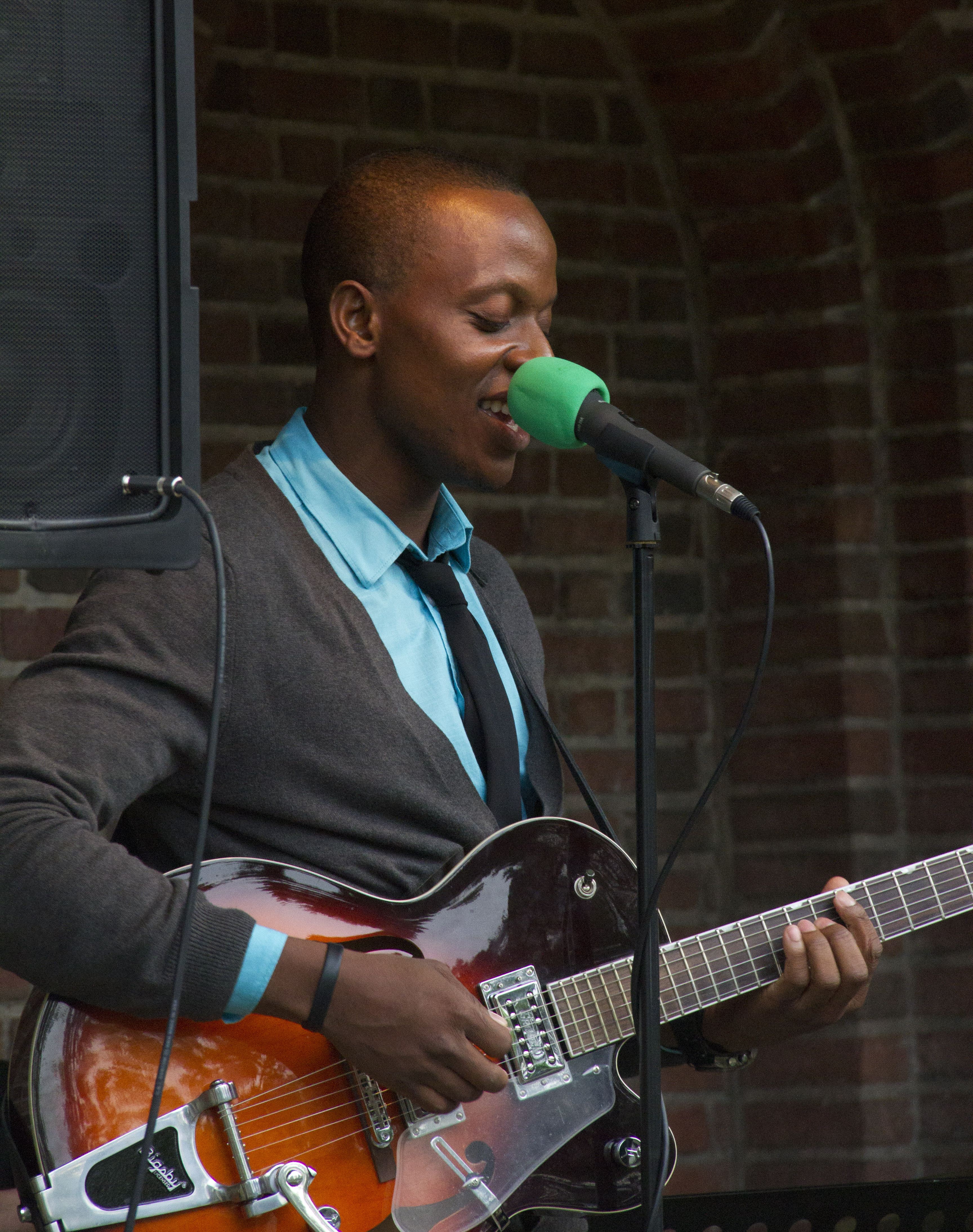
Nelson EmokpaeUMBC alumnus Nelson Emokpae ’03, psychology, will make his television debut tonight on NBC’s singing competition “The Voice.” Emokpae immigrated to the U.S. as a political refugee from Nigeria and received his B.A. from UMBC before picking up a guitar for the first time while in graduate school. He decided to pursue a full-time music career as Nelly’s Echo just last year, and has been touring at college campuses around the country.

In a recent interview, the Baltimore-based Emokpae remarked, “I love touring. I love meeting different people. I love seeing different locations, trying out different cultures. Because even in America, the variety of cultures within one country is so vast, and being able to travel from California to Maine to Seattle to Florida and every [place] in between affords me that opportunity to meet a lot of people and amass a lot of great experiences.”

To watch Emokpae’s audition on “The Voice,” tune into NBC at 8:00 p.m. EST on September 11th and 12th (Note: his exact air date has not been announced and it could be either day), and check out this video performance of the song “If I Were the King.”

This article originally appeared on UMBC Insights.

The Beats Go On

At his San Francisco museum, UMBC alumnus Jerry Cimino ’76 makes sure the world is still hep to one of America’s greatest literary movements.

By Jenny O’Grady
Photos by Mirissa Neff and Brittany Powell

The Beat Generation was a uniquely American movement – producing pockets of poetry and art across the land. You could find them in 1950s New York City in their early days clustered around Columbia University – or down in the cafes and jazz clubs of Greenwich Village. Some of them found refuge at Black Mountain College in North Carolina. And they drank and declaimed in juke joints across the Midwest and the Southwest.

That restless urge to explore great spaces is at the heart of Beat verse and prose. But if you had to pick an epicenter of the movement, you’d likely choose San Francisco’s North Beach – and specifically the crossroads of Broadway and Columbus Avenue.

That’s where you’ll find one of America’s great literary meccas: the checkerboard-floored City Lights Books, which was founded by poet/ publisher Lawrence Ferlinghetti in 1953. Right next to it is the Vesuvio Café, a popular watering hole of poets like Allen Ginsberg and Jack Kerouac. And just up the street, at 1562 Grant Avenue, young writers spent hours smoking dope on a crooked stairwell called “Poet’s Corner” – and then headed to the press next door to check galleys of the latest chapbook.

North Beach is also where you’ll find Jerry Cimino ’76, history. From the book-lined open air porch of the Beat Museum, which he founded in 2003 at 540 Broadway to pay homage to a generation of writers and artists who continue to inspire him, he takes in the rich history of this historic section of the city. He savors it. And he can’t help but share it with anyone who will listen.

“What we like to say is: ‘Welcome to the center of the universe,’” enthuses Cimino, with the flair of a modern day P.T. Barnum. “Because you’re at Broadway and Columbus right now – and everything that happened with the Beat Generation happened right here at this intersection.”

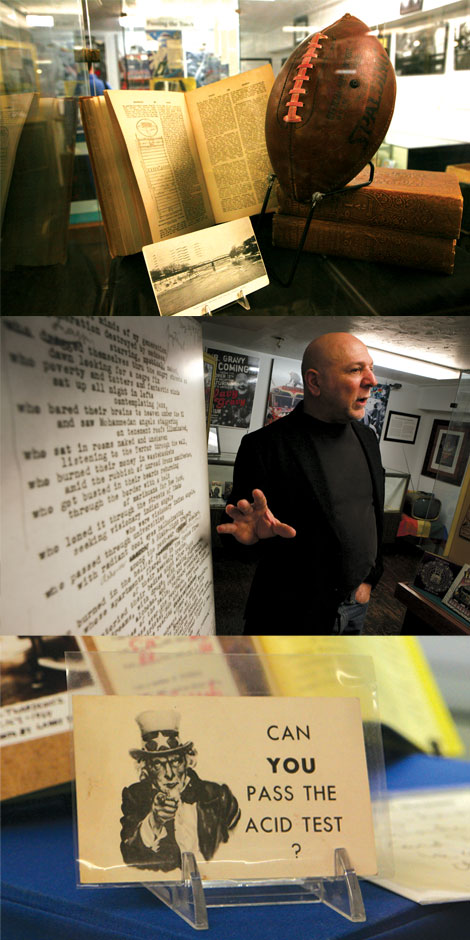
The museum’s walls reflect this, exploding with colorful posters, books, author photographs, drawings and videos covering every surface. One wall is devoted completely to editions of Kerouac’s On the Road from around the world. Another shows an early version of Ginsberg’s “Howl,” complete with scrawling edits by the author – enough to make even the biggest bookworm giddy.

More than 60 years after the Beats’ heyday, the culture has found a true evangelist in Cimino, a determined man driven by respect for the inclusive, nonconformist ideals the Beat authors represented. With a little elbow grease – and some recent attention from Hollywood – he’s on the road to making a lasting tribute to his heroes.

“IT KNOCKED ME OUT”

Beat Museum

Cimino grew up in the suburbs of Baltimore, the son of a WWII vet-turned-postal clerk. His first encounter with the music and movement of the Beat writers came when a teacher read poems from Lawrence Ferlinghetti’s classic collection A Coney Island of the Mind to his eighth-grade class.

“That whole book of poetry literally changed my life…it knocked me out,” says Cimino, who to this day can recite the book’s fifth poem, “Sometimes During Eternity,” from memory.

“You know, 1968 is when it all happened,” Cimino recalls. “Bobby Kennedy was shot and killed. Martin Luther King was shot and killed. The Vietnam War was raging, and all of us kids were looking at each other and saying, ‘What in the hell are we inheriting?’”

When Cimino arrived at UMBC in 1972, he was among the few students actually living on campus at the time, splitting time between what were then called “Dorms 1, 2, and 3.” He says that many of the bonds that he formed in that era at UMBC – including friendships with older students freshly scarred from serving in Vietnam, and with closeted gays who trusted him with their secret – would forever change his own way of thinking. He also enjoyed some time on stage with the theatre club, sharing the bill (but, sadly, never the stage) with one-time UMBC student Kathleen Turner in a 1975 campus production of Antigone.

“For the first time in my life, I was interacting with a lot of people who weren’t like me,” says Cimino. “And that’s what the Beats were all about – coming together and really celebrating your differences… they were about tolerance and compassion and having the courage to live the most authentic life you can.”

Jonathan M. Cooperman, who roomed with Cimino at UMBC before finishing a degree in physical therapy at the University of Maryland, Baltimore, recalls a thoughtful, passionate friend who also had more hair back then.

“He is very much the same guy to me now as he was then,” says Cooperman, who is now a member of the Beat Museum’s board. “If you walked into his room at three in the morning, the door would be cracked open with light pouring out into the hall. If you walked inside, Jer would be sipping tea and reading a book – usually Kerouac.”

Although he loved history and other subjects he’d studied at UMBC, Cimino graduated without a clear career path to follow. So he went with the flow in which he found himself, relocating to California and forging a successful career in sales for both IBM and American Express.

VOICES THAT SPAN GENERATIONS

Beat Museum

Over the years, however, Cimino and his wife, Estelle, started craving something more than a career in business. His continuing affection for the Beat literature he had read as a young man led him to befriend John Cassady – the son of Kerouac’s friend Neal Cassady, who is immortalized in the character of “Dean Moriarty” in On the Road.

Cimino also began building a collection of Beat generation memorabilia which eventually became “The Beat Museum on Wheels” in 2003. And just as Dean Moriarty took off across the country with Sal Paradise (the character representing Kerouac himself in On the Road), Cimino and Cassady drove “the mighty beatmobile” across America’s highways in October 2005 – even parking it overnight in Commons Circle at UMBC.

Cimino says he reveled in the chance to share his growing collection with UMBC students and see his old campus. And faculty members were happy to have a bit of the Beats in Catonsville.

“The students enjoyed visiting the museum on wheels, with all kinds of interesting, hard-to-get publications and memorabilia, and just hanging out with Jerry and John,” says UMBC associate professor of English Piotr Gwiazda, who helped organize the appearance.

The Beats cast a spell over today’s students now just as much as ever, Gwiazda says.

“Whenever I teach ‘Howl,’ students respond with interest,” he says. “There still seems to be something magnetic about the work of Beat Generation writers: the idea of community it embodied, its counter-cultural aspects, its philosophical dimensions, and of course its sheer verbal power and vitality.”

STAR POWER

Of course, interest in the Beats has never been limited to college students reading in circles on the grass. A new Hollywood treatment of Kerouac’s On the Road – which features Kristen Stewart of Twilight fame and Viggo Mortensen from the Lord of the Rings films – is traveling the festival circuit now and scheduled for general release later this year.

Cimino couldn’t be happier about what the new film means for the legacy of the Beats – and for the future of his own museum.

“It’s just great, have you seen it?” he says, cueing up the movie trailer on a screen above the museum’s entrance. Since filming began in 2010 under director Walter Salles, Cimino says members of the film’s cast have visited the museum and asked questions about their characters.

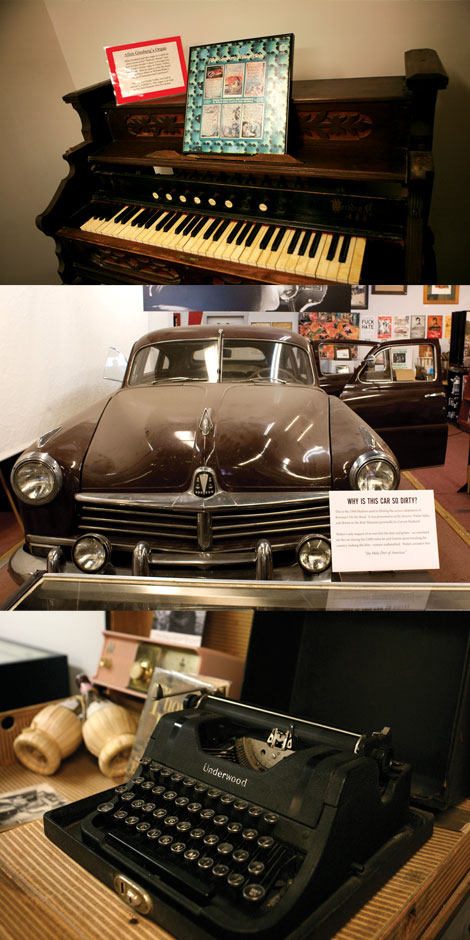
The cast and crew even dropped off a surprise prop from the film at the museum. Just to the right of the museum’s check-in desk sits a dusty maroon 1949 Hudson Hornet used during filming and driven to its resting spot in North Beach by none other than the movie’s star Garrett Hedlund (“a really delightful young man,” says Cimino), who portrays the ever-restless Dean Moriarty.

Beside it stands a sign: “Walter’s only request of us was that the dust and grime – accumulated on the car during the 5,000 miles he and Garrett spent traveling the country making the film – remain undisturbed. Walter considers this ‘the Holy Dirt of America.’”

“You know, every fingerprint has a story,” says Cimino. “It’s important to keep that history intact.”

That’s a major part of Cimino’s job as curator: making the story of the Beats accessible and fun for anyone who might wander in. He loves every second of his evangelism for the movement and its great writers.

“The museum is successful because it represents a significant part of American culture and American literary history,” says Cooperman. “The opening of the movie On the Road demonstrates how this literature is still relevant.

“Of course, the fact that Jerry is probably as knowledgeable of the Beats as any academic doesn’t hurt either,” he adds. “He’ll ultimately be successful because he has a passion for what he does.”

NOW AND LATER

Passion is one thing. But, if you’re wondering how a start-up museum makes it in such difficult economic times, here’s your answer: It ain’t easy.

But the Beat Museum now survives and thrives thanks to Cimino’s magnetic business sense and a lot of hard work.

Just above Cimino’s desk hangs a complicated organizational chart showing a collage of boxes representing duties spanning everything from marketing to merchandising to fixing the guest toilet. One line connects them all.

“And every one of those boxes has my damn name on it,” he jokes. “That’s just how it is.”

The museum’s collection has grown as fans discover it. Cimino admits that “most people who love the Beats don’t have a lot of money,” but as fans of certain writers have discovered his museum, the memorabilia contributions have flowed in steadily. There’s a plaid jacket once worn by Kerouac, and a creaky pipe organ owned by Allen Ginsberg. There’s even an original “Can YOU pass the acid test?” card from the days when Neal Cassady drove Ken Kesey and the Merry Pranksters across the country in a psychedelic bus – a trip immortalized by author Tom Wolfe in his 1968 book, The Electric Kool-Aid Acid Test. (There’s also a film version of that book in works, to be directed by Gus Van Sant.)

Over the years, Cimino also found mentors to advise him as his plans for the museum have grown. He singles out the late Kim Greer, who was president of the National Steinbeck Center in Salinas, California, until his death in 2006.

“I have people come in every day telling me what I should be doing,” he says. “But I only take advice from people who have successfully done what they’re telling me I ought to do. It’s easy to guess…but that’s not going to get you anywhere.”

Right now, the Beat Museum is just as Cimino would like it to be: full, eclectic, engaging. Not too smooth, or too uniform: that wouldn’t fit well with the artists that it celebrates. Mismatched shelves offer hand-assembled chapbooks by local poets. A claw-footed bathtub filled with dime store novels invites visitors to try something new. There’s a definite flavor to the place – a sort of San Francisco sourdough bite.

Cimino would enjoy having someone else fix the toilet from time to time. More important, however, is growing the Beat Museum so that it can stand strong for generations to come. That’s his next step.

“I started this place the only way I know how. I built it from nothing,” he says. “Now we’ve built a track record, we’ve made it succeed with the blood and sweat of a lot of people. If this thing’s going to outlive me…I’m going to have to think big.”