All posts by: Magazine Editor


Search Engineers

British writer and scientist Arthur C. Clarke once wrote that “any sufficiently advanced technology is indistinguishable from magic.”

And for many of us, that’s exactly how the beeps and pings and connecting dings that keep our schedules, steer our cars to the right destination, and even maintain our bonds with family and friends over great distances seem to work. Like magic.

But to the humans behind the technologies – including Silicon Valley-based UMBC alumni at Apple and Google – it’s anything but abracadabra. It’s a combination of hard work, entrepreneurial drive and visionary imagination at its geekish best.

Let’s meet some of the minds behind the magic of our technologies.

by Jenny O’Grady
Photos by Gabriela Hasbun

Stroll down the yellow brick walkway that leads to Building 43, and a trio of girls on colorful bikes rides by, dinging their handlebar bells and singing “Hello!”

Take a right, and you’re in a garden of busts that depict everyone from Lloyd Bridges to Jacques Cousteau. Beyond that, a T-Rex skeleton feasts on helpless plastic pink flamingos. There’s a delicious savory breeze – does it come from one of the free cafeterias or the employee-run herb garden? – and a burst of laughter from a group of young engineers playing beach volleyball nearby.

Oh, right: and today’s free haircut day. That’s life in the Googleplex for you.

Google’s headquarters in Mountain View, California, is often depicted as a Willy Wonka’s Chocolate Factory of high-tech geekdom. It’s frequently listed on Top 10 lists of amazing workplaces. But what’s it really like to work at a company with a product so popular that it’s become a verb?

“It is very good to foster a culture where people are engaged, want to be at work, and that allows you to concentrate your time on what you’re trying to do in the day,” says Jeffrey Burgan ’83, computer science, director of network engineering for Google Access, which delivers high speed internet. “People work very hard here, so if the place can take the burden off in other areas – like get an oil change or a haircut, or to have washers and driers so people can do their laundry – it definitely helps.”

Google is known as much for the sheer difficulty of its confounding job interviews as it is for the replica of SpaceShipOne in its lobby. The secret to the company’s success seems to lie in its careful balance of work and play, and other UMBC alumni at Google agree that its unique culture pushes them to be more creative and constructive.

Jeetendra M. Soneja M.S. ’04, computer science, is the tech lead for Google Analytics API. He works in an outlying office, but finds the company culture persists across Google’s many campuses.

“One thing that is common across all the Google offices all over the world is the friendly and helpful nature of the fellow Googlers,” he says. “This leads to a very healthy working environment and is one of the best things why I love working here. The work environment is also fun and relaxing, and yet focused and one that promotes and rewards innovation.”

Robert Banz ’95, computer science, has worked as a site reliability engineer at Google for four years. (“We make sure Google is ‘always on,’” he says.) Before that, he worked at UMBC, which gives him a bit of special perspective about what’s extra cool about working at the Mountain View campus.

“Everyone says it’s the free food options, so I’ll go with something else. I’d say I was surprised how much it felt like a university campus,” he said.

Banz also believes the atmosphere of Silicon Valley is a significant influence on the famed Google culture. “Silicon Valley and San Francisco, but really the entire Bay Area, has this amazing critical mass of passionate creative, scientific, and engineering talent,” he says. “These groups mix socially; mutual curiosity leads to unique ideas. I think that’s the secret to the creative engine, and the source of very engaging and entertaining conversation.”

Sandor Dornbush M.S. ’06, computer science, sometimes runs to work with his black lab, Coltrane. Other times, he takes the free Google shuttle. Today, he wheels his bike into a meeting room playfully covered in a soft padded material. Photos of the Burning Man festival hang nearby.

“Despite all the games, and the food and everything, I honestly don’t think I’ve played a single game of pool in my six years here,” says Dornbush, an engineer for Google Play, who knows his work ultimately comes first.

“People talk about the Google 15 (because of the free food), but I’ve actually found the opposite,” Dornbush says. “For the first time, many people have access to really good food, and they have access to the gym, and they see people around them taking care of themselves, and they start to drop pounds. So despite the fact that there’s all this free stuff, people work really hard. And it’s a culture that encourages that.”

A SIRI-ous Mind

British writer and scientist Arthur C. Clarke once wrote that “any sufficiently advanced technology is indistinguishable from magic.”

And for many of us, that’s exactly how the beeps and pings and connecting dings that keep our schedules, steer our cars to the right destination, and even maintain our bonds with family and friends over great distances seem to work. Like magic.

But to the humans behind the technologies – including Silicon Valley-based UMBC alumni at Apple and Google – it’s anything but abracadabra. It’s a combination of hard work, entrepreneurial drive and visionary imagination at its geekish best.

Let’s meet some of the minds behind the magic of our technologies.

by Jenny O’Grady

Photos by Timothy Archibald. Illustrations by Meredith Nelson.

* * * *

Siri-ous Mind
Just about anything can inspire an idea. It’s up to engineers like Chen to bring them to life.

How a UMBC alumnus found more than (voice) recognition for his work on the iPhone’s enigmatic Siri technology.

Sometimes, Harry Chen needs to get away. Far away.

When he’s surrounded by the sands of Death Valley, California, even the GPS can’t find him. He can’t check his email, or video chat with his parents in Hong Kong, or stream music from his favorite Pandora station. And he likes that solitude.

“Sometimes you’ve got to go to the desert,” says Chen, a UMBC computer science alumnus (B.A. ’98, M.S. ’00, Ph.D. ’04) who helped develop Siri, the voiceresponsive “personal assistant” found inside the latest Apple iPhones.

“You stay out there, and when you come back, you see such a big contrast of civilization,” he continues. “And it makes you appreciate life a lot more. Everything we created – one way or another – is kind of superficial, but also kind of essential.”

In a world where computing has left the desktop and lives in the clouds, Chen is a bit of a tech superstar. The work that he and his colleagues have done makes it easy for everyone from tweeners to grandfolks to whisper wishes into the palms of their hands to find the closest pizza, send an email or solve a math problem.

Reflecting on his short-yet-impressive career, the energetic 35-year-old software engineer is quick to note the importance of the nearly ten years he spent at UMBC. He says that the people and the environment of discovery at the university helped shaped him into the kind of thinker capable of seeing models and years ahead to the next cool thing.

Building The Basics

Like many blossoming tech geeks in the early 1990s, Chen first contemplated the inner workings of computers as a teenager, sitting at home in Hong Kong, his thumbs occupied by the bright red buttons of that era’s ubiquitous Nintendo controller.

“While I was playing, I’d get so curious. How did all those characters come about? I started thinking about how some games would make very predictable moves, and why some are not predictable at all,” he says. “Later on, my dad bought me a computer…and the games on that were sort of like the ones with a snake going in different directions. It made me very interested in understanding more about computer instructions.”

When Chen left home for Towson University in 1994, the world of web-based computing was just beginning to blossom. At the urging of his parents, he began a course of study in pharmacy, but a job opening at the campus library allowed Chen to help customers with computers. He started building simple websites with his friends. After taking a few classes, Chen discovered he had an aptitude for programming.

Suddenly, the future – including a transfer to UMBC – seemed obvious to him. It didn’t take Chen long to make himself at home in the university’s computer science department, where he turned artificial intelligence algorithms into Java code for computer science research projects, won highly-sought internships at Hewlett-Packard, and generally wowed his peers.

“One thing we always liked so much about Harry is that he liked to charge into things,” says Dr. Tim Finin, a professor of computer science and electrical engineering who specializes in artificial intelligence and who served as Chen’s Ph.D. advisor. “He was not afraid to just drop in and start working on something.”

At the time, many of UMBC’s computer science researchers focused on pervasive computing – which aims to unobtrusively connect and share data between the many devices in our lives. Chen took to it like a teen to texting, and reveled in collaborating with fellow students to test new ideas.

“Harry was, and probably still is, very good at that level. He could very effortlessly turn ideas into working prototypes,” says Finin. “It’s a really significant skill to be able to have an idea and then very quickly test it out…to be able to implement enough of it to get some feedback to know whether it’s a brilliant idea, whether it’s something that will pan out.”

The Smartest Room in the Building

Smart roomMany computer science students at UMBC take jobs right after they finish undergraduate studies. But an iffy job market in the late 1990s and then the dot.com bubble’s burst a few years later kept Chen in school.

Chen’s decision to wait to test the market turned out to be a good one. He used that time to develop a concept that helped shape his future research.

Imagine a room that answers your questions, or anticipates your needs and then fulfills them. Chen imagined that room – and then figured out how it might be brought to life.

“The graduate student’s life is really about exploration and to be free to identify your interests,” he says. “It’s almost like an accident when you find something you really like to work on and you just know it.”

Chen had spent some time interning at the Hewlett-Packard Labs, which were – at the time – at the forefront of mobile computing research and development. So when Chen returned to UMBC, he figured out what he wanted to design: a conference room broker. This system would retrieve and translate data from the devices within the room itself to solve problems for occupants while also considering user-privacy issues.

“So you walk into a meeting room,” Chen explains, “and the room understands how many people are in that room, what those people do…so the room says, ‘Oh, there’s a projector,’ and the projector would say, ‘I want to show a PowerPoint presentation. I can do that.’”

The smart room would also locate the presentation on Chen’s phone, download it, and show it – after automatically darkening the room. It might know that one of the meeting attendees wants a copy of the PowerPoint, and then simply download it to their phone. The room might even detect that an attendee’s hotel room is several miles away – and offer to call them a taxi.

“The idea is that people will use technology without thinking about it, which is just like you pick up chopsticks or a utensil and you just use it, you don’t think about it,” he says. “So that’s an idea, to try to encourage people to build technology for everyday people, to solve everyday problems.”

Imagining this room would help Chen shape his later work.

Taking Chances – and Detours

Following graduation from UMBC, both Chen and his wife Gigi Yim, who earned a bachelor’s and a master’s degree in information systems from UMBC in 2004 and 2007, pursued jobs in the Baltimore area. They even bought a house.

But the lure of Silicon Valley – and the fast-paced, creative life it offered – called to Chen.

“At one point, I thought: life is too short. I woke up one morning and I wrote my wife an essay and I said these are the reasons why we should just move to the West Coast,” he says, smiling. “Kind of like writing a paper: these are my reasons. I sent the email in the morning, and in the evening, I come home, and she says, ‘OK. Let’s do it.’”

Within days, they were looking for new jobs and making plans to move west. Yim took a job at Netflix, and Chen wound up at a vaguely-named startup working on a secret project involving voice recognition. (This startup – Siri – would later be bought by Apple.)

Right away, Chen felt confident they had made the right choice.“There’s a mentality here among a lot of people…a sort of hunger drive to make something” in Silicon Valley. “I always feel like you capture people’s smartness in thin air here,” he adds. “Somehow, you just breathe in people’s knowledge.”

“Harry, from day one, was pretty clear. Silicon Valley was where he wanted to end up,” says Dr. Anupam Joshi, a professor of computer science and another of Chen’s graduate school advisors. He observes that some students simply crave the risk and reward of the Silicon Valley environment.

“Some of it could be – for all we know – genetic hard wiring,” Joshi says. “That is why some people become race car drivers and others, like me, drive five miles below the posted speed limit.”

Valley Life: 101

Drive down Route 101 from San Francisco, and you see signs of our burgeoning tech civilization everywhere.

Billboards touting the latest cloud software. Silver-sided buildings in seemingly endless business parks that are home to startup upon startup. Even the street names themselves – like Apple’s famous Infinite Loop, or the punningly named Disk Drive in San Jose – conjure images of innovation and dreams.

Strolling around the manicured Apple campus in Cupertino, California, Chen speaks quickly. Excitedly. He says Silicon Valley is a place where ideas can be imagined without fear, where innovation is rewarded.

“People here have a passion for technology and innovation,” he says. “They want to change the world. They take risks. Most of the time they fail, but sometimes they succeed. So they step out, dream up some crazy idea and say ‘If I fail, fine. I’ll dream another one.’”

Even so, Chen acknowledges that nothing happens overnight. If you think about the gadgets that have occupied your pockets over the last 10 years, the technology required to power them crawled more than it leapt. The palm-held organizers of the mid-’90s, for example, were little more than tiny personal computers; today’s equivalent relies on web networking and interaction with other devices. Who knows what tomorrow’s devices will look like?

“Especially in the [artificial intelligence] research field, you can’t just jump to the dream right away,” Chen says. “You kind of have to think about yourself climbing a mountain. You have to do the work to get up there…you can’t just shoot straight up because that’s impossible. And once in a while you will have to make a detour, and because certain technology or culture has changed, you have to adapt to that.”

Back at UMBC, Joshi acknowledges that Chen’s metaphor is rooted in the reality of how creativity works. “That’s part of the fascination of this field, I think, going back to the creative process,” he says. “So much is yet not done. So much power is available through the computational process…we just have to channel it. We’ve barely scratched the surface.”

For Chen, it’s often enough just to see these products in use by the people he loves. When he was an undergraduate student, he communicated with his parents in Hong Kong by hand-written letter; today, he uses FaceTime to video chat with them whenever he wants.

Chen isn’t able to discuss what he’s working on now at Apple – a company known for keeping a tight leash on its ideas and products until they are introduced. But when you ask Siri a question on your new iPhone and get an answer, consider yourself at the doorway of Chen’s smart room, engaging with his work.

“It feels surreal,” Chen concludes, “because the things I talked about four or five years ago seem like a dream, and today, it doesn’t seem like a dream anymore.”

Read about UMBC alumni working at Google here.

“Uncle Devin” Walker '89, PoliSci, Shares Music with Kids in D.C.

Musician Devin Walker ’89, political science, took his “Uncle Devin” show to the U.S. Capitol this summer, sharing educational music with children and parents alike.
Walker, who plays the drums, calls the show “a live, interactive musical experience for children five and over by renowned drummer Devin Walker. The show cultivates the minds of children through percussion instruments and is a dynamic cross between Fat Albert and Schoolhouse Rock.”
View photos from the show here.  Read more about the show here.
Walker and his jazz band, A Sense of Urgency, will be one of three alumni-driven bands playing at this year’s Homecoming Crab Feast on Saturday, October 13. (The others are: Fiddlin’ Around, an Irish folk band featuring UMBC’s own staff and faculty members Terry Aylsworth, Eric Ebersole, and William Farrell, and alums David Aylsworth ’74, Tara Ebersole ’08 and Sara Moreland ’97; and Black Falls, a blues and classic rock band featuring alumnus Philip Medenbach, Jr. ’87.)
For more information about the event, visit the Homecoming website here.

“Uncle Devin” Walker ’89, PoliSci, Shares Music with Kids in D.C.

Musician Devin Walker ’89, political science, took his “Uncle Devin” show to the U.S. Capitol this summer, sharing educational music with children and parents alike.

Walker, who plays the drums, calls the show “a live, interactive musical experience for children five and over by renowned drummer Devin Walker. The show cultivates the minds of children through percussion instruments and is a dynamic cross between Fat Albert and Schoolhouse Rock.”

View photos from the show here.  Read more about the show here.

Walker and his jazz band, A Sense of Urgency, will be one of three alumni-driven bands playing at this year’s Homecoming Crab Feast on Saturday, October 13. (The others are: Fiddlin’ Around, an Irish folk band featuring UMBC’s own staff and faculty members Terry Aylsworth, Eric Ebersole, and William Farrell, and alums David Aylsworth ’74, Tara Ebersole ’08 and Sara Moreland ’97; and Black Falls, a blues and classic rock band featuring alumnus Philip Medenbach, Jr. ’87.)

For more information about the event, visit the Homecoming website here.

With BreakingGround, Philanthropy Takes on Infinite Forms

Philanthropy is an extremely personal act. We all give in different ways, and for very different reasons.

Many of us give back by writing a check to a favorite program, providing an immediate (and, often, necessary) infusion of funds. Some of us also volunteer time to the organizations that mean the most to us. And, many times, we give as members of groups — interactions that bind and strengthen our communities.

It is in this spirit that UMBC has launched BreakingGround, “a campus-wide initiative to embed opportunities for civic learning and collaborative problem-solving even more broadly and deeply in our curriculum and co-curricular activities.” Already, stories of new partnerships and programs designed to make UMBC — and, ultimately, the world — a better place are streaming onto the BreakingGround site.

For students learning how best to shape their world, BreakingGround is terrific way to inspire good work, and to frame and measure successes. It is also an excellent showcase of the many ways we, as members of the UMBC community, can put the philosophy of philanthropy to work in ways both fun and fulfilling.

In an op-ed published in this week’s Baltimore Sun, co-authors SGA president Kaylesh Ramu and David Hoffman, assistant director of student life for civic agency at UMBC, share a vision of civic engagement that invites students — and the community surrounding them — to think creatively about how they can improve UMBC, and beyond:

UMBC has received so much attention because our culture and practices make creativity, innovation, appreciation for diverse perspectives and talents, and public impact central to our identity. We take pride in our scrappy, can-do spirit, celebrating entrepreneurs, boundary-busters and problem-solvers in every field.

We look forward to seeing how UMBC’s students, faculty, staff and alumni use BreakingGround as a springboard for community-based philanthropy, and we will share the most interesting stories from these efforts throughout the year.

Messner '01 and Moore '07 in Everyman Theatre's Time Stands Still


When war strikes in a distant nation, the only way that many Americans experience it is through the lens of the journalists and photographers who risk life and limb to get the shots that capture war’s horrors and tragedies. But what is the personal cost for those who show such courage?
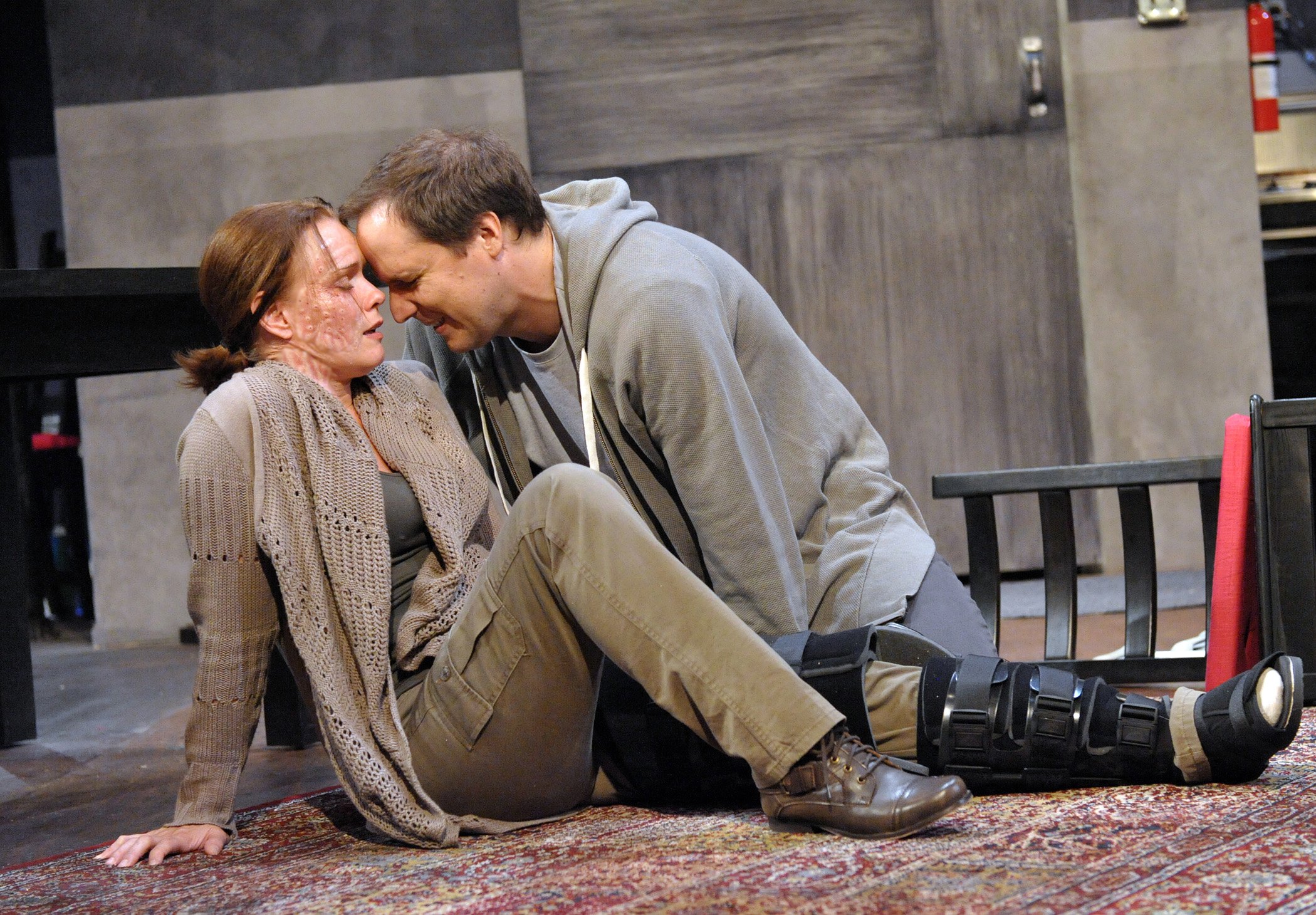
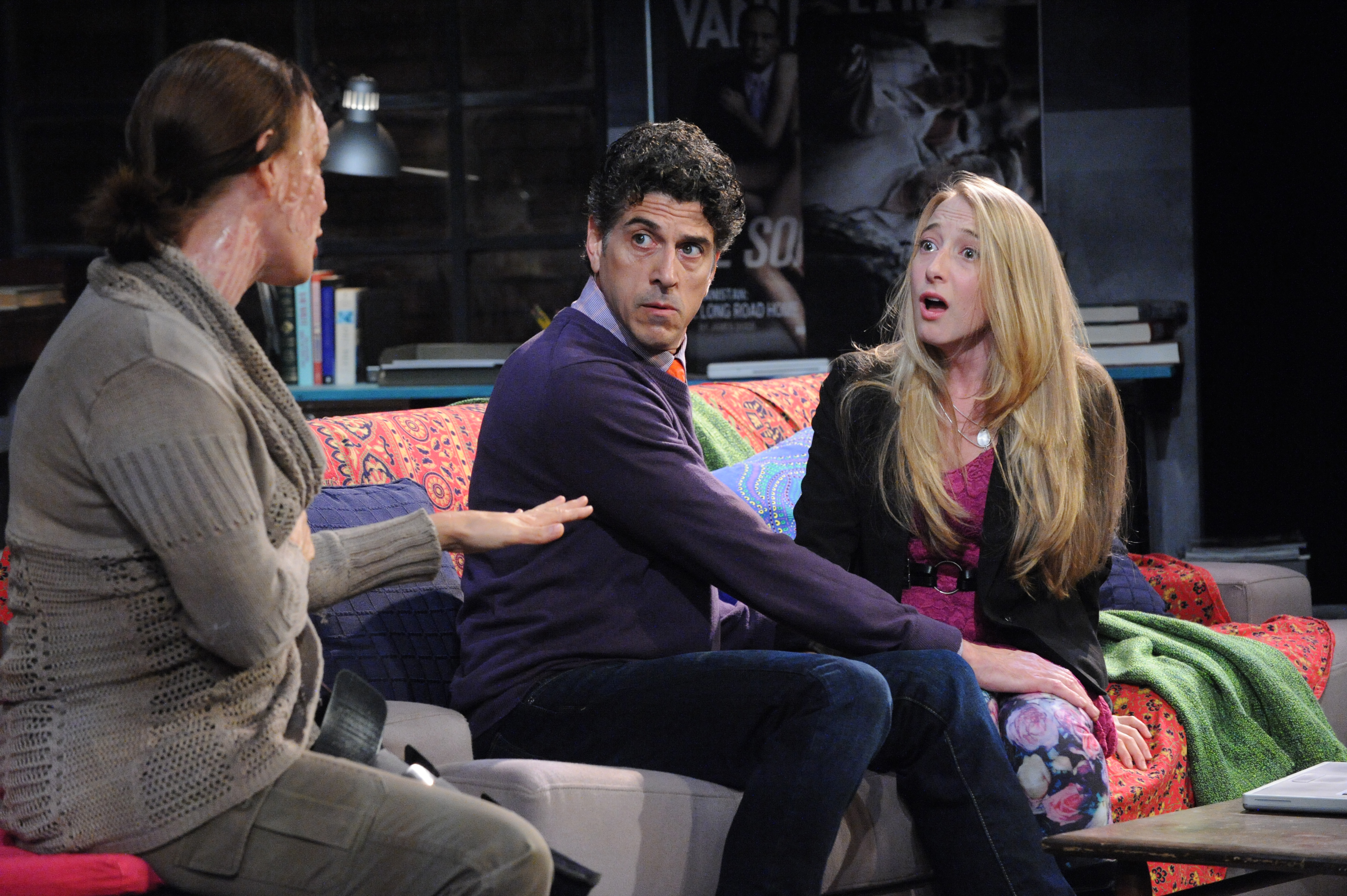
Assessing that human cost to the chroniclers of war is the essence of Donald Maguiles’ play Time Stands Still, which opened last week at Baltimore’s Everyman Theatre with UMBC alumni Eric Messner ’01, acting,  and Mandy Moore ’07, acting, among its ensemble.
“When I was at UMBC I used to go and see shows at Everyman Theatre,” Messner recalls, “then for a time after graduating, I lived five blocks away from the theatre. It’s a place where I’ve always wanted to work, and now I’m getting that chance….  I’m so proud that I get to open the final season in their Charles Street space, the same space that I would go to see their plays when I was at school.”
Moore observes that “there are some very big fascinating questions being asked in our production.  I feel lucky to play such fun, joyful role in the discussion.  It’s that sharp kind of theatre where you are asked questions and not told what to think.”
“It’s a really great play,” Messner concurs. “There’s just so much going on emotionally and Donald Margulies has such a wonderful gift for writing dialogue.”
Time Stands Still runs at Everyman Theatre through Sunday, October 7. For more information and tickets, go to  http://everymantheatre.org/.

Messner ’01 and Moore ’07 in Everyman Theatre’s Time Stands Still

When war strikes in a distant nation, the only way that many Americans experience it is through the lens of the journalists and photographers who risk life and limb to get the shots that capture war’s horrors and tragedies. But what is the personal cost for those who show such courage?

Assessing that human cost to the chroniclers of war is the essence of Donald Maguiles’ play Time Stands Still, which opened last week at Baltimore’s Everyman Theatre with UMBC alumni Eric Messner ’01, acting,  and Mandy Moore ’07, acting, among its ensemble.

“When I was at UMBC I used to go and see shows at Everyman Theatre,” Messner recalls, “then for a time after graduating, I lived five blocks away from the theatre. It’s a place where I’ve always wanted to work, and now I’m getting that chance….  I’m so proud that I get to open the final season in their Charles Street space, the same space that I would go to see their plays when I was at school.”

Moore observes that “there are some very big fascinating questions being asked in our production.  I feel lucky to play such fun, joyful role in the discussion.  It’s that sharp kind of theatre where you are asked questions and not told what to think.”

“It’s a really great play,” Messner concurs. “There’s just so much going on emotionally and Donald Margulies has such a wonderful gift for writing dialogue.”

Time Stands Still runs at Everyman Theatre through Sunday, October 7. For more information and tickets, go to  http://everymantheatre.org/.

Case ’11 and Student Blog from Democratic National Convention

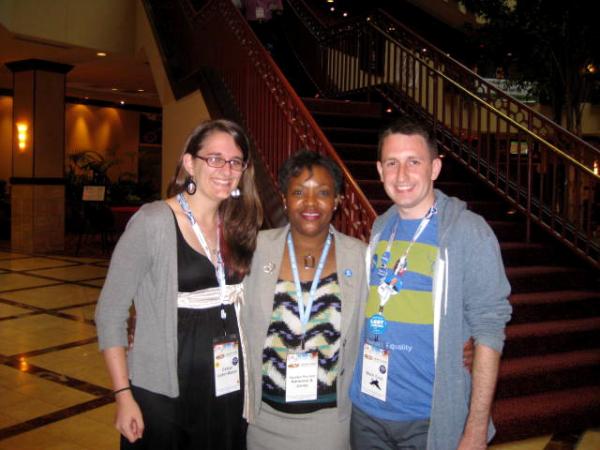
Mitch Case ’11, media & communication studies, and current UMBC junior Caitlyn Leiter-Mason, a Sondheim Public Affairs Scholar majoring in Gender & Women’s Studies and Political Science, are blogging about their experiences as delegates to the Democratic National Convention this week in Charlotte, NC.

Their shared blog, A Tale of Two Delegates, follows their adventures as delegates for President Obama representing Maryland’s 6th and 7th districts (Leiter-Mason and Case, respectively).

Leiter-Mason is the current president of UMBC College Democrats, and Case served as president when he attended UMBC.

Read more at UMBC’s BreakingGround site. BreakingGround is at the forefront of a vibrant, new movement toward increased campus and community engagement—a movement that is now gaining ground nationally. In early 2012, two widely heralded reports called on higher education to play a central role in renewing American democracy and preparing citizens to tackle the challenges of our age.

Case '11 and Student Blog from Democratic National Convention


Mitch Case ’11, media & communication studies, and current UMBC junior Caitlyn Leiter-Mason, a Sondheim Public Affairs Scholar majoring in Gender & Women’s Studies and Political Science, are blogging about their experiences as delegates to the Democratic National Convention this week in Charlotte, NC.
Their shared blog, A Tale of Two Delegates, follows their adventures as delegates for President Obama representing Maryland’s 6th and 7th districts (Leiter-Mason and Case, respectively).
Leiter-Mason is the current president of UMBC College Democrats, and Case served as president when he attended UMBC.
Read more at UMBC’s BreakingGround site. BreakingGround is at the forefront of a vibrant, new movement toward increased campus and community engagement—a movement that is now gaining ground nationally. In early 2012, two widely heralded reports called on higher education to play a central role in renewing American democracy and preparing citizens to tackle the challenges of our age.

Four Lax Alumni Compete in MLL Championship at Harvard

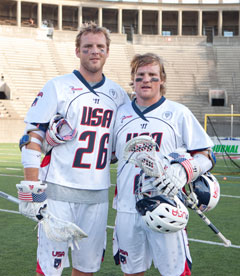
Four UMBC alums competed in Major League Lacrosse’s Championship Weekend, held at Harvard University Stadium in Boston, Mass.

Attackman Drew Westervelt ’09, economics, is a member of the 2012 champion Chesapeake Bayhawks, while Brendan Mundorf ’06, sociology, Peet Poillon ’10, INDS, and Terry Kimener ’09, American studies, competed for the runner-up Denver Outlaws. All four former Retrievers finished the 2012 season ranked in the top-20 in the MLL scoring race.

Westervelt played for the Denver squad in his first five years in the league. A Third Team All-American for UMBC in 2007, the Bel Air, Md. native tied for 20th in the league with 33 points and has 209 points (134-69-209) in his six years in MLL.

Mundorf was named 2012 Bud Light MLL Season Most Valuable Player just prior to the championship weekend. He also was named to his second All-MLL Team (2009, 2012) as the attackman finished second in the league with 59 points (32-27-59). Denver’s all-time leading scorer has 206 goals, 100 assists and 306 total points in seven league seasons.

The Mount St. Joseph graduate earned America East Player of the Year honors and All-America citations in 2005 and 2006. He suffered an ankle injury in practice on Friday, did not play in the semifinal victory over Long Island and scored a goal in limited action on Sunday vs. Denver.

Westervelt and Mundorf both represented the victorious United States squad in the 2010 FIL World Championships.

Poillon scored three goals in the Outlaws’ come-from-behind victory over the Lizards, including the game-tying goal early in the fourth quarter. The sharp-shooting midfielder tied for ninth in scoring in 2012 with 40 points (24-13-40) and surpassed the 100-point plateau (75-32-113) in his fifth MLL season in 2012.

The Cranberry Township, Pa. native was a Second Team All-American for UMBC in 2009.

Kimener just completed his most successful of six MLL campaigns, sparking Denver with 17 goals and 18 assists for 36 total points from his midfield position. The Oakton, Va. native earned three All-America citations at UMBC in 2006, 2007, and 2008.

To learn more about the MLL Championship, click here.

This story was first published on the UMBC Athletics site.

Alumni Welcome Brand-New Retrievers

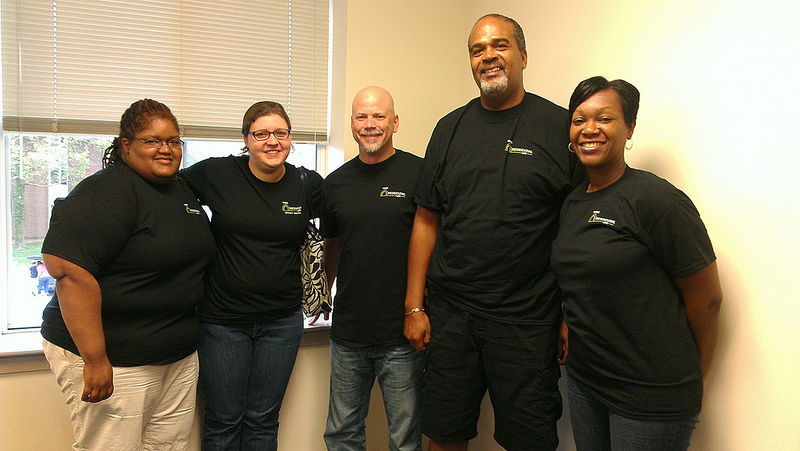
Thank you to the alumni volunteers who helped welcome a new class of Retrievers (and move their stuff!) at UMBC’s Move-In Day, August 25. Pictured below (L-R): Corris Davis ’98 of the Meyerhoff Alumni Chapter; Melissa Evans ’07, president of the Chapter of Young Alumni; Bennett Moe ’88, president of the Alumni Association Board of Directors; Donnie Downey ’85 of the Alumni Association Board of Directors; and Yvette Mozie-Ross ’88 of the Chapter of Black and Latino Alumni.

See more photos from Move-In Day on UMBC’s Alumni Flickr site.

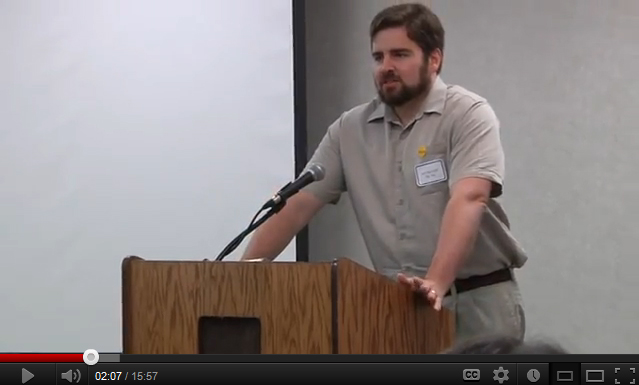
Video: Barczak '03, '06 MS CompSci, Talks Gaming at URCAD

Computer science alumnus Joshua Barczak ’03, M.S. ’06, spoke about his work in the video game industry at this spring’s Undergraduate Research and Creative Achievement Day (URCAD). Barczak, who is a senior graphics engineer at Firaxis Games, helped develop Sid Meier’s Civilization V game.
Watch the full video by clicking the image below.