All posts by: Magazine Editor


A Sweet Success: Reflections on Sweeten Up Your Network 2017

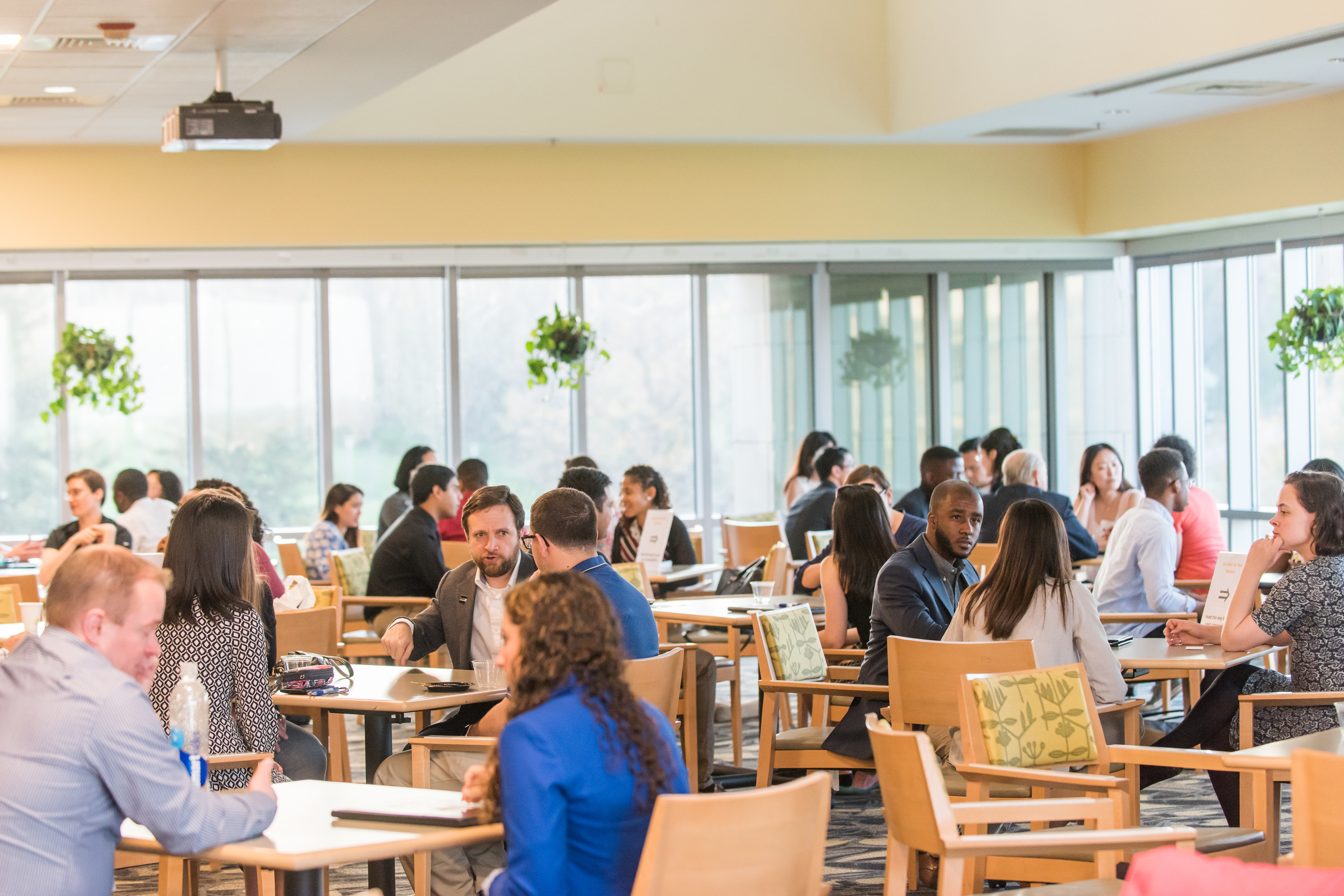
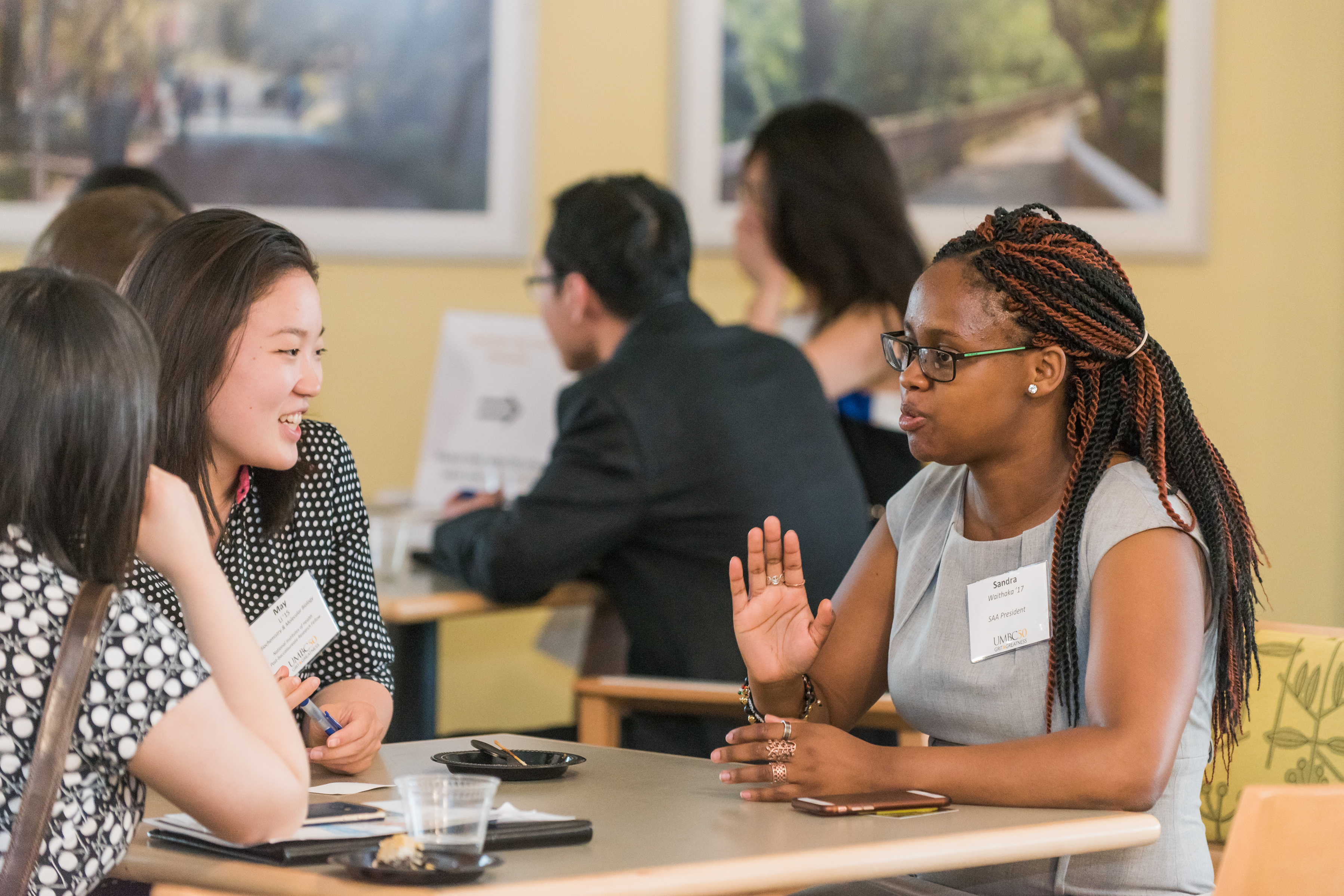
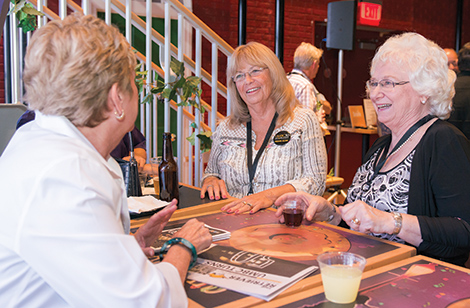
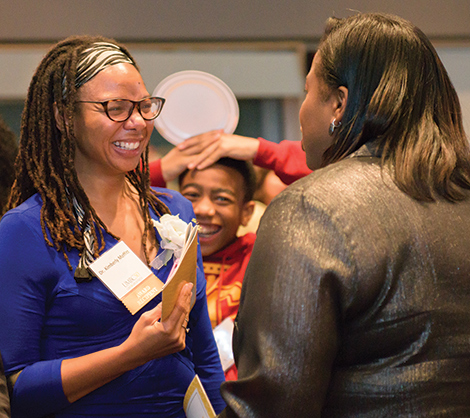
33206351623_3f2bc1eabe_oIn partnership with the Career Center and the Office of Alumni Relations, the UMBC Student Alumni Association (SAA) was proud to host the annual Sweeten Up Your Network event on Tuesday, April 11. As one of Career Month’s staple events, Sweeten Up Your Network is open to students and alumni from all majors and years, and is almost entirely planned and executed by a team of SAA members. Because of their amazing efforts, this year we had just under 30 alumni and over 50 students participate!

As the Assistant Director of Alumni Relations, I have the honor and privilege of supporting both current students and alumni in developing programming that connects them to campus and one another. Sweeten Up Your Network is one of the most special examples of how these types of programs can really impact both sides of the speed networking table. I asked two participants from the evening to share a little more about their experience.

Julia Celtnieks ‘13, Media & Communication Studies

Despite being a relatively recent alumna, as well as a staff member, I’d never made it to Sweeten Up Your Network before this year. Nonetheless, I was intrigued by the opportunity to help students hone their networking skills, as well as offer some of my insights as a young professional. As it turned out, I had as much to learn from this experience as they did!

Most of the students I met and spoke with were going into fields completely different than my own: the sciences, psychology, engineering. At first it was challenging to tailor the conversation to their specific experiences, but then I realized I didn’t have to. There are plenty of ways to make connections, and many things I’ve learned over the course of my post-grad life, like the ins and outs of entry-level job searching, can apply to almost any area. Sweeten Up Your Network is really about getting students used to the idea of networking in general, and I think giving them the chance to talk with alumni in a variety of careers is what makes it so unique…and so perennially popular.

Alida Hartwell ‘19, Bioinformatics and Computational Biology

I have been with SAA since the fall 2016 semester. SAA is full of amazingly motivated and helpful people. They always manage to make our meetings not only productive, but fun as well. All SAA events that I have participated in have felt like that, too. I also love that our events are planned and run by the SAA members.

Specifically relating to this event, I was very excited going into it. Ever since I joined SAA, the upperclassmen have talked up Sweeten Up Your Network. My experience was even better than what I was expecting. There were so many alumni from all different fields. I got the chance to speak with people who are in fields that I am considering going into, which was awesome for me because I got to see how powerful a degree from UMBC can be in the real world. Even talking to people from different degrees and fields was eye-opening. All of the alumni were passionate about UMBC and still love it […] it made me feel very proud to be attending this university. Overall, I think the best thing about Sweeten Up Your Network was the chance to see what it will be like years after graduation, whether that is what careers people with my major have or how much Retriever pride alumni carry with them!

33206351523_5884d6e832_oSo there you have it! If you’re an alum who wants to give back to the UMBC community, explore ways to get involved with UMBC. We’ve always got events and programs going on that could use your support.

Jessica Wyatt, Assistant Director of Alumni Relations

Postcards from True Grit: CAHSS alumni send their well wishes to admitted students

With college admissions season kicking into high gear, we got a few on-campus alumni together last week to send personalized notes to students accepted into the College of Arts, Humanities, and Social Sciences (CAHSS). Retrievers shared their memories and well wishes with accepted students across Maryland and all around the country. 

The project caught on off-campus, as well: all told, we had 61 alumni from a variety of CAHSS majors send out over 1,400 postcards to prospective students. We can’t wait to meet the Class of 2021!

Photo courtesy of Mimi Dietrich ’70.

To learn more about opportunities to get involved as an alum, like us on Facebook, follow us on Twitter, or visit our website!

A Culture of Caring: Student philanthropy takes off with the Stay Black and Gold Fund

Diverse. Innovative. Up-and-coming. Those are just three words often used to describe UMBC’s campus and culture. Another word, one that’s no less a part of who we are, is caring. We care about our students’ success, both academically and in their home lives. With initiatives like the Stay Black and Gold Fund, an emergency fund for students whose financial need stands between them and their studies, we’re creating that culture of caring from the ground up.

Unlike many scholarship and grant programs on campus, the Stay Black and Gold fund is a student-led initiative. A committee of representatives from the Student Government Association (SGA), the Student Alumni Association (SAA), and other groups on campus, with the help of a staff advisor, will review emergency aid applications from their peers and decide how awards are allocated. While the idea has been around for years, it’s finally coming to fruition thanks to the work of dedicated students like Lillianne Keplinger.

The current sophomore and SGA Senator was inspired to take action on the fund last spring, when she was serving as Assistant Director for Leadership Development for SGA. “I’m a student who takes out loans, and I realize that not everyone is…able to,” she says. “ So it’s unfortunate for people that have to leave the institution because they can’t afford school.” The fund will assist students who experience unexpected life crises that affect their ability to pay for current tuition, fees, books, and other school-related expenses.

Along with with fellow SGA Senator Chiamaka Ugboh and SAA Vice President Ariana Nogin, Keplinger has been working with departments across campus to finalize the committee’s membership and secure an advisor. The fund is already accepting contributions from students, alumni, parents, and friends online.

Leanna Powell ’08, English, UMBC’s Assistant Director of Annual Giving, has worked closely with the students throughout the process. “We hope this will…become a way to help students understand the real impact of philanthropy on campus, and help them become leaders in giving,” she says.

Whether you’re on or off campus, by making a gift today, you can help build and sustain UMBC’s culture of caring.

— Julia Celtnieks ’13


Power and Artistry: UMBC’s practice organ, donated by Dr. Charles Nicholas, makes its public debut

If you’ve never heard organ music in person, the first thing that strikes you is the complexity of the sound that comes from within it. At a recent concert showcasing an instrument donated to UMBC by Charles Nicholas, Professor of Computer Science and Electrical Engineering, the organ’s power and artistry was on full display for a standing room-only crowd on February 10.

“I was blown away, for one thing,” said Nicholas, following the recital and historical lecture by Paula Maust, an adjunct professor in the Music Department. Maust played an array of pieces to show the range and history of what’s known as “the king of instruments,” including a piece by Frank Ferko played solely with the feet.

The instrument itself, donated in honor of the professor’s parents, Charles and Barbara Nicholas, sits in a practice studio in the Performing Arts and Humanities Building. As Music Department chair Linda Dusman told the crowd, the nation is facing a shortage of trained organists, so having an instrument on which to practice gives students an immediate leg up for employment, post graduation. (They previously had to seek out local churches for practice.)

In addition to the Ferko piece, Maust’s recital covered both sacred and secular pieces, all designed to show the organ’s versatility of sound. The organ has two keyboards: a board-full of buttons (known as “stops”) to alter the sounds made by the keys, as well as a full range of floor pedals that are played with the feet.

Dusman thanked Nicholas and his wife, telling the audience, “Dr. Nicholas’s generosity is going to make this extraordinary music available for generations of students and the communities that they’re going to serve, so thank you so much.”

Nicholas and his wife, Janice, said they enjoyed the show very much.

“I’ve been a fan of organ music all my life and I have never heard any of these pieces before, and I’m very impressed,” he said. “I’m glad that people are getting use out of this, so I’m just delighted.”

— Jenny O’Grady

Throughout the Ages: Past, present, and future converge at annual Hilltop Society Dinner

UMBC has accumulated a rich history in its first 50 years, rising from a patch of Baltimore County farmland through the social and political turbulence of the mid-20th century to become a university nationally recognized for the quality of its education and its commitment to diversity. This year’s annual Hilltop Society dinner, in addition to being a “thank you” to our donors, carried on that story, as guests dined amid the “UMBC at 50: Sharing the Past, Building the Future” exhibit at the Albin O. Kuhn Library Gallery.

UMBC Archivist Lindsey Loeper ’04, American studies, introduces the exhibit to guests.

The exhibit was curated by Tom Beck and Lindsey Loeper ’04, American studies, with the help of various partners across campus. It features more than 200 items from UMBC’s archives. Official documents, letters, photos, physical artifacts, and a continuous video loop all help to tell the story of UMBC, from long before the ground was broken until today. (It’s open to the public through December 15, but if you can’t make it to campus, it lives online as well.)

Bentley Corbett-Wilson ’17, music, one of the evening’s two student speakers, addresses the crowd.

With such a storied past behind us, it’s only fitting that the two students who spoke at the event be excellent examples of UMBC’s present and future. Bentley Corbett-Wilson ’17, music, this year’s student body president, has been involved with the Student Government Association (SGA) since his very first semester here. He spoke at length about how his UMBC experience has shaped his understanding of the world, and how UMBC’s commitment to shared governance empowers students to speak out on what matters to them.

“It is not uncommon for students to passionately express concerns about an issue on campus, and find that it has been solved the next semester by simply reaching out to SGA, campus departments, or other administrators on campus,” he said. “The potential that SGA has to help move this campus towards an even higher level of greatness is immense, and I’ve been honored to help guide the organization to do exactly that.”

Corbett-Wilson is also a recipient of the Sprint to the End Scholarship, which was established to help upperclassmen in need complete their degrees here. “I want to thank you all […] for your generosity to this community and its students,” he said.

Jeffrey Carr ’19, interdisciplinary studies, speaks at the 2016 Hilltop Society Dinner.

Jeffrey Carr ’19, interdisciplinary studies, told the audience that while he wasn’t sure what to expect when he first got to UMBC last fall, he took the advice of Dr. Jason Schiffman, a psychology professor who spoke to Carr’s orientation group, to heart: “It’s cool to be smart at UMBC, [and] this place will be what you make it.”

His intellectual curiosity led him to the Discovery Scholars Living-Learning Community, which provides opportunities and resources for undecided first-year students to forge their own academic path. Carr said that the support he received from both his fellow students and the faculty and staff members involved in the program gave him the confidence to branch out and try new things. In the past year and a half, he’s competed in the Pan-American Chess Championships with the UMBC B-Team, become a Peer Mentor for Discovery Scholars, and even joined the baseball team…as its statistician. (Carr hopes to work in baseball management after completing his degree.)

“Through the generous contributions of my donors […] and backed by the support network obtained through the living-learning community, I don’t think I could have had a better experience up to this point,” he said.

Throughout our past and into our present, UMBC has remained a place that students, no matter their background or interests, can make their own. With your generous support, we hope to continue that legacy far into our future.

Julia Celtnieks ’13; all photos by Marlayna Demond ’11

To You – Fall 2016

Richard Byrne

Could you get UMBC President (and head Retriever) Freeman A. Hrabowski, III, to say “Woof! Woof! Woof!?”

Dan Bailey and Lee Boot, the visionaries behind the Imaging Research Center (IRC), did it early in UMBC’s 50th anniversary campaign.

Bailey is a professor of Visual Arts who recently retired as director of the IRC. Boot is an affiliate associate professor of visual arts who became the new director of the center this past fall. Together, they lent their talents to creating a video that challenged UMBC alumni, students, faculty, and staff to be one of the hundreds of Retrievers who would reach out to the more than 70,000 UMBC alumni and spread the word about the university’s anniversary.

When the two men got UMBC’s president in front of the camera last year, they asked him about one of the university’s call-and-response athletic cheers: “UM! BC! UM! BC! UM! BC! Woof! Woof! Woof!”

Bailey managed to get Hrabowski to say it. Just as a warm up. But the warm up made the cut, and ended up being one of the highlights of the video. And UMBC’s president has led the cheer often in the months that have followed.

The video also proved to be a success. UMBC found the hundreds of volunteers it needed to attract the thousands of alumni who have turned up at numerous events to celebrate UMBC’s 50th anniversary – especially the daylong celebration on September 17, 2016 that we chronicle in this commemorative issue of UMBC Magazine.

The IRC has been one of the key partners in the UMBC50 effort from beginning to end, from their work on a new campus storytelling portal Retriever Stories, through the video shoot, and even in dazzling time-lapse video work by Bailey to document the construction of the stage for the 50th anniversary celebration and the delightful mix of sounds from the UMBC Symphony. It is a sample of Bailey’s work that you see on the cover of this issue.

The IRC is one of the most-celebrated engines of research innovation on UMBC’s campus. Among its many projects are collaborations with renowned Baltimore political cartoonist Kevin “Kal” Kallaugher, (“US Democrazy”) and UMBC professor of history Anne Rubin (“Sherman’s March”). They have also created important (and deeply researched) three-dimensional digital windows into the history of early Baltimore and Washington, DC.

Their latest project is MUSE: Mapping UMBC’s Social Engagement – a visual mapping of UMBC’s engaged scholarship and service activity in the Baltimore area, built with a new IRC software called MapTu, which combines geographic mapping, concept diagramming, and media hosting.

Bailey and Boot were among the hundreds who answered the call to help tell UMBC’s story to thousands of alumni. This issue of the magazine shows the impact that the work of these hundreds had over the past few years of planning and preparation for the 50th anniversary celebration.

The reward? All the stories from UMBC alumni you will read in these pages about how, together, we built a university on a hilltop that shines brightly through our region, our state, and far beyond.

— Richard Byrne ’86

A Lens on UMBC History

Richard Chisolm ’82, interdisciplinary studies, has a unique vantage point on UMBC’s history. He lived on the edge of campus as the university grew. In this essay, the award-winning documentary filmmaker and recipient of UMBC’s Alumnus of the Year award in 2001 explains how his career path was influenced by proximity to the university.

“How did you get into filmmaking?”

For over three decades, I’ve been working as an independent cinematographer and documentary filmmaker, travelling the world, interacting with remarkable humans on both sides of the camera, and being a messenger of information, education, and entertainment. It is an unpredictable, financially sporadic, and sometimes dangerous profession. But it is life affirming, personally rewarding, and at times amazingly impactful.

Sometimes my assignments are highly creative and involve collaboration with a large professional crew and talented actors. Others are humble affairs with a small team observing and recording lives and events to be shared with a wide audience. I feel very fortunate to love what I do and be able to make a living doing it. Someone recently suggested I use the term ‘funemployment’ to describe my lifestyle and it fits me perfectly. Over time I’ve learned to fully enjoy a balance of workdays and days in between.

I’ve answered the “How did you get into filmmaking?” question a thousand times, a thousand ways, and with a thousand variations. But I have never been able to answer it without including the story of my time at UMBC.

For many years, people I met outside of Maryland had no knowledge of my alma mater. If rushed, I’d just say “University of Maryland” and not worry about the imprecision. Happily, the conversation has changed over the years. Now when I mention UMBC to the outer world, people often already know about it and usually have a high regard for its “rock star” president. (If the situation allows, I relish in boasting that I have repeatedly “hung out” with Freeman Hrabowski in person!)

For me, the University of Maryland, Baltimore County is much more than the place I went to college. It is literally where I grew up, from ages 9 to 22. My late father, Guy Chisolm, an architect and builder, was hired to help plan and construct the new campus. He stayed on as director of the physical plant until retirement. The state provided our family with an old existing house on the grounds in which to live.

For me as a kid, UMBC was a huge wild landscape in my back yard, surrounded by a perpetual construction site. By the time I was a teenager attending Catonsville High School, it was a surreal, six building treeless ‘set’ for my early experimental films. (As a childhood artist, I had turned to filmmaking when my older brother gave me a Super-8 camera system that I believe was a re-gifted wedding present.)

When the issue of my higher education arose, a fortuitous event took place in my life. I came home from school one afternoon to find my sister Susie (a UMBC freshman at the time) chatting with a long-haired hippie standing next to a shiny and vastly expensive 16mm film camera on a tripod. Right there at the intersection of Wilkens Avenue and Hilltop Road was the intersection of my boyhood and my vocation! I may have blacked out temporarily, but I do remember learning that my sister’s friend was a UMBC film major who was working on his class project. The very idea that I could possibly attend this university with access to state-of-the-art equipment instantly became an obsessional goal. I applied to no other college, graduated high school, and entered UMBC in 1975.

I chose to live with my parents while attending college, mostly for economic reasons, but partly because our house was closer to the Fine Arts Building than the actual dorms. (Yes, I measured it.) It was awkward when one of my professors recognized my last name and asked if I was related to that man he or she had been complaining to about air conditioning, lighting, or carpet issues.

But UMBC was a paradise of creativity and professional career development. The film/video area was new, endowed with the best gear available, and supported an eclectic mix of prestigious faculty. We all thrived in a communal atmosphere of unprecedented freedom and experimentation. My filmmaking cohort would easily spend forty to sixty hours in Fine Arts, sometimes sleeping on couches or afloat the screening room’s king-sized waterbed (eventually removed by more prudish leadership in the 1980s).

As a sophomore, I began to get occasional day work as a production assistant on this or that commercial, documentary, or educational film out in the real world. For my senior thesis project, I made a half-hour documentary about what goes on behind the walls of an art museum (shot at what was then called the Walters Art Gallery) that somehow managed to air nationally on PBS. I was far from exceptional, but rather I was in the company of many other students who were also able to flourish there in all sorts of motion picture media.

The department was considered the best in the mid-Atlantic south of New York and – to this day – I run across dozens of UMBC alumni working on professional film and TV production crews. And this was also the place where I would meet and fall in love with my wife of thirty plus years. Meg graduated in 1981 with a B.A. in Visual Arts/Film, declined acceptance to New York University’s prestigious graduate program in Cinema Studies, and attended the University of Maryland Medical School. (She is now an associate professor of psychiatry and behavioral sciences at the Johns Hopkins University School of Medicine.)

See more about Richard Chisolm at www.richardchisolm.com.

You may also enjoy:
The Alumni Awards
The Visual Arts Golden Ball

Back Story – Fall 2016

UMBC’s 50th anniversary coincided with the release of Our UMBC: A Strategic Plan for Advancing Excellence. It is a road map for UMBC’s future in key areas including academic research and scholarship, student experience, innovative curriculum, and how the university connects with the world outside it. UMBC Magazine talked about Our UMBC with Provost Philip Rous, who led the effort, and with two alumni – former alumni board President Bennett Moe ’88, visual and performing arts, and UMBC’s coordinator for student organizations Romy Hübler ’15, Ph.D., language, literacy, and culture – involved in creating the plan.

What principles in drafting the plan created the circumstances for its successful launch?

Bennett Moe: Inclusion was a big part of the plan. The plan from the very beginning was largely based on including a wider array of constituents than ever before.

Romy Hübler: It was three year long process, but it was necessary to figure out what – at the core – people care about. And then come back and share important developments. Share the mission statement. It felt like a constant loop of feedback that was not only collected but then also acted upon.

Philip Rous: What I wanted – and what the community wanted – was a vision for the university that was the community’s vision…. Sometimes strategic plans fail because they are siloed. We wanted to think about the interest of the entire community. One thing about the plan that sometimes people don’t notice is, that when you look at the plan, there is almost zero mention of a specific unit or division…. It reflects the fact that this is a community vision. It also reflects the fact that we understand that to accomplish almost all of our goals, we are going to have to work together across divisions, and units, and traditional lines. That is a very contemporary view of an academic institution. Most places don’t have that view. To do the things we want to do, say, student success, we have to involve everyone.

What should alumni look for as they read the plan? How can they become involved in pushing it forward?

Moe: A lot of our alumni stay in the area. A big focus of the plan is our regional impact. And that’s where our alumni work…. There’s also a sense of pride in how the university has progressed among alumni.

Hübler: Building relationships. It’s a commitment that will become the roots of the change we want to see at UMBC. Mentorship relationships, or creating ways for students to meet with alumni on a regular basis.

Moe: What brought me back to campus was exactly that. It wasn’t just about connecting with students. It was connecting with fellow professionals in my field.

Rous: Typically there are two parts to strategic planning. The plan itself, and then actually moving forward. This plan has recommendations and goals, but it is not explicit in a tactical sense. We know where we want to go, and what is essential to get us there. But this is not exactly a linear process… So there’s still a lot to talk about and to think about as we move along. We’re going to have to bring in a lot of people as we move those conversations forward. Alumni have a very special perspective on the institution, which is why I am glad so many people wanted join us in this process. They have invested years of their lives in our institution, embedded in our fundamental mission of the university. Those are perspectives we would never get if we did not include alumni in the discussion.

Moe: When we started, [the Alumni Association] wanted alumni to have a stronger voice in the direction of the university. The participation of alumni in this process shows that the university wants that as well.

Rous: At UMBC, our alumni are very invested in the same set of shared values of the university – the most important of which is student success – through their experience with the university…. Our alumni have a very great stake in this institution. How this institution evolves, and its reputation, has a huge impact on our alumni.

Hübler: This idea of the university as a community is in a way unique to UMBC…. People who work here and go to school here really feel invested. They don’t only think of themselves but of the community as a whole, and how we can work beyond our silos so everyone can thrive here.

Rous: The title of the plan is “Our UMBC.” It’s ours. It’s our vision of the institution. It’s not the vision of one person, or an outside force telling us what to be…. There’s a sense of a confidence in our own vision and our own path.
Richard Byrne ’86

Read Our UMBC: A Strategic Plan for Advancing Excellence at strategicplan.umbc.edu

House (of Grit) Party

UMBC celebrates its 50 years in style

Saturday, September 17, 2016 was a day to remember for any Retriever who made it to campus to join in the  biggest celebration of black and gold pride ever.

Over 3,300 alumni, students, faculty and staff from across the campus community came together to attend the event – which included a puppy parade, storytelling, hands-on demonstrations and lectures across disciplines, athletics events, and a dazzling display of fireworks to cap it off. We wanted to share that day – including some of the best stories from faculty and alumni – with our readers.

Also in this feature:

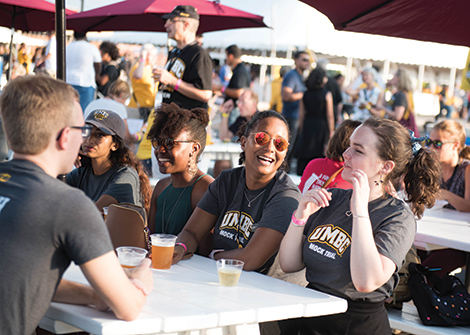
Enjoying the sunshine and ale crafted by alumni founded Suspended Brewing Company in the beer garden.

Enjoying the sunshine and ale crafted by alumni founded Suspended Brewing Company in the beer garden.

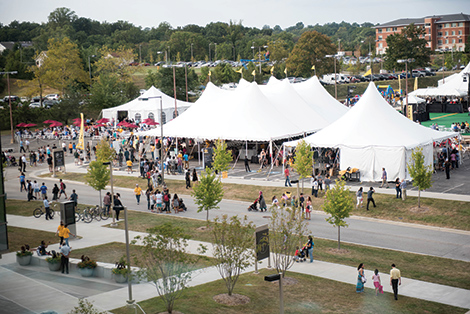
The UMBC community gathers in the House of Grit.

The UMBC community gathers in the House of Grit.

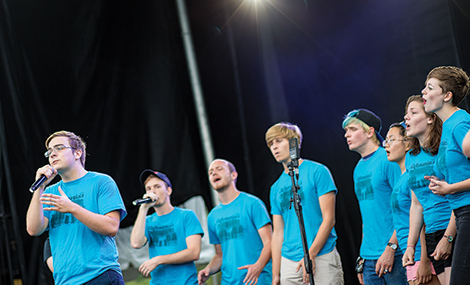
UMBC a cappella group the Cleftomaniacs performs.

UMBC a cappella group the Cleftomaniacs performs.

Science demonstration in the Thinkers Tent at the House of Grit.

Science demonstration in the Thinkers Tent at the House of Grit.

First Class

Members of UMBC’s first graduating class share memories at the Class of 1970 happy hour on Friday night.

Kids find the plush life with Retriever memorabilia at the House of Grit.

Kids find the plush life with Retriever memorabilia at the House of Grit.

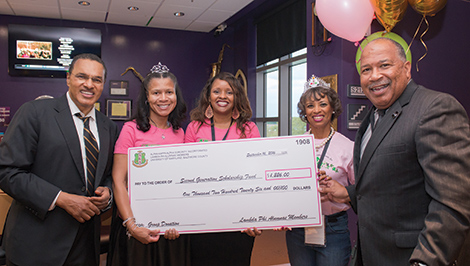
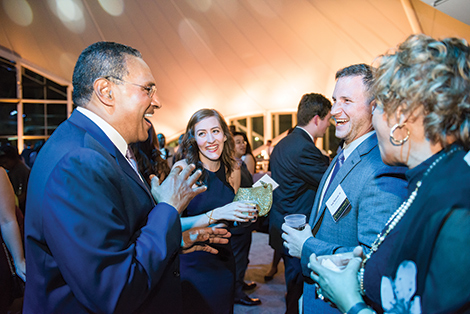
President Hrabowski celebrates philanthropy with alumni at the Alpha Kappa Alpha/Lamda Phi Reunion Friday night.

President Hrabowski celebrates philanthropy with alumni at the Alpha Kappa Alpha/Lamda Phi Reunion Friday night.

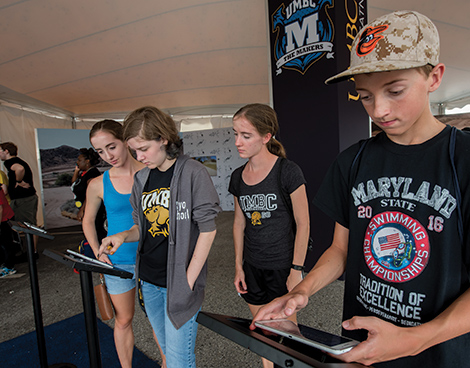
Future UMBC alumni get hands-on experiences with gaming and prototyping at the Makers Tent in the House of Grit.

Future UMBC alumni get hands-on experiences with gaming and prototyping at the Makers Tent in the House of Grit.

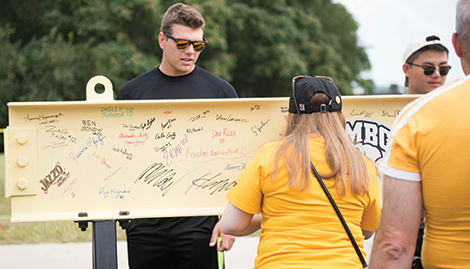
Alumni sign a beam that will be placed in UMBC’s new state-of-the-art Events Center.

Alumni sign a beam that will be placed in UMBC’s new state-of-the-art Events Center.

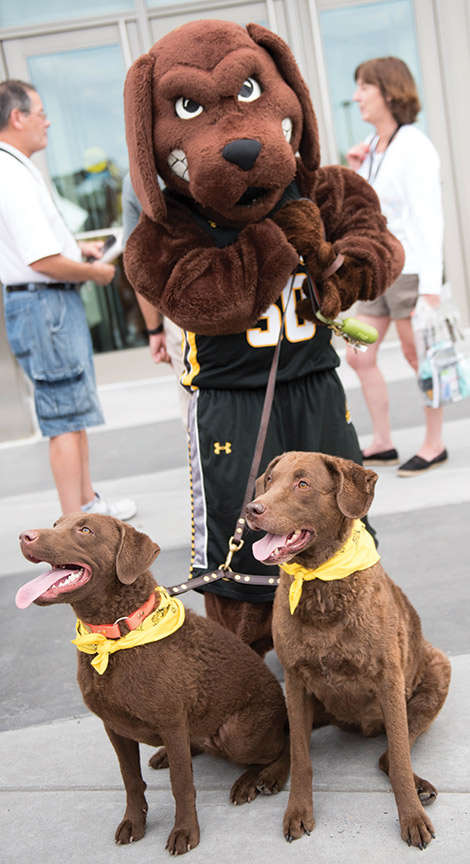
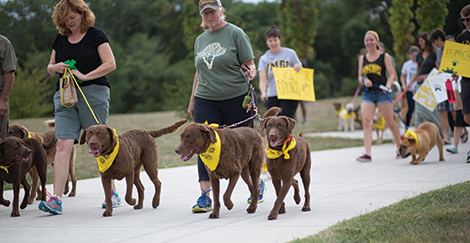
Mascots meet at the Puppy Parade, as True Grit gets a grip on some of the Chesapeake Bay Retriever puppies

Mascots meet at the Puppy Parade, as True Grit gets a grip on some of the Chesapeake Bay Retrievers in attendance.

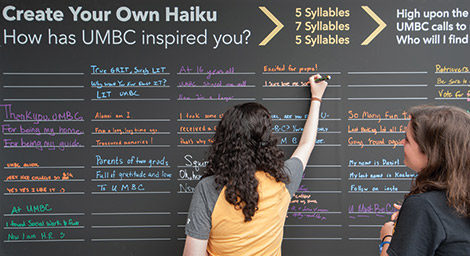
The UMBC community counts its syllables creatively at UMBC Haiku in the Thinkers Tent.

The UMBC community counts its syllables creatively at UMBC Haiku in the Thinkers Tent.

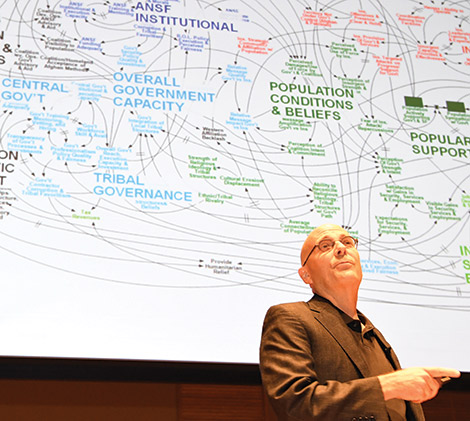
Imaging Research Center director Lee Boot talks about “Putting Humpty Together Again” at Grit-X.

Imaging Research Center director Lee Boot talks about “Putting Humpty Together Again” at Grit-X.

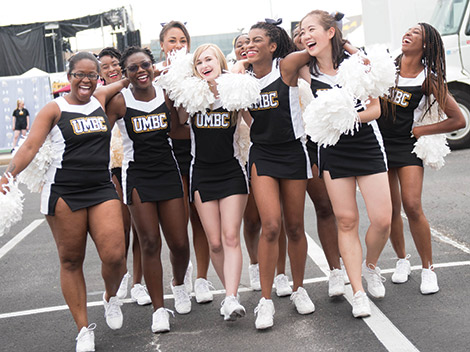
UMBC’s varsity cheerleaders help get alumni into the black and gold spirit at the Dawg Pound.

UMBC’s varsity cheerleaders help get alumni into the black and gold spirit at the Dawg Pound.

Alumni from the Honors College gather to celebrate one of the key programs in UMBC’s academic excellence.

Alumni from the Honors College gather to celebrate one of the key programs in UMBC’s academic excellence.

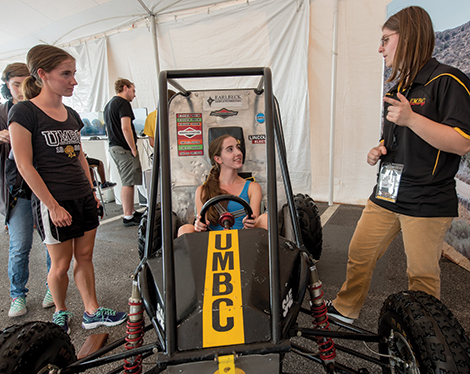
A chance to get behind the wheel of Baja SAE off-road vehicle was on offer at the Makers Tent in the House of Grit.

A chance to get behind the wheel of Baja SAE off-road vehicle was on offer at the Makers Tent in the House of Grit.

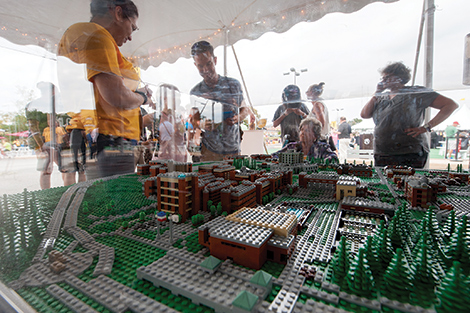
UMBC took shape plastic brick by plastic brick in a Lego display of campus.

UMBC took shape plastic brick by plastic brick in a Lego display of campus.

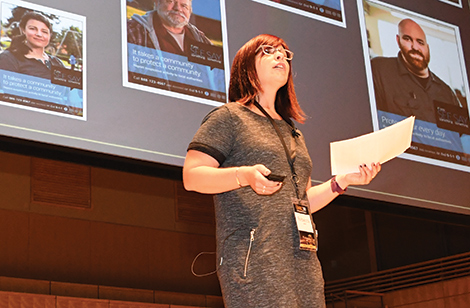
Rebecca Adelman, associate professor of media and communications studies, talks about citizenship and surveillance at Grit-X.

Rebecca Adelman, associate professor of media and communications studies, talks about citizenship and surveillance at Grit-X.

Doggone! UMBC canines strut their stuff at the Puppy Parade.

Doggone! UMBC canines strut their stuff at the Puppy Parade.

Really Really Big Breakfast and Bingo were on the menu at the RAC on Friday night.

Really Really Big Breakfast and Bingo were on the menu at the RAC on Friday night.

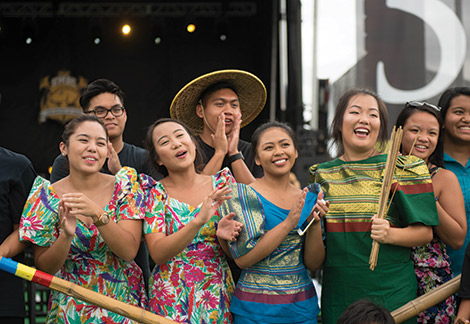
Student and alumni performers make a joyful noise all day long on the House of Grit Community Festival stage.

Student and alumni performers make a joyful noise all day long on the House of Grit Community Festival stage.

Grit & Greekness

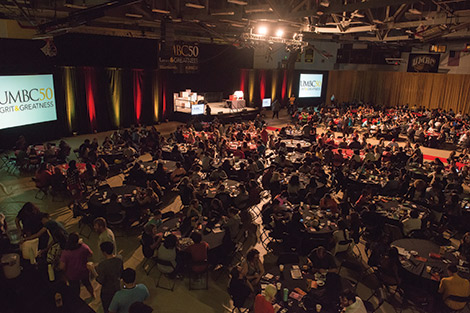
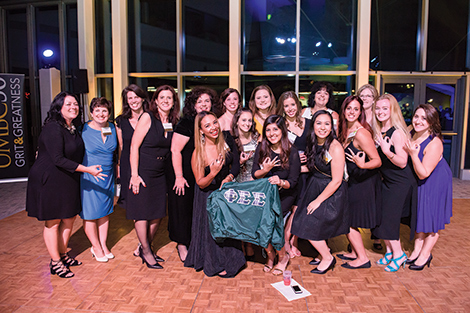
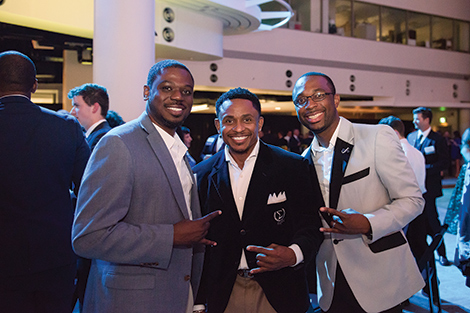
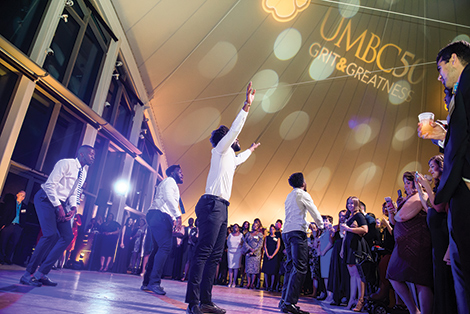
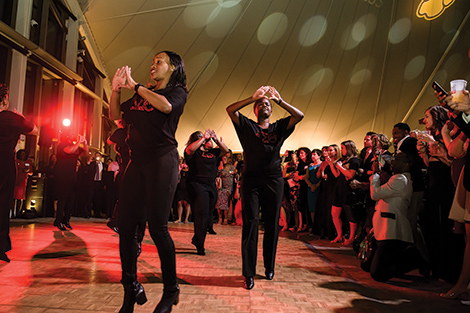
Sorority and fraternity memories shone out at the Grit & Greekness Event held at the Columbus Center on October 15, 2016.

CN-Grit-Greekness16-6771 CN-Grit-Greekness16-6749 CN-Grit-Greekness16-6883 CN-Grit-Greekness16-6948 CN-Grit-Greekness16-6598 CN-Grit-Greekness16-7033

Visual Arts Golden Ball

Creative costumes were all the rage at the Golden Ball hosted by the Visual Arts program and its alumni on October 15, 2016.

CN-golden-ball-MWebbKBellSpoonPopkin

CN-golden-ball-Preminda

CN-golden-ball-stairwell-CrawfordKotula_180251-TN

CN-golden-ball-tintype50-24

CN-golden-ball-gallery50-1

CN-goldenr-ball-CheonKroizDiamond-TN