All posts by: Magazine Editor


Who is responsible for migrants?

by Felipe A. Filomeno, Assistant Professor of Political Science and Global Studies, UMBC

President Donald Trump tends to portray migrants as a foreign problem that has suddenly – and unfairly – been “dumped” at America’s doorstep.

Migration “is a way they get certain people out of their country and dump in U.S.,” he wrote on Nov. 25 about a caravan of mostly Honduran women, children and young men seeking asylum in the United States.

He is not alone. The flow of refugees and asylum-seekers from poor countries to the United States border is often attributed, incorrectly, to domestic unrest in a far-off nation. Some Americans blame far-off governments for not being “willing to take care of their own country’s problems,” as one New York Times reader commenting on the migrant caravan put it recently.

This one-sided view of migration ignores the global forces that bind our world together, my research on immigration policy shows.

The extreme violence, environmental disasters and grinding poverty that drive people from places like Guatemala, Honduras and Afghanistan are largely the result of global phenomena like colonialism, climate change and trade.

Seen through an international lens, both migrant-sending and migrant-receiving countries share responsibility for the people displaced by globalization.

Colonialism and its consequences

It’s no coincidence that immigration routes today follow the same path European colonizers did – but in reverse.

France invaded Algeria in 1830 and kept it as a colony until 1962. Today, the largest immigrant group in France is Algerians.

And while Britain today may wish to close its borders, in 1948 it invited citizens of former British colonies into the country to help the United Kingdom rebuild after World War II. Indians and Pakistanis are now the second- and third-largest immigrant groups in the United Kingdom, after Polish people.

The Central Americans looking to the United States for refuge are following a similar historical pattern.

Technically, the United States was never an empire. But its government consistently intervened in Latin American domestic affairs during the late 20th century, installing and even removing leaders across the region.

In the 1980s, hoping to beat back Communism, the U.S. funded and armed authoritarian regimes in Central America as they battled leftist guerrillas. These decadeslong civil wars killed thousands and displaced hundreds of thousands.

War also killed the region’s economy. Average income in El Salvador, Guatemala, Honduras and Nicaragua was actually lower in 1990 than it had been in 1980.

Regional instability caused mass migration to the United States. Between 1981 and 1990 almost 1 million Salvadorans and Guatemalans entered the United States clandestinely.

Trade, poverty and cheap immigrant labor

Economic links between richer and poorer countries have also spurred mass migration.

More international trade in recent decades has brought jobs and improved living standards in some countries – among them Chile, China and South Korea – preventing migration by creating the economic conditions that allow people to stay put.

Strategic agricultural aid to developing countries, too, has reduced emigration from some rural countries, according to a recent study in the journal World Development, which analyzed data from 103 countries that received aid from 1995 to 2010.

But international commerce has also unleashed migration elsewhere.

Mexican immigration to the U.S. surged after the North American Free Trade Agreement went into effect in 1994. The deal increased Mexico’s manufacturing sector substantially – but it hurt farmers by opening Mexican markets to subsidized U.S. agricultural products.

Unable to compete with these cheap imports, hundreds of thousands of Mexican farmers lost their jobs. By 2006, an estimated 2 million peasants had been pushed out of rural areas in Mexico. Many of these displaced farmers migrated to the U.S., where they found jobs in the construction, agricultural and restaurant sectors.

Today, Hispanics make up around a quarter of workers in those industries. The same low-wage immigrant labor helps to keep manufacturing afloat in the U.S. despite the otherwise high costs of doing business.

Trump insists only that cheap imports from developing countries threatens U.S. industry. The realities of migration are more complex and nuanced than that.

Climate refugees

Climate change is another global problem contributing to the migration crisis.

Global warming-related problems like rising sea levels and extreme weather have their origins in the Industrial Revolution in Europe 150 years ago. But their impacts are hitting poor countries first and hardest.

Residents of small Pacific islands such as Kiribati and Tuvalu must abandon their homes because coastal erosion is pushing people inland, creating conflicts over the scarce remaining dry land.

Tuvalu is among the low-lying island nations facing imminent risk of extinction.
Tomoaki INABA, CC BY-SA

Even Central American migration is linked in part to climate change. Changes in temperature and rainfall across the region have damaged the coffee and maize crops over the past decade. Some farmers who’ve lost their rural livelihood joined the caravan earlier this year.

And though China has surpassed the United States as the world’s largest emitter of greenhouse gases, people in rich countries still use a disproportionate share of global resources.

Per capita carbon emissions in high-income countries is about 30 times higher than in low-income countries because people in the richer countries have bigger and more air-conditioned homes, eat more meat and drive and fly more.

Such statistics raise serious doubt about who, exactly, should take responsibility for modern climate refugees.

Stopping migration before it starts

Rich countries are not to blame for every problem that drives migration from poor countries.

Corrupt, predatory and violent leaders in Central America, Syria, Pakistan and many other places are also accountable for creating hazardous conditions in their countries.

And Haiti’s devastating 2010 earthquake, which destroyed the nation’s capital and sent thousands fleeing for their lives, had nothing to do with climate change.

Still, too much political rhetoric out of Washington offers a simplistic, one-sided view of migration. A more balanced debate might help policymakers take measures that might actually address the problem, rather than just casting blame on poor countries and closing borders.

Other countries increasingly agree. On Dec. 10, 164 nations signed the Global Compact for Migration, the world’s first-ever comprehensive international agreement. It assigns shared responsibility for hosting migrants in ensuring their human rights are respected and addressing the root causes of displacement.

The United States was not one of them.

* * * * *

Felipe A. Filomeno, Assistant Professor of Political Science and Global Studies, University of Maryland, Baltimore County

Header photo by Andrew Stutesman on Unsplash

This article is republished from The Conversation under a Creative Commons license. Read the original article.The Conversation

Moments of Truth

We’ve all had these moments.

Moments of wondering aloud. Moments of principled argument over sandwiches in The Commons. Moments of listening and believing as someone’s personal truth unfolds before you. Moments of examining our ideals and acting upon them.

Humanity strives for truth, but it’s not such an easy thing to achieve. Barriers can keep us from it. (Sometimes we are our own worst barriers, in fact.) But we persist in breaking through, in not shying away. And we nurture each other as we figure things out.

In his State of the University address this fall, UMBC President Freeman Hrabowski noted, “We are a community that believes in the importance of having respect for each other and seeking the truth. Nothing we do at UMBC is more important than the search for truth, and our role in teaching students how to think critically.”

You can’t have truth without light. This is a community where that light burns brightly.

These are but a few of our community’s ways of approaching tough questions. These are our

MOMENTS OF TRUTH.


Moment #1: Questioning Everything — Math + Philosophy = Doubt
Moment #2: Committing to Print — Beyond Black & White
Moment #3: Examining Our Biases — Seeking Honesty in Collections
Moment #4: Seeking the Truth — Science and Faith
Moment #5: Creating Safe Spaces — Seen and Believed
Moments #6-11: Walking the Talk — Words Become Actions
Moment #12: Listening to Our Instincts — The Computer is (Not) Always Right
Moment #13: All Voices Welcome — Conversations We Avoid Over Thanksgiving Dinner
Moment #14:  Being Ourselves, for Ourselves and Strangers — Our (Secret) Truths


Moment #1.
Questioning Everything
MATH + PHILOSOPHY = DOUBT

For those who think college is just about sitting in a lecture hall, listening to a professor profess, absorbing what they hear, and leaving with a brain full of absolutes, we humbly turn your attention to the far corner of the room.

As a mathematician, professor, and novelist Manil Suri wants his students to question everything they hear; as a philosopher, instructor Jim Thomas desires the same. So, when they talk with their classes about representations of truth in their fields — proofs, axioms, facts, and the like — they sometimes bend it a bit just for the sake of argument.

Suri likes to start his 301 class with a proof that seems right…until it suddenly doesn’t. The students realize they’re trying earnestly to prove that any whole number, like 1, 2, 3, etc., equals any other possible whole number.

“And I say, ‘Do you know what this is saying? Do you think there might be something wrong with it?’ And so then they scramble to try and find what could be wrong,” he says.

Thomas approaches his intro students in similar fashion, telling them a series of truths about himself when he first meets them, then building into statements that could or could not be believable, and then laying it on a bit thicker. He’ll say he’s in his 70s, for instance (which he most certainly is not), but with a truly double take-inducing deadpan.

It’s all part of how they teach their students to think deeply about two subjects known for building off of deceptively simple ideas. One plus one equals two, but it can take hundreds of pages to prove that equation. Philosophy hopes to create a truthful description of the world, but anyone studying it long enough eventually realizes how naive the pursuit is, Thomas says: there’s so much standing in the way of answers.

“I say, ‘Of course, it’s a word. I wrote it on the board, so that’s a word.’
And so now they’re thinking, ‘Why am I trusting this?’”
— Jim Thomas, philosophy instructor

The best way of moving forward is to doubt everything, the two agree, discussing it upon meeting for the first time.

“Any kind of proposition that’s given to you, the only way you can actually get to a proof — even when it’s true — is to try and think how it might be false and to hurl all these possibilities at it, and try to see if there’s a chink somewhere that things don’t work out,” says Suri. “And that’s a super-concentrated version of the same kind of skepticism we increasingly need in day-to-day life.”

And so Thomas’s way of purposely misspelling words on the whiteboard to see if anyone calls him out on it isn’t just some kooky professor trick, but a way of kickstarting that doubt in his students.

“I say, ‘Of course, it’s a word. I wrote it on the board, so that’s a word.’ And so now they’re thinking, ‘Why am I trusting this?’” says Thomas. “I want them to doubt whether or not they know the truth, and I want them to doubt it so they understand that the truth is something that is worth the trouble.”

— Jenny O’Grady


Jump to Moment #1  #2  #3  #4  #5  #6-11  #12  #13  #14   Back to Top


Moment #2.
Committing to Print
BEYOND BLACK & WHITE

The Retriever, UMBC’s student newspaper since 1966, has always had something to say. Above the fold, the very first paper of this fall semester declared its intentions in bold inch-high type:

We Commit.
To Truth. To Community. To You.

“We decided we needed to make a statement and re-commit to what we stand for as an organization,” said current editor-in-chief Julia Arbutus ’20, a double major in English and financial economics.

People noticed. And as the semester has progressed, with all of the twists and turns of news on campus, the student reporters have stretched themselves to learn and grow — a process repeated many times over since the paper first published in its original form as UMBC News in September 1966.

Joseph Howley ’06, ancient studies, served as a reporter and editor during a period of time that included upsets in fraternity leadership, a murder case involving a former student, and the beginnings of the war in Iraq. During that time, he and his staff strove to create a publication that helped students understand what was going on in the world around them, he said.

“An independent student press may be the only organization on campus equipped and motivated to challenge those institutions and make sure that students know what they need to about how they are or are not looking out for them,” said Howley, now an associate professor of classics at Columbia University.

“I hoped for this type of impact, but I didn’t know how
widespread it would be.” — Julia Arbutus ’20

Former news editor Tyler Lewis ’18, political science, learned skills during his years at The Retriever that are serving him now as an intern on Capitol Hill.

“Working as a student journalist provided the perfect opportunity to sit down with important members of the community,” he said. “The more I networked, the more scoops I received, and consequently I was able to better fulfill my goal of writing meaningful stories that mattered to my audience.”

As a scholar and a budding journalist, Arbutus takes the job of telling the truth very seriously. When that first issue hit the stands, she got an immediate rush of support from students, as well as alums of the paper, she said.

“I hoped for this type of impact, but I didn’t know how widespread it would be,” she said. “[This is] a movement to channel our journalism into more student-focused stories and to find a more active place within the student body on campus. We really want students to be proud of and engage with their community newspaper.”

— Jenny O’Grady


Jump to Moment #1  #2  #3  #4  #5  #6-11  #12  #13  #14   Back to Top


Moment #3.
Examining Our Biases
SEEKING HONESTY IN COLLECTIONS

The tagline for the television show The X-Files proclaimed that “the truth is out there.” Once a week, true-believer Fox Mulder and sceptic Dana Scully probed the possibility of hidden realms of the paranormal and conspiratorial lurking beneath the surface of American society. Faced with current cultural debates, the tagline seems less a tongue-in-cheek credo than a desperate plea to restore a once verifiable truth that is now elusive; the truth is out there, somewhere, surely, but where? While it is easier than ever to access information, it seems harder to decipher the significant fact from the extraneous detail.

“We must also interrogate how these objects came together in a collection
in the first place, since what is excluded can tell us just as
much as what is included.” — Beth Saunders

I come from the world of museums, where provenance is a major key to unlocking information about an object. Knowing where something came from and who else may have viewed, valued, or owned it tells us a great deal about objects, but also about history. I would argue that we could all benefit from thinking more about the provenance of the information we encounter. Museum and library collections make it possible to trace information to its origin by providing access to primary sources. Evaluating subsequent interpretations against the original text illuminates the biases that each researcher necessarily brings to the material. However, we must also interrogate how these objects came together in a collection in the first place, since what is excluded can tell us just as much as what is included. The truth is indeed out there, if you are willing to look for it.

— Beth Saunders, curator and head of Special Collections and Gallery


Jump to Moment #1  #2  #3  #4  #5  #6-11  #12  #13  #14   Back to Top


Moment #4.
Seeking the Truth
SCIENCE AND FAITH

“Science is a systematic process that seeks to understand the inner workings of the universe, our world, and ourselves,” says Bill LaCourse, dean of the College of Natural and Mathematical Sciences at UMBC. In other words, it is a process that seeks the truth — not a static body of facts. Scientists rely on observations and experiments to reveal and then repeatedly confirm truths about the world, but no conclusions they draw are ever guaranteed to be the last word.

It’s that uncertainty, the apparent fleeting nature of what is true, that may lead some people to toss science aside as unreliable or even misleading. That’s why it’s so important that the practice of science be communicated in a way that helps people understand its strengths alongside its limitations.

One of those limitations is that science is a human endeavor. As such, it is not as pure or objective as we might like to believe. “Science is a search for truth that relies on observations by humans and all their inherent qualities, whether righteous or flawed,” says LaCourse. Steve Freeland, an astrobiologist and director of the Individualized Study Program (formerly known as Interdisciplinary Studies) at UMBC, adds, “Scientists are partly responsible for creating what they observe in ways we still do not fully understand.” In other words, who does the science, despite their best intentions to be objective, influences what truths are discovered.

But the scientific method is not the only way to seek the truth. “Twentieth century scholarship, from within and beyond science, has led us to a current understanding that no one approach to finding truth is superior or sufficient,” says Freeland, who is also a committed Christian. “Logical systems must always be incomplete in terms of what they describe,” he adds. “This gives each of us reasons for humility as we seek truth in our different ways.” The scientific method, religious traditions, spiritual practices, and Indigenous traditional knowledge are all valid ways of seeking truth.

However, it is easy to distrust knowledge gained by means one does not understand. In particular, the uncertainties and impurities inherent to the scientific enterprise can influence how it is perceived by people more familiar with other truth-seeking methods, especially if they are more absolute in their profession of what the truth is. And yet, it is critical that scientists and people of faith communicate across their differences if we are to build a just, safe, and healthy world for all.

“In the end, the search for truth will be a collective journey of many by many roads,
humbled by our own ignorance and glorified by a common goal.”
— CNMS Dean Bill LaCourse

In March, UMBC will offer our community the chance to explore the tricky terrain that is communication among science and faith communities. UMBC is one of six universities nationwide selected by the American Association for the Advancement of Science’s Dialog on Science, Ethics, and Religion to organize two days of events around this topic. LaCourse, Freeland, and STEM communications manager Sarah Hansen lead the UMBC team organizing the workshop.

Researchers will receive training on how to communicate with people of faith in ways that constructively engage them while also respecting their identities and worldviews. That includes finding ways to show people of all backgrounds how recognizing the value of science — but not necessarily its primacy — aligns with their values, such as being stewards of the Earth or protecting the vulnerable. The event will also allow scientists an opportunity to familiarize themselves with other means of truth-seeking, and learn how to avoid alienating people by invalidating those methods in conversation.

“In the end, the search for truth will be a collective journey of many by many roads, humbled by our own ignorance and glorified by a common goal,” says LaCourse. As Karl Popper, renowned secular philosopher, put it, “Our attempts to see and to find the truth are not final, but open to improvement… criticism and discussion are our only means of getting nearer to the truth.”

— Sarah Hansen M.S. ’15


Jump to Moment #1  #2  #3  #4  #5  #6-11  #12  #13  #14   Back to Top


Moment #5.
Creating Safe Spaces
SEEN AND BELIEVED

“Is it my fault?”
“What just happened?”
“Is it rape?”
“Am I just making a big deal out of this?”

These are the questions we hear on a daily basis in the Women’s Center. UMBC community members — whether current students, alumni, faculty, or staff — tell us their truths, despite their own misgivings about the efficacy of that truth.

This self-doubt is common among survivors of sexual violence. And, so we tell them: We believe you. We see you. You matter.

In the wake of trauma and abuses of power, many question the veracity of their experiences and the impact that it has had on them. Whether a person has faced emotional, physical, psychological, social, or economic abuse, we see the impact clearly in the fear and misplaced self-doubt that surround them like dark clouds. Sometimes, coming to the Women’s Center is the first time a student feels believed or validated. Even as we work through resources meant to help and guide people towards healing, these misgivings continue interrupting every aspect of recovery.

And this work is complex.

Our community is not just made up of survivors puzzling through their experiences for the first time. Healing is not, as much as we may want it to be, linear. And, so we also support survivors as they face instances of re-traumatization, as they navigate the frustrating and often disappointing process of seeking justice, and as they practice coping skills in a culture that often does not lend itself to healing.

“There is power in naming our experiences and truths as a shared collective and
this is what we have been called to do in this moment on our campus.”
— Jess Myers and Amelia Meman ’15

Our job in the Women’s Center is to create space for truth-telling. This has been our role since our founding in 1991 as a small, volunteer-led operation. We were born in the wake of Anita Hill’s testimony where she spoke her truth about sexual harassment, and which then allowed so many other women to come forward with their own experiences.

There is power in naming our experiences and truths as a shared collective and this is what we have been called to do in this moment on our campus. As UMBC wrestles with the reality of a civil lawsuit that has forced us to examine the ways we listen to and support survivors of sexual violence, we are given a renewed opportunity to bring a light to truth and help foster a campus that is survivor-centered.

For the last 27 years, our job in the Women’s Center has been to create space for truth-telling by supporting survivors of all genders through individualized support, events like Take Back the Night, educational workshops, and advising the We Believe You student organization, but our real goal is ultimately to work ourselves out of the job. What would it look like if our campus community was so dedicated to sexual violence prevention work that the Women’s Center no longer needed to operate? What are the doubts and truths within ourselves that we need to explore to get there as a campus community? These are the questions we ask ourselves every day and we hope that in this chaotic time, more of us will have the courage to join us in this culture changing work.

— Jess Myers, director, and Amelia Meman ’15, program coordinator, UMBC Women’s Center For more information about the Women’s Center and its services for the many UMBC communities it supports, visit womenscenter.umbc.edu.


Jump to Moment #1  #2  #3  #4  #5  #6-11  #12  #13  #14   Back to Top


Moments #6-11.
Walking the Talk
WORDS BECOME ACTIONS

“It’s much easier to help others when you yourself are okay with asking for help. My hope is that by empowering others to ask for help, they will be more willing to give help in the future. Students seem to be very responsive to this. I’ve developed a relationship with many of my residents because I helped them out of a tight spot just once. Later on, they’ve helped me carry stuff up to my room, cleaned up after a program, and other small acts that really mean a lot to me. By cultivating a culture of high support, we can empower others to ask for help and give help. I’ve found that this principle is much less about knowing exactly what to do in every situation, and more about being willing to participate in the community of support.”

Lauren Whittaker is lead resident assistant in Erickson Hall, responsible for 50 students and 11 other R.A.s in the building. As a junior on the pre-physician’s assistant track, she is studying biological sciences with a psychology minor.

“I myself am a survivor of sexual assault and I know how traumatizing that can be to experience, and that really motivates me to make sure the school is doing everything it can to support survivors as well as enacting preventative measures. It is important to feel empowered because literally everything is malleable, even the things they say are not changeable are changeable with enough drive and support. Without people advocating during every step of the process, change ceases to happen.”

John Platter is a junior studying psychology, and a member of the LGBTQ Student Union, as well as various campus groups such as STOPP and UMBC Progressives.

“I have been working with people who have experienced assault since 2002 and have heard many stories. I have learned that there is no ‘right’ way to respond to an assault. People’s responses to an assault, and what they need to feel supported following assault, vary hugely. Some want to talk about the assault to whomever will listen. Some never tell anyone. Some seem relatively unaffected, whereas others seem shattered. And these responses often change over time. People may seem fine right after a traumatic event and then become more distressed months or years later. It’s often not possible to predict what someone who has been assaulted will need, and usually what we see as observers is just a piece of what’s happening inside someone after an assault. I have learned that the only way to know how to support survivors is to listen to them, and listen closely. Sometimes this means putting aside my anger when I hear about injustice and harm that someone has suffered so that I can stay focused on providing the support that they’re asking for — in short, allowing survivors to define their experience for themselves and ask for what they want.”

Rebecca Schacht is a clinical psychologist who serves as director of the UMBC Psychology Training Clinic. She is also an assistant professor in the Department of Psychology.

“In an environment where student-athletes are expected to be physically and mentally strong, it can be hard for them to ask for help. I feel honored when they seek me out for assistance. They trust me to help guide them through a challenging situation and I do my best to help them navigate the environment. It is important for community members who work closely with students to feel comfortable being an advocate. Even if you don’t know the right answer, you probably know someone who does. And to that student, the first phone call makes all the difference.”

Jessica Hammond-Graf advises student-athletes in her role as senior associate athletic director at UMBC.

“One of my favorite opportunities to connect with students is through Green Dot, which teaches community members that as bystanders we have a responsibility to keep each other safe. Community members learn how to identify behaviors related to stalking, partner violence, and sexual assault and then act by being direct, distracting, or delegating to someone more equipped to help. Nobody has to do everything, but everyone has to do something! I think people get overwhelmed by the idea of intervening as if it has to be a superhero gesture — where you put on a cape and take down the ‘bad guys.’ Intervening can be a simple moment in time where you ask someone if they’d like to talk or share some behavior that you have observed. Most of us can think about a moment, big or small, where we could have really benefited from someone stepping in to help us. How great it would feel to have confidence that the people around you, both friends and strangers, have an interest in keeping everyone safe. I believe that when thoughtful citizens learn the skills to do this, we can change UMBC and the world.”

Jacki Stone runs UMBC’s Green Dot training program, and serves as a community health and safety specialist in UMBC’s Division of Student Affairs.

“My work often involves feelings of excitement, frustration, sadness, hurt, joy, and fulfillment. These feelings at times can happen at once in the one hour I’m sitting with the student trying to navigate the process of understanding their needs, finding the resources, calling, advocating and connecting them to the resources. Some days the process is easy and straightforward and I have answers right away. Other times it feels like I am jumping hoops and moving mountains. We are in the business of higher education, meaning we are in the role of getting these individuals educated, with degrees to be productive members of society. They can’t get to the finish line if we don’t help them with the many hurdles along the way….and model behaviors that show empowerment and value social justice.”

Doha Chibani is a clinical social worker in UMBC’s Counseling Center and a 2008 alumna of UMBC’s psychology program.


Jump to Moment #1  #2  #3  #4  #5  #6-11  #12  #13  #14   Back to Top


Moment #12.
Listening to Our Instincts
THE COMPUTER IS (NOT) ALWAYS RIGHT

Each day, we interact with content in a range of forms, and rely on technology for everything from communicating and navigating our travels, to staying updated on the news and paying bills. Richard Forno, assistant director of UMBC’s Center for Cybersecurity and senior lecturer of computer science and electrical engineering, says people should take any information they find online with a grain of salt until they can verify it. Just because something is on the internet, Forno explains, does not mean that it is true or accurate.

Technology, however, is not solely to blame. “It’s a function, I think, of education and society teaching people to put faith in technology before their own selves,” he says.

Forno recommends that people do their own fact checking and listen to their instincts. “A good rule of thumb is if you hear something or receive something online, that before you get your emotions all tied up in knots, is anybody else reporting on this?”

As an educator, Forno feels it is his responsibility to educate UMBC students on how to think critically. “This all ties back to the idea of thinking critically and thinking for yourself, and not just blindly relying on what you’re presented with as information,” Forno explains. It’s also important that people who post to social media accounts be aware of the content they are sharing with their followers.

“This all ties back to the idea of thinking critically and thinking for yourself,
and not just blindly relying on what you’re presented with as
information.” — Richard Forno

“Recognizing that by just blindly passing something along on Twitter, you’re contributing to the noise machine, and you’re making the problem worse,” he says. “I know in my case, there were times where I’ve seen stuff on Twitter that I’ve been caught in a moment of weakness, and went ‘Oh, retweet. Stop.’ Then look through it, and say ‘No, I’m not going to play this.’”

The notion that the “computer is always right” can be challenging for consumers of media and information to work against because some images and videos circulating online can be very convincing. That’s why taking courses in a wide range of disciplines is so helpful for students shaping their perspectives, Forno says. “Things like civics and media literacy, digital cybersecurity — there’s a need for that so that you become a well-rounded and competent citizen.”

— Megan Hanks


Jump to Moment #1  #2  #3  #4  #5  #6-11  #12  #13  #14   Back to Top


Moment #13.
All Voices Welcome
CONVERSATIONS WE AVOID OVER THANKSGIVING DINNER

The old adage says there are three things one should never talk about: religion, money, and politics. However, avoiding certain topics instead of facing them head on can lead to divisiveness, and a lack of forward momentum.

As Romy Hübler, assistant director of the Center for Democracy and Civic Life, explains, “That goes against the idea of coming together and thinking about our own experiences and acknowledging the issues we’re all facing in order to truly address them.”

As a campus, the way to ensure that each community member’s truth is heard and respected is by placing the emphasis on collaboration and conversation, not individualization. Vrinda Deshpande ’20, executive vice president of the Student Government Association, recently worked with peers and several campus constituents to organize a “Dinner with Friends,” where guests talked about Maryland state and local politics at 10 simultaneous dinners, drawing conversation from their personal experiences.

While the student voice is important, students may not necessarily recognize that. “The biggest thing I hear from my fellow students is that as an undergraduate student, I’m not qualified to be part of certain conversations,” says Deshpande. “But undergraduate students make up the majority of the campus so a lot of the policy and decisions affect us directly.”

Similarly, in 2016 UMBC’s chapters of College Democrats and College Republicans began hosting “Coffee and Conversation” events — forums intended to appeal to all students, not just those who previously engaged in civil discourse, the organizers say.

“We want to help mend the social fabric and move away from the
divisive rhetoric that we see in our society today.” — Scott Buchan ’20

This year’s topic was healthcare, chosen because “we found the issue to be extremely relevant to the current election cycle and a contentious topic of the same nature as past topics (e.g., immigration, gun control),” explained College Democrats president, Luis Zuluaga-Orozco ’18, political science and media and communication studies.

Representatives from the Maryland Citizens’ Health Initiative and the Heartland Institute opened the event with remarks and then allowed the audience to steer the conversation, with lots of interaction in small groups. “We hope that the people coming out walk away with a better understanding of their peers and those who think differently than them and that they find that they can get along,” says Scott Buchan ’20, political science, College Republicans president. “So much emphasis is put on political beliefs that people are cutting off their friends who think differently. We want to help mend the social fabric and move away from the divisive rhetoric that we see in our society today.”

— Kait McCaffrey


Jump to Moment #1  #2  #3  #4  #5  #6-11  #12  #13  #14   Back to Top


Moment #14.
Being Ourselves, for Ourselves and Strangers
OUR (SECRET) TRUTHS

Tucked away in a thicket of trees at the edge of campus, a seemingly ordinary notebook holds hundreds of tales of heartbreak, euphoria, angst, and love. The journal is housed beneath a bench in the Joseph Beuys Sculpture Park and serves as a blank slate for any passerby who has a story to tell.

In a world that lives almost entirely online through platforms like Twitter, Facebook, Reddit, and Tumblr, the idea of taking pen to paper seems almost archaic. However, members of the UMBC community have shared their most private, oftentimes anonymous, truths in this highly public forum for nearly two decades now.

“If everybody keeps it secret, those who really need it may never find it.”
— Sandra Abbott, Center for Art, Design and Visual Culture

Once each journal is filled, it is collected and added to the tome that’s been steadily growing since the early 2000s, each serving as its own sort of time capsule. Brandee Blumenthal ’20, economics, is spending her semester working in the Center for Art, Design and Visual Culture (CADVC) to scan and archive the collection of journals. She reflects on how this project manages to thrive in a digital world explaining, “The notion of journaling is something we all still grew up with. There’s something about writing on paper that feels different than typing it. You’re actually creating the words. For some people, it’s nostalgic and provides an element of comfort and familiarity.”

Sandra Abbott, curator of collections and outreach for the CADVC, cites the physical location as a reason for inspiration.

“You’re in a place that’s lush and green and cut off from the hustle and bustle of campus. It forces you to slow down. Handwriting takes longer, but that’s because you have to choose your words carefully and critically since you can’t go back and edit. It gives more weight to your words because you’re being intentional.”

While individuals may put their thoughts to paper and be done with them, that doesn’t mean their story is over. Many entries have annotated words of support or congratulations or commiseration from strangers flipping through the pages. Using the journals as inspiration, Linehan music composition majors performed “Creative Acts,” a site-specific music and dance production. A few students have even used the journal to take a major next step in their lives.

Nate Dissmeyer ’07, information systems management, had his unofficial first date with his wife in the Joseph Beuys Sculpture Park. When the time came to propose to his wife, he “grabbed the journal and suggested she leave an entry about us. While she was writing, I was able to pull out the ring from my pocket and get down on my knee and add that she should include this moment in the journal.”

With more attention being paid to the Joseph Beuys Sculpture Park’s treasures, is there a concern that this hidden gem will lose its luster? “I’ve always been divided because it’s a place that people discover on their own and it’s so special,” said Abbott. “But if everybody keeps it secret, those who really need it may never find it. We want the campus to take advantage of this space. It’s theirs.”

— Kait McCaffrey


Jump to Moment #1  #2  #3  #4  #5  #6-11  #12  #13  #14   Back to Top


Diamonds are forever – whether made in a lab or mined from the earth

by Joshua Wilhide, M.S. ’10, and William LaCourse, UMBC

It’s diamond season. Almost 40 percent of American engagements happen between Thanksgiving and Valentine’s Day, with Christmas the most popular day to pop the question – and hand over a sparkly piece of ice. Jewelry stores do at least double their usual monthly sales in December.

Since at least the late 1800s, with the discovery of huge diamond mines in South Africa, people have treasured these dazzling gems. The beauty and splendor of diamonds goes well beyond the surface. Like a diamond hunter digging in an underground mine, one must look deeper to their atomic characteristics to understand what sets these stones apart – and what makes them valuable not just for romantics but also for scientists.

On the atomic level


When mined from the earth, diamonds look like cloudy rocks before they’re cut and polished. Their chemical nature and structure were unknown for centuries. It was Isaac Newton’s experiments in the 1600s that first suggested diamonds are made up of the fourth-most abundant element, carbon.

People doubted Newton’s discovery, which is understandable considering how different diamonds look from other common forms of carbon, like the graphite in pencils or the ash left over in a wood-burning fireplace. But in 1797, English scientist Smithson Tennant confirmed the composition of diamonds.

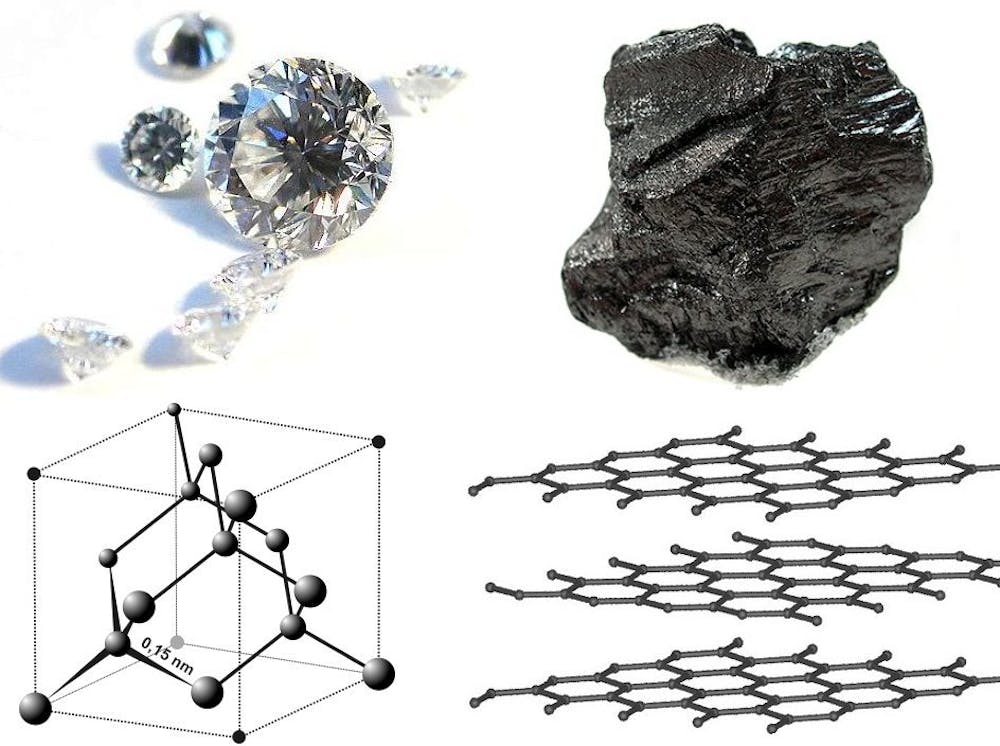
Diamond and graphite are both made of carbon atoms, but organized in different structures.
Materialscientist/Wikimedia Commons, CC BY-SA

It turns out that carbon takes two common forms that have crystalline structures on the atomic level. Graphite is a repeating two-dimensional, honeycomb-like shape, with layers stacking on top of each other. Alternatively, carbon can form a repeating three-dimensional shape, a tetrahedron – and that’s your diamond.

Where do they come from?

There are two sources of the precious gemstone: natural mining or synthesis within a laboratory.

Natural diamonds are formed under intense pressure and heat in the Earth’s crust over millions of years. Natural deposits have been found all over the world, from Northern Canada to Western Australia, even underwater in Namibia.

Mines were the only source of the gemstone until 1955, when General Electric produced the first synthetic diamond using what’s called the high-pressure, high-temperature process. This process works by applying hundreds of thousands pounds of pressure to graphite at 2,700 degrees Fahrenheit to force the carbon into the correct crystalline structure. It’s sort of like an artificial version of the extreme conditions that produce diamonds deep within the earth.

In the 1970s, labs started to use the chemical vapor deposition method to grow diamonds at lower pressures. At the time, the HPHT technique couldn’t produce a gem-quality stone. This improved method converts a hydrocarbon gas mixture by breaking it down to its components, carbon and hydrogen molecules, with an intense heated filament or plasma and deposits it onto a substrate, ultimately forming a solid diamond. Originally, this process had a very slow growth rate, but it’s now optimized to grow quality diamonds within days.

Together these techniques are largely responsible for human-made diamonds – upwards of 4 billion carats worldwide annually.

There’s a common misconception that a natural diamond must be inherently different than a synthetic diamond. To the contrary, they are chemically identical and share the same physical properties. Even the most sophisticated techniques can not detect a difference between a flawless mined diamond and a flawless human-made diamond – both are “real” diamonds. However, truly flawless diamonds of either type are extremely scarce.

Assessing a diamond

No matter its origin, a diamond can be assessed by the “four Cs” of cut, color, clarity and carat weight. Specialized laboratories grade each category, as created by the Gemological Institute of America.

The cut of a diamond is defined in two ways. There’s “the general shape of the cut stone,” with shapes including round brilliant (most common), oval, emerald, pear, princess, trilliant, triangle, heart and radiant. And there’s “the degree of perfection achieved by the cutting and polishing process” as rated on a scale ranging from excellent to poor. The type and quality of the cut ultimately determines the way light reflects in the stone, contributing to its “brilliance.”

The color of a diamond is graded on a scale from “D,” being perfectly colorless, to “Z” having the most color. Originally, the color of the stone was a huge hint about how it was formed because until 2007 about 90 percent of the high-pressure, high-temperature synthetic stones were yellow orange or yellow. Almost no stones from that process were colorless, so a colorless stone was almost certainly natural. But the HPHT growing process has greatly improved and as of 2016, 43 percent of synthetic diamonds were colorless.

Diamond clarity indicates the presence of inclusions, or tiny imperfections, in the stone. Inclusions make every diamond unique and provide strong clues to whether a diamond is natural or synthetic. The HPHT process uses metal flux, or a hot metal liquid, which acts as a solvent to dissolve the carbon source, graphite, to be rearranged and grown into a diamond. Diamonds grown this way can have inclusions of metals. The resulting stones may be magnetic – if a diamond reacts with a magnet, it is certainly synthetic. Additionally, most synthetic diamonds receive high clarity grades, while natural diamonds contain larger inclusions.

Many consumers focus on carat weight – that is, diamond size. The stone is weighed on a scale where one carat is 200 milligrams (0.007 ounces). Diamonds larger than four carats are almost guaranteed to be natural because that’s the limit for the size of the diamonds that the synthetic processes can grow.

Although the “four Cs” of diamonds ultimately define retail value, sentimental value can be even greater. Buyers must decide if a natural or synthetic stone fits the bill for them, based on factors that might include the ecological and ethical ramifications of diamond mining as well as the lower price tag for synthetic rocks.

Diamonds found beyond your ring finger

Although diamonds are well known for their place in the jewelry industry, they play other valuable roles, too.

Their physical properties, especially hardness, are ideal for abrasive applications. Small diamonds can be found coating cutting wheels, drill bits and grinding wheels, which are used for cutting concrete or brickwork.

Diamonds also have certain optical properties that make them suitable for various spectroscopy techniques, or measurements involving the electromagnetic spectrum. Scientific researchers use these tests to help identify the composition of materials they’re investigating.

A previously common place for diamonds was on record players, where to this day the needle that touches the record can be a very small diamond sliver.

Whether one appreciates the aesthetic or scientific characteristics of the gem more, diamonds can dazzle.The Conversation

* * * * *

Joshua Wilhide, M.S. ’10, chemistry, Manager of the Molecular Characterization and Analysis Complex, University of Maryland, Baltimore County and William LaCourse, Professor of Chemistry and Dean of the College of Natural and Mathematical Sciences, University of Maryland, Baltimore County

This article is republished from The Conversation under a Creative Commons license. Read the original article.

Header image  chuttersnap on Unsplash

A Matter of Trust

Driven in her work by memories of her grandmother, Dr. Tabassum Majid, M18, ’10, interdisciplinary studies, M.A. ’18, management of aging studies, has made a career of education and research related to Alzheimer’s disease and dementia. Recently, she was recognized in the Baltimore Sun’s “25 Women to Watch in 2018” list. Following her undergraduate study in neurodegenerative disorders of the aged, she earned her Ph.D. from the Baylor College of Medicine in Houston and had a fellowship at the University of Maryland, School of Pharmacy. Today, as executive director of the Integrace Institute, former Meyerhoff Scholar Majid looks ahead to ways of improving the lives of elders and their support networks, and many of the tools she uses every day come from the interdisciplinary education she received at UMBC. Here, Majid tells us how taking a chance on UMBC, and granting the trust of her most precious possession — her dreams — has made all the difference.

“Trust us with your dreams; you were meant to heal the world.”

This is one of the first things that I heard as a freshman at UMBC, the first time a mentor ever pushed me to both be vulnerable and challenge the universe at the same time.

The mantra has stayed with me throughout my personal and professional journeys since setting foot on a campus that I have come to consider a second home. The story began there.

UMBC was not my first choice until I met the people in it. I had dreams, big ones: neurosurgery at Yale, curing Alzheimer’s disease, traveling the world and making music come alive.

Yet, my heart and mind were one when I interacted with society’s most vulnerable: Older adults with dementia who reminded me of my lifelong hero — my grandmother — and children with chronic illness but sunny dispositions.

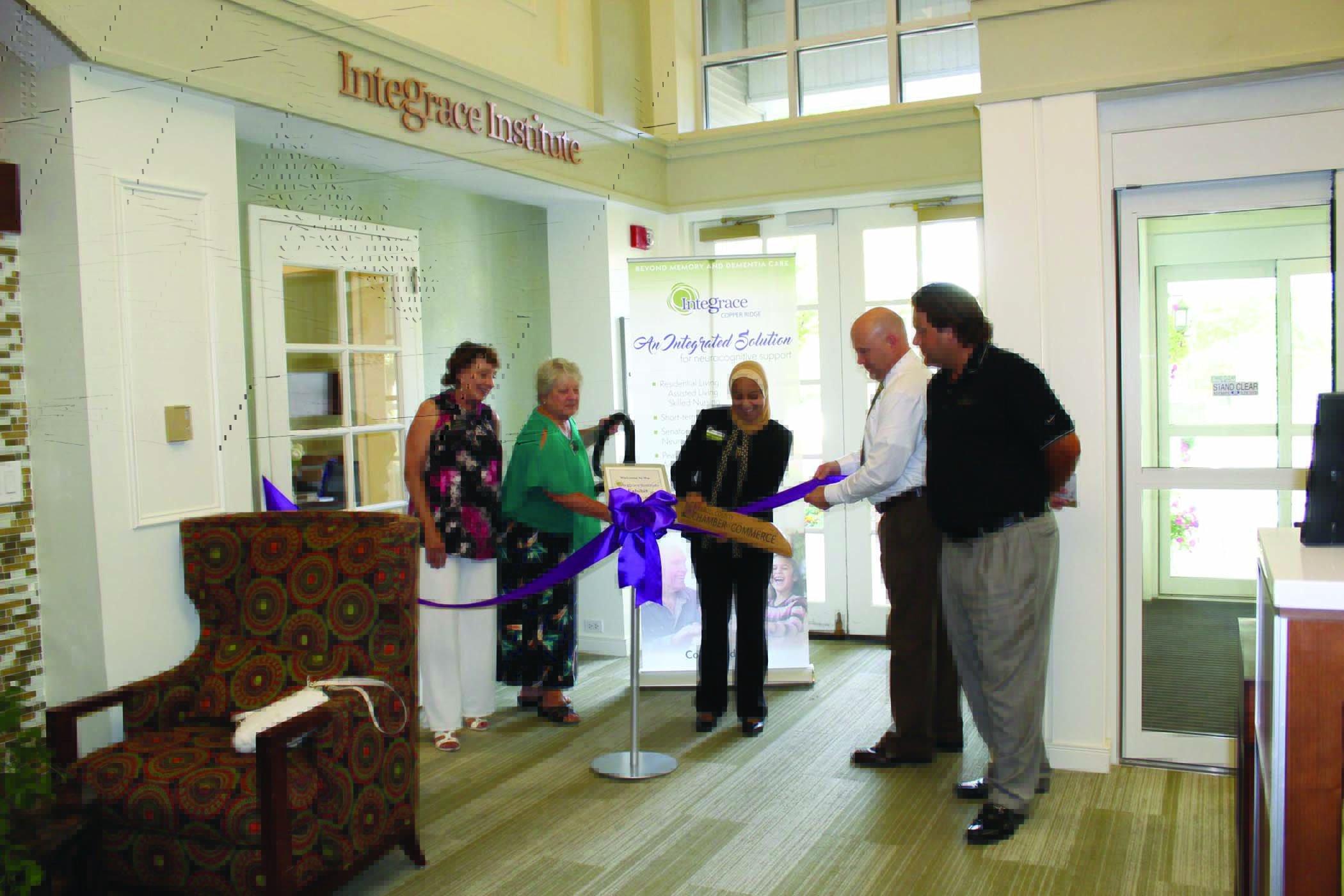
Majid cuts the ribbon at the launch of an exhibit created at Integrace Institute through collaborations with UMBC students. Image courtesy of Integrace Institute.

It took some trust to hand that over to the gentle soul who greeted me on my first day on campus. How could I refuse a place that was saying yes to my dreams, telling me that anything was possible? Freshman? Meyerhoff Scholar? Creating your own interdisciplinary studies degree focused neurodegenerative disorders of the aged? “We can figure that out,” they said. You want to be SGA Vice President? “We’ve never had a freshman do that, but why not? You were meant for greatness. Grit is in your nature.”

The opportunities kept coming, but I didn’t understand why. I kept looking for something to tell me I was in the right place doing the right thing. And then it happened. I was asked to write down the story of my grandmother. A release valve opened, passion flowed out, and I started to solidify those dreams. Before I knew it, I was graduating and off to Houston, Texas, to work with my new set of mentors, internationally renowned pioneers in Alzheimer’s and dementia research.

I finished my Ph.D. degree by focusing on all of those who came before me, who paved the path. Who I trusted with my dreams. My parents, two immigrants who came to the U.S. to give me a better life; my grandmother, who inspires me daily; my mentors, dozens of them, who encouraged, guarded, and nurtured my dreams. I defended my dissertation and got a letter from that same gentle soul at UMBC: “You’ve done what you went there to do; now you may come home.”

I came back to Maryland and decided to teach, to give back, and begin my research trajectory. I started teaching and mentoring UMBC students as an adjunct faculty member while doing my post-doctoral research. I found the most joy in seeing others be inspired to achieve their dreams, to discover their grit. I kept working with individuals with dementia and their caregivers, and got an amazing job at the Integrace Institute, a non-profit organization in Maryland that integrates research, education, and consulting together to transform the lives of those with neurocognitive changes.

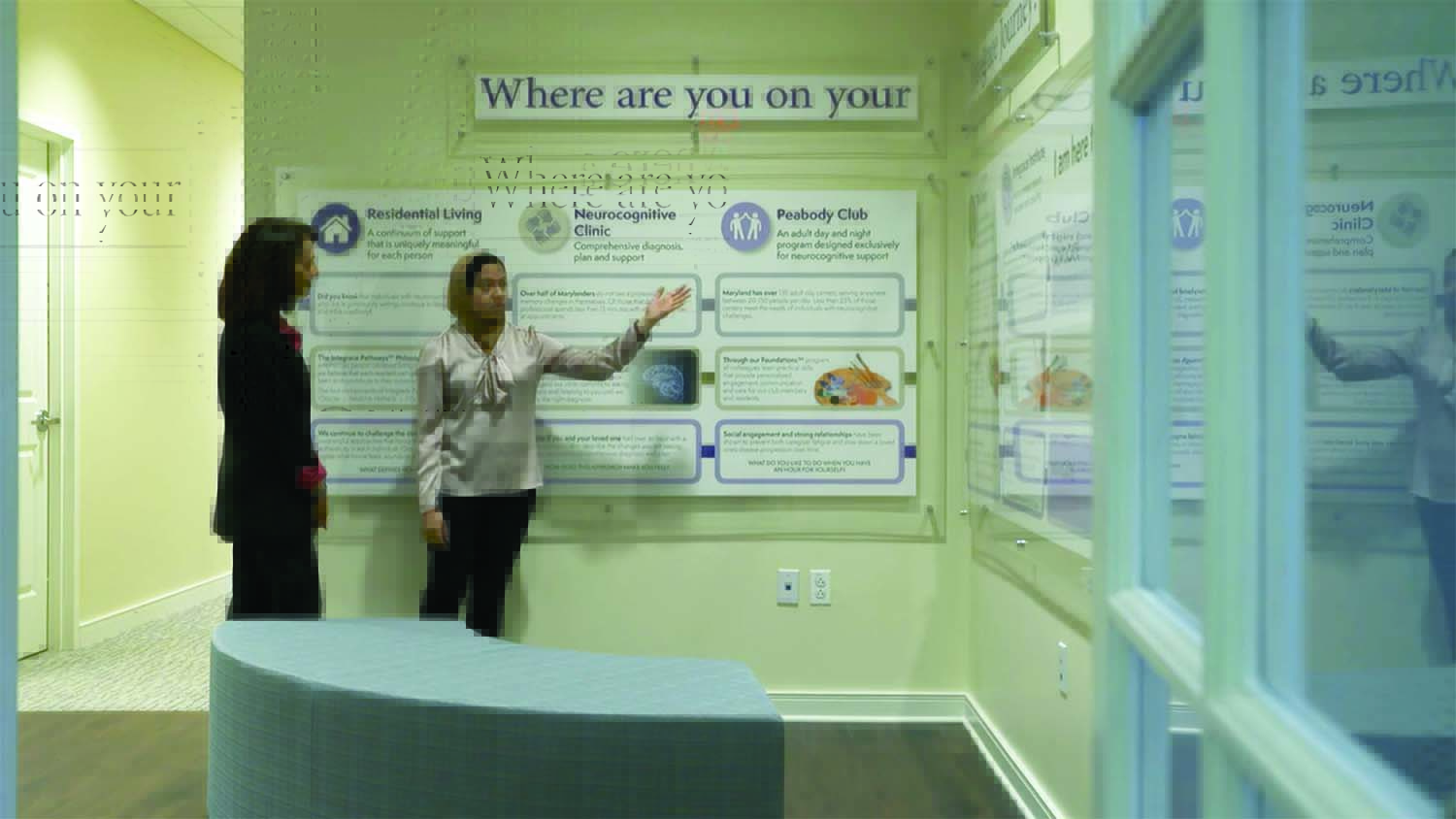
I needed more knowledge on this new industry, so I came back to UMBC for my MAgS degree. Every day is different now. Whether I am teaching staff members on how to individualize care, chatting with a resident about their life, presenting at a national research conference on brain health, I’m living those dreams with my UMBC family. One of my students used her museum design background to create an exhibit space to communicate research and educational findings in an innovative way. Another is using his musical talents to help us with a meaningful music study. Faculty and staff are co-creating curriculum and collaborating on research and future intergenerational programs. We are always looking ahead for more ways to grow, expand, and change.

It has been a transformational journey for me, expanding and changing as quickly as UMBC. In times of change, however, it is comforting to know that a walk around the loop will always welcome me home.

 Majid speaks with a reporter during the production of Every 3 Seconds , a documentary produced by Alzheimer’s Disease International to help raise awareness of global impact of dementia. The documentary came out in July. Image courtesy of Alzheimer’s Disease International.

Big Screen Dreams – Erick Chavarria ’05, theatre

As a small boy, Erick Chavarria lived with his grandparents in Guatemala in the village of Loma de Chavarria (“village of Chavarria”), where everyone had the same last name. At the time, there were only dirt roads.

“Everyone — and I mean everyone — was dirt poor. My grandparents’ house was made of mud,” he recalls.

Life changed when he was six years old, and the village got running water and electricity. Sometime shortly after, his grandparents got the first television in town. Nearly the entire village would show up at his home during the day to watch Mexican soap operas. “The TV would be on from like 8 a.m. until midnight,” says Chavarria. “This was such a huge thing in the village. Everyone was so engaged with what was going on on the soaps.”

When their electric bill got too high, Chavarria’s grandmother started charging people to watch. “My job was to go around and collect five cents from everyone,” says Chavarria.

The draw of the television soaps made Chavarria think about acting. And with that thought, his whole life would change.

“It’s What I Always Wanted to Do”

When he was 15, Chavarria and some of his extended family decided to head to the United States to live. He spent 23 days walking, riding in 18-wheelers, and once in a fruit truck. His backpack with all his belongings was stolen, and the pocket of his jeans got stuck on a barbed wire fence and ripped off.

Chavarria’s plan was to work for three years in the States and then return to Guatemala for his education. Then living with family in Laurel, Maryland, he enrolled in high school and got a work permit to bus tables. After graduating, Chavarria enrolled at Howard Community College as a business administration major, but then he took an acting class. “It’s what I always wanted to do — be an actor. But my father thought it was the funniest thing ever,” he says.

After five years in the States, Chavarria became an American citizen, and once he finished his AA degree, he transferred to UMBC. He didn’t make it into the theatre program right away; so he took acting classes, worked on his craft, and was accepted the next year.

After he graduated, he didn’t go directly into acting. After a stint as a loan officer, then a real estate agent, Chavarria lost all his money in the real estate crash. With just $500 in his checking account and nothing much to lose, he decided to go head west.

“I said, ‘If I’m broke here, I might as well be broke in LA.’”

“One Day She Called Me In”

Chavarria began working as a server at a restaurant while he took acting classes. Armed with a demo reel made while at UMBC, he secured both theatrical and commercial agents and began auditioning. He began sending introduction letters to casting agents, and Gwen Hellier, who was then casting for General Hospital, stood out. Chavarria made a point of keeping in touch with her.

“I told her how I used to watch the soaps with my grandmother or that I just did a little commercial,” recalls Chavarria. “One day she called me in.”

He was given a script and told to go to the lobby and read it over, and then come back in. That’s when Chavarria realized that he was the only one auditioning for the bartender role. He got the part.

Chavarria was on six episodes of GH, played a recurring character on Eastbound and Down and Borderline, and has appeared in movies like Office Christmas Party. He has also acted at the Frida Kahlo Theatre in downtown LA and in commercials, and has a healthy IMDB profile to show for it.

The greatest reward, Chavarria said, is to be able to make a living acting. “I think a million people could’ve told me the stories of how hard it is to get into acting, and I still would have gone into acting. The most important thing is being happy.”

— Michele Wojciechowski

Image: Josue Pena

Friendly Competition

Many observers will point to March 16, 2018, as the date that UMBC Athletics came of age. But there are numerous, more subtle signals that #RetrieverNation is maturing in intercollegiate athletics.

In short order this past spring, UMBC doubled the number of former student-athletes who have risen to the pinnacle of the coaching ranks and become Division I head coaches. Temple University hired Brian Rowland ’03, economics, as its head men’s soccer coach, while America East rival Binghamton University tapped Bethann (Shapiro) Ord ’89, psychology, (pictured above) as its head women’s basketball coach.

The duo joins Michael Casper ’00, psychology, and Jen (Kasper) O’Brien ’05, psychology, who have previously directed their charges against their alma mater. (Ord will when Binghamton plays at UMBC on February 13, 2019.)

Pride and Competitive Spirit

For all of them, coming back to coach against their own team brings a mix of pride and competitive spirit.

Casper, who played for head soccer coach Pete Caringi, Jr., led his St. Francis Pennsylvania side against UMBC in September 2009, dropping a 3-1 decision to the Retrievers. O’Brien, who scored 86 goals as a four-year starter for UMBC women’s lacrosse, brought a first-year program from Virginia Commonwealth University into UMBC Stadium in February 2016, and the more experienced Retrievers prevailed, 20-5.

Rowland made his head coaching debut against his former mentors in the 2018 season opener for both squads. UMBC scored a late goal to prevail over Temple, 1-0.

“It was nice that [my debut] was here. It was familiar,” said Rowland, who starred as a goalkeeper for UMBC from 1999 to 2002, and was inducted into the UMBC Athletics Hall of Fame in 2014. “[The UMBC staff] are great coaches, great examples. Pete was always a fantastic players’ coach. I’ve always remembered that and try to emulate it as much as possible — the understanding of the player.”

Ord returns to her home state of New York after serving as head coach at Weber State for the past seven years. “I’m excited to be [coming] back and see all the changes on campus, including the new gym,” she said. “It has been a long time and I look forward to seeing a lot of my [former] teammates and people that still work at school.”

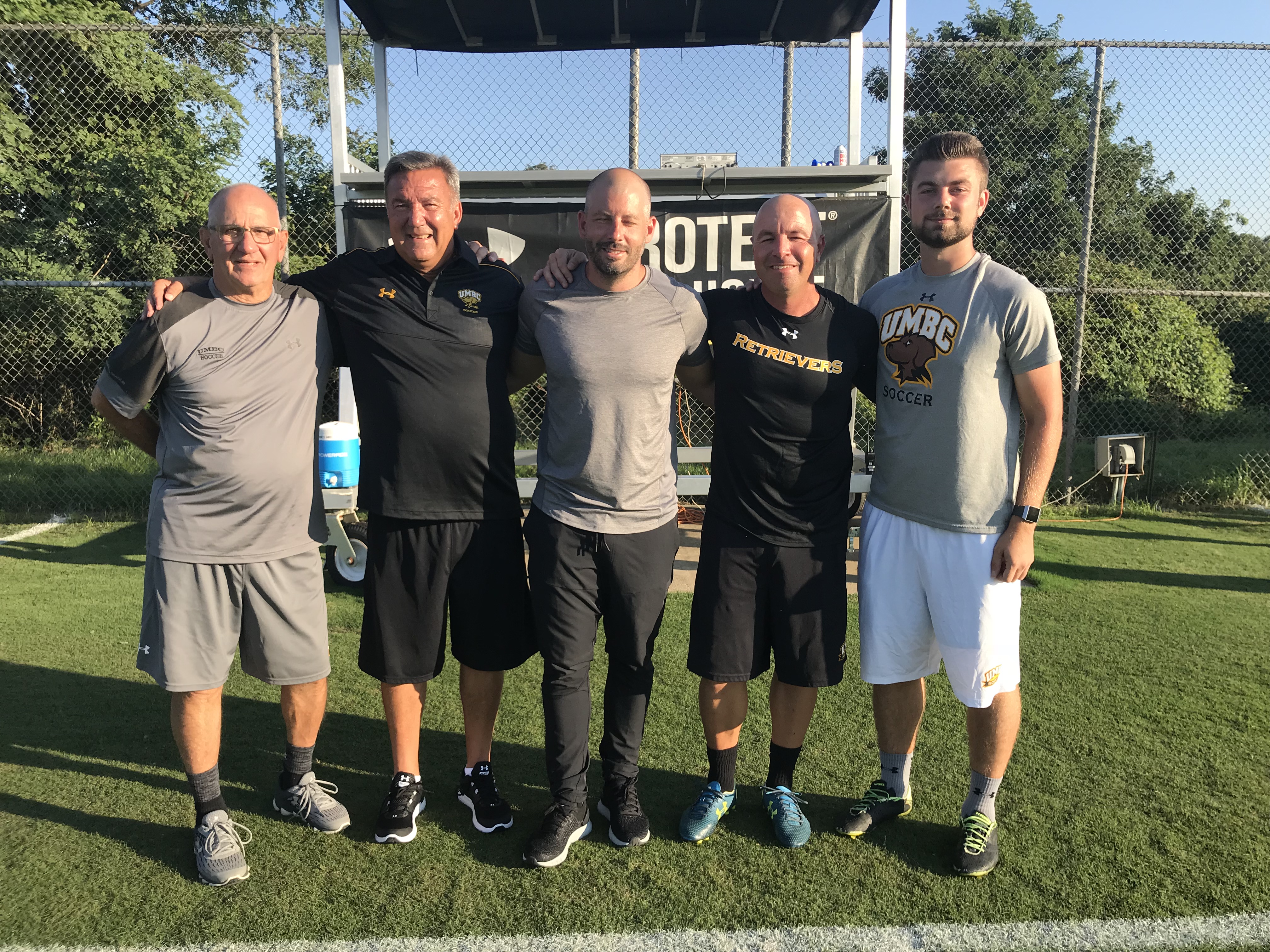
a group of men stand shoulder to shoulder in athletics gear
Brian Rowland ’03, economics (center) visits with UMBC soccer coaching staff (L-R): Sam DeBone, head men’s soccer coach Pete Caringi, Jr., Anthony Adams, Pete Caringi III.

Feeling Connected

O’Brien and Casper both vividly recall how they dealt with their emotions in those games versus UMBC.

“Every time I face UMBC, at home or away, I am filled with an immense amount of pride, appreciation, and love,” O’Brien said. “I am so proud to be a Retriever. I am grateful for the opportunity [head coach] Monica [Yeakel] gave me and I absolutely loved my time at UMBC with teammates that became family.”

Casper said he really wanted to win against UMBC — for a variety of reasons.

“I was excited to bring our team [St. Francis] to campus and compete against my alma mater,” he said. “I really wanted to show Coach Caringi, and Coach Anthony Adams [’97, history], who I have a ton of respect for, that we were a good team, and that I was a good coach.

“I was disappointed we lost, but at the same time, had we won the game, I think it would have been hard to really be excited about the win. I remember leaving [and] thinking, unless we play in the NCAA tournament, or I get a job in the same conference, I never wanted to play [UMBC] again. It is hard to compete against a school, a coaching staff, and a team that you love, that you still feel connected to, and really respect.”

— Steve Levy ’85

Image: Casey Staff, Binghamton University

Supporting Artistic Talents

The Linehan Artist Scholars Reception is an annual event students have long enjoyed.  This year, scholar alumni joined current students to meet with donors Earl and Darielle Linehan, and to thank them for their support.  Students talked about their studies and plans while alumni shared their accomplishments with the Linehans.  During the program, students and alumni displayed their talents in dance, music, theatre, and visual arts.

Learn more about the Linehan Artist Scholars Program.

See more photos from the reception. All images by Marlayna Demond ’11 for UMBC Magazine.


From Apple to Tesla to … Bumblebee

Experiences with big companies leads Sankarshan Murthy, M.S. ’06, to become an entrepreneur of more livable spaces

By Tom Kertscher

After Sankarshan Murthy got his master’s in mechanical engineering at UMBC, and then a master’s in technology management from the Wharton School at University of Pennsylvania, it was on to Apple and then Tesla and then to his current endeavor: Using technology to create more living space  — mostly by storing furnishings and belongings up near the ceiling, until you need it.

The big-company experiences helped create the entrepreneur.

Sankarshan MurthyAt Apple, where he was a product manager for the iPhone and Apple Watch from 2012 to 2016, Murthy learned the importance of thinking big  — something he eventually hopes to achieve with his new company, Bumblebee Spaces.

“The power of Apple  — everything is based to scale,” he said. “Some of the factories they work with are like cities. So, the impact you can have on Apple products, financially speaking, is so massive. Some of the people working at Apple control in their business units more money than most Fortune 500 CEOs.

“So, I learned about design thinking, but still ready-to-scale mentality. Whenever something’s designed, right from the time it’s sketched, people are thinking about how to make a million of one of these in one day.”

Then it was on to Tesla Motors, the electric car maker, and a different way of thinking.

Tesla co-founder Elon Musk “has set up the organization in such a way that there are no information blockers,” Murthy said. “So, if you find something inspirational to work on, or you find a problem that needs to be fixed, you get to jump on it and take it. That gives a certain level of empowerment to the people working there.”

Murthy said that approach caused him to think more entrepreneurially himself. And the contrasts between Apple and Tesla also led him to believe he could succeed on his own.

“The challenges that the Tesla team works on are pretty massive,” he said. “At Apple, I feel like they’re set up not to fail, because they have lots of money, they have time, there’s the power to wait and see, and then going to the market. Tesla has like 1/20th the number of engineers that Apple has and about 1/100th, or whatever the amount, of cash that Apple has. But, they are a lot more scrappy bunch and the things that they take on are much more ambitious.“

After a year as a staff product technologist at Tesla, Murthy left in 2017 to start Bumblebee Spaces. Already, his San Francisco Bay Area company was been featured in Inc. and the New York Times. Bumblebee says it is “creating a new way to live by unlocking the third dimension — using smart robots and an AI (Artificial Intelligence) stack, we increase usable space and reduce your footprint by storing, managing and retrieving objects on-demand in your ceiling.”

Imagine yourself in tiny apartment in the super-expensive Bay Area. After you wake up in the morning, you don’t really need your bed and your nightstand for awhile, right? So, after a couple of taps on a computer screen, up they go to the ceiling, freeing up space for daytime activities.

The inspiration came, in part, from Murthy’s move from Baltimore to the Bay Area. A mortgage for a three-bedroom house in Baltimore was less than rent for a one-bedroom house, less well constructed, near San Francisco.

“The only way to make housing affordable, without doing big suburban sprawl, is to make the best use of space possible,” Murthy said.

“The thing that we want to unlock is space.”

* * * * *

Tom Kertscher is a PolitiFact Wisconsin reporter for the Milwaukee Journal Sentinel. His reporting on Steven Avery was featured in Making a Murderer. He’s the author of sports books on Brett Favre and Al McGuire. Follow him at TomKertscher.com and on Twitter: @KertscherNews and @KertscherSports.

Images provided by Sankarshan Murthy.

The equivalence test: A new way for scientists to tackle so-called negative results

by Evangeline Rose, Kevin E. Omland, and Thomas Mathew, UMBC

A paleontologist returns to her lab from a summer dig and sets up a study comparing tooth length in two dinosaur species. She and her team work meticulously to avoid biasing their results. They remain blind to the species while measuring, the sample sizes are large, and the data collection and the analysis are rigorous.

The scientist is surprised to find no significant difference in canine tooth length between the two species. She realizes that these unexpected results are important and sends a paper off to the appropriate journals. But journal after journal rejects the paper, since the results aren’t significantly different. Eventually, the scientist gives up, and the paper with its so-called negative results is placed in a drawer and buried under years of other work.

This scenario and many others like it have played out across all scientific disciplines, leading to what has been dubbed “the file drawer problem.” Research journals and funding agencies are often biased toward research that shows “positive” or significantly different results. This unfortunate bias contributes to many other issues in the scientific process, such as confirmation bias, in which data are interpreted incorrectly to support a desired outcome.

A new method: Equivalence

Unfortunately, publication bias issues have been prevalent in science for a long time. Due to the structure of the scientific method, scientists often focus only on differences between groups – like the dinosaur teeth from two different species, or a public health comparison of two different neighborhoods. This leaves studies that focus on similarities completely hidden.

However, pharmaceutical trials have found a solution for this problem. In these trials, researchers sometimes use a test known as TOST, two one sided test, to look for equivalence between treatments.

For example, say a company develops a generic drug that is cheaper to produce than the name-brand drug. Researchers need to demonstrate that the new drug functions in a statistically equivalent manner to the name brand before selling it on the market. That’s where equivalence testing comes in. If the test shows equivalence between the effects of the two drugs, then the FDA can approve the new drug’s release on the market.

While traditional equivalence testing is very helpful for preplanned and controlled pharmaceutical tests, it isn’t versatile enough for other types of studies. The original TOST cannot be used to test equivalence in experiments where the same individuals are in multiple treatment groups, nor does it work if the two tests groups have different sample sizes.

Additionally, the TOST used in pharmaceutical testing does not typically address multiple variables simultaneously. For example, a traditional TOST would be able to analyze similarities in biodiversity at several river locations before and after a temperature change. However, our new TOST would allow to test for similarities in multiple variables – such as biodiversity, water pH, water depth and water clarity – at all of the river sites simultaneously.

The limitations of the traditional TOST and the pervasiveness of the “file drawer problem” led our team to develop a multivariate equivalence test, capable of addressing similarities in systems with repeated measures and unequal sample sizes.

Our new equivalence test, published in October, flips the traditional null hypothesis framework on its head. Now, rather than assuming similarity, a researcher starts with the assumption that the two groups are different. The burden of proof now lies with evaluating the degree of similarity, rather than the degree of difference.

Our test also allows researchers to set their own acceptable margin for declaring similarity. For example, if margin were set to 0.2, then the results would tell you if the means of the two groups were similar within plus or minus 2 percent.

A step in the right direction

Our modification means that equivalence testing can now be applied across a wide range of disciplines. For example, we used this test to demonstrate equivalent acoustic structure in the songs of male and female eastern bluebirds. Equivalence testing has also already been used in some areas of engineering and psychology.

The method could be applied even more broadly. Imagine a group of researchers who want to examine two different teaching methods. In one classroom there is no technology, and in another all of the students’ assignments are done online. Equivalence testing might help an school district decide if they should invest more in technology or if the two methods of teaching are equivalent.

The development of a broadly applicable equivalence test represents what we think will be a huge step forward in scientists’ long struggle to present real and unbiased results. This test provides another avenue for exploration and allows researchers to examine and publish the results from studies on similarities that have not been published or funded in the past.

The prevalence of publication bias, including the file drawer problem, confirmation bias and accidental false positives, is a major stumbling block for scientific progress. In some fields of research, up to half of results are missing from the published literature.

Equivalence testing provides another tool in the toolbox for scientists to present “positive” results. If the scientific community takes hold of this test and utilizes it to its full potential, we think it may help mitigate one of the major limitations in the way science is currently practiced.

* * * * *

Evangeline Rose, Ph.D Candidate in Biological Sciences, University of Maryland, Baltimore County; Kevin E. Omland, Professor of Biological Sciences, University of Maryland, Baltimore County, and Thomas Mathew, Professor of Mathematics and Statistics, University of Maryland, Baltimore County

Header image: © Yerbolat Shadrakhov | Dreamstime.com

This article is republished from The Conversation under a Creative Commons license. Read the original article.

4 Reasons Gerrymandering is Getting Worse

John Rennie Short, Professor, School of Public Policy, UMBC

November’s midterm elections are some of the most eagerly awaited, closely watched and hyperpartisan for many years.

But the results for many congressional House seats are already known because the election will occur at a time of rampant gerrymandering.

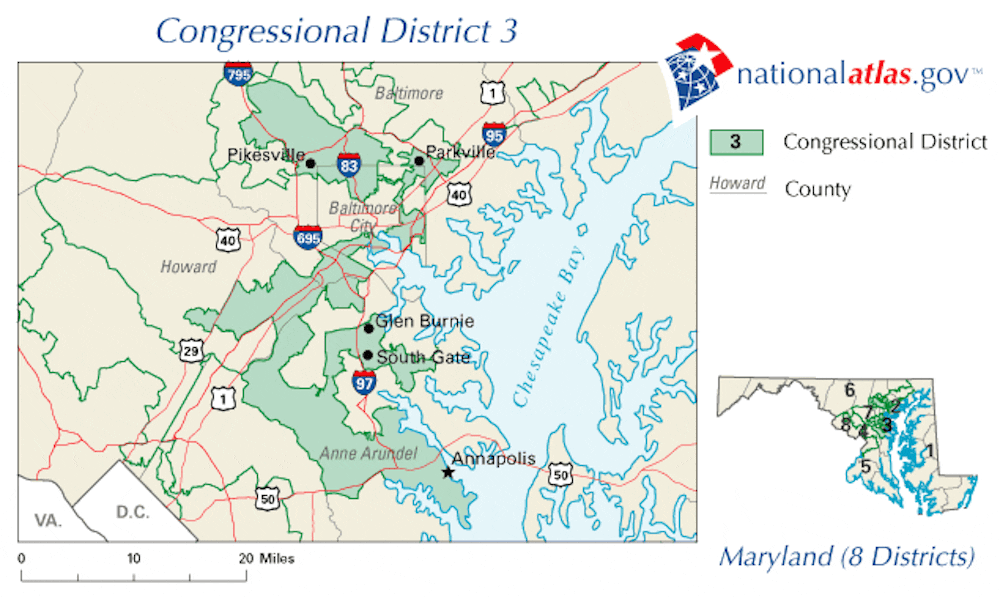
Maryland’s 3rd Congressional District.

For example, Maryland’s 3rd Congressional District is drawn up in a way that guarantees the 2018 election victory of Democratic incumbent John Sarbanes. Congressional districts in Texas are drawn up to favor Republicans, such as Mike Conway who is assured victory in the 11th District.

The mechanism is simple: The political party that controls state legislatures gets to redraw congressional boundaries every 10 years after the results of the most recent Census. Gerrymandering is the partisan redrawing of these boundaries. Basically, it allows politicians to select their voters rather than the voters to choose their representatives.

In 2012, Republicans won a majority of 33 seats in the House despite getting 1.4 million fewer votes than their Democratic opponents. In the past four congressional elections, Republicans have won a larger share of seats than their share of nationwide votes. These results are a sure sign that gerrymandering is involved.

The term “gerrymandering” originates with the activities of Elbridge Gerry, who in 1810 as governor of Massachusetts signed a bill that created legislative boundaries that favored his political party. A cartoonist of the day depicted the boundaries as a salamander. The system was so “gerrymandered” that the Democratic-Republicans won only 49 percent of the votes but picked up 72 percent of the seats.

Gerrymandering involves what’s called the “cracking and packing” of voters by moving the boundaries of voting districts. Cracking spreads opposition voters thinly across many districts to dilute their power. Packing concentrates opposition voters in fewer districts to reduce the number of seats they can win.

There are four main reasons why gerrymandering has gotten worse in the last 20 years.

1. It makes a difference

First, gerrymandering is effective in helping political parties hold power in the House.

Since 1995, after 40 years of uninterrupted Democratic dominance, the House has become more competitive because in large part the South turned Republican.

As the Dixie Democratic stronghold became a Republican bastion, the House came into play. Republicans took control from 1995 to 2007, Democrats won back the house in 2007 and Republicans regained control in 2011. Gerrymandering is now seen as a way to tip the scales in a more competitive climate.

One political consultant, Thomas Hofeller, described by many as a gerrymander genius, was particularly effective in designing redistricting strategies for Republicans between 1992 and 2017. He was one of the first to realize that redrawing boundaries was one way to elect as many Republicans as possible. In 1992 he worked for the Republican National Committee in drawing congressional maps in Arizona, Michigan, Minnesota and Ohio. He subsequently advised Republican politicians across the country on how to redraw electoral maps to their advantage.

2. More effective technology

Second, gerrymandering has become a much more effective tool in the last 20 years. With sophisticated computer programs and ever more detailed information on voters’ location and preferences, politicians can now crack and pack with surgical precision.

Maryland’s 3rd Congressional District slithers and slides across the state to pick up as many Democratic voters as possible. A Republican Texas packs Democratic voters into a few seats to ensure a Republican majority. With pinpoint accuracy afforded by these new technologies, state legislatures are able to ensure victory for their party.

3. The Supreme Court

The third reason is that the Supreme Court has effectively sanctioned gerrymandering.

In 1986, the court in Thornburg v. Gingles ruled against a Democratic legislature’s attempt to thinly spread minority voters among seven new districts in North Carolina. The case was brought by minority groups in the state who felt it impaired their ability to elect representatives of their choice in violation of the Voting Rights Act of 1965. The ruling helped create districts where minority voters were concentrated, so-called majority-minority seats, and hence encouraged the future packing of voters.

When the Republican-controlled Pennsylvania legislature proposed a partisan redistricting plan after the 2000 Census, members of the Democratic Party sued in federal court that it was unconstitutional under the one-person, one-vote principle of Article 1, Section 2 of the Constitution. In Vieth v. Jubelirer in 2004, the court ruled 5-4 not to intervene. Predictably, partisan gerrymandering then increased especially after the redistricting round after the 2010 Census.

Shelby County Alabama filed a case against the constitutionality of the 1965 Voting Rights Act that protected voters’ rights in the South. In Shelby v. Holder in 2013, the court in a 5-4 ruling overturned key elements of the act. The ruling encouraged partisan gerrymandering in areas of the country previously under federal scrutiny.

In 2017, and again in 2018, the Supreme Court passed up numerous opportunities to decide upon the constitutional legality or illegality of gerrymandering. The Supreme Court’s choice not to intervene has emboldened ever more partisan gerrymandering.

4. No likely solution

A fourth reason is that it is difficult for the courts to agree on solutions. There are numerous potential solutions.
The efficiency gap for example measures the number of “wasted” votes for a party that cannot win in a district. The difference between the wasted votes for each side, divided by the total number of votes, is the efficiency gap. It was used to assess the Republican 2011 redistricting plan in Wisconsin.

But technical problems
remain in dealing with the complexity of creating fair elections under the “winner take all” system we currently have.

So, some people argue for a major overhaul of our electoral system to overcome gerrymandering. For example, under equal weighting, voters rank candidates in order of preference rather than just choosing one. Proportional representation would involve major changes to our current electoral system and is unlikely in the near future.

Polarized politics

Gerrymandering has a pernicious impact on the electoral system and on the wider democratic process. It encourages long-term incumbency and a consequent polarization of political discourses. In gerrymandered districts, politicians only need to appeal to their base rather than to a wider electorate.

Legal challenges to gerrymandering may succeed, but until then it remains an ugly fact of the U.S. electoral system that belies our claim to be a democracy. The results of the upcoming election will reflect the redistricting designs of politicians as much as the will of the people.

* * * * *

John Rennie Short, Professor, School of Public Policy, University of Maryland, Baltimore County

This article is republished from The Conversation under a Creative Commons license. Read the original article.

Header image by Joey Csunyo on Unsplash

The Conversation

Staging Important Conversations: She Like Girls

Trying to make it through high school unscarred is difficult, but trying to balance it while discovering one’s sexuality can feel impossible. That’s the story of Kia and Marisol, who struggle to find acceptance in an intolerant community in Chisa Hutchinson’s She Like Girls – the Department of Theatre’s latest production, running now through October 28.

The department strives to produce new plays from diverse playwrights in its seasonal productions. Selecting Hutchinson’s work – she’s an acclaimed new African-American playwright – furthered that goal says director, Eve Muson, who chose the play, in part, to fit her students.

“We have a strong, talented, vibrant group of African-American actors. It felt right to give them the opportunity to play roles that they could absolutely play and audition for after graduation, as they pursue their acting careers.”

“It Makes You Think”

She Like Girls addresses sensitive themes of sexual orientation, community, domestic violence, and hate crimes. Muson relayed that the intention in staging this production on campus is to prompt discussion of these issues and give voice to students, faculty, and others to speak openly and mediate a conversation.

As a coming of age story, “this play speaks to a topic that directly interests our students. It’s also a coming out story and I felt like it was also relevant,” says Muson.

“This play offers up some very key, heartwarming moments that a variety of people can resonate with. It’s an interesting commentary on poverty, sexuality, language, misogyny and bullying,” said Majenta Thomas (Kia), a sophomore acting major. “It makes you think about being better to those around you, which has a place on a college campus, and honestly, everywhere.”

“I think the most important part about playing Marisol is that she is ferociously herself,” says Maria Marsalis, a junior acting major.

Both characters struggle to maintain their secret love to protect their safety.

Much of Muson’s research for the production focused on discovering more about the central character Kia and her world. Muson researched the life of Sakia Gunn, the teenager on whom this story is based, who was stabbed to death by a group of men after telling them that she was a lesbian in an effort to stop their harassment at the Newark train station. Her death was greatly overshadowed by Matthew Shepard’s story. Her world was the city and culture of Newark, New Jersey; Muson wanted to understand how it could impact a young woman.

Interrogating Language

Another part of discovering the “world” of the play was investigating playwright Chisa Hutchinson’s use of language. Language coaches Lynn Watson and Gerrard Taylor were brought into the rehearsals to assist with this process, training actors in the  specific dialect and accent needed to fit with the story.

Although the language of the play can be offensive to some, Muson was ready to challenge the audience: “I love that the play interrogates language.”

The actors were faced with the challenge of using racial epithets and slurs throughout the play. But through the process of working under the direction of Muson relayed that “reclaiming the hateful language is the characters’ way to strengthen bonds as community.”

– Justine Cataneo ’19

She Like Girls will run in the Black Box Theatre in UMBC’s Performing Arts and Humanities Building through October 28. Find out more about dates and ticketing here, as well as information on a panel discussion about the play on October 28.

Photos by Marlayna Demond ’11 for UMBC Magazine.

A day to celebrate chemistry’s favorite unit — the mole. But what’s a mole?

Tara S. Carpenter, Senior Lecturer and General Chemistry Coordinator, 
and Gabriella Balaa, Assistant researcher, UMBC

On Oct. 23, between 6:02 a.m. and 6:02 p.m., chemists celebrate Mole Day. Mole Day is not a day to celebrate those furry little creatures that live in the ground. Rather, it is a day to celebrate a very important idea in the sub-microscopic world.

In chemistry, the mole is a unit used to talk about atoms. It is similar to other units we use everyday. For example, you might walk into the local doughnut shop and order a dozen doughnuts. In doing so, you know that you will get 12 of these snacks and the clerk knows to give you 12. The dozen unit is simply for convenience in discussing a quantity.

We apply the same idea to discuss quantities of atoms. Why do we not simply talk about dozens of atoms? The reason is because atoms are so small that it doesn’t make sense to do so. Imagine a single grain of table salt. That tiny crystal contains over 1,000,000,000,000,000,000 (one quintillion) atoms. Rather than discussing such a large number of atoms, we can talk more conveniently through the mole unit. A mole of something contains 602,000,000,000,000,000,000,000 or 6.02 x 10²³ of that thing.

So rather than talking about over 1,000,000,000,000,000,000 atoms in the grain of salt, we can express the quantity as around 0.000002 moles of atoms, which is much more convenient.

The number 6.02 x 10²³ is also called Avogadro’s number. Amedeo Avogadro was an Italian physicist. In 1811, he proposed that equal volumes of any gas at the same temperature and pressure contain the same number of atoms (or molecules). The number is named after him to honor his work. Because Oct. 23 is abbreviated as 10/23, chemists use this date to celebrate Mole Day.

How much space does a mole occupy?

Now just how many is 6.02 x 10²³? How long do you think it would take you to count to a mole? One day? One week? One year? Go ahead, start counting. It would take you around 20,000,000,000,000,000 years. As you can see, very large quantities of atoms take up very little space which gives us an idea of just how tiny they are. Here is another example: One mole of water with all 6.02 x 10²³ molecules of H₂O occupies slightly more than a tablespoon.

So how do those tiny atoms come together to make up the stuff in the world around us? Even though atoms are so small, there is a lot of action going on. Each atom is made up of even smaller particles called electrons. The way those electrons place themselves around the atom lead to properties we can experience and observe. In a metal, the tiny atoms are swimming in a sea of electrons which gives them the ability to conduct heat and electricity.

How about water? The electrons in a molecule of water are arranged so that each water molecule is extremely attracted to the one next to it. Because of this they naturally arrange themselves at the atomic level in ways that have big consequences in the world around us. When water freezes, the molecules arrange in a way that creates a lattice that causes ice to float in liquid water. Why is that so important? Because ice floats, a pond or lake will freeze at the top, but below the entire aquatic ecosystem is able to survive. This is an amazing phenomenon of water.

Small atoms with big consequences

Many other substances adopt their own unique properties due to arrangement of electrons. The propane gas that we use to fuel a gas grill is a gas at room temperature because the molecules are weakly attracted to each other. Unlike water, they don’t really want to be next to each other at all. Consequently, the space between them results in a gaseous state.

Another important gas is oxygen. We need oxygen to live out our lives. Close your eyes and take a deep breath. As you do that, the molecules are whizzing through your nose, into your lungs where about 0.001 moles of oxygen are absorbed into your blood. Those molecules are responsible for helping each cell in your body produce energy so that your eyes can see the words on this page and your brain can think about what they mean, all while keeping your heart beating.

So, if you ever feel like you’re too insignificant to make a difference, just remember that even the smallest of things matter in the grand scheme of things.

Happy Mole Day!

* * * * *

Tara S. Carpenter, Senior Lecturer and General Chemistry Coordinator, University of Maryland, Baltimore County and Gabriella Balaa, Assistant researcher, University of Maryland, Baltimore County

This article is republished from The Conversation under a Creative Commons license. Read the original article.

The Conversation