All posts by: Magazine Editor


Alumni Award Winner Crafts Sounds for the Stars

A degree from UMBC can take you anywhere even a galaxy far, far away. Kimberly Patrick ’08, recipient of UMBC’s 2019 Outstanding Alumni of the Year award for Visual and Performing Arts, has a geek’s dream job, working as a sound editor and foley artist for Lucasfilm’s Skywalker Sound.

Just reading the experience section of this alumna’s resume will make you crave popcorn. In it are Star Wars: The Force Awakens, Star Wars: The Last Jedi, and Rogue One: A Star Wars Story as well as the Marvel movies Captain Marvel and Thor: Ragnarok, all indelible parts of modern pop culture. She was nominated for a Primetime Emmy award for her sound editing for the animated series Star Wars Rebels.

Studying music technology at UMBC kick started Patrick’s interest in film sound.

“I realized how much I enjoy recording and adding sounds to moving images,” she says, and after graduation she went to film school at the University of Southern California to get her MFA in film and television production. She started as an intern at Lucasfilm in 2012 and advanced from there.

Patrick creates sounds on one of the foley stages at Skywalker with two of her coworkers.

“I was able to make some fart sounds!”

For Patrick, a typical day as a foley artist might include shaking together rollerblades and running around to make the sounds of stormtroopers on the move. As a sound editor, she might be helping to decide the exact amount of fire sound in Captain Marvel’s superpowers.

In a documentary on YouTube about the making of Star Wars: The Force Awakens, Patrick can be seen making those sounds and talking about her experience with such a seminal franchise. “It’s really exciting to be a part of that and to know that you’re part of this future generation of Star Wars movies,” which are iconic for sound and filmmaking in general, she says.

And then there is her work that slightly less auspicious like the fart noises she made for Despicable Me 2. “There’s an end credit sequence with three of the minions and you know how… they’re always doing crazy things, one of them pulled out a trumpet and they wanted the trumpet to sound like a fart.” Patrick put her musical background to work and made it happen. “It definitely makes my parents super proud,” she says, “all those trumpet lessons. I was able to make some fart sounds!”
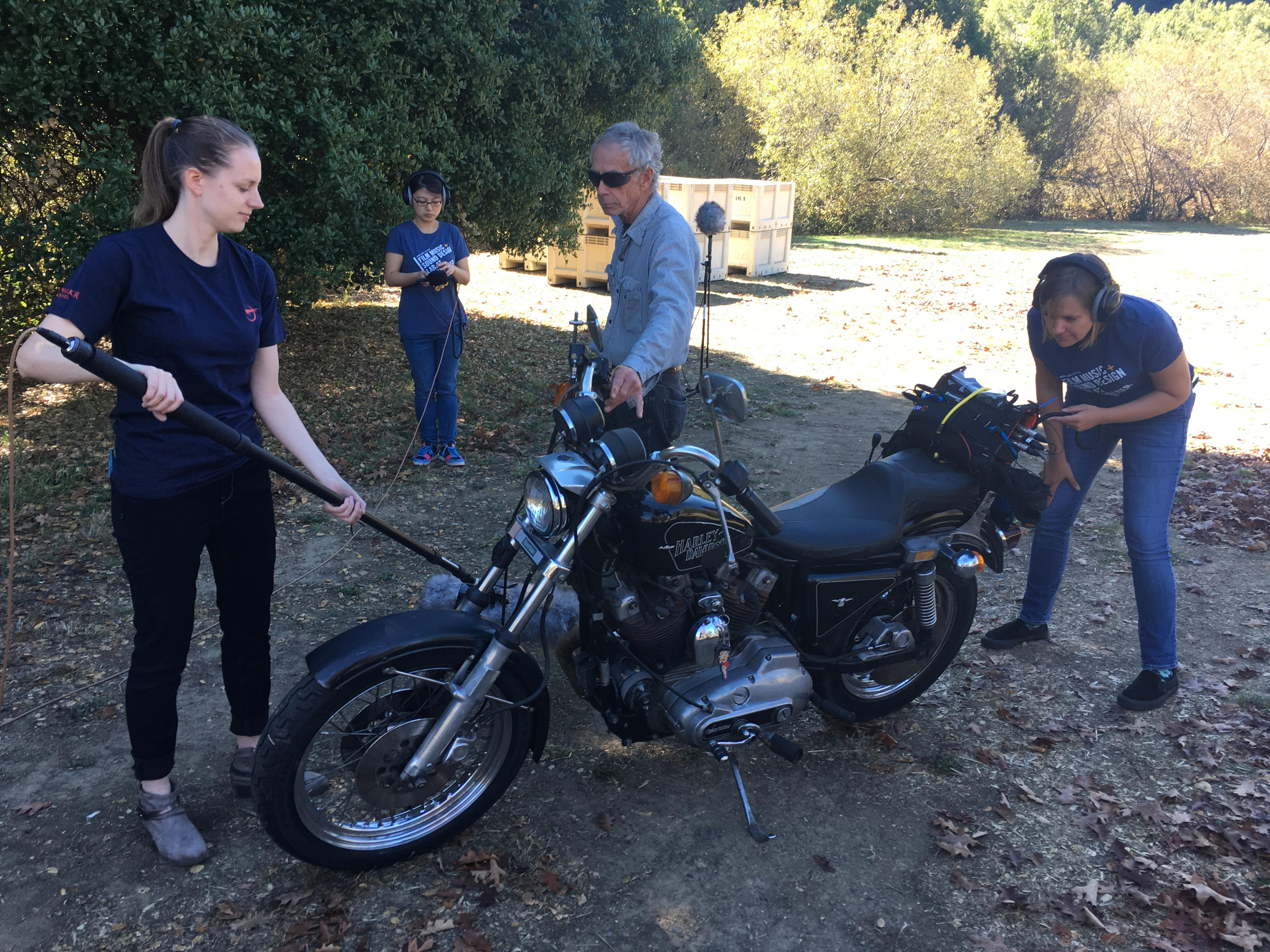
A day in the life of a foley artist can include almost anything.

“Is it going to be lasery?”

Most of what she does, however, is edit previously-recorded sounds together to achieve the right effect. For the recent Captain Marvel, Patrick was given about a third of the movie to work with and tasked with deciding what sounds needed to go where.

“With these movies, you do get direction from the directors of what they have in mind, how they imagine it to sound, and then you have to sort of translate back.” Sometimes they might ask, “Can you do a woosh kind of thing? Or it should go like vroom pow!” Other times they use emotional direction, like “This needs to be powerful but have weight to it,” and then she might use a low-end sound.

For the superpower effects used in Captain Marvel, “You have to decide is it going to be like electrical, it is going to be fiery, is it going to be lasery? You generally give a bunch of options to the directors like, here’s this version where it’s very fiery and here’s this version where it’s a lot of electricity,” she says.

Star Wars fans will recognize her work from an eerie scene in The Last Jedi in which the main character Rey snaps her fingers in a hall of mirrors. For that effect Patrick had to use cloth and snapping sounds to create an echo. “I couldn’t just copy-paste the same sound over and over again; it would sound mechanical. There had to be a distinct rhythm, as well as a sense that her reflection repeated indefinitely away from her into the cave, so the quality of the sound would need to change as it got further and further away.  It was a bit of a painstaking process to cut each individual repeated sound and sculpt it all into a believable performance that had some nuance, but it ultimately became a pretty cool sound moment in the film,” she says.

“You have to be an experimenter.”

UMBC may seem like it’s pretty far from that world of Jedi and superheroes, but Patrick says she uses her time as a Retriever to inform her work. “Having a degree in music from UMBC has been beneficial in so many ways. The music tech program emphasizes both the creative and technical sides of music-making which prepared me for the work I now do every day,” she says.

Patrick credits Professor Alan Wonneberger with encouraging her to pursue a career in film sound and the Linehan Scholars program with giving her much needed financial help and an introduction to artistic collaboration. “It exposed me to a large group of artists that I got to work with, which ultimately is what I do every day now I get to work with a bunch of different artists from different departments and… we can just make beautiful things together.”

To give back to the school, Patrick coaches current students on how to get into the business. She has gone back to UMBC to speak to music classes and did a foley recording exercise with Professor Wonneberger’s class. She also spoke with Dr. Lisa Cella’s professional development classes about her career path. Recently, current student Jenna Polignone ’19, information systems and music technology got to pick her brain via Skype about applying for a summer internship at Skywalker.

To succeed, Patrick says, “I think you have to be an experimenter. And you have to have an ear for what things work and what things don’t and be able to describe why things work and why they don’t.” It can be rewarding artistically when it all comes together, she says, particularly when she works on a documentary with social impact like the 2016 film Looking at the Stars. But being part of blockbusters brings Patrick’s work to the hearts of geeks the world over.

“It’s really awesome that I get to work on these movies that are well known I think that’s part of what makes my job very exciting… you get to be a part of this thing that’s bigger than you and say, yeah, I contributed to that.” 

Kimberly Patrick in her office.

Karen Stysley

All photos courtesy of Kimberly Patrick. 

Restoring tropical forests isn’t meaningful if those forests only stand for 10 or 20 years

By Matthew Fagan, UMBC; Leighton Reid, University of Missouri-St. Louis, and Margaret Buck Holland, UMBC

Tropical forests globally are being lost at a rate of 61,000 square miles a year. And despite conservation efforts, the global rate of loss is accelerating. In 2016 it reached a 15-year high, with 114,000 square miles cleared.

At the same time, many countries are pledging to restore large swaths of forests. The Bonn Challenge, a global initiative launched in 2011, calls for national commitments to restore 580,000 square miles of the world’s deforested and degraded land by 2020. In 2014 the New York Declaration on Forests increased this goal to 1.35 million square miles, an area about twice the size of Alaska, by 2030.

Ecological restoration is a process of helping damaged ecosystems recover. It produces many benefits for both wildlife and people – for example, better habitat, erosion control, cleaner drinking water and jobs.

That’s why the Bonn Challenge is so exciting for geographers and ecologists like us. It brings restoration into the center of global discussions about combating climate change, preventing species extinctions and improve farmers’ lives. It connects governments, organizations, companies and communities, and is catalyzing substantial investments in forest restoration.

However, a closer look shows that a struggle remains to fully realize the Bonn Challenge vision. Some reforestation efforts provide only limited benefits, and studies have shown that maintaining these forests for decades is critical to maximize the economic and ecological benefits of establishing them.

Reforestation project in northern Costa Rica: a plantation of native trees with valuable wood.
Matthew Fagan, CC BY-ND

Putting trees back on the land

So far, 48 nations and 10 states and companies have made Bonn Challenge commitments to restore 363,000 square miles by 2020 and another 294,000 square miles by 2030. The United States and a Pakistani province have already fulfilled their commitments, restoring a total of 67,000 square miles.

Restoring forests poses political and economic challenges for national governments. Letting forests grow back inevitably means pulling land out of farming. Natural forest regeneration mainly occurs where farmers have abandoned poor quality land, or where governments discourage poor farming practices – for example, near wetlands or on steep slopes. Opportunities for natural regeneration elsewhere are limited.

As a result, much forest landscape restoration under the Bonn Challenge focuses on improving existing landscapes using trees. Restoration activities may include creating timber or fruit plantations; agroforestry, or planting rows of trees in and around agricultural fields; and silviculture, or improving the condition of degraded forests.

The U.N. Decade of Ecosystem Restoration seeks to restore some 5 billion acres of deforested and degraded landscapes and seascapes between 2021 and 2030.

One early success, the “Billion Tree Tsunami” in Pakistan’s Khyber Pakhtunkhwa province, has exceeded its 350,000-hectare pledge through a combination of protecting forest regeneration and planting trees. Similarly, Rwanda has restored 700,000 of the 2 million hectares it pledged, primarily through agroforestry and reforesting erosion-prone areas, and created thousands of green jobs.

Green deserts

However, these “restored forests” are often poor replacements for natural habitat. For animals dwelling in tropical forests, agroforestry and tree plantations can look more like green deserts than forests.

Many tropical forest wildlife species are only found in mature tropical forests and cannot survive in open agroforests, monoculture tree plantations or young natural regeneration. Truly restoring tropical forest habitat takes a diversity of forest species, and time.

Nonetheless, these working “forests” do have ecological value for some species, and can spare remaining natural forests from axes, fire and plows. In addition, scientists have estimated that restored forests could sequester up to 16 percent of the carbon needed to limit global warming to less than 2 degrees Celsius above pre-industrial levels, while generating some US$84 billion in assets such as timber and erosion control.

Logging and degradation of tropical forests is the main reason why forestry and land use account for 10–15 percent of the world’s total human-induced CO2 emissions.
GRID-Arendal, CC BY-NC-SA

Restored, but for how long?

Benefits for wildlife and Earth’s climate from forest restoration accrue over decades. However, many forests are unlikely to remain protected for this long.

In a 2018 study we showed that forests that naturally regenerated in Costa Rica between 1947 and 2014 had only a 50 percent chance of enduring for 20 years. Most places where forests regrew were subsequently re-cleared for farming. Twenty years represents about a quarter of the time needed for forest carbon stocks to fully recover, and less than one-fifth of the time required for many forest-dwelling plants and animals to return.

Unfortunately, 20 years may be more than most new forests get. Studies in Brazil and Peru show that regenerating forests there are re-cleared even faster, often after just a few years.

This problem is not limited to natural forests. Agroforests worldwide are under pressure. For example, until recent decades, coffee and cocoa farmers in the tropics raised their crops in agroforests under a shady canopy of trees, which mimicked the way these plants grow in nature and maximized their health. Today, however, many of them grow their crops in the sun. This method can improve yield, but requires pesticides and fertilizer to compensate for added stress on the plants.

Poor management of coffee and cacao farming is a leading cause of deforestation in Peru. Local and international organizations are working to conserve and restore forests through better farming practices.

And although timber plantations sequester additional carbon with every harvest and replanting, their replanting is dependent on shifting market demand for wood. Once they are harvested after six to 14 years of growth, tropical timber plantations can be abandoned as a bad investment and replaced with higher-yielding row crops or pasture.

Solid foundations for recovery

If the Bonn Challenge is to achieve its goals, nations will have to find ways of converting short-term restoration pledges into long-term ecosystem recovery. This may require tightening the rules.

Some countries have pledged to protect unrealistically large areas. For example, Rwanda committed to restore 77 percent of its national territory, and Costa Rica and Nicaragua pledged to restore 20 percent of their territories apiece. Another flaw is that the Bonn Challenge does not prevent countries from deforesting some areas even as they are restoring others.

It will be impossible to track overall progress without an international commitment to monitor and sustain restoration successes. International organizations need to invest in satellite and local monitoring networks. We also believe they should consider how large international investments in sectors such as agriculture, mining and infrastructure drive forest loss and regrowth.

Countries like Indonesia that may be considering a Bonn Challenge pledge should be encouraged to focus on long-term impacts. Instead of restoring 10,000 square miles of one-year-old forest by 2020, why not restore 5,000 square miles of 100-year-old forest by 2120? Countries like Costa Rica that have already pledged can lock in those gains by protecting regrown forests.

The U.N. General Assembly recently approved a resolution designating 2021 to 2030 as the U.N. Decade of Ecosystem Restoration. We hope this step will help motivate nations to keep their promises and invest in restoring Earth’s deforested and degraded ecosystems.The Conversation

* * * * *

Matthew Fagan, Assistant Professor of Geography and Environmental Systems, University of Maryland, Baltimore County; Leighton Reid, Faculty Associate, University of Missouri-St. Louis, and Margaret Buck Holland, Associate Professor, University of Maryland, Baltimore County

This article is republished from The Conversation under a Creative Commons license. Read the original article.

Header image: A regenerating stand of rainforest in northern Costa Rica. Matthew Fagan, CC BY-ND

The True Story of UMBC’s Mascot, True Grit

Q: What’s the real story behind True Grit? Why was a Chesapeake Bay Retriever chosen as the school’s mascot?
—Zozscha Bomhardt ’93

fa15-trugrit-web
Campus Sam was UMBC’s very first live mascot. A contest during the Fall 1966 semester resulted in the selection of the Chesapeake Bay Retriever as the university symbol.

A: In the fall of 1966, a piece in the inaugural issue of UMBC News (later dubbed The Retriever Weekly) announced a contest to choose a mascot for the new university. Entreating readers to choose a mascot “that will become the loveable pet of students for years to come,” the contest garnered dozens of entries, ranging from whimsical fancies (unicorn, angel) to prosaic suggestions (muskrat, crab).

On October 30, 1966, the university announced that student Tom Berlin had won the contest with his nomination of the Chesapeake Bay Retriever. And soon after, UMBC received its first live mascot in the form of a spirited Chesapeake Bay Retriever pup with curly brown fur. Dog breeder Claude L. Callegary – whose son Peter Callegary attended UMBC and played lacrosse for the Retrievers – donated the dog to the school in the spring of 1967. Another contest failed to yield a name for the puppy, which eventually became known as “Campus Sam.” Lacking any formal arrangements to care for the dog, Guy Chisolm, UMBC’s first director of physical plant, volunteered to take the mascot to live with his family in their Catonsville home, which was adjacent to the campus.

Richard Chisolm ’82, interdisciplinary studies, who has made a notable career as a documentary filmmaker, recalls that “Sammy” (as he and his siblings Mac and Susie called the puppy that their father brought home) grew into a large dog with a fierce bark who loved to swim in the family’s swimming pool. He and his siblings were responsible for training and walking Sammy. From time to time, coaches or faculty members from UMBC would borrow Sammy for games or campus events, where he would be adorned for the occasion with a black and gold UMBC scarf.

While Campus Sam’s life was largely peaceful, Richard Chisolm recalls that it was nearly cut short when the mascot escaped a fenced yard to chase after a deer. Richard ran after and witnessed the determined dog crash headfirst into a moving car. Sammy survived with a permanent bump on his head.

UMBC has had a number of other live Chesapeake Bay Retriever mascots – as well as mascot images to represent the university. (Two of these images, including the most recent, have been created by Jim Lord ’99 – design director of UMBC’s Creative Services.)

But perhaps the most prominent symbol of the university is a 500-pound bronze cast sculpture of the mascot, dubbed “True Grit,” which graces the plaza between the Administration Building and the Retriever Athletic Center (RAC).

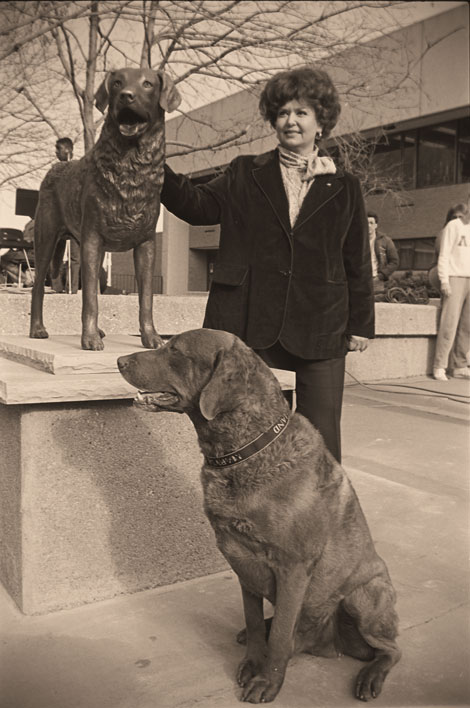
Paulette Raye ‘87, poses with her creation and model.

UMBC commissioned artist and alumna Paulette Raye ’87, who had graduated summa cum laude from the university with a degree in philosophy, to create the sculpture. Raye created the work in a studio at Towson University, using “Nitty Gritty” – a champion Chesapeake Bay Retriever owned by Howard County residents and veterinarians James and Brenda Stewart – as her model.

In an email to UMBC Magazine, Raye recalls that “the mascot was the first dog I had ever sculpted – of any size. It was the only large size sculpture that I had ever done.”

Raye relates that a number of setbacks delayed the completion of the project. In fact, she writes, the project almost literally melted down.

“The wax casting was made and then sat in the foundry – very warm in there – for a full year before [UMBC President Michael] Hooker released the funds to complete the casting in bronze,” she recalls.

“In the meantime, the wax casting had distorted – not terribly, but it did not cast nearly as detailed and beautiful as it had been sculpted because of some warping from the heat that it had sat in for a year.”

Raye also helped UMBC Magazine solve one enduring mystery about UMBC’s mascot that an extensive search for details about the project in the university archives did not reveal: The model’s name was “Nitty Gritty,” so what was the origin of the name “True Grit?”

“‘True Grit’ was the name of Nitty Gritty’s father,” writes Raye.” Exactly why the mascot received that name, I am not sure, other than it sounded bold and strong – like the team.”

Hooker and UMBC director of athletics Rick Hartzell oversaw an unveiling of the statue – with a tug from model Nitty Gritty himself – at a ceremony on December 7, 1987. In a letter to Hoke Smith, then president of Towson University, Hooker lauded the statue’s creation at Towson’s art studios as an historic truce in the “traditional Retriever-Tiger” rivalry, and graciously invited Towson’s president to stop by and “see us, and True Grit, when you can.”

True Grit remains a steadfast and enduring campus presence – greeting new students and visitors on their arrival to campus, and bidding a fond farewell to UMBC’s proud new alumni with cap on his head and diploma in his teeth as they graduate. And that shine on his muzzle? UMBC students have developed a tradition of rubbing True Grit’s nose for luck in their exams.

— Theresa Donnelley ’13 and Richard Byrne ’86

Read more Histories & Mysteries

The real women of ‘The Favourite’ included an 18th-century Warren Buffett

Amy Froide, Professor of History, UMBC

One of the challengers at this year’s Oscars is “The Favourite,” a film set in the early 18th-century court of British monarch Queen Anne.

Focusing on the political and sexual intrigues of a female-led state, the film has, at its center, not only the queen but also her two “favorites” – Sarah, Duchess of Marlborough, and Abigail, Baroness Masham. Much of the film focuses on how these two female courtiers vie for influence over Anne.

These early 18th-century women are hardly household names, so a movie that introduces them to a wider audience is welcome. And it doesn’t hurt that some of today’s biggest Hollywood stars inhabit the main roles: Olivia Coleman stars as Queen Anne, Rachel Weisz plays Sarah Churchill, and Emma Stone appears as Abigail Masham.

The film, as well as all three actresses, were nominated for Oscars.

But how does the portrayal of these women stack up against the historical reality? Might the fancy frocks, extravagant palaces and sexual triangles distract viewers from their true historical significance?

As a historian of women in early modern Britain, I’ve built my career analyzing the roles that women played in the past despite living in male-dominated societies. In fact, Sarah Churchill is featured in my recent book, “Silent Partners: Women as Public Investors during England’s Financial Revolution, 1680-1750.”

While “The Favourite” introduces viewers to the women who were important political figures in early 18th-century Britain, it doesn’t quite capture just how much power these women – especially Sarah – actually wielded.

Queen Anne and the birth of an empire

The Queen Anne portrayed in “The Favourite” is physically and mentally a mess, which isn’t entirely inaccurate.

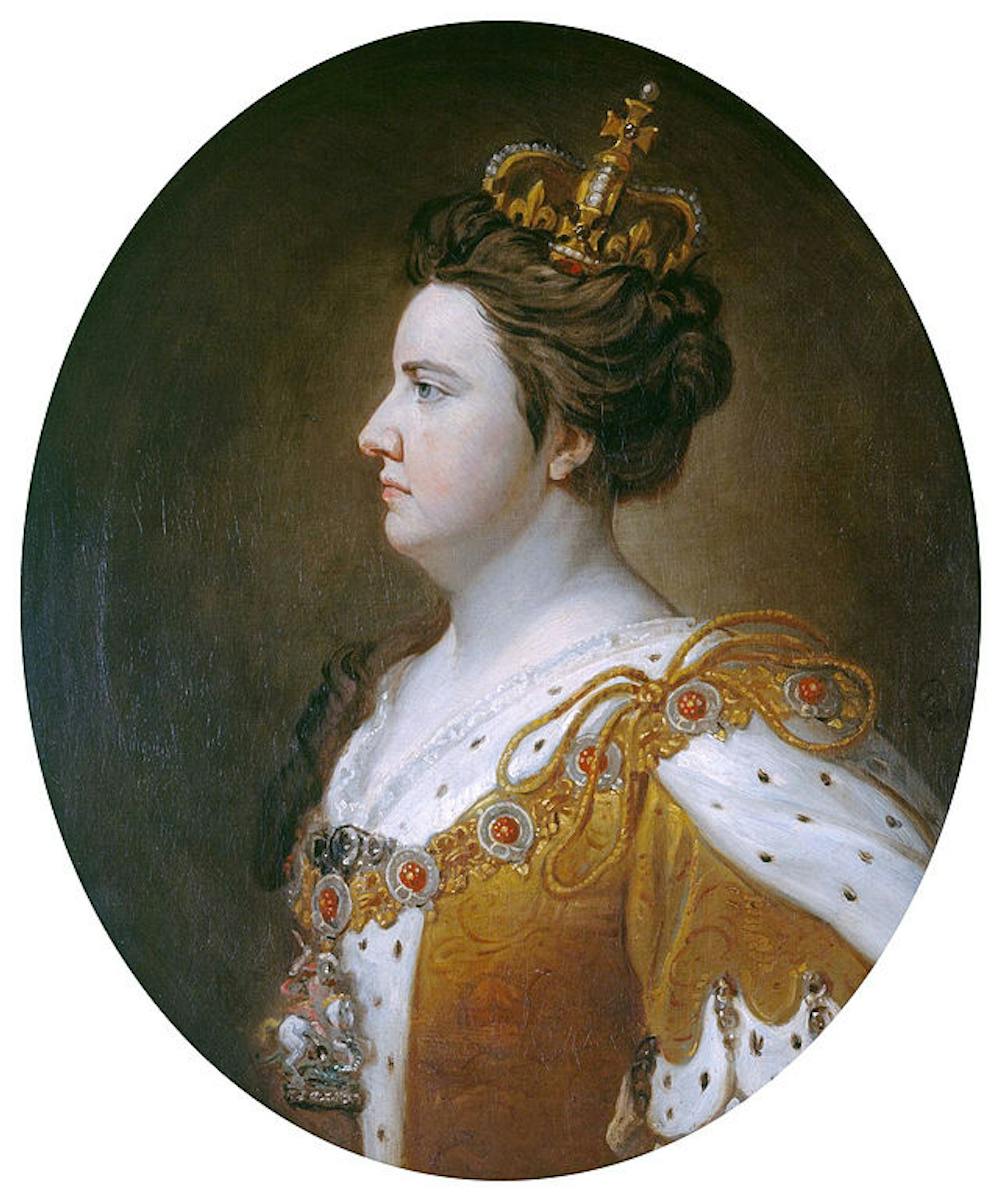
Queen Anne wasn’t without flaws, but she left a bold stamp on history. Royal Collection
Queen Anne wasn’t without flaws, but she left a bold stamp on history.
Royal Collection

While it is true that she had bad eyesight, was overweight, suffered from gout and endured the loss of 17 children, this was only one side of her.

By watching the film, you wouldn’t learn that Queen Anne presided over the union of Scotland and England into Great Britain in 1707, kept the Jacobite supporters of her Catholic half-brother at bay, successfully maintained a Protestant monarchy that has lasted into the present day, and furthered Britain’s rise to dominance on sea and land, ushering in the first century of Britain’s global empire.

Sarah pulls the (purse) strings

The figure around whom the action pivots in “The Favourite,” however, is not Queen Anne but Sarah Churchill. The power behind Anne’s throne, Sarah possesses the political, economic and military vision for the country.

As Keeper of the Privy Purse, one of Sarah’s jobs was to manage the royal household’s financial accounts. And with her husband, General John Churchill, away much of the time leading the queen’s troops, Sarah also handled the finances and investments for her own family.

Her political adversaries accused both Churchills of benefiting financially from their ties to Queen Anne. Sarah’s control over access to the queen and John’s role leading the army created opportunities for patronage, bribes and, in John’s case, some shady involvement in army supply contracts.

In my book, I argue that while the Churchills may have been venal and dishonest, much of their money came from Sarah’s astute and underappreciated investing in the stock market. As an early adopter of stock investing, Sarah put her family’s funds into the national debt, the Bank of England and shares in private companies. In 1704, she had over 19,000 pounds of her own money in stocks, or US$3.5 million today.

Sarah became famous for avoiding the losses so many of her contemporaries incurred in the South Sea Bubble of 1720, when investors poured money into the South Sea Company. She had wisely taken her family’s money out a few months before the crash because she realized the company’s stock was overvalued. In the process she made a cool 100,000 pounds.

Unlike the male courtiers in “The Favourite” who foolishly wager on duck races, Sarah didn’t make unnecessary gambles. She was such a savvy and significant investor; like Warren Buffett today, her actions and decisions could single-handedly influence the market. When British Prime Minister Robert Walpole needed money to fund the government, it was Sarah Churchill whom he approached for a loan of 200,000 pounds.

Abigail Masham is a more shadowy historical figure. As Emma Stone so ably shows in the movie, Abigail was quite intelligent.

But she seemed to be more interested in political maneuvering for personal gain, or for the benefit of her party, the Tories, who competed with the Whigs for power. Tellingly, Abigail left politics when Anne died, while Sarah, a Whig, didn’t end her political involvement even when dismissed from Anne’s service.

A reflexive response to powerful female figures

As a queen, Anne had female, rather than, male attendants, meaning that those closest to power were also women. In “The Favourite,” Sarah Churchill tells the government ministers that if they want to see the queen, they need to an appointment with her. This inverted power dynamic made contemporaries uncomfortable and resulted in rumors and insinuations about the nature of the relationships between the queen and her female attendants.

Not surprisingly, “The Favourite” makes much of these lesbian rumors, and some scenes depict sexual activity between women. But the 18th-century suggestions of homosexuality had more to do with the discomfort contemporaries had about women wielding power than actual same-sex relationships, although those happened too.

While the movie primarily focuses on the politics of the personal – the cat fights, jealousy and love triangles – the reality is that these women ran Britain.

The movie is on firmer ground in the way it depicts the men in their orbit. They are either absent (the Duke of Marlborough is away at the front), foolish (Minister Harley struts around in make up and a foppish get-up) or subservient (the young Colonel Masham follows Abigail around like a puppy).

Yes, women like Sarah enjoyed a lot of power due to her role as the queen’s favorite, and yes, she used that power to benefit her family. No, she probably wasn’t nice.

But how was this any different from the male courtiers who had been close to English kings for centuries? Sarah Churchill wasn’t doing anything new or particularly wrong.

She was just doing it as a woman.

* * * * *

Amy Froide, Professor of History, University of Maryland, Baltimore County, is the author of Silent Partners: Women as Public Investors during Britain’s Financial Revolution, 1690-1750 (Oxford University Press, 2016).

This article is republished from The Conversation under a Creative Commons license. Read the original article.

Header image: Sarah Churchill was an adroit investor and savvy political operative. Government Art Collection

The Conversation

Why US cities are becoming more dangerous for cyclists and pedestrians

by John Rennie Short, Professor, School of Public Policy, UMBC

As cities strive to improve the quality of life for their residents, many are working to promote walking and biking. Such policies make sense, since they can, in the long run, lead to less traffic, cleaner air and healthier people. But the results aren’t all positive, especially in the short to medium term.

In Washington D.C., for example, traffic fatalities as a whole declined in 2018 compared to the year before, but the number of pedestrian and bicyclist deaths increased by 20 percent. Pedestrian deaths also have risen in New York, and pedestrian and cycling fatalities have increased in Los Angeles in the past several years.

biking in cities

Across the nation, cyclist fatalities have increased by 25 percent since 2010 and pedestrian deaths have risen by a staggering 45 percent. More people are being killed because cities are encouraging residents to walk and bike, but their roads are still dominated by fast-moving vehicular traffic. As my research has shown, this shifting mix can be deadly.

The long decline in traffic fatalities

From a long-term perspective, traffic fatalities in the United States are declining. In the early 1970s, almost 55,000 Americans were killed in traffic accidents yearly, including people in vehicles, pedestrians and cyclists. By 2017 that figure had fallen to around 40,000, even with an increase in the number of vehicle miles driven.

The overall decline is a confirmation of Smeed’s Law, named after R.J. Smeed, a scholar at the United Kingdom’s Road Research Laboratory. Smeed found that initially, with the early introduction of motor vehicles, traffic deaths tend to rise. Around the world, almost 1.35 million people die each year in traffic accidents, but 93 percent of those fatalities occur in low- and middle- income countries where mass vehicle usage is a recent phenomenon.

As manufacturers produce safer vehicles, cities improve roads and drivers become more adept, fatalities tend to decline. But Smeed’s Law only seems to hold up for people in cars – not for other road users.

A global status report shows that road traffic injuries are now the single biggest cause of death for children and young adults, and that more than half of all traffic deaths are pedestrians, bicyclists and motorcyclists. In the United States, driver fatalities fell from 27,348 in 2006 to 23,611 in 2017, but pedestrian and cyclist fatalities increased from 5,567 to 6,760.

Lower-density cities that are heavily car-dependent, such as Phoenix, tend to be more dangerous for pedestrians.

The vehicle-centric city

Modern U.S. cities are designed largely for motor vehicles. At the turn of the 20th century, people and cars shared city streets, which served as places for children to play, adults to walk and neighbors to meet. From the 1900s to the early 1930s a battle was fought as motor vehicles became increasingly dominant. As traffic fatalities rose, angry mobs dragged reckless drivers from their cars, and some cities printed “murder maps” showing where people had been killed in traffic.

However, automotive interests won out. From the 1950s forward, city streets lost their conviviality. Roads were engineered for fast-moving and unhindered vehicular traffic, with few pedestrian crossings or bike lanes.

Even today, motorists in many cities are able to turn onto streets at intersections where pedestrians are also crossing. Most pedestrians and bicyclists are killed or injured while they are obeying the law.

A new Wild West

In the 21st century, a new city ideal has emerged of a more bike-friendly, walking-oriented city. But piecemeal implementation of bike lanes, pedestrianized zones and traffic calming measures often just adds to the confusion.

Many bike lanes and pedestrianized zones only extend for short distances. Most American drivers have yet to fully appreciate that urban streets are to be shared. And even in the best of times, cars and trucks are not good at sharing the road. Vehicle drivers are often moving too fast to identify and respond to pedestrians and bicyclists. Blind spots for drivers can be death traps for other road users.

Then there’s the asymmetry. Drivers are operating fast-moving lethal weapons, and are encased in a protective shield. And speed literally kills. A car hitting a pedestrian at 36 to 45 mph per hour is four times more likely to cause death than a vehicle traveling between 26 to 30 mph.

Adding to the dangers are distracted drivers and pedestrians and the introduction of electric scooters. Some observers also believe an epidemic of narcissism is causing more aggressive driving.

All of these factors are making walking and bicycling more dangerous. While pedestrian deaths in Norway declined by 37 percent from 2010 to 2016, in the United States they increased by 39 percent. Non-driver traffic fatalities are increasing in the United States at higher rates than most other wealthy nations.

Large trucks turning right are particularly dangerous for cyclists.

A better vision

Vision Zero, a strategy first proposed in Sweden in 1997, imagines cities with no traffic fatalities or serious injuries. At least 18 U.S. cities and states have signed on to reach that goal by 2024, including Boston, Chicago, Los Angeles, New York and Washington D.C.

Strategies vary from one city to another. Boston, for example, has reduced the city speed limit from 30 miles per hour to 25 mph. Washington D.C. is improving 36 intersections that pose threats to pedestrians and enacting more bicycle-friendly policies. These cities still have far to go, but they are moving in the right direction.

There are many more options. Manufacturers can make vehicles less threatening to pedestrians and bicyclists by reducing the height of front bumpers. And cities can make streets safer with a combination of speed limit reductions, traffic calming measures, “road diets” for neighborhoods that limit traffic speed and volume, and better education for all road users.

Initiatives to create more pedestrian- and bicycle-friendly infrastructure should also be sensitive to social and class differences that may shape local priorities. And advocates contend that shifting to autonomous vehicles could make streets safer, although the verdict is still out on this claim.

The most radical shift will require not only re-engineering urban traffic, but also reimagining our cities. In my view, we need to think of them as shared spaces with slower traffic, and see neighborhood streets as places to live in and share, not just to drive through at high speed.

* * * * *

John Rennie Short, Professor, School of Public Policy, University of Maryland, Baltimore County

This article is republished from The Conversation under a Creative Commons license. Read the original article.

Header image by Erik Witsoe on Unsplash

The Conversation

Just what are ‘zero tolerance’ policies – and are they still common in America’s schools?

by F. Chris Curran, Assistant Professor of Public Policy, UMBC

When parents and educators discuss school discipline, one of the things that comes up most are “zero tolerance” policies. This term is often misused and misunderstood, according to new research I published recently.

Zero tolerance policies are also thought to be widespread. But, my work and a recent report show they are actually less common than frequently thought.

Zero tolerance policies are likely to get more attention now that education secretary Betsy DeVos has repealed Obama-era guidance that sought to reduce suspensions, particularly among children of color. Some claimed that the guidance may have made things worse – and even contributed to school shootings – by discouraging schools from reporting problem behavior.

A better understanding of zero tolerance is important, then, as schools nationwide once again grapple with the proper approach to discipline. Below, I explain some basic facts about zero tolerance policies and how prevalent they are in America’s schools.

Just what is a zero tolerance policy?

Zero tolerance policies require specific and generally serious responses – such as suspension or expulsion – for certain types of student misconduct. The Department of Education’s Office for Civil Rights defines a zero tolerance policy as one that “results in mandatory expulsion of any student who commits one or more specified offenses.”

As early as the late 1980s, a handful of states had already adopted such laws for offenses like drugs or assaults. The 1994 passage of the federal Gun-Free Schools Act resulted in the expansion of mandatory expulsion policies for firearm offenses to all states. Wider use of zero tolerance approaches by schools for other offenses, such as tobacco and alcohol, soon followed.

In recent years, however, the term “zero tolerance” has frequently been used by advocates and the media to describe a wider range of disciplinary approaches. For example, the Advancement Project, an advocacy organization, has used the term “zero tolerance” as “shorthand for all punitive school discipline policies and practices.”

These kinds of broad definitions might rally people to join the cause of school discipline reform. However, they also muddy the water when it comes to understanding the scope of actual zero tolerance policies and efforts to reform specific practices of schools.

For example, research I have conducted with education policy expert Maida Finch of Salisbury University shows that exclusionary forms of discipline, like suspension, are an option for infractions at many schools but usually are not required. Instead, exclusionary forms of discipline are often part of a tiered system in which other interventions are tried first. A tiered system might be viewed as “zero tolerance” based on a broad definition like that used by the Advancement Project. However, it is a far stretch from being zero tolerance in actual practice.

How common are zero tolerance policies?

In a recent study, I found that, as of 2013, only seven states and 12 percent of school districts had discipline policies that used the term “zero tolerance.” While almost all states and about two-thirds of districts had a policy that required expulsion for certain infractions, these state laws and district policies overwhelmingly applied to serious infractions, like bringing a gun to school.

A recent report by the Education Commission of the States shows that only 15 states require suspension or expulsion for physical harm or assault. And only 11 do for drug use or possession. Only two states’ statutes require suspension or expulsion for less serious infractions, like defiance or disruptive behavior.

This focus on serious infractions in laws and policies contrasts with many media portrayals of zero tolerance. Based on my research, media portrayals of zero tolerance are more likely to focus on minor offenses. For example, the term “zero tolerance” has been used by the media to refer to situations where students were suspended for minor offenses, such as failing to wear a student ID badge, but only after multiple violations of the rule.

The lack of broad presence of zero tolerance policies is, in part, a result of states adopting more laws that scale back exclusionary discipline and fewer laws that call for exclusionary approaches.

Many school districts have also limited the use of suspensions. For example, Philadelphia banned the use of suspensions for minor infractions. Other districts, such as New York City and Austin, Texas, have adopted changes that make it more difficult to suspend students in the earliest grades.

Are zero tolerance policies the enemy?

During the 1990s, proponents of zero tolerance discipline saw it as a solution for school violence. They also saw it as a way to ensure unbiased discipline by removing discretion from school staff. For example, in 1995 Albert Shanker, then-president of the American Federation of Teachers, stated: “The way to make sure that this is done fairly and is not done in a prejudiced way is to say, look, we don’t care if you’re white or Hispanic or African-American or whether you’re a recent immigrant or this or that, for this infraction, this is what happens.”

To the contrary, however, studies have found that zero tolerance policies can increase suspensions and exacerbate racial disparities in discipline. They may also yield little benefit in terms of improved school climate.

Addressing zero tolerance policies is important. However, in my view, it’s important to look beyond zero tolerance. In general, almost half of suspensions occur for less serious infractions, like defiance or disruption. Students are being suspended for these infractions even when there isn’t a zero tolerance requirement in place.

Perhaps if everyone were more clear about what is and what isn’t zero tolerance, it would lead to more productive discussions about how to reform school discipline and improve outcomes for students.
* * * * *

F. Chris Curran, Assistant Professor of Public Policy, University of Maryland, Baltimore County

This article is republished from The Conversation under a Creative Commons license. Read the original article.

Header photo by Joshua Hoehne on Unsplash

The Conversation

Ivanka and her tower of crumbs

Preminda Jacob, Associate Professor of Art History and Museum Studies, UMBC

For two hours each evening, an Ivanka Trump lookalike has been vacuuming a hot pink carpet at the Flashpoint Gallery in Washington, D.C.

As she appears to be on the cusp of completing the task, spectators soil the carpet with bread crumbs. She vacuums them up. The audience tosses more crumbs onto the carpet. The pattern repeats itself.

Jennifer Rubell’s installation, titled “Ivanka Vacuuming,” has already elicited a response from the subject.

Following the Feb. 1 opening, Ivanka Trump tweeted, “Women can choose to knock each other down or build each other up. I choose the latter,” to which Rubell parried, “I would encourage you to see the piece and form your own direct response. … Not knocking anyone down. Exploring complicated subjects we all care about.”

As a historian of contemporary art, I wanted to learn more about this headline-grabbing work. So I followed Rubell’s directive and saw it myself.

The piece certainly pops: It’s pink. Very pink. And the Ivanka double has a plastic sheen that borders on surreal.

It took a moment to adjust to the saccharine visuals. But it soon became apparent that Rubell was drawing from a rich tradition of performance art. She seems to be compelling viewers to think about the huge numbers of women who perform invisible labor – all in exchange for a few crumbs from the great American pie.

Repetitive, relentless work

The work of art has been staged at the back of the gallery, in a space surrounded by three white walls. In the foreground, there’s a white cube, approximately three-and-a-half feet high and topped with a two-foot mound of Panko bread crumbs. Text invites the viewers to scatter the crumbs onto the pink carpet to keep the Ivanka doppelgänger busy.

Fortunately, the night I visited, Rubell was in the gallery observing the performance. She told me that she has witnessed the live performance in Washington, D.C., a few times. Otherwise, she’s been watching it on a live feed from her home in New York City.

The Ivanka lookalike is a model whom Rubell hired through an agency. In my brief conversation with Rubell, she mentioned that although she had to make some minor adjustments to the model’s hair color and makeup, it was relative easy to mimic Ivanka’s look because she is already so doll-like.

Rubell cited pioneering performance artist Vito Acconci as an inspiration for her interest in the medium. You can see his stamp on “Ivanka Vacuuming” in works like “Step Piece.” Over a performance period of one month in 1970, Acconci documented himself, each day, stepping on and off a stool in his apartment at the rate of 30 steps per minute until he was unable to continue. He wanted to highlight the absurdity of certain repetitive tasks.

Invisible female labor

In her work, Rubell is also tackling the seeming endlessness of mind-numbing labor. But she’s doing it in a way that aligns herself with artists such as Judy Chicago and Miriam Schapiro, who co-founded the California Institute of Arts’ Feminist Art program.

In 1972, Chicago and Schapiro collaborated with other feminists to create installations, performances and discussion groups concerned with the invisible labor performed by women, especially in the home.

Titled “Womanhouse,” this influential exhibition criticized prevailing attitudes towards femininity and domesticity that had been instilled through a range of cultural messages, from advertisements for home appliances, to toys like the Barbie doll.

Describing their motivation for the exhibition, Chicago and Schapiro wrote, ‘Womanhouse became the repository of the daydreams women have as they wash, bake, cook, sew, clean and iron their lives away. The Getty Research Institute, 2000.M.43.1.

The exhibition was set up in a dilapidated Los Angeles mansion. A group of 23 artists refurbished the residence prior to installing their work to make the familiar spaces of the home seem strange. For instance, the walls of the kitchen were pockmarked with fried egg sculptures that resembled eyes or breasts, while the shelves of a linen closet were merged into the body of a life-size mannequin doll.

In “Ivanka Vacuuming,” I also see echoes of New York-based artist Mierle Laderman Ukeles. In 1973, Ukeles got down on her hands and knees to scrub the floors and steps of the Wadsworth Atheneum museum. In another famous work, Ukeles shook the hand of every New York City sanitation worker.

Like “Ivanka Vacuuming” and “Womanhouse,” Ukeles wanted to bring attention to the drudgery of everyday tasks that are crucial to our well-being but go largely unrecognized and unrewarded.

The viewer as enabler

There’s a twist to “Ivanka Vacuuming,” however: It requires audience participation. In order to complete the work, viewers must grab from the pile of crumbs sitting on an abstract cube in the darkened half of the gallery and toss them into the brightly lit performance space.

Rubell’s invitation to viewers made me think of Yoko Ono’s famous “Cut Piece” from 1964. In it, Ono sat on the floor with her legs folded beneath her body and a pair of scissors by her side. Viewers were invited to approach the artist, one by one, and cut off a piece of her dress. The performance continued until the artist was almost naked.

Yoko Ono’s 1964 piece of performance art, ‘Cut Piece.’

I was also reminded of the 1990 work “Untitled (USA Today),” in which artist Felix Gonzalez-Torres piled a large mound of candy wrapped in red, blue and silver foil against the corner of a gallery and invited visitors to help themselves. Torres was prompting the viewer to think critically about the sugary news dished out by mainstream newspapers like USA Today and the way many readers uncritically gobble it up.

Rubell’s work likewise, challenges her audience to engage and to think critically.

Vacuuming isn’t inherently degrading or abject. But it’s difficult to imagine Ivanka, at any point in her privileged upbringing, wielding a vacuum.

The artwork is jolting in the way that it juxtaposes Ivanka’s public image – pristine, professional, camera-ready – with tasks performed by the maids and housekeepers who labor in Trump’s homes, hotels and resorts.

But Rubell slyly subverts the dynamics of control. Who’s in charge? Is it the wealthiest one percent whose needs power the vacuums, start up the hotel laundries every night and turn on the kitchen fryers at 4 a.m.?

Or, perhaps it’s us – the public, the spectator – who keep the crumbs coming, participating in a system that privileges the few at the expense of the many.

* * * * *

Preminda Jacob, Associate Professor of Art History and Museum Studies, University of Maryland, Baltimore County

This article is republished from The Conversation under a Creative Commons license. Read the original article.

Header image of Preminda Jacob by Marlayna Demond ’11 for UMBC Magazine.

Florence Knoll Bassett’s mid-century design diplomacy

by Margaret Re, Associate Professor of Graphic Design, UMBC
The look, feel and functionality of the modern American office can be traced back to the work of one woman.
Florence Knoll Bassett, whom Architectural Record called the “single most powerful figure in modern design,” died at 101 on Jan. 25.
In the early 20th century, offices consisted of rows of dark, heavy desks and chairs, with the executive desk angled toward an office door.
Knoll, who believed that a building’s interior was as important as its exterior, introduced an office aesthetic based on function. She interviewed people about how they did their job so they could do it efficiently and comfortably. She then went on to design products like the Model 1500 series – a desk that allowed drawers and cabinets to be added to the frame based on need.
The press coined a term for her “humanist interpretation of European modernism”: the “Knoll Look.” Her clients included CBS, Connecticut General, Alcoa and the University of Michigan, and you’ll see her influence in mid-century period pieces like “Mad Men.”
The U.S. State Department had also noticed Knoll’s growing reputation. As part of a Cold War propaganda effort to align consumer choice with political choice, they used her and her “look” to help establish and promote an American identity abroad.

Reimagining the textile

Knoll attended the Cranbrook Academy of Art, a school that’s considered the birthplace of American modernism, where she was a classmate of future star designers Charles and Ray Eames, Eero Saarinen, Harry Bertoia and Benjamin Baldwin.
She eventually moved to New York, where she joined the architectural firm of Harrison & Abromovitz in 1941. While living and working in New York, she met Hans Knoll, the owner of a small furniture company, and she joined his firm in 1943. The couple married in 1946; that same year, the H. G. Knoll Company was renamed “Knoll Associates,” and the Knoll Planning Unit, which focused on interior design, was set up. Florence was named head.
“I am not a decorator,” she famously declared in a 1964 New York Times article that credited her for revolutionizing office design as an architect in a predominantly male profession.
Frustrated by the challenge of finding fabrics suitable for use on modern furniture, Knoll initially used men’s suiting fabrics for upholstery and interiors.
Then, in 1947, Knoll Textiles, which worked closely with the Planning Unit, was launched, giving Knoll the opportunity to develop, market and sell printed and woven textiles.

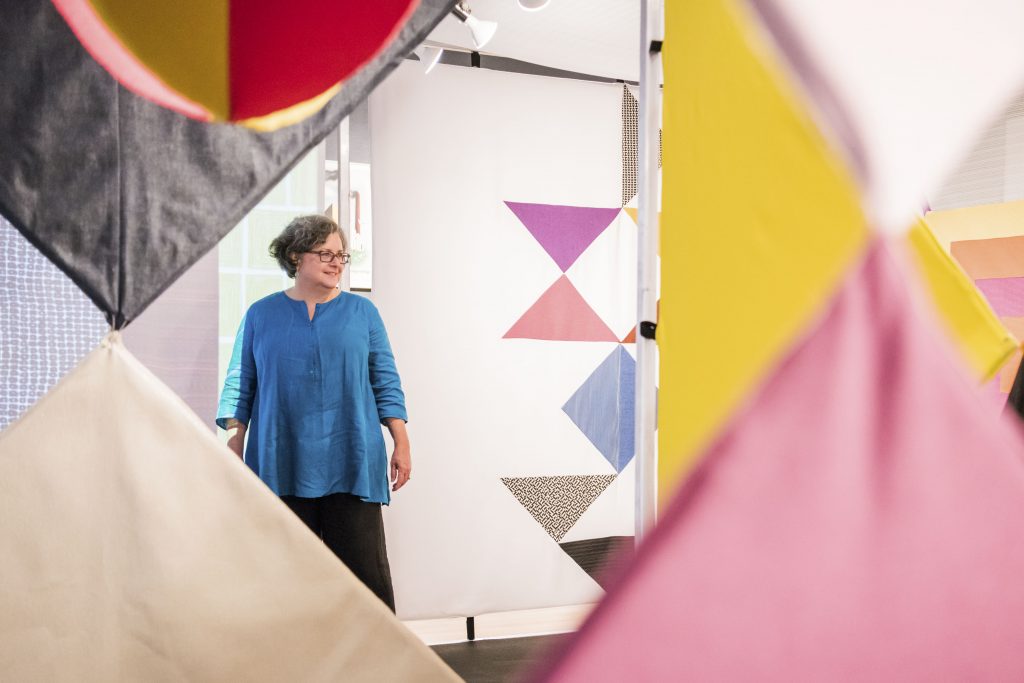
Margaret Re standing in her colorful textile installation.
Curator Margaret Re with her 2018 exhibit A Designed Life: Contemporary American Textiles, Wallpapers, and Containers & Packaging, 1951 – 1954, at UMBC’s Center for Art, Design and Visual Culture (CADVC). Photo by Marlayna Demond ’11 for UMBC Magazine.

READ MORE: A Designed Life: Modernism as Propaganda
“Textiles were among the most visible and industrially innovative products produced in the U.S. in the 1950s and impacted many aspects of postwar life,” Berry College historian Virginia Troy told me in an interview.
Wartime rationing, which included clothing and textiles, had ended in 1946. As the economy grew, so did the appetite for textiles. Used for upholstery, curtains and carpeting, they were integral to modern architecture: They could unify open floor plans, serve as dividers and separate work areas from living spaces.
Knoll’s unobtrusive textile designs – which tended to feature subtle colors – often included geometric or biomorphic prints and woven fabrics in which vertical and horizontal weaves formed a pattern.
Her textiles were quite different from the brocade and chintz cabbage roses sold in most of the era’s textile showrooms.

Branding and selling America abroad

Around this time, the U.S. government started sponsoring international expositions to introduce the American people and their innovations abroad – what historian Robert Haddow called “Pavilions of Plenty.”
The most famous is probably the 1959 American National Exhibition in Moscow, during which then-Vice President Richard Nixon and Soviet Premier Nikita Khrushchev held their “kitchen debate” and argued about the merits of capitalism and communism.
But there were smaller exhibits that preceded the American National Exhibition in Moscow including “How America Lives,” which was held in Frankfurt in 1949, and “America at Home,” an exhibition in Berlin that took place in 1950.
In 1951, the Traveling Exhibition Service – now called the Smithsonian Institution Traveling Exhibition Service – asked Knoll to curate and design an exhibit. She had been recommended by Edgar Kaufmann Jr., the director of the Museum of Modern Art’s Good Design program. It also didn’t hurt that Knoll was known in some government circles. She had designed Secretary of War Henry Stimson’s office, and Knoll Associates had outfitted government buildings in the U.S. and Europe.
Titled “Contemporary American Textiles,” Knoll and the Planning Unit designed an exhibit that, like her office designs, was meant to be experienced as a whole. The self-lit aluminum-framed pavilion included its own drop-in floor, and double-sided wall panels assembled from textiles were hung by straps and braced by cross-wires.
For a 2018 exhibit titled “A Designed Life,” organized by UMBC’s Center for Art, Design & Visual Culture, I recreated Knoll’s original exhibit using photographs and plans from the Archives of American Art.
Brightly colored panels were used to make rooms within a room. Sight lines formed by triangular shapes and patterns directed visitors through the exhibit, offering a continuously changing viewpoint described by the magazine Interiors as “kaleidoscopic.”
The display showcased over 150 well-designed, mass-produced and readily available fabrics; in the forward of the accompanying catalog, Knoll described the textiles as “designs of beautiful color in all price ranges.” Over 50 of these fabrics were sold under the Knoll Textile label.

The recreated Knoll exhibition allows visitors to participate in the original ‘kaleidoscopic’ experience. Dan Meyers, Author provided.

The goal was to sell the idea of capitalism, America and democracy in a post-war Europe that was anxious to rebuild, and it appeared in West German and Austrian schools, museums and trade fairs.
Government records note that the exhibit was included in the 1952 Berlin Cultural Festival and presented in 1953 in Munich and Essen. The U.S. Embassy in France also sponsored its display in a 1954 Parisian trade show dedicated to household management.
To date, there’s no known physical trace of this exhibit.
Was it thrown away or donated to a German school or museum in order to earn some goodwill? Was it discarded because the 1948 Smith-Mundt Act, which authorized international public diplomacy, discouraged the presentation of these exhibitions back in the United States?
I have no way of knowing.
I do know, however, that Knoll was proud of this exhibit: When German architect Walter Gropius praised it, she wrote that it was “a great honor.” And she included sketches, plans and photographs of “Contemporary American Textiles” in her papers that she donated to the Archives of American Art.
The exhibit is a reminder that one of the country’s most influential designers was also one of its great ambassadors.


Margaret Re, Associate Professor of Graphic Design, University of Maryland, Baltimore County
This article is republished from The Conversation under a Creative Commons license. Read the original article.
Header Image:  For the 2018 exhibit ‘A Designed Life,’ the author rebuilt Knoll’s ‘Contemporary American Textiles.’ Dan Meyers, Author provided

Restorative practices may not be the solution, but neither are suspensions

by F. Chris Curran, assistant professor of public policy, UMBC

Proponents of restorative justice suffered a blow recently with the late 2018 release of a much anticipated RAND study of restorative practices in Pittsburgh schools. The study’s results showed restorative practices were not as effective as many hoped – or as they are sometimes portrayed by proponents and in the media .

Unlike traditional disciplinary approaches, such as suspension, which remove students from school, restorative practices focus on repairing harm done by getting victims and perpetrators together to talk.

The idea is to rebuild and restore a sense of dignity and community.

As an educational researcher who studies school discipline, I think it would be misguided to use the study as a reason to go back to the old way of doing things, as is currently under debate in some locales.

First, let’s look at what the study found.

Mixed results

On the positive side, the study found evidence that teachers in schools using restorative practices reported better classroom management and school climate. Restorative practices led to an almost 15 percent decline in days lost to suspension overall. The intervention decreased the days lost to suspension for both black students and students from lower income households. However, it had no significant impact on white students or students from more affluent households. Furthermore, impacts were particularly large in elementary schools – there, the intervention led to an over 50 percent decline in days lost to suspension.

At the same time, however, there were a number of negative outcomes. Restorative practices did not lead to lower rates of suspension in middle schools. Nor did it result in declines in suspensions for violence or arrests. Furthermore, there were negative, statistically significant impacts on standardized achievement test scores in middle schools and for black students.

And, contrary to how teachers saw restorative practices, students reported worse classroom management and relationships.

In my opinion, it’s fair to say the findings were mixed at best.

Strong design, different takes on results

While the new study is not the first to examine restorative practices, it is notable for the strength of its research design. Schools were randomly assigned to use the Institute for Restorative Practices’ SaferSanerSchools Whole-School Change program or not. Since randomized controlled trials are considered the “gold-standard” of evaluating the effectiveness of an intervention, the RAND study theoretically provides more credible estimates of the true effect of the program separate from other school policies and practices.

Perhaps unsurprisingly, the mixed findings have resulted in differing interpretations of the results.

For instance, Max Eden, of the Manhattan Institute, criticized the study’s original authors and popular media for focusing on the positive findings and downplaying the negative results. Ironically, Eden played up the negative findings claiming that “restorative justice isn’t working”.

In addition to the RAND study of restorative practices, other recent studies of discipline reforms, including bans on the use of suspension for minor offenses and shortening the length of suspensions, have also resulted in mixed findings.

A return to suspensions is not the solution

So what should educators and policymakers do with these results?

Even though the RAND study presents a speed bump on the road to discipline reform, turning back to what research has shown to be ineffective and inequitable exclusionary discipline practices would also be a mistake. Numerous studies have found that being suspended from school is predictive of a host of negative outcomes. Those outcomes include decreased academic achievement, a higher likelihood of involvement with the justice system, and decreased civic engagement as adults.

Zero tolerance policies have also been shown to result in greater uses of suspensions and little benefit in terms of improved school climate.

Exclusionary practices are also disproportionately used against students of color. Federal data and other studies have repeatedly shown that black students are three to four times as likely to be suspended as white students, with a large number of these suspensions being for lower level misconduct like “disrespect.”

Such disparities can’t be explained by differences in behavior across racial groups. The disparities may be the result of differences in the use of exclusionary discipline policies across schools.

Reducing suspensions and improving equity in school discipline is still a valid policy goal. The fact that initial reforms have not produced immediate positive results is disappointing, but hardly surprising. After all, changing practice and finding effective interventions in the field of education is hard work. Instead of settling for suspensions, I believe this is the time when states and local school districts should double down on trying innovative alternative approaches to discipline.2

* * * * *

F. Chris Curran, Assistant Professor of Public Policy, University of Maryland, Baltimore County

This article is republished from The Conversation under a Creative Commons license. Read the original article.

Header image of Chris Curran by Marlayna Demond ’11 for UMBC Magazine.

The Conversation

Celebrating Public Service

More than 130 members of the Retriever community gathered in Annapolis on January 23 to celebrate the many ways UMBC alumni make an impact through careers that serve the State of Maryland, including elected officials, policy analysts, and other advocates working for the public good. In addition to networking, talking with current students, and celebrating UMBC’s recent successes, guests also took part in a “UMBC 101” active learning demonstration, a highlight of the evening.

See more images from the evening at UMBC Alumni Flickr.

Photos by Marlayna Demond ’11 for UMBC Magazine.

Countering Russian disinformation the Baltic nations’ way

by Terry Thompson, Adjunct Instructor in Cybersecurity, UMBC

As the new Congress begins, it will soon discuss the comprehensive reports to the U.S. Senate on the disinformation campaign of half-truths, outright fabrications and misleading posts made by agents of the Russian government on social media in the run-up to the 2016 presidential election.

After years of anemic responses to Russian influence efforts, official U.S. government policy now includes taking action to combat disinformation campaigns sponsored by Russia or other countries. In May 2018, the Senate Intelligence Committee endorsed the concept of treating attacks on the nation’s election infrastructure as hostile acts to which the U.S. “will respond accordingly.” In June, the Pentagon unleashed U.S. Cyber Command to respond to cyberattacks more aggressively, and the National Cyber Strategy published in September 2018 clarified that “all instruments of national power are available to prevent, respond to, and deter malicious cyber activity against the United States.”

There are already indications that Cyber Command conducted operations against Russian disinformation on social media, including warning specific Russians not to interfere with the 2018 elections. However, low-level cyberwarfare is not necessarily the best way. European countries, especially the Baltic states of Estonia, Latvia and Lithuania, have confronted Russian disinformation campaigns for decades. Their experience may offer useful lessons as the U.S. joins the battle.

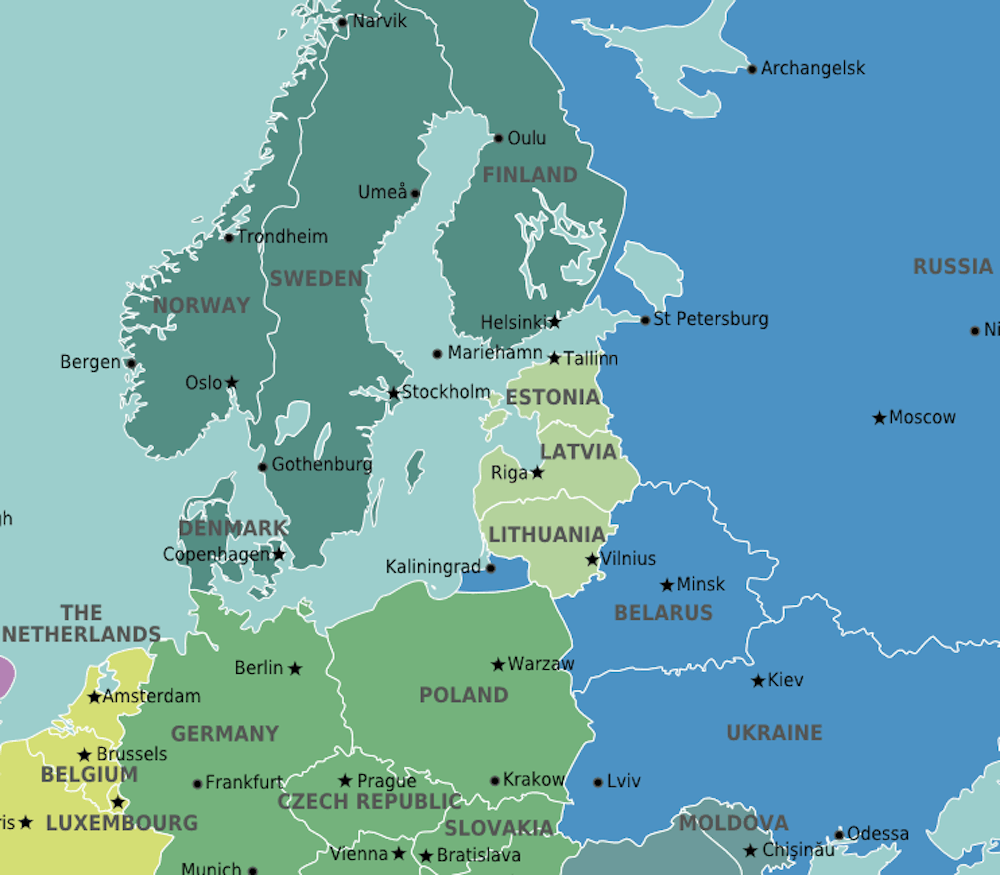
The Baltic Sea region of northern Europe. Estonia, Latvia and Lithuania are in light green in the center, west of Russia in blue.
Stefan Ertmann/Wikimedia Commons, CC BY-SA

The Baltic experience

Beginning in 1940 and continuing until they declared independence in the early 1990s, the Baltic countries were subjected to systematic Russian gaslighting designed to make people doubt their national history, culture and economic development.

The Soviets rewrote history books to falsely emphasize Russian protection of the Baltic people from invading hordes in the Middle Ages, and to convey the impression that the cultural evolution of the three countries was enabled by their allegiance and close ties to Russia. Even their national anthems were rewritten to pay homage to Soviet influence.

Soviet leaders devalued Baltic currencies and manipulated economic data to falsely suggest that Soviet occupation was boosting the Baltic economies. Further, Soviet authorities settled ethnic Russians in the Baltic countries, and made Russian the primary language used in schools.

Since the fall of the Soviet Union and the independence of the Baltic countries, the Russian Federation has continued to deliver disinformation to the region, making extensive use of Russian-language social media. Some themes characterize the Baltic people as ungrateful for Soviet investment and aid after World War II. Another common message criticizes Baltic historians for “falsification of history” when really they are describing the real nature of the Soviet occupation.

A massive Russian attack

After independence, and as the internet grew, Estonia led the way in applying technology to accelerate economic development. The country created systems for a wide range of government and commercial services, including voting, banking and filing tax returns electronically. Today, Estonia’s innovative e-residency system is being adopted in many other countries.

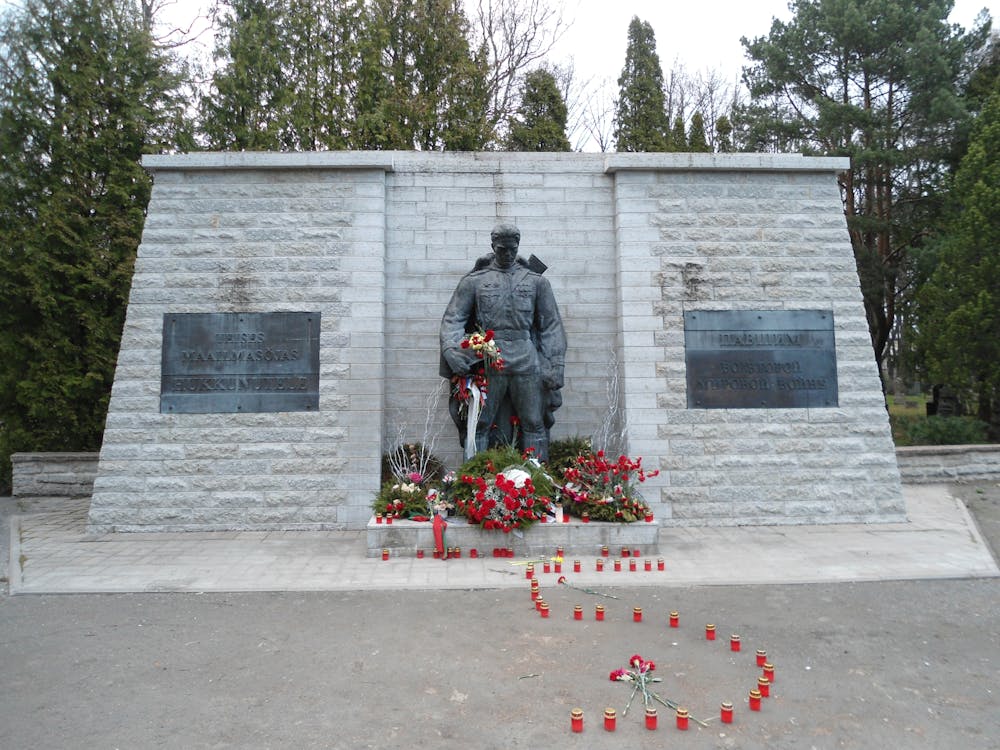
These advances made the Baltics a prime target for cyberattacks. In the spring of 2007, the Russians struck. When Estonia moved a monument memorializing Soviet soldiers from downtown Tallinn, the country’s capital, to a military cemetery a couple of miles away, it provoked the ire of ethnic Russians living in Estonia as well as the Russian government.

A statue
The relocation of the Bronze Soldier of Tallinn sparked a Russian cyberattack on Estonia in 2007.
Keith Ruffles/Wikimedia Commons, CC BY

For three weeks, Estonian government, financial and media computer systems were bombarded with enormous amounts of internet traffic in a “distributed denial of service” attack. In these situations, an attacker sends overwhelming amounts of data to the targeted internet servers, clogging them up with traffic and either slowing them down or knocking them offline entirely. Despite concerns about the first “cyber war,” however, these attacks resulted in little damage. Although Estonia was cut off from the global internet temporarily, the country’s economy suffered no lasting harm.

These attacks could have severely damaged the country’s financial system or power grid. But Estonia was prepared. The country’s history with Russian disinformation had led Estonia to expect Russian attacks on computer and information systems. In anticipation, the government spearheaded partnerships with banks, internet service providers and other organizations to coordinate responses to cyberattacks. In 2006, Estonia was one of the first countries to create a Computer Emergency Response Team to manage security incidents.

The Baltic response

After the 2007 attack, the Baltic countries upped their game even more. For example, Estonia created the Cyber Defense League, an army of volunteer specialists in information technology. These experts focus on sharing threat information, preparing society for responding to cyber incidents and participating in international cyber defense activities.

Internationally, Estonia gained approval in 2008 to establish NATO’s Cooperative Cyber Defense Center of Excellence in Tallinn. Its comprehensive research into global cyber activities helps identify best practices in cyber defense and training for NATO members.

In 2014, Riga, the capital of neighboring Latvia, became home to another NATO organization combating Russian influence, the Strategic Communications Center of Excellence. It publishes reports on Russian disinformation activities, such as the May 2018 study of the “Virtual Russian World in the Baltics.” That report analyzes Russian social media activities targeting Baltic nations with a “toxic mix of disinformation and propaganda.” It also provides insight into identifying and detecting Russian disinformation campaigns.

Baltic elves” – volunteers who monitor the internet for Russian disinformation – became active in 2015 after the Maidan Square events in the Ukraine. And the Baltic nations have fined or suspended media channels that display bias.

The Baltic countries also rely on a European Union agency formed in 2015 to combat Russian disinformation campaigns directed against the EU. The agency identifies disinformation efforts and publicizes accurate information that the Russians are seeking to undermine. A new effort will issue rapid alerts to the public when potential disinformation is directed against the 2019 European Parliament elections.

Will the ‘Baltic model’ work in the US?

Because of their political acknowledgment of threats and actions taken by their governments to fight disinformation, a 2018 study rated Estonia, Latvia and Lithuania the three European Union members best at responding to Russian disinformation.

A look inside Russia’s propaganda machine.

Some former U.S. officials have suggested adopting similar practices, including publicizing disinformation efforts and evidence tying them to Russia. The Senate Intelligence Committee has called for that too, as has the Atlantic Council, an independent think tank that focuses on international affairs.

The U.S. could also mobilize volunteers to boost citizens’ and businesses’ cyberdefenses and teach people to identify and combat disinformation.

Disinformation is a key part of Russia’s overall effort to undermine Western governments. As a result, the battle is ever-changing, with Russians constantly trying new angles of attack and target countries like the Baltic nations identifying and thwarting those efforts. The most effective responses will involve coordination between governments, commercial technology companies and the news industry and social media platforms to identify and address disinformation.

A similar approach may work in the U.S., though it would require far more collaboration than has existed so far. But backed by the new government motivation to strike back when provoked, the methods used in the Baltic states and across Europe could provide a powerful new deterrent against Russian influence in the West.The Conversation

* * * * *

Terry Thompson, Adjunct Instructor in Cybersecurity, University of Maryland, Baltimore County

This article is republished from The Conversation under a Creative Commons license. Read the original article.

Header image by 贝莉儿 NG on Unsplash.

Peaceworkers Reunite to Celebrate Milestone of Public Service

Twenty-five years ago, when Sarge and Eunice Shriver inaugurated the new Shriver Center at UMBC, they charged the community to connect scholarship, service, and reflection to engage and collaborate with communities in Baltimore City. At the time, Ernest Boyer, a leading visionary in higher education, called the newly inaugurated center a prototype for a  “New American College,” where the university’s people and resources would be focused on a public service mission within its urban setting…to take up the citizen call to connect learning and higher education with social change and development.

The Shriver Center meets that challenge in a number of ways, including the Shriver Peaceworker Program, which since 1993 has “realized the potential impact of Peace Corps Volunteers returning home ready to apply the lessons and experience they had gained abroad.” Through this work, the program has supported nearly 190 Fellows representing over 60 countries of Peace Corps service (from Albania to Zimbabwe and dozens in between), as well as served with scores of local community partners. Their commitment in East Baltimore alone has supported a myriad of programs and organizations such as inclusive programming in Patterson Park; bringing Spanish bilingual services and outreach to numerous organizations in the area’s diverse surrounding communities; coordinating environmental education programming; organizing communities and local projects, and serving youth in local schools to provide college access and increase family engagement.  

This fall more than a hundred Shriver Peaceworker alumni living locally and around the world reunited in Baltimore to celebrate their first reunion with a weekend filled with festivities, reflection, and service, including trash clean-up at Gwynns Falls/Leakin Park.

The next 25 years of Peaceworkers

The weekend closed with alumni reflecting on the challenges of continuing to engage in authentic dialogue across diverse perspectives and lines of division. It’s the community created by this shared and ongoing commitment to service and peace that makes the program’s bonds so strong and enduring.  

We’re proud and inspired by the lives of service and social change our alumni are leading.  Nearly half have stayed on in our Baltimore region and the other half are engaged around the country and across the globe. And all are committed to living their values and making a positive difference in their communities and beyond. Peaceworker alums are teachers, program leaders, policy analysts and advocates, social workers, community organizers, public servants at all levels of government, higher education staff and faculty, and more.     

We had a wonderful reunion celebration…Now we are looking forward to keeping that energy moving forward into the next 25 years!  In one of Sarge’s (Sargent Shriver’s) late public speeches in 2004, he continued to challenge us all to hold on to social hope and keep at the work of peacebuilding and positive social change, saying:  “All of history’s great changes — nonviolent changes — came from below, not from above. It comes from us, and often from the least of us. From my own life I can tell you. It’s not what you get out of life. It’s what you give to others in life which truly enriches your own life.”

– Joby Taylor, Ph.D. ’05, language, literacy & culture
Director, Shriver Peaceworker Program