All posts by: Magazine Editor


Smart devices spy on you – 2 computer scientists explain how the Internet of Things can violate your privacy

By Roberto Yus, assistant professor, Computer Science, UMBC, and Primal Pappachan, Penn State

Have you ever felt a creeping sensation that someone’s watching you? Then you turn around and you don’t see anything out of the ordinary. Depending on where you were, though, you might not have been completely imagining it. There are billions of things sensing you every day. They are everywhere, hidden in plain sight – inside your TV, fridge, car and office. These things know more about you than you might imagine, and many of them communicate that information over the internet.

Back in 2007, it would have been hard to imagine the revolution of useful apps and services that smartphones ushered in. But they came with a cost in terms of intrusiveness and loss of privacy. As computer scientists who study data management and privacy, we find that with internet connectivity extended to devices in homes, offices and cities, privacy is in more danger than ever.

Internet of Things

Your appliances, car and home are designed to make your life easier and automate tasks you perform daily: switch lights on and off when you enter and exit a room, remind you that your tomatoes are about to go bad, personalize the temperature of the house depending on the weather and preferences of each person in the household.

To do their magic, they need the internet to reach out for help and correlate data. Without internet access, your smart thermostat can collect data about you, but it doesn’t know what the weather forecast is, and it isn’t powerful enough to process all of the information to decide what to do.
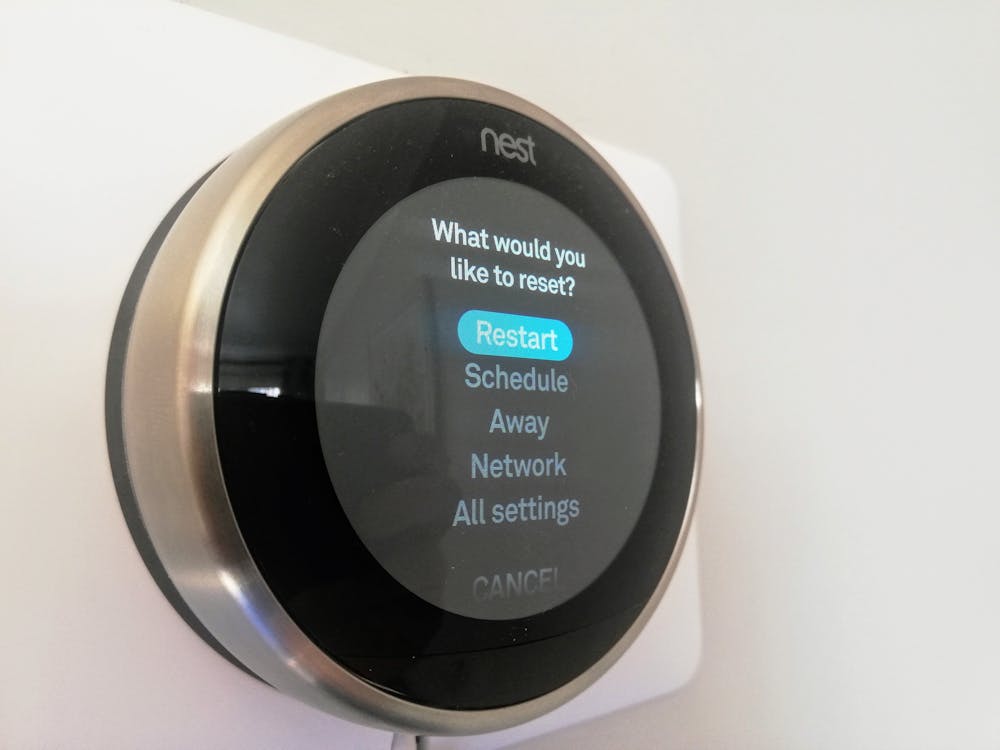
A disk with a display screen mounted on a wall
The Nest smart thermostat tracks your presence and is connected to the internet. Smart Home Perfected/FlickrCC BY

But it’s not just the things in your home that are communicating over the internet. Workplaces, malls and cities are also becoming smarter, and the smart devices in those places have similar requirements. In fact, the Internet of Things (IoT) is already widely used in transport and logistics, agriculture and farming, and industry automation. There were around 22 billion internet-connected devices in use around the world in 2018, and the number is projected to grow to over 50 billion by 2030.

What these things know about you

Smart devices collect a wide range of data about their users. Smart security cameras and smart assistants are, in the end, cameras and microphones in your home that collect video and audio information about your presence and activities. On the less obvious end of the spectrum, things like smart TVs use cameras and microphones to spy on users, smart lightbulbs track your sleep and heart rate, and smart vacuum cleaners recognize objects in your home and map every inch of it.

Sometimes, this surveillance is marketed as a feature. For example, some Wi-Fi routers can collect information about users’ whereabouts in the home and even coordinate with other smart devices to sense motion.

Manufacturers typically promise that only automated decision-making systems and not humans see your data. But this isn’t always the case. For example, Amazon workers listen to some conversations with Alexa, transcribe them and annotate them, before feeding them into automated decision-making systems.

But even limiting access to personal data to automated decision making systems can have unwanted consequences. Any private data that is shared over the internet could be vulnerable to hackers anywhere in the world, and few consumer internet-connected devices are very secure.

Understand your vulnerabilities

With some devices, like smart speakers or cameras, users can occasionally turn them off for privacy. However, even when this is an option, disconnecting the devices from the internet can severely limit their usefulness. You also don’t have that option when you’re in workspaces, malls or smart cities, so you could be vulnerable even if you don’t own smart devices.

Therefore, as a user, it is important to make an informed decision by understanding the trade-offs between privacy and comfort when buying, installing and using an internet-connected device. This is not always easy. Studies have shown that, for example, owners of smart home personal assistants have an incomplete understanding of what data the devices collect, where the data is stored and who can access it.

a toddler touches the top of a black cylinder on a dining table as a family eats in the background
Smart speakers continuously listen for your commands. Oscar Wong/Moment via Getty Images

Governments all over the world have introduced laws to protect privacy and give people more control over their data. Some examples are the European General Data Protection Regulation (GDPR) and California Consumer Privacy Act (CCPA). Thanks to this, for instance, you can submit a Data Subject Access Request (DSAR) to the organization that collects your data from an internet-connected device. The organizations are required to respond to requests within those jurisdictions within a month explaining what data is collected, how it is used within the organization and whether it is shared with any third parties.

Limit the privacy damage

Regulations are an important step; however, their enforcement is likely to take a while to catch up with the ever-increasing population of internet-connected devices. In the meantime, there are things you can do to take advantage of some of the benefits of internet-connected without giving away an inordinate amount of personal data.

If you own a smart device, you can take steps to secure it and minimize risks to your privacy. The Federal Trade Commission offers suggestions on how to secure your internet-connected devices. Two key steps are updating the device’s firmware regularly and going through its settings and disabling any data collection that is not related to what you want the device to do. The Online Trust Alliance provides additional tips and a checklist for consumers to ensure safe and private use of consumer internet-connected devices.

If you are on the fence about purchasing an internet-connected device, find out what data it captures and what the manufacturer’s data management policies are from independent sources such as Mozilla’s Privacy Not Included. By using this information, you can opt for a version of the smart device you want from a manufacturer that takes the privacy of its users seriously.

*****

Roberto Yus, Assistant Professor of Computer Science, University of Maryland Baltimore County and

Primal Pappachan, Postdoctoral Scholar in Computer Science, Penn State

Header Image: Appliances that make your life easier could also put your privacy at risk. Eric Kayne/AP Images for Samsung

This article is republished from The Conversation under a Creative Commons license. Read the original article.

Settler Colonialism Helps Explain Current Events

By John Rennie Short, professor, School of Public Policy, UMBC

Global flashpoints, including the Russian invasion of Ukraine and Chinese actions in Xinjiang, share a common background: a previous history of invasion and occupation.

The northwestern region of Xinjiang, for example, became an autonomous region under Chinese rule in 1955. Officially known as the Xinjiang Uyghur Autonomous Region, this mainly Turkic, Muslim area is viewed by the Chinese as a possible threat to China’s security and territorial integrity.

The government in Beijing encouraged mass migration of Han Chinese into Xinjiang, which fomented resentment among the local Uyghur people. After clashes in 2009 that caused more than 200 deaths and a 2013 terrorist attack in Tiananmen Square, the Chinese cracked down with aggressive policing and extreme surveillance. Hundreds of thousands of Uyghurs have been jailed, more than 1 million detained in “reeducation camps,” and China has been accused of genocide.

These tactics of invasion and occupation can also be seen in the way 250,000 Russians moved to Crimea after it was annexed in 2014.

Academics sometimes refer to these tactics as “settler colonialism.” As a strategy of subjugation, it has many historical precedents and it provides an important lens for understanding geopolitics in various parts of today’s world.

Two types of empire

History is studded with empires. Broadly speaking, there are two types.

British rule in India exemplifies an empire of control, where imperialists extract wealth and resources without large-scale emigration from the colonizing country. The importation of the wealth of India, especially its textiles, was an essential requirement of Britain’s Industrial Revolution.

There are also empires of settlement that occupy colonial territories by moving in large numbers of settlers. Across the world, especially in the lightly settled open grasslands of Australia and the Americas, the original inhabitants were displaced and marginalized as their homeland was taken by treaty, sale, guile and theft.

The process often involved brute force or ethnic cleansing as land was seized and handed over to immigrants. In Australia, the British justified colonization by declaring the continent “terra nullius” – that is, empty and uninhabited.

Settler colonies were used to safeguard the edges of empires. A policy used by the Qing dynasty (1644-1912) that moved ethnic Chinese settlers into recently captured territory is still used today in Tibet and Xinjiang. Both imperial Russia and the former Soviet Union encouraged citizens to settle border regions, so today at least 20% of the population of Ukraine is ethnic Russian.

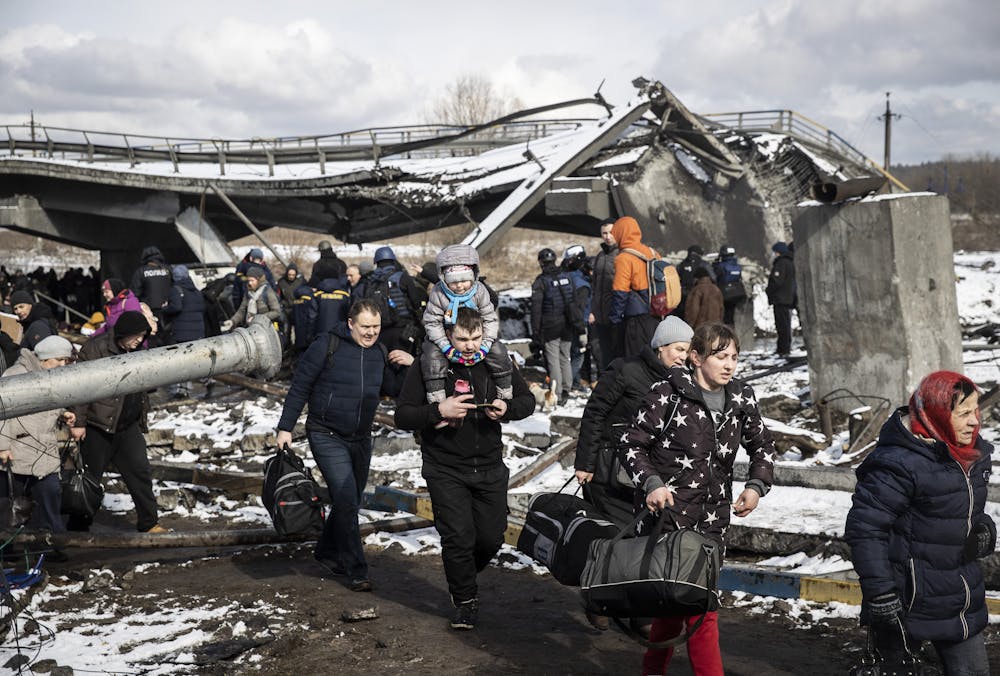
people dressed in winter coats carry their belongings through the snow, with a destroyed bridge in the background
Civilians continue to flee from Irpin because of ongoing Russian attacks in Irpin, Ukraine on March 8, 2022. Emin Sansar/Anadolu Agency via Getty Images

Settler colonialism

Many settler empires rose in the 18th and 19th centuries and continued well into the 20th century. In Africa, for example, settler societies were established by the British in Kenya, the French in Algeria and the Dutch in South Africa.

The colonists who moved in, often in large numbers, were typically white Europeans who took control over the land, lives and economy of Indigenous peoples. There were exceptions, though. In Liberia, Black Americans settled in the land of Black Africans; in Israel, mainly Jewish immigrants took over the land of Arab populations; and in China, the majority Han people moved into non-Han areas.

My research into the interactions between Indigenous people and European settlers in North America and resistance to cultural integration by an Indigenous art movement in central Australia has offered me a different way to view history. Looking at the past through a lens of settler colonialism substantially changes how we view histories of many countries, including Australia, Canada, New Zealand, South Africa and the U.S.

Today’s issues, viewed through a colonial lens

Most settler societies are steeped in a prejudiced history in which racial categories define who has power. One strategy has been to make full citizenship available only to settlers and their offspring. Some of the more extreme examples include racialized rule in South Africa that created brutal apartheid and traumatized generations of aboriginal Australians.

There is also a long history of child abuse, with Indigenous children taken from their homes to be assimilated into settler society. Emerging evidence of these practices, including those experienced by Indigenous children in Canada’s residential schools, is helping to rewrite the history books from the Indigenous – rather than just from the settler – perspective.

By restricting immigration, some countries – including Australia, Canada and the U.S., among others – have tried to maintain their racial or ethnic identities and their power. Many of these policies were weakened only in recent years.

But in acts of amazing resilience, Indigenous societies have resisted cultural assimilation, political marginalization and economic insecurity.

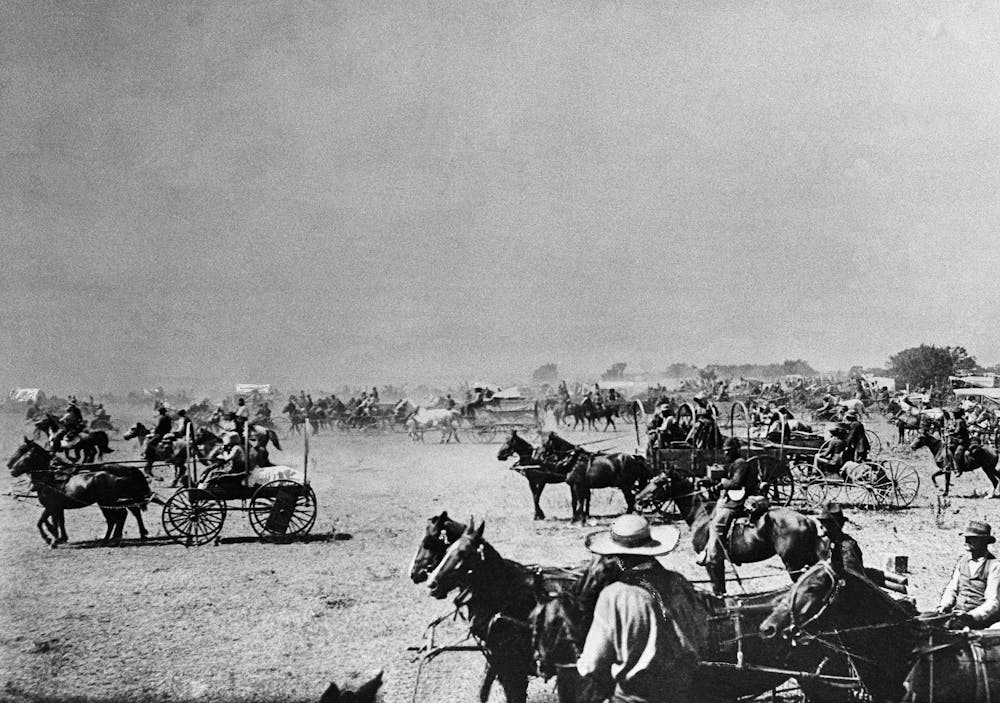
Horse-drawn carriages are scattered across a deep and flat landscape in a black and white photograph.
Settlers raced into what was then known as ‘Indian Territory’ as the sound of a gunshot opened the area to white settlement on Sept. 16, 1893. The land rush marked the early beginnings of the state of Oklahoma. AP Photo/A.A. Forbes

Land is a key issue, as Indigenous groups continue to pursue land claims and resist land grabs. From ongoing Mapuche claims in Chile to aboriginal Australians’ successful campaign to overturn the legality of “terra nullius,” land seized by settlers is being disputed.

New facts and greater awareness of the racist nature of settler societies are challenging the triumphalist view of progress. New information is providing a darker understanding of the impact of settler colonialism on Indigenous peoples, including ethnic genocide and the devastating impacts of the loss of both land and cultural identity.

This isn’t just history. Unequal, brutal treatment of settlers and indigenous peoples continues in today’s settler societies, not least of all in Xinjiang and in Ukraine.

*****

Header image: Demonstration for the rights of the Uyghurs in Berlin, 2020. Leonhard Lenz, Wikimedia Commons , CC BY-SA

John Rennie Short, Professor, School of Public Policy, University of Maryland, Baltimore County

This article is republished from The Conversation under a Creative Commons license. Read the original article.
Battles Over Book Bans Reflect Conflicts from the 1980s

By Fred L. Pincus, Emeritus Professor of Sociology, UMBC

A conservative leader found fault with how “respect for our nation’s heritage” had been mostly stripped from the textbooks of public schools.

“From kindergarten right through the total school system, it almost seems as if classroom textbooks are designed to negate what philosophies previously had been taught,” the conservative leader lamented. “[M]any textbooks are actually perverting the minds of literally millions of students.”

A teachers organization shot back, saying the underlying motive for some attacks against books has “unquestionably been racial.”

This might sound like a back-and-forth from recent debates over removing books from school classrooms and libraries. Often, critical race theory – an academic framework for understanding racism – has been at the center of these debates. But in reality, both quotes are more than 40 years old.

Religious influence on politics

The first quote came from a 1981 book by the Rev. Jerry Falwell titled “Listen, America!” Falwell, founder of the Moral Majority, was one of the leaders of the book-banning efforts of the 1980s. It was during this period – with Ronald Reagan in the White House – that Christian fundamentalists became a growing influence in conservative American politics.

The second quote comes from a 1981 publication of the National Council of Teachers of English, “The Students’ Right to Read.” The council was one of the major groups opposing Falwell and other conservatives.

AOK Library stacks, photo by Marlayna Demond ’11.

The attacks on books in the 1980s bear similarities to the current attacks. Both object to the critical teaching about race and racism, historical as well as contemporary. Both accuse schools of tearing down America and weakening patriotism. Both object to teaching about gender roles, sexual orientation and alternative models of the family. Conservative institutions like the Heritage Foundation have been involved in both periods.

There are also important differences between the two periods. The 1980s bogeyman was secular humanism, because it argued that human beings can define their own morality without the use of religion. Falwell and others claimed that public schools were anti-Christian because they taught students that they didn’t have to use the Bible as a standard for right and wrong. Chaos would result, the Christian fundamentalists asserted, if everyone had to determine their own morality.

In a way reminiscent of the so-called Scopes Monkey Trial in 1925, conservatives objected to the teaching of evolution as a fact, rather than a theory. Instead, they wanted biology textbooks to give equal space to the so-called scientific theory of creationism, which holds that God created the universe.

A new bogeyman

In 2022, of course, the bogeyman is critical race theory. Emerging from critical legal theory taught in law schools, critical race theory argues that white supremacy has been embedded in American legal and educational institutions since the time of slavery.

Right-wing critics have made a number of erroneous allegations about critical race theory: that it is taught in public schools; that it is Marxist; that it is intended to make whites feel guilty; and more. The Heritage Foundation has published “How to Identify Critical Race Theory” as a guide to help parents evaluate books and curricula by looking for words like “systemic racism,” “white privilege” and “social construction or race.”

In fact, these concepts predated critical race theory, which came on the scene in the late 1970s and 1980s. Activist Stokely Carmichael – also known as Kwame Ture – and political scientist Charles V. Hamilton discussed institutional racism in “Black Power: The Politics of Liberation in America” in 1967. “Institutional racism” and “structural racism” are very similar to “systemic racism.”

AOK Library book display with a sign that says “Read books by Black Women.” Photo by Marlayna Demond ’11.

White privilege” was discussed by W.E.B. Du Bois in the early 20th century and by civil rights activists in the 1950s and 1960s. Another term associated with critical race theory, “the social construction of race,” was used by anthropologists like Franz Boas back in the 1950s.

New interpretations

Critical race theorists took these and other concepts, reinterpreted them and applied them to the American legal system. Scholars in education have done the same in trying to understand education as an institution. After 40-plus years of teaching and writing about race and diversity, I know that it is impossible to accurately discuss American racial conflict without using these concepts. But that’s what many lawmakers would have American educators do.

According to a Pen America report, a nonprofit that advocates for freedom of expression in literature, 156 “educational gag order” bills in 39 states have been introduced since January 2021. Twelve have become law in 10 states, and 113 are pending in 35 states. As of March 2022, at least seven states specifically ban the teaching of critical race theory. “Cumulatively,” says the Pen report, “they represent a national assault on our education system, censoring both what teachers can say and what students may learn.”

Of course, some white students – and other students, too, for that matter – will feel uncomfortable upon learning not only about the history of American racism but also its present manifestations. Reality is sometimes uncomfortable.

That’s where good teaching comes in. Good teaching means taking the students’ age into account. It also means being supportive of students who may feel uncomfortable or guilty about certain events in American history.

I always tell students: “You are not responsible for what happened in the past. You are responsible to decide what you plan to do in the present and the future.”

*****

Fred L. Pincus, Emeritus Professor of Sociology, University of Maryland, Baltimore County

Header Image: At least seven states have banned the teaching of critical race theory. Smith Collection/Gado/Getty Images

Economic Sanctions May Deal Fatal Blow to Russia’s Already-Weak Domestic Opposition

By Brian Grodsky, professor, Political Science, UMBC

The West has responded to Russia’s invasion of Ukraine by imposing harsh economic sanctions.

Most consequentially, key Russian banks have been cut out of the SWIFT payments messaging system, making financial transactions much more difficult. The United States, European Union and others also moved to freeze Russian Central Bank reserves. And U.S. President Joe Biden is weighing a total ban on Russian oil imports.

These sanctions are aimed at generating opposition from both Russian President Vladimir Putin’s inner circle and everyday Russians. As a scholar who studies regime change, I believe the risk is that they will actually drive the Kremlin’s weak opposition further into obscurity.

A ‘punishment logic’

Economic sanctions follow a “punishment logic”: Those feeling economic pain are expected to rise up against their political leaders and demand a change in policies.

Everyday Russians have already felt the pain from the newest sanctions. The ruble plummeted in value, and Russia’s stock market dipped. The effects of Western sanctions were seen in the long lines at ATMs as Russians tried to pull out their cash before it was lost.

But the odds of an uprising are not great. Empirical research suggests that sanctions rarely generate the sorts of damage that compel their targets to back down. Their greatest chance of success is when they are used against democratic states, where opposition elites can mobilize the public against them.

In authoritarian regimes like Putin’s, where average citizens are the most likely to suffer, sanctions usually do more to hurt the opposition than help it.

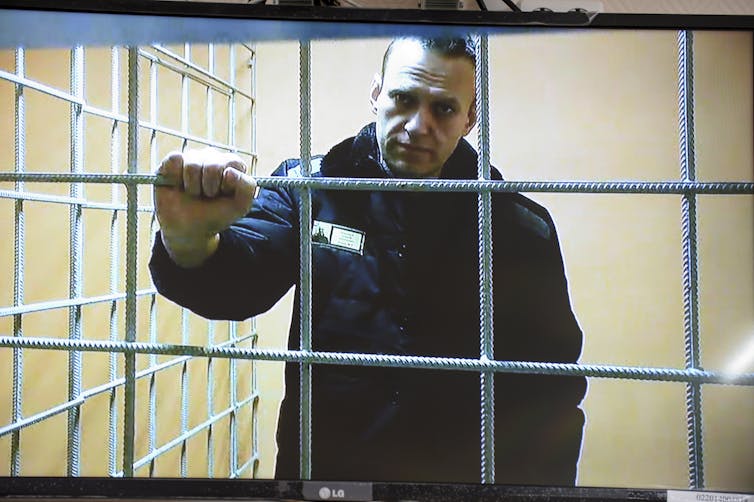
A man stands behind bars in a prison with his right hand on one of the bars
Russian opposition leader Alexei Navalny has been behind bars since early 2021. AP Photo/Denis Kaminev

How Putin has quelled dissent

Putin has used a variety of tools to try to quell domestic opposition over the past two decades.

Some of these were subtle, such as tweaking the electoral system in ways that benefit his party. Others were less so, including instituting constitutional changes that allow him to serve as president for years to come.

But Putin has not stopped at legislative measures. He has long been accused of murdering rivals, both at home and abroad. Most recently, Putin has criminalized organizations tied to the opposition and has imprisoned their leader, Alexei Navalny, who was the target of two assassination attempts.

Despite a clampdown on activism, Russians have repeatedly proved willing to take to the streets to make their voices heard. Thousands demonstrated in the summer and fall of 2020 to support a governor in the Far East who had beaten Putin’s pick for the position only to be arrested, ostensibly for a murder a decade and a half earlier. Thousands more came out last spring to protest against Navalny’s detention.

Putin has even begun facing challenges from traditionally subservient political parties, such as the Communist Party and the nationalist Liberal Democratic Party.

Flickers of opposition

Importantly, Putin has occasionally shown a willingness to back down and change his policies under pressure. In other words, as much as Putin has limited democracy in Russia, opposition has continued to bubble up.

The result is a president who feels compelled to win over at least a portion of his domestic audience. This was clear in the impassioned address Putin made to the nation setting the stage for war. The fiery hourlong speech falsely accused Ukrainians of genocide against ethnic Russians in eastern Ukraine. “How long can this tragedy continue? How much longer can we put up with this?” Putin asked his nation.

Since Russia invaded Ukraine, Russians have continued to show their willingness to stand up to Putin. Thousands have gathered to protest the war in Ukraine, despite risking large fines and jail time.

They have been aided by a network of “hacktivists” outside Russia using a variety of tactics to overcome the Kremlin’s mighty propaganda machine. These groups have blocked Russian government agencies and state news outlets from spreading false narratives.

Controlling the narrative

Despite these public showings, the liberal opposition to Putin is undoubtedly weak. In part, this is because Putin controls state television, which nearly two-thirds of Russians watch for their daily news. Going into this war, half of Russians blamed the U.S. and NATO for the increase in tensions, with only 4% holding Russia responsible.

This narrative could be challenged by the large number of Russians – 40% – who get their information from social media. But the Kremlin has a long track record of operating in this space, intimidating tech companies and spreading false stories that back the government line. Just on Friday state authorities said they would block access to Facebook, which around 9% of Russians use.

Putin has already shown he can use his information machine to convert past Western sanctions into advantage. After the West sanctioned Russia for its 2014 takeover of Crimea, Putin deflected blame for Russians’ economic pain from himself to foreign powers. The result may have fallen short of the classic “rally around the flag” phenomenon, but on balance Putin gained politically from his first grab on Ukraine. More forceful economic sanctions this time around may unleash a broader wave of nationalism.

More importantly, sanctions have a long track record of weakening political freedoms in the target state. As the situation in Russia continues to deteriorate, Putin will likely crack down further to stamp out any signs of dissent.

And former Russian president Dmitry Medvedev reacted to the country’s expulsion from the Council of Europe by suggesting Russia might go back on its human rights promises.

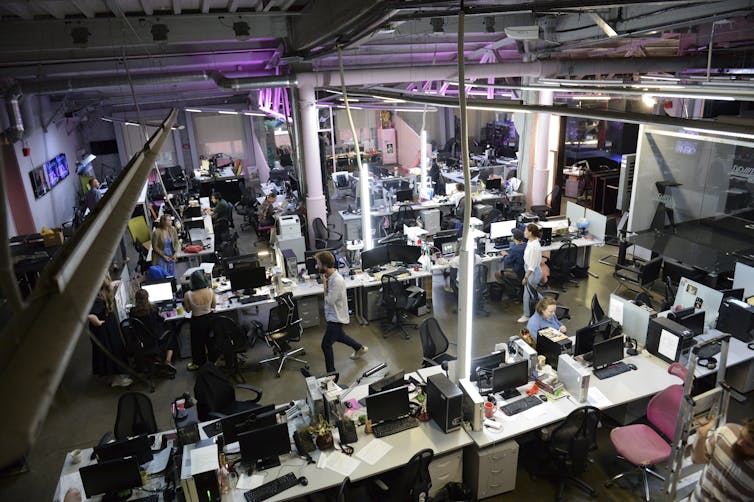
Male and female reporters work at desks in a large newsroom, some sitting, some standing, as viewed from ceiling height
Authorities blocked access to the website of Russian TV channel Dozhd, and the chief editor has fled the country. AP Photo/Denis Kaminev

Another casualty of the war

This has already begun.

In the first week of the war, Russian authorities arrested more than 7,000 protesters. They ramped up censorship and closed down a longtime icon of liberal media, the Ekho Moskvy radio station. The editor of Russia’s last independent TV station, TV Dozhd, also announced he was fleeing the country.

Russia already ranked near the bottom – 150 out of 180 – in the latest Reporters Without Borders assessment of media freedom. And a new law, passed on March 4, 2022, punishes the spread of “false information” about Russia’s armed forces with up to 15 years in jail.

Ironically, then, the very sanctions that encourage Russians to attack the regime also narrow their available opportunities to do so.

Ultimately, the opposition seen on the streets in Russia today and perhaps in the coming weeks may be the greatest show of strength that can be expected in the near future.

The West may have better luck using targeted sanctions against those in Putin’s inner circle, including Russia’s infamous oligarchs. But with their assets hidden in various pots around the world, severely hurting these actors may prove difficult.

Even in the best of circumstances, economic sanctions can take years to have their desired effect. For Ukrainians, fighting a brutal and one-sided war, the sanctions are unlikely to help beyond bolstering morale.

The danger is that these sanctions may also make average Russians another casualty in Putin’s war.

*****

Header image: Russian police have detained thousands of Russians who have taken to the streets to protest the invasion of Ukraine. AP Photo/Dmitri Lovetsky

Brian Grodsky, Professor of Political Science, University of Maryland, Baltimore County

This article is republished from The Conversation under a Creative Commons license. Read the original article.

Ukraine Conflict Brings Cybersecurity Risks to US Homes, Businesses

By Richard Forno, principal lecturer, Cybersecurity, and assistant director, UMBC Cybersecurity Center

All cybersecurity is local, regardless of the world situation. That means it’s personal, too – in Americans’ homes, computers and online accounts. As violence spreads thousands of miles away from the U.S., my strong recommendation is that all Americans remain vigilant and check on their own cybersecurity.

While organizations reinforce their cybersecurity posture during this period of geopolitical tension, I also suggest people regularly ensure their computer, mobile devices and software are updated, double-check that all passwords are secure and all key accounts are protected by two-factor authentication. Beware that phishing attacks may increase, seeking to trick people into clicking links that grant attackers access to computer systems. These are a few simple steps that can help increase one’s cybersecurity preparedness both now and for the future.

Recent Russian-linked cyberattacks, including against energy pipelines, federal government services, and attacks on local governments, first responders, hospitals and private corporations, show the potential for Russian cyber warriors to put U.S. civilians at risk. All these entities should be more vigilant over the coming days.

In the days before Russia invaded Ukraine, a series of cyberattacks disrupted Ukrainian government and business websites – despite Ukraine’s cyberdefense teams’ being prepared to defend against them.

With many Americans working from home because of the pandemic, the U.S. is more vulnerable than it might have been otherwise: Home networks and computers are often less protected than those at an office – which makes them enticing targets.

Russian cyber capabilities, and threats from Russian President Vladimir Putin, mean that what might look like random technical glitches on personal computers, websites and home networks may not be accidental. They could be precursors to – or actual parts of – a larger cyberattack. Therefore, ongoing vigilance is more crucial than ever.

*****

Richard Forno, Principal Lecturer, Cybersecurity and Assistant Director, UMBC Cybersecurity Center, University of Maryland, Baltimore County

Header image: Regular Americans could find themselves targets of Russian cyberwarfare. Roberto Westbrook via Getty Images

This article is republished from The Conversation under a Creative Commons license. Read the original article.

Why Is Taiwan Competing in the Olympics Under ‘Chinese Taipei’?

By Meredith Oyen, associate professor, History and Asian Studies, UMBC

When the Beijing Olympics opens with a glitzy ceremony on Feb. 4, 2022, a tiny contingent of Taiwanese athletes will be in attendance. But they won’t be marching under the Taiwanese flag. And they will be announced as the team from “Chinese Taipei.”

They almost weren’t going to be there at all. Officials from the island had intended their athletes to be absent from the opening or closing ceremony, citing the complexity of pandemic travel. But on Feb. 1, at the behest of the International Olympic Committee (IOC), Taiwanese authorities reversed course.

COVID-19 isn’t the main issue. Behind the changing plans is a dispute over the name of the Taiwanese delegation in Olympic competition. It has its roots in the long history of contention over the status of Taiwan.

As a scholar of relations between the United States and East Asia, I also know that it is a particularly sensitive time. World attention on the Beijing Games comes amid heightened tension over Taiwan’s status, with warnings of “military conflict” if the contested island moves toward formal independence.

Competing Chinas

The status of Taiwan has been disputed since the founding of modern Communist China.

The Chinese Communist Party won its civil war against the Nationalist Party then governing as the “Republic of China” in 1949. The latter fled across the approximately 100-mile strait to the island of Taiwan, which was then still transitioning from decades of Japanese colonization.

There, the exiled Republic of China enjoyed two decades of international support as the government of “Free China.”

Led by the United States, many countries and the United Nations recognized this government on Taiwan as “China,” while refusing to recognize the new People’s Republic of China controlling the far larger mainland.

The IOC similarly only recognized the Taiwan-based government. As a result, the mainland was not represented at the Olympics throughout the 1950s and 1960s. The only Chinese team competing came from Taiwan.

A flag-bearer at the 2018 Beijing Winter Olympic Games holds aloft the emblem of the Chinese Taipei team.
Flying the flag of Chinese Taipei. Ronald Martinez/Getty Images

In the 1970s, however, the tide began to shift. Until then, recognition of Communist China had been limited to Soviet bloc countries and newly decolonized nations in Asia and Africa.

First, in 1971, the U.N shifted recognition from the Republic of China to the People’s Republic of China. Nation after nation followed suit over the course of the decade, with the U.S. switching diplomatic recognition from Taiwan to Beijing in 1979.

Throughout this period, both the People’s Republic of China and the Republic of China on Taiwan agreed on the principle of “one China.” Both governments argued that Taiwan was part of China, and neither would allow countries or organizations to recognize both.

When the UN chose to admit the People’s Republic of China, the government in Taiwan ceased membership in the international body.

When Beijing sought admission into the IOC, it was clear that any formula that allowed athletes from both territories to compete would have to take into account the commitment to the principle of “one China.”

In 1979, the executive committee of the IOC passed a resolution that both governments ultimately agreed to follow. It admitted the People’s Republic of China under the name “Chinese Olympic Committee” and the government of Taiwan as the “Chinese Taipei Olympic Committee.”

This arrangement allowed Beijing to accept Taiwan’s inclusion in the Games by framing the island contingent as a regional branch of its national team, even though their medal counts were separate.

Taiwanese athletes would be required to compete under an alternate anthem and flag to that used by Taiwan, so as not to display Republic of China emblems.

The Republic of China in Taiwan finally agreed to compete under these terms in 1981. It had few other options, given its own past recalcitrance on the issue of allowing both governments in any formal organization. A similar formula was later adopted to allow an independent Olympic team from Hong Kong to compete after the British handed its former colony back to China in 1997.

Pushback to independence

Over the last four decades, the Republic of China on Taiwan has transformed from a colonial authoritarian regime to a democracy.

But at the same time, its international recognition as an independent government has dwindled. From 2000 to 2008 and again starting in 2016, political parties advocating Taiwan’s independence achieved electoral success at the highest levels. But this served to trigger a pushback from Beijing as it seeks to stave off what it views as growing separatism.

These tensions have spilled out into the Olympic arena.

Just last year, during the opening ceremony of the Tokyo Games, a Japanese announcer referred to the “Chinese Taipei” Olympic team as “the team from Taiwan,” lining up in the opening ceremony under “Taipei” instead of “Chinese.”

This angered mainland Chinese officials concerned about a shift away from the one China principle.

And in the run-up to the 2022 Beijing Olympics, Beijing’s Taiwan Affairs Office used a slight variation in the Chinese name for the team from “Chinese Taipei” to stress that it considered Taiwan to be a part of China. They used “zhongguo” (China) instead of “zhonghua” (Chinese). While “Zhonghua” is a broad term that refers to anything Chinese by ethnicity or heritage, “Zhongguo” refers to the country itself.

The Taiwan government vehemently opposed the altered name.

Because Taiwan is a subtropical island, it does not have a significant presence at the Winter Olympics – only four of its athletes have qualified for the forthcoming competition.

Regardless of the team’s size, Chinese authorities will be keen not to allow the issue to be a media distraction during the Beijing Games.

*****

Meredith Oyen, Associate Professor of History and Asian Studies, University of Maryland, Baltimore County

This article is republished from The Conversation under a Creative Commons license. Read the original article.
Header image: Taiwanese independence activists call for a boycott of the Beijing Games. Walid Berrazeg/Anadolu Agency via Getty Images

5 Tips to Help Preschoolers with Special Needs During the Pandemic

By Michele L. Stites, associate professor, Early Childhood Education, UMBC, and Susan Sonnenschein, professor, Applied Developmental Psychology, UMBC

Four months in reading. Five months in math. That’s how far children are behind where they should be for their grade level, according to a 2021 report that says the COVID-19 pandemic – and the transition to virtual learning – are to blame.

For young children in particular, parents report that opportunities for both academic and social emotional growth were lacking during the pandemic. But what is the effect of the pandemic on young children with disabilities, many of whom did not receive their federally mandated special education services as many schools shifted online?

As researchers who specialize in issues of education for young children with disabilities, we found that parents of such children are worried about the impact of virtual learning because of the lack of special education services, their own child’s inability to participate in virtual instruction, and the lack of opportunities for social emotional growth and development.

While we know that parents are very busy, based on our research, here are five things parents and caregivers of young children with disabilities can do to help bridge the gap caused by the pandemic and distance learning.

1. Communicate frequently with your child’s therapists and educators

In the years before COVID-19 it was common for teachers and therapists – such as speech pathologists, occupational therapists and the like – to initiate communication with families. But as the pandemic persists, educators face overwhelming staff shortages, constant COVID-19 outbreaks and children who have not been in traditional school settings for months on end in some cases.

A teacher helps a child in a wheelchair cut a pink piece of paper with scissors.
Parents of children with special needs worry that their children have fallen behind. ktaylorg/E+ via Getty Images

Since school faculty and staff are overwhelmed, parents may need to take the lead when it comes to communication. Emailing teachers and therapists about your child’s progress is a good place to start. Meetings can be set up from there if needed.

2. Create opportunities to socialize with other children

Parents and psychologists have reported that missing out on opportunities for socialization is one of the biggest side effects of the pandemic. Consider reaching out to parents of your child’s classmates to set up small social gatherings where children can practice age-appropriate socialization skills, such as sharing and taking turns. Being COVID-19 responsible is important, so be sure to follow local safety guidelines.

You can also work with different advocacy groups like the Special Olympics to see what types of programs are available in your area.

3. Work on goals in the child’s individualized education program

A child’s individualized education program should outline the child’s strengths and weaknesses. The IEP should also include goals to support learning in all areas, such as language skills, social skills and the like.

Asking teachers and therapists about how those goals are being addressed at school can give parents ideas about how to naturally incorporate them into a child’s daily routine. For example, if a child is working on counting items one at a time, parents can count oranges at the grocery store or Goldfish crackers on a lunch plate.

4. Take a play-based approach to learning

Embedding learning into play allows parents to teach their child without the formality – and, let’s face it, dullness – of tools like flashcards and worksheets.

Reading and asking questions, playing games like Go Fish where children can identify colors and numbers, spraying a small amount of shaving cream on a flat surface and writing letters in it, and even counting snowballs can be used as learning opportunities.

5. Engage children in conversation

Providing young children opportunities to hear and practice language is critical for their learning. Taking time to talk with a young child is particularly important when the child has a disability. It is also important to give the child the needed time to answer questions. Parents can demonstrate responses for the child to repeat as necessary.

Incorporating some of these ideas into a daily routine can go a long way in bridging the gaps left in the wake of COVID-19 and virtual learning.

*****

Michele L. Stites, Associate Professor of Early Childhood Education, University of Maryland, Baltimore County

Susan Sonnenschein, Professor of Applied Developmental Psychology, University of Maryland, Baltimore County

Header image: Parents say there has been a lack of academic and social learning opportunities for children during the pandemic. SDI Productions/E+ via Getty Images

This article is republished from The Conversation under a Creative Commons license. Read the original article here.

UMBC Softball: Full Steam Toward the ‘Three-peat’

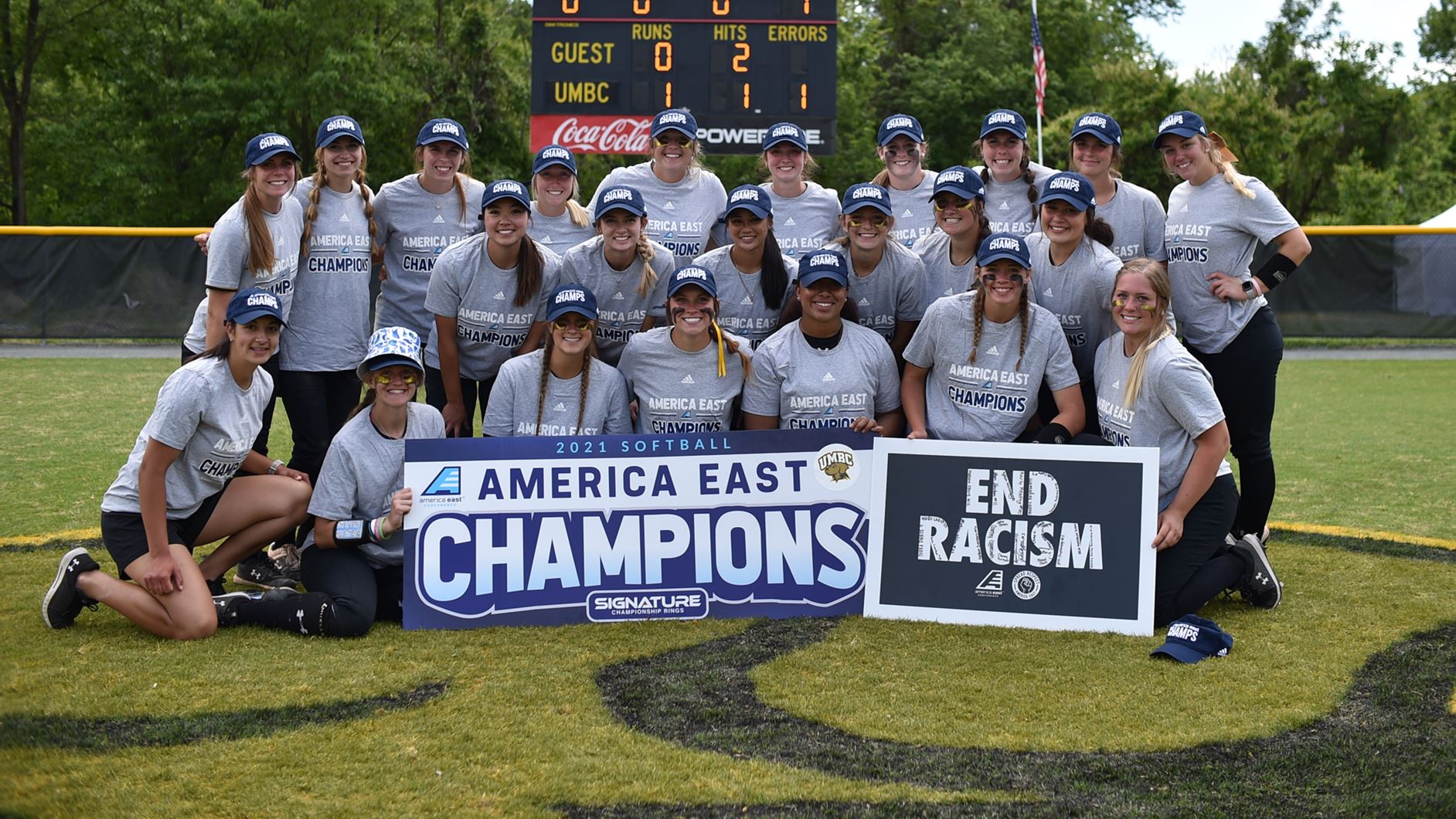
As two-time reigning America East champions, the UMBC women’s softball team is eagerly awaiting the spring season. Following a promising preseason, teammates and coaches are confident and feel prepared to fight for their third America East Conference championship in a row.

Senior catcher and utility—a player who is capable of playing multiple positions—Karly Keating ’22, media and communication studies, remembers what it felt like to capture the conference championship in 2019, the program’s first since they joined America East in 2003. The Retrievers were expected to place last in the tournament. Instead, they upset number three Stony Brook in a thrilling championship match.

“UMBC was known for just not being good at softball. We were always ranked last in our conference every single year, like not even close to even be considered,” Keating said. So when they won the conference tournament, went to the NCAA Tournament selection room and saw they were facing Oklahoma—one of the best softball schools in the NCAA—in the first round, it was a total shock. “When you were a little girl, you knew that’s where the number one school is and you wanna go there, and now the fact that I was playing there was really awesome.”

The making of the team

Even though the  team was ultimately defeated by Oklahoma, senior infielder Chloe Obispo ’22, media and communication studies, can’t stop thinking about their surreal win against Stony Brook. Since there was no pressure to win, they just played their game throughout the season and hoped to prove everyone wrong. 

The team celebrating their 2019 win together with Coach Kuhlmeyer. Photo from The Oklahoman.

“We ended up playing in the conference tournament, and we just kept it day by day, every single game,” Obispo said. “We realized, ‘maybe we actually have a chance this season.’ We were supposed to be last, but it didn’t seem like we could be last at that point. [The win] was a surprise to everyone, including ourselves.”

Both players added that their recruiting class, the class of 2018, included players that filled some gaps in previous rosters. “My freshman year, we were close, but we were really just a bunch of good girls coming together,” said Keating. “And then as we went on, we just got a lot more gelled together and I think we just stayed really strong-minded throughout the whole season.”

Winning under pressure 

The team’s new-found confidence fueled a great start to their 2020 season, and they racked up five wins until the season was canceled by COVID. Nonetheless, the team brushed it off, worked hard over the seven months of quarantine, returned for the 2021 season, and defended their title from 2019. 

“We had to keep our heads high because we won the first time. I felt like a lot more people were coming for us since we basically shut out every team in the tournament last time. When we were working out, we kept in mind that we had to keep our crown, keep our ring,” Obispo said. “It was a lot of pressure, but it was definitely something that we could all handle together.”

Keating said that their second championship win felt just as shocking as the first, but the team had something more to prove. “We had to do it for ourselves, and to prove to us that we are what we preach.”

Ohana Means Family

The team culture revolves around the word “Ohana,” the Hawaiian word for family, said Obispo. This feeling of sisterhood and “no girl left behind” is what drew Obispo to the program, and what the team wanted to showcase in the 2021 regional game. They wanted to show their guts, their trust in each other, and feel like they accomplished something as a family rather than a team. 

The softball team with President Freeman Hrabowski at their last regional tournament in Tucson, Arizona. Photo from UMBC Softball’s Twitter.

“Our Ohana is what our culture and program is all about,” said head softball coach Chris Kuhlmeyer.  “We cannot accomplish anything without each other. Choosing love, respect, unselfishness and forgiveness over pride, unforgiveness, and selfishness will lead you to places you never knew you could accomplish together.  At the end of the day, when we say Ohana, we are choosing family over self and everyone else.”  

To prepare for the Spring 2022 season, the team is working tirelessly to be prepared to defend their title. During the fall semester, they condition once a week on top of daily practices on the field and three weight room sessions per week. 

The players are also focusing on accountability: making sure each teammate is using their time wisely, even if that means spending their day off at the cages to improve their hitting, or getting on the mound for a few hours to perfect their pitching. 

Off the field, they also are strengthening their “Ohana” with team bonding exercises. 

“My coach does this thing where he puts us in groups and we have to go out and do something, and he puts us in groups with different people,” said Obispo. “I think that’s something the team really needed because you play with a bunch of girls and it can get a little hectic sometimes, so sometimes we have to learn how to get along and know more about each other.”

Obispo feels that these exercises help the team bond and will “help overall chemistry, like there are days where we win really big games, it will feel a lot better internally, like we won this as a team.” 

They also are working to find each girl’s “why.” Each player’s “why” is different, but once they find their own individual reason, it makes the team as a whole stronger because each player will play to their best ability, making each win more meaningful. Keating says that intrinsic motivation is what drives her to play well. She understands that this is her last chance to play softball at a high, competitive level, so she wants to make the most of it and leave it all on the field. 

“After college, I can play in a beer league. People will have fun and it will be a good time, but you don’t care as much,” she said.  “I’ll never get the chance to play with girls that genuinely love the sport again.”

The team after they won their 2021 conference title. Photo by Ian Feldmann/UMBC Athletics.

For Obispo, the people around her are what motivates her to make the most of her opportunities. “I’ve worked so hard for my whole childhood to get to moments like this,” she said. “I really enjoy showing up to practice for the people around me and for the people at home, like my family.”

Looking toward the 2022 Season

The team is eager to defend their crown. Unlike previous seasons, they are no longer underdogs, but the team to beat.

“I’m very confident in this group that at the end, we will be right there with a shot at it,” Kuhlmeyer said of winning the conference championship. “This team is built different than previous years, but with the pieces we have added and the veteran experience we have returning, that gives me the confidence we will be there again at the end.  My belief in this group of women is endless.”  

“I’m so excited for the season. Not only because it’s my last season, but I think we really have the potential to win,” said Obispo. With a talented freshman class, the team can adapt to any situation. Each player works just as hard as the next to play their part and step up to fill in any gaps needed. That shows the team’s versatility, confidence in themselves, and their willingness to take chances in a pinch.

“I think we have a lot of guts and I think we all care a lot, I mean not just for our egos because we won back to back, but because we want to win, we want to play in the conference tournament, we want to go play that regional game,” Keating concluded. “We are very confident and we know our goals.”

— By Jordan Lomax ’22, media and communication studies

*****

Header image: UMBC Retrievers congratulate each other at the 2021 America East Championships. Photo by Marlayna Demond ’11.

Biden to expand access to at-home COVID kits: 4 essential reads on the critical role of rapid tests

By Matt Williams, Breaking News Editor

President Joe Biden has outlined plans to massively ramp up COVID-19 testing in an effort to curb – or at least slow – the spread of the highly infectious omicron variant across the U.S.

In a speech on Dec. 21, 2021, Biden said he aimed to get out “as many tests, as quickly as possible” and said free at-home kits would be sent out to Americans beginning in January.

At the forefront of the push against the omicron variant will be new federal testing sites and the distribution of 500 million rapid tests, free of charge, to the public. To enable the speedy rollout of tests, the White House committed to using the Defense Production Act, which allows the federal government to “allocate materials, services and facilities” from the private sector to meet the demands of the nation.

The focus on testing comes at a time of high demand for kits that diagnose infection. The arrival of the omicron variant has coincided with a desire by many to get tested before meeting up with loved ones over the holiday period, resulting in long lines outside test sites and a run on home kits being sold at pharmacies.

Throughout the coronavirus pandemic, The Conversations’s team of health experts has been on hand to explain why testing is such a crucial part of the response.

1. What exactly is a rapid COVID-19 test?

The type of test that Biden is hoping to get into the hands of Americans is a rapid antigen test.

Rapid antigen tests look for proteins from the virus that may be present in samples collected via saliva or a swab up the nostrils.

The tests are relatively cheap and quick, with results known in around 15 minutes. They are, however, not 100% reliable and can miss the early stages of COVID-19 infection.

The more accurate PCR test is usually performed by a doctor or health practitioner – although some are available for home use – after which the samples are sent to a lab.

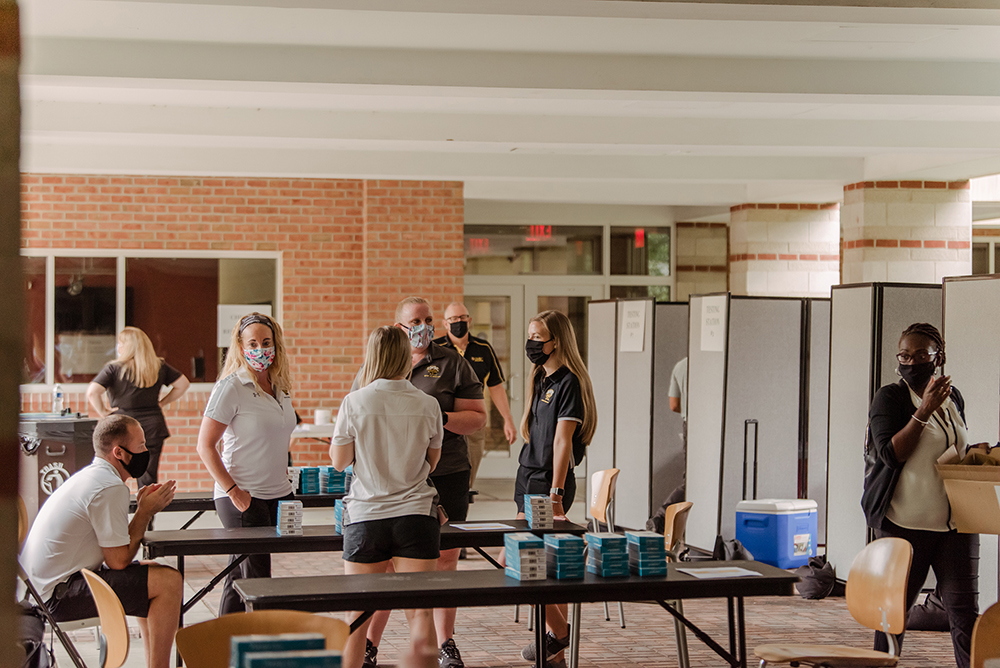
UMBC COVID-19 test pop up

Like the rapid test, the first step in a PCR test is the collection of genetic material – again, saliva or nostril swab.

After that initial procedure, the sample is amplified through a sophisticated process that causes the test DNA to replicate until there are a billion copies of the original piece.

This allows for a very high level of accuracy, with the test being able to detect the tiniest presence of SARS-CoV-2, the virus that causes COVID-19.

But as Nathaniel Hafer, an expert in molecular medicine at UMass Chan Medical School, notes, the PCR test has weaknesses – a PCR test can cost up to US$100 or more, and results can take several days to come through.

It’s important to note that all tests are a snapshot at the time of sample collection and are much more likely to be accurate when a person is infectious. So people are encouraged to take multiple tests 24 hours apart.

2. Why rapid tests are important – especially now

Despite their lower accuracy, the antigen tests can be particularly useful at a time when many people need to get tested.

As Hafer notes in a separate article for The Conversation, rapid tests are “a welcome tool in society’s fight against the COVID-19 pandemic.”

He advises readers to take a test, be it PCR or antigen, as soon as they show symptoms of COVID-19. And the same holds true whether someone is vaccinated or not.

“The faster you can determine if you have COVID-19, the sooner you can isolate yourself, which helps prevent transmission to others,” he writes.

And even if someone gets a negative antigen result, it shouldn’t be assumed that they are in the clear. Anyone showing symptoms would be advised to have a follow-up rapid or PCR test.

3. So how do you use a home testing kit?

One of the big benefits of the rapid test is that it can be performed at home – no need for a lab setting or skilled lab technicians.

Zoë McLaren, a public health policy expert at the University of Maryland, Baltimore County, explained how readers should go about using their home test.

First off, plan ahead.

“It’s important to have a plan for what to do based on the test results. If you get a positive result, immediately take precautions to slow transmission, such as self-isolating, letting close contacts know about the test result and reporting the case to health authorities,” McLaren writes. Even when presented with a negative result, caution is advised, “and, if you have symptoms or a known exposure, it’s a good idea to do a follow-up rapid antigen or PCR test just in case the first test was a false negative.”

A second rapid test performed 24-36 hours after the initial test can help detect coronavirus cases that may have been missed the first time around due to an insufficient viral load, writes McLaren.

4. And if you still can’t get your hands on a rapid test?

Despite the massive planned rollout of rapid tests announced by Biden, there may well still be difficulties finding a kit.

Loss of smell or taste can be an indicator of COVID-19 infection. John Hayes and Cara Exten, both of Penn State, recount how a graduate student’s mother discovered recently that she could neither smell nor taste her habitual cup of coffee. She quarantined and got a rapid test, which came back positive.

The fact that she confirmed her suspicions by use of an antigen test underscores a key point: If you have the slightest inkling that you may have COVID-19, or been in contact with someone who has, it is advisable to get tested to know for sure.

“Using loss of smell as a COVID-19 test is far from perfect. But because a daily smell check is very specific, instantaneous and quite literally free, it is a highly useful screening tool,” write Hayes and Exten.

*****

Interviewed: Cara Exten Assistant Professor of Epidemiology, Penn State; John E. Hayes Professor of Food Science, Penn State; Nathaniel Hafer Assistant Professor of Molecular Medicine, UMass Chan Medical School; and Zoë McLaren Associate Professor of Public Policy, University of Maryland, Baltimore County.

This article is republished from The Conversation under a Creative Commons license. Read the original article here.

Header image: Reflecting on the growing demand for at-home rapid COVID-19 tests. Corinna Kern/Getty Images

All images courtesy of Marlayna Desmond unless otherwise noted.

As spiritualism’s popularity grows, photographer Shannon Taggart takes viewers inside the world of séances, mediums and orbs

By Beth Saunders, Curator and Head of Special Collections and Gallery, UMBC

The word séance conjures images of darkened rooms, entranced mediums, strange occurrences and spirit voices. For many contemporary audiences, these visions might seem like something out of the past, or perhaps a movie, rather than a living belief system.

For the past 20 years, American photographer Shannon Taggart has explored modern spiritualism, a religion whose adherents believe in communication with the dead.

Her photographic series “Séance,” which was recently on view at the Albin O. Kuhn Gallery at the University of Maryland, Baltimore County, provides a window into this often misunderstood religion.

As a curator and art historian who has researched apparition photographs and the art of conspiracy theory, I was drawn to Taggart’s images because they offer a lens through which to examine the role of spirituality in modern life.

In an era defined by a global pandemic, heightened political division and the planetary threat of climate change, I wonder: Is spiritualism due for a major resurgence?

Spiritualism comes knocking

Spiritualism emerged near Rochester, New York, in 1848 when two sisters, Kate and Margaret Fox, claimed to hear a mysterious rapping at their bedroom wall. The adolescents claimed to communicate through a system of knocks with the spirit of a man who had died in the house years earlier. News of the phenomenon traveled quickly, and the girls appeared before crowds demonstrating their purported abilities.

Soon, reports of similar phenomena occurring across the United States appeared in the press, and the possibility of speaking with the deceased fueled the popular imagination.

Spiritualism first grew in private. People who channeled communication with the dead, called mediums, operated out of their homes, where they would organize séance circles, gatherings in which a small group attempted to make contact with the spirit world.

Over time, spiritualists started appearing publicly at conventions and outdoor summer camp meetings. By the 1870s, they began to put down roots, founding like-minded communities and centers of study, such as the spiritualist colony of Lily Dale, New York, established in 1879.

In addition to holding séances, spiritualists practice healings and believe in the gift of prophecy. Mediums say they convey messages from the dead to the living, including reports about the future.

Many spiritualists hoped to make utopian visions of the future a reality in the present by supporting progressive political causes such as abolitionism, women’s rights and Indigenous rights.

Notably, spiritualism gave women an unprecedented role in religion, providing an audience and a platform to deliver messages both personal and political. Suffragists Marion H. Skidmore, Elizabeth Cady Stanton and Susan B. Anthony all spoke at Lily Dale. The views of spiritualists thus represented a radical break from traditional religious and political authority.

Ghosts in the machine

The Fox sisters’ purported ability to communicate with the dead became known as “the spiritual telegraph,” referencing the then-recent invention by Samuel B. Morse. As spiritualism developed, adherents embraced technology as tools for spirit communication and to prove the existence of spirits.

Photography became “the perfect medium” with which to create an iconography of spiritualism. Whether it was through astronomical, microscopic or X-ray photography, cameras could render the unseen visible. Despite the proliferation of altered photographs in the 19th century, the photograph’s status as a truthful representation of reality remained – and, one might argue, continues to remain – largely intact.

Photography also played a leading role in the 19th century’s memorial culture, since the camera could freeze time and render absent loved ones present, if only as a visual trace.

The American Civil War brought death at an unprecedented scale into people’s living rooms through the pages of the illustrated press. Black attire, mourning jewelry and the genre of post-mortem photography were commonplace in a culture of grieving.

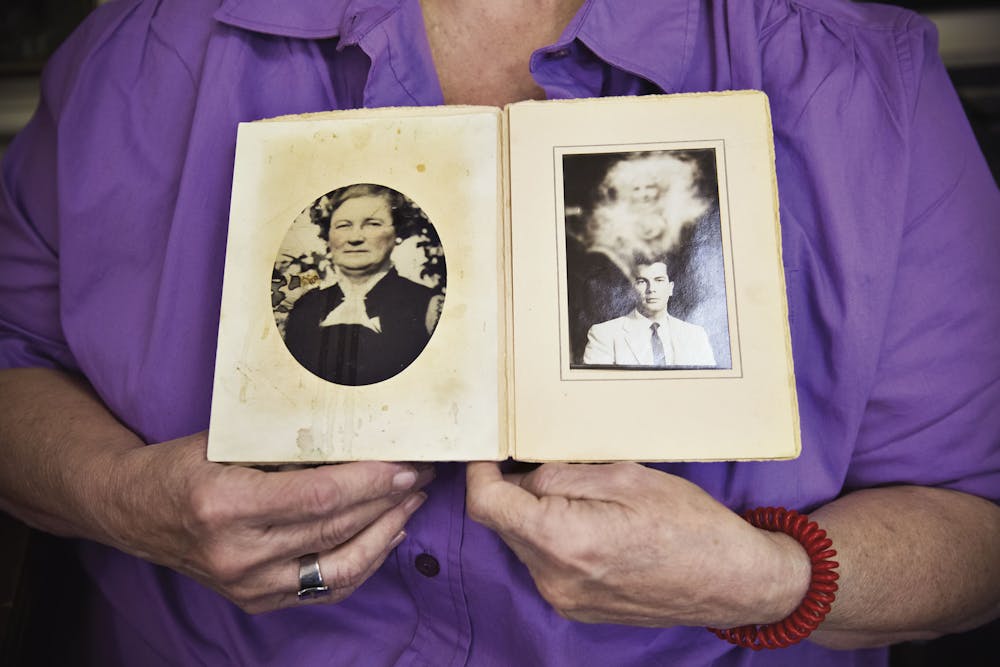
Woman holds photo album with two black and white portraits.
Sandy Candy Eppinger’s family spirit photographs, which show her brother Eugene Candy with the spirits of their grandmother Ethel Philips and great aunt Helen Thompson, at Lily Dale, New York, in 2015. © Shannon Taggart. Courtesy of the Artist, Author provided

In the 1860s, New York portrait photographer William Mumler and his wife, Hannah Mumler, a medium, offered portrait sessions in which spirits of the sitters’ loved ones appeared to manifest in the resulting photographs.

Mumler’s spectacular portraits also raised the specter of hucksterism. The photographer was charged with fraud by claimants who argued he faked the photographs, and none other than showman P.T. Barnum gave evidence for the prosecution.

In the early 20th century, Sherlock Holmes creator Sir Arthur Conan Doyle famously rallied to defend British medium Ada Emma Deane, who was also accused of faking spirit photographs.

The double-sided coin of belief and skepticism haunts these historical examples; nonetheless, the psychological impact of these images among the grieving remained powerful.

Spiritualist revivals

History seems to suggest that catastrophic loss of life can spur renewed interest in spiritualist beliefs.

Perhaps it’s no coincidence that the Mumlers’ portraits became all the rage amid the devastation of the U.S. Civil War, while Deane’s popularity peaked in the wake of World War I and the flu pandemic.

Has the pervading sense of uncertainty induced by the COVID-19 pandemic triggered another spiritualist revival?

Alternative belief structures, including astrology and tarot, seem to have experienced a resurgence, reaching new audiences through the internet and social media.

Trumpets with faces painted on them.
Séance trumpets featuring celebrity spirit guides, including Michael Jackson and Freddie Mercury, hand-painted by medium Sylvia Howarth, in England in 2013. © Shannon Taggart. Courtesy of the Artist., Author provided

Recently, a number of mediums have become famous thanks to their endorsements by celebrity clientele. Some mediums claim to be able to channel stars from the grave, from Louis Armstrong to Elvis Presley.

While modern mediums have their detractors, their eager adoption of television and the internet is a logical step for a religion that has always embraced new technologies.

What was once seen as a niche subculture or the domain of late-night 1-900 call-in shows has gone mainstream: Psychic businesses were a US$2 billion industry in 2018.

Shannon Taggart’s ‘Séance’

This new spirituality has influenced pop culture as well as high art; the Guggenheim’s 2019 retrospective of Swedish artist and mystic Hilma af Klint was the most-visited exhibition in the museum’s history, drawing over 600,000 viewers.

New York Times art critic Roberta Smith argued that the exhibition’s impact amounted to a “psychic and historical shift” in the art world. Smith’s use of the word “psychic” is apt; the exhibition was a watershed not only for restoring to primacy women’s role in the development of abstract painting, but also for re-centering the spiritual within art.

Taggart’s photographs, meanwhile, explore present-day practices, sites and objects of spiritualism.

Allowing chance and automation to guide camera experiments, she reveals processes of transformation and altered states through blurred effects, halos of light and doubling in images that reference historical spirit photographs.

In one image, for example, a grieving mother raises her arms into a darkened sky dotted with circles of light known as orbs. Orb photography is a recent innovation within spirit photography in which practitioners call upon spirits to manifest orbs, which are then captured by digital cameras. Orb photography is another example of the ambiguity of spirit photographs: Does it channel the supernatural, or simply capture reflections of dust on the camera lens?

Woman stands before American flag with arms outstretched.
Kim Kitchen calls to her deceased daughter Casey and asks her for orbs in Lily Dale, New York, in 2014. © Shannon Taggart. Courtesy of the Artist, Author provided

For Taggart, that question is largely beside the point. Her aim is to remain truthful to the psychological experience of spiritualism, to make visible what is ineffable.

Taggart’s photographs recover the marginalized history of spiritualism at a moment when the religion feels once again on the verge of a resurgence.

As Taggart is fond of saying, “You don’t have to take spiritualism literally to take it seriously.”

*****

Disclosure statement: Beth Saunders does not work for, consult, own shares in or receive funding from any company or organization that would benefit from this article, and has disclosed no relevant affiliations beyond their academic appointment.

This article is republished from The Conversation under a Creative Commons license. Read the original article here.

Header image: Table-tipping workshop with mediums Jane and Chris Howarth in Erie, Pennsylvania, in 2014. © Shannon Taggart. Courtesy of the Artist., Author provided

Sold-out supplies, serving a public need and other adventures of doing science during a pandemic – 4 researchers share their experiences

By Erin Lavik, Professor of Chemical, Biochemical, and Environmental Engineering, UMBC; Nilanjan Banerjee, Associate Professor of Computer Science and Electrical Engineering, UMBC; Christian L’Orange, Colorado State University; and Tony Schmitz, University of Tennessee

Closures, remote work, supply chain issues and changing priorities have affected almost everyone’s lives at some point during the nearly two years of the coronavirus pandemic. The process of science itself was no exception. The many people who do the lab work, experiments and human studies that further scientific knowledge all faced challenges – many of which were unexpected.

To understand how the pandemic changed the process of science, we asked four researchers about their experiences over the past two years.


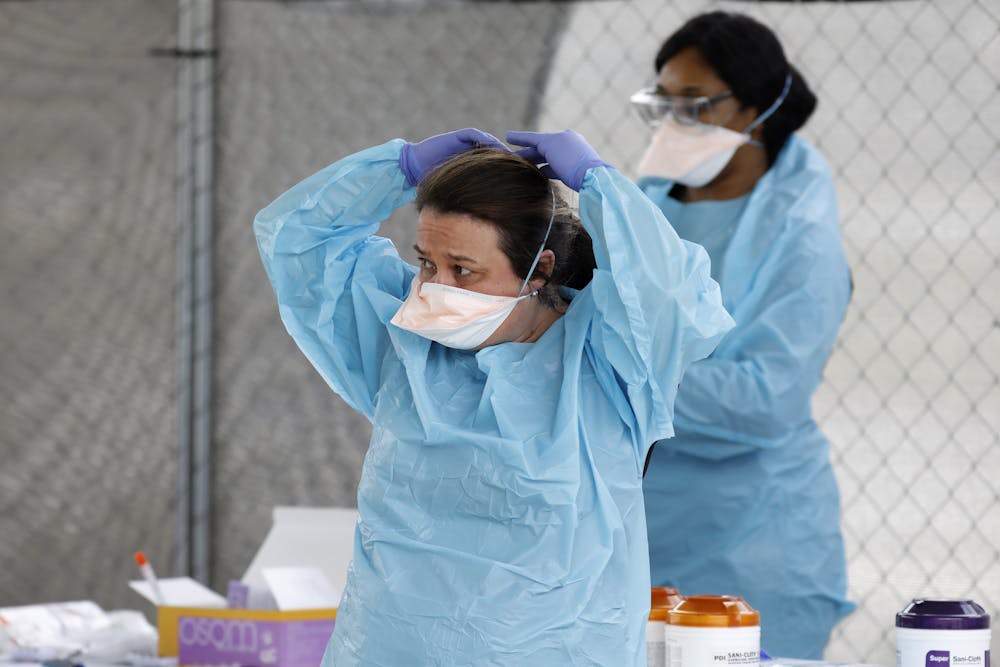
Two health care workers wearing masks.
Early in the pandemic, a lot of scientific testing needed to be done to understand how masks could protect health care workers. AP Photo/Mic Smith

Balancing public needs with science and mentorship

Christian L’Orange, Assistant Research Professor of Mechanical Engineering, Colorado State University

I am an engineer and aerosol scientist. People used to return a look of confusion when I said that, and prospective engineering students rarely had any idea that aerosol science was even an area of research. That all changed with COVID-19.

In March 2020, as the world was being told to stay home in the first weeks of the lockdown, the university and my lab were asked by the Colorado governer’s office to test masks being purchased for front-line workers.

In a matter of days, we pivoted all of our time to testing masks. This came at the cost of our research: Everything was put on hold. Nevertheless, we were proud to do it. I have had few experiences more gratifying than knowing I was making a difference in a time of need – however bittersweet.

A big reason I do the job I do is my love for research and the opportunity to mentor students. COVID-19 took both of those away for nearly two years. Research has begun again, and students are returning to the lab, but we won’t get that time back.

My colleagues and I were able to respond to the governor’s request for mask testing only because of the skills and experience that come from years of being in the lab – but what could those skills have led to if we hadn’t lost the past two years? What more could my students have achieved if they hadn’t lost that time?

Despite the good we have done, those questions still bother me.

However, I am optimistic that the pandemic might end up being good for aerosol research. I no longer get blank stares when I mention airborne particles, and maybe this pandemic will attract new bright students to a field about which I am so passionate.


Thousands of shipping containers stacked on a dock.
Scientific supplies – from chemicals to plastic containers – were all affected by supply chain issues. AP Photo/Noah Berger

Resource sharing to overcome supply chain issues

Erin Lavik, Professor of Chemical, Biochemical and Environmental Engineering, University of Maryland, Baltimore County

My lab – where my colleagues and I study biomaterials to control bleeding, deliver drugs and build tissues – was shut down in March 2020 because of the coronavirus. When labs on campus began to reopen that June, we worked with a skeleton crew to restart our projects.

We expected there to be challenges getting certain supplies and chemicals that were necessary for vaccine production, but I was utterly surprised by how hard it was to get everything. Plasticware that we use in experiments became impossible to find. Many chemicals were back-ordered for months, if not years.

To keep scientific projects moving forward, my lab and many others on campus have banded together and have been sharing supplies and looking after one another’s projects. Because of unexpected sudden quarantines, we cannot afford to just do our work – we need to know what others are doing and be willing and able to step in at a moment’s notice to complete a chemical reaction, take care of some cells in a petri dish or record important data.

The challenges of limited supplies and quarantines are not over and may even be getting worse. But through the collaborative systems my colleagues and I have built, we have been able to keep research moving forward, albeit at a slower pace. And like everyone, we have all gotten better at the process of collaborating remotely, too.


Teaching the public directly

Tony Schmitz, Professor of Mechanical, Aerospace and Biomedical Engineering, University of Tennessee, Knoxville

The challenges of the pandemic are significant and continuing, but my personal experience at the intersection of COVID-19 and science has been unexpectedly positive.

I run the Machine Tool Research Center and study ways to improve and speed up the process of manufacturing parts. Machining is important because it remains a critical process for manufactured products, but the U.S. workforce is in sharp decline. When the University of Tennessee transitioned from in-person to online instruction, this new time away from the office gave me the opportunity to produce video and written content that explains the science and modern skills of machining to a lay audience.

The online training I developed is like a flight simulator for machining. No prior experience is necessary, and it provides step-by-step instructions for computer-aided manufacturing skills. It explains the geometry and physics of machining and simulates the real-world vibrations and sounds of making parts.

I was not alone in having time on my hands though. Disruptions to education and the supply chain provided time for both students and manufacturing professionals to explore the online training I made. In one sense, the two factors created the perfect storm for nontraditional learning in machining, and the response has been fantastic. Since its launch in December 2021, 1,756 people have registered for the class, and 676 people completed it. These participants comprised 36% industry workers and 64% students and represented 47 states.

It has been fantastic to have an opportunity to teach machining in a unique way to a broader audience, and I will continue to do so. The Department of Defense is funding the effort, and in the future I plan to grow the network and add in-person training locations that complement the online instruction. Despite the many hardships the shutdowns caused, this would not have been possible in a normal year.


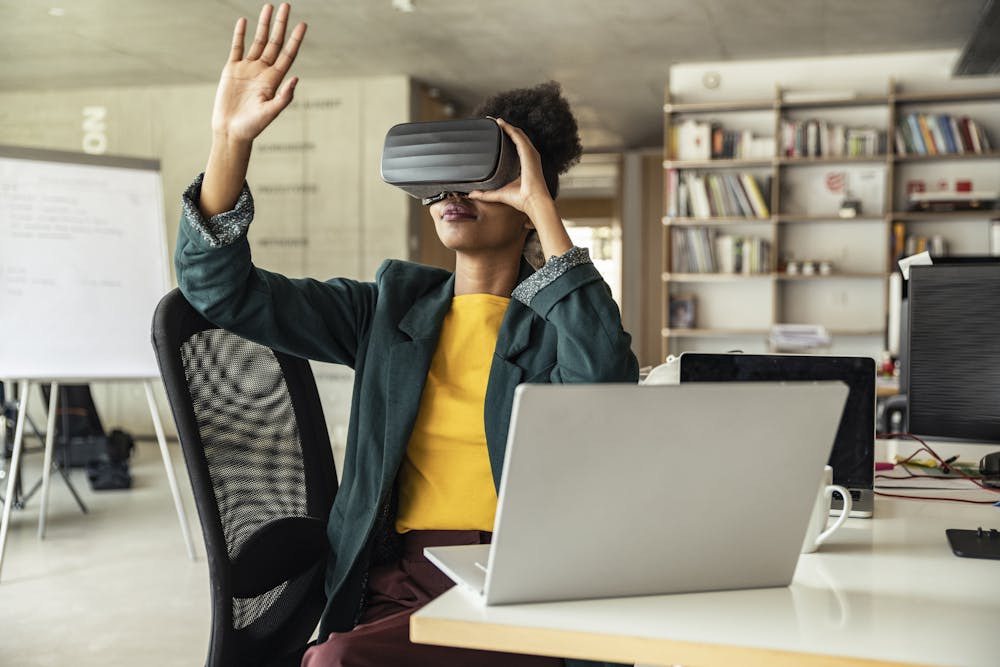
A woman wearing virtual reality goggles.
Virtual reality can mimic many in-person experiences. Westend61 via Getty Images

Using tech when you can’t meet in person

Nilanjan Banerjee, Professor of Computer Science and Electrical Engineering, University of Maryland, Baltimore County

At the Mobile Pervasive and Sensor Systems Lab, my colleagues and I seek to understand how people’s physical states – like stress, for example – affect the performance of a group. To study this, we need to collect physiological data like heart rate and heart rate variability from subjects while they play group games in person.

Unfortunately, having people meet in person to play games has been impossible for much of the past two years, thanks to the coronavirus. For many situations, remote conference tools can get the job done even if they are a bit more tiring than meeting in person. But a Zoom call simply can’t emulate the immersive environment required for group games and the physical responses that I study.

If my colleagues and I wanted to continue our research, we needed an immersive but safe way for our study participants to interact. So, we developed virtual reality games. Over the months that we relied on virtual reality, my colleagues and I realized that not only did these games work, in fact, they turned out to be better than in-person games because the virtual environment is completely free of distractions.

[Over 140,000 readers rely on The Conversation’s newsletters to understand the world. Sign up today.]

Developing virtual reality games and making them as realistic as possible is not cheap. But compared with a normal in-person study, this is a simple, inexpensive and effective platform to study how people in groups perform under different conditions. Since it allows our team to study these things without the need for subjects to be in the same room all at once, we plan to continue using this platform for future large-scale studies even post-pandemic.

Christian L’Orange, Assistant Research Professor of Mechanical Engineering, Colorado State University; Erin Lavik, Professor of Chemical, Biochemical, and Environmental Engineering, University of Maryland, Baltimore County; Nilanjan Banerjee, Associate Professor of Computer Science and Electrical Engineering, University of Maryland, Baltimore County, and Tony Schmitz, Professor of Mechanical, Aerospace and Biomedical Engineering, University of Tennessee

This article is republished from The Conversation under a Creative Commons license. Read the original article.
Header Image: Like much else, scientific labs have been shut down by the pandemic. Cavan Images/Cavan via Getty Images

Up On the Roof—Fall 2021

Late this summer, President Freeman Hrabowski announced that he will be retiring from UMBC at the end of this academic year after a career that has included more than 30 years at UMBC. We sat down to talk about moments of joy he has experienced in his penultimate semester, and why he’s so very excited about the future of UMBC.

UMBC Magazine: I’ve been thinking a lot about what life must have been like for you since you made your big announcement. In the days and weeks that followed, what has brought you joy?

Freeman Hrabowski: Well, it has been this spirit of love that is all around us. You may recall that in one of my opening speeches on campus, right after announcing, I talked about the idea that UMBC is “the house that love built,” which is inspired by the Ronald McDonald house. And that thought has really resonated with people—from alumni to faculty and staff, to our students. People believe in the UMBC way, and that means an emphasis on grit and resilience. It means supporting each other, having compassion, academic excellence, and really being grateful to be a part of such a healthy community. And that’s the part that’s given me such joy. 

People from around the country have been writing and saying, “Wow, what is the magic sauce, that secret sauce at UMBC?” The truth is that when you talk to people who work here, they love it. You talk to our alumni, and they’re so proud to be from our institution. So, when they ask, “What is the secret sauce?” I say, “We have really good people here. We care about each other. We love ideas. We love working with people in the communities. We’re proud of our alumni.” 

And to see just how supportive people are is just wonderful… and at this past Homecoming taking photos with the children of alumni, I was just surprised by it all. I didn’t think I could ever be surprised, but at Homecoming when we took the big community photo, and you’ve got all those folks on the library steps and they’re all applauding—well, I wasn’t ready for it. I was getting a little emotional. But it was so special. And that’s what I’ve been feeling since announcing. 

At Homecoming 2021, Dr. Hrabowski snaps a shot of the group who gathered to take an updated community photo. Courtesy of Jim Burger.

UMBC Magazine: Thinking ahead, what are you hoping that alumni and our community will be keeping top of mind as we travel into the spring and the transition ahead?

Hrabowski: It is the idea that this is not a story about one person. It is about all of us and  the alumni who helped build the foundation; UMBC really belongs to the alumni. And it’s about how proud we are as faculty and staff, administrators, and students to be here at this moment. For all of us, it is about caring about this university, this house that love built.

You know people always say, “What’s going to happen to UMBC?” And I’m saying, “UMBC is going to continue to get better and better and better because we’ve laid a great foundation… People have been so amazingly supportive of me for the past 30 years, and the other five when I was here before that, that everybody knows a new president will be given a chance to thrive and to help the university go to the next level. And she will be fantastic. I’ve been saying that to people putting that idea in the universe. We’ll see. We don’t know who that person will be. There are many people in leadership positions interested in the presidency of UMBC because the university is one of the most talked about and admired institutions in the country, and I leave it in really good shape. I feel so good about that.

And so this transition will be one where we’re shedding light on what’s important, and our shared values… the emphasis on people, loving ideas, the importance of grit, and most important—believing in ourselves. We are UMBC.

Learn more about the Presidential Search Process at president.umbc.edu.

*****

Header image by Marlayna Demond ’11.