We use cookies for analytics and, unless you opt out, advertising.
You can opt out of advertising at any time.UMBC uses essential cookies to run this site. With your permission we would also use analytics cookies (to understand how the site is used) and advertising cookies (to measure and target our ads on other platforms). Nothing else loads unless you accept. You can change your choice any time from Cookie Settings in the footer.Privacy Policy
EssentialRequired for the site to work (login, security, your cookie choice). Always on.
Cameron Hindle finished 22nd of 92 cross country runners in the America East Championships. Lauren Reid played nearly every minute in all 17 soccer games as a central fullback. Hayden Lim scored the game-winning soccer goal to clinch a playoff spot.
What do these UMBC student-athletes have in common? They are all first-year students at UMBC, after COVID-19 curtailed their senior year of high school.
Since the NCAA allowed all student-athletes enrolled in the spring of 2020 and the fall and winter of 2020 – 21 to earn an extra year of eligibility, fifth-year seniors and graduate students are dominating most NCAA Division I intercollegiate rosters. But at UMBC, this trio of student-athletes are among many first-year Retrievers who are contributing to their teams’ success.
Cameron Hindle at the 2021 America East Conference Cross Country Championship meet in Durham, NH, in October 2021. Photo courtesy of America East Conference.
Only two other America East first years outpaced Hindle in cool, muddy conditions on the New Hampshire course on October 29. Moreover, the Elliott City native’s UMBC classmate, Ayalew Fantaw ’24, information systems, was the second Retriever to cross the finish line.
As a member of the women’s soccer team, Reid was one of seven first-year students that started at least six times and one of 14 first-year players on the roster. The Retrievers earned as many “results” (eight, with five wins and three draws) than they have since 2015. Reid came to UMBC from Denver, Colorado, and credits her new #RetrieverNation family for her early success.
“Each and every single one of the players on the team pushes you to be the best version of yourself that you can be whether playing or going through life,” said Reid. “The coaches are also a huge part of my success this semester. They provide constant support, checking in on school, food, mental health, etc. In every part of life, they are making sure that we’re okay.”
“The 14 young women from the class of 2025 have not only been able to complement our returners but have also been able to start to lay down the initial steps of what their legacy will be here at UMBC,” said fourth-year Women’s Soccer Head Coach Vanessa Mann. “We are incredibly optimistic about where we are headed and feel now like this really was our true ‘year-one’ in terms of moving the program forward.”
The nationally-ranked New Hampshire men’s soccer team faced UMBC on October 23 with 10 graduate students on their active roster and barely escaped Retriever Soccer Park with a 1-0 victory. Six days later, Lim and the Retrievers faced a must-win game at NJIT, a team which featured the nation’s top active goal-scorer. UMBC fell behind, 2-0, but rallied with three second-half goals, including Lim’s game-winner with 17 minutes remaining, to clinch a playoff berth.
“I believe that some of my success started with the attitude of knowing I am younger but still wanting to make an impact to help the team any way I can,” said Lim. “I have gained a lot of confidence by having good chemistry with the team on and off the field and also knowing the trust coaches had in me in high-stakes moments. This has and will continue to make my first semester here a memorable one and I can’t wait to keep going.”
— Steve Levy ’85
Athletics Highlights
The Retriever volleyball team won the America East regular season championship for the second consecutive year.
So far in the season, Pete Caringi Jr.’s dynamic men’s soccer team scored 32 goals through 18 games, their highest total since 2014.
Juliana Rafaniello ’23, media and communication studies, led the women’s soccer team with six goals and earned a spot on the league’s All-Academic team.
Both cross country squads placed seventh in the America East Championships.
Header image: UMBC freshman midfielder Izzy Binko led the Retrievers to a 5-1 victory over Delaware Statein October 2021. Photo courtesy of UMBC Athletics.
At their most basic levels, learning and play can look a lot alike. Both call for creativity and resourcefulness; inspire curiosity; and require failure, reflection, and practice. For some students, learning isn’t all fun and games. But members of the UMBC community are looking to change that.
Kerri Evans always strives to make her curriculum engaging, but knew she needed a new way to connect her students to the material. As a social work professor at UMBC, Evans teaches and studies the experiences of recent immigrants and refugees to the U.S. and wanted a new way to expose her students to the trials and triumphs of immigrant children navigating the U.S. education system.
“Social work curriculums largely rely on analyzing and reflecting upon case studies,” Evans says. “But immigrant stories are so diverse—it’s hard to understand the breadth of their experiences just by reading and responding to a case study.”
While working as a program manager at Lutheran Immigration and Refugee Service in downtown Baltimore, Evans saw how an engaging training activity helped foster parents, educators, and staff to better understand the experiences of immigrant and refugee children. For the activity, participants read cards containing stories of immigrants as they navigated various stages of their journey, like falling off the train in Guatemala, or losing your relatives at the U.S. and Mexico border, for example. A group discussion followed of how these experiences, some horrific, influenced the lives of unaccompanied children in the U.S.
“It wasn’t a game in the traditional sense, but it was inspiring and engaging,” she says.
And thus, Evans’ idea for the board game “Emerging: The Educational Journey of Immigrant Students” was born.
The gamification of learning is an approach more instructors are adopting to motivate their students to think outside of the box. Professors like Evans and others are maximizing enjoyment and engagement in their classes by capturing the interests of students and inspiring them to keep learning. Students across disciplines at UMBC are getting hands-on experience building games—tangible ones like “Emerging” as well as a host of video games that also foster a collaborative learning environment. Both the students and teachers agree: Learning is a lot easier when you’re having fun.
Understanding the “Rules of the Game”
“Emerging” is still in its infancy, but it is attracting the help of people across the UMBC community. In fall 2021, Evans paired up with UMBC’s assistant professors of education, Jiyoon Lee and Keisha Allen, and five UMBC undergraduate and graduate students to help bring the game to fruition.
Both the game and a future interdisciplinary course will focus on the immigrant experience in the U.S. from pre-kindergarten to college, with the goal of teaching UMBC students who will become service providers and teachers to understand the experiences faced, to advocate for inclusion, and to dismantle racism in schools.
Kerri Evans headshot courtesy of Melissa Penley Cormier.
Funded by a UMBC Hrabowski Innovation Fund Grant: Implementation and Research Award, “Emerging” will be a multiplayer, cooperative game where participants assume the role of an immigrant child and work together to gain the resources necessary for “success” such as educational attainment, language skills, and social networks. Along the way, players will face challenges, get helpful boosts, and be forced to mitigate stress before it brings the game to a close. Picture Forbidden Island- meets-Catan-meets-Monopoly-meets immigrant experiences.
Participants will need to achieve both happiness and self-sufficiency to win, and players will lose if their stress levels get too high or if they are unable to access help and resources they need.
Advancing on the board will require strategy, resourcefulness, collaboration, and a little bit of luck. Players could land on spaces that require them to pick a card that describes a “win” or a “setback.” Wins may include getting an A on a test, making a new friend, or having a teacher stick up for you. Setbacks may look like getting bullied, forgetting to turn in your homework, or having troubles with immigration status.
Players can also gather “resources” along the way, which could come in the form of joining a sports team, partaking in an after-school program, or going to a tutoring session. These resources play an integral role in managing your players’ mental health, an essential part of winning the game.
All of the “wins” and “setbacks” will be based on real-life stories collected by a research process the students are currently undertaking, something Evans says is important to the integrity of the game.
“We don’t want these stories to be hearsay or things that could theoretically happen, we’re doing our research to create an accurate game of experiences that have truly happened,” Evans says.
“I think we are creating something really special,” says social work and psychology undergrad Ashley Pereira ’22, who is part of the team currently analyzing hundreds of peer-reviewed journals and case studies to find stories of success and heartbreak to include. “And to know we are creating it in a way where it’s based on research just makes you feel so confident about the decisions you make.”
The game also aims to highlight the cultural differences within the education systems of various countries. For example, Evans says, it’s important to be mindful that immigrant students may not understand how to open up a locker, or the need to raise your hand to ask for permission to speak. The team is working on ways to include these discrepancies into the game.
“We take for granted that we know the ‘rules of the game,’ in our education systems,” says TESOL graduate student and team member Eric Chen ’22. “If educators assume children from other countries come in with this knowledge, it can put the kids at a disadvantage.”
Like all great games, “Emerging” plays on participants’ emotions. The stakes are high, and tragedy or triumph may be just around the corner.
Game Developer Galore
Over in the Engineering building, a different type of game development is taking place. Over 46 game developers are congregating to create the next great video game. Founded in 2005, the Game Developers Club is dedicated to bringing students of all majors and skill levels together to learn about game development, work as a team, and of course, create video games.
Emotions are high around this time of year, as club members pitch their ideas to the group in hopes their game will garner interest from other club members. Vice president of the club, Seth Davis ’22, computer science, is well acquainted with the process. He’s been a part of the club for three years and has created three games. Pitch time is his favorite time of the year.
“It’s always so exciting to see a person get up in front of the club and talk about an idea they’re passionate about,” Davis says. “Some people are so nervous that others won’t like their idea, but then after they pitch it, five people come running up to them saying they love the idea and want to support them.”
In 2020, Davis pitched the idea for a game called Binary Bubbles, a side-scroller (think Super Marios Bros.) puzzle game. The goal is simple: Get to the yellow flag as quickly as you can. The catch? There are malfunctioning robots in the way. Using strategy and logic, players must hack into the robots, steal their code bubbles, and move the code bubbles to other robots.
Davis and his team created 20 levels that span over two worlds, something he says would only be possible by working with an interdisciplinary team. Davis enlisted the help of art students, music students, and English students to make his games a reality.
“There are so many majors represented in the club, it’s not just computer science people,” he says. “This club teaches you how to work as a team to create an amazing product.”
Turning games into jobs
If Davis had to pick a second-favorite time of year, it would be the unveiling of the games. It’s when club members take their projects to the school and community and let others play the video games they’ve worked so hard to create.
Binary Bubbles was featured at 2020’s Undergraduate Research and Creative Achievement Day (URCAD) along with 13 other video games created by members of the Game Developers Club. Previous games have also been featured at Artscape, Baltimore’s largest annual art festival.
Members of the Game Developers Club receive more than just thunderous applause at URCAD and Artscape, they also get job offers from blue-chip employers. They’ve gone on to find positions at Facebook, Unity Game Engine, and Firaxis games, to name a few.
“Our club is actually very career-focused,” Davis says. “Employers love it when they see our portfolios and see we completed a game. Lots of former members got jobs because of this club.”
As a member of the club’s executive board, Davis works hard to ensure the games are seen by as many people as possible, including professional game developers. Some of those professionals are former club members themselves. Davis says alumni like Eric Jordan ’08, computer science, currently at Facebook, are eager to help current club members achieve their dreams.
“This club is such a great way to network and build real relationships,” Davis says. “It’s the perfect way to get that gaming job you’ve always dreamed of.”
The Go-To Gamer Guy
Marc Olano knows a thing or two about video games—he’s commonly referred to as UMBC’s “go-to gamer guy.” Ironically, Olano isn’t much of a gamer himself, but he certainly knows the recipe for creating a great game.
Marc Olano headshot courtesy of Ryan Zuber ’04, Imaging Research Center.
Olano has been doing research on video game graphics hardware for over 25 years. He pioneered procedural shading on graphics hardware, a technique that is used to add details to a surface of an object. The model is now the standard on every PC and game platform. Olano also pioneered UMBC’s Game Development track and helped usher in UMBC’s 3D photogrammetry scanning facility in 2015, now serving as the director for both.
The Game Development track and the Visual Arts Department’s Animation and Interactive Media concentration make up “GAIM:” UMBC’s Games, Animation and Interactive Media program. GAIM prepares students for careers in the video game industry, and exposes them to internship opportunities at local game development companies such as Firaxis, Big Huge Games, Epic Games, Mythic Entertainment and Zynga.
In the GAIM capstone course, visual arts and computer science students join forces for a semester to design an original game. The course mimics the setup of teams in the industry where 500 artists and programmers must work together for several years to develop a single game.
“My role is teaching the students how to do the work, then letting the students figure out for themselves how to actually do it,” Olano says. “I’ve found it brings students a lot of joy to know they created something very independently.”
“Bandit”
Olano’s first taste of an educational game development project was with UMBC history professor Anne Rubin. In spring 2015, Rubin and Olano united their classes to create a computer game called “Bandit” which detailed the 1861 Pratt Street Riots, an event many scholars believe was the site of first blood shed in the American Civil War. Undergraduates in the Game Development track built the game and Rubin’s history students served as historical researchers and consultants.
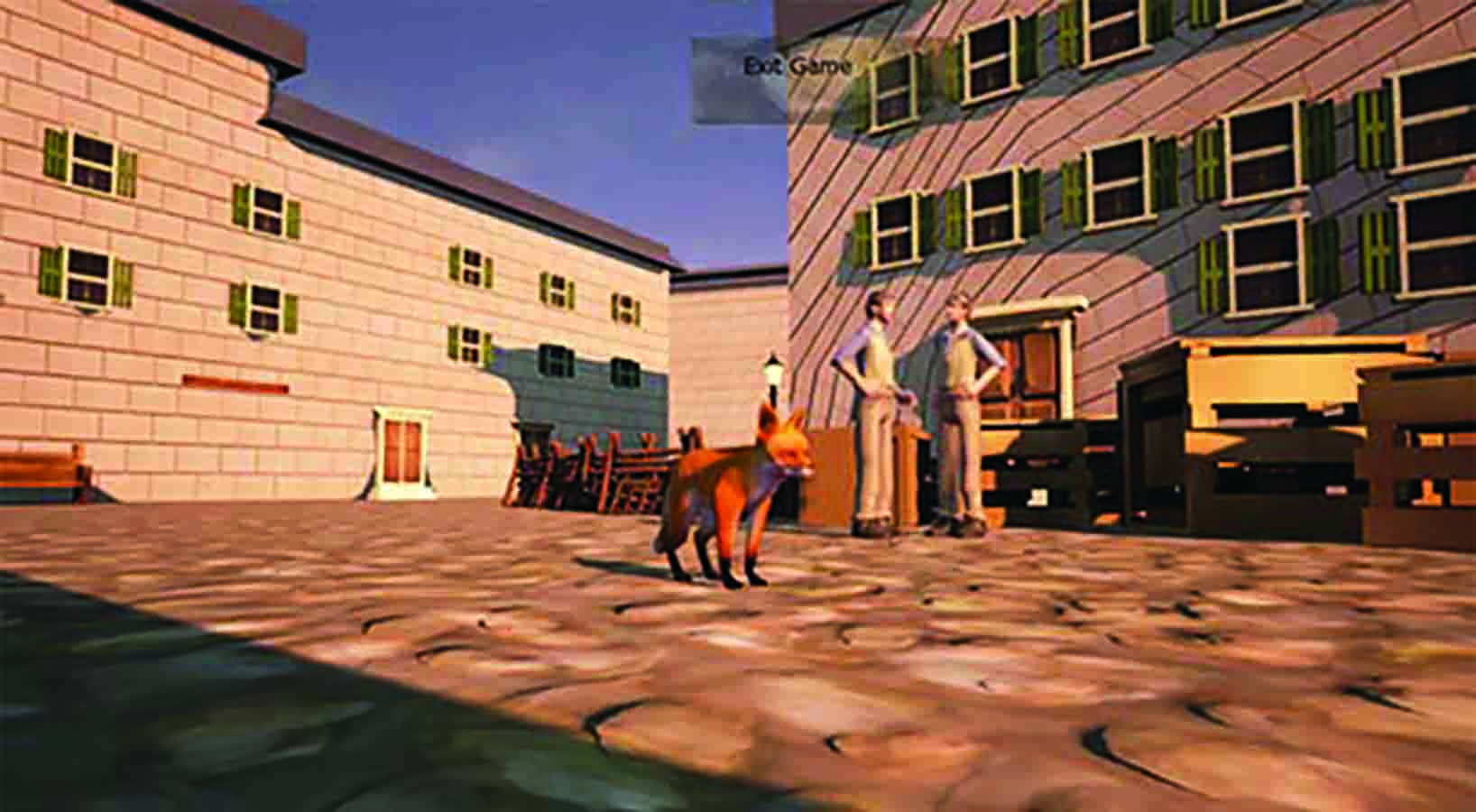
A still from “Bandit.”
In the game, players control a fox who is on the loose on the streets of Baltimore during the Pratt Street Riots, when Massachusetts militiamen came in contact with anti-war protestors in Baltimore. The fox is on the hunt for documents from the riots which can be examined and recorded all while trying to avoid guards patrolling Pratt Street.
“MeetingMayhem”
Olano is currently working with professor of computer science Alan Sherman and students from the UMBC Cyber Defense Lab to create a video game called “MeetingMayhem.” The web-based game aims to help students learn about adversarial thinking, or the ability to embody the technological capabilities and strategic reasoning of hackers. The goal of the game is to arrange a meeting time and place by sending and receiving messages through an unsecure network that is under the control of a malicious adversary. Players can choose to be the hero or the villain, or in this case, the benevolent meeting-maker or the hacker. The hacker can disrupt the efforts of the meeting-maker by intercepting, modifying, blocking, and injecting messages into the unsecure network.
In this engaging challenge, computer science students learn the basics of the Dolev-Yao intruder network model, a framework used to analyze safety protocols within a communications network. Students also learn the value of using cryptography to mitigate these dangers.
What Does it Mean to Win?
Across UMBC, professors and students are harnessing the power of play to enrich their learning experiences. Be it video games, board games, or anything in between, Retrievers are rich with ideas of how to make learning a little more interactive and a lot more fun.
Olano, who was recently appointed associate dean for Academic Programs, is adjusting to his new responsibilities, but for him, it’s still all about the students and the games.
“It never gets old seeing students when they realize they can actually build a game for themselves and they are excited doing it,” Olano says. “Honestly, it brings me a lot of joy, too.”
For Evans, winning means the participants of “Emerging” leave the game with more insight than before—even insight into what different types of “success” could look like. In the meantime, her students will experience joy as they learn research skills, build the game, and begin to introduce the game to more students in the coming semesters. The team plans to gain knowledge from other UMBC students who are immigrants themselves and discover how this subset of students found success in college. After that, the team will enlist the help of UMBC art students to help design a prototype. In the future, the team hopes to premiere the game to educators outside of the UMBC community
“People have sympathy reading case studies, but it’s not nearly as visceral as if you’re playing a game and your character experiences something tragic and now you’ve lost three turns,” Evans says. “Players will feel the anger of feeling left behind and the joy of successes.”
For Davis and the Game Developers Club, winning means making friends, networking, and having fun. “At the end of the day, we’re really just having a great time making games,” he says.
— Kennedy Lamb ’20and Illustration by Marissa Clayton ’21.
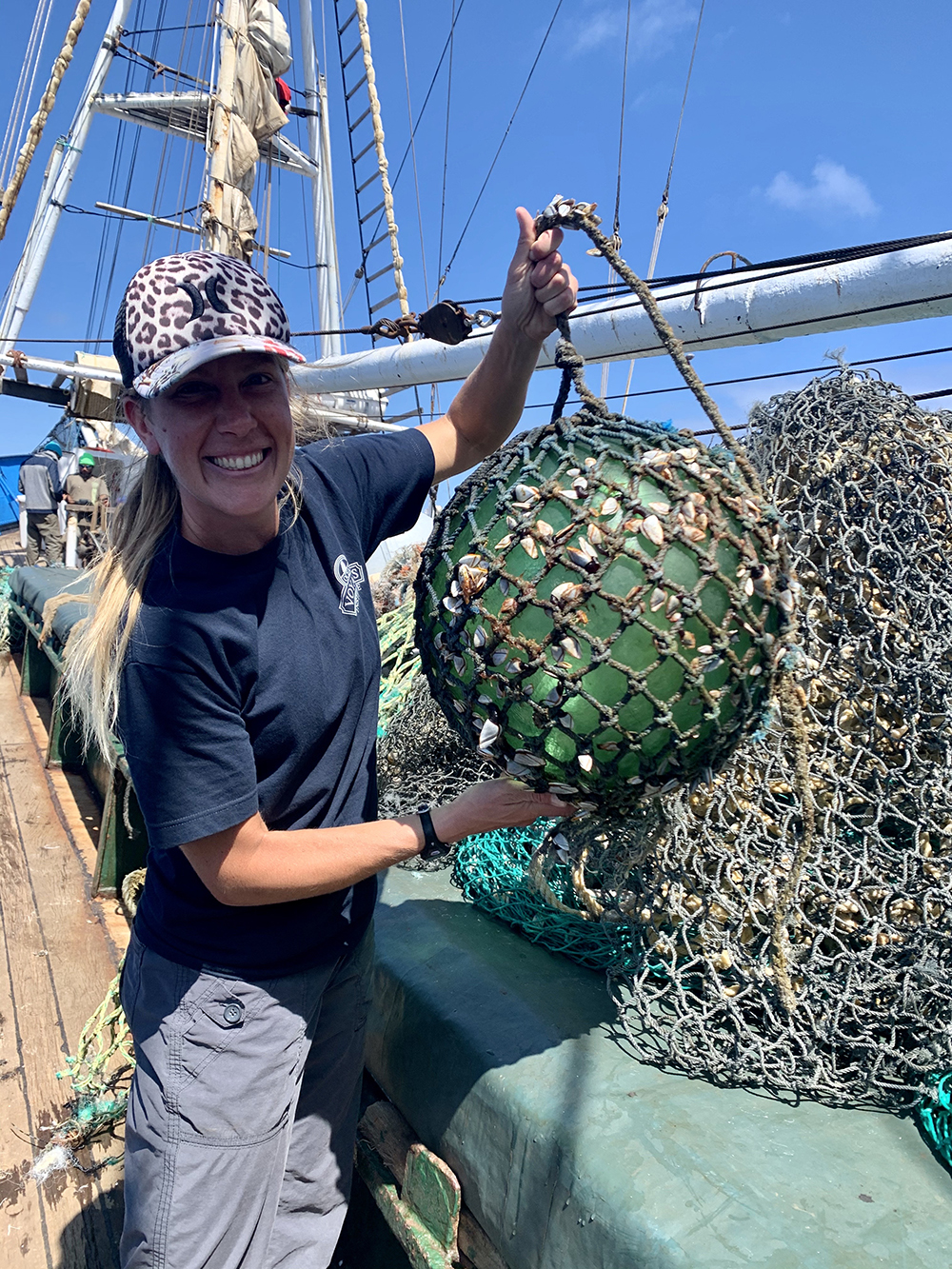
First Mate Alex Barnard ’09, American Studies spends many mornings high atop the mast on the 150-foot sailing ship Kwai, watching the bright horizon of the Pacific Ocean through binoculars for the shimmer of an abandoned fishing net. When she spots a clump of plastic waste, she guides the captain toward the tangle of fishing nets and the garbage they accumulate.
Then sailors on deck throw grappling hooks into the floating trash. A hydraulic crane hauls onto the deck the dripping hunks of degrading plastic nets—sometimes the size of Volkswagen Bug, sometimes 100 feet long. Barnard and the crew stumble through tangles slick with algae and seaweed, throwing the trash’s resident crabs and fish back overboard. Those moments are cathartic, Barnard says, as if they’ve just pulled a rotten tooth from the mouth of the ocean.
“I just think about that moment as beautiful. I love seeing that net up on deck,” Barnard says. “It’s so toxic and then to watch it come out. Just to be able to do that all day every day. It’s pretty amazing.”
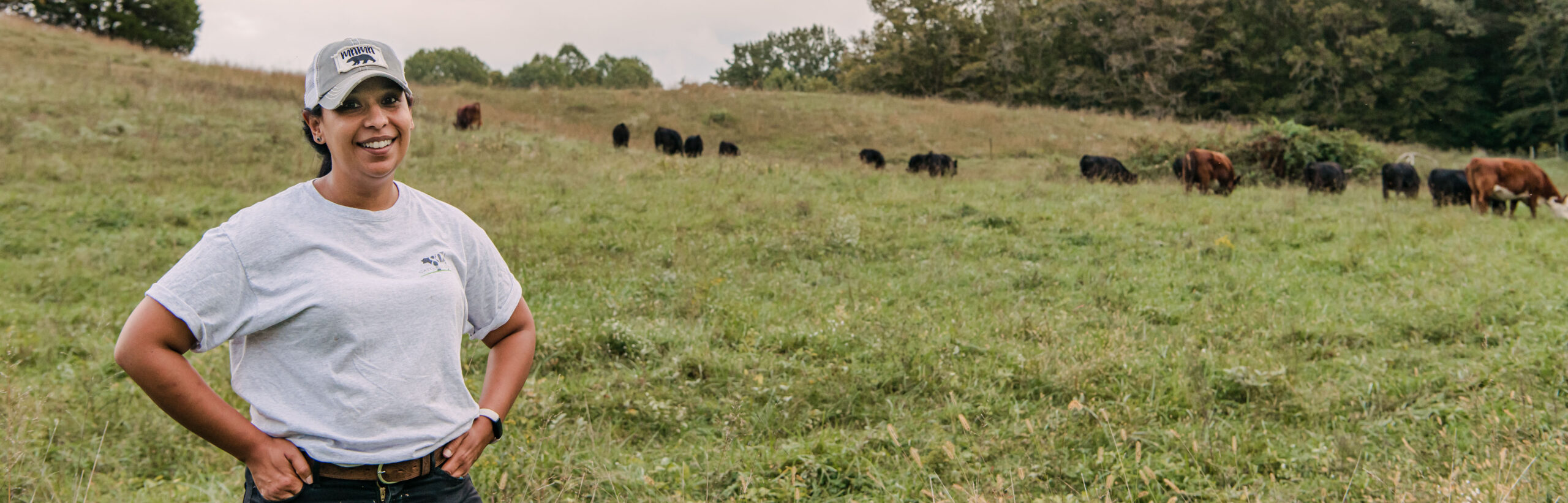
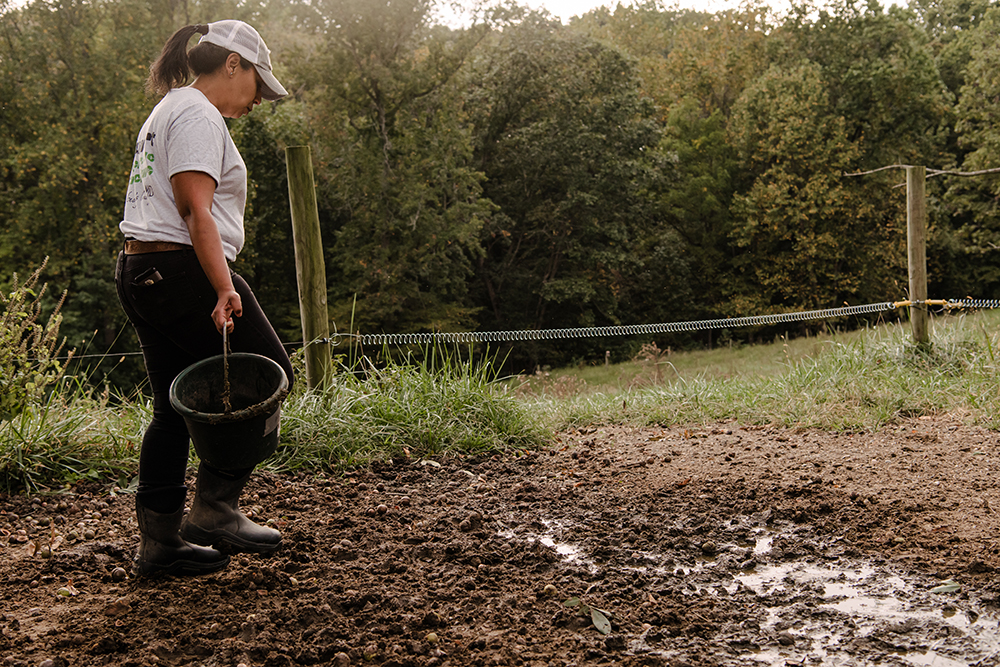
Walking down a steep hill on her family’s farm, Roxann Brooks Motroni’06, M14, biological sciences is searching for her cattle.
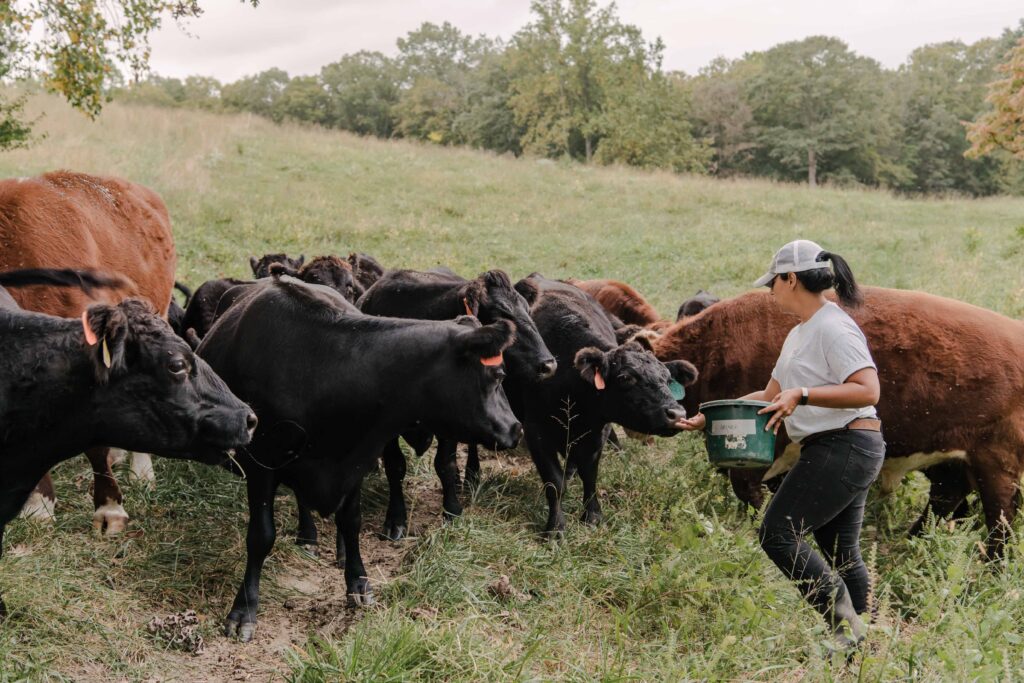
“Hey mamas! Hey cows!” the veterinarian calls. A fuzzy black head pops up over the next hill and bellows. The cattle gallop toward Motroni and her bucket, which rattles with hay cookies.
She steps into the pasture and is mobbed by her family’s cattle, the flies clustered on their backs in the late autumn heat. Cookie, the black Lowline Angus most fond of the treats, pushes to the front of the herd. The cow’s foot-long tongue curls around Motroni’s forearm, leaving bubbly trails of slobber and grass bits.
Ignoring the fresh cow patty her black boot has just stepped in, Motroni hands out cookies, then tosses the rest of the nuggets into the scrum. She swipes off her freshly slimed arm and continues naming the cattle—The Hereford, Valentino the bull, and her favorite, Nellie, named for a great-grandmother because they’re a bit alike.
“Sweet, but a little suspicious of new people,” Motroni says and wades out of the herd distributing scratches all around, oblivious to the flies and slobber and excrement.
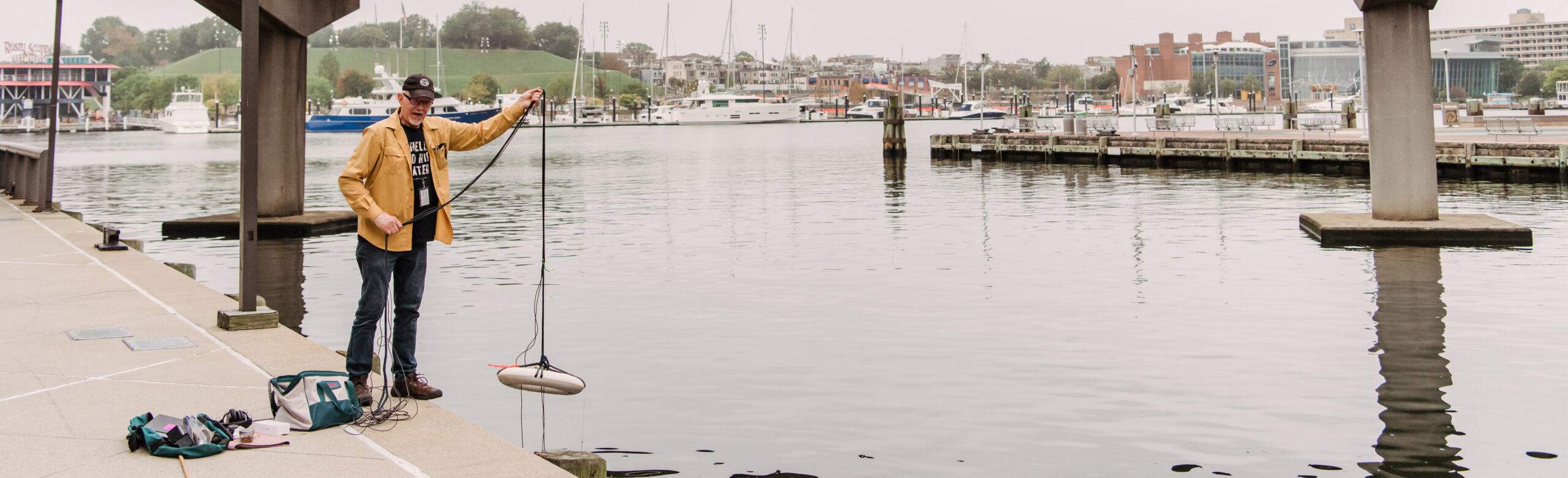
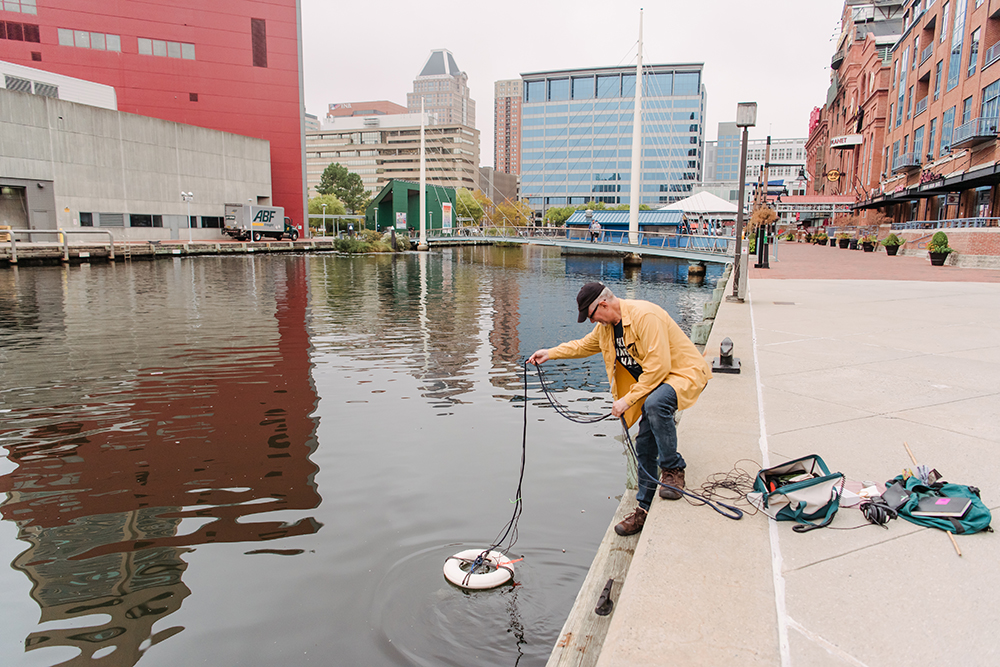
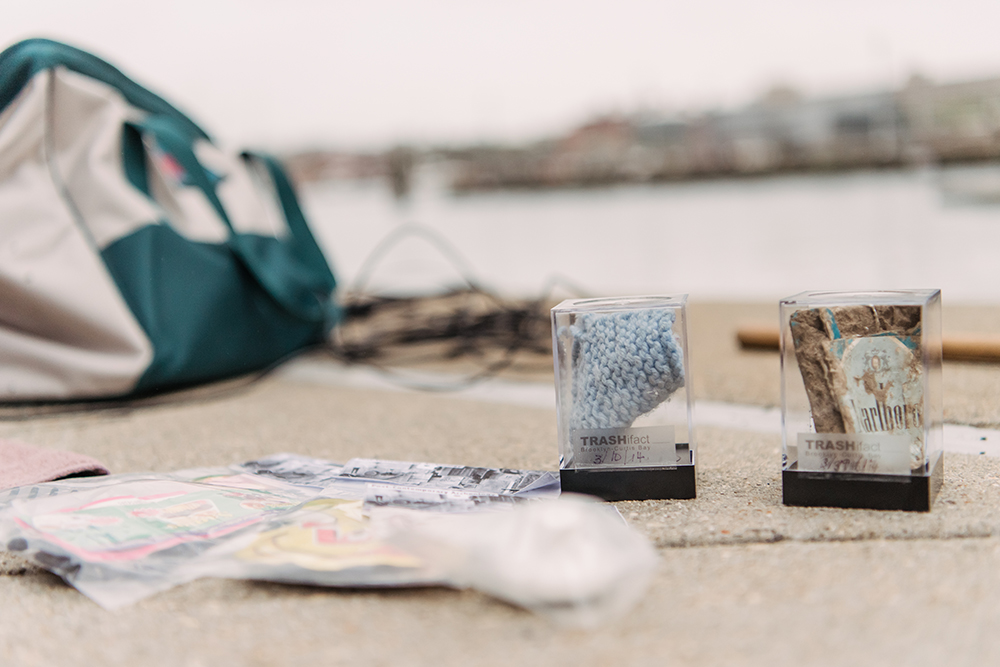
Stephen Bradley, associate professor in the Department of Visual Arts, hauls on a braided cord connected to a white lifesaving ring that bobs on the water of the Jones Falls in Baltimore. A Doritos package, two latex gloves, a slick of oil, and some liquor bottles float nearby. And that’s just what’s visible. Other ingredients in the toxic stew flowing toward the Inner Harbor are heavy metals, fertilizer, microbes, pesticides, and sewage, as well as industrial sound pollution.
Bradley, an artist who adds video and audio sensory layers to his sculptures, pulls out his dripping hydrophones and fiddles with their connections. Then he lowers the receivers back in, to record the underwater sounds of mussels, gizzard shad, and blue crabs, along with the urban noise of HVAC systems and traffic.
Chatting away, Bradley pulls out his sketch pad to show some drawings, then licks his thumb to turn the page. He stops to grimace at his thumb, which was just mucking about in the murky water.
“Guess I shouldn’t have done that,” he says.
Making a difference in the world isn’t always a neat endeavor. Hard to keep your hands clean when you’re raising cattle humanely and safely, pulling communities together to pick up trash and make art, or hauling tons of plastic waste from the Pacific Ocean. These three Retrievers all find immense joy in work that is sometimes smelly, usually dirty, and always requires an intrepid spirit.
Sustainability sparked Barnard’s quest
Alex Barnard wrote her UMBC honors thesis on her attempts to live sustainably in Baltimore. “Extremely challenging,” Barnard summarizes, with a wry chuckle. “It completely changed my life. I see everything through this lens now.”
For nearly 10 years, she traveled, trying to live lightly on the planet. She worked in an eco-cafe in Fiji, labored on an organic farm in Hawaii, sailed on eco-tourism voyages in the South Pacific, and biked New Zealand.
Now, she has her captain’s license and sails as a chief mate on National Geographic voyages to Costa Rica, Alaska, and Baja with Lindblad Expeditions, a company known for its green approach to travel.
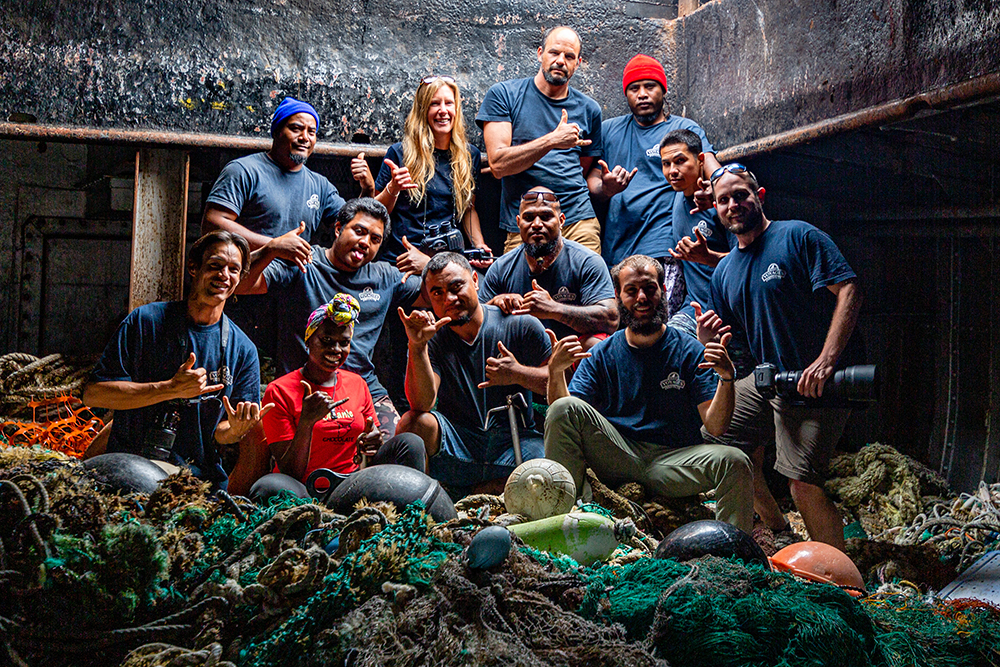
Alex Barnard (top, center) poses with her team. All photos of Barnard, courtesy of Ocean Voyages Institute.
Barnard’s schedule of two months on, two months off gives her time to volunteer on the Kwai for the Ocean Voyages Institute. The institute partners with companies that turn the trash into fuel, shoes, clothing, and building blocks for construction.
Through overconsumption and improper trash disposal, humans have created five garbage patches in the Pacific, Atlantic, and Indian oceans, where trash is concentrated by currents.
Courtesy of Alex Barnard and Ocean Voyages Institute.
Discarded nets and lines from fishing boats now make up 46% of the waste in the Great Pacific Garbage Patch, according to the World Wildlife Fund. Dubbed “ghostnets” or “ghost gear,” the fishing waste kills marine life by the thousands—turtles and whales and dolphins tangle themselves in the nets that are tossed off fishing boats. But because oceans are vast, and the nets sink and bob in the waves, they’re difficult to find.
“It’s not like wading through trash,” Barnard explains. “There are big spaces in between. If you were at sea level, the nets are hard to see. We could be sailing right by one and not see it until we’re past it. The plastic breaks down in UV light. A lot of it is microplastic, which is deadly to the ocean.”
Last summer, Barnard and the Kwai crew hauled 170 tons of plastic from the ocean, a fraction of the 17 billion tons dumped into the world’s waters every year. Other organizations, like Sea Shepherd Conservation Society, Greenpeace, The Ocean Cleanup, and the 5 Gyres Institute, are also focusing on ghostnet removal. Many environmental groups are pushing the Global Ghost Gear Initiative, a collaborative effort by the fishing industry, NGOs, governments, and researchers to regulate plastic dumping.
“This work is possible and successful,” Barnard says. “The idea is to show that we need more boats, a fleet of vessels doing the same thing. It feels like a starting point more than anything.”
Temporarily on land, in a remote cabin in Michigan where she’s doing some writing for Lindblad, Barnard hikes often, always with a trash bag.
“It’s my dream to go somewhere and not have to pick up trash,” Barnard says. “I could spend my whole life picking up trash everywhere I go. That’s not very efficient. It has to be bigger than just one person. But it’s better than not picking it up.”
A family farm affair
Every morning and evening, Roxann Brooks Motroni visits her cattle, not just to offer treats but to check the herd for a limp, some pinkeye, a calf that’s not thriving.
Her family started 804 Cattle Company in Upper Marlboro in 2016 with three cows. They now raise 25 cattle on 33 acres. A vet married to an agricultural business expert, Motroni works the farm with her parents, John and Chantal Brooks, both retired doctors. And while Motroni has a day job as a National Program Leader for Animal Health for the USDA’s Agricultural Research Service, focusing on research solutions for livestock diseases, she begins and ends her days on the farm.
“This is a family affair. My mom is the chief cow operator. I do the vet work, my husband does the finances and handyman work,” Motroni explains, plus he’s the beekeeper.
The farm is also devoted to teaching the next generation of farmers and veterinarians. Today, two interns hoping to be veterinarians are chasing Nutmeg the goat and grooming horses. The family brings in veterans seeking help getting started in agriculture, through the Arcadia Center for Sustainable Food and Agriculture. The farm also sells at the Capital Market, whose mission is to provide quality food, produced by businesses and farms run by people of color, to residents of Prince George’s County’s food deserts.
A Meyerhoff Scholar, Motroni quotes its motto, “To Whom Much Is Given, Much Is Expected” and says she lives by it.
Their farm prides itself on their humane and safe practices with their cattle. The animals and their health comes first. No hormones or steroids go into their cattle and they limit antibiotic use to only sick cows. Their chutes and corrals are designed to reduce their cattle’s stress. All animals spend all their lives on grass pastures.
The family also uses regenerative agriculture practices to improve soil health and combat climate change through carbon sequestration while limiting fertilizer and pesticide usage. Motroni crouches in the pasture to show off the shoots of radishes, hairy vetch, turnips, oats, and rye that she interplants with grass, to aerate and fix nitrogen and carbon in the soil. Plus they offer her herd fine dining.
“I didn’t know when I became a cattle farmer that I would also become a grass farmer. I’ve come to realize how magical cow poop is. Every year our pastures get better and better,” she says, laughing. “All those plant physiology classes at UMBC really served me well.”
She hikes up the hill again, squelching through the mud around a water pump.
“Wow, now you can really smell the cow,” she says and smiles at the odor and the view.
Traces of life fuel his art
As an artist, Stephen Bradley sees and hears things a little differently. From the pop of color of a blue plastic container handle to the squelching clicks of the mussels underwater, the evidence of life is fascinating to him.
For more than 12 years, he has labored in the Brooklyn and Curtis Bay area of Baltimore, partnering with the Enoch Pratt Free Library, the National Aquarium, the local Boys and Girls Club, and the Masonville Cove Environmental Education Center to clean up the alleys and streets and to make art, from sidewalk paintings and murals to trash sculptures.
Right now, he’s bent closely over a pier in the Inner Harbor, lowering a round lifesaver strung with microphones and chum to attract fish into the water. He occasionally catches the attention of passersby and eagerly explains his artistic vision to them.
The project that inspired his recording in the Jones Falls waterway is a collaborative biodiversity study with the National Aquarium and the Institute of Marine and Environmental Technology (IMET). IMET has sunk a biodisk in the same areas Bradley is recording, to track biodiversity in the waters by collecting DNA samples. Those findings will be paired with Bradley’s recordings to provide a fuller picture of what’s living in Baltimore’s waterways. Bradley’s Inner Harbor’s soundtrack is run through a spectrograph to determine what species made the sounds, most of which can’t be heard by human ears, such as the mating songs of water bugs.
“With these recordings, it’s almost as if I have my ear to the water,” he says. “The gift is going home and listening.”
Bradley’s portion of the IMET project, called Bio-Buggy: Ear to the Harbor, will draw attention to the harm that human-generated noise pollution inflicts on aquatic species, including disrupting mating and growth.
In the fall, Bradley was recording at Marshy Point Nature Center and heard explosions coming from his underwater recorders, from the direction of Aberdeen Proving Ground, nearly 30 miles away.
“Hundreds of small minnows leaped out of the water each time there was an explosion, and there were nine huge discharges,” Bradley says. But in between, he heard the complex harmonies of bubbles and critter sounds, something he calls “musical marshlands.”
He has also built an exhibit, called the “Oh, Murky Waters Chorus,” with trash compositions, an aquarium with teeny water critters still living on one of those IMET DNA sampling biodisks, and an interactive video of microscopic creatures paired with their noises. The art installation showed at UMBC’s Center for Art, Design, and Visual Culture in 2019, and Bradley hopes to exhibit it again, as a work-in-progress later in 2022.
“The trash-filled sculptural elements in the art installation…are there to represent the stress and urgency for us as a society to gain control of our waste before we drown from it,” Bradley explains. Baltimore has taken recent steps, including banning polystyrene and taxing plastic bags, to reduce the trash in the Inner Harbor enough that if it hasn’t rained in 48 hours, according to Blue Water Baltimore, some areas are swimmable.
At the IMET open house next spring, Bradley hopes to show a prototype of the Bio-Buggy, a mobile science and sound collection lab, which engineering students at UMBC will work to design with him as their capstone project. The Bio-Buggy exhibit will also feature Bradley’s sound compositions based on the Inner Harbor and other Chesapeake Bay recordings.
“I have no aspiration to be a scientist, but I am inspired by science, the tools, the rigor, the process,” he says and tucks his headphones back on, listening for evidence of life in the waters. Perhaps, Bradley hopes, if people hear and see the life below the surface, they’ll pocket their Doritos packages and recycle their water bottles, instead of tossing them in the gutter for him to find later.
People who care about change must be willing to plunge their hands deep into the mess of this world. It’s a dirty job, but someone’s gotta do it.
— By Susan Thornton Hobby
*****
All photos courtesy of Marlayna Demond ’11 unless otherwise noted.
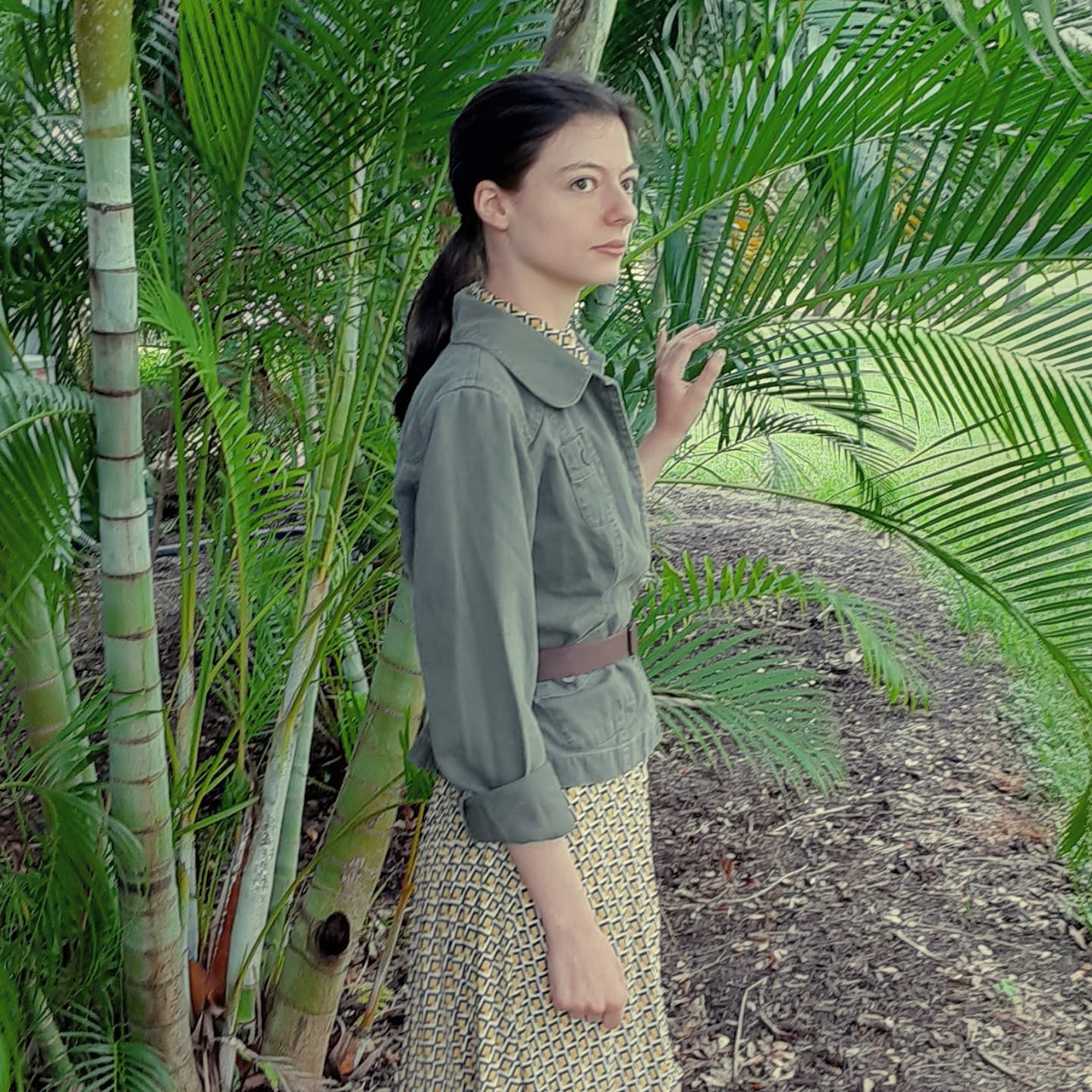
Jennifer Hewitt’18, physics, didn’t know that her casual interest in reptiles would lead to a one-of-a-kind study that helps snake hunters track down Burmese pythons in the Florida Everglades.
Hewitt, a doctoral candidate at the University of Central Florida (UCF), and fellow researchers at UCF CREOL, The College of Optics and Photonics, are using near-infrared (NIR) cameras to detect and identify Burmese pythons. The snakes, which can reach up to 26 feet in length and 200 pounds, have threatened the native species in the Everglades since they were first introduced into the region in the late 1990s by the hands of irresponsible exotic pet owners and breeders. Since then, previous studies have shown that pythons have caused a drop in the number of common native species—such as raccoons, opossums, and rabbits—by more than 90 percent.
Headshot of Hewitt in Florida. All photos courtesy of Hewitt unless otherwise noted.
Working around natural camouflage
Hewitt, who is a part of CREOL’s Infrared Systems and Imaging Group, led the python-tracking study, which was published in Applied Optics earlier this year. Her work is paving the way in decreasing the pesky python problem in the Everglades, while further advancing optics research and system design.
The Maryland native joined the project to build off of the work that was already being done in analyzing the spectral reflectivity characterizations of pythons—which would then allow the NIR camera to effectively circumvent the python’s natural camouflage.
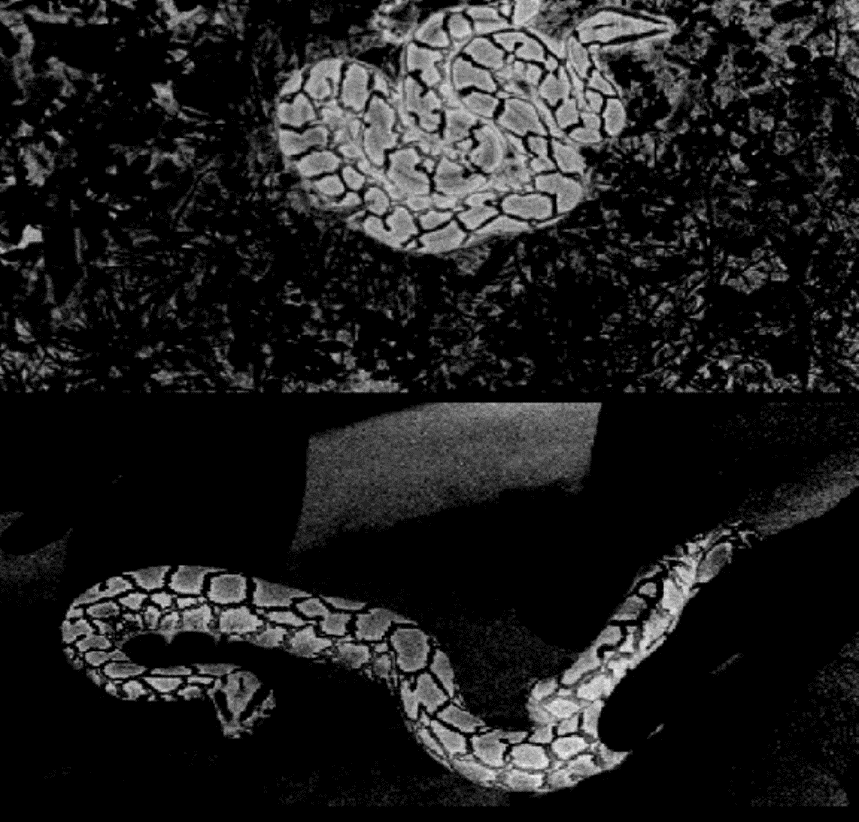
“We went to a local zoo and took spectral measurements of the [snake] hide so that we could take a look at their reflectivity,” said Hewitt. “We compared that to similar spectral measurements of plant life, both the living and dead, that are local to the region. We noticed that there is a pretty good contrast between the pythons and the background in the NIR starting at around 750 nanometers and longer.” At lower ranges, said Hewitt, there isn’t very much visible difference between python and plant.
Hewitt collected images of pythons in different locations and with different background scenery. She then conducted a human perception test on volunteers to evaluate the effectiveness of the system she developed.
“For both day and night conditions, volunteers were able to detect the pythons further away with NIR than with visible imagery [basically, the naked eye]. From here, we are continuing to fine tune the camera system to further improve the detection rate,” Hewitt shared in a press release announcing her published study.
The study’s results showed that the enhanced contrast from the NIR enabled participants to detect pythons at 20 percent longer ranges than the use of visible imagery. Hewitt’s research could potentially be later used to develop automated snake detection systems.
Early beginnings in optics
Hewitt is no stranger to capturing and analyzing imaging data. While pursuing her undergraduate degree at UMBC, she worked in Eileen Meyer’s physics lab studying black hole imaging and the structure of jets emitted from the black holes. Meyer, associate professor in UMBC’s Department of Physics, advised Hewitt during her undergraduate career and immediately recognized her aptitude in understanding the physics and mathematics of interferometry, which is used in astronomy for radio-wavelength observations.
“I first noticed [Hewitt’s] aptitude in my junior optical lab course, where she wrote the most beautiful lab reports I ever saw in the course. After she joined the research group, Hewitt very quickly mastered the ‘art’ of analyzing astronomy images made at radio wavelengths,” said Meyer. “She made so many useful images for our archive that we still regularly use them today.”
Pictures of pythons taken with near-infrared (NIR) cameras.
Even though Hewitt shared that she was initially interested in being an astronomer, Meyer encouraged the young physicist to explore optics graduate programs after taking notice of her success in optics research.
“I knew right away from seeing her work in my optics lab that she had talent for research—conscientiousness, clarity of thought, and an analytical mind. I am beyond happy to see how well Hewitt is doing,” Meyers said. “I am particularly grateful that UMBC supports undergraduate research so well.”
Hewitt was a 2017 – 2018 recipient of UMBC’s Undergraduate Research Award for her work “Characterizing Hotspots of Extragalactic Jets and the Connection Between Jet Speed and Let Power.” While her current research pursuits have gone in a different direction, Hewitt shared that she “liked what I was doing in astronomy, but I very much prefer the field work that I’m doing as a more closer-to-earth scientist.”
Supporting a growing demographic in physics
Hewitt doesn’t take it lightly that she’s among the small percentage of women who have a career in physics. According to the American Institute of Physics, in 2017, women earned 21 percent of physics bachelor’s degrees and 20 percent of physics doctorates. At UCF, Hewitt said women comprised about one-third of the physics classes.
Jennifer Hewitt with tracking equipment in the field.
Hewitt’s mother, Jeanne Toussaint, works in systems engineering and shared with her daughter the drastic difference of the number of women currently in physics compared to when she was a student.
“I find myself doing the mental tally of how many of us women there are,” said Hewitt, “and my mother says that’s already far better than what I used to have. She said that maybe one or two women were in her classrooms, and sometimes she was the only one.”
Hewitt’s hoping to add to the growing demographic of women working in her industry. Her snake-tracking research will be used by the Florida Fish and Wildlife Conservation Commission on a project that will possibly assist professional hunters with locating Burmese pythons. Her work has already garnered attention from major research entities. Hewitt was awarded a scholarship by the U.S. Air Force and will work in the Air Force’s research labs after she graduates from UCF.
“It’s going to be a huge change from what I’m currently doing because most of my research has been applied to single band imagery,” Hewitt noted. “I’m hopefully going to be using a lot of the stuff that I’ve learned for overall general system design to assist with some of the research that they’re doing in the labs.”
Life doesn’t pause when classes end and the sun goes down. Instead, students grab a cup of coffee and find a million ways to follow their interests. Whether dancing, studying over pizza, or keeping delicate plants alive in the labs—our campus is abuzz 24/7. We sent staff writer Charis Lawson ’20 and editorial interns Anna Lee ’22 and Eric Widemann ’21 off into the night with UMBC Magazine photographer Marlayna Demond ’11 to explore it all.
Especially in the Dark, UMBC Rolls On D-Hall Basketball Court
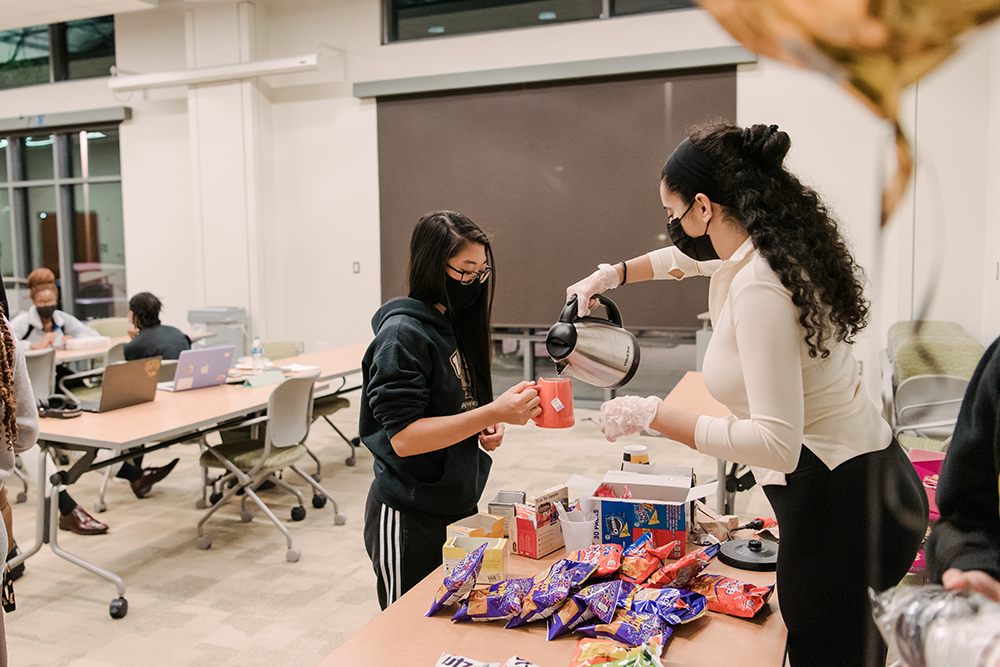
Every evening from 8 p.m. to 2 a.m., steady streams of students fill the dining hall at True Grit’s Late Night. Some come strictly for the food, others to socialize. Some come for a study break, others come to study.
Just outside the dining hall, an entirely different scene presents itself. Playful shouts radiate from the basketball court. As night arrives, so does cool, crisp air—but students have found a way to keep warm by engaging in a hotly contested pick-up basketball game. This happens here almost every night.
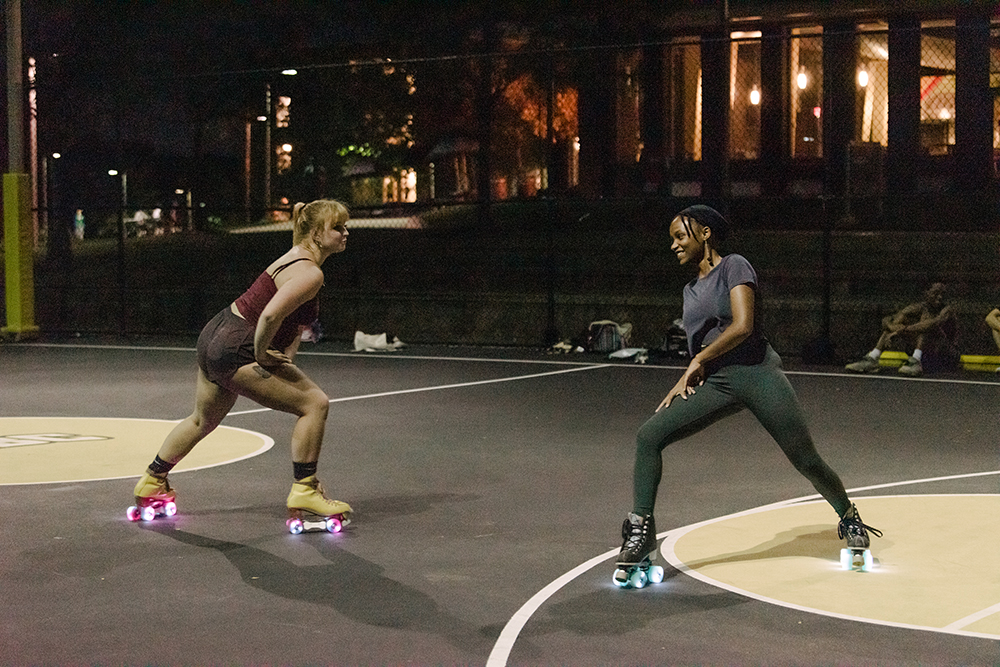
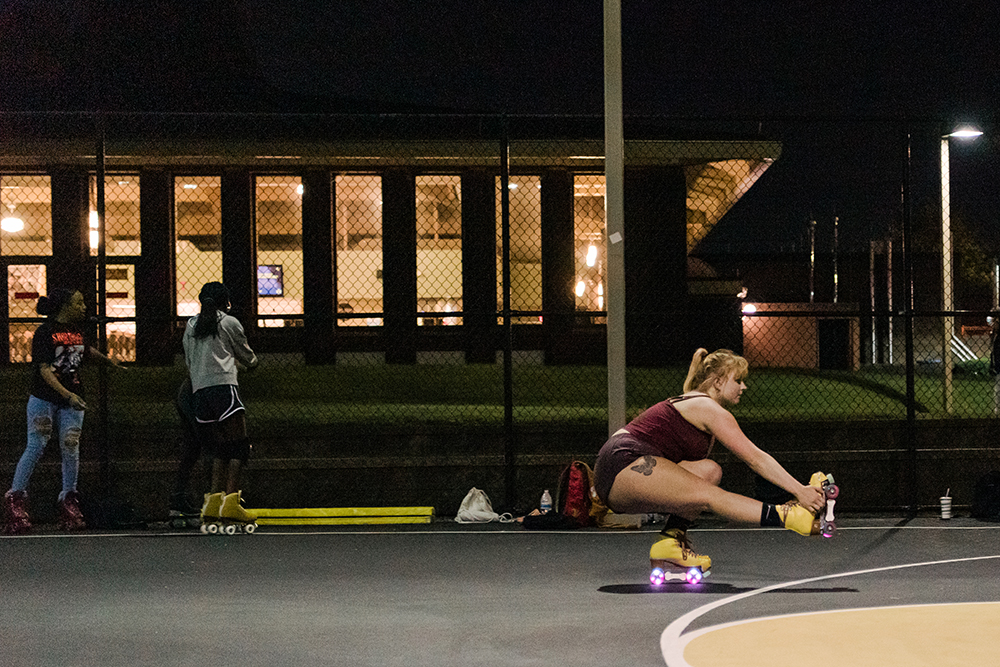
But tonight, something else is particularly eye-catching. Whizzing just above the ground, the wheels of roller skates radiate bright rainbow colors, and laughter and chatter follow the lights much in the way that sound usually follows light.
Maddie Mills-Snyder ’25 and Leah Jupiter ’25 practice their roller skating on the basketball court near True Grit’s.
“I roller skate on campus every single day, as often as I can, sometimes even to or in class,” says Maddie Mills-Snyder ’25, undecided, AKA “Rex” to the thousands of followers of her roller skating-centric Instagram.
Skating after dark presents a unique opportunity “because that’s when we get to skate to late night with our light-up wheels,” says Mills-Snyder, sharing the court with Leah Jupiter ’25, biology, who loves the energy and cool breezes of nighttime skating.
The basketball court near True Grit’s is home to all types of sports.
“I love learning new tricks and showing off. I love when people ask us to show them a trick. Rex and I have also created a few dances to popular songs like ‘Bad’ by Michael Jackson,” continues Jupiter. Both love this court but also take advantage of any flat surface, really—the Commons garage, or elsewhere around campus.
Both agreed the best part of skating is the community it brings. So if you’re looking to light up the night on campus, lace up your skates and you’ll be sure to find a welcoming scene.
“I love empowering other skaters,” says Mills-Snyder.
– Eric Widemann ’21
Run for Your Life Campus-wide
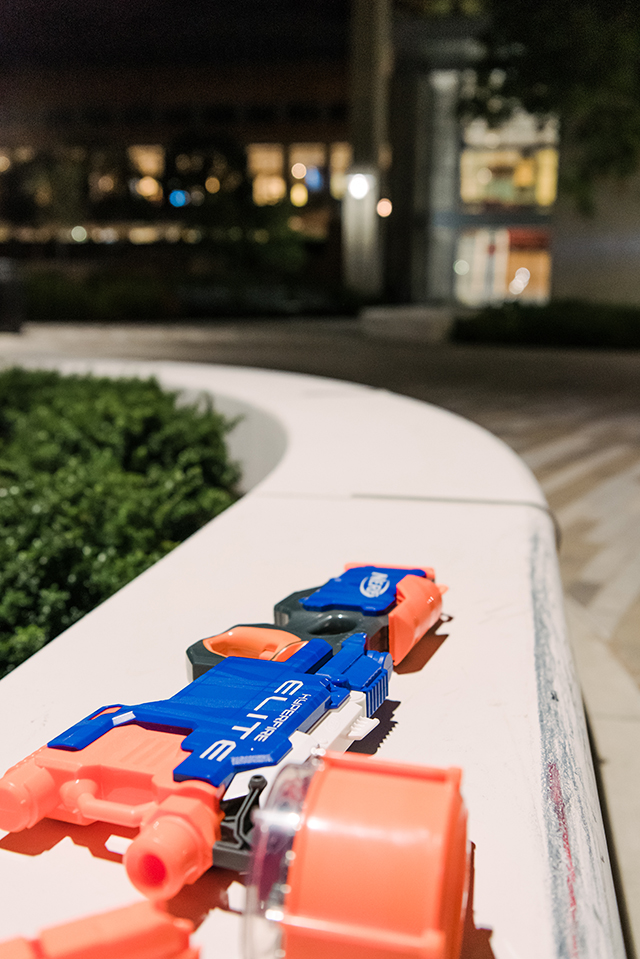
All across campus, darkness camouflages hoards of young adults chasing one another and defending themselves with Nerf darts and rolled-up socks. If that sounds like a childish game, Humans vs. Zombies (HvZ) members would agree with you. HvZ members are not known for taking themselves seriously.
While many members have described HvZ as a glorified game of tag, there is a lot more to it than that, the members explain. “An average mission starts with a briefing where we learn about our mission and what we’re expected to do in order to win. Most people start ‘human’ but some start ‘zombie.’ Humans start strong and more often than not, human victory feels like it’ll be a piece of cake,” notes Henry Denny ’23, mechanical engineering. Usually, the humans have to rethink that sentiment as the hoard of zombies grows.
HvZ has a decade-long legacy on campus, organizing night missions, Saturday games, missions that span across other colleges, and even week-long missions that run 24/7. The result? A tight-knit community like no other. Kyle Mosier ’20, computer science and mathematics, M.S. ’22 computer science talks about how during the pandemic, having a group of friends to eat with several times a day on campus was so important.
Even after the missions are complete, it doesn’t mean everything is over. They often head over to D-Hall (as their human selves, not their zombie selves) for non-brain-related snacks and to tell stories from the night and club lore, stories that have been passed down from years ago.
– Charis Lawson ’20
Bringing Your A-Game UMBC Game Room
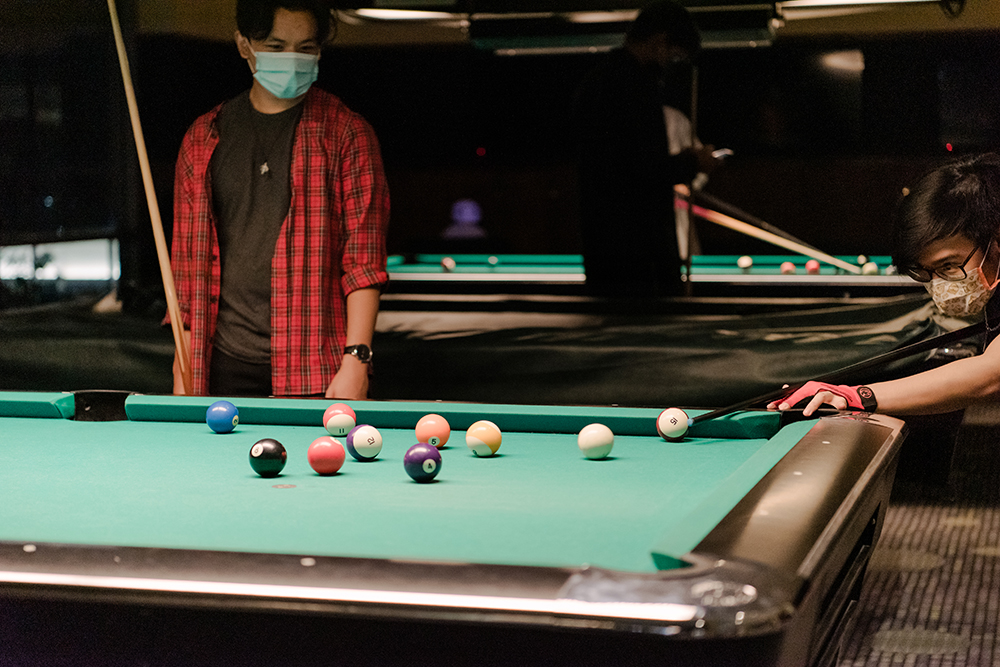
Whoever controls the playlist in the Game Room has queued a selection of upbeat songs, only rivaled in volume by the smacking of billiard balls and rhythmic bouncing coming from the pingpong tables.
Tonight, more or less every billiards table is in use, and the pingpong tables are playing host to some intense rallies. Ayush Nigam ’24, computer science, plays pingpong or billiards two to three times a week and enjoys the “dark-ish warm vibe” of the space after hours.
The Game Room offers billiards, pingpong, video games, and other amusements.
Justin Nguyen ’24, biochemistry, is among the gamers, as he is many nights of the week. Around him, enthusiastic players of all sorts blow off steam with their favorite video games or practice their angles on the pool tables.
“Whenever my friends and I come [here], it’s to play pingpong. We love the competitiveness– it gets the blood flowing,” he continues. “I love hanging out with friends.”
– Eric Widemann ’21
Late Night Pick-Me-Up UMBC Shuttle Route
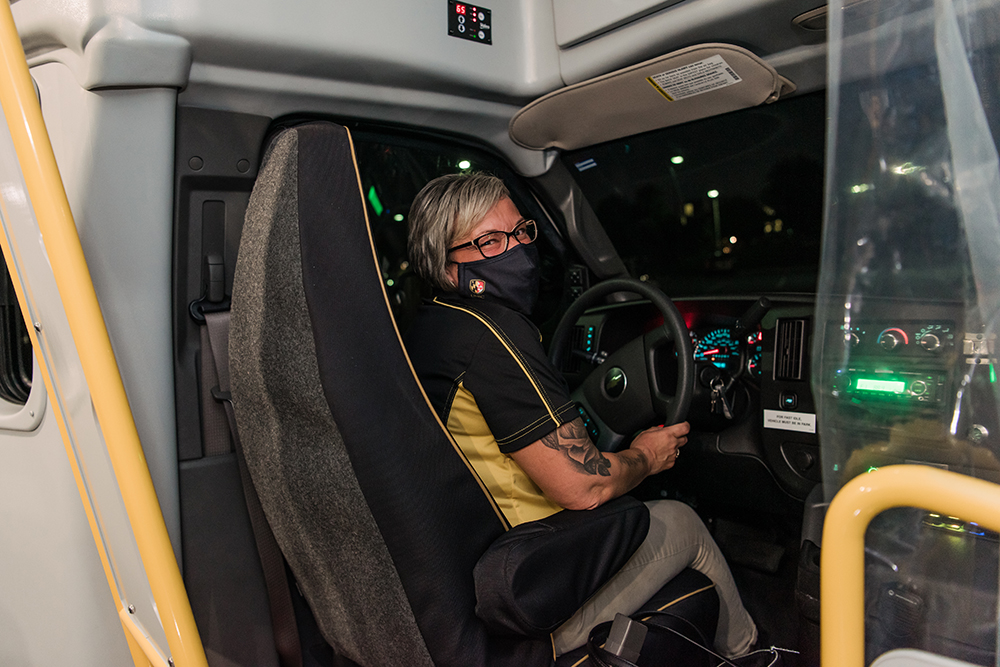
Holly Knott clutches the microphone of the CB radio on her shuttle dashboard. “319 BWI 10-8,” Knott says. It’s 6:20 p.m. and the code signals to the others working in the UMBC Transit office that her bus is in service and she is about to start her five-hour shift.
She’s headed to BWI, a run she completes five times a night. The darkness makes it hard to know how much time has passed sometimes, but she fixes her concentration on the road before her and keeps her eyes wide open.
“When students get on, I try to turn the music up a little bit for them.” Most nights, Knott is playing 97.1—her favorites include the classics from the ’80s and ’90s and earlier hits from the Temptations. “I tell people I’m a young person with an old soul,” Knott adds with a smile.
Driver Holly Knott says hello to shuttle riders as she begins the night shift.
“Everybody here is very welcoming,” says Knott, who started at UMBC in August 2021. “The students, they greet you. ‘Have a good day.’ ‘Have a good night.” Some even said, ‘Be careful out there.’”
Knott looks forward to the day the protective plastic curtain around the driver’s seat can come down and it’s safe to have prolonged conversations with some of the regulars. Until then, she finds other little ways to return the warmth. She welcomes students and makes sure she turns towards them when they board. She tries to make sure to park super close to the curb so that students have easy access to the bus.
Knott enjoys working late at night, but it’s 11:12 pm, so she leisurely drives the bus into its proper parking spot. Once again, she grabs the microphone of her CB radio. “319 BWI 10-7.” she says, indicating that the 319 bus trip to BWI has ended and the bus is no longer in service.
– Charis Lawson ’20
Making the Rounds Chester Hall, West Hill Apartments
It’s 10:25 p.m. and Lead Residential Assistant (RA) Hager Younes ’22, biology, is grateful to wrap up her rounds on a quiet note. Anything can happen in this job. But even when it isn’t easy, the bonds she has formed with her residents help her through—just as her former RA did for her.
When she came to UMBC in 2018 as an out-of-state student, Younes felt isolated from friends, family, and any sense of stability. However, through the efforts of her Erickson Hall RA Princess Sara Njemanze ’21, chemical engineering, Younes soon felt welcomed and part of a community. That is why she works so hard to instill that same sense of community in her residents and her fellow RAs.
Resident Assistant Hager Younes ’22 shares a moment with her residents.
Younes loves getting creative, posting, “Would you rather?” boards to spark hours-long conversations and organizing an on-going gathering where students drink tea, eat snacks, and just talk.
“I feel like everyone is so human deprived. People are wanting to come to any and every event.” Younes says, commenting on the sheer turnout of events this semester. One thing that always makes the students happy? Visits from Chip, the campus comfort dog.
“When she would come through, you could just hear doors opening down the hall.”
– Charis Lawson ’20
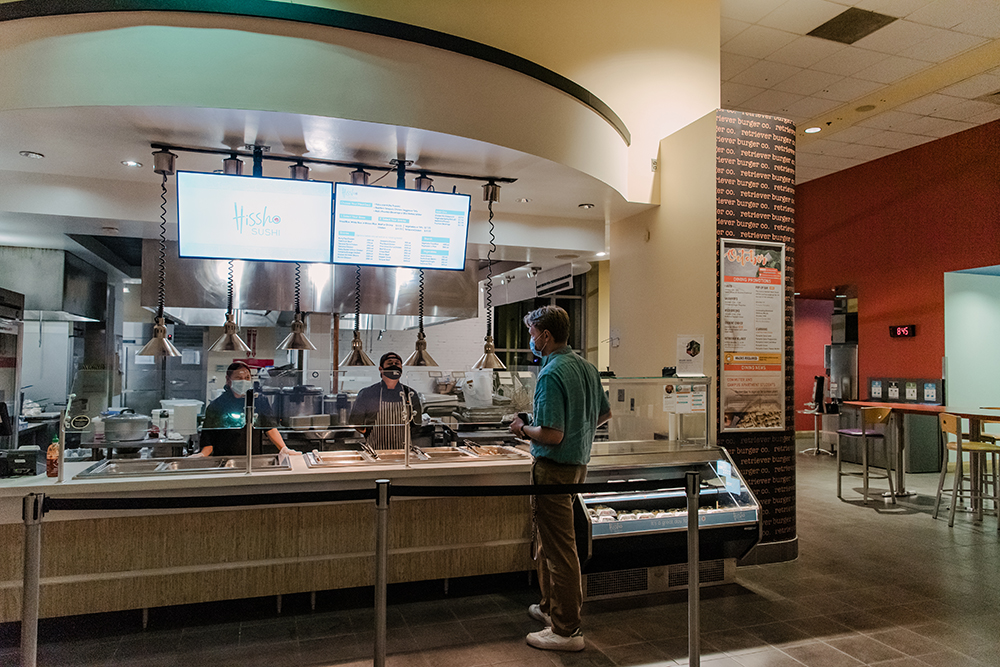
Studying Over Sushi Hissho Sushi, The Commons
Late-night studying means late-night snacking. And while you’ll find students squeezing in cram sessions pretty much everywhere around campus in the wee hours, one newer option is over sashimi and California rolls.
Soft chatter fills the second floor of The Commons, as students share company and a meal with one another. The zesty scent of orange chicken fills the air and the brightly illuminated sushi refrigerator invites in curious students, especially at this hour. While by day The Commons is rather loud, the nighttime calm is the perfect environment to do some studying
Late-night sushi always hits the spot!
“I study late with friends, so it’s definitely become convenient,” says Erin Hamner ’22, geography and environmental science.
To top it off, the staff here is so friendly—even through the masks, you can make out the smiles.
– Eric Widemann ’21
Dance Like No One Can See You University Center Hallway, Ground Level
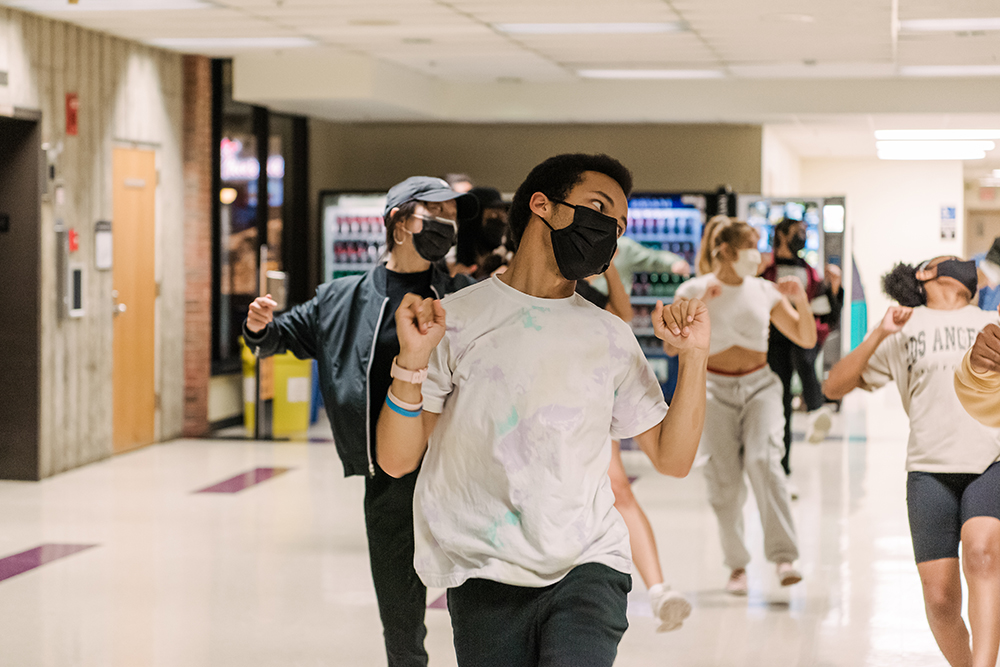
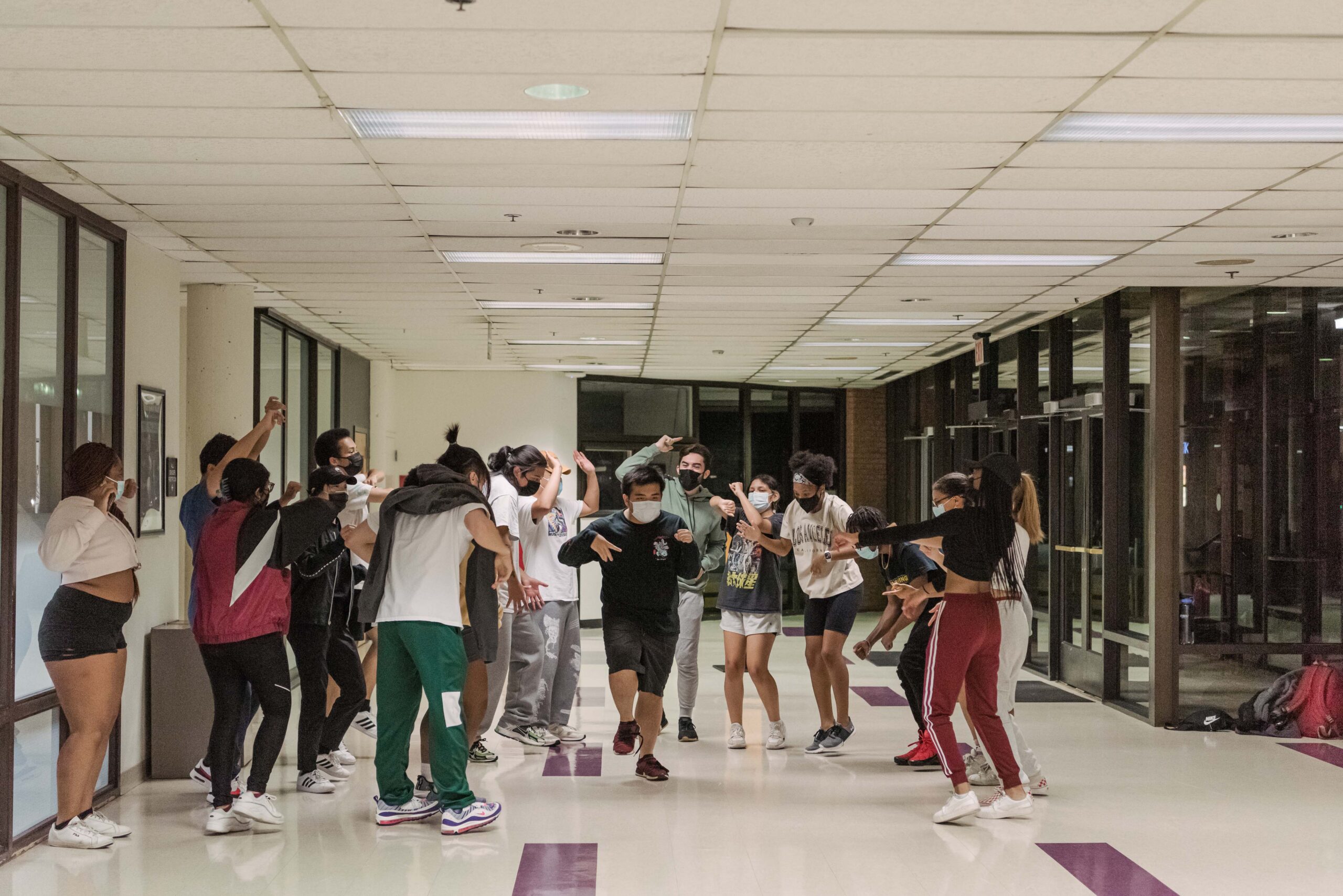
UMBC’s University Center appears quiet and empty, with students retiring for the night with Chick-fil-A or Starbucks in their hands. But if you listen closely, you’ll hear the faint thump of bass and upbeat hip-hop music emanate from the first floor. Most of the building has gone to sleep, but Major Definition dances on to the beat.
Major Def’s executive director, Timothy Huynh ’22, computer science, wasn’t sure what dance meant to him when he joined the club. But Huynh’s connection and dedication has since grown, as he now considers dance to be essential to his well-being and weekly schedule.
Major Definition turns up the bass as it takes over a hallway in the UC for a late-night practice session.
Prior to the pandemic, Major Def would meet at the UC three evenings a week. Even after their practices turned virtual, they continued working just as hard to put together concept videos in small teams. While Major Def plans on slowly getting back into the swing of things with the in-person semester, their energy remains just as contagious.
“When you’re really passionate about dance or you’re just looking forward to dancing with each other, the hours really don’t matter because they go by really quickly and you’re not even looking at the time,” says Huynh.
The club’s practices take place in an uplifting, supportive environment where teammates offer feedback to one another and embrace each other’s unique styles. From quick twists and turns, hand gestures, facial expressions, and smooth movements from head to toe, the dancers are precise and tell stories of their own.
While Major Definition found a way to stay connected virtually during the pandemic, they’re excited to practice in person again.
After practice, dancers form a circle and put their hands in for a chant before dismissal. Later, you might see the team stay back to chat with each other, show off their new choreography, or head out to grab some bubble tea.
“Even if you don’t see yourself growing in terms of dance, your other teammates can see it. And it’s really beautiful being able to see that progression,” Huynh says.
– Anna Lee ’22
Midnight Melodies Fine Arts, Room 306
A single voice enchants you. Despite being faint, almost whisked away by the wind, the voice is clear. Another voice joins the first and then another until a whole group of voices are expertly switching from synchronization to harmonization, each moment a new voice coming to the forefront. Sonia Anger ’22, mathematics and psychology, with her clear soprano, blends with the talents around her.
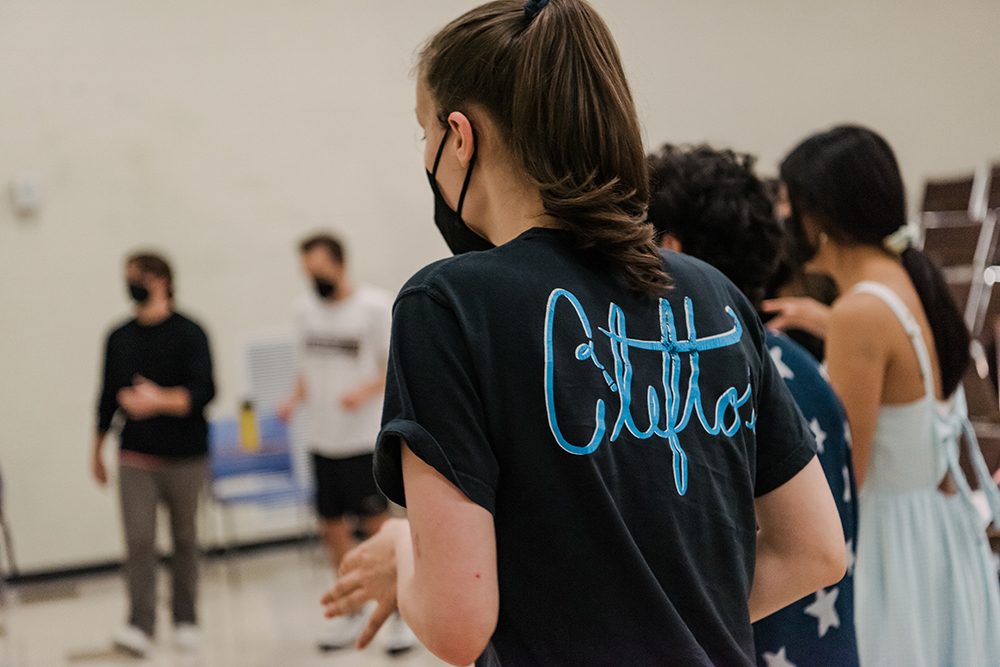
The Cleftomaniacs made a name for themselves when they placed first in the 2018 Mid-Atlantic Quarterfinals at the International Championship of Collegiate A Cappella. When Anger got involved with the co-ed performance group her first year at UMBC, the club was the breath of fresh air she needed.
After a year spent serving with Americorps, Anger felt disconnected from her peers, but from the moment she auditioned, despite her own anxiety, she could see how welcoming and friendly the group was and she wanted to be a part of it. Anger talks about the Cleftomaniacs like the group is her own family. While they spend a lot of time together outside of club activities, performing is her favorite part.
Harmonies blend and echo as the Cleftomaniacs practice their songs in Fine Arts, Room 306
When the group splits up to work on individual voice parts late at night, she frequently finds herself practicing in empty classrooms, hallways, and stairwells of ITE. Afterward, she often walks with her friends to the dorms or Late Night at True Grit’s only to continue singing.
“We would be singing outside of SUS [Susquehanna dorm] in the middle of December and people would be like, ‘You know you can go inside right?’ but we were stubborn and we just wanted to have fun,” says Anger.
– Charis Lawson ’20
Eyes to the Stars UMBC Observatory and Lawn
It’s easy in an academic environment to keep your head in a book—or more likely, in front of a screen. The Astronomy Club, however, asks you to look up.
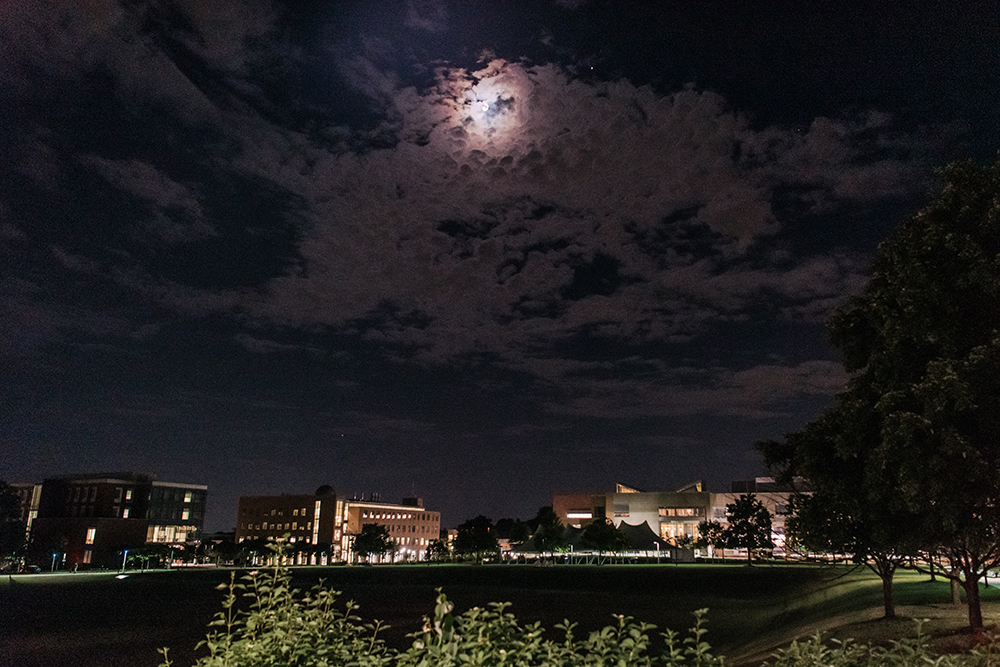
“I love taking walks at night around campus– it is very freeing.” says Tara O’Donnell ’24, physics. As she looked up into the night sky, O’Donnell—president of the Astronomy Club— and fellow members found solace in the vast cosmos. Despite loving the atmosphere of campus at night and the view of the stars and the moon, most of her first year at UMBC was virtual. “My experience was sitting in my room doing classes through Blackboard, so my opportunity to connect more fully with the UMBC community was through the Astronomy Club,” says O’Donnell.
On a gorgeous night, Astronomy Club members enjoy open spaces and fun conversation.
Now the Astronomy Club once again meets in person, and their meetings range from discussing major space news like the Perseverance landing on Mars or making use of the telescope in the observatory on top of the Physics building to playing games like Jeopardy, watching movies, and hosting special guests and debates.
The Astronomy Club has maintained a thriving community. Late into the night, you can find O’Donnell and her friends looking up into the sky contemplating ideas as big as the universe itself.
– Charis Lawson ’20
Burning the Midnight Oil Biological Sciences Building, Hua Lu Lab
When the sun has gone down, plants are just as active as they are during the day. Like humans, they have an internal clock that prompts responses to environmental stimuli such as light, temperature, and unwanted visitors like pathogens. If left unaddressed, these pathogens can be detrimental to plant health and reduce crop yield in agricultural fields. In UMBC’s Biological Sciences building, the members of Professor Hua Lu’s lab study the role of the circadian clock in plant defense against these outside invaders.
That explains the brown, cushiony sofa to the side of the room. Because students have had to monitor the plants every four hours for previous projects, Lu’s office has become the go-to snooze spot for overnight stays. Jessica Allison, a graduate student at the Lu lab, even remembers finding a sleeping bag under her desk after joining the team.
Graduate Jessica Allison tends to the flora in the Hua Lu Lab.
The plants that Allison and the other lab members use in their research, thale cress (Arabidopsis thaliana), seem to sit peacefully in the large chambers they’re stored in. But much more is happening beneath the surface of these wispy, flowering plants.
For her project, Allison regularly conducts a process called a luminescence assay where 96 thale cress seedlings are first planted into a well plate. The plates are then placed into chambers, where the plants are only exposed to light. Allison finally examines how the absence of dark conditions affects plants’ circadian clocks.
Even after the lab members have gone home, this process continues to run throughout the night. The next day, Allison uses a machine called a plate reader once an hour to check the plates for gene expression patterns—graphs that depict the activity of the plants’ internal clocks.
“We test a lot of genes like that, and we knock out some genes and see if it affects others. We let that run 24/7,” Allison explains.
For now, Allison hasn’t had to stay overnight to check up on the plants on a set schedule. But she expects to be making good use of the couch when the time comes.
– Anna Lee ’22
All-Nighters Welcome Retriever Learning Center, Albin O. Kuhn Library
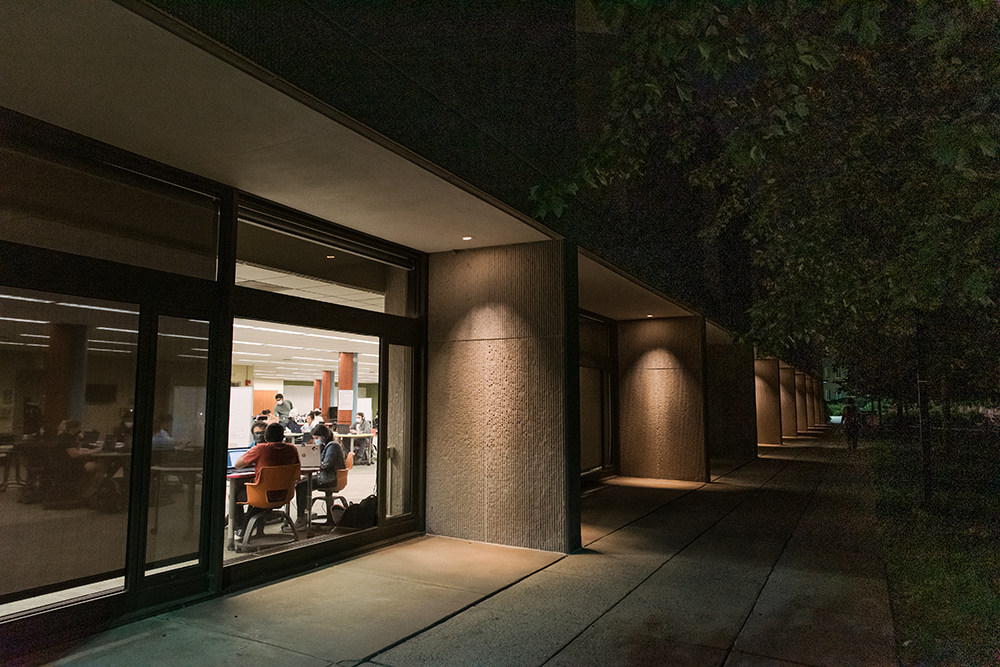
At 8 p.m. as the rest of the library closes for the night, students begin heading to the 24/7 Retriever Learning Center (RLC). The white lights of the RLC beam down on notebooks and bright laptop screens. Students clack away at their keyboards and scribble down notes from the formula-ridden whiteboards beside them. Some have earphones in, dedicated to finishing the assignment due at midnight, while others study all night in larger groups to tackle content for an upcoming exam.
Peer through the windows of the Retriever Learning Center, and you’ll see learning happening 24/7.
Among them are information systems majors Ahsan Baig ’24,Devanshi Patel ’24, Emilien Tchuosi ’24, and Nazim Elliott ’22, who are working on a group project for their information systems class. Baig loves the fact that you don’t have to whisper here. The RLC’s whiteboards and portable chairs are also a plus, as the group mentions how practical they are for studying. Tchuosi especially appreciates having a place where she feels compelled to get work done.
“I come here on a daily basis just because it pressures me to study…. So when I come here, I actually study instead of watching YouTube videos,” Tchuosi says, eliciting laughter from her group mates.
Shawn Parker, a building manager at the library, is dedicated to making the RLC more secure and conducive to student learning. With students as a top priority, Parker works to provide accessible furniture and ensure students’ safety within the building. This was also students’ vision for the RLC when plans for an accessible learning space began in 2006. With support from the university, the overnight learning center became a reality.
Parker hopes that the center can continue equipping students with the resources to collaborate on all sorts of projects.
“It’s a brighter day for students when they’re listened to and understood. But most importantly, you have to hear what they’re saying to understand what they’re asking for. And that’s what I try to do best,” says Parker.
In Baltimore City, middle schoolers are making roller coasters out of insulation tubing and tape. High schoolers are dunking basketballs to learn math equations. And not too far away at UMBC, the Sherman STEM Teacher Scholars are prepping to spread even more innovative, inclusive lessons throughout city schools.
The Sherman STEM Teacher Scholars Program began in the fall of 2007 thanks to the generosity of philanthropists George and Betsy Sherman. The goal of the program is to support scholars to become culturally responsive and compassionate STEM educators in historically underserved, urban schools.
George and Betsy Sherman at the celebration of the Meyerhoff Scholars Program 30th anniversary in 2019. Photo by Jim Berger.
“They’re working in the school buildings that people tend to shy away from because they’ve got those ‘bad kids’ or they don’t have a lot of resources. Our scholars are gravitating to those spaces,” says program director Rehana Shafi.
George Sherman passed away earlier this year but the legacy he left continues to be felt in the lives of the scholars who bear his name. Fourteen years later, the program supports 80 current scholars who will one day join the 140 program alumni who are teaching in high needs schools in Baltimore and throughout the region. All scholars receive scholarships towards their education as well as advising and coaching to embody the Sherman Program’s values.
Putting the fun in active learning
Ben Davis ’11, biological sciences, M.A.T. ’13, was one of the first Sherman scholars to enter the workforce. Today he is teaching at KIPP Ujima Village Academy in Baltimore, where he tries to make sure his middle school science students do one hands-on project a week like making the roller coasters out of household materials or dissecting sharks or frogs. “The kids are able to use scalpels and surgical scissors and… look inside and see what’s going on, [asking] is this similar to what we see in a human or is this different?” says Davis.
Davis on campus with a group of his students. Photo courtesy of Davis.
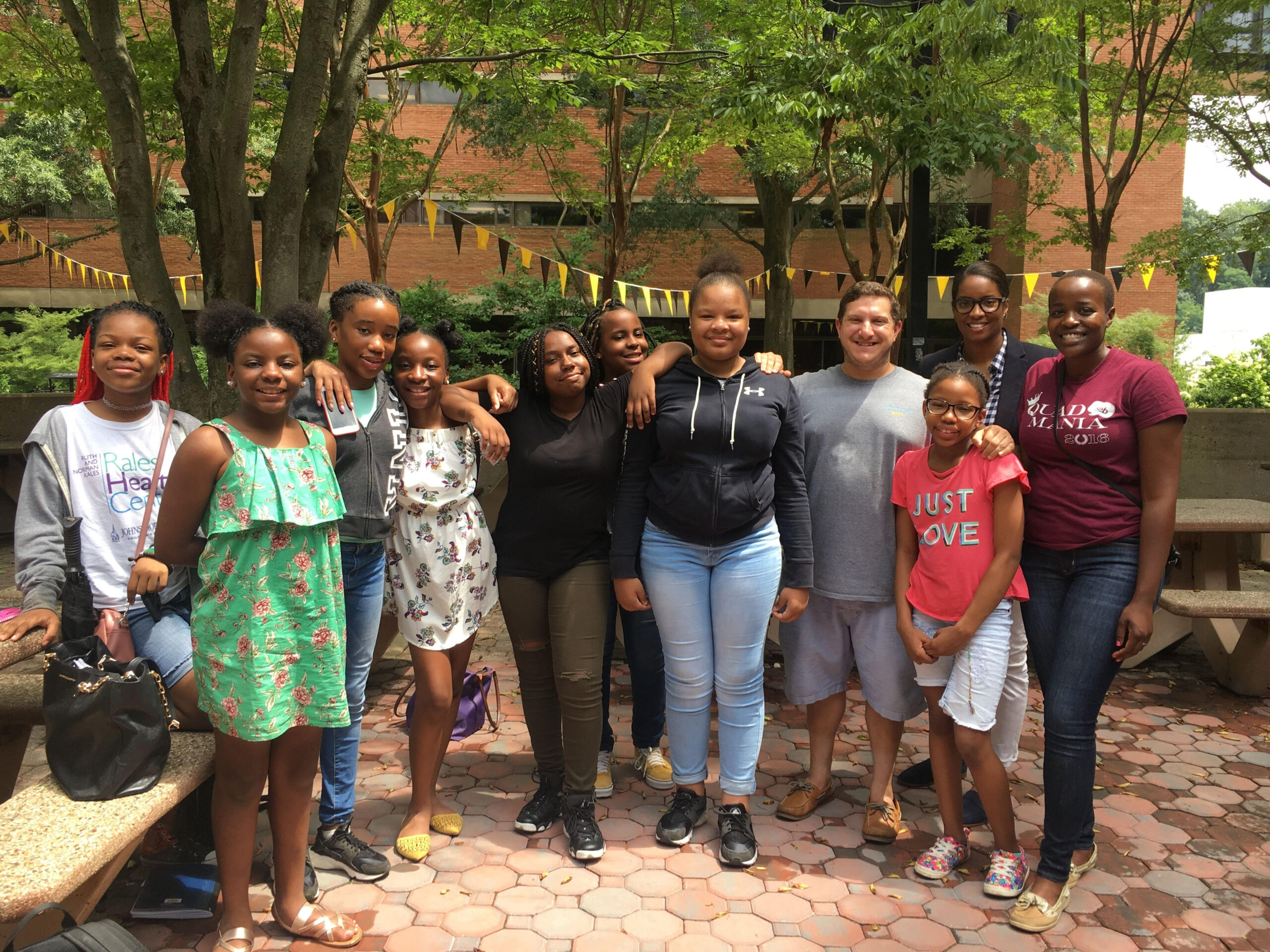
Davis has also started a summer program to get middle-school girls onto the UMBC campus to attend college courses and engage in lab work like discovering a virus, sequencing its DNA, and even naming it. “They’re building that skill of optimism and grit and growth mindset,” he says.
Sherman scholar Maria Packard ’19, mathematics, M.A.T. ’20, meanwhile, is at Green Street Academy in Baltimore challenging the stigma that math is boring. She has her 11th graders shooting basketball hoops for extra points, giving Algebra 2 an unexpectedly exciting and competitive edge for students she cherishes.
Both Davis’ and Packard’s jobs were made possible through connections made in the Sherman Program. Davis also credits Shafi and other Sherman staff with giving him much-needed support and guidance. “[Shafi] was the person really there every step of the way—she was there for me no matter if it was something that had to do with teaching or science or life,” he says.
Connecting with different lived experiences
Shafi has been with the program since its beginning, guiding it as it evolved from smaller to larger cohorts of students who are likely to teach in urban or other historically underserved schools. To prepare scholars for this, the Sherman Program requires applied learning experiences or volunteering in local classrooms. The program also provides coursework that helps scholars reflect on their own cultural lens and to understand the historical context of schooling in Baltimore. Experiences like this make space for scholars to embrace the humility required to listen to “kids whose own lived experiences are generally different from their own,” says Shafi.
That aspect of cultural humility and social responsibility is what drew Haleemat Adekoya ’22, political science, to UMBC. “I can’t engage my student in academics if I’m not engaging their mind and their soul,” says Adekoya, who plans to be an elementary school teacher who nurtures her students’ identities. “I’m not going to just start talking to you and teaching you—I cannot push you to where I think you should be or your biggest potential without engaging your community and the communities you come from,” she says.
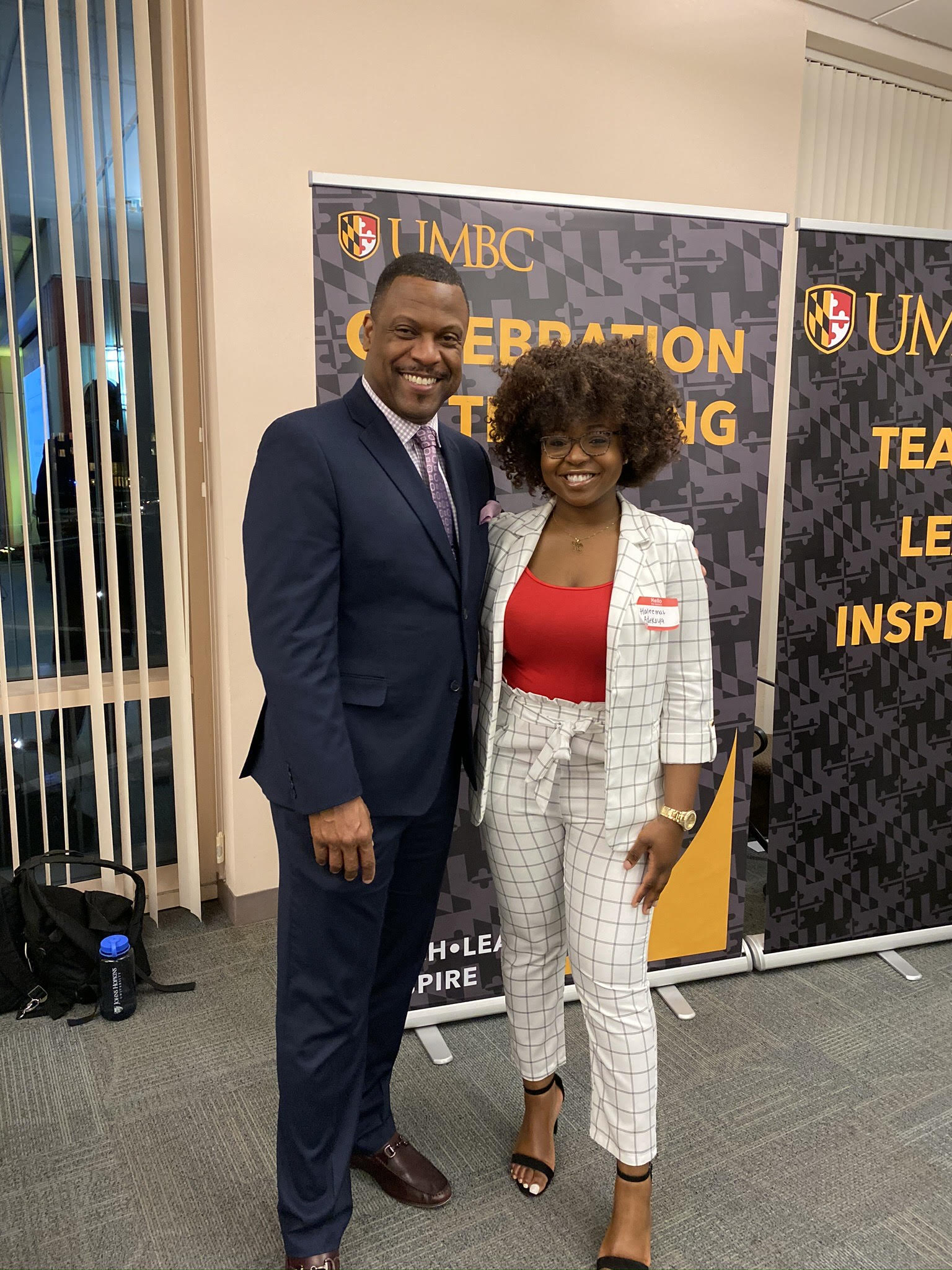
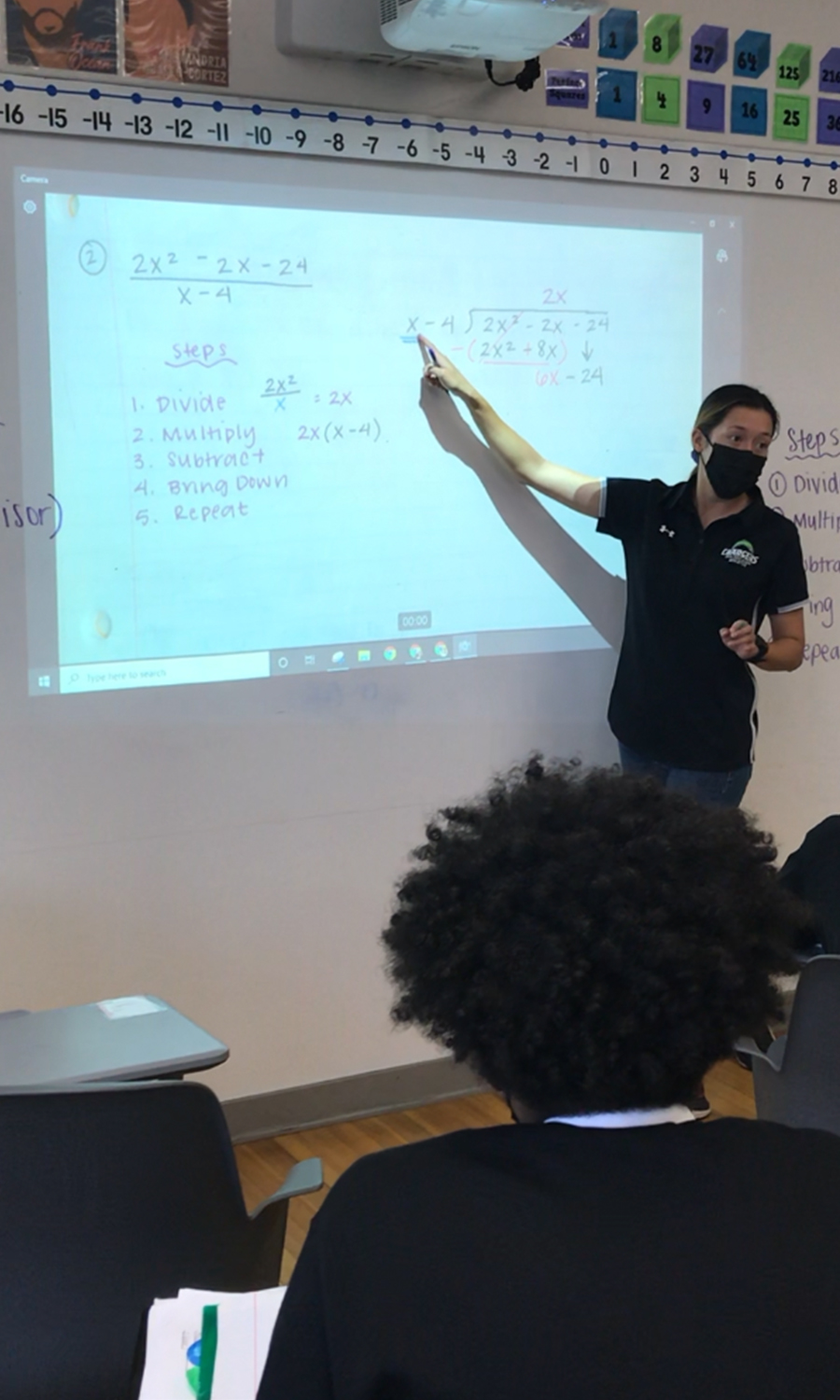
Left, Adekoya with Dr. Darryl Williams, superintendent of Baltimore County Public Schools. Right, Packard teaching her students.
Helping the Sherman scholars reach their own potential was important to George Sherman, says Shafi, and part of that is the scholarship money that helps keep scholars focused on learning. “He profoundly cared about people and their ability to be successful,” she says.
Today, the people in the Sherman program help each other succeed in a close-knit community, Packard says. Alumni get together to chat, discuss books on social issues, and support each other with advice in a challenging field.
Adekoya, student member of the Maryland Higher Education Commission, is optimistic about her future and that of the program. “I see the legacy of the Sherman program as a seed—it’s been planted and people will continue to water that seed…it will be one of those trees in a folk tale that does not die out because the community and the people who have benefited from its impact see the importance of that tree living beyond generations,” she says.
— Karen Stysley
*****
Header image of Adekoya in the classroom, courtesy of the Sherman STEM Teacher Scholars Program.
ByDavid L. Di Maria, associate vice provost for International Education, UMBC
Driven largely by the global pandemic, the number of international students enrolled at U.S. colleges and universities fell by 15% – or 161,401 students – from 2019 to 2020. However, early data for 2021 indicate the number might bounce back soon. This is according to new data from the Institute of International Education and the U.S. State Department.
The decrease in 2020, however, is the largest on record based on data dating back to 1948.
Enrollments are down across all fields of study at both the undergraduate and graduate levels, which fell by 14.2% and 12.1%, respectively. Meanwhile, more than half of all international students come from just two countries: China and India. About 1 in 3 international students in the U.S. are from China, and about 1 in 5 are from India. For context, the third-most represented nation is South Korea, which accounts for about 1 out of every 25 international students in the U.S.
2. A rebound is evident, but it may not last
While the overall number of international students dropped in fall 2020, a preliminary snapshot points to a 68% increase in the number of students beginning their studies in fall 2021 compared with a year earlier. This increase, which cannot be confirmed until a more comprehensive census is released in 2022, suggests a possible rebound is occurring.
Nonetheless, it is important to understand that the rebound reflected in these data undoubtedly includes some of the nearly 40,000 international students who were admitted for fall 2020 but had to defer their studies due to the pandemic.
Given that most admission offers may be deferred for only one year, it is reasonable to assume that fall 2020 deferrals helped fuel fall 2021 gains. So any increase in 2021 could be a temporary spike and not necessarily a sign that international student enrollments will reverse their downward trend.
3. Other nations’ losses may be the US’ gains
Another factor fueling the reported surge in new international enrollments within the U.S. for fall 2021 is that the U.S. experienced less competition from abroad.
In addition to a delayed vaccine rollout across countries in Europe, some nations have been entirely off-limits since the start of the pandemic. For instance, China and Australia, the world’s fourth- and fifth-most popular study destinations, respectively, have both remained closed to international students since the start of the pandemic, causing students who would otherwise have traveled to these countries to switch destinations in pursuit of in-person learning.
In August 2021, Australia reported more than 200,000 fewer international students than a year earlier, before the pandemic began. While Australia will allow international students to return starting on Dec. 1, 2021, it remains uncertain when China might reopen its borders to students.
4. Less funding for STEM graduate programs
Many U.S. universities would find it difficult to maintain graduate programs in science, technology, engineering and mathematics, or STEM, without international students. This is made clear by a 2021 report showing that international students constitute the majority of full-time graduate students in many STEM fields. For example, at the graduate level, international students are 82% of all petroleum engineering students, 74% of all electrical engineering students and 72% of all computer and information sciences students.
While some might think these figures mean U.S. students are being crowded out, research reveals that international student enrollment actually helps increase U.S. enrollment. Consider that international students pay higher tuition than their U.S. classmates, which helps pay for enrolling more American students.
5. Fewer US jobs
Beyond usually paying a higher tuition, international students spend money off campus as well. In fact, they spend on just about everything that U.S. students do, from apartments and transportation to insurance and technology. In much of the country, local and state sales taxes are paid on top of these purchases.
These dollars add up to the point that for every three international students, one U.S. job is created or supported by their spending. The 2020 enrollment drop-off means 109,679, or 26.4%, fewer U.S. jobs were supported by international students in 2020 than in 2019.
6. Fewer highly skilled workers
International students who work internships or get practical training also serve as a valuable pool of talent for U.S. employers struggling to hire workers in highly skilled areas, such as science and engineering.
According to the U.S. Chambers of Commerce, the shortage of highly skilled workers is a key factor holding back economic recovery from the effects of the pandemic. A healthy talent pool in the U.S. also has implications for global competitiveness, as other nations, such as China and Russia, aim to increase their scientific and technological capabilities.
Consider that from 2000 to 2020 the U.S. share of the world’s international students fell from 28% to 20%. How could this be? Unlike the next four most popular destinations, the United Kingdom, Canada, China and Australia, the U.S. lacks a national strategy for recruiting and retaining international students.
Earlier in 2021, the Biden-Harris administration signaled that may be changing. Specifically, the U.S. secretaries of education and state released a Joint Statement on Principles in Support of International Education. In that statement, they committed to a number of actions, such as implementing new policies and procedures aimed at ensuring the U.S. remains the top destination for global talent.
More recently, several major U.S. higher education associations called for a national strategy to reverse the international enrollment decline.
While it is still too early to predict if a unified strategy would actually reverse international student enrollment declines at U.S. colleges and universities, the idea of a coordinated national approach could help position the U.S. to compete for the world’s best and brightest minds.
*****
David L. Di Maria, Associate Vice Provost for International Education, University of Maryland, Baltimore County
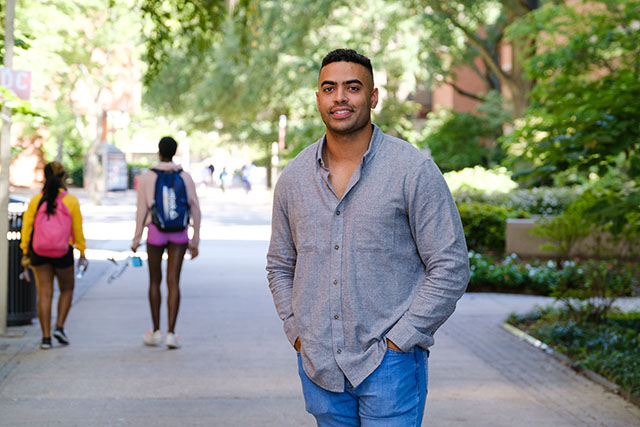
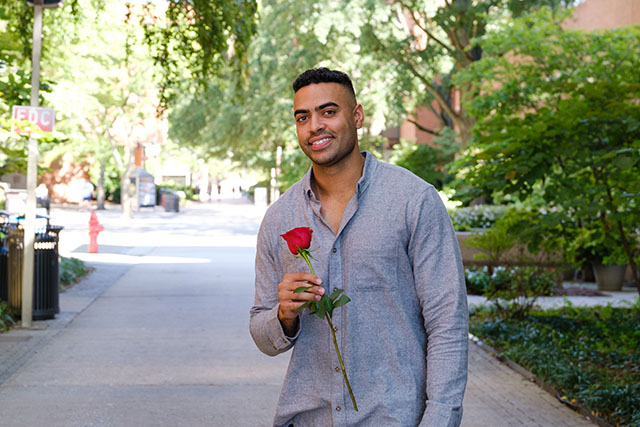
At first glance, Justin Glaze ’16 seems like the quintessential UMBC alum—a graduate in business technology administration but a minor in fine arts, a track & field athlete who went on to work at T. Rowe Price. But if he looks a little more familiar than most Retrievers, it’s probably because you’ve seen so many of his facial expressions as the runner-up on season 17 (with Katie Thurston) of ABC’s The Bachelorette. Glaze sat down with UMBC Magazine to discuss the behind-the-scenes friendship of so many of the men on set and how they still keep in touch daily. He also shares some UMBC memories, like forming an unexpected connection with President Freeman Hrabowski and eventually hanging his own art in the Hrabowski’s family home.
UMBC Magazine: So, you were the runner-up on the most recent season of The Bachelorette. How’d that happen?
Justin Glaze: In November 2020, during Tayshia’s season, I was in my house eating Ben & Jerry’s—and it was COVID so you couldn’t really go out and do anything. I was single as a Pringle. I was in a group chat with some people that watch the show and we were kind of joking about applying. It just so happened to be [an episode with] an art group date, and I was like, “Wait a minute. If I was on this date right now, I feel like I’d crush this.”
So I thought, “If it’s a short application and I can knock it out during a commercial break, why not?” Less than a week later, I got an email from a casting producer from ABC and two months later, I was getting casted.
UMBC Magazine: We loved watching the bromance develop this season. Can you share a bit about your relationship with the other guys?
Justin Glaze: Oh yes, but I don’t know where to start. But take Michael A., for example. He’s taught me no matter what life throws your way, no matter what you’re going through, to keep pushing forward. He’s experienced almost all that life has to offer, and so that’s invaluable to have as a close friend, to be able to bounce ideas off of and to kind of keep you grounded. We’ve all been able to lean on each other through tough times though. I’m super grateful for the house of guys that I had.
UMBC Magazine: How did your time at UMBC prepare you for this experience?
Justin Glaze: At UMBC I learned about creating a strong social circle and staying true to myself, which were crucial elements of my time on the show. Being a student-athlete at UMBC, you’re all joined together through the unity of sports and the togetherness of cheering for each other, whatever team you’re on.
Obviously UMBC’s a fantastic academic school and that, in my opinion, is what should come first and foremost, but you have to be involved in something. It really helps you to branch out and feel included and have that tight-knit feel, which I think helped me get through college.
The other thing I felt strongly about on the show was something reinforced to me at UMBC: Stay true to yourself. Be comfortable with who you are. As long as you know who you are, you have a strong support system who knows who you are, that’s what’s most important.
UMBC Magazine: How did you end up choosing UMBC?
https://www.instagram.com/p/BT7szZVDJkv/
Justin Glaze: UMBC is huge on inclusivity and diversity, and so it felt like a natural fit for me, but I did consider transferring because I was thinking about using my art skills to study architecture. But at a meet-and-greet my freshman year with Dr. Hrabowski, I thought, “You know what? Let me go shoot my shot and introduce myself.”
To no one’s surprise, he was super friendly—asked what my grades were like, what my major was, what I was interested in. I told him my thoughts about transferring, and he was like, “Okay, well, how about at the end of the semester, shoot me an email, we’ll set some time up, and we’ll figure something out.” I’m like, “There’s no way. I’m just a freshman, one of however many thousand.”
Long story short, I ended up meeting with him and to this day, he’s been probably one of my biggest mentors. He introduced me to the job I’m at now and took me under his wing for the remaining four years and beyond, and so he’s played a huge role in my experience.
UMBC Magazine: What’s your fondest memory with President Hrabowski?
Justin Glaze: Every time I met with him, he served me a big slice of humble pie. He gives me that tough love that I need, and that’s what I love about him. He shoots it straight and he sees the potential in me. He has this drive to always improve himself and be better, and that is something that really resonates with me.
I have to say, it’s also pretty cool that I have a couple pieces of commissioned artwork I’ve done that he has hung up in his house.
UMBC Magazine: Wait, what? Tell us more.
Justin Glaze: I was definitely nervous, because for all my art clients, I want to give my best, but especially him—after all he’s done for me—I wanted to give my best work. I was very grateful that he had the trust in me to create some artwork for some special people in his family. So yeah, it was an honor.
UMBC Magazine: How have you been managing the return to normal life after you came back from the show?
Justin Glaze: I was a bit naïve as to what it would be like. I expected a little bit of it, but I didn’t expect the magnitude that it is. It’s still new to me how to navigate it. I’m the type of person, I’ll talk to anybody, so when people come up to me, gym, grocery store, out in public, I don’t want people to be nervous. I’m a normal, nice guy. I’ll talk to people, take pictures. It doesn’t bother me.
The biggest thing is just coming to grips with people’s expectations of you. It’s been tough trying to find that balance of staying true to who you are but also knowing that being true to who you are can be perceived in so many different ways.
UMBC Magazine: If the season was in a post-COVID era and you were able to bring Katie [the eponymous bachelorette] to Baltimore for a hometown visit, what places or activities would you have done with her?
Justin Glaze: For the best view, I would have taken her to Federal Hill to overlook the harbor. I think that would have been a really nice place to chat and talk about home with that view. Katie is really into animals, so I would have taken her to the aquarium, maybe through the zoo. Definitely would have taught her how to pick crabs.
UMBC Magazine: If you had the chance to do it all over again, would you?
Justin Glaze: Without hesitation. The good, the bad. All of it. 100%.
Artist, educator, community and cultural worker, and curator: Kimberley Acebo Arteche identifies themself with all of these labels. But their path as an artist was a considerable diversion from their original plan to enter the field of medicine.
“I come from a Filipino family and the expectation is always that the children either become nurses, doctors, or pharmacists,” says Arteche ’11, visual arts. Their mother worked at Howard University Hospital, mostly with other Filipino nurses, and Arteche’s high grades in science pushed them in that direction.
Photo by Jamie Cardenas, courtesy of Arteche.
It was at UMBC that Arteche, now the co-director of the Berkeley Art Center, decided to delve into other ways of exploring their identity and visibility. Joining the Filipino American Student Association freshman year was one step, another was their role as a founding member of the campus hip-hop dance group Major Definition.“I did struggle a little bit trying to navigate what my identity was as an autonomous person outside of my parents home. I started dancing and that led me into a few years of training with a dance company in DC called Culture Shock,” they say.
This exposure to folks pursuing arts pushed Arteche to switch majors and they began their journey down a new path: photography—finishing a visual arts major in only a year and a half.
Independent study
Headshot of Gonzalves. Courtesy of Marlayna Demond.
Coincidentally, Arteche’s graduation in 2011 was the same year UMBC established the Asian studies program. It felt like such bad timing, Arteche remembers. “I’ve had been looking for this kind of education in this kind of history for so long!’” they say. Arteche even emailed American Studies Professor Theodore S. Gonzalves to ask if she should try to get a second degree at UMBC, this time in Asian studies. He offered to meet with her regularly instead.
Gonzalves, currently the interim director of the Smithsonian Asian Pacific American Center, introduced Arteche to Filipino American literature and had them read America Is in the Heart, a book by Carlos Bulosan about the struggles of Filipino migrant laborers in the 1930s and 1940s. Gonzalves and Arteche also discussed Carlos Villa, an artist, educator, and community arts organizer and the first person in the United States to teach a Filipino American arts course.
From these conversations, Arteche situated themself in the greater historical and colonialist context of America. “What came out of that was me finally realizing that, although my family had just immigrated to the U.S., my history here in the United States is so much longer,” they say.
Rethinking the gallery
After getting their M.F.A at San Francisco State, Arteche teaches there while also working at the Berkeley Art Center, and pursuing their own art. “For me, all of that informs each other. I’m teaching two classes now [and] one of them is the intermediate darkroom class. My focus is also on decolonizing photography, because our history of photography, in the European American Western canon, is about documenting indigenous peoples and like using that as a tool for colonialism.”
While at the Berkeley Art Center, Arteche aims to break down ideas of art being within the “white cube gallery with crisp white walls.” One of their art exhibitions is Bodyless, which features colorful and bright dusters suspended in spaces as if being worn, but, as expected by the title: without a body inside the dress.
Dusters, Arteche says, are very significant to their community. “They’re the dresses that you wear at home. A lot of times your grandma doesn’t even wear underwear underneath the dresses, because they’re at home, they’re doing physical domestic care work,” Arteche says. As the only one pursuing arts in their family, and a self proclaimed black sheep, Arteche has been digging into family history to understand oral histories and experiences.
They collected dusters from their own family members and created Bodyless, the experience of being seen as a body in space but not being seen as a full human. “You see the outline of a body. That also is very similar for me, as a person of color in art spaces. When I got out of grad school, so much of me being affiliated with white art spaces was so that I could check off these diversity boxes.”
They noted that they value being conscious about equity within art spaces. “[With] my role at Berkeley Art Center, we have been very conscious to not underpay artists. [I try to be] very intentional, like in all of the layers of all the work that I do, to make sure that each decision we make also sets people up to be well and be healthy.”
Reclaiming our bodies
Most recently, the San Francisco Arts Commission awarded Arteche funding for their work, an upcoming project called Kundiman ng Katawan. “It touches on these really tense political histories in the Philippines like the [Ferdinand] Marcos dictatorship, and also just how colonialism has compromised our relationship to our bodies, and how we feel like success and wealth and freedom is tied to how much money we can make and that also kind of puts our bodies at this way where it’s really just a tool for capitalism. I’m unpacking all of those things in this project that’s going to premiere next year,” they say.
As for their future, they hope to move towards taking on larger art commissions, and having their work acquired by museum collections. “Artistically, my goal is to make art that makes folks question their relationship to culture and question their relationship to history, in whatever that means for them,” Arteche says.
— Anjali DasSarma ‘21
*****
Header image: Arteche at a speaking engagement. Photo by Minoosh Zomordinia, courtesy of Arteche.
By Patricia A. Young, professor of literacy, culture, and instructional design & technology, UMBC
At a large private university in Northern California, a business professor uses an avatar to lecture on a virtual stage.
Meanwhile, at a Southern university, graduate students in an artificial intelligence course discover that one of their nine teaching assistants is a virtual avatar, Jill Watson, also known as Watson, IBM’s question-answering computer system. Of the 10,000 messages posted to an online message board in one semester, Jill participated in student conversations and responded to all inquiries with 97% accuracy.
At a private college on the East Coast, students interact with an AI chat agent in a virtual restaurant set in China to learn the Mandarin language.
These examples provide a glimpse into the future of teaching and learning in college. It is a future that will involve a drastically reduced role for full-time tenured or tenure-track faculty who teach face to face.
I forecast this future scenario and other trends in my 2021 book “Human Specialization in Design and Technology: The Current Wave for Learning, Culture, Industry and Beyond.” As a researcher who specializes in educational technology, I see three trends that will further shrink the role of traditional college professors.
1. The rise of artificial intelligence
According to a 2021 Educause Quick Poll report on AI, many institutions of higher education find themselves more focused on the present limited use of AI – for tasks such as detecting plagiarism or proctoring – and not so much the future of AI.
In my view, universities should broaden their use of AI and conduct experiments to improve upon its usefulness to individual learners. For example, how can colleges use AI to improve student learning of calculus or help students become stronger writers?
According to a 2021 poll, some of the challenges to acquiring AI included lack of technical expertise, financial concerns, insufficient leadership and biased algorithms.
Rensselaer Polytechnic Institute and Massachusetts Institute of Technology are leading the way with new uses of AI. In an immersion lab staged as a food market in China, Rensselaer virtually transports students learning Mandarin Chinese into this market to interact with AI avatars. MIT has devoted millions of dollars to faculty research in AI. One of MIT’s projects – called RAISE, for Responsible AI for Social Empowerment and Education – will support how people from diverse backgrounds learn AI, and human learning in general.
Professors from the baby-boom generation are retiring, and I expect some of their jobs will not be filled. In many cases, these coveted positions will be replaced by part-time and temporary faculty. I believe the rising use of AI will contribute to this trend, with universities relying more on technology than in-person teaching.
2. Erosion of academic tenure
Tenure is a status that grants professors protections against being outright fired without due cause or extraordinary circumstances. However, the pandemic became a means to dismiss, suspend or terminate tenured faculty. For example, the Kansas Board of Regents in January 2021 voted to allow emergency terminations and suspensions – including for tenured faculty – to alleviate financial pressures placed on universities by the pandemic.
News reports continue to show a steady decline in the number of tenured faculty positions. According to an American Association of University Professors report, the proportion of part-time and full-time nontenure-track faculty grew from 55% in 1975 to 70% in 2015. Conversely, the proportion of full-time tenured and tenure-track faculty fell from 45% to 30% in that period.
Ultimately, the pandemic was an opportunity for universities to downsize unproductive faculty and keep “active practitioners.”
3. The flipped classroom
The flipped classroom provides students with opportunities to view, listen and learn at their own pace through video instruction outside the classroom. It has been around since at least 2007.
This teaching approach is similar to the way people learn from one another by watching videos on YouTube or TikTok. However, in college the flipped classroom involves prerecorded faculty lectures of course content, whether that be on the causes and effects of the Civil War or the origins of white rice. In class, students build on the professor’s prerecorded lecture and work on activities to assist discussions and expand knowledge. The classroom becomes a place for social interaction and understanding course content. The flipped classroom maximizes instructional time for the professor and students because the lecture comes before the course’s in-class session.
As an example of the operation of a flipped classroom, a professor records a video on a subject area. This allows the same video to be viewed by one student or thousands of students. A human teaching assistant, avatar or chat agent conducts all in-class activities, tests and group work. No additional professors are needed to teach multiple sections of the same course. Professors, in this example, serve a limited role and ultimately will be needed less.
These trends illustrate a profession that I see as being on the cusp of radical transformation.
*****
Header image: Some colleges and universities may be using AI technology to help teach their students. skynesher/E+ via Getty Images
Climate change is magnifying threats such as flooding, wildfires, tropical storms and drought. In 2020 the U.S. experienced a record-breaking 22 weather and climate disasters that each caused at least US$1 billion in damage. So far in 2021, the count stands at 18.
I study urban issues and have analyzed cities’ relationship with nature for many years. As I see it, cities are quickly becoming more vulnerable to extreme weather events and permanent shifts in their climate zones.
I am concerned that the pace of climate change is accelerating much more rapidly than urban areas are taking steps to adapt to it. In 1950, only 30% of the world’s population lived in urban areas; today that figure is 56%, and it is projected to rise to 68% by 2050. Failure to adapt urban areas to climate change will put millions of people at risk.
Extreme weather isn’t the only concern. A 2019 study of 520 cities around the world projected that even if nations limit warming to 2 degrees Celsius (about 3.6 degrees Fahrenheit) above preindustrial conditions, climate zones will shift hundreds of miles northward by 2050 worldwide. This would cause 77% of the cities in the study to experience a major change in their year-round climate regimes.
A boy cools off in Seattle’s Yesler Terrace spray park in June 2021 during a record-setting Pacific Northwest heat wave. AP Photo/John Froschauer
For example, the study authors predicted that by midcentury, London’s climate will resemble that of modern-day Barcelona, and Seattle’s will be like current conditions in San Francisco. In short, in less than 30 years, three out of every four major cities in the world will have a completely different climate from the one for which its urban form and infrastructure were designed.
A similar study of climate change impacts on more than 570 European cities predicted that they will face an entirely new climate regime within 30 years – one characterized by more heat waves and droughts, and increased risk of flooding.
Mitigating climate change
Cities’ responses to climate change fall into two broad categories: mitigating (reducing) emissions that drive climate change, and adapting to effects that can’t be averted.
For example, as cities expand, people clear vegetation, which can increase the risk of flooding and sea level rise. They also create impermeable surfaces that don’t absorb water, such as roads and buildings.
This contributes to flooding risks and produces urban heat islands – zones where temperatures are hotter than in outlying areas. A recent study found that the urban heat island in Jakarta, Indonesia, expanded in recent years as more land was developed for housing, businesses, industry and warehouses.
But cities are also important sources of innovation. For example, the inaugural Oberlander Prize for landscape architecture was awarded on Oct. 14, 2021, to U.S. landscape architect Julie Bargemen for re-imagining polluted and neglected urban sites. And the prestigious Pritzker Architectural Prize went this year to French architects Anne Lacaton and Jean-Phillipe Vassal for creating resilient buildings by transforming existing structures instead of demolishing them to make room for new construction.
Just 25 of the world’s cities account for 52% of total urban greenhouse gas emissions. This means that focusing on these cities can make a huge difference to the arc of long-term warming.
The mayors of Los Angeles, Paris and Accra, Ghana, along with Mumbai’s environment minister, talk about how climate change is affecting their cities and what they are doing about it.
Adapting too slowly
In contrast, adaptation in the shorter term is moving much more sluggishly. This isn’t to say that nothing is happening. For example, Chicago is developing policies that anticipate a hotter and wetter climate. They include repaving streets with permeable materials that allow water to filter through to the underlying soil, planting trees to absorb air pollutants and stormwater runoff, and providing tax incentives to install green roofs as cooling features on office buildings. Similar plans are moving forward in cities around the world.
But reshaping cities in a timely manner can be extremely expensive. In response to levee failures that inundated New Orleans during Hurricane Katrina in 2005, the U.S. government spent more than $14 billion to build an improved flood control system for the city, which was completed in 2018. But many other cities around the world face similar threats, and few of them – especially in developing countries – can afford such an ambitious program.
Time is also a critical resource as the pace of climate change accelerates. In the European Union, about 75% of buildings are not energy efficient. A 2020 report from the European Commission predicted that it would take 50 years to make those buildings more sustainable and resilient to shifting climate conditions.
At best, urban infrastructures that were built for previous climate regimes and less extreme weather events can only be changed at a rate of about 3% per year. At that rate, which would be difficult even for the wealthiest cities in the world to maintain, it will take decades to make cities more sustainable and resilient. And the most vulnerable city dwellers live in fast-growing cities in the developing world, such as Dhaka, Bangladesh, Lagos, Nigeria, and Manila, Philipines, where local governments rarely have enough resources to make the expensive changes that are needed.
Remaking cities worldwide quickly enough to deal with more extreme weather events and new climate regimes requires massive investments in new ideas, practices and skills. I see this challenge as an ecological crisis, but also as an economic opportunity – and a chance to make cities more equitable for the 21st century and beyond.
*****
Header image: Flooding is seen in the Manayunk section of Philadelphia after the remnants of Hurricane Ida, Sept. 2, 2021. AP Photo/Matt Rourke
By Ivan Erill, associate professor of biological sciences, UMBC
Viruses have a bad reputation. They are responsible for the COVID-19 pandemic and a long list of maladies that have plagued humanity since time immemorial. Is there anything to celebrate about them?
Many biologists like me believe there is, at least for one specific type of virus – namely, bacteriophages, or viruses that infect bacteria. When the DNA of these viruses is captured by a cell, it may contain instructions that enable that cell to perform new tricks.
Recent research points to another important function of phages: They may be nature’s ultimate genetic tinkerers, crafting novel genes that cells can retool to gain new functions.
Most phages have a rigid shell called a capsid that is filled with their genetic material. In many cases, the shell has more space than the phage needs to store the DNA essential for its replication. This means that phages have room to carry extra genetic baggage: genes that are not actually necessary for the phage’s survival that it can modify at will.
How bacteria retooled a viral switch
To see how this plays out, let’s take a deeper look at the phage life cycle.
Phages come in two main flavors: temperate and virulent. Virulent phages, like many other viruses, operate on an invade-replicate-kill program. They enter the cell, hijack its components, make copies of themselves and burst out.
Temperate phages, on the other hand, play the long game. They fuse their DNA with the cell’s and may lay dormant for years until something triggers their activation. Then they revert to virulent behavior: replicate and burst out.
Many temperate phages use DNA damage as their trigger. It’s sort of a “Houston, we have a problem” signal. If the cell’s DNA is being damaged, that means the DNA of the resident phage is likely to go next, so the phage wisely decides to jump ship. The genes that direct phages to replicate and burst out are turned off unless DNA damage is detected.
Virulent phages follow the lytic cycle of viral reproduction, destroying their hosts as soon as they complete replication. Temperate phages, on the other hand, follow the lysogenic cycle and stay dormant inside their host’s DNA until they’re triggered to burst out. CNX OpenStax/Wikimedia Commons, CC BY
Bacteria have retooled the mechanisms controlling that life cycle to generate a complex genetic system that my collaborators and I have been studying for over two decades.
Bacterial cells are also interested in knowing if their DNA is getting busted. If it is, they activate a set of genes that attempt to repair the DNA. This is known as the bacterial SOS response because, if it fails, the cell is toast. Bacteria orchestrate the SOS response using a switch-like protein that responds to DNA damage: It turns on if there is damage and stays off if there isn’t.
Perhaps not surprisingly, bacterial and phage switches are evolutionarily related. This prompts the question: Who invented the switch, bacteria or viruses?
Our previous research and work by other researchers indicates that phages got there first. In our recent report, we discovered that the SOS response of Bacteroidetes, a group of bacteria that comprise up to a half of the bacteria living in your gut, is under control of a phage switch that was retooled to implement the bacteria’s own complex genetic programs. This suggests that bacterial SOS switches are in fact phage switches that got retooled eons ago.
When a temperate phage infects a bacterial cell and integrates its genome with the cell’s DNA, it typically lays dormant until it’s triggered to burst out of the cell. But once the phage’s DNA is part of the bacterium’s, mutations can disrupt the phage’s genetic material and render it inactive. This means that when DNA damage occurs, the phage won’t be able to reform itself and burst out. Over time, the bacterium may adapt the phage’s switch to control its own SOS response genes. Miquel Sánchez-Osuna/Created with BioRender.com, CC BY-NC-ND
It’s not just bacterial switches that appear to be phage inventions. Beautiful detective work has shown that a bacterial gene needed for cell division also arose through “domestication” of a phage toxin gene. And many bacterial attack systems, such as toxins and the genetic guns used to inject them into cells, as well as the camouflage they use to evade the immune system, are known or suspected to have phage origins.
The upside of viruses
OK, you may think, phages are great, but the viruses that infect us are certainly not cool. Yet there is mounting evidence that the viruses that infect plants and animals are also a major source of genetic innovation in these organisms. Domesticated viral genes have been shown, for instance, to play a key role in the evolution of mammalian placentas and in keeping human skin moist.
So while you may be used to thinking of viruses as the quintessential villains, they are arguably nature’s powerhouses for genetic innovation. Humans are likely here today because of them.