We use cookies for analytics and, unless you opt out, advertising.
You can opt out of advertising at any time.UMBC uses essential cookies to run this site. With your permission we would also use analytics cookies (to understand how the site is used) and advertising cookies (to measure and target our ads on other platforms). Nothing else loads unless you accept. You can change your choice any time from Cookie Settings in the footer.Privacy Policy
EssentialRequired for the site to work (login, security, your cookie choice). Always on.
With galleries and exhibition spaces off limits because of the pandemic, it’s been a tough year for artists and art lovers alike. But now, UMBC artists are once again in the limelight at the annual SPARK pop-up gallery, a joint project with Towson University that can be enjoyed in person through June 26 at Maryland Art Place in downtown Baltimore. The exhibition, entitled SPARK IV: A New World?, is made possible through the sponsorship of PNC Bank, and expands on the light-based themes of past SPARK exhibitions to embrace the power of art to illuminate and inspire reflection and dialogue.
Information on visiting the gallery is available on UMBC’s Arts & Culture Calendar. A virtual opening reception for SPARK IV: A New World? will be held on Thursday, May 6 at 6 p.m., and will include a tour of the gallery. To attend this free event, please register in advance here.
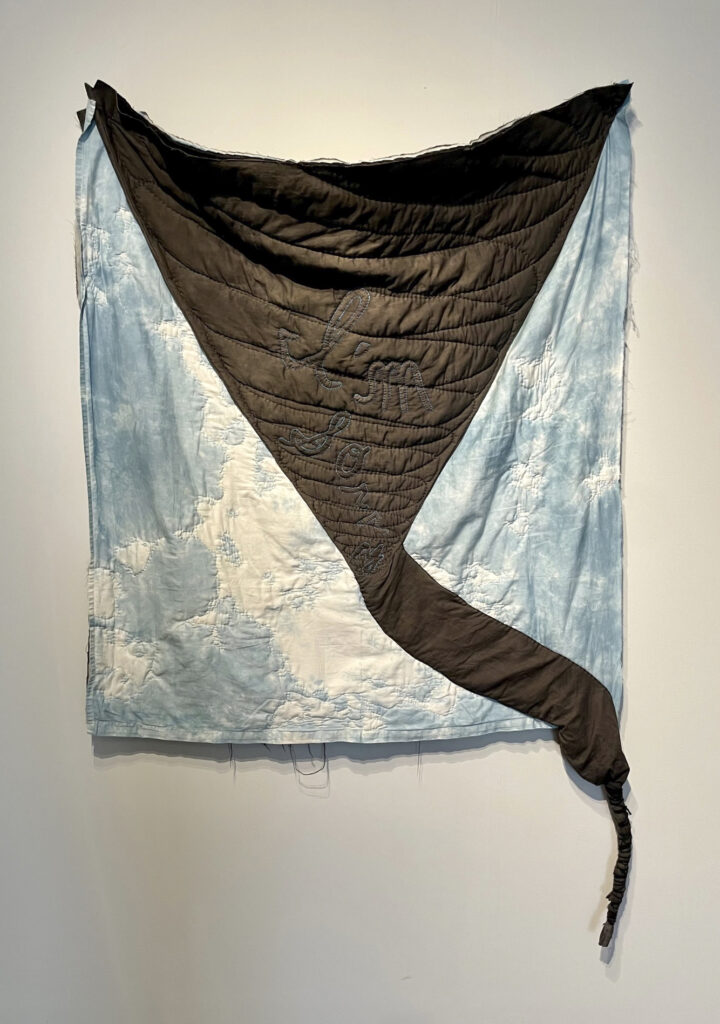
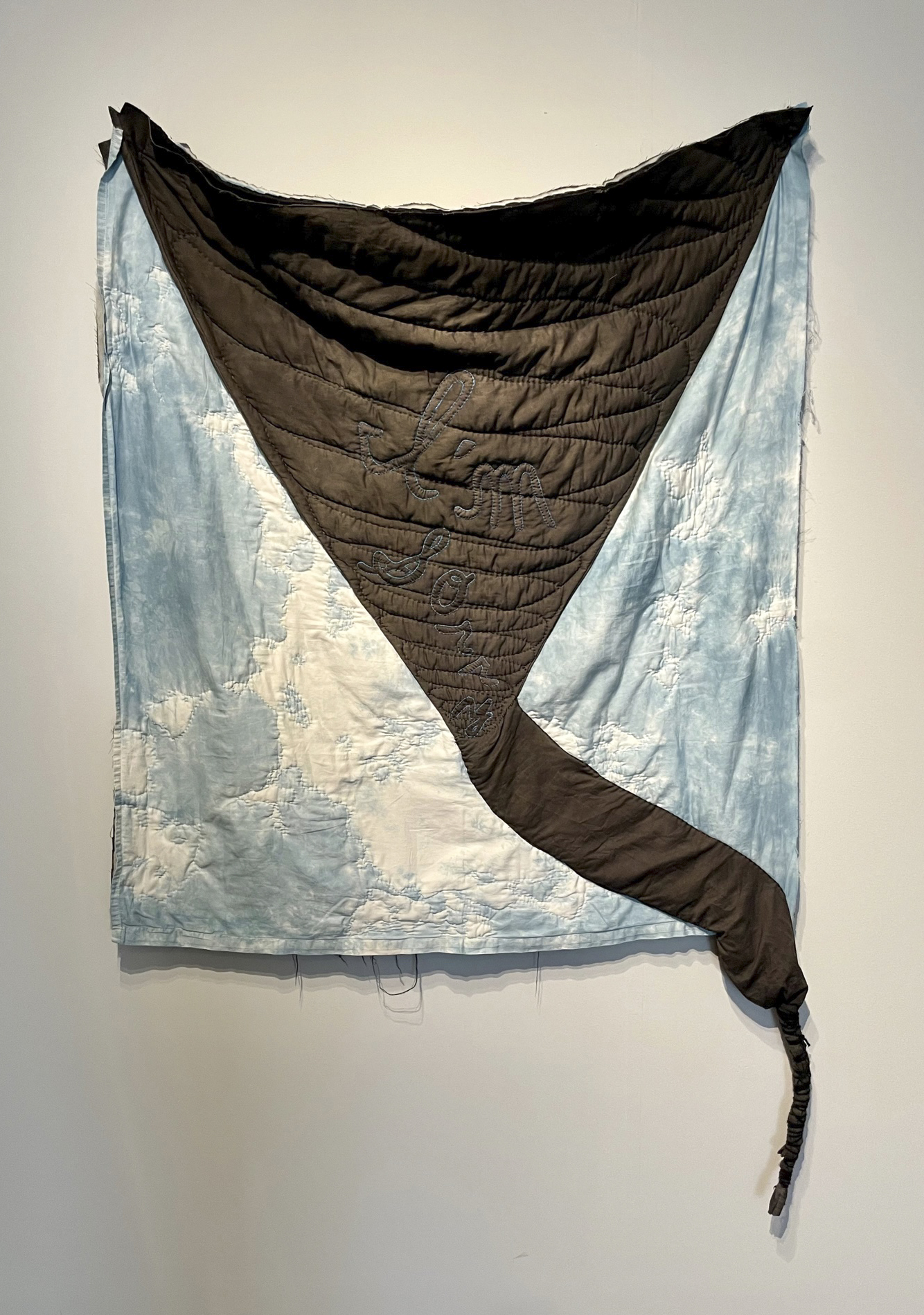
I’m Sorry by Monique Crabb, which the artist describes as “a soft and unstable monument to the unavoidable nature of loss and turmoil.”
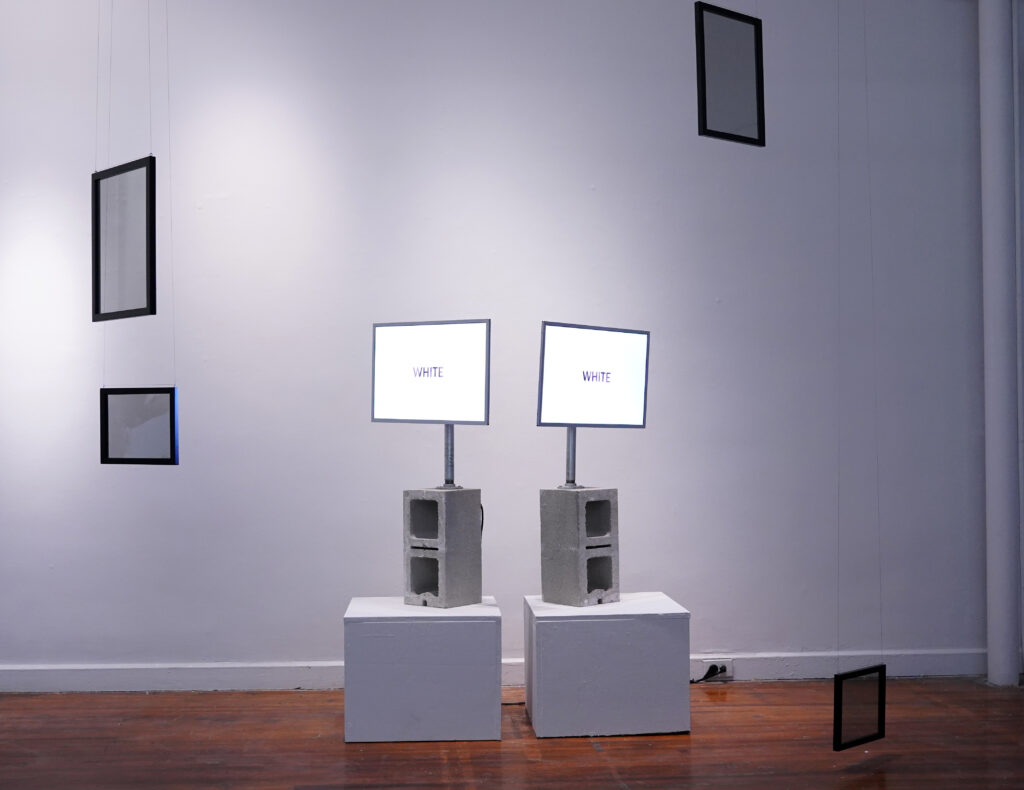
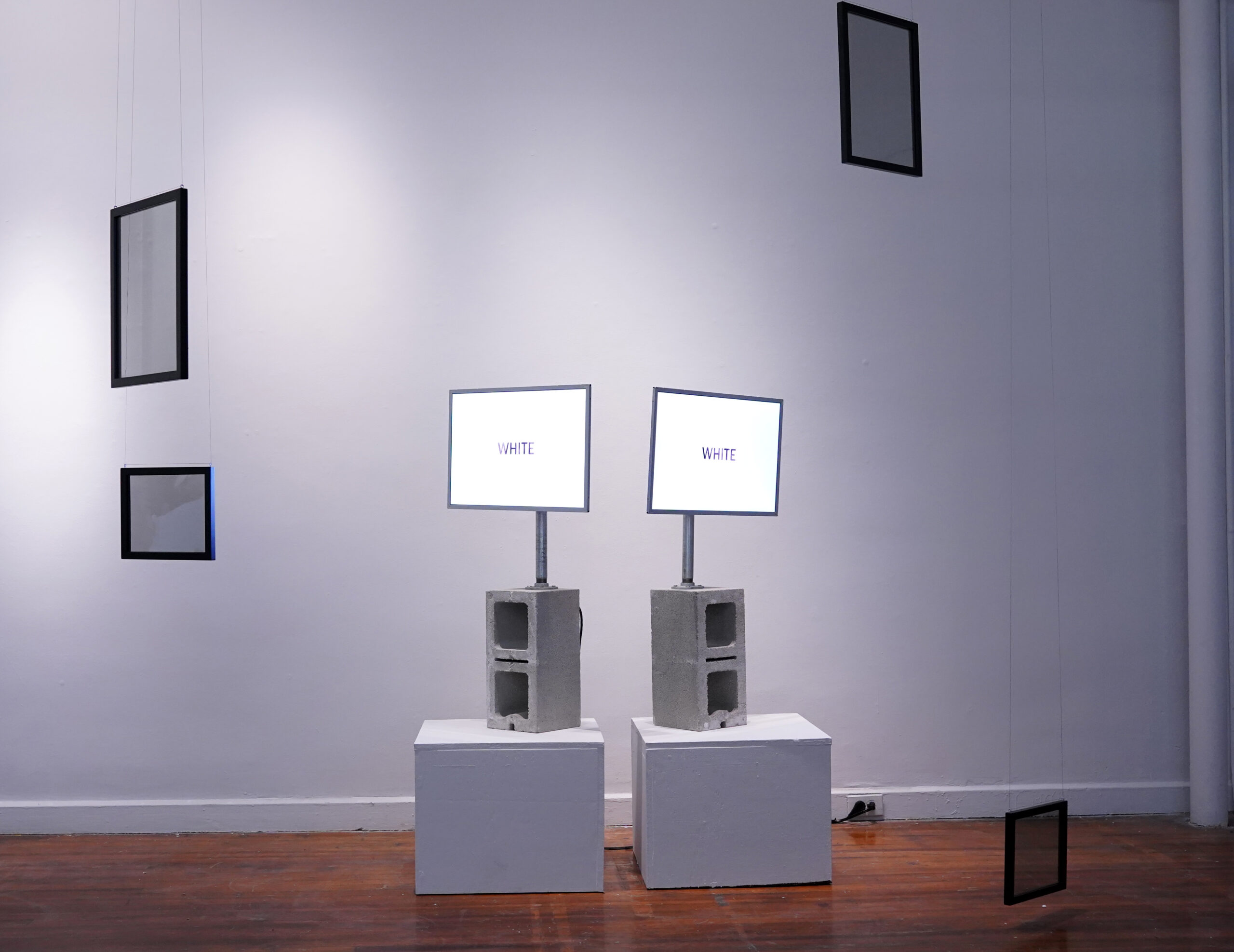
Occam’s Frame by Evan Tedlock.
SPARK IV presents the work of 24 UMBC and Towson University faculty and student artists or collaborative pairs. Through their artistic creations, the past year of the pandemic and longer timelines impacting our future are considered. After experiencing the chaos, upheaval, and uncertainty that dominated this past year, these artists help us see the world and consider how to cope, adapt, and persevere through whatever lies ahead.
“The act of discovery—delving into the idea, reflection, or space an artist creates with their work—is always the most inspiring aspect of curating,” remarks gallery curator Catherine Borg. ”That has been the case with the exhibition of SPARK, and the challenge as I considered more than 80 works from faculty and students from both UMBC and Towson.” As she selected the work to be displayed, five themes emerged that provided a structure to the exhibition: altered time, imagined places, future focus, climate horizon and equitable future.
Participating faculty and staff from UMBC include Evan Tedlock, Irene Chan, Kelley Bell, M.F.A. ’06, intermedia and digital arts (IMDA), and Melissa Penley Cormier, M.F.A. ’17, (IMDA), Lynn Cazabon, Samantha Sethi, Sarah G. Sharp, and Stephen Bradley. UMBC IMDA graduate students whose work is represented in the exhibition include Foster Reynolds-Santiago, Monique Crabb, Rahne Alexander, and Safiyah Cheatam. The art project of Kelley Bell and Melissa Penley Cormier, The Yonder Cabinet, in turn features artwork by UMBC’s Beth Yashnyk, Jim Doran, and Jenny O’Grady.
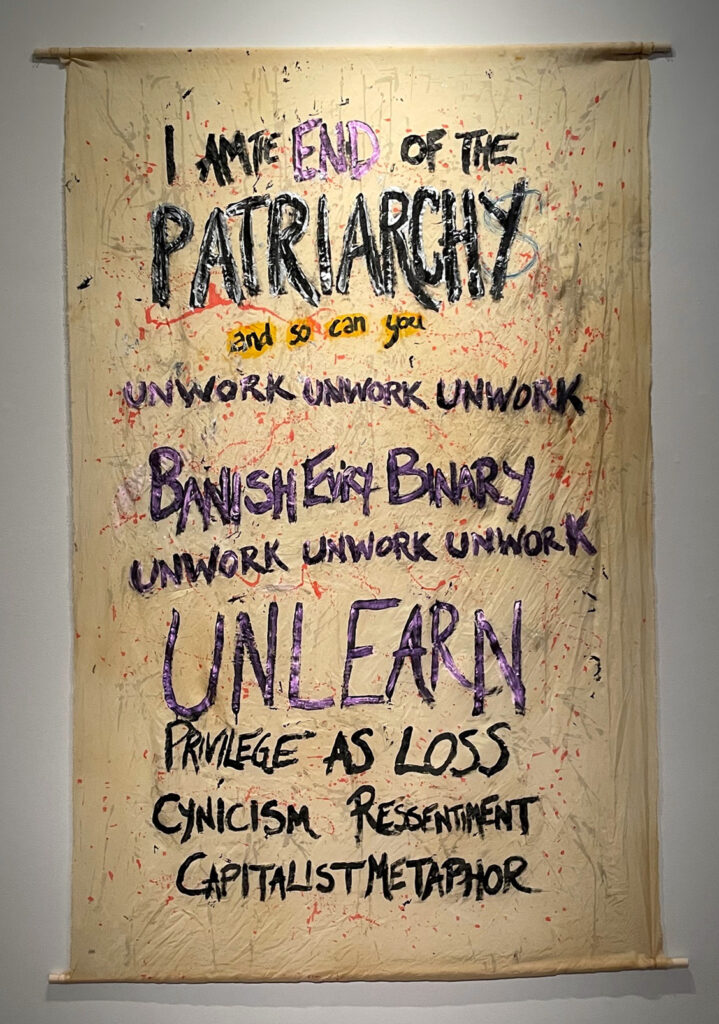
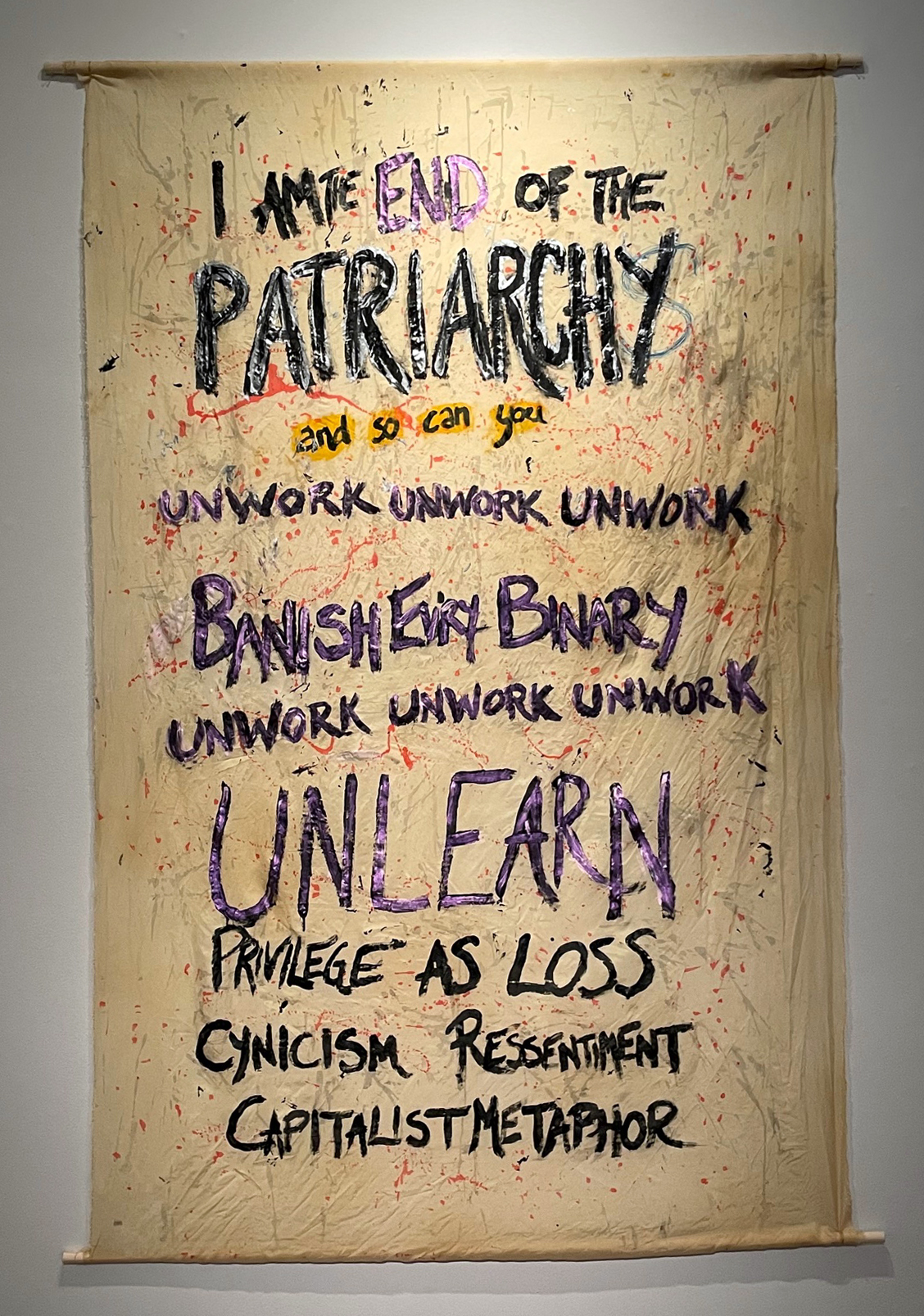
I Am The End Of The Patriarchy And So Can You (center panel) by Rahne Alexander.
Of her work I Am The End Of The Patriarchy And So Can You, Rahne Alexander M.F.A. ’21, IMDA, remarks, “It’s a manifesto of sorts, comprised of catalyzing concepts and conclusions that have driven me as an artist, citizen, and woman. In most cases, a manifesto is written for the author first, and this is no exception. It’s an early 21st-century transfeminist statement of purpose, a letter of encouragement for my past self, and a travelogue of how I have arrived where I am today.”
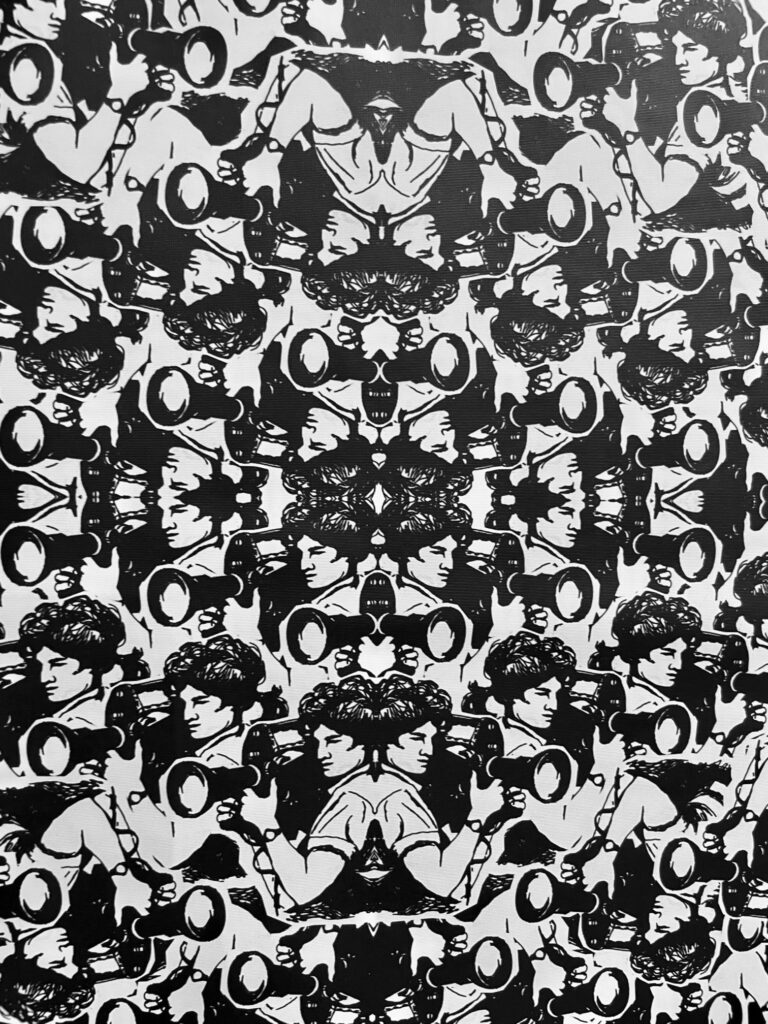
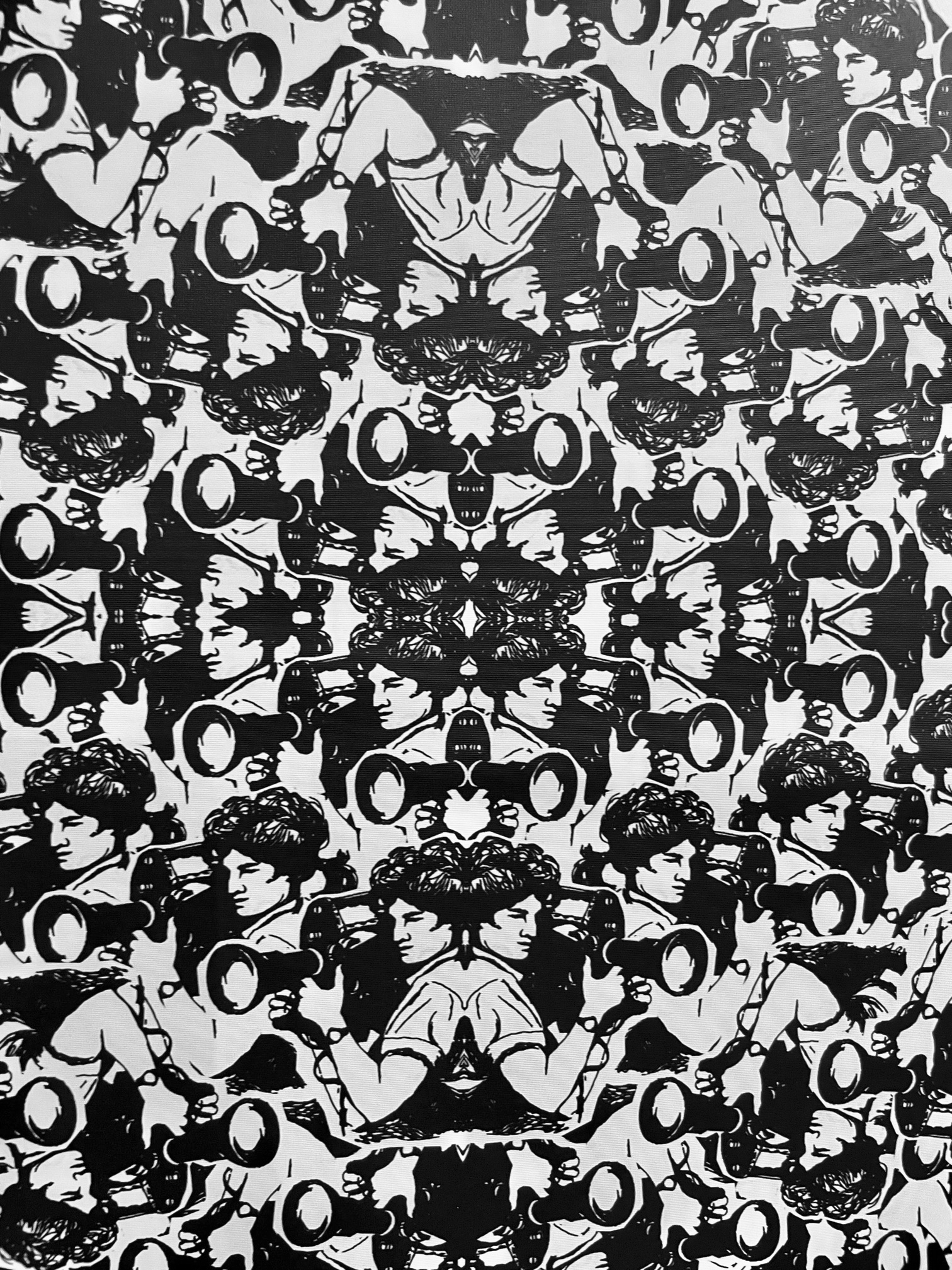
Women Looking/Camerawoman by Sarah G. Sharp.
Women Looking/Camerawoman by Sarah G. Sharp, assistant professor of visual arts, is part of a series of custom wallpaper designs based on images found in early underground feminist publications. “Among the discourse I expected to encounter when researching this material (abortion rights, the passage of the Equal Rights Amendment, etc.), I found many conversations about the revolutionary potential of the newly created component of cable television: public access television channels,” she shares. “Public access TV represents the first TV-based examples of what media theorists call ‘the many speaking to the many,’ and, in some ways, it was a precursor to today’s social media.”
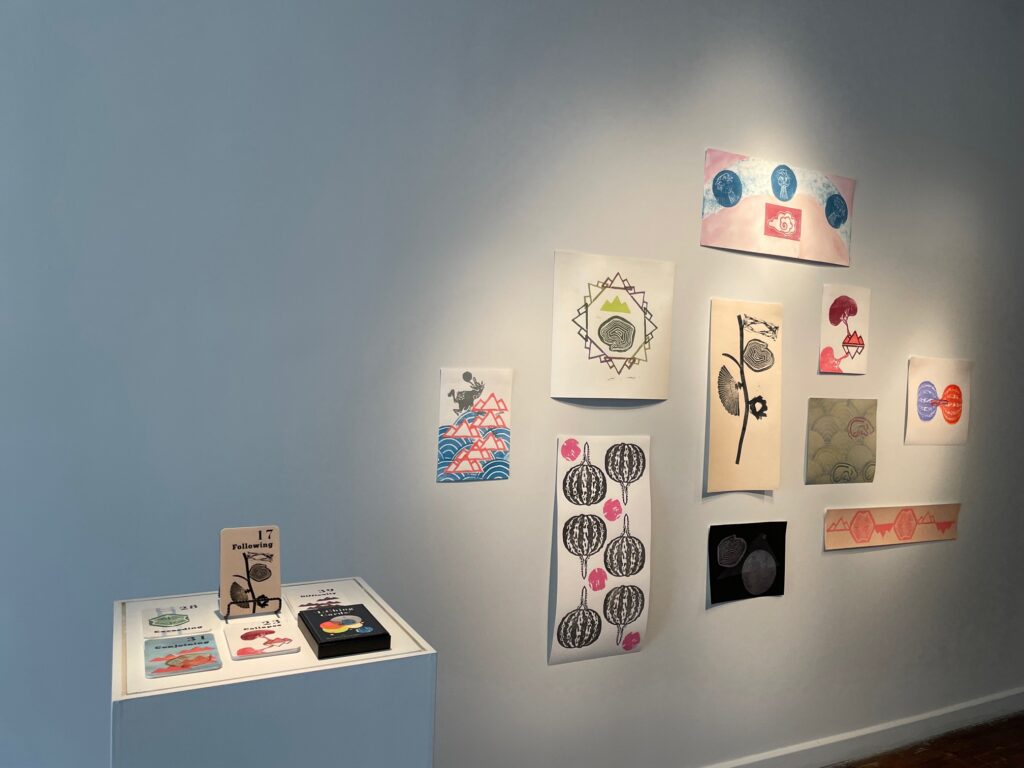
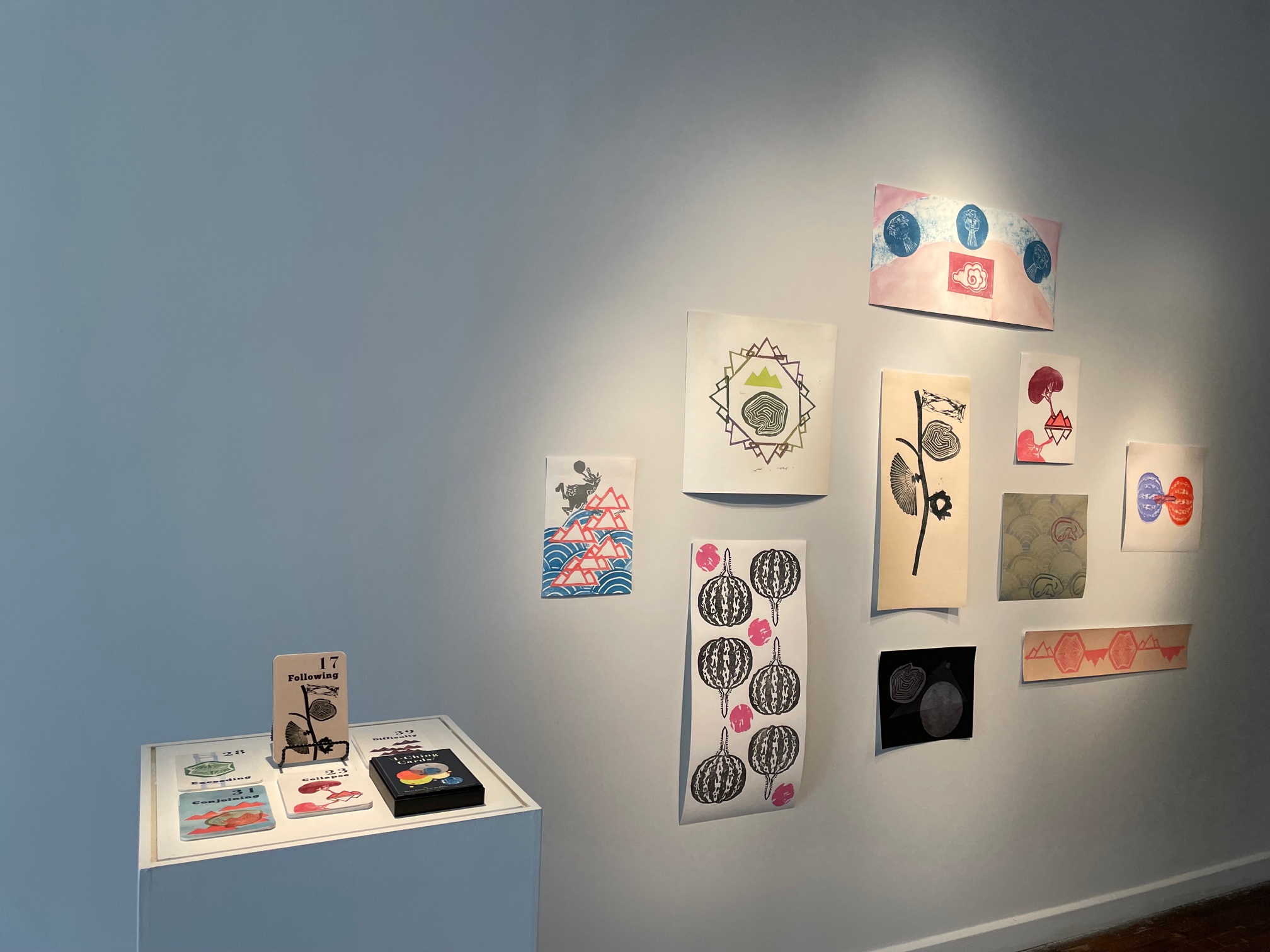
\I-Ching Cards/ by Irene Chan.
Irene Chan, associate professor of visual arts, created \I-Ching Cards/, an artist book—a set of interactive cards inspired by the I Ching or Book of Changes. As she describes her work, “The I-Ching, the Book of Changes is a 3000-year-old oracle Chinese divination tool that does not tell you what to do, but inspires you to answer your own questions—the activity is interactive. One is able to ‘read’ in infinite directions as it guides one through life.”
On May 14, May 28, and June 25 at 7 p.m., SPARK will present performances by Anna Kroll, M.F.A. ’23, IMDA, and Chloe Engel. Their work, entitled I Want To Be, takes place by telephone. In each performance, Kroll and Engel navigate a score in which they co-imagine events in a room. These are improvisational, spoken performances that have developed out of their collaborative practice of negotiating and refining scores to create imaginary realities. To attend the performance, audience members will call a phone number at a specific time, hear a welcome message, and then enter the “space.” A live captioned version will also be simultaneously available. Information on additional performances and events, including a video gallery, is forthcoming.
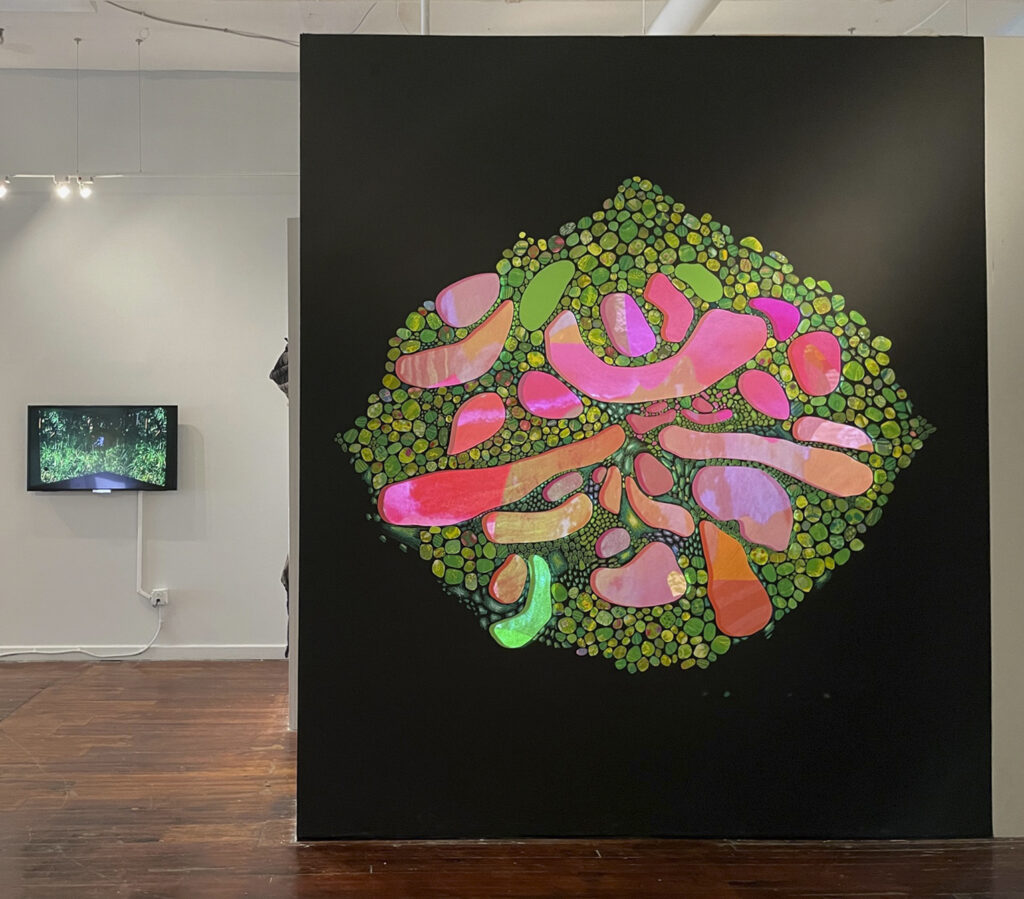
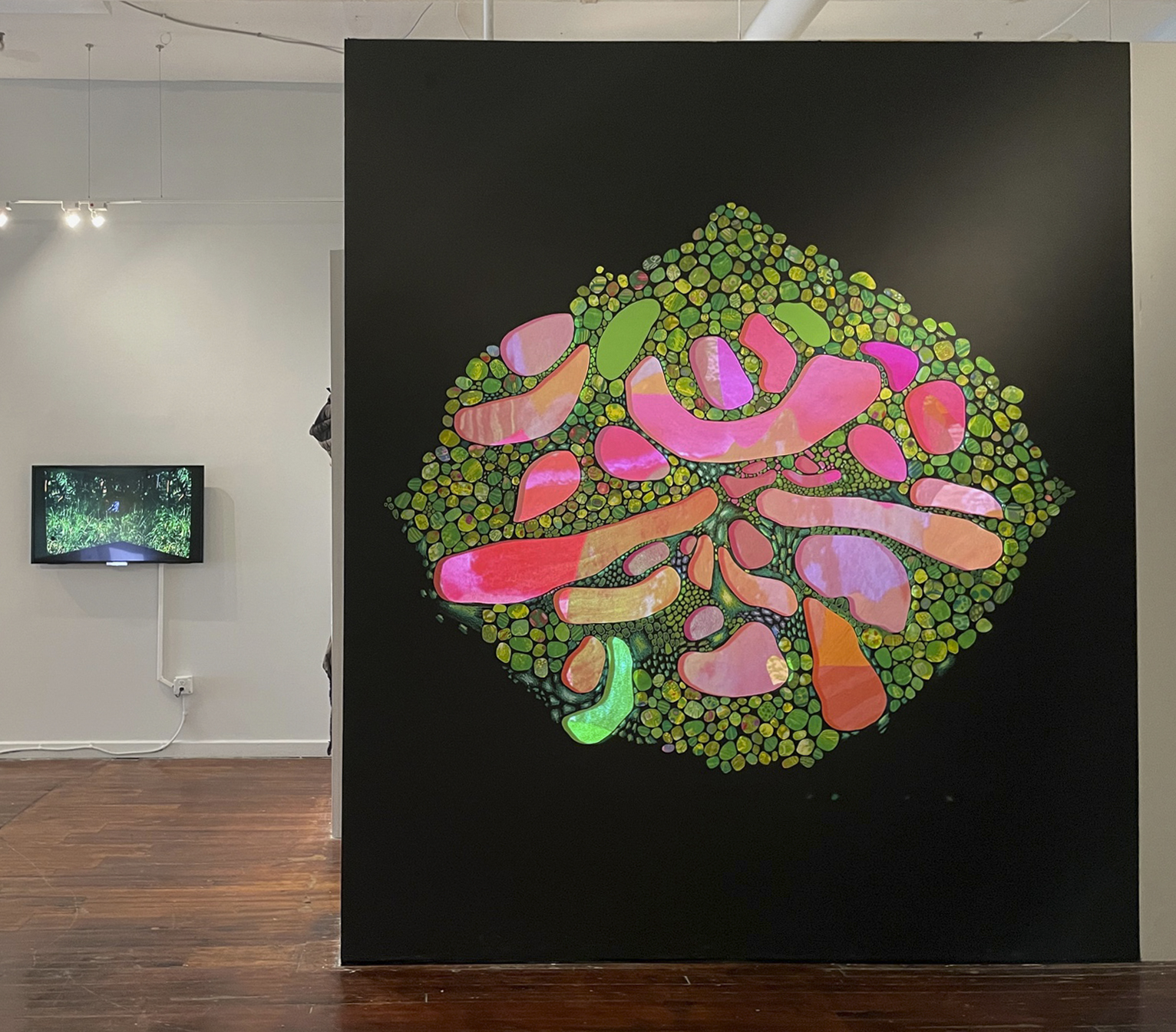
Sueños de Iguana, by Foster Reynolds-Santiago, is a multimedia installation “where a family’s shared iguana dreams go to converse and create form. It is a place where I go to speak with my mother on the things that go unsaid about my transition, in a language I hope to create through texture and color.”
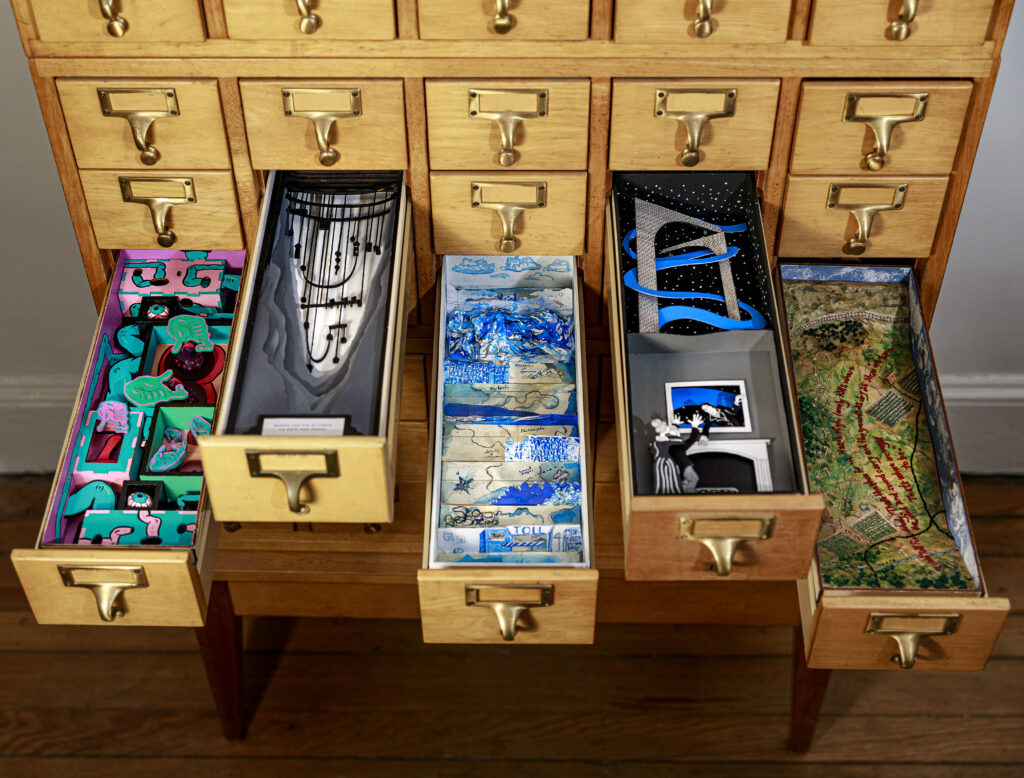
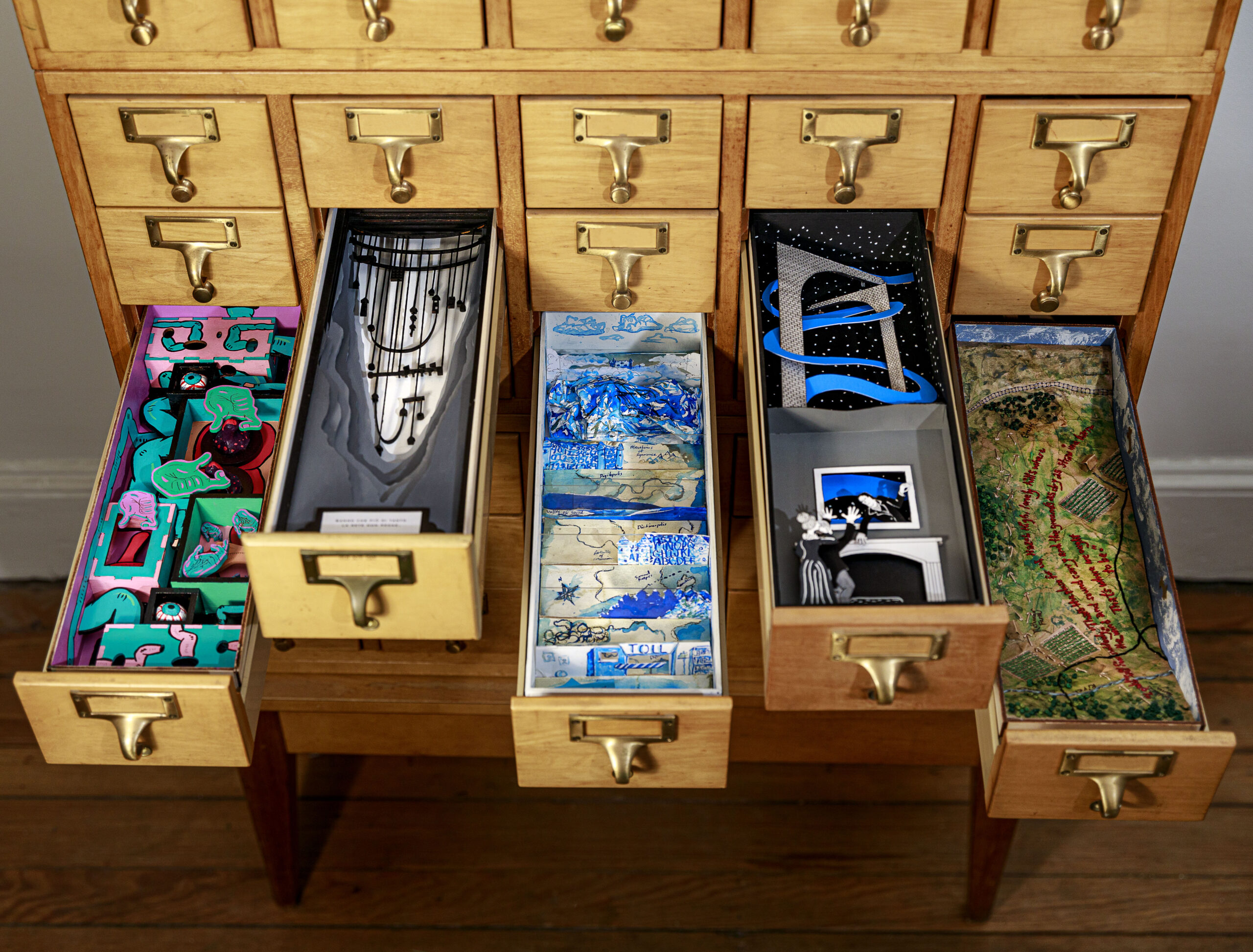
The Yonder Cabinet by Kelley Bell and Melissa Penley Cormier, featuring artworks (L-R) by Beth Yashnyk, Bell, Penley Cormier, Jim Doran, and Jenny O’Grady.
Presenting an exhibition like SPARK IV: A New World? is an expensive undertaking, and for the fourth consecutive year PNC Bank has generously invested in the collaborative UMBC-TU project. “PNC has a legacy of investing in the arts, as we understand the economic, social, and civic impacts that a thriving arts and culture community have on our city,” says Laura Gamble, PNC regional president for Greater Maryland. “There are few better ways to support our community, at a time when it’s never been more necessary, than by supporting the arts, and specifically, Maryland Arts Place’s SPARK exhibition, which features the thought-provoking works of local students and faculty.”
The SPARK gallery at Maryland Art Place may be visited in person from 12 p.m. through 4 p.m., Tuesday through Saturday, through June 26. MAP is located at 218 West Saratoga Street between Park and Howard Streets in downtown Baltimore, with nearby on-street and garage parking. The exhibition can also be experienced virtually at sparkbaltimore.org.
As the pandemic surged across the country last spring, university arts venues closed their doors, but that didn’t stop UMBC artists from creating. Without the traditional opportunities for collaboration that can be so important in dance, music, theatre, and the visual arts, they turned to new approaches and to individual projects with determination and passion.
Time for research and writing
For Brianna Harper, B.A. ’20, visual arts, the pandemic represented an opportunity to focus on her research and writing. “Actually, I’m lucky. What I do is I hole up, I research, and I write,” she says. “During COVID I was able to focus on the materials, synthesizing information without any distractions.”
PorBrianna Harper. Image courtesy of Brianna Harper.
Harper’s research focuses on the enigmatic paintings of the Swedish artist Hilma af Klint (1862–1944), whose artwork she discovered by chance on a 2019 visit to the Guggenheim Museum in New York. Her capstone project, presented at both URCAD and the Exit Art exhibition in spring 2020, explored the spiritual influences on af Klint’s paintings by using contemporary astrological processes to interpret the art.
“The premise of the paper is that Hilma af Klint created this huge breadth of work, Paintings for the Temple, and yet she didn’t really understand what it meant. She felt she was almost painting the words of ethereal beings, or painting their ideas, sort of like a prophet of theosophy in a way,” says Harper.
“Because her work has astrological symbolism, with which I’m familiar, I was able to synthesize the astrological practices of that time, the early 20th century, and then use that to track her work patterns to see what astrological themes appeared in skies at certain points in her life,” Harper explains. “So it was using 19th-century theosophical astrology as a lens to deepen our understanding of Hilma af Klint’s Painting for the Temple.”
“Noting the deep influence of astrology on af Klint’s artistic practice and spiritual life, Brianna melded iconology, a well-established mode of analyzing artworks, with her own specialized knowledge of astrology,” notes Preminda Jacob, associate dean of the College of Arts, Humanities and Social Sciences and professor of visual arts, who was Harper’s advisor. “The outcome of Brianna’s research was a uniquely exciting interpretation of visual artworks.”
Bonding together
Celine “CJ” Jones-Cameron, B.A. ’20, theatre, will graduate this week having developed a broad range of skills across the discipline. “I really enjoy acting, I really enjoy doing tech, and I really enjoy carpentry and building sets,” she says. “I like the idea that I now have opportunities to do so much because my background is so well-rounded.”
She notes that theatre productions can be complex, involving not only actors, but also set designers, carpenters, costume designers, sound and light designers, directors, vocal coaches and more. During performances, each of those professionals has to coordinate with split-second accuracy. It’s the unifying experience of the performance that most fascinates her.
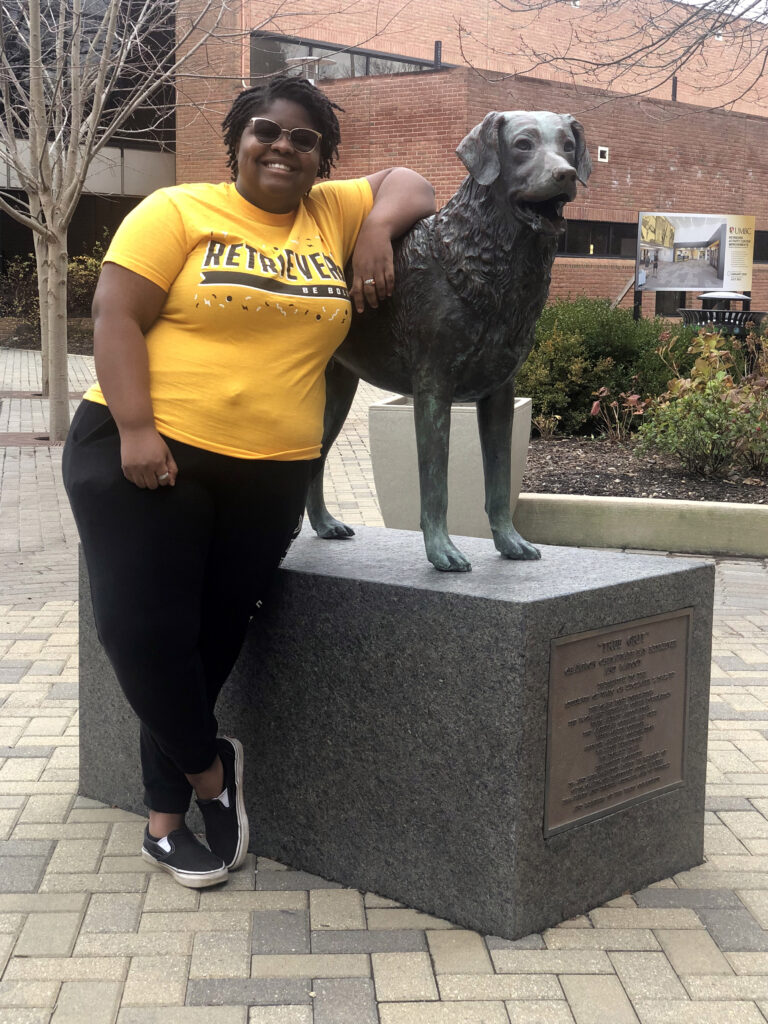
Celine “CJ” Jones-Cameron gets in a visit with True Grit. Image courtesy of Celine Jones-Cameron.
UMBC’s theatre department usually stages two productions each semester. But their regular kind of collaborative work just wasn’t feasible once students had to pivot to online and socially-distanced learning.
Still, Jones-Cameron noticed an outpouring of empathy from her fellow theatre students, and feels that their inability to stage productions actually brought them closer together. “It’s been nice to see us talk to each other more,” she said. Thanks to the “closeness” of students in the department, she says, “I think we adjusted pretty well.”
“CJ always finds a way to take challenges and difficult situations and merge them with humor. She is a leader and a constant source of energy,” says Adam Mendelson, senior lecturer in the theatre department and one of CJ’s teachers. “The most impressive thing about CJ is her undaunted ability to keep pushing her own boundaries and definitions of what she is capable of even in the face of unprecedented national challenges.”
Jones-Cameron plans to begin auditioning and working in Los Angeles or New York, possibly with a focus on children’s theatre, which has long been one of her passions.
Finding his voice
Pramuk Mohanlal-Vargas B.A. ’20, music and global studies, has lived in his native Paraguay, in India, and in the United States, so an emphasis in global studies came naturally. “I love traveling and learning about different cultures and people,” he shares. And his interest in music similarly came about at a young age — “I grew up singing and playing piano,” he says, “and then I took interest in acoustic guitar.”
Mohanlal-Vargas’s musical path has led him to emerge as a singer-songwriter (going by his first name, Pramuk). During the pandemic he managed to complete and release his first album, an EP titled Ordinary Soul, on November 27.
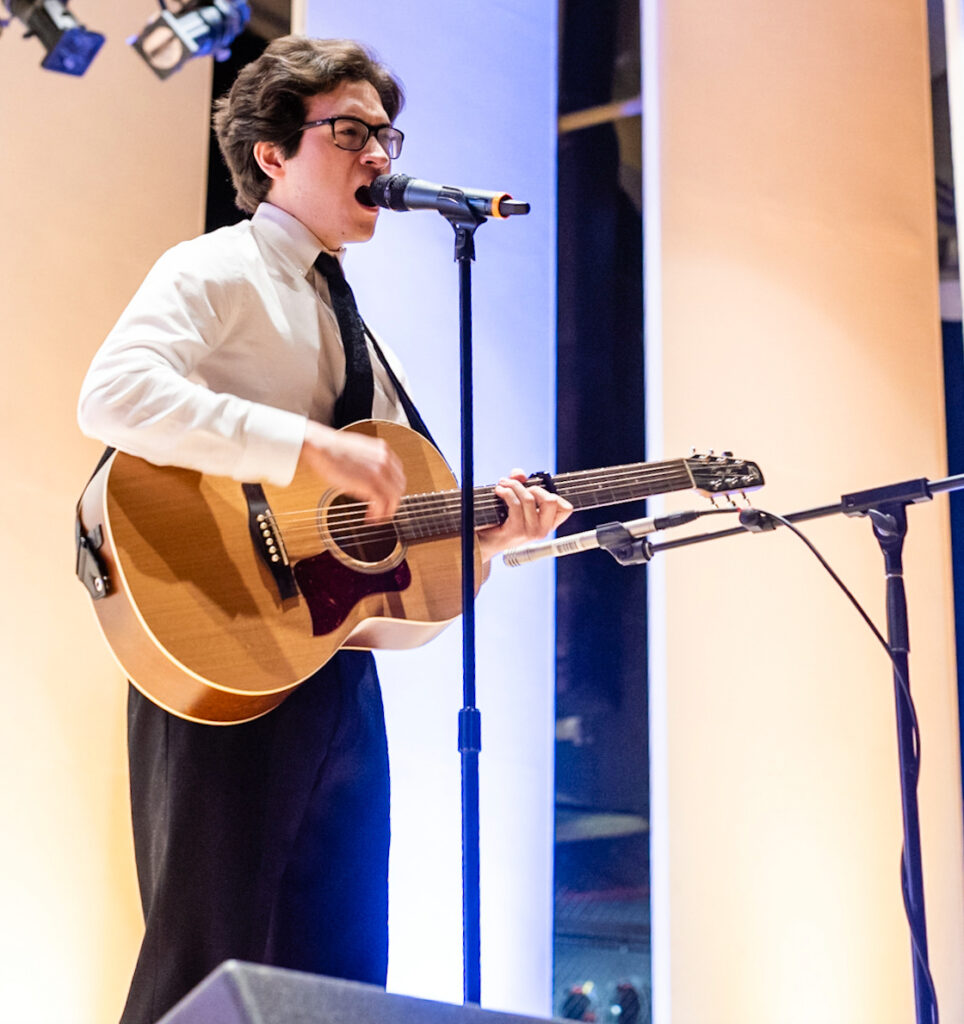
Pramuk Mohanlal-Vargas in performance. Image courtesy of Pramuk Mohanlal-Vargas.
His teacher, Sammy Huh, an affiliate artist in the music department and director of UMBC’s Opera Workshop, describes him as “possessing a beautiful Mozartean tenor instrument and dynamic guitar skills.”
At UMBC, Mohanlal-Vargas has participated in the Camerata Chamber Choir, the Opera Workshop and other ensembles. He credits these opportunities as having helped him gain exposure to a diversity of genres and historical periods.
“UMBC has helped me grow, learning a lot about Renaissance music, classical, romantic — different time periods — different composers and their lives, and even a lot of the theoretical side of things,” he says. “I never would have thought that opera is what I would be studying in college. Singing in Italian, in German, in French — it’s a beautiful thing.”
The past several months have provided Mohanlal-Vargas time for introspection and reflection. “It’s kind of a strange feeling — all virtual, not performing in front of a live audience. That’s what’s made it challenging,” he says. “But it’s also helped me become more grounded, be more still in the moment.”
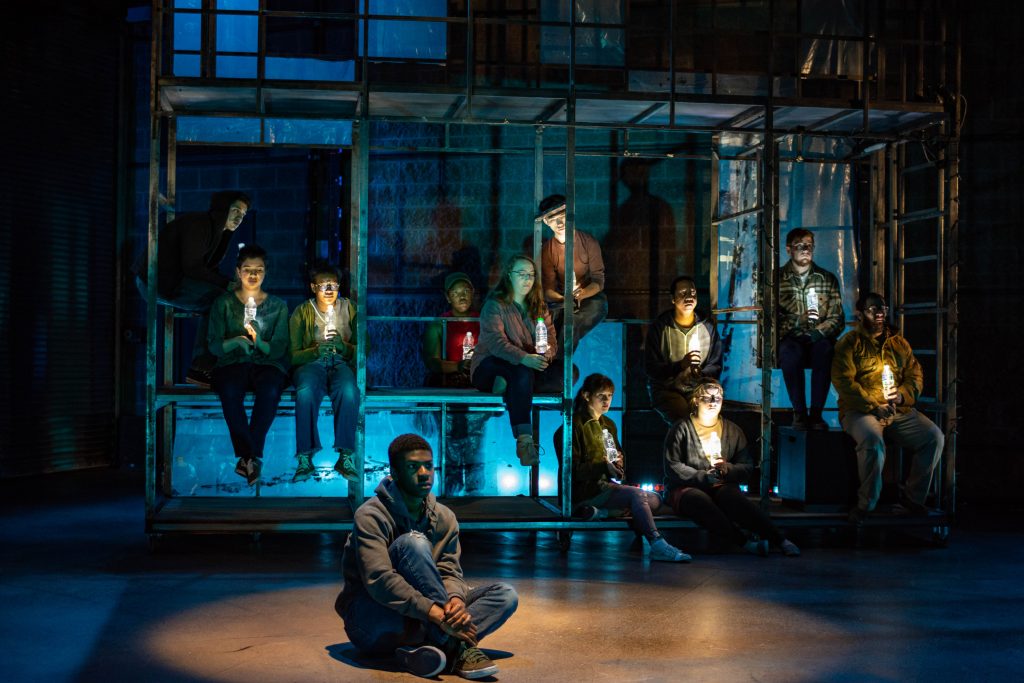
Banner image: Girls on a Dirt Pile (2019) by Susan McCully, directed by Eve Muson, a production for which Celine Jones-Cameron was a theatrical electrician. Photo by Marlayna Demond ’11 for UMBC.
UMBC’s Kimberly Moffitt, professor of Language, Literacy & Culture and affiliate professor of Africana Studies, has been appointed Interim Dean of the College of Arts, Humanities, and Social Sciences (CAHSS), effective August 17.
“UMBC has been my academic home for the last fourteen years, and I consider it an honor to be able to serve in this capacity at this particular time when my skill set can be best utilized to support the work ahead,” says Moffitt. “It will require grace and patience to successfully navigate the upcoming year, but I know the commitment of this community to our students, to our work, and to ourselves and as a result, CAHSS will thrive.”
Moffitt earned a B.A. in political science from the University of North Carolina-Charlotte, an M.A. in mass communication from Boston University, and a Ph.D. in mass communication/media studies from Howard University. She became the first Southern Regional Education Board (SREB) Fellow from Howard University and completed a teaching postdoctoral fellowship at Hope College in Holland, Michigan before holding a faculty position at DePaul University. She joined UMBC in 2006 as an assistant professor of American Studies, and, prior to her appointment as Interim Dean, served as director of the Language, Literacy & Culture doctoral program.
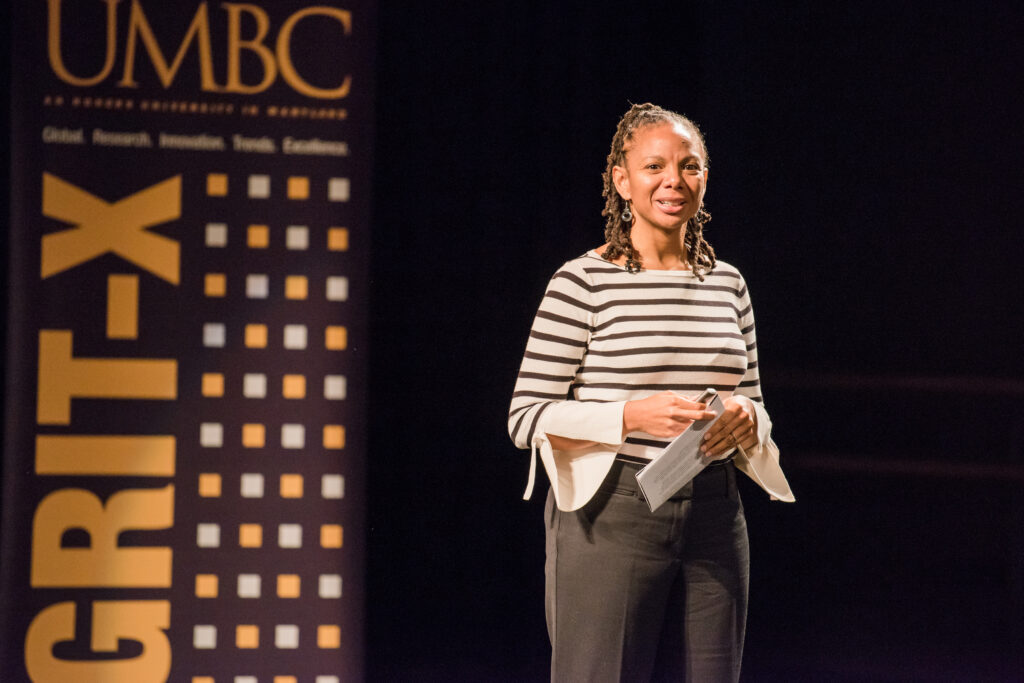
Kimberly Moffitt presenting at GRIT-X in 2018 — visit here to see her presentation.
“Dr. Moffitt brings to her new position an outstanding record of scholarship and leadership in shared governance,” says Provost Philip Rous, “including serving as president and vice president of UMBC’s Faculty Senate, a member of the Faculty Senate Executive Committee, UMBC’s NCAA Faculty Athletic Representative, and as a member of several other university committees.”
As a media scholar and critic, Moffitt’s work centers on topics that encompass ideas of citizenship, identity, representations, and belonging in society. Specifically, she explores the mediated representations of the Black body and its extremities (e.g., hair), often in programming such as Disney and other media forms. Her research seeks to understand how these representations influence communication among different cultures, affect policies within institutional structures, and impact the self-esteem and self-worth of those occupying Black bodies. She has an extensive publication record, including five co-edited volumes and numerous scholarly articles and book chapters.
In addition to her service at UMBC, Moffitt also extends her expertise into the greater Baltimore community by facilitating workshops on diversity and inclusion, as well as appearing as a featured guest on several media outlets, both locally and nationally. Moffitt is the founding parent of Baltimore Collegiate School for Boys charter school and a member of Delta Sigma Theta Sorority, Inc. She remains actively involved in her disciplinary association, National Communication Association, and is also a board member of the National Association of Media Literacy Education.
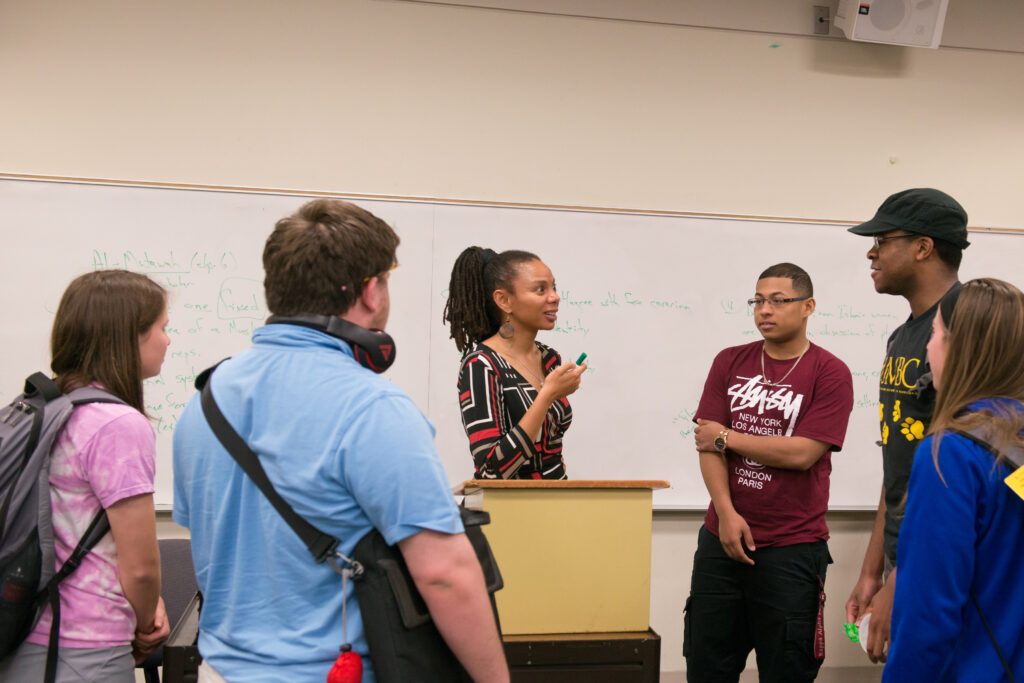
Moffitt confers with students after a class.
Moffitt will build on the remarkable legacy of Dean Scott Casper, who will step down as dean on August 17 to become Dean Emeritus and President of the American Antiquarian Society.
The Library of Congress’s Coolidge Auditorium, one of the nation’s leading performing arts venues, is typically busy year-round, bustling with performers playing to capacity audiences. Now, with the venue silenced by the coronavirus pandemic, the Library has launched a new kind of program, The Boccaccio Project.
During the darkest period of the plague in 14th-century Italy, author Giovanni Boccaccio (1313–1375) wrote the Decameron, structured as a collection of stories told by ten characters, all of whom were in self-isolation. This artistic response during a time of quarantine inspired the Library of Congress’s contemporary Boccaccio Project, in which the Library has commissioned ten composers and ten performers to create and record new works of music that will reach audiences online.
UMBC’s Daniel Pesca, a pianist and assistant professor of music, is one of these performers. He was chosen by David Plylar, music specialist and concert producer at the Library of Congress.
“I’ve known Daniel’s phenomenal work as a pianist and composer for many years,” says Plylar. “He has performed at the Library of Congress in the past, so our concert team knows him as well. We were thrilled to work with him again.”
To bring Pesca into The Boccaccio Project, the Library of Congress collaborated with the University of Chicago’s Grossman Ensemble, a nationally-recognized new music group of which Pesca is a member.
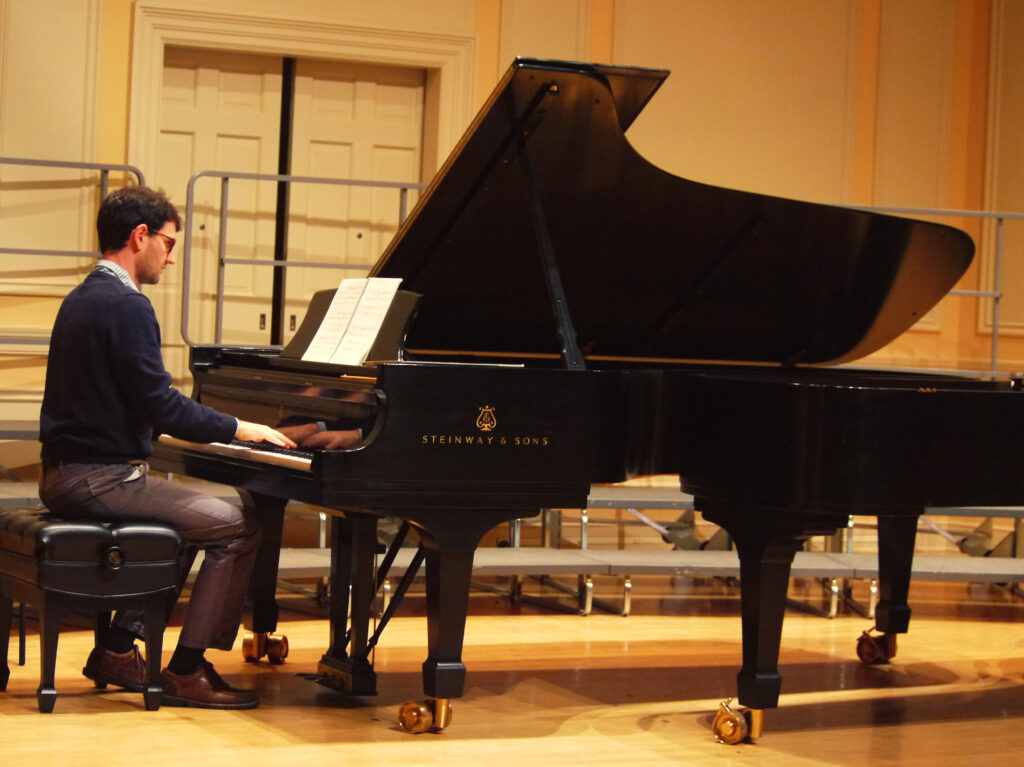
Pesca warms up before a 2014 performance at the Library of Congress. Image by Alison Lowell.
Selecting a composer
Each commissioned performer was asked to select a composer with whom to partner. In Pesca’s case, he immediately turned to Aaron Travers, an assistant professor at Indiana University Bloomington. “I’ve long admired Aaron’s exquisite writing, and particularly love his piano solo piece Songs of Loss,” says Pesca.
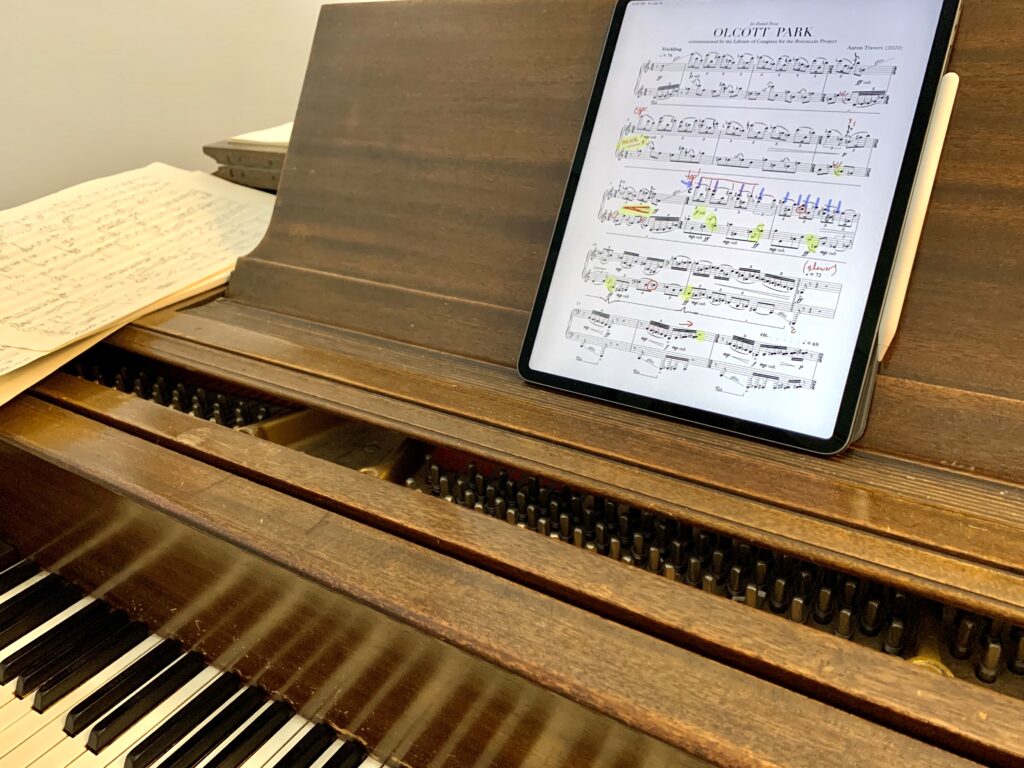
“It’s a special thing as a performer when you encounter a composer who you feel understands not just what is technically possible on your instrument, but your instrument’s soul, its voice,” says Pesca. “Aaron has that affinity for the piano—I knew this from his earlier work, and I see that again in his new piece, Olcott Park. What I love here in particular is the layers of sound that he draws out of a solo instrument. I find this kind of layered writing particularly rewarding to play.”
Virtual performance
Pesca’s performance of Travers’s new composition, Olcott Park, will be broadcast on Tuesday, June 23 at 8 p.m. on the Library of Congress YouTube channel, and simultaneously on Facebook and Twitter. The performance will remain on the Library of Congress YouTube channel indefinitely. Other performances in The Boccaccio Project are already underway and will continue through Friday, June 26.
The score of Olcott Park resting on the rack of Pesca’s piano. Image courtesy of Pesca.
“We are thrilled that Daniel Pesca will be one of the select few performers chosen to premiere new works as part of the Library of Congress’s Boccaccio Project,” says Linda Dusman, chair of music. “This marks him not only as a pianist of note, but also as a socially conscious musician who responds dynamically to important contemporary issues.”
Banner image: Daniel Pesca by Rosen-Jones Photography.
This fall, UMBC will bid farewell to one of its senior leaders as Scott Casper, dean of the College of Arts, Humanities and Social Sciences (CAHSS), departs the university to assume the presidency of the American Antiquarian Society (AAS). His new position speaks not only to his administrative skills, but also to his national eminence as a scholar of 19th-century U.S. history.
“We are very proud of our colleague Scott Casper, and know he will do a superb job as president of the American Antiquarian Society,” says President Freeman A. Hrabowski, III. “He is one of UMBC’s most admired leaders—as a scholar, academic administrator, and human being, and he has done a masterful job as dean of our College of Arts, Humanities, and Social Sciences.”
“Most important, Dean Casper lives the values we consider most significant in the humanities, including intellectual curiosity, compassion for others, and an abiding commitment to social justice,” Hrabowski says. “He will always be part of the UMBC community.”
“I want to express my gratitude to everyone at UMBC,” Casper shares. “This extraordinary community has changed me in deep, powerful ways, and UMBC’s values will go with me on this next step in my journey.”
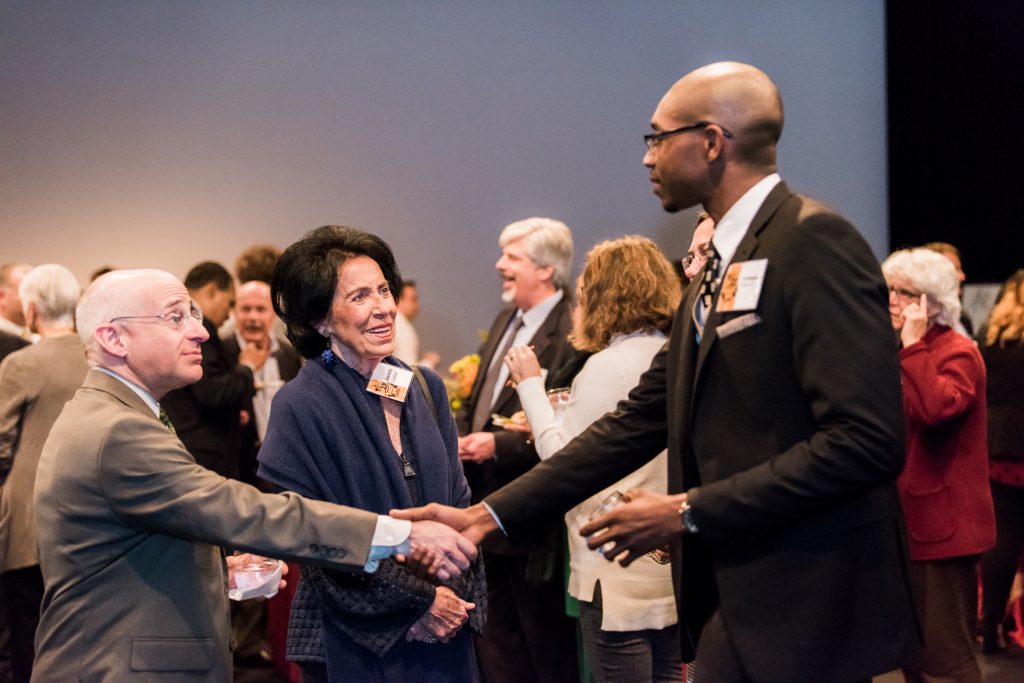
Scott Casper and Darielle Linehan welcome Christopher Dew ’13, theatre, to the 2018 Linehan Artist Scholars reception.
Transformative leadership
Under Dean Casper’s leadership, UMBC received the distinguished Community Engagement Classification from The Carnegie Foundation for the Advancement of Teaching in January 2020. This achievement required a rigorous campus-wide self-study of UMBC’s work with communities in Greater Baltimore and beyond, a process that involved more than 120 members of the UMBC community as well as dozens of community partners.
During Casper’s tenure as dean, CAHSS scaled up research in significant ways, including the creation of the Center for Social Science Scholarship. The college’s commitment to community engagement and civic agency has been notable, reflected in UMBC’s most recent Mellon Foundation grant, in hosting the Imagining America conference in 2015, in establishing studios and a classroom at the Lion Brothers building in downtown Baltimore, and in the new Community Leadership MPS and Public Humanities minor.
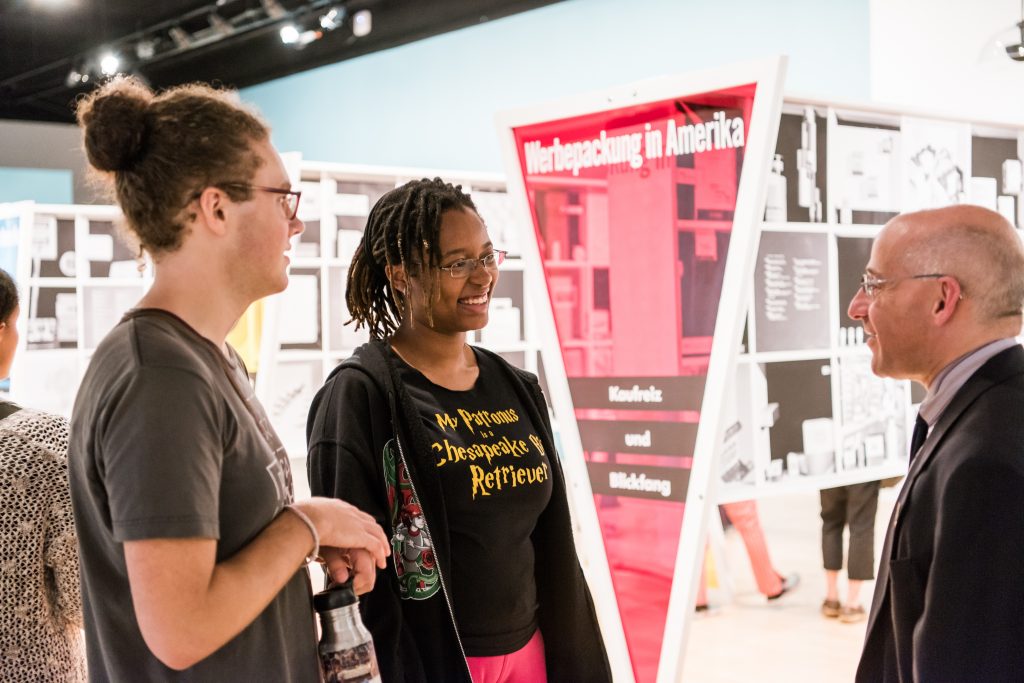
Scott Casper joins students at the exhibition A Designed Life, curated by associate professor Peggy Re, at the Center for Art, Design and Visual Culture.
And, in the time since Dean Casper’s arrival, CAHSS has hired one third of its current faculty, enriching the campus with the addition of an extraordinary, diverse cohort of brilliant scholars and artists, and outstanding teachers.
“Everything we’ve accomplished these past seven years has come from collective effort by so many people—faculty and staff and students across the college and the university,” says Casper. “We have an exceptional college—broad and diverse and also truly collegial and supportive. It’s been a privilege and a joy to serve it and UMBC.”
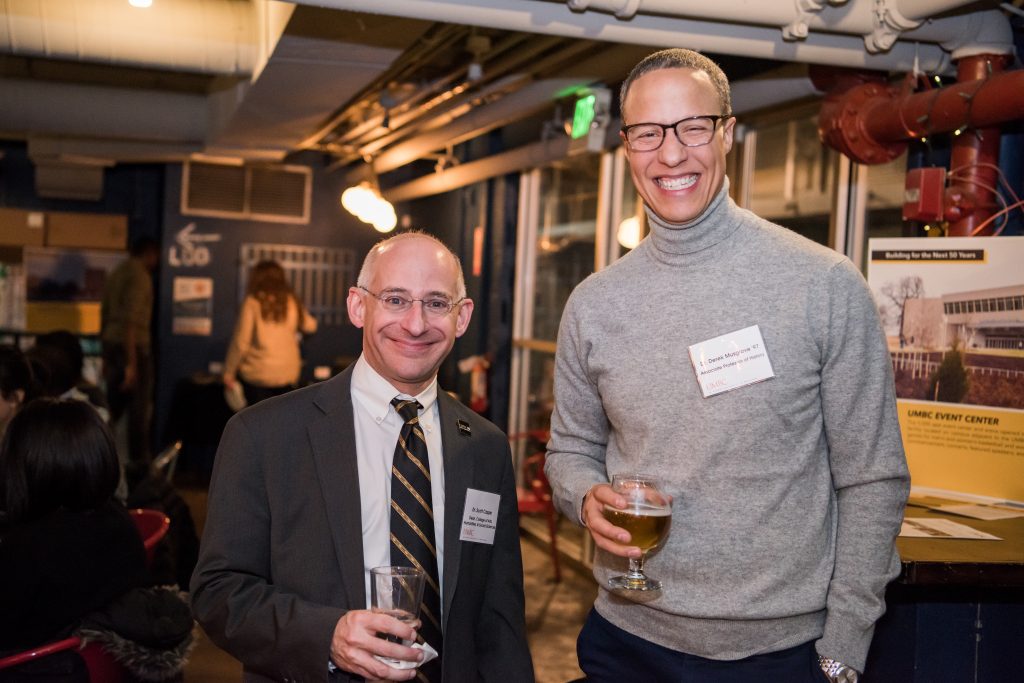
Scott Casper with Derek Musgrove ’97, associate professor of history, at a “bar talk” event to discuss Musgrove’s book Chocolate City.
Building community relationships
Dean Casper has also worked to develop robust relationships with external organizations. Under his guidance, UMBC signed an MOU with The Walters Art Museum. And Casper served on the advisory committee for the reinstallation of The Walters’s 1 West Mount Vernon Place. He also serves on the boards of Maryland Humanities and the Greater Baltimore Cultural Alliance.
“In my former role as executive director of Maryland Humanities, I saw the impact of Scott’s many community contributions,” says Phoebe Stein, president of the Federation of State Humanities Councils. “He was consistently generous, level-headed, and a real cheerleader for the work.”
“His commitment also extends to other nonprofits,” says Stein. “On the board of the Greater Baltimore Cultural Alliance, there too he is a generous contributor and colleague who brings intellectual rigor, a passion for the humanities, and common sense.”
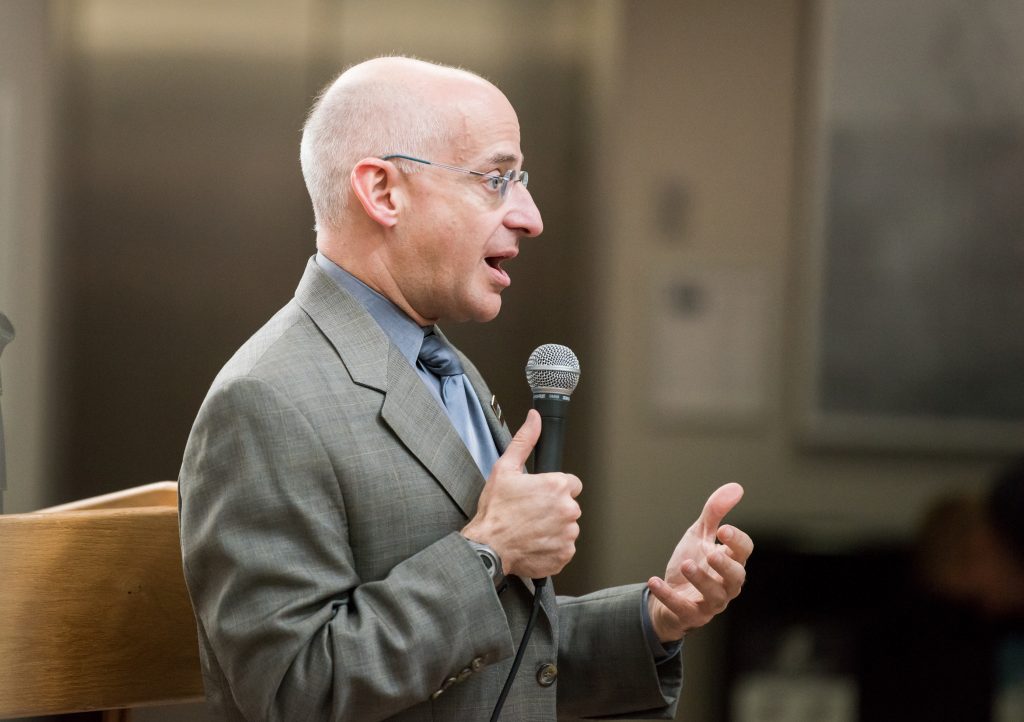
Scott Casper speaks to the audience at the 2018 Frederick Douglass Day Transcribe-a-thon.
Eminence as a scholar
Casper, who received his Ph.D. in American Studies from Yale University, joined the UMBC community in 2013, after many years on the faculty of the University of Nevada, Reno.
A historian of the nineteenth-century United States, he is the author of Sarah Johnson’s Mount Vernon: The Forgotten History of an American Shrine (Hill & Wang, 2008) and Constructing American Lives: Biography and Culture in Nineteenth-Century America (University of North Carolina Press, 1999). He is the co-author, editor, or co-editor of seven other books, most recently The Oxford Encyclopedia of American Cultural and Intellectual History (Oxford University Press, 2013).
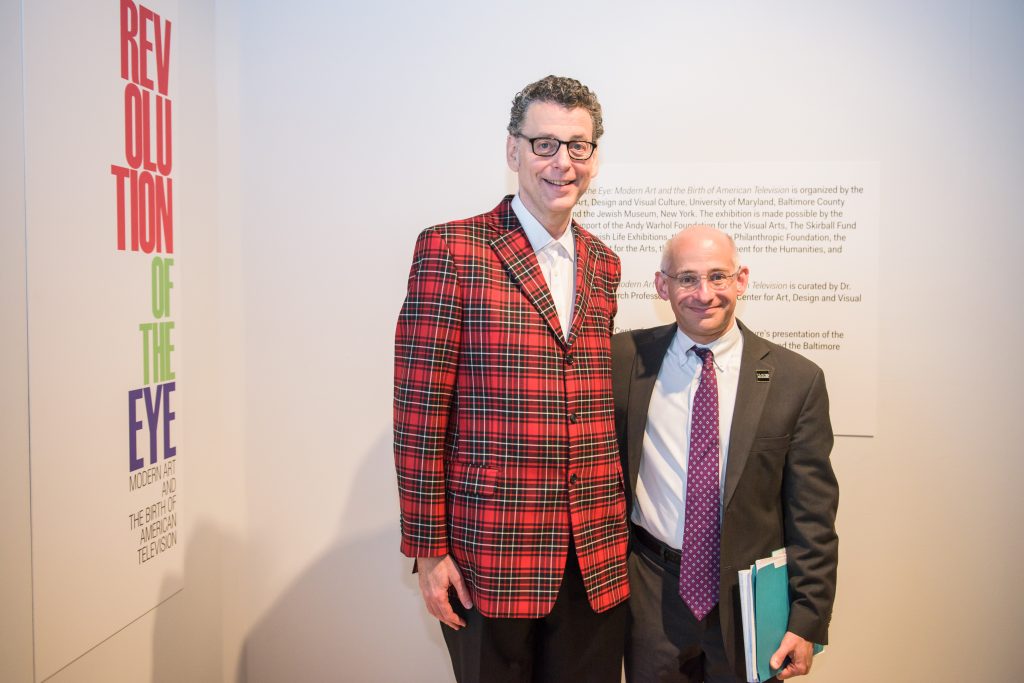
The late Maurice Berger, research professor at the Center for Art, Design and Visual Culture, with Scott Casper, celebrating the opening of the exhibition Revolution of the Eye: Modern Art and the Birth of American Television.
Casper’s commitment to teaching is also evident through his publications. He edited the annual “Textbooks and Teaching” section of the Journal of American History from 2008 to 2018, and was acting editor of the William and Mary Quarterly in 2008–09. He has worked extensively with K–12 history and social studies educators through the Mount Vernon Ladies’ Association, the Center for Civic Education, and the Northern Nevada Teaching American History Project.
The American Antiquarian Society
Dean Casper will become the 8th president in the 208-year history of the American Antiquarian Society. “At a time when deepened understanding of our past has never been more important, I look forward to leading an institution that fosters the essential work of telling America’s complex, contested stories,” says Casper, reflecting on his upcoming role.
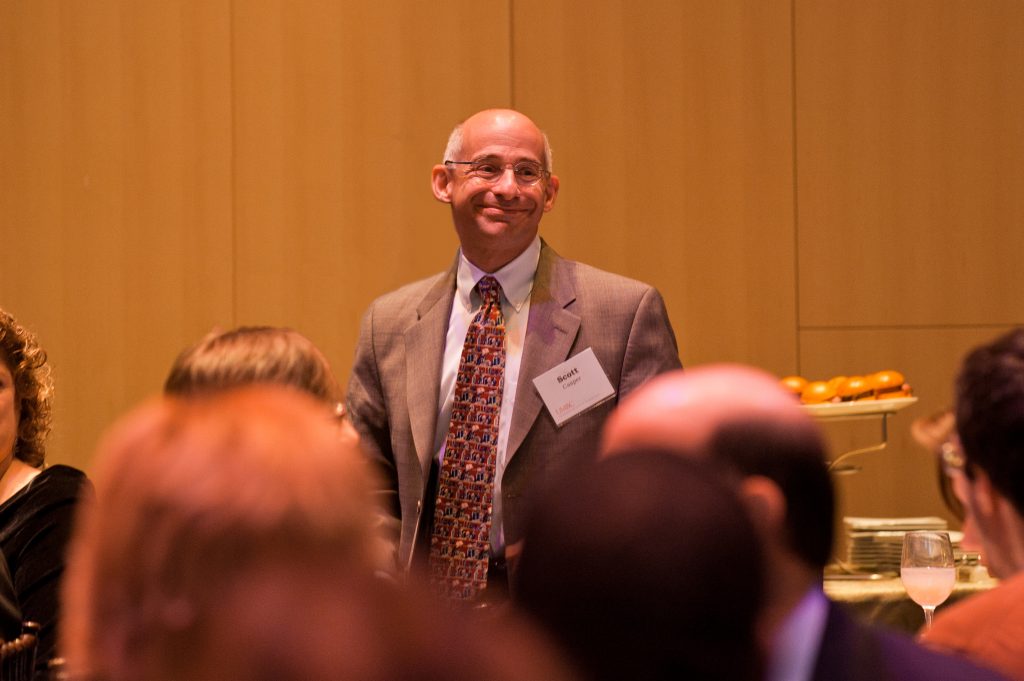
Scott Casper at the 2013 Theatre Salon.
The American Antiquarian Society was founded in 1812 by Revolutionary War patriot and printer Isaiah Thomas, and is both a learned society and a major independent research library. The AAS library, with some four million items, today houses the largest and most accessible collection of books, pamphlets, broadsides, newspapers, periodicals, music, and graphic arts material printed through 1876 in what is now the United States. It also houses manuscripts and a substantial collection of secondary texts, bibliographies, and digital resources and reference works related to all aspects of American history and culture before the twentieth century. AAS was presented with the 2013 National Humanities Medal by President Obama in a ceremony at the White House.
“We are thrilled that Scott Casper has agreed to become the next President of the American Antiquarian Society,” says John Herron, Jr., chair of the AAS Council. “Our nation’s past is as present as ever in this important time in our civic life. As a scholar, administrator, mentor and more, Scott is unusually well prepared to further leverage the Society’s long-standing commitment to evidence-based history and to preserving and sharing the stories of all Americans.”
Majoring in the arts requires intense levels of stamina and self-discipline—long hours rehearsing, creating, writing, designing, interpreting—coupled with an inner drive for inquiry and perfection. UMBC’s undergraduate and graduate students in the arts are no exception, reaching forward even in this era of social distancing.
UMBC’s 2020 graduates in dance, theatre, music, and visual arts include scholars looking forward to graduate study, teaching, and professional creative work in their fields. Some have been able to move ahead with long-planned next steps. Others have been making adjustments in response this unique and challenging moment.
Listening to the natural world
Percussionist Jonathan Sotelo ’20, music, came to UMBC to study music education, but discovered his love of timpani by playing in the UMBC Symphony. Since then, he has been a member of the UMBC Percussion Ensemble and studied with associate professor Tom Goldstein and Baltimore Symphony principal timpanist James Wyman.
With a strong interest in new music, Sotelo has commissioned a number of his student composer colleagues to write solo percussion pieces for him.
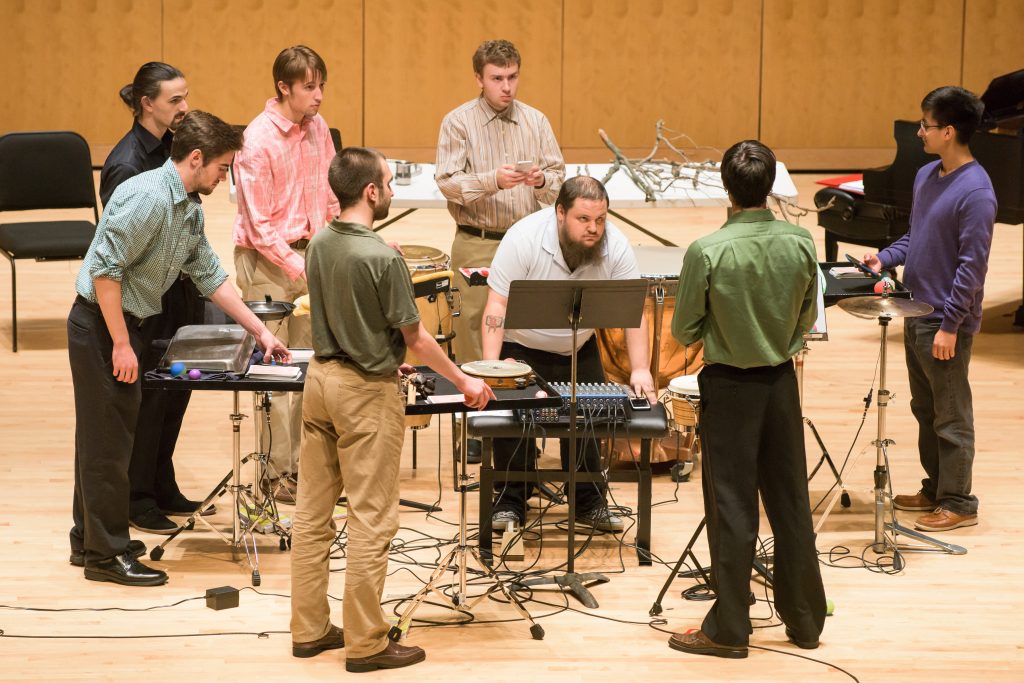
Jonathan Sotelo (far right) performs in the UMBC Percussion Ensemble’s rendition of Ben Johnston’s Knocking Piece 2 during the music department’s 2017 Livewire festival.
“My most important achievement at UMBC,” says Sotelo, “was learning how to listen. I’ve learned how to listen to the natural world, and how to apply it to music. Because of that, I am able to make my performances more connective to the audience, in any type of music—improvisations to the orchestral repertoire.”
He looks forward to attending graduate school at the University of Maryland, College Park, with the goal of becoming an orchestral timpanist.
An athlete, an artist
Linehan Artist Scholar and Division I soccer player Courtney Culp ’20, visual arts, has combined her loves of sport and visual arts to create impactful works during her time at UMBC.
The National Civil Rights Museum in Memphis screened her film A Mile in My Cleats as the opening presentation of the 2020 Race and Sports Day, held just before Martin Luther King Day. Through her documentary, she gave others space to share their stories of what it’s like to be a black female athlete. She shares, “I finished the project with an immense amount of new knowledge of my craft and closer relationships with my peers at UMBC.”
Courtney Culp’s capstone senior project, Pieces of Me, explores the challenges of tracing her roots as an African American. It was planned as a mural-scale illustration for the Center for Art, Design and Visual Culture. Image courtesy of Culp.
Studying Italian art and culture in Rome in 2019, with UMBC visual arts faculty Kimberly Anderson and Lynn Cazabon, also played a significant role in Culp’s UMBC experience. “I have gained lifelong friends at UMBC that have pushed and challenged me for the better,” she says. “I will forever be grateful for my time here.”
Culp will begin an M.F.A. program in illustration with minors in production design and themed entertainment design at the Savannah College of Art and Design (SCAD) this fall. “My hope is to become a visual designer for animation, film, and interactive entertainment projects.” She is also slated to play soccer at SCAD.
Contemporary musician
Few musicians are equally adept at more than one instrument, but Christian Hartman ’20, music, is an exception. He has made a name for himself as both a cellist and percussionist.
The principal cellist of the UMBC Symphony and a Linehan Artist Scholar, Hartman will attend the University of Delaware in the fall for graduate studies in cello performance. While at UMBC, he received a Music Performance Fellowship and Music Achievement Award.
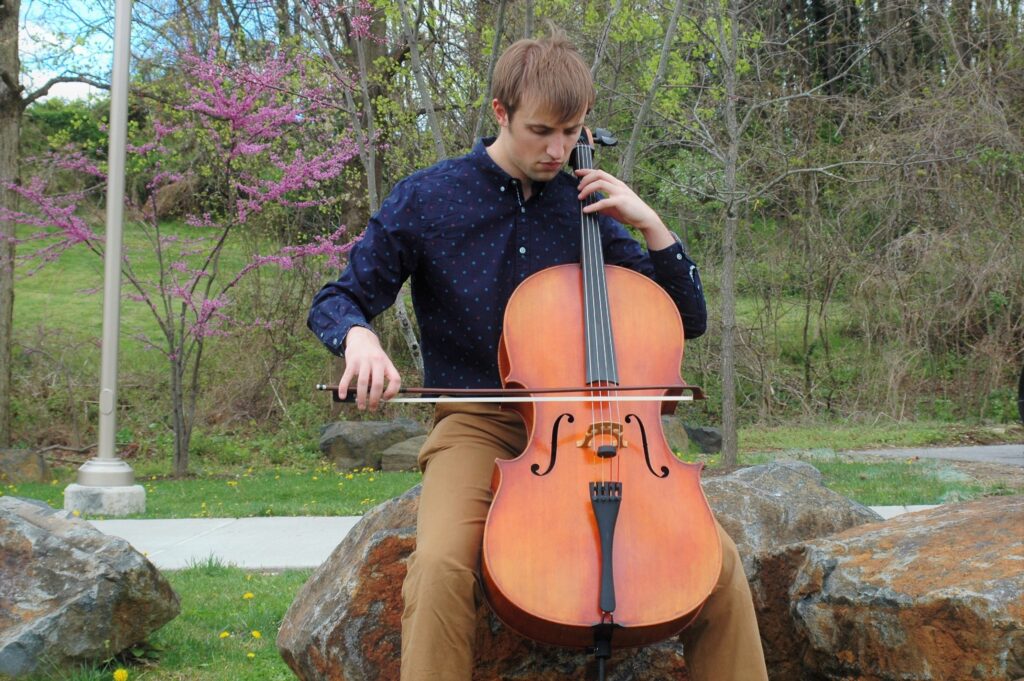
Christian Hartman practices cello in solitude near the Library Pond. Photo by Emily Godfrey ’20.
“I’m considering an academic career, which would allow me to perform, teach, and research,” says Hartman, “especially in the fields of contemporary and early music in which I’m most interested.”
His interest in contemporary music has led to collaborations with composers, and he has premiered a number of new compositions. A composer and arranger himself, he has written and arranged music for a variety of ensembles, including works premiered by high schools, honor groups, dance companies, and collegiate ensembles.
As a percussionist, Hartman plays snare drum in the Baltimore’s Marching Ravens Drumline, which he intends to continue through graduate school. He also drums for the Baltimore-based rock band The Negative Men and serves as percussion director for Manchester Valley High School marching band, his high school alma mater.
Lighting a new path
Linehan Artist Scholar Corey Goulden-Naitove ’20, theatre, has already had the opportunity to work professionally as a lighting designer at the Annapolis Shakespeare Company, Abington Friends School, and Long Lake Camp for the Arts. He had planned to continue this path when he graduated. But as coronavirus stay-at-home orders rolled out, and show after show was cancelled, he watched as five months of work evaporated in 24 hours.
Remarkably, the next day Goulden-Naitove received a call from Indiana University, Bloomington, inviting him to their Design + Technology program. At the time, it seemed “out of the blue.”
“They called up to offer me a spot in the M.F.A. program, with an assistantship with a living wage and tuition remission,” he says. Now, he will have a chance to continue studying his craft and remain connected to the theatre industry during COVID-19 closures.
Corey Goulden-Naitove’s award-winning lighting design for the 2019 theatre department production of Anon(ymous) by Naomi Iizuka. Photo by Raquel Hamner ’20.
This past winter at the Southeastern Theatre Conference, Goulden-Naitove presented his lighting design for the 2019 UMBC production of Anon(ymous), and won First Place in the Undergraduate Lighting Competition. He would later learn that it was that lighting design and award that caught the attention of the University of Indiana.
“UMBC was definitely the right choice for me—I have had opportunities here that I don’t think I would have found anywhere else in the world,” Goulden-Naitove says. “I am very grateful to all of my professors, to the university, and to Earl and Darielle Linehan for helping to make this happen.”
Inspiring the next generation of students
It’s no wonder that Linehan Artist Scholar Teresa Whittemore received the dance department’s Outstanding Senior in Choreography Award—her work has been twice featured at the American College Dance Festival. This includes the work Giving Skin, performed this spring.
Whittemore has also twice presented for UMBC’s Undergraduate and Creative Achievement Day, and through departmental dance showcases. And Arts by the People has presented her choreography in New York.
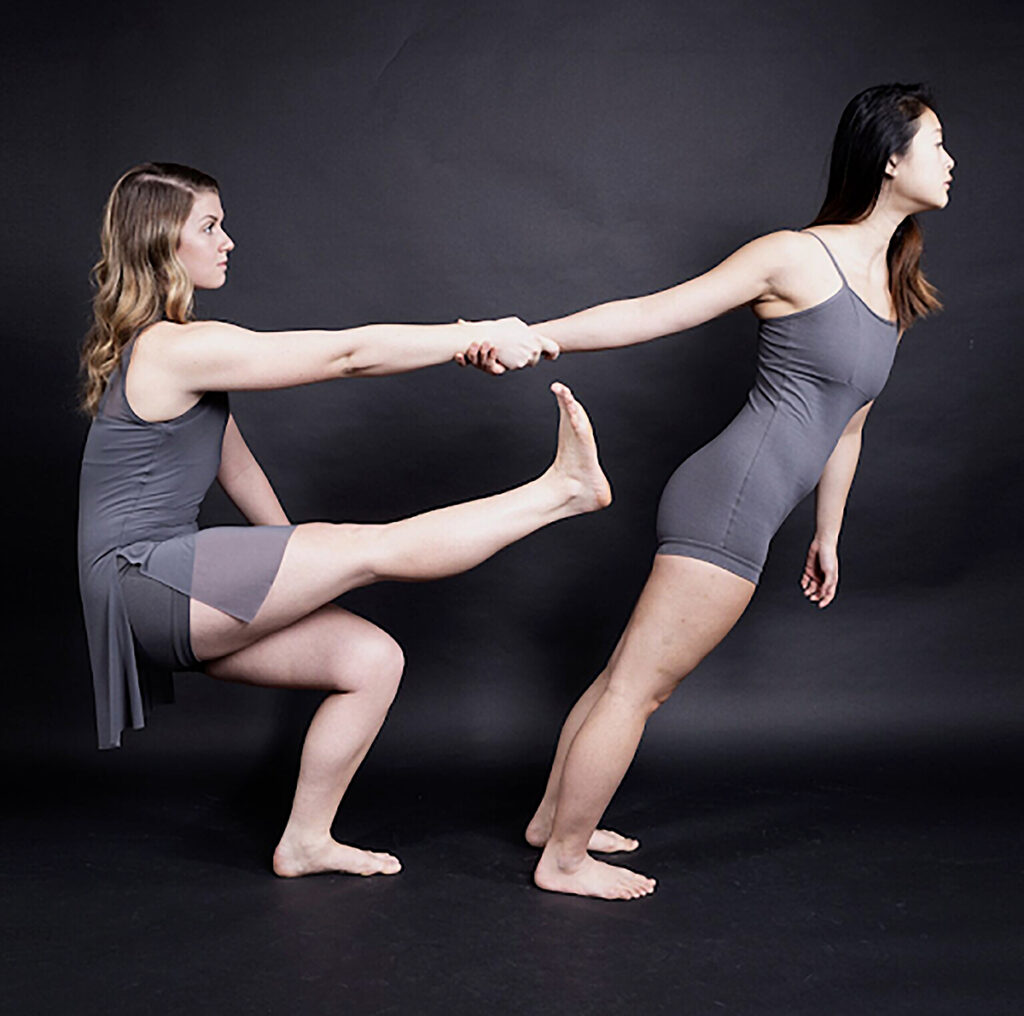
Dancers Sarah Brewer (l) and Michelle Ye (r) in Teresa Whittemore’s 2019 choreography When Eve and Eve Bit The Apple. Photo by Francisco Jarauregui.
In addition to choreography, Whittemore also loves to teach. Following graduation, she plans to teach at three area studios—JMD Studios, EMC Performing Arts, and Kinetics Dance Theatre, where she is currently assistant school manager.
Everyday activities become something more
Brandon Ables, who earns his M.F.A. in Intermedia and Digital Arts this spring, had expected to travel to Romania this September as a Fulbright scholar. Fortunately, although coronavirus complications have delayed his travel, it will still move forward in February 2021. In Romania, he’ll teach English at a university and will conduct an arts research project on the Romanian deadlift weightlifting form and history.
In the meantime, Ables will continue his research in the U.S. His work replays dreams, notes, and ideas using everyday environments and actions, accompanied with hypnotic suggestions. “I’m interested in discovering and creating triggerable actions within daily routines to score with audio and visual self-help style suggestions, guiding the subconscious to solve practical and absurd challenges,” he says.
“Activities like lying in bed, chewing, and looking in the pantry become opportunities to carve the subconscious into a desirable shape with no extra effort required.”
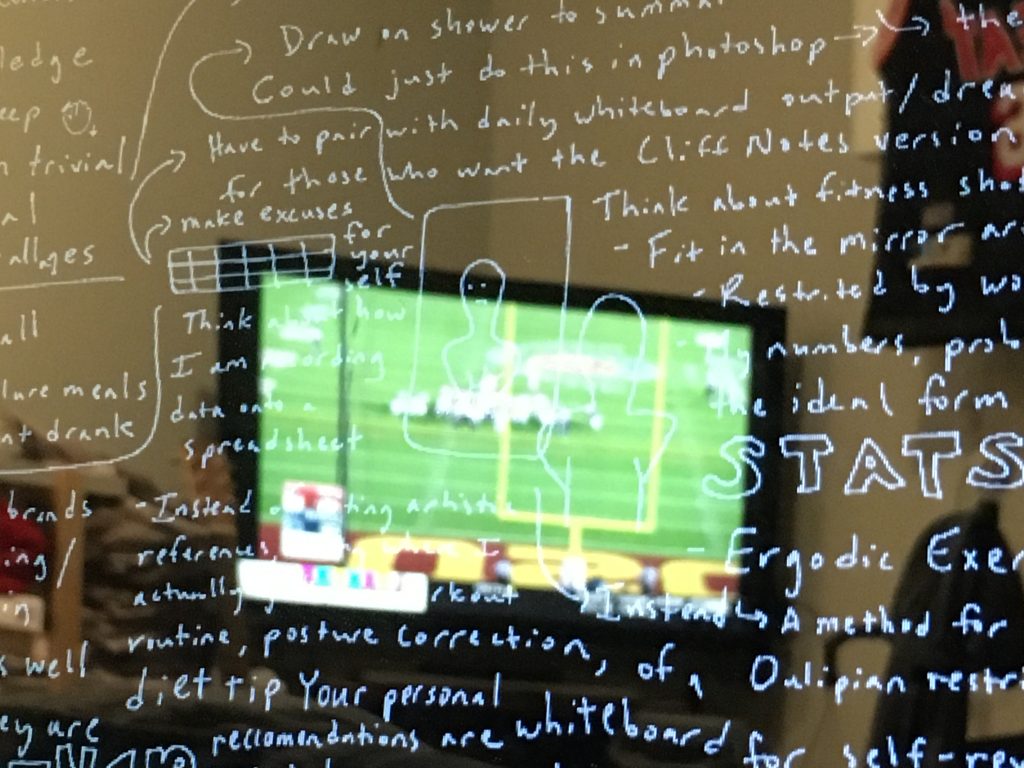
In One Man Trance, Brandon Ablesrecreates his studio apartment, demonstrating how he programs his subconscious by scoring everyday gestures with audio and visual accompaniment. Different areas of the installation can be activated when viewers chew food, use mouthwash, practice an instrument, exercise, and lie in bed watching TV. Image courtesy of Ables.
This summer, Ables will complete an interactive novel about parking, autonomous cars, and impulse purchases. He will also develop a one-man-band live performance to add more complexity to the actions he’s using to trigger self-hypnotic audio and visuals. And then, onward to Romania.
Performer, producer, teacher
Raymond Robinson ’17, music technology and jazz studies, and ’20 M.A.T., music, came to UMBC in 2013 as Linehan Artist Scholar and a multifaceted musician. He already was a skilled pianist and saxophonist, but he credits UMBC and his professors for his mastery of music theory and music technology.
“Now I produce, engineer, and know advanced jazz theory, arrangement, and composition,” he says. “I would not be the musician and educator that I am today without the guidance of all my teachers. I feel like I owe it to them to also be a teacher.”
Raymond Robinson in performance. Photo courtesy of Robinson.
Robinson feels that it’s important to have more men in the education system, especially black men. “I hope to have the opportunity to teach students of all ethnicities about acceptance and open-mindedness before perspectives and deeper implicit biases get locked-in,” he says. And he hopes to be a role model for black boys and young men.
He looks forward to teaching instrumental and general music in Baltimore County and Anne Arundel County public schools. He also looks forward to resuming performances at popular venues around Washington’s U Street corridor and with A.B.M and New Impressionz, two of the major Go-Go bands in the District.
Intensive training, unique opportunities
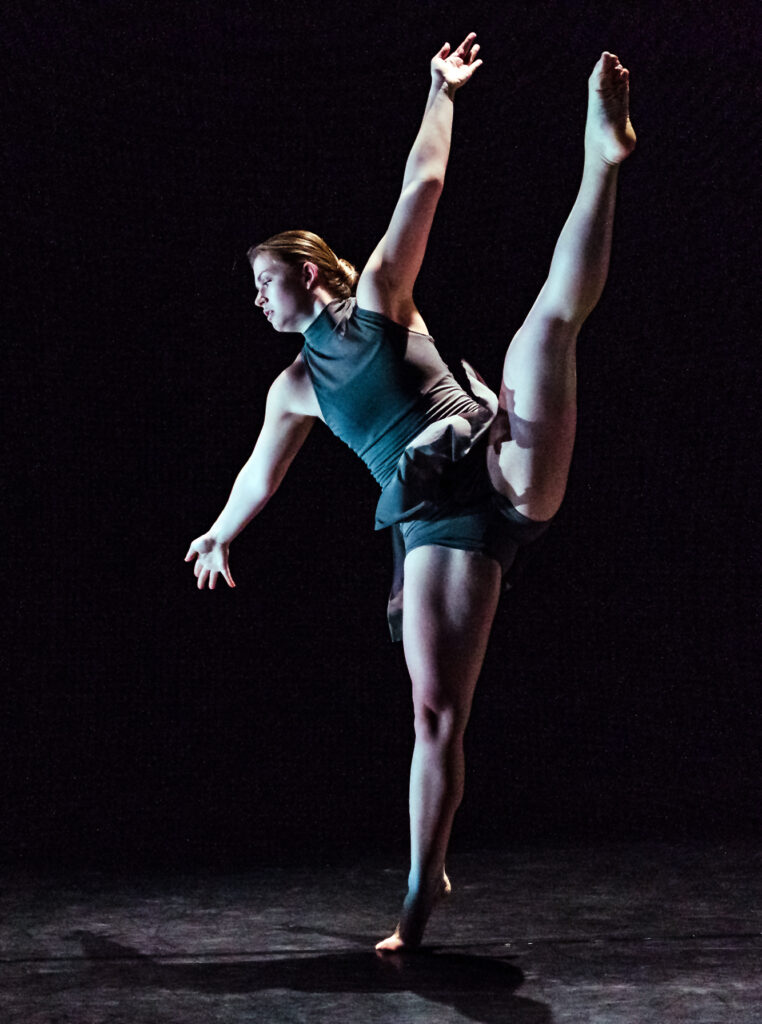
Linehan Artist Scholar Emily Godfrey ’20, dance, has performed at the Kennedy Center not once, but twice. Godfrey first appeared there in 2018 at the American College Dance Festival, performing choreography by Maia Schechter ’18, dance. She then appeared again in 2019 in choreography by assistant professor Ann Sofie Clemmensen.
Godfrey’s own choreography, terminal, was chosen in 2020 for the American College Dance Association (ADCA) Mid-Atlantic North Conference Gala, along with Giving Skin by Teresa Whittemore. At UMBC, she has appeared on stage with Baltimore Dance Project and in many dance department programs.
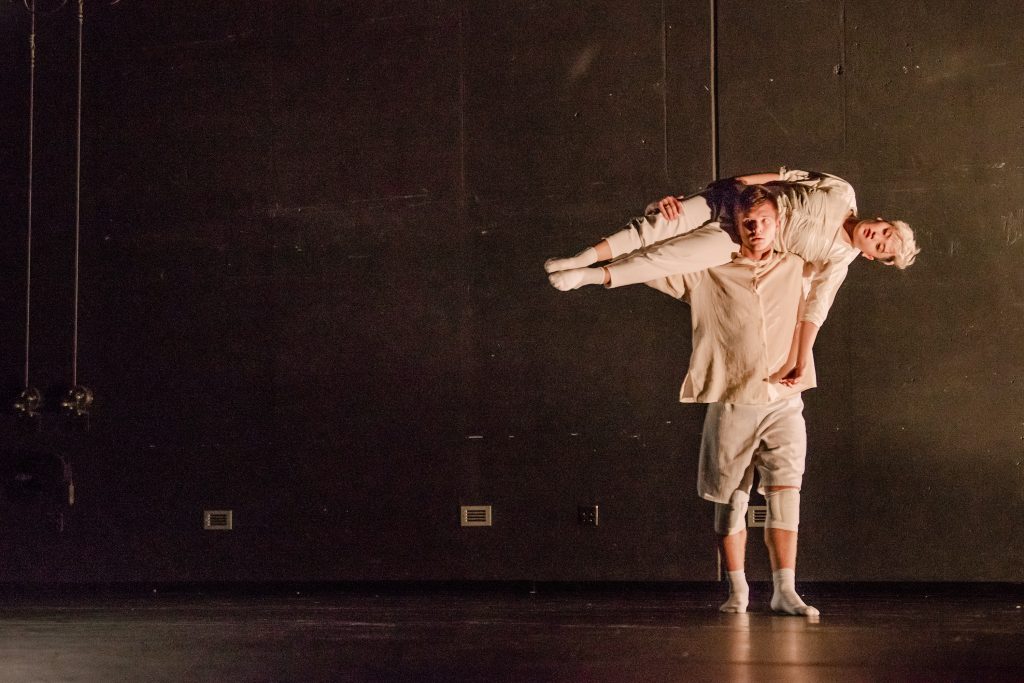
Emily Godfrey balances on the back of Deven Fuller ’23, dance, as they perform In To and Out Of by Ann Sofie Clemmensen on Baltimore Dance Project’s spring 2020 concerts.
With the financial support of the Linehan Summer Award and the Dance Department Summer Award, Godfrey attended several intensive programs. These include the Hubbard Street Dance Chicago Summer Intensive, the Paul Taylor American Modern Dance Summer Intensive, the Peridance Blueprint Summer Intensive, and study at the Gerlev Sports Academy in Denmark.
Following graduation, Godfrey plans to pursue a professional career in dance performance with national and international companies.
Satisfying “my creative side”
Double majoring in the arts and sciences can be daunting, but Linehan Artist Scholar and Honors College student Sarah Brewer ’20 will graduate with a B.A. in dance and a B.S. in biology. She credits open communication with dance and biology faculty, a team of advisors, and her own focus on time management for making it work.
Sarah Brewer onstage at UMBC.
As she prepares to leave UMBC, Brewer remains committed to both art and science. She is interning at a molecular biology lab within the Johns Hopkins Applied Physics Laboratory, and recently interviewed for a full-time position. She says the work at the lab “satisfies some of my creative side and all of my scientific side.” Still, she’s already reaching out to contacts at local companies to find ways to continue her work in dance.
Brewer says her proudest undergraduate moment was a duet performance choreographed by Teresa Whittemore ’20, When Eve and Eve Bit the Apple, at an ACDA gala performance in spring 2019. The piece was one of only two undergraduate works among twelve selected for the gala.
She shares, “To be a part of Teresa’s choreographic process, and build a creative relationship with her and my duet partner Michelle Ye ’22 was one of the most rewarding experiences I’ve had at UMBC.”
The perfect fit
Some UMBC students dream of attending the university for years before they arrive on campus. Linehan Artist Scholar Olivia Mills ’20, visual arts, had a different experience.
“I’m not from Maryland, and I wasn’t familiar with UMBC until the end of my college search,” Mills says, “but once I researched it and was offered the Linehan Artist Scholarship, it rose to being my first choice—and it was the perfect fit for me,” she says.
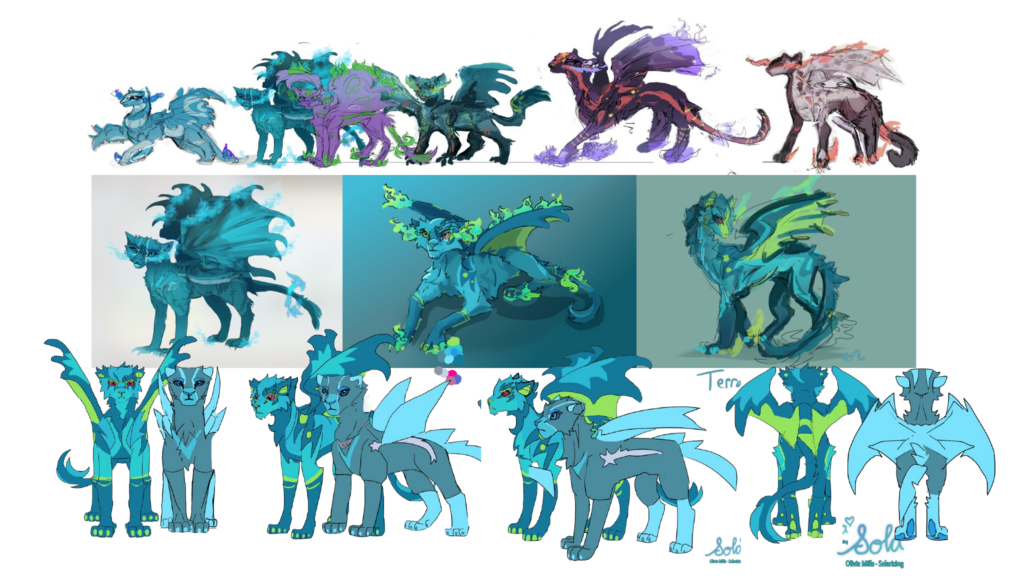
Mills’s focus has been on animation. Her senior capstone project and 2020 URCAD presentation, the animated film Creatures in Crisis, challenged the notion that robust animated film projects emerge only from major studios.
Animation studies for Olivia Mills’s 2020 frame-by-frame animation Creatures in Crisis. Image courtesy of Mills.
As an artist at UMBC, she especially enjoyed Commonvision programs, and made a point to share her work during annual Art Week festivities and in seasonal zines.
Given the impact of coronavirus on the arts, Mills plans to use her time immediately following graduation to build her artistic portfolio. “While the coronavirus situation saddens me and has been a source of stress, a silver lining is I now have to stay in and work on my art,” she says. “I’m also glad there is a virtual network through UMBC’s Career Center and Alumni Association to get on-track with my professional goals.”
Catherine Borg contributed to this article.
Banner image: Emily Godfrey ’20 performs with colleagues in Baltimore Dance Project’s 2020 concerts at UMBC.
All Photos by Marlayna Demond ’11 for UMBC unless otherwise noted.
Nothing in Undergraduate Research and Creative Achievement Day’s twenty-four year history could have prepared its organizers and participants for the challenge presented in spring 2020, as COVID-19 pushed what would have been a heavily-attended event into a virtual space online.
Using a technology called VoiceThread, student researchers uploaded poster presentations, performances, and visual artwork, adding commentary and responding to questions from the online audience—mimicking the in-person experience—and URCAD XXIV transformed from a single day into a week-long event stretching from April 22 to 29.
Keisha John’03, biochemistry and molecular biology, provided a video message about leadership with integrity for URCAD XXIV’s opening remarks as the annual alumni guest speaker. A former Meyerhoff Scholar, she is now associate dean for diversity and inclusion in the Graduate School of Arts and Sciences at the University of Virginia.
“Hosting URCAD online gave students a new skill set, which involved producing a virtual presentation — an ability that they will absolutely need going forward in their future academic and professional lives, given the huge cultural shift that has happened due to the coronavirus pandemic,” said April Householder, director of undergraduate research and prestigious scholarships in the Division of Undergraduate Academic Affairs.
“The students really jumped in with both feet to the new technology and made some really dynamic presentations. They created voiceovers for their posters, made videos, and converted their live performances to the web. And they did that in a very condensed amount of time with a very short learning curve.”
URCAD usually attracts about 2,500 attendees, but this year’s online event far surpassed that number. The URCAD site was viewed 18,771 times—more than 8,200 times on the first day alone—and 2,971 unique users logged in, with visitors from as far away as the United Kingdom and South Korea. The VoiceThreads were viewed 3,750 times (with Angela Endres, visual arts, leading the pack at 97 views) and collected 2,671 comments (with Kenneth M’Bale, media and communication studies, topping out at 52).
#UMBCalumni speaker, Keisha John '03, biochemistry and molecular biology, kicked off #umbcURCAD 2020. In order to have an impact in during these uncertain times, Keisha recommends we: continue to learn, never stop living, and never stop leading. https://t.co/aNPUek4CW3
In presentations in disciplines ranging from environmental engineering to information systems, students in the College of Engineering and Information Technology shared insights from their research.
“I became interested in this topic when I heard about billboards that use natural humidity to produce drinkable water in Peru. I realized there was a disadvantage in countries that lack humidity,” Talib says. Her presentation focused on how organic waste, such as food waste and paper, can be used to create potable water, electricity, and fertilizer, while minimizing the production of carbon dioxide.
Yianni Karabatis ’21, computer science, presented his work on using deep learning to more accurately diagnose breast cancer. Karabatis, who worked with Konstantinos Kalpakis, associate professor of computer science and electrical engineering, explained that a significant percentage of people will be diagnosed with breast cancer in their life, and it is important to have a trustworthy system in place to correctly make these diagnoses.
“The goal of this project is to increase diagnosis accuracy, while refining interpretation of difficult cases and reducing fatigue and increasing efficiency of pathologists,” he shares. He developed a Convolutional Neural Network, a system of computation inspired by the human brain, which after the first round of training achieved 88% validation accuracy.
While live performances and in-person exhibitions and screenings were not possible this year, the VoiceThread platform gave rise to a deeper look into the scholarly research and technical processes that go into creative works across the arts.
In her presentation “Authorship and Animation,” Linehan Artist Scholar Olivia Mills ’20, visual arts, challenged the notion of animated film projects as big studio productions, noting direct access to tools and audience is within grasp for independent filmmakers. She presented a compelling overview of the production processes for her animated film, Creatures in Crisis, commenting that “this process is a marathon in nature, requiring patience and multitasking with the unique and time-consuming challenges animation presents.” Her hope is to inspire others to overcome technical challenges or skill barriers to authoring one’s own animated story.
In January, Courtney Culp '20, visual arts, was chosen to share her powerful documentary about what it means to be a black female athlete at the @NCRMuseum's "Intersection of Race & Sports" program. Congratulations, Courtney! https://t.co/p5h5EZ1rSUpic.twitter.com/kDAxC9gjoA
In A Mile in My Cleats, a short documentary film by Linehan Artist Scholar Courtney Culp’20, visual arts, four black female athletes at UMBC reflect on their experiences as Division I athletes in basketball, volleyball, lacrosse, and track and field (freshman Tyler Moore, freshman Carmen Freeman, senior Zoë Pekins, and sophomore Ariella Garcia, respectively). In the film, each student shares personal anecdotes revealing the questions and pressures they have endured as black athletes. They also share the cues—from media representation, microaggressions, sexism and the ever-present undercurrents of racism—on what society expects from them.
“Overall my biggest takeaway was realizing that through my documentary, I was able to give others the space they needed to share their stories of what it’s like being a black female athlete,” says Culp. She “finished the project with an immense amount of new knowledge of my craft and closer relationships with my peers at UMBC.” Culp’s film was shown earlier this year at the annual Race and Sports Day at the National Civil Rights Museum in Memphis.
Linehan Artist Scholar Emily Godfrey’20, dance, presented her work terminal, with choreography that explores the individual choice forced upon family members when a family dynamic is drastically changed forever. “The piece is intentionally left open-ended, leaving the audience to reflect, react, and invoke discussion,” shares Godfrey. “So long as the work resonates with the viewer, the experience is what matters, not the presentation of a theme.”
Just prior to URCAD, Godfrey’s work was presented at the gala of the American College Dance Festival’s Mid Atlantic North Conference, along with Giving Skin by Teresa Whittemore ’20, dance.
Seeking greater understanding
In a world with many uncertainties, UMBC students in the humanities and social sciences seek greater understanding through research on global, national, and local topics including environmental change, presidential electability, and food insecurity in Baltimore City.
Cameron Rybacki ’20, political science, wanted to understand her peers’ voting behavior during a highly controversial presidential election year. In Rybacki’s research project, Assessing the Electability of U.S. Presidential Candidates, she surveyed twenty-five peers to predict how they would vote, and how they chose a candidate. The preliminary findings showed that this group of college-age voters were most likely to choose candidates based on their party identification.
Nihira Mugamba ’22, political science, presented her research on Establishing Food Inequality In Baltimore City: The Influence Of Race And Poverty On Food Insecurity, drawing from data sources from a range of Baltimore City government organizations, Johns Hopkins Livable Future data, and interviews with local food justice organizations. She seeks to understand how structural racism has affected food accessibility in Baltimore’s black communities.
Mugamba is also the 2020 recipient of the Newman Civic Fellowship which acknowledges students’ commitments to educational access and responsible citizenship.
Students show off their interdisciplinary work On Thin Ice, a film about global warming.
Paul Ocone’20, individualized study; Lauren Patel’20, environmental science; Sangita Ramaswamy ’20, biological sciences; Tori Nelson’20, environmental science, collaborated to produce the interdisciplinary work On Thin Ice. This sixteen-minute film, formatted as a sphere, tells the story of global warming through videos of changing natural habitats and heat maps.
BUILDing confidence
UMBC’s NIH-funded STEM BUILD program intends to increase the diversity of the workforce in biomedical sciences, and six BUILD Trainees presented at URCAD XXIV.
The research of Shehar Yar Awan ’20, biological sciences, who works with Erin Green, assistant professor of biological sciences, focused on SET5, a yeast protein that has a counterpart in humans. Awan intends to increase understanding of SET5’s activity in cells, which has been linked to tumor formation. “Thanks to the STEM BUILD team’s constant academic and emotional support, I was able to effectively organize and present two years of my undergraduate research,” Awan shares.
“STEM BUILD prepared me through two Summer Bridges by teaching me how to create posters and present them,” shares Sara Reagan’21, biological sciences and psychology. “I really felt confident making my URCAD poster on my own due to my summer experiences.” She conducts research at Johns Hopkins University on the long-term outcomes for individuals with Tourette’s Syndrome, a condition that causes severe motor or verbal tics, such as throat-clearing or repeating certain words.
Victor Omoniyi’20, biological sciences, was also well-positioned to present at URCAD because of his prior training and experience with STEM BUILD. “STEM BUILD has supported me in my research in many ways, from funding my trip to present research at the Annual Biomedical Research Conference for Minority Students in California last year, to ensuring that I found the right mentor to conduct research with,” Omoniyi says. He uses fruit flies to study neurodegenerative disorders with Fernando Vonhoff, assistant professor of biological sciences.
“I was proud to showcase my hard work on a virtual platform,” adds Ena Oboh ’21, biological sciences. She conducted research with Rachel Brewster, professor of biological sciences. Oboh’s project focuses on how certain genes may allow zebrafish embryos to survive for long periods without oxygen, which has implications for everything from organ transplants to cancer.
“STEM BUILD has supported and prepared me for events like URCAD since I was a freshman,” Oboh says, “and gave me the tools necessary to seek advice during the process of preparation.”
Looking forward
Administrators and professors who have worked for months with presenting students applauded their efforts, especially given the sudden change in presentation methods.
“In these challenging times, our students’ dedication to carry on and participate in URCAD is nothing short of remarkable,” says Katharine Cole, vice provost and dean of Undergraduate Academic Affairs. “Their grit, enthusiastic imaginations, hard work and unwavering commitment in the face of challenge is a reflection of their resilience, determination and immense talent.”
The UMBC community now looks forward to URCAD XXV in spring 2021 with hope that crowds will once again fill the University Ballroom and studios in the Fine Arts and the Performing Arts and Humanities Building.
When junior Linehan Artist ScholarEtai Fuchs heard about the economic devastation the COVID-19 pandemic was wreaking on the music industry, he knew he needed to respond. And as a music technology major, he realized he was in a unique position to help bands that had lost income because of canceled shows.
“I created an online record label called Gardenhead Records,” he explained, “and released a compilation recording that features and raises money for musicians whose performances have been canceled.”
In all, Fuchs was able to include twenty-six tracks by twenty-six different bands, and the resulting album — Pandemic Artist Relief: Music in the Time of Covid-19 — was released exclusively on Bandcamp on April 10. All proceeds from sales of the recording will benefit the artists.
“The best outcome would be to continue raising money for these musicians,” said Fuchs. “Some of them have lost their jobs and are struggling to pay rent, so my priority is to try and help these people out in any way that I can. Also, it’s great to be able to help promote music that I genuinely enjoy by lesser-known artists.”
One song was authored by Tom Waterworth (writing under the pen name Firesites), an undergraduate at Newcastle University in the UK who studied music technology at UMBC as an exchange student.
Putting Skills to Work
The project engaged many of Fuchs’s music technology and entrepreneurship skills—he contacted the artists, started the label, created the artwork, reached out to media, and mastered the compilation. He’s also working on plans to livestream a concert featuring some of the artists.
“We are so proud of Etai’s project and its potential for positive impact during a difficult time!” said Linda Dusman, chair of the music department. “Etai’s work exemplifies the extraordinary creativity fostered in all of our music majors. Our faculty and students embody that creative spirit as performing, teaching, and composing musicians who contribute to the community through their artistry.”
Fuchs also recently released his own solo album, Bloodletting, which he describes as a collection of “very introspective indie folk and dream pop” written about core memories and experiences. After graduating, he plans to record and perform his music, organize music releases, book shows, and freelance in production and graphic design.
Scott Casper, dean of the College of Arts, Humanities, and Social Sciences, applauded Fuchs’s efforts, as well.
“Etai Fuchs’s project, so perfect for this moment, also embodies UMBC’s long-standing values,” he said. “It exemplifies entrepreneurship in the arts, and it reaches beyond our university community to assist other artists challenged by COVID-19 and the loss of live performance opportunities.”
Linda Dusman, professor and chair of music, has been named the Bearman Foundation Chair in Entrepreneurship for 2020 – 2023. This role is designed to recognize and support a faculty member with an interest in entrepreneurship, outstanding teaching skills, and a strong record of scholarship in entrepreneurial studies or a field related to entrepreneurship.
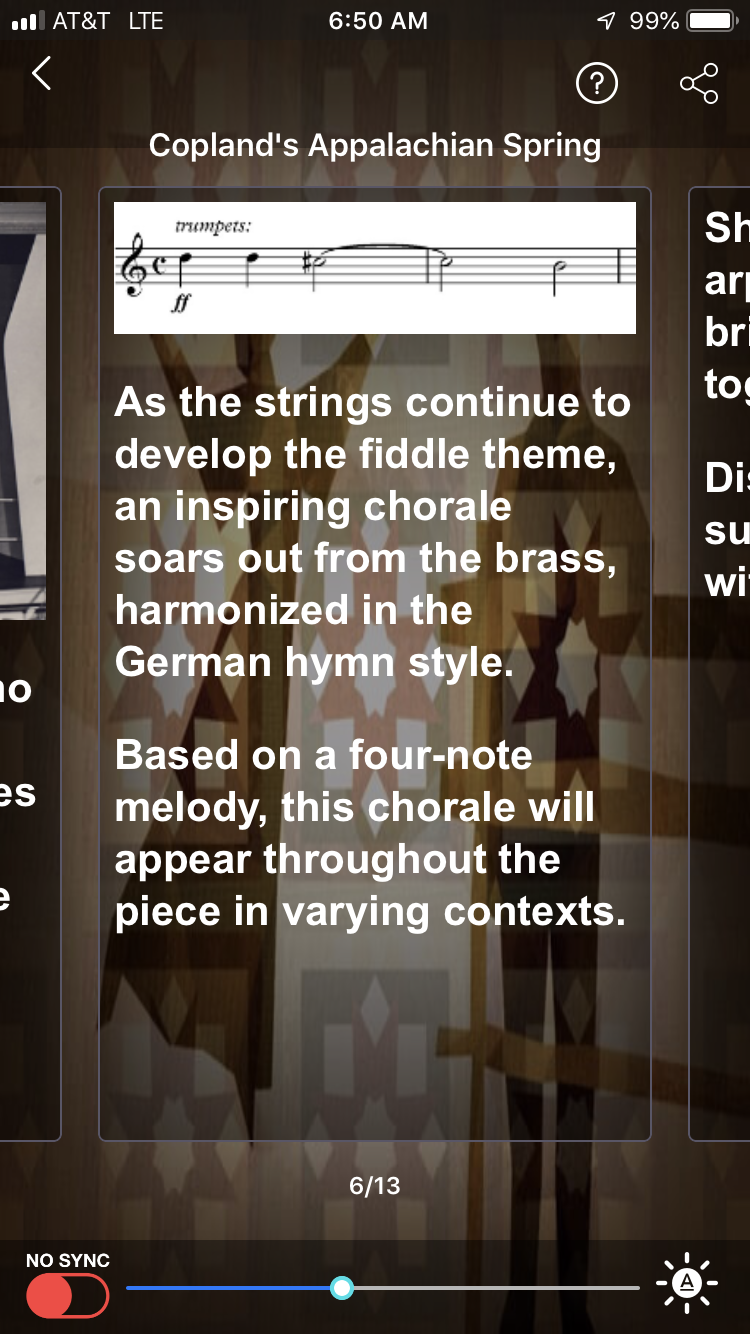
The three-year appointment will enable Dusman to further her work with EnCue, an audience engagement app she co-designed for use during classical music performance. EnCue is intended to be used by the audience on tablets or smartphones in real time during performances, especially symphony orchestra concerts. It helps listeners understand and more fully appreciate the music, thereby deepening the experience. EnCue was co-developed by Eric Smallwood, former assistant professor of visual arts, and received support from UMBC and the Maryland Innovation Initiative.
“Linda Dusman’s work exemplifies entrepreneurship in the arts,” says Scott Casper, dean of the College of Arts, Humanities and Social Sciences. “Through EnCue, Linda translates classical music for broader audiences in ways that enrich the listening experience.”
Audience experiences around the world
“The thing I’m most excited about,” says Dusman, “is that Bearman support will enable me to try to answer the questions I started asking ten years ago, which are: Can people learn about music in real time during concerts, and if they do learn, does that make a difference? Does it enhance their engagement of the experience? Does it make it more likely for them to want to return?”
“Now I’m going to be able to actually work with an educational psychologist — Linda Baker, recently retired professor of psychology here at UMBC — to test that hypothesis,” Dusman explains. “I’ll also be able to travel to orchestras that are engaged with this process, to see how audiences respond in different parts of the world.”
Last fall, Dusman was asked to speak at a conference in Berlin at the German Orchestra Days (Deutsche Orchestertag) about real-time education using mobile technologies. There, she described how EnCue has been used by orchestras in locations as diverse as Baltimore, Winnipeg, London, and Augusta, Georgia.
“I want to better understand EnCue’s impact in diverse geographic regions with diverse audiences,” says Dusman. “Obviously, audiences in London are very different than audiences in Augusta, Georgia, yet they’re listening to the same music played by symphony orchestras. How does that impact the engagement of the audience, and what does the live classical music experience mean for them?”
The Bearman Foundation Chair in Entrepreneurship was established by The Herbert Bearman Foundation to acknowledge and honor the contributions of Arlene Bearman, who taught in UMBC’s administrative and managerial sciences program for many years.
Featured Image: Linda Dusman. Photo by Marlayna Demond ’11 for UMBC.
The film begins, a fast-moving montage of seemingly unrelated images: eyes, people dancing, an airplane landing, artillery, President Kennedy, wrestlers, a woman applying hairspray, all interspersed with wacky cartoon-like animated images.
It’s the start of Breathdeath, Stan VanDerBeek’s experimental 1963 masterpiece that would influence a generation of artists, including Monty Python’s Terry Gilliam. VanDerBeek’s genius and visionary thinking—not only as a filmmaker, but also as a video artist, computer animator, and futurist—would earn him worldwide fame and, in 1975, a full professorship at UMBC, where he taught until his untimely death in 1984.
VanDerBeek’s vision can still be seen in the programs he helped found and the alumni he inspired at UMBC.
Underground Artist
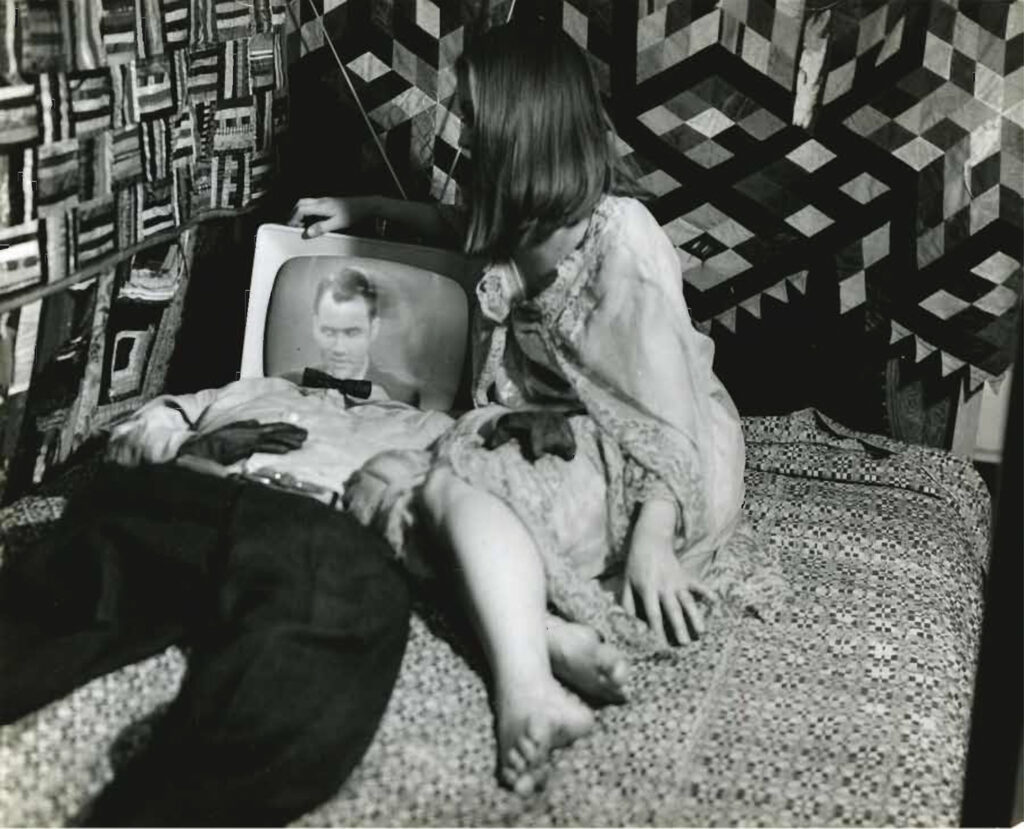
Born in 1927 in New York to immigrant parents, VanDerBeek’s early interest in painting, architecture, and design led him to Black Mountain College, where he befriended pioneering composer John Cage, choreographer Merce Cunningham, and inventor Buckminster Fuller, all of whom were to prove deeply influential on the artist. In the early 1950s, working as a designer on the CBS children’s program Winky Dink and You—which featured plastic screens children could apply to the television and draw on with special crayons—VanDerBeek learned basic animation skills and, by 1955, began to create his own animated films. In 1959, he organized a New York film festival entitled “Films from the Underground,” and the term “underground film” was born.
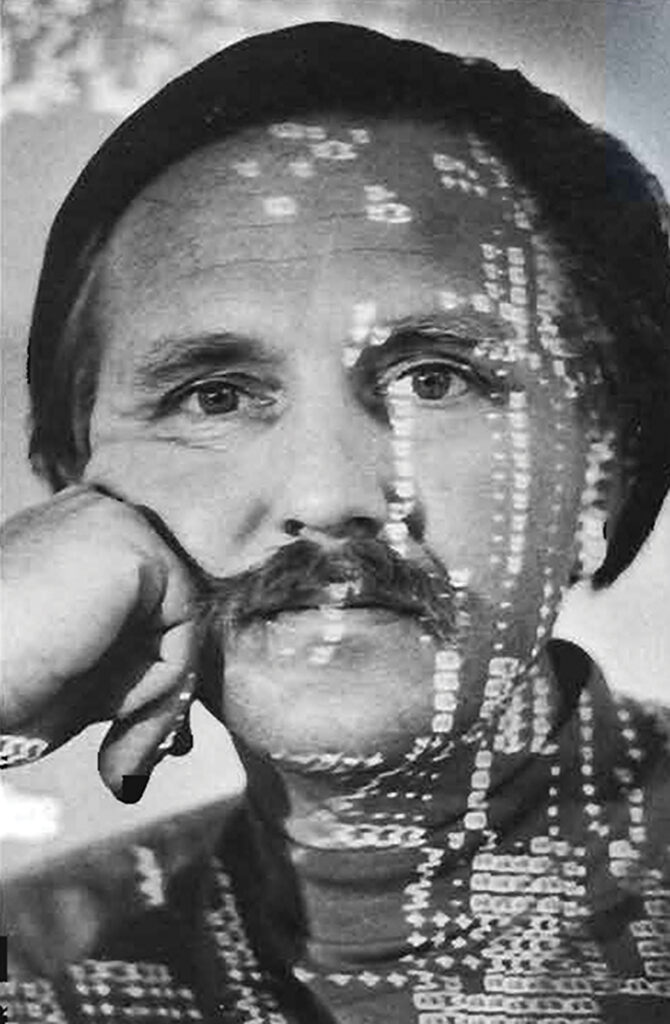
A portrait of Stan VanDerBeek.
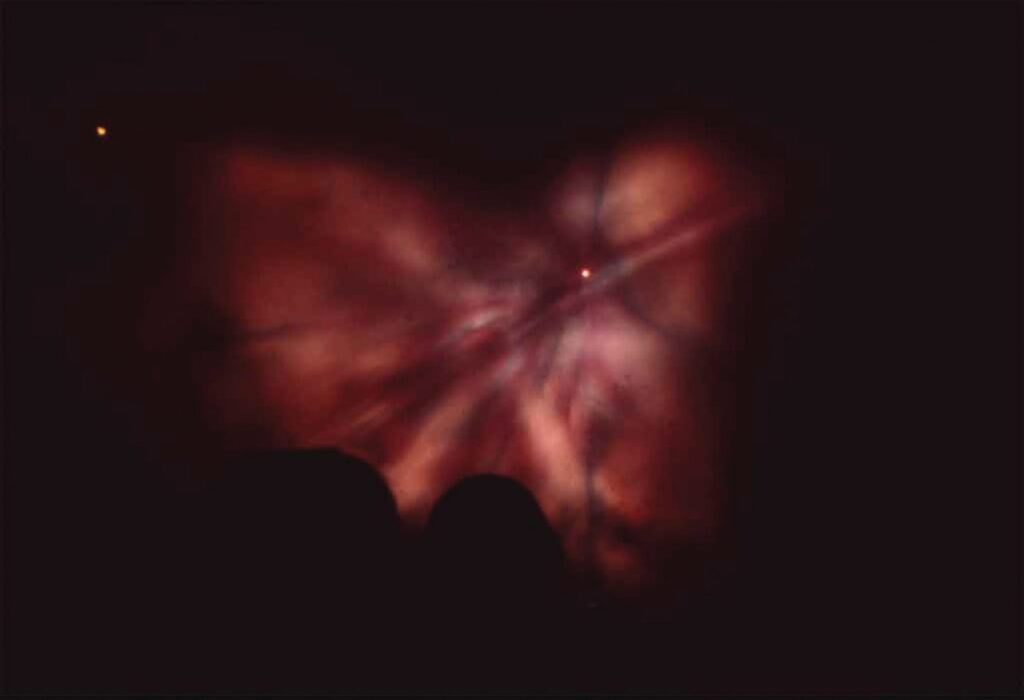
Throughout his 30-year career, VanDerBeek was more than an artist; he became a visionary who thought beyond limits and boundaries, often dreaming up fascinating ideas that couldn’t be executed—at least in his lifetime. In 1980, midway through his tenure at UMBC, he imagined, “You’ll sit in your backyard and look up at beautiful paintings I and other artists will do for you on a 10,000 square mile screen of clouds. The strokes and colors will be images projected by laser beams. I call it ‘painting with light’ or optical painting.”
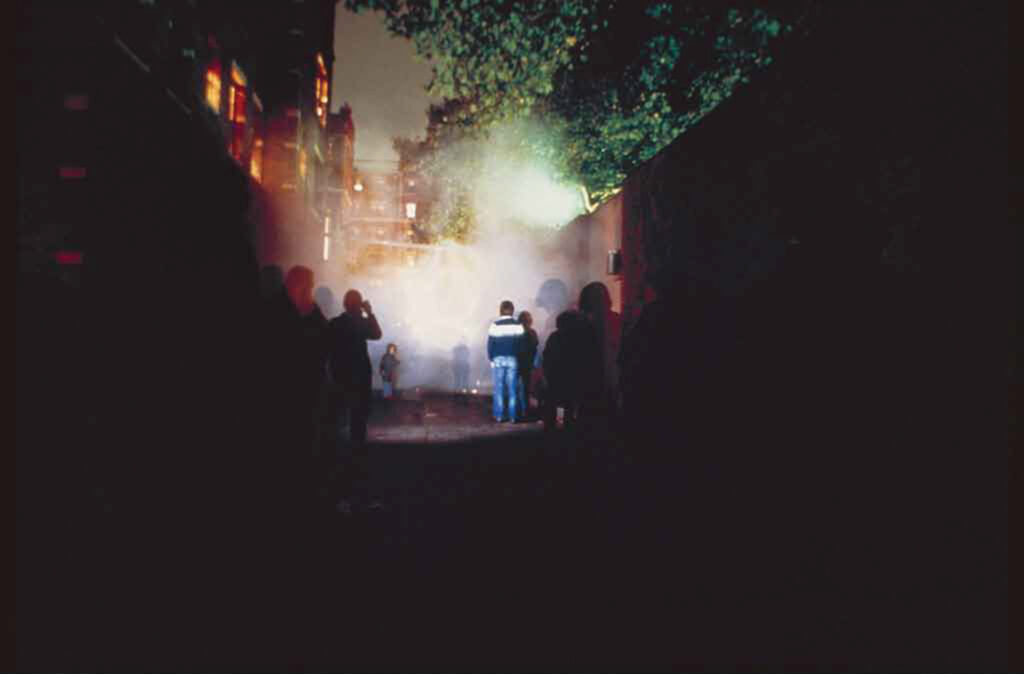
At UMBC, recalls Ellsworth Hall ’82, visual arts, the cloud projections were realized on a smaller scale. “A good friend of mine, Ed Hopf, with whom I’ve made films with since we were 13, helped Stan on his multimedia presentations. He would have film projected on the ‘smoke’ created by melting dry ice. At one point there wasn’t enough ‘smoke’ and Stan was in a hurry trying to coordinate some other aspect of the production so he grabbed the dry ice with his bare hands and threw it in the container to melt!”
For VanDerBeek, moving images weren’t only material for his artwork—they had the power to facilitate global understanding and to help the world move toward peace. In a manifesto, “CULTURE: Intercom and Expanded Cinema,” he wrote, “I propose the following: that immediate research begin on the possibility of a picture-language based on motion pictures; that we combine audio-visual devices into an educational tool: an experience machine or ‘culture-intercom’; that audio-visual research centers be established on an international scale to explore the existing audio-visual devices and procedures, develop new image-making devices, and store and transfer image materials, motion pictures, television, computers, video-tape, etc.; that artists be trained on an international basis in the use of these image tools…” He set forth ideas with the certainty that they could be accomplished and even needed to be accomplished.
To facilitate that vision of global communication, VanDerBeek forged what was perhaps his best-known creation, the Movie-Drome. Located at Stony Point, New York, at the Gate Hill Cooperative (populated by the young VanDerBeek family in addition to others who had migrated from Black Mountain College, including John Cage, pianist David Tudor, and potter M.C. Richards), the Movie-Drome was the top of a grain silo dome. Guests were invited inside, asked to lie down, and, looking up, watched a mosaic of continually changing films and slides that were concurrently projected across the dome’s interior. VanDerBeek imagined a network of Movie-Dromes operating internationally, linked by satellite, presaging the internet.
Endless Possibilities
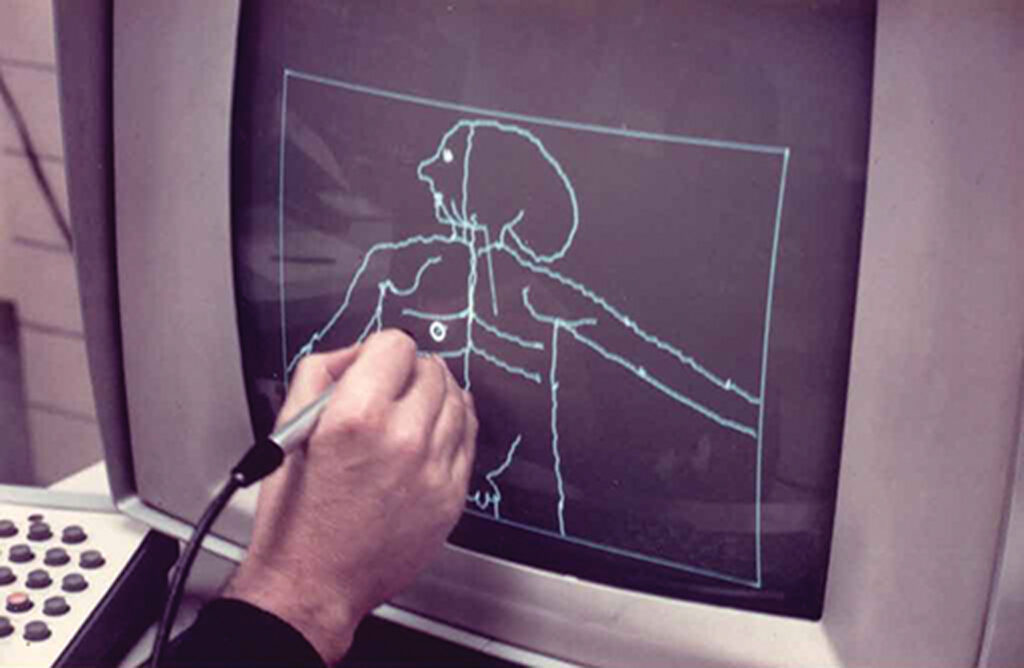
By the time VanDerBeek arrived at UMBC in 1975, he was already in the international limelight—a filmmaker whose works had won awards at festivals worldwide and who had received support from the Guggenheim Foundation, the Ford Foundation, the National Endowment for the Arts, and the Rockefeller Foundation. He had taught, lectured, or been in residence at Columbia University, MIT, the Walker Arts Center, the Smithsonian Institution, WGBH (Boston), NASA, and dozens of other institutions and had enjoyed a 1968 retrospective at the Museum of Modern Art. Ever fascinated by the possibilities of emerging technologies, VanDerBeek had branched out from film to embrace videography and computer animation, which seemed to offer endless possibilities. (His early computer-generated films were produced at MIT and at Bell Labs, where he was in residence and assisted by computer art pioneer Ken Knowlton.) An exhibition of VanDerBeek’s work Machine Art: An Exhibit of “Inter-Graphics” was presented in UMBC’s Library Gallery in spring 1976.
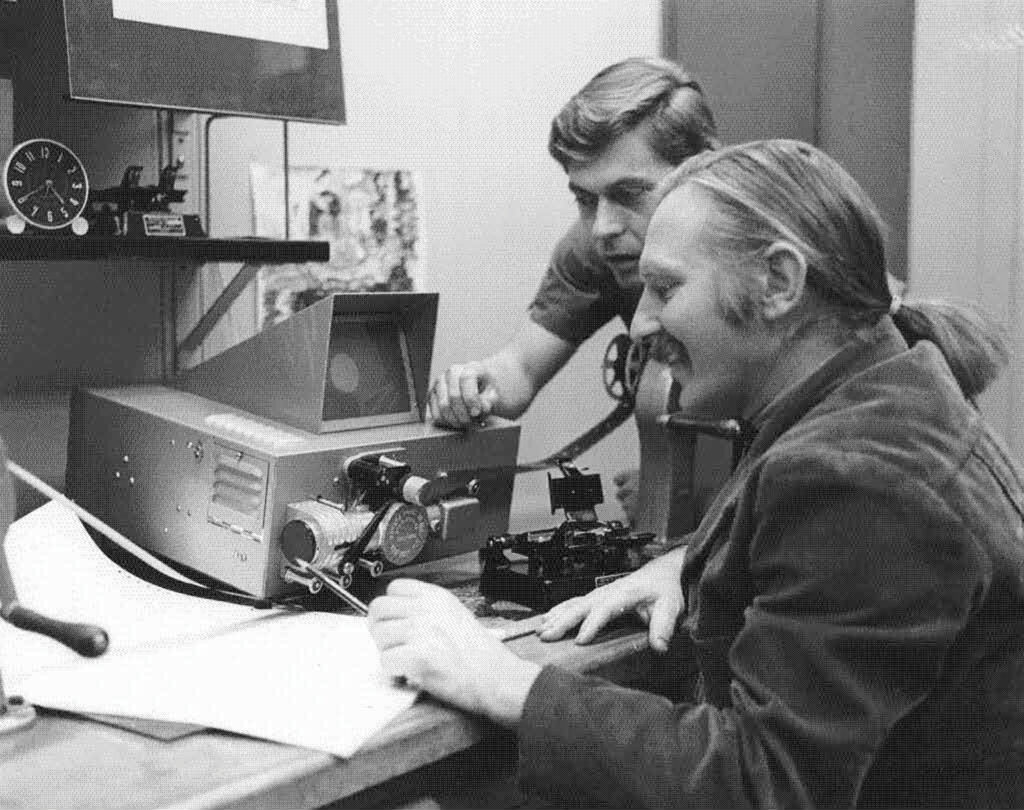
“It was a dynamic time,” remembers Ferdinand Maisel, who studied at UMBC and also worked in the dance department, “and Stan was maybe among the first interdisciplinary/collaborative artists of the 20th century. He was fascinated with how other people would think and solve problems. I met Stan via my work with Liz Walton—I worked for the dance department back then as a composer. Stan immediately had me push his shopping cart of films (which he was known to walk around campus) to a Steenbeck film machine, where I watched, with amazement, some of the films for which he wanted music.” VanDerBeek tapped Maisel to help run his Image Lab, a precursor to UMBC’s present-day Imaging Research Center.
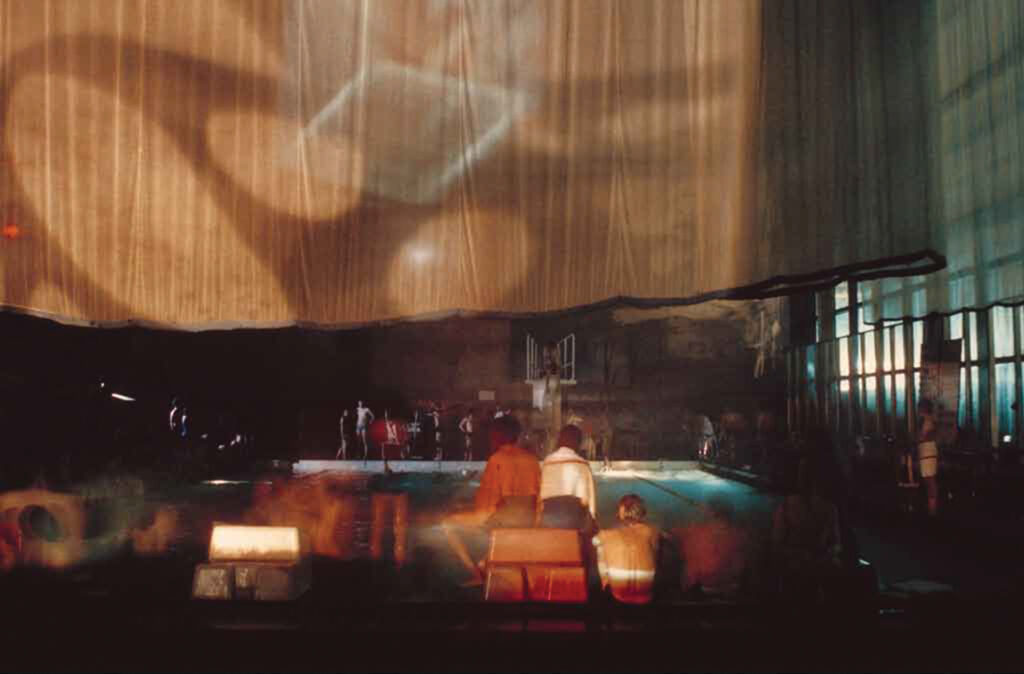
While at UMBC, VanDerBeek recreated the Movie-Drome. Baltimore newscaster Denise Koch, who taught acting and theatre performance at UMBC, recalled, “Stan built a geodesic dome in the center of a large field and projected clouds and nighttime sky-lines, and had people come and lay on the floor for the experience.” (He had planned to erect on campus a 70-foot dome housing a 40-foot planetarium screen.)
VanDerBeek’s award-winning 1963 film Breathdeath was described by the filmmaker as “a film experiment that deals with the photo reality and the surrealism of life…a black comedy, a fantasy that mocks at death.”
Koch also stars in a 1979 VanDerBeek film, Mirrored Reason. “He came to me and told me he’d been given a studio at the Voice of America for a day, and wanted to play with some of the equipment and asked if I’d participate as his actor—how could I refuse! We went to the studio, and he placed me in a room and just asked me to do an improvisation. I think I used a Kafka story to fall into a state of paranoia as Stan fooled around with my image. At one point my head splits in two and then I’m facing myself—thus, I believe, Mirrored Reason. Stan and our theatre company, Kraken, collaborated a number of times. Once, he took video of each actor’s head in the exact same position and then had us bleeding or melting into and out of each other as if we were a company made up of one face that held the persona of eight different people. It’s hard to explain, but I remember I was stunned!”
Ellsworth Hall remembers that VanDerBeek’s “office was rather messy with stacks of magazines, books, and film cans, but he knew where everything was!” Always encouraging his students to branch out with novel techniques, “In Experimental Film class Stan would have us put objects directly on unexposed film and then move them and expose each frame so as to create a direct animation on the emulsion. Very unusual technique, but it resulted in some interesting images.”
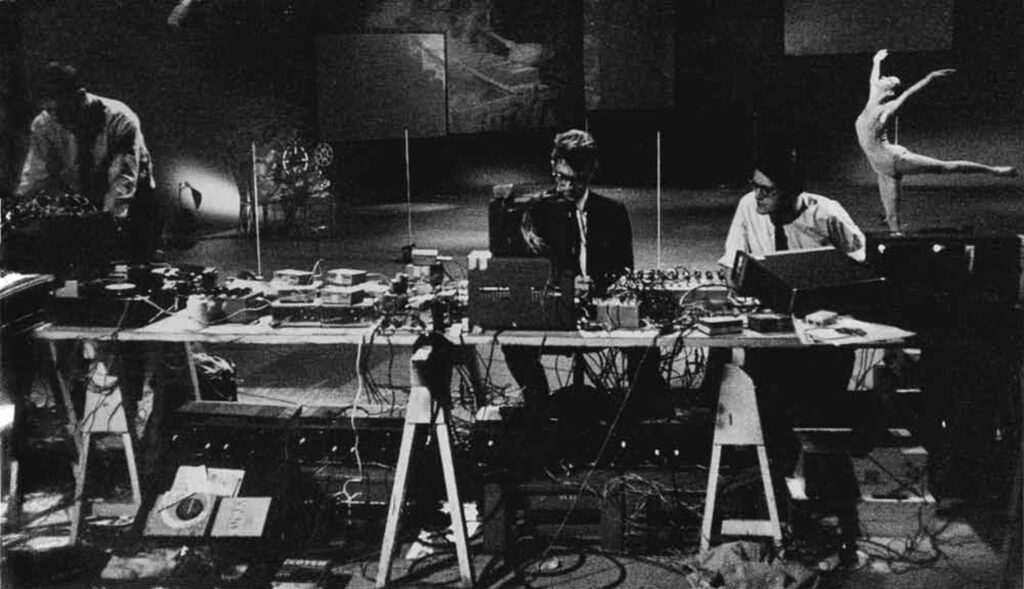
A frequent collaborator across artistic disciplines, VanDerBeek worked in 1965 on the Merce Cunningham Dance Company’s Variations V with John Cage, Nam June Paik, and others. (Pictured: Cage with composers David Tudor and Gordon Mumma, and dancer Carolyn Brown.)
Steve Estes, who studied film at UMBC as an undergraduate and then returned to earn an MFA in 1997, remembers VanDerBeek as an encouraging, supportive force. “He was very open, and very open to whatever you really wanted to do. Stan was the kind of guy who was helpful by basically just being there, and letting you do what you did, and providing whatever assistance he could. He had suggestions about this or that, but he was pretty much, ‘Go for it! Freedom, man, just go ahead and do it. Explore! Play!’”
Filmmaker Richard Chisolm ’82, interdisciplinary studies, recalls VanDerBeek as a character whose mind was sometimes racing so quickly that he wasn’t always focused on teaching, but says, “This dreamer personality, this charming dreamer, is kind of by definition boundary-less, and wild, and expressive. We need Stan VanDerBeeks to challenge our otherwise concrete, boring, structured way of looking at the arts. True art is extremely messy. It requires taking risks, and it requires trying things that are going to fail, and losing money, and losing time during those failures, and people like Stan are just fearless and have no regard for whether this dream is going to come true or be doable or not. It’s the old cliché about throwing things at the wall and seeing what sticks—that’s definitely how he looked at ideas. He got ideas every day, and every week, and he tried to contagiously get people to jump in with him, and sometimes they would. He was going super fast every day, always walking and talking fast and could never sit still.”
Dreaming at UMBC
VanDerBeek’s “dreamer” personality was, in fact, fascinated by dreams. He posted a note in a 1970s-era publication, Dreamworks, encouraging readers to send him brief written descriptions of their dreams, saying, “I am seeking this material for developing my ‘dream theater’ and for other futuristic dream-related media projects…. I am convinced that movies are the visual enactment of the dream state. I do not know how specific this function of pre-visualizing and making tangible the dream state is in our lives. But my own instincts move me further into experimenting with such illusory systems, such as freedom of metamorphosis to create ‘meta’ images that can approximate the geometry and forms of dreams.”
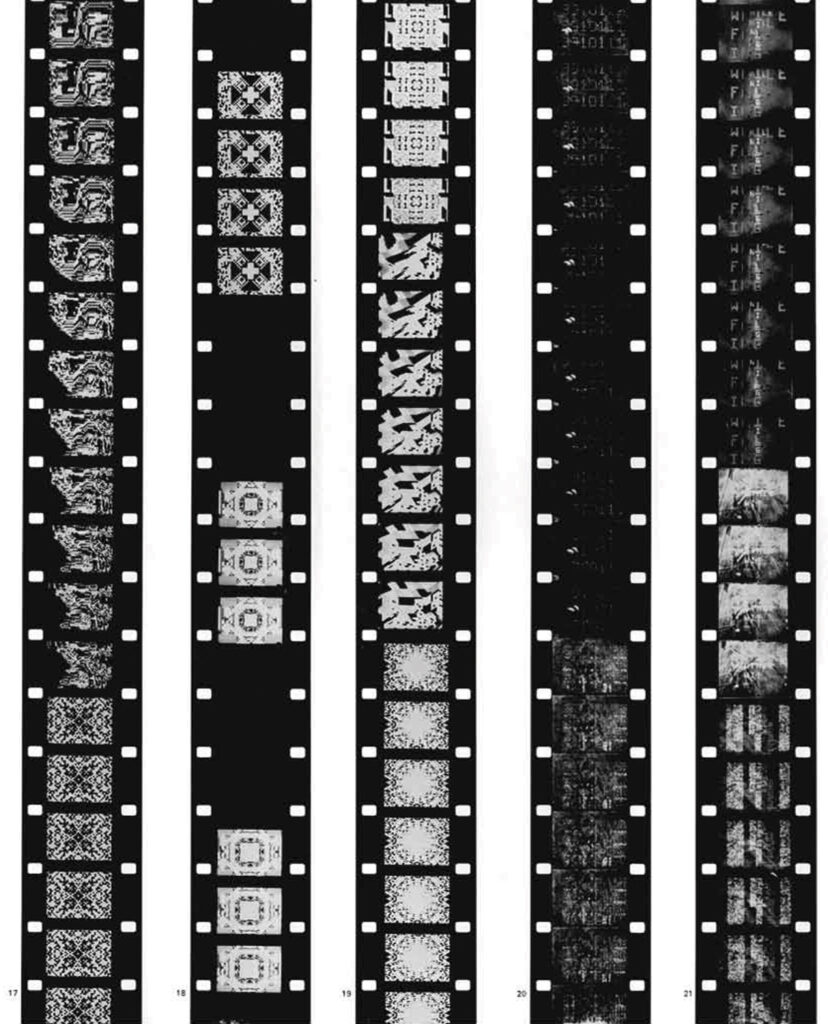
The computer-generated Poemfield series, created between 1965 and 1969, were the artist’s exploration of “image-based poetry language.”
UMBC’s connections to the VanDerBeek family run deep. Two of his children—August and Max—studied briefly at UMBC, and his daughter Julie graduated in 2003 with a degree in theatre. Max returned in the 1990s to teach for the Department of Music; his son, Clay, was a Linehan Artist Scholar who graduated in 2017 with a degree in theatre. Another of Stan’s daughters, artist Sara VanDerBeek, has exhibited and spoken at UMBC’s Center for Art, Design, and Visual Culture. Stan VanDerBeek’s second wife, Louise, graduated in 1976 with a degree in interdisciplinary studies and an arts emphasis and then returned to earn a master’s in 1995 in instructional development systems.
“If I had to draw a cartoon for The New Yorker that was about Stan VanDerBeek?” Richard Chisolm asks rhetorically. “It would be Stan VanDerBeek buys furniture at IKEA, and then you see him in a room with the boxes, and then in the next frame you would see something that didn’t look at all like furniture, and the instructions would be curled up in the corner, and what he built would be this anarchistic mound of panels and windows that was not at all what the IKEA people were telling you to build.”
VanDerBeek served as chair of UMBC’s Department of Visual Arts for only a short time in 1983 and 1984 before becoming ill. Several days before his death in September 1984, he received a poignant good-bye letter from fellow experimental filmmaker Stan Brakhage, who wrote, “I grow more sure of what we’ve done, and that someday…our works and lives will be fully known to the ears and minds of human beings….”
— Tom Moore
*****
To learn more about Stan VanDerBeek’s work, visit stanvanderbeek.com. An exhibition, VanDerBeek + VanDerBeek, which presents artwork by Stan VanDerBeek alongside work by Sara VanDerBeek, is on display at the Black Mountain College Museum + Arts Center through January 4, 2020.
Thanks to Max VanDerBeek, August VanDerBeek, Chelsea Spengemann, the Stan VanDerBeek Archives, and Judy Taylor.
All images, including header, courtesy of the Estate of Stan VanDerBeek.
From November 1 through 10, UMBC will again join in two of Baltimore’s signature events — Light City and the Baltimore Book Festival — which will be held together in 2019 under the theme of Brilliant Baltimore.
Organized by the Baltimore Office of Promotion and the Arts, Brilliant Baltimore promises to illuminate the city with literature, ideas, world-class light installations, and performances. UMBC’s contributions include a talk by President Freeman Hrabowski, a UMBC-Light Ekphrastic panel discussion, apanel discussion on Baltimore Revisited featuring UMBC faculty, and the SPARK gallery, which will showcase visual artwork and offer performances and presentations.
President Hrabowski: The Empowered University // Sunday, November 3, 2 p.m., Literary Salon, USM Columbus Center
UMBC President Freeman Hrabowski will discuss his new book, The Empowered University: Shared Leadership, Culture Change, and Academic Success, written with Philip Rous and Peter Henderson. The Empowered University examines how university communities support academic success by cultivating an empowering institutional culture and broad leadership for innovation. President Hrabowski argues that higher education can play a unique role in addressing the fundamental divisions in our society and economy by supporting people in reaching their full potential.
SPARK Gallery // November 1 – 10, 5 – 10 p.m., USM Columbus Center
The SPARK Gallery represents a the third year of collaboration between UMBC, Towson University, PNC Bank, and BOPA. Curated by Catherine Borg, it features light art by UMBC faculty Corrie Francis Parks, Evan Tedlock, Lisa Moren, Lynn Cazabon, Timothy Nohe, Vin Grabill, and Colette Searls, with presentations of animated films by UMBC students.
Performances and events at SPARK will be presented by the UMBC Jazz Ensemble, directed by Matt Belzer; Lisa Cella and Stephen Bradley; and the UMBC New Music Ensemble; the Umbilicus percussion ensemble. They also include a site-specific dance performance by UMBC students choreographed by Ann Sofie Clemmensen and Carol Hess.
UMBC Light City Reception // Saturday, November 9, 4 – 9 p.m., USM Columbus Center
UMBC alumni and the UMBC community are invited to stop by the Columbus Center to enjoy light refreshments and pick up a fun glow in the dark giveaway (for first 300 guests), and enjoy a breathtaking view of the harbor and Light City Baltimore. Attendees are encouraged to bring friends and family, and to register in advance for the reception.
Word & Image // Saturday, November 2, 6 p.m., World Trade Center
In its first decade, The Light Ekphrastic (TLE) has paired more than 450 artists and writers from Baltimore and around the world to create new works of art and writing inspired by that of their partners. In “Word & Image: Creative Collaborations with UMBC and The Light Ekphrastic,” TLE participants share their work and talk about how the experience of collaborating with strangers has broadened the way they create.
The panel will be co-moderated by Jenny O’Grady, editor of UMBC Magazine; and Timothy Nohe, professor of visual arts and director of the Center for Innovation, Research, and Creativity in the Arts. Panelists will include Melissa Cormier, M.F.A. ’17, visual arts, and Katie Feild ’05, visual arts.
Baltimore Revisited // Sunday, November 3, 2 p.m., Radical Book Fair Pavilion
Baltimore Revisited is an innovative new edited volume that examines the complex histories of Charm City and efforts underway to address the city’s pervasive inequalities. These issues continue to resonate with Baltimore residents almost five years after the death of Freddie Gray and the Baltimore Uprising that followed.
The book is co-edited by Nicole King, associate professor and chair of American Studies; Kate Drabinski, lecturer, gender, women’s, and sexuality studies; and University of Baltimore historian Joshua Clark Davis. King will moderate a panel that will include Baltimore Revisited contributors Drabinski; Michael Casiano, assistant professor, American studies; and Ashley Minner, professor of the practice, American studies. It will take place in the Radical Book Fair Pavilion at the Baltimore Book Festival.
Drabinski has shared, “We hope the book raises questions about how history can inform the present to understand the roots of the city’s many inequalities. We wish readers to imagine new ways of being in and organizing for Baltimore in the future.”
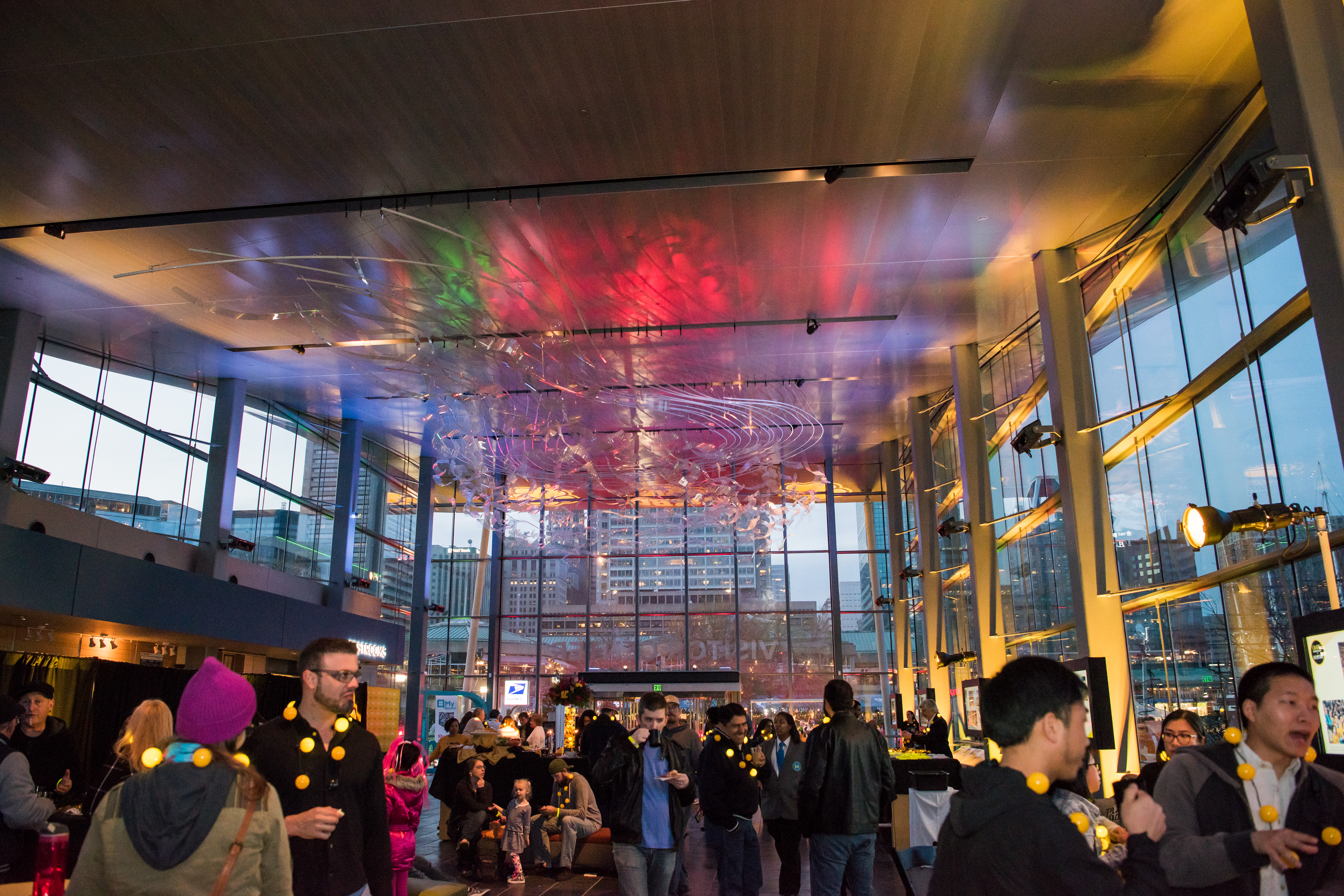
Featured image: The roof of the Columbus Center was illuminated in 2016 with artwork by UMBC’s Kelley Bell and Corrie Francis Parks. Photos by Marlayna Demond ’11 for UMBC.
From October 24 through 27, UMBC’s department of music celebrates the tenth anniversary of its fall Livewire festival, an annual event that explores the classical music of our time through concerts, lecture-recitals, paper presentations, multimedia installations, and conversation.
This year’s festival, Livewire 10: Rewind / Fast Forward, features guest composers Mercedes Otero and Mischa Salkind-Pearl, who earned a post-baccalaureate certificate in contemporary American music at UMBC in 2007. Public performances will feature the Inscape Chamber Orchestra, the Third Practice ensemble, sopranos Susan Botti and Tony Arnold, clarinetist Gleb Kasenevich, the Ruckus faculty ensemble, and UMBC students.
During its ten years, including events this forthcoming weekend, Livewire has presented works by hundreds of composers and has featured dozens of leading new music performers from around the world. Additionally, the festival has attained statistics that position it as a leading national voice in new music:
426 compositions
36 world premieres
4 United States premieres
73 electro-acoustic works
250 chamber pieces
87 solo (unaccompanied) works
16 electronic compositions
“Ten years of the Livewire festival speak to the commitment of UMBC and the music department here to embracing the ever-changing present while we continue to teach the past,” says Linda Dusman, chair of the department. “The liveliness of engagement of our students and faculty at this time of year has become a verb: we all are livewired at the end of October!”
While many college and university music programs across the country focus primarily on the music of the 17th, 18th and 19th centuries, faculty at UMBC have embraced the exploration of the music of the 20th and 21st centuries. UMBC’s faculty have been advocates of new music for decades, stretching well beyond the inaugural Livewire festival in 2010.
“Before Mobtown Modern hit the scene or the Evolution Contemporary Music Series evolved,” critic Tim Smith noted in The Baltimore Sun during a previous Livewire, “Baltimore-area fans of new sounds could get an earful at the University of Maryland, Baltimore County, where the music department continues to champion adventurous repertoire.”
For Livewire’s 10th anniversary, major financial support was provided by the Center for Innovation, Research, and Creativity in the Arts (CIRCA), with additional funding from the College of Arts, Humanities and Social Sciences and the Office of the Provost.
A complete schedule for Livewire 10: Rewind / Fast Forward can be found on the Arts and Culture Calendar.
Featured image: Members of the Ruckus ensemble perform in 2016. Photos by Marlayna Demond ’11 for UMBC.