We use cookies for analytics and, unless you opt out, advertising.
You can opt out of advertising at any time.UMBC uses essential cookies to run this site. With your permission we would also use analytics cookies (to understand how the site is used) and advertising cookies (to measure and target our ads on other platforms). Nothing else loads unless you accept. You can change your choice any time from Cookie Settings in the footer.Privacy Policy
EssentialRequired for the site to work (login, security, your cookie choice). Always on.
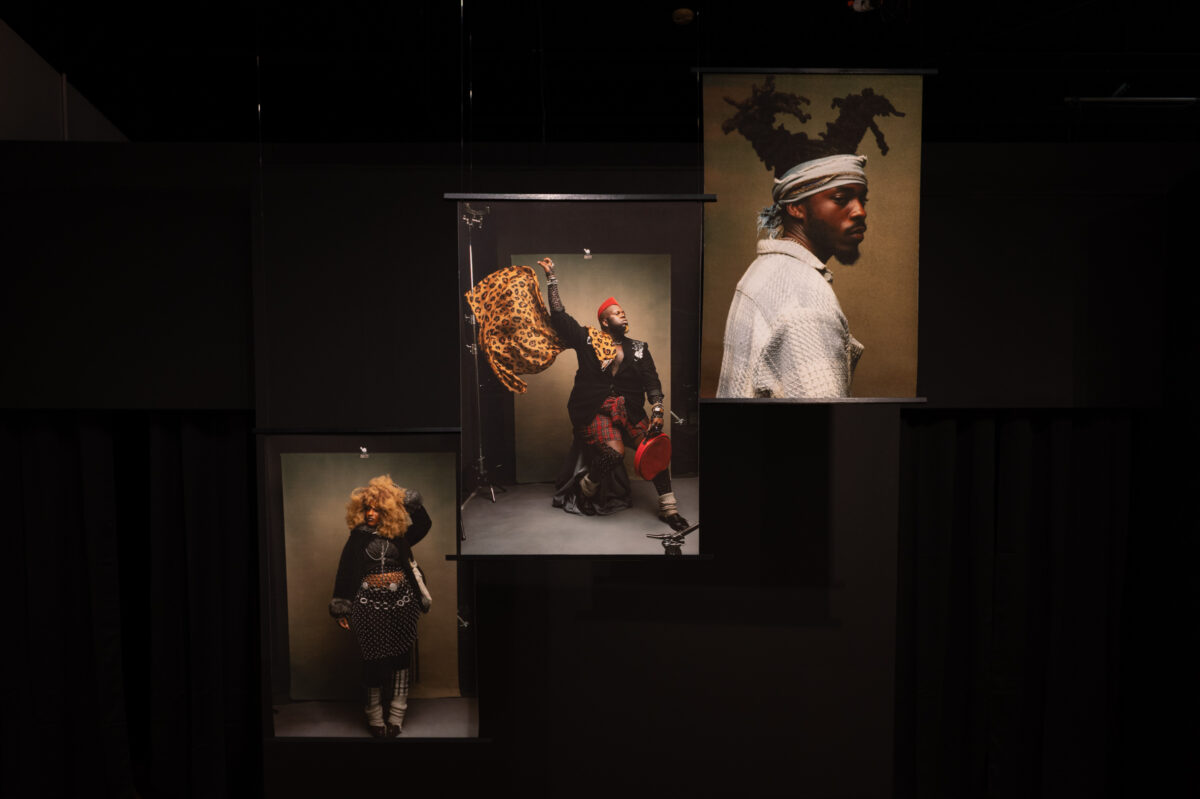
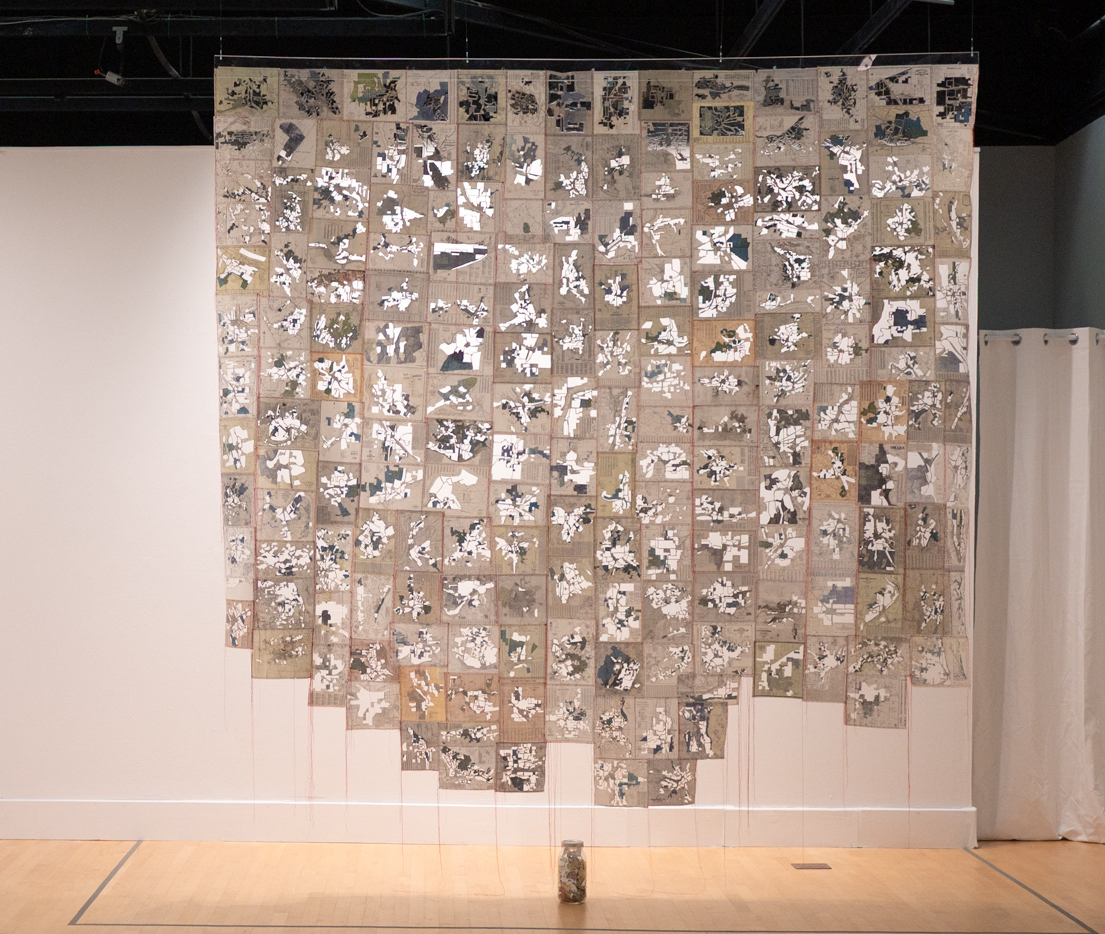
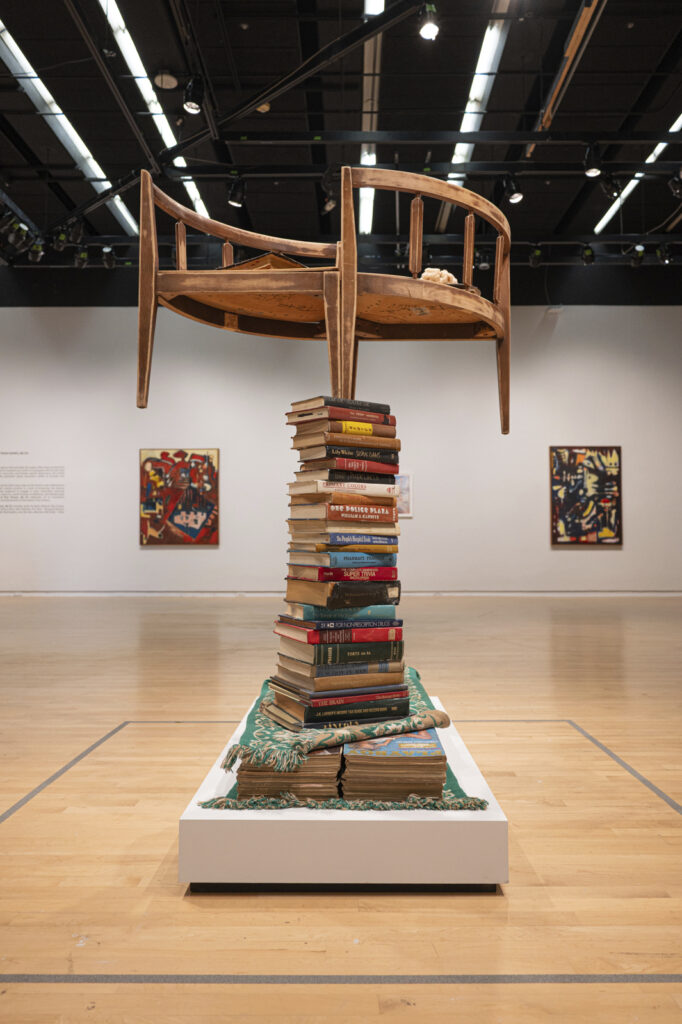
On view through November 24, the show features a powerful group of artists based in or connected to Baltimore, including Brianna Faulkner ’11, visual arts, Kelvin Bulluck, Roy Crosse, Darrius Fox, Lehna Huie, Jeffrey Kent, Ada Pinkston, Kim Rice, Margaret Rorison, Ernest Shaw, Shan Wallace, Jasmine Gabrielle Washington, as well as a collaborative film work by NIA JUNE + Kirby Griffin + APoetNamedNate.
Through serial compositions, photographic triptychs, poetic floating installations, and kaleidoscopic cinema, the exhibition’s artists contemplate themes of home, memory, and community. In the spirit of Duke Ellington, who regularly performed in jazz clubs on the historic strip of Baltimore’s Pennsylvania Avenue and theorized that all creative practice is a form of dreaming, Somewhere Over the Rainbow of Row Homes, We Fly invites audiences into a state of intentional, lucid, and restorative visioning.
Kelvin Bulluck: In Pursuit of Courage, Knowledge & Love, 2024. (Photo: Tedd Henn for UMBC.)
Somewhere Over the Rainbow of Row Homes, We Fly offers insights into the power of collective imagination to transform the world—the artistic perspectives are radically optimistic about humanity’s ability to triumph over adversity.
“The exhibition celebrates and affirms alternate conceptions of reality through speculative and abstract anti-representational expressions and forms,” shares Carroll. “Glitch, distortion, rupture, and defiant challenges to traditional technical and material applications offer prescient responses to the tumultuousness of the 21st century.”
Kim Rice: American Quilt, 2025. (Photo: Tedd Henn for UMBC.)
On September 3, about 125 people gathered for an opening reception and artist panel moderated by Angela N. Carroll with Brianna Faulkner, Jeffrey Kent, Kim Rice, and Margaret Rorison.
Accompanying the exhibition are several additional events:
Thursday, October 15, 6 – 8 p.m.
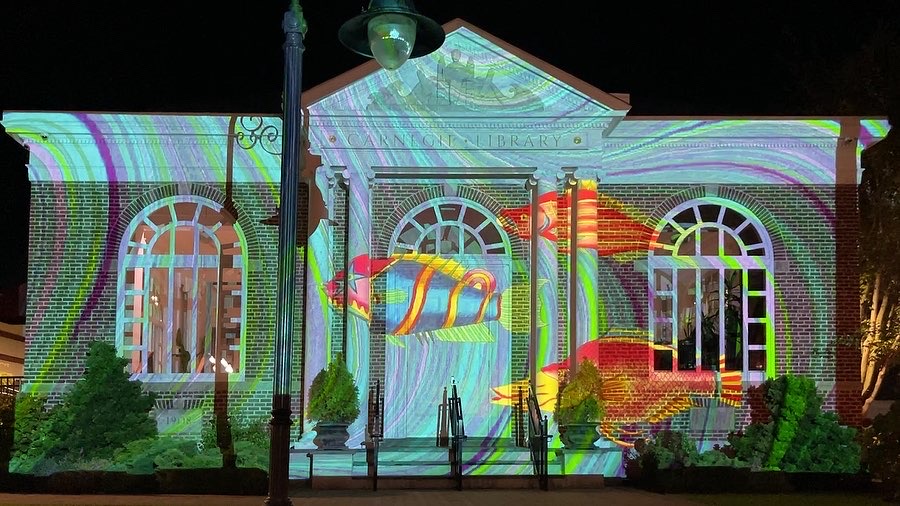
A free outdoor concert by Brandon Woody alongside public projection of The Unveiling of God / a love letter to my forefathers by NIA JUNE + Kirby Griffin + APoetNamedNate.
The CADVC’s exhibition gallery is open Tuesday and Wednesday from 12 to 5 p.m., and Thursday through Saturday from 10 a.m. to 5 p.m. For more information about Somewhere Over the Rainbow of Row Homes, We Fly, visit UMBC’s Arts & Culture calendar.
Jeffrey Kent: Justice, Peace, and Genuine Respect for All People, 2012. (Photo: Tedd Henn for UMBC.)
Corrie Francis Parks, professor of visual arts, is an inventor of animation techniques whose short films have been screened at major festivals around the world. Her numerous awards and honors now include a major addition: This past summer, she was elected to the Academy of Motion Picture Arts and Sciences, known especially for the annual Academy Awards.
Parks has been creating animation since her teenage years. She designed her own major in animation at Dartmouth College and subsequently received her M.F.A. in animation and digital arts from University of Southern California. At UMBC, she encourages animation students to expand their understanding of the art of movement.
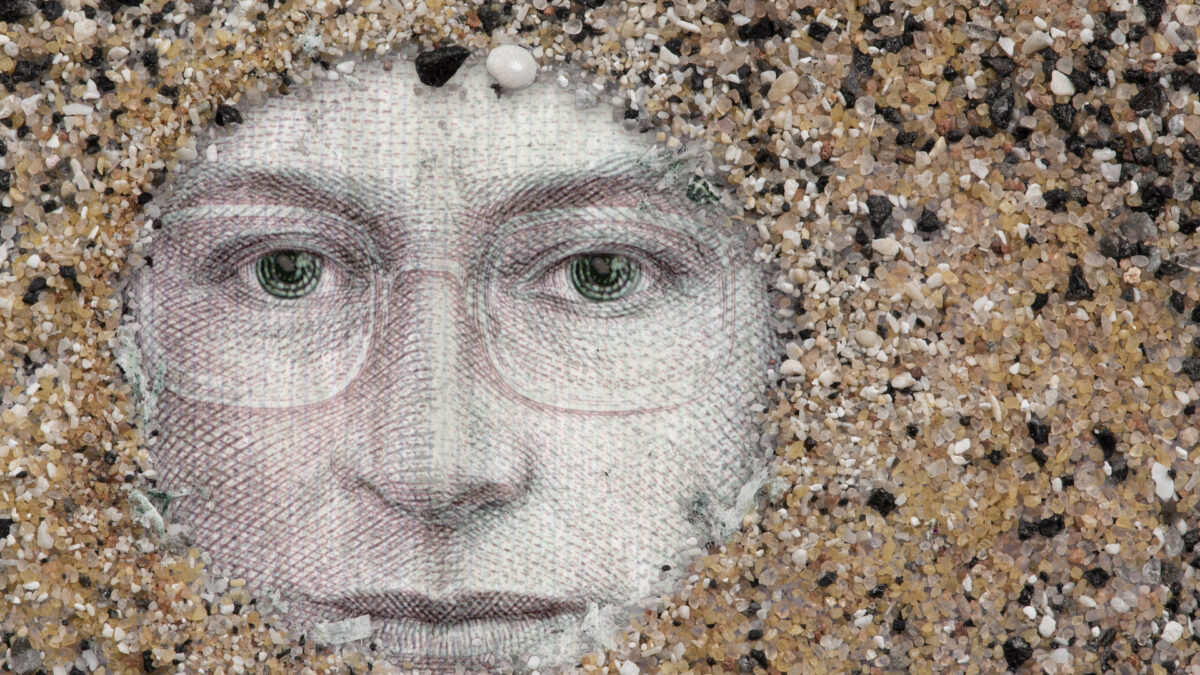
Her book Fluid Frames: Experimental Animation with Sand, Clay, Paint and Pixels explores the tactile nature of moving malleable materials directly under the camera, bringing together traditional and digital workflow through interviews with contemporary animators and workshop-style exercises.
Below, Parks shares what it means to become a member of the Academy, talks about her artwork, and chats about teaching and the Baltimore arts scene.
Q: What does it mean to be recognized by the Academy at this point in your career?
A: As an independent filmmaker it is an incredible honor to be invited to the Academy. My work explores experimental production methods and non-narrative structures, so to have this sort of research recognized alongside large-budget commercial productions is really encouraging, both for me personally and for the field. In recent years the Academy has been diligent and intentional about diversifying its membership in all aspects to better represent the art of cinema and including more artists who make experimental and independent films is part of that initiative.
A still frame from Parks’s 2019 film Foreign Exchange. (Courtesy of Parks.)
Q: As a visual artist, was stop motion animation your first love? What inspired or excited you about it?
A: I actually first fell in love with hand-drawn animation and originally wanted to work on Disney and Pixar films. I studied character animation and how to break down movement to make anything—drawings, puppets, objects—come alive. In the process of making films, I discovered I really liked inventing new ways to use materials and find a unique “look” for my films. There’s a problem-solving and engineering aspect to stop-motion since I am working in physical space and with dimensional materials. I find those limitations help shape the animation and help me make decisions.
Q: How would you describe your work to someone unfamiliar with it, and where would you suggest they begin?
A: I would say I am an animation artist who makes both short films and projection-based installations. I began working with sand as my primary material in 2002 and continue to find new ways to use it, especially combining shooting stop motion with digital post-production. This means each project has its own style, so a good place to start is with one of my early films, A Tangled Tale, and then to see how I approach the material differently in later films like Foreign Exchange or some of my installations. Seeing installation and projection mapping works are harder because they exist in a physical space for a limited time, but would give a viewer a different understanding of how animation can work in a non-linear setting. Most of my films and other work are documented on my website.
Q: The stop-motion animation in Foreign Exchange requires tiny, intricate movements of grains of sand, while similarly in SKRFF you cut through layers of paint. What are the most significant challenges for you as you create?
A: Animation does take great patience but it is also always moving forward, so for me quickly going from one frame to the next is much more engaging than spending hours on a single painting or drawing! As I have become more interested in applying animation principles to new materials, like a graffiti wall in SKRFF or tiny grains of sand in Foreign Exchange, I have found my work becomes less narrative, so the challenge for me is to determine an underlying structure. Often that comes from the music or sound design, as it did in both these films.
There are technical challenges as well—having the right camera lens, lighting, and computer power to make the work efficient. I’m lucky to be able to work with my husband, Thom Parks, who is the technical director on most of my projects and he really keeps the studio running very smoothly!
In the studio, Parks manipulates grains of sand as she creates an animation. (Courtesy of Parks.)
Q: Sound is clearly an important component of your work. How do you select and work with a sound artist?
A: The collaborations have happened naturally and oftentimes are shaping the project from the very beginning. In Foreign Exchange, the driving musical track is a piece by Baltimore composer Alexandra Gardner. Alex and I met many years ago at the MacDowell colony and eventually both ended up in Baltimore. We had wanted to collaborate for some time so when I was exploring micro-sand animation, she gave me some of her music to play around with. Eventually we settled on Tourmaline and Alex re-worked her composition to fit the length and structural arc I was aiming for. The sound effects and mixing were all done by Matt Davies at Studio Unknown, a fantastic sound design studio in Catonsville.
For SKRFF, since the film was shot in Vienna, Austria, we asked Sandro Nicolussi, a sound artist we had met at another residency earlier that year. My collaborator on the film, Daniel Nuderscher, had worked with Sandro previously and we both felt his sound aesthetic would really fit the footage we were creating on the graffiti wall. As I was editing the footage, I would send pieces to Sandro, and he would send segments of sound back and we went back and forth letting the film develop in an organic way.
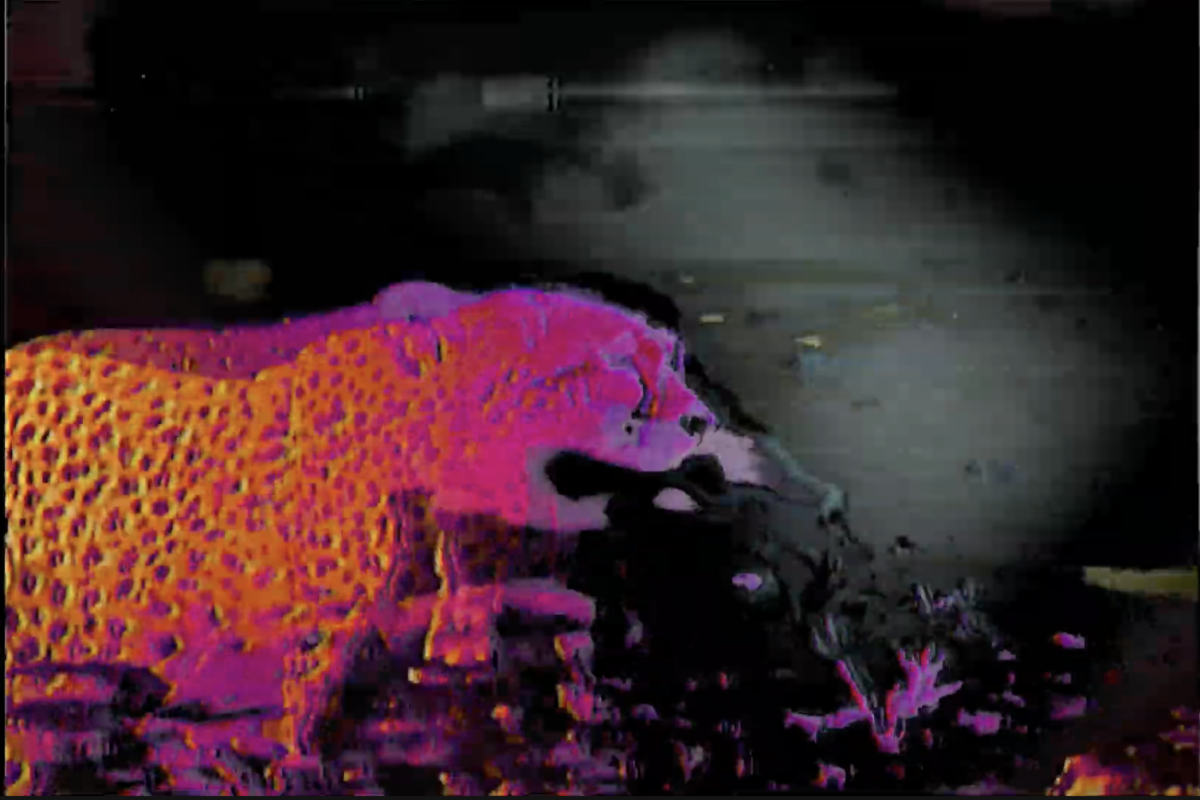
A still frame from SKRFF, created in 2024. (Courtesy of Parks.)
Q: What do you love about teaching, and what’s it like in your classroom?
A: I do love teaching, especially challenging students to expand their artistic process and try new techniques. My classroom involves a lot of student-to-student conversation, with a bit of guidance from me—because I think learning how to articulate and analyze your own work and that of your peers is essential to the artistic process. The most impactful teachers in my life were the ones that interacted with me as artist-to-artist, and showed me films or gave me assignments that were somewhat uncomfortable. That’s how we all grow beyond the limits we impose on ourselves.
Q: Can you tell us about UMBC’s connections to the Baltimore arts community?
A: I think a great asset to our students is how engaged our arts faculty and staff are with what’s going on in Baltimore. We are always showing or performing work somewhere nearby, so students can see what it’s like to be a practicing artist in a community. I love that some of our students have taken over the first floor hallway in the Fine Arts Building and are making it an exhibition space for their own work.
Q: Your work with sand has lots of quirky playfulness to it—things that would make people smile. Do you think about that as you’re creating new work?
A: I make work that makes me delighted and that I find interesting to watch! Animation is always a bit magical, because it’s breathing life into something that shouldn’t be alive. I guess if it works for me it works for other people too!
Q: What’s next for you? Can you share anything about works in progress?
A: I have a new film in the works, based on writings and discoveries made by early microscopists, Antonie van Leeuwenhoek and Robert Hooke. I’m animating grains of sand as though they were microscopic organisms inhabiting their own cosmic worlds, waiting to be discovered and explored.
Parks works on an animation in the studio. (Courtesy of Parks.)
Katie King ’26, biology and dance, completed an ambitious double degree, and not only thrived but also became co-captain of the UMBC Dance Team and worked for the admissions office as a Grit Guide. Looking forward, she plans to become a physician assistant, and hopes to find ways to combine her love of both dance and biology.
Q: What attracted you to UMBC?
A: I knew I wanted to double major in biology and dance. I’m planning to go into the medical field, so biology was the route I needed to take, but I have been dancing since I was three. When looking at colleges, a lot of them told me I had to choose, but UMBC allowed me to do both. I was accepted into the Linehan Artist Scholars Program, so that also drew me here—I really love the possibilities and experiences that the program gives.
Q: How did the Linehan Artist Scholars Program impact your time at UMBC?
A: My experience began with the first-year seminar, and that class really helped me get more exposure and awareness to the other arts. As a dancer of many years, I really only stuck to dance, so I never really dove into the music or the theatre sides, and I didn’t know a lot about visual arts at all. That class really helped open my eyes—we did skits, we had to learn how to play music. In the second year, we had to do service hours, and that was rewarding. I did service hours within the dance department, and it was nice to feel like I was giving back to a bigger cause. The different trips that we got to go on with the Linehan program were super fun—twice to New York and once to Philly, to visit art museums and see performances. I was also in the Living-Learning Community in Harbor Hall, living right next to everyone in my cohort.
Katie King and two colleagues perform in the 2025 Fall Dance Showcase. (Photo by Kiirstn Pagan ’11.)
Q: Can you share more about your dance and biology double major?
A: I knew I wanted to be in the medical field since I was little. My dolls would be wrapped in casts, and I bought my own crutches when I was 7 at the pharmacy! At the same time, I’ve been dancing since I can remember. For a while, I thought of going into physical therapy, combining my dance and biology backgrounds. Now, I’m thinking of becoming a physician assistant. Both dance and biology have been passions, and I haven’t wanted to give up either one. I worked in a physical therapy office for 5 or 6 years, and there I got the idea to specialize in dancers. So that was the route I thought for a while until I switched to physician’s assistant, but I’m hoping at some point those fields intercross.
Q: How did being a Grit Guide impact your experience?
A: During my freshman year, I joined the UMBC Dance Team to get more involved on campus, and the coach said that the admissions office was hiring. I was brought on as a visual and performing arts tour guide for dance, but later became a general tour guide, and it shaped my entire experience at UMBC. I’ve done it for four years now. Working with professional staff, I gained skill sets that I’ll be able to use in the future, especially if I go into the medical field or work with the public again.
Katie King, third from right, poses UMBC’s comfort dog, Chip, her handler, Sergeant Jamie Cheatem, and other friends. (Image courtesy of King.)
Q: What motivated you to join the UMBC Dance Team?
A; At the start of my freshman year, I didn’t join anything—I thought I needed to get acclimated. But by November, I was bored! I’ve never been the kind of person who isn’t involved—I have to be going all the time. So I decided to try out for the Dance Team, and I was accepted. It was a super fun experience. During my last two years, I was co-captain for the team and built so many friendships. I love basketball and used to play, but had to give it up for dance. With the Dance Team, I could both dance and watch basketball, and this year they won championships—life was good! It was probably my favorite part of college.
Q: How did you maintain a work-life balance?
A: I prioritize sleep, and get eight hours every night. My calendar is my best friend, truthfully. A lot of my shifts for tour guides were in the mornings, and then I had classes, and then rehearsals at night, and then a 3 or 4-hour block at the end of the night where I would do homework. I didn’t do a lot of hanging out in general besides those things—my social time was being at those events and at work.
Katie King, left, poses with other members of the UMBC Dance Team on the basketball court.
Q: Were there faculty or staff who made a difference for you?
A: Definitely Ann Sofie Clemmensen—I call her my school mom! She was my dance advisor, but also became my unintentional biology advisor. At the start of my freshman year, we sat down, and she helped me plan out all four years, saying, “We’re going to get you out in four years, both degrees done.” We planned everything out. We met all the time, and I text and call her all the time. She’s always been there.
Q: What are your post-graduation plans?
A: I’m applying to physician assistant school and hope to start somewhere in January. Over the summer, though, I’ll be visiting Portugal, Spain, England, France, and Switzerland. I’m so excited—I haven’t been to Europe.
Katie King, bottom right, poses with Grit Guide colleagues. (Image courtesy of King.)
Q: What advice would you give to new students?
A: My advice would be to stay true to yourself and always go after what you want. I was told many times that I couldn‘t do both degrees, and then I found a way. Get involved. That changed my whole trajectory here at UMBC. It’s hard to get out of your shell sometimes, and hard to put yourself out there, but it’s so rewarding, especially here. Step out of your comfort zone!
With support from faculty, staff, and her peers, Maia Turman Cooke ’26, English and political science, not only thrived in her double major but also challenged herself by joining the McNair Scholars Program and working as a workforce and education advocate for the Shriver Center’s Choice Program. An Honors College student, she was awarded a 2025–2026 undergraduate research award to conduct a qualitative study on British Columbia’s 2023 drug decriminalization policy, and her paper “Resilient Hearts: Theoretical Portrayals: Lauryn Hill’s Self Love and Resistance Against Intimate Consequences,” was recently published in the UMBC Review. This fall, she begins work on a Ph.D. in English at the University of Maryland, College Park.
Q: What attracted you to UMBC?
A: During my senior year of high school, I moved from Brooklyn, New York, to southern Maryland, where my mom’s side of the family lives. At first, I thought I wanted to return to New York for school, but, after thinking things through, I realized I wanted to stay near my mom and her family. When I visited UMBC, I had never seen a school so diverse. And there was a section on the UMBC website that said, “15 minutes from Baltimore, one hour from D.C., and 3 hours from New York.” And as soon as I saw that, I was sold. I thought it was the best thing to do, and I’m glad I did it.
Q: What excites you about your two majors, and why did you choose them?
A: My mom wanted me to be a lawyer because of how much I argued with her! All my undergraduate applications were in political science. But literature was always such a huge part of me. I also realized how much I enjoyed writing the college application essays, and I realized I wanted to do English. Then, at orientation, I met a senior with an English and political science major. That was the first time I’d ever heard of double majoring. I thought, I’m going to do that. The intersecting qualities that English and political science have helped me understand my communities, learn how to better communicate, and how to represent and advocate for communities.
Q: What surprised you the most about your student experience at UMBC?
A: I guess what surprised me the most was what the McNair Scholars Program could do for my life. At the beginning of the application process, it seemed like a lot, and I wanted to quit—I didn’t want to join. The director of the McNair Scholars program, Dr. Michael Hunt, called me and said, “Just see it through, see it out. If you don’t like it when you get more involved, then you can leave.”
There were a lot of expectations, like pursuing graduate school. I knew I’d want to go to grad school, but I knew nothing about what it actually held. And I didn’t know a single thing about research when I started my first research project. I was so overwhelmed because I thought I had to solve every world problem. But my peers convinced me to stay. Soon, that work became a normal part of my schedule. I had no idea what research was, and now it’s something I’m super passionate about. Everyone has been so amazing.
Maia Turman Cooke (far left on lower low) with student colleagues. (Image courtesy of Turman Cooke.)
Q: Can you share more about your enthusiasm for the McNair Scholars Program?
A: I never knew what a strong and supportive academic community could look like, and they go above and beyond for every single person. Being able to prove myself, as well as supporting other people, has been a really great experience. The McNair Scholars Program also helped me financially, so that I could attend events I never could have afforded on my own. The McNair Scholars Program is not just within UMBC—it’s a nationwide program. There was a time when I was in a program through Penn State, and I met a peer who was also a McNair Scholar. It excites me to know that there’s a huge network I can keep meeting as I go along the way with my career.
Q: How have your experiences with the Shriver Center impacted your time at UMBC?
A: As a freshman, I applied to the Shriver Living Learning Community and then became connected to The Choice Program, which completely transformed my life. I started as a student coordinator for the College Night events, which is when students from Baltimore City visit the campus for different activities. I then decided to join the Choice Program as a job coach—a workforce and education advocate. I’ve been working with around 5 to 10 Baltimore youth, helping them with their professional, academic, and even personal goals. I’ve always wanted to serve my community, and it was such a great introduction to Baltimore, learning systems, skills, and understanding how to best support my community. I’ve grown a lot from the lessons they’ve taught me as well.
Q: And were there any faculty who especially supported you during your time at UMBC?
A: Oh my gosh, yes. Yes, so many—I can’t even count. First, Dr. Hunt, the director of the McNair Scholars Program. If not for him, I probably would have dropped out so long ago. Ting Huang, the McNair program coordinator, as well—she’s like Dr. Hunt’s right arm. Dr. Earl Brooks, an associate professor of English, who is my research mentor, introduced me to the whole world of rhetorical studies. Crazy enough, I’ve never taken one of his classes, but he just took time out of his personal and academic life to mentor me and introduced me to so many programs and conferences. Dr. Keegan Finberg, an assistant professor of English, introduced me to English research papers, helping with the structure of my papers—I really like playing with words and articulating myself in creative ways that push the boundaries of academia.
Maia Turman Cooke with Dr. Earl Brooks at URCAD 2025. (Image courtesy of Turman Cooke.)
Q: What do you feel most proud of from your time at UMBC?
A: My paper on Lauryn Hill, who is a singer, songwriter, and producer, is something I hold dear to my heart—it was just published in the UMBC Review. I was super happy. It was actually in Dr. Finberg’s English class that I learned that you can close read music, movies, anything outside of a formal paper, novel, or book structure. I chose a single Lauren Hill song for her class, but when it came to my McNair research, I decided to look at her whole album, TheMiseducation of Lauren Hill. Having that opportunity to take something so personal to me and apply my close reading skills in a professional setting was something I never thought was possible.
Q: How did you manage to keep a work-life balance?
A: One day at a time, honestly. There were days when I knew I had to focus on one area of my life. And my planner—I wouldn’t be moving or running without my handwritten planner. There were some days when I knew I couldn’t work on a paper because I was so tired of reading my own work—my mind was about to explode. So, I think listening to myself every day, prioritizing myself, and my mental health.
Q: What are your post-graduation plans?
A: I’m starting an English Ph.D. program at the University of Maryland, College Park. I’m super excited about that. Long term, I don’t know, but the work I did with the Choice Program has changed my life entirely. I’d like to find a community service organization that advocates for a grassroots cause. Given that UMD is close to Washington, D.C., I hope to move in more political spaces.
Maia Turman Cooke ’26 presents at URCAD in 2025. (Image courtesy of Turman Cooke.)
Q: What advice would you give to new students?
A: Push yourself to be extroverted, if you can, not limiting yourself to one space. Go to as many meetings as you can, and talk to people. Push yourself a little bit, and you’ll meet so many people, discover important resources, and learn more about yourself and your connections. You will be introduced to a whole other world if you just meet someone or go somewhere!
This academic year, UMBC launched a bold new initiative, Arts+, designed to celebrate our academic excellence in the arts, to elevate the visibility of our arts public programs, and to deepen audience engagement. We marked the 30th anniversary of the Linehan Artist Scholars Program, invited internationally known artists to campus, and have seen a robust increase in audience growth.
As the school year comes to a close, a flurry of events across the disciplines—including dance, music, theatre, and the visual arts—offers delightful opportunities to enjoy the work of guest artists and UMBC students and faculty. We’ve picked out just a few of the many happenings, for you to consider attending.
1.Mary Ellen Mark: Ward 81
Explore an exhibition of photography that’s at once beautiful and disturbing. Mary Ellen Mark: Ward 81, on display at the Albin O. Kuhn Library Gallery through May 22, showcases work by American photographer Mary Ellen Mark and sociologist Karen Folger Jacobs, who spent thirty-six days living in the Oregon State Hospital, where they photographed the residents of Ward 81, the hospital’s all-female, high-security psychiatric unit. Their unprecedented access allowed them to create a deeply nuanced portrayal of women navigating psychiatric care in the mid-1970s. Ward 81 brings together Mark’s photographs, Jacobs’s newly uncovered audio recordings, and rare archival materials, offering an intimate and expanded view of this landmark documentary project.
2. The Wonderful Wizard of Oz
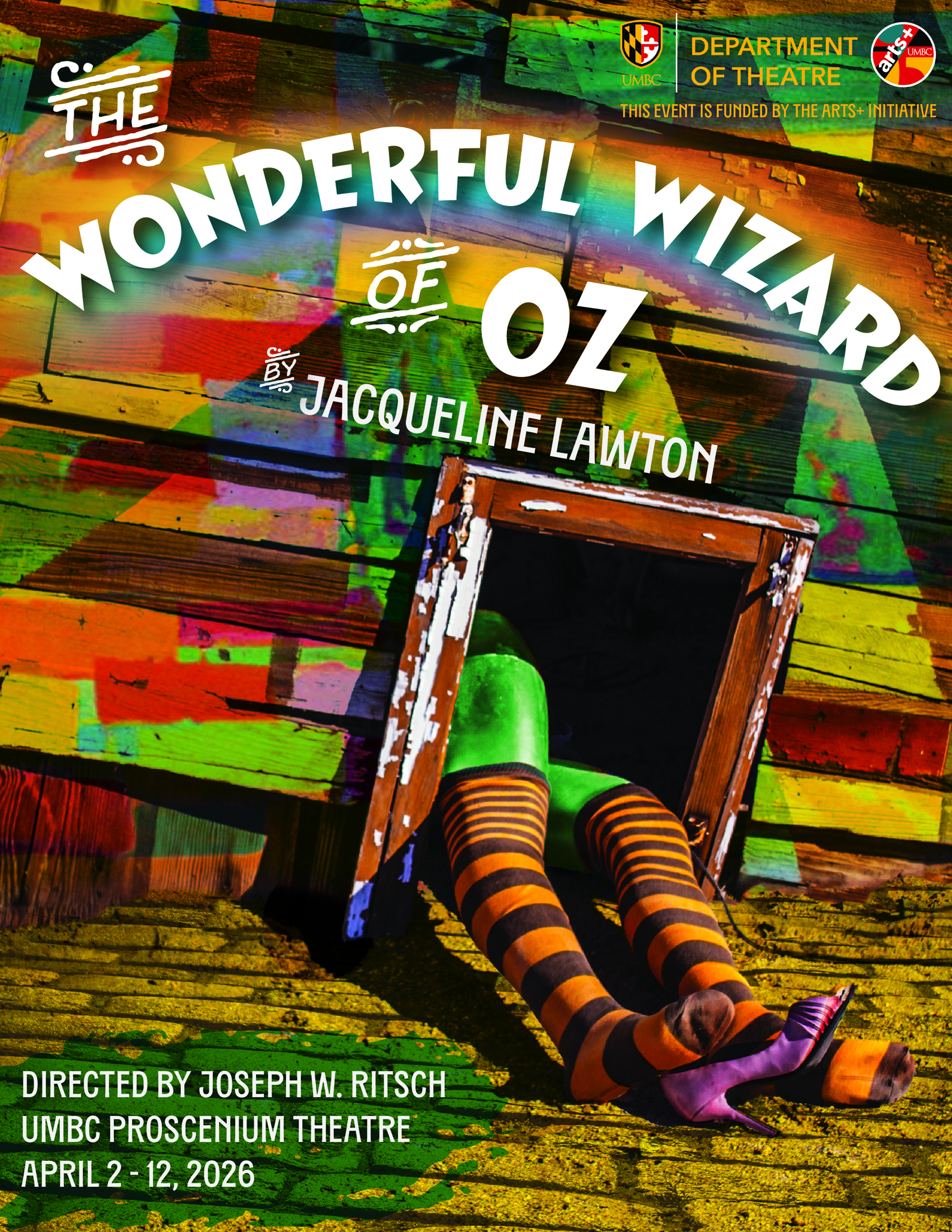
Get ready to head down the yellow brick road as UMBC Theatre presents The Wonderful Wizard of Oz, adapted by Jacqueline Lawton and directed by Joseph W. Ritsch. This family friendly production, featuring the work of both students and faculty, will grace the Proscenium Theatre stage from April 2 through 12. And the plot will sound familiar! Life in modern day Baltimore has been a bit boring for Dorothy and her little dog Toto. Until one day, when a cyclone swoops in and takes them “over the rainbow” to the wonderful and magical land of Oz. With the Scarecrow, the Tin Man, and the Cowardly Lion, Dorothy sets off on the adventure of a lifetime down the yellow brick road to the Emerald City. These new friends brave witches, flying monkeys, and a Haunted Forest, all to meet the Wizard of Oz, who promises to make their dreams come true.
3. Step Back in Time: An Immersive Medieval Banquet
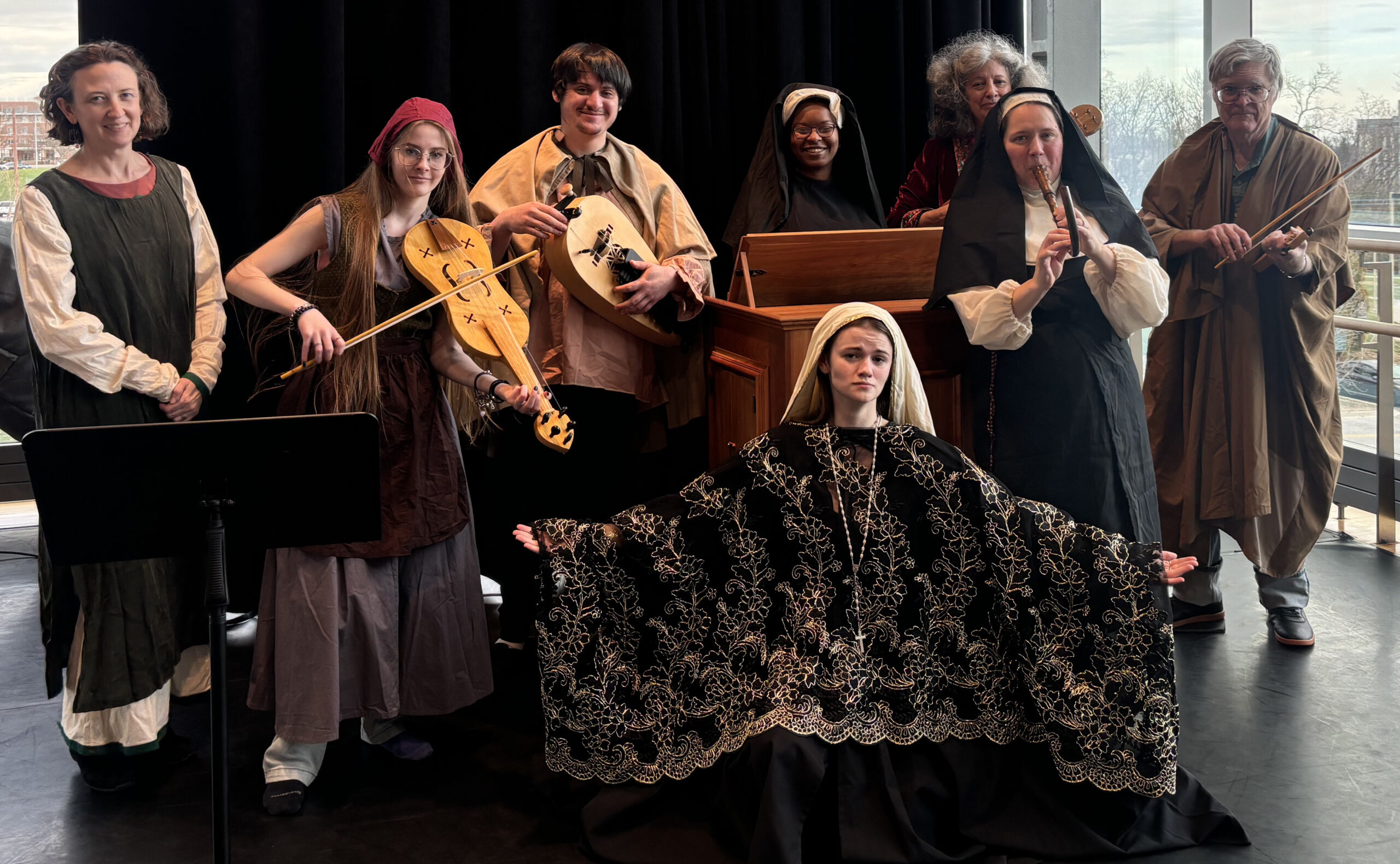
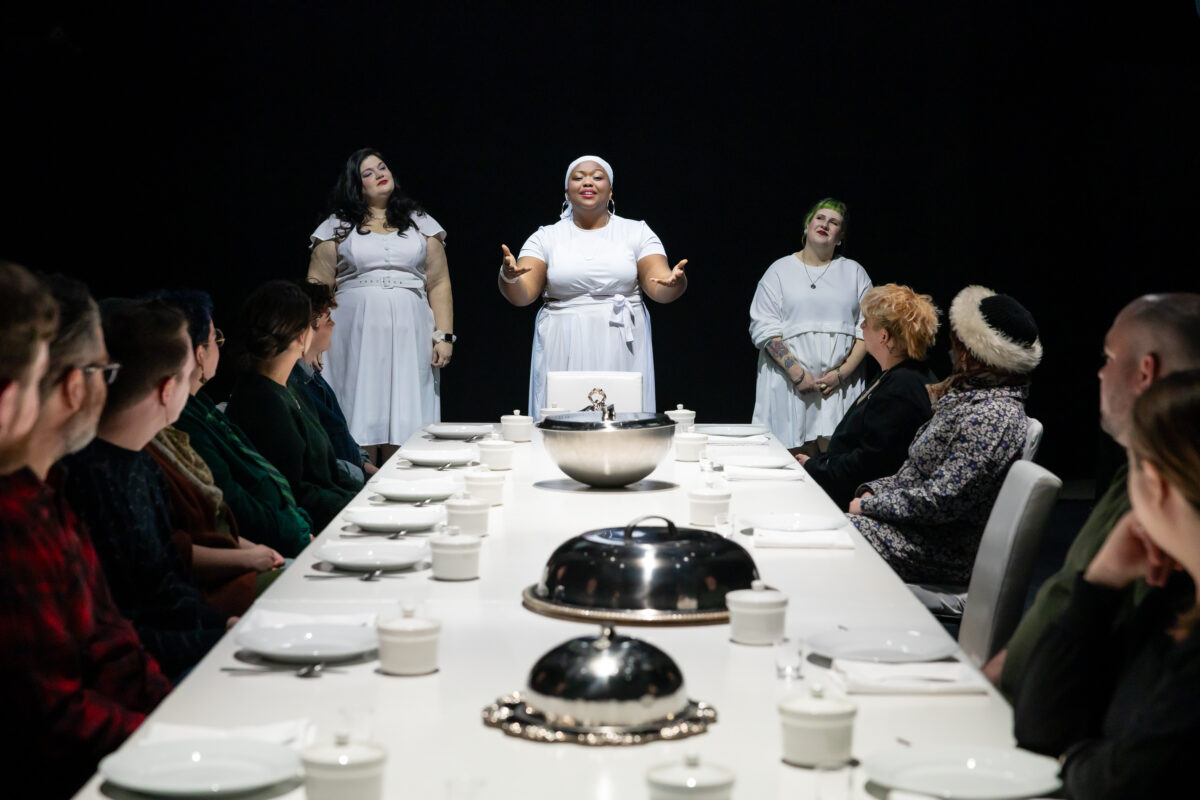
On Saturday, April 11, step back in time—the year 1161, to be precise—to a 12th century banquet that features the best in medieval food (yes, it’s really a banquet), music, and dance. Transport yourself to the Klopp Castle in the Rhine Valley, where you will dine (a three course feast!) in the presence of visionary nun, composer, and artist Hildegard of Bingen and the newly appointed Archbishop of Mainz, Conrad of Wittelsbach. This isn’t just a dinner, though—it’s a living art installation meticulously crafted by the students of an interdisciplinary arts course created just for this event.
4. Inscape Chamber Orchestra
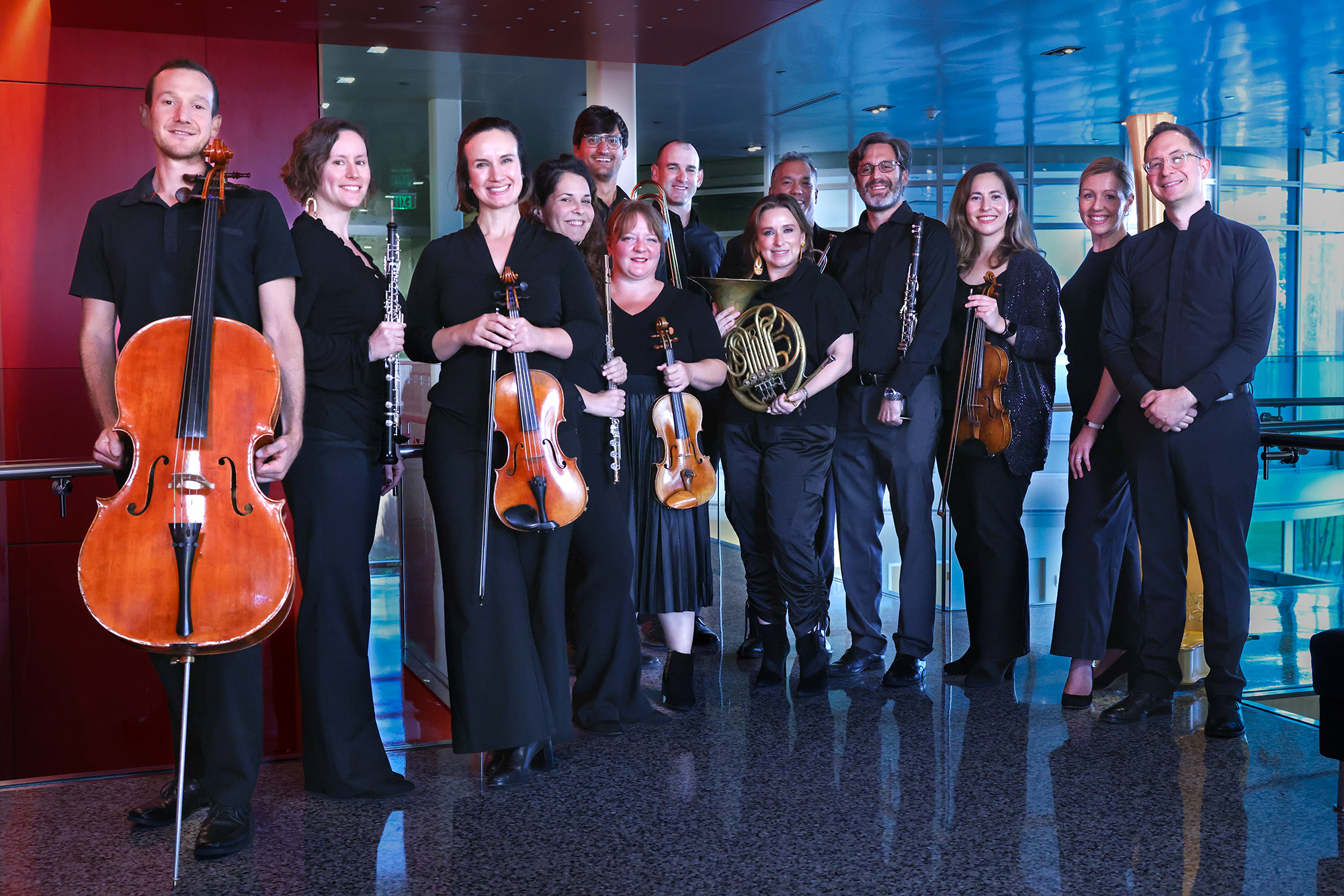
Journey with the acclaimed Inscape Chamber Orchestra on Sunday, April 19, as they explore Aaron Copland’s beloved Appalachian Spring, a masterwork of American music that captures the spare beauty of the frontier spirit and the warmth of community gathering. The program also features Richard Strauss’s Suite from Der Rosenkavalier, and Béla Bártok’s Violin Concerto No. 1, featuring soloist Airi Yoshioka, UMBC professor of music. The Strauss and Bartók are presented in rare chamber orchestra arrangements inspired by Arnold Schoenberg’s visionary Society for Private Musical Performance. In early 20th-century Vienna, Schoenberg’s Society brought monumental orchestral scores into salon-sized venues, revealing intricate details often lost in larger halls and making essential works accessible to new audiences.
5. The Polar Ice Museum
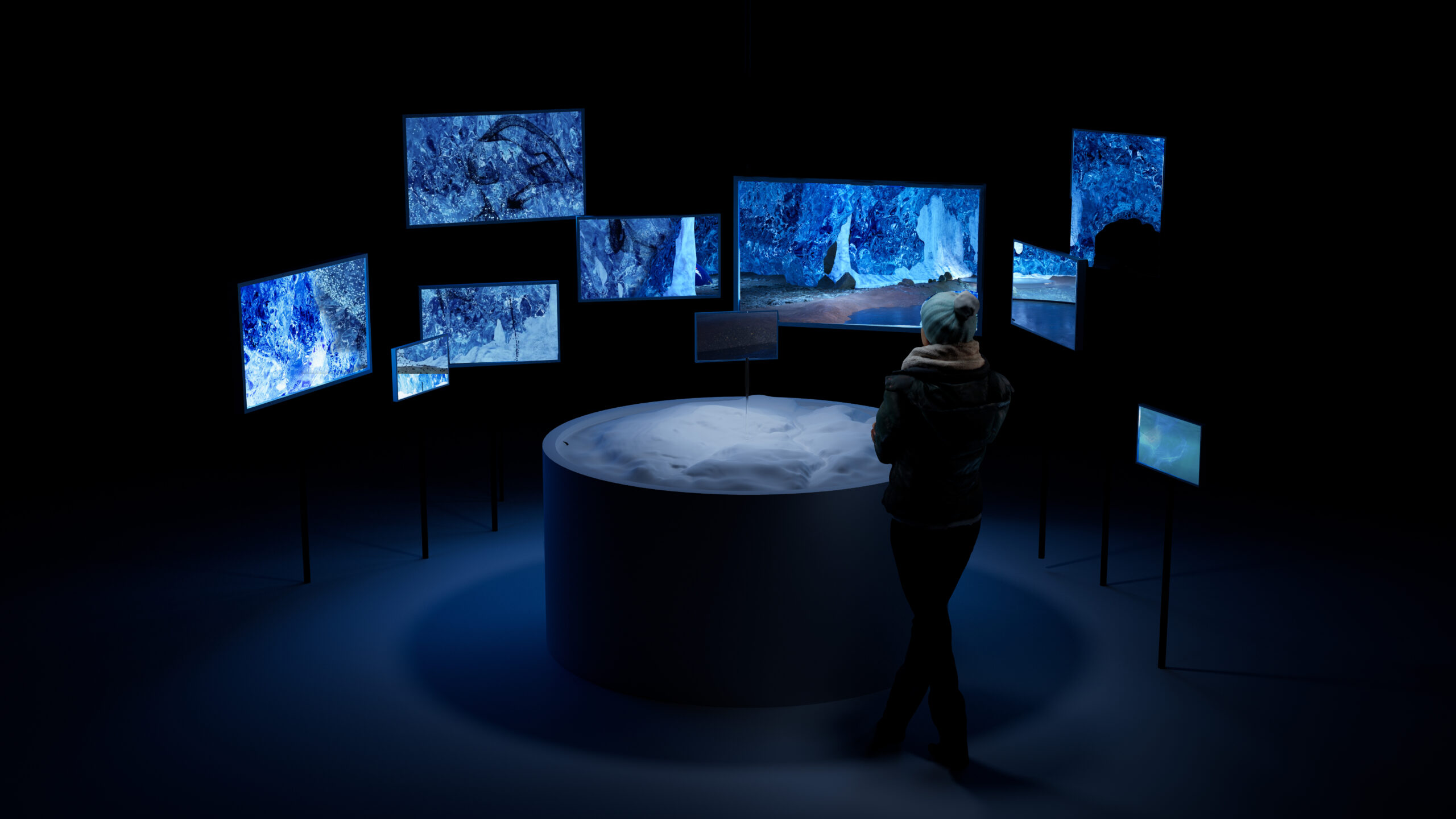
Tucked away in the ITE Building, UMBC’s Imaging Research Center is a hidden gem—but you get a chance to take a deep dive into the IRC on April 30, when the doors open for The Polar Ice Museum, a series of eye-popping artworks and immersive, data-driven installations that transform polar data into meaningful public engagement experiences on sea level, climate, and related environmental issues. With support from the National Science Foundation, the project draws on climate data from NASA and research conducted in Greenland. Visitors encounter a wall of videos depicting an ice cave and are invited to participate by altering visualizations of glaciers and sea-level change, both within the polar ice cave and at a South Baltimore landmark affected by flooding. Water-filled relief sculptures, interactive sound objects, VR climate games, and relevant information will all be on display.
6. Orange Grove Dance: Site / Unseen
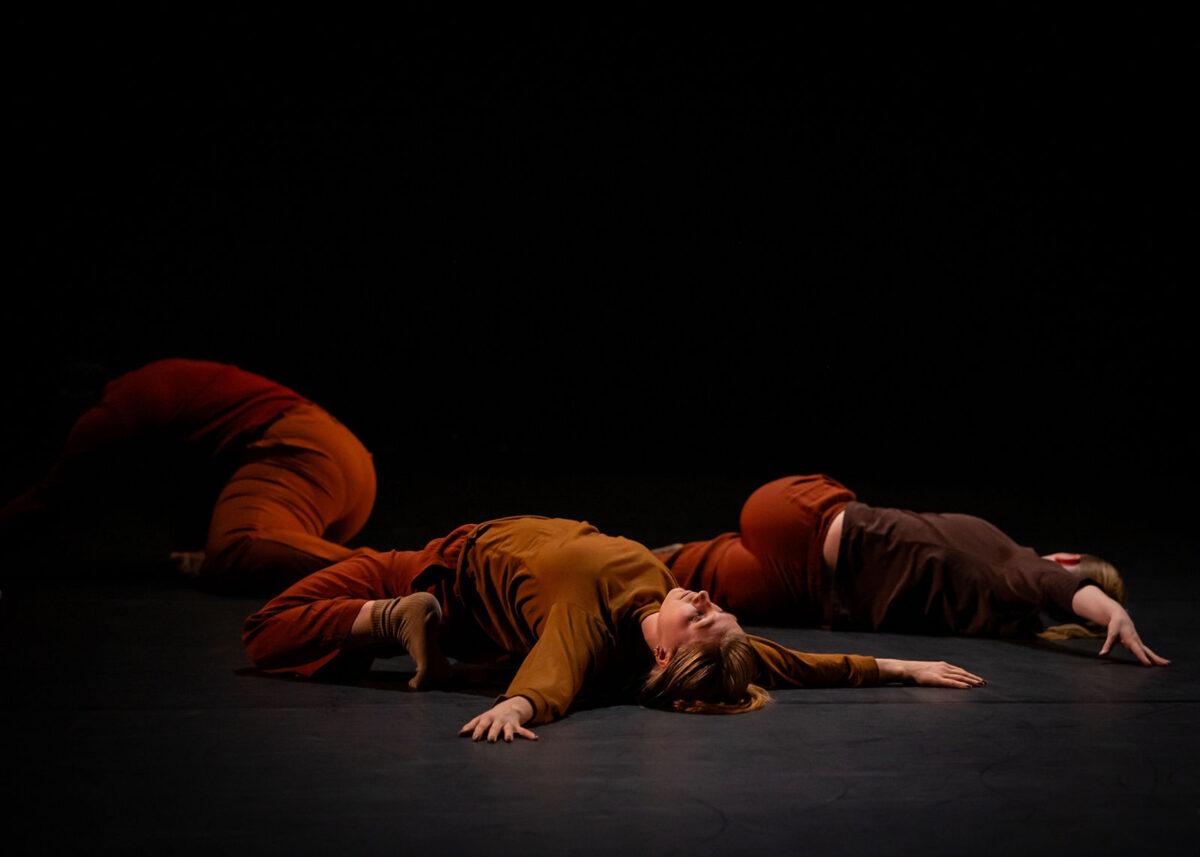
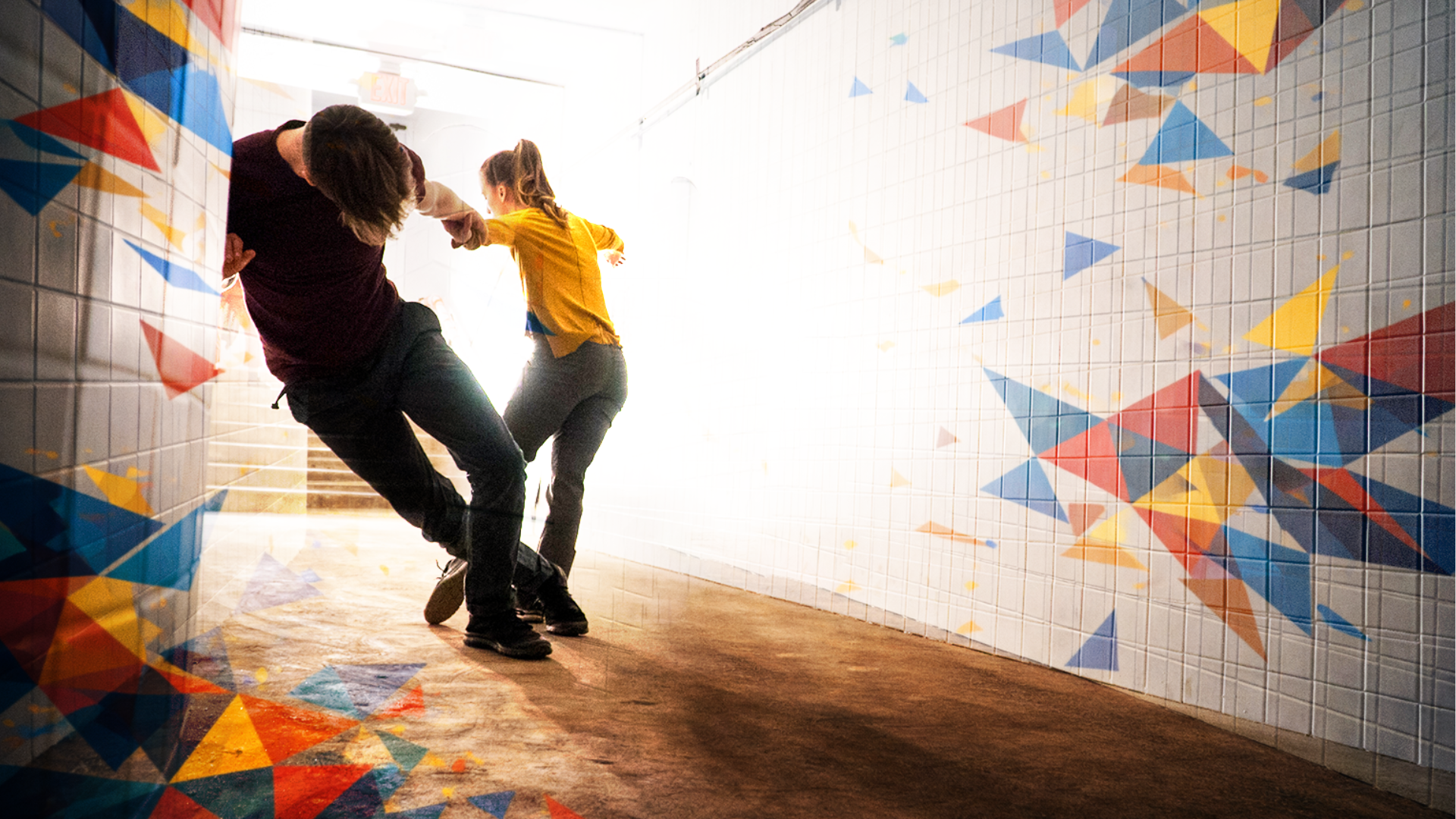
As the weather warms, it’s the perfect time for an outdoor performance. Gather on April 30 – May 2 as guest artists Orange Grove Dance bring 10 performers into dynamic partnership with sidewalks, stairways, and the UMBC amphitheatre. Through shared weight, timing, and physical negotiation, bodies and architecture collide and collaborate, revealing the unseen choreography woven into the spaces we pass through every day. The immersive performance, entitled Site / Unseen, will travel a short distance across campus, beginning at the Performing Arts and Humanities Building and concluding at the Fine Arts Building Amphitheatre.
On December 5, the campus celebrated this year’s Arts+ initiative with five concurrent events featuring UMBC students, faculty, and guest artists. In a sold out concert in Linehan Concert Hall, the UMBC Symphony Orchestra and String Chamber Orchestra, directed by assistant professor Philip Mann, performed Alexander Glazunov’s Violin Concerto, featuring professor Airi Yoshioka, and works by professor Linda Dusman and Rich Sigwald ’03, music.
A moment from Street Scenes, with Jamia Tutt, ’26, as Mamie Jackson, and Christian Price-Burnett, ’26, as Jim Jackson.. Photo: Kiirstn Pagan ’11 for UMBC.
Down the hall in the Black Box Theatre, UMBC Theatre presented Street Scenes, with text by Langston Hughes and his contemporaries, with music by Kurt Weill, adapted and directed by associate professor Eve Muson, with musical direction by adjunct professor Andrew Hann—also to a sold out house.
Students perform in the Fall Dance Showcase. Photo: Kiirstn Pagan,’11 for UMBC.
The Department of Dance presented the Fall Dance Showcase on the stage of the Proscenium Theatre, featuring striking capstone works by senior students and independent student research.
Still from video by McCoy Chance, M.F.A. ’25, IMDA.
The PAHB lecture hall was home to a Film and Animation Showcase, featuring works by 18 students and recent graduates of UMBC’s Intermedia and Digital Arts (IMDA) program.
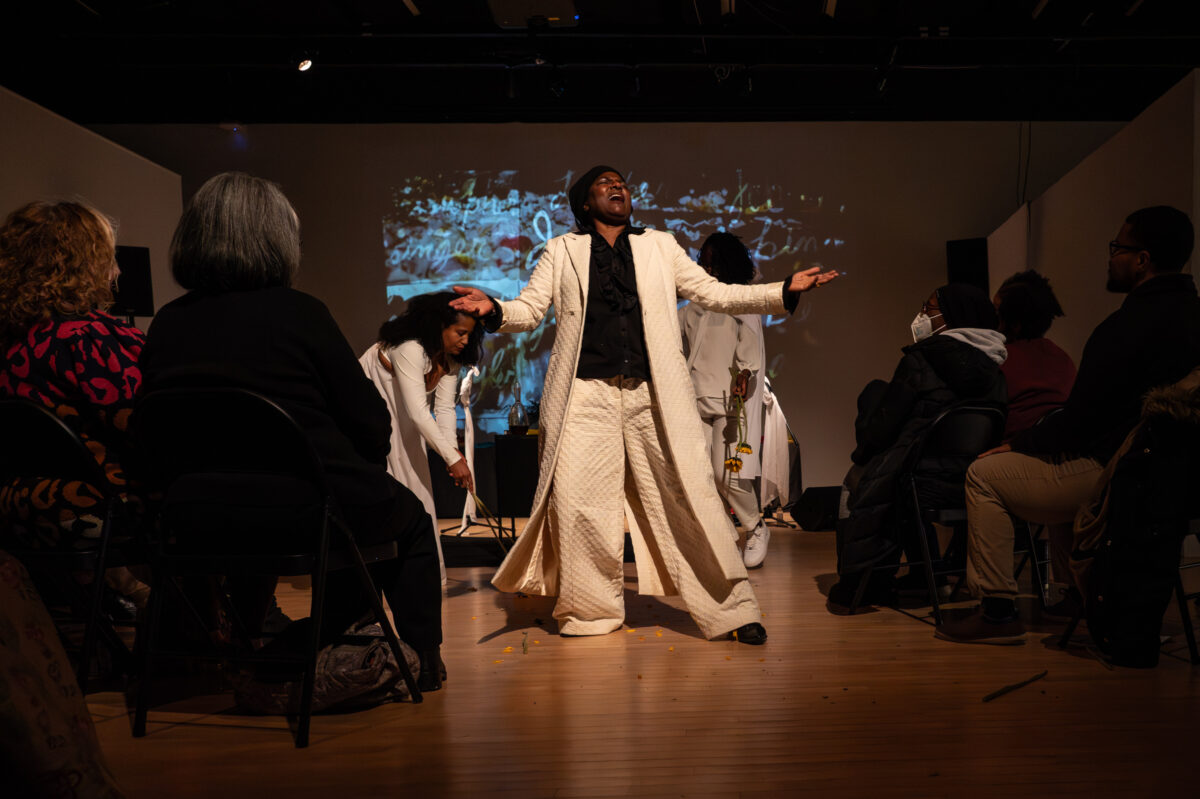
María Magdalena Campos-Pons performs at the Center for Art, Design, and Visual Culture. Photo: Tedd Henn for UMBC.
The Center for Art, Design, and Visual Culture presented a collaboration between 2023 MacArthur Fellow María Magdalena Campos-Pons and musician Kamaal Malak, known collectively as KaMag. Their work, entitled Vignettes in 3 Sessions: An Immersive Ancestral Experience, delighted a capacity audience and was followed by the launch of a new public projection by KaMag, I Am Soil — My Tears Are Water, in the Fine Arts Building amphitheatre.
The Arts+ initiative will continue in spring 2026 with performances by Baltimore Dance Project and Orange Grove Dance, a faculty art exhibition, a lecture by visual artist Lynda Barry, a production of The Wonderful Wizard of Oz, and more than a dozen music concerts by faculty and guest artists. A full schedule will be available in January 2026.
UMBC’s annual collaborative art exhibition with Towson University, Spark, opened its doors this November at The Peale, Baltimore’s neighborhood museum, and has continued to delight audiences with its captivating installations. This year’s show, titled SPARK VII: Industrial Afterglow, gathers more than 20 artists working across sculpture, installation, sound, photography, video, textiles, and ecological documentation to explore what lingers in the wake of industrial and technological systems.
Timothy Nohe, professor of visual arts, discusses his artwork with UMBC president Valerie Sheares Ashby.
In addition to those highlighted in photos, participating artists from UMBC include Chelsey Barrera, B.F.A.’27, visual arts; McCoy Chance, M.F.A. ’25, intermedia and digital arts; Danielle d’Amico, M.F.A. ’19, intermedia and digital arts; Gracie Horne, B.F.A.’27, visual arts; Leah Clare Michaels, M.F.A. ’19, intermedia and digital arts; Edgar Reyes, assistant professor of visual arts; Sarah G. Sharp, associate professor of visual arts; Samantha Sethi, adjunct professor of visual arts; and Mariia Usova, M.F.A. ’25, intermedia and digital arts.
Artwork by Lynn Cazabon, professor of visual arts.
“From bioplastic light sculptures and cyanotype archives to rewilded cityscapes and AI-coded sea monsters, the exhibition casts light — literal and symbolic — on the residues of industry, the reconfigurations of ecosystems, and the speculative futures already blooming in the present,” says Liz Faust, who curated the exhibition on behalf of both universities.
Artwork by Eric Millikin, assistant professor of visual arts.
”As a former industrial port city undergoing rapid urban transformation, Baltimore provides a vital lens through which to consider the aftermath of extractive systems and the possibilities of repair,” notes Faust. “Spark asks: What remains after infrastructures collapse? How do ecologies adapt and resist? What does it mean to imagine otherwise? By attending to what still glows, hums, or grows through the ruins, this exhibition transforms light from metaphor into method — revealing the unseen, mourning the obsolete, and illuminating paths toward speculative futures.”
President Sheares Ashby welcomes the audience during the opening reception.
Spark continues on display through this weekend, December 7, with free admission. On Saturday, December 6, at 11 a.m., the exhibition will host a panel discussion featuring assistant professor of visual arts Erik Millikin and Alexi Scheiber, M.F.A. ’25, intermedia and digital arts.
An exhibition visitor surveys artwork by Cathy Cook, associate professor of visual arts.
Top image: artwork by McCoy Chance. Photography by Brad Ziegler/UMBC.
Jordan Fisher, visual arts, discovered a nurturing environment in commonvision, UMBC’s student design and print center, where he could apply the graphic design skills he learned in his academic courses. There, he found mentors—Emma Hagen ’14, Laura Schraven, and Katie Chrzanowski ’07—who sustained him throughout his undergraduate experience.
Q: How did you decide to come to UMBC?
A: It was pretty straightforward for me. I started thinking about college when I was in high school. I went to Sollers Point Technical High School in Dundalk, Maryland, and that had a program where I could spend half the day at the Community College of Baltimore County (CCBC) during my senior year. Then I got into the CCBC honors program and from there it was guaranteed admission into various colleges. I picked UMBC because the location worked and because it had a design program that I liked.
Fisher’s work at the 2025 Senior Exhibition, on display at the Center for Art, Design, and Visual Culture through May 24. “This is a collaborative display between me, Aidan Sobutka, and Shomapti Hussain,” says Fisher. “We have each designed the last three volumes of the UMBC Review. We’re friends and coworkers at commonvision, so we wanted to showcase our work together—from left to right mine is first, then Aidan, then Shomapti.”
Q: How did you choose your major?
A: It was kind of spontaneous. I transferred from CCBC with an associates degree in computer science, but I figured out during my last semester at CCBC that I didn’t want to do computer science. It was around this time that I started drawing a lot, and I stumbled upon some YouTube videos teaching graphic design. So I binged those for a good week or a month then, and I started making some designs of my own. This would have been in 2019 or 2020. It just felt like something that I really liked doing, and something that I wanted to know a lot more about. But risky—riskier than computer science probably! I didn’t quite know what graphic design was when I was getting into it and feeling it out, but I felt like it just came to me.
Fisher standing next to one of his designs for the Fall 2022 Welcome Retrievers/Welcome Week campaign.
Q: Who has helped you along your academic journey?
A: Definitely all my supervisors at commonvision—Emma Hagen, Laura Schraven, and Katie Chrzanowski. They’ve all been instrumental to my growth professionally and academically here at UMBC. As far as professors go, I would say Guenet Abraham—a big influence in my academic training, and the first graphic design professor I had. Our relationship continues—we still run into each other and catch up. Her teachings have influenced my work a lot.
Fisher standing next to one of his designs for the Fall 2022 Welcome Retrievers/Welcome Week campaign.
Q: What are you most proud of from your time at UMBC?
A: I’m proud of the skills I’ve gained and the work that I’ve done. If there was one particular thing that I would be proud of the most, it would be my work for UMBC Review. I did the design for the 24th volume of the UMBC Review a couple years ago, and that was a monumental task, partly because I made it a monumental task for myself. I really pushed myself on that, and I’m really happy with the result.
Q: What has been the best part of your UMBC experience?
A: In these last couple years, I’ve really opened up and met a lot more people who maybe I had been just acquaintances with before. Now I feel much more personally connected to the people around me every day. I’ve really enjoyed getting to know everybody in my design classes. Also, commonvision has enabled me to gain real-world design experience and create work that has had a lasting impact on the campus community.
“This was taken the day that the commonvision Pizza Zine shirts had been delivered, and we had some pizza in the office.” From left to right: Katherine Thorp, Thomas Hammond, Aidan Sobutka, Sarah Myers, Gwen Knott, Emma Hagen, Jeremiah Dammons, Makenna Fairbrother, Shomapti Hussain, Jordan Fisher.
Q: What advice would you give to an incoming graphic design student?
A: Try to see your classmates as your network of friends, not as people with whom you’re competing in the job market. Chances are they’re probably lovely people, so just be sociable. You can’t really design in a vacuum or make art in a vacuum, so you have to build connections with the people who are around you, who are experiencing the same things that you’re going through, and get inspired from their work as well. So make those connections.
Fisher, far right, with Thomas Hammond and Aidan Sobutka. “This was one of the best days at work,” he says. “SEB had an event on the Quad where there was hobby horsing, and we could see it from our office. So a few of us went down to participate.”
Q: Do you have a favorite graphic designer? Is there someone whose work inspires you?
A: I really admire a lot of the work that my classmates do. If I were to name professional designers, I would say I’ve really enjoyed listening to designers Kel Lauren and Elliott Ulm. They have a podcast I was actually just listening to just now. Their perspectives on graphic design are really eye opening to me, and their design work is great.
Fisher, second from left, with Lauryn Schiller, Emma Hagen, and Hezron Burks.
Q: What’s next for you after you graduate? What are your plans and aspirations?
A: I would definitely like to work in a place like commonvision—a design studio where you have multiple clients. It’s not an in-house studio—It’s just whoever comes to you, because I like that kind of variety.
On May 2 and 3, the campus celebrated the 30th anniversary of the Linehan Artist Scholars Program with two days of festivities attended by dozens of alumni, current scholars, and incoming students.
Exhibitions and performances featured works by scholars from across the years, including choreography by Ryan Bailey, LAS ’16, a theatrical performance by Grace Marsh, LAS ’28, music performances by Michelle Purdy, LAS ’10 and Christian Hartman, LAS ’20, artwork by Petra Janka, LAS ’25 and Riley Payne, LAS ’29, and creativity by many other alumni and students. Featured speakers included Cameron Slayden, LAS ’99, from the very first LAS cohort and now CEO of Microverse Studios, James Dorsey, LAS ’05, a music teacher in Prince George’s County Public Schools, and Courtney Culp, LAS ’20, a designer with Warner Brothers Discovery.
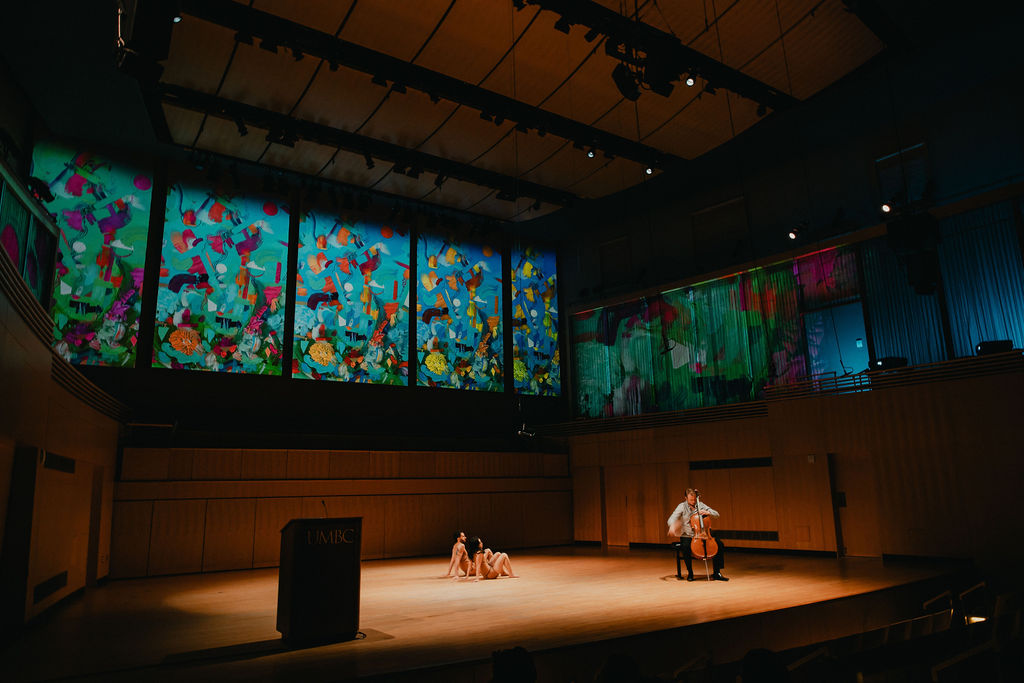
Left: Brechtel and Haynes are greeted by UMBC President Valerie Sheares Ashby following their performance, joined by Shaness Kemp, assistant professor of dance. Right: Christian Hartman plays the cello, while Ryan Bailey and Clarisse Lukban dance on stage in Linehan Concert Hall.
“The Linehan Program has strengthened my passions for new music and interdisciplinary collaboration, and I am so grateful to the program for supporting me as an artist and providing me with so many opportunities to create and collaborate,” says Hartman, who played the cello for the event. “I was so thrilled to get the opportunity to perform once again on the stage I called home for four years, and to work with Clarisse and Ryan. I didn’t see their choreography or the projections until the day of the performance, and to see it all come together was such a breathtaking experience.”
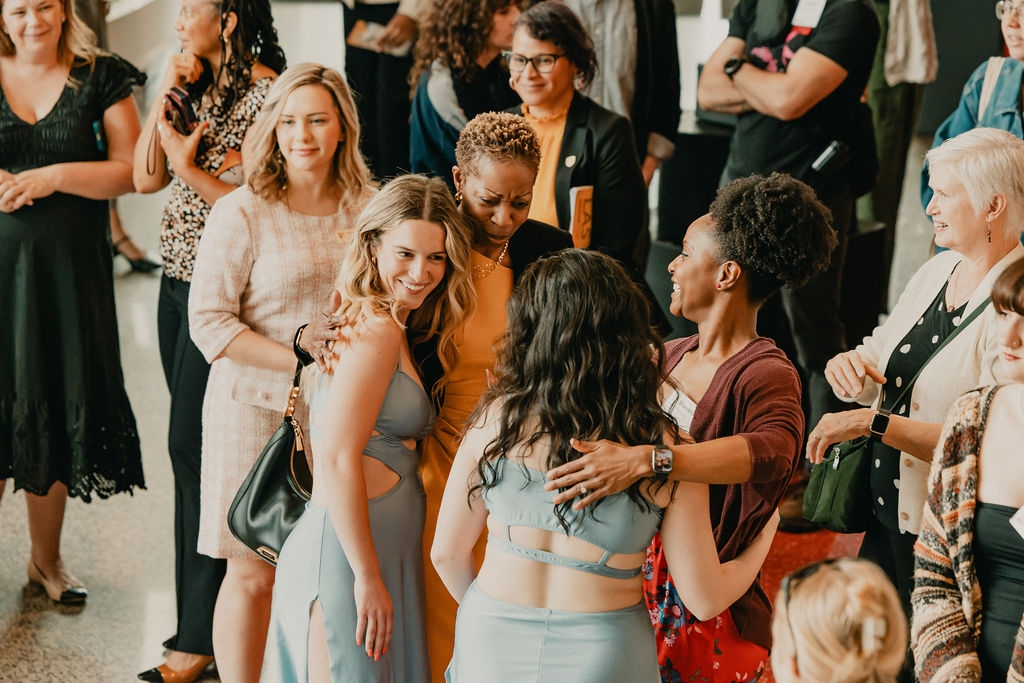
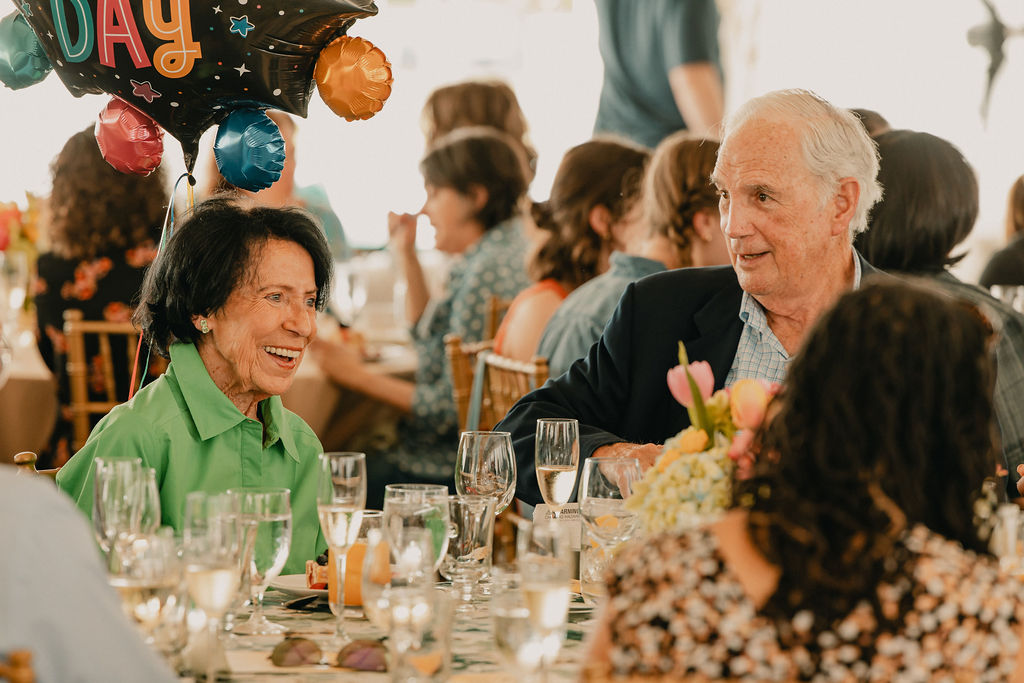
Left to right: Darielle and Earl Linehan at the post-celebration luncheon; Jillian Casey, LAS ’27 with her mom at the post-celebration luncheon; Ann Sofie Clemmensen, director of the Linehan Artist Scholars Program, poses with Petra Janka, LAS ’25.
“Earl and Darielle Linehan’s commitment to UMBC and the Linehan Artist Scholars Program has created transformative learning experiences for hundreds of talented undergraduates majoring in the visual and performing arts,” says Ann Sofie Clemmensen, director of the program. “Our focus for the celebration was to highlight the past and the future of the Linehan Artist Scholars program, and what makes our program and community unique and essential to the undergraduate rigor at UMBC.”
Juju Ayoub, LAS ’25, and Sarah McHale perform a dance duet, accompanied by music sung by Jacob Perry, LAS ’14, with visual projections by Jillian Casey, LAS ’28.
With a deeply held belief in the importance of the arts in society, Earl and Darielle Linehan launched the Linehan Artist Scholars Program with a generous gift in the 1990s. (To this day, Earl Linehan loves to recount that he and Darielle met UMBC President Emeritus Freeman Hrabowski on a bus in Israel, and that Hrabowski asked them right then for their support.) In 2015 the Linehans fully endowed the Linehan Artist Scholars Program, ensuring its future ability to continue and grow. Now, its graduates in dance, music, theatre, and the visual arts number almost 400.
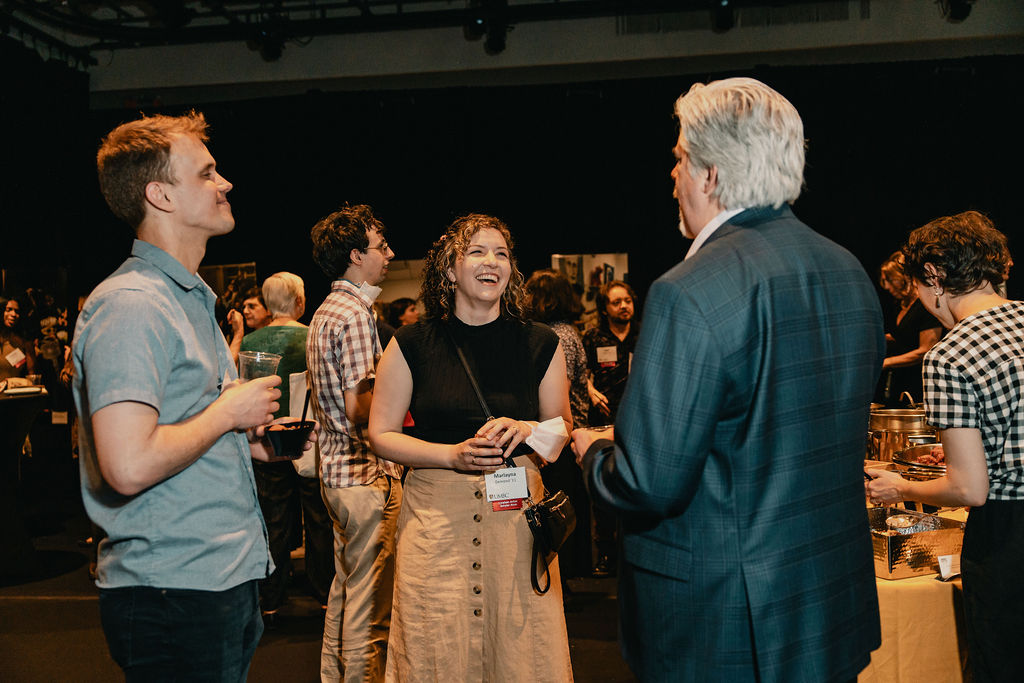
Left to right: An audience cheers on dance and music performances in the Theatre atrium; a group of Linehan Artist Scholars pose for a group photo during the post-celebration luncheon; Marlayna Demond, LAS ’11, center, talks with her husband, Adam Rhoads, and Tom Moore, director of arts and culture.
“Artists are the leading edge of creativity in our society,” says Earl Linehan. “They inspire our thinking and enrich our lives. But how can we encourage more young people to turn their talents into a career? Young artists seem to thrive best in an atmosphere that blends critical study with creative expressions—the kind of interdisciplinary environment that UMBC has always fostered.”
With plans to become a professional photographer, Luna Siesko, a rising senior in visual arts, has already generated an impressive portfolio of work, ranging from portraiture to landscapes to event photography. But Siesko knows that in order to succeed as an artist, in today’s world, that also means succeeding as a small business owner—promoting herself and her work in the marketplace.
For Siesko, a summer internship at the Baltimore County Arts Guild (BCAG) in nearby Catonsville provided a key opportunity to broaden her skills, expanding her background in social media, website posts, space management, and event planning, developing capabilities that she feels will ground her in the future. “I’ve always had this dream of having my own studio space, and some sort of exhibit space for my work,” Siesko says. “And so this internship has been really applicable to that—making sure that the space is managed and accessible, and everything is running smoothly.”
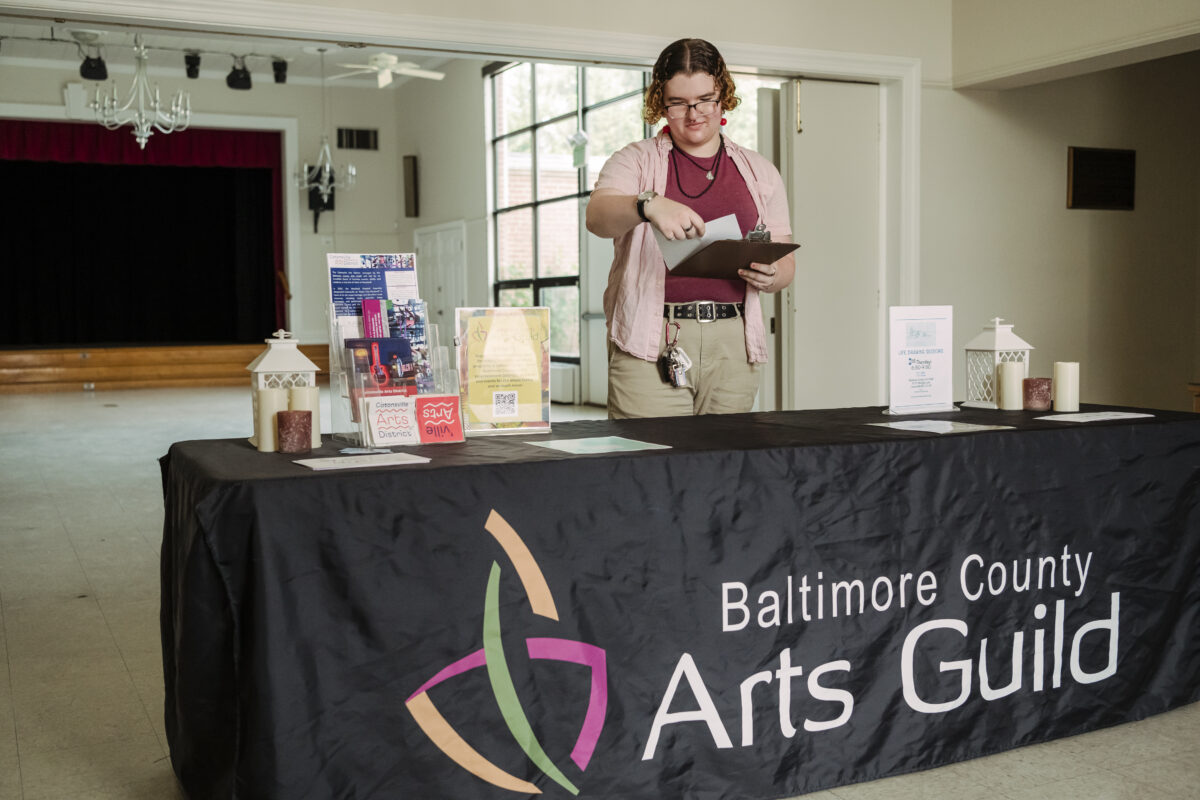
Siesko prepares for the day at the Baltimore County Arts Guild’s location in Catonsville. (Marlayna Demond ’11/UMBC)
Young artists like Siesko who study in UMBC’s dance, music, theatre, and visual arts programs often choose to establish themselves as independent practitioners, whether performing on stage, creating artwork, or expressing their work in other ways. Siesko says this will allow her to continue doing what she loves: “I just really enjoy working with people and being able to capture how multifaceted people can be.”
Engaging the community in the arts
A special focal point of Siesko’s work this summer was promotion of BCAG’s Arts & Drafts Summer Music Festival, held at Guinness Open Gate Brewery in late June. “A lot of the work I’ve been doing for them I would consider to be outreach work,” Siesko shares. “So I’ve been making posts on their website and doing social media. And for Arts and Drafts, I voiced a video, a little commercial they made to promote the festival.”
Established in 2012, the non-profit Baltimore County Arts Guild fosters the arts throughout Baltimore County, and is also the managing entity of the Catonsville Arts District, which is centered along downtown Frederick Road. “Luna’s creativity always shines through in her work,” says Gloria Fajimolu, programs and events manager at BCAG, who supervised Siesko’s internship. “Throughout her internship, she’s engaged with clients for rentals, liaised with contractors, established connections with a myriad of businesses, and fostered collaboration with talented artists.She’s always exploring new ideas and growing, despite any challenges along the way.”
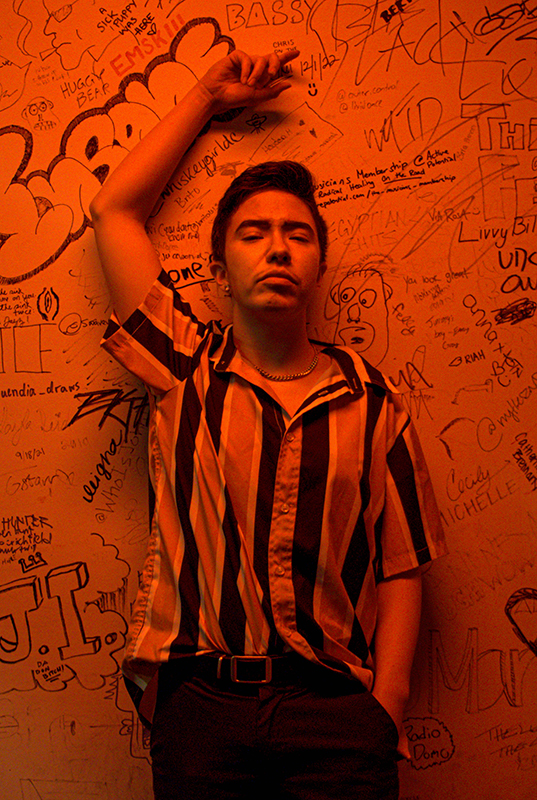
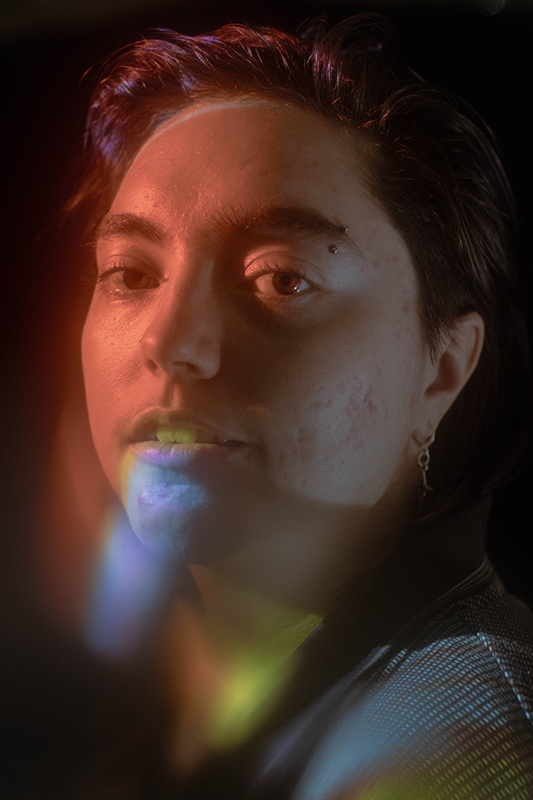
Two untitled portrait photographs by Luna Siesko, courtesy of Siesko.
On campus, Siesko has been able to hone her skills through work at commonvision, UMBC’s print and design center, where she has focused on event photography and videography—images of people on campus and signature events such as Homecoming and Quadmania, as well as helping film a promotional video for the Woolies at UMBC.
Looking forward to what comes next
Siesko gives a special shout-out to the Career Center, where she found her summer internship opportunity. “My first two years at UMBC I didn’t really go to any career fairs, because I wasn’t sure what I was looking for at all. But then I went to one to try to find an internship, and that was very helpful to me,” says Siesko, “and that’s how I am where I am now.”
Siesko poses with her internship supervisor, Gloria Fajimolu, at the Baltimore County Arts Guild. (Marlayna Demond ’11/UMBC)
After graduation next spring, Siesko plans to continue work as a freelance photographer, basing her work in the Baltimore area. “I’ve really fallen in love with the arts scene, and have met a lot of great people here,” she says. “I can’t imagine myself ever being too far away from Maryland.”
On May 30, Kelley Bell, M.F.A. ’06, associate professor of visual arts, was named one of the six 2024 Baker Artist Awardees, receiving the $10,000 Mary Sawyers Baker Prize. The awardees were selected by an anonymous jury from a field of almost 700 artists from across the greater Baltimore region. Corrie Francis Parks, associate professor of visual arts, and Katie Hileman ’12, theatre, and general associate in the department of theatre, were among the finalists for the prestigious 2024 Baker Artist Award.
Established in 2009, the Baker Artist program was created to support artists and promote greater Baltimore as a strong creative community. Since then, more than 150 artists have been awarded $1.3 million in grant money. The program was established by the William G. Baker, Jr. Memorial Fund and is managed by the Greater Baltimore Cultural Alliance.
Still from Paper Palazzo by Kelley Bell. Image courtesy of the artist.
As part of the Baker program, artists across six disciplines—visual arts, film/video, interdisciplinary, literary arts, performance, and music—are invited to establish online portfolios of their work, which are housed on the Baker Artist Awards website. The 2024 portfolios, numbering more than 700, were reviewed by an anonymous jury which selected the 36 finalists. One artist in each of the disciplines was awarded the $10,000 Mary Sawyers Baker prize, and one of those six awardees was selected to receive the additional $30,000 Mary Sawyers Imboden prize.
I Will Eat You Alive, written and directed by Katie Hileman ’12. Pictured from left, actors Betse Lyons, Vicky Graham ’20, and Meghan Taylor. Photo by Kiirstn Pagan ’11.
The work of Bell, Parks, Hileman, and other finalists will be featured in a series of finalist showcases. Kelley Bell’s work (in the interdisciplinary category) will be on display at Current Space from April 20 to June 2; Katie Hileman’s work (in the performance category) will be featured at Theatre Project on April 27 at 7:30 p.m. and on April 28 at 4 p.m. The showcase that will feature the work of Corrie Parks (and others in the film/video category) has yet to be scheduled.
UMBC is no stranger to the Baker Artist Awards. Previous recipients have included:
2015—Eric Dyer ’95, visual arts, and professor, visual arts ($25,000 Mary Sawyers Baker prize); and Dominique Zeltzman, M.F.A. ’14, ($5,000 Nancy Haragan award)
2018—Lafayette Gilchrist ’92 ($10,000 Mary Sawyers Baker prize)
2021—Rahne Alexander, M.F.A. ’21, ($2,500 Baker Artist award); and Mina Cheon, M.F.A. ’02 ($2,500 Baker Artist award)
“Being counted among the 2024 Mary Sawyers Baker Prize awardees is amazing,” said Bell. “I am fiercely proud to call Baltimore my home and inspirational wellspring—it‘s a city like no other, and there is no other creative community I‘d rather be a part of. My colleagues from CAHSS, Katie Hileman and Corrie Francis Parks, were also included in the finalist‘s circle for this prestigious acknowledgment, and that’s a testament to the wonderful things that can happen when UMBC supports and invests in the arts and culture—our colleagues, our institution, and our city all reap the benefits of an active and vibrant creative community.”
Bell’s work will be featured in an exhibition of works by Baker Award recipients at the Baltimore Museum of Art in spring 2025.
As a high school student, Pam Voulalas ’24 was an aspiring clarinetist, determined to major in music and secure a position in a major symphony orchestra. But, on learning how infrequently symphony positions become available, she put down her clarinet. For 37 years.
Instead, she embarked on a career in the sciences, earning a Ph.D. and joining the faculty at the University of Maryland School of Pharmacy. Now, decades later, she returned to school, and graduates this week with a B.A. in music from UMBC.
Q: What was your career path in the sciences?
A: My Ph.D. studies were focused on synaptic plasticity in the brain—how the brain physically changes in response to exposure to novel stimuli.
When you’re exposed to something new, the brain processes that incoming information, creating a physical network that underlies long-term memory storage and retrieval. An important part of this network is an area of the brain called the hippocampus—the seat of learning and memory—which acts like a relay station. I was focusing on that part of the brain, trying to understand how different neurotransmitters interact with each other through their receptor systems to cause short-term stimuli to be transformed into long-term memories.
After completing my Ph.D. I went on to work as a postdoctoral fellow at the National Institutes of Health and Johns Hopkins School of Medicine before I then landed at the University of Maryland, Baltimore as a senior fellow (while I had three kids!). Later I joined the faculty in the School of Pharmacy there.
Q: What prompted you to leave your career and enroll in an undergraduate music program?
A: That was a sort of series of unexpected life events. I was collaborating with another researcher on a project studying plasticity in chronic neuropathic pain, and the funding was running out. Meanwhile, my husband and I both had parents with serious health issues, so I took what I thought was going to be a leave of absence to care for them. But I was also at a point where I was feeling like I was ready for a change, ready to move away from academic research.
During that period, I wanted to take a class in music theory at Howard Community College, but I learned that I couldn’t just take one class, I had to take three: theory, ear training, and piano keyboard skills. I thought I would just take the theory class, sign up for the other two, and drop them! Two years later I finished at HCC with an associate’s degree in music performance and my husband then asked me, “Are you going to finish this?” So I applied to UMBC.
Siblings, in Twelve Tones by Pam Voulalas, performed by Alice Massey, Braden McKibben, and Jennifer Sorrells. (Video courtesy of Voulalas, Massey, McKibben, Sorrells, and the UMBC Department of Music)
Q: Why music composition?
A: As a scientist, I was very interested in the tiny details of brain function, down to the molecular level: what is learning and memory all about? What is the pathology of these processes? What does that look like? How does that work? In music, I think that composition was a purposeful choice of mine—it makes sense because I like learning about, if you will, the mechanics of music, the finer details.
I chose composition because I initially wanted to compose for clarinet ensembles. In 2016, I had picked up my clarinet again and joined the local community band. Within that group I found a bunch of interested clarinetists, and with them I formed a clarinet choir. We were together for about two years before COVID-19 hit. We performed at a few senior living communities and rehab centers, when it struck me that I could combine my musical skills with my knowledge of learning and memory and how to keep our neural circuits healthy throughout our lives.
As I got back to studying clarinet, I took lessons with people who were 70 to 85 years old who were still amazing players. I started thinking that a practical application of my love and interest in music would be to establish programs at senior living communities—places where people are still living independently and may still be playing or want to play their instruments. I could help them form ensembles on site, ideally leading to a performance. And that way they’re not just listening to music, they’re actively engaging—which is great for our brains—it’s great for everyone’s psyche, and it’s great for other residents to enjoy.
Q: You returned to school after a successful career in the sciences. What was it like being around other students who were so much younger than you?
A: Well, I was very nervous about transferring to UMBC. One of the players in my clarinet choir was a retired nurse, and she and I did the program together at HCC. I’m happy to say that both at HCC and also at UMBC, I never felt like I was playing the mother or the parent to younger students.
In fact, I feel like I added something to the classroom because, for example, some students can be timid about asking questions and putting themselves out there. I feel like I helped to be a role model for them, helping them by breaking the ice in certain circumstances.
I was just telling a friend of mine at lunch that I’ve had UMBC students want to hang out and talk, which I do feel has been pretty genuine. I can’t really explain that. I do believe that there is something special about the students who come to UMBC. I think this place attracts very open-minded individuals.
Q: At UMBC, who has been a mentor to you, or who has supported you in your work?
A: Who wasn’t a mentor?! I spent the most time with Dr. Linda Dusman, and then the three large ensemble directors, Dr. Philip Mann (Symphony Orchestra), Dr. Brian Kaufman (Wind Ensemble), and Dr. Patrick Crossland (New Music Ensemble). I had never had the opportunity to play in an orchestra before coming to UMBC! The very first person I connected with for orchestra was Dr. Nell Flanders, who was the orchestral director my second semester here. I was incredibly excited to be able to play orchestral repertoire. All of the faculty take their students seriously, setting the bar high. I love that. I love how the professors, every one of them from Dr. Airi Yoshioka to Dr. Lisa Cella, all push in a very gentle, supportive way. And I think this takes a lot of finesse—to encourage without completely stressing students out.
Pam Voulalas (right) with Linda Dusman, professor of music. (Image courtesy of Voulalas)
Q: As an undergraduate composition major, you had your works performed by professional ensembles that visited UMBC, including the Bergamot String Quartet and the Strata ensemble. That must have been an unusual experience.
A: That is one of the huge gifts and the glorious insights and understanding that Dr. Dusman has given to her composition students. And that’s another thing that I think really elevates the composition program here—that we do have those opportunities to write music for people who have the skills to be able to attack more complex pieces.
That’s a wonderful feeling—when you can compose something challenging knowing that the ensemble will be able to handle it. It’s both exciting and a little intimidating, because you’re hoping you’re going to write something that the musicians enjoy playing. And then when it all works, it’s magical, something being brought to life, very surreal.
Q: Out of the works you composed during your time at UMBC, is there one that stands out for you?
A: I have to say that two pieces stand out. One was this piece that I call my “sleep piece” entitled To Sleep, Perchance to Dream. The assignment was to compose a piece based on a graphic score. That was challenging, but it was also fun because I ended up tapping into my neuroscience background to develop the idea. It demanded improvisation, which is not something that I had ever done before. I felt like I grew a lot with that experience, because I needed to compose in a very different way. And since I was also a member of the ensemble in that case, I had to learn how to feel comfortable improvising. It ended up being a multimedia piece, so that was more complex than anything I had tackled before. The successful performance of that piece was very gratifying.
With improvisation, there are moments when a special kind of cohesion occurs which is very different from playing standard notation repertoire—you hope that the ensemble will reach its optimal cohesiveness during the performance. Of course, with improv, you just never know how it’s going to go! When it works well it is a wonderful feeling.
The other piece that was probably the most challenging was Phaistos, in which I had to interpret an ancient artifact—a series of hieroglyphics arranged in a spiral pattern—and compose a piece based on that. It was technically very demanding, but in the end, incredibly gratifying, especially given that the Strata trio did a fabulous job interpreting it. Those are the two standouts for me.
The Bergamot String Quartet performs Voulalas’s composition From Whence We Came. (Video courtesy of Voulalas, the Bergamot String Quartet, and the UMBC Department of Music)
Q: This semester, as a member of UMBC’s New Music Ensemble, you performed Mauricio Kagel’s Staatstheater, a piece that features all sorts of theatrical gestures, many of which are intentionally absurd. What was that like for you?
A: Well, when Dr. Crossland first proposed it, we students were looking at each other like, “Okay….” Before I started this program, I loved all sorts of music. My husband and I have a collection that spans medieval and renaissance music, classical, jazz, minimalist, folk, rap, and a little bit of new music. But as far as really new music, very contemporary music, I hadn’t had a lot of exposure to that, and so it was very uncomfortable and foreign to me. I would put like the Kagel piece into that category, which ended up being both fun and enlightening.
One of the most interesting things that occurred to me as a student—and I was kind of warned by a student who graduated a year before me that this would happen—is that you come in as a mostly classically focused tonal person and then something happens, and your brain opens up to new musical possibilities. And I’ll never forget the moment when that happened. I was in my kitchen making breakfast, listening to the radio, a classical station, when I suddenly had this realization: This classical music was wonderful, but it’s not enough. Right? There’s so much more that can be done with instruments and music and sound. I feel like it was really then that this concept gelled for me. It was a very cool moment.
Q: What’s next for you?
A: I have a lot of experience writing grants for scientific research, and I’ve had some opportunities to do that for free for arts organizations and been very successful with that.
I’ve had a glorious career in science, but now I really am trying to focus on what kinds of work I can I do that will allow me to give back in one way or another—something that will have a lot of meaning for me and others while at the same time allowing me time to compose, because I have a lot of ideas for pieces I’d like to write for all kinds of different ensembles. And I do intend to keep studying. If I had the opportunity for advanced study in composition, I would like to do that.
I really would like to find ways to engage seniors citizens in music making. Aside from that, I have a dream to create a small, very intimate chamber space in Howard County, where we can present concerts of all genres of music performed by professionals and amateurs, including young students. Music is very big in Howard County—kids of all ages are achieving great things with their music. So that’s my dream—we’ll see!
The Strata ensemble perform’s Voulalas’s composition Phaistos. (Video courtesy of Voulalas, Strata, and the UMBC Department of Music)
Q: Is there anything we missed?
A: I’m so in awe of and grateful for the faculty and the staff in the music department—every single one of them. I come from a field where it’s tough, the pressure is high, which can negatively affect the work environment and personal interactions, right? I know that a career in the arts is tough too. Maybe in a conservatory there’s a very different feel, but however the music department at UMBC manages to achieve it, I feel like they absolutely strike the right balance here.
And I know this sounds corny, but I feel so appreciative of the students here who I believe really accepted me as one of their own. I’m very grateful for that.