All posts by: Sarah Hansen, M.S. '15


Kayla Smith, student health advocate, to attend Brooklyn Law School

Kayla Smith
B.A., Interdisciplinary Studies (Public Health Advocacy)
Hometown: Laurel, Maryland
Plans: J.D., Brooklyn Law School

Iron sharpens iron, and at UMBC I have been given the space to interact with and learn from people who challenge me and push me to be my best.

Kayla Smith has steadfastly dedicated her time at UMBC to serve as an advocate and educator for fellow students, particularly in areas related health and wellbeing.

Smith is a three-year peer health educator, worked as chair of the Sexual Health Committee in the Health Promotion Office at UMBC University Health Services, and served as executive director of the Student Government Association’s Department of Health and Wellness. She has also served as both an intern and a student staff member for the Women’s Center, and worked as an Introduction to an Honors University peer facilitator.

Smith received the Black Girls Rock Community Activist Award for her work to raise awareness about sexual assault and mental illness. She has also served as a campus representative for the sexual health website Bedsider, operated by the nonprofit National Campaign to Prevent Teen and Unplanned Pregnancy.

In keeping with her legal aspirations, Smith has served as a justice on the Student Judicial Programs Hearing Board and a member of UMBC’s Mock Trial team. Throughout her years on Mock Trial, she has received eight awards for her performance on the team, which recently competed for the first time in the national championship tournament, hosted by UCLA.

Through all of these experiences, Smith says, “UMBC has given me the opportunity to learn in an environment that fosters growth. I have grown in my ability to advocate for myself, achieve my goals, and most importantly, live up to my fullest potential.”

Smith will attend Brooklyn Law School in New York City after graduation.

Image: Portrait by Marlayna Demond ’11 for UMBC.

Danielle Allison advocates for student veterans on campus

Danielle Allison
B.A., Political Science; B.A., Asian Studies
Magna Cum Laude
Hometown: Columbia, Maryland
Plans: U.S. Department of Defense

During orientation, all incoming students were encouraged to be involved on campus…in civic agency as students who could have an impact on the direction of UMBC’s culture and policies…[and] in research and conferences, even at the undergraduate level. This all sounded too good to be true at the time. Yet my experiences at UMBC proved it to be true.

As both a student veteran and the first in her family to go to college, Danielle Allison wanted to pursue her education in a place where she was confident her experience and perspective would be valued. At UMBC, she not only found that place, she was also able to advocate to make that place better for students like her.

Allison has served as project manager for the Veteran Peer Mentors program, regularly working with staff, faculty, and administrators across UMBC to expand and streamline supports for veterans. Initiatives included everything from reviewing and improving services available to student veterans to increasing their visibility and recognition on campus.

Reflecting on her time at UMBC, Allison shares her gratitude for the supportive faculty and staff she found on campus from the very beginning. She says:

When I was deciding whether I wanted to transfer to UMBC I made an appointment with a professor in the political science department and the director of Asian studies to get some advice. The fact that they both made time for me impressed me a great deal on how UMBC prioritizes its students. They listened to my concerns patiently and gave me honest opinions. I knew then that UMBC was the place for me.

Allison is a recipient of both the Outstanding Scholar-Leader Award in political science and the Academic Excellence Award in Asian studies. Her academic excellence has also been recognized through induction into multiple honors societies, including Phi Beta Kappa, Phi Kappa Phi, and Omicron Delta.

Portrait by Marlayna Demond ’11 for UMBC.

Daniela Mujica-Martorell, undergraduate researcher and polyglot, studies design across cultures

Daniela Mujica-Martorell
B.A., Asian Studies; B.A., Global Studies; B.F.A., Design
Magna Cum Laude, Certificate: Honors College
Hometown: Arequipa, Peru
Plans: Applying for a Fulbright scholarship to South Korea

My professors and mentors at UMBC have never told me to curb my ambitions or endeavors, and have thus helped me find my best self. I am convinced that UMBC has given me unique opportunities no other university would have, and for that I am incredibly grateful.

A passionate undergraduate researcher, Daniela Mujica-Martorell is interested in how the concept of “design” can shift and change in different cultural contexts. As a U.S. immigrant who frequently transferred between schools growing up, Mujica-Martorell is no stranger to change, and says UMBC has given her a strong sense of belonging and community not felt anywhere else. She is thankful for the campus’ inclusive culture, which she says has provided her many opportunities to explore what it means to be a global citizen.

This past year, she worked with Kyung-Eun Yoon, modern languages and linguistics, on an URCAD project that explored the impact of globalization on design processes in South Korea, and in 2015 she studied abroad at Sophia University in Tokyo, Japan. During her time at UMBC, she has also been involved with the campus Korean Dance Club and the Japanese Student Association. Already fluent in Spanish, English, French, and Japanese, she is working on adding Korean to her repertoire. More recently, she has performed translation work on a research project for the psychology department.

japan_sushi class photo

Mujica-Martorell is a member of several honors societies, including Phi Beta Kappa, Omicron Delta Kappa, and Golden Key. She has served as senior managing editor for Bartleby, UMBC’s literary arts journal; an architecture and engineering assistant for Facilities Management; a student reviewer for the visual arts department promotion and tenure committee; and as a teaching assistant for an undergraduate course in international law. She has also participated in UMBC’s Camerata.

Mujica-Martorell plans to apply for a Fulbright scholarship, where she hopes to travel to South Korea to continue her research on the role of design in shaping national and cultural identities.

Portrait by Alison Kreckmann.

Kaitlin Smith, leader in vibrant campus life, to pursue graduate study in student affairs

Kaitlin Smith
B.A., Media and Communication Studies
Cum Laude
Hometown: Perryville, Maryland
Plans: M.A., Morgan State University

Finding my place in college is one of the greatest things that has ever happened to me… My involvement in student life, admissions and orientation, and student affairs connected me to people who believed in my abilities, gave me the support and strength to pursue many different avenues…and gave me the opportunity to help others find their passions and place at UMBC.

As a freshman, Kaitlin Smith was performing well in her classes and making friends, but she had a nagging feeling that she wasn’t making the most of her college experience. That changed when a staff member encouraged her to get involved in the Orientation Peer Advisor program, which opened the door to her involvement and leadership in campus life.

Smith completed an internship focused on campus safety with the Office of the Vice President of Student Affairs, joined the service-focused Alpha Sigma Alpha sorority, became a coach for STRiVE (an intensive student leadership development program), served as a Woolie (a UMBC Welcome Week leader), and became a trainer with the Green Dot bystander intervention program.

In her senior year she has served as undergraduate fellow in the Office of Undergraduate Admissions and Orientation, and as president of UMBC’s highly active Student Events Board (seb). On the academic side, she also served as president of the Media and Communications Studies Council of Majors.

Smith’s experiences have inspired her to pursue a master’s degree in higher education and student affairs administration at Morgan State University, to ensure future students have access to the same kinds of college experiences that brought so much meaning to her time at UMBC.

Austin Maduka, dedicated mentor, to pursue M.D./Ph.D. at Duke University

Austin Maduka
B.S. Biochemistry and Molecular Biology
Cum Laude
Hometown: New Carrollton, Maryland
Plans: M.D./Ph.D., Duke University

UMBC has provided the best environment for me to challenge myself, discover new passions, and grow both personally and academically. I know that the network of friends and mentors I have made at UMBC will continue to support my growth for years to come.

Austin Maduka graduates from UMBC with a wealth of research experience and an ongoing commitment to supporting up and coming STEM students as they discover their passions and work through early challenges in their studies.

During his time at UMBC, Maduka worked in research labs at Johns Hopkins University for three years, in addition to spending two summers conducting research at the Massachusetts Institute of Technology. He credits these experiences with helping him develop his confidence as a scientific researcher and his science communication skills. He further refined those skills through award-winning presentations at professional conferences, serving as a chemistry tutor at UMBC, and publishing his work as co-author of a peer-reviewed article in the Journal of Biological Chemistry.

Maduka is a Meyerhoff Scholar and MARC U*STAR trainee at UMBC. He received the ASBMB Marion B. Sewer Scholarship for Undergraduates, recognizing his deep interest in a biochemistry and molecular biology career and his commitment to enhancing diversity in science. As a UMBC junior, he also received the Lisë K. Satterfield Scholarship, which honors an exceptional chemistry student with research experience. Additionally, he is a founding member of the Phi Delta Epsilon Medical Fraternity.

Maduka’s commitment to giving back to fellow aspiring scientists runs deep. With Daniel Ocasio [link], he co-founded Achievement and Inspiration through Mentorship (AIM), which provides long-term mentoring to underserved teens in Baltimore City. He tutors in chemistry and biology at UMBC and is a Meyerhoff peer advisor, as well as an Eagle Scout.

Writing about his own educational path, and what motivates him to mentor younger students, Maduka recently shared in ASBMB Today:

“It is crucial to realize that support can change a person’s trajectory in life, especially for people in minority, inner-city communities… Although I had a positive outcome, many like me do not. Whenever possible, be a source of support for others. It may have a bigger impact than you would expect.”

This fall, Maduka will pursue a combined M.D./Ph.D. at Duke University.

Portrait by Marlayna Demond ’11 for UMBC.

Jaelyn Bos applies passion for ecology to teaching biology in Mozambique

Jaelyn Bos
B.A., Biological Sciences; B.S., Environmental Science
Summa Cum Laude, Certificate: Honors College
Hometown: Columbia, Maryland
Plans: Biology teacher, Peace Corps, Mozambique

My experiences with the Shriver Center were my most meaningful at UMBC, and they showed me how to incorporate social change into my future ambitions. I appreciate how UMBC encourages and empowers students to create change on and off campus.

Jaelyn Bos has long been committed to leadership through service, and throughout her time at UMBC she has sought out experiences to grow her ability to impact local and global issues, from her time in the Shriver Living Learning Community to her study abroad experience in Ecuador.

Bos served as the community outreach coordinator for Arbutus Achievers, a group that supports students at Arbutus Middle School who are striving to move past challenges. She won a BreakingGround grant to organize Service Fest, an on-campus event that brought together local non-profits with potential student volunteers. She also created the “One UMBC, One Baltimore” interactive online map to share information about Shriver Center outreach activities. By her senior year, Bos was named France-Merrick Fellow for her “exemplary commitment to service, leadership, and civic engagement on the UMBC campus and in Baltimore City.

Bos bridges her commitment to social justice with a passion for ecology, undertaking internships at the National Park Service and Cary Institute of Ecosystem Studies, and holding a research assistant position with Matthew Baker, professor of geography and environmental systems. It is this combined interest in community engagement, ecology, and passion for learning that has inspired Bos’s next step after graduation: teaching biology to secondary school students in Mozambique as a Peace Corps fellow.

Portrait by Marlayna Demond ’11 for UMBC.

Emily Melluso to continue social justice work through applied sociology master’s at UMBC

Emily Melluso
B.A., Biological Sciences; B.A., Sociology
Magna Cum Laude
Hometown: Union Bridge, Maryland
Plans: M.A., UMBC

My experiences have shown me the importance of self-determination and the need for students to recognize their own power within their communities and beyond them.

Emily Melluso arrived at UMBC with a broad vision of serving communities facing challenges. Over the course of her undergraduate years, she refined that vision and strengthened her commitment to social justice work through on-and off-campus experiences that helped her “consider the ways in which people struggle at UMBC and in our neighboring communities in Baltimore City.”

Melluso has served fellow students through such leadership and mentorship roles as an SGA ProveIt! coordinator, IHU peer facilitator, STRiVE coach, resident assistant, and Imagining America undergraduate fellows coordinator. This year she co-led the “Seeing Baltimore” alternative spring break trip, which connected students to social justice work in the city.

In recognition of her academic excellence, Melluso has been recognized as a member of Alpha Kappa Delta (the international honors society for sociology) and the National Society of Collegiate Scholars. After graduation, Melluso will pursue a master’s in applied sociology at UMBC while continuing her community education and organizing work in Baltimore.

Portrait by Marlayna Demond ’11 for UMBC.

Ryan Atkinson, ice hockey MVP, to attend medical school on U.S. Air Force scholarship

Ryan Atkinson
B.S. Biochemistry and Molecular Biology
Summa Cum Laude
Hometown: Vacaville, California
Plans: M.D., University of Southern California School of Medicine

Playing hockey at UMBC has helped me grow so much as an individual and as a leader. The people I encountered playing hockey are a huge reason why I am heading to medical school this fall.

Ryan Atkinson has excelled as a scholar-athlete at UMBC, and also as a scientist. Atkinson served as captain and president of UMBC’s club ice hockey team during his junior and senior years, receiving UMBC Club Sport Athlete of the Year and league MVP honors, as well as the 2016 Lou Cantori Award, given to an outstanding UMBC scholar-athlete in a club sport.

Ryan Atkinson playing hockey with teammate

While competing, Atkison also maintained a 4.0 GPA and contributed to two journal articles based on his research in Suzanne Rosenberg’s immunology lab. This fall, he will head to the University of Southern California School of Medicine on a U.S. Air Force Health Professions Scholarship.

“UMBC has helped me achieve my goals by pushing me academically while also providing the resources to explore potential career pathways until I settled on one that was right for me,” Atkinson shares. “The professors on this campus were instrumental in providing guidance and opportunities throughout my time here.”

Portrait by Marlayna Demond ’11 for UMBC.

Da’Kuawn Johnson, future M.D./Ph.D., combines commitments to research and peer mentorship

Da’Kuawn Johnson
B.S., Biochemistry and Molecular Biology
Cum Laude, Certificate: Honors College
Hometown: Baltimore City
Plans: M.D./Ph.D., University of Maryland, Baltimore

Having the guidance from the Meyerhoff program has allowed me to come in with a dream and leave with it being reality.

UMBC’s supportive environment and game-changing guidance offered by peer and faculty mentors have inspired Da’Kuawn Johnson to focus on what he could give back as a mentor to others—in the classroom, in the lab, and in campus life. “UMBC embodies students giving back to their peers,” he says. “I spent my college career in a give and take relationship where older students provided guidance, and my classmates and I worked as a team to achieve success.”

As a Meyerhoff, HHMI, MARC U*STAR, and Kevin Yang and Katelyn Niu Scholar, Johnson has taken advantage of research opportunities in Jeffrey Gardner’s bacterial physiology lab, earning an Undergraduate Research Award for his work and presenting at the Summer Undergraduate Research Fest. Meanwhile, he served as a Learning Resources Center tutor, undergraduate teaching assistant in biological sciences, and justice on the UMBC Student Hearing Board in the Office of Student Judicial Programs, which promotes “personal integrity, civility, self-responsibility, citizenship, and appreciation for diversity” at the university.

“I did all of these things because other students did them for me,” Johnson shares.

On top of his research and service, Johnson is a classical pianist. Next, he will pursue a combined M.D./Ph.D. at the University of Maryland, Baltimore.

Photos by Marlayna Demond ’11 for UMBC.

Brandon Enriquez, USM student regent, heads to economics Ph.D. at MIT

Brandon Enriquez
B.A., Economics; B.S., Mathematics
Summa Cum Laude, Certificate: Honors College
Hometown: Ellicott City, Maryland
Plans: Ph.D., Massachusetts Institute of Technology

There are many talented and intelligent college graduates in the world against whom I must compete. My advantage comes through the support I receive from my school, through how I am pushed by mentors to be innovative and creative. UMBC provides that support.

How do financial aid packages affect retention rates for low-income college students? What would happen if remedial courses stopped after the two-year community college level? These are the kinds of challenging, highly complex higher education policy questions that interest Meyerhoff Scholar Brandon Enriquez, which he’s examined through research at Harvard and MIT, and service to the University System of Maryland as student regent for 2016-17.

As student regent, Enriquez is a voice for over 18,000 students systemwide. On campus, he is president of the UMBC College Democrats, co-president and founder of the UMBC TED Club, a member of the Phi Kappa Phi fraternity, and has served as an Alternative Spring Break trip leader.

In recognition of his leadership and exceptional academic and extracurricular accomplishments, Enriquez was named a finalist for the Marshall and Rhodes scholarships this year. After considering opportunities in doctoral programs at Harvard, Yale, Princeton, and the University of Chicago, and he has decided to pursue his Ph.D. in economics with a full fellowship at MIT.

Image: Portrait by Marlayna Demond ’11 for UMBC.

UMBC forum highlights need for interdisciplinary collaboration in aging research

The spring 2017 UMBC Research Forum focused on innovative research in aging and the life course—a notably far-reaching area of study that transcends a diverse range of fields. Speakers discussed aging research from the microscopic scale of genetic mutation to analysis of federal policy, and all emphasized the importance of interdisciplinary collaboration in this complex area of study.

“Health, we know, is not cardiovascular, is not neurological, is not pathological. Those are completely artificial distinctions,” shared keynote speaker Luigi Ferrucci, director of science at the National Institute on Aging. “It’s become very, very clear that everything interconnects.”

Ferrucci focused his remarks on the complex relationship between nutrition and aging. “We know intuitively that nutrition affects the aging process dramatically, but it’s also an understudied area,” he said. For example, strict caloric restriction, which has resulted in lifespan extension across many species in scientific studies, seems to have a more nuanced effect on human health and lifespan.

Ferrucci also stressed the importance of analyzing how the body processes food after ingestion. His research suggests that people don’t absorb amino acids, the building blocks of muscles, into their muscles as well as they age. Also, age-related changes in mitochondria, which release energy for use by cells, result in reduced muscular strength.

“Nutrition cannot be resolved in terms of what you put in your stomach, but what happens to those molecules when they come into your body,” Ferrucci said. “Only by putting together the biology of aging will a nutritional intervention really be able to make a difference.”

It’s these connections across fields of research that have so much potential to reveal new insights in aging, said Karl Steiner, vice president for research, affirming that we “need to shine the light on these complex issues.”

John Schumacher, associate professor of sociology, anthropology, and health administration policy, kicked off the first panel by addressing his research on geriatric emergency departments. These senior-focused facilities have been popping up around the country over the last decade, but they can be quite different from one another, and much can still be done to improve the experiences of seniors who visit emergency departments, Schumacher said.

Sarah Chard, associate professor of anthropology, discussed her research on the subjective experiences of people with diabetes. She explained how doctors may label patients as “non-compliant” when they do not follow medical guidance, without recognizing “the presence of patients’ competing, yet very rational, health goals.” For example, if a person who would benefit from exercise is wary of leaving home, it would be more beneficial for a doctor to suggest at-home exercise options than to insist the patient walk or drive to an exercise facility. Chard explains, “Greater attention to the social dimensions of disease management is critically needed.”

Nancy Kusmaul, assistant professor of social work, talked about how some nursing homes are making systemic changes to give residents more autonomy, such as offering meals across wider time windows. However, institutions often make changes without considering the impact on employees, many of whom are living at or below the poverty line despite working full time. “How can staff care for residents when they’re not being cared for themselves by the organization?” Kusmaul asked.

In the second panel, Ravi Kuber, associate professor of human-centered computing, spoke about his work developing a tool that helps people maintain pace while walking. It provides cues in the form of vibrations at the hip, leaving eyes and ears available to take in the environment. Kuber’s research team is also learning more about how seniors interact with technology, such as tablets, with the goal of providing guidelines to interface developers.

Jeff Leips, professor of biological sciences, studies how aging affects traits in fruit flies. At the forum, he discussed work that looks at the immune response, lifespan, and endurance. Genes are highly conserved across flies and humans, making them an excellent study organism. One surprising finding from the lab has been that genes do not affect traits in the same way across the lifespan, Leips says. That might mean treatment for the same disease should look different depending on a patient’s age.

Nancy Miller, professor of public policy, talked about her research on the distribution of funding for long-term care services between institutional environments and home- and community-based care. She found that public funding for the latter increased following policy changes, especially in states that initially provided the least funding for these services. That suggests, she says, “there’s a continued role for policies to encourage states in this direction.”

In closing the event, President Freeman Hrabowski focused on the fact that those who are privileged tend to age more gracefully than those who are not, and that that inequality needs to change. Moving forward, he told the participating researchers, “the work that you do, and the research, the training, will be increasingly important for all of us.”

Banner image: Ravi Kuber, information systems; Jeff Leips, biological sciences; and Nancy Miller, public policy, take questions after giving short talks on their research. All photos by Marlayna Demond ’11 for UMBC.

A Look Ahead highlights UMBC-affiliated scientists making waves in cell biology

A Look Ahead, hosted by UMBC’s College of Natural and Mathematical Sciences (CNMS) on May 3, featured posters from every CNMS department and talks by three distinguished scientists with deep ties to UMBC. The highlighted speakers included Michelle Starz-Gaiano, associate professor of biological sciences; Jeffrey Gross ’96, biological sciences, and E. Ronald Salvitti Professor of Ophthalmology at the University of Pittsburgh School of Medicine; and Ruth Lehmann, Starz-Gaiano’s mentor and Laura and Isaac Perlmutter Professor of Cell Biology at the New York University School of Medicine.

As a flagship annual event of CNMS, A Look Ahead “is all about highlighting the pioneering research that our faculty, students, and staff here at UMBC do,” said Dean Bill LaCourse. “The aim of the College is to provide the tools and resources for the faculty and students to succeed and achieve great heights. We hope this event will be one of those tools.”

Lehmann shared how her lab seeks to understand the development of germline (sperm and egg) cells and, essentially, “what makes sperm and egg cells so special.” She has found that regulation of RNA, a molecule similar to DNA that is translated into protein inside cells, determines whether a cell develops into a germline cell or not. Her research on RNA regulation in the early embryo has challenged previous scientific understanding by finding strong evidence that “RNAs can self-localize” in the egg cell, rather than being directed by proteins.

Lehmann also addressed the role of mitochondria, structures that release energy inside the cell, in germline differentiation. Her lab has identified a new role for a protein called ATP synthase, which appears to be critical for the construction of cristae, elaborate folds in the inner membranes of mitochondria. “We need the cristae as a checkpoint for the differentiation” of germ cells, Lehman says.

Mitochondria are only inherited from one’s mother and can carry mutations that cause disease. Learning more about how mitochondria develop within germ cells could inform studies of those diseases.

Starz-Gaiano’s research focuses on a different aspect of early development. Her lab studies a step in early fruit fly development when a small cluster of cells migrates from one end of the egg to the other. The way these cells detach from tissue and then migrate is similar to how cancer cells metastasize, so learning more about the process could inform cancer treatments in the future.

To initiate migration, the cells must receive a chemical signal from nearby cells. Starz-Gaiano predicted that if the migrating cells received the signal uniformly, they would detach symmetrically, “but much more often our prediction was not correct,” she says. “That left us with a puzzle—why aren’t some cells responding?”

Starz-Gaiano hypothesized that small gaps between the signaling cells trapped the signal molecule, preventing it from reaching the target cells. She and her students worked with UMBC colleague Brad Peercy, professor of mathematics, to create a mathematical model of migration in the presence of gaps, and it very closely matched her data from real flies.

Starz-Gaiano’s research now suggests that the gaps eventually release the trapped signal, affecting migration in surprising ways. “I think this is a really exciting result, because it’s unexpected,” Starz-Gaiano says.

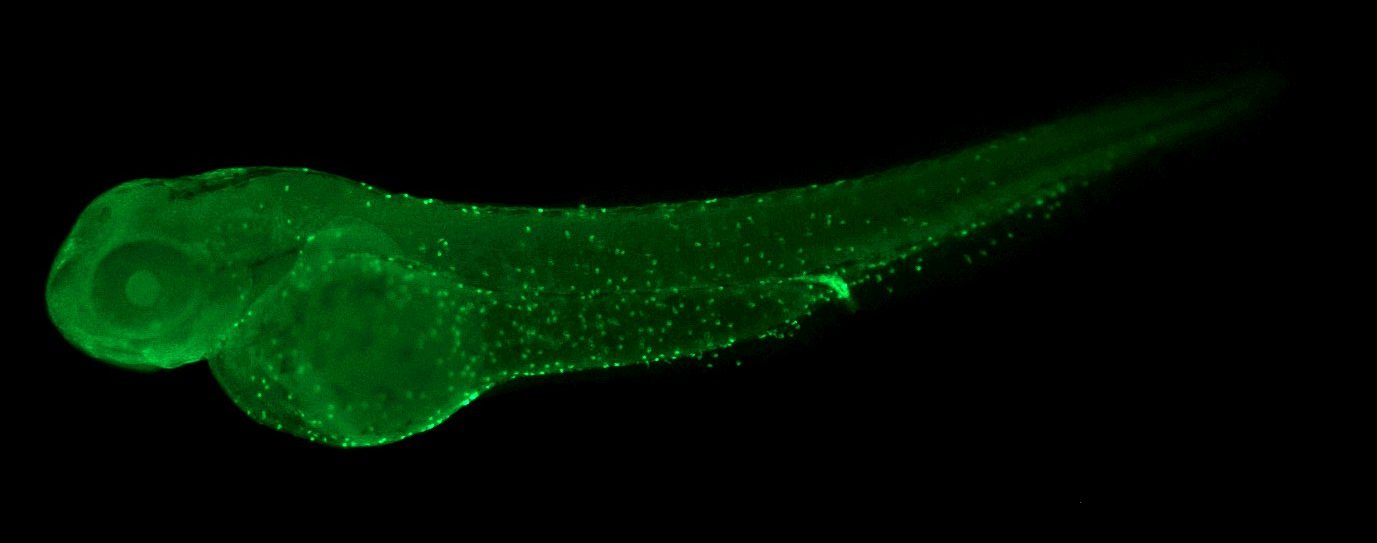
Gross is also turning up compelling results in his research on age-related macular degeneration (AMD), a disease that causes blurred vision and can lead to blindness. His model organism, the zebrafish, has “a remarkable ability to recover from any injury,” Gross says, including the ability to regenerate the type of eye tissue that degenerates in AMD. At early stages of development, the zebrafish eye is similar to the human eye, and zebrafish embryos are transparent, making them easy to observe.

After an eye injury, some zebrafish eye cells revert to stem cells, then develop into the cell type of the injured tissue. In humans, stem cell reversion sometimes happens, but the cells don’t re-differentiate, instead building up and making the situation worse.

Gross’s goal now is to discover the pathways in zebrafish that result in successful regeneration. “That’s the big question,” he says, “What’s the mechanism underlying this response?” Once the pathway is understood in zebrafish, scientists will be that much closer to an effective therapy for AMD.

Gross took a moment during his talk to thank Phyllis Robinson, professor of biological sciences, for making possible his success as a research scientist focused on vision. As a UMBC undergraduate, Gross wasn’t certain of his future as a scientist until he worked in Robinson’s lab. Today, he, Starz-Gaiano, and Lehmann all focus on continuing to expand opportunities for more students to participate in cell research and tap into the excitement of discovering new things about the building blocks of life.

Banner image: Michelle Starz-Gaiano, biological sciences, presents her work on cell migration. All photos by Marlayna Demond ’11 for UMBC.