All posts by: UMBC News Staff


Erle Ellis, GES, in The New Yorker

erle_ellis_2012In response to recent research published in the journal Trends in Ecology & Evolution that argued scientists should spend more time studying apes’ behavior in places where humans are disrupting their lives, Erle Ellis was interviewed for a recent article in The New Yorker about his Anthropocene research. In the article, Ellis, an associate professor of geography and environmental systems, discussed his research on human influence on ecosystems around the world.

“This is the ecology that matters now,” Ellis said. “It’s become the most pervasive context. If you’re interested in working across the span of habitat that species are living in, it’s very likely that most of that habitat is under human influence.” Simply ignoring that fact doesn’t make it any less real. “This process is not slowing down,” he added. “It’s speeding up.”

Ellis also commented on the controversial notion that humans are a legitimate part of an area’s ecology worth studying. “A lot of people feel like that’s kind of giving in—that the idea that we could successfully maintain wildlife in human habitats is going to get people to say, ‘Well, we might as well turn everything into parking lots,’ ” Ellis said.

To read the full article in The New Yorker, click here.

Norman Augustine, USM Board of Regents, Visits UMBC

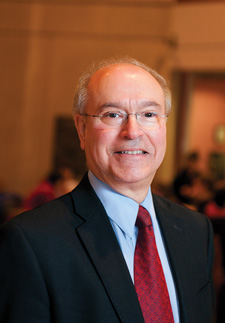
Augustine_Visit-3024On April 9, Norman Augustine, member of the University System of Maryland Board of Regents and former chair and CEO of Lockheed-Martin , visited UMBC to learn more about engineering education and research, as well as technology transfer from universities to the marketplace.

During his visit, Augustine met with President Hrabowski, Julia Ross, dean of the College of Engineering and Information Technology (COEIT), and several COEIT faculty. After Ross spoke about COEIT’s success in producing more IT graduates than any other university in Maryland, Anupam Joshi, computer science and electrical engineering, discussed UMBC’s work in cybersecurity. Penny Rheingans, center for Women in Technology, explained her work with encouraging women in information technology and engineering, and Anne Spence, mechanical engineering, shared her experiences in redesigning courses.

Augustine also toured several laboratories and centers, including the MicroMaterials Characterization Laboratory and UMBC’s Center for Advanced Sensor Technology.

USM Women’s Forum Scholarship and Award Opportunities (6/30 Deadline)

The USM Women’s Forum Student Scholarship (up to $500) is open to all students enrolled/attending a USM institution for the fall semester of the year scholarship application. To be eligible for the award, you must have earned a total of 48 undergraduate OR 9 graduate credits, have a minimum GPA of 3.0 at your USM institution, be a U.S. citizen or permanent resident, and have demonstrated financial need. One scholarship per lifetime.

The scholarship is open to both men and women. Application materials must be received by June 30th in order to be considered for the award.

The USM Women’s Forum Professional Staff Development Award (up to $500) provides funding to eligible staff members currently employed at USM institutions for a minimum of five (5) years cumulative service (with verification of employment supported by the applicant’s USM institution’s Human Resources Department). The USMWF wishes to encourage and enable staff to pursue training and/or professional development activities to enhance current job skills and/or seek career advancement opportunities. Funding can be used for non-credit courses and conferences.

The award is open to both men and women. Application materials must be received by June 30th in order to be considered for the award.

The USM Women’s Forum Faculty Research Award (up to $1000) is designed to provide a funding opportunity for faculty who are pursuing research on women’s experiences: social, scientific, economic, political, and health conditions that impact women. All faculty who hold an academic appointment at any of the USM institutions may apply with preference given to junior faculty members at the rank of assistant professor, research associate, or instructor. In addition, faculty must be within five years of their appointment. Only one proposal per investigator will be considered.

The award is open to both men and women. Application materials must be received by June 30th in order to be considered for the award.

Alumni Perk: Spring Driving Tips

Editor’s Note: This is a message from our partner, Meyer and Associates.

It can happen to anyone. You’re driving along the road, when something happens unexpectedly and your car breaks down. It could be a mechanical issue, a pothole, an obstacle in the road, or even an animal. No matter what causes your car to break down, it’s a scary experience, but one that you should be prepared for. Follow these roadside safety tips if you’re ever in this type of emergency:

Slow down. If you feePrintl a change in your vehicle’s performance, start to decrease your speed, but don’t slam on the brakes. Instead, slowly lift off of the gas pedal and use calm, controlled braking to slow down gradually.

Use your indicators. It’s important to use your four-way emergency (hazard) lights to indicate to other drivers from the very first sign of trouble that you’re slowing down and moving off the road. Be sure to get as far off the road as possible.

Be seen. Any vehicle pulled off to the side of the road near traffic needs lighting, reflectors or other gear to warn oncoming traffic. It’s a good idea to keep a roadside emergency kit in your car that includes reflective triangles that can be used to warn oncoming traffic, particularly at nighttime when visibility is worse.

Call for help. Calling police or first-responders as quickly as possible can also limit your risk; once they arrive they have resources for ensuring traffic safety.

Stay out of the road. It may seem easy to go for your trunk, jack up a flat, or start walking down the road for help, but even when you are safely in the shoulder, you can still be at risk for a collision. If getting out of your car is necessary, always step around the vehicle on the side away from traffic. Never stand by the vehicle in the roadway.

Remembering these roadside safety tips can help keep you and your passengers safe after a vehicle breakdown while you wait for help.

You can also protect yourself, your vehicle, and your belongings with Auto, Home, and Renters coverage from Liberty Mutual via the Alumni Insurance Program.

For more information and free quotes, visit http://meyerandassoc.com/umbc

Up on the Roof – Spring 2015

UMBC President Freeman A. Hrabowski, III takes your questions.

UMBC and the University of Maryland, Baltimore (UMB), have a longstanding relationship that dates back to the founding of UMBC in 1966. Recently the partnership has grown deeper, with increased ties in research and other areas. How important is this relationship between our universities and where is it heading in the future?

– Richard Byrne ’86

Two institutions are rarely as closely connected as UMBC and UMB. That is especially true when you take note of the difference in our ages. UMBC is preparing to celebrate its 50th anniversary, which makes us the youngest campus in the University System of Maryland. UMB was founded in 1807, and is the founding campus of the system.

Yet despite our age difference, we are inspired by the same ideals and we both focus on academic excellence.

One of the reasons this campus was created was to feed students to the professional schools downtown. There was a need for students well-prepared in a variety of disciplines – especially in the sciences for the health professions and in the social sciences and humanities for the law school. So from the beginning we have had students preparing to go to UMB.

While we’ve always had a healthy relationship with UMB, our relationship now is stronger than ever. UMB has a very strong and collaborative president in Jay Perman. We trust each other and hold the same values, and when you have that trust and vision, you can achieve marvelous things. We both have a vision of making this state a better place for all of its citizens.

Secondly, UMB also has cooperative and vibrant academic leaders. UMB’s Chief Academic and Research Officer and Senior Vice President, Bruce Jarrell, works closely with UMBC Provost Philip Rous on several initiatives, including the UMBC-UMB Research and Innovation Partnership Seed Grant Program that encourages cross-campus interdisciplinary relationships. Our Center for Innovation, Research, and Creativity in the Arts (CIRCA) is organizing exciting joint programs with UMB. And Julie Ross, our dean of the College of Engineering and Information Technology, chose to work with President Perman and others at UMB during her prestigious American Council on Education fellowship.

Our relationship is strong because we know each other well. The shuttle bus link that we restored this year between the campuses is very important to that effort. Technology is critical, but I hear of many opportunities that people have taken to build research initiatives between our institutions because of face-to-face meetings.

UMB also plays a role in making UMBC a more beautiful place through the UMB Services Center, which provides construction management support for major projects such as our Performing Arts and Humanities Building and the creation of our new Campus Gateway. It is a rich and collaborative relationship.

To send a question to President Hrabowski, visit www.umbc.edu/magazine

Top Gear – Marla Streb '91

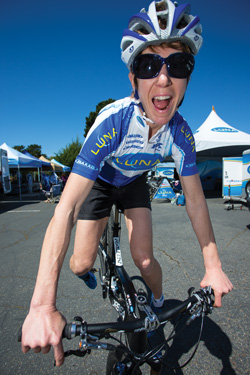
sp15_Alumni-Stories_top-gearIf there were such a thing as extreme sports fairy tales, Marla Streb ’91, M.S., marine estuarine science, would be fairy godmother of that daredevil realm.
Once upon a time, at the relatively advanced age of 28, Streb walked away from a career as an AIDS research biologist and fashioned herself into a world champion mountain bike racer and gravity goddess.
As a career move, it was akin to selling your master’s degree in marine-estuarine environmental science for a handful of magic beans, but Streb made it work – and marvelously.
Before her transformation, Streb rode bicycles as a hobby. She says her commute by bike as a student from her apartment in downtown Baltimore to UMBC was a fun way to exercise and “to maybe help the planet a little bit” along the way.
“I used to ride this demented single speed bike with no brakes back and forth to
campus,” says Streb. “That was really crazy, but also really empowering.”
After completing her degree in 1990, she moved to San Diego to accept a job in the renowned Scripps Research neuropharmacology lab. It was in California in 1992 that Streb discovered a brand-new and rapidly expanding sport: downhill mountain biking.
“The mid-nineties were heady times for professional mountain biking,” recalls Streb. “You’d race a couple times and then all of a sudden people were throwing sponsorship money at you. I quit my job after just a couple of races, and committed myself completely to training and racing. Suddenly, I was making six figures, traveling, riding in World Cup races.”
Streb quickly established herself as a champion, by winning the X Games in 1998 and the Single Speed World Championship in 1999 (and again in 2006), and a World Cup downhill racing title in 2005. She has also shone bright in the media spotlight, posing nude for the cover of Outside magazine in 2000 and riding her bike down the world’s fastest bobsled track in Salt Lake City for the 2003 IMAX movie Top Speed.
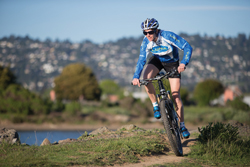
sp15_Alumni-Stories_top-gear2Yet it is Streb’s sustained excellence as a top professional that won her induction into the Mountain Bike Hall of Fame in 2013. Given that she was a decade older than many others in the sport, Streb says the disciplined attention to detail she’d learned in the laboratory helped her “work smarter” than her competitors. Her scientific training also gave her a framework to track her progress and setbacks as a racer, using data to identify weak areas in her performance, and attack those areas with relentless ferocity.
“I value that my advisers and my instructor professors guided me really well, yet did not simply lead me through my education,” says Streb. ”They just showed me what was possible and how everything works, and told me I could do it. And lo and behold, I could!”
Streb’s professional riding career slowed a bit after becoming a mother to Nikolya (now eight years old), and Kiyano (age five). These days, she works as the media liaison for the LUNA Chix women’s professional mountain biking team, and as the safety program coordinator for Bike Maryland – a cycling advocacy group in Baltimore. Streb and her husband, Mike Fitzgerald, are also working to open the city’s first bicycle cafe this year in Harbor East.
Streb still finds power in pedaling, however. Last year, after five years of semi-retirement, she quietly began training again and won three out of the four “national caliber” races she entered in 2014. Streb now spends up to 12 hours per week training – “the bare minimum to be competitive in the sport of mountain bike racing” – and she intends to compete in more races in 2015.
“I never officially announced my retirement,” she says. “I know in my blood I’ll never be completely done with racing.”
– Michelle Gienow

Top Gear – Marla Streb ’91

sp15_Alumni-Stories_top-gearIf there were such a thing as extreme sports fairy tales, Marla Streb ’91, M.S., marine estuarine science, would be fairy godmother of that daredevil realm.

Once upon a time, at the relatively advanced age of 28, Streb walked away from a career as an AIDS research biologist and fashioned herself into a world champion mountain bike racer and gravity goddess.

As a career move, it was akin to selling your master’s degree in marine-estuarine environmental science for a handful of magic beans, but Streb made it work – and marvelously.

Before her transformation, Streb rode bicycles as a hobby. She says her commute by bike as a student from her apartment in downtown Baltimore to UMBC was a fun way to exercise and “to maybe help the planet a little bit” along the way.

“I used to ride this demented single speed bike with no brakes back and forth to

campus,” says Streb. “That was really crazy, but also really empowering.”

After completing her degree in 1990, she moved to San Diego to accept a job in the renowned Scripps Research neuropharmacology lab. It was in California in 1992 that Streb discovered a brand-new and rapidly expanding sport: downhill mountain biking.

“The mid-nineties were heady times for professional mountain biking,” recalls Streb. “You’d race a couple times and then all of a sudden people were throwing sponsorship money at you. I quit my job after just a couple of races, and committed myself completely to training and racing. Suddenly, I was making six figures, traveling, riding in World Cup races.”

Streb quickly established herself as a champion, by winning the X Games in 1998 and the Single Speed World Championship in 1999 (and again in 2006), and a World Cup downhill racing title in 2005. She has also shone bright in the media spotlight, posing nude for the cover of Outside magazine in 2000 and riding her bike down the world’s fastest bobsled track in Salt Lake City for the 2003 IMAX movie Top Speed.

sp15_Alumni-Stories_top-gear2Yet it is Streb’s sustained excellence as a top professional that won her induction into the Mountain Bike Hall of Fame in 2013. Given that she was a decade older than many others in the sport, Streb says the disciplined attention to detail she’d learned in the laboratory helped her “work smarter” than her competitors. Her scientific training also gave her a framework to track her progress and setbacks as a racer, using data to identify weak areas in her performance, and attack those areas with relentless ferocity.

“I value that my advisers and my instructor professors guided me really well, yet did not simply lead me through my education,” says Streb. ”They just showed me what was possible and how everything works, and told me I could do it. And lo and behold, I could!”

Streb’s professional riding career slowed a bit after becoming a mother to Nikolya (now eight years old), and Kiyano (age five). These days, she works as the media liaison for the LUNA Chix women’s professional mountain biking team, and as the safety program coordinator for Bike Maryland – a cycling advocacy group in Baltimore. Streb and her husband, Mike Fitzgerald, are also working to open the city’s first bicycle cafe this year in Harbor East.

Streb still finds power in pedaling, however. Last year, after five years of semi-retirement, she quietly began training again and won three out of the four “national caliber” races she entered in 2014. Streb now spends up to 12 hours per week training – “the bare minimum to be competitive in the sport of mountain bike racing” – and she intends to compete in more races in 2015.

“I never officially announced my retirement,” she says. “I know in my blood I’ll never be completely done with racing.”

– Michelle Gienow

To You – Spring 2015

Richard ByrneAs the university and our alumni begin to plan for UMBC’s 50th anniversary in 2016, those of us who put together UMBC Magazine have been thinking hard about the history of the institution and how we tell its story.

You saw some of the results of that process in our Fall 2014 issue, in which we recalled some of the greatest moments in the history of UMBC athletics. And you’re about to read more about our university’s past in this Spring 2015 issue, as we tell the stories behind some of the most prominent pieces of public art – some now vanished – on our campus. (See “Space in Time,” Page 14.)

But our mission at UMBC Magazine isn’t just to look back at our institution’s history. We’re also here to help our readers understand the university’s present and its future trajectory. That’s why we sat down with UMBC athletics director Tim Hall for his candid assessment of the program and where it is headed in our last issue. And it’s why we’re telling the story behind the latest installation of public art on our campus – Thomas Sayre’s Forum – and the collaborative process between the university and the Maryland Commission on Public Art that helped make it a reality.

The UMBC of today is driven by those collaborations. And its future will be determined by them. That’s why you’ll read about the UMBC researchers who have come together to collaborate with each other – and with fellow researchers at the University of Maryland, Baltimore (UMB) – to help those who have physical disabilities take advantage of technological innovations. (“The Sum of the Parts, Page 22.) And it’s why we talked with UMBC President Freeman A,. Hrabowski, III about the value of the university’s growing partnership with UMB and the historic links between the two schools. (“Up on the Roof,” Page 4.)

We’re also committed to telling you about how researchers at UMBC are looking for new routes into crystallizing and addressing some of the most controversial issues of our time. To mark the 50th anniversary of “Bloody Sunday” in Selma, Alabama, and the passage of the Voting Rights Act, UMBC Magazine talked with Tyson King-Meadows, professor of political science and chair of the university’s Africana studies department, about his work, which asks hard questions about the continuing legacy and unfulfilled promise of that landmark legislation. (See “Rights and Wrongs,” Page 28.)

We are proud of UMBC’s past, and in future issues, we will be asking you to share more of your stories about your experiences at the university. But as we start the journey to commemorate an important milestone in UMBC’s history, we are committed to letting you know about the university’s present and future as well – and hope that you’ll want to be a part of it.

– Richard Byrne ’86

The News – Spring 2015

Walking the Walk

A February 18 visit to UMBC by U.S. Secretary of Education Arne Duncan was a chance to shine a national spotlight on the university’s leadership in innovative teaching and K-12 partnerships.

“Teachers, principals, community leaders, families and the students themselves have helped to bring about some of the biggest and boldest changes in American education in decades to prepare all of our children for college, careers, and life,” said Duncan to an audience that filled the concert hall in the Performing Arts and Humanities Building. “These changes include higher standards, better support for teachers, a powerful focus on improvement in instruction, and underlying all of that, a fundamental conviction that great schools, principals, and teachers can and do transform the lives of our children.”

Duncan also highlighted UMBC’s strength in preparing the next generation of teachers and praised the university’s Choice Program and its continuing work to empower at-risk youth and families.

Following his prepared remarks, Duncan participated in a wide-ranging discussion with UMBC President Freeman Hrabowski. America’s top education official praised UMBC for investing in course redesign and innovative teaching, and for the university’s commitment to changing the broader culture of education.

“You’re not just talking about this, you’re living it. You’re walking the walk,” said Duncan.

Supporting students’ educational progress through partnerships has been a special emphasis at UMBC. The university serves as a pipeline for K-12 teachers at a critical time for schools across the nation, and it offers a wealth of training and support opportunities, including the Sherman STEM Teacher Scholars Program and the TEACH (Federal Teacher Education Assistance for College and Higher Education) Grant Program.

The Sherman STEM Teacher Scholars Program identifies and nurtures students seeking to become math and science teachers serving high-need communities. “The Sherman program teaches UMBC students to be empathetic to the complexity of students’ situations, while still serving as teachers who help them grow academically,” says Rehana Shafi, director of the program. About 75 percent of the Sherman program’s graduates go on to teach students in communities that are financially challenged.

The TEACH Grant Program provides grants of up to $4,000 a year to students who are completing or plan to complete course work needed to begin a career in teaching. Students commit to teaching in a high-need field at an elementary school, secondary school, or educational service agency for at least four full academic years within eight years after completing (or ceasing enrollment in) their course of study.

UMBC’s efforts square with one of Duncan’s key points of emphasis on his visit. Americans and their education officials need to stop drawing lines between K-12 and college, and think of education as a continuum.

“Today, school should mean preschool through a postsecondary degree. What worked for the past 100 years I think is insufficient as we move forward,” Duncan said. “What’s really striking is that in places that have shown the most courage and commitment to these changes, those places have seen the most progress.”

– Max Cole and Eleanor Lewis


Promoting Policy

Public Policy 40th Anniversary Graphic, ColorUMBC’s public policy program has been among the most prominent research engines at the university. And on the occasion of the program’s 40th anniversary, UMBC officials announced that it would now become the School of Public Policy.

The announcement was made at a November celebration of the program’s legacy, with Maryland Governor Martin O’Malley giving the keynote address.

The UMBC Policy Sciences Graduate Program was conceived in 1974 as a novel interdisciplinary program. It initially had no dedicated faculty or budget. The School of Public Policy now boasts ten full-time faculty and more than 30 affiliated faculty from economics, education, history, sociology, and political science. It is home to more than 130 students and has $23 million in active research grants.

Donald Norris, professor and director of the School of Public Policy, says that a key to the program’s success has been its focus on policy research impacting Maryland – including studies on gambling prevalence in Maryland, ambulance response times for heart attack victims, efforts to prevent asthma in children who live in low-income households, and implications of Maryland’s Dream Act.

The school’s faculty also maintain strong connections with state and local governments, and bring those connections into the classroom as they involve students in their research.

“We have two really important dimensions,” explains Norris. “We teach students about how public policy is made, and we teach them how to analyze public policy and its impacts.”

– Max Cole


In Command

sp15_NEWS_in-commandThe president of Portugal has honored Antonio “Tony” Moreira, vice provost of academic affairs and professor of chemical and biochemical engineering, with one of the country’s highest awards: Commander of the Order of Public Instruction.

Ambassador Nuno Brito formally bestowed the honor upon Moreira on February 25 at the Portuguese Embassy in Washington, D.C. The ceremony was attended by many of the vice provost’s colleagues in academic leadership, including UMBC President Freeman A. Hrabowski, III.

At the event, Moreira discussed how he works to foster connections between UMBC and Portugal. “In my almost 25 years working at UMBC… I have felt that I need to support the youth of Portugal and provide them opportunities,” he said.

The Commander of the Order of Public Instruction is given to distinguished individuals from the Portuguese diaspora community to commemorate the National Day of Portugal, which is celebrated annually on June 10.

Hrabowski praised Moreira’s work at UMBC during the ceremony. “Portugal has a rich tradition of exploration and of working across cultures,” he said. “Tony’s efforts to expand international opportunities for UMBC students clearly reflect this tradition. It’s very fitting that he was selected for this honor.”

– Richard Byrne ’86

Space in Time

As UMBC celebrates its newest work of public art, we look back at the university’s legacy of public works on campus.

By Lindsey Loeper ’04 and Richard Byrne ’86

One of the key elements of UMBC’s history as a campus has been the institution’s search for a definition of its mission and purpose. Founded in the blossoming of a baby boom generation of students in Maryland and beyond that needed more teachers, classrooms and desks to fulfill the dreams of a college education, the university was buffeted by the same cultural, economic and political forces faced by the state and the country as a whole. And UMBC faced these challenges as a young university still putting down roots.

These roots have taken hold now, and strengthened. UMBC has grown into a celebrated research university. And though the heart of UMBC’s work as a successful public research university takes place in the minds and hearts of its students, alumni, faculty and staff, the outward appearance of our campus does matter – and also tells a significant story.

In a recent interview with UMBC’s Alumni blog, Julie Kuhn Sanchez ’10, media & communication studies and visual arts, recalled how her grandfather, UMBC’s first chancellor, Albin O. Kuhn, helped define the shape of the campus’s Hilltop Circle by riding around in circles on a tractor. And the architecture first built within that loop road was very much of its time. Built with a bricks that nodded to the foundations of America’s oldest campuses, UMBC’s planners fashioned them into shapes much more angular and modern.

As the university and its ambitions have grown, its architecture and campus aesthetics have become more ambitious. UMBC President Freeman A. Hrabowski, III has crusaded to make the campus a greener place, and not only in terms of its climate impact. The newer buildings on campus nod to UMBC’s brick origins, but push that very familiar look into new vistas of glass and metal. It is an evolution one glimpses easily in UMBC’s now-complete Performing Arts and Humanities Building.

That vision is also articulated in Forum – a public artwork by North Carolina-based artist Thomas Sayre thatsp15_CC_PAHB_Campus was commissioned to accompany the opening of the Performing Arts and Humanities Building. The work is a series of eight earthcast arches that converge at a meeting point where granite blocks, smoothed on top for more comfortable seating but otherwise hewn roughly, are gathered.
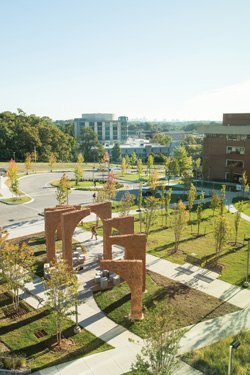
UMBC has a long history of distinctive public artworks on campus. Some have disappeared from view over time. Others have become icons of the university. But the process behind the concept and execution of “Forum” was different in several key aspects.

For instance, Forum was the first project completed as part of the Maryland Public Art Initiative (MPAI). Passed by the state legislature and signed into law in 2013, the MPAI requires all new state construction and renovation to integrate public art into the planning and building process. UMBC eagerly became a test case for the new initiative, and a committee of 13 members of the faculty, academic leaders and officials from the Maryland Commission on Public Art sat on the selection committee.

Timothy Nohe, a professor of visual arts and the founding director of UMBC’s Center for Innovation, Research and Creativity in the Arts (CIRCA), says that the search for the right artist and the execution of Sayre’s vision on an accelerated timetable required close collaboration between academic leaders, state officials, and the campus as a whole. The committee met with all of the university’s shared governance bodies and created a set of questions that quickly shaped themselves by consensus into the themes which Sayre and other artists who applied for the commission found compelling.

“The campus really found its voice in the process,” Nohe says.

The request for proposals circulated by the university had a galvanizing effect on Sayre, who was selected in March 2014 as the project artist. “It was the best-written one I’d ever encountered,” he says. “It was willing to say something about the hopes and dreams for the art in front of the building…. It immediately captured my imagination.”

Sayre says that the elements of a cloister, which are clearly articulated in his design for Forum, “hearken back to the origins of the university in ecclesiastical places, and the origins of the [academic] disciplines in those buildings.” The design of the piece will allow for performances as well as reflection, yet the artist notes that Forum resists a simple relationship between spectator and performer.

“The way the seating is created, “Sayre says of the stones of varying height and distance place at the center of Forum, “it becomes a terrain.”

Sayre’s choice of materials – earthcast arches and granite seats – also summons up something even more ancient and essential: the relationship between humans and the space they inhabit. The physical process of earthcasting itself underscores what the artist observes are “relationships between humans and the earth. When you dig a mold into the earth, there is the establishment of a balance between human intentions and the grain of nature itself.”

Forum has already hosted some gatherings and other performances, including a reading of Homer’s Odyssey in December. It seems certain to become yet another key gathering point for the UMBC community as the campus grows – and a model for public art’s future on campus.

Nohe says that the success of Forum will offer new chances to mark UMBC’s physical growth and its deeper vision of itself. Future buildings on campus (including a planned Life Sciences building) will have a similar public art requirement, he observes. The next installations of public art at UMBC will offer “an opportunity to make a clear statement of our values, and an opportunity to point to ourselves as a mature campus.”

A Brief History of Public Art at UMBC

Many of the prominent public art projects on campus are still on view. Others have disappeared. Here are some selected highlights of artistic expression in the public spaces of campus.

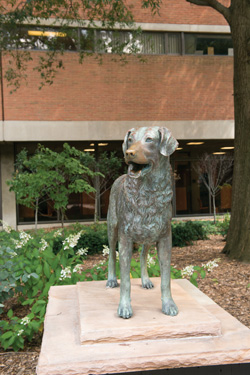
sp15_CC_SpaceInTime_Art-True_Grit-a(A) Perhaps the most iconic piece of public art on campus, the bronze statue of UMBC’s Chesapeake Bay Retriever mascot – True Grit – has been a focal point of the university community since UMBC President Michael Hooker commissioned the work in the late 1980s. The statue – created by alumna Paulette Raye ’87, philosophy, will be moved later this year and rededicated as a centerpiece in the university’s new gateway to campus. As UMBC President Freeman A. Hrabowski, III recalled to UMBC Magazine in 2012: “If you asked [Michael Hooker] what he did at UMBC that really mattered, he’d say that he wanted that dog out front. As a symbol.”

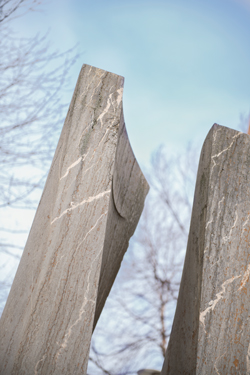
sp15_CC_SpaceInTime_Art-helix-b(B) One of the earliest pieces of public art remaining on campus is Double Helix, a work in Tennessee Black Marble situated at a prominent spot in front of UMBC’s Administration Building. It was created by former UMBC student Robert DuBourg, and it was purchased by the university and installed circa 1978.


sp15_CC_SpaceInTime_Art-sondheim-c

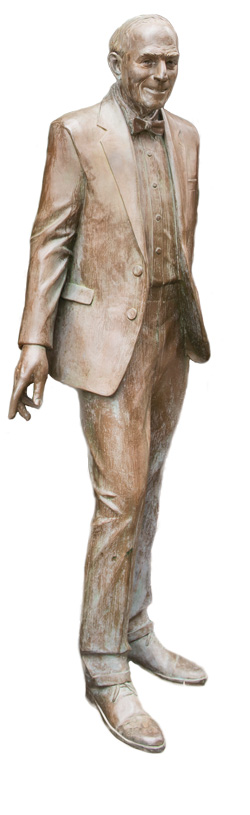
(C) When does public art also become a university meme? A life-sized statue of businessman, philanthropist and pioneer in school desegregation Walter Sondheim, Jr. stands directly outside the UMBC building named for him and his wife, Janet. The statue was created by Maryland artist Antonio Tobias Mendez and was unveiled in 2005 to celebrate the endowment of the Sondheim Public Affairs Scholars Program. The statue became the subject of a light-hearted student blog later that decade called “Walter Sondheim is Smoking,” in which photos of the statue were posted with cigarettes placed strategically in one of Sondheim’s hands. Though that meme eventually lost steam, that statue and the benches around it – with words of wisdom from Sondheim carved into them to inspire the campus community – has become a key meeting spot at the heart of UMBC.


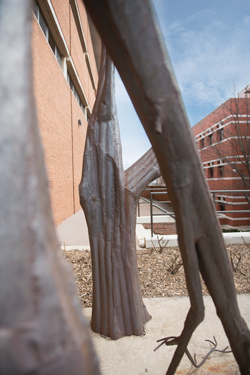
sp15_CC_SpaceInTime_Art-Mneumonic-d(D) One of the most poignant pieces of public art on campus is Mnemonic by artist Marc O’Carroll, which is situated at the rear of the campus’ Fine Arts Building. According to a September 13, 1976 story in The Retriever Weekly, the piece was made in UMBC’s art studio and was meant to commemorate “a huge and ancient sycamore” that once stood behind UMBC’s Dining Hall and was chopped down to make way for a service driveway. “O’Carroll carried the memory of that sycamore with him until the day the school commissioned him to do a sculpture for the new Fine Arts building,” wrote Bernard Penner ’77, English. “Painstakingly he welded his memory into steel and now it stands on display for all to see. The tree is gone and so is Marc O’Carroll but the Mnemonic carries on.”

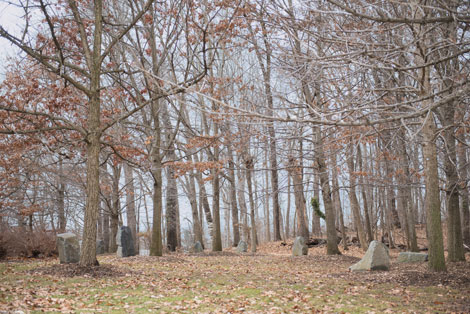
sp15_CC_SpaceInTime_Art-Beuys-e(E) While Mnemonic depicted a UMBC in conflict with nature, one of the most prominent public art projects at the university – The Joseph Beuys Sculpture Park – is a grand effort to promote harmony between the environment and the university. Created in 2001-02, the collection of thirty rocks and tree plantings in the park was inspired by artist Joseph Beuys’ transformation of the German town of Kassel by the planting of 7,000 oaks. The park provides a quiet and contemplative space at the heart of the campus, with benches and paths that invite meandering and reflection.

sp15_CC_SpaceInTime_Art-Entropy-Micro-f-final

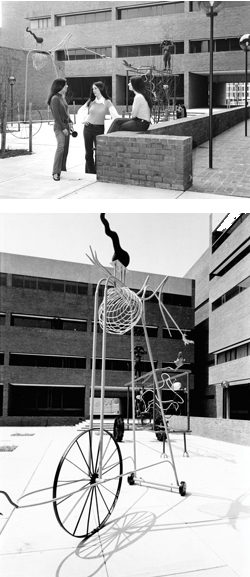
(F) Some of UMBC’s most notable public art from its earliest days has vanished from view. Today, the courtyard tucked beside the Meyerhoff Chemistry Building is usually quiet and peaceful, but in the university first years, it was a place where students came together for various performances and protests. The courtyard was dominated in that era by two large sculptures by local artist Pat McGuire – a large, metal sculpture including animals (a kangaroo and birds), a large wheel, and a moving element that operated like a windmill called “Entropy Machine No. 7,” and a green sculpture called “Micro Mantis.” The latter piece, wrote Bernard Penner in the March 10, 1975 edition of The Retriever Weekly, hearkened back to a time when UMBC “was a peaceful woods through which Indians ran and praying mantises thrived.”
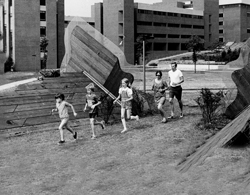


sp15_CC_SpaceInTime_Art-winged-g(G) Another piece of public art that has vanished from UMBC was a large installation near the library erected in the early 1970s by Maryland Institute College of Art professor Ron Grow called “Winged Earth.” The work spanned 80 feet of a sloping grassy hillside near the Albin O. Kuhn Library, and was described by The Retriever Weekly as a formation of “two walls which converge to a center point, then open outward into two large wings of graded earth.” The work was created as part of a series of collaborations between campus and local artists organized by visual arts professor Patrick Canavan.

Portions of this article were first featured in a post by author Lindsey Loeper on UMBC’s “Breaking Ground” website.

Narrative Arc – Stephen Morgan ’72

Sometimes a person’s journey to become one of the state’s most effective CEOs is surprisingly direct.

Take Stephen Morgan ’72, psychology, who is the executive director of The Arc Baltimore. Morgan began his career at the organization as an undergraduate, teaching at a summer camp for disabled adults.

Fast forward to 2014, and the Maryland Daily Record names him as one of “Maryland’s Most Admired CEOs.” It’s an achievement that Morgan observes is as much about the organization as it is about his leadership.

“The award is flattering,” he says, “but what I like is that it’s for the ‘most admired.’ It’s not just about what we do, but how we do it. It’s really about all of us at The Arc, not just me.”

Headquartered in Towson, The Arc now has 10 state chapters. The organization provides employment training and support, residential services, family support and education, treatment foster care, respite care, public policy advocacy and information and referrals for over 6,000 people with intellectual and developmental disabilities.

Morgan knew early on that he wanted to teach or work in human services. He transferred to UMBC in his sophomore year as a psychology major. As a member of one of UMBC’s first graduating classes, what Morgan remembers is the community atmosphere and direct access to faculty.

Recent visits to a fast-growing campus haven’t changed his view of the UMBC experience “It was a much smaller campus then,” says Morgan, “but even with more people and buildings, UMBC still has that warm, inviting atmosphere, that student-centered feeling.”

Morgan eventually completed all of the coursework for elementary school education as well as his degree in psychology.

“I felt that my academic training would prepare me to enter a variety of fields,” he recalls, “and even now I still come back to what I learned at UMBC – those fundamentals of psychology and education.”

Morgan felt a connection with the adults at the camp where he taught as an undergraduate, and joined The Arc (then known as the Baltimore Association for Retarded Citizens) full time after graduation as a teacher at one of its child development centers.

It was a historical moment – just a few years before the Equal Education Opportunities Act (EEOA) of 1974 was signed into law – when The Arc’s programs were one of the few educational options for disabled children. They could not attend public school, and after age 18 they were often institutionalized. Adults also had few, if any, chances for education or job training.

“The students I taught didn’t learn as easily or in a conventional fashion, but they were still able to learn, just at a different rate and in a different way,” Morgan explains.

Morgan was a program manager overseeing four child development centers for The Arc when the landmark federal legislation passed. He served as a liaison, helping to transition children into public schools. “The children who had been at The Arc had a much easier time acclimating because of the education they received with us,” he says.

Amid rapid increases in opportunity for the community he served, Morgan worked in training, curriculum development, and management positions at The Arc over the next two decades. By the time the Americans with Disabilities Act (ADA) passed in 1990, securing significant job training and employment programs for the disabled, he had been executive director for five years.

“The ADA was more like an omnibus civil rights bill that supported independence and integration,” says Morgan. “It established the rights of individuals to have access to the same public and private resources everyone else does, including access to transportation support, and it asked employers to find ways to adapt their workplaces for disabled workers. These changes helped the disabled become less isolated and more a part of their communities.”

Morgan says that he’s welcomed the opportunity to make the story of The Arc his own story throughout his professional life.

“It’s often considered an anomaly now,” he says, “to stay at the same organization your entire career. But I had the good fortune to have opportunities for advancement and new challenges at The Arc just when I was ready for them.”

– Eleanor Lewis

How To – Spring 2015

Build a Major League Sports Museum

With Mike Gibbons ’75, English
sp15_HOWTO-Sports_Museum-Mike_Gibbons-5258
sp15_HOWTO-Sports_Museum-Mike_Gibbons-5361

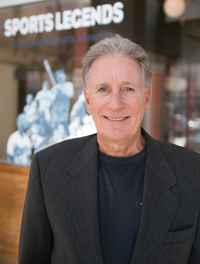
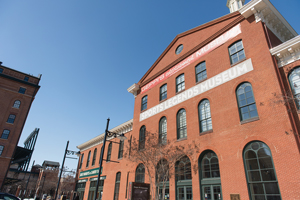
Mike Gibbons ’75, English was making a film about baseball in 1981 when a research expedition led him to Baltimore’s Babe Ruth Birthplace Museum. He liked the place so much that he stuck around – first as a volunteer, then rising to become the institution’s executive director.
Thirty-two years later, Gibbons’ vision now spreads over two downtown sites. Visitors to the Babe Ruth Birthplace can still stand in the very room where the Bambino was born. But since the creation of The Sports Legends Museum and Maryland Sports Hall at nearby Camden Yards in 2005, visitors are charmed by an institution where champion duckpin bowlers and collegiate lacrosse stars are celebrated along with the greatest players from the region’s professional sports teams.
So how did Gibbons transform a small, semi-obscure birthplace attraction into a major league museum destination?
Step 1: SCORE DONATIONS OF COVETED SPORTS MEMORABILIA
The current superheated market for sports memorabilia makes it difficult for museums to purchase items for their collections. So how do you persuade the owner of a valuable Brooks Robinson-autographed baseball to give it the museum instead?
It’s all about relationships, says Gibbons.
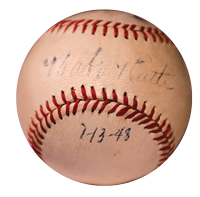
The museum has strong ties with the Orioles, Ravens, Baltimore Blast soccer team, and every other regional sports organization, professional and collegiate, so items such as a signed Ray Lewis jersey or Cal Ripken’s cleats come courtesy of the clubs. Families of locally-based sports legends like Johnny Unitas also tend to remember the collection generously when settling an estate.
But Gibbons also delights in the donation of obscure items, which he says come by “constantly connecting and reconnecting” with people. Case in point: The original lyrics to “Thank God I’m a Country Boy” – scrawled in pencil on a torn-out sheet of notebook paper – came to the museum through Gibbons’ relationship with the song’s writer, John Martin Sommers. The 1970s country hit is, of course, the long-standing soundtrack to every seventh inning stretch at a Baltimore Orioles’ game since God was in short pants. John Denver made the song famous, but Sommers actually penned the song when he was the musician and actor’s fiddle player.
Step 2: CHOOSE YOUR ARTIFACTS CAREFULLY
Since there are many more artifacts than the museum has the capacity to store and display, Gibbons says a grateful “no thank you” to many proffered donations. The trick, he explains, is to gauge an item’s outright historical significance against its ability to evoke “emotional experiences” for visitors.
“We are looking for things that specifically tell the story of real deal Baltimore sports,” says Gibbons. So a jersey signed by Cal Ripken (there are plenty of those in existence, it turns out) may not be as valuable to the museum as a worthless-looking hunk of wood currently in storage that happens to be the bench from the 1959 Baltimore Colts victory over the New York Giants in the NFL Championship game at Memorial Stadium.
The heart of the museum is a vault where temperature, light and humidity are minutely calibrated for ideal preservation conditions. Exactly three people have access to this room, all the better to ensure the safekeeping of $10 million worth of items that are either fragile or just small and easily pocketed.
Step 3: MAKE YOUR MUSEUM A LOCAL AND NATIONAL DESTINATION
“Baltimore has such an incredible sports history,” says Gibbons. “The museum sort of sells itself just by existing.” Its location near the city’s two major sports stadiums also ensures significant foot traffic on game days. However, as curator and director, Gibbons has put in a great deal of effort to making the museum’s draw both broad and deep.
Beyond the sure-fire bling of Super Bowl championship rings and World Series trophies, there’s also a gallery featuring the sports triumphs of local college and prep school teams, including the UMBC Retrievers. The official Maryland Sports Hall of Fame, housed on the museum’s lower level, celebrates the achievements of the state’s native-born athletes and all-stars.
Among the museum’s most popular features is an interactive exhibit where young athletes can put on authentic uniforms for Orioles baseball, Ravens football, and Maryland Terrapins basketball teams, try out equipment, even take a swing in the Orioles’ 2004 on-deck batting circle. “Schools come for field trips, kids get a taste and drag their parents back for more later,” he explains.
Gibbons says his approach comes down to something he learned from his writing instructors at UMBC during his undergraduate years: We are all storytellers.
“At the end of the day, a collection of objects is only that – people look once and then keep walking,” explains Gibbons. “But when you use those objects as part of exploring a greater story, that is where fascination begins.”
– Michelle Gienow

By the Numbers

Number of visitors to museum each year: 60,000
Size of museum collection in 2015: More than 10,000 items
Value of Babe Ruth Birthplace and Sports Legends Museum collections: $10 million
Number of audio-visual presentations in museum: 64 (all of them scripted by Gibbons)