All posts by: UMBC News Staff


UMBC Biological Sciences Faculty Explain Benefits of Active Learning in Nature News

Sarah LeupenSeveral UMBC biological sciences faculty and staff were featured in a Nature article on July 15 about the benefits of active learning in science courses. Neuroscientist Sarah Leupen was quoted in the story and described a question that spurs interesting discussion in her introductory physiology class: You’re innocently walking down the street when aliens zap away the sensory neurons in your legs. What happens?

“We usually get lots of vigorous debate on this one,” said Leupen, who spends most of her class time firing such questions at her students. “It’s lovely to experience.” Leupen said the students grapple with the material they learn by discussing the options in teams. And if a team gets a question wrong, she says, “that’s usually a good thing — because then they really remember it.”

Jeff LeipsJeff Leips, a professor of biological sciences, is also quoted in the article and said it requires compromise to get past simply communicating factual knowledge covered in a course. “You have to accept that you can’t cover everything to the same level,” he said.
Linda Hodges, a biochemist and head of the Faculty Development Center at UMBC, is the author of a forthcoming book on overcoming obstacles to education reform. She noted that for many scientists, active learning can be at odds with their beliefs about teaching content and the factual knowledge covered in a given course.

Read “Why we are teaching science wrong, and how to make it right,” in Nature.

Pres. Hrabowski Looks to Baltimore as City of Hope in Face of Growing Inequality

President Hrabowski penned an article for the Washington Post this week reflecting on societal inequalities. Drawing on his experiences in the Civil Rights Movement, he compares the struggles of today’s society to challenges present in the 1960s.

hrabowski“I am stunned and saddened by the growth of inequality in our society and the fact that many children have simply stopped dreaming about the future,” Dr. Hrabowski wrote as he recounted how many families are stuck in poverty and gains in post-secondary education are unevenly spread. “Yet I also remind myself how far we’ve come,” he continued. “If we don’t count our progress, we lose sight of the lessons we’ve learned, and we run the risk of losing hope.”

Dr. Hrabowski pointed to Baltimore as a place to find hope, saying “I’ve lived and worked here the past 40 years, and I see the many ways this region reflects the country’s progress and its challenges.” Describing Baltimore as a prosperous city with a number of African-Americans in leadership roles, he also recognized the city’s challenges with high unemployment and poverty rates.

“The challenge now is to reflect on how we can extend the gains of the past 50 years to even more Americans,” Dr. Hrabowski said. “We now have the opportunity — indeed, the responsibility — to look again at public policies in such areas as education and job training, housing and transportation, drug enforcement and incarceration.”

Read “Need a reason to believe there’s hope for racial progress? Look to Baltimore” on the Washington Post.

Building a community through art

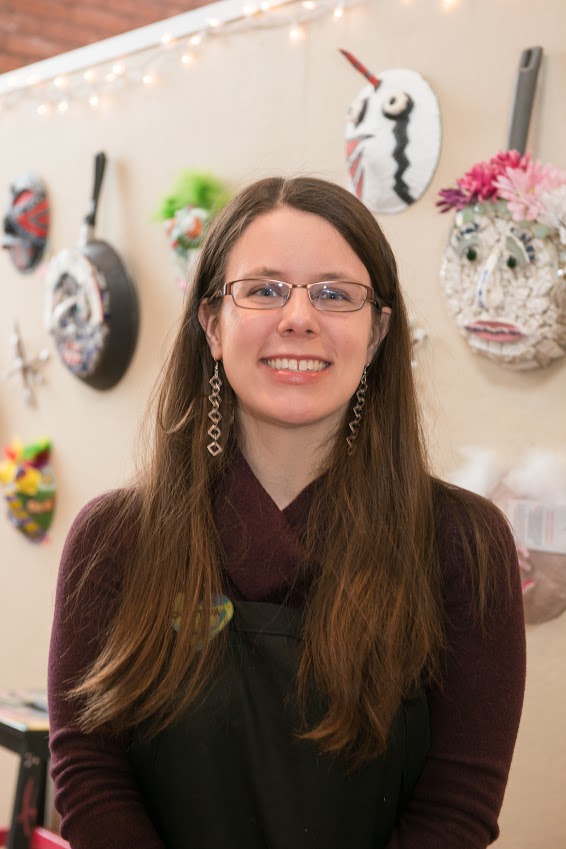
Christina_Ralls-0173If you met Christina Ralls ‘07, visual arts, in her office at Art With a Heart and saw how effortlessly she interacted with the huge cast of charities, non-profits, and community members that liven up HeARTwares, Art With a Heart’s social enterprise and marketable art store, you probably wouldn’t expect that when she arrived at UMBC from eastern Maryland, she was a shy, quiet introvert.

And, if you saw how enthusiastic she was to make art with the countless Baltimoreans she comes into contact with, you probably wouldn’t expect that she started off as a computer science/visual arts double major, either. “I actually wanted to work on video games,” Ralls says, “I thought working behind a computer screen suited me better.”

But, despite her tendency toward introversion, Ralls is thoroughly dedicated to Art With A Heart’s mission to enhance the lives of people in need through visual art. She’s also enamored with the idea of community, so much so that her time at UMBC can be seen as one headlong dive into greater and greater connection.

Ralls first pushed herself to become more involved with campus life: she joined the Student Government Association, was elected president of the Visual Arts Council, helped develop Art Week, was an Imaging Research Center fellow, and she even installed an interactive sculpture at the Baltimore Museum of Art with undergraduate research funding. And, as her connection to the UMBC community grew, so did her appreciation for the interdisciplinary culture in which she found herself increasingly ensconced. “I’m incredibly indebted to the entire Visual Arts department [and the IRC],” Ralls says. “They were all great arts advocates and very community-minded in their work.”

Continue reading “Building a community through art” →

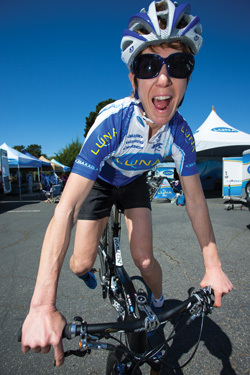
Top Gear: Marla Streb ’91, M.S., Marine Estuarine Science

Marla StrebIf there were such a thing as extreme sports fairy tales, Marla Streb ’91, M.S., marine estuarine science,would be fairy godmother of that daredevil realm.

Once upon a time, at the relatively advanced age of 28, Streb walked away from a career as an AIDS research biologist and fashioned herself into a world champion mountain bike racer and gravity goddess.

As a career move, it was akin to selling your master’s degree in marine-estuarine environmental science for a handful of magic beans, but Streb made it work – and marvelously.

Before her transformation, Streb rode bicycles as a hobby. She says her commute by bike as a student from her apartment in downtown Baltimore to UMBC was a fun way to exercise and “to maybe help the planet a little bit” along the way.

“I used to ride this demented single speed bike with no brakes back and forth to campus,” says Streb. “That was really crazy, but also really empowering.”

After completing her degree in 1990, she moved to San Diego to accept a job in the renowned Scripps Research neuropharmacology lab. It was in California in 1992 that Streb discovered a brand-new and rapidly expanding sport: downhill mountain biking.

Continue reading “Top Gear: Marla Streb ’91, M.S., Marine Estuarine Science” →

Maryland Unites: UMBC Community Service Leave

University System of Maryland (USM) Chancellor Robert L. Caret announced that the USM community will participate in Maryland Unites: Day of Service, an initiative for state employees to offer their time and talents through community service. The campaign, established by Md. Governor Larry Hogan in June 2015, offers state employees the opportunity to become involved with helping communities throughout Baltimore and Maryland.

Though USM has its own personnel system, Chancellor Caret has committed the system to taking an active role in this initiative. UMBC will grant eight hours of paid leave (coded as Community Service Leave) to all full-time, leave-eligible employees interested in participating in the program. Employees may choose to volunteer at a non-profit, non-partisan accredited 501(c)(3) organization on any scheduled workday between now and the end fiscal year, June 30, 2016, including the upcoming Maryland Unites program designated days (July 15, July 29, August 12 and August 26). Please visit the Human Resources website for specific guidelines to the UMBC Community Service Leave Program.

We encourage you to use Maryland Volunteer Centers and the Maryland Charities Database for an extensive list of non-profit organizations and charities. You may also contact the Shriver Center and The Choice Program at UMBC for additional volunteer opportunities in Baltimore and Maryland.

Questions regarding Community Service Leave should be directed to Sherrell McNamara, mcnamara@umbc.edu or 410-455-3646.

UMBC: Seeking Out the Unexpected

Seeking Out the Unexpected

UMBC’s newest prestigious scholarship recipients reflect on the “remarkable gift” of an international experience.

In 2012, Kate Witt ’13, M.A., intercultural communication, became UMBC’s first master’s student to receive a Boren Fellowship. She travelled Brazil to study how non-governmental organizations work with Bolivian immigrants using the Portunhol language, a hybrid of Spanish and Brazilian Portuguese. This year, Witt has received a prestigious Fulbright research award to explore the use of Portunhol in Paraguay as the language evolves through social media. She shares, “I want to be there creating user-friendly systems while simultaneously aiding in preservation of local language through technology. Fulbright offers that opportunity and more.”

Witt is one of seven UMBC students and recent alumni awarded Fulbright grants this year, setting a new record for the university. Three students received English teaching assistantships: Tyler McCafferty ’15, cultural anthropology and environmental studies (Malaysia); Stevenson Ramsey ’14, political science (Indonesia); and Stephen Moore ’15, computer engineering and mathematics (Poland). Four students were awarded research grants: Patrice Matthews ’15, environmental studies (Ecuador); Witt (Paraguay); Cheryl Camillo, Ph.D. student in public policy (Canada); and Jared Margulies, Ph.D. student in geography (India). This year marks the first year that UMBC Ph.D. students have won Fulbright awards to conduct research abroad.

The Fulbright program recognized an additional eight UMBC students as finalists. They include Kelsey Krach ’14, anthropology (Spain); Martha Robichaud ’15, theatre (United Kingdom); Sarah Koolbeck ’15, Asian studies (South Korea); Charlotte Keniston ’14, M.F.A. (Mexico); Rachel Rettaliata ’14, history (Moldova); Ruth Blusiewicz ’15, English and political science (Slovakia); Kymberly Peters ’15, visual arts (Czech Republic); and Molly Bradtke ’14, English, history, and Asian studies (Taiwan).

The Fulbright program is sponsored by the U.S. government to increase mutual understanding between Americans and citizens of other countries. As the government’s flagship international educational exchange program operating in over 160 countries, Fulbright awards English teaching assistantships and research grants to graduating college seniors, graduate students, and young professionals.

Fulbright award recipients are selected for their academic or professional achievement, as well as demonstrated leadership potential in their fields. The experience is also incredibly beneficial for recipients’ future career advancement. Brian Souders, associate director of International Education Services and UMBC’s Fulbright program advisor, reflects, “It gives students that leg up, knowing they’ll be always recognized as a Fulbright scholar.”

UMBC President Freeman Hrabowski recently spoke to International Educator magazine about how study abroad experiences can lead to successful and meaningful careers. Recalling his semester at the American University in Cairo, he discussed how his time in Egypt shaped his perspective as an educator. “I’m always working with colleagues to create a culture that’s welcoming,” he says, “and we’re always encouraging both our American students and our students from other countries go beyond their comfort zones.”

Bambi Chapin, associate professor of sociology and anthropology, received a Fulbright research award to Sri Lanka as a Ph.D. candidate in 1999. She spent nine months studying parenting, political violence, and religious beliefs in the country and eventually wrote Childhood in a Sri Lankan Village (2014) based on that and subsequent research experiences. “Without that initial Fulbright fellowship and the opportunity to immerse myself in everyday life in Sri Lanka, I would not have had the career or the perspective or the family that I have now,” Chapin shares.

Camillo, one of UMBC’s first Ph.D. students to receive a Fulbright award, plans to follow in Chapin’s footsteps, using the next year to pursue a promising line of research into health policy reform in Canada. “During my fellowship, I hope to develop a very strong working knowledge of how provincial health insurance programs operate, as well as how they interact with national and local levels of government,” she says. “I am determined to experience and absorb as much as I can, professionally and personally.”

As an English teaching assistant in Poland, Moore is also excited to jump right into the Fulbright experience. “I love…seeing new places and sharing my knowledge with others, but nothing compares to the conversations you have with locals while living abroad,” he says.

UMBC students will also be traveling the world this year as participants in the Lindau Nobel Laureate Meeting and recipients of Gilman International Scholarships.

Akua Nimarko ’15, biological science and psychology, and Subramani Swaminathan, a post-doctoral researcher in chemistry and biochemistry, were invited to attend the distinguished Lindau Nobel Laureate Meeting in Germany, which brings together Nobel Prize winners and promising young researchers from all over the world.

The competitive Gilman International Scholarship Program offers traditionally underrepresented students grants to study and complete internships abroad. This year’s recipients include Lia Adams ’17, sociology and psychology; Lisa March ’17, Asian studies; Alicyn Curtis ’16, Asian studies and modern languages, linguistics, and intercultural communication; Benjamin Fosbaugh ’17, global studies, economics, and political science; and Megan Derosa ’16, psychology.

For all UMBC students who are traveling the globe through prestigious awards and other study abroad opportunities, President Hrabowski’s words ring true: “It’s so important to understand what it means to immerse yourself in another culture. […] Students who do that are never quite the same.”

As a thankful Fulbright recipient, Moore agrees: “Broadening your view of the world is the most remarkable gift that you can receive from international experiences.”

(7/2/2015)

© University of Maryland, Baltimore County • 1000 Hilltop Circle, Baltimore, MD 21250 • 410-455-1000 •

Kate Drabinski, Gender and Women’s Studies, Discusses Public Representation of the Civil War in Md. on WYPR

Kate DrabinskiKate Drabinski, lecturer of gender and women’s studies, was a guest on WYPR’s Maryland Morning on July 10 to discuss how slavery and the Civil War is represented in public spaces in Maryland. Drabinski was joined by Karsonya (Kaye) Wise Whitehead ’09, Ph.D. LLC, an assistant professor in the department of communication at Loyola University-Maryland.

The discussion helped listeners think about how the history of slavery is conveyed in Maryland memorials and parks as Gov. Larry Hogan has decided to stop issuing license plates with the Confederate symbol and Baltimore Mayor Stephanie Rawlings-Blake is appointing a task force to review the city’s Confederate monuments and other historical sites.

The conversation covered a wide range of issues, including thinking about symbols of the Civil War in the context of present day America. “We are long past slavery, but we are still working through the issues of the relationship between freedom and slavery, between white Americans and black Americans, and these different periods of history. We’re still fighting over the meaning of the war,” Drabinski said.

To listen to the complete discussion, click here.

Erickson School and Sociology and Anthropology Featured in the Baltimore Sun for Work with St. Agnes Hospital

The Erickson School and the Department of Sociology and Anthropology were featured in a recent Baltimore Sun article about the opening of senior emergency departments at St. Agnes and Holy Cross hospitals. Both hospitals turned to The Erickson School for assistance and consultation in developing the programs.

Judah RonchErickson School Dean Judah Ronch was quoted in the article and shared insight into the growing demand for senior emergency departments. He also discussed how the new facilities are calmer, safer, and targeted to geriatric conditions. “The pediatric emergency room was really the genesis for senior emergency rooms,” said Ronch. “The need was pretty evident, and places that saw success with that said OK what is the next opportunity.”

John Schumacher, an associate professor of sociology and anthropology, was also quoted in the article and said that there are 85 emergency departments across the country doing some type of senior-focused emergency medicine, less than 2 percent of hospitals nationwide. He added that implementation varies, with about 30 percent of departments having a separate space for seniors, while the rest designate beds within the existing emergency room.

The Erickson School’s work with St. Agnes was also recently featured in the Baltimore Business Journal.

John Rennie Short, School of Public Policy, Warns about the Dangers of Digital Distractions in The Conversation

In an article published July 7 in The Conversation, School of Public Policy Professor John Rennie Short explained the value of unplugging during an age where technology is so prevalent in our daily lives. “The age of distraction is dangerous,” he wrote. “A recent report by the National Safety Council showed that walking while texting increases the risk of accidents. More than 11,000 people were injured last year while walking and talking on their phones…texting while driving resulted in 16,000 additional road fatalities from 2001 to 2007. More than 21% of vehicle accidents are now attributable to drivers talking on cellphones and another 5% were text messaging.”

John Rennie ShortBeyond the statistics showing the dangers of distracting driving, Short also outlined cognitive impairment that can result from being “plugged in” to technology. “We are more efficient users of information when we concentrate on one task at a time. When we try to do more than one thing, we suffer from inattention blindness, which is failing to recognize other things, such as people walking toward us or other road users.”

Short provided his thoughts on what can be done to further prevent negative impacts of digital distractions. “We are witnessing a cultural shift occurring with the banning of devices, cellphone usage being curtailed in certain public places and policies banning texting while driving. This is reactive. We also need a new proactive civic etiquette so that the distracted walker, driver and talker have to navigate new codes of public behaviors.”

Professor Short has written several articles for The Conversation on sustainability, climate change, and response to the recent unrest in Baltimore.

Justin Vélez-Hagan, School of Public Policy, Weighs in on Puerto Rico’s Fiscal Crisis

With Puerto Rico currently $72 billion in debt, School of Public Policy Ph.D. student Justin Vélez-Hagan has been in the news recently explaining the severity of the situation and its potential impact on the world economy.

JVHVélez-Hagan, who is executive director of the National Puerto Rican Chamber of Commerce, shared his views on what has contributed to the debt crisis and what can be done to help get the economy back on track. “Not being able to have autonomous control over all of its policies puts Puerto Rico at a major disadvantage over other economies that it competes with for labor, business investment, and tourism,” he wrote in an op-ed for Fox News Latino.   

Vélez-Hagan was also a guest on “The Takeaway with John Hockenberry,” a co-production of WNYC Radio and Public Radio International, in collaboration with the New York Times and WGBH Boston, to discuss the debt crisis. “The best solution is really a court overseeing restructuring through Chapter 9 bankruptcy. I think would be the best way to start,” he said during the segment.

Update: Watch an interview with Vélez-Hagan that aired July 13 on the Al Jazeera English world broadcast about his analysis on Puerto Rico’s fiscal crisis. 

Amy Hurst, Information Systems, Featured on National Science Foundation Website For Assistive Tech Research

Amy HurstOn July 6, the National Science Foundation (NSF) published an article in its “Discoveries” section featuring Amy Hurst’s assistive technology research. Hurst, an assistant professor of information systems, has published research with collaborators that found little use of assistive technologies in the maker community. “No one else was reflectively studying what’s happening in the Maker space,” Hurst said in the NSF article.

In her research, Hurst found that assistive technologies have a low adoption rate and almost one-third of them go unused because they don’t meet people’s needs. She also found that maker tools offered unmatched opportunities for individuals with special needs. The article stated that after several years of research, Hurst and her team have created several tools to allow people of all skill levels to make objects that are useful to them, such as the Easy-Make Oven, GripFab, and VizTouch. “We’re empowering people to incorporate making into their daily lives to solve their own accessibility challenges,” said Hurst.

“Working with a diverse population including individuals with intellectual disabilities, power wheelchair users, individuals with visual impairments, and physical therapists, [Hurst] is demonstrating what can happen when technology intersects with opportunity,” the article stated.

Hurst’s research was recently featured in UMBC Magazine.

Clifford Murphy, American Studies, Selected for National Arts Director Position

Clifford Murphy, an adjunct lecturer of American studies, has been selected by the National Endowment for the Arts (NEA) to be its new director of folk and traditional arts. Murphy, an adjunct lecturer of American studies, will manage NEA grantmaking in folk and traditional arts, oversee the NEA National Heritage Fellowship program, and represent the agency in the field as part of the new role.

Clifford MurphyMurphy is currently director of Maryland Traditions, the folklife program of the Maryland State Arts Council (MSAC) and last year helped bring MSAC’s 40 years of folklife archives into UMBC’s library system, making the collection available to the public.

“Working as a state folklorist in Maryland has brought me into close collaboration with remarkable artists, communities, and innovative organizations” said Murphy in a press release announcing the new position. “I’m incredibly excited about joining the NEA and being of service to folk and traditional artists, advocates, and programs nationwide.”

“Clifford has an impressive range of experience in the folk and traditional arts,” said NEA Chairman Jane Chu. “The NEA will surely benefit from his skills as an administrator, a university professor, a field folklorist, and his time as a touring musician.”

Murphy was featured in UMBC Magazine earlier this year for his research on country and western music in his home region of New England. The New Hampshire native and ethnomusicologist recently published his findings in a new book: Yankee Twang: Country and Western Music in New England (University of Illinois, 2014).